

Paternal Family Tree: Zouche
Maternal Family Tree: Emmeline Riddlesford 1223-1276
Before 16th July 1334 [his father] William Zouche 2nd Baron Zouche Harringworth [aged 12] and [his mother] Elizabeth Ros Baroness Zouche Harringworth were married. They were second cousin once removed. She a great x 5 granddaughter of King Henry "Curtmantle" II of England.
On 27th October 1351 William Zouche 3rd Baron Zouche Harringworth was born to William Zouche 2nd Baron Zouche Harringworth [aged 29] and Elizabeth Ros Baroness Zouche Harringworth at Harringworth, Northamptonshire [Map].
On 11th March 1352 William Zouche 1st Baron Zouche Harringworth [aged 75] died at Harringworth, Northamptonshire [Map]. He was buried at Biddlesden Abbey, Buckinghamshire [Map]. His grandson [his father] William [aged 30] succeeded 2nd Baron Zouche Harringworth. [his mother] Elizabeth Ros Baroness Zouche Harringworth by marriage Baroness Zouche Harringworth.
In or before 1365 William Zouche 3rd Baron Zouche Harringworth [aged 13] and Agnes Greene Baroness Zouche Harringworth [aged 23] were married. She by marriage Baroness Zouche Harringworth. They were second cousin once removed.
Around 1365 [his daughter] Eleanor Zouche Baroness Lovel was born to William Zouche 3rd Baron Zouche Harringworth [aged 13] and [his wife] Agnes Greene Baroness Zouche Harringworth [aged 24]. She married in or before 1397 her half second cousin John Lovell 6th Baron Lovel, son of John Lovell 5th Baron Lovel, Baron Holand and Maud Holland 3rd Baroness Holand, Baroness Lovel, and had issue.
Before 1st October 1369 [his brother-in-law] Robert Willoughby 4th Baron Willoughby [aged 20] and [his sister] Margery Zouche Baroness Willoughby of Eresby [aged 30] were married. They were sixth cousins.
On 29th March 1372 John Willoughby 3rd Baron Willoughby [aged 49] died. His son [his brother-in-law] Robert [aged 23] succeeded 4th Baron Willoughby de Eresby. [his sister] Margery Zouche Baroness Willoughby of Eresby [aged 33] by marriage Baroness Willoughby de Eresby.
He was buried at St James' Church, Spilsby [Map]. Early Plate Bascinet Period.
John Willoughby 3rd Baron Willoughby:
In 1323 he was born to John Willoughby 2nd Baron Willoughby and Joan Roscelyn Baroness Willoughby and Latimer at Willoughby-on-the-Wolds, Nottinghamshire [Map].
Before 1349 John Willoughby 3rd Baron Willoughby and Cecily Ufford Baroness Willoughby of Eresby were married. When John married Cecily he changed his arms from  Willoughby Arms to
  Willoughby de Eresby Arms. She the daughter of Robert Ufford 1st Earl Suffolk and Margaret Norwich Countess Suffolk.
Margery Zouche Baroness Willoughby of Eresby: Around 1339 she was born to William Zouche 2nd Baron Zouche Harringworth and Elizabeth Ros Baroness Zouche Harringworth. Before 1st October 1369 Robert Willoughby 4th Baron Willoughby and she were married. They were sixth cousins. On 18th October 1391 Margery Zouche Baroness Willoughby of Eresby died.


Around 1373 [his son] William Zouche 4th Baron Zouche Harringworth was born to William Zouche 3rd Baron Zouche Harringworth [aged 21] and [his wife] Agnes Greene Baroness Zouche Harringworth [aged 32] at Harringworth, Northamptonshire [Map]. He married before 1415 Elizabeth Crosse Baroness Zouche Harringworth.
On 23rd April 1382 [his father] William Zouche 2nd Baron Zouche Harringworth [aged 60] died. He was buried at Biddlesden Abbey, Buckinghamshire [Map]. His son William [aged 30] succeeded 3rd Baron Zouche Harringworth.
Annals of the six Kings of England by Nicholas Trivet
Translation of the Annals of the Six Kings of England by that traces the rise and rule of the Angevin aka Plantagenet dynasty from the mid-12th to early 14th century. Written by the Dominican scholar Nicholas Trivet, the work offers a vivid account of English history from the reign of King Stephen through to the death of King Edward I, blending political narrative with moral reflection. Covering the reigns of six monarchs—from Stephen to Edward I—the chronicle explores royal authority, rebellion, war, and the shifting balance between crown, church, and nobility. Trivet provides detailed insight into defining moments such as baronial conflicts, Anglo-French rivalry, and the consolidation of royal power under Edward I, whose reign he describes with particular immediacy. The Annals combines careful year-by-year reporting with thoughtful interpretation, presenting history not merely as a sequence of events but as a moral and political lesson. Ideal for readers interested in medieval history, kingship, and the origins of the English state, this chronicle remains a valuable and accessible window into the turbulent world of the Plantagenet kings.
Available at Amazon in eBook and Paperback format.
Around 1383 [his son] John Zouche was born to William Zouche 3rd Baron Zouche Harringworth [aged 31] and [his wife] Agnes Greene Baroness Zouche Harringworth [aged 42] at Harringworth, Northamptonshire [Map].
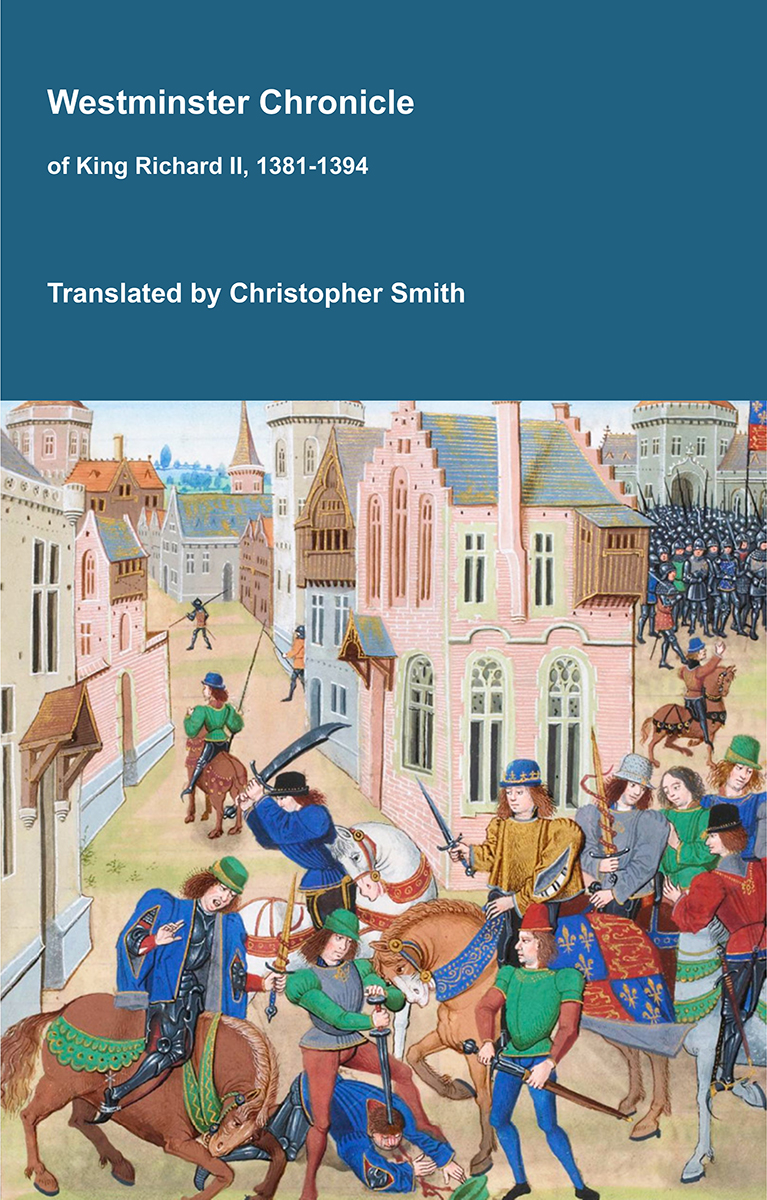 Westminster Chronicle. Thirdly, concerning a certain Carmelite friar1, who, driven by some spur of folly, came to the king’s court with the intention of accusing the duke of Lancaster, namely that the duke of Lancaster had deceitfully and treacherously plotted the king’s death. Therefore, after this friar had one day celebrated Mass before the king in the chamber of the earl of Oxford, and had obtained permission to say to the lord king whatever he wished, the aforesaid friar immediately attacked the duke of Lancaster on this matter, and proceeded so sharply that the king, without examination, would have ordered the aforesaid duke to be killed. But the other nobles standing by the lord king utterly denied that this should be done, asserting that it would be unjust for anyone to be condemned without judgement. When he had heard these things, the king, like a wise man, promised that for the time being he would act according to their counsel. Therefore, just as Sir John Clanvowe [aged 43]2 had predicted, the friar at once feigned madness, took off his cloak and his shoes, threw them out through the window, and in every way did the things that madmen do. The king further asked the often-mentioned friar whether anyone was aware of this matter, or whether he alone knew it. To this the friar replied, "Indeed, Lord Zouche3 has full knowledge of this matter, and I well know that I shall die for this cause." The king again said to him, "Take parchment for yourself4 and make two indentured bills containing everything you wish to allege against any person. Give one to me, and you shall keep the other with you, and then we shall know what we are to do in this matter." But the friar was in some confusion, because the duke of Lancaster would have to answer the charges laid against him. And so the king, seeing this, ordered him to be kept in custody in the meantime, until he should deliberate with his council what ought to be done with him.
Tertio de quodam fratre Carmelita qui quodam stimulo fatuitatis ductus ad curiam regis accessit ea intentione ut ducem Lancastriæ accusaret scilicet quod ipse dux Lancastriæ dolose et proditorie mortem regis machinatus est. Igitur postquam frater iste quadam die coram rege in camera comitis Oxoniæ missam celebrasset obtentaque licentia dicendi ea quæ sibi placuisset domino regi, super hujusmodi re frater prædiectus ducem Lancastriæ instanter impetiit et tam acriter processit quod rex sine examinatione ducem prædictum juberet occidi. Sed alii ncbiles domino regi astantes id fieri omnino negabant asserentes iniquum fore ut quispiam sine judicio condemnaretur. His quoque auditis rex velut sapiens secundum consilium eorum se protunc facturum promisit. Igitur, secundum quod dominus J. Clanvowe prædixerat, statim simulavit furorem exuit se capa sua et calciamentis suis eaque per fenestram ejiciebat ac ea quæ furiosi sunt ipse per omnia agebat. Et ulterius interrogavit sæpedictum fratrem an foret aliquis hujus rei conscius vel ipse solus novit. Ad quem frater respondit. "Immo dominus Le Souche plenam notitiam haberet hujus materiæ et bene cognosco me moriturum pro ista causa." Cui iterum ait rex, "Sume tibi parcamentum ac facias duas billas indentatas continentes omnia quæ volueris objicere contra aliquam personam et tradas mihi unam et alteram habebis penes te, et tunc sciemus quid super hujusmodi faciemus." Sed frater quodammodo confusus erat eo quod dux Lancastriæ ad objecta sibi imposita respondere deberet. Rex itaque hæc videns jussit eum interim custodiri donee deliberaret se cum suo consilio quid secum agere deberet.
Note 1. The Carmelite Friar who made accusations against John of Gaunt was John Latimer.
Note 2. John Clanvowe, around 1341-1391, was a Welsh knight, and a personal friend of Geoffrey Chaucer. He died in 1391 on a journey to Constantinople with William Neville, who died two days later. They were buried together in a joint tomb discovered in 1913 in Istanbul's Arap Mosque.
Note 3. William Zouche [aged 32], 1351-1396, 3rd Baron Zouche of Harringworth in Northamptonshire. Married 1. in or before 1365 Agnes Green sister of [his brother-in-law] Henry Green [aged 37] referred to in the note above, and 2. before 1396 Elizabeth Despencer.
Note 4. On the margin here is the note: "These two bills were afterwards drawn up according to what the said friar dictated while lying in his bed, and were produced and read aloud in full parliament. In them he confessed that Lord Zouche had fully known the whole matter of the said proclamation. Moreover, he affirmed in the aforesaid bills that the community of London and that of Coventry had also consented to the said proclamation."
4. On the margin here is the note: "Istæ duæ billæ postea secundum quod dictus frater jacendo in lecto suo dictavit fuerunt confectæ et in pleno parliamento adhibitæ et perlectæ. In quibus vero fatebatur ... sse dominum le Souche totam materiam dictæ prædicationis ad plenum scivisse. Insuper et affirmavit in billis prædictis communitatem Londoniæ et Coventrensem dictæ prædicationi etiam consensisse."
Before 1st August 1385 John Fitzalan Baron Maltravers 2nd Baron Arundel [aged 20] and [his future wife] Elizabeth Despencer Baroness Zouche, Harringworth, Maltravers and Arundel were married. She by marriage Baroness Maltravers, Baroness Arundel. They were half third cousins. He a great x 3 grandson of King Henry III of England. She a great x 3 granddaughter of King Edward I of England.
In 1391 [his wife] Agnes Greene Baroness Zouche Harringworth [aged 50] died.
On 18th October 1391 [his sister] Margery Zouche Baroness Willoughby of Eresby [aged 52] died.
Before 4th May 1396 William Zouche 3rd Baron Zouche Harringworth [aged 44] and Elizabeth Despencer Baroness Zouche, Harringworth, Maltravers and Arundel were married. She by marriage Baroness Zouche Harringworth. They were third cousin once removed. She a great x 3 granddaughter of King Edward I of England.
On 4th May 1396 William Zouche 3rd Baron Zouche Harringworth [aged 44] died. He was buried at Biddlesden Abbey, Buckinghamshire [Map]. His son William [aged 23] succeeded 4th Baron Zouche Harringworth.
On 11th April 1408 [his former wife] Elizabeth Despencer Baroness Zouche, Harringworth, Maltravers and Arundel died.
Westminster Chronicle. After this he began to grow gravely weak, and, with the spirit of consolation cast far away, he took care to taste neither food nor drink. At last, as the sickness grew stronger, caused by the rotting of the sinews and veins because of their excessive injury, as has been said before, and as the sting of death pressed upon him, after some days the aforesaid friar departed from this unstable light and rested in peace. Therefore, when the death of the aforesaid friar was made public, and after the report of his death had reached the ears of the duke of Lancaster, he did not look upon the aforesaid keeper of the castle with favourable eyes as he had before1. For while the friar was alive under his custody, he had been accustomed to confer with him more familiarly. But now, with his expression changed, he strove to lay upon him the cause of the friar’s death2 and the blame for it, under this pretext, however, that those who had given the cause of death might appear wholly free from his killing. For they said that he had by no means died because of the things which they had inflicted on him, but rather that he had to die and depart because of the prison punishments which he continually endured under the keeper’s custody.
Post hoc vero cœpit graviter languescere, et spiritu consolätionis procul abjecto neque cibum neque potum gustare curavit. Tandem invalescente infirmitate causante putrefactione nervorum et venarum ob nimiam læsionem eorundem ut præmittitur ; at urgente mortis stimulo post aliquot dies frater prædictus ab hac instabili luce migravit et in pace quievit. Igitur publicata morte supradicti fratris postquam ad aures ducis Lancastriæ fama de ejus morte pervenit non rectis oculis prædictum castri custodem aspexit sicut anteaNam fratre vivente sub ejus custodia familiarius seeum conferre solebat. Sed nune mutata facie causam mortis suæ? et culpam sibi imponere contendebat sub isto tamen colore ut illi qui causam mortis dederunt immunes ab ejus nece penitus viderentur, quia dixerunt illum nequaquam mori propter illa quæ sibi intulerunt, sed potius propter carcerales pœnas quas sub ejus custodia jugiter sustinuit illum obire et decedere oportebat.
Note 1. In margin here is: "This account is true according to some. Others, however, affirm the contrary, asserting that the duke of Lancaster would more willingly have wished the life of the aforesaid friar to be preserved."
1. In margin here is: "Vera est ista litera seeundum quosdam. Alii vero contrarium affirmant asserentes ducem Lancastriæ vitam fratris prædieti habere salvam libentius voluisse."
Note 2. At the foot of p. 143 is the following passage: "And there came with Lord Zouche to the aforesaid friar six knights of the lord king, three knights of the duke of Lancaster, and three knights from parliament, who, before the king and the whole parliament, set forth the friar’s words as though acting as reporters. They asserted that he had openly said that, by the prompting of the devil, he had proclaimed such things against the aforesaid lords. For this reason, in full parliament, at the petition of Lord Zouche, with the duke of Lancaster especially favouring this, it was enacted by the assent of all the nobles then present there that such accusers of lords, unless they justly and legally proved the things which they had charged against them, should incur without delay the penalty of drawing and hanging."
2. At the foot of p. 143 is the following passage: "Veneruntque cum domino le Souche ad fratrem præfatum sex milites domini regis, tres milites ducis Lancastriæ, et, tres milites de parliamento qui coram rege et toto parliamento dicta fratris quasi referendarii proponebant, asserentes ipsum palam dixisse quod suggestione diabolica talia contra præfatos dominos prædicavit. Propter quod in pleno parliamento ad petitionem domini le Souche, favente ad hoc potissime duce Lancastriæ, statutum fuit assensu omnium procerum tunc ibidem existentium, quod tales dominorum delatores nisi juste et juridice ea probaverunt quæ eis objecerunt pœnam tractionis et suspensionis incurrerent indilate."
Westminster Chronicle. Yet the aforesaid things by no means sufficed them. They then laid him down at their feet and violently made his feet and legs, up to the knees, lie for a long time in the fire. For Sir W. Elmham sat so heavily upon the loins of the aforesaid friar that all power of drawing his feet back from the fire was taken from him. For this reason, from the burning and scorching of the fire, many charred cracks appeared in his feet and legs, visible to all who looked on, until the day of his burial. At last they forced him to lie on his back, and into his mouth, covered with linen, they poured warm water to the measure of three gallons and more, often warning him amid these things to confess who it was who had procured him to bring forward such great and such serious charges against so great a lord. But he, afflicted and worn down by injuries and torments in many ways, did not care to answer their questions. For those knights thought that the aforesaid friar had been suborned by some great man, and therefore they forced him to undergo such punishments or tortures, so that at least, at some point, through fear of pain, he might reveal him more quickly to them. But they laboured in vain. Therefore, as the shadow of night approached, the keeper of the aforesaid castle, according to what had first been commanded him, took the aforesaid friar, placed light shackles upon him, and, fearing that perhaps he might use some contrivance, shut him up in a secure but honourable place within the aforesaid castle. And as far as he could, he supplied him that night most abundantly with food, drink, and bedding. For the king, after the aforesaid friar had been removed from his sight, immediately sent for Lord Zouche, so that, all other matters put aside, he should come to him at once. When Zouche heard the message, without drawing out any delay, although he was burdened by some illness, he at once prepared himself for the journey and within a few days came to the king. The duke of Lancaster, hearing that he had been gravely accused before the lord king, quickly went to him and splendidly excused him from this infamy, so that the king afterwards held him excused. Lord Zouche also came to him and rejected the words of the aforesaid friar, saying that he had never in any way known of such a proclamation, and he offered to prove this by duel against anyone who wished to contradict him. What more? He pressed the matter then with such urgency before the king and the other lords present that he was wholly absolved from this accusation.
Præmissa tamen eis minime sufficiebant sed quid deposuerunt eum tunc ad pedes suos et tibias usque ad genua diu in igne violenter jacere fecerunt. Nam dominus W. Elmham tam ponderose super lumbos prædicti fratris sedebat quod vis retrahendi pedes suos ab igne penitus ab eo erat ablata. Qua de causa ex ignis adustione et incendio plures rimæ torridæ inejus pedibus et tibiis usque in diem suæ sepulturæ cunctis intuentibus apparebant. Ad ultimum vero cogebant eum super ejus dorsum jacere et in os suum opertum lintheo fundebant aquam calidam ad mensuram trium lagenarum et amplius monentes eum sæpius inter ista ut fateretur quisnam esset ille qui illum adversus tam magnum dominum tanta et talia proponere procuravit. Sed ille injuriis et tormentis afflictus multipliciter et attritus ad illorum interrogata respondere non curavit. Putabant enim isti milites prædictum fratrem ab aliquo magno fore subornatum et ideo ipsum talia supplicia sive cruciatus subire cogebant, ut saltem aliquando metu pœnæ ipsum eis citius revelaret. Sed supervacue laborabant. Igitur appropinquante noctis umbraculo custos castri prædicti, secundum quod sibi erat primitus imperatum, accepit fratrem prædictum et leves compedes super eum posuit et timens ne forsan experimentis uteretur in tuto loco tamen castri prædicti honesto ipsum reclusit ; et ei quantum licuit in esculentis poculentis et lectisterniis nocte illa abundantissime ministravit. Rex namque postquam prædictus frater a suis conspectibus esset subtractus incontinenti misit pro domino le Souche ut ceteris postpositis ilico veniret ad eum. Qui audito nuncio nulla mora protracta licet aliquali infirmitate esset gravatus statim accinxit se ad iter et infra paucos dies pervenit ad regem. Dux itaque Lancastriæ audiens ipsum fore penes dominum regem graviter accusatum celeriter accessit ad eum et ipsum super hujusmodi infamia splendide excusavit ; sic quod rex ipsum postmodum pro excusato habebat. Supervenit etiam ad eum dominus le Souche et dicta prædicti fratris reprobravit, dicens se nullatenus de tali prædicatione unquam scivisse et hoc obtulit se duello probare contra quemlibet sibi contradicere volentem. Quid plura? Tanta enim instantia penes regem et alios dominus tunc præsentes instetit, quod ab hujusmodi impetitione totaliter extitit absolutus.
Chronicle of Walter of Guisborough
A canon regular of the Augustinian Guisborough Priory, Yorkshire, formerly known as The Chronicle of Walter of Hemingburgh, describes the period from 1066 to 1346. Before 1274 the Chronicle is based on other works. Thereafter, the Chronicle is original, and a remarkable source for the events of the time. This book provides a translation of the Chronicle from that date. The Latin source for our translation is the 1849 work edited by Hans Claude Hamilton. Hamilton, in his preface, says: 'In the present work we behold perhaps one of the finest samples of our early chronicles, both as regards the value of the events recorded, and the correctness with which they are detailed; Nor will the pleasing style of composition be lightly passed over by those capable of seeing reflected from it the tokens of a vigorous and cultivated mind, and a favourable specimen of the learning and taste of the age in which it was framed.'
Available at Amazon in eBook and Paperback format.
Westminster Chronicle. When the space of the night had therefore passed and morning had come, the aforesaid keeper of the castle went to the place where the aforesaid friar was lying, and found him oppressed by grave illness. For the veins and sinews of his virile member had begun to rot inwardly, and his whole body was so shattered by various torments that he could not be moved without great pain. Therefore the aforesaid keeper, moved by mercy, had him brought to a more elevated place, removed his shackles, and there prepared for him a sufficiently decent bed, and provided adequately for the other things necessary to him. For the aforesaid friar had heard of the arrival of Lord Zouche. He called the keeper of the castle to him and said to him: "For the love of God and of the Blessed Virgin Mary, I ask you to do this one thing for me, please, and you shall have one hundred shillings faithfully paid to you on this condition: arrange diligently that I may have secret conversation with Lord Zouche for some time, and without doubt you shall have what I have promised." The keeper said to him: "I shall see whether I can fulfil your desire." And leaving him, he came to the king’s court. As he was going towards the court, he thought within himself that danger might easily threaten from such a thing, if it were done without the knowledge of the lord king. Therefore he went to the steward and chamberlain of the lord king, and disclosed the whole matter to them in order. They went to the king and reported to him the things which they had heard from the aforesaid keeper, while he was meanwhile present in person. The king asked him how the friar was. For he did not know that the friar had been subjected to such very grievous tortures. But after he had learnt how matters stood with him, he drew anxious groans from the depths of his breast with sighing. At last, however, the king granted that the friar should enjoy conversation with the aforesaid Lord Zouche, under this condition, that some of his own men, in whom he placed great trust, sitting in the windows or in other nearby places, might be able to hear the things which he wished to report to him on that side. Without delay Lord Zouche came to the often-mentioned friar, with certain secretaries of the lord king accompanying him. They stood near him and earnestly asked him whether he knew anything other than good of the aforesaid Lord Zouche. He said to them: "I know him to be a worthy and faithful lord, for indeed I know nothing to say of him except good." Soon, looking at the keeper of the castle, he said in Latin: "Did I not tell you, and so on?" By this he meant that, if he had been able to have private conversation with the aforesaid lord, he would have given the same keeper one hundred shillings.
Decurso igitur noctis spatio facto mane præfatus castri custos perrexit ad locum ubi frater prædictus jacebat et invenit eum gravi infirmitate oppressum. Nam venæ et nervi ejus virilis virgæ cœperunt introrsus putrescere ac corpus ejus totum ita erat diversis suppliciis conquassatum quod eum sine magna pœna movere non posset. Unde custos prælibatus misericordia motus ipsum in eminentiorem locum fecit adduci, compedes suos deposuit et ibi pro eo stravit lectum satis honestum, atque alia sibi necessaria sufficienter providit. Audivit namque frater prædietus de adventu domini le Souche, vocavit ad se custodem castri et dixit ei: "Amore Dei et beatæ Virginis Mariæ hoc unum rogo facias pro me, si placet, et habebis C. solidos tibi eo pacto fideliter persolutos ; procures cum diligentia quod cum domino le Souche possem habere secretum colloquium per aliquod tempus et habebis sine dubio quod promisi." Cui custos: "Temptabo si possem implere desiderium tuum." Et discedens ab eo venit ad curiam regis. Ac eundo versus curiam cogitabat inter se quod de hujusmodi possit de facili imminere perieulum, si hoc esset factum absque scientia domini regis. Igitur accessit ad seneschallum et camerarium domini regis et eis negotium ex ordine totum pandit. Qui accedentes ad regem et eidem retulerunt ea quæ a præfato custode audierunt eo interim præsentialiter existente. Rex vero quæsivit ab eo qualiter frater se habuit; nesciebat enim quod talibus gravissimis quæstionibus fuisset expositus. Sed postquam scivisset quomodo stetit cum eo anxiosos gemitus pectoris ab imo suspirando eduxit. Demum tamen concessit rex ut frater ille cum præfato domino le Souche colloquio frueretur, sub ista tamen forma, quod aliqui ex suis, in quibus multum confidebat, in fenestris vel aliis locis propinquis residentes possent audire ea quæ sibi voluerit ea parte referre. Nec mora, venit ad sæpedictum fratrem dominus le Souche et quidam secretarii domini regis cum eo, qui steterunt juxta eum et inquirentes ab eo instanter an aliud quam bonum scivisset de prædicto domino le Souche. Quibus ipse dixit. "Scio ipsum esse valentem dominum et fidelem, nam profecto aliud quam bonum nescio de illo proferre." Mox respiciens custodem castri dixit Latine: "Nonne dixi tibi et cetera:" innuens per hoc quod si cum prædicto domino in secreto potuisset colloquium habuisse C. solidos eidem dedisset.
Kings Wessex: Great x 10 Grand Son of King Edmund "Ironside" I of England
Kings Gwynedd: Great x 11 Grand Son of Maredudd ab Owain King Deheubarth King Powys King Gwynedd
Kings Seisyllwg: Great x 13 Grand Son of Hywel "Dda aka Good" King Seisyllwg King Deheubarth
Kings Powys: Great x 11 Grand Son of Maredudd ab Owain King Deheubarth King Powys King Gwynedd
Kings England: Great x 6 Grand Son of King Henry "Curtmantle" II of England
Kings Scotland: Great x 5 Grand Son of King William I of Scotland
Kings France: Great x 11 Grand Son of Hugh I King of the Franks
Kings Duke Aquitaine: Great x 15 Grand Son of Ranulf I Duke Aquitaine
Great x 4 Grandfather: Alain Zouche 
Great x 3 Grandfather: Roger Zouche
Great x 4 Grandmother: Adelicia Belmeis
Great x 2 Grandfather: Eudo Zouche
Great x 3 Grandmother: Margaret Bisset
Great x 1 Grandfather: William Zouche 1st Baron Zouche Harringworth 9 x Great Grandson of Hugh I King of the Franks
Great x 4 Grandfather: William Cantilupe 
Great x 3 Grandfather: William Cantilupe
Great x 2 Grandmother: Millicent Cantilupe 8 x Great Granddaughter of Hugh I King of the Franks
Great x 4 Grandfather: William de Braose 9th Baron Abergavenny 7th Baron Bramber  7 x Great Grandson of Maredudd ab Owain King Deheubarth King Powys King Gwynedd
Great x 3 Grandmother: Eva de Braose 7 x Great Granddaughter of Hugh I King of the Franks
Great x 4 Grandmother: Eva Marshal  6 x Great Granddaughter of Hugh I King of the Franks
Grandfather: Eudo Zouche 4 x Great Grandson of King William I of Scotland
Great x 4 Grandfather: John Lovell 
Great x 3 Grandfather: John Lovell 3 x Great Grandson of King Henry I "Beauclerc" England
Great x 4 Grandmother: Catherine Basset  2 x Great Granddaughter of King Henry I "Beauclerc" England
Great x 2 Grandfather: John Lovell 1st Baron Lovel 4 x Great Grandson of King Henry I "Beauclerc" England
Great x 4 Grandfather: William Sydenham
Great x 3 Grandmother: Maud Sydenham
Great x 1 Grandmother: Maud Lovell Baroness Zouche Harringworth 3 x Great Granddaughter of King William I of Scotland
Great x 4 Grandfather: William Ros  Grandson of King William I of Scotland
Great x 3 Grandfather: Robert Ros Great Grandson of King William I of Scotland
Great x 4 Grandmother: Lucy Fitzpiers
Great x 2 Grandmother: Joan Ros Baroness Lovel 2 x Great Granddaughter of King William I of Scotland
Great x 4 Grandfather: William de Albini 10 x Great Grandson of King Edward "Elder" of the Anglo Saxons
Great x 3 Grandmother: Isabel de Albini 11 x Great Granddaughter of King Edward "Elder" of the Anglo Saxons
Father: William Zouche 2nd Baron Zouche Harringworth 5 x Great Grandson of King William I of Scotland
William Zouche 3rd Baron Zouche Harringworth 5 x Great Grandson of King William I of Scotland
Great x 4 Grandfather: Robert Ros
Great x 3 Grandfather: William Ros Grandson of King William I of Scotland
Great x 4 Grandmother: Isabella Mac William Dunkeld  daughter of King William I of Scotland
Great x 2 Grandfather: Robert Ros Great Grandson of King William I of Scotland
Great x 4 Grandfather: Piers Fitzherbert 
Great x 3 Grandmother: Lucy Fitzpiers
Great x 1 Grandfather: William Ros 1st Baron Ros Helmsley 2 x Great Grandson of King William I of Scotland
Great x 4 Grandfather: William de Albini 9 x Great Grandson of King Edward "Elder" of the Anglo Saxons
Great x 3 Grandfather: William de Albini 10 x Great Grandson of King Edward "Elder" of the Anglo Saxons
Great x 4 Grandmother: Agatha Trusbut
Great x 2 Grandmother: Isabel de Albini 11 x Great Granddaughter of King Edward "Elder" of the Anglo Saxons
Grandfather: William Ros 2nd Baron Ros Helmsley 3 x Great Grandson of King William I of Scotland
Great x 3 Grandfather: Oliver Vaux 
Great x 2 Grandfather: John Vaux
Great x 1 Grandmother: Maud Vaux Baroness Ros
Mother: Elizabeth Ros Baroness Zouche Harringworth 4 x Great Granddaughter of King William I of Scotland
Great x 2 Grandfather: Gunselin Badlesmere 
Great x 1 Grandfather: Bartholomew Badlesmere 1st Baron Badlesmere
Great x 2 Grandmother: Joan Fitzbernard
Grandmother: Margery Badlesmere Baroness Ros of Helmsley 4 x Great Granddaughter of King Henry "Curtmantle" II of England
Great x 4 Grandfather: Gilbert Clare 5th Earl Gloucester 4th Earl Hertford  2 x Great Grandson of King Henry I "Beauclerc" England
Great x 3 Grandfather: Richard de Clare 6th Earl Gloucester 5th Earl Hertford 3 x Great Grandson of King Henry I "Beauclerc" England
Great x 4 Grandmother: Isabel Marshal Countess Cornwall, Gloucester and Hertford 6 x Great Granddaughter of Hugh I King of the Franks
Great x 2 Grandfather: Thomas de Clare 4 x Great Grandson of King Henry I "Beauclerc" England
Great x 4 Grandfather: John Lacy Earl Lincoln  10 x Great Grandson of King Edward "Elder" of the Anglo Saxons
Great x 3 Grandmother: Maud Lacy Countess Gloucester and Hertford 4 x Great Granddaughter of King Henry I "Beauclerc" England
Great x 4 Grandmother: Margaret Quincy 3rd Countess Lincoln and Pembroke 3 x Great Granddaughter of King Henry I "Beauclerc" England
Great x 1 Grandmother: Margaret Clare Baroness Badlesmere 3 x Great Granddaughter of King Henry "Curtmantle" II of England
Great x 4 Grandfather: Maurice Fitzgerald 2nd Lord Offaly  5 x Great Grandson of Maredudd ab Owain King Deheubarth King Powys King Gwynedd
Great x 3 Grandfather: Maurice Fitzgerald 4th Lord Offaly 6 x Great Grandson of Maredudd ab Owain King Deheubarth King Powys King Gwynedd
Great x 4 Grandmother: Juliana Granville Baroness Offaly 
Great x 2 Grandmother: Juliana Fitzgerald 2 x Great Granddaughter of King Henry "Curtmantle" II of England
Great x 4 Grandfather: Stephen Longespée  Grandson of King Henry "Curtmantle" II of England
Great x 3 Grandmother: Emmeline Longespée Baroness Offaly Great Granddaughter of King Henry "Curtmantle" II of England
Great x 4 Grandmother: Emmeline Riddlesford