

Paternal Family Tree: Fortescue
On 8th July 1752 [his father] Matthew Fortescue 2nd Baron Fortescue [aged 33] and [his mother] Anne Campbell Baroness Fortescue [aged 24] were married. She by marriage Baroness Fortescue of Castle Hill.
On 12th March 1753 Hugh Fortescue 1st Earl Fortescue was born to Matthew Fortescue 2nd Baron Fortescue [aged 34] and Anne Campbell Baroness Fortescue [aged 25].
On 10th May 1782 Hugh Fortescue 1st Earl Fortescue [aged 29] and Hester Granville Countess Fortescue [aged 16] were married.
On 13th February 1783 [his son] Hugh Fortescue 2nd Earl Fortescue was born to Hugh Fortescue 1st Earl Fortescue [aged 29] and [his wife] Hester Granville Countess Fortescue [aged 17]. He married 1. 4th July 1817 his fourth cousin Susan Ryder, daughter of Dudley Ryder 1st Earl of Harrowby and Susanna Leveson-Gower Countess Harrowby Lincolnshire, and had issue 2. 1841 Elizabeth Geale Countess Fortescue.
In 1784 Hugh Fortescue 1st Earl Fortescue [aged 30] was elected MP Beaumaris.

In December 1784 [his brother-in-law] George Nugent Temple Grenville 1st Marquess Buckingham [aged 31] was created 1st Marquess Buckingham.
In 1785 [his father] Matthew Fortescue 2nd Baron Fortescue [aged 66] died. His son Hugh Fortescue [aged 31] succeeded 3rd Baron Fortescue of Castle Hill.
On 30th August 1786 [his daughter] Catherine Fortescue Countess Portsmouth was born to Hugh Fortescue 1st Earl Fortescue [aged 33] and [his wife] Hester Granville Countess Fortescue [aged 20]. She married 24th June 1820 her sixth cousin Newton Wallop aka Fellowes 4th Earl of Portsmouth, son of John Wallop 2nd Earl Portsmouth and Urania Fellowes, and had issue.
On 13th October 1788 Robert Nugent 1st Earl Nugent [aged 79] died. [his brother-in-law] George Nugent Temple Grenville 1st Marquess Buckingham [aged 35] succeeded 2nd Earl Nugent. Viscount Clare, Baron Nugent extinct.
The London Gazette 13123. Whitehall, August 18 [1789].
The King has been pleased to grant the Dignity of a Marquess of the Kingdom of Great Britain to the Right Honourable James Earl of Salisbury [aged 40], and the Heirs Male of his Body lawfully begotten, by the Name, Stile and Title of Marquess of Salisbury, in the County of Wilts. [Mary Amelia Hill Marchioness Salisbury [aged 39] by marriage Marchioness Salisbury in Wiltshire.]
The King has also been pleased to grant the Dignity of a Marquess of the Kingdom of Great Britain to the Right Honourable Thomas Viscount Weymouth [aged 54], Knight of the Most Noble Order of the Garter, and the Heirs Male of his body lawfully begotten, by the Name, Stile and Title of Marquess of Bath, in the County of Somerset. [Elizabeth Bentinck Marchioness Bath [aged 54] by marriage Marchioness of Bath.]
The King has been pleased to grant the Dignity of an Earl of this Kingdom of Great Britain to the Right Honourable George Viscount Mount-Edgcumbe and Valletort [aged 69], and the Heirs Male of liis Body lawfully begotten, by the Name, Stile and Title of Earl of Mount-Edgcumbe. [Emma Gilbert Countess Mount Edgcumbe by marriage Countess of Mount Edgcumbe.]
The King has been pleased to grant the Dignities of Viscount and Earl of the Kingdom of Great Britain to the Right Honourable Hugh Lord Fortescue [aged 36], and the Heirs Male of his Body lawfully begotten, by the Name, Stile and Title of 1stViscount Ebrington, of Ebrington in the County of Gloucester, and Earl Fortescue. [[his wife] Hester Granville Countess Fortescue [aged 23] by marriage Countess Fortescue.]
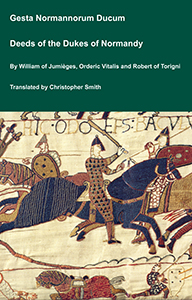
The Deeds of the Dukes of Normandy
The Gesta Normannorum Ducum [The Deeds of the Dukes of Normandy] is a landmark medieval chronicle tracing the rise and fall of the Norman dynasty from its early roots through the pivotal events surrounding the Norman Conquest of England. Originally penned in Latin by the monk William of Jumièges shortly before 1060 and later expanded at the behest of William the Conqueror, the work chronicles the deeds, politics, battles, and leadership of the Norman dukes, especially William’s own claim to the English throne. The narrative combines earlier historical sources with firsthand information and oral testimony to present an authoritative account of Normandy’s transformation from a Viking settlement into one of medieval Europe’s most powerful realms. William’s history emphasizes the legitimacy, military prowess, and governance of the Norman line, framing their expansion, including the conquest of England, as both divinely sanctioned and noble in purpose. Later chroniclers such as Orderic Vitalis and Robert of Torigni continued the history, extending the coverage into the 12th century, providing broader context on ducal rule and its impact. Today this classic work remains a foundational source for understanding Norman identity, medieval statesmanship, and the historical forces that reshaped England and Western Europe between 800AD and 1100AD.
Available at Amazon in eBook and Paperback format.
In 1791 [his son] George Matthew Fortescue was born to Hugh Fortescue 1st Earl Fortescue [aged 37] and [his wife] Hester Granville Countess Fortescue [aged 25]. He married 1877 his fourth cousin Louisa Ryder, daughter of Dudley Ryder 1st Earl of Harrowby and Susanna Leveson-Gower Countess Harrowby Lincolnshire.
On 15th September 1792 [his daughter] Mary Fortescue was born to Hugh Fortescue 1st Earl Fortescue [aged 39] and [his wife] Hester Granville Countess Fortescue [aged 26]. She married in or before 1824 James Hamlyn-Williams 3rd Baronet, son of James Hamlyn-Williams 2nd Baronet and Diana Anne Whitaker, and had issue.
In 1796 [his son] John Fortescue was born to Hugh Fortescue 1st Earl Fortescue [aged 42] and [his wife] Hester Granville Countess Fortescue [aged 30].
In 1798 [his daughter] Eleanor Fortescue was born to Hugh Fortescue 1st Earl Fortescue [aged 44] and [his wife] Hester Granville Countess Fortescue [aged 32].
On 10th July 1801 [his daughter] Elizabeth Fortescue Countess Devon was born to Hugh Fortescue 1st Earl Fortescue [aged 48] and [his wife] Hester Granville Countess Fortescue [aged 35]. She married 1830 her sixth cousin William Courtenay 11th Earl Devon, son of William Courtenay 10th Earl Devon and Henrietta Leslie Pepys Countess Devon, and had issue.

On 26th May 1804 [his son-in-law] Peter King 7th Baron King [aged 27] and Hester Fortescue Baroness King were married. She the daughter of Hugh Fortescue 1st Earl Fortescue [aged 51] and Hester Granville Countess Fortescue [aged 38].
On 26th May 1812 [his mother] Anne Campbell Baroness Fortescue [aged 84] died.
On 11th February 1813 [his brother-in-law] George Nugent Temple Grenville 1st Marquess Buckingham [aged 59] died. His son Richard [aged 36] succeeded 2nd Marquess Buckingham, 4th Earl Temple, 3rd Earl Nugent, 5th Viscount Cobham. Anne Elizabeth Brydges Duchess Buckingham and Chandos [aged 34] by marriage Marchioness Buckingham.
On 4th July 1817 Hugh Fortescue 2nd Earl Fortescue [aged 34] and Susan Ryder [aged 21] were married. She the daughter of Dudley Ryder 1st Earl of Harrowby [aged 54] and Susanna Leveson-Gower Countess Harrowby Lincolnshire [aged 44]. He the son of Hugh Fortescue 1st Earl Fortescue [aged 64] and Hester Granville Countess Fortescue [aged 51]. They were fourth cousins.
On 24th June 1820 [his son-in-law] Newton Wallop aka Fellowes 4th Earl of Portsmouth [aged 47] and Catherine Fortescue Countess Portsmouth [aged 33] were married. She the daughter of Hugh Fortescue 1st Earl Fortescue [aged 67] and Hester Granville Countess Fortescue [aged 54]. He the son of John Wallop 2nd Earl Portsmouth and Urania Fellowes. They were sixth cousins.
Abbot John Whethamstede’s Chronicle of the Abbey of St Albans
Abbot John Whethamstede's Register aka Chronicle of his second term at the Abbey of St Albans, 1451-1461, is a remarkable text that describes his first-hand experience of the beginning of the Wars of the Roses including the First and Second Battles of St Albans, 1455 and 1461, respectively, their cause, and their consequences, not least on the Abbey itself. His text also includes Loveday, Blore Heath, Northampton, the Act of Accord, Wakefield, and Towton, and ends with the Coronation of King Edward IV. In addition to the events of the Wars of the Roses, Abbot John, or his scribes who wrote the Chronicle, include details in the life of the Abbey such as charters, letters, land exchanges, visits by legates, and disputes, which provide a rich insight into the day-to-day life of the Abbey, and the challenges faced by its Abbot.
Available at Amazon in eBook and Paperback format.
In or before 1824 [his son-in-law] James Hamlyn-Williams 3rd Baronet [aged 33] and Mary Fortescue [aged 31] were married. She the daughter of Hugh Fortescue 1st Earl Fortescue [aged 70] and Hester Granville Countess Fortescue [aged 58].
In 1830 [his son-in-law] William Courtenay 11th Earl Devon [aged 22] and Elizabeth Fortescue Countess Devon [aged 28] were married. She the daughter of Hugh Fortescue 1st Earl Fortescue [aged 76] and Hester Granville Countess Fortescue [aged 64]. He the son of William Courtenay 10th Earl Devon [aged 52] and Henrietta Leslie Pepys Countess Devon [aged 52]. They were sixth cousins.
Greville Memoirs. 22nd September 1831. The night before last Croker and Macaulay made two fine speeches on Reform; the former spoke for two hours and a half, and in a way he had never done before. Macaulay was very brilliant. There was a meeting at Lord Ebrington's [aged 78] yesterday, called by him, Lyttelton Lawley, and of members of the House of Commons only, and they (without coming to any resolution) were all agreed to prevail on the Government not to resign in the event of the Reform Bill being rejected in the House of Lords. I have no doubt, therefore, in spite of what Lord Grey said, and the other circumstances I have mentioned above, that they will not resign, and I doubt whether there will be any occasion for it.
Greville Memoirs. 24th September 1831. Paris, on the point of exploding, is again tranquil, but nobody can tell for how long. They bet two to one here that the Reform Bill is thrown out on the second reading; and what then? The meeting at Ebrington's [aged 78] was flat, nothing agreed on. Hume wanted to pass some violent resolution, but was overruled. Milton made a foolish speech, with prospective menaces and present nothingness in it, and they separated without having done good or harm.
Greville Memoirs. 10th October 1831. Riddlesworth. At Newmarket all last week; all the Peers absent; here since Friday. Yesterday morning the newspapers (all in black1) announced the defeat of the Reform Bill by a majority of forty-one, at seven o'clock on Saturday morning, after five nights' debating. By all accounts the debate was a magnificent display, and incomparably superior to that in the House of Commons, but the reports convey no idea of it. The great speakers on either side were:—Lords Grey, Lansdowne, Goderich, Plunket, and the Chancellor, for the Bill; against it, Lords Wharncliffe (who moved the amendment), Harrowby, Carnarvon, Dudley, Wynford, and Lyndhurst. The Duke of Wellington's speech was exceedingly bad; he is in fact, and has proved it in repeated instances, unequal to argue a great constitutional question. He has neither the command of language, the power of reasoning, nor the knowledge requisite for such an effort. Lord Harrowby's speech was amazingly fine, and delivered with great effect; and the last night the Chancellor is said to have surpassed all his former exploits, Lyndhurst to have been nearly as good, and Lord Grey very great in reply. There was no excitement in London the following day, and nothing particular happened but the Chancellor being drawn from Downing Street to Berkeley Square in his carriage by a very poor mob. The majority was much greater than anybody expected, and it is to be hoped may be productive of good by showing the necessity of a compromise; for no Minister can make sixty Peers, which Lord Grey must do to carry this Bill; it would be to create another House of Lords. Nobody knows what the Ministers would do, but it was thought they would not resign. A meeting of members of the House of Commons was held under the auspices of Ebrington [aged 78] to agree upon a resolution of confidence in the Government this day. The majority and the magnificent display of eloquence and ability in the House of Lords must exalt the character and dignity of that House, and I hope increase its efficacy for good purposes and for resistance to this Bill. It may be hoped, too, that the apathy of the capital may have some effect in the country, though the unions, which are so well disciplined and under the control of their orators, will make a stir. On the whole I rejoice at this result, though I had taken fright before, and thought it better the Bill should be read a second time than be thrown out by a very small majority.
Note 1. Not all of them; neither the 'Times' nor the 'Morning Herald.'
Greville Memoirs. 12th October 1831. The Reformers appear to have rallied their spirits. Lord Grey went to Windsor, was graciously received by the King, and obtained the dismissal of Lord Howe, which will serve to show the King's entire good-will to his present Ministers. Ebrington's [aged 78] resolution of confidence was carried by a great majority in the House of Commons after some violent speeches from Macaulay, Sheil, and O'Connell, and very moderate ones and in a low tone on the other side. Macaulay's speech was as usual very eloquent, but as inflammatory as possible. Such men as these three can care nothing into what state of confusion the country is thrown, for all they want is a market to which they may bring their talents;2 but how the Miltons, Tavistocks, Althorps, and all who have a great stake in the country can run the same course is more than I can conceive or comprehend. Party is indeed, as Swift says, 'the madness of many,' when carried to its present pitch. In the meantime the Conservative party are as usual committing blunders, which will be fatal to them. Lord Harrowby was to have moved yesterday or the day before, in the House of Lords, a resolution pledging the House to take into consideration early in the next session the acknowledged defects in the representation, with a view to make such ameliorations in it as might be consistent with the Constitution, or something to this effect. This has not been done because the Duke of Wellington objects. He will not concur because he thinks the proposition should come from Government; as if this was a time to stand upon such punctilios, and that it was not of paramount importance to show the country that the Peers are not obstinately bent upon opposing all Reform. I had hoped that he had profited by experience, and that at least his past errors in politics might have taught him a little modesty, and that he would not have thwarted measures which were proposed by the wisest and most disinterested of his own party. I can conceive no greater misfortune at this moment than such a disunion of that party, and to have its deliberations ruled by the obstinacy and prejudices of the Duke. He is a great man in little things, but a little man in great matters—I mean in civil affairs; in those mighty questions which embrace enormous and various interests and considerations, and to comprehend which great knowledge of human nature, great sagacity, coolness, and impartiality are required, he is not fit to govern and direct. His mind has not been sufficiently disciplined, nor saturated with knowledge and matured by reflection and communication with other minds, to enable him to be a safe and efficient leader in such times as these.
Note 2. This was very unjust to Macaulay, and not true as to Sheil; to O'Connell alone applicable.
[In reading over these remarks upon the Duke of Wellington, and comparing them with the opinions I now entertain of his present conduct, and of the nature and quality of his mind, I am compelled to ask myself whether I did not then do him injustice. On the whole I think not. He is not, nor ever was, a little man in anything, great or small; but I am satisfied that he has made great political blunders, though with the best and most patriotic intentions, and that his conduct throughout the Reform contest was one of the greatest and most unfortunate of them.—July 1838.]
Greville Memoirs. 24th February 1832. In the evening went to Lord Holland's, when he and she asked me about the letter. Somebody had given abstracts of it, with the object of proving to Lord Grey that Harrowby had been uncandid, or something like it, and had held out to the Tories that if they would adopt his line they would turn out the Government. Holland and the rest fancied the letter had been written since the interview, but I told them it was three weeks before, and I endeavoured to explain that the abstracts must be taken in connection not only with the rest of the text, but with the argument. Holland said Lord Grey meant to ask Harrowby for the letter. From thence I went to Harrowby, and told him this. He said he would not show it, that Grey had no right to ask for a private letter written by him weeks before to one of his friends, and it was beneath him to answer for and explain anything he had thought fit to say. But he has done what will probably answer as well, for he has given Ebrington [aged 78] a copy of it for the express purpose of going to Lord Grey and explaining anything that appears ambiguous to him. As the business develops itself, and the time approaches, communication becomes more open and frequent; the Tories talk with great confidence of their majority, and the ultra-Whigs are quite ready to believe them; the two extreme ends are furious. Our list up to this day presents a result of forty-three votes to thirty-seven doubtful, out of which it is hard if a majority cannot be got. I have no doubt now that they will take a very early opportunity of making a declaration. Peel, in the other House, is doing what he can to inflame and divide, and repress any spirit of conciliation. Nothing is sure in his policy but that it revolves round himself as the centre, and is influenced by some view which he takes of his own future advantage, probably the rallying of the Conservative party (as they call themselves, though they are throwing away everything into confusion and sinking everything by their obstinacy) and his being at the head of it. He made a most furious and mischievous speech.
Greville Memoirs. 29th February 1832. Ebrington [aged 78] took Harrowby's letter to Lord Grey, who was satisfied but not pleased; the date and the circumstances (which were explained) removed all bad impressions from his mind. Since this a garbled version (or rather extracts) has appeared in the 'Times,' which endeavours to make a great stir about it. Harrowby was very much annoyed, and thought of sending the letter itself to the 'Times' to be published at once; but Haddington and I both urged him not, and last night he put a contradiction in the 'Globe.' I have little doubt that this as well as the former extracts came from the shop of Durham and Co., and so Melbourne told me he thought likewise. There was a great breeze at the last Cabinet dinner between Durham and Richmond again on the old subject—the Peers. I believe they will now take their chance. Our list presents forty-seven sure votes besides the doubtful, but not many pledges. As to me, I am really puzzled what to wish for—that is, for the success of which party, being equally disgusted with the folly of both. My old aversion for the High Tories returns when I see their conduct on this occasion. The obstinacy of the Duke, the selfishness of Peel, the pert vulgarity of Croker, and the incapacity of the rest are set in constant juxtaposition with the goodness of the cause they are now defending, but which they will mar by their way of defending it. A man is wanting, a fresh man, with vigour enough to govern, and who will rally round him the temperate and the moderate of different parties—men unfettered by prejudices, connections, and above all by pledges, expressed or implied, and who can and will address themselves to the present state and real wants of the country, neither terrified into concession by the bullying of the press and the rant of public meetings and associations, nor fondly lingering over bygone systems of government and law. That the scattered materials exist is probable, but the heated passion of the times has produced so much repulsion among these various atoms that it is difficult to foresee when a cooler temperature may permit their cohesion into any efficient mass.
Greville Memoirs. 6th April 1832. I heard yesterday, however, from Keate, who is attending me (and who is the King's surgeon, and sees him when he is in town), that he saw his Majesty after the levee on Wednesday, and that he was ill, out of sorts, and in considerable agitation; that he enquired of him about his health, when the King said he had much to annoy him, and that 'many things passed there (pointing to the Cabinet, out of which he had just come) which were by no means agreeable, and that he had had more than usual to occupy him that morning.' Keate said he was very sure from his manner that something unpleasant had occurred. This was, I have since discovered, the question of a creation of Peers again brought forward, and to which the King's aversion has returned so much so that it is doubtful if he will after all consent to a large one. It seems that unless the Peers are made (in the event of the necessity arising) Brougham and Althorp will resign; at least so they threaten. I have seen enough of threats, and doubts, and scruples, to be satisfied that there is no certainty that any of them will produce the anticipated effects, but I am resolved I will try, out of these various elements, if I cannot work out something which may be serviceable to the cause itself, though the materials I have to work with are scanty. The Ministers were all day yesterday settling who the new Peers shall be, so seriously are they preparing for the coup. They had already fixed upon Lords Molyneux, Blandford, Kennedy, Ebrington [aged 79], Cavendish, Brabazon, and Charles Fox, Littleton, Portman, Frederick Lawley, Western, and many others, and this would be what Lord Holland calls assimilating the House of Lords to the spirit of the other House, and making it harmonise with the prevailing sense of the people.
In 1841 Hugh Fortescue 2nd Earl Fortescue [aged 57] and Elizabeth Geale Countess Fortescue were married. He the son of Hugh Fortescue 1st Earl Fortescue [aged 87] and Hester Granville Countess Fortescue [aged 75].
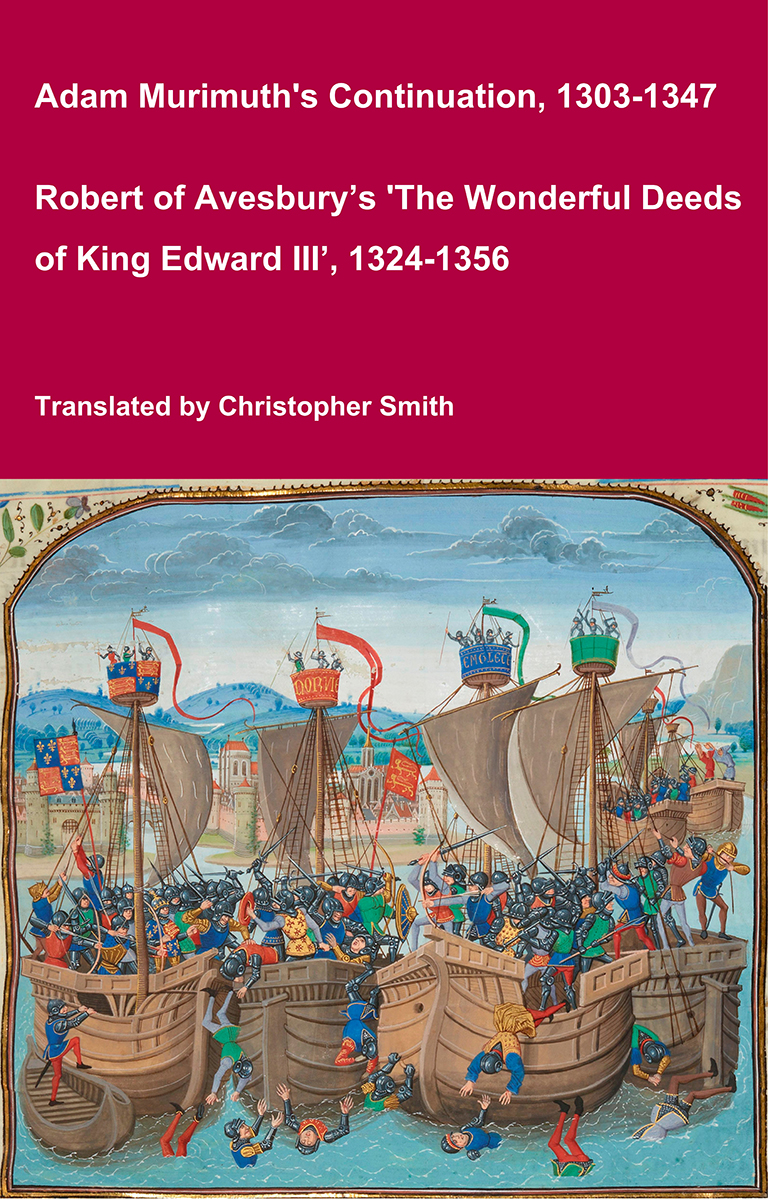
Adam Murimuth's Continuation and Robert of Avesbury’s 'The Wonderful Deeds of King Edward III'
This volume brings together two of the most important contemporary chronicles for the reign of Edward III and the opening phases of the Hundred Years’ War. Written in Latin by English clerical observers, these texts provide a vivid and authoritative window into the political, diplomatic, and military history of fourteenth-century England and its continental ambitions. Adam Murimuth Continuatio's Chronicarum continues an earlier chronicle into the mid-fourteenth century, offering concise but valuable notices on royal policy, foreign relations, and ecclesiastical affairs. Its annalistic structure makes it especially useful for establishing chronology and tracing the development of events year by year. Complementing it, Robert of Avesbury’s De gestis mirabilibus regis Edwardi tertii is a rich documentary chronicle preserving letters, treaties, and official records alongside narrative passages. It is an indispensable source for understanding Edward III’s claim to the French crown, the conduct of war, and the mechanisms of medieval diplomacy. Together, these works offer scholars, students, and enthusiasts a reliable and unembellished account of a transformative period in English and European history. Essential for anyone interested in medieval chronicles, the Hundred Years’ War, or the reign of Edward III.
Available at Amazon in eBook and Paperback format.
On 16th June 1841 Hugh Fortescue 1st Earl Fortescue [aged 88] died. His son Hugh [aged 58] succeeded 2nd Earl Fortescue, 2nd Viscount Ebrington of Ebrington in Gloucestershire, 4th Baron Fortescue of Castle Hill. Elizabeth Geale Countess Fortescue by marriage Countess Fortescue.
On 13th November 1847 [his former wife] Hester Granville Countess Fortescue [aged 81] died.
[his daughter] Hester Fortescue Baroness King was born to Hugh Fortescue 1st Earl Fortescue and Hester Granville Countess Fortescue. She married 26th May 1804 Peter King 7th Baron King, son of Peter King 6th Baron King, and had issue.
[his daughter] Anne Fortescue was born to Hugh Fortescue 1st Earl Fortescue and Hester Granville Countess Fortescue.
Kings Wessex: Great x 21 Grand Son of King Edmund "Ironside" I of England
Kings Gwynedd: Great x 18 Grand Son of Owain "Great" King Gwynedd
Kings Seisyllwg: Great x 24 Grand Son of Hywel "Dda aka Good" King Seisyllwg King Deheubarth
Kings Powys: Great x 19 Grand Son of Maredudd ap Bleddyn King Powys
Kings Godwinson: Great x 22 Grand Son of King Harold II of England
Kings England: Great x 9 Grand Son of King Henry VII of England and Ireland
Kings Scotland: Great x 7 Grand Son of King James V of Scotland
Kings France: Great x 12 Grand Son of Charles "Beloved Mad" VI King France
Kings Duke Aquitaine: Great x 25 Grand Son of Ranulf I Duke Aquitaine
Kings Spain: Great x 17 Grand Son of Alfonso VII King Castile VII King Leon
Great x 4 Grandfather: Hugh Fortescue 
Great x 3 Grandfather: John Fortescue 7 x Great Grandson of King Edward III of England
Great x 4 Grandmother: Elizabeth Chichester  6 x Great Granddaughter of King Edward III of England
Great x 2 Grandfather: Hugh Fortescue 8 x Great Grandson of King Edward III of England
Great x 1 Grandfather: Arthur Fortescue 9 x Great Grandson of King Edward III of England
Great x 3 Grandfather: Robert Rolle of Heanton 
Great x 2 Grandmother: Mary Rolle
Grandfather: Hugh Fortescue 10 x Great Grandson of King Edward III of England
father: Matthew Fortescue 2nd Baron Fortescue 11 x Great Grandson of King Edward III of England
Great x 1 Grandfather: Matthew Aylmer
Grandmother: Lucy Aylmer
Hugh Fortescue 1st Earl Fortescue 7 x Great Grandson of King James V of Scotland
Great x 4 Grandfather: John Campbell 7 x Great Grandson of King Robert II of Scotland
Great x 3 Grandfather: Colin Campbell 3 x Great Grandson of King James IV of Scotland
Great x 4 Grandmother: Jean Campbell 2 x Great Granddaughter of King James IV of Scotland
Great x 2 Grandfather: Hugh Campbell 4 x Great Grandson of King James IV of Scotland
Great x 1 Grandfather: Alexander Campbell 16th Thane of Cawdor 4 x Great Grandson of King James V of Scotland
Great x 4 Grandfather: James Stewart 3rd Earl of Moray  Great Grandson of King James V of Scotland
Great x 3 Grandfather: James Stewart 4th Earl of Moray 2 x Great Grandson of King James V of Scotland
Great x 4 Grandmother: Anne Gordon Countess Moray 3 x Great Granddaughter of King James IV of Scotland
Great x 2 Grandmother: Henrietta Stewart 3 x Great Granddaughter of King James V of Scotland
Great x 4 Grandfather: Alexander Home 1st Earl of Home
Great x 3 Grandmother: Margaret Home Countess Moray 8 x Great Granddaughter of King Edward III of England
Great x 4 Grandmother: Mary Dudley Countess Home  7 x Great Granddaughter of King Edward III of England
Grandfather: John Campbell 5 x Great Grandson of King James V of Scotland
Great x 4 Grandfather: Henry Lort of Stackpole Court in Pembrokeshire
Great x 3 Grandfather: Roger Lort 1st Baronet
Great x 2 Grandfather: John Lort 2nd Baronet 10 x Great Grandson of King Edward III of England
Great x 4 Grandfather: Francis Annesley 1st Viscount Valentia
Great x 3 Grandmother: Hester Annesley 9 x Great Granddaughter of King Edward III of England
Great x 4 Grandmother: Dorothy Philipps 8 x Great Granddaughter of King Edward III of England
Great x 1 Grandmother: Elizabeth Lort 9 x Great Granddaughter of King Edward III of England
Great x 4 Grandfather: John Holles 1st Earl de Clare 7 x Great Grandson of King Edward III of England
Great x 3 Grandfather: John Holles 2nd Earl de Clare 7 x Great Grandson of King Edward III of England
Great x 4 Grandmother: Anne Stanhope Countess de Clare  6 x Great Granddaughter of King Edward III of England
Great x 2 Grandmother: Susan Holles 8 x Great Granddaughter of King Edward III of England
Great x 4 Grandfather: Horace de Vere 1st Baron Vere  7 x Great Grandson of King Edward I of England
Great x 3 Grandmother: Elizabeth Vere Countess Clare 8 x Great Granddaughter of King Edward I of England
Great x 4 Grandmother: Mary Tracy Baroness Spencer Tilbury
mother: Anne Campbell Baroness Fortescue 6 x Great Granddaughter of King James V of Scotland
Great x 1 Grandfather: Lewis Pryse of Gogirthen in Wales
Grandmother: Mary Pryse