

Paternal Family Tree: Lamb
Maternal Family Tree: Elizabeth Milbanke Viscountess Melbourne 1751-1818
On 13th April 1769 [his father] Penistone Lamb 1st Viscount Melbourne [aged 24] and [his mother] Elizabeth Milbanke Viscountess Melbourne [aged 17] were married.


On 17th April 1782 Frederick Lamb 3rd Viscount Melbourne was born to Penistone Lamb 1st Viscount Melbourne [aged 37] and Elizabeth Milbanke Viscountess Melbourne [aged 30]. His paternity is considered a matter of conjecture given that his mother is believed to have had numerous lovers?

On 8th November 1787 John Eliot 1st Baronet [aged 51] died at Brocket Hall, Hertfordshire [Map], the seat of his friend [his father] Penistone Lamb 1st Viscount Melbourne [aged 42]. He was buried at St Etheldreda's Church, Hatfield [Map]. Baronet Eliot of Pebbles extinct.
The Memoirs of Harriet Wilson Chapter 1. 1801. I was not depraved enough to determine immediately on a new choice, and yet I often thought about it. How indeed could I do otherwise, when the Honourable Frederick Lamb [aged 18] was my constant visitor, and talked to me of nothing else? However, in justice to myself, I must declare that the idea of the possibility of deceiving Lord Craven while I was under his roof, never once entered into my head. Frederick was then very handsome, and certainly tried with all his soul and with all his strength, to convince me that constancy to Lord Craven was the greatest nonsense in the world. I firmly believe that Frederick Lamb sincerely loved me, and deeply regretted that he had no fortune to invite me to share with him.
Lord Melbourne [aged 55], his father, was a good man. Not one of your stiff-laced, moralising fathers, who preach chastity and forbearance to their children. Quite the contrary, he congratulated his son on the lucky circumstance of his friend Craven having such a fine girl with him.
"No such thing," answered Frederick Lamb, "I am unsuccessful there. Harriette will have nothing at all to do with me."
"Nonsense!" rejoined Melbourne, in great surprise, "I never heard anything half so ridiculous in all my life. The girl must be mad! She looks mad. I thought so the other day, when I met her galloping about, with her feathers blowing, and her thick dark hair about her ears.
"I'll speak to Harriette for you," added his lordship, after a long pause, and then continued repeating to himself, in an undertone, "not have my son indeed! Six feet high! A fine, straight, handsome, noble young fellow! I wonder what she would have!"
In 1805 [his brother] William Lamb 2nd Viscount Melbourne [aged 25] and [his sister-in-law] Caroline Ponsonby aka Lamb [aged 19] were married. She the daughter of Frederick Ponsonby 3rd Earl Bessborough [aged 46] and Henrietta Frances Spencer Countess Bessborough [aged 43].


On 20th July 1805 [his brother-in-law] Peter Nassau Clavering-Cowper 5th Earl Cowper [aged 27] and [his sister] Emily Lamb Countess Cowper [aged 18] were married. She by marriage Countess Cowper. He the son of George Nassau Clavering-Cowper 3rd Earl Cowper and Hannah Anna Gore 3rd Countess Cowper.
In 1818 [his mother] Elizabeth Milbanke Viscountess Melbourne [aged 66] died.
On 22nd July 1828 [his father] Penistone Lamb 1st Viscount Melbourne [aged 83] died. His son [his brother] William [aged 49] succeeded 2nd Viscount Melbourne of Kilmore in County Cavan, 3rd Baronet Lamb of Brocket Hall in Hertfordshire.
Greville Memoirs. 16th December 1830. At Court yesterday; William Bathurst [aged 39] sworn in. All the Ministers were there, and the Duke of Wellington at the levee looking out of sorts. Dined at the Lievens'; [his sister] Lady Cowper [aged 43] told me that in the summer the Duke had not made a direct offer to Melbourne, but what was tantamount to it. He had desired somebody (she did not say who) to speak to Lamb [aged 48]6, and said he would call on him himself the next day. Something, however, prevented him, and she did not say whether he did call or not afterwards. He denied ever having made any overture at all. To Palmerston he proposed the choice of four places, and she thinks he would have taken in Huskisson if the latter had lived. He would have done nothing but on compulsion; that is clear. It is very true (what they say Peel said of him) that no man ever had any influence with him, only women, and those always the silliest. But who are Peel's confidants, friends, and parasites? Bonham, a stock-jobbing ex-merchant; Charles Ross, and the refuse of society of the House of Commons.
Note 6. Sir Frederick Lamb.
Jean de Waurin's Chronicle of England Volume 6 Books 3-6: The Wars of the Roses
Jean de Waurin was a French Chronicler, from the Artois region, who was born around 1400, and died around 1474. Waurin’s Chronicle of England, Volume 6, covering the period 1450 to 1471, from which we have selected and translated Chapters relating to the Wars of the Roses, provides a vivid, original, contemporary description of key events some of which he witnessed first-hand, some of which he was told by the key people involved with whom Waurin had a personal relationship.
Available at Amazon in eBook and Paperback format.
Greville Memoirs. 16th December 1830. Lamb [aged 48] told me afterwards, talking of the Duke and Polignac, that Sébastiani had told him that Hyde de Neuville (who was Minister at the time Polignac went over from here on his first short visit, before he became Minister) said that upon that occasion Polignac took over a letter from the Duke to the King of France, in which he said that the Chambers and the democratical spirit required to be curbed, that he advised him to lose no time in restraining them, and that he referred him to M. de Polignac for his opinion generally, who was in possession of his entire confidence. I think this may be true, never having doubted that these were his real sentiments, whether he expressed them or not.
Greville Memoirs. 12th January 1831. Passed two days at Panshanger [Map], but my room was so cold that I could not sit in it to write. Nobody there but F. Lamb [aged 48] and J. Russell. [his sister] Lady Cowper [aged 43] told me what had passed relative to the negotiation with Melbourne last year, and which the Duke or his friends denied. The person who was employed (and whom she did not name) told F. Lamb that the Duke would take in Melbourne and two others (I am not sure it was not three), but not Huskisson. He said that it would be fairer at once to say that those terms would not be accepted, and to save him therefore from offering them, that Melbourne would not be satisfied with any Government which did not include Huskisson and Lord Grey, and that upon this answer the matter dropped. I don't think the Duke can be blamed for answering to anybody who chose to ask him any questions on the subject that he had made no offer; it was the truth, though not the whole truth, and a Minister must have some shelter against impertinent questioners, or he would be at their mercy. An Envoy [aged 20] is come here from the Poles11, who brought a letter from Prince Czartoryski to Lord Grey, who has not seen him, and whose arrival has naturally given umbrage to the Lievens.
Note 11. This Envoy was Count Alexander Walewski, a natural son of the Emperor Napoleon, who afterwards played a considerable part in the affairs of France and of Europe, especially under the Second Empire. During his residence in London in 1831 he married Lady Caroline Montagu [aged 22], a daughter of the Earl of Sandwich, but she did not live long. I remember calling upon him in St. James's Place, and seeing cards of invitation for Lady Grey's assemblies stuck in his glass. The fact is he was wonderfully handsome and agreeable, and soon became popular in London society.
Greville Memoirs. 7th January 1832. Gorhambury [Map]. Came here to-day. Berkeley Paget and Lushington; nobody else. Had a conversation with Lady C. before I came away; between Palmerston, Frederick Lamb [aged 49], and Melbourne she knows everything, and is a furious anti-Reformer. The upshot of the matter is this: the question about the Peers is still under discussion; Lord Grey and the ultra party want to make a dozen, now, the others want only to yield five or six. Lord Grey wrote to Palmerston saying the King had received his proposition (about the Peers) very well, but desired to have his reasons in writing, and to-day at twelve there was to be another Cabinet on the subject, in order probably that the 'reasons' might go down by the post. The moderate party in the Cabinet consists of Lansdowne, Richmond, Palmerston, Melbourne, and Stanley. Palmerston and Melbourne, particularly the latter, are now heartily ashamed of the part they have taken about Reform. They detest and abhor the whole thing, and they find themselves unable to cope with the violent party, and consequently implicated in a continued series of measures which they disapprove; and they do not know what to do, whether to stay in and fight this unequal battle or resign. I told her that nothing could justify their conduct, and their excuses were good for nothing; but that there was no use in resigning now. They might still do some good in the Cabinet; they could do none out of it. In fact, Durham and the most violent members of the Cabinet would gladly drive Palmerston and Melbourne to resign if they could keep Stanley, who is alone of importance of that squad; but he is of such weight, from his position in the House of Commons, that if he can be prevailed upon to be staunch, and to hold out with the moderates against the ultras, the former will probably prevail. Durham wants to be Minister for Foreign Affairs, and would plague Lord Grey till he gave him the seals, unless his other colleagues put a veto upon the appointment. But the anxiety of the Reformers to make Peers has not reference to the Reform Bill alone; they undoubtedly look further, and knowing their own weakness in the House of Lords, they want to secure a permanent force, which may make them stronger than their antagonists in that House. Otherwise they would not be so averse to all questions of conciliation, express their disbelief in conversions, and trumpet forth their conviction that any individual of the late majority will vote just the same way again. The earnest desire of the moderate party in the Cabinet is that those who will vote for the second reading shall make haste to declare their intention, and I have written to Lady Harrowby [aged 59] to endeavour to get Lord Harrowby to take some such step. I had already written to De Ros, urging him to speak to Wharncliffe [aged 55], and get him to take an opportunity of giving the King to understand that the necessity for a creation of Peers is by no means so urgent as his Ministers would have him believe.
Greville Memoirs. 13th January 1832. Last night Frederick Lamb [aged 49] told me that Lord Grey had sent word to Melbourne of what Wharncliffe [aged 55] had said to Sir Herbert Taylor, and Lord Grey assumed the tenour of Wharncliffe's language to have been merely an advice to the King not to make Peers, whereas all I suggested to him was to explain to the King that the creation was not necessary for the reasons which have been assigned to his Majesty by his Ministers, viz., the intention of all who voted against the second reading last year to vote against it this. In the meantime the dispute has been going on in the Cabinet, time has been gained, and several incidents have made a sort of cumulative impression. There is a petition to the King, got up by Lord Verulam [aged 56] and Lord Salisbury, which is in fact a moderate Reform manifesto. It has been numerously signed, and Verulam is going to Brighton to present it. I have been labouring to persuade him to make up his mind to vote for the second reading, and to tell the King that such is his intention, which he has promised me he will. When I had obtained this promise from him I wrote word to [his sister] Lady Cowper [aged 44], telling her at the same time that Lord Harris (I had heard) would vote for the second reading, and this letter she imparted to Melbourne, who stated the fact in the Cabinet, where it made a considerable impression. All such circumstances serve to supply arms to the moderate party.
Greville Memoirs. 15th January 1832. This morning Frederick Lamb [aged 49] showed me a letter he had got from Melbourne to this effect: 'that they had resolved to make no Peers at all at present; that to make a few would be regarded as a menace, and be as bad as if they made a great many; but that as many as would be necessary to carry the Bill would be made, if it was eventually found that it must be so;' he added 'it only remained for people to come forward and declare their intention of supporting the second reading.' This is certainly a great victory, and I do believe mainly attributable to our exertions, to the spirit we have infused into Melbourne himself, and the use we have made of Wharncliffe [aged 55] and Verulam [aged 56], and the different little circumstances we have brought to bear upon the discussion. What now remains is the most difficult, but I shall do all I can to engage Peers to take a moderate determination and to declare it. Lamb told me that the King has an aversion to making a few Peers, that he has said he would rather make twenty-five than five, that whatever he must make he should like to make at once, and not to have to return to it. Anyhow, time is gained, and a victory for the moment.
Greville Memoirs. 24th January 1832. Yesterday morning Frederick Lamb [aged 49] came to me and told me that the question of the Peers was again in agitation, that the King had agreed to make as many as they pleased, and had understood Wharncliffe's [aged 55] conversation with his Majesty not to have contained any distinct assurance that he would vote for the second reading of the Bill. Our party in the Cabinet still fight the battle, however, and Stanley (on whom all depends) is said to be firm, but circumstances may compel them to give way, and Lord Grey (who is suspected to have in his heart many misgivings as to this measure), when left to Durham and Co., yields everything. Under these circumstances I went to Wharncliffe last night, to persuade him to declare his intentions without loss of time. He owned that he had not pledged himself to the King, and he was frightened to death at the idea of taking this step, lest it should give umbrage to the Tories, and he should find himself without any support at all. We went, however, together to Grosvenor Square, and had a long conference with Harrowby, whom I found equally undecided.
Greville Memoirs. 2nd February 1832. Met Frederick Lamb [aged 49] at dinner to talk over the state of affairs before he goes to Vienna. What he wishes for is the expulsion of this Government, and the formation of a moderate one taken from all parties. Received another letter from Wharncliffe [aged 55] yesterday, in which he stated that he had communicated to the Duke of Wellington his intention of supporting the second reading, and asked if the Duke would support his amendments in Committee. In the meantime I wrote to Harrowby, begging he would communicate with Lord Carnarvon and the Duke of Buckingham. They keep doubting and fearing about who will or will not join them, but do not stir a step. George Bentinck told me that Lord Holland said to the Duke of Richmond the other day 'that he had heard a declaration was in agitation; that nothing could be more unfortunate at this moment, as it would make it very difficult to create fifty Peers.' In the meantime a difficulty is likely to arise from another source, and the Government to derive strength from their very weakness. Robert Clive (who is a moderate Tory) called on me the other day, and when (after expressing his anxiety that the question should be settled) I asked him whether such a declaration would meet with much success, said he thought that it would have done so a fortnight ago, but that the extreme discredit into which Ministers were fallen would now operate as a reason against supporting them in any stage of the business, and offered so good a chance of expelling them altogether that people would be anxious to try it. Still it must be so obvious that it would be next to impossible to make a Government now, that it is to be hoped all but the most violent will feel it. Herries indeed told somebody that he had no doubt the Tories could make a Government, and that on a dissolution they would get a Parliament that would support them. Parnell2 has been turned out for not voting on the Russian Loan affair, and Hobhouse appointed in his place. Tennyson resigned from ill health. Parnell was properly enough turned out, and he is a good riddance, but it is not the same thing as turning people out on Reform. He wrote an excellent book on finance, but he was a very bad Secretary at War, a rash economical innovator, and a bad man of business in its details. After waiting till the last moment for the arrival of the Russian ratification, the French and English signed the Belgian treaty alone, and the others are to sign after as their powers arrive.
Note 2. Sir Henry Parnell had been appointed Secretary at War on the formation of Lord Grey's Ministry. He had exasperated his colleagues by entering upon an unauthorised negotiation with the French Post Office, without the knowledge of the Duke of Richmond, then Postmaster-General, and by encouraging Joseph Hume to bring on a motion against the Post Office. Hume brought this letter to the Duke of Richmond, who was indignant and laid the whole matter before Lord Grey, who behaved very well about it. Parnell narrowly escaped dismissal at that time, and on his next sign of disaffection to the Government he was turned out of office.
In 1839 Frederick Lamb 3rd Viscount Melbourne [aged 56] was created 1st Baron Beauvale of Beauvale in Nottinghamshire.
On 24th November 1848 William Lamb 2nd Viscount Melbourne [aged 69] died. His brother Frederick [aged 66] succeeded 3rd Viscount Melbourne of Kilmore in County Cavan, 4th Baronet Lamb of Brocket Hall in Hertfordshire.
Before 29th January 1853 Frederick Lamb 3rd Viscount Melbourne [aged 70] and Alexandrina Julia Gräfin von Maltzan were married.
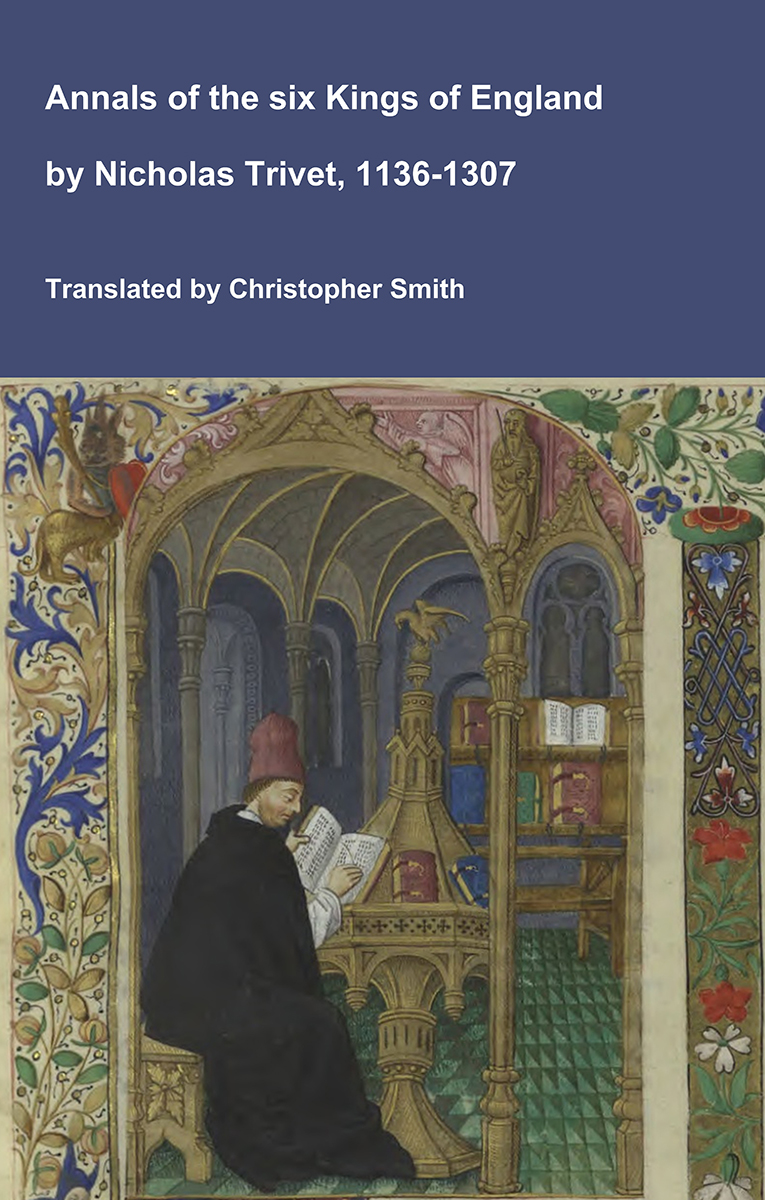
Annals of the six Kings of England by Nicholas Trivet
Translation of the Annals of the Six Kings of England by that traces the rise and rule of the Angevin aka Plantagenet dynasty from the mid-12th to early 14th century. Written by the Dominican scholar Nicholas Trivet, the work offers a vivid account of English history from the reign of King Stephen through to the death of King Edward I, blending political narrative with moral reflection. Covering the reigns of six monarchs—from Stephen to Edward I—the chronicle explores royal authority, rebellion, war, and the shifting balance between crown, church, and nobility. Trivet provides detailed insight into defining moments such as baronial conflicts, Anglo-French rivalry, and the consolidation of royal power under Edward I, whose reign he describes with particular immediacy. The Annals combines careful year-by-year reporting with thoughtful interpretation, presenting history not merely as a sequence of events but as a moral and political lesson. Ideal for readers interested in medieval history, kingship, and the origins of the English state, this chronicle remains a valuable and accessible window into the turbulent world of the Plantagenet kings.
Available at Amazon in eBook and Paperback format.
On 29th January 1853 Frederick Lamb 3rd Viscount Melbourne [aged 70] died without issue. Viscount Melbourne of Kilmore in County Cavan, Baron Beauvale of Beauvale in Nottinghamshire and Baronet Lamb of Brocket Hall in Hertfordshire extinct. Melbourne Hall, Derbyshire [Map] was inherited by his sister Emily Lamb Countess Cowper [aged 65].
On 10th June 1856 John Weld-Forester 2nd Baron Forester [aged 54] and [his former wife] Alexandrina Julia Gräfin von Maltzan were married at St John the Evangelist, Paddington.
In 1894 [his former wife] Alexandrina Julia Gräfin von Maltzan died.
Kings Wessex: Great x 22 Grand Son of King Edmund "Ironside" I of England
Kings Gwynedd: Great x 20 Grand Son of Owain "Great" King Gwynedd
Kings Seisyllwg: Great x 26 Grand Son of Hywel "Dda aka Good" King Seisyllwg King Deheubarth
Kings Powys: Great x 21 Grand Son of Maredudd ap Bleddyn King Powys
Kings Godwinson: Great x 23 Grand Son of King Harold II of England
Kings England: Great x 13 Grand Son of King Edward III of England
Kings Scotland: Great x 17 Grand Son of King William I of Scotland
Kings France: Great x 15 Grand Son of King Philip IV of France
Kings Duke Aquitaine: Great x 27 Grand Son of Ranulf I Duke Aquitaine
Kings Spain: Great x 19 Grand Son of Alfonso VII King Castile VII King Leon
Great x 1 Grandfather: Matthew Lamb of Southwell in Nottinghamshire
Grandfather: Matthew Lamb 1st Baronet
father: Penistone Lamb 1st Viscount Melbourne
Great x 4 Grandfather: John Coke
Great x 3 Grandfather: Thomas Coke
Great x 2 Grandfather: John Coke
Great x 1 Grandfather: Thomas Coke
Grandmother: Charlotte Coke
Great x 2 Grandfather: Richard Hale of King's Walden
Great x 1 Grandmother: Mary Hale
Great x 3 Grandfather: Isaac Meynell of Meynell Langley, Derbyshire
Great x 2 Grandmother: Elizabeth Meynell
Frederick Lamb 3rd Viscount Melbourne 13 x Great Grandson of King Edward III of England
Great x 4 Grandfather: Mark Milbanke
Great x 3 Grandfather: Mark Milbanke 1st Baronet
Great x 2 Grandfather: Mark Milbanke 2nd Baronet
Great x 1 Grandfather: Ralph Milbanke 4th Baronet
Grandfather: Ralph Milbanke 5th Baronet 11 x Great Grandson of King Edward III of England
Great x 4 Grandfather: John Delaval 7 x Great Grandson of King Edward III of England
Great x 3 Grandfather: George Delaval of North Dissington 8 x Great Grandson of King Edward III of England
Great x 4 Grandmother: Elizabeth Selby
Great x 2 Grandfather: Edward Delaval of South Dissington 9 x Great Grandson of King Edward III of England
Great x 4 Grandfather: Edward Grey of Bitchfield  7 x Great Grandson of King Edward III of England
Great x 3 Grandmother: Margaret Grey 8 x Great Granddaughter of King Edward III of England
Great x 1 Grandmother: Anne Delaval Lady Milbanke 10 x Great Granddaughter of King Edward III of England
Great x 3 Grandfather: Francis Blake of Cogges
Great x 2 Grandmother: Mary Blake
Great x 3 Grandmother: Elizabeth Carr 
mother: Elizabeth Milbanke Viscountess Melbourne 12 x Great Granddaughter of King Edward III of England