

Chronicle of a Bourgeois of Valenciennes
Récits d’un bourgeois de Valenciennes aka The Chronicle of a Bourgeois of Valenciennes is a vivid 14th-century vernacular chronicle written by an anonymous urban chronicler from Valenciennes in the County of Hainaut. It survives in a manuscript that describes local and regional history from about 1253 to 1366, blending chronology, narrative episodes, and eyewitness-style accounts of political, military, and social events in medieval France, Flanders, and the Low Countries. The work begins with a chronological framework of events affecting Valenciennes and its region under rulers such as King Philip VI of France and the shifting allegiances of local nobility. It includes accounts of conflicts, sieges, diplomatic manoeuvres, and the impact of broader struggles like the Hundred Years’ War on urban life in Hainaut. Written from the perspective of a burgher (bourgeois) rather than a monastery or royal court, the chronicle offers a rare lay viewpoint on high politics and warfare, reflecting how merchants, townspeople, and civic institutions experienced the turbulence of the 13th and 14th centuries. Its narrative style combines straightforward reporting of events with moral and civic observations, making it a valuable source for readers interested in medieval urban society, regional politics, and the lived experience of war and governance in pre-modern Europe.
Available at Amazon in eBook and Paperback format.
Paternal Family Tree: Anjou aka Plantagenet
1152 Marriage of Henry II and Eleanor of Aquitaine
1162 Thomas Becket appointed Archbishop of Canterbury
1170 Murder of Thomas a Becket
In 1129 [his grandfather] Fulk "Young" King Jerusalem [aged 40] travelled to Jerusalem [Map] on pilgrimage. His son [his father] Geoffrey Plantagenet Duke Normandy [aged 15] was appointed Count Anjou.
Around 1129 Hamelin Warenne Earl of Surrey was born illegitimately to [his father] Geoffrey Plantagenet Duke Normandy [aged 15] and [his mother] Mistress Unknown.
In 1144 [his father] Geoffrey Plantagenet Duke Normandy [aged 30] by conquest Duke Normandy. Empress Matilda [aged 41] by marriage Duchess Normandy.
On 7th September 1151 [his father] Geoffrey Plantagenet Duke Normandy [aged 38] died at Château du Loir [Map]. He was buried at St Julien's Cathedral [Map].
On 18th May 1152 Whit Sunday [his half-brother] King Henry "Curtmantle" II of England [aged 19] and [his sister-in-law] Eleanor of Aquitaine Queen Consort Franks and England [aged 30] were married at Poitiers Cathedral [Map]. They were more closely related than Eleanor and her previous husband Louis VII King of the Franks [aged 32]. The marriage would bring the Kingdom of England, and the Duchies of Normandy and Aquitaine under the control of King Henry "Curtmantle" II of England. She the daughter of William "Saint" Poitiers X Duke Aquitaine and Aenor Chatellerault Duchess Aquitaine. He the son of [his father] Geoffrey Plantagenet Duke Normandy and Empress Matilda [aged 50]. They were half third cousins. He a grandson of King Henry I "Beauclerc" England.
On 25th October 1154 King Stephen I England [aged 60] died at Priory of St Martin, Dover [Map]. His first cousin once removed [his half-brother] Henry [aged 21] succeeded II King of England.
On 26th July 1158 [his half-brother] Geoffrey Plantagenet Count Nantes [aged 24] died at Nantes [Map].
On 23rd May 1162 Archbishop Thomas Becket [aged 42] was elected Archbishop of Canterbury by [his half-brother] King Henry "Curtmantle" II of England [aged 29].
In 1163 [his daughter] Maud aka Matilda Plantagenet Countess Eu was born to Hamelin Warenne Earl of Surrey [aged 34] and Isabella Warenne Countess Boulogne 4th Countess of Surrey [aged 26]. She married in or before 1191 her half fifth cousin Henry Normandy 7th Count of Eu, son of John Normandy 6th Count of Eu and Alice D'Aubigny, and had issue.
On 30th January 1164 [his half-brother] William Longsword [aged 27] died. He was buried at Notre Dame de Paris Cathedral [Map]. His death said to have been of a broken heart since he was unable to marry Isabella Warenne Countess Boulogne 4th Countess of Surrey [aged 27] as a result of Archbishop Thomas Becket [aged 44] refusing to grant the necessary dispensation. His death may have been the start of the rift between his elder brother King Henry II [aged 30] and Becket.
In April 1164 Hamelin Warenne Earl of Surrey [aged 35] and Isabella Warenne Countess Boulogne 4th Countess of Surrey [aged 27] were married by which Conisbrough Castle [Map] came into his posession. He rebuilt the castle in stone. He by marriage Earl Surrey. She the daughter of William Warenne 3rd Earl of Surrey and Adela Montgomery Countess of Salisbury and Surrey. He the illegitmate son of Geoffrey Plantagenet Duke Normandy and Mistress Unknown. They were sixth cousins.
On 29th December 1170 Archbishop Thomas Becket [aged 51] was murdered at Canterbury Cathedral [Map] by four knights on behalf of [his half-brother] King Henry "Curtmantle" II of England [aged 37]. Whether Henry ordered the murder, or whether the four knights were acting without orders, is a matter of conjecture. The first use of the well-known phrase "Will no-one rid me of this turbulent priest" appears some five hundred and more years later in Robert Dodsley's 1740 Chronicle of the Kings of England.
In December 1174 King William I of Scotland [aged 31], imprisoned at Falaise Castle [Map], signed the Treaty of Falaise by which he agreed [his half-brother] King Henry "Curtmantle" II of England [aged 41] was overlord of Scotland. He also agreed to marry a bride of Henry's choosing. He married Ermengarde Beaumont Sarthe Queen Consort Scotland [aged 4] twelve years later.
Simon Senlis 7th Earl Huntingdon 6th Earl of Northampton [aged 36] succeeded 7th Earl Huntingdon, 6th Earl of Northampton.
On 5th September 1186 King William I of Scotland [aged 43] and Ermengarde Beaumont Sarthe Queen Consort Scotland [aged 16] were married at Woodstock Palace, Oxfordshire [Map] by Archbishop Baldwin of Forde [aged 61]. She by marriage Queen Consort Scotland at Woodstock Palace, Oxfordshire [Map]. His bride had been chosen by [his half-brother] King Henry "Curtmantle" II of England [aged 53] as part of the Treaty of Falaise. William received Edinburgh Castle [Map] as a wedding gift from King Henry "Curtmantle" II of England. The difference in their ages was 27 years. He the son of Henry Dunkeld 3rd Earl Huntingdon 1st Earl of Northumbria and Ada Warenne Countess Huntingdon and Northumbria. They were half fourth cousins. She a great granddaughter of King Henry I "Beauclerc" England.
In 1176 Bishop Peter de Leia was appointed Bishop of St David's by [his half-brother] King Henry II [aged 42] despite the cathedral chapter preferring Gerald of Wales aka Cambrensis [aged 29] aka Giraldus Cambrensis.
Around 1180 Hamelin Warenne Earl of Surrey [aged 51] commissioned the building of a stone castle at Conisbrough [Map]. The castle comprised a Circular Keep with four storeys.


Internal staircase between the first and second floors.


The finely made fireplace on the second floor with decorated capitals.

Window opening on the second floor showing the thickness of the walls of the Keep.


Garderobe on the second floor.

Window opening on the third floor.

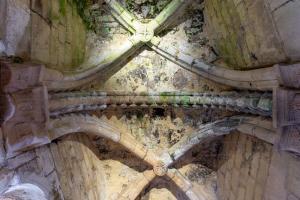
Chapel in one of the buttresses on the third floor.

View looking east with the Railway Viaduct over the River Don in the distance.

View of the earthworks of the Outer Bailey.

Entrance to the Keep on the first floor.
The History of William Marshal was commissioned by his son shortly after William’s death in 1219 to celebrate the Marshal’s remarkable life; it is an authentic, contemporary voice. The manuscript was discovered in 1861 by French historian Paul Meyer. Meyer published the manuscript in its original Anglo-French in 1891 in two books. This book is a line by line translation of the first of Meyer’s books; lines 1-10152. Book 1 of the History begins in 1139 and ends in 1194. It describes the events of the Anarchy, the role of William’s father John, John’s marriages, William’s childhood, his role as a hostage at the siege of Newbury, his injury and imprisonment in Poitou where he met Eleanor of Aquitaine and his life as a knight errant. It continues with the accusation against him of an improper relationship with Margaret, wife of Henry the Young King, his exile, and return, the death of Henry the Young King, the rebellion of Richard, the future King Richard I, war with France, the death of King Henry II, and the capture of King Richard, and the rebellion of John, the future King John. It ends with the release of King Richard and the death of John Marshal.
Available at Amazon in eBook and Paperback format.
On 11th May 1183 Archbishop Walter de Coutances was elected Bishop of Lincoln being selected by [his half-brother] King Henry "Curtmantle" II of England [aged 50] over three other candidates.

On 6th July 1189 [his half-brother] King Henry "Curtmantle" II of England [aged 56] died at Chinon Castle [Map]. William Mandeville 3rd Earl Essex Count Aumale was present. He was buried at Fontevraud Abbey [Map]. His son [his nephew] Richard [aged 31] succeeded I King of England.
Gesta Regis Henrici by Benedict of Peterborough. 3rd September 1189. Then [his nephew] Richard [aged 31], Duke of Normandy, came to London, and having gathered there the archbishops and bishops, earls and barons, and a large multitude of knights, on the third day before the Nones of September, on a Sunday, the moon being in its nineteenth phase, on the feast of the ordination of Pope Saint Gregory, an ill-omened day, the aforementioned Richard, Duke of Normandy, was consecrated and crowned as King of England at Westminster in London by Baldwin [aged 64], Archbishop of Canterbury. Assisting him in this office were Walter, Archbishop of Rouen, John, Archbishop of Dublin, Formale, Archbishop of Trier, Hugh, Bishop of Lincoln, Hugh [aged 64], Bishop of Durham, William, Bishop of Worcester, John, Bishop of Exeter, Reginald, Bishop of Bath, John, Bishop of Norwich, Seffrid, Bishop of Chichester, Gilbert, Bishop of Rochester, Peter, Bishop of St. David's in Wales, the Bishop of St. Asaph in Wales, the Bishop of Bangor in Wales, Albinus, Bishop of Ferns in Ireland, and Concors, Bishop of Kildare in Ireland.
Geoffrey, Archbishop-elect of York, John, Bishop-elect of Whithorn in Galloway, the Abbot of Westminster, the Abbot of St. Albans, the Abbot of St. Augustine's in Canterbury, the Abbot of Hyde in Winchester, Benedict, Abbot of Peterborough, the Abbot of St. Edmund's, the Abbot of Crowland, the Abbot of Battle, the Abbot of St. Mary's in York, Arnold, Abbot of Rievaulx, the Abbot of Holm Cultram, the Abbot of Mortemer, and the Abbot of St. Denis, who had come on behalf of the King of France, were present.
Also present were William, Earl of Aumale and Essex, Hamelin [aged 60], brother of King Henry, Earl of Warenne, John [aged 22], brother of King Richard, Earl of Mortain and Gloucester, Robert, Earl of Leicester, Richard [aged 36], Earl of Clare, Waleran [aged 36], Earl of Warwick, William de Aubigny [aged 51], Earl of Sussex, Aubrey [aged 74], Earl of Oxford, William [aged 39], Earl of Salisbury, William Marshal [aged 43], Earl of Striguil, and David [aged 37], brother of the King of Scotland, Earl of Huntingdon.
Moreover, these barons were present: Robert de Lacy, Nigel de Mowbray [aged 43], Roger Bigot, Reginald de Lucy, Gervase Paynel, William de Humet, Baldwin Wake, Robert de Stafford, John,20 Constable of Chester, Jollan de Neville, William de Neville, Henry de Putot, Ranulf de Glanville [aged 77], Justiciar of England, Gerard de Glanville, his brother, Gilbert Basset [aged 34], Gerard de Camville, and Richard de Camville.
Deinde Ricardus dux Normanniæ venit Lundonias, et congregatis ibi archiepiscopis et episcopis, comitibus et baronibus et copiosa militum multitudine, tertio nonas Septembris, die Dominica, luna xix., festo ordinationis Sancti Gregorii papa, die mala, prædictus Ricardus dux Normanniæ consecratus et coronatus est in regem Angliæ, apud Lundonias in Westmonasterio, a Baldewino Cantuariensi archiepiscopo, ministrantibus illi in illo officio Waltero Rothomagensi archiepiscopo, Johanne Dublinensi archiepiscopo, Formale1 Treverensi archiepiscopo, Hugone Lincolniensi episcopo, Hugone Dunelmensi episcopo, Willelmo Wigornensi episcopo, Johanne Exoniensi episcopo, Reginaldo Bathoniensi episcopo, Johanne Norwicensi episcopo, Sefrido Cices- trensi episcopo, Gilleberto Rofensi episcopo, Petro episcopo de Sancto David in Wallia, episcopo2 de Asfath in Wallia, episcopo3 de Pangor in Wallia.—Albinus episcopus Fernensis4 in Hibernia, Concors episcopus Heghdunensis5 in Hibernia;
Gaufridus Eboracensis electus, Johannes electus Candidæ Casæ in Galweia, abbas de Westmonasterio6, abbas de Sancto Albano7, abbas de Sancto Augustino Cantuariæ8, abbas de Hyda Wintoniæ9, Benedictus abbas de Burgo10, abbas de Sancto Eadmundo11, abbas de Croilandia12, abbas de Bello13, abbas Sanctæ Mariæ Eboraci14, Arnaldus abbas Rievallis, abbas de Holm Cultram15, abbas de Mortemer16, et abbas de Sancto Dionysio17, qui venerant ex parte regis Franciæ.
Willelmus comes Albemarliæ et Essesse, Hamellinus frater regis Henrici comes Warennæ, Johannes frater regis Ricardi, comes Meretonæ et Gloucestriæ, Robertus comes Leicestriæ, Ricardus comes de Clara, Wallerannus comes de Warwic, Willelmus de Aubeni comes de Suthsex, Albricus comes18, Willelmus19 comes de Salesbiria, Willelmus Marescallus comes de Strignil, David frater regis Scotiæ comes de Huntendona.
Præterea hi barones interfuerunt, Robertus de Lasci, Nigellus de Mumbray, Rogerus Bigot, Reginaldus Lusci, Gervasius Painel, Willelmus de Humet, Baldewinus Wag, Robertus de Stanford, Johannes constabularius Cestrize, Jollanus de Nevil, Willelmus de Nevil, Henricus de Puteaco, Ranulfus de Glanvil justitiarius Anglize, Gerardus de Glanvilla frater ipsius, Gillebertus Basset, Gerardus de Camvilla, Ricardus de Camvilla.
Note 1. Fulmar, Formalis, or Formator, archdeacon of Treves, was elected archbishop by intrigue in 1183, and consecrated by pope Urban III. on Whit Sunday 1186. He never gained full possession of his see, and was, with his competitor Rodolf, deprived by Clement III. in 1189. He then came to England, where he died.
Note 2. [episcopo] Reiner, 1186-1224.
Note 3. [episcopo] Guy, 1177-1190.
Note 4. [Fernensis] Albinus, 1185-1122.
Note 5. [Heghdunensis] Concord, bishop of Euaghduu.
Note 6. Walter, 1176-1190.
Note 7. Warin, 1188-1195.
Note 8. Roger, abbot 1178-1212.
Note 9. John Suthill, abbot 1181-1222.
Note 10. Benedict, abbot 1181-1193.
Note 12. Sampson de Totington, 11821211.
Note 12. Robert of Reading, abbot of Croyland, 1175-1190.
Note 13. Odo, abbot of Battle 1175-1200.
Note 14. Robert Harpham, 1184-1189, was dead. The abbey was represented by William the prior.
Note 15. Everard, 1175-1192.
Note 16. Mortemer-en-Lions. William Tholomeus, 1179-1200.
Note 17. Hugh Foucaut, 1186-1197.
Note 18. De Vere, earl of Oxford.
Note 19. William of Evreux, son of Patrick, 1168-1196.
Note 20. De Lacy.
In or before 1191 [his son-in-law] Henry Normandy 7th Count of Eu and Maud aka Matilda Plantagenet Countess Eu [aged 27] were married. She by marriage Countess Eu. She the daughter of Hamelin Warenne Earl of Surrey [aged 61] and Isabella Warenne Countess Boulogne 4th Countess of Surrey [aged 53]. He the son of John Normandy 6th Count of Eu and Alice D'Aubigny. They were half fifth cousins. He a great x 3 grandson of King William "Conqueror" I of England.
Chronicle of Roger de Hoveden. 30th March 1194. On the thirtieth day of March, a Wednesday, Richard, King of England, held the first day of his council at Nottingham. Present at this council were: [his former sister-in-law] Queen Eleanor [aged 72], his mother, Hubert [aged 34], Archbishop of Canterbury, who sat on the king's right, [his nephew] Geoffrey [aged 42], Archbishop of York, who sat on the king's left, Hugh [aged 69], Bishop of Durham, Hugh [aged 54], Bishop of Lincoln, William, Bishop of Ely, the king's chancellor, William, Bishop of Hereford, Henry, Bishop of Worcester, Henry [aged 46], Bishop of Exeter, John, Bishop of Whithorn (Candida Casa), Count David [aged 42], brother of the King of Scotland, Hamelin [aged 65], Earl of Warenne, Ranulf [aged 24], Earl of Chester, William [aged 26], Earl of Ferrers, William [aged 18], Earl of Salisbury, Roger Bigod [aged 50].
Tricesima die mensis Martii, feria quarta, Ricardus rex Angiiæ celebravit primum conciJii sui diem apud Notingliam; cui interfueiunt Alienor regina mater ejus, et Hubertus Cantuariensis arcbiepiscopus, qui in dextris regis sedebat in concilio illo, et Gaufridus Eboracensis arcbiepiscopus, qui a sinistris ejus sedebat, et Hugo Dunelmensis, et Hugo Lincolniensis, et Willelmus Eliensis regis cancellarius, et Willelmus Herefordensis, et Henriecus Wigornensis, et Henricus Exoniensis, et Johannes Candidæ Casæ episcopi; et comes David frater regis, Scotiæ, et Hamelinus comes de Warenna, et Ranulfus comes Cestriæ, et Willelmus comes de Ferreres, et Willelmus comes de Salesbiria, et Rogerus Bigot.
Chronicle of Roger de Hoveden. 17th April 1194. On the seventeenth day of April, a Sunday within the Octave of Easter, a great assembly gathered in the Church of St. Swithun [Map]. Present were: Hubert [aged 34], Archbishop of Canterbury, John [aged 44], Archbishop of Dublin, Hugh [aged 69], Bishop of Durham, Hugh of Lincoln, Richard of London, Gilbert of Rochester, William of Ely, Seffrid of Chichester, Henry of Exeter, William of Hereford, the Bishop of Worcester, the Bishop of St. David's, and the Bishop of Bangor, together with many abbots, clergy, and laypeople. Richard, King of England, clothed in royal garments and wearing a golden crown on his head, came forth from his chamber already crowned. He held in his right hand the royal sceptre, topped with the sign of the cross, and in his left hand a golden rod, topped with the figure of a dove. On his right walked William, Bishop of Ely, his chancellor, and on his left, Richard, Bishop of London. Preceding them in ordered procession were the archbishops, bishops, abbots, monks, and clerics. Following the king were earls, barons, knights, and a great multitude of common people.
And a silken canopy, supported by four lances, was carried above the king [[his nephew] King Richard "Lionheart" I of England [aged 36]] by four earls: Roger Bigod [aged 50], Earl of Norfolk, William, Earl of the Isle of Wight, the Earl of Salisbury [aged 18], the Earl of Ferrers [aged 26].Three swords taken from the royal treasury were carried before the king: one sword was carried by William [aged 51], King of Scotland. another was borne by Hamelin [aged 65], Earl of Warenne. The third was carried by Ranulf [aged 24], Earl of Chester. Among them, the King of Scotland walked in the middle, with the Earl of Warenne at his right and the Earl of Chester at his left.
Septima decima die mensis Aprilis, die Dominica in octavis Paschæ, convenientibus in unum in ecclesia Sancti Swithuni Huberto Cantuariensi, et Johanne Dublinensi archiepiscopis; et Hugone Dunelmensi, et Hugone Lincolniensi, et Ricardo Londoniensi, et Gilberto Roffensi, et Willelmo Eliensi, et Sefrido Cicestrensi, et Henrico Exoniensi, et1.... Willelmo Herefordensi, et Wigornensi, et de S. David, et1.... Pangorensi episcopis; et abbatibus multis, et clero et populo; Ricardus rex Angliæ vestimentis regalibus indutus, coronam auream habens in capite,2 processit de thalamo suo coronatus, gestans in manu sua dextra sceptrum regale, cujus sum mitate habetur signum crucis, et in manu sinistra virgam auream, in cujus summitate habetur species columbz et a dextris ejus ibat Willelmus Eliensis episcopus, cancellarius suus, et a sinistris Ricardus Londoniensis episcopus. Præcedebat quoque eos ordinata processio archiepiscoporum et episcoporum, et abbatum, et monachorum et clericorum. Comites vero, et barones, et milites, et magna plebis multitudo, sequebantur regem.
Et pannus sericus quatuor lanceis superpositus ferebatur supra regem a quatuor comitibus: videlicet, Rogero Bigot comite de Norfolchia, et Willelmo comite de Insula Vectæ et—comite Salesbiriensi, et—comite de Ferreres. Et tres gladii de thesauro regis sumpti gestabantur ante regem; quorum unum gestabat Willelmus rex Scottorum, et alterum portabat Hamelinus comes de Warenna, et tertium gestabat Ranulfus comes Cestriæ: medius autem illorum ibat rex Scottorum, et comes Warennæ a dextris ejus, et comes Cestriæ a sinistris ejus.
Note 1. blanks for names of the bishops of Worcester and Bangor.
Note 2. coronam auream habens in capite. It is worthwhile remarking that notwithstanding the political significance given to this second coronation of Richard, it was a ceremony different in kind from the first, and far more in itself analogous to the great crown-wearing days of the earlier Norman kings. The king receives the crown from the archbishop privately (Gerv. l.?S7), and presents himself to the people already crowned and in his royal robes. It is not so much a renewal of his "inauguration" after an eclipse of dignity or even a loss of it, as an assertion that that dignity has undergone no diminution. The day and place recall the Easter crown-wearing of William the Conqueror at Winchester. Gervase was reminded by them of the Canterbury crowning of king Stephen, c. 1588.
In 1201 [his nephew] King John of England [aged 34] visited the new stone-built Conisbrough Castle [Map] whilst it was held by Hamelin Warenne Earl of Surrey [aged 72] and Isabella Warenne Countess Boulogne 4th Countess of Surrey [aged 64].
On 7th May 1202 Hamelin Warenne Earl of Surrey [aged 73] died. His son William succeeded 5th Earl Surrey and inherited his estates including Conisbrough Castle [Map]. He undertook further building work including the Great Hall and service buildings in the Inner Bailey. Maud Marshal Countess Norfolk and Surrey [aged 8] by marriage Countess Surrey.
[his daughter] Ela Plantagenet was born to Hamelin Warenne Earl of Surrey and Isabella Warenne Countess Boulogne 4th Countess of Surrey.
[his son] William Warenne 5th Earl of Surrey was born to Hamelin Warenne Earl of Surrey and Isabella Warenne Countess Boulogne 4th Countess of Surrey. He married 13th October 1225 his half second cousin once removed Maud Marshal Countess Norfolk and Surrey, daughter of William Marshal 1st Earl Pembroke and Isabel Clare Countess Pembroke, and had issue.
[his daughter] Adela Plantagenet was born to Hamelin Warenne Earl of Surrey and Isabella Warenne Countess Boulogne 4th Countess of Surrey.
Kings Franks: Great x 10 Grand Son of Charles "Charlemagne aka Great" King of the Franks King Lombardy Holy Roman Emperor
King Robert II of Scotland [1]
King Richard II of England [1]
Philippa Lancaster Queen Consort Denmark [2]
Joan Beaufort Queen Consort Scotland [3]
King Richard III of England [7]
Anne Neville Queen Consort England [11]
King Henry VII of England and Ireland [4]
Queen Anne Boleyn of England [9]
Queen Jane Seymour [10]
Catherine Parr Queen Consort England [16]
Queen Catherine Howard of England [7]
Maximilian Habsburg Spain II Holy Roman Emperor [2]
Jane Grey I Queen England and Ireland [18]
King James I of England and Ireland and VI of Scotland [2]
Maximilian "The Great" Wittelsbach I Duke Bavaria I Elector Bavaria [2]
Maria Anna Wittelsbach Holy Roman Empress [2]
Marie de Medici Queen Consort France [2]
Ferdinand of Spain II Holy Roman Emperor [4]
George Wharton [120]
Margaret of Austria Queen Consort Spain [4]
Anna of Austria Holy Roman Empress [4]
John George Wettin Elector Saxony [2]
Frederick William "Great Elector" Hohenzollern Elector Brandenburg [2]
Eleonora Gonzaga Queen Consort Bohemia [4]
Maria Leopoldine Habsburg Spain Queen Consort Bohemia [4]
Hedwig Eleonora Queen Consort Sweden [2]
Charlotte Amalie Hesse-Kassel Queen Consort Denmark and Norway [2]
Louise of Mecklenburg Güstrow Queen Consort Denmark and Norway [2]
Maria Anna Neuburg Queen Consort Spain [4]
Joseph I Holy Roman Emperor [4]
Charles Habsburg Spain VI Holy Roman Emperor [4]
Adolph Frederick King Sweden [2]
President George Washington [6]
King George III of Great Britain and Ireland [4]
Charlotte Mecklenburg Strelitz Queen Consort England [2]
Caroline Matilda Hanover Queen Consort Denmark and Norway [4]
Marie Sophie Hesse-Kassel Queen Consort Denmark and Norway [6]
Caroline of Brunswick Queen Consort England [4]
Frederick William III King Prussia [2]
Frederica Mecklenburg Strelitz Queen Consort Hanover [4]
Queen Fredrika Dorotea Vilhelmina [4]
King Christian I of Norway and VIII of Denmark [6]
Frederick William IV King Prussia [4]
Frederick VII King of Denmark [10]
Queen Louise Hesse-Kassel of Denmark [12]
King Christian IX of Denmark [6]
Queen Victoria of the United Kingdom [8]
Queen Sophia of Sweden and Norway [10]
Victoria Empress Germany Queen Consort Prussia [22]
King Edward VII of the United Kingdom [22]
Maria Christina of Austria Queen Consort Spain [6]
Brigadier-General Charles Fitz-Clarence [473]
Victoria Mary Teck Queen Consort England [12]
Frederick Charles I King Finland [12]
Alexandrine Mecklenburg-Schwerin Queen Consort Denmark [16]
Victoria Eugénie Mountbatten Queen Consort Spain [28]
Louise Mountbatten Queen Consort Sweden [34]
Ingrid Bernadotte Queen Consort Denmark [26]
Philip Mountbatten Duke Edinburgh [40]
Queen Elizabeth II of the United Kingdom [1926]
Carl XVI King Sweden [54]
Queen Consort Camilla Shand [650]
Diana Spencer Princess Wales [5729]
Great x 4 Grandfather: Fulcuich Count Mortagne au Perche 
Great x 3 Grandfather: Hugh de Perche Count Gâtinais
Great x 4 Grandmother: Melisende Viscountess Châteaudun
Great x 2 Grandfather: Geoffrey "Ferréol" Anjou 2nd Count Gâtinais
Great x 4 Grandfather: Albéric II Count Mâcon
Great x 3 Grandmother: Béatrice de Mâcon Countess Gâtinais
Great x 1 Grandfather: Fulk "Réchin" Anjou 4th Count Anjou
Great x 4 Grandfather: Geoffrey "Greygown" Ingelger 1st Count Anjou
Great x 3 Grandfather: Fulk "Black" Ingelger III Count Anjou
Great x 4 Grandmother: Adele Vermandois Countess Anjou
Great x 2 Grandmother: Ermengarde Blanche Ingelger Duchess Burgundy
Great x 3 Grandmother: Hildegarde Sundgau Countess Anjou
GrandFather: Fulk "Young" King Jerusalem
Great x 4 Grandfather: William Reginarids
Great x 3 Grandfather: Aumary Reginarids
Great x 2 Grandfather: Simon Montfort
Great x 3 Grandmother: Bertrade Unknown
Great x 1 Grandmother: Bertrade Montfort Queen Consort France
Great x 4 Grandfather: Robert Normandy Archbishop of Rouen 
Great x 3 Grandfather: Richard Normandy 2nd Count Évreux
Great x 4 Grandmother: Herleva Countess Évreux
Great x 2 Grandmother: Agnès of Normandy
Great x 4 Grandfather: Ramon Borrell Count of Barcelona
Great x 3 Grandmother: Adelaide aka Godehildis Ramon
Great x 4 Grandmother: Ermesinde of Carcassonne
Father: Geoffrey Plantagenet Duke Normandy
Great x 2 Grandfather: Jean de la Flèche de Baugency
Great x 1 Grandfather: Elias I Count Maine
Great x 4 Grandfather: Hugh Maine III Count Maine
Great x 3 Grandfather: Herbert "Wakedog" Maine I Count Maine
Great x 4 Grandmother: Unamed Penthièvre Countess Maine
Great x 2 Grandmother: Paula Maine
GrandMother: Ermengarde of Maine Countess of Anjou
Great x 2 Grandfather: Gervais II Lord Chateau Du Loir
Great x 1 Grandmother: Matilda Chateau Du Loir Countess Maine
Hamelin Warenne Earl of Surrey
Mother: Mistress Unknown