

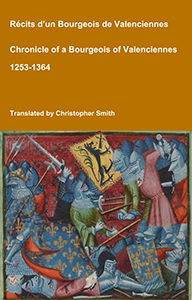
Chronicle of a Bourgeois of Valenciennes
Récits d’un bourgeois de Valenciennes aka The Chronicle of a Bourgeois of Valenciennes is a vivid 14th-century vernacular chronicle written by an anonymous urban chronicler from Valenciennes in the County of Hainaut. It survives in a manuscript that describes local and regional history from about 1253 to 1366, blending chronology, narrative episodes, and eyewitness-style accounts of political, military, and social events in medieval France, Flanders, and the Low Countries. The work begins with a chronological framework of events affecting Valenciennes and its region under rulers such as King Philip VI of France and the shifting allegiances of local nobility. It includes accounts of conflicts, sieges, diplomatic manoeuvres, and the impact of broader struggles like the Hundred Years’ War on urban life in Hainaut. Written from the perspective of a burgher (bourgeois) rather than a monastery or royal court, the chronicle offers a rare lay viewpoint on high politics and warfare, reflecting how merchants, townspeople, and civic institutions experienced the turbulence of the 13th and 14th centuries. Its narrative style combines straightforward reporting of events with moral and civic observations, making it a valuable source for readers interested in medieval urban society, regional politics, and the lived experience of war and governance in pre-modern Europe.
Available at Amazon in eBook and Paperback format.
Paternal Family Tree: Bridgeman
On 30th January 1606 Orlando Bridgeman 1st Baronet was born to Bishop John Bridgeman [aged 28].
In 1619 [his father] Bishop John Bridgeman [aged 41] was appointed Bishop of Chester.
On 16th August 1631 [his son] John Bridgeman 2nd Baronet was born to Orlando Bridgeman 1st Baronet [aged 25].
After 16th August 1631 [his daughter] Charlotte Bridgeman Lady Myddelton was born to Orlando Bridgeman 1st Baronet [aged 25]. She married after 1675 Thomas Myddelton 2nd Baronet, son of Thomas Myddelton 1st Baronet and Maria Cholmondeley, and had issue.
On 11th November 1652 [his father] Bishop John Bridgeman [aged 75] died at Moreton, Shropshire. He was buried at Kinnerley, Shropshire.
In June 1660 King Charles II of England Scotland and Ireland [aged 30] rewarded those who supported his Restoration...
6th William Wray 1st Baronet [aged 35] and John Talbot of Lacock [aged 29] were knighted.
7th Geoffrey Palmer 1st Baronet [aged 62] was created 1st Baronet Palmer of Carlton in Northampton
7th Orlando Bridgeman 1st Baronet [aged 54] was created 1st Baronet Bridgeman of Great Lever in Lancashire.
7th John Langham 1st Baronet [aged 76] was created 1st Baronet Langham of Cottesbrooke in Northamptonshire.
11th Henry Wright 1st Baronet [aged 23] was created 1st Baronet Wright of Dagenham. Ann Crew Lady Wright by marriage Lady Wright of Dagenham.
13th Nicholas Gould 1st Baronet was created 1st Baronet Gould of the City of London.
14th Thomas Allen 1st Baronet [aged 27] was created 1st Baronet Allen of Totteridge in Middlesex.
18th Thomas Cullum 1st Baronet [aged 73] was created 1st Baronet Cullum of Hastede in Suffolk.
19th Thomas Darcy 1st Baronet [aged 28] was created 1st Baronet Darcy of St Osith's.
22nd Robert Cordell 1st Baronet was created 1st Baronet Cordell of Long Melford.
22nd John Robinson 1st Baronet [aged 45] was created 1st Baronet Robinson of London. Anne Whitmore Lady Robinson [aged 48] by marriage Lady Robinson of London.
25th William Bowyer 1st Baronet [aged 47] was created 1st Baronet Bowyer of Denham Court. Margaret Weld Lady Bowyer [aged 43] by marriage Lady Bowyer of Denham Court.
25th Thomas Stanley 1st Baronet [aged 63] was created 1st Baronet Stanley of Alderley in Cheshire.
26th Jacob Astley 1st Baronet [aged 21] was created 1st Baronet Astley of Hill Morton.
27th William Wray 1st Baronet was created 1st Baronet Wray of Ashby in Lincolnshire. Olympia Tufton Lady Ashby [aged 36] by marriage Lady Wray of Ashby in Lincolnshire.
28th Oliver St John 1st Baronet [aged 36] was created 1st Baronet St John of Woodford in Northamptonshire.
29th Ralph Delaval 1st Baronet [aged 37] was created 1st Baronet Delaval of Seaton in Northumberland. Anne Leslie Lady Delaval by marriage Lady Delaval of Seaton in Northumberland.
30th Andrew Henley 1st Baronet [aged 38] was created 1st Baronet Henley of Henley in Somerset.


Samuel Pepys' Diary. 10th October 1660. In Sir Orlando Bridgman's [aged 54] charge, he did wholly rip up the unjustness of the war against the King from the beginning, and so it much reflects upon all the Long Parliament, though the King had pardoned them, yet they must hereby confess that the King do look upon them as traitors. To-morrow they are to plead what they have to say. At night to bed.
Samuel Pepys' Diary. 10th November 1662. Thence by water, and so by land to my Lord Crew's, and dined with him and his brother, I know not his name; where very good discourse; among others, of France's intention to make a patriarch of his own, independent from the Pope, by which he will be able to cope with the Spaniard in all councils, which hitherto he has never done. My Lord Crew told us how he heard my Lord of Holland say that, being Embassador about the match with the Queene-Mother [aged 23] that now is, the King [aged 32] of France [Louis XIII, in 1624.] insisted upon a dispensation from the Pope, which my Lord Holland making a question of, and that he was commanded to yield to nothing to the prejudice of our religion, says the King of France, "You need not fear that, for if the Pope will not dispense with the match, my Bishopp of Paris shall". By and by come in great Mr. Swinfen, the Parliament-man, who, among other discourse of the rise and fall of familys, told us of Bishopp Bridgeman (brother of Sir Orlando [aged 56]) who lately hath bought a seat anciently of the Levers, and then the Ashtons; and so he hath in his great hall window (having repaired and beautified the house) caused four great places to be left for coates of armes. In one, he hath put the Levers, with this motto, "Olim". In another the Ashtons, with this, "Heri". In the next his own, with this, "Hodie". In the fourth nothing but this motto, "Cras nescio cujus". Thence towards my brother's; met with Jack Cole in Fleet Street, and he and I went into his cozen Mary Cole's (whom I never saw since she was married), and drank a pint of wine and much good discourse. I found him a little conceited, but he had good things in him, and a man may know the temper of the City by him, he being of a general conversation, and can tell how matters go; and upon that score I will encourage his acquaintance.


Samuel Pepys' Diary. 31st August 1667. After having wrote my letters at the office in the afternoon, I in the evening to White Hall to see how matters go, and there I met with Mr. Ball, of the Excise-office, and he tells me that the Seal is delivered to Sir Orlando Bridgeman [aged 61]; the man of the whole nation that is the best spoken of, and will please most people; and therefore I am mighty glad of it. He was then at my Lord Arlington's [aged 49], whither I went, expecting to see him come out; but staid so long, and Sir W. Coventry [aged 39] coming thither, whom I had not a mind should see me there idle upon a post-night, I went home without seeing him; but he is there with his Seal in his hand. So I home, took up my wife, whom I left at Unthanke's, and so home, and after signing my letters to bed. This day, being dissatisfied with my wife's learning so few songs of Goodgroome, I did come to a new bargain with him to teach her songs at so much, viz.; 10s. a song, which he accepts of, and will teach her.


Samuel Pepys' Diary. 1st September 1667. Lord's Day. Up, and betimes by water from the Tower, and called at the Old Swan [Map] for a glass of strong water, and sent word to have little Michell and his wife come and dine with us to-day; and so, taking in a gentleman and his lady that wanted a boat, I to Westminster. Setting them on shore at Charing Cross [Map], I to Mrs. Martin's, where I had two pair of cuffs which I bespoke, and there did sit and talk with her.... [Missing text: "and no mas, ella having aquellos [ those ] upon her"] and here I did see her little girle my goddaughter, which will be pretty, and there having staid a little I away to Creed's chamber, and when he was ready away to White Hall, where I met with several people and had my fill of talk. Our new Lord-keeper, Bridgeman [aged 61], did this day, the first time, attend the King [aged 37] to chapel with his Seal. Sir H. Cholmly [aged 35] tells me there are hopes that the women will also have a rout, and particularly that my Baroness Castlemayne [aged 26] is coming to a composition with the King to be gone; but how true this is, I know not. Blancfort [aged 26] is made Privy-purse to the Duke of York [aged 33]; the Attorney-general [aged 69] is made Chief justice, in the room of my Lord Bridgeman; the Solicitor-general [aged 45] is made Attorney-general; and Sir Edward Turner [aged 50] made Solicitor-general.


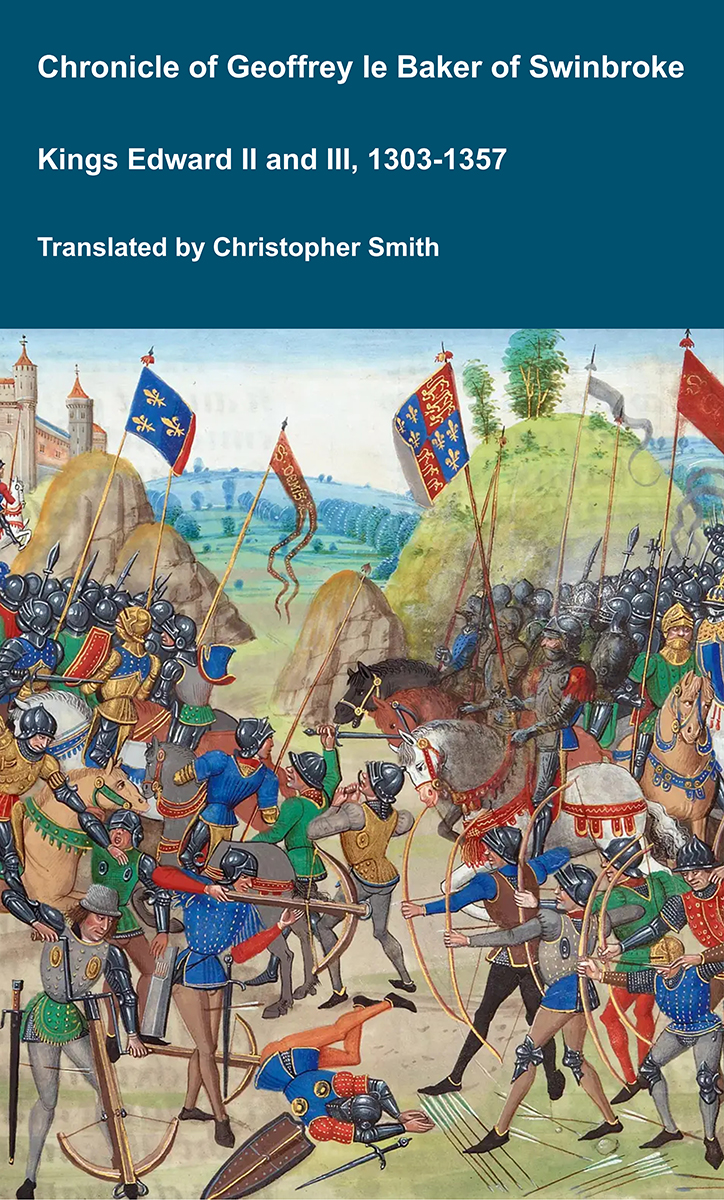
Chronicle of Geoffrey le Baker of Swinbroke
Baker was a secular clerk from Swinbroke, now Swinbrook, an Oxfordshire village two miles east of Burford. His Chronicle describes the events of the period 1303-1356: Gaveston, Bannockburn, Boroughbridge, the murder of King Edward II, the Scottish Wars, Sluys, Crécy, the Black Death, Winchelsea and Poitiers. To quote Herbert Bruce 'it possesses a vigorous and characteristic style, and its value for particular events between 1303 and 1356 has been recognised by its editor and by subsequent writers'. The book provides remarkable detail about the events it describes. Baker's text has been augmented with hundreds of notes, including extracts from other contemporary chronicles, such as the Annales Londonienses, Annales Paulini, Murimuth, Lanercost, Avesbury, Guisborough and Froissart to enrich the reader's understanding. The translation takes as its source the 'Chronicon Galfridi le Baker de Swynebroke' published in 1889, edited by Edward Maunde Thompson.
Available at Amazon in eBook and Paperback format.
Samuel Pepys' Diary. 4th September 1667. I met with Sir Samuel Morland [aged 42], who chewed me two orders upon the Exchequer, one of £600, and another of £400, for money assigned to him, which he would have me lend him money upon, and he would allow 12 per cent. I would not meddle with them, though they are very good; and would, had I not so much money out already on public credit. But I see by this his condition all trade will be bad. I staid and heard Alderman Barker's case of his being abused by the Council of Ireland, touching his lands there: all I observed there is the silliness of the King [aged 37], playing with his dog all the while, and not minding the business1, and what he said was mighty weak; but my Lord Keeper [aged 61] I observe to be a mighty able man.
Note 1. Lord Rochester [aged 20] wrote "His very dog at council board Sits grave and wise as any lord". Poems, 1697; p. 150.-the King's dogs were constantly stolen from him, and he advertised for their return. Some of these amusing advertisements are printed in "Notes and Queries" (seventh series, vol. vii., p. 26).


Samuel Pepys' Diary. 12th October 1667. At home we find that Sir W. Batten's [deceased] burial was to-day carried from hence, with a hundred or two of coaches, to Walthamstow, Essex [Map], and there buried. Here I hear by Mr. Pierce the surgeon; and then by Mr. Lewes, and also by Mr. Hater, that the Parliament hath met on Thursday last, and adjourned to Monday next. The King [aged 37] did make them a very kind speech, promising them to leave all to them to do, and call to account what and whom they pleased; and declared by my Lord Keeper [aged 61] how many, thirty-six, actes he had done since he saw them; among others, disbanding the army, and putting all Papists out of employment, and displacing persons that had managed their business ill, that the Parliament is mightily pleased with the King's speech, and voted giving him thanks for what he said and hath done; and, among things, would by name thank him for displacing my Chancellor [aged 58], for which a great many did speak in the House, but it was opposed by some, and particularly Harry Coventry [aged 48], who got that it should be put to a Committee to consider what particulars to mention in their thanks to the King, saying that it was too soon to give thanks for the displacing of a man, before they knew or had examined what was the cause of his displacing.


Samuel Pepys' Diary. 10th November 1667. Thence, not finding Sir W. Coventry [aged 39], and going back again home, we met him coming with the Lord Keeper [aged 61], and so returned and spoke with him in White Hall Garden, two or three turns, advising with him what we should do about Carcasse's bringing his letter into the Committee of Parliament, and he told us that the counsel he hath too late learned is, to spring nothing in the House, nor offer anything, but just what is drawn out of a man: that this is the best way of dealing with a Parliament, and that he hath paid dear, and knows not how much more he may pay, for not knowing it sooner, when he did unnecessarily produce the Duke of Albemarle's [aged 58] letter about Chatham, Kent [Map], which if demanded would have come out with all the advantages in the world to Sir W. Coventry, but, as he brought it out himself, hath drawn much evil upon him. After some talk of this kind, we back home, and there I to my chamber busy all the evening, and then to supper and to bed, my head running all night upon our businesses in Parliament and what examinations we are likely to go under before they have done with us, which troubles me more than it should a wise man and a man the best able to defend himself, I believe, of our own whole office, or any other, I am apt to think.


Samuel Pepys' Diary. 21st December 1667. At the office all the morning, and at noon home to dinner with my Clerks and Creed, who among other things all alone, after dinner, talking of the times, he tells me that the Nonconformists are mighty high, and their meetings frequented and connived at; and they do expect to have their day now soon; for my Lord of Buckingham [aged 39] is a declared friend to them, and even to the Quakers, who had very good words the other day from the King [aged 37] himself: and, what is more, the Archbishop of Canterbury [aged 69] is called no more to the Cabal, nor, by the way, Sir W. Coventry [aged 39]; which I am sorry for, the Cabal at present being, as he says, the King, and Duke of Buckingham, and Lord Keeper [aged 61], the Duke of Albemarle [aged 59], and Privy Seale [aged 61]. The Bishops, differing from the King in the late business in the House of Lords, having caused this and what is like to follow, for every body is encouraged nowadays to speak, and even to preach, as I have heard one of them, as bad things against them as ever in the year 1640; which is a strange change. He gone, I to the office, where busy till late at night, and then home to sit with my wife, who is a little better, and her cheek asswaged. I read to her out of "The History of Algiers", which is mighty pretty reading, and did discourse alone about my sister Pall's [aged 27] match, which is now on foot with one Jackson [aged 27], another nephew of Mr. Phillips's, to whom he hath left his estate.


Samuel Pepys' Diary. 21st March 1669. Lord's Day. Up, and by water over to Southwarke [Map]; and then, not getting a boat, I forced to walk to Stangate; and so over to White Hall, in a scull; where up to the Duke of York's [aged 35] dressing-room, and there met Harry Saville [aged 27], and understand that Sir W. Coventry [aged 41] is come to his house last night. I understand by Mr. Wren [aged 40] that his friends having, by Secretary Trevor [aged 45] and my Lord Keeper [aged 63], applied to the King [aged 38] upon his first coming home, and a promise made that he should be discharged this day, my Lord Arlington [aged 51] did anticipate them, by sending a warrant presently for his discharge which looks a little like kindness, or a desire of it; which God send! though I fear the contrary: however, my heart is glad that he is out.

Around 1670 Pieter Borsseler [aged 36]. Portrait of Orlando Bridgeman 1st Baronet [aged 63]. Chirk Castle.
John Evelyn's Diary. 26th May 1671. The Earl of Bristol's [aged 58] house in Queen's Street was taken for the Commissioners of Trade and Plantations, and furnished with rich hangings of the King's [aged 40]. It consisted of seven rooms on a floor, with a long gallery, gardens, etc. This day we met the Duke of Buckingham [aged 43], Earl of Lauderdale [aged 55], Lord Culpeper, Sir George Carteret [aged 61], Vice-Chamberlain, and myself, had the oaths given us by the Earl of Sandwich [aged 45], our President. It was to advise and counsel his Majesty, to the best of our abilities, for the well-governing of his Foreign Plantations, etc., the form very little differing from that given to the Privy Council. We then took our places at the Board in the Council-Chamber, a very large room furnished with atlases, maps, charts, globes, etc. Then came the Lord Keeper, Sir Orlando Bridgeman [aged 65], Earl of Arlington [aged 53], Secretary of State, Lord Ashley, Mr. Treasurer [aged 40], Sir John Trevor [aged 34], the other Secretary, Sir John Duncomb [aged 49], Lord Allington [aged 31], Mr. Grey, son to the Lord Grey, Mr. Henry Broncher, Sir Humphrey Winch [aged 49], Sir John Finch, Mr. Waller [aged 65], and Colonel Titus [aged 48], of the bedchamber, with Mr. Slingsby, Secretary to the Council, and two Clerks of the Council, who had all been sworn some days before. Being all set, our Patent was read, and then the additional Patent, in which was recited this new establishment; then, was delivered to each a copy of the Patent, and of instructions: after which, we proceeded to business.
On 1st October 1671 [his brother] Bishop Henry Bridgeman was consecrated as Bishop of Sodor and Man.
On 15th March 1672. The Royal Declaration of Indulgence was Charles II's [aged 41] attempt to extend religious liberty to Protestant nonconformists and Roman Catholics. It was highly controversial. Sir Orlando Bridgeman [aged 66] resigned as Lord Keeper of the Great Seal because he refused to apply the Great Seal to it.
John Evelyn's Diary. 13th October 1672. After sermon (being summoned before), I went to my Lord Keeper's, Sir Orlando Bridgeman [aged 66], at Essex House, where our new patent was opened and read, constituting us that were of the Council of Plantations, to be now of the Council of Trade also, both united. After the patent was read, we all took our oaths, and departed.
On 25th June 1674 Orlando Bridgeman 1st Baronet [aged 68] died. His son John [aged 42] succeeded 2nd Baronet Bridgeman of Great Lever in Lancashire.
John Evelyn's Diary. 27th June 1675. At Ely House, I went to the consecration of my worthy friend, the learned Dr. Barlow [aged 51], Warden of Queen's College, Oxford, now made Bishop of Lincoln. After it succeeded a magnificent feast, where were the Duke of Ormond [aged 64], Earl of Lauderdale [aged 59], the Lord Treasurer [aged 43], Lord Keeper, etc.


Abbot John Whethamstede’s Chronicle of the Abbey of St Albans
Abbot John Whethamstede's Register aka Chronicle of his second term at the Abbey of St Albans, 1451-1461, is a remarkable text that describes his first-hand experience of the beginning of the Wars of the Roses including the First and Second Battles of St Albans, 1455 and 1461, respectively, their cause, and their consequences, not least on the Abbey itself. His text also includes Loveday, Blore Heath, Northampton, the Act of Accord, Wakefield, and Towton, and ends with the Coronation of King Edward IV. In addition to the events of the Wars of the Roses, Abbot John, or his scribes who wrote the Chronicle, include details in the life of the Abbey such as charters, letters, land exchanges, visits by legates, and disputes, which provide a rich insight into the day-to-day life of the Abbey, and the challenges faced by its Abbot.
Available at Amazon in eBook and Paperback format.

Before 1691. John Riley [aged 44]. Portrait of Orlando Bridgeman 1st Baronet.
Great x 1 Grandfather: Edward Bridgeman 
GrandFather: Thomas Bridgeman
Father: Bishop John Bridgeman