

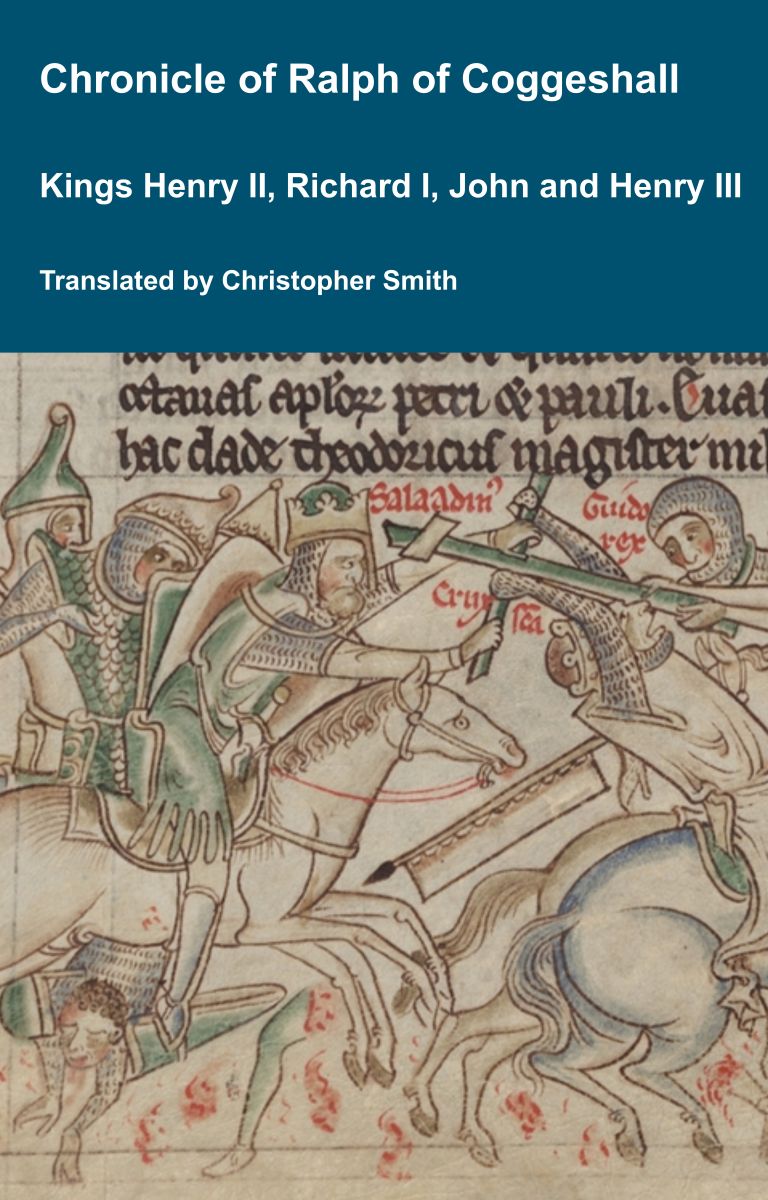
Chronicle of Abbot Ralph of Coggeshall
The Chronicle of Abbot Ralph of Coggeshall (Chronicon Anglicanum) is an indispensable medieval history that brings to life centuries of English and European affairs through the eyes of a learned Cistercian monk. Ralph of Coggeshall, abbot of the Abbey of Coggeshall in Essex in the early 13th century, continued and expanded his community’s chronicle, documenting events from the Norman Conquest of 1066 into the tumultuous reign of King Henry III. Blending eyewitness testimony, careful compilation, and the monastic commitment to record-keeping, this chronicle offers a rare narrative of political intrigue, royal power struggles, and social upheaval in England and beyond. Ralph’s work captures the reigns of pivotal figures such as Richard I and King John, providing invaluable insights into their characters, decisions, and the forces that shaped medieval rule. More than a simple annal, Chronicon Anglicanum conveys the texture of medieval life and governance, making it a rich source for scholars and readers fascinated by English history, monastic authorship, and the shaping of the medieval world.
Available at Amazon in eBook and Paperback format.
Paternal Family Tree: Wessex
King Æthelwulf of Wessex was born to King Egbert of Wessex.
In 802 [his father] King Egbert of Wessex [aged 29] succeeded King Wessex.
Anglo-Saxon Chronicle. 823. This year a battle was fought between the Welsh in Cornwall and the people of Devonshire, at Camelford, Cornwall; and in the course of the same year [his father] Egbert, king of the West-Saxons [aged 50], and Bernwulf, King of Mercia, fought a battle at Wilton, in which Egbert gained the victory, but there was great slaughter on both sides. Then sent he his son Ethelwulf into Kent, with a large detachment from the main body of the army, accompanied by his bishop, Elstan, and his alderman, Wulfherd; who drove Baldred, the king, northward over the Thames. Whereupon the men of Kent immediately submitted to him; as did also the inhabitants of Surrey, and Sussex, and Essex; who had been unlawfully kept from their allegiance by his relatives. The same year also, the king of the East-Angles, and his subjects besought King Egbert to give them peace and protection against the terror of the Mercians; whose king, Bernwulf, they slew in the course of the same year.
In or before 838 King Æthelwulf of Wessex and Osburgh Queen Consort Wessex were married. She by marriage Queen Consort Wessex. He the son of King Egbert of Wessex [aged 64].
Around 838 [his daughter] Æthelswith Wessex Queen Consort Mercia was born to King Æthelwulf of Wessex and [his wife] Osburgh Queen Consort Wessex. She married May 853 King Burgred of Mercia.
In 839 [his son] King Æthelstan of Kent was appointed King of Kent by his father King Æthelwulf of Wessex.
In 839 [his father] King Egbert of Wessex [aged 66] died. His son Æthelwulf succeeded King Wessex.
Anglo-Saxon Chronicle. 839. In this year, [his father] King Ecgbryht [aged 66] passed away, and previously, King Offa of Mercia and King Beorhtric of Wessex had exiled him for three years from the land of the English to the land of the Franks, before he became king. And Beorhtric supported Offa in this because he had Offa's daughter [Queen Eadburga of Wessex] as his queen. And Ecgbryht reigned for thirty-seven years and seven months, and Æthelwulf, son of Ecgbryht, succeeded to the kingdom of the West Saxons, and he gave his son Æthelstan the kingdom of the Kentish people, East Saxons, Surrey, and South Saxons.
Manuscript A. 836. Her Ecgbryht cyning forþferde, 7 hine hæfde ær Offa Miercna cyning 7 Beorhtric Wesseaxna cyning afliemed .iii. gear of Angelcynnes lande on Fronclond, ær he cyning wære, 7 þy fultomode Beorhtric Offan þy he hæfde his dohtor him to cuene; 7 se Ecgbyht ricsode .xxxvii. wintra, .vii. monaþ, 7 feng Ęþelwulf Ecgbrehting to Wesseaxna rice, 7 he salde his suna Ęþelstane Cantwara rice 7 Eastseaxna 7 Suþrigea 7 Suþseaxna.
Anglo-Saxon Chronicle. 840. This year King Ethelwulf fought at Charmouth with thirty-five ship's-crews, and the Danes remained masters of the place. The Emperor Louis [aged 62] died this year.
Anglo-Saxon Chronicle. The same year, ere midwinter, died [his future father-in-law] Charles, king of the Franks [aged 16]. He was slain by a boar; and one year before his brother [aged 36] died, who had also the Western kingdom. They were both the sons of Louis [aged 62], who also had the Western kingdom, and died the same year that the sun was eclipsed. He was the son of that Charles whose [his future daughter-in-law] daughter Ethelwulf, king of the West-Saxons, had to wife.

Anne Boleyn. Her Life as told by Lancelot de Carle's 1536 Letter.
In 1536, two weeks after the execution of Anne Boleyn, her brother George and four others, Lancelot du Carle, wrote an extraordinary letter that described Anne's life, and her trial and execution, to which he was a witness. This book presents a new translation of that letter, with additional material from other contemporary sources such as Letters, Hall's and Wriothesley's Chronicles, the pamphlets of Wynkyn the Worde, the Memorial of George Constantyne, the Portuguese Letter and the Baga de Secrets, all of which are provided in Appendices.
Available at Amazon in eBook and Paperback format.
Around 847 [his son] King Æthelred of Wessex was born to King Æthelwulf of Wessex and [his wife] Osburgh Queen Consort Wessex. He married Wulfthryth Unknown Queen Anglo Saxons and had issue.
In 849 [his son] King Alfred "The Great" of Wessex was born to King Æthelwulf of Wessex and [his wife] Osburgh Queen Consort Wessex at Wantage, Berkshire. He married 868 Æalhswith of Mercia Queen Consort of England, daughter of Æthelred Mucel Mercia Earldorman Gaini and Eadburh of Mercia, and had issue.
Anglo-Saxon Chronicle. 851. This year Alderman Ceorl, with the men of Devonshire, fought the heathen army at Wemburg [Map], and after making great slaughter obtained the victory. The same year King Athelstan and Alderman Elchere fought in their ships, and slew a large army at Sandwich [Map] in Kent, taking nine ships and dispersing the rest. The heathens now for the first time remained over winter in the Isle of Thanet [Map]. The same year came three hundred and fifty ships into the mouth of the Thames; the crew of which went upon land, and stormed Canterbury, Kent [Map] and London; putting to flight Bertulf, king of the Mercians, with his army; and then marched southward over the Thames into Surrey. Here Ethelwulf and his son Ethelbald, at the head of the West-Saxon army, fought with them at Ockley [Map], and made the greatest slaughter of the heathen army that we have ever heard reported to this present day. There also they obtained the victory.
Assers Life of Alfred 851. 851. 5. Battle of Aclea.14 Having done these things there, the aforesaid heathen host went into Surrey, which is a shire situated on the south shore of the river Thames, and to the west of Kent. And Æthelwulf, King of the Saxons, and his son Æthelbald, with the whole army, fought a long time against them at a place called Aclea15, that is, 'Oak-plain'; there, after a lengthy battle, which was fought with much bravery on both sides, the most part of the heathen horde was utterly destroyed and slain, so that we never heard of their being so smitten, either before or since, in any region, in one day16; and the Christians gained an honorable victory, and kept possession of the battle-field.
Note 14. Based upon the Chronicle.
Note 15. Stevenson is inclined to reject this customary identification with Oakley, in Surrey.
Note 16. The source - the Chronicle - says: 'And there made the greatest slaughter among the heathen army that we have heard reported to the present day.'
In 852 [his son] King Æthelstan of Kent died. He may have been buried at Winchester Old Minster.
Anglo-Saxon Chronicle. 853. This year [his future son-in-law] Burhred, King of Mercia, with his council, besought King Ethelwulf to assist him to subdue North-Wales. He did so; and with an army marched over Mercia into North-Wales, and made all the inhabitants subject to him. The same year King Ethelwulf sent his son Alfred to Rome [aged 4]; and Leo, who was then pope, consecrated him king, and adopted him as his spiritual son. The same year also Elchere with the men of Kent, and Huda with the men of Surrey, fought in the Isle of Thanet [Map] with the heathen army, and soon obtained the victory; but there were many men slain and drowned on either hand, and both the aldermen killed. Burhred, the Mercian king, about this time received in marriage the daughter [aged 15] of Ethelwulf, king of the West-Saxons.
Assers Life of Alfred 853. 853. 9. Other Events of 853.24 That same year also, Ealdorman Ealhere with the men of Kent, and Huda with the men of Surrey, fought bravely and resolutely against an army of the heathen in the island which is called Tenet [Map]25 in the Saxon tongue, but Ruim in the Welsh language. At first the Christians were victorious. The battle lasted a long time; many fell on both sides, and were drowned in the water; and both the ealdormen were there slain. In the same year also, after Easter, Æthelwulf, King of the West Saxons, gave his daughter [aged 15] to Burgred, King of the Mercians, as his queen, and the marriage was celebrated in princely wise at the royal vill of Chippenham [Map].
Note 24. Based upon the Chronicle.
Assers Life of Alfred 853. 853. 7. Æthelwulf assists Burgred.18 In the year of our Lord's incarnation 853, which was the fifth of King Alfred's life, [his future son-in-law] Burgred, King of the Mercians, sent messengers to beseech Æthelwulf, King of the West Saxons, to come and help him in reducing to his sway the inhabitants of Mid-Wales, who dwell between Mercia and the western sea, and who were struggling against him beyond measure. So without delay King Æthelwulf, on receipt of the embassy, moved his army, and advanced with King Burgred against Wales19; and immediately upon his entrance he ravaged it, and reduced it under subjection to Burgred. This being done, he returned home.
Note 18. Mainly from the Chronicle.
Note 19. The 'North Welsh' of the Chronicle.
Assers Life of Alfred 853. 853. 8. Alfred at Rome.20 In that same year King Æthelwulf sent his above-named son Alfred [aged 4] to Rome, with an honorable escort both of nobles and commoners. Pope Leo at that time presided over the apostolic see, and he anointed as king21 the aforesaid child22 Alfred in the town, and, adopting him as his son, confirmed him.23
Note 20. Based upon the Chronicle.
Note 21. MS. in regem.
Note 22. MS. infantem.
Note 23. 'A letter from the pope to Alfred's father, regarding the ceremony at Rome, has been fortunately preserved for us in a twelfth-century collection of papal letters, now in the British Museum.... The letter is as follows: "Edeluulfo, regi Anglorum [marginal direction for rubricator].
Around May 853 [his son-in-law] King Burgred of Mercia and Æthelswith Wessex Queen Consort Mercia [aged 15] were married at Chippenham, Wiltshire [Map]. She by marriage Queen Consort Mercia. She the daughter of King Æthelwulf of Wessex and Osburgh Queen Consort Wessex.
Anglo-Saxon Chronicle. 854. This year the heathen men34 for the first time remained over winter in the Isle of Shepey [Map]. The same year King Ethelwulf registered a TENTH of his land over all his kingdom for the honour of God and for his own everlasting salvation. The same year also he went to Rome with great pomp, and was resident there a twelvemonth. Then he returned homeward; and [his future father-in-law] Charles, king of the Franks [aged 30], gave him his daughter, whose name was [his future daughter-in-law] Judith [aged 10], to be his queen. After this he came to his people, and they were fain to receive him; but about two years after his residence among the Franks he died; and his body lies at Winchester. He reigned eighteen years and a half. And Ethelwulf was the son of Egbert, Egbert of Ealhmund, Ealhmund of Eafa, Eafa of Eoppa, Eoppa of Ingild; Ingild was the brother of Ina, king of the West-Saxons, who held that kingdom thirty-seven winters, and afterwards went to St. Peter, where he died. And they were the sons of Cenred, Cenred of Ceolwald, Ceolwald of Cutha, Cutha of Cuthwin, Cuthwin of Ceawlin, Ceawlin of Cynric, Cynric of Creoda, Creoda of Cerdic, Cerdic of Elesa, Elesa of Esla, Esla of Gewis, Gewis of Wig, Wig of Freawine, Freawine of Frithugar, Frithugar of Brond, Brond of Balday, Balday of Woden, Woden of Frithuwald, Frithuwald of Freawine, Freawine of Frithuwualf, Frithuwulf of Finn, Finn of Godwulf, Godwulf of Great, Great of Taetwa, Taetwa of Beaw, Beaw of Sceldwa, Sceldwa of Heremod, Heremod of Itermon, Itermon of Hathra, Hathra of Hwala, Hwala of Bedwig, Bedwig of Sceaf; that is, the son of Noah, who was born in Noah's ark: Laznech, Methusalem, Enoh, Jared, Malalahel, Cainion, Enos, Seth, Adam the first man, and our Father, that is, Christ. Amen. Then two sons of Ethelwulf succeeded to the kingdom; Ethelbald to Wessex, and Ethelbert to Kent, Essex, Surrey, and Sussex. Ethelbald reigned five years. Alfred [aged 5], his third son, Ethelwulf had sent to Rome; and when the pope heard say that he was dead, he consecrated Alfred king, and held him under spiritual hands, as his father Ethelwulf had desired, and for which purpose he had sent him thither.
Note 34. i.e. the Danes; or, as they are sometimes called, Northmen, which is a general term including all those numerous tribes that issued at different times from the north of Europe, whether Danes, Norwegians, Sweons, Jutes, or Goths, etc.; who were all in a state of paganism at this time.
Assers Life of Alfred 855. 855. 12. Rebellion of Æthelbald.29 In the meantime, however, whilst King Æthelwulf was residing this short time beyond sea, a base deed was done in the western part of Selwood30, repugnant to the morals of all Christians. For King Æthelbald, Ealhstan, Bishop of the church of Sherborne, and Eanwulf, Ealdorman of Somerset, are said to have formed a conspiracy to the end that King Æthelwulf, on his return from Rome, should not again be received in his kingdom. This unfortunate occurrence, unheard-of in all previous ages, is ascribed by many to the bishop and ealdorman alone, since, say they, it resulted from their counsels. Many also ascribe it solely to the insolence of the king, because he was headstrong in this matter and in many other perversities, as I have heard related by certain persons, and as was proved by the result of that which followed. For on his return from Rome, Æthelwulf's son aforesaid, with all his counselors, or rather waylayers, attempted to perpetrate the crime of repulsing the king from his own kingdom; but neither did God suffer it, nor did the nobles of all Wessex consent thereto. For to prevent this irremediable danger to Wessex of a war between father and son, or rather of the whole nation waging civil war more fiercely and cruelly from day to day, as they espoused the cause of the one or the other, - by the extraordinary clemency of the father, seconded by the consent of all the nobles, the kingdom which had hitherto been undivided was parted between the two, the eastern districts being given to the father, and the western to the son. Thus where the father ought by just right to have reigned, there did his unjust and obstinate son bear rule; for the western part of Wessex is always superior to the eastern.
Note 29. Original.
Note 30. Comprising Somerset, Devon, and Cornwall.
Assers Life of Alfred 855. 855. 11. Æthelwulf journeys to Rome.27 In that same year the aforesaid worshipful King Æthelwulf freed the tenth part of all his kingdom from every royal service and tribute, and offered it up as an everlasting grant to God the One and Three, on the cross of Christ, for the redemption of his own soul and those of his predecessors. In the same year he went to Rome with much honor; and taking with him his son, the aforesaid King Alfred, a second time on the same journey, because he loved him more than his other sons, he remained there a whole year. After this he returned to his own country, bringing with him [his future daughter-in-law] Judith [aged 11], daughter of [his future father-in-law] Charles [aged 31], King of the Franks.28
Note 27. Based upon the Chronicle.
Note 28. Charles the Bald.
Chronicle of Abbot Ralph of Coggeshall
The Chronicle of Abbot Ralph of Coggeshall (Chronicon Anglicanum) is an indispensable medieval history that brings to life centuries of English and European affairs through the eyes of a learned Cistercian monk. Ralph of Coggeshall, abbot of the Abbey of Coggeshall in Essex in the early 13th century, continued and expanded his community’s chronicle, documenting events from the Norman Conquest of 1066 into the tumultuous reign of King Henry III. Blending eyewitness testimony, careful compilation, and the monastic commitment to record-keeping, this chronicle offers a rare narrative of political intrigue, royal power struggles, and social upheaval in England and beyond. Ralph’s work captures the reigns of pivotal figures such as Richard I and King John, providing invaluable insights into their characters, decisions, and the forces that shaped medieval rule. More than a simple annal, Chronicon Anglicanum conveys the texture of medieval life and governance, making it a rich source for scholars and readers fascinated by English history, monastic authorship, and the shaping of the medieval world.
Available at Amazon in eBook and Paperback format.
Assers Life of Alfred 856. 856. 13. Judith's Position in Wessex.31 When Æthelwulf, therefore, returned from Rome, the whole nation, as was fitting, so rejoiced32 in the arrival of the ruler that, if he had allowed them, they would have expelled his unruly son Æthelbald, with all his counselors, from the kingdom. But he, as I have said, acting with great clemency and prudent counsel, would not act in this way, lest the kingdom should be exposed to peril. He likewise bade Judith [aged 12], daughter of King Charles [aged 32], whom he had received from her father, take her seat by his own side on the royal throne, without any dispute or enmity from his nobles even to the end of his life, though contrary to the perverse custom of that nation.33 For the nation of the West Saxons does not allow the queen to sit beside the king, nor to be called queen, but only the king's wife; which refusal, or rather reproach, the chief persons of that land say arose from a certain headstrong and malevolent queen of the nation, who did all things so contrary to her lord and to the whole people that not only did the hatred which she brought upon herself bring to pass her exclusion from the queenly throne, but also entailed the same corruption upon those who came after her, since, in consequence of the extreme malignity of that queen, all the inhabitants of the land banded themselves together by an oath never in their lives to let any king reign over them who should bid his queen take her seat on the royal throne by his side. And because, as I think, it is not known to many whence this perverse and detestable custom first arose in Wessex, contrary to the custom of all the Germanic peoples, it seems to me right to explain it a little more fully, as I have heard it from my lord Alfred the truth-teller, King of the Anglo-Saxons, who often told me about it, as he also had heard it from many men of truth who related the fact, or, I should rather say, expressly preserved the remembrance of it.
Note 31. Chiefly original.
Note 32. From the Chronicle.
Note 33. Prudentius of Troyes (in Annales Bertiniani, an. 856, ed. Waitz, p. 47), says of Bishop Hincmar: 'Eam ... reginæ nomine insignit, quod sibi suæque genti eatenus fuerat insuetum.'
In 856 King Æthelwulf of Wessex and Judith Carolingian Queen Consort Wessex [aged 12] were married. She by marriage Queen Consort Wessex. She the daughter of Charles "Bald" I King West Francia [aged 32] and Ermentrude Orléans Queen Consort West Francia. He the son of King Egbert of Wessex.
Assers Life of Alfred 858. 858. 16. Æthelwulf's Will.39 Now King Æthelwulf lived two years after his return from Rome; during which, among many other good deeds of this present life, reflecting on his departure according to the way of all flesh, that his sons might not quarrel unreasonably after their father's death, he ordered a will or letter of instructions to be written40, in which he commanded that his kingdom should be duly divided between his two eldest sons; his private heritage between his sons, his daughter, and his relatives; and the money which he should leave behind him between his soul41 and his sons and nobles. Of this prudent policy I have thought fit to record a few instances out of many for posterity to imitate, namely, such as are understood to belong principally to the needs of the soul; for the others, which relate only to human stewardship, it is not necessary to insert in this little work, lest prolixity should create disgust in those who read or wish to hear. For the benefit of his soul, then, which he studied to promote in all things from the first flower of his youth, he directed that, through all his hereditary land, one poor man to every ten hides42, either native or foreigner, should be supplied with food, drink, and clothing by his successors unto the final Day of Judgment; on condition, however, that that land should still be inhabited both by men and cattle, and should not become deserted. He commanded also a large sum of money, namely, three hundred mancuses43, to be carried annually to Rome for the good of his soul, to be there distributed in the following manner: a hundred mancuses in honor of St. Peter, especially to buy oil for the lights of that apostolic church on Easter Eve, and also at cockcrow; a hundred mancuses in honor of St. Paul, for the same purpose of buying oil for the church of St. Paul the apostle, to fill the lamps for Easter Eve and cockcrow; and a hundred mancuses for the universal apostolic Pope.
Note 39. Mostly original.
Note 40. In Alfred's will (Cart. Sax. 2. 177. 9) he refers to this as 'Aþulfes cinges yrfegewrit' (Stevenson).
Note 41. That is, for the good of his soul.
Note 42. Lat. manentibus.
Note 43. A mancus was thirty pence, one-eighth of a pound.
Assers Life of Alfred 858. 858. 17. Æthelbald marries Judith.44 But when King Æthelwulf was dead [and buried at Winchester [Map]]45, his son Æthelbald, contrary to God's prohibition and the dignity of a Christian, contrary also to the custom of all the heathen46, ascended his father's bed, and married Judith [aged 14], daughter of Charles [aged 34], King of the Franks, incurring much infamy from all who heard of it. During two years and a half of lawlessness he held after his father the government of the West Saxons.
Note 44. Original.
Note 45. From Florence of Worcester. The Annals of St. Neots have: 'and buried at Steyning' (Stemrugam).
Note 46. This last statement is incorrect.
Around 858 King Æthelbald of Wessex and Judith Carolingian Queen Consort Wessex [aged 14] were married. She by marriage Queen Consort Wessex. She the daughter of Charles "Bald" I King West Francia [aged 34] and Ermentrude Orléans Queen Consort West Francia. He the son of King Æthelwulf of Wessex and Osburgh Queen Consort Wessex.
On 13th January 858 King Æthelwulf of Wessex died. His son Æthelbald succeeded King Wessex.
Around 870 [his former daughter-in-law] Judith Carolingian Queen Consort Wessex [aged 26] died.
[his son] King Æthelberht of Wessex was born to King Æthelwulf of Wessex and Osburgh Queen Consort Wessex.
[his son] King Æthelbald of Wessex was born to King Æthelwulf of Wessex and Osburgh Queen Consort Wessex. He married 858 Judith Carolingian Queen Consort Wessex, daughter of Charles "Bald" I King West Francia and Ermentrude Orléans Queen Consort West Francia.
King Æthelstan of Kent was born to King Æthelwulf of Wessex and Osburgh Queen Consort Wessex. There is some confusion as to whether he was Æthelwulf's son with some versions of the Anglo-Saxon Chronicle stating he was Æthelwulf's brother.
Baldwin "Iron Arm" I Margrave Flanders and Judith Carolingian Queen Consort Wessex were married. She by marriage Margravine Flanders. She the daughter of Charles "Bald" I King West Francia and Ermentrude Orléans Queen Consort West Francia.
Kings Wessex: Son of King Egbert of Wessex
Great x 4 Grandfather: Cenred Wessex 2 x Great Grand Son of Ceawlin King Wessex
Great x 3 Grandfather: Ingild Wessex 3 x Great Grand Son of Ceawlin King Wessex
Great x 2 Grandfather: Eoppa Wessex 4 x Great Grand Son of Ceawlin King Wessex
Great x 1 Grandfather: Eafa Wessex 5 x Great Grand Son of Ceawlin King Wessex
GrandFather: Ealmund King of Kent 6 x Great Grand Son of Ceawlin King Wessex
Father: King Egbert of Wessex 7 x Great Grand Son of Ceawlin King Wessex
King Æthelwulf of Wessex Son of King Egbert of Wessex