

The History of William Marshal was commissioned by his son shortly after William’s death in 1219 to celebrate the Marshal’s remarkable life; it is an authentic, contemporary voice. The manuscript was discovered in 1861 by French historian Paul Meyer. Meyer published the manuscript in its original Anglo-French in 1891 in two books. This book is a line by line translation of the first of Meyer’s books; lines 1-10152. Book 1 of the History begins in 1139 and ends in 1194. It describes the events of the Anarchy, the role of William’s father John, John’s marriages, William’s childhood, his role as a hostage at the siege of Newbury, his injury and imprisonment in Poitou where he met Eleanor of Aquitaine and his life as a knight errant. It continues with the accusation against him of an improper relationship with Margaret, wife of Henry the Young King, his exile, and return, the death of Henry the Young King, the rebellion of Richard, the future King Richard I, war with France, the death of King Henry II, and the capture of King Richard, and the rebellion of John, the future King John. It ends with the release of King Richard and the death of John Marshal.
Available at Amazon in eBook and Paperback format.
Paternal Family Tree: Orange
In 1625 [his father] Frederick Henry Orange Nassau II Prince Orange [aged 40] and [his mother] Amalia Solms Braunfels Princess Orange [aged 22] were married. She by marriage Princess Orange.


On 27th May 1626 William Orange Nassau II Prince Orange was born to Frederick Henry Orange Nassau II Prince Orange [aged 42] and Amalia Solms Braunfels Princess Orange [aged 23].
John Evelyn's Diary. On the 27th April 1641, came over out of Holland the young Prince of Orange [aged 14], with a splendid equipage, to make love to his [his future father-in-law] Majesty's [aged 40] eldest [his future wife] daughter [aged 9], the now Princess Royal.


On 2nd May 1641 William Orange Nassau II Prince Orange [aged 14] and Mary Stewart Princess Orange [aged 9] were married. She the daughter of King Charles I of England, Scotland and Ireland [aged 40] and Henrietta Maria Bourbon Queen Consort England [aged 31].
On 23rd October 1642 the Battle of Edge Hill was fought at Edge Hill [Map]. The Royal army was commanded by [his father-in-law] King Charles I of England, Scotland and Ireland [aged 41] (with his son [his brother-in-law] King Charles II of England Scotland and Ireland [aged 12] present), Prince Rupert Palatinate Simmern 1st Duke Cumberland [aged 22] and Richard Spencer [aged 49] commanded the army that included Maurice Palatinate Simmern [aged 21], Richard Byron 2nd Baron Byron [aged 36], Lucius Carey 2nd Viscount Falkland [aged 32], Charles Cavendish [aged 22], Henry Newton aka Puckering 3rd Baronet [aged 24], Spencer Compton 2nd Earl of Northampton [aged 41], Thomas Salusbury 2nd Baronet [aged 30], John Byron 1st Baron Byron [aged 43] and William Feilding 1st Earl Denbigh [aged 55].
George Stewart 9th Seigneur D'Aubigny [aged 24] was killed.
Of the Parliamentary army Basil Feilding 2nd Earl Denbigh [aged 34] and Robert Devereux 3rd Earl Essex [aged 51]. Oliver St John 5th Baron St John [aged 39] was wounded.
Samuel Sandes [aged 27] commanded a troop of horse.
Richard Sandes [aged 26] was killed.
Thomas Strickland [aged 20] was knighted on the field for his gallantry.
Henry Hunloke 1st Baronet [aged 24] was knighted by King Charles I of England, Scotland and Ireland.
William Dugdale [aged 37] witnessed the battle and subsequently surveyed the battlefield.
John Hinton [aged 38] was present.
Edward Verney [aged 52] was killed.
John Assheton [aged 29] was killed.
Robert Bertie 1st Earl Lindsey [aged 59] was killed. His son Montagu [aged 34] succeeded 2nd Earl Lindsey, 15th Baron Willoughby de Eresby.
William Pennyman 1st Baronet [aged 35] commanded a regiment, of which he served as Colonel, which he led for the King.
Edward Stradling 2nd Baronet [aged 42] fought for the King, was captured imprisoned for seven months, and died a month after his release.
In November 1644 George Goring 1st Earl Norwich [aged 59] was created 1st Earl Norwich by [his brother-in-law] King Charles II of England Scotland and Ireland [aged 14] for his support during the Civil War. The last Earl Norwich of the previous creation was his uncle Edward Denny 1st Earl Norwich brother of his mother Anne Denny [aged 77].
In 1645 William Orange Nassau II Prince Orange [aged 18] was appointed 441st Knight of the Garter by [his father-in-law] King Charles I of England, Scotland and Ireland [aged 44]..
In 1646 Elizabeth Capell [aged 54] died in the Channel Islands [Map] to where her husband had travelled with [his brother-in-law] King Charles II of England Scotland and Ireland [aged 15].
On 14th March 1647 [his father] Frederick Henry Orange Nassau II Prince Orange [aged 63] died. His son William [aged 20] succeeded II Prince Orange. [his wife] Mary Stewart Princess Orange [aged 15] by marriage Princess Orange.
In 1648 [his brother-in-law] King Charles II of England Scotland and Ireland [aged 17] travelled to where his sister [his wife] Mary Stewart Princess Orange [aged 16] and brother in law William Orange Nassau II Prince Orange [aged 21] were living at The Hague.
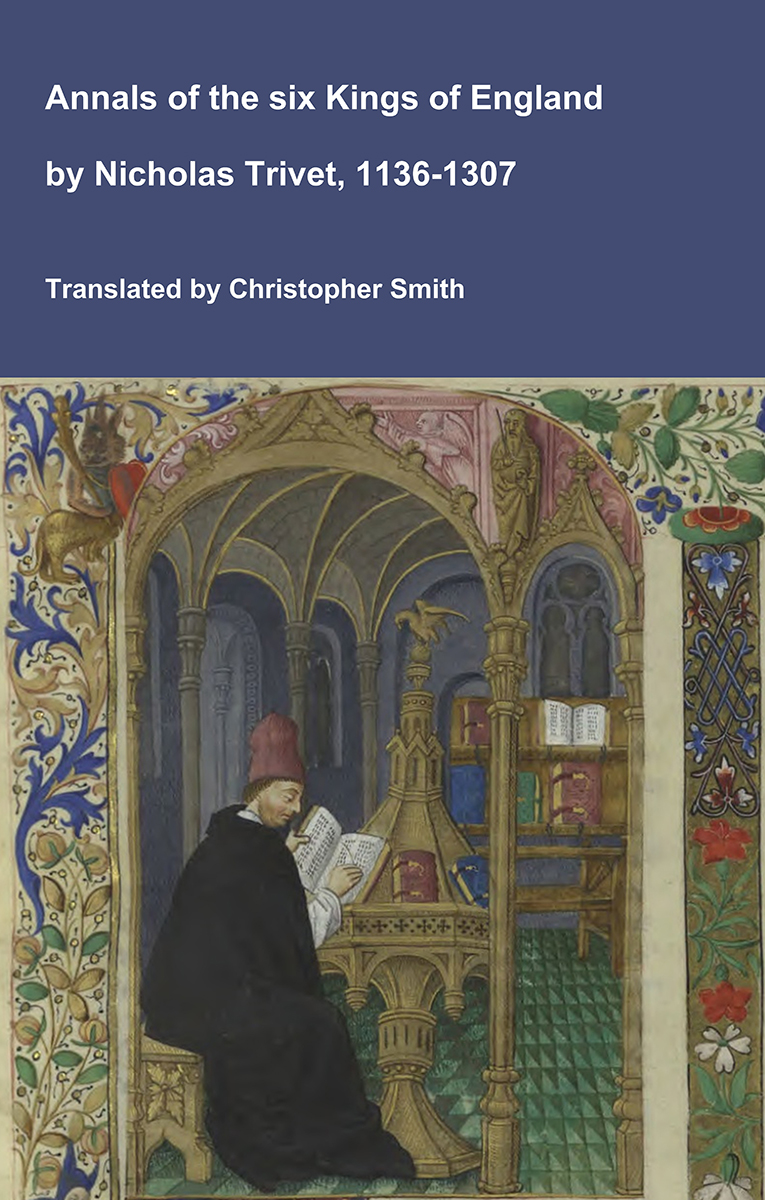
Annals of the six Kings of England by Nicholas Trivet
Translation of the Annals of the Six Kings of England by that traces the rise and rule of the Angevin aka Plantagenet dynasty from the mid-12th to early 14th century. Written by the Dominican scholar Nicholas Trivet, the work offers a vivid account of English history from the reign of King Stephen through to the death of King Edward I, blending political narrative with moral reflection. Covering the reigns of six monarchs—from Stephen to Edward I—the chronicle explores royal authority, rebellion, war, and the shifting balance between crown, church, and nobility. Trivet provides detailed insight into defining moments such as baronial conflicts, Anglo-French rivalry, and the consolidation of royal power under Edward I, whose reign he describes with particular immediacy. The Annals combines careful year-by-year reporting with thoughtful interpretation, presenting history not merely as a sequence of events but as a moral and political lesson. Ideal for readers interested in medieval history, kingship, and the origins of the English state, this chronicle remains a valuable and accessible window into the turbulent world of the Plantagenet kings.
Available at Amazon in eBook and Paperback format.
Around May 1650 John Germain 1st Baronet was born. His paternity the subject of speculation with some believing he was the illegitimate son of William Orange Nassau II Prince Orange [aged 23].
On 4th November 1650 [his son] King William III of England, Scotland and Ireland was born to William Orange Nassau II Prince Orange [aged 24] and [his wife] Mary Stewart Princess Orange [aged 19]. He a grandson of King Charles I of England, Scotland and Ireland. He married 4th November 1677 his first cousin Mary Stewart II Queen England Scotland and Ireland, daughter of King James II of England Scotland and Ireland and Anne Hyde Duchess of York.


On 6th November 1650 William Orange Nassau II Prince Orange [aged 24] died. His son William succeeded III Prince Orange.
John Evelyn's Diary. 16th November 1650. I went to Monsieur Visse's, the French King's Secretary, to a concert of French music and voices, consisting of twenty-four, two theorbos, and but one bass viol, being a rehearsal of what was to be sung at vespers at St. Cecilia's, on her feast, she being patroness of Musicians. News arrived of the death of the Princess of Orange [deceased] of the smallpox. [Note. This is a transcription error - should read Prince.].
Samuel Pepys' Diary. 14th May 1660. In the morning when I woke and rose, I saw myself out of the scuttle close by the shore, which afterwards I was told to be the Dutch shore; the Hague was clearly to be seen by us. My Lord went up in his nightgown into the cuddy1, to see how to dispose thereof for himself and us that belong to him, to give order for our removal to-day. Some nasty Dutchmen came on board to proffer their boats to carry things from us on shore, &c., to get money by us. Before noon some gentlemen came on board from the shore to kiss my Lord's hands. And by and by Mr. North [aged 24] and Dr. Clerke went to kiss the Queen of Bohemia's' hands, from my Lord, with twelve attendants from on board to wait on them, among which I sent my boy, who, like myself, is with child to see any strange thing. After noon they came back again after having kissed the Queen of Bohemia's [aged 63] hand, and were sent again by my Lord to do the same to the [his son] Prince of Orange [aged 9]2.
Note 1. "A sort of cabin or cook-room, generally in the fore-part, but sometimes near the stern of lighters and barges of burden".-Smyth's Sailor's Word-Book.
Note 2. Son of the Prince of Orange and [his former wife] Mary [aged 28], eldest daughter of Charles I afterwards William III He was then in his tenth year, having been born in 1650.


Samuel Pepys' Diary. 17th May 1660. Up early to write down my last two days' observations. Dr. Clerke came to me to tell me that he heard this morning, by some Dutch that are come on board already to see the ship, that there was a Portuguese taken yesterday at the Hague, that had a design to kill the King. But this I heard afterwards was only the mistake upon one being observed to walk with his sword naked, he having lost his scabbard. Before dinner Mr. Edw. Pickering [aged 42] and I, W. Howe, Pim, and my boy [aged 12], to Scheveling, where we took coach, and so to the Hague, where walking, intending to find one that might show us the King incognito, I met with Captain Whittington (that had formerly brought a letter to my Lord from the Mayor of London) and he did promise me to do it, but first we went and dined at a French house, but paid 16s. for our part of the club. At dinner in came Dr. Cade, a merry mad parson of the [his former brother-in-law] King's [aged 29]. And they two after dinner got the child and me (the others not being able to crowd in) to see the King, who kissed the child very affectionately. Then we kissed his, and the Duke of York's, and the Princess Royal's hands. The King seems to be a very sober man; and a very splendid Court he hath in the number of persons of quality that are about him, English very rich in habit. From the King to the Lord Chancellor1, who did lie bed-rid of the gout: he spoke very merrily to the child and me. After that, going to see the Queen of Bohemia, I met with Dr. Fullers whom I sent to a tavern with Mr. Edw. Pickering, while I and the rest went to see the [his former mother-in-law] Queen [aged 50], who used us very respectfully; her hand we all kissed. She seems a very debonaire, but plain lady. After that to the Dr.'s, where we drank a while or so. In a coach of a friend's of Dr. Cade we went to see a house of the [his former wife] Princess Dowager's [aged 28]2 in a park about half-a-mile or a mile from the Hague, where there is one, the most beautiful room for pictures in the whole world. She had here one picture upon the top, with these words, dedicating it to the memory of her husband:-"Incomparabili marito, inconsolabilis vidua".
Note 1. On January 29th, 1658, Charles II entrusted the Great Seal to Sir Edward Hyde [aged 51], with the title of Lord Chancellor, and in that character Sir Edward accompanied the King to England.
Note 2. Mary, Princess Royal, eldest daughter of [his former father-in-law] Charles I, and widow of William of Nassau, Prince of Orange. She was not supposed to be inconsolable, and scandal followed her at the court of Charles II, where she died of small-pox, December 24th, 1660.


On 24th December 1660 [his former wife] Mary Stewart Princess Orange [aged 29] died of smallpox. Her brother [his former brother-in-law] Henry Stewart 1st Duke Gloucester had also died of smallpox a few weeks before; she was buried in the same vault in the King Henry VII Chapel, Westminster Abbey [Map] on 2nd January 1661.

Samuel Pepys' Diary. 4th July 1665. This morning I did a good piece of work with Sir W. Warren, ending the business of the lotterys, wherein honestly I think I shall get above £100. Bankert, it seems, is come home with the little fleete he hath been abroad with, without doing any thing, so that there is nobody of an enemy at sea. We are in great hopes of meeting with the Dutch East India fleete, which is mighty rich, or with De Ruyter [aged 58], who is so also. Sir Richard Ford [aged 51] told me this day, at table, a fine account, how the Dutch were like to have been mastered by the present [his son] Prince of Orange1 [aged 14] his father to be besieged in Amsterdam, having drawn an army of foot into the towne, and horse near to the towne by night, within three miles of the towne, and they never knew of it; but by chance the Hamburgh post in the night fell among the horse, and heard their design, and knowing the way, it being very dark and rainy, better than they, went from them, and did give notice to the towne before the others could reach the towne, and so were saved. It seems this De Witt and another family, the Beckarts, were among the chief of the familys that were enemys to the Prince, and were afterwards suppressed by the Prince, and continued so till he was, as they say, poysoned; and then they turned all again, as it was, against the young Prince, and have so carried it to this day, it being about 12 and 14 years, and De Witt in the head of them.
Note 1. The period alluded to is 1650, when the States-General disbanded part of the forces which the Prince of Orange (William) wished to retain. The prince attempted, but unsuccessfully, to possess himself of Amsterdam. In the same year he died, at the early age of twenty-four; some say of the small-pox; others, with Sir Richard Ford, say of poison. B.
John Evelyn's Diary. 15th December 1670. It was the thickest and darkest fog on the Thames that was ever known in the memory of man, and I happened to be in the very midst of it. I supped with Monsieur Zulestein, late Governor of to the late Prince of Orange.
Great x 1 Grandfather: William "The Rich" I Count of Nassau Dillenburg
GrandFather: William "The Silent" Orange Nassau I Prince Orange
Father: Frederick Henry Orange Nassau II Prince Orange
GrandMother: Louise Coligny Princess Orange
William Orange Nassau II Prince Orange
Mother: Amalia Solms Braunfels Princess Orange