

27 Sep is in September.
1485 Sweating Sickness Outbreak
1501 Arrival of Catherine of Aragon
1517 Sweating Sickness Outbreak
On 27th September 1162 Odo II Duke Burgundy [aged 44] died. His son Hugh [aged 20] succeeded III Duke Burgundy.
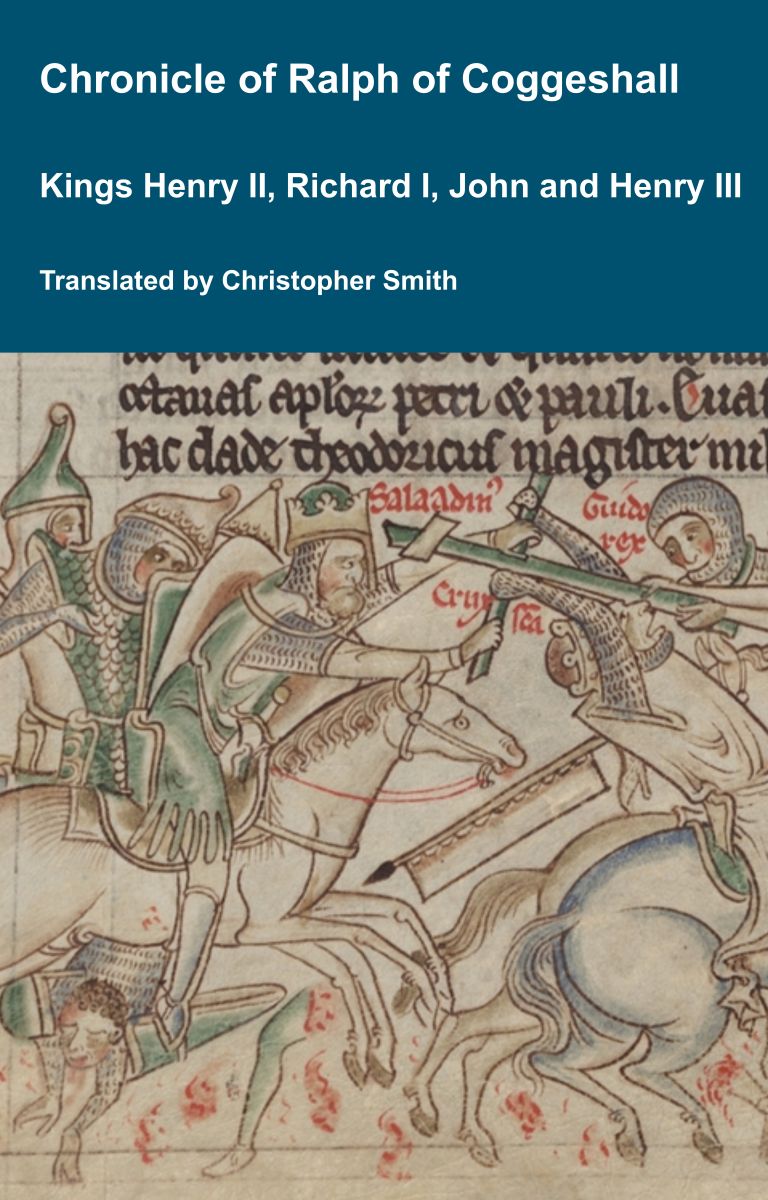 Chronicum Anglicanum by Ralph Coggeshall. About this time the Count of Flanders besieged that noble castle of Saint-Omer. The besieged, however, sent word to King Philip to bring relief to the siege within a certain named period; but when he did not come to their aid, they surrendered the castle to the count. At that same time, the king of England entered the land of the king of France near Dangu, and took the castle of Courcelles with its tower, and drove the king of France himself, who was coming from Mantes with his army to give aid, into flight as far as the gates of Gisors, where his army was for the most part routed, and many nobles were taken prisoner1. How and in what manner, and at what time of the year this happened, the letters which King Richard sent to his chancellor, E., bishop of Ely, then in England, declare more plainly. The tenor of which is as follows:
Circa hoc tempus, comes Flandrensis illud præclarum castrum de Sancto Omero obsedit. Obsessi vero regi Philippo mandant ut obsidioni succurrat infra terminum quemdam nominatum; quo non opem ferente, reddiderunt castrum comiti. Quo in tempore, rex Anglorum intravit terram regis Franciæ apud Dangu, et cepit castrum de Curcellis, cum turri, ipsumque regem Galliæ, qui veniebat de Mantua cum exercitu suo in auxilium, fugavit usque ad portas Gisortii, ubi ejus exercitus magna ex parte fusus est, et plures nobiles capti sunt. Quomodo autem et qualiter, et quo anni hujus tempore id factum fuerit, literæ quas rex Ricardus cancellario suo E. episcopo Elyensi, tunc in Anglia constituto, direxit, expressius indicant, quarum tenor hujuscemodi est:
Note 1. Ralph de Decito: "King Richard of England entered the land of the king of France with a great army on the fifth day before the Kalends of October, and captured the castle of Courcelles and of Burris, and a third castle, Siret-Fontaines. On the next day [27th September 1198], the king of France came from Mantes with four hundred knights, and with his sergeants and his commons, to relieve the castle of Courcelles, which he did not believe had been captured. Therefore, as soon as the king of England learned of his coming, he pursued him as he turned to flight, and pressed him so hard at the gate of Gisors that the bridge collapsed beneath him, and twenty of his knights were drowned. Meanwhile the king of England, with his own lance, struck down Matthew of Montmorency and Alain of Lusignan and Fulk of Gilerval, and held them captive. And up to a hundred knights were taken with them, and sergeants beyond number. Two hundred destriers were captured, of which one hundred and forty were covered in armour."
On 27th September 1275 John "Peaceful" Reginar II Duke Brabant was born to John Reginar I Duke Brabant [aged 22] and Margaret Dampierre Duchess Brabant [aged 22]. He a great x 4 grandson of King Stephen I England. He married 9th July 1290 his half third cousin twice removed Margaret Plantagenet Duchess Brabant, daughter of King Edward I of England and Eleanor of Castile Queen Consort England, and had issue.
On 27th September 1300 Adolph Count Palatine Rhine was born to Rudolf Wittelsbach I Duke Bavaria [aged 25]. He a great x 4 grandson of King Henry "Curtmantle" II of England.
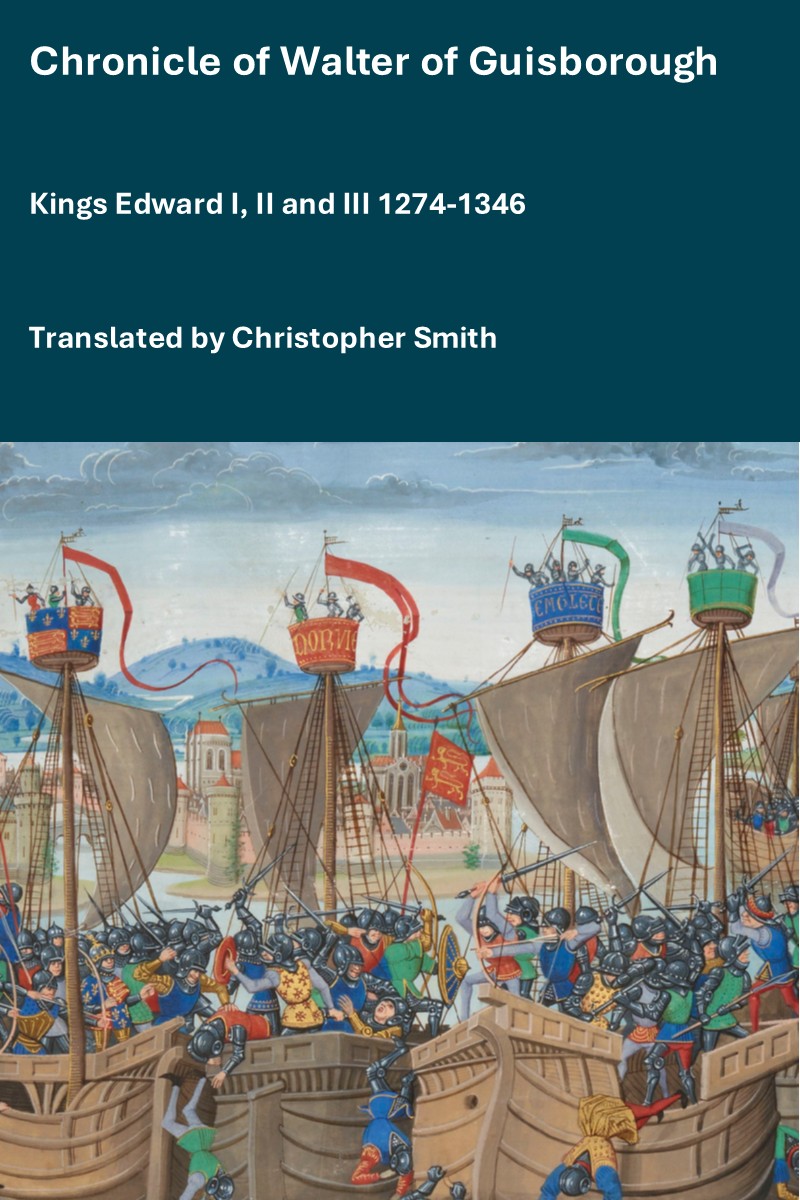 Chronicle of Walter of Guisborough. In the same year, on the fifth day before the Kalends of October [27th September 1333], Edward Balliol was solemnly crowned king at the monastery of Scone in Scotland. Then, returning from there to Roxburgh, he engaged in battle with the Scots, where Andrew of Moray was captured and held in custody at Durham. After this, Patrick the earl and Archibald Douglas requested and obtained from Edward Balliol a truce lasting until the Feast of the Purification [2nd February], so that at that time, with a parliament held, both parties might discuss more fully the settlement of peace. But King Edward, unaware of their treachery, dismissed his forces to their homes; and on the very day appointed, armed Scots, arriving unexpectedly, slew all they found, Edward himself barely saving himself by flight1.
Eodem anno quinto kalendas Octobris, Edwardus de Baliolo apud monasterium de Scone in Scotia in regem solemniter coronatur: inde vero rediens apud Rokesburgh cum Scotis congressum habuit, ubi et Andreas de Morravia captus fuit, et apud Dunolmum in custodia detentus. Post hæc Patricius comes et Archebaudus Douglas ab Edwardo de Baliolo usque ad Purificationem treugas petierunt et obtinuerunt; ut tunc, habito parliamento, pars utraque pro pacis reformatione plenius tractaret; rex vero Edwardus doli ignarus, gentem suam ad propria remisit; He is obliged die enim assignato Scoti armati ex improviso accedentes quotquot invenerunt, Edwardo sibi vix fuga consulente, peremerunt.
Note 1. Baliol escaped to Carlisle, where he was well received by the governor, Lord Dacre. H. Knyghton, 2562 The 'Lady of Guines' being Christina Lindsay, wife of Enguerrand de Guines, daughter of Ada Balliol [aged 85]. She was a first cousin of Edward Balliol.
 Chronicle of Jean le Bel Volume 1. On the day that had been agreed upon between the lords and the Flemings, they all came before Tournai and laid siege to it on every side1. The noble king was positioned fairly close on one side, with Jacquemart d’Artevelde and the Flemings; the Duke of Brabant was on another side with all his forces; and the Count of Hainaut, together with all the other lords who made up the third division of the host, took their position elsewhere. Thus the whole city was surrounded. Afterward they constructed several bridges over the Scheldt, which there is wide and deep, setting them upon boats, so that one army could easily go to the other without danger.
A celluy jour qui fut acordé entre les seigneurs et les Flamens, tous vindrent devant Tournay et l'assiegerrent tout autour; le noble roy assez prez, d'une part, de Jacquemart d'Artevelle et des Flamens, le duc de Brabant, d'aultre part, à toutes ses gens, le conte de Haynau et tous les aultres seigneurs qui faisoient le tiers ost, d'une part, par quoy toute la cité fut assiegée par quoy en aprez firent pluseurs pons sur l'Escaut, qui là est grand et parfont, sur nefs, ainsy l'un ost pouoit legierement aler à l'aultre sans peril.
Note 1. The siege of Tournai lasted from 1st August to 27th September 1340, the day on which Philip VI dismissed his army assembled at Bouvines. However, after the 27th, the defenders of Tournai remained in the city until 1st October, 'because it was necessary to settle payment of what they owed in the said town, and they could not depart sooner.' (Bibliothèque Nationale) This explains why all the accounts of the defenders of the city run from 1st August to 1st October, 'during which time they were enclosed in the said town of Tournai for sixty days'. The dates given prior to 1st August for the beginning of the siege are no doubt the dates of assembly of the various army corps that were to invest the city.
1. Le siège de Tournai dura du 1o août au 27 septembre 1340, jour où Philippe VI donna congé à son armée réunie à Bouvines. Mais, après le 27, les défenseurs de Tournai restèrent encore dans la ville jusqu'au 1o octobre, «pour ce qu'il esconvint faire finance de ce qu'il devoient en ladicte ville, et plus tost ne sen poouoient partir.» (Bibl. nat., ms. fr. nouv. acq. 9238, fol. 54 vo et 55 ro.) C'est ce qui explique que tous les comptes des défenseurs de cette ville vont du 1er août au 1er octobre, «qu'ils furent enclos en ladicte ville de Tournay par zx: jours.» Voy., Ibid fol. 55 à 90 et 141 à 165, les noms des chevaliers et écuyers qui prirent part à la défense de Tournai. Les dates données avant le 1er août pour le commencement du siège sont sans doute les dates de rassemblement des différents corps d'armée qui devaient investir la ville. Cf. Chronique Normande, éd. Molinier, p. 255, note 4; Chronographia, t. II, p. 139, note 1; Chronique de Richard Lescot, p. 53, note 1; Appendice, p. 207.
Chronicle of Jean le Bel Volume 1. Now I have taken a little leisure; so I shall return to the noble history of the gentle King Edward of England and take it up again where I left it, that is, at the breaking up of his siege of Tournai, which was in the year of grace 1340, in the month of August1. And the departure was made by truces, which were then agreed upon between the two kings; yet the agreement was never well kept, especially in the distant regions of Gascony, of Toulouse, of Saintonge, and in other far-off lands, where those of the party of the king of France did not cease from making war upon those of the party of the king of England. And they often won towns and strong castles, one side from the other, and there frequently occurred great deeds and feats of arms, of which you shall hear recounted hereafter.
Or ay Je pris ung petit de loisir; si retourneray à la noble hystoire du gentil roy Edowart d'Angleterre et la reprendray où je la laissay, ce fut à la departie de son siege de Tournay, qui fut l'an de grace mil CCC et XL ou moys d'aoust. Et fut faitte la departie par treves, lesquelles furent adoncq acordées entre les u roys, et onques ne fut bien tenu l'acord, mesmement entre ceux de loingtaines parties de Gascongne, de Thoulousain, de Xantonge et des aultres loingtains pays, que toudis ne guerriassent ceulx de la partie du roy de France à ceulx de la part au roy d'Angleterre, et souvent gaaignerrent villes et fors chasteaulx, les ungs sur les aultres, et avenoyent souvent grands fais et proesses d'armes, dont vous orrez puis aprez recorder.
Note 1. Edward III raised the siege of Tournai on 27th September 1340.
1. Édouard III leva le siège de Tournai le 27 septembre. (Déprez, les Préliminaires de la guerre de Cent ans, la Papauté, la France et l'Angleterre, p. 346.)
On 27th September 1442 John de la Pole 2nd Duke of Suffolk was born to William "Jackanapes" de la Pole 1st Duke of Suffolk [aged 45] and Alice Chaucer Duchess Suffolk [aged 38]. He married (1) January 1450 his half third cousin Margaret Beaufort Countess Richmond, daughter of John Beaufort 1st Duke of Somerset and Margaret Beauchamp Duchess Somerset (2) before February 1458 his half third cousin Elizabeth York Duchess Suffolk, daughter of Richard Plantagenet 3rd Duke of York and Cecily "Rose of Raby" Neville Duchess York, and had issue.
On 7th September 1450 Richard Plantagenet 3rd Duke of York [aged 38] returned from Ireland landing at Beaumaris, Anglesey. He arrived in London on 27th September 1450.
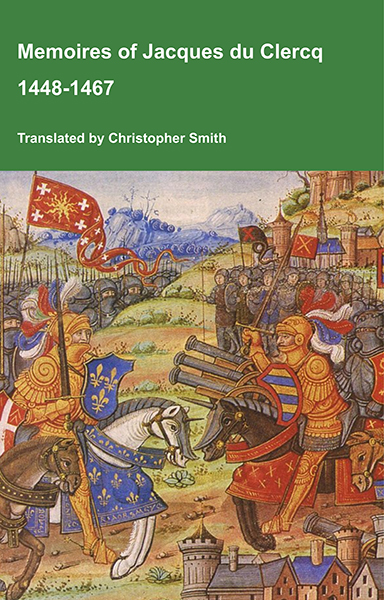 Memoires Jacques du Clercq. These things having been done and concluded, on the 5th day of August, the Duke of Burgundy, accompanied by some fourteen thousand fighting men, as was said, entered the city of Utrecht. The people of the city came far outside it to meet him and presented him with the keys of the city, in the name of his bastard son David. The next day, Friday, the said David, bishop of Utrecht, made his entry into the city, entering in armour, accompanied by the Picards; and on the following Sunday he said mass in the cathedral church. After this, the duke, wishing to bring all those of that bishopric fully into obedience, went to lay siege to a town called Deventer, a very fine and strong town belonging to the said bishopric, which was rebellious and disobedient to the said David. At the beginning of the siege, the townspeople sallied out and there was a skirmish, with wounded and dead on both sides; but the townsmen were driven back, and the siege was established. The people of Deventer had built a very strong bulwark, which, four days after the siege began, was so heavily battered by engines that half of the townspeople themselves set fire to it and withdrew into the town. The next morning, the duke's men went there and completely demolished it. The duke maintained the siege until about the end of September, when the people of that town sent an embassy to him and promised to obey his son David, bishop of Utrecht, and to bring all the other towns of the bishopric into obedience. During the time that the Duke of Burgundy was besieging Deventer, and while the townspeople were negotiating peace, the Duke of Guelders, who had married the duke's niece, and who had brought the Duke of Burgundy into that country and entrusted to him all his lands and fortresses, made an alliance with the Frisians. The Frisians and the said Duke of Guelders gathered in great numbers to attack the Duke of Burgundy and raise the siege he was conducting. The Duke of Burgundy knew nothing of this, but regarded the Duke of Guelders as his true friend. The wife of the Duke of Guelders, who was the niece of the Duke of Burgundy, learning of the false and wicked treachery that her husband intended, secretly left by night from the town where she was staying, taking with her one of her sons, about fifteen or sixteen years old, son of the Duke of Guelders, and came to reveal everything that her husband was planning and intended to do against the Duke of Burgundy, her uncle. For this reason, the duke hastened matters and agreed more quickly to conclude a treaty with the people of Deventer. After the treaty had been made and concluded, and the people of Deventer had promised to keep it, as said above, and had sealed letters with their seals, promising never to act against it but always to obey the said David, on the 27th day of September 1456, the Duke of Burgundy raised his siege and, without loss of goods or men, returned to Utrecht, and from Utrecht to The Hague in Holland, where he disbanded his army and left his son peacefully established as bishop of Utrecht. The duke indeed had good reason to love his niece; for it is certain that the very night after he raised the siege, the Duke of Guelders and the Frisians were to have attacked him and were hastening to come upon him with all speed. But as soon as they learned that the duke had been warned, they halted. The Duke of Guelders was very treacherous and disloyal, and showed little regard for the benefits the Duke of Burgundy had done him, who had married his daughter to the King of Scotland and had arranged and financed it entirely, and had done him many other favours beyond number.
Ces choses faites et passées le cinquiesme jour d'aoust, le duc de Bourgogne, accompagnié de bien quatorze mille combattants, comme on disoit, entra en la ville d'Utrech, et vindrent ceulx de la ville, bien loing au dehors de ladite ville, allencontre de lui, et lui presenterent les clefs de ladite ville, pour et au nom dudit David son fils bastard, et le lendemain jour de venderdy ledit David, evesque d'Utrech, feit son entrée en ladite ville, lequel y entra en armes de corps, accompagnié des Picards; et le dimanche ensuivant dit la messe en l'eglise cathedrale; après ce fait, le duc veuillant mectre en obeissance du tout ceulx dudit evesque, alla mectre le siege devant une ville nommée Deventer, moult belle et forte ville, laquelle estoit de ladite evesquié, et laquelle estoit rebelle et desobeissante audit David, evesque d'Utrech; auquel siege mectre ceulx de la ville issirent et y olt escarmouche, et y olt des blesciés et morts d'une part et d'aultre; mais ceulx de la ville feurent rebouttés, et fust le siege mis. Iceulx de Deventer avoient fait ung moult fort boullovert, lequel quatre jours après le siege mis, fust sy fort battu d'engins que une moitié de ceulx de Deventer mesmes boutterent le feu dedans, et se retrairent dans la ville, et le lendemain matin les gens du duc y allerent, et le pardemolirent. Tant tint le siege le duc devant ladite ville de Deventer, que environ la fin du mois de septembre, ceulx d'icelle ville envoyerent ambassade vers le duc, et promirent au duc de obeir audit David son fils, evesque d'Utrech, et faire obeir toutes les aultres villes de ladite evesquié. Ce temps pendant que le duc de Bourgogne tenoit le siege devant Deventer, et que ceulx de la ville traictoient de paix et accords, le duc de Gueldres qui avoit epousé la niepce dudit duc de Bourgogne, et lequel avoit amené ledit duc audit pays, et abbandonné touts ses pays et fortresses, feit alliance a ceulx de Frise; et s'assemblerent ceulx de Frise et ledit duc de Gueldres en grand nombre pour venir ruer jus ledit duc, et lever son siege qu'il tenoit; et de ce ne sçavoit riens le duc de Bourgogne, ains tenoit le duc de Gueldres pour son vray amy. La femme du duc de Gueldres, qui estoit niepce du duc de Bourgogne, sçachant la fausse et mauvaise trahison que son mary voulloit et pourchassoit, par une nuict se embla d'une ville ou elle se tenoit, et print ung sien fils avecq elle, de l'age de quinze a seize ans, fils du duc de Gueldres, et vint dire tout ce que son mary pourchassoit, et avoit intention de faire au duc de Bourgogne, son oncle, pour laquelle cause le duc fust plus prest et condescendit a plutost prendre traictié a ceulx de Deventer; pourquoy après ledit traictié fait et passé par ceulx de Deventer au duc, et ceulx de Deventer le olrent promis a tenir, comme dit ai, cy dessus, et eurent fait lettres scellées de leurs seaulx et promis de non jamais aller au contraire, ains de toujours obeir audit David: le xxvije de septembre mil iiija lvj, le duc de Bourgogne leva son siege, et, sans encombrier ne perte de biens ne de gens, s'en retourna a Utrech et de Utrech a La Haye en Hollande et illecq defit son armée et laissa son fils paisible evesque d'Utrech. Bien debvoit le duc aimer sa niepce; car pour certain la nuict ensuivant que le duc de Bourgogne leva son siege, le duc de Gueldres et les Frisins lui debvoient venir courre sus, et se hastoient a tuer cheval d'y venir; mais sitost qu'ils sceurent que le duc en fust adverty, sy se arreterent; le due de Gueldres estoit moult traitre et desloyal, et mal consideroit les biens que le duc de Bourgognelui avoit faits, lequel avoit marrié sa fille au roy d'Escosse, et le fait mener, et tout a ses despens, et d'aultres biens que, sans nombre, il lui avoit faits.
Chronicles of London Vitellius A XVI. And the xxvij day of Septembre [1485] began the Swetyng Syknesse in London, wherof dyed Thomas Hyll that yer Mayr, for whom was chosen Sir William Stokker, knyght, which dyed wt in v dayes after of the same dyssease; than for him was chosyn John Warde, which occupied till the day of newe eleccion. And this yere dyed of that Syknes, besyde the ij mayrs aboue rehersed, John Stokker, Thomas Breten, Richard Rawson, Thomas Norland, Aldermen, and many worshipfull comoners ; vpon whos sowles, and all Christen Jhesu haue mercy. Amen!
Calendar of State Papers of Spain. 4th October 1501. Voyage of the Princess of Wales [Catherine of Aragon [aged 15]], and arrival in England. 305. The Licentiate Alcares to Queen Isabella [aged 50].
The Princess of Wales embarked1 on Monday the 27th of September. At five o'clock in the afteroon the ship weighed anchor, and set sail. The weather was favourable at first, but changed after midnight. Continued their voyage until they were off Ushant [Map], without any great inconvenience. The winds were variable, but the sea was not rough. When they had passed Ushant [Map], however, they were overtaken by a most furious vendabal2, thunderstorms, and immense waves. Had a thunderstorm every four or five hours during the rest of the voyage. "It was impossible not to be frightened."
The following Saturday [2nd October 1501], at 3 o'clock in the afternoon, the Princess entered the harbour of Plymouth [Map], which is the first on the coast of England. "She could not have been received with greater rejoicings, if she had been the Saviour of the world." As soon as she left the boat, she went in procession to the church [Plymouth Monastery [Map]], where, it is to be hoped, God gave her the possession of all these realms for such a period as would be long enough to enable her to enjoy life, and to leave heirs to the throne.—4th of October.
Addressed: "To the very powerful Queen of Spain, our excellent Lady." Spanish. Holograph, pp. 2.
Note 2. "Viento de abajo" (wind from below), that is, according to Castilian phraseology, south wind.


On 27th September 1510 Edward Redman Lord Harewood [aged 55] died. All Saints Church Harewood [Map]. Monument to Edward Redman Lord Harewood and Elizabeth Huddlestone Baroness Harewood [aged 60]. Fluted Period. Esses and Roses Collar. Dogs Head Crest. She wearing a simple headdress with veil falling low on the shoulders. The carving somewhat reminiscent of Alice Chaucer's. Monument in Ewelme [Map], Oxfordshire. Angels Supporting Pillow. Chest with Angels with Rounded Wings holding Shields. Chest with Weepers.
Elizabeth Huddlestone Baroness Harewood: In 1450 she was born to John Huddlestone 7th Lord Millom and Mary Fenwick Lady Millom. Around 1483 William Redman Lord Harewood died. He was buried at Levens, Heversham. His brother Edward succeeded Lord Harewood. She by marriage Lord Harewood. In or before 1510 Edward Redman Lord Harewood and she were married. They were fifth cousins. On 31st May 1526 Elizabeth Huddlestone Baroness Harewood died.


Letters and Papers Foreign and Domestic Henry VIII 1517. 27th September 1517. R.O. 3700. MARGARET OF SAVOY to HENRY VIII.
In behalf of Jacques Pauye, nephew of the late Mich. Pauye, confessor of the King Catholic, who in his uncle's lifetime had been provided by exchange with a prebend in Tournay, and would have gone personally to Wolsey to receive collation but for the prevailing sickness. Brussels, 27 Sept. 1517. Signed.
Fr., p. 1. Add.
Letters and Papers Foreign and Domestic Henry VIII 1528. 27th September 1528. R. O. 4782. SIR EDWARD GULDEFORD to WOLSEY.
Has sent to Calais four passengers (ships) for transporting cardinal Campeggio. Among the others "the Peter Baily, for his own person, which is the ship that your Grace hath passed in divers times, and hath a bed in her, and the cabin, appareled after the best fashion." Wishes to know whether the charge is to be at the King or Wolsey's cost. The Legate cannot stay more than one night at Dovor, as it is infected with the sickness, and as the priory is in that quarter of the town, has appointed the bailiff's house for the reception of the Legate. The town is prepared. Dovor, Sunday, 27 Sept. Signed.
P. 1. Add. Endd.
Letters and Papers Foreign and Domestic Henry VIII 1535. 27th September 1535. R. O. 450. Sir Thomas Audeley to Cromwell.
Has received his letter, with the books of Bath and Winchester for valuation of the spiritualities. Only 12 or 13 books have yet come to his hands. Wonders the Commissioners are so negligent. Has lain at Old Ford only for this cause these 14 or 15 days, and cannot proceed till all the books come in. Intends to write letters, in the names of Cromwell and himself, to the Commissioners of the shires where they lack. and send them with the writs of the prorogation of Parliament, and with the commissions and proclamations for wheat, which will all be ready tomorrow. Wishes to know the King's pleasure about proclamations for clothiers. Must ride to the burial of Sir David Owen, who has named him one of his executors. Wishes to know what Cromwell has done for London, Middlesex, and Surrey. Thanks him for moving the Queen [aged 34] for her house, and desires him to thank her Highness for lending it to him. Would be glad to gratify Cromwell about the nomination of the under-sheriff of Middlesex, "and am right well content ye take your pleasure in it, praying you to consider that it is given me, and that of good congruence and reason ye cannot take it from me." You have done me much greater pleasures, and this is not for my own profit, but for my poor servant's, to whom I can give nothing. Remember, I moved you once for poor Dyne to have the controllership of the dispensations, "with poor £10 fee. Ye have his bill." Each of us must have a clerk, with 20 marks' fee, to make up books of benefices, as it will be a great business. I shall be near the Court when I go to Mr. Owen's burial, but dare not approach the King's presence till I know his pleasure. I have long wished to see his Grace, "but I have a little resorted to London, and some suitors of London daily have come to my house." Can never be rid of them. Sends humble recommendations to the King and Queen. Old Ford, Monday before Michaelmas Day.
Hol., pp. 2. Add.: Thomas Crumwell, Esq., Chief Secretary to the King's Highness. Endd.


Chronicle of Abbot Ralph of Coggeshall
The Chronicle of Abbot Ralph of Coggeshall (Chronicon Anglicanum) is an indispensable medieval history that brings to life centuries of English and European affairs through the eyes of a learned Cistercian monk. Ralph of Coggeshall, abbot of the Abbey of Coggeshall in Essex in the early 13th century, continued and expanded his community’s chronicle, documenting events from the Norman Conquest of 1066 into the tumultuous reign of King Henry III. Blending eyewitness testimony, careful compilation, and the monastic commitment to record-keeping, this chronicle offers a rare narrative of political intrigue, royal power struggles, and social upheaval in England and beyond. Ralph’s work captures the reigns of pivotal figures such as Richard I and King John, providing invaluable insights into their characters, decisions, and the forces that shaped medieval rule. More than a simple annal, Chronicon Anglicanum conveys the texture of medieval life and governance, making it a rich source for scholars and readers fascinated by English history, monastic authorship, and the shaping of the medieval world.
Available at Amazon in eBook and Paperback format.
On 27th September 1601 Louis XIII King France was born to Henry IV King France [aged 47] and Marie de Medici Queen Consort France [aged 26]. He married 1615 his second cousin Anne of Austria Spain Queen Consort France, daughter of Philip III King Spain and Margaret of Austria Queen Consort Spain, and had issue.


On 27th September 1651 Maximilian "The Great" Wittelsbach I Duke Bavaria I Elector Bavaria [aged 78] died.
John Evelyn's Diary. 27th September 1660. The King [aged 30] received the merchant's addresses in his closet, giving them assurances of his persisting to keep Jamaica, choosing Sir Edward Massey Governor [aged 41]. In the afternoon, the Danish Ambassador's condolences were presented, on the death of the Duke of Gloucester [deceased]. This evening, I saw the Princess Royal [aged 28], mother to the Prince of Orange, now come out of Holland in a fatal period.


Samuel Pepys' Diary. 27th September 1665. Back again the same way and had most excellent discourse of Mr. Evelyn [aged 44] touching all manner of learning; wherein I find him a very fine gentleman, and particularly of paynting, in which he tells me the beautifull Mrs. Middleton is rare, and his own wife do brave things. He brought me to the office, whither comes unexpectedly Captain Cocke [aged 48], who hath brought one parcel of our goods by waggons, and at first resolved to have lodged them at our office; but then the thoughts of its being the King's house altered our resolution, and so put them at his friend's, Mr. Glanvill's [aged 47], and there they are safe. Would the rest of them were so too! In discourse, we come to mention my profit, and he offers me £500 clear, and I demand £600 for my certain profit.


Samuel Pepys' Diary. 27th September 1665. I thence to Captain Cocke's [aged 48], [and] (he not yet come from town) to Mr. Evelyn's [aged 44], where much company; and thence in his coach with him to the Duke of Albemarle [aged 56] by Lambeth, who was in a mighty pleasant humour; there the Duke [aged 31] tells us that the Dutch do stay abroad, and our fleet must go out again, or to be ready to do so.


Samuel Pepys' Diary. 27th September 1665. Here I saw this week's Bill of Mortality, wherein, blessed be God! there is above 1800 decrease, being the first considerable decrease we have had.
John Evelyn to Samuel Tuke 27 Sep 166. 27th September 1666. John Evelyn [aged 45] to Samuel Tuke 1st Baronet [aged 51].
It was some foure dayes before the most fatal Conflagration of the (quondam) Cltty of London yt I addressed a few lines to you; little thinking I should so soone have had two such dissolutions to deplore: The burning of the best Towne in the World: and the discease of the best fFriend in ye World, your excellent Lady. Sr, you know they are but small afflictions that are loquacious - greate ones are silent: & if ever greate ones there were, mine eyes have beheld, & mine eares heard them, with an heart so possess'd with sorrow, that it Is not easily expressed; because ye instances have ben altogether stupendous & unparallel'd. But it were in vaine to entertaine you with those formal topics, wh are wont to be apply'd to persons of lesse fortitude & Christian resignation, though I cannot but exhort you to what, I know, you do - looke upon all things in this World as transitory & perishiug; sent us upon condition of quitting them cherefully, when God pleases to take them from us. This consideration alone, wth the rest of those Graces wh God has furnish'd you wth all will be able to alevlate yr passion, & to preserve you from succumbing under yr pressures, wh I confesse are weighty: but not insupportable: Live therefore, I conjure you, & helpe to restore yr deare Country, & to consolate yt ffriends: There is none alive wishes you more sincere happlnesse than my poore family.
I suppose I should have heard ere this from you of all y concerntnents; but impute y silence to some possible miscarriage of y"^ Letf^; since the usual place of addresse is wth the rest reduc'd to ashes & made an heape of ruines. I would give you a more particular relation of this calamitous accident; but I should oppresse you with sad stories, and I. question not but they are come too soone amongst you at Paris with all mlnutenesse, & (were it possible) hyperbolies; There is this yet of lesse deplorable in it: That, as it pleas'd God to order it, little effects of any greate consequence have been lost, besides the houses: - That of Merchands at the same instant in w it was permitted y^ tidings should file over Seas, had so settled all their affaires, as they complying w their forraliie Correspondence as punctualy as if no disaster at all had happen'd; nor do we heare of so much as one that has fail'd. The Exchange is now at Gressham Colledge. The rest of the Qitty (which m.ay consist of neere a 7th part) & suburbs peopl'd with new shopps, the same noyse, bulslnesse & co'merce, not to say vanity. Onely the poore Booke-sellers have ben indede ill treated by Vulcan; so many noble impressions consum'd, hy their trusting them to y* Churches, as the losse is estimated neere two-hundred thousand pounds: w will he an extraordinary detriment to y^ whole Republiq of Learning. In ye meane time, the King & Parliament are infinitely zealous for the rebuilding of our ruines; & I believe it will universally be the employment of y^ next Spring: They are now busied w'*^ adjusting the claimes of each proprietor, that so they may dispose things for the building after the noblest model: Every body brings in his idea, amongst the rest I P'^sented his Ma^"^ my owne conceptions, w^'' a Discourse annex'd. It was the second that was seene, within 2 dayes after the Conflagration; But Dr. Wren had got the start of me *. Both of us did coincide so frequently, that his Ma^'^ was not displeas'd with it, & it caus'd divers alterations; and truly there was never a more glorious Phoenix upon Earth, if it do at last emerge out of these cinders, & as the designe is layd, with the present fervour of y* undertakers. But these things are as yet im'a- ture; & I pray God we may enjoy peace to encourage those faire dispo- sitions: The miracle is, I have never in my life observ'd a more uni- versal resignation, lesse repining amongst sufferers; which makes me hope, ye God has yet thoughts of mercy towards us: Judgments do not alwayes end where they begin; & therefore let none exult over our calamities: - We know not whose turne it mav be next. But S'", I forbear to entertaine you longer on these sad reflections; but persist to beg of you not to suffer any transportations unbecoming a man of xvirtue; resolve to preserve ye selfe, if it be possible, for better times, the good & restauration of e Country, & the comfort of Friends & Relations, and amongst them of, Sr,
Samuel Pepys' Diary. 27th September 1667. To the office again, my head running on this pretty girl, and there till noon, when Creed and Sheres come and dined with me; and we had a great deal of pretty discourse of the ceremoniousness of the Spaniards, whose ceremonies are so many and so known, that, Sheres tells me, upon all occasions of joy or sorrow in a Grandee's family, my Lord Embassador is fain to send one with an 'en hora buena', if it be upon a marriage, or birth of a child, or a 'pesa me', if it be upon the death of a child, or so. And these ceremonies are so set, and the words of the compliment, that he hath been sent from my Lord, when he hath done no more than send in word to the Grandee that one was there from the Embassador; and he knowing what was his errand, that hath been enough, and he never spoken with him: nay, several Grandees having been to marry a daughter, have wrote letters to my Lord to give him notice, and out of the greatness of his wisdom to desire his advice, though people he never saw; and then my Lord he answers by commending the greatness of his discretion in making so good an alliance, &c., and so ends. He says that it is so far from dishonour to a man to give private revenge for an affront, that the contrary is a disgrace; they holding that he that receives an affront is not fit to appear in the sight of the world till he hath revenged himself; and therefore, that a gentleman there that receives an affront oftentimes never appears again in the world till he hath, by some private way or other, revenged himself: and that, on this account, several have followed their enemies privately to the Indys, thence to Italy, thence to France and back again, watching for an opportunity to be revenged. He says my Lord was fain to keep a letter from the Duke of York [aged 33] to the Queen of Spain [aged 32] a great while in his hands, before he could think fit to deliver it, till he had learnt whether the Queen [aged 28] would receive it, it being directed to his cozen. He says that many ladies in Spain, after they are found to be with child, do never stir out of their beds or chambers till they are brought to bed: so ceremonious they are in that point also. He tells me of their wooing by serenades at the window, and that their friends do always make the match; but yet that they have opportunities to meet at masse at church, and there they make love: that the Court there hath no dancing, nor visits at night to see the King [aged 37] or Queen, but is always just like a cloyster, nobody stirring in it: that my Lord Sandwich [aged 42] wears a beard now, turned up in the Spanish manner. But that which pleases me most indeed is, that the peace which he hath made with Spain is now printed here, and is acknowledged by all the merchants to be the best peace that ever England had with them: and it appears that the King thinks it so, for this is printed before the ratification is gone over; whereas that with France and Holland was not in a good while after, till copys come over of it in English out of Holland and France, that it was a reproach not to have it printed here. This I am mighty glad of; and is the first and only piece of good news, or thing fit to be owned, that this nation hath done several years.


Samuel Pepys' Diary. 27th September 1667. After dinner I to the office, and they gone, anon comes Pelling, and he and I to Gray's Inne Fields, thinking to have heard Mrs. Knight sing at her lodgings, by a friend's means of his1 but we come too late; so must try another time.
Note 1. Mrs. Knight, a celebrated singer and mistress of Charles II. There is in Waller's "Poems" a song sung by her to the Queen [aged 28] on her birthday. In her portrait, engraved by Faber, after Kneller [aged 21], she is represented in mourning, and in a devout posture before a crucifix. Evelyn [aged 46] refers to her singing as incomparable, and adds that she had "the greatest reach of any English woman; she had been lately roaming in Italy, and was much improv'd in that quality" ("Diary", December 2nd, 1674).
Samuel Pepys' Diary. 27th September 1668. Thence spent all the afternoon walking in the Park, and then in the evening at Court, on the Queen's [aged 29] side; and there met Mr. Godolphin [aged 33], who tells me that the news, is true we heard yesterday, of my Lord Sandwich's [aged 43] being come to Mount's Bay, in Cornwall, and so I heard this afternoon at Mrs. Pierce's, whom I went to make a short visit to. This night, in the Queen's drawing-room, my Lord Brouncker [aged 48] told me the difference that is now between the three Embassadors here, the Venetian, French, and Spaniard; the third not being willing to make a visit to the first, because he would not receive him at the door; who is willing to give him as much respect as he did to the French, who was used no otherwise, and who refuses now to take more of him, upon being desired thereto, in order to the making an accommodation in this matter, which is very pretty. So a boat staying for me all this evening, I home in the dark about eight at night, and so over the ruins from the Old Swan [Map] home with great trouble, and so to hear my boy read a little, and supper and to bed. This evening I found at home Pelling and Wallington and one Aldrige, and we supped and sung.
Samuel Pepys' Diary. 27th September 1668. Lord's Day. Up, and to my office to finish my journall for five days past, and so abroad and walked to White Hall, calling in at Somerset House [Map] Chapel, and also at the Spanish Embassador's at York House [Map], and there did hear a little masse: and so to White Hall; and there the King [aged 38] being gone to Chapel, I to walk all the morning in the Park, where I met Mr. Wren; and he and I walked together in the Pell-Mell, it being most summer weather that ever was seen: and here talking of several things: of the corruption of the Court, and how unfit it is for ingenious men, and himself particularly, to live in it, where a man cannot live but he must spend, and cannot get suitably, without breach of his honour: and did thereupon tell me of the basest thing of my Lord Barkeley [aged 66], one of the basest things that ever was heard of of a man, which was this: how the Duke of York's [aged 34] Commissioners do let his wine-licenses at a bad rate, and being offered a better, they did persuade the Duke of York to give some satisfaction to the former to quit it, and let it to the latter, which being done, my Lord Barkeley did make the bargain for the former to have £1500 a-year to quit it; whereof, since, it is come to light that they were to have but £800 and himself £700, which the Duke of York hath ever since for some years paid, though this second bargain hath been broken, and the Duke of York lost by it, [half] of what the first was. He told me that there hath been a seeming accommodation between the Duke of York and the Duke of Buckingham [aged 40] and Lord Arlington [aged 50], the two latter desiring it; but yet that there is not true agreement between them, but they do labour to bring in all new creatures into play, and the Duke of York do oppose it, as particularly in this of Sir Prince.


On 27th September 1700 Elizabeth Cavendish was born to William Cavendish 2nd Duke Devonshire [aged 28] and Rachel Russell Duchess Devonshire [aged 26].


On 27th September 1735 Diana Spencer Duchess Bedford [aged 25] died at Southampton House.
Jean de Waurin's Chronicle of England Volume 6 Books 3-6: The Wars of the Roses
Jean de Waurin was a French Chronicler, from the Artois region, who was born around 1400, and died around 1474. Waurin’s Chronicle of England, Volume 6, covering the period 1450 to 1471, from which we have selected and translated Chapters relating to the Wars of the Roses, provides a vivid, original, contemporary description of key events some of which he witnessed first-hand, some of which he was told by the key people involved with whom Waurin had a personal relationship.
Available at Amazon in eBook and Paperback format.

On 27th September 1739 Francis Russell was born to John Russell 4th Duke Bedford [aged 28] and Gertrude Leveson-Gower Duchess Bedford. He married 8th June 1764 his fifth cousin once removed Elizabeth Keppel, daughter of William Anne Keppel 2nd Earl Albermarle and Anne Lennox Countess Albermarle, and had issue.
On 27th September 1788 Robert Taylor [aged 74] died at his home 34 Spring Gardens. He was buried at St Martin in the Fields Church [Map].
On 8th July 1810 the Bow Street police raided the White Swan on Vere Street in London that had been established as a molly-house in early 1810 by two men, James Cook and Yardley. Twenty-seven men were arrested, but the majority of them were released (perhaps as a result of bribe); eight were tried and convicted. On 27th September 1810 six men were pilloried at the Haymarket. On 7th March 1811 John Hepburn (46) and Thomas White (16), a drummer boy, were hanged at Newgate Prison, London [Map] for 'for the perpetration of an unnatural crime' against the 1533 Buggery Act despite not being present on the night of the raid.
On 27th September 1820 Elizabeth Hay Duchess Wellington was born to George Hay 8th Marquess Tweedale [aged 33] and Susan Montagu Marchioness Tweddale [aged 19]. She married 1839 Arthur Wellesley 2nd Duke Wellington, son of Arthur Wellesley 1st Duke Wellington and Catherine "Kitty" Pakenham Duchess Wellington.
Vestiges of the Antiquities of Derbyshire. September 27th, 1843, a barrow, called Ringham Lowe [Map], on Middleton Moor, was reopened. It was first examined by the late Mr. William Bateman in 1821, who found only the fragments of two urns and a piece of charcoal; one of the urns was of fine black ware, the other very coarse and of a grayish colour. The second investigation did not prove much more interesting than the first; the particulars are as follows: in the centre were the remains of a fire which had burnt upon the surface of the ground, before the construction of the mound; there remained pieces of charred wood, either oak or ash, near three inches in diameter. About the same place some more fragments of the above-mentioned urns were found; also numerous chippings of flint; but no bones, either human or animal, were seen. Near the surface of the tumulus a carefully-chipped instrument of flint was picked up, on refilling the excavation.
On 27th September 1850 James Thomson [aged 62] died at his home in Albany Street, Regent's Park.
On 27th September 1850 Chandos Leigh 1st Baron Leigh [aged 59] died. His son William [aged 26] succeeded 2nd Baron Leigh of Stoneleigh in Warwickshire. Caroline Amelia Grosvenor Baroness Leigh [aged 22] by marriage Baroness Leigh of Stoneleigh in Warwickshire.
Monument in Church of the Virgin Mary, Stoneleigh [Map]. An elaborate Recess in late C19 Gothic style constructed in 1850 for alabaster Table Tomb; unclear as to why the effigy was not installed.
Chandos Leigh 1st Baron Leigh: On 27th June 1791 he was born to James Henry Leigh of Adlestrop and Julia Judith Twisleton. Coefficient of inbreeding 1.76%. On 8th June 1819 Chandos Leigh 1st Baron Leigh and Margaret Willes were married. In 1839 Chandos Leigh 1st Baron Leigh was created 1st Baron Leigh of Stoneleigh in Warwickshire. Margarette Willes Baroness Leigh by marriage Baroness Leigh of Stoneleigh in Warwickshire.
William Henry Leigh 2nd Baron Leigh: On 17th January 1824 he was born to Chandos Leigh 1st Baron Leigh and Margarette Willes Baroness Leigh. He was baptised at St Mary Magdalene's Church, Adlestrop, and for a second time, at Church of the Virgin Mary, Stoneleigh [Map] on 10th September 1824. He was educated at Harrow School then Trinity College, Cambridge University [Map]. On 22nd August 1848 William Henry Leigh 2nd Baron Leigh and Caroline Grosvenor were married. They had eight children. She the daughter of Richard Grosvenor 2nd Marquess Westminster and Elizabeth Mary Leveson-Gower Marchioness Westminster.
Caroline Amelia Grosvenor Baroness Leigh: On 14th June 1828 she was born to Richard Grosvenor 2nd Marquess Westminster and Elizabeth Mary Leveson-Gower Marchioness Westminster. She was baptised at St Mary's Church, Eccleston [Map] on 28th July 1828.


St Michael's Church, Rocester [Map]. Church reopened 27th September 1872.
On 27th September 1900 Arthur Bulleid [aged 38] and Anna Eleanor Austin [aged 28] were married at Langham Place, London. She originally from Australia. They lived at Dymboro, Midsomer Norton which house was commissioned for them as a wedding present by her father.
On 27th September 1903 Charles Gordon-Lennox 6th Duke Richmond [aged 85] died. His son Charles [aged 57] succeeded 7th Duke Richmond, 2nd Duke Gordon, 7th Earl March, 7th Baron Settrington.
On 27th September 1910 Percy Hamilton Seymour 18th Duke of Somerset was born to Evelyn Francis Edward Seymour 17th Duke of Somerset [aged 28] and Edith Mary Parker Duchess Somerset [aged 29]. He married 18th December 1951 Gwendoline Collette Jane Thomas Duchess Somerset and had issue.
On 27th September 1915 Fergus Bowes-Lyon [aged 26] was killed in action during the Battle of the Hohenzollern Redoubt in the Battle of Loos. As he led an attack on the German lines, his leg was blown off by a barrage of German artillery and he fell back into his sergeant's arms. Bullets struck him in the chest and shoulder and he died on the field.
Chronicle of Abbot Ralph of Coggeshall
The Chronicle of Abbot Ralph of Coggeshall (Chronicon Anglicanum) is an indispensable medieval history that brings to life centuries of English and European affairs through the eyes of a learned Cistercian monk. Ralph of Coggeshall, abbot of the Abbey of Coggeshall in Essex in the early 13th century, continued and expanded his community’s chronicle, documenting events from the Norman Conquest of 1066 into the tumultuous reign of King Henry III. Blending eyewitness testimony, careful compilation, and the monastic commitment to record-keeping, this chronicle offers a rare narrative of political intrigue, royal power struggles, and social upheaval in England and beyond. Ralph’s work captures the reigns of pivotal figures such as Richard I and King John, providing invaluable insights into their characters, decisions, and the forces that shaped medieval rule. More than a simple annal, Chronicon Anglicanum conveys the texture of medieval life and governance, making it a rich source for scholars and readers fascinated by English history, monastic authorship, and the shaping of the medieval world.
Available at Amazon in eBook and Paperback format.
On 27th September 1915 John Kipling [aged 18] was killed in action at the Battle of Loos.
On 27th September 1915 Captain James Harold Cuthbert [aged 39] was killed in action at the Battle of Loos; his body was never found

After 27th September 1915. St John Lee Church, Hexham [Map]. Monument to Captain James Harold Cuthbert [deceased],
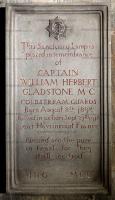
On On 27th September 1918 Captain William Herbert Gladstone [aged 20] was killed in action near Havrincourt, France. He was buried at Sanders Keep Military Cemetery, Graincourt-les-Havrincourt. Memorial at the Church of St Deiniol, Hawarden, Flintshire.
This Sanctuary Lamp is Placed in Remembrance of Captain William Herbert Gladstone (M.C.) Coldstream Guards Born August 8th 1898 Killed in Action Sept 27 1918 Near Havrincourt Blessed are the pure in heart for they shall see God H.W.G. M E.G.
Captain William Herbert Gladstone: On 8th August 1898 he was born to Reverend Stephen Edward Gladstone and Annie Crosthwaite Wilson. On 15th January 1917 Captain William Herbert Gladstone was gazetted as a Lieutenant. On 22nd April 1918 Captain William Herbert Gladstone was awarded the Military Cross: For conspicuous gallantry and devotion to duty. When in command of the main attacking party during a raid, he led his party with splendid dash, and on the barrage lifting gauged the right moment to rush the enemy front line. By his prompt action he forestalled the enemy taking the offensive, and rendered possible the unmolested approach of the whole raiding party to hostile lines.
On 27th September 1922 Constantine I King Greece [aged 54] abdicated King Greece. Alexander I King Greece succeeded I King Greece. George II King Hellenes [aged 32] succeeded II King Hellenes. Elisabeth Hohenzollern Sigmaringen Queen Consort Greece Queen Consort Hellenes [aged 27] by marriage Queen Consort Hellenes.


On 27th September 1931 Robert Walpole 5th Earl Orford [aged 77] died. Earl Orford extinct. His half third cousin twice removed Robert [aged 18] succeeded 7th Baron Walpole of Wollerton. Monument in Church of St Andrew, Wickmere [Map] sculpted by Esmond Burton [aged 45]. The stone brought from St Paul's Island in the Pacific where HMS Magaera, in which the Earl of Orford served as a midshipman, was wrecked in 1871. Armorials include  Walpole Arms impaled
  Barkham Arms. Motto fari quae sentiat. Saracen's Head Crest.
Robert Walpole 5th Earl Orford: On 10th July 1854 he was born to Frederick Walpole and Laura Sophia Frances Walpole. On 7th December 1894 Horatio Walpole 4th Earl Orford died. His nephew Robert succeeded 5th Earl Orford, 6th Baron Walpole of Wollerton.
Robert Walpole 9th and 7th Baron Walpole: On 25th April 1913 he was born to Lieutenant Horatio Spencer Walpole and Dorothea Frances Montgomerie. In 1989 Robert Walpole 9th and 7th Baron Walpole died. His son Robert succeeded 8th Baron Walpole of Wollerton.


On 27th September 1995 Alastair Guy Waterhouse of Lomberdale Hall [aged 69] died. He was buried at All Saints Church, Youlgreave [Map].
Alastair Guy Waterhouse of Lomberdale Hall: On 2nd January 1926 he was born to Charles Waterhouse of Lomberdale Hall and Beryl Ford.
On 27th September 1275 John "Peaceful" Reginar II Duke Brabant was born to John Reginar I Duke Brabant [aged 22] and Margaret Dampierre Duchess Brabant [aged 22]. He a great x 4 grandson of King Stephen I England. He married 9th July 1290 his half third cousin twice removed Margaret Plantagenet Duchess Brabant, daughter of King Edward I of England and Eleanor of Castile Queen Consort England, and had issue.
On 27th September 1300 Adolph Count Palatine Rhine was born to Rudolf Wittelsbach I Duke Bavaria [aged 25]. He a great x 4 grandson of King Henry "Curtmantle" II of England.
On 27th September 1442 John de la Pole 2nd Duke of Suffolk was born to William "Jackanapes" de la Pole 1st Duke of Suffolk [aged 45] and Alice Chaucer Duchess Suffolk [aged 38]. He married (1) January 1450 his half third cousin Margaret Beaufort Countess Richmond, daughter of John Beaufort 1st Duke of Somerset and Margaret Beauchamp Duchess Somerset (2) before February 1458 his half third cousin Elizabeth York Duchess Suffolk, daughter of Richard Plantagenet 3rd Duke of York and Cecily "Rose of Raby" Neville Duchess York, and had issue.
On 27th September 1564 George Vaux was born to William Vaux 3rd Baron Vaux Harrowden [aged 29]. He married before 13th September 1588 Elizabeth Roper, daughter of John Roper 1st Baron Teynham, and had issue.
On 27th September 1601 Louis XIII King France was born to Henry IV King France [aged 47] and Marie de Medici Queen Consort France [aged 26]. He married 1615 his second cousin Anne of Austria Spain Queen Consort France, daughter of Philip III King Spain and Margaret of Austria Queen Consort Spain, and had issue.
On 27th September 1602 Capell Bedell 1st Baronet was born to Thomas Bedell of Hamerton in Huntingdonshire [aged 22] and Winifred Capell [aged 18]. He married June 1619 his fourth cousin once removed Alice Fanshawe and had issue.
On 27th September 1616 Dorothy Rich was born to Henry Rich 1st Earl Holland [aged 26] and Isabel Cope Countess Holland. She died aged one in 1617.


Chronicle of a Bourgeois of Valenciennes
Récits d’un bourgeois de Valenciennes aka The Chronicle of a Bourgeois of Valenciennes is a vivid 14th-century vernacular chronicle written by an anonymous urban chronicler from Valenciennes in the County of Hainaut. It survives in a manuscript that describes local and regional history from about 1253 to 1366, blending chronology, narrative episodes, and eyewitness-style accounts of political, military, and social events in medieval France, Flanders, and the Low Countries. The work begins with a chronological framework of events affecting Valenciennes and its region under rulers such as King Philip VI of France and the shifting allegiances of local nobility. It includes accounts of conflicts, sieges, diplomatic manoeuvres, and the impact of broader struggles like the Hundred Years’ War on urban life in Hainaut. Written from the perspective of a burgher (bourgeois) rather than a monastery or royal court, the chronicle offers a rare lay viewpoint on high politics and warfare, reflecting how merchants, townspeople, and civic institutions experienced the turbulence of the 13th and 14th centuries. Its narrative style combines straightforward reporting of events with moral and civic observations, making it a valuable source for readers interested in medieval urban society, regional politics, and the lived experience of war and governance in pre-modern Europe.
Available at Amazon in eBook and Paperback format.
On 27th September 1670 Thomas Horton Stanley 4th Baronet was born to Edward Stanley 3rd Baronet [aged 27] and Elizabeth Bosville [aged 25]. He married 1688 Elizabeth Patten and had issue.
On 27th September 1689 Edward Stanley 11th Earl of Derby was born to Thomas Horton Stanley 4th Baronet [aged 19] and Elizabeth Patten [aged 19]. He married 1714 his fifth cousin once removed Elizabeth Hesketh Countess Derby.
On 27th September 1696 John St Aubyn 3rd Baronet was born to John St Aubyn 2nd Baronet [aged 26] and Mary de la Hay. He married 3rd October 1725 Catherine Morice Lady St Aubyn, daughter of Nicholas Morice 2nd Baronet and Catherine Herbert Lady Morice, and had issue.
On 27th September 1700 Elizabeth Cavendish was born to William Cavendish 2nd Duke Devonshire [aged 28] and Rachel Russell Duchess Devonshire [aged 26].
On 27th September 1739 Francis Russell was born to John Russell 4th Duke Bedford [aged 28] and Gertrude Leveson-Gower Duchess Bedford. He married 8th June 1764 his fifth cousin once removed Elizabeth Keppel, daughter of William Anne Keppel 2nd Earl Albermarle and Anne Lennox Countess Albermarle, and had issue.
On 27th September 1739 Robert Stewart 1st Marquess Londonderry was born to Alexander Stewart [aged 41] and Mary Cowan. He married (1) before 1769 Sarah Frances Seymour-Conway, daughter of Francis Seymour-Conway 1st Marquess Hertford and Isabella Fitzroy Countess Hertford, and had issue (2) 7th June 1775 Frances Pratt Marchioness Londonderry, daughter of Charles Pratt 1st Earl Camden and Elizabeth Jeffreys, and had issue.


On 27th September 1742 John Crewe 1st Baron Crewe was born to John Crewe [aged 33]. He married 1766 Frances Anne Greville and had issue.
On 27th September 1747 Sarah Frances Seymour-Conway was born to Francis Seymour-Conway 1st Marquess Hertford [aged 29] and Isabella Fitzroy Countess Hertford [aged 21]. She a great x 2 granddaughter of King Charles II of England Scotland and Ireland. She married before 1769 Robert Stewart 1st Marquess Londonderry and had issue.


On 27th September 1752 Nathaniel Curzon 2nd Baron Scarsdale was born to Nathaniel Curzon 1st Baron Scarsdale [aged 26] and Caroline Colyear Baroness Scarsdale [aged 19]. He married (1) 11th August 1777 Sophia Susanna Noel, daughter of Edward Noel 1st Viscount Wentworth, and had issue (2) 18th November 1798 Félicité Anne Josephe de Wattines Lady Scarsdale and had issue.


On 27th September 1805 William Hervey was born to Frederick William Hervey 1st Marquess of Bristol [aged 35] and Elizabeth Albana Upton [aged 30].
Jean de Waurin's Chronicle of England Volume 6 Books 3-6: The Wars of the Roses
Jean de Waurin was a French Chronicler, from the Artois region, who was born around 1400, and died around 1474. Waurin’s Chronicle of England, Volume 6, covering the period 1450 to 1471, from which we have selected and translated Chapters relating to the Wars of the Roses, provides a vivid, original, contemporary description of key events some of which he witnessed first-hand, some of which he was told by the key people involved with whom Waurin had a personal relationship.
Available at Amazon in eBook and Paperback format.
On 27th September 1817 George Samuel Jenkinson 11th Baronet was born to Bishop John Jenkinson [aged 36] and Frances Augusta Pechell. He married 1845 Emily Sophia Lyster Lady Jenkinson and had issue.
On 27th September 1820 Elizabeth Hay Duchess Wellington was born to George Hay 8th Marquess Tweedale [aged 33] and Susan Montagu Marchioness Tweddale [aged 19]. She married 1839 Arthur Wellesley 2nd Duke Wellington, son of Arthur Wellesley 1st Duke Wellington and Catherine "Kitty" Pakenham Duchess Wellington.
On 27th September 1820 Henry William Beresford was born to Admiral John Beresford 1st Baronet [aged 54] and Harriet Elizabeth Peirse Lady Beresford.
On 27th September 1834 Bishop John Percival was born in Brough Sowerby Kirkby Stephen.
On 27th September 1840 Henry Herbert Wombwell 5th Baronet was born to George Wombwell 3rd Baronet [aged 48] and Georgiana Hunter. He married 9th February 1902 Myrtle Mabel Muriel Mostyn.
On 27th September 1841 William Sydney Hylton Jolliffe was born to William Jolliffe 1st Baron Hylton [aged 40] and Eleanor Paget.
On 27th September 1845 Sydney Stanhope 6th Earl Harrington was born to Leicester FitzGerald Charles Stanhope 5th Earl of Harrington [aged 61] and Elizabeth Green Countess Harrington [aged 36]. He a great x 4 grandson of King Charles II of England Scotland and Ireland.
On 27th September 1851 Mark Pleydell-Bouverie was born to Jacob Pleydell-Bouverie 4th Earl Radnor [aged 36] and Mary Augusta Frederica Grimston [aged 30].
On 27th September 1852 Fitzalan Charles John Foley 6th Baron Foley was born to Thomas Henry Foley 4th Baron Foley [aged 43] and Mary Charlotte Fitzalan Baroness Foley [aged 30].
On 27th September 1857 Frederick William Rodney Ricketts 5th Baronet was born to Cornwallis Ricketts 2nd Baronet [aged 54] and Caroline Augusta Pelham-Clinton [aged 47].
On 27th September 1863 George Herbert Shakerley 4th Baronet was born to Charles Watkin Shakerley 2nd Baronet [aged 30]. He married 22nd January 1891 Evelyn Mary France-Hayhurst Lady Shakerley and had issue.
On 27th September 1867 Charles Naunton Paston Paston-Cooper 4th Baronet was born to Astley Paston Paston-Cooper 3rd Baronet [aged 43].
Adam Murimuth's Continuation and Robert of Avesbury’s 'The Wonderful Deeds of King Edward III'
This volume brings together two of the most important contemporary chronicles for the reign of Edward III and the opening phases of the Hundred Years’ War. Written in Latin by English clerical observers, these texts provide a vivid and authoritative window into the political, diplomatic, and military history of fourteenth-century England and its continental ambitions. Adam Murimuth Continuatio's Chronicarum continues an earlier chronicle into the mid-fourteenth century, offering concise but valuable notices on royal policy, foreign relations, and ecclesiastical affairs. Its annalistic structure makes it especially useful for establishing chronology and tracing the development of events year by year. Complementing it, Robert of Avesbury’s De gestis mirabilibus regis Edwardi tertii is a rich documentary chronicle preserving letters, treaties, and official records alongside narrative passages. It is an indispensable source for understanding Edward III’s claim to the French crown, the conduct of war, and the mechanisms of medieval diplomacy. Together, these works offer scholars, students, and enthusiasts a reliable and unembellished account of a transformative period in English and European history. Essential for anyone interested in medieval chronicles, the Hundred Years’ War, or the reign of Edward III.
Available at Amazon in eBook and Paperback format.
On 27th September 1867 John Alexander Miller 3rd Baronet was born to William Miller 1st Baronet [aged 58].
On 27th September 1877 Eric Chaplin 2nd Viscount Chaplin was born to Henry Chaplin 1st Viscount Chaplin [aged 36] and Florence Sutherland Leveson-Gower [aged 22]. He married 3rd August 1905 Gwladys Alice Wilson Viscountess Chaplin, daughter of Charles Henry Wilson 1st Baron Nunburnholme and Florence Jane Helen Wellesley Baroness Nunburnholme, and had issue.


On 27th September 1905 Ralph Henry Lawson 4th Baronet was born to Henry Joseph Lawson 3rd Baronet [aged 27] and Ursula Mary Howard [aged 26].
On 27th September 1907 Lieutenant-Colonel Robert Edward James Clive Milnes-Coates 3rd Baronet was born to Edward Clive Milnes-Coates 2nd Baronet [aged 28] and Celia Hermione Crewe Milnes Lady Milnes-Coates [aged 23]. He married 4th September 1945 Ethel Patricia Hare Lady Milnes-Coates, daughter of Richard Granville Hare 4th Earl of Listowel, and had issue.
On 27th September 1910 Percy Hamilton Seymour 18th Duke of Somerset was born to Evelyn Francis Edward Seymour 17th Duke of Somerset [aged 28] and Edith Mary Parker Duchess Somerset [aged 29]. He married 18th December 1951 Gwendoline Collette Jane Thomas Duchess Somerset and had issue.
On 27th September 1912 Francis Henry Coventry 12th Earl Coventry was born to Charles John Coventry [aged 45].
On 27th September 1928 John Wyndham Hanmer 8th Baronet was born to Griffin Wyndham Hanmer 7th Baronet [aged 35].
On 27th September 1971 Francis Crossley 4th Baron Somerleyton was born to Saville Crossley 3rd Baron Somerleyton [aged 43].
On 27th September 1447 Reginald Grey 7th Baron Grey of Wilton [aged 26] and Tacine Beaufort Baroness Grey Wilton [aged 4] were married. She by marriage Baroness Grey of Wilton. The difference in their ages was 22 years. She the illegitmate daughter of John Beaufort 1st Duke of Somerset. They were fourth cousins. He a great x 5 grandson of King Henry III of England. She a great x 2 granddaughter of King Edward III of England.
On 27th September 1732 William Clavering-Cowper 2nd Earl Cowper [aged 23] and Henrietta Nassau 2nd Countess Cowper [aged 19] were married. She by marriage Countess Cowper. She the daughter of Henry Nassau 1st Earl Grantham [aged 59] and Henrietta Butler Countess Grantham. He the son of William Cowper 1st Earl Cowper and Mary Clavering Countess Cowper.
Adam Murimuth's Continuation and Robert of Avesbury’s 'The Wonderful Deeds of King Edward III'
This volume brings together two of the most important contemporary chronicles for the reign of Edward III and the opening phases of the Hundred Years’ War. Written in Latin by English clerical observers, these texts provide a vivid and authoritative window into the political, diplomatic, and military history of fourteenth-century England and its continental ambitions. Adam Murimuth Continuatio's Chronicarum continues an earlier chronicle into the mid-fourteenth century, offering concise but valuable notices on royal policy, foreign relations, and ecclesiastical affairs. Its annalistic structure makes it especially useful for establishing chronology and tracing the development of events year by year. Complementing it, Robert of Avesbury’s De gestis mirabilibus regis Edwardi tertii is a rich documentary chronicle preserving letters, treaties, and official records alongside narrative passages. It is an indispensable source for understanding Edward III’s claim to the French crown, the conduct of war, and the mechanisms of medieval diplomacy. Together, these works offer scholars, students, and enthusiasts a reliable and unembellished account of a transformative period in English and European history. Essential for anyone interested in medieval chronicles, the Hundred Years’ War, or the reign of Edward III.
Available at Amazon in eBook and Paperback format.
On 27th September 1764 George Coventry 6th Earl Coventry [aged 42] and Barbara St John Countess Coventry were married. She by marriage Countess Coventry. He the son of William Coventry 5th Earl Coventry and Elizabeth Allen Countess Coventry.


On 27th September 1827 Henry Bourchier Wrey 9th Baronet [aged 30] and Ellen Maria Toke [aged 26] were married at St James' Church, Piccadilly. They were first cousins.
On 27th September 1836 Alexander Murray 6th Earl Dunmore [aged 32] and Catherine Herbert Countess Dunmore [aged 21] were married at Frankfurt. She by marriage Countess Dunmore. She the daughter of George Augustus Herbert 11th Earl Pembroke 8th Earl Montgomery and Yekaterina Semyonovna Vorontsova Countess Pembroke and Montgomery [aged 51]. He the son of George Murray 5th Earl Dunmore [aged 74] and Susan Hamilton Countess Dunmore [aged 62].
On 27th September 1900 Arthur Bulleid [aged 38] and Anna Eleanor Austin [aged 28] were married at Langham Place, London. She originally from Australia. They lived at Dymboro, Midsomer Norton which house was commissioned for them as a wedding present by her father.
On 27th September 1900 Granville Leveson-Gower 3rd Earl Granville [aged 28] and Nina Ayesha Baring [aged 24] were married. He the son of Granville Leveson-Gower 2nd Earl Granville and Sophia Castila Rosamund Campbell Countess Granville [aged 53].
On 27th September 1162 Odo II Duke Burgundy [aged 44] died. His son Hugh [aged 20] succeeded III Duke Burgundy.
On 27th September 1194 Renaud Courtenay [aged 69] died.
On 27th September 1249 Raymond Rouerge VII Count Toulouse [aged 52] died.
On 27th September 1404 Bishop William of Wykeham [aged 84] died at Bishop's Waltham [Map]. He was buried in a chantry chapel on the south side of Winchester Cathedral [Map].
On 27th September 1584 or 15th October 1584 Bishop Thomas Watson [aged 69] died at Wisbech Castle [Map] having been confined for the previous twenty-five years.
On 27th September 1651 Maximilian "The Great" Wittelsbach I Duke Bavaria I Elector Bavaria [aged 78] died.
Abbot John Whethamstede’s Chronicle of the Abbey of St Albans
Abbot John Whethamstede's Register aka Chronicle of his second term at the Abbey of St Albans, 1451-1461, is a remarkable text that describes his first-hand experience of the beginning of the Wars of the Roses including the First and Second Battles of St Albans, 1455 and 1461, respectively, their cause, and their consequences, not least on the Abbey itself. His text also includes Loveday, Blore Heath, Northampton, the Act of Accord, Wakefield, and Towton, and ends with the Coronation of King Edward IV. In addition to the events of the Wars of the Roses, Abbot John, or his scribes who wrote the Chronicle, include details in the life of the Abbey such as charters, letters, land exchanges, visits by legates, and disputes, which provide a rich insight into the day-to-day life of the Abbey, and the challenges faced by its Abbot.
Available at Amazon in eBook and Paperback format.
On 14th September 1659 Anne Bayning Countess of Oxford [aged 22] died. She was buried at Westminster Abbey [Map] on 27th September 1659.
On 27th September 1660 Hervey Bagot 1st Baronet [aged 69] died at Field Hall, Rugeley. His son Edward [aged 44] succeeded 2nd Baronet Bagot of Blithfield Hall.
On 27th September 1667 Elizabeth Mills Lady Coryton died. She was buried at Colebrooke Church, where her mural monument with Corinthian columns and scrollwork pediment survives.
On 27th September 1692 Abigail Pitt Baroness Stawell died.
On 27th September 1693 John Lovelace 3rd Baron Lovelace [aged 52] died. His first cousin once removed John [aged 21] succeeded 4th Baron Lovelace of Hurley in Berkshire.
On 27th September 1708 Ann Crew Lady Wright died.
On 27th September 1712 Rowland Dormer 4th Baron Dormer [aged 61] died. His second cousin Charles [aged 44] succeeded 5th Baron Dormer of Wyng in Buckinghamshire, 5th Baronet Dormer of Wyng in Buckinghamshire.
On 27th September 1735 Diana Spencer Duchess Bedford [aged 25] died at Southampton House.

On 27th September 1737 John Sidney 6th Earl of Leicester [aged 57] died at Penshurst Place, Kent [Map]. He was buried at St John the Baptist Church, Penshurst. His brother Jocelyn [aged 55] succeeded 7th Earl of Leicester, 7th Viscount Lisle.
On 27th September 1753 John Anstruther 1st Baronet [aged 75] died. His son John [aged 34] succeeded 2nd Baronet Anstruther. Janet "Queen of the Gypsies" Fall [aged 36] by marriage Lady Anstruther.


Annals of the six Kings of England by Nicholas Trivet
Translation of the Annals of the Six Kings of England by that traces the rise and rule of the Angevin aka Plantagenet dynasty from the mid-12th to early 14th century. Written by the Dominican scholar Nicholas Trivet, the work offers a vivid account of English history from the reign of King Stephen through to the death of King Edward I, blending political narrative with moral reflection. Covering the reigns of six monarchs—from Stephen to Edward I—the chronicle explores royal authority, rebellion, war, and the shifting balance between crown, church, and nobility. Trivet provides detailed insight into defining moments such as baronial conflicts, Anglo-French rivalry, and the consolidation of royal power under Edward I, whose reign he describes with particular immediacy. The Annals combines careful year-by-year reporting with thoughtful interpretation, presenting history not merely as a sequence of events but as a moral and political lesson. Ideal for readers interested in medieval history, kingship, and the origins of the English state, this chronicle remains a valuable and accessible window into the turbulent world of the Plantagenet kings.
Available at Amazon in eBook and Paperback format.
On 27th September 1759 Bishop Isaac Maddox [aged 62] died. He is buried in the South Transept of Worcester Cathedral [Map].

On 27th September 1764 John Trevor 3rd Baron Trevor [aged 69] died. His half brother Robert [aged 58] succeeded 4th Baron Trevor Bromham.
On 27th September 1788 Robert Taylor [aged 74] died at his home 34 Spring Gardens. He was buried at St Martin in the Fields Church [Map].
On 27th September 1827 Reverend George Lee 6th Baronet [aged 60] died. Baronet Lee of Hartwell in Buckinghamshire extinct.
On 27th September 1837 John English Dolben 4th Baronet [aged 87] died. Baronet Dolben of Finedon in Northamptonshire extinct.
On 27th September 1845 John Mordaunt 9th Baronet [aged 37] died. His son Charles [aged 9] succeeded 10th Baronet Mordaunt of Massingham Parva.
On 27th September 1850 Chandos Leigh 1st Baron Leigh [aged 59] died. His son William [aged 26] succeeded 2nd Baron Leigh of Stoneleigh in Warwickshire. Caroline Amelia Grosvenor Baroness Leigh [aged 22] by marriage Baroness Leigh of Stoneleigh in Warwickshire.
Monument in Church of the Virgin Mary, Stoneleigh [Map]. An elaborate Recess in late C19 Gothic style constructed in 1850 for alabaster Table Tomb; unclear as to why the effigy was not installed.
Chandos Leigh 1st Baron Leigh: On 27th June 1791 he was born to James Henry Leigh of Adlestrop and Julia Judith Twisleton. Coefficient of inbreeding 1.76%. On 8th June 1819 Chandos Leigh 1st Baron Leigh and Margaret Willes were married. In 1839 Chandos Leigh 1st Baron Leigh was created 1st Baron Leigh of Stoneleigh in Warwickshire. Margarette Willes Baroness Leigh by marriage Baroness Leigh of Stoneleigh in Warwickshire.
William Henry Leigh 2nd Baron Leigh: On 17th January 1824 he was born to Chandos Leigh 1st Baron Leigh and Margarette Willes Baroness Leigh. He was baptised at St Mary Magdalene's Church, Adlestrop, and for a second time, at Church of the Virgin Mary, Stoneleigh [Map] on 10th September 1824. He was educated at Harrow School then Trinity College, Cambridge University [Map]. On 22nd August 1848 William Henry Leigh 2nd Baron Leigh and Caroline Grosvenor were married. They had eight children. She the daughter of Richard Grosvenor 2nd Marquess Westminster and Elizabeth Mary Leveson-Gower Marchioness Westminster.
Caroline Amelia Grosvenor Baroness Leigh: On 14th June 1828 she was born to Richard Grosvenor 2nd Marquess Westminster and Elizabeth Mary Leveson-Gower Marchioness Westminster. She was baptised at St Mary's Church, Eccleston [Map] on 28th July 1828.
On 27th September 1850 James Thomson [aged 62] died at his home in Albany Street, Regent's Park.
On 27th September 1894 William Ridley Charles Cooke 9th Baronet [aged 66] died. His son William [aged 22] succeeded 10th Baronet Cooke of Wheatley Hall in Yorkshire
On 27th September 1903 Charles Gordon-Lennox 6th Duke Richmond [aged 85] died. His son Charles [aged 57] succeeded 7th Duke Richmond, 2nd Duke Gordon, 7th Earl March, 7th Baron Settrington.
William of Worcester's Chronicle of England
William of Worcester, born around 1415, and died around 1482 was secretary to John Fastolf, the renowned soldier of the Hundred Years War, during which time he collected documents, letters, and wrote a record of events. Following their return to England in 1440 William was witness to major events. Twice in his chronicle he uses the first person: 1. when writing about the murder of Thomas, 7th Baron Scales, in 1460, he writes '… and I saw him lying naked in the cemetery near the porch of the church of St. Mary Overie in Southwark …' and 2. describing King Edward IV's entry into London in 1461 he writes '… proclaimed that all the people themselves were to recognize and acknowledge Edward as king. I was present and heard this, and immediately went down with them into the city'. William’s Chronicle is rich in detail. It is the source of much information about the Wars of the Roses, including the term 'Diabolical Marriage' to describe the marriage of Queen Elizabeth Woodville’s brother John’s marriage to Katherine, Dowager Duchess of Norfolk, he aged twenty, she sixty-five or more, and the story about a paper crown being placed in mockery on the severed head of Richard, 3rd Duke of York.
Available at Amazon in eBook and Paperback format.
On 27th September 1931 Robert Walpole 5th Earl Orford [aged 77] died. Earl Orford extinct. His half third cousin twice removed Robert [aged 18] succeeded 7th Baron Walpole of Wollerton. Monument in Church of St Andrew, Wickmere [Map] sculpted by Esmond Burton [aged 45]. The stone brought from St Paul's Island in the Pacific where HMS Magaera, in which the Earl of Orford served as a midshipman, was wrecked in 1871. Armorials include Walpole Arms impaled Barkham Arms. Motto fari quae sentiat. Saracen's Head Crest.
Robert Walpole 5th Earl Orford: On 10th July 1854 he was born to Frederick Walpole and Laura Sophia Frances Walpole. On 7th December 1894 Horatio Walpole 4th Earl Orford died. His nephew Robert succeeded 5th Earl Orford, 6th Baron Walpole of Wollerton.
Robert Walpole 9th and 7th Baron Walpole: On 25th April 1913 he was born to Lieutenant Horatio Spencer Walpole and Dorothea Frances Montgomerie. In 1989 Robert Walpole 9th and 7th Baron Walpole died. His son Robert succeeded 8th Baron Walpole of Wollerton.
On 27th September 1950 George Henry Bowyer 9th and 5th Baronet [aged 80] died. Baronet Bowyer of Radley extinct. His third cousin twice removed Bertram [aged 22] succeeded 10th Baronet Bowyer of Denham Court.
On 27th September 1969 Magdalen Mary Charlotte Fraser Countess Eldon [aged 56] died.