

02 Mar is in March.
Bede. 2nd March 672. Ceadda died on the 2nd of March, and was first buried by St. Mary's Church [Map], but afterwards, when the church [Map] of the most holy prince of the apostles, Peter, was built, his bones were translated into it. In both which places, as a testimony of his virtue, frequent miraculous cures are wont to be wrought. And of late, a certain distracted person, who had been wandering about everywhere, arrived there in the evening, unknown or unregarded by the keepers of the place, and having rested there all the night, went out in his perfect senses the next morning, to the surprise and delight of all; thus showing that a cure had been performed on him through the goodness of God. The place of the sepulchre is a wooden monument, made like a little house, covered, having a hole in the wall, through which those that go thither for devotion usually put in their hand and take out some of the dust, which they put into water and give to sick cattle or men to drink, upon which they are presently eased of their infirmity, and restored to health. In his place, Theodore [aged 70] ordained Winfrid, a good and modest man, to preside, as his predecessors had done, over the bishoprics of the Mercians, the Midland Angles, and the Lindisfarnes, of all which, Wulfhere [aged 32], who was still living, was king. Winfrid was one of the clergy of the prelate he had succeeded, and had for a considerable time filled the office of deacon under him.
Bede. 2nd March 672. When he had spoken thus much and more, and they, having received his blessing, had gone away in sorrow, he, who had heard the heavenly song, returned alone, and prostrating himself on the ground, said, "I beseech you, father, may I be permitted to ask a question?" - "Ask what you will," answered the bishop. Then he added, "I entreat you to tell me what song of joy was that which I heard coming upon this oratory, and after some time returning to heaven. The bishop answered, "If you heard the singing, and know the coming of the heavenly company, I command you, in the name of our Lord, that you do not tell the same to any before my death. They were angelic spirits, who came to call me to my heavenly reward, which I have always longed after, and they promised they would return seven days hence, and take me away with them." Which was accordingly fulfilled, as had been said to him; for being presently seized with a languishing distemper, and the same daily increasing, on the seventh day, as had been promised to him, when he had prepared for death by receiving the body and blood of our Lord, his soul being delivered from the prison of the body, the angels, as inay justly be believed, attending him, he departed to the joys of heaven.
On 2nd March 968 William Saxon Ottonian Archbishop of Mainz [aged 39] died.
On 2nd March 986 Lothair III King West Francia [aged 45] died. His son Louis [aged 19] succeeded V King West Francia. Adelaide-Blanche of Anjou Queen Consort West Francia [aged 46] by marriage Queen Consort West Francia.
Anglo-Saxon Chronicle. 2nd March 1127. In the Lent-tide of this same year was the Earl Charles of Flanders [aged 43] slain in a church, as he lay there and prayed to God, before the altar, in the midst of the mass, by his own men.
The Deeds of Louis le Gros by Suger. When therefore he had come to Bruges1 one day and, early in the morning, was present in the church of God, lying prostrate on the pavement and holding a book of prayers in his hand, he was praying when suddenly a certain Burchard, nephew of the aforementioned provost, a savage henchman, together with others of the same most wicked stock and other accomplices in that vile treachery, silently approached him from behind as he prayed, indeed as he spoke with God. Carefully drawing his sword, he gently touched the count’s neck as it lay bowed to the ground so that, when it was raised slightly, it might unexpectedly meet the striker’s blade; placing the sword against him, with a single blow the impious man most wickedly beheaded the pious one, the servant his lord.
Cum igitur quadam die Brugas venisset, summo mane ecclesie Dei assistens, pavimento prostratus, librum orationum manu tenens orabat, cum subito Buchardus quidam, nepos prepositi prefati, satelles truculentus, cum aliis de eadem sceleratissima radice et aliis tradicionis pessime complicibus oranti, immo Deo loquenti, tacite retrocedit, et caute gladio evaginato, collum terre prostratum comitis suavissime tangens, ut paululum erectum ferientis gladio se inopinate dirigeret, ensem ei applicans, uno ictu impius pium, servus dominum sceleratissime detruncat.
Note 1. On 2nd March 1127., in the church of Saint-Donatian, which communicated with the count’s house by a gallery (Galbert of Bruges, ed. Pirenne, p. 20).
1. Le 2 mars 1127, dans l'église Saint-Donatien, qui communiquait avec la maison du comte par une galerie (Galbert de Bruges, éd. Pirenne, p. 20).
The Ecclesiastical History of England and Normandy by Orderic Vitalis. On the calends [1st of March]1 Charles, duke of Flanders, son of Canute, king of Denmark, attended by Tesnard, castellan of Bourbourg, and twenty men-at-arms went to the church at Bruges to hear mass. There, while praying to God prostrate on the floor, he was slain by Burchard de Lille, and thirty-two other men-at-arms, and almost all his attendants were cruelly massacred on the spot. William d'Ypres, having heard of this monstrous outrage, immediately blockaded the castle of Bruges, and beset the cruel murderers on all sides, until the king of France arrived with William the Norman, and after closely besieging the bloody butchers for the period of a month, took them, and cast them headlong from the highest tower.
Note 1. This fearful assassination took place on the 2nd March 1127 , not on the 1st of March. The count and Thesnard, châtelain of Bourbourg, without any attendants, were in the church of St. Donatien at Bruges, kneeling before the altar of our Lady or St. Basil, and the count was reciting the fourth of the penitential psalms, when the assassins, to the number of seven or eight only, fell upon them. It was Burchard, who having touched the count on the shoulder to make him turn his head, dealt him so violent a blow that his brains were scattered on the pavement. The assassins then hastened to Thesnard's house to butcher his two sons, Walter and Gilbert; and afterwards learning that Thesnard still showed signs of life, and had even been able to receive the last sacraments, they returned with fresh fury, and dragging him by the feet, fractured his skull as they hauled him down the steps before the church porch. Count Charles had the honour of a public service to his memory on the very day of his death. One of Thesnard's sons, named Henry, escaped the massacre of his family, and afterwards married Sibylla, commonly called the Rose, daughter of Manasses, count de Guignes. Bourbourg was at this time a place of importance, and Robert the Jerusalemite bore the title of Count de Bourbourg during the latter years of his father, Robert the Frisian. Almost all Burchard's accomplices, like himself, were of the family of Bertulf his uncle, provost of St. Domitien of Bruges, arch-chaplain and chancellor of Flanders, and the instigator of this bloody outrage. Their names were Guelric, Bertulf's brother, Robert his nephew, Walter another nephew, William de Verviers, Ingran Esmensis, Isaac, his cousin, Haket châtelain of Bruges, with some others.
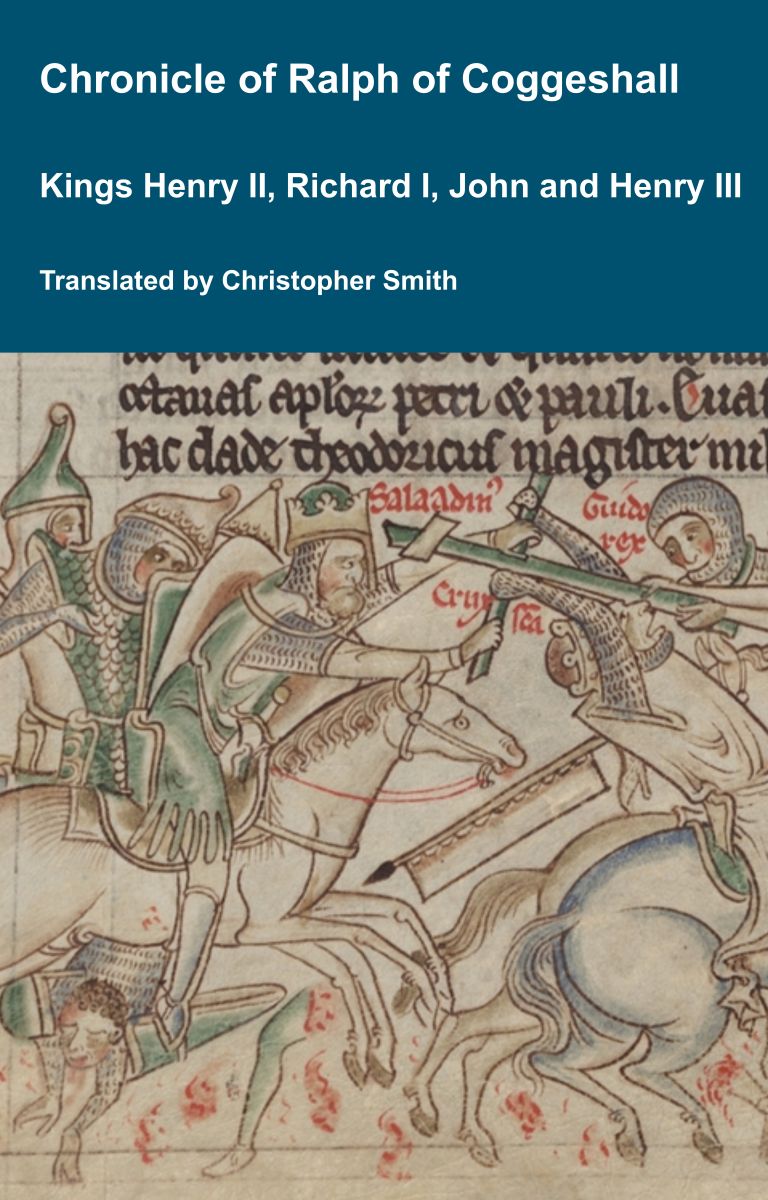 Chronicum Anglicanum by Ralph Coggeshall. 1127. Charles [aged 43], Count of Flanders, was killed1.
MCXXVII. Occisus est Carolus comes Flandrensis.
Note 1. Anglo-Saxon Chronicle. "In the Lent-tide of this same year was the Earl Charles of Flanders slain in a church, as he lay there and prayed to God, before the altar, in the midst of the mass, by his own men."
Orderic Vitalis: "On the calends [1st of March - a mistake for the 2nd] Charles, duke of Flanders, son of Canute, king of Denmark, attended by Tesnard, castellan of Bourbourg, and twenty men-at-arms went to the church at Bruges to hear mass. There, while praying to God prostrate on the floor, he was slain by Burchard de Lille, and thirty-two other men-at-arms, and almost all his attendants were cruelly massacred on the spot. William d'Ypres, having heard of this monstrous outrage, immediately blockaded the castle of Bruges, and beset the cruel murderers on all sides, until the king of France arrived with William the Norman, and after closely besieging the bloody butchers for the period of a month, took them, and cast them headlong from the highest tower."
On 2nd March 1127 Charles I Count Flanders [aged 43] was murdered at Church of St Donatian. His second cousin William [aged 24] succeeded Count Flanders. Joanna Monferrat Countess Essex and Flanders by marriage Countess Flanders.
On 2nd March 1241 Isabella Capet was born to King Louis IX of France [aged 26] and Margaret Provence Queen Consort France [aged 20]. She a great x 2 granddaughter of King Henry "Curtmantle" II of England. She married 6th April 1255 her half third cousin Theobald "Young" II King Navarre, son of Theobald IV King Navarre and Margaret Bourbon Queen Consort Navarre.
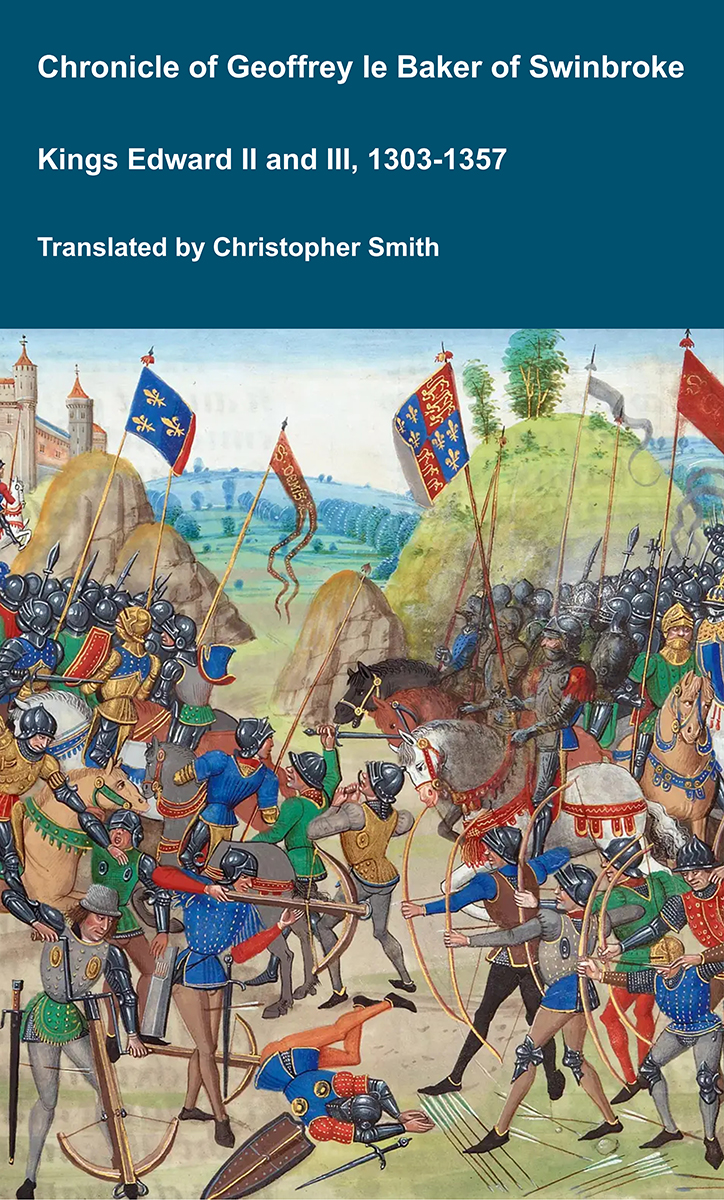
Chronicle of Geoffrey le Baker of Swinbroke
Baker was a secular clerk from Swinbroke, now Swinbrook, an Oxfordshire village two miles east of Burford. His Chronicle describes the events of the period 1303-1356: Gaveston, Bannockburn, Boroughbridge, the murder of King Edward II, the Scottish Wars, Sluys, Crécy, the Black Death, Winchelsea and Poitiers. To quote Herbert Bruce 'it possesses a vigorous and characteristic style, and its value for particular events between 1303 and 1356 has been recognised by its editor and by subsequent writers'. The book provides remarkable detail about the events it describes. Baker's text has been augmented with hundreds of notes, including extracts from other contemporary chronicles, such as the Annales Londonienses, Annales Paulini, Murimuth, Lanercost, Avesbury, Guisborough and Froissart to enrich the reader's understanding. The translation takes as its source the 'Chronicon Galfridi le Baker de Swynebroke' published in 1889, edited by Edward Maunde Thompson.
Available at Amazon in eBook and Paperback format.
On 2nd March 1316 King Robert II of Scotland was born to Walter Stewart 6th High Steward [aged 20] and Marjorie Bruce [aged 20] at Paisley Abbey. His mother Marjorie Bruce died in childbirth. He a great x 3 grandson of King John of England. He married (1) 1336 Elizabeth Mure Queen Consort Scotland and had issue (2) 1356 Euphemia Ross Queen Consort Scotland, daughter of Hugh 4th Earl Ross and Margaret Graham Countess Ross, and had issue.
On 2nd March 1401 William Sawtry aka Salter was burned at the stake for heresy at Smithfield [Map]. He was the first follower of Lollardy to die for his beliefs.

On 10th March 1401. Henry IV's [aged 33] Royal Assent was given to "De heretico comburendo", by which heretics were to be burned at the stake in reaction to the Lollard movement.
The request "... the said church would be injured or gravely oppressed or even perturbed by certain perverse doctrines, or wicked, heretical or erroneous opinions; nevertheless, various perfidious and perverse people of a certain new sect, believing damnable things of the said faith, the sacrament of the church, and its authority, rashly usurping the office of preacher, contrary to divine and ecclesiastical law, perversely and maliciously preach and teach these days, publicly and secretly, under simulation of the colour of sanctity, various new doctrines and wicked, heretical and erroneous opinions, contrary to this same faith and the holy decrees of the sacrosanct church ...".
The answer: "and they shall cause these same persons to be publicly burnt in a high place; and may punishment of this sort strike fear into the minds of others.".
On 2nd March 1401 William Sawtrey was the first heretic to be burned although his burning pre-dated the statute.
On 2nd March 1409 John Valois II Duke Alençon was born to John Valois I Duke Alençon and Marie Montfort Duchess Alençon [aged 18]. He a great x 4 grandson of King Henry III of England. He married 1437 his second cousin Marie Armagnac Duchess Alençon, daughter of John IV Count Armagnac and Isabella Évreux Countess Armagnac, and had issue.
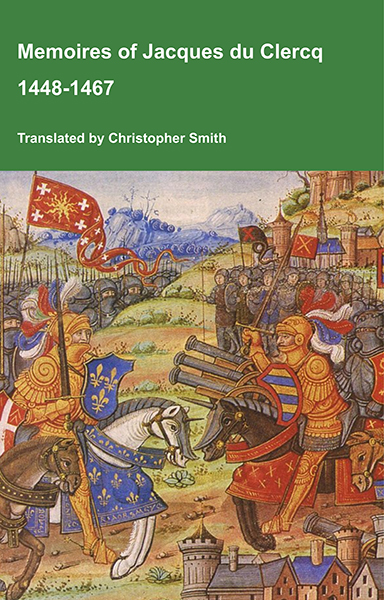 Memoires Jacques du Clercq. On the 2nd day of March in the said year 1452, the Bastard of Burgundy, with his company, once again rode out toward Ghent and encountered a large number of men of Ghent. They engaged them and killed about fifty, besides taking several prisoners.
Le ije jour de mars audit an cinquante deux, le bastard de Bourgogne et sa compagnie alla encoires vers Gand, et rencontra grand plante des Gantois esquels ils se ferirent, et en occit bien cinquante sans plusieurs qu'il print prisonniers.
Memoires Jacques du Clercq. Around this time, on the 2nd day of March, in the town of Brussels, the Duke of Burgundy was seized with so severe an illness that his death was thought more likely than his recovery. In the town was his son, the Count of Charolais, but the Lord of Croy was not there, having departed about three weeks before the duke's illness. The count, fearing his father's death, and knowing that the Lord of Croy and his friends and allies governed his father's lands, especially the towns and territories of Luxembourg, Namur, Boulogne, Beaumont in Hainaut, and elsewhere, sent, without the knowledge of the Lord of Croy, to renew the captains of the castles of Luxembourg, Namur, Boulogne, and Beaumont. Having done this by subtle means, and after his father had recovered his health, he so acted that on the 8th day of the said month, encouraged by certain members of the council and many nobles, the duke agreed that his son should hold under him the government of all his lands. At this, the Lord of Quiévrain, eldest son of Sir Jean de Croy, chamberlain to the duke, was greatly angered; and by his counsel, on the ninth day of the said month, the duke assembled his council and revoked what he had granted the day before. When his son learned of this, he gathered his own council, including the Count of Saint-Pol, the Bastard of Burgundy, and others, together with most of his father's council. There he declared that he would no longer conceal his feelings, but would openly say what he had long wished to say: namely, that from that day forward he made it known to all his friends that he regarded the Lord of Croy, his family, and all their allies as his mortal enemies. He gave his reasons, some of which will be set out below in letters that he caused to be published throughout the principal towns of his father's lands. Having done this, he promptly sent two or three knights to inform the Lord of Quiévrain, who in the service of the Lord of Croy, his uncle, was chief chamberlain to the duke his father, that unless he withdrew from his father's service, no good would come to him, and that he would do wisely to retire. The Lord of Quiévrain, hearing this, perhaps fearing more than he ought, or not knowing how best to act or how to depart safely without dishonour, went the next day, on a Saturday morning, to kneel before the Duke of Burgundy. He thanked him for the benefits he had received and begged him to accept his past service, and asked leave to depart from his court. In great fear, he told him that he was being sought in order to be killed, and that the count, his son, was ill-disposed towards him. When the duke heard this, he was greatly troubled, and forbade him to leave. In anger, he took in his hand a staff, called a gonge or spear, and went out of his chamber, saying that he would see whether his son would allow his servants to be killed. He went to the gate of his residence and remained there for some time. The Duchess of Bourbon, his sister, together with other ladies and damsels, and the Bastard of Burgundy, came to him and calmed him as best they could, and at length persuaded him to return to his chamber. Meanwhile, the Lord of Quiévrain, despite the duke's command, left the court as secretly as he could, accompanied by two others, and had his most valuable possessions carried away. The Count of Charolais, knowing that his father was displeased with him, held council daily, both with his own advisers and with those of his father, among whom were the Bishop of Tournai, the Lord of Gois, and others, and made every effort to reconcile himself with his father. As the duke's loyal counsellors also worked to bring about peace between the count and his father, the Count of Charolais, after careful deliberation and advice, sent letters patent throughout all the principal towns of his father's lands, addressed to the nobles, the burgesses, and the commons, requesting that they be publicly read. The contents follow.
Environ ce temps, le ije jour de mars, en la ville de Bruxelles, prist au duc de Bourgogne une maladie sy griefve que on esperoit mieulx sa mort que şa vie; en laquelle ville estoit le comte de Charollois son fils, et n'y estoit pas le S de Croy; ains s'estoit party environ trois semaines auparavant sa maladie. Icelluy comte, doubtant la mort de son pere, et sçachant que le S de Croy et ses amys et alliés avoient le gouvernement du pays du duc son pere, et par especial de la ville et pays de Luxembourg, de Namur, de Boullenois, de Beaumont en Haynault et ailleurs, sans le sceu du Sr de Croy, envoya renouveller les capitaines des chasteaux dudit Luxembourg, de Namur, de Boulogne et Beaumont, et par subtille maniere ce fait, et sondit pere retourné en santé, feit tant que le viije jour dudit mois de mars, par l'enhort d'aulcuns de son conseil et plusieurs nobles, fust content que sondit fils eut soubs lui le gouvernement de touts ses pays, dont le S de Quievrain, fils aisné de messire Jehan de Croy, chambellan du duc, fust moult courchié, et par son conseil, le ixe jour dudit mois, le duc rassembla son conseil et revocqua ce qu'il avoit fait le jour de devant; ce sçachant son fils, assembla son conseil, tel comme le comte de Saint Pol, le bastard de Bourgogne et aultres, avecq la pluspart du conseil de son pere, et illecq dit que plus il ne voulloit celler son courraige, ains volloit dire ce que piecha avoit eu volonté de dire: c'estoit que de ce jour en avant, il faisoit sçavoir a touts ses amys que le S de Groy, les siens et touts ses alliés, il tenoit et reputoit mortels ennemys, en leur disant les causes, lesquelles aulcunes seront chy après desclarées par lettres que le comte envoya publier par touts les bonnes villes du pays de son pere; et ce fait, envoya prestement deux ou trois chevalliers, et feit sçavoir Jau S de Quievrain, lequel en la seigneurie du Sª de Croy, son oncle, estoit premier chambellan du duc, son pere, que il ne se despartist du serviche de son pere, il ne lui en viendroit ja bien, et qu'il feroit que sage de se retirer. Lequel St de Quievrain, oye la nouvelle du comte, doubtant par adventure plus qu'il ne debvoit, ou non sçachant comment faire pour bien faire, ne comment s'en partir seurement, au moings du deshonneur qu'il poldroit advenir, le lendemain du mandement, par ung samedy matin, se alla jetter a genoulx devant le duc de Bourgogne, le remerchiant des biens qu'il lui avoit fait et lui priant qu'il print en gré ce qu'il lui avoit fait de serviche, lui priant qu'il lui donnat congié de partir de sa cour, et moult effrayement lui dit que on le cachoit pour occire, et comment le comte, son fils, estoit mal content de lui. Quant le duc l'olt oy, sy fust moult troublé, et lui deffendit qu'il ne se partist point, et moult airement prist ung baston, que on appelle ung gonge ou espieu, en sa main, et issit de sa chambre et dit qu'il vouroit sy son fils verroit tuer ses gens, et alla a la porte de son hostel, et illecq fust longuement; la duchesse de Bourbon, sa soeur, avecq aultres dames et dar moiselles et le bastard de Bourgogne vindrent devers lui et l'appaiserent au mieulx qu'ils polrent, et tant feirent qu'il retourna en sa chambre. Ce temps pendant le St de Quievrain, quel command que le duc lui olt fait, se partist de la cour du duc, le plus secretement qu'il peult, lui ije, et feit emporter ses meilleurs bagues. Le comte de Charollois, sçachant que son pere estoit mal content de lui, sy tint touts les jours conseil, tant de ceulx de son conseil, comme de ceulx du conseil de son pere, auquel estoit l'evesque de Tournay, le St de Gois, et aultres, et se meit en ses debvoirs de rappaiser son pere; et comme chacun des bons conseilliers de son pere se meirent en leurs debvoirs de faire la paix du comte vers son pere, par meure desliberation et par conseil, le comte de Charollois envoya, par toutes les bonnes villes du pays de son pere, ses lettres patentes adressantes aulx nobles, aulx bourgeois et aulx communes, requerant qu'elles lues publiquement, dont la teneur s'ensuit.
Patent Rolls. 2nd March 1478. Grant for life to the king's counsellor John Audeley, lord Audeley [aged 52], of the office of steward of all lordships, manors and lands in the county of Dorset late of George, late duke of Clarence [deceased], and in the king's hands by his forfeiture, with 20 marks yearly from the issues of the lordship of Halisbere, co. Dorset; grant to him, during minority, of the office of steward of all lordships, manors and lands in the said county in the king's hands by reason of the minority of Edward [aged 3], son of the said George, with 10 marks yearly from the issues of the premises; and grant to him for life of the office of constable and the custody of the castle of Warden and the office of constable and the custody of the castle of Corffe, with the accustomed fees from the issues of the king's lordships there and all other profits. By p.s.
On 2nd March 1484 Ralph Fitzherbert [aged 56] died at Norbury, Derbyshire [Map]. He was buried at Church of St Barlok, Norbury [Map].
On 20th October 1490 Elizabeth Marshall [aged 53] died. She was buried at Church of St Barlok, Norbury [Map].
Monument to Ralph and Elizabeth. Finely made in Chellaston alabaster of the Fluted Period. Possibly Harpur and Moorecock of Burton on Trent. Fitzherbert Clenched Fist Crest. His effigy notable for being the only remaining with the Yorkist Boar Pendant (boar of Richard III) on his Suns and Roses Collar.
Ralph Fitzherbert: Around 1428 he was born to Nicholas Fitzherbert and Alice Booth at Norbury, Derbyshire [Map]. In or before 1450 Ralph Fitzherbert and Elizabeth Marshall were married. They had seven sons and five daughters.
Elizabeth Marshall: Around 1437 she was born to John Marshall.


Henry Machyn's Diary. 2nd March 1561. The ij day of Marche was consecratyd at the byshope of London('s) palles master Yonge [aged 54] byshope of Yorke, was byshope of (Saint David's).
On 2nd March 1573 Johann Wilhelm Wettin Duke Saxe Weimar [aged 42] died. His son Friedrich [aged 10] succeeded I Duke Saxe Weimar.
On 2nd March 1619 Anne of Denmark Queen Consort Scotland England and Ireland [aged 44] died.


Diary of Anne Clifford. 2nd March 1619. The 2nd the Queen died at Hampton Court between two and three in the morning, the King was then at Newmarket. Legge brought me the news of her death about two in the afternoon, I being in the bed chamber at Knole where I had the first news of my Mother's death about the same hour. (Legge told me my Lord [aged 29] was about to take some physic of Mr Smith and as he could not come from London these four or five days yet.) She died in the same room that Queen Jane, Harry 8th's wife died in, though Rina was there when the pangs of death came upon her, but went into another chamber some half an hour before she died.
On 2nd March 1625 James Hamilton 2nd Marquess Hamilton [aged 36] died at Whitehall Palace [Map]. His son James [aged 18] succeeded 3rd Marquess Hamilton, 2nd Earl Cambridge, 2nd Baron Innerdale. Margaret aka Mary Feilding [aged 12] by marriage Marchioness Hamilton.



Samuel Pepys' Diary. 2nd March 1660. This morning I went early to my Lord at Mr. Crew's [aged 62], where I spoke to him. Here were a great many come to see him, as Secretary Thurlow [aged 43] who is now by this Parliament chosen again Secretary of State. There were also General Monk's [aged 51] trumpeters to give my Lord a sound of their trumpets this morning. Thence I went to my office, and wrote a letter to Mr Downing [aged 35] about the business of his house. Then going home, I met with Mr. Eglin, Chetwind, and Thomas, who took me to the Leg in King's street, where we had two brave dishes of meat, one of fish, a carp and some other fishes, as well done as ever I ate any. After that to the Swan [Map] tavern, where we drank a quart or two of wine, and so parted. So I to Mrs. Jem and took Mr. Moore with me (who I met in the street), and there I met W. Howe and Sheply. After that to Westminster Hall [Map], where I saw Sir G. Booth [aged 37] at liberty. This day I hear the City militia is put into good posture, and it is thought that Monk will not be able to do any great matter against them now, if he have a mind. I understand that my Lord Lambert [aged 40] did yesterday send a letter to the Council, and that to-night he is to come and appear to the Council in person. Sir Arthur Haselrigge [aged 59] do not yet appear in the House. Great is the talk of a single person, and that it would now be Charles [aged 29], George, or Richard [aged 33]-For the last of which, my Lord St. John [aged 61] is said to speak high. Great also is the dispute now in the House, in whose name the writs shall run for the next Parliament; and it is said that Mr. Prin [aged 60], in open House, said, "In King Charles's". From Westminster Hall [Map] home. Spent the evening in my study, and so after some talk with my wife, then to bed.


Samuel Pepys' Diary. 2nd March 1664. Up, my eye mightily out of order with the rheum that is fallen down into it, however, I by coach endeavoured to have waited on my Lord Sandwich [aged 38], but meeting him in Chancery Lane [Map] going towards the City I stopped and so fairly walked home again, calling at St. Paul's Churchyarde, and there looked upon a pretty burlesque poem, called "Scarronides, or Virgile Travesty"; extraordinary good.


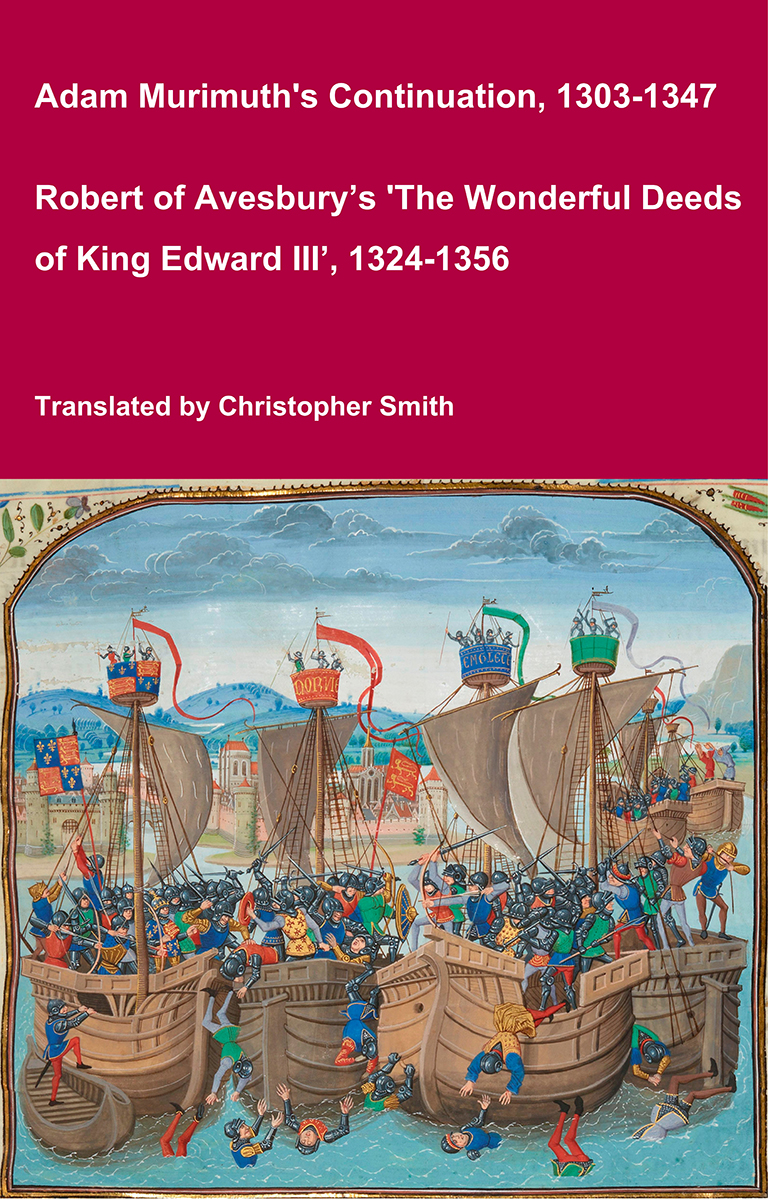
Adam Murimuth's Continuation and Robert of Avesbury’s 'The Wonderful Deeds of King Edward III'
This volume brings together two of the most important contemporary chronicles for the reign of Edward III and the opening phases of the Hundred Years’ War. Written in Latin by English clerical observers, these texts provide a vivid and authoritative window into the political, diplomatic, and military history of fourteenth-century England and its continental ambitions. Adam Murimuth Continuatio's Chronicarum continues an earlier chronicle into the mid-fourteenth century, offering concise but valuable notices on royal policy, foreign relations, and ecclesiastical affairs. Its annalistic structure makes it especially useful for establishing chronology and tracing the development of events year by year. Complementing it, Robert of Avesbury’s De gestis mirabilibus regis Edwardi tertii is a rich documentary chronicle preserving letters, treaties, and official records alongside narrative passages. It is an indispensable source for understanding Edward III’s claim to the French crown, the conduct of war, and the mechanisms of medieval diplomacy. Together, these works offer scholars, students, and enthusiasts a reliable and unembellished account of a transformative period in English and European history. Essential for anyone interested in medieval chronicles, the Hundred Years’ War, or the reign of Edward III.
Available at Amazon in eBook and Paperback format.
Samuel Pepys' Diary. 2nd March 1664. This morning Mr. Burgby, one of the writing clerks belonging to the Council, was with me about business, a knowing man, he complains how most of the Lords of the Council do look after themselves and their own ends, and none the publique, unless Sir Edward Nicholas [aged 70]. Sir G. Carteret [aged 54] is diligent, but all for his own ends and profit. My Lord Privy Seale [aged 58], a destroyer of every body's business, and do no good at all to the publique. The Archbishop of Canterbury [aged 65] speaks very little, nor do much, being now come to the highest pitch that he can expect. He tells me, he believes that things will go very high against the Chancellor [aged 55] by Digby [aged 51], and that bad things will be proved. Talks much of his neglecting the King [aged 33]; and making the King to trot every day to him, when he is well enough to go to visit his cozen Chief-Justice Hide [aged 69], but not to the Council or King. He commends my Lord of Ormond [aged 53] mightily in Ireland; but cries out cruelly of Sir G. Lane [aged 44] for his corruption; and that he hath done my Lord great dishonour by selling of places here, which are now all taken away, and the poor wretches ready to starve. That nobody almost understands or judges of business better than the King, if he would not be guilty of his father's fault to be doubtfull of himself, and easily be removed from his own opinion. That my Lord Lauderdale [aged 47] is never from the King's care nor council, and that he is a most cunning fellow. Upon the whole, that he finds things go very bad every where; and even in the Council nobody minds the publique.
John Evelyn's Diary. 2nd March 1665. I went with his Majesty [aged 34] into the lobby behind the House of Lords, where I saw the King and the rest of the Lords robe themselves, and got into the House of Lords in a corner near the woolsack, on which the Lord Chancellor sits next below the throne: the King sat in all the regalia, the crown-imperial on his head, the sceptre and globe, etc. The Duke of Albemarle [aged 56] bore the sword, the Duke of Ormond [aged 54], the cap of dignity. The rest of the Lords robed in their places:-a most splendid and august convention. Then came the Speaker and the House of Commons [aged 48], and at the bar made a speech, and afterward presented several bills, a nod only passing them, the clerk saying, Le Roy le veult, as to public bills, as to private, Soit faite commeil est desirè. Then, his Majesty made a handsome but short speech, commanding my Lord Privy Seal [aged 59] to prorogue the Parliament, which he did, the Chancellor [aged 56] being ill and absent. I had not before seen this ceremony.


Samuel Pepys' Diary. 2nd March 1666. At noon dined and to the office again, and about 4 o'clock took coach and to my Lord Treasurer's [aged 58] and thence to Sir Philip Warwicke's [aged 56] new house by appointment, there to spend an houre in talking and we were together above an hour, and very good discourse about the state of the King [aged 35] as to money, and particularly in the point of the Navy. He endeavours hard to come to a good understanding of Sir G. Carteret's [aged 56] accounts, and by his discourse I find Sir G. Carteret must be brought to it, and what a madman he is that he do not do it of himself, for the King expects the Parliament will call upon him for his promise of giving an account of the money, and he will be ready for it, which cannot be, I am sure, without Sir G. Carteret's accounts be better understood than they are. He seems to have a great esteem of me and my opinion and thoughts of things.
Samuel Pepys' Diary. 2nd March 1667. After dinner, with my wife, to the King's house to see "The Mayden Queene", a new play of Dryden's [aged 35], mightily commended for the regularity of it, and the strain and wit; and, the truth is, there is a comical part done by Nell [aged 17]1, which is Florimell, that I never can hope ever to see the like done again, by man or woman. The King [aged 36] and Duke of York [aged 33] were at the play. But so great performance of a comical part was never, I believe, in the world before as Nell do this, both as a mad girle, then most and best of all when she comes in like a young gallant; and hath the notions and carriage of a spark the most that ever I saw any man have. It makes me, I confess, admire her. Thence home and to the office, where busy a while, and then home to read the lives of Henry 5th and 6th, very fine, in Speede, and to bed. This day I did pay a bill of £50 from my father, being so much out of my own purse gone to pay my uncle Robert's legacy to my aunt Perkins's child.
Note 1. "Her skill increasing with her years, other poets sought to obtain recommendations of her wit and beauty to the success of their writings. I have said that Dryden was one of the principal supporters of the King's house, and ere long in one of his new plays a principal character was set apart for the popular comedian. The drama was a tragi-comedy called 'Secret Love, or the Maiden Queen,' and an additional interest was attached to its production from the King having suggested the plot to its author, and calling it 'his play.'"-Cunningham's Story of Nell Gwyn, ed: 1892, pp. 38,39.


Samuel Pepys' Diary. 2nd March 1667. Up, and to the office, where sitting all the morning, and among other things did agree upon a distribution of £30,000 and odd, which is the only sum we hear of like to come out of all the Poll Bill for the use of this office for buying of goods. I did herein some few courtesies for particular friends I wished well to, and for the King's service also, and was therefore well pleased with what was done.
On 2nd March 1675 Justinian Isham 2nd Baronet [aged 65] died of smallpox at Oxford, Oxfordshire [Map]. He was buried at Church of All Saints, Lamport. His son Thomas [aged 17] succeeded 3rd Baronet Isham of Lamport in Northamptonshire.
John Evelyn's Diary. 2nd March 1682. Came to see and congratulate my recovery, Sir John Lowther, Mr. Herbert, Mr. Pepys [aged 49], Sir Anthony Deane [aged 48], and Mr. Hill.


On 2nd March 1707 Louis Michael van Loo was born.

On 2nd March 1743 James Hamilton 5th Duke Hamilton 2nd Duke Brandon [aged 40] died. His son James [aged 18] succeeded 6th Duke Hamilton, 3rd Duke Brandon of Suffolk, 3rd Baron Dutton of Cheshire.
On 2nd March 1767 John "The Elder" Bacon [aged 26] and Elizabeth Wade [aged 27] were married at St Saviour's Church, Southwark. They had three sons, one of which died in infancy, and three daughters.
On 2nd March 1793 Carl Gustaf Pilo [aged 81] died.

On 2nd March 1802 Francis Russell 5th Duke Bedford [aged 36] died unmarried at Woburn, Bedfordshire. He was buried at Bedford Chapel, St Michael's Church, Chenies. His brother John [aged 35] succeeded 6th Duke Bedford, 6th Marquess Tavistock, 10th Earl Bedford, 10th Baron Russell of Cheneys, 8th Baron Russell of Thornhaugh, 6th Baron Howland of Streatham.
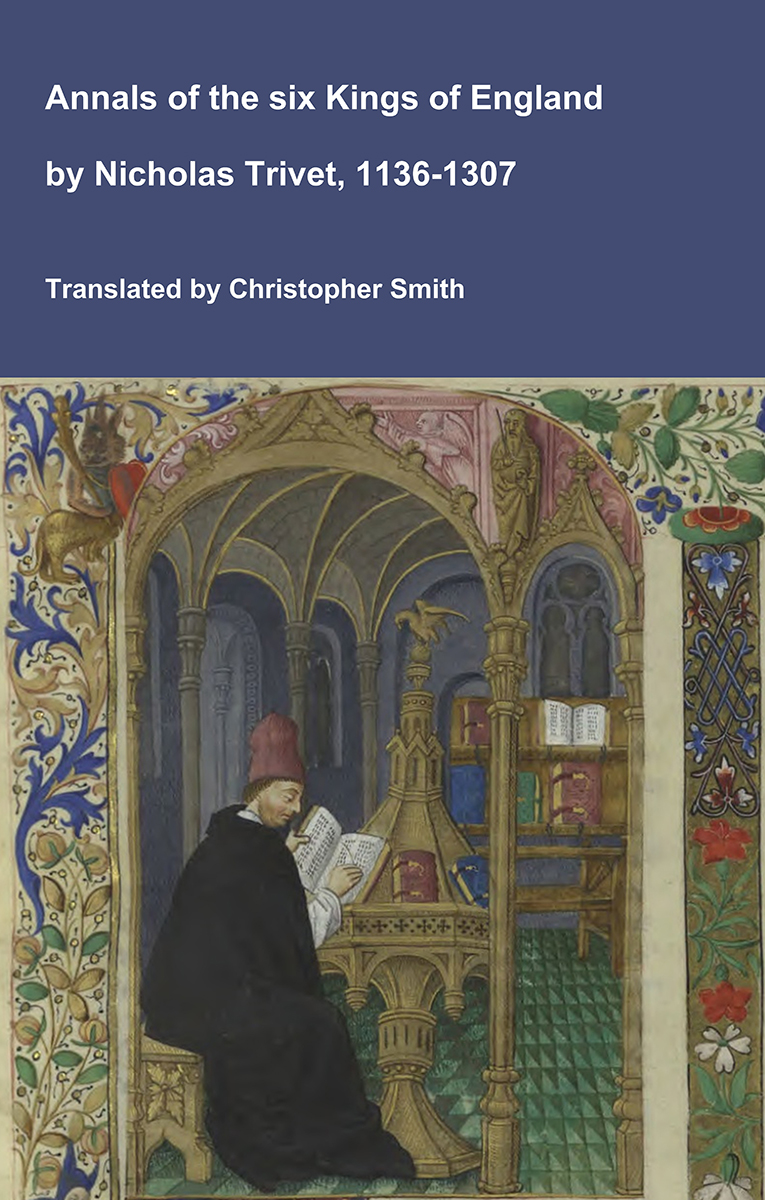
Annals of the six Kings of England by Nicholas Trivet
Translation of the Annals of the Six Kings of England by that traces the rise and rule of the Angevin aka Plantagenet dynasty from the mid-12th to early 14th century. Written by the Dominican scholar Nicholas Trivet, the work offers a vivid account of English history from the reign of King Stephen through to the death of King Edward I, blending political narrative with moral reflection. Covering the reigns of six monarchs—from Stephen to Edward I—the chronicle explores royal authority, rebellion, war, and the shifting balance between crown, church, and nobility. Trivet provides detailed insight into defining moments such as baronial conflicts, Anglo-French rivalry, and the consolidation of royal power under Edward I, whose reign he describes with particular immediacy. The Annals combines careful year-by-year reporting with thoughtful interpretation, presenting history not merely as a sequence of events but as a moral and political lesson. Ideal for readers interested in medieval history, kingship, and the origins of the English state, this chronicle remains a valuable and accessible window into the turbulent world of the Plantagenet kings.
Available at Amazon in eBook and Paperback format.
On 28th February 1809 Charles John Cary 9th Viscount Falkland [aged 40] was shot through the groing during a duel with Arthur Annesley Roberts aka Powell. On 2nd March 1809 Charles John Cary 9th Viscount Falkland died from wounds received duelling. His son Lucius [aged 5] succeeded 10th Viscount Falkland. He was buried at the Grosvenor Chapel, Mayfair.
Saint James's Chronicle, 7 March 1809:
Various erroneous statements have appeared, respecting the unfortunate duel betwixt Lord Falkland and Mr Powell; but the following particulars we are told, may be relied on: Lord Falkland dined at Mr Powell's house with a large party on the Saturday preceding the duel. The party broke up early, and Lord F and Mr P went to the opera together, having drunk a good deal of wine.
They returned from the opera to Stephen's Hotel, Bond Street, and parted as they had met, intimate friends, but in a state of inebriety. It was after this that Lord Falkland visited the Mount coffee house. On Sunday evening, Lord F looked in at Stephens's again and espying his friend, Mr Powell, he accosted him, in words, similar to these 'What! Drunk again tonight, Pogey?' and it is understood neither was at this time perfectly sober.
Mr Powell did not relish the mode in which he had been accosted, and after a retort, Lord F snatched a cane from a gentleman's hand, and used it about his friend. The waiter and some gentlemen present, extricated Mr Powell, who retired; but the waiter met his Lordship's displeasure. On the following morning Lord Falkland went to Mr Powell's house, and apologised, by asking that gentleman's pardon, an attributing his rash conduct to inebriety. Mr Powell observed that he could not accept of his Lordship's apology, unless made at Stephen's before the persons who were present at the outrage, or to make a public one in another way.
Lord Falkland could not accede to this proposition; but in the afternoon of the same day (Monday), Captain Cotton waited on him from Mr Powell, to state that if he (Lord F) would allow Captain C to make the public apology for him at Mr Powell's house, and shortly after Mr Powell sent him challenge.
Lord F appeared much hurt after he had receive the challenge, and he did not take his wine as usual, at dinner, on Monday, on which day Mr P. and others, who dined on the Saturday at his house, were to have dined with Lord Falkland His Lordship did not go to bed on Monday night, but threw himself on his sofa, and gave strict orders to his servant to call him, to be at the Admiralty at eight o'clock in the morning.
The parties met at Golder's Green, at eleven o'clock, attended by their seconds, and two surgeons. By etiquette Mr P. fired first and inflicted the mortal wound. Lord F stood for above a minute in his position; and then threw his pistol away without discharging its contents. It is well understood that his Lordship never intended to fire at his antagonist, for he was aware he had done wrong, but he conceived his honour called him to the field, rather than make the apology required. On the arrival of his Lordship on the stones in a post chaise, he requested of Mr B. his second, to stop the chaise, as he could not bear the sensation it occasioned, but requested to be conveyed home in a hammock on the men's shoulders.
During the stoppage of the chaise, Mr Powell and Captain C, his second, overtook them, and the latter gentleman, on ascertaining the cause of the stoppage, observed, that Powell's house was near at hand, and Lord F instantly expressed a desire to go there in preference to any other house, for the world would then be convinced he owed no animosity to his antagonist.
On Mr Heaviside examining the wound, his Lordship observed that he wish to know the state of it candidly. He had seen many wounds cured on board ship, and he begged of the surgeon to treat him in the way a ship's surgeon would a wounded sailor. He vomited freely, and wished to know if there was no probability of throwing up the ball. Once Mr Heaviside having done what he could he requested as a favour, that he would go to Dorant's, and make his lady acquainted with his real state; this was done, and Lady F soon arrived at Devonshire place.
His Lordship suffered greatly the first twelve hours, but his pain was eased, and he died gradually, while his Lady, who was attentively watching him at his bedside, thought he was sleeping.
The deceased was appointed to a 74 gunship, which is to take Lord Amherst to Sicily. His Lady whom he married in the West Indies in the year 1803, was the daughter of a merchant of the first respectability. She has three sons and a daughter, the eldest boy begin only five years old, and who succeeds to the title of Lord Falkland. Mr Powell is a man of considerable fortune. He was separated from his Lady some time since, and she now lives on an annuity of £500 a year at Ramsgate.
Greville Memoirs. 2nd March 1831. The great day at length arrived, and yesterday Lord John Russell [aged 38] moved for leave to bring in his Reform Bill. To describe the curiosity, the intensity of the expectation and excitement, would be impossible, and the secret had been so well kept that not a soul knew what the measure was (though most people guessed pretty well) till they heard it. He rose at six o'clock, and spoke for two hours and a quarter—a sweeping measure indeed, much more so than anyone had imagined, because the Ministers had said it was one which would give general satisfaction, whereas this must dissatisfy all the moderate and will probably just stop short enough not to satisfy the Radicals. They say it was ludicrous to see the faces of the members for those places which are to be disfranchised as they were severally announced, and Wetherell, who began to take notes, as the plan was gradually developed, after sundry contortions and grimaces and flinging about his arms and legs, threw down his notes with a mixture of despair and ridicule and horror. Not many people spoke last night: Inglis followed John Russell, and Francis Leveson closed the debate in the best speech he has ever made, though rather too flowery. Everything is easy in these days, otherwise how Palmerston, Goderich, and Grant can have joined in a measure of this sweeping, violent, and speculative character it is difficult to conceive, they who were the disciples of Castlereagh and the adherents of Canning; but after the Duke of Wellington and Peel carrying the Catholic question, Canning's friends advocating Radical Reform, and Eldon living to see Brougham on the Woolsack, what may one not expect?


On 2nd March 1834 Walter Charles Montagu-Douglas-Scott was born to Walter Scott 5th Duke Buccleuch 7th Duke Queensberry and Charlotte Anne Thynne Duchess Buccleuch Duchess Queensbury [aged 22].
On 2nd March 1835 Francis Lorraine II Holy Roman Emperor [aged 67] died.

On 2nd March 1867 John William Spencer Brownlow Egerton-Cust 2nd Earl Brownlow [deceased] was buried in St Peter and St Paul Church, Belton [Map].

The London Gazette 24071. 2nd March 1874. St. James's Palace, March 2, 1874.
The Queen [aged 54] has been pleased to appoint to be Lords in Waiting in Ordinary to Her Majesty:-
Charles Adolphus, Earl of Dunmore [aged 32], in the room of Gavin, Earl of Breadalbane [aged 22], resigned.
Robert, Earl of Roden [aged 27], in the room of Valentine Augustus, Earl of Kenmare [aged 48], resigned.
Cornwallis, Viscount Hawarden [aged 56], in the room of Albert Edmund, Earl of Morley [aged 30], resigned.
William, Lord Bagot [aged 62], in the room of Thomas, Lord Camoys [aged 76], resigned.
Dudley Charles, Lord De Ros [aged 46], in the room of Charles, Lord Lurgan, resigned.
William Buller Fullerton, Lord Elphinstone [aged 45], in the room of Frederick Henry Paul, Lord Methuen [aged 56], resigned.
Thomas, Lord Walsingham [aged 30], in the room of Arthur, Lord Wrottesley [aged 49], resigned.
The London Gazette 24071. Board of Green Cloth, March 2, 1874.
The Queen [aged 54] has been pleased to appoint the Right Honourable Frederick, Earl Beauchamp [aged 43], to be Lord Steward of Her Majesty's Household, in the room of the Right Honourable John George Brabazon, Earl of Bessborough [aged 64], resigned.
The Queen has also been pleased to appoint the Honourable Henry George Percy [aged 27] (commonly called Earl Percy) to be Treasurer of Her Majesty's Household, in the room of the Right Honourable William John, Lord Monson [aged 45], resigned.
The Queen has also been pleased to appoint the Honourable Henry Richard Charles Somerset [aged 24] (commonly called Lord Henry Somerset) to be Comptroller of Her Majesty's Household, in the room of the right Honourable Otho Augustus Fitzgerald [aged 46] (commonly called Lord Otho Fitzgerald), resigned.
On 2nd March 1877 Consuelo Vanderbilt Duchess of Marlborough was born to William Kissam Vanderbilt [aged 27] and Alva Erskine Smith [aged 24] at New York. She was named after her godmother Consuelo Yznaga Duchess Manchester [aged 24]. She married (1) 6th November 1895 Charles Richard John Spencer-Churchill 9th Duke of Marlborough, son of George Charles Spencer-Churchill 8th Duke of Marlborough and Albertha Frances Anne Hamilton Duchess of Marlborough, and had issue (2) 4th July 1921 Jacques Balsan.
On 2nd March 1881 John Prescott Knight [aged 78] died. He was buried at Kensal Green Cemetery [Map].
On 2nd March 1885 Gwendolen Fanny Godolphin Osborne was born to George Godolphin Osborne 10th Duke Leeds [aged 22] and Katherine Frances Lambton Duchess Leeds [aged 22]. She married 17th July 1923 Algernon Gascoyne Cecil.

On 2nd March 1917 Henry John Cockayne-Cust [aged 55] died. His monument at St Peter and St Paul Church, Belton [Map] sculpted by his wife Emmeline "Nina" Welby-Gregory [aged 50].
Henry John Cockayne-Cust: On 10th October 1861 he was born to Henry Cockayne-Cust and Sara Jane Cookson. On 11th October 1893 Henry John Cockayne-Cust and Emmeline "Nina" Welby-Gregory were married.
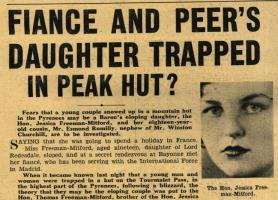
2nd March 1937. Daily Mirror. Fiance [Esmond Romilly [aged 18]] and Peer's Daughter [aged 19] Trapped in Peak Hut.
Saying that she was going to spend a holiday in France, Miss Freeman-Mitford, aged nineteen, daughter of Lord Redesdale, eloped, and at a secret rendezvous at Bayonne met her fiancé, who has been serving with the International Force in Madrid.
Esmond Romilly: On 10th July 1918 he was born to Colonel Bertram Romilly and Nellie Hozier. On 18th May 1937 he and Jessica Lucy Freeman-Mitford were married in a civil ceremony in Bayonne. Both mothers, Sydney Bowles Baroness Redesdale and Nellie Hozier attended the ceremony. They were second cousins. On 30th November 1941 Esmond Romilly died in a plane crash. According to official reports his plane left the base at 4.45pm as part of a 9 plane mission to raid Hamburg. At 8pm a radio message advised that due to low oil pressure in the port engine the mission was being abandoned & they were returning to base. About 40 minutes later the aircraft put out an SOS but nothing more was heard - their position was 110 miles east of the Yorkshire coast well out in the North Sea. Thick fog hampered rescue craft and nothing was found.

On 2nd March 1939 Howard Carter [aged 64] died.
Jean de Waurin's Chronicle of England Volume 6 Books 3-6: The Wars of the Roses
Jean de Waurin was a French Chronicler, from the Artois region, who was born around 1400, and died around 1474. Waurin’s Chronicle of England, Volume 6, covering the period 1450 to 1471, from which we have selected and translated Chapters relating to the Wars of the Roses, provides a vivid, original, contemporary description of key events some of which he witnessed first-hand, some of which he was told by the key people involved with whom Waurin had a personal relationship.
Available at Amazon in eBook and Paperback format.
On 2nd March 1940 William Edwards Miller [aged 88] died.
On 2nd March 1947 Stanhope Forbes [aged 89] died. He was buried at St Sancredus' Church, Sancreed.
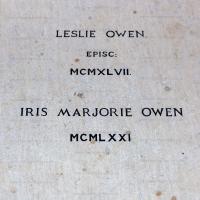
On 2nd March 1947 Bishop Leslie Owen [aged 61] died. He was buried at Lincoln Cathedral [Map].
Bishop Leslie Owen: On 3rd February 1886 he was born. In July 1920 he and Iris Marjorie Lawrence were married. On 12th June 1946 Bishop Leslie Owen was nominated Bishop of Lincoln which office he held for ten months.
On 2nd March 1964 Osborne De Vere Beauclerk 12th Duke St Albans [aged 89] died. His second cousin Charles [aged 48] succeeded 13th Duke St Albans, 13th Earl Burford, 13th Baron Heddington, 10th Baron Vere of Hanworth in Middlesex. Suzanne Marie Fesq Duchess St Albans [aged 42] by marriage Duchess St Albans.

On 2nd March 1965 Louise Mountbatten Queen Consort Sweden [aged 75] died.

On 2nd March 1975 Charles Waterhouse of Lomberdale Hall [aged 81] died. He was buried at All Saints Church, Youlgreave [Map].
Charles Waterhouse of Lomberdale Hall: On 1st July 1893 he was born to Thomas Crompton Waterhouse of Lomberdale Hall. In 1912 Thomas Crompton Waterhouse of Lomberdale Hall died. His son Charles Waterhouse of Lomberdale Hall inherited Lomberdale House [Map]. In 1914 Charles Waterhouse of Lomberdale Hall purchased Middleton Hall [Map]. In 1917 he and Beryl Ford were married. They had two sons and one daughter.
On 2nd March 1241 Isabella Capet was born to King Louis IX of France [aged 26] and Margaret Provence Queen Consort France [aged 20]. She a great x 2 granddaughter of King Henry "Curtmantle" II of England. She married 6th April 1255 her half third cousin Theobald "Young" II King Navarre, son of Theobald IV King Navarre and Margaret Bourbon Queen Consort Navarre.
On 2nd March 1316 King Robert II of Scotland was born to Walter Stewart 6th High Steward [aged 20] and Marjorie Bruce [aged 20] at Paisley Abbey. His mother Marjorie Bruce died in childbirth. He a great x 3 grandson of King John of England. He married (1) 1336 Elizabeth Mure Queen Consort Scotland and had issue (2) 1356 Euphemia Ross Queen Consort Scotland, daughter of Hugh 4th Earl Ross and Margaret Graham Countess Ross, and had issue.
On 2nd March 1378 Edmund Stafford 5th Earl Stafford was born to Hugh Stafford 2nd Earl Stafford [aged 42] and Philippa Beauchamp Countess Stafford [aged 44]. He a great x 3 grandson of King Edward I of England. He married 28th June 1398 his third cousin once removed Anne of Gloucester Plantagenet Countess Eu and Stafford, daughter of Thomas of Woodstock 1st Duke of Gloucester and Eleanor Bohun Duchess Gloucester, and had issue.
On 2nd March 1409 John Valois II Duke Alençon was born to John Valois I Duke Alençon and Marie Montfort Duchess Alençon [aged 18]. He a great x 4 grandson of King Henry III of England. He married 1437 his second cousin Marie Armagnac Duchess Alençon, daughter of John IV Count Armagnac and Isabella Évreux Countess Armagnac, and had issue.
Chronicle of Abbot Ralph of Coggeshall
The Chronicle of Abbot Ralph of Coggeshall (Chronicon Anglicanum) is an indispensable medieval history that brings to life centuries of English and European affairs through the eyes of a learned Cistercian monk. Ralph of Coggeshall, abbot of the Abbey of Coggeshall in Essex in the early 13th century, continued and expanded his community’s chronicle, documenting events from the Norman Conquest of 1066 into the tumultuous reign of King Henry III. Blending eyewitness testimony, careful compilation, and the monastic commitment to record-keeping, this chronicle offers a rare narrative of political intrigue, royal power struggles, and social upheaval in England and beyond. Ralph’s work captures the reigns of pivotal figures such as Richard I and King John, providing invaluable insights into their characters, decisions, and the forces that shaped medieval rule. More than a simple annal, Chronicon Anglicanum conveys the texture of medieval life and governance, making it a rich source for scholars and readers fascinated by English history, monastic authorship, and the shaping of the medieval world.
Available at Amazon in eBook and Paperback format.
On 1st March 1682 John Evelyn 1st Baronet was born to John The Younger Evelyn [aged 27] and Martha Spencer [aged 23] at Sayes Court, Deptford [Map]. He was baptised on 2nd March 1682. He married 18th September 1705 Anne Boscawen Lady Evelyn and had issue.
On 2nd March 1683 Archer Croft 2nd Baronet was born to Herbert Croft 1st Baronet [aged 32] and Elizabeth Archer Lady Croft.
On 2nd March 1684 Christopher Wandesford 2nd Viscount Castlecomer was born to Christopher Wandesford 1st Viscount Castlecomer [aged 27] and Elizabeth Montagu. He married 31st May 1715 his fifth cousin Frances Pelham Viscountess Castlecomer, daughter of Thomas Pelham 1st Baron Pelham of Laughton and Grace Holles, and had issue.

On 2nd March 1696 William Murray 3rd Earl Dunmore was born to Charles Murray 1st Earl Dunmore [aged 35] at St James's Palace [Map].
On 2nd March 1702 Charles Stourton 15th Baron Stourton was born to Charles Stourton [aged 32]. He married 2nd April 1733 Catherine Walmesley Baroness Petre and Stourton.

On 2nd March 1705 William Murray 1st Earl Mansfield was born to David Murray 5th Viscount of Stormont [aged 40] and Marjory Scott Viscountess Stormont. He married 20th September 1738 Elizabeth Finch Countess Mansfield, daughter of Daniel Finch 2nd Earl Nottingham 7th Earl Winchilsea and Anne Hatton Countess Nottingham and Winchelsea.
On 2nd March 1707 Louis Michael van Loo was born.
On 2nd March 1714 John Hamilton was born to James Hamilton 7th Earl Abercorn [aged 27] and Anne Plumer Countess Abercorn [aged 24]. He married 20th November 1749 Harriet Craggs and had issue.


On 2nd March 1754 Anne Venables-Vernon was born to George Venables-Vernon 1st Baron Vernon [aged 45] and Martha Harcourt Baroness Vernon of Kinderton [aged 38].


On 2nd March 1755 Fitzwilliam Barrington 10th Baronet was born to Fitzwilliam Barrington 8th Baronet [aged 46]. He married 8th July 1789 his fifth cousin once removed Edith Mary Marshall Lady Barrington and had issue.
Annals of the six Kings of England by Nicholas Trivet
Translation of the Annals of the Six Kings of England by that traces the rise and rule of the Angevin aka Plantagenet dynasty from the mid-12th to early 14th century. Written by the Dominican scholar Nicholas Trivet, the work offers a vivid account of English history from the reign of King Stephen through to the death of King Edward I, blending political narrative with moral reflection. Covering the reigns of six monarchs—from Stephen to Edward I—the chronicle explores royal authority, rebellion, war, and the shifting balance between crown, church, and nobility. Trivet provides detailed insight into defining moments such as baronial conflicts, Anglo-French rivalry, and the consolidation of royal power under Edward I, whose reign he describes with particular immediacy. The Annals combines careful year-by-year reporting with thoughtful interpretation, presenting history not merely as a sequence of events but as a moral and political lesson. Ideal for readers interested in medieval history, kingship, and the origins of the English state, this chronicle remains a valuable and accessible window into the turbulent world of the Plantagenet kings.
Available at Amazon in eBook and Paperback format.
On 2nd March 1763 William Knollys 8th Earl Banbury was born to Thomas Woods Knollys 7th Earl Banbury [aged 35] and Mary Porter [aged 20].
On 2nd March 1774 Thomas Maryon Wilson 7th Baronet was born to Thomas Spencer Wilson 6th Baronet [aged 47].
On 2nd March 1807 Mary Grey Viscountess Halifax was born to Charles Grey 2nd Earl Grey [aged 42] and Mary Elizabeth Ponsonby Countess Grey [aged 30]. She married 29th July 1829 Charles Wood 1st Viscount Halifax, son of Francis Lindley Wood 2nd Baronet and Anne Buck Lady Wood, and had issue.


On 2nd March 1812 John Grey was born to Charles Grey 2nd Earl Grey [aged 47] and Mary Elizabeth Ponsonby Countess Grey [aged 35]. He married (1) July 1836 Georgiana Elizabeth Charlotte Hervey, daughter of Frederick William Hervey 1st Marquess of Bristol and Elizabeth Albana Upton (2) 11th April 1874 Helen Spalding.
On 2nd March 1812 Adolphus Edward Shelley was born to John Shelley 6th Baronet [aged 39] and Frances Wickley Lady Shelley [aged 15].

On 2nd March 1814 Georgiana Sarah Elizabeth Lambton was born to John "Radical Jack" Lambton 1st Earl Durham [aged 21] and Harriet Cholmondeley [aged 24].
On 2nd March 1834 Walter Charles Montagu-Douglas-Scott was born to Walter Scott 5th Duke Buccleuch 7th Duke Queensberry and Charlotte Anne Thynne Duchess Buccleuch Duchess Queensbury [aged 22].
On 2nd March 1834 Charles Hepburn-Stuart-Forbes-Trefusis 20th Baron Clinton was born to Charles Rudolph Trefusis 19th Baron Clinton [aged 42] and Elizabeth Georgiana Kerr Baroness Clinton [aged 27] at Rome, Italy [Map]. He married (1) 1858 his first cousin Harriet Williamina Hepburn-Forbes Baroness Clinton and had issue (2) 1875 Margaret Walrond Baroness Clinton and had issue.
On 2nd March 1843 William Ashley Webb Ponsonby 3rd Baron de Mauley was born to Charles Frederick Ashley-Cooper Ponsonby 2nd Baron de Mauley [aged 27] and Maria Jane Elizabeth Ponsonby Baroness Mauley [aged 23]. Coefficient of inbreeding 6.27%.
On 2nd March 1848 John Hely-Hutchinson 5th Earl of Donoughmore was born to Richard Hely-Hutchinson 4th Earl of Donoughmore [aged 24].
Chronicle of Walter of Guisborough
A canon regular of the Augustinian Guisborough Priory, Yorkshire, formerly known as The Chronicle of Walter of Hemingburgh, describes the period from 1066 to 1346. Before 1274 the Chronicle is based on other works. Thereafter, the Chronicle is original, and a remarkable source for the events of the time. This book provides a translation of the Chronicle from that date. The Latin source for our translation is the 1849 work edited by Hans Claude Hamilton. Hamilton, in his preface, says: 'In the present work we behold perhaps one of the finest samples of our early chronicles, both as regards the value of the events recorded, and the correctness with which they are detailed; Nor will the pleasing style of composition be lightly passed over by those capable of seeing reflected from it the tokens of a vigorous and cultivated mind, and a favourable specimen of the learning and taste of the age in which it was framed.'
Available at Amazon in eBook and Paperback format.
On 2nd March 1851 William Frederick Waldegrave 9th Earl Waldegrave was born to William Frederick Waldegrave [aged 34] and Frances Bastard [aged 23]. He married 5th August 1874 his half first cousin Mary Dorothea Palmer Countess Waldegrave, daughter of Roundell Palmer 1st Earl Selborne and Laura Waldegrave Countess Selborne, and had issue.
On 2nd March 1865 Alice Josephine Bertie was born to Montagu Arthur Bertie 7th Earl of Abingdon [aged 28] and Caroline Theresa Towneley [aged 27].
On 2nd March 1873 Eric James Lascelles was born to Henry Thynne Lascelles 4th Earl Harewood [aged 48] and Diana Smyth Countess Harewood [aged 35].
On 2nd March 1874 Dudley Marjoribanks 3rd Baron Tweedmouth was born to Edward Marjoribanks 2nd Baron Tweedmouth [aged 24] and Fanny Octavia Louise Spencer-Churchill [aged 21]. He married 30th November 1901 Muriel Brodrick, daughter of William St John Brodrick 1st Earl of Midleton and Hilda Charteris.
On 2nd March 1875 Richard Hely-Hutchinson 6th Earl of Donoughmore was born to John Hely-Hutchinson 5th Earl of Donoughmore [aged 27].
On 2nd March 1877 Consuelo Vanderbilt Duchess of Marlborough was born to William Kissam Vanderbilt [aged 27] and Alva Erskine Smith [aged 24] at New York. She was named after her godmother Consuelo Yznaga Duchess Manchester [aged 24]. She married (1) 6th November 1895 Charles Richard John Spencer-Churchill 9th Duke of Marlborough, son of George Charles Spencer-Churchill 8th Duke of Marlborough and Albertha Frances Anne Hamilton Duchess of Marlborough, and had issue (2) 4th July 1921 Jacques Balsan.
On 2nd March 1885 Gwendolen Fanny Godolphin Osborne was born to George Godolphin Osborne 10th Duke Leeds [aged 22] and Katherine Frances Lambton Duchess Leeds [aged 22]. She married 17th July 1923 Algernon Gascoyne Cecil.
On 2nd March 1899 Janet Helena Campbell was born to Hugh Campbell 4th Earl Cawdor [aged 29] and Joan Emily Thynne Countess Cawdor [aged 26]. She married 14th April 1926 her fifth cousin John Francis Gore.
On 2nd March 1900 John Fremantle 4th Baron Cottesloe was born to Thomas Fremantle 3rd Baron Cottesloe [aged 38]. He married (1) 16th February 1926 Gloria Jean Irene Hill Baroness Cottesloe (2) 16th February 1926 his third cousin Elizabeth Harris Baroness Cottesloe, daughter of James Edward Harris 5th Earl Malmesbury and Dorothy Gough-Calthorpe Countess of Malmesbury, and had issue.
On 2nd March 1906 Charles Howard 20th Earl of Suffolk, 13th Earl Berkshire was born to Henry Molyneux Paget Howard 19th Earl Suffolk 12th Earl Berkshire [aged 28] and Margaret Hyde "Daisy" Leiter [aged 27]. He married March 1934 Minnie "Mimi" Forde-Pigott Countess of Suffolk and Berkshire and had issue.


Annals of the six Kings of England by Nicholas Trivet
Translation of the Annals of the Six Kings of England by that traces the rise and rule of the Angevin aka Plantagenet dynasty from the mid-12th to early 14th century. Written by the Dominican scholar Nicholas Trivet, the work offers a vivid account of English history from the reign of King Stephen through to the death of King Edward I, blending political narrative with moral reflection. Covering the reigns of six monarchs—from Stephen to Edward I—the chronicle explores royal authority, rebellion, war, and the shifting balance between crown, church, and nobility. Trivet provides detailed insight into defining moments such as baronial conflicts, Anglo-French rivalry, and the consolidation of royal power under Edward I, whose reign he describes with particular immediacy. The Annals combines careful year-by-year reporting with thoughtful interpretation, presenting history not merely as a sequence of events but as a moral and political lesson. Ideal for readers interested in medieval history, kingship, and the origins of the English state, this chronicle remains a valuable and accessible window into the turbulent world of the Plantagenet kings.
Available at Amazon in eBook and Paperback format.
On 2nd March 1918 Moyra Ponsonby was born to Vere Brabazon Ponsonby 9th Earl Bessborough [aged 38].
On 2nd March 1931 Hugo Giles Edmund Sebright 14th Baronet was born to Giles Edward Sebright 13th Baronet [aged 34]. He married 6th December 1952 Deirdre Anne Bethell Lady Sebright and had issue.
On 2nd March 1943 Richgard Edmund Simeon 8th Baronet was born to John Edmund Simeon 7th Baronet [aged 32].
On 2nd March 1951 Dwight William Makins was born to Roger Makins 1st Baron Sherfield [aged 47] and Alice Brooks Davis.
On 2nd March 1699 William Maxwell 5th Earl Nithsale and Winifred Herbert Countess Nithsdale [aged 19] were married. She by marriage Countess Nithsdale. She the daughter of William Herbert 1st Marquess Powis and Elizabeth Somerset Marchioness Powis. He the son of Robert Maxwell 4th Earl Nithsdale and Lucy Douglas Countess Nithsdale [aged 55].
On 2nd March 1706 Charles Howard 9th Earl Suffolk [aged 31] and Henrietta Hobart Countess Suffolk [aged 17] were married at St Benet's Church, Paul's Wharf [Map]. He the son of Henry Howard 5th Earl Suffolk [aged 78] and Mary Stewart.


On 2nd March 1767 John "The Elder" Bacon [aged 26] and Elizabeth Wade [aged 27] were married at St Saviour's Church, Southwark. They had three sons, one of which died in infancy, and three daughters.
On 2nd March 1767 William Anne Capell 4th Earl Essex [aged 34] and Harriet Bladen Countess Essex [aged 32] were married. She by marriage Countess Essex. He the son of William Capell 3rd Earl Essex and Elizabeth Russell Countess Essex [aged 56].

On 2nd March 1780 Armar Lowry-Corry 1st Earl Belmore [aged 39] and Harriet Hobart Viscountess Belmore [aged 17] were married. She by marriage Countess Belmore in the County of Fermanagh. The difference in their ages was 22 years. She the daughter of John Hobart 2nd Earl Buckinghamshire [aged 56] and Mary Anne Drury Countess Buckinghamshire.

On 2nd March 1826 Charles Gordon 10th Marquess Huntly [aged 34] and Elizabeth Conyngham [aged 27] were married. She the daughter of Henry Conyngham 1st Marquess Conyngham [aged 59] and Elizabeth Denison Marchioness Conyngham [aged 56]. He the son of George Gordon 9th Marquess Huntly [aged 64] and Catherine Anne Cope [aged 55].
On 2nd March 672 Bishop Chad of Mercia died. He was buried at Lichfield Cathedral [Map].
On 2nd March 968 William Saxon Ottonian Archbishop of Mainz [aged 39] died.
On 2nd March 986 Lothair III King West Francia [aged 45] died. His son Louis [aged 19] succeeded V King West Francia. Adelaide-Blanche of Anjou Queen Consort West Francia [aged 46] by marriage Queen Consort West Francia.
Adam Murimuth's Continuation and Robert of Avesbury’s 'The Wonderful Deeds of King Edward III'
This volume brings together two of the most important contemporary chronicles for the reign of Edward III and the opening phases of the Hundred Years’ War. Written in Latin by English clerical observers, these texts provide a vivid and authoritative window into the political, diplomatic, and military history of fourteenth-century England and its continental ambitions. Adam Murimuth Continuatio's Chronicarum continues an earlier chronicle into the mid-fourteenth century, offering concise but valuable notices on royal policy, foreign relations, and ecclesiastical affairs. Its annalistic structure makes it especially useful for establishing chronology and tracing the development of events year by year. Complementing it, Robert of Avesbury’s De gestis mirabilibus regis Edwardi tertii is a rich documentary chronicle preserving letters, treaties, and official records alongside narrative passages. It is an indispensable source for understanding Edward III’s claim to the French crown, the conduct of war, and the mechanisms of medieval diplomacy. Together, these works offer scholars, students, and enthusiasts a reliable and unembellished account of a transformative period in English and European history. Essential for anyone interested in medieval chronicles, the Hundred Years’ War, or the reign of Edward III.
Available at Amazon in eBook and Paperback format.
On 2nd March 1121 Floris II Gerulfing II Count Holland [aged 36] died. His son Dirk [aged 7] succeeded VI Count Holland.
On 2nd March 1127 Charles I Count Flanders [aged 43] was murdered at Church of St Donatian. His second cousin William [aged 24] succeeded Count Flanders. Joanna Monferrat Countess Essex and Flanders by marriage Countess Flanders.
On 2nd March 1475 Constance Green Countess Wiltshire [aged 48] died.
On 2nd March 1543 John Neville 3rd Baron Latimer [aged 49] died at London. He was buried at St Paul's Cathedral [Map]. His son John [aged 23] succeeded 4th Baron Latimer of Snape.
On 2nd March 1573 Johann Wilhelm Wettin Duke Saxe Weimar [aged 42] died. His son Friedrich [aged 10] succeeded I Duke Saxe Weimar.
On 2nd March 1619 Anne of Denmark Queen Consort Scotland England and Ireland [aged 44] died.
On 2nd March 1625 James Hamilton 2nd Marquess Hamilton [aged 36] died at Whitehall Palace [Map]. His son James [aged 18] succeeded 3rd Marquess Hamilton, 2nd Earl Cambridge, 2nd Baron Innerdale. Margaret aka Mary Feilding [aged 12] by marriage Marchioness Hamilton.
On 2nd March 1637 Edward Bourchier 4th Earl Bath [aged 47] died. He was buried at St Peter's Church, Tawstock [Map]. His first cousin once removed Henry [aged 50] succeeded 5th Earl Bath. Baron Daubeney and Baron Fitzwarin abeyant between his three daughters Elizabeth Bourchier Countess Denbigh [aged 11], Dorothy Bourchier [aged 10] and Anne Bourchier Countess Middlesex [aged 6] and their coheirs.
On 2nd March 1643 Robert Greville 2nd Baron Brooke [aged 35] died. His son Francis succeeded 3rd Baron Brooke of Beauchamps Court in Warwickshire.
On 2nd March 1675 Justinian Isham 2nd Baronet [aged 65] died of smallpox at Oxford, Oxfordshire [Map]. He was buried at Church of All Saints, Lamport. His son Thomas [aged 17] succeeded 3rd Baronet Isham of Lamport in Northamptonshire.
The Deeds of the Dukes of Normandy
The Gesta Normannorum Ducum [The Deeds of the Dukes of Normandy] is a landmark medieval chronicle tracing the rise and fall of the Norman dynasty from its early roots through the pivotal events surrounding the Norman Conquest of England. Originally penned in Latin by the monk William of Jumièges shortly before 1060 and later expanded at the behest of William the Conqueror, the work chronicles the deeds, politics, battles, and leadership of the Norman dukes, especially William’s own claim to the English throne. The narrative combines earlier historical sources with firsthand information and oral testimony to present an authoritative account of Normandy’s transformation from a Viking settlement into one of medieval Europe’s most powerful realms. William’s history emphasizes the legitimacy, military prowess, and governance of the Norman line, framing their expansion, including the conquest of England, as both divinely sanctioned and noble in purpose. Later chroniclers such as Orderic Vitalis and Robert of Torigni continued the history, extending the coverage into the 12th century, providing broader context on ducal rule and its impact. Today this classic work remains a foundational source for understanding Norman identity, medieval statesmanship, and the historical forces that reshaped England and Western Europe between 800AD and 1100AD.
Available at Amazon in eBook and Paperback format.
On 2nd March 1742 Robert Stewart 8th Baron Castle Stuart [aged 41] died. His son Andrew [aged 16] de jure 9th Baron Castle Stuart of County Tyrone.
On 2nd March 1743 James Hamilton 5th Duke Hamilton 2nd Duke Brandon [aged 40] died. His son James [aged 18] succeeded 6th Duke Hamilton, 3rd Duke Brandon of Suffolk, 3rd Baron Dutton of Cheshire.
On 2nd March 1763 John Whitefoord 2nd Baronet 1701-1763 [aged 62] died. His son John [aged 29] succeeded 3rd Baronet Whitefoord of Blairquhan in Ayrshire.
On 2nd March 1793 Carl Gustaf Pilo [aged 81] died.
On 2nd March 1797 Horace Walpole 4th Earl Orford [aged 79] died unmarried. Earl Orford extinct. He left a life interest in his home Strawberry Hill House to his first-cousin once-removed Anne Seymour-Conway [aged 48]. After her death in 1828 the house was inherited by his great great nephew John James Waldegrave 6th Earl Waldegrave [aged 11], great grandson of his brother Edward Walpole.


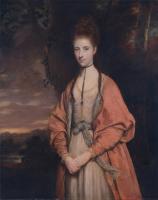


On 2nd March 1802 Francis Russell 5th Duke Bedford [aged 36] died unmarried at Woburn, Bedfordshire. He was buried at Bedford Chapel, St Michael's Church, Chenies. His brother John [aged 35] succeeded 6th Duke Bedford, 6th Marquess Tavistock, 10th Earl Bedford, 10th Baron Russell of Cheneys, 8th Baron Russell of Thornhaugh, 6th Baron Howland of Streatham.
On 2nd March 1802 John Bateman 2nd Viscount Culmore [aged 80] died without issue. Viscount Culmore and Baron Culmore in Londonderry extinct.
On 2nd March 1802 Charles Coote 7th Earl of Mountrath [aged 77] died. Earl Mountrath extinct. Charles Henry Coote 9th Baronet [aged 9] succeeded 9th Baronet Coote of Castle Cuffe. His fourth cousin Charles [aged 47] succeeded 2nd Baron Castle Coote.
On 2nd March 1805 Bridget Heathcote Countess Morton died.
On 28th February 1809 Charles John Cary 9th Viscount Falkland [aged 40] was shot through the groing during a duel with Arthur Annesley Roberts aka Powell. On 2nd March 1809 Charles John Cary 9th Viscount Falkland died from wounds received duelling. His son Lucius [aged 5] succeeded 10th Viscount Falkland. He was buried at the Grosvenor Chapel, Mayfair.
Saint James's Chronicle, 7 March 1809:
Various erroneous statements have appeared, respecting the unfortunate duel betwixt Lord Falkland and Mr Powell; but the following particulars we are told, may be relied on: Lord Falkland dined at Mr Powell's house with a large party on the Saturday preceding the duel. The party broke up early, and Lord F and Mr P went to the opera together, having drunk a good deal of wine.
They returned from the opera to Stephen's Hotel, Bond Street, and parted as they had met, intimate friends, but in a state of inebriety. It was after this that Lord Falkland visited the Mount coffee house. On Sunday evening, Lord F looked in at Stephens's again and espying his friend, Mr Powell, he accosted him, in words, similar to these 'What! Drunk again tonight, Pogey?' and it is understood neither was at this time perfectly sober.
Mr Powell did not relish the mode in which he had been accosted, and after a retort, Lord F snatched a cane from a gentleman's hand, and used it about his friend. The waiter and some gentlemen present, extricated Mr Powell, who retired; but the waiter met his Lordship's displeasure. On the following morning Lord Falkland went to Mr Powell's house, and apologised, by asking that gentleman's pardon, an attributing his rash conduct to inebriety. Mr Powell observed that he could not accept of his Lordship's apology, unless made at Stephen's before the persons who were present at the outrage, or to make a public one in another way.
Lord Falkland could not accede to this proposition; but in the afternoon of the same day (Monday), Captain Cotton waited on him from Mr Powell, to state that if he (Lord F) would allow Captain C to make the public apology for him at Mr Powell's house, and shortly after Mr Powell sent him challenge.
Lord F appeared much hurt after he had receive the challenge, and he did not take his wine as usual, at dinner, on Monday, on which day Mr P. and others, who dined on the Saturday at his house, were to have dined with Lord Falkland His Lordship did not go to bed on Monday night, but threw himself on his sofa, and gave strict orders to his servant to call him, to be at the Admiralty at eight o'clock in the morning.
The parties met at Golder's Green, at eleven o'clock, attended by their seconds, and two surgeons. By etiquette Mr P. fired first and inflicted the mortal wound. Lord F stood for above a minute in his position; and then threw his pistol away without discharging its contents. It is well understood that his Lordship never intended to fire at his antagonist, for he was aware he had done wrong, but he conceived his honour called him to the field, rather than make the apology required. On the arrival of his Lordship on the stones in a post chaise, he requested of Mr B. his second, to stop the chaise, as he could not bear the sensation it occasioned, but requested to be conveyed home in a hammock on the men's shoulders.
During the stoppage of the chaise, Mr Powell and Captain C, his second, overtook them, and the latter gentleman, on ascertaining the cause of the stoppage, observed, that Powell's house was near at hand, and Lord F instantly expressed a desire to go there in preference to any other house, for the world would then be convinced he owed no animosity to his antagonist.
On Mr Heaviside examining the wound, his Lordship observed that he wish to know the state of it candidly. He had seen many wounds cured on board ship, and he begged of the surgeon to treat him in the way a ship's surgeon would a wounded sailor. He vomited freely, and wished to know if there was no probability of throwing up the ball. Once Mr Heaviside having done what he could he requested as a favour, that he would go to Dorant's, and make his lady acquainted with his real state; this was done, and Lady F soon arrived at Devonshire place.
His Lordship suffered greatly the first twelve hours, but his pain was eased, and he died gradually, while his Lady, who was attentively watching him at his bedside, thought he was sleeping.
The deceased was appointed to a 74 gunship, which is to take Lord Amherst to Sicily. His Lady whom he married in the West Indies in the year 1803, was the daughter of a merchant of the first respectability. She has three sons and a daughter, the eldest boy begin only five years old, and who succeeds to the title of Lord Falkland. Mr Powell is a man of considerable fortune. He was separated from his Lady some time since, and she now lives on an annuity of £500 a year at Ramsgate.
On 2nd March 1817 Theodosia Magill Countess Clanwilliam [aged 73] died.
Chronicle of a Bourgeois of Valenciennes
Récits d’un bourgeois de Valenciennes aka The Chronicle of a Bourgeois of Valenciennes is a vivid 14th-century vernacular chronicle written by an anonymous urban chronicler from Valenciennes in the County of Hainaut. It survives in a manuscript that describes local and regional history from about 1253 to 1366, blending chronology, narrative episodes, and eyewitness-style accounts of political, military, and social events in medieval France, Flanders, and the Low Countries. The work begins with a chronological framework of events affecting Valenciennes and its region under rulers such as King Philip VI of France and the shifting allegiances of local nobility. It includes accounts of conflicts, sieges, diplomatic manoeuvres, and the impact of broader struggles like the Hundred Years’ War on urban life in Hainaut. Written from the perspective of a burgher (bourgeois) rather than a monastery or royal court, the chronicle offers a rare lay viewpoint on high politics and warfare, reflecting how merchants, townspeople, and civic institutions experienced the turbulence of the 13th and 14th centuries. Its narrative style combines straightforward reporting of events with moral and civic observations, making it a valuable source for readers interested in medieval urban society, regional politics, and the lived experience of war and governance in pre-modern Europe.
Available at Amazon in eBook and Paperback format.
On 2nd March 1835 Francis Lorraine II Holy Roman Emperor [aged 67] died.
On 2nd March 1841 Elizabeth Adair Viscountess Barrington [aged 72] died.
On 2nd March 1845 Augusta Sophia Greville Countess Aylesford died.

On 2nd March 1855 Philip Henry Stanhope 4th Earl Stanhope [aged 73] died. His son Philip [aged 50] succeeded 5th Earl Stanhope.
On 2nd March 1869 Hugh Gough 1st Viscount Gough [aged 89] died at his home St Helen's Booterstown. He was buried at Stillorgan, Dublin. His son George [aged 54] succeeded 2nd Viscount Gough of Goojerat in the Punjab and of the City of Limerick, 2nd Baron Gough of Chin-Kang-Foo in China and of Maharajpore and the Sutlej in the East Indies, 2nd Baronet Gough of Synone and Drangan in County Tipperary. Jane Arbuthnot Viscountess Gough [aged 52] by marriage Viscountess Gough of Goojerat in the Punjab and of the City of Limerick.
On 2nd March 1881 John Prescott Knight [aged 78] died. He was buried at Kensal Green Cemetery [Map].
On 2nd March 1917 Henry John Cockayne-Cust [aged 55] died. His monument at St Peter and St Paul Church, Belton [Map] sculpted by his wife Emmeline "Nina" Welby-Gregory [aged 50].
Henry John Cockayne-Cust: On 10th October 1861 he was born to Henry Cockayne-Cust and Sara Jane Cookson. On 11th October 1893 Henry John Cockayne-Cust and Emmeline "Nina" Welby-Gregory were married.
On 2nd March 1918 John Henry Algernon Anson 5th Baronet [aged 21] died when the submarine HMS H5 was lost having been rammed by the British merchantman Rutherglen off Caernarfon Bay. It had been mistaken as a German U-boat and sank with the loss of all hands. His brother Edward [aged 16] succeeded 6th Baronet Anson of Birch Hall in Lancashire.
On 2nd March 1929 Augusta Lucy Clavering Lady Paston-Bedingfield died.
On 2nd March 1936 Frederick D'Abernon Vincent 15th Baronet [aged 84] died. His brother Edgar [aged 78] succeeded 16th Baronet Vincent of Stoke d'Abernon


On 2nd March 1939 Howard Carter [aged 64] died.
On 2nd March 1940 William Edwards Miller [aged 88] died.
On 2nd March 1947 Stanhope Forbes [aged 89] died. He was buried at St Sancredus' Church, Sancreed.
On 2nd March 1947 Bishop Leslie Owen [aged 61] died. He was buried at Lincoln Cathedral [Map].
Bishop Leslie Owen: On 3rd February 1886 he was born. In July 1920 he and Iris Marjorie Lawrence were married. On 12th June 1946 Bishop Leslie Owen was nominated Bishop of Lincoln which office he held for ten months.
Chronicle of a Bourgeois of Valenciennes
Récits d’un bourgeois de Valenciennes aka The Chronicle of a Bourgeois of Valenciennes is a vivid 14th-century vernacular chronicle written by an anonymous urban chronicler from Valenciennes in the County of Hainaut. It survives in a manuscript that describes local and regional history from about 1253 to 1366, blending chronology, narrative episodes, and eyewitness-style accounts of political, military, and social events in medieval France, Flanders, and the Low Countries. The work begins with a chronological framework of events affecting Valenciennes and its region under rulers such as King Philip VI of France and the shifting allegiances of local nobility. It includes accounts of conflicts, sieges, diplomatic manoeuvres, and the impact of broader struggles like the Hundred Years’ War on urban life in Hainaut. Written from the perspective of a burgher (bourgeois) rather than a monastery or royal court, the chronicle offers a rare lay viewpoint on high politics and warfare, reflecting how merchants, townspeople, and civic institutions experienced the turbulence of the 13th and 14th centuries. Its narrative style combines straightforward reporting of events with moral and civic observations, making it a valuable source for readers interested in medieval urban society, regional politics, and the lived experience of war and governance in pre-modern Europe.
Available at Amazon in eBook and Paperback format.
On 2nd March 1964 Osborne De Vere Beauclerk 12th Duke St Albans [aged 89] died. His second cousin Charles [aged 48] succeeded 13th Duke St Albans, 13th Earl Burford, 13th Baron Heddington, 10th Baron Vere of Hanworth in Middlesex. Suzanne Marie Fesq Duchess St Albans [aged 42] by marriage Duchess St Albans.
On 2nd March 1965 Louise Mountbatten Queen Consort Sweden [aged 75] died.
On 2nd March 1967 Albert Charles Gladstone 5th Baronet [aged 80] died unmarried. His brother Charles [aged 78] succeeded 6th Baronet Gladstone of Fasque and Balfour in Kincardineshire.
On 2nd March 1975 Nancy Phyllis Louise Astor Countess Astor [aged 65] died.
On 2nd March 2013 Diana Mary Pelham 15th Baroness Conyers 9th Fauconberg [aged 92] died. Baron Conyers and Baron Fauconberg abeyant between her two daughters.