

25 Nov is in November.
25th November 1120-Sinking of The White Ship
25 November 1487-Coronation of Elizabeth of York
1611 November 1611 Creation of Baronets
1677 Marriage of William of Orange and Princess Mary Stewart
On 25th November 1034 King Malcolm II of Alba [aged 80] died. King Duncan I of Scotland [aged 33] succeeded I King Scotland. Bethóc Unknown Queen Consort Scotland by marriage Queen Consort Scotland.
On 25th November 1120 the White Ship left Barfleur in north-west Normandy, with a party of young Normans. King Henry I "Beauclerc" England [aged 52] had left earlier on another ship. A mile out the White Ship foundered on a submerged rock. William Adelin Duke Normandy [aged 17], his half-siblings Richard Fitzroy [aged 19] and Matilda Fitzroy Countess Perche, William Bigod [aged 27], Lucia Mahaut Blois Countess Chester, brothers Geoffrey Aigle and Engenulf Aigle, half-brothers Richard Avranches 2nd Earl Chester [aged 26] and Ottiwel Avranches, brothers Ivo Grandesmil and William Grandesmil and Geoffrey Ridel were all drowned.
Chronicle of William of Malmesbury Book 5. Nevertheless, the calm of this brilliant, and carefully concerted peace, this anxious, universal hope, was destroyed in an instant by the vicissitudes of human estate. For, giving orders for returning to England, the king set sail from Barfleur just before twilight on the seventh before the kalends of December [25th November 1120]; and the breeze which filled his sails conducted him safely to his kingdom and extensive fortunes. But the young man, who was now somewhat more than seventeen years of age, and, by his father's indulgence, possessed everything but the name of king, commanded another vessel to be prepared for himself; almost all the young nobility flocking around him, from similarity of youthful pursuits. The sailors, too, immoderately filled with wine, with that seaman's hilarity which their cups excited, exclaimed, that those who were now a-head must soon be left astern; for the ship was of the best construction, and recently fitted with new materials. When, therefore, it was now dark night, these imprudent youths, overwhelmed with liquor, launched the vessel from the shore. She flies swifter than the winged arrow, sweeping the rippling surface of the deep: but the carelessness of the intoxicated crew drove her on a rock, which rose above the waves not far from shore. In the greatest consternation, they immediately ran on deck, and with loud outcry got ready their boat-hooks, endeavouring, for a considerable time, to force the vessel off: but fortune resisted and frustrated every exertion. The oars, too, dashing, horribly crashed against the rock,1 and her battered prow hung immoveably fixed. Now, too, the water washed some of the crew overboard, and, entering the chinks, drowned others; when the boat having been launched, the young prince was received into it, and might certainly have been saved by reaching the shore, had not his illegitimate sister, the countess of Perche, now struggling with death in the larger vessel, implored her brother's assistance; shrieking out that he should not abandon her so barbarously. Touched with pity, he ordered the boat to return to the ship, that he might rescue his sister; and thus the unhappy youth met his death through excess of affection: for the skiff, overcharged by the multitudes who leaped into her, sank, and buried all indiscriminately in the deep. One rustic2 alone escaped; who, floating all night upon the mast, related in the morning, the dismal catastrophe of this tragedy. No ship was ever productive of so much misery to England; none ever so widely celebrated throughout the world. Here also perished with William, Richard, another of the king's sons, whom a woman of no rank had borne him, before his accession; a youth of intrepidity, and dear to his father from his obedience: Richard earl of Chester, and his brother Otuell, the tutor and preceptor of the king's son: the countess of Perche, the king's daughter, and his niece the countess of Chester, sister to Theobald: and indeed almost every person of consequence about court, whether knight, or chaplain, or young nobleman, training up to arms. For, as I have said, they eagerly hastened from all quarters, expecting no small addition to their reputation, if they could either amuse, or show their devotion to the young prince. The calamity was augmented by the difficulty of finding the bodies, which could not be discovered by the various persons who sought them along the shore; but delicate as they were, they became food for the monsters of the deep. The death of this youth being known, produced a wonderful change in existing circumstances. His father renounced the celibacy he had cherished since Matilda's death, anxious for future heirs by a new consort: his father-in-law, returning home from Jerusalem, faithfully espoused the party of William, the son of Robert earl of Normandy, giving him his other daughter3 in marriage, and the county of Maine; his indignation being excited against the king, by his daughter's dowry being detained in England after the death of the prince.
Note 1. Virgil Æneid. v. 206.
Note 2. He is called a butcher by Orderic Vitalis, p. 867, who has many particulars of this event.
Note 3. "The marriage of William, son of the duke of Normandy, with Sibilla, in 1123, was dissolved, at the instance of king Henry, in the following year, by the pope's legate."—Hardy.
Chronicle of William Nangis. William and Richard, sons of Henry, king of England, and the king’s daughter and niece, as well as many leading men and nobles of England, wishing to cross from Normandy, were drowned in the sea1, although the sea was very calm and free from winds. Nearly all of them were said to be entangled in the stain of sodomy, and almost all of them lacked burial.
Note 1. The White Ship disaster occurred on 25th November 1120 when a ship travelling from Barfleur to England carrying hit a rock with alkl bar one person drowned. Chronicum Anglicanum by Ralph Coggeshall: "A collision with a rock caused the wreck of a ship near Barfleur, in which nearly the entire lineage of the Norman nobility perished. Among the dead were William, the son of King Henry, along with another of his illegitimate sons, two daughters of the king, one of his nieces, and many others, nearly three hundred people. This disaster occurred on the seventh day before the Kalends of December [25th November], and none of their bodies were ever found."
Guillermus et Richardus, filii Henrici regis Anglorum, et filia ipsius regis et neptis, necnon multi proceres et nobiles Angliæ, volentes de Normannia transire, in mari submersi sunt, cum mare esset tranquillissimum et ventis careret. Qui omnes fere sodomitica labe dicebantur et erant irretiti, et omnes fere sepultura caruerunt.
1. Telle est la leçon des édit. confirmée par les Mss. 4917-20. Nous l'avons preferce à celle du Ms. 10298-6, qui est beaucoup plus ahregée; la voici: Guillermus, Henrici regis Anglorum filius, volens transire in Angliam, cum multis nobilibus in mari submersus est.
 History of the Dukes of Normandy by William of Jumieges. In the absence of the original text we should mention the White Ship Disaster that occurred on 25th November 1120 in which King Henry's only son and heir William Adelin drowned along with his illegitimate half-siblings Richard and Matilda, and hundred and more of the youth of the Norman nobility.
 Chronicum Anglicanum by Ralph Coggeshall: "A collision with a rock caused the wreck of a ship near Barfleur, in which nearly the entire lineage of the Norman nobility perished. Among the dead were William, the son of King Henry, along with another of his illegitimate sons, two daughters of the king, one of his nieces, and many others, nearly three hundred people. This disaster occurred on the seventh day before the Kalends of December [25th November], and none of their bodies were ever found."
William of Malmesbury, Book 5: "Nevertheless, the calm of this brilliant, and carefully concerted peace, this anxious, universal hope, was destroyed in an instant by the vicissitudes of human estate. For, giving orders for returning to England, the king set sail from Barfleur just before twilight on the seventh before the kalends of December [25th November]; and the breeze which filled his sails conducted him safely to his kingdom and extensive fortunes. But the young man, who was now somewhat more than seventeen years of age, and, by his father's indulgence, possessed everything but the name of king, commanded another vessel to be prepared for himself; almost all the young nobility flocking around him, from similarity of youthful pursuits. The sailors, too, immoderately filled with wine, with that seaman's hilarity which their cups excited, exclaimed, that those who were now a-head must soon be left astern; for the ship was of the best construction, and recently fitted with new materials. When, therefore, it was now dark night, these imprudent youths, overwhelmed with liquor, launched the vessel from the shore. She flies swifter than the winged arrow, sweeping the rippling surface of the deep: but the carelessness of the intoxicated crew drove her on a rock, which rose above the waves not far from shore. In the greatest consternation, they immediately ran on deck, and with loud outcry got ready their boat-hooks, endeavouring, for a considerable time, to force the vessel off: but fortune resisted and frustrated every exertion. The oars, too, dashing, horribly crashed against the rock,1 and her battered prow hung immovably fixed. Now, too, the water washed some of the crew overboard, and, entering the chinks, drowned others; when the boat having been launched, the young prince was received into it, and might certainly have been saved by reaching the shore, had not his illegitimate sister, the countess of Perche, now struggling with death in the larger vessel, implored her brother's assistance; shrieking out that he should not abandon her so barbarously. Touched with pity, he ordered the boat to return to the ship, that he might rescue his sister; and thus the unhappy youth met his death through excess of affection: for the skiff, overcharged by the multitudes who leaped into her, sank, and buried all indiscriminately in the deep. One rustic2 alone escaped; who, floating all night upon the mast, related in the morning, the dismal catastrophe of this tragedy. No ship was ever productive of so much misery to England; none ever so widely celebrated throughout the world. Here also perished with William, Richard, another of the king's sons, whom a woman of no rank had borne him, before his accession; a youth of intrepidity, and dear to his father from his obedience: Richard earl of Chester, and his brother Otuell, the tutor and preceptor of the king's son: the countess of Perche, the king's daughter, and his niece the countess of Chester, sister to Theobald: and indeed almost every person of consequence about court, whether knight, or chaplain, or young nobleman, training up to arms. For, as I have said, they eagerly hastened from all quarters, expecting no small addition to their reputation, if they could either amuse, or show their devotion to the young prince. The calamity was augmented by the difficulty of finding the bodies, which could not be discovered by the various persons who sought them along the shore; but delicate as they were, they became food for the monsters of the deep. The death of this youth being known, produced a wonderful change in existing circumstances. His father renounced the celibacy he had cherished since Matilda's death, anxious for future heirs by a new consort: his father-in-law, returning home from Jerusalem, faithfully espoused the party of William, the son of Robert earl of Normandy, giving him his other daughter3 in marriage, and the county of Maine; his indignation being excited against the king, by his daughter's dowry being detained in England after the death of the prince."
Chronicon ex Chronicis, Page 232: "Henry, king of England, having successfully accomplished all his designs, returned from Normandy to England. His son William, hastening to follow him, embarked in company with a great number of nobles, knights, women, and boys. Having left the harbour and put out to sea, encouraged by the extraordinary calmness of the weather, shortly afterwards the ship in which they were sailing struck on a rock and was wrecked, and all on board were swallowed up by the waves, except one churl, who, as it is reported, was not worthy of being named, but by the wonderful mercy of God, escaped alive. Of those who perished, those of highest rank were, William, the king's son, Richard, earl of Chester, Othiel, his brother, William Bigod, Geoffrey Riddel, Walter d'Evereux, Geoffrey, archdeacon of Hereford, the king's daughter, the countess of Perche, the king's niece, the countess of Chester, and many more who are omitted for brevity's sake. This disaster horrified and distressed the mind of the king, who reached England after a safe voyage, and of all who heard of it, and struck them with awe at the mysterious decrees of a just God."
Orderic Vitalis, Book 12, Chapter 25: "In this voyage a sad disaster happened which caused much lamentation and innumerable tears to flow. Thomas, the son of Stephen, had obtained an audience of the king, and offering him a gold mark, said to him, 'Stephen, the son of Airard, was my father, and during his whole life he was in your father's service as a mariner. He it was who conveyed your father to England in his own ship, when he crossed the sea to make war on Harold. He was employed by your father in services of this description as long as he lived, and gave him such satisfaction that he honoured him with liberal rewards, so that he lived in great credit and prosperity among those of his own class. My lord king, I ask you to employ me in the same service, having a vessel, called the Blanche-Nef, which is fitted out in the best manner, and perfectly adapted to receive a royal retinue.' The king replied: 'I grant your request; but I have already selected a ship which suits me, and I shall not change: however, I entrust to you my sons, William and Richard, whom I love as myself, with many of the nobility of my realm.' The mariners were in great glee at hearing this, and greeting the king's son with fair words asked him to give them something to drink. The prince gave orders that they should have three muids1. No sooner was the wine delivered to them than they had a great drinking bout, and pledging their comrades in full cups, indulged too much and became intoxicated. By the king's command many barons with their sons embarked in the Blanche-Nef, and there were in all, as far as I can learn, three hundred souls om board the ill-fated ship. But two monks of Tyron, Count Stephen,2 with two men-at-arms, William de Roumare, Rabel the chamberlain,3 Edward of Salisbury,4 and several others came on shore, having left the vessel upon observing that it was overcrowded with riotous and headstrong youths. The crew consisted of fifty experienced rowers, besides an armed marine force,5 who were very disorderly, and as soon as they got on board insolently took possession of the benches of the rowers, and being very drunk forgot their station, and scarcely paid respect to any one. Alas! How many, among the company embarked, were without the slightest feeling of devotion towards God, 'Who rules the storm, and calms the raging sea.' They even drove away with contempt, amidst shouts of laughter, the priests who came to bless them, with the other ministers who carried the holy water; but they were speedily punished for their mockery. Besides the king's treasure and some casks of wine, there was no cargo in Thomas's ship, which was full of passengers; and they urged him to use his utmost endeavours to overtake the royal fleet which was already ploughing the waves. In his drunken folly, Thomas, confident in his seamanship and the skill of his crew, rashly boasted that he would soon leave behind him all the ships that had started before them. At last, he gave the signal for departure; the sailors seized the oars without a moment's delay, and, unconscious of the fate which was imminently impending, joyously handled the ropes and sails, and made the ship rush through the water at great rate. But as the drunken rowers exerted themselves to the utmost in pulling the oars, and the luckless pilot steered at random and got the ship out of its due course, the starboard bow of the Blanche-Nef struck violently on a huge rock,1 which is left dry, every day, when the tide is out, and covered by the waves at high water. Two planks having been shattered by the crash, the ship, alas! filled and went down. At this fearful moment, the passengers and crew raised cries of distress, but their mouths were soon stopped by the swelling waves, and all perished together, except two who seized hold of the yard from which the sail was set. They hung on to it the greater part of the night, in earnest hope that they would receive aid in some shape or other. One of these men was a butcher of Rouen, of the name of Berold; the other, a young man of gentle birth whose name was Geoffrey, the son of Gilbert de I'Aigle. The moon was at this time in her nineteenth day in the constellation of the Bull, and gave light to the world for nine hours, so that all objects on the surface of the sea were clearly visible to the sailors.1 Thomas, the master of this vessel, after his first plunge into the sea, gained fresh energy, and, recovering his senses, raised his head above the water, and perceiving the two men clinging to the yard-arm, cried out: 'What has become of the king's son?' The shipwrecked men replied that he and all who were with him had perished. 'Then,' said he, 'it is misery for me to live any longer.' Having said this, he abandoned himself to his fate in utter despair, preferring to meet it at once, rather than face the rage of the king in his indignation for the loss of his children, or drag out his existence and expiate his crime in a dungeon. Meanwhile, Berold and Geoffrey, hanging by the yard-arm over the waters, called upon God to save them, and encouraging one another, waited in fearful anxiety for the end to which it should please him to bring their misery."
The Ecclesiastical History of England and Normandy by Orderic Vitalis. Meanwhile, Henry king of England [aged 67], having arrived at the castle of Lions [Map]1 on the seventh of the calends of December [25th November 1135], gave orders to his huntsmen to be ready to attend him for the chace in the woods on the next day. But during the night he suddenly fell sick, and lay at the point of death from Tuesday till the following Sunday. In the course of that time he confessed his sins to his chaplains;2 and then, sending for Hugh, archbishop of Rouen, he requested his spiritual counsels. By his admonitions, the king released criminals from all forfeitures, permitted all exiles to return to their homes, and restored those whom he had disinherited to their paternal estates. He gave orders to his son Robert to take out of his treasury, which was under his charge at Falaise, sixty thousand livres, and distribute it in pay and donatives to his household servants and hired troops.3 He commanded that his body should be carried to Reading, where he had founded a monastery for two hundred monks, in honour of the Holy and Undivided Trinity.4
Note 1. The castle of Lions [Map] was a favourite hunting seat of the Norman dukes and kings, in a forest of the same name, about six leagues from Rouen. Henry arrived there on Monday November 25. Henry of Huntingdon mentions, that his illness was caused by eating lampreys, of which he was immoderately fond. P. 259, Antig. Lib.
Note 2. It was the abbot of Reading, who, happening to be in the neighbourhood, was first summoned to administer the consolations of religion to the king. He afterwards sent to the archbishop of Rouen, who gives the following account of his last hours in a letter to Pope Innocent, preserved by William of Malmesbury: "I went to him and stayed there, full of grief, three days. At my instance, he confessed his sins, and beat his breast with his own hand, dismissing all ill-will. By the divine counsels given him by me and the bishops, he often promised that he would lead a better life. After that promise, as my duty was, I gave him absolution for the third time in three days, He adored the crucifix, received with devotion the body and blood of our Lord, and ordered alms to be distributed, thus saying: 'Let my debts be paid, all wages and stipends be discharged, and the rest be given amongst the poor.'"
At the king's death, there was found in his treasury at Winchester, say the historians, more than a hundred thousand livres, of exquisite coinage. There were also vessels of gold and silver, of massive weight and inestimable value, collected by the ancient kings, with magnificent additions by Henry himself.
Note 3. Our author omits noticing, that he bequeathed his immense heritage to his daughter, without making any mention of his son-in-law, "being incensed against her husband, exasperated by his threats, and even injuries."
Note 4. This is not quite exact. The abbey of Reading was dedicated to the blessed Virgin and St. John, as we have already observed.
Chronicum Anglicanum by Ralph Coggeshall. King Henry I died1 the fourth day before the Nones of December [2nd December 1135]. His body was embalmed with salt after being eviscerated and was transported to England, where it was buried at Reading Abbey, a monastery he himself had founded. His nephew Stephen succeeded him as king. Stephen was the son of Stephen, Count of Blois, and Adela, daughter of King William the Conqueror. Adela had also given birth to Count Theobald. King Stephen had married Matilda, whose mother Maria was the sister of Queen Matilda. Their father was King Malcolm of Scotland. Matilda was the daughter of Eustace, Count of Boulogne, who held the honour of Boulogne. This Eustace was the brother of Godfrey, Duke of Lower Lorraine, who later became King of Jerusalem, and of Baldwin, Count of Rethel, who succeeded his brother Godfrey as King of Jerusalem. From Queen Matilda and King Stephen, two sons were born: Eustace, Count of Boulogne William, Count of Warenne They also had a daughter, who was removed from a convent and given in marriage to Count Matthew, the brother of Philip, Count of Flanders. From this marriage, two daughters were born: one married the Duke of Brabant, the other, after three marriages, married the son of the Count of Dammartin.
Obiit rex Henricus quarto nonas Decembris, cujus corpus exenteratum ac sale conditum delatum est in Angliam, et apud monasterium de Redinghes, quod ipse fundaverat, humatum est. Cui successit Stephanus, nepos ejus ex sorore, filius Stephani comitis Blesensis, qui illum et comitem Theobaldum ex filia regis Willelmi Bastardi genuerat. Porro rex Stephanus duxerat uxorem Mathildem (cujus mater dicebatur Maria, soror regine Mathildis, quarum pater rex Malcomus) filiam Eustachii comitis Boloniensis, cum honore Bolonize. Hic Eustachius frater extitit Godefridi ducis Lothariz, et postmodum regis Hierosolymitani, et frater Baldewini comitis de Roheise, qui postea rex Hierosolymitanus post fratrem suum Godefridum effectus est. De ista regina Mathildi et pio rege Stephano natus est Eu stachius comes Bolonize, et Willelinus comes Warenniz. Quamdam etiam filiam habuerunt, quae de monasterio sanctimonialium postmodum abstracta, comiti Matthaeo fratri Philippi comitis Flandrensis traditur in uxorem ex qua duas habuit filias, quarum una data est duci Luvane, alia vero post tertium maritum nupsit filio comitis de Dammartin.
Note 1. Most sources state King Henry died on the Kalends i.e. the 1st of December 1135.
Roger of Wendover: "Whilst king Henry was in Normandy, he one day returned from hunting, and stopped at St. Denys, in the wood of Lions, to eat some lampreys, a fish which he was very fond of, though they always disagreed with him, and the physicians had often cautioned him against eating them, but he would not listen to their advice. This food mortally chilled the old man's blood, and caused a sudden and violent illness, against which nature struggled, and brought on an acute fever, in the effort to resist the worst effects of the disease. Unable to overcome the malady, this great king died on the first day of December, after he had reigned thirty-five years and three months."
Orderic Vitalis: "Meanwhile, Henry king of England, having arrived at the castle of Lions on the seventh of the calends of December [25th November 1135], gave orders to his huntsmen to be ready to attend him for the chace in the woods on the next day. But during the night he suddenly fell sick, and lay at the point of death from Tuesday till the following Sunday. In the course of that time he confessed his sins to his chaplains; and then, sending for Hugh, archbishop of Rouen, he requested his spiritual counsels. ... Lastly, this catholic prince besought all persons to preserve peace and protect the poor. Then, after having made his confession, he received penance and absolution from the priests, and receiving extreme unction, and being strengthened by the holy eucharist, commended himself to God, and departed this life on the calends of December [1st December 1135], being Sunday, early in the night."
William of Malmesbury: "He [King Henry] reigned, then, thirty-five years, and from the nones of August to the kalends of December [1st December 1135], that is, four months, wanting four days. Engaged in hunting at Lihun, he was taken suddenly ill. His malady increasing, he summoned to him, Hugo, whom, from prior of Lewes, he had made abbot of Reading, and afterwards archbishop of Rouen, who was justly indebted to him and his heirs for such great favours. The report of his sickness quickly gathered the nobility around him. Robert, too, his son, the earl of Gloucester, was present; who, from his unblemished fidelity and matchless virtue, has deserved to be especially signalized throughout all ages. Being interrogated by these persons, as to his successor, he awarded all his territories, on either side of the sea, to his daughter, in legitimate and perpetual succession; being somewhat displeased with her husband, as he had irritated him both by threats and by certain injuries. Having passed the seventh day of his sickness, he yielded to nature about midnight."
 Annals of Six Kings of England by Nicholas Trivet. Henry, son of Geoffrey, surnamed Plantagenet, count of Anjou, by the empress Matilda, daughter of the king of the English, after his father's death already held the counties of Anjou and Maine, the duchy of Normandy by his mother's grant, and the duchy of Aquitaine through his wife Eleanor. When he learned of the death of Stephen, king of England, he crossed over into England at the command of his mother the empress and with the consent of the bishops and nobles of Normandy. In the year of the Lord 1154, on the seventh day before the Ides of December [25th November 1154], he was received by the clergy and the people with the greatest joy and honour.
HENRICUS filius Galfridi, cognomento Plantegeneth, Andegavensis comitis, ex imperatrice Matilde, filia regis Anglorum, cum, defuncto patre Andegaviæ et Cenomanniæ comitatus, ex concessioneque matris Normanniæ, et per Alianoram uxorem Aquitaniæ jam obtineret ducatus, certificatus de morte regis Angliæ Stephani, jubente matre imperatrice, de assensu episcoporum et optimatum Normanniæ in Angliam transfretans, anno Domini MCLIV septimo idus Decembris, a clero excipitur et populo, cum gaudio maximo et honore.
Flowers of History by Roger of Wendover 1233. Of the fierce battle between the marshal and the Poictevins.
In the same year the marshal [aged 42], on one of his foraging incursions into the territories of his enemies, came to the town of Monmouth [Map], which was hostile to him, where he ordered his army to proceed on their expedition, whilst he with a hundred of his fellow knights turned aside towards the castle of that place to examine its condition, as he purposed to besiege it in a few days; but as he was riding round the walls of the town, he was seen by Baldwin de Guisnes [aged 33], to whom the king had entrusted the charge of that castle [Map] together with several Poictevins, and understanding that the marshal was there with only a few followers for the purpose of examining the castle, he sallied out with a thousand brave and well-equipped soldiers, and pursued him at full speed, designing to make him and his followers prisoners and bring them into the town. The earl Marshal's companions however, when they saw the impetuous advance of the enemy, advised him to consult their safety by flight, saying that it would be rash for such a few of them to engage with such a number of the enemy; to which the marshal replied that he had never as yet turned his back on his enemies in battle, and declared that he would not do so now, and exhorted them to defend themselves bravely and not to die unavenged. The troops from the castle then rushed fiercely on them and attacked them with their lances and swords [Battle of Monmouth]: a severe though very unequal conflict then ensued, yet although there were only a hundred of the marshal's party to oppose a thousand of their adversaries, they fought for a great part of the day. But Baldwin de Guisnes with twelve of his stoutest and best armed soldiers made au attack on the marshal in person, and endeavoured to take him prisoner and carry him off to the castle; he however kept them at a distance, brandishing his sword right and left, and struck down whoever came within reach, either killing them or stunning them hy the force of his blows, and although engaged single-handed against twelve enemies, defended himself for a length of time. His enemies at length, not daring to approach him, killed the horse he rode with their lances; but the marshal, who was well practised in the French way of fighting, seized one of the knights who was attacking him by the feet, and dragged him to the ground, and then quickly mounting his adversary's horse, he renewed the battle. The knight Baldwin was ashamed that the marshal defended himself single-handed against so many of his enemies for such a time, and made a desperate attack on him, and seizing his helmet, tore it from his head with such violence, that blood gushed forth from his mouth and nostrils; he then seized the marshal's horse by the bridle, and endeavoured to drag it with its rider towards the castle, whilst others assisted him by impelling the marshal on from behind. The latter however, sweeping his sword behind him, struck two of his enemies to the earth stunned, but could not then release himself from their grasp. At this juncture however a cross-bowman amongst the marshal's company, seeing his lord in danger, discharged an arrow from his bow, which, striking Baldwin, who was dragging the marshal away, in the breast, entered his body, notwithstanding his armour, and he fell to the earth believing himself mortally wounded; his companions on seeing this, left the marshal, and went to raise Baldwin from the ground, for they thought that he was dead.
Flowers of History by Roger of Wendover 1233. After this battle the marshal with Gilbert Basset, Richard Siward, and his other proscribed confederates, laid ambuscades for the Poictevins who held charge of the king's castles, so that whenever any of them went out foraging, they were attacked, and no quarter was given them: the consequence of which was, that the whole atmosphere in that part of the country was tainted by the numbers of dead foreigners who lay about in the roads and other places.
Chronicle of Walter of Guisborough
A canon regular of the Augustinian Guisborough Priory, Yorkshire, formerly known as The Chronicle of Walter of Hemingburgh, describes the period from 1066 to 1346. Before 1274 the Chronicle is based on other works. Thereafter, the Chronicle is original, and a remarkable source for the events of the time. This book provides a translation of the Chronicle from that date. The Latin source for our translation is the 1849 work edited by Hans Claude Hamilton. Hamilton, in his preface, says: 'In the present work we behold perhaps one of the finest samples of our early chronicles, both as regards the value of the events recorded, and the correctness with which they are detailed; Nor will the pleasing style of composition be lightly passed over by those capable of seeing reflected from it the tokens of a vigorous and cultivated mind, and a favourable specimen of the learning and taste of the age in which it was framed.'
Available at Amazon in eBook and Paperback format.
On 25th November 1253 Katherine Plantagenet was born to King Henry III of England [aged 46] and Eleanor of Provence Queen Consort England [aged 30] at Westminster Palace [Map]. She died aged three in 1257.
On 25th November 1314 King John Balliol I of Scotland [aged 65] died at Château de Hélicourt.
Rotuli Parliamentorum Volume 2. Pleas of the Crown held before Lord Edward, the third king after the Conquest, in his full parliament at Westminster, on the Monday next after the feast of Saint Catherine the Virgin [25th November 1330], in the fourth year of the reign of the same King Edward.
Pl'ita Corone tenta coram D'no Edwardo Rege tertio post Conquestum, in pleno Parl'to suo apud Westm' die Lune proximo post Festum S'c'e Katerine Virginis, anno Regni Regis ejusdem Edwardi quarto.
 Adam Murimuth Continuation. In the year of the Lord 1340, in the sixth year of Pope Benedict XI, and the fourteenth year of King Edward III since the Conquest, while the king of England was at Ghent awaiting confirmation of the said truce and also money from England, which did not arrive, after the feast of Saint Catherine [25th November], with a few companions, namely eight of his men, pretending that he wished to go out for recreation, he came to Zeeland, where he put to sea. There he sailed for three days and nights, and on the night of Saint Andrew [30th November], at cockcrow, he entered by water into the Tower of London [continuing as in Adam Murimuth Continuation TBC].
Anno Domini MCCCXL, Benedicti papæ XI anno VJ, regis Edwardi tertii a conquæstu XIIIJ, rege Angliæ exspectante confirmationem dictæ treugæ in Gandavo et etiam; pecuniam de Anglia quæ non venit, post festum beatæ Katerinæ, oum paucis, soilicet octo de suis, fingens se velle spatiari, venit ad Selandum, ubi posuit se in mari, in quo tribus diebus et noctibus navigavit; et in nocte sancti Andreæ contra gallicantam turrim Londoniarum per aquam intravit.
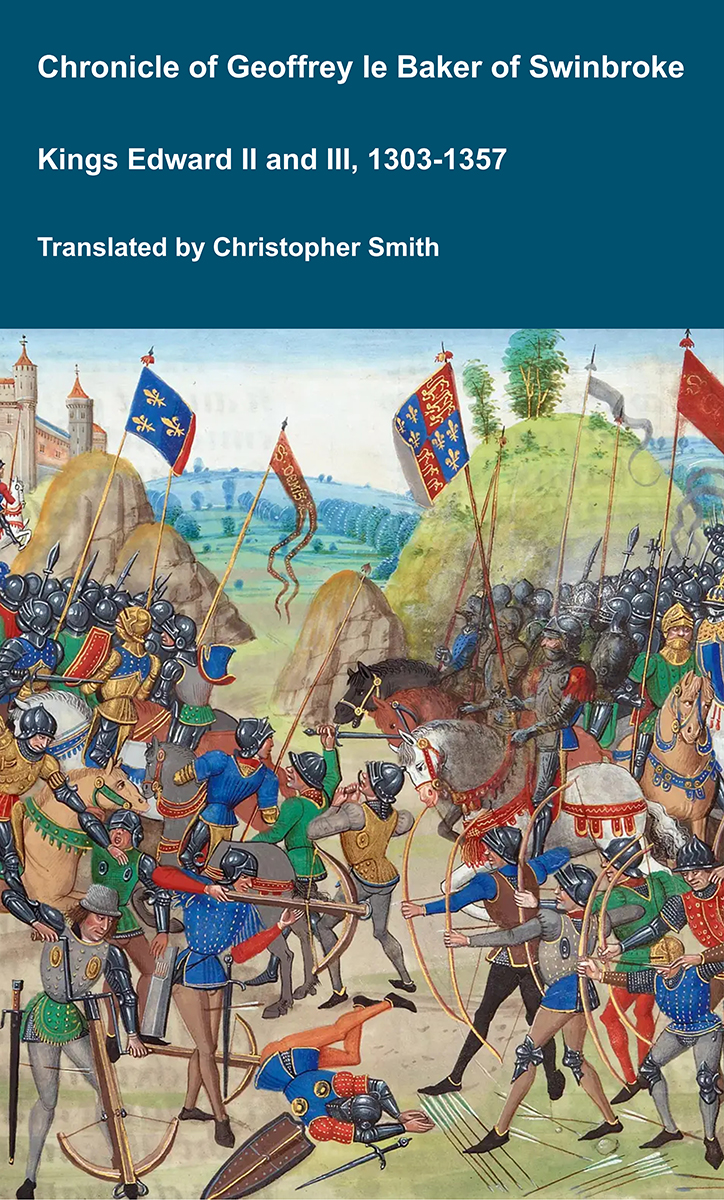 Chronicle of Geoffrey le Baker of Swinbroke. In the year of our Lord 1341, the 16th of his reign in England and the third in France, the king [Edward III] granted the county of Cambridge to Lord John of Hainaut, uncle of Queen Philippa. After celebrating the feast of Saint Catherine [25th Nov] and the solemnity of the Nativity of the Lord at Newcastle,1 where King David of Scots had threatened to appear for the same feast, Edward, having gathered an army, invaded Scotland and pursued the said David, who fled beyond the Scottish sea, laying waste to all in his path except castles and marshes, where the Scots and their king David concealed themselves.
Anno Domini MCCCXLIJ, regni sui Anglie XVJ Francieque tercio, rex dedit comitatum Cantbriggie domino Iohanni de Henald, patruo domine Phillipe regine, et, postquam apud Novum castrum celebravit festum sancte Katerine et solempnitatem Dominice Nativitatis, quo ad idem festum David rex Scotorum comminabatur se affuturum, collecto exercitu intravit Scociam, et predictum David fugientem persequebatur ultra mare Scoticum, omnia devastans preter castra et paludes, in quibus Scoti cum eorum rege David se occuluerunt.
Note 1. Edward was in the north in November 1341, at Newcastle early in December, at Melrose late in the month and in January and back in London in February 1342. While he was collecting his forces, Stirling fell; and his provision ships were scattered by a storm. He therefore agreed to a short truce.
On 25th November 1350 Katherine Swynford aka Roet Duchess Lancaster was born to Giles "Payne" Roet [aged 40]. She married (1) in or before 1367 Hugh Swynford and had issue (2) 13th January 1396 John of Gaunt 1st Duke Lancaster, son of King Edward III of England and Philippa of Hainaut Queen Consort England, and had issue.
Chronicle of Geoffrey le Baker of Swinbroke. On the feast of Saint Catherine, they crossed a river with great difficulty, where they had hoped to encounter the enemy; and, leaving the walled town of Fleurance which had once belonged to the English on their right, they passed through the large town of Silarde; and the central division was lodged in the town of Realmont, which had been taken by force and therefore was burned.
Die sancte Katerine cum districcione magna preterierunt aquam, ubi sperabant inimicis obviasse; et, dimittentes a dextris villam Florencie muratam, aliquando Anglicam, transierunt grandem villam de Silarde; et media custodia fuit ospitata apud opidum de Realmont, violenter conquisitam et ideo combustam.
 Chronicle of Jean le Bel Volume 1. Thus the people of Louvain and the other good towns of Brabant within the diocese of Liège managed, through the mediation of the Count of Looz1, to restore to the bishop all his rights, and they promised that they would help him and his successors to enjoy them peacefully and freely. In return, the bishop agreed to cease making war against the Brabançons and allowed his loyalty to the Count of Flanders to lapse. In this way Duke Wenceslas passed peacefully through the county of Looz with his men-at-arms and went to Louvain, where he was received as lord. He installed his officers and justices at Louvain and in all the good towns peacefully, and removed the other officers whom the Count of Flanders had appointed, except at Malines. The Count of Flanders always kept a large number of men-at-arms at Malines, who would hardly have allowed the townspeople to commit any disturbance or wrongdoing. I shall leave the matter there for now and return to the earlier subject.
Si firent tant ceulx de Louvaing et des aultres bonnes villes de Brabant seans ou dyocese de Liege, que ilz recouvrerent, par le pourchassement du conte de Los à l'evesque du Liege, toutes ses droictures, et luy promirent que ilz luy aideroïent à jouir paisiblement et quittement, luy el ses successeurs; él parmy ce, ledit evesque se rescorda de guerrier les Brabanchons et sy laissa aler dormir la leaulté que il avoit au conte de Flandres. Ainsy passa paisiblement le duc Wincelin parmi le conté de Los, à tout ses gens d'armes, et ala à Louvaing, et fut recheu à seigneur, et mist ses officiers el justiciers à Louvaing et par toutes les bonnes villes paisiblement, et osta les aultres officiers mis par le conte de Flandres fors que à Malignes. Le conte de Flandres avoit tousjours grand foison de gens d'armes à Malignes, qui envis eussent souffert à cheulx de la ville faire nul meschief ou deffaulte. Si m'en vueil taire à tant et retourneray à la premiere matere.
Note 1. This struggle of the Brabançons, aided by the counts of Looz and of Mons, took place, according to de Dynter, around Saint Catherine’s Day [25th November 1356].
1. Cette lutte des Brabançons, aidés des comtes de Looz et de Mons, eut lieu, d'après de Dynter, op. eit., t. III, p. 29, autour de la Sainte-Catherine (25 novembre) 1356.

On 25th November 1410 Isabel de Lingen [aged 40] was granted a Royal License to found a Collegiate Church at St Bartholemew's Church, Tong [Map] by King Henry IV of England [aged 43] at a cost of £40.
On 25th November 1412 Henry "The Rich" Wittelsbach XVI Duke Bavaria [aged 26] and Margarete Habsburg Duchess Bavaria [aged 17] were married. She by marriage Duchess Bavaria. She the daughter of Albert Habsburg IV Duke Austria and Joanna Sophia Wittelsbach Duchess Austria. He the son of Frederick Wittelsbach Duke Bavaria and Maddalena Visconti Duchess Bavaria. They were half second cousins.
On 25th November 1431 Walter Fitzwalter 7th Baron Fitzwalter [aged 31] drowned at sea in a storm whilst returning from France.
Elizabeth Fitzwalter Baroness Dinham 8th Baroness Fitzwalter [aged 2] succeeded 8th Baroness Fitzwalter. Note. Chronicle of Gregory 1432 states 24th November 1432 or, more specifically, "on Syn Kateryn ys eve" - St Katherine's feast day is 25 Nov.
Jean de Waurin's Chronicle of England Volume 6 Books 3-6: The Wars of the Roses
Jean de Waurin was a French Chronicler, from the Artois region, who was born around 1400, and died around 1474. Waurin’s Chronicle of England, Volume 6, covering the period 1450 to 1471, from which we have selected and translated Chapters relating to the Wars of the Roses, provides a vivid, original, contemporary description of key events some of which he witnessed first-hand, some of which he was told by the key people involved with whom Waurin had a personal relationship.
Available at Amazon in eBook and Paperback format.
On 25th November 1452 Jasper Tudor 1st Duke Bedford [aged 21] was created 1st Earl Pembroke.
On 25th November 1467 Walter Blount 1st Baron Mountjoy [aged 51] and Anne Neville Duchess Buckingham [aged 59] were married. She by marriage Baroness Mountjoy. She the daughter of Ralph Neville 1st Earl of Westmoreland and Joan Beaufort Countess of Westmoreland.
Collectanea by John Leland [1502-1552]. In the forfaide Chirche, on the right Side betwixt the Pulpit and the High Auter, was ordeyned a goodlye Stage coverede and well besene with Clothes of Arras, and wele latyzede, wherin was the Kings Grace [aged 30], my Lady his Moder [aged 44], and a goodly Sight of Ladies and Gentilwomen attending upon her, as my Lady Margaret Pole [aged 14], Doughter to the Duc of Claraunce, and many other. When the dyvyne Service was thus folemply ended and al doon, the Retourne of the Quene to her Paloys, with all her goodly and royal Company, was after the Maner as ensueth.


On 25th November 1487 Elizabeth of York [aged 21] was crowned Queen Consort England at Westminster Abbey [Map].
Giles Daubeney 1st Baron Daubeney [aged 36], Edward Stafford 2nd Earl Wiltshire [aged 17], Christopher Willoughby 10th Baron Willoughby [aged 34], Giles Daubeney 1st Baron Daubeney, Richard Woodville 3rd Earl Rivers [aged 34], William Herbert 2nd Earl Pembroke 1st Earl Huntingdon [aged 36] and Thomas Fitzalan 10th or 17th Earl of Arundel [aged 37], who carried the Rod and Dove, attended as did Cecily York Viscountess Welles [aged 18].

Wriothesley's Chronicle [1508-1562]. 25th November 1487. This yeare the Queene was crowned.f
Note f. At Westminster on the 25th November, 1487.
Collectanea by John Leland [1502-1552]. On the Morne, the Day of the Coronation [25th November 1487], she was apparelde in a Kirtill and a Mantell of Purple Velvett furred with Ermyns, with a Lace afor the Mantell. On her Hair, a Serkelett of Golde richely garnysshede with Perle and precious Stonys. And fo apparelled, my Lady Cecill [aged 18] bering her Trayne, the remevede furthe of Westminster Hall, and ther stode under a Cloth of Aftate unto the Tyme the Proceffion was orderde, from the whiche Place to the Pulpit in Westminster Chirche she wentt upon new Ray Clothe1. Al the Day from thens forth, the Bande of the v Ports [Cinque Ports] bare the Canapie according to ther Privileges. And the Order of the Proceffion was as eufueth.
Furst, Esquiers proceded, and Knyghts folowed them. After theym went the new made Knyghts wele besene in dyvers Silks, every Man as hym best likede after his Degre. After theym the Barons, and other Estats in Order as they wer, the Heraldes on every Side the Proceffion, and Sergeannts of Armes to make Rome. Then folowed Abbotts, and next theym Bisshops in Pontificalibus, to the Nomber of xv [15] Bishops, besyde Abbotts, wherof the Bisshop of bare Seint Edwards Chales, the Bishop of Norwiche bare the Patent, byfor whiche Prelats went the Monks of Westminster al in Albes, and the Kings Chapell folowing theym. Next to the Quene went al the other Bishops, except the Bisshop of Wynchester, and the Bishop of Ely, whiche went on ether Hande the Quene under the Canapie to fufteyne her Grace. Then went th Archebisshop of Yorke [aged 64]. After him was Garter King of Armes; the Maire of London next byfor the Counstable and Marshall as befor rehersede. Next unto theym th Erle of Aronndell [aged 70] bering the Virge of Iverye, with a Dove in the Tope. After hym the Duc of Suffolke [aged 45] bering the Septre. Then th Erle of Oxinforde [aged 45] Great Chamberlayn, in his Parliament Roobees, having in his Hand the Staff of his Office. Then the Duc of Bedforde [aged 56] bar hedede in his Roobees of Aftate bering a riche Corowne of Golde. Then folowed the Quene apparelde as is afor rehersede; and next her my Lady Cecill, whiche bar her Trayne. Next her folowd the Duchesse of Bedeforde [aged 29], and another Duchesse and Comtesse apparelled in Mantells and Sircoots of Scarlet, furred and powderde, the Duchesses having on ther Heds Coronatts of Golde richely garnysshed with Perle and precious Stones, and the Comtesse on her Hed Serkeletts of Golde in like wife garnysshed, as dooth apper in the Bok of Picture therof made. But the more Pitie ther was so Hoge a People inordynatly presing to cut the Ray Cloth, that the Quenes Grace gede upon, so that in the Prefence certeyne Persones wer slayne, and the Order of the Ladies folowing the Quene was broken and diftrobled.
The Quenes Grace thus comyng forth, when she came to the Entre of the West Dore of the Chirche of Westminster, ther was saide by the. this Orifon, Omnipotens fempiterne Deus, &c. That doon she procedede thorowgh the Quer unto the Pulpit, wherin was a Sege Royall2 dressed with Cloth of Golde, and Cusshins accordingly. Th Archebisshop of Canterbury [aged 67] ther being present, and revested as apperteyneth to the Celebration of the Maffe, receyved the Quene comyng from her Royall Sege with the Lordes bering her Crowne, Septer, and Rodde, and the Bisshops fusteynyng her as is abovesaide. The Grecis byfor the High Auter wer honorably dressed and arrayed with Carpetts and Cufshions of Aftate, wherupon the Quene lay prostrate afor the Archebisshop, whiles he seide over her this Orifon, Deus qui folus habes, &c. That doon she aros and kneled, and my Lady .... toke her Kerchef from her Hede, and th Archebysshop opend her Brest, and anoynted her ij [2] Tymes. Furst, in the former Parte of her Hede, and fecondly, in her Breste afor, sayng thies Wordes, In nomine Patris & Filii, &c. profit tibi hec unctio, with this Orison, Omnipotens Sempiterne Deus. That doon the said Lady closed her Breft, and folowingly the saide Archebisshop blessed her Ring, seing this Orifon, Creator, and cast holy Water upon it. Then he put this same Ring on the iiij [4] Finger of the Quenes right Hande, saing theyes Words, Accipe annulum, and then he faid, Dominus vobifcum, with this Collect, Deus cujus, &c. Then after the said Archebisshop had blessed the Quenes Corone, seing, Oremus Deus tuorum, he sett the Crowne uppon her Hede, wherupon was a Coyff put by my seid Lady for the Conservation of the holy Uncion, whiche is afterwarde to be delyverede unto the saide Archebisshop, feing theys Words, Officium noftrum, &c. Then he delyverede unto the Quene a Septer in her right Hande, and a Rodde in her left Hande, faing this Orifon, Omnipotens Domine. The Quene thus corowned, was lede by the abovefaide Bisshops up into the Sege of her Estate, al the Ladies folowing her. Whiles the Offratory was in playing at Organs, she was ledde corowned, from her Sege Roiall by the faide ij [2] Bisshops unto the High Auter, her Septer and Rodde of Golde borne byfor her as is aforsaide. Then th Archebisshop turned his Face to the Quer warde, and after this the Quene was, as byfor, brought up ageyn to her Sege Royall of Aftate, wher the fatt stille, until Agnus Dei was begone, and after Per omnia fecula feculorum, he turned hym to the Quene, blessing her with this Orifon, Omnipotens Deus carismate, &c. wherunto the Quene answerde, Amen. In the Tyme of finging of Agnus Dei, the Pax was brought to the Qwene by the Bishop of Worcester, whiche brought, when the Quene had kissed it, she descendid and came to the High Auter, and had a Towell holden byfor her by ij [2] Bisshops. And ther the lowly inclynyng herself to the Grounde, feide her Confiteor, the Prelats feing Misereatur, and th'Archebisshop the Abfolution, and then the Quene fumwhat areyfyng her: self, receyved the Blessed Sacrament. Thies Things reverently accomplishede, the Quene retourned to her Sette Roiall, and ther abode til the Masse was ended. The Maffe doon, her Grace, accompanyed with Prelats and Nobles, descended from her Sege Roiall of Aftate, and went to the High Auter, and then the faide Archebisshop arrayde in Pontificalibus, as he saide Masse, with all the Mynifters of the Auter byfore hym, went byfor the Auter of the Shryne of Seint Edwarde the King, and after hym folowed al other Prelats and Lordes. Then the Quenes Grace commyng byfor the faide Auter of the Shryne, the said Archebisshop toke the Crowne from her Hede, and fett upon the fame Auter.
Note 1. In the Tudor period a 'ray cloth' (sometimes rey, raie, ray, or reye, ray-cloth or rays cloth) is a woollen textile characterized by weft-faced coloured stripes or bands, used especially for floor coverings, procession carpets, and sometimes garments. The word "ray" comes from Old French raie meaning 'stripe' or 'line'.
Note 2. 'Sege Royall' i.e. Royal seat, throne.
Collectanea by John Leland [1502-1552]. Furst, Esquiers and Knyghts, then the Barons of the Exchequer, the Jugges and Officers of Armes. Then al th Abbotts and Bisshops in their Coppis or Robes of Parliament, al on the right Side. The Barons in ther Roobes, and th Erles in ther Roobes of Aftate, saving the Great Chamberlayn whiche was in his Parliament Roobes, wer al on the lefte Side. After theym went next the Prefence, the Duks and Garter, with the Maire of London, next byfor the Conftable and Marshall. When the Quene was come into the Hall, she went thens unto the White Hall, and fo to her Chambre. In the meane tyme the high and myghty Prince Duc of Bedeforde [aged 56], in a Gowne of Clothe of Golde richely furrede, mounted on a goodly Courser richely trapped with a Trapper embroderde with red Roses, a Border of Golde Smythes Werk encompasshede with rede Dragons, a longe white Rodde in his Hande, a riche Cheyne aboute his Nek. Th' Erle of Derbye [aged 52], Ro. Lorde Standely Conftable of England also in a riche Gowne furred with Sables, a marveolous riche Cheyne of Golde many Fowlds aboute his Neke, mounted also his Courser richely trapped, and enarmed, that is to say, Quarterly Golde, in the furft Quarter a Lyon Gowls, having a Mannes Hede in a Bycokett of Silver, and in the ijde a Lyon of Sable. This Trapper was right curiously wrought with the Nedell, for the Mannes Visage in the Bicokett shewde veryly wel favorede, and he had his Staff of Office in his Hande. Also th Erle of Notingham [aged 61] roode alfo on another Courfer richely trapped in a Trapper of Cloth of Golde bordered with .... and his gilte Staff of his Office in his Hand. Thus theys iij [3] great Eftats1 roode aboute the Hall. In especiall th Erle Marshall had great Plenty of his Servaunts with tipped Staves to voyde the People, for the Preyse was so great. After that the Quene was retourned, and had washede, th Archebisshop of Canterbury faide Grace. Then Dame Katheryn Gray [aged 32] and Maistres Ditton wente undre the Table, wher the fatt on ether Side the Quenes Fetee al the Dyner Time. Th Archebisshop of Canterbury fatt at the Tables Ende on the right Hande. The Duches of Bedeforde [aged 29], and my Lady Cecill [aged 18] the Quenes Sifter, fatt at the other Ende on the lifte Hande. The Counteffe of Oxinforde [aged 43] and the Countesse of Ryvers [aged 22] knelede on ether Side the Quene, and at certeyne Tymys helde a Kerchief byfor her Grace. At the Ende of the Hall on high byfor the Wyndow, ther was made a Stage for the Trumpetts and Mynftrells, whiche when the furste Course was fett forwarde, bygan to blowe. The Sergeaunts of Armes byfor theym, the Controller and Treforer, and then the iij Estats on Horsbak afor rehersede. The Lorde Fitzwater [aged 35], Sewer, in his Surcot, with Tabarde Sleves, a Hode abought his Nek, and his Towell above all, fervede the the Messes as enfueth, al borne by Knyghts. Furst, a Warner byfor the Course. Sheldes of Brawne in Armor. Frumetye with Veneson. Bruet riche. Hart powderd graunt Chars. Fesaunt intramde Royall. Swan with Chawdron. Capons of high Goe. Lampervey in Galantine. Crane with Cretney. Pik in Latymer Sawce. Heronufew with his Sique. Carpe in Foile. Kid reversed. Perche in Jeloy depte. Conys of high Grece. Moten Roiall richely gar nysmed. Valance baked. Custarde Royall. Tarte Poleyn. Leyfe Damafk. Frutt Synoper. Frutt Formage. A Soteltie, with Writing of Balads, whiche as yet I have not.
Note 1. The three great offices rather than estates: 1. High Steward, Jasper Tudor, as denoted by his carrying a 'white rod', 2. Lord High Constable, Thomas Stanley, and 3. Earl Marshal, William de Berkeley.
Collectanea by John Leland [1502-1552]. When as the high Borde was servede, than Garter King of Armes, with other Kings of Armes, Herauldes, and Pursuivaunts, did ther Obeysaunce, and at the Prefence in the Name of al the Officers gave the Quene Thankings as foloweth, feiyng, "Right high and myghty Prince, mooft noble and excellent Princesse, mooft Christen Quene, and al our most drad and Souveraigne liege Ladye, We the Officers of Armes, and Servaunts to al Nobles, beseche Almyghty God to thank you for the great and habundaunt Largesse whiche your Grace hathe geven us in the Honor of your most honorable and right wife Coronation, and to fend your Grace to liff in Honor and Virtue." That doon she was criede as ensuethe in v [5] Places of the Hall by the faide Garter, Largeffes iij [3] Tymes. "DE LA TRES HAULT, TRES PUISSAUNI, TRES EXCELLENT PRINCESSE, LA TRES NOBLE REIGNE D'ENGLETER, ET DE FRAUNCE, ET DAME D'IRLAND, Largeffe." And at every ijde [2nd] Crye as enfueth, Largeffe as afor. "DE LA TRES HAULT, TRES PUISSAUNT, TRES EXCELLENT PRINCESSE, LA TRES CRESTIEN REIGNE DE FRAUNCE, D'ENGLETER, ET DAME D'IRLANDE." That doon the Officers went to the Cupborde to th Erle of Aronndell [aged 70], the great Botteler, and drank. Then playde divers Mynstrells bothe of the Kings and the Quenes Mynstrells, and after theym the Mynfthells of other Aftats.
On 25th November 1533 Philip of Savoy Duke Nemours [aged 43] died. His son Jacques [aged 2] succeeded Duke Nemours.
On 25th November 1533 Alfonso Este II Duke Ferrara was born to Ercole Este II Duke Ferrara [aged 25] and Renée of France Duchess of Ferrara [aged 23]. He married his third cousin Barbara Habsburg Spain Duchess Ferrara, daughter of Ferdinand I Holy Roman Emperor and Anne Jagiellon.


Henry Machyn's Diary. 25th November 1554. The sam day, the wyche was Sonday, at after-non, the Kyngs [aged 27] grace and my lord Fuwater [Probably Henry Radclyffe 2nd Earl of Sussex [aged 47]] and dyvers Spaneards dyd ryd in dyvers colars, the Kyng in red, and som [in] yellow, sum in gren, sum in whyt, sum in bluw, and with targets and canes in ther hand, herlyng of rods on at a-nodur, and thrumpets in the sam colars, and drumes mad of ketylles, and banars in the sam colars.


Henry Machyn's Diary. 25th November 1556. The xxv day of November my lord of Pembroke [aged 55] toke ys barge toward Cales [Map], and (unfinished).
On 25th November 1609 Henrietta Maria Bourbon Queen Consort England was born to Henry IV King France [aged 55] and Marie de Medici Queen Consort France [aged 34]. She married 1st May 1625 her third cousin once removed King Charles I of England, Scotland and Ireland, son of King James I of England and Ireland and VI of Scotland and Anne of Denmark Queen Consort Scotland England and Ireland, and had issue.


On 25th November 1611 a further tranche of Baronets was created by King James I of England and Ireland and VI of Scotland [aged 45]...
Edward Devereux 1st Baronet [aged 67] was created 1st Baronet Devereux of Castle Bromwich. Catherine Arden Baroness Devereux [aged 53] by marriage Lady Devereux of Castle Bromwich.
Francis Englefield 1st Baronet [aged 50] was created 1st Baronet Englefield of Wootton Bassett in Wiltshire.
Harbottle Grimston 1st Baronet [aged 42] was created 1st Baronet Grimston of Bradfield.
John Portman 1st Baronet [aged 36] was created 1st Baronet Portman of Orchard Portman in Somerset.
William Wray 1st Baronet [aged 56] was created 1st Baronet Wray of Glentworth in Lincolnshire. Frances Drury Lady Glentworth [aged 35] by marriage Lady Wray of Glentworth in Lincolnshire.
Thomas Puckering 1st Baronet [aged 19] was created 1st Baronet Puckering of Weston in Hertfordshire.


The History of William Marshal was commissioned by his son shortly after William’s death in 1219 to celebrate the Marshal’s remarkable life; it is an authentic, contemporary voice. The manuscript was discovered in 1861 by French historian Paul Meyer. Meyer published the manuscript in its original Anglo-French in 1891 in two books. This book is a line by line translation of the first of Meyer’s books; lines 1-10152. Book 1 of the History begins in 1139 and ends in 1194. It describes the events of the Anarchy, the role of William’s father John, John’s marriages, William’s childhood, his role as a hostage at the siege of Newbury, his injury and imprisonment in Poitou where he met Eleanor of Aquitaine and his life as a knight errant. It continues with the accusation against him of an improper relationship with Margaret, wife of Henry the Young King, his exile, and return, the death of Henry the Young King, the rebellion of Richard, the future King Richard I, war with France, the death of King Henry II, and the capture of King Richard, and the rebellion of John, the future King John. It ends with the release of King Richard and the death of John Marshal.
Available at Amazon in eBook and Paperback format.
On 25th November 1623 Margaret Maria Catherine Habsburg Spain was born to Philip IV King Spain [aged 18] and Elisabeth Bourbon Queen Consort Spain [aged 21]. Coefficient of inbreeding 4.39%. He died aged less than one years old.


On 25th November 1638 Catherine of Braganza Queen Consort England was born to John IV King Portugal [aged 34] and Luisa de Guzman Queen Consort Portugal [aged 25] in Ducal Palace of Vila Viçosa, Nossa Senhora da Conceição, Vila Viçosa. She married 21st May 1662 King Charles II of England Scotland and Ireland, son of King Charles I of England, Scotland and Ireland and Henrietta Maria Bourbon Queen Consort England.


John Evelyn's Diary. 23rd November 1641. I returned to London; and, on the 25th, saw his Majesty [aged 41] ride through the City after his coming out of Scotland, and a Peace proclaimed, with great acclamations and joy of the giddy people.


Samuel Pepys' Diary. 25th November 1660. Lord's Day. In the forenoon I alone to our church, and after dinner I went and ranged about to many churches, among the rest to the Temple [Map], where I heard Dr. Wilkins' a little (late Maister of Trinity in Cambridge). That being done to my father's [aged 59] to see my mother who is troubled much with the stone, and that being done I went home, where I had a letter brought me from my Lord to get a ship ready to carry the Queen's [aged 51] things over to France, she being to go within five or six days. So to supper and to bed.
Samuel Pepys' Diary. 25th November 1662. Up and to the office all the morning, and at noon with the rest, by Mr. Holy, the ironmonger's invitation, to the Dolphin, to a venison pasty, very good, and rare at this time of the year, and thence by coach with Mr. Coventry [aged 34] as far as the Temple [Map], and thence to Greatorex's [aged 37], where I staid and talked with him, and got him to mend my pocket ruler for me, and so by coach to my Lord's lodging, where I sat with Mr. Moore by appointment, making up accounts for my Lord Sandwich [aged 37], which done he and I and Capt. Ferrers and W. Howe very merry a good while in the great dining room, and so it being late and my Lord not coming in, I by coach to the Temple [Map], and thence walked home, and so to my study to do some business, and then home and to bed. Great talk among people how some of the Fanatiques do say that the end of the world is at hand, and that next Tuesday is to be the day. Against which, whenever it shall be, good God fit us all.


Samuel Pepys' Diary. 25th November 1663. Up and to Sir G. Carteret's [aged 53] house, and with him by coach to Whitehall. He uses me mighty well to my great joy, and in our discourse took occasion to tell me that as I did desire of him the other day so he desires of me the same favour that we may tell one another at any time any thing that passes among us at the office or elsewhere wherein we are either dissatisfied one with another, and that I should find him in all things as kind and ready to serve me as my own brother. This methinks-was very sudden and extraordinary and do please me mightily, and I am resolved by no means ever to lose him again if I can. He told me that he did still observe my care for the King's service in my office. He set me down in Fleet Street [Map] and thence I by another coach to my Lord Sandwich's [aged 38], and there I did present him Mr. Barlow's "Terella", with which he was very much pleased, and he did show me great kindnesse, and by other discourse I have reason to think that he is not at all, as I feared he would be, discontented against me more than the trouble of the thing will work upon him.
On 25th November 1663 Anne Pulteney Duchess Southampton Duchess of Cleveland was born to William Pulteney [aged 39] and Grace Corbet. She married 1694 Charles Fitzroy 1st Duke Southampton 2nd Duke Cleveland, son of King Charles II of England Scotland and Ireland and Barbara Villiers 1st Duchess of Cleveland, and had issue.
Samuel Pepys' Diary. 25th November 1663. I left him in good humour, and I to White Hall, to the Duke of York [aged 30] and Mr. Coventry [aged 35], and there advised about insuring the hempe ship at 12 per cent., notwithstanding her being come to Newcastle [Map], and I do hope that in all my three places which are now my hopes and supports I may not now fear any thing, but with care, which through the Lord's blessing I will never more neglect, I don't doubt but to keep myself up with them all. For in the Duke, and Mr. Coventry, my Lord Sandwich [aged 38] and Sir G. Carteret [aged 53] I place my greatest hopes, and it pleased me yesterday that Mr. Coventry in the coach (he carrying me to the Exchange [Map] at noon from the office) did, speaking of Sir W. Batten [aged 62], say that though there was a difference between them, yet he would embrace any good motion of Sir W. Batten to the King's advantage as well as of Mr. Pepys' or any friend he had. And when I talked that I would go about doing something of the Controller's work when I had time, and that I thought the Controller would not take it ill, he wittily replied that there was nothing in the world so hateful as a dog in the manger.
Samuel Pepys' Diary. 25th November 1663. Thence home to dinner with my poor wife, and with great joy to my office, and there all the afternoon about business, and among others Mr. Bland came to me and had good discourse, and he has chose me a referee for him in a business, and anon in the evening comes Sir W. Warren, and he and I had admirable discourse. He advised me in things I desired about, bummary, [bottomry] and other ways of putting out money as in parts of ships, how dangerous they are, and lastly fell to talk of the Dutch management of the Navy, and I think will helpe me to some accounts of things of the Dutch Admiralty, which I am mighty desirous to know. He seemed to have been mighty privy with my Lord Albemarle [aged 54] in things before this great turn, and to the King's dallying with him and others for some years before, but I doubt all was not very true. However, his discourse is very useful in general, though he would seem a little more than ordinary in this. Late at night home to supper and to bed, my mind in good ease all but my health, of which I am not a little doubtful.


Samuel Pepys' Diary. 25th November 1666. Here staid till the Council rose, walking in the gallery. All the talke being of Scotland, where the highest report, I perceive, runs but upon three or four hundred in armes; but they believe that it will grow more, and do seem to apprehend it much, as if the King of France [aged 28] had a hand in it. My Lord Lauderdale [aged 50] do make nothing of it, it seems, and people do censure him for it, he from the beginning saying that there was nothing in it, whereas it do appear to be a pure rebellion; but no persons of quality being in it, all do hope that it cannot amount to much. Here I saw Mrs. Stewart [aged 19] this afternoon, methought the beautifullest creature that ever I saw in my life, more than ever I thought her so, often as I have seen her; and I begin to think do exceed my Baroness Castlemayne [aged 25], at least now.
Samuel Pepys' Diary. 25th November 1666. This being St. Catherine's day, the Queene [aged 57] was at masse by seven o'clock this morning; and Mr. Ashburnham [aged 62] do say that he never saw any one have so much zeale in his life as she hath: and, the question being asked by my Baroness Carteret [aged 64], much beyond the bigotry that ever the old Queen-Mother had.
Samuel Pepys' Diary. 25th November 1666. The Council up, after speaking with Sir W. Coventry [aged 38] a little, away home with Captain Cocke [aged 49] in his coach, discourse about the forming of his contract he made with us lately for hempe, and so home, where we parted, and I find my uncle Wight [aged 64] and Mrs. Wight and Woolly, who staid and supped, and mighty merry together, and then I to my chamber to even my journal, and then to bed. I will remember that Mr. Ashburnham [aged 62] to-day at dinner told how the rich fortune Mrs. Mallett [aged 15] reports of her servants; that my Lord Herbert [aged 25] would have had her; my Lord Hinchingbrooke [aged 18] was indifferent to have her1 my Lord John Butler [aged 23] might not have her; my Lord of Rochester [aged 19] would have forced her2 and Sir---Popham [aged 20], who nevertheless is likely to have her, would kiss her breach to have her.
Note 1. They had quarrelled (see August 26th). She, perhaps, was piqued at Lord Hinchingbroke's refusal "to compass the thing without consent of friends" (see February 25th), whence her expression, "indifferent" to have her. It is worthy of remark that their children intermarried; Lord Hinchingbroke's son married Lady Rochester's daughter. B.
Note 2. Of the lady thus sought after, whom Pepys calls "a beauty" as well as a fortune, and who shortly afterwards, about the 4th February, 1667, became the wife of the Earl of Rochester, then not twenty years old, no authentic portrait is known to exist. When Mr. Miller, of Albemarle Street, in 1811, proposed to publish an edition of the "Memoires de Grammont", he sent an artist to Windsor to copy there the portraits which he could find of those who figure in that work. In the list given to him for this purpose was the name of Lady Rochester. Not finding amongst the "Beauties", or elsewhere, any genuine portrait of her, but seeing that by Hamilton she is absurdly styled "une triste heritiere", the artist made a drawing from some unknown portrait at Windsor of a lady of a sorrowful countenance, and palmed it off upon the bookseller. In the edition of "Grammont" it is not actually called Lady Rochester, but "La Triste Heritiere". A similar falsification had been practised in Edwards's edition of 1793, but a different portrait had been copied. It is needless, almost, to remark how ill applied is Hamilton's epithet. B.


Samuel Pepys' Diary. 25th November 1666. Thence into the Court and there delivered copies of my report to my Lord Treasurer [aged 59], to the Duke of York [aged 33], Sir W. Coventry [aged 38], and others, and attended there till the Council met, and then was called in, and I read my letter. My Lord Treasurer declared that the King [aged 36] had nothing to give till the Parliament did give him some money. So the King did of himself bid me to declare to all that would take our tallys for payment, that he should, soon as the Parliament's money do come in, take back their tallys, and give them money: which I giving him occasion to repeat to me, it coming from him against the 'gre'1 I perceive, of my Lord Treasurer, I was content therewith, and went out, and glad that I have got so much.
Note 1. Apparently a translation of the French 'contre le gre', and presumably an expression in common use. "Against the grain" is generally supposed to have its origin in the use of a plane against the grain of the wood.


Samuel Pepys' Diary. 25th November 1666. Lord's Day. Up, and with Sir J. Minnes [aged 67] by coach to White Hall, and there coming late, I to rights to the chapel, where in my usual place I heard one of the King's chaplains, one Mr. Floyd [aged 39], preach. He was out two or three times in his prayer, and as many in his sermon, but yet he made a most excellent good sermon, of our duty to imitate the lives and practice of Christ and the saints departed, and did it very handsomely and excellent stile; but was a little overlarge in magnifying the graces of the nobility and prelates, that we have seen in our memorys in the world, whom God hath taken from us.
Samuel Pepys' Diary. 25th November 1668. Up, and by coach with W. Hewer [aged 26] to see W. Coventry [aged 40]; but he gone out, I to White Hall, and there waited on Lord Sandwich [aged 43], which I have little encouragement to do, because of the difficulty of seeing him, and the little he hath to say to me when I do see him, or to any body else, but his own idle people about him, Sir Charles Harbord [aged 28], &c.

John Evelyn's Diary. 25th November 1668. I waited on Lord Sandwich [aged 43], who presented me with a Sembrador [A type of seed drill] he brought out of Spain, showing me his two books of observations made during his embassy and stay at Madrid, in which were several rare things he promised to impart to me.
Henrici Quinti, Angliæ Regis, Gesta, is a first-hand account of the Agincourt Campaign, and subsequent events to his death in 1422. The author of the first part was a Chaplain in King Henry's retinue who was present from King Henry's departure at Southampton in 1415, at the siege of Harfleur, the battle of Agincourt, and the celebrations on King Henry's return to London. The second part, by another writer, relates the events that took place including the negotiations at Troye, Henry's marriage and his death in 1422.
Available at Amazon in eBook and Paperback format.
Samuel Pepys' Diary. 25th November 1668. Thence walked with him to White Hall, where to the Duke of York [aged 35]; and there the Duke, and Wren, and I, by appointment in his closet, to read over our letter to the Office, which he heard, and signed it, and it is to my mind, Mr. Wren [aged 39] having made it somewhat sweeter to the Board, and yet with all the advice fully, that I did draw it up with. He [the Duke] said little more to us now, his head being full of other business; but I do see that he do continue to put a value upon my advice; and so Mr. Wren and I to his chamber, and there talked: and he seems to hope that these people, the Duke of Buckingham [aged 40] and Arlington [aged 50], will run themselves off of their legs; they being forced to be always putting the King [aged 38] upon one idle thing or other, against the easiness of his nature, which he will never be able to bear, nor they to keep him to, and so will lose themselves. And, for instance of their little progress, he tells me that my Lord of Ormond [aged 58] is like yet to carry it, and to continue in his command in Ireland; at least, they cannot get the better of him yet. But he tells me that the Keeper is wrought upon, as they say, to give his opinion for the dissolving of the Parliament, which, he thinks, will undo him in the eyes of the people. He do not seem to own the hearing or fearing of any thing to be done in the Admiralty, to the lessening of the Duke of York, though he hears how the town talk's full of it.


John Evelyn's Diary. 15th November 1677. The Queen's [aged 38] birthday, a great ball at Court, where the Prince of Orange [aged 27] and his new Princess [aged 15] danced.


John Evelyn's Diary. 25th November 1682. I was invited to dine with Monsieur Lionberg, the Swedish Resident, who made a magnificent entertainment, it being the birthday of his King. There dined the Duke of Albemarle, Duke of Hamilton [aged 47], Earl of Bath [aged 54], Earl of Aylesbury [aged 56], Lord Arran [aged 24], Lord Castlehaven [aged 65], the son of him who was executed fifty years before, and several great persons. I was exceedingly afraid of drinking (it being a Dutch feast), but the Duke of Albemarle being that night to wait on his Majesty, excess was prohibited; and, to prevent all, I stole away and left the company as soon as we rose from table.

On 25th November 1696 Michael Biddulph 2nd Baronet [aged 42] and Richard Dowdeswell of Pull Court, Bushley, Worcestershire [aged 43] voted for the attainder of John Fenwick 3rd Baronet [aged 51].
On 25th November 1705 Robert "Beau Handsome" Fielding [aged 55] and Barbara Villiers 1st Duchess of Cleveland [aged 64] were married bigamously. She the daughter of William Villiers 2nd Viscount Grandison and Mary Bayning Countess Anglesey.


After 25th November 1710. St Oswald's Church, Ashbourne [Map]. Monument to Henry Boothby 2nd Baronet [deceased] and Gore Boothby [aged 12].
Henry Boothby 2nd Baronet: Around 1682 he was born to Francis Boothby. On 24th March 1707 William Boothby 1st Baronet died at Ashbourne Hall, Derbyshire [Map]. His grandson Henry succeeded 2nd Baronet Boothby of Broadlow Ash in Derbyshire.
Gore Boothby: Before 24th July 1698 he was born to William Boothby 3rd Baronet and Frances Williams. On 24th July 1698 Gore Boothby was baptised at St Oswald's Church, Ashbourne [Map]. Before 19th August 1730 Gore Boothby died. He was buried at St Oswald's Church, Ashbourne [Map].


On 19th November 1733 Mary Somerset Duchess Ormonde [aged 69] died. On 25th November 1733 she was buried in the Duke of Ormonde Vault, King Henry VII Chapel, Westminster Abbey.
On 25th November 1743 William Henry Hanover 1st Duke Gloucester and Edinburgh was born to Frederick Louis Hanover Prince of Wales [aged 36] and Augusta Saxe Coburg Altenburg [aged 23]. He a grandson of King George II of Great Britain and Ireland. He married 1766 Maria Walpole Duchess Gloucester and Edinburgh and had issue.


On 25th November 1775 Rear-Admiral Richard Spry [aged 59] died unmarried at Place House, St Anthony in Roseland [Map]. He was buried at St Anthony's Church, St Anthony in Roseland [Map] where he has a monument sculpted by Richard "The Elder" Westmacott [aged 28]. His estates were inherited by his nephew Lieutenant Thomas Davy [aged 21] who adopted the surname Spry.
Sacred to the Memory of Sir Richard Spry, KT Rear admiral of the White Several years Commander-in-Chief of H.M. Ships in North-America, the Mediterranean, and Plymouth. He was envoy to the Emporer of Morocco and the States of Barbary. He died on the 25st of November 1775, aged 60 years. This momument as a testimony of gratitude is erected by his affectionate nephew Admiral Thomas Spry.


On 25th November 1803 Joseph Wilton [aged 81] died.
Greville Memoirs. 25th November 1830. I am in a very disagreeable situation as regards my late colleague's place. Lord Bathurst [aged 68] wrote a letter to Lord Lansdowne stating that the King had approved of his son's appointment, and that he had intended to reduce the salary of the office. Lord Grey spoke to the King, and said that after what had passed in both Houses he did not wish to do anything, but to leave the office to be dealt with by a Committee of the House of Commons, under whose consideration it would come. Lord Lansdowne said he certainly should do nothing either, so that it remains to be seen whether they will give me a colleague, a deputy, or nothing at all.
On 25th November 1841 Francis Leggatt Chantrey [aged 60] died at his home 13 Eccleston Street, Pimlico [Map].
After 25th November 1841. Church of St James the Great, Norton [Map]. Monument to Francis Leggatt Chantrey [deceased].


On 25th November 1845 Charlotte Lucy Beatrix Egerton [deceased] was buried at St Mary's Church, Rostherne, Tatton [Map] sculpted Richard Westmacott [aged 70].
Charlotte Lucy Beatrix Egerton: On 13th September 1824 she was born to Wilbraham Egerton and Elizabeth Sykes. Coefficient of inbreeding 3.12%. On 10th November 1845 Charlotte Lucy Beatrix Egerton drowned in Rostherne Mere, Tatton the evening before her wedding day, or possibly died after a short illness. Her death certificate states "Bronchitis and exhaustion after 12 days" - information provided by CB Newham.


Abbot John Whethamstede’s Chronicle of the Abbey of St Albans
Abbot John Whethamstede's Register aka Chronicle of his second term at the Abbey of St Albans, 1451-1461, is a remarkable text that describes his first-hand experience of the beginning of the Wars of the Roses including the First and Second Battles of St Albans, 1455 and 1461, respectively, their cause, and their consequences, not least on the Abbey itself. His text also includes Loveday, Blore Heath, Northampton, the Act of Accord, Wakefield, and Towton, and ends with the Coronation of King Edward IV. In addition to the events of the Wars of the Roses, Abbot John, or his scribes who wrote the Chronicle, include details in the life of the Abbey such as charters, letters, land exchanges, visits by legates, and disputes, which provide a rich insight into the day-to-day life of the Abbey, and the challenges faced by its Abbot.
Available at Amazon in eBook and Paperback format.

On 25th November 1868 Ernest Louis Hesse Darmstadt Grand Duke was born to Prince Louis Hesse Darmstadt IV Grand Duke [aged 31] and Princess Alice Saxe Coburg Gotha [aged 25]. He a grandson of Queen Victoria of the United Kingdom. He married (1) 19th April 1894 his first cousin Victoria Melita Windsor, daughter of Prince Alfred Windsor and Maria Holstein Gottorp Romanov, and had issue (2) 2nd February 1905 Eleonore Solms Hohensolms Lich Grand Duchess and had issue.
On 25th November 1876 Victoria Melita Windsor was born to Prince Alfred Windsor [aged 32] and Maria Holstein Gottorp Romanov [aged 23]. She a granddaughter of Queen Victoria of the United Kingdom. She married (1) 19th April 1894 her first cousin Ernest Louis Hesse Darmstadt Grand Duke, son of Prince Louis Hesse Darmstadt IV Grand Duke and Princess Alice Saxe Coburg Gotha, and had issue (2) 8th October 1905 her first cousin Cyril Vladimirovich Holstein Gottorp Romanov and had issue.


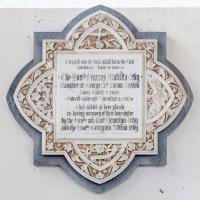
After 25th November 1879. Memorial to Frances Matilda Irby [deceased] at St Nicholas Church, Whiston [Map].
Frances Matilda Irby: On 7th March 1810 she was born to George Irby 3rd Baron Boston and Rachel Ives Drake Baroness Boston. On 25th November 1879 Frances Matilda Irby died.
Annals of Six Kings of England by Nicholas Trivet. Pope Lucius died [on 25th November 1885], after he had sat for four years, two months, and eighteen days. In the same year, after a vacancy of three days, Urban III was elected pope, a Lombard by birth, from the city of Milan, previously called Umbertus. Walter, formerly bishop of Lincoln, was received as archbishop at Rouen with a solemn procession.
Lucius papa moritur, cum sedisset annis quatuor, mensibus duobus, diebus octodecim. Eodem anno, post vacationem trium dierum, electus est in papam Urbanus III. natione Lumbardus, de civitate Mediolanensi, dictus prius Umbertus. Walterus, quondam Lincolniensis episcopus, cum processione solemni Rothomagi in archiepiscopum est receptus.
On 25th November 1885 Alfonso XII King Spain [aged 27] died. On 17th May 1886 His son Alfonso succeeded posthumously XIII King Spain when he was born some seven months later.
After 25th November 1891. Carlisle Cathedral [Map]. Monument to Bishop Harvey Goodwin [deceased] sculpted by William Hamo Thornycroft [aged 41].
Bishop Harvey Goodwin: On 9th October 1818 he was born in King's Lynn, Norfolk [Map]. In October 1869 Bishop Harvey Goodwin was elected Bishop of Carlisle. On 25th November 1891 he died in Bishopthorpe York whilst on a visit to William Maclagan, Archbishop of York.


St Michael's Church, Rocester [Map]. 281235 Private A.Clarke, Labour Corps. Died 25th November 1917, aged 29. Son of James and Elizabeth Clarke, of 19, West View, Rocester.
On 25th November 1926 Simon Elwes [aged 24] and Gloria Rodd [aged 25] were married.
On 25th November 1932 Maureen Swanson Countess of Dudley was born in Glasgow.
On 25th November 1963 the funeral of President John Fitzgerald Kennedy [deceased] was held.
On 25th November 1253 Katherine Plantagenet was born to King Henry III of England [aged 46] and Eleanor of Provence Queen Consort England [aged 30] at Westminster Palace [Map]. She died aged three in 1257.
The History of William Marshal was commissioned by his son shortly after William’s death in 1219 to celebrate the Marshal’s remarkable life; it is an authentic, contemporary voice. The manuscript was discovered in 1861 by French historian Paul Meyer. Meyer published the manuscript in its original Anglo-French in 1891 in two books. This book is a line by line translation of the first of Meyer’s books; lines 1-10152. Book 1 of the History begins in 1139 and ends in 1194. It describes the events of the Anarchy, the role of William’s father John, John’s marriages, William’s childhood, his role as a hostage at the siege of Newbury, his injury and imprisonment in Poitou where he met Eleanor of Aquitaine and his life as a knight errant. It continues with the accusation against him of an improper relationship with Margaret, wife of Henry the Young King, his exile, and return, the death of Henry the Young King, the rebellion of Richard, the future King Richard I, war with France, the death of King Henry II, and the capture of King Richard, and the rebellion of John, the future King John. It ends with the release of King Richard and the death of John Marshal.
Available at Amazon in eBook and Paperback format.
On 25th November 1274 Catherine Courtenay Countess Valois was born to Philip Courtenay [aged 31]. She married 1302 her third cousin once removed Charles Valois I Count Valois, son of King Philip III of France and Isabella Barcelona Queen Consort France, and had issue.
On 25th November 1350 Katherine Swynford aka Roet Duchess Lancaster was born to Giles "Payne" Roet [aged 40]. She married (1) in or before 1367 Hugh Swynford and had issue (2) 13th January 1396 John of Gaunt 1st Duke Lancaster, son of King Edward III of England and Philippa of Hainaut Queen Consort England, and had issue.
On 25th November 1467 Thomas Dacre 2nd Baron Dacre Gilsland was born to Humphrey Dacre 1st Baron Dacre Gilsland [aged 43] and Mabel Parr Baroness Dacre of Gilsland at Cumberland. He married 1488 his half second cousin once removed Elizabeth Greystoke 6th Baroness Greystoke Baroness Dacre of Gilsland and had issue.
On 25th November 1533 Alfonso Este II Duke Ferrara was born to Ercole Este II Duke Ferrara [aged 25] and Renée of France Duchess of Ferrara [aged 23]. He married his third cousin Barbara Habsburg Spain Duchess Ferrara, daughter of Ferdinand I Holy Roman Emperor and Anne Jagiellon.
On 25th November 1537 Elizabeth Baldry Baroness Rich Leez was born to George Baldry [aged 27]. She married before 1559 Robert Rich 2nd Baron Rich of Leez, son of Richard Rich 1st Baron Rich and Elizabeth Jenks Baroness Rich, and had issue.
On 25th November 1587 Gervase Clifton 1st Baronet was born to George Clifton and Winifred Thorold [aged 19]. He married (1) before 1612 Penelope Rich Lady Clifton, daughter of Robert Rich 1st Earl Warwick and Penelope Devereux Countess Devonshire, and had issue (2) 7th September 1615 Frances Clifford Lady Clifton, daughter of Francis Clifford 4th Earl of Cumberland and Grisold Hughes Countess Cumberland, and had issue (3) 5th May 1629 Mary Egioke Lady Clifton (4) after 1630 Isabel Meek Lady Clifton (5) 1st January 1638 Anne South Lady Clifton (6) 17th February 1639 Jane Eyre Lady Clifton and had issue (7) 17th December 1656 Alice Hastings Lady Clifton, daughter of Henry Hastings 5th Earl Huntingdon and Elizabeth Stanley Countess Huntingdon.
On 25th November 1609 Henrietta Maria Bourbon Queen Consort England was born to Henry IV King France [aged 55] and Marie de Medici Queen Consort France [aged 34]. She married 1st May 1625 her third cousin once removed King Charles I of England, Scotland and Ireland, son of King James I of England and Ireland and VI of Scotland and Anne of Denmark Queen Consort Scotland England and Ireland, and had issue.
On 25th November 1623 Margaret Maria Catherine Habsburg Spain was born to Philip IV King Spain [aged 18] and Elisabeth Bourbon Queen Consort Spain [aged 21]. Coefficient of inbreeding 4.39%. He died aged less than one years old.
On 25th November 1638 Catherine of Braganza Queen Consort England was born to John IV King Portugal [aged 34] and Luisa de Guzman Queen Consort Portugal [aged 25] in Ducal Palace of Vila Viçosa, Nossa Senhora da Conceição, Vila Viçosa. She married 21st May 1662 King Charles II of England Scotland and Ireland, son of King Charles I of England, Scotland and Ireland and Henrietta Maria Bourbon Queen Consort England.
On 25th November 1663 Anne Pulteney Duchess Southampton Duchess of Cleveland was born to William Pulteney [aged 39] and Grace Corbet. She married 1694 Charles Fitzroy 1st Duke Southampton 2nd Duke Cleveland, son of King Charles II of England Scotland and Ireland and Barbara Villiers 1st Duchess of Cleveland, and had issue.
On 25th November 1674 Elizabeth Shirley was born to Robert Shirley 1st Earl Ferrers [aged 24] and Elizabeth Washington Baroness Ferrers Chartley. He died aged two in 1677.


The History of William Marshal was commissioned by his son shortly after William’s death in 1219 to celebrate the Marshal’s remarkable life; it is an authentic, contemporary voice. The manuscript was discovered in 1861 by French historian Paul Meyer. Meyer published the manuscript in its original Anglo-French in 1891 in two books. This book is a line by line translation of the first of Meyer’s books; lines 1-10152. Book 1 of the History begins in 1139 and ends in 1194. It describes the events of the Anarchy, the role of William’s father John, John’s marriages, William’s childhood, his role as a hostage at the siege of Newbury, his injury and imprisonment in Poitou where he met Eleanor of Aquitaine and his life as a knight errant. It continues with the accusation against him of an improper relationship with Margaret, wife of Henry the Young King, his exile, and return, the death of Henry the Young King, the rebellion of Richard, the future King Richard I, war with France, the death of King Henry II, and the capture of King Richard, and the rebellion of John, the future King John. It ends with the release of King Richard and the death of John Marshal.
Available at Amazon in eBook and Paperback format.

On 25th November 1705 Meriel Leicester was born to Francis Leicester 3rd Baronet [aged 41]. She married in or before 1732 John Byrne aka Leicester 3rd Baronet, son of Daniel Byrne 2nd Baronet.
On 25th November 1719 George Crowe was born to Christopher Crowe [aged 38] and Charlotte Lee Baroness Baltimore [aged 40]. He a great grandson of King Charles II of England Scotland and Ireland. He married Anne Swift and had issue.
On 25th November 1720 John Proby 1st Baron Carysfort was born to John Proby [aged 22] and Jane Leveson-Gower [aged 16].
On 25th November 1721 William Chetwynd 4th Viscount Chetwynd was born to William Chetwynd 3rd Viscount Chetwynd [aged 37]. He married 28th October 1751 Susannah Cope, daughter of Johnathan Cope 1st Baronet and Mary Jenkinson Lady Cope, and had issue.
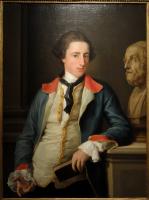
On 25th November 1732 Robert Clements 1st Earl Leitrim was born to Nathaniel Clements [aged 27] and Hannah Gore. He married 1765 Elizabeth Skeffington Countess Leitrim, daughter of Clotworthy Skeffington 1st Earl Massereene and Anne Eyre Countess Massereene, and had issue.
On 25th November 1743 William Henry Hanover 1st Duke Gloucester and Edinburgh was born to Frederick Louis Hanover Prince of Wales [aged 36] and Augusta Saxe Coburg Altenburg [aged 23]. He a grandson of King George II of Great Britain and Ireland. He married 1766 Maria Walpole Duchess Gloucester and Edinburgh and had issue.
On 25th November 1749 Henry George Liddell 5th Baronet was born to Thomas Liddell [aged 34] and Margaret Bowes [aged 42].
On 25th November 1751 Amelia Egerton was born to Bishop John Egerton [aged 29] and Anne Sophia Grey [aged 21]. Coefficient of inbreeding 6.25%. She married before 21st January 1772 Abraham Hume 2nd Baronet, son of Abraham Hume 1st Baronet, and had issue.
On 25th November 1772 Elizabeth Penelope Mcdouall Crichton was born to Patrick Mcdouall Crichton 6th Earl Dumfries [aged 46]. She married 12th October 1792 John Stuart, son of John Stuart 1st Marquis of the Isle of Bute and Charlotte Jane Windsor Marchioness Bute, and had issue.
On 25th November 1820 Harriet Cavendish Countess Strafford was born to Charles Compton Cavendish 1st Baron Chesham [aged 27] and Catherine Susan Gordon Baroness Chesham [aged 28]. She married 16th March 1848 George Byng 2nd Earl Strafford, son of John Byng 1st Earl Strafford and Mary Stevens Mackenzie, and had issue.


Chronicle of Abbot Ralph of Coggeshall
The Chronicle of Abbot Ralph of Coggeshall (Chronicon Anglicanum) is an indispensable medieval history that brings to life centuries of English and European affairs through the eyes of a learned Cistercian monk. Ralph of Coggeshall, abbot of the Abbey of Coggeshall in Essex in the early 13th century, continued and expanded his community’s chronicle, documenting events from the Norman Conquest of 1066 into the tumultuous reign of King Henry III. Blending eyewitness testimony, careful compilation, and the monastic commitment to record-keeping, this chronicle offers a rare narrative of political intrigue, royal power struggles, and social upheaval in England and beyond. Ralph’s work captures the reigns of pivotal figures such as Richard I and King John, providing invaluable insights into their characters, decisions, and the forces that shaped medieval rule. More than a simple annal, Chronicon Anglicanum conveys the texture of medieval life and governance, making it a rich source for scholars and readers fascinated by English history, monastic authorship, and the shaping of the medieval world.
Available at Amazon in eBook and Paperback format.
On 25th November 1825 George Herbert was born to Edward Herbert 2nd Earl Powis [aged 40] and Lucy Graham Countess Powis [aged 32]. He was educated at Eton College [Map] and St John's College, Cambridge University [Map]. He married 1863 Elizabeth Beatrice Sykes, daughter of Tatton Sykes 4th Baronet and Mary Anne Foulis.


On 25th November 1827 Frederick Richard Chichester was born to George Chichester 3rd Marquess Donegal [aged 30] and Harriet Anne Butler Marchioness Donegal [aged 28].
On 25th November 1832 George Orby Wombwell 4th Baronet was born to George Wombwell 3rd Baronet [aged 40] and Georgiana Hunter. He married 3rd September 1861 Julia Sarah Alice Child-Villiers Lady Wombwell, daughter of George Child-Villiers 6th Earl Jersey and Julia Peel Countess Jersey, and had issue.
On 25th November 1833 William Edward Brinckman was born to Theodore Henry Brinckman 1st Baronet [aged 35] and Charlotte Osborne Lady Broadhead. He married 13th September 1859 Mary Alice Egerton-Warburton.
On 25th November 1835 Reverend Eliot Henry Stapleton was born to Francis Jarvis Stapleton 7th Baronet [aged 28].
On 25th November 1856 Ernest William Beckett 2nd Baron Grimthorpe was born to William Beckett-Denison [aged 30] and Helen Duncombe [aged 25]. He married 4th October 1883 Lucy Tracy Lee and had issue.


On 25th November 1861 Archibald John Marjoribanks was born to Dudley Marjoribanks 1st Baron Tweedmouth [aged 40] and Isabella Hogg.
On 25th November 1868 Ernest Louis Hesse Darmstadt Grand Duke was born to Prince Louis Hesse Darmstadt IV Grand Duke [aged 31] and Princess Alice Saxe Coburg Gotha [aged 25]. He a grandson of Queen Victoria of the United Kingdom. He married (1) 19th April 1894 his first cousin Victoria Melita Windsor, daughter of Prince Alfred Windsor and Maria Holstein Gottorp Romanov, and had issue (2) 2nd February 1905 Eleonore Solms Hohensolms Lich Grand Duchess and had issue.
On 25th November 1873 Katherine Mary Cole was born to Lowry Cole 4th Earl Enniskillen [aged 27] and Charlotte Marion Baird Countess of Enniskillen [aged 21]. She married before 17th April 1915 Lieutenant-Colonel Charles Walter Villiers and had issue.


On 25th November 1876 Victoria Melita Windsor was born to Prince Alfred Windsor [aged 32] and Maria Holstein Gottorp Romanov [aged 23]. She a granddaughter of Queen Victoria of the United Kingdom. She married (1) 19th April 1894 her first cousin Ernest Louis Hesse Darmstadt Grand Duke, son of Prince Louis Hesse Darmstadt IV Grand Duke and Princess Alice Saxe Coburg Gotha, and had issue (2) 8th October 1905 her first cousin Cyril Vladimirovich Holstein Gottorp Romanov and had issue.
On 25th November 1889 Lionel Eldred Pottinger Smith-Gordon 4th Baronet was born to Lionel Eldred Pottinger Smith-Gordon 3rd Baronet [aged 32].
On 25th November 1891 Margery Joan Shirley was born to Walter Shirley 11th Earl Ferrers [aged 27] and Mary Jane Moon Countess Ferrers. She married 22nd September 1920 Lancelot Sackville Fletcher.
On 25th November 1900 Anne Catherine Tredick Wendell Countess Carnarvon was born to Jacob "Jake" Wendell [aged 31] and Marian Fendall [aged 30]. She married (1) 17th July 1922 Henry Herbert 6th Earl Carnarvon, son of George Edward Stanhope Molyneux Herbert 5th Earl Carnarvon and Almina Wombwell Countess Carnarvon, and had issue.
Abbot John Whethamstede’s Chronicle of the Abbey of St Albans
Abbot John Whethamstede's Register aka Chronicle of his second term at the Abbey of St Albans, 1451-1461, is a remarkable text that describes his first-hand experience of the beginning of the Wars of the Roses including the First and Second Battles of St Albans, 1455 and 1461, respectively, their cause, and their consequences, not least on the Abbey itself. His text also includes Loveday, Blore Heath, Northampton, the Act of Accord, Wakefield, and Towton, and ends with the Coronation of King Edward IV. In addition to the events of the Wars of the Roses, Abbot John, or his scribes who wrote the Chronicle, include details in the life of the Abbey such as charters, letters, land exchanges, visits by legates, and disputes, which provide a rich insight into the day-to-day life of the Abbey, and the challenges faced by its Abbot.
Available at Amazon in eBook and Paperback format.
On 25th November 1904 Evelyn Vane Drummond of Cromlix Baroness Auckland was born to Colonel Arthur William Henry Drummond of Cromlix [aged 42] and Mary Scott. She married 12th September 1925 her first cousin Major Terence Eden 8th Baron Auckland and had issue.

On 25th November 1907 Pamela Mitford was born to David Freeman-Mitford 2nd Baron Redesdale [aged 29] and Sydney Bowles Baroness Redesdale [aged 27].

On 25th November 1914 John Starr Paget 3rd Baronet was born to Richard Arthur Surtees Paget 2nd Baronet [aged 45] and Muriel Finch-Hatton Lady Paget [aged 38].
On 25th November 1932 Maureen Swanson Countess of Dudley was born in Glasgow.
On 25th November 1937 Zinnia Rosemary Denison was born to Hugo Denison 4th Earl of Londesborough and Marigold Lubbock Countess Londesborough [aged 34]. She was born posthumously her father having died six months before her birth.
On 25th November 1412 Henry "The Rich" Wittelsbach XVI Duke Bavaria [aged 26] and Margarete Habsburg Duchess Bavaria [aged 17] were married. She by marriage Duchess Bavaria. She the daughter of Albert Habsburg IV Duke Austria and Joanna Sophia Wittelsbach Duchess Austria. He the son of Frederick Wittelsbach Duke Bavaria and Maddalena Visconti Duchess Bavaria. They were half second cousins.
On 25th November 1467 Walter Blount 1st Baron Mountjoy [aged 51] and Anne Neville Duchess Buckingham [aged 59] were married. She by marriage Baroness Mountjoy. She the daughter of Ralph Neville 1st Earl of Westmoreland and Joan Beaufort Countess of Westmoreland.
On 25th November 1479 William Graham 1st Earl Montrose [aged 15] and Annabella Dummond Countess Montrose [aged 16] were married. They were half fourth cousin once removed.
On 25th November 1596 Thomas West 3rd Baron De La Warr [aged 20] and Cecily Shirley Baroness De La Warr were married.
On 25th November 1695 George Hamilton 1st Earl Orkney [aged 29] and Elizabeth Villiers Countess Orkney [aged 38] were married. He the son of William Hamilton 1st Duke Hamilton and Anne Hamilton 3rd Duchess Hamilton [aged 63]. They were half second cousin once removed.
On 25th November 1705 Robert "Beau Handsome" Fielding [aged 55] and Barbara Villiers 1st Duchess of Cleveland [aged 64] were married bigamously. She the daughter of William Villiers 2nd Viscount Grandison and Mary Bayning Countess Anglesey.
On 25th November 1710 Richard Granville [aged 32] and Hester Temple 1st Countess Temple [aged 20] were married.
Chronicle of Abbot Ralph of Coggeshall
The Chronicle of Abbot Ralph of Coggeshall (Chronicon Anglicanum) is an indispensable medieval history that brings to life centuries of English and European affairs through the eyes of a learned Cistercian monk. Ralph of Coggeshall, abbot of the Abbey of Coggeshall in Essex in the early 13th century, continued and expanded his community’s chronicle, documenting events from the Norman Conquest of 1066 into the tumultuous reign of King Henry III. Blending eyewitness testimony, careful compilation, and the monastic commitment to record-keeping, this chronicle offers a rare narrative of political intrigue, royal power struggles, and social upheaval in England and beyond. Ralph’s work captures the reigns of pivotal figures such as Richard I and King John, providing invaluable insights into their characters, decisions, and the forces that shaped medieval rule. More than a simple annal, Chronicon Anglicanum conveys the texture of medieval life and governance, making it a rich source for scholars and readers fascinated by English history, monastic authorship, and the shaping of the medieval world.
Available at Amazon in eBook and Paperback format.
On 25th November 1741 Clotworthy Skeffington 1st Earl Massereene [aged 26] and Anne Eyre Countess Massereene [aged 24] were married.

On 25th November 1751 George Strickland 5th Baronet [aged 22] and Elizabeth Letitia Winn [aged 18] were married.
On 25th November 1800 Francis Almeric Spencer 1st Baron Churchill [aged 20] and Frances Fitzroy Baroness Churchill Wychwood [aged 20] were married. She the daughter of Augustus Henry Fitzroy 3rd Duke Grafton [aged 65] and Elizabeth Wrottesley Duchess Grafton [aged 55]. He the son of George Spencer 4th Duke of Marlborough [aged 61] and Caroline Russell Duchess of Marlborough [aged 57]. They were second cousins. She a great x 3 granddaughter of King Charles II of England Scotland and Ireland.
On 25th November 1809 James Hamilton [aged 23] and Harriet Douglas Countess Aberdeen [aged 17] were married. He the son of John Hamilton 1st Marquess Abercorn [aged 53] and Catherine Moyle Marchioness Abercorn.
On 25th November 1834 Ernest Brudenell-Bruce 3rd Marquess Ailesbury [aged 23] and Louisa Elizabeth Horsley Beresford Marchioness Ailesbury [aged 20] were married. He the son of Charles Brudenell 1st Marquess Ailesbury [aged 61] and Henrietta Maria Hill.
On 25th November 1858 Henry Holland 1st Baronet [aged 70] and Margaret Jean Trevelyan Lady Holland [aged 23] were married. She by marriage Lady Holland of Sandlebridge. The difference in their ages was 46 years.
On 25th November 1926 Simon Elwes [aged 24] and Gloria Rodd [aged 25] were married.
On 25th November 1931 John Lyon-Dalberg-Acton 3rd Baron Acton [aged 23] and Daphne Strutt Baroness Acton [aged 20] were married. She by marriage Baroness Acton of Aldenham in Shropshire.
On 25th November 1955 John Francis Baring 7th Baron Ashburton [aged 27] and Susan Renwick [aged 25] were married.
On 25th November 1034 King Malcolm II of Alba [aged 80] died. King Duncan I of Scotland [aged 33] succeeded I King Scotland. Bethóc Unknown Queen Consort Scotland by marriage Queen Consort Scotland.
On 25th November 1120 the White Ship left Barfleur in north-west Normandy, with a party of young Normans. King Henry I "Beauclerc" England [aged 52] had left earlier on another ship. A mile out the White Ship foundered on a submerged rock. William Adelin Duke Normandy [aged 17], his half-siblings Richard Fitzroy [aged 19] and Matilda Fitzroy Countess Perche, William Bigod [aged 27], Lucia Mahaut Blois Countess Chester, brothers Geoffrey Aigle and Engenulf Aigle, half-brothers Richard Avranches 2nd Earl Chester [aged 26] and Ottiwel Avranches, brothers Ivo Grandesmil and William Grandesmil and Geoffrey Ridel were all drowned.
Chronicle of Geoffrey le Baker of Swinbroke
Baker was a secular clerk from Swinbroke, now Swinbrook, an Oxfordshire village two miles east of Burford. His Chronicle describes the events of the period 1303-1356: Gaveston, Bannockburn, Boroughbridge, the murder of King Edward II, the Scottish Wars, Sluys, Crécy, the Black Death, Winchelsea and Poitiers. To quote Herbert Bruce 'it possesses a vigorous and characteristic style, and its value for particular events between 1303 and 1356 has been recognised by its editor and by subsequent writers'. The book provides remarkable detail about the events it describes. Baker's text has been augmented with hundreds of notes, including extracts from other contemporary chronicles, such as the Annales Londonienses, Annales Paulini, Murimuth, Lanercost, Avesbury, Guisborough and Froissart to enrich the reader's understanding. The translation takes as its source the 'Chronicon Galfridi le Baker de Swynebroke' published in 1889, edited by Edward Maunde Thompson.
Available at Amazon in eBook and Paperback format.
On 25th November 1314 King John Balliol I of Scotland [aged 65] died at Château de Hélicourt.
On 25th November 1402 Catherine Mauley Countess Suffolk [aged 72] died.
On 25th November 1431 Walter Fitzwalter 7th Baron Fitzwalter [aged 31] drowned at sea in a storm whilst returning from France.
Elizabeth Fitzwalter Baroness Dinham 8th Baroness Fitzwalter [aged 2] succeeded 8th Baroness Fitzwalter. Note. Chronicle of Gregory 1432 states 24th November 1432 or, more specifically, "on Syn Kateryn ys eve" - St Katherine's feast day is 25 Nov.
On 25th November 1462 John Stourton 1st Baron Stourton [aged 62] died. His son William [aged 36] succeeded 2nd Baron Stourton.
On 25th November 1483 Richard Fiennes Baron Dacre Gilsland [aged 68] died.
On 25th November 1533 Philip of Savoy Duke Nemours [aged 43] died. His son Jacques [aged 2] succeeded Duke Nemours.
On 25th November 1564 Isabel or Elizabeth Stewart Countess Lennox [aged 69] died.
On 25th November 1664 Christoper Wray 4th Baronet [aged 43] died. He was buried at St Michael's Church, Glentworth [Map]. His brother Bethel [aged 41] succeeded 5th Baronet Wray of Glentworth in Lincolnshire.
On 25th November 1670 John Lovelace 2nd Baron Lovelace [aged 54] died. His son John [aged 29] succeeded 3rd Baron Lovelace of Hurley in Berkshire. Martha Pye Baroness Lovelace [aged 28] by marriage Baroness Lovelace of Hurley in Berkshire.
On 25th November 1692 Edward Clinton 5th Earl Lincoln died. His second cousin twice removed Francis succeeded 6th Earl Lincoln.
This is a translation of the 'Memoires of Jacques du Clercq', published in 1823 in two volumes, edited by Frederic, Baron de Reissenberg. In his introduction Reissenberg writes: 'Jacques du Clercq tells us that he was born in 1424, and that he was a licentiate in law and a counsellor to Philip the Good, Duke of Burgundy, in the castellany of Douai, Lille, and Orchies. It appears that he established his residence at Arras. In 1446, he married the daughter of Baldwin de la Lacherie, a gentleman who lived in Lille. We read in the fifth book of his Memoirs that his father, also named Jacques du Clercq, had married a lady of the Le Camelin family, from Compiègne. His ancestors, always attached to the counts of Flanders, had constantly served them, whether in their councils or in their armies.' The Memoires cover a period of nineteen years beginning in in 1448, ending in in 1467. It appears that the author had intended to extend the Memoirs beyond that date; no doubt illness or death prevented him from carrying out this plan. As Reissenberg writes the 'merit of this work lies in the simplicity of its narrative, in its tone of good faith, and in a certain air of frankness which naturally wins the reader’s confidence.' Du Clercq ranges from events of national and international importance, including events of the Wars of the Roses in England, to simple, everyday local events such as marriages, robberies, murders, trials and deaths, including that of his own father in Book 5; one of his last entries.
Available at Amazon in eBook and Paperback format.
On 19th November 1733 Mary Somerset Duchess Ormonde [aged 69] died. On 25th November 1733 she was buried in the Duke of Ormonde Vault, King Henry VII Chapel, Westminster Abbey.
On 25th November 1759 Arthur Newcomen 7th Baronet [aged 58] died. His son Thomas [aged 19] succeeded 8th Baronet Newcomen of Kenagh in County Longford.
On 25th November 1761 John Kemp 5th Baronet [aged 60] died. His nephew John [aged 7] succeeded 6th Baronet Kemp of Gissing in Norfolk.

On 25th November 1771 Thomas Fane 8th Earl of Westmoreland [aged 70] died. His son John [aged 43] succeeded 9th Earl of Westmoreland. Susan Gordon Countess of Westmoreland [aged 19] by marriage Countess of Westmoreland.
Henry Fane of Fulbeck [aged 32] inherited Fulbeck Hall.
On 25th November 1775 Rear-Admiral Richard Spry [aged 59] died unmarried at Place House, St Anthony in Roseland [Map]. He was buried at St Anthony's Church, St Anthony in Roseland [Map] where he has a monument sculpted by Richard "The Elder" Westmacott [aged 28]. His estates were inherited by his nephew Lieutenant Thomas Davy [aged 21] who adopted the surname Spry.
Sacred to the Memory of Sir Richard Spry, KT Rear admiral of the White Several years Commander-in-Chief of H.M. Ships in North-America, the Mediterranean, and Plymouth. He was envoy to the Emporer of Morocco and the States of Barbary. He died on the 25st of November 1775, aged 60 years. This momument as a testimony of gratitude is erected by his affectionate nephew Admiral Thomas Spry.
On 25th November 1798 John Dawson 1st Earl Portarlington [aged 54] died. His son John [aged 17] succeeded 2nd Earl Portarlington.
On 25th November 1802 Edward Hussey-Montagu 1st Earl Beaulieu [aged 81] died at Dover Street. He was buried at St Edmund's Church, Warkton [Map]. Earl Beaulieu, Baron Beaulieu of Beaulieu in Hampshire extinct.
On 25th November 1803 Joseph Wilton [aged 81] died.
On 25th November 1804 Barbara St John Countess Coventry died.
On 25th November 1841 Francis Leggatt Chantrey [aged 60] died at his home 13 Eccleston Street, Pimlico [Map].

On 25th November 1862 Harriet Cavendish Countess Granville [aged 77] died.
Chronicle of Geoffrey le Baker of Swinbroke
Baker was a secular clerk from Swinbroke, now Swinbrook, an Oxfordshire village two miles east of Burford. His Chronicle describes the events of the period 1303-1356: Gaveston, Bannockburn, Boroughbridge, the murder of King Edward II, the Scottish Wars, Sluys, Crécy, the Black Death, Winchelsea and Poitiers. To quote Herbert Bruce 'it possesses a vigorous and characteristic style, and its value for particular events between 1303 and 1356 has been recognised by its editor and by subsequent writers'. The book provides remarkable detail about the events it describes. Baker's text has been augmented with hundreds of notes, including extracts from other contemporary chronicles, such as the Annales Londonienses, Annales Paulini, Murimuth, Lanercost, Avesbury, Guisborough and Froissart to enrich the reader's understanding. The translation takes as its source the 'Chronicon Galfridi le Baker de Swynebroke' published in 1889, edited by Edward Maunde Thompson.
Available at Amazon in eBook and Paperback format.
On 25th November 1863 Agnes Beresford Lady Fitzherbert [aged 78] died.
On 25th November 1869 Pamela Fitzgerald Lady Campbell [aged 73] died.

On 25th November 1872 Frederick William Robert Stewart 4th Marquess Londonderry [aged 67] died. His half brother George [aged 51] succeeded 5th Marquess Londonderry. Mary Cornelia Edwards Marchioness Londonderry [aged 43] by marriage Marchioness Londonderry.
On 25th November 1885 Alfonso XII King Spain [aged 27] died. On 17th May 1886 His son Alfonso succeeded posthumously XIII King Spain when he was born some seven months later.

On 25th November 1887 John William Maule Ramsay 13th Earl Dalhousie [aged 40] died. His son Arthur [aged 9] succeeded 14th Earl Dalhousie.
On 25th November 1889 George Patrick Evans 7th Baron Carbery [aged 79] died without issue. His brother William [aged 77] succeeded 8th Baron Carbery. Victoria Cecil Baroness Carbery [aged 46] by marriage Baroness Carbery.
On 25th November 1891 Bishop Harvey Goodwin [aged 73] died in Bishopthorpe York whilst on a visit to William Maclagan, Archbishop of York.
On 25th November 1900 James Heron Walker 3rd Baronet [aged 35] died. His son Robert [aged 10] succeeded 4th Baronet Walker of Sand Hutton in Yorkshire.
On 25th November 1911 William Hay 10th Marquess of Tweeddale [aged 85] died. His son William [aged 27] succeeded 11th Marquess Tweeddale.
On 25th November 1920 Frederica Berkeley Baroness Gifford [aged 95] died.
On 25th November 1938 Victor James Guy Chetwynd 6th Baronet [aged 36] died. His second cousin once removed Arthur [aged 51] succeeded 7th Baronet Chetwynd of Brocton Hall in Staffordshire.
Adam Murimuth's Continuation and Robert of Avesbury’s 'The Wonderful Deeds of King Edward III'
This volume brings together two of the most important contemporary chronicles for the reign of Edward III and the opening phases of the Hundred Years’ War. Written in Latin by English clerical observers, these texts provide a vivid and authoritative window into the political, diplomatic, and military history of fourteenth-century England and its continental ambitions. Adam Murimuth Continuatio's Chronicarum continues an earlier chronicle into the mid-fourteenth century, offering concise but valuable notices on royal policy, foreign relations, and ecclesiastical affairs. Its annalistic structure makes it especially useful for establishing chronology and tracing the development of events year by year. Complementing it, Robert of Avesbury’s De gestis mirabilibus regis Edwardi tertii is a rich documentary chronicle preserving letters, treaties, and official records alongside narrative passages. It is an indispensable source for understanding Edward III’s claim to the French crown, the conduct of war, and the mechanisms of medieval diplomacy. Together, these works offer scholars, students, and enthusiasts a reliable and unembellished account of a transformative period in English and European history. Essential for anyone interested in medieval chronicles, the Hundred Years’ War, or the reign of Edward III.
Available at Amazon in eBook and Paperback format.
On 25th November 1939 Rudolph Feilding 9th Earl of Denbigh [aged 80] died. His grandson William [aged 27] succeeded 9th Earl Desmond, 10th Earl Denbigh, 10th Viscount Feilding, 10th Baron Feilding of Newnham Paddocks in Warwickshire, 9th Viscount Callan of Callan in Kilkenny, 9th Baron Feilding of Lecagh in Tipperary, 9th Baron St Liz.
On 25th November 1958 Mary Carolyn Campbell Cuyler Lady Egerton [aged 86] died.
On 25th November 1972 Francis Henry Manners 4th Baron Manners [aged 75] died. His son John [aged 49] succeeded 5th Baron Manners of Foston in Lincolnshire.
On 25th November 1998 Montague John Cholmeley 6th Baronet [aged 63] died. His son Hugh [aged 30] succeeded 7th Baronet Cholmeley of Easton in Lincolnshire.
On 25th November 2007 Patrick Crofton 7th Baron Crofton [aged 56] died. His son Edward [aged 19] succeeded 8th Baron Crofton, 9th Baronet Crofton of The Mote in Roscommon.
On 25th November 2009 Maureen Therese Josephine Noel Baroness Dormer [aged 92] died.