

15 Jan is in January.
1478 Marriage of Richard Duke of York and Anne Mowbray
1559 Coronation of Elizabeth I
On 15th January 935 Rudolph aka Raoul I King West Francia [aged 45] died.
On 15th January 1149 Berenguela Barcelona Queen Consort Castile and Leon [aged 33] died.
On 15th January 1245 Archbishop Boniface Savoy [aged 38] was consecrated Archbishop of Canterbury at Lyon, France [Map] by Pope Innocent IV during the First Council of Lyon.
 Deeds of King Edward III by Robert of Avesbury. "Clement, bishop, servant of the servants of God, to his most dear son in Christ, Edward, the illustrious king of England, greeting and apostolic blessing. If you would carefully consider, most dear son, as befits a Catholic prince, the destruction of countless persons redeemed by the precious blood of Christ our Redeemer, the ruin of possessions, and the bitterly lamentable dangers of souls which the dissensions and wars stirred up between you and our most dear son Philip, the illustrious king of France, have produced and continue daily without ceasing; and also the groans of the poor, of pupils, orphans, widows, and other miserable persons who, despoiled and robbed and reduced to the distress of hunger, cry to the Lord with tears falling upon their cheeks; likewise the destruction of churches, monasteries, and holy places, and the sacrilegious plundering of vestments and other ornaments appointed for divine worship; the seizure, imprisonment, and despoiling of religious and ecclesiastical persons and of many others; and innumerable other detestable and execrable evils which offend the eyes of the divine majesty, if you would revolve these things deeply within your royal heart and consider also that the Catholic faith itself, especially in the eastern regions, is oppressed, and that the faithful living there, because of these same dissensions and wars and deprived of the assistance of the Catholic powers of the West, are afflicted by the infidels, who, seeing Christendom thus disturbed, persecute them more cruelly than usual; although in these times opportunities are prepared for the expansion of the faith in those eastern regions greater than in many past ages, then indeed we believe that your heart will be softened and that you will turn your mind to restoring peace and concord with the said king, so that such great and numerous evils may proceed no further and that the many good things which might now be accomplished for the enlargement of the aforesaid faith may not be hindered. For if the Lord has granted you favourable fortune, most beloved son, your heart ought rather to be humbled than exalted, and you ought to be found more ready for such a voice, so that you may please the Lord who loves peace and delights in peaceful men, and may direct the efforts of your mind toward avoiding the aforesaid evils which undoubtedly grievously offend Him. Finally, we greatly marvel that to our venerable brother Annibaldus, bishop of Tusculum, and to our beloved son Stephen, cardinal priest of the title of Saints John and Paul, envoys of the Apostolic See specially sent by us to negotiate this peace and diligently and faithfully labouring for it, men who love truth, justice, and equity and who are promoters of your honour, you have not yet, as we have learned, been willing in any way to open yourself on certain matters by which an entrance to peace might be made. Wherefore we more earnestly beseech your royal excellence and implore you by the mercy of God that, putting an end to these dreadful evils and forestalling by the sweetness of mercy and compassion the vengeance of divine indignation which might justly be feared from the continuation of such evils, you will open to the aforesaid cardinals, at least privately so that your honour may in no way be diminished, some means for the negotiation of peace. Incline your mind with diligent affection toward that peace which is pleasing to God, desirable to the world, useful to you and to the said king, and beneficial to the Catholic faith, so that, once it is perfected and confirmed by divine grace, you may turn your strength to the affairs of God in the eastern regions, where at this time many favourable opportunities occur for such matters, and may thereby attain happy increase of your salvation, honour, and renown, as we have heard you ardently desire. Write back to us concerning your intention on these matters and those related to them. Given at Avignon, on the eighteenth day before the Kalends of February [15th January 1347], in the fifth year of our pontificate."
"Clemens, episcopus, servus servorum Dei, carissimo in Christo filio Edwardo, regi Angliæ illustri, salutem et apostolicam benedictionem. Si diligenter, fili carissime, tanquam princeps catholicus, attenderis personarum innumerabilium, pretioso Christi sanguine redemptoris nostri redemptarum, excidia, lapsus rerum, et animarum amarius plangonda pericula, quæ dissensiones et guerræ, inter te et carissimum filium Philippum, regem Franciæ illustrem, suscitatæ, produxerunt et producunt cotidie incessanter; necnon gemitus pauperum, pupillorum, orphanorum, viduarum, et aliarum personarum miserabilium, quæ, deprædatæ et derobatæ famisque subjectæ angustiæ, clamant ad Dominum, lacrimis descendentibus ad maxillas; necnon destructiones eoclesiaram, monasteriorum ac locorum sanctorum, et væ soram et alioram ornamentorum divino cultui deputatoram rapinas sacrilegas; captiones, incarcerationes, spoliationes religiosram et ecclesiasticarum ac alieram personarum, ceteraque innumerabilia detestanda et exsecranda mala, divinæ majestatis oculos offendentia, manifeste intra præcordia revolveris regia; tuisque considerationibus adjeceris in hac parte quod prædicia fides catholica, præsertim in partibus orientalibus, opprimitur, ac fideles ibidem degentes, propter dissensiones et guerras easdem, suxiliis catholicoram partium oocidentalium destituti, ab infidelibus sic turbatam Christianitatem aspicientibus, diris persecotionibus solito crudelius, quamquam his temporibus ad istam fiden ampliandam in ipsis partibus orientalibus exsistant parata merita plus quam fuerint a multis retroactis temporibus, affliguntur, profecto credimus quod cor tuum emollies et, ut tot et tante mala non procedant ulterius, nec tot bona, quot pro dilatatione fidei prædictæ fieri poussent, his temporibus impediri valeant, ad pacem et concordiam cum rege prædicto reformandam placabilem diriges animum et convertes. Si enim tibi, fili dilectissime, arridentem fortunam dederit Dominus, humiliari quam elevari tuus debet animus et reperiri ad vacem hujusmodi magis promptus, ut Domino, qui pacem diligit et viris pacificis delectatur, placere possis, ac ad vitandum mals prædicta, quæ Ipsum graviter offendere non est dubium, dirigere stadia mentis tuæ. Denique miramur admodum quis venerabili fratri, Ambaldo, episcopo Tusculano, et dilecto filio nostro Stephano, titali sanctorum Johannis et Pauli presbytero cardinali, apostolicæ sedis nunciis, per nos et sedem nostram ad tractandam pacem hujusmodi specialiter destinatis, et pro illa diligenter et fideliter laborantibus, qui veritatem, justitiam, et æquitatem diligunt, tuique honoris elatores exsistunt, nondum te, sicut intelleximus, super sliquibus, quibus ad pacem ipsam pandi possit aditus, aperiri quomodolibet voluisti. Quocirca tuam regiam excellentiam attentius deprecamur, et per Dei misericordiam obnixius obsecramus, quatinus, malis prædictis horribilibus quem necesse fuerit finem ponens, et præveniens pietatis et compassionis dulcedine ultionem indignationis divinæ, quæ possit ex præmissis malis, si continuarentur, quod absit, ulterius merito formidari, super vis tractatus pacis de vobis præfatis cardinalibus, saltem secrete, ut tuis in aliquo non derogetur honoribus, aperire, ac ad pacem ipsam, Deo placabilem, mundo desirabilem, ac tibi dictoque regi perutilem, fideique catholicæ votivam, inclinare operosis affectibus mentem tuam, ut, es perfecta et, divina suffragante gratia, solidata, circa Dei negocia in partibus prædictis orientalibus, occurrente matoria his, ut præmittitur, temporibus multa apta, ad tuæ salutis, honoris, ac nominis incrementa felicia, vires tuas valeas, sicut te ferventer in votis gerere audivimus, exercere, nobis super prædictis et ea tangentibus tuæ intentionis propositum rescripturus. Datæ Avinoniæ, XVIIJ kalendas Februarii, pontificatus nostri anno quinto."
Life of Charles VI by a Monk of St Denis. The king, rejoicing greatly, dismissed them back to the duchy after rewarding them with generous gifts. In the following month of February they read the royal letters before the duke and the nobles of the land, and there they swore to observe the conditions inviolably. The duke likewise swore the same oath, though, as many asserted, perhaps only in word and not in heart. Together with the aforementioned envoys the king had also sent the bishop of Chartres, Lord John Fabri, the lord of Caprosia, and Master Arnaud of Corbeil, president of the ParlementENDNOTE1ENDNOTE, in whom he placed great trust, so that they might complete what had been begun. Acting in obedience to the royal decree, they restored the duchy to the duke by royal authority and brought back the form of the agreement, confirmed with his seal, in that same month of FebruaryENDNOTE2ENDNOTE.
Unde rex exhilaratus gaudio, eos ingentibus prosequtus premiis, remisit ad ducatum; qui quidem, mense februario se. quente, coram duce et nobilibus patrie scripta legerunt regalia, tuncque condiciones observare inviolabiliter juraverunt; quod itidem dux juravit, et forsitan, ut asserebatur a mukis, solum verbo sed non animo mutato. Cum prenominatis eciam rex miserat episcopum Carnotensem dominum Johannem Fabri, dominum de Caprosia et magistrum Árnaudum de Corbeia in Parlamento presidentem, quibus plurimum fidebat, qui consummarent inchoata, et qui edicto parentes regio, duci auctoritate regia ducatum restituerunt; tractatus quoque formam, ipsius sigillo roboratam, eodem mense februario retulerunt.
Note 1. Lobineau also cites, among the king’s envoys, Jean le Mercier, counsellor, and Jean Tabari, secretary.
1. Lobineau cite encore, parmi les envoyés du roi, Jean le Mercier, conseiller, et Jean Tabari, secrétaire.
Note 2. According to Lobineau, this treaty was signed by the king at Paris on 15th January 1381, and ratified by the Duke of Brittany on 4th April, at Guérande.
2. Suivant Lobineau, ce traité fut signé par le roi à Paris le 15 janvier 1581, n. st, et ratifié par le duc de Bretagne, le 4 avril, à Guérande.
Chronicle of the Betrayal of Richard II. [15th January 1400]. The Duke of Exeter Earl of Huntingdon [aged 48], King Richard's brother, and Sir Thomas Shelley,1 a worthy knight, who had been his steward of the household, fled into Essex, into a small town where dwelt the Countess of Hereford, the sister of the late Earl of Arundel, who had been beheaded in the great Parliament; and they went to lodge in the house where they had been accustomed to stop when they went that way;2 and the Countess, having received information that the Earl of Hantingdon had arrived, ordered the constable of the town to collect secretly all the townsmen to seize him and all his people, for she wished to take vengeance upon him for the cause of her brother. The constable accordingly did as he was commanded, and captured the Earl of Huntingdon, as well as his knight and his butler, of the name of Hugb Cade. The greater part of the knights and esquires of the Earl's army were taken here and there in different parts of the country, for they did not know which way to turn nor where to go.
Note 1. The Earl of Huntingdon made several attempts to escape with his followcrs by sea to France, But was always driven back by stress of woathcr. (Sir J. Hayward, Life of Henry IV.) Richard had given to Sir Thomas Shelley the goods and chattels of Roger Nele of Toppesham, forfeited to him. (Rot. Pat. 20 Rie. II. p. 1. 23rd Oct.) After his execution, Henry gave the mayor of London two of Sir Thomas Shelley's mantles, with doublets of red velvet, &c. (Rot. Claus. 1 Hen. IV. 14th April.)
Note 2. The Earl was captured at the house of John Pritelwell or Pritewell, at Pritelwell, Essex, on the Thames, and was thence taken by the people of the country to the Countess of Hereford at Pleshey. (See Appendix A.) Walsingham says, he was taken on the festival of St. Maur (Jan. 15th) towards evening. It does not appear whether the Countess had Henry's order for the exécution of the Earl. Sir Harris Nicolas quotes William of Malmesbury to prove that the ancient Earls had a power of legislation within their counties (Life of Chaucer, i. 157); and as late as the reign of Henry the Sixth we find the great Earls beheadiug prisoners taken in battle. But an order of council was issued by Henry to stop such irregular proceediugs,and to bring the parties offending to justice. The following is the reason stated: "Considering that the commons of the country, on account of the destruction of the Earls of Kent, of Salisbury, and of Huntingdon, and of the Lord le Despencer, and other traitors to the King, have become so proud, that they fear not to put to death of their own will many of the King's lieges without process of law." (Minutes of Council, Feb. 1400.) Henry gave the goods and chattels of the Earl to Richard Spicer of Plymoulh, and others. (Rot. Claus. 30th INLir. 1 Hen. IV.) No less than eleven commissioners were appointed to take into the King's lands the property of the Earls of Kent and Salisbury, Sir Ralph Lunley, and Sir Thomas Blount. (Pell of Issue Rolls, Jan, 1400.)
Chronicle of the Betrayal of Richard II. [After 15th January 1400]. The Countess [aged 53]1 sent a letter to King Henry to acquaint him that she had seized the Earl of Huntingdon [aged 48], and to beg him to send his cousin of Arundel to take vengeance upon him for the death of his father, for she was determined to have him drawn and hung. Then the King sent the Earl of Arundel thither, and said, "Cousin, go to your aunt, and fetch the prisoners dead or alive." When the Earl of Arundel arrived at the town where the Earl of Huntingdon was taken, he found there his aunt, and eight thousand or more of the villeins of the country, before whom his aunt had led forth the Earl of Huntingdon to put him to death; and there was not one of the villeins present who did not take compassion on him.
Note 1. Joan, widow of Humphrey de Bohun Earl of Hereford, Lord Constable of England, mother of Mary de Bohun, the first wife of Henry IV, who died in 1394. This extraordinary woman, sister to the Earl of Arundel executed by Richard [aged 33], and to the Archbishop of Canterbury [aged 47] whom he had banished, and mother to Aleanora Duchess of Gloucester, was completely identified by all the ties of relationship with Henry and his party. Imbued with the feelings of chivalry, she, like our Queen Philippa, the Countess of Salisbury, and some others, was equal, in case of emergency, to daring exploits at the heads of armies. (See Froissart, i. 77, 81, 134,137, 139.) Humanity, in its nobler meauing, was, however, without the circle of the sympathies of chivalry. She appears to have acted a mother's part to Henry's children after they had lost their natural protector. Henry V. bequeathed to Thomas Bishop of Durham 'the missal and portophoriuin which we had of the gift of our dear grandmother the Countess of Hereford.' He also bequeathed her 'a gold cyphus.' But she did not survive him. She died on the 7th of April 1416. [Note. Most sources give her death in 1419.]
On 15th January 1432 Alfonso "The African" V King Portugal was born to Edward "The Philosopher" I King Portugal [aged 40] and Eleanor Trastámara Queen Consort Portugal. He a great x 2 grandson of King Edward III of England. Coefficient of inbreeding 4.40%. He married (1) 1447 his first cousin Isabella Aviz Queen Consort Portugal and had issue (2) 1475 his niece Joanna "La Beltraneja" Trastámara Queen Consort Portugal, daughter of Henry IV King Castile and Joan Aviz Queen Consort Castile.
On 15th January 1460 Yorkist forces commanded by John Dynham 1st Baron Dynham [aged 27] and Richard "Kingmaker" Neville Earl Warwick, 6th Earl Salisbury [aged 31] raided Sandwich, Kent [Map] capturing a number of Lancastrian ships. In addition, the Woodville family: Richard Woodville 1st Earl Rivers [aged 55], his wife Jacquetta of Luxemburg Duchess Bedford [aged 45] and their son Anthony Woodville 2nd Earl Rivers [aged 20] were captured.
 Memoires Jacques du Clercq. Around the 15th day of January in the said year 1460, the Lord of Rivers, who had formerly been captain of Calais in the name of King Henry of England, a powerful and noble man, had assembled several vessels full of men-at-arms at a port in England called Sandwich, near Calais, in order to launch an assault against those of Calais and to bring back the Duke of Somerset, who was staying at Guînes and did not know how to return to England for fear of those of Calais. While the said Lord of Rivers was at Sandwich, during the night he was captured, along with several others, by the men of the Count of Warwick, captain of Calais, and they were taken as prisoners to Calais. At the same time, they also brought to Calais five or six vessels laden with goods, which they had found at Sandwich and which belonged to the party of the said Lord of Rivers.
Environ le quinziesme jour de janvier audit an mil iiij lix, le St de Rivieres, lequel avoit esté autrefois capitaine de Calaix au nom du roy Henry d'Angleterre, icelluy Sr de Rivieres, lequel estoit puissant et noble, avoit assemblé aulcuns basteaux pleins de gens de guerre a ung port de mer en Angleterre nommé Sandewacq, assez près de Calaix pour venir livrer assault a ceulx de Calaix et remener le duc de Sombreset, lequel se tenoit a Guynes et ne sçavoit comment rentrer en Angleterre pour doubte de ceulx de Calaix, et comme icelluy St de Rivieres estoit audit Sandewacq par une nuit fust prins et plusieurs aultres avec lui par les gens du comte de Werwicq, capitaine de Calaix, et furent menés prisonniers a Calaix, et avecq ce emmenerent audit Calaix cinq ou six basteaux pleins de biens qu'ils trouverent audit Sandewacq qui estoient de la partie dudit Sr de Rivieres.
Chronicle of Gregory. 15th January 1460. But the Erle of Warwycke [aged 31] come unto Sondewyche [Map], and there he toke the Lord Rivers [aged 55] with his ladye [aged 45], the lady and Duchyes of Bedfordeb and brought them to Calys, for he was commaundyd to have londyd at C[a]lys by the King, but he was brought there sonner then him lekyd.
Note b. Jaquetta, widow of the Regent Bedford. She was the daughter of Peter of Luxemburg, Count of St. Pol, and soon after her first husband's death married Sir Richard Woodville, who was created Baron Rivers by Henry VI. in 1448, and Earl Rivers by Edward IV. (who was his son-in law) in 1466.
 Chronicle of England by William of Worcester. [15th January 1460]. And shortly after the said feast, John Dynham [aged 27], with others from Calais, secretly entered Sandwich [Map], and there captured Lord Rivers [aged 55] and Anthony Woodville [aged 20] his son, with many large ships, and brought them to Calais, where the Earls of March [aged 17], Warwick [aged 31], and Salisbury [aged 60] were present.
Et cito post dictum festum Johannes Denham cum aliis de Calesiæ secrete intravit Sandwycum, ac ibidem cepit dominum de Reverys et Antonium Widwele filium ejus, cum multis magnis navibus, et adduxit Calisiæ, comitibus Marchiæ et Warrewici et Sarum, Calisiæ existentibus.
On 15th January 1478 Edward IV's youngest son Richard of Shrewsbury [aged 4] and Anne Mowbray [aged 5] were married at St Stephen's Chapel in Westminster [Map]. She by marriage Duchess Norfolk. She the daughter of John Mowbray 4th Duke of Norfolk and Elizabeth Talbot Duchess Norfolk [aged 35]. He the son of King Edward IV of England [aged 35] and Elizabeth Woodville Queen Consort England [aged 41]. They were second cousin once removed. She a great x 3 granddaughter of King Edward III of England.
The ceremony was attended by Edward's daughters Elizabeth [aged 11], Mary [aged 10] and Cecily [aged 8].
The day before Thomas Howard [aged 35] was knighted.
In 1483 Parliament changed the succession so Richard of Shrewsbury 1st Duke of York would continue to enjoy her inheritance (she died in 1481) effectively dis-inheriting William Berkeley 1st Marquess Berkeley [aged 52] (who was subsequently created Earl and Marquess), who accepted a payment of £34,000, and John Howard 1st Duke of Norfolk [aged 53], who was subsequently created Duke of Norfolk, possibly in compensation.
Thomas Frowyk [aged 55] was created Knight of the Bath.
See Woodville Marriages.


15th January 1513. Armour. Indenture, made 15 Jan. 4 Henry VIII., between Mr. Thomas Wolsy [aged 39], clk., councillor, and John Daunce, in the King's name, on the one part, and Robert Bolte, of London, mercer, on the other part, for delivery of 3,000 harnesses (described), at 16s., by 30 April next, at the Tower. Signed at the head by the King and at the foot by Daunce.
Henry Machyn's Diary. 15th January 1554. [The xv day of January, the lord mayor, and the] aldermen whent to Westmynster [to the court, and] my lord chanseler mad a protestacyon [to them, and to] othur pepyll, that the quen('s) [aged 37] grace ys myndyd [to marry] with the prynche of Spayne [aged 26], and the reme [realm] for to have [great] benefett commyng in to the rayme [realm]; and that he not [to meddle with the public affairs of the State] thyngs, butt her consell of thys reame sh ....


Chronicle of Greyfriars. 15th January 1554. Item the xv. day of the same monyth began the insurreccion at Maydstone by sir Thomas Wyett knyght, lorde Cobhame [aged 57]1, Harper, and Colpeper, with dyvers others.
Note 1. Lord Cobham was at first suspected of taking part in Wyatt's rebellion: see the Chronicle of Queen Jane and Queen Mary, p. 36.
On 15th January 1559 Queen Elizabeth I of England and Ireland [aged 25] was crowned I Queen of England by Bishop Owen Oglethorpe [aged 52] at Westminster Abbey [Map].
Margaret Audley Duchess Norfolk [aged 19] carried the train. Archbishop Nicholas Heath [aged 58] censed. Edward Dymoke [aged 51] attended as the Queen's Champion. Thomas Howard 4th Duke of Norfolk [aged 22], Francis Talbot 5th Earl of Shrewsbury [aged 59], Henry Fitzalan 12th or 19th Earl of Arundel [aged 46], Thomas Cecil 1st Earl Exeter [aged 16] and William Herbert 1st Earl Pembroke [aged 58] attended.
Archives of Venice. On Sunday, 15th January [1559], mass was sung for the coronation in Westminster Abbey, which was decorated with the handsomest and most precious tapestries that were ever seen, they having been purchased by Henry VIII., representing on one side the whole of Genesis, and on the other the Acts of the Apostles, from a design by Raffael d'Urbino; and the chambers were hung with the history of Cæsar and Pompey. At one of the sides the buffet was prepared with its raised steps, on which were seen 140 gold and silver drinking cups, besides others which were below for the service. The Queen was received under the canopy by the Archbishop [aged 58] and another Bishop, they having previously perfumed her with incense, giving her the holy water and the pax, the choristers singing; then the Earl of Rutland [aged 9] followed her Majesty with a plain naked sword without any point, signifying Ireland, which has never been conquered; then came the Earl of Exeter with the second sword; the third was borne by Viscount Montagu; the Earl of Arundel [aged 46], having been made Lord Steward and High Constable for that day, carried the fourth (sword) of royal justice, with its gilt scabbard loaded with pearls. The orb was carried by the Duke of Norfolk, Lord Marshal, and in advance were knights clad in the ducal fashion, carrying the three crowns, they being the three Kings-at-arms; they bore the three sceptres, with their three crowns of iron, of silver, and of gold on their heads, and in their hands three naked iron swords, signifying the three titles of England, France, and Ireland.
Adam Murimuth's Continuation and Robert of Avesbury’s 'The Wonderful Deeds of King Edward III'
This volume brings together two of the most important contemporary chronicles for the reign of Edward III and the opening phases of the Hundred Years’ War. Written in Latin by English clerical observers, these texts provide a vivid and authoritative window into the political, diplomatic, and military history of fourteenth-century England and its continental ambitions. Adam Murimuth Continuatio's Chronicarum continues an earlier chronicle into the mid-fourteenth century, offering concise but valuable notices on royal policy, foreign relations, and ecclesiastical affairs. Its annalistic structure makes it especially useful for establishing chronology and tracing the development of events year by year. Complementing it, Robert of Avesbury’s De gestis mirabilibus regis Edwardi tertii is a rich documentary chronicle preserving letters, treaties, and official records alongside narrative passages. It is an indispensable source for understanding Edward III’s claim to the French crown, the conduct of war, and the mechanisms of medieval diplomacy. Together, these works offer scholars, students, and enthusiasts a reliable and unembellished account of a transformative period in English and European history. Essential for anyone interested in medieval chronicles, the Hundred Years’ War, or the reign of Edward III.
Available at Amazon in eBook and Paperback format.
Henry Machyn's Diary. 15th January 1559. The xv day was the crounasyon of quen Elsabeth [aged 25] at Westmynster abbay [Map], and theyr all the trumpettes, and knyghtes, and lordes, and haroldes of armes in ther cotte armurs; and after all they in ther skarlett, and all the bysshopes in skarlett, and the Quen, and all the fottmen waytyng a-pone the quene, to Westmynster hall; ther mett all the byshoppes, and all the chapell with iij crosses, and in ther copes, the byshoppes mytered, and syngyng Salve festa dyes; and all the strett led with gravell, and bluw cloth unto the abbay, and raylled on evere syd, and so to the abbay to masse, and ther her grasse was crounyd; and evere offeser rede against she shuld go to dener to Westmynster hall [Map], and evere offeser to take ys offes at serves a-pone ther landes; and my lord mare [aged 50] and the althermen.
Henry Machyn's Diary. 15th January 1560. The xv day of January was cared to be bered master doctor Whyt [deceased], late byshope of Wynchester, unto Wynchester [Map], and bered ther.
Note. P. 224. Funeral of the late bishop of Winchester. John White, warden of Winchester college, consecrated bishop of Lincoln 1554 (see p. 58), translated to Winchester 1556, deprived 1559. He was brother to alderman sir John White, to whose house he had been allowed to repair on coming out of the Tower (see p. 203), this being an instance (to which there are many parallels) of two brothers bearing the same Christian name. Sir Thomas White, of South Warnborough, Hampshire, was his brother-in-law, for, though not nearly related in paternal descent, there had been two marriages which connected the families, sir Thomas White having married Agnes sister to the bishop and sir John, and sir John having married for his first wife Sibell sister of sir Thomas White. See the Collectanea Topogr. et Geneal. vol. vii. p. 212.

Henry Machyn's Diary. 15th January 1562. The xv day of January the Quen('s) [aged 28] grace cam to Beynard Castyll [Map] to the yerle of Penbroke [aged 61] to dener, and mony of here consell, and tared soper, and at nyght there was grett chere and a grett bankett [banquet], and after a maske, and here grace tared all nyght.
Memorials of affairs of state in the reigns of Q Elizabeth and K James I Volume 2. The King [aged 38] is gone to Huntington where he will stay till towards Candlemas. The Queen [aged 30] goes to Greenwich, Kent [Map] this Week, to give Whitehall some Ayre against that time; and presently after the King goes back sur ses brisees, and the Queen returns to Greenwich to lay down her great Belly, which is iook'd for about three Months hence.


Memorials of affairs of state in the reigns of Q Elizabeth and K James I Volume 2. Sir Richard Spencer was brought to the King the Morning he went from London, and kneeling down had this ill Encounter, to light with his Knee on a Pin, which lamed him for the present and ever since. They say, malum omen in principio lapsus; and methinks it should be no good signe, to be pinn'd to the Ground at his Entry into his Charge. Upon Complaint that our Merchants were molested in Spaine, Wilson, who is newly come from thence was appointed to return thither, and had Allowance assigned of 30s a Day: But there came News of Reformation, and his Journey was stayed. He is to go with my Lord Admirall, and to remaine there as a Consul for our Merchants. Sir Henry Maynard prepares for France. Sir Thomas Bodeley hath been much laid to by my Lord of Cranborne [aged 13] to accept the place of Secretary, and I doubt not but you hear how he refused it. This offer is made an Act so meritorious, that it is brued a son de trompette in all Places, but some malicious Fellows talk as fast of Sir Walter Cope, as if he were designed to that Place, and that the other was only ad faciendum populum. Sir Henry Neville fits by all this while unthought of, but 'tis hoped by many honest Men, the Necesslty of the Time will lay the Place upon him.
On 15th January 1634 Edward Barkham [aged 64] died. His eldest son Edward Barkham 1st Baronet [aged 42] inherited all his estates except Waynflete which were inherited by his younger son Robert Barkham [aged 35]. In 1652 Jane Crouch [aged 61] died.
Church of St George, South Acre [Map].
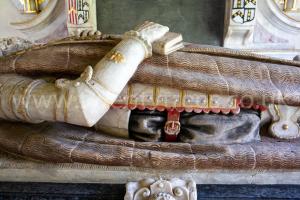
A very rich and stately altar monument, of marble and alabaster, ornamented with several deaths heads, bones, &c. in basso-relievo, on this rests a large black marble slab, supported at each corner by a column of black marble of the Dorick order; on this slab lies a mat or bass of alabaster, curiously carved; and on that lie the statues of Sir Edward Barkham and his lady, on their backs, in their full length and proportions in alabaster, Sir Edward in armour, and (what is somewhat incompatible) with his scarlet gown and golden chain about his neck, as Lord Mayor of London, over his armour; so that the statuary was of the same opinion with the Roman orator, Cedant arma togœ (Let the arms yield to the toga or Let the sword yield to the toga); he has also a book in his right hand, and rests his head on a cushion: his lady is in a dress agreeable to the age she lived in, her hands across, and rests her head on a cushion; at the head and foot of this monument are the effigies of two sons (Edward Barkham 1st Baronet and Robert Barkham) and three daughters (Elizabeth Barkham Lady Garrard, Margaret Barkham [aged 29] and Jane Barkham [aged 38] Note. one daughter Susan Barkham had predeceased her father) all kneeling on cushions. To this monument is a wall-piece of the same materials, on the summit of which is this shield, argent, three pallets gules over all a chevron or, Barkham; and under it this motto, diligentia, fortunæmater (fortune, prosper through diligence, care, economy); on each side of this, is a figure; that on the right hand representing Victory, with a laurel crown in her right hand, and on the pedestal that supports her, Barkham impaling quarterly 1&4, arg. on a pale sable three crosses pattee, or, in a bordure engrailed of the 2d, Crouch; in the 2&3 arg. on a chevron sable three helmets closed, or, Scot: the figure on the left hand is, a skeleton representing death, and on the pedestal the arms of Crouch and Scott quarterly, and by these figures are two hour-glasses with wings.




Samuel Pepys' Diary. 15th January 1661. Home, where my wife not yet come home, so I went up to put my papers in order, and then was much troubled my wife was not come, it being 10 o'clock just now striking as I write this last line. This day I hear the Princess [aged 16] is recovered again. The King hath been this afternoon at Deptford, to see the yacht that Commissioner Pett [aged 50] is building, which will be very pretty; as also that that his brother at Woolwich, Kent [Map] is in making. By and by comes in my boy and tells me that his mistress do lie this night at Mrs. Hunt's, who is very ill, with which being something satisfied, I went to bed.


Samuel Pepys' Diary. 15th January 1665. Staying without, my Lord Fitz Harding [aged 35] come thither, and fell to discourse of Prince Rupert [aged 45], and made nothing to say that his disease was the pox and that he must be fluxed, telling the horrible degree of the disease upon him with its breaking out on his head. But above all I observed how he observed from the Prince, that courage is not what men take it to be, a contempt of death; for, says he, how chagrined the Prince was the other day when he thought he should die, having no more mind to it than another man. But, says he, some men are more apt to think they shall escape than another man in fight, while another is doubtfull he shall be hit. But when the first man is sure he shall die, as now the Prince is, he is as much troubled and apprehensive of it as any man else; for, says he, since we told (him) that we believe he would overcome his disease, he is as merry, and swears and laughs and curses, and do all the things of a [man] in health, as ever he did in his life; which, methought, was a most extraordinary saying before a great many persons there of quality.
Samuel Pepys' Diary. 15th January 1665. At four o'clock with Sir W. Pen [aged 43] in his coach to my Chancellor's [aged 55], where by and by Mr. Coventry [aged 37], Sir W. Pen, Sir J. Lawson [aged 50], Sir G. Ascue [aged 49], and myself were called in to the King [aged 34], there being several of the Privy Council, and my Chancellor lying at length upon a couch (of the goute I suppose); and there Sir W. Pen begun, and he had prepared heads in a paper, and spoke pretty well to purpose, but with so much leisure and gravity as was tiresome; besides, the things he said were but very poor to a man in his trade after a great consideration, but it was to purpose, indeed to dissuade the King from letting these Turkey ships to go out: saying (in short) the King having resolved to have 130 ships out by the spring, he must have above 20 of them merchantmen. Towards which, he in the whole River could find but 12 or 14, and of them the five ships taken up by these merchants were a part, and so could not be spared. That we should need 30,000 [sailors] to man these 130 ships, and of them in service we have not above 16,000; so we shall need 14,000 more. That these ships will with their convoys carry above 2,000 men, and those the best men that could be got; it being the men used to the Southward that are the best men for warr, though those bred in the North among the colliers are good for labour. That it will not be safe for the merchants, nor honourable for the King, to expose these rich ships with his convoy of six ships to go, it not being enough to secure them against the Dutch, who, without doubt, will have a great fleete in the Straights. This, Sir J. Lawson enlarged upon. Sir G. Ascue he chiefly spoke that the warr and trade could not be supported together, and, therefore, that trade must stand still to give way to them. This Mr. Coventry seconded, and showed how the medium of the men the King hath one year with another employed in his Navy since his coming, hath not been above 3,000 men, or at most 4,000 men; and now having occasion of 30,000, the remaining 26,000 must be found out of the trade of the nation. He showed how the cloaths, sending by these merchants to Turkey, are already bought and paid for to the workmen, and are as many as they would send these twelve months or more; so the poor do not suffer by their not going, but only the merchant, upon whose hands they lit dead; and so the inconvenience is the less. And yet for them he propounded, either the King should, if his Treasure would suffer it, buy them, and showed the losse would not be so great to him: or, dispense with the Act of Navigation, and let them be carried out by strangers; and ending that he doubted not but when the merchants saw there was no remedy, they would and could find ways of sending them abroad to their profit. All ended with a conviction (unless future discourse with the merchants should alter it) that it was not fit for them to go out, though the ships be loaded. The King in discourse did ask me two or three questions about my newes of Allen's loss in the Streights, but I said nothing as to the business, nor am not much sorry for it, unless the King had spoke to me as he did to them, and then I could have said something to the purpose I think. So we withdrew, and the merchants were called in.


Samuel Pepys' Diary. 15th January 1665. Then home to dinner, and after dinner to read in "Rushworth's Collections" about the charge against the late Duke of Buckingham [aged 36], in order to the fitting me to speak and understand the discourse anon before the King [aged 34] about the suffering the Turkey merchants to send out their fleete at this dangerous time, when we can neither spare them ships to go, nor men, nor King's ships to convoy them.


Samuel Pepys' Diary. 15th January 1668. At noon home to dinner, and then to the Office again, where we met about some business of D. Gawden's till candle-light; and then, as late as it was, I down to Redriffe [Map], and so walked by moonlight to Deptford, Kent [Map], where I have not been a great while, and my business I did there was only to walk up and down above la casa of Bagwell, but could not see her, it being my intent to have spent a little time con her, she being newly come from her husband; but I did lose my labour, and so walked back again, but with pleasure by the walk, and I had the sport to see two boys swear, and stamp, and fret, for not being able to get their horse over a stile and ditch, one of them swearing and cursing most bitterly; and I would fain, in revenge, have persuaded him to have drove his horse through the ditch, by which I believe he would have stuck there. But the horse would not be drove, and so they were forced to go back again, and so I walked away homeward, and there reading all the evening, and so to bed. This afternoon my Lord Anglesey [aged 53] tells us that it is voted in Council to have a fleete of 50 ships out; but it is only a disguise for the Parliament to get some money by; but it will not take, I believe, and if it did, I do not think it will be such as he will get any of, nor such as will enable us to set out such a fleete.
Chronicle of Walter of Guisborough
A canon regular of the Augustinian Guisborough Priory, Yorkshire, formerly known as The Chronicle of Walter of Hemingburgh, describes the period from 1066 to 1346. Before 1274 the Chronicle is based on other works. Thereafter, the Chronicle is original, and a remarkable source for the events of the time. This book provides a translation of the Chronicle from that date. The Latin source for our translation is the 1849 work edited by Hans Claude Hamilton. Hamilton, in his preface, says: 'In the present work we behold perhaps one of the finest samples of our early chronicles, both as regards the value of the events recorded, and the correctness with which they are detailed; Nor will the pleasing style of composition be lightly passed over by those capable of seeing reflected from it the tokens of a vigorous and cultivated mind, and a favourable specimen of the learning and taste of the age in which it was framed.'
Available at Amazon in eBook and Paperback format.
Samuel Pepys' Diary. 15th January 1669. Thence he and I out of doors, but he to Sir J. Duncomb [aged 46], and I to White Hall through the Park, where I met the King [aged 38] and the Duke of York [aged 35], and so walked with them, and so to White Hall, where the Duke of York met the office and did a little business; and I did give him thanks for his favour to me yesterday, at the Committee of Tangier, in my absence, Mr. Povy [aged 55] having given me advice of it, of the discourse there of doing something as to the putting the payment of the garrison into some undertaker's hand, Alderman Backewell [aged 51], which the Duke of York would not suffer to go on, without my presence at the debate. And he answered me just thus: that he ought to have a care of him that do the King's business in the manner that I do, and words of more force than that. Then down with Lord Brouncker [aged 49] to Sir R. Murray [aged 61], into the King's little elaboratory, under his closet, a pretty place; and there saw a great many chymical glasses and things, but understood none of them. So I home and to dinner, and then out again and stop with my wife at my cozen Turner's where I staid and sat a while, and carried The. [aged 17] and my wife to the Duke of York's house, to "Macbeth", and myself to White Hall, to the Lords of the Treasury, about Tangier business; and there was by at much merry discourse between them and my Lord Anglesey [aged 54], who made sport of our new Treasurers, and called them his deputys, and much of that kind. And having done my own business, I away back, and carried my cozen Turner and sister Dyke to a friend's house, where they were to sup, in Lincoln's Inn Fields; and I to the Duke of York's house and saw the last two acts, and so carried The. thither, and so home with my wife, who read to me late, and so to supper and to bed. This day The. Turner shewed me at the play my Baroness Portman [aged 29], who has grown out of my knowledge.

Samuel Pepys' Diary. 15th January 1669. Up, and by coach to Sir W. Coventry [aged 41], where with him a good while in his chamber, talking of one thing or another; among others, he told me of the great factions at Court at this day, even to the sober engaging of great persons, and differences, and making the King [aged 38] cheap and ridiculous. It is about my Lady Harvy's [aged 30] being offended at Doll Common's acting of Sempronia, to imitate her; for which she got my Lord Chamberlain [aged 67], her kinsman, to imprison Doll: when my Baroness Castlemayne [aged 28] made the King to release her, and to order her to act it again, worse than ever, the other day, where the King himself was: and since it was acted again, and my Lady Harvy provided people to hiss her and fling oranges at her: but, it seems the heat is come to a great height, and real troubles at Court about it.


John Evelyn's Diary. 15th January 1679. I went with my Lady Sunderland [aged 33] to Chelsea, and dined with the Countess of Bristol [aged 59] [her mother] in the great house, formerly the Duke of Buckingham's, a spacious and excellent place for the extent of ground and situation in a good air. The house is large but ill-contrived, though my Lord of Bristol, who purchased it after he sold Wimbledon to my Lord Treasurer [aged 46], expended much money on it. There were divers pictures of Titian and Vandyke, and some of Bassano, very excellent, especially an Adonis and Venus, a Duke of Venice, a butcher in his shambles selling meat to a Swiss; and of Vandyke, my Lord of Bristol's picture, with the Earl of Bedford's at length, in the same table. There was in the garden a rare collection of orange trees, of which she was pleased to bestow some upon me.


John Evelyn's Diary. 15th January 1689. I found by the Lord-Advocate [aged 53] that the Bishops of Scotland (who were indeed little worthy of that character, and had done much mischief in that Church) were now coming about to the true interest, in this conjuncture which threatened to abolish the whole hierarchy in that kingdom; and therefore the Scottish Archbishop [aged 55] and Lord-Advocate requested the Archbishop of Canterbury [aged 71] to use his best endeavors with the Prince [aged 55] to maintain the Church there in the same state, as by law at present settled.


John Evelyn's Diary. 15th January 1689. It now growing late, after some private discourse with his Grace [aged 71], I took my leave, most of the Lords being gone.
John Evelyn's Diary. 15th January 1689. The great convention being assembled the day before, falling upon the question about the government, resolved that King James [aged 55] having by the advice of the Jesuits and other wicked persons endeavored to subvert the laws of the Church and State, and deserted the Kingdom, carrying away the seals, etc., without any care for the management of the government, had by demise abdicated himself and wholly vacated his right; they did therefore desire the Lords' concurrence to their vote, to place the crown on the next heir, the Prince of Orange [aged 38], for his life, then to the Princess [aged 26], his wife, and if she died without issue, to the Princess of Denmark [aged 23], and she failing, to the heirs of the Prince, excluding forever all possibility of admitting a Roman Catholic.
Note. The reference to Prince is somewhat abiguous. It may refer to King William III of England, Scotland and Ireland.
John Evelyn's Diary. 15th January 1689. I visited the Archbishop of Canterbury [aged 71], where I found the Bishops of St. Asaph [aged 61], Ely [aged 51], Bath and Wells [aged 51], Peterborough [aged 61], and Chichester [aged 65], the Earls of Aylesbury [aged 33] and Clarendon, Sir George Mackenzie [aged 53], Lord-Advocate of Scotland, and then came in a Scotch Archbishop, etc. After prayers and dinner, divers serious matters were discoursed, concerning the present state of the Public, and sorry I was to find there was as yet no accord in the judgments of those of the Lords and Commons who were to convene; some would have the Princess [aged 26] made Queen without any more dispute, others were for a Regency; there was a Tory party (then so called), who were for inviting his Majesty [aged 55] again upon conditions; and there were Republicans who would make the Prince of Orange [aged 38] like a Stadtholder. The Romanists were busy among these several parties to bring them into confusion: most for ambition or other interest, few for conscience and moderate resolutions. I found nothing of all this in this assembly of Bishops, who were pleased to admit me into their discourses; they were all for a Regency, thereby to salve their oaths, and so all public matters to proceed in his Majesty's name, by that to facilitate the calling of Parliament, according to the laws in being. Such was the result of this meeting.
John Evelyn's Diary. 15th January 1689. My Lord of Canterbury [aged 71] gave me great thanks for the advertisement I sent him in October, and assured me they took my counsel in that particular, and that it came very seasonably.
John Ashton Edmund Elliot Richard Graham 1691. On Fryday, the 2d day of this Sessions, my Lord Preston [aged 41], John Ashton and Edmund Elliot, were all Arrained for High Treason, my Lord Preston was Tryed on Saturday by the name of Sir Richard Graham, Mr. Ashton on Monday. The Indictments against them consisted of Two Parts, the First of which set forth, That they had a Treasonable Design carrying on to Depose the King and Queen, and to Subvert and Alter the Government of the Kingdom of England, and to raise War and Rebellion in the same; which said Traiterous and Wicked Designs and Purposes to bring to pass, they did, on the 29th of December last, Meet and Conspire together, with several other Traitors not yet discovered, and did Compose several Treasonable Letters, Notes and Memorandums in writing, which set forth the most effectual way and means how they might Dethrone and Depose our Most Gracious Sovereign Lord and Lady the King [aged 40] and Queen [aged 28], and further describing therein how the Affairs of this Kingdom stood, and of what Strength and Force our Shipping was; as also the Fortifications of several Sea-Port-Towns within this Kingdom. The Second Part was their adhering to the Kings's Enemies: And to that end, that they might Acquaint Lewis the French King of the same, they did hire a Boat and Embarque themselves in order to Transport themselves and Pacquet of Treasonable Letters into France, agreeing to pay for their said Passages the Sum of One hundred Pound; and, in order to their Treasonable Voyage, they had made their Passage as far as below Gravesend [Map], but were then Taken by Captain Billop, who Cruised abroad to search for them.
After this the Evidence for the King being called, gave an Account particularly from Step to Step, how cunningly and subtilly they managed this horrid Conspiracy, by hiring the Smack called the Thomas and Elizabeth, to convey them secretly into France; in order to which they took Water in a Skuller at Surrey-Stairs, and went on Board the aforesaid Vessel, which lay in the River of Thames over against the Tower [Map]: From thence they set Sail down the River, till coming within the View of the George Frigate, lying in Long-reach, they desired the Master of the Smack to hide them under the Quarter-Hatches; which was done, they having some Fear of being discovered: There they remained till past that Danger, and then came up; but when they were within Sight of Gravesend [Map] they hid again, and a little below it Captain Billop came aboard them, under Pretence of Pressing the Masters two Men, who were assistants to him; but indeed his Design and real Intention was to find out those Traytors, which, upon Search, he found lying along under the Hatches; and after their being haled up he search'd them, and found a Pacquet of Treasonable Papers in Mr. Ashton's Bosom: which he with the Prisoners carried before my Lord Nottingham; who examined the Papers, and after being examined by the Cabinet Council they were committed to the Tower. The Evidence was very full and plain against them both, much to the same effect and purport: The Letters being also Read against them in Court, were adjudged to be of no less Import than High-Treason. Upon the whole they had nothing material to offer in their Defence; so after a very long hearing, they were both found Guilty of High Treason. Edmond Elliot was ordered to remain till further order.


On 15th January 1703 John Brydges was born to James Brydges 1st Duke Chandos [aged 30] and Mary Lake [aged 34]. He married 1st September 1724 Catherine Tollemache, daughter of Lionel Tollemache 3rd Earl Dysart and Grace Wilbraham Countess Dysart, and had issue.
On 15th January 1724 Philippe V King Spain [aged 40] abdicated. His son Louis [aged 16] succeeded I King Spain. Louise Élisabeth Bourbon Queen Consort Spain [aged 14] by marriage Queen Consort Spain. Louis reigned for seven months before he died after which Phillipe was re-instated as King.


Chronicle of Walter of Guisborough
A canon regular of the Augustinian Guisborough Priory, Yorkshire, formerly known as The Chronicle of Walter of Hemingburgh, describes the period from 1066 to 1346. Before 1274 the Chronicle is based on other works. Thereafter, the Chronicle is original, and a remarkable source for the events of the time. This book provides a translation of the Chronicle from that date. The Latin source for our translation is the 1849 work edited by Hans Claude Hamilton. Hamilton, in his preface, says: 'In the present work we behold perhaps one of the finest samples of our early chronicles, both as regards the value of the events recorded, and the correctness with which they are detailed; Nor will the pleasing style of composition be lightly passed over by those capable of seeing reflected from it the tokens of a vigorous and cultivated mind, and a favourable specimen of the learning and taste of the age in which it was framed.'
Available at Amazon in eBook and Paperback format.

On 15th January 1728 William Egerton was born to Scroop Egerton 1st Duke Bridgewater [aged 46] and Rachel Russell Duchess Bridgewater [aged 21]. He died aged one in 1729.

On 15th January 1738 Archbishop Thomas Herring [aged 45] was consecrated Bishop of Bangor.

On 15th January 1742 Diana Vere Duchess St Albans [aged 63] died.

On 15th January 1748 George Fitzgerald was born to James Fitzgerald 1st Duke Leinster [aged 26] and Emilia Mary Lennox Duchess Leinster [aged 16]. He a great x 2 grandson of King Charles II of England Scotland and Ireland.
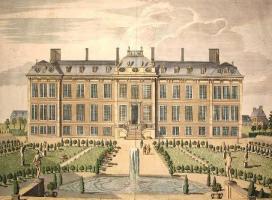
On 15th January 1759 the British Museum opened at Montagu House in Bloomsbury which it had purchased from the Montagu family for £20,0000. The opening wasn't quite for the general public - scholars had to be approved. It is now the most visited attraction in the United Kingdom.
On 15th January 1776 William Frederick Hanover 2nd Duke Gloucester and Edinburgh was born to William Henry Hanover 1st Duke Gloucester and Edinburgh [aged 32] and Maria Walpole Duchess Gloucester and Edinburgh [aged 39] at Palazzo Teodoli, via del Corso. He a great grandson of King George II of Great Britain and Ireland. He married 22nd July 1816 his first cousin Mary Hanover Duchess Gloucester and Edinburgh, daughter of King George III of Great Britain and Ireland and Charlotte Mecklenburg Strelitz Queen Consort England.


On 15th January 1781 Henry Cheere 1st Baronet [aged 78] died. His son William succeeded 2nd Baronet Cheere of St Margaret's in Westminster.
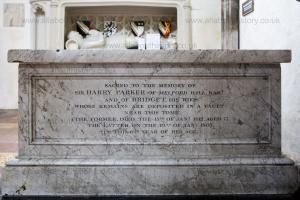
On 15th January 1812 Harry Parker 6th Baronet [aged 77] died. His son William [aged 28] succeeded 7th Baronet Parker of Melford Hall in Suffolk. Monument at Holy Trinity Church, Long Melford [Map] to Harry Parker 6th Baronet and Bridget Cresswell.
Harry Parker 6th Baronet: In 1735 he was born to Vice-Admiral Hyde Parker 5th Baronet. In 1775 he and Bridget Cresswell were married. In 1786 Harry Parker 6th Baronet bought Melford Hall, Long Melford [Map].
William Parker 7th Baronet: In or before 1784 he was born to Harry Parker 6th Baronet and Bridget Cresswell. On 1st April 1830 he died. His brother Hyde succeeded 8th Baronet Parker of Melford Hall in Suffolk.
Bridget Cresswell: Around 1744 she was born. On 19th January 1807 she died.
On 15th January 1815 Amy Lyon aka Emma Hart Lady Hamilton [aged 49] died.


On 15th January 1816 Alfred Gatley was born at Spring Cottage aka House, Kerridge.
On 15th January 1826 Caroline Amelie Oldenburg was born to Christian August Oldenburg II Duke Schleswig Holstein Sonderburg Augustenburg [aged 27] and Louise Sophie Danneskiold Samsøe Duchess Schleswig Holstein Sonderburg Augustenburg. She a great x 3 granddaughter of King George II of Great Britain and Ireland.
Greville Memoirs. 15th January 1832. This morning Frederick Lamb [aged 49] showed me a letter he had got from Melbourne to this effect: 'that they had resolved to make no Peers at all at present; that to make a few would be regarded as a menace, and be as bad as if they made a great many; but that as many as would be necessary to carry the Bill would be made, if it was eventually found that it must be so;' he added 'it only remained for people to come forward and declare their intention of supporting the second reading.' This is certainly a great victory, and I do believe mainly attributable to our exertions, to the spirit we have infused into Melbourne himself, and the use we have made of Wharncliffe [aged 55] and Verulam [aged 56], and the different little circumstances we have brought to bear upon the discussion. What now remains is the most difficult, but I shall do all I can to engage Peers to take a moderate determination and to declare it. Lamb told me that the King has an aversion to making a few Peers, that he has said he would rather make twenty-five than five, that whatever he must make he should like to make at once, and not to have to return to it. Anyhow, time is gained, and a victory for the moment.
William of Worcester's Chronicle of England
William of Worcester, born around 1415, and died around 1482 was secretary to John Fastolf, the renowned soldier of the Hundred Years War, during which time he collected documents, letters, and wrote a record of events. Following their return to England in 1440 William was witness to major events. Twice in his chronicle he uses the first person: 1. when writing about the murder of Thomas, 7th Baron Scales, in 1460, he writes '… and I saw him lying naked in the cemetery near the porch of the church of St. Mary Overie in Southwark …' and 2. describing King Edward IV's entry into London in 1461 he writes '… proclaimed that all the people themselves were to recognize and acknowledge Edward as king. I was present and heard this, and immediately went down with them into the city'. William’s Chronicle is rich in detail. It is the source of much information about the Wars of the Roses, including the term 'Diabolical Marriage' to describe the marriage of Queen Elizabeth Woodville’s brother John’s marriage to Katherine, Dowager Duchess of Norfolk, he aged twenty, she sixty-five or more, and the story about a paper crown being placed in mockery on the severed head of Richard, 3rd Duke of York.
Available at Amazon in eBook and Paperback format.
Ten Years' Digging. January 15th [1848]. A tunnel was driven from the west side of the trench at right angles, in the hope of finding an interment, but after carrying it three or four yards it was deemed unsafe to continue it; and the supporting timbers being knocked away previous to abandoning the work, the whole superstructure fell in, and, much to our surprise, revealed the interment near the top of the mound, which we had been so laboriously seeking at its base. This consisted of a rectangular cist, measuring inside 2 feet 6 inches by 2 feet, composed of four massive blocks of limestone, covered in by a fifth of irregular form, averaging 4 feet square by 10 inches thick. The capstone was not more than eighteen inches beneath the turf clothing the summit of the barrow; in fact the men had been working directly under the cist for some time. By the sudden fall of two of the sides and the adjacent earth, a very pretty vase of small size was crushed to pieces the fragments mingling with the burnt human bones in company with which it had for ages occupied the sepulchral chamber. The urn measuring 4¼ inches in height, has since been restored almost to its original perfection; it is of that class of vessels indifferently deposited with human remains, burnt or unburnt, and which may probably have contained food or drink, but never the remains, as is the case with cinerary urns. A review of these facts leads to the conclusion that Gib Hill was not in the first instance a sepulchral mound, so large a portion of the interior having been removed down to the natural rock without any deposit of human remains being found, it appears impossible for any interment to have escaped observation at the base of the tumulus, where it would naturally have been placed at the time of its formation, had any such existed.
On 15th January 1853 James Collinson [aged 27] entered Hodder Place near Stonyhurst, the Jesuit College in Lancashire, as a novitiate to train for the priesthood. Collinson discontiued his studies some time between September 1854 and January 1855 without completing his religious training and resumed his painting career.
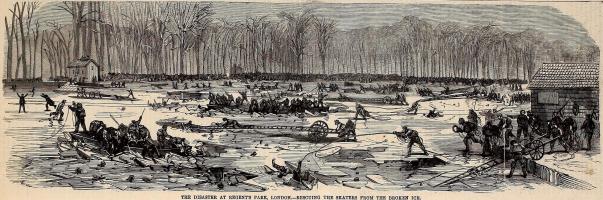
On 15th January 1867 sixty people died when the ice broke on the lake in London's Regent's Park on which around five hundred people were skating. As a consequence the lake bed which had been as deep as 3.7m, was raised to be a maximum of 1.2, Images from Harper's Weekly.
The Illustrated London News 1867. APPALLING ACCIDENT IN REGENT'S PARK.
On Tuesday afternoon [15th January 1867] an accident involving a serious loss of life occurred through the breaking of the ice on the ornamental water in Regent's Park. The scene of the terrible event was that portion of the lake extending along the side of the pleasure-ground in front of Sussex-place, and is about 300 yards in length by 130 in breadth. At the east and west ends are small islands, and on the north side there is a third small island midway between the other two, and opposite the end of the low park which bounds that side of the water.
On this part of the lake, which is the broadest, several thousand persons had been skating during the forenoon without any accident taking place, although the ice was looked upon by the experienced icemen on duty as very unsafe, from its being principally snow ice. About half-past three o'clock in the afternoon there were near the same spot about 500 skaters, among whom were many ladies, there being at the same time on the banks from 2000 to 3000 spectators. The excitement and fun were at their highest. Select circles were surrounding the more skilled skaters, men of all ages and classes were darting across in each direction, the park was resounding with sounds of merriment and life, when, without warning, the scene was terribly changed. The entire expanse of ice, covering nearly an acre of water, gave way according to some, exploded according to others, and was agitated as if by an earthquake according to others. The fatal cracks are described as shooting with sharp reports in every conceivable direction, and with such rapidity that it seemed as if the giving way was simultaneous in each direction. Within a minute the whole sheet of the ice over the full width of the lake gave way, and split up into fragments of a few yards square. A general rush was made for the banks, Unfortunately, this broke up the soft ice into still smaller pieces. Numbers of persons fell through the crevices into the water, which is, at this part 12ft. deep. About 200 persons were struggling in the water, and screaming for help. A few, with great presence of mind, threw themselves flat upon the surface of the pieces of ice and were thus instrumental in saving the lives of many of those in the water, as well as preserving their own until assistance came to them.
On 15th January 1872 Harold St George Gray was born at Lichfield, Staffordshire [Map].
On 15th January 1882 Margaret "Daisy" Windsor was born to Prince Arthur Windsor 1st Duke Connaught and Strathearn [aged 31] and Luise Margarete Hohenzollern Duchess Connaught [aged 21] at Bagshot Park, Berkshire. She was baptised on 11th March 1882 at the Chapel Royal, Windsor Castle by Archbishop Archibald Campbell Tait [aged 70]. Her godparents were Queen Victoria [aged 62]; the German Emperor [aged 84], who was represented by the German Ambassador, Count Münster); the German Crown Princess [aged 41] who was represented by her sister, Princess Christian of Schleswig-Holstein [aged 35]; Prince [aged 53] and Princess Friedrich Karl of Prussia [aged 44], for whom the Duke of Edinburgh [aged 37] and aunt Princess Beatrice [aged 24] stood proxy); the Duchess of Cambridge [aged 84], who was represented by Princess Louise, Duchess of Argyll [aged 33]; the Prince of Wales [aged 40] and Prince Charles of Prussia [aged 80], for whom Prince Leopold, Duke of Albany [aged 28] stood proxy. She a granddaughter of Queen Victoria of the United Kingdom. She married 15th June 1905 her fourth cousin twice removed Gustaf Adolph VI King Sweden and had issue.



On 1st October 1900 Frederick Lambton [aged 45] was elected MP South East Durham. He was re-elected in 1906 but lost the seat on 15th January 1910.

On 15th January 1917 William Frend De Morgan [aged 77] died. He was buried at Brookwood Cemetery, Woking.


On 15th January 1968 Randal Smith 2nd Baron Bicester [aged 70] died in a car accident. His nephew Angus [aged 36] succeeded 3rd Baron Bicester of Tusmore in Oxfordshire.
On 15th January 1432 Alfonso "The African" V King Portugal was born to Edward "The Philosopher" I King Portugal [aged 40] and Eleanor Trastámara Queen Consort Portugal. He a great x 2 grandson of King Edward III of England. Coefficient of inbreeding 4.40%. He married (1) 1447 his first cousin Isabella Aviz Queen Consort Portugal and had issue (2) 1475 his niece Joanna "La Beltraneja" Trastámara Queen Consort Portugal, daughter of Henry IV King Castile and Joan Aviz Queen Consort Castile.
On 15th January 1596 Henry Carey 2nd Earl Monmouth was born to Robert Carey 1st Earl Monmouth [aged 36] and Elizabeth Trevannion Countess Monmouth [aged 33] at Denham, Buckinghamshire. He married 1620 Martha Cranfield Countess Monmouth, daughter of Lionel Cranfield 1st Earl Middlesex and Elizabeth Sheppard, and had issue.

Anne Boleyn. Her Life as told by Lancelot de Carle's 1536 Letter.
In 1536, two weeks after the execution of Anne Boleyn, her brother George and four others, Lancelot du Carle, wrote an extraordinary letter that described Anne's life, and her trial and execution, to which he was a witness. This book presents a new translation of that letter, with additional material from other contemporary sources such as Letters, Hall's and Wriothesley's Chronicles, the pamphlets of Wynkyn the Worde, the Memorial of George Constantyne, the Portuguese Letter and the Baga de Secrets, all of which are provided in Appendices.
Available at Amazon in eBook and Paperback format.
On 15th January 1656 John Ashburnham 1st Baron Ashburnham was born to William Ashburnham [aged 27] and Elizabeth Paulett [aged 26]. He married 1677 his half fifth cousin once removed Bridget Vaughan Baroness Ashburnham and had issue.
On 15th January 1703 John Brydges was born to James Brydges 1st Duke Chandos [aged 30] and Mary Lake [aged 34]. He married 1st September 1724 Catherine Tollemache, daughter of Lionel Tollemache 3rd Earl Dysart and Grace Wilbraham Countess Dysart, and had issue.
On 15th January 1716 Elizabeth Berkeley was born to James Berkeley 3rd Earl Berkeley [aged 36] and Louisa Lennox Countess Berkeley [aged 21]. Louisa Lennox Countess Berkeley died in childbirth She a great granddaughter of King Charles II of England Scotland and Ireland.
On 15th January 1717 William Wildman Barrington 2nd Viscount Barrington was born to John Shute aka Barrington 1st Viscount Barrington [aged 39] and Anne Daines Viscountess Barrington [aged 27].

On 15th January 1720 William Fitzwilliam 1st and 3rd Earl Fitzwilliam was born to John Fitzwilliam 2nd Earl Fitzwilliam [aged 35] and Anne Stringer. He married 22nd June 1744 Anne Watson Wentworth Countess Fitzwilliam, daughter of Thomas Watson 1st Marquess Rockingham, and had issue.
On 15th January 1728 William Egerton was born to Scroop Egerton 1st Duke Bridgewater [aged 46] and Rachel Russell Duchess Bridgewater [aged 21]. He died aged one in 1729.
On 15th January 1744 Kenneth Mackenzie 1st Earl Seaforth was born to Kenneth Mackenzie Lord Fortrose [aged 27] and Mary Stewart. He married (1) in or before 1766 Caroline Stanhope, daughter of William Stanhope 2nd Earl of Harrington and Caroline Fitzroy Countess Harrington (2) after 9th February 1767 Harriet Powell aka Lamb Lady Seaforth.
On 15th January 1747 Baldwin Leighton 6th Baronet was born to Baldwin Leighton [aged 30]. He married (1) before 1802 Anne Pigott Lady Leighton (2) 1802 Louisa Margaret Anne Lady Leighton, daughter of Edward Stanley 5th Baronet, and had issue.
On 15th January 1748 George Fitzgerald was born to James Fitzgerald 1st Duke Leinster [aged 26] and Emilia Mary Lennox Duchess Leinster [aged 16]. He a great x 2 grandson of King Charles II of England Scotland and Ireland.
On 15th January 1770 John Edwards 1st Baronet was born to John Edwards.
On 15th January 1771 Arthur Paget was born to Henry Bayly-Paget 1st Earl Uxbridge [aged 26] and Jane Champagné Countess Uxbridge [aged 29]. He married 1809 Augusta Fane Baroness Boringdon, daughter of John Fane 10th Earl of Westmoreland and Sarah Anne Child Countess of Westmoreland, and had issue.


On 15th January 1776 William Frederick Hanover 2nd Duke Gloucester and Edinburgh was born to William Henry Hanover 1st Duke Gloucester and Edinburgh [aged 32] and Maria Walpole Duchess Gloucester and Edinburgh [aged 39] at Palazzo Teodoli, via del Corso. He a great grandson of King George II of Great Britain and Ireland. He married 22nd July 1816 his first cousin Mary Hanover Duchess Gloucester and Edinburgh, daughter of King George III of Great Britain and Ireland and Charlotte Mecklenburg Strelitz Queen Consort England.
Chronicle of Walter of Guisborough
A canon regular of the Augustinian Guisborough Priory, Yorkshire, formerly known as The Chronicle of Walter of Hemingburgh, describes the period from 1066 to 1346. Before 1274 the Chronicle is based on other works. Thereafter, the Chronicle is original, and a remarkable source for the events of the time. This book provides a translation of the Chronicle from that date. The Latin source for our translation is the 1849 work edited by Hans Claude Hamilton. Hamilton, in his preface, says: 'In the present work we behold perhaps one of the finest samples of our early chronicles, both as regards the value of the events recorded, and the correctness with which they are detailed; Nor will the pleasing style of composition be lightly passed over by those capable of seeing reflected from it the tokens of a vigorous and cultivated mind, and a favourable specimen of the learning and taste of the age in which it was framed.'
Available at Amazon in eBook and Paperback format.
On 15th January 1788 Valentine Browne 2nd Earl of Kenmare was born to Valentine Browne 1st Earl of Kenmare [aged 34]. He married in or before 1789 Augusta Anne Wilmot Countess of Kenmare, daughter of Robert Meade Wilmot 2nd Baronet and Marianne Howard.

On 15th January 1789 Robert Henry Herbert was born to Edward Clive 1st Earl Powis [aged 34] and Henrietta Antonia Herbert 3rd Countess Powis [aged 30] at the parish of St George's Church, Hanover Square. He a great x 4 grandson of King James II of England Scotland and Ireland. He married 1819 Harriet Windsor, daughter of Other Windsor 5th Earl Plymouth and Sarah Archer Countess Plymouth and Amherst, and had issue.
On 15th January 1811 Matthew Blakiston 4th Baronet was born to Matthew Blakiston 3rd Baronet [aged 27].
On 15th January 1816 Alfred Gatley was born at Spring Cottage aka House, Kerridge.
On 15th January 1826 Caroline Amelie Oldenburg was born to Christian August Oldenburg II Duke Schleswig Holstein Sonderburg Augustenburg [aged 27] and Louise Sophie Danneskiold Samsøe Duchess Schleswig Holstein Sonderburg Augustenburg. She a great x 3 granddaughter of King George II of Great Britain and Ireland.
On 15th January 1835 Francis Edmund Cecil Byng 5th Earl Strafford was born to George Byng 2nd Earl Strafford [aged 28] and Agnes Paget [aged 30]. He married (1) 8th June 1859 Florence Louisa Miles and had issue (2) 4th August 1866 his fifth cousin Emily Georgina Kerr Countess Strafford and had issue.

On 15th January 1841 Frederick Arthur Stanley 16th Earl of Derby was born to Edward Smith-Stanley 14th Earl of Derby [aged 41] and Emma Caroline Bootle-Wilbraham Countess Derby [aged 36]. He married 31st May 1864 Constance Villiers Countess Derby, daughter of George William Villiers 4th Earl Clarendon and Katherine Grimston Countess Clarendon, and had issue.
On 15th January 1846 Isabella Grace Maude was born to Cornwallis Maude 1st Earl Montalt [aged 28] and Clementina Elphinstone-Fleming Viscountess Hawarden [aged 23]. She married 28th January 1869 Reginald Charles Abbot 3rd Baron Colchester, son of Charles Abbot 2nd Baron Colchester.
On 15th January 1854 Lyonel Felix Carteret Eugene Tollemache 4th Baronet was born to Ralph Tollemache [aged 27] and Caroline Tollemache [aged 25]. Coefficient of inbreeding 6.25%.
On 15th January 1872 Harold St George Gray was born at Lichfield, Staffordshire [Map].
Chronicle of Abbot Ralph of Coggeshall
The Chronicle of Abbot Ralph of Coggeshall (Chronicon Anglicanum) is an indispensable medieval history that brings to life centuries of English and European affairs through the eyes of a learned Cistercian monk. Ralph of Coggeshall, abbot of the Abbey of Coggeshall in Essex in the early 13th century, continued and expanded his community’s chronicle, documenting events from the Norman Conquest of 1066 into the tumultuous reign of King Henry III. Blending eyewitness testimony, careful compilation, and the monastic commitment to record-keeping, this chronicle offers a rare narrative of political intrigue, royal power struggles, and social upheaval in England and beyond. Ralph’s work captures the reigns of pivotal figures such as Richard I and King John, providing invaluable insights into their characters, decisions, and the forces that shaped medieval rule. More than a simple annal, Chronicon Anglicanum conveys the texture of medieval life and governance, making it a rich source for scholars and readers fascinated by English history, monastic authorship, and the shaping of the medieval world.
Available at Amazon in eBook and Paperback format.
On 15th January 1882 Margaret "Daisy" Windsor was born to Prince Arthur Windsor 1st Duke Connaught and Strathearn [aged 31] and Luise Margarete Hohenzollern Duchess Connaught [aged 21] at Bagshot Park, Berkshire. She was baptised on 11th March 1882 at the Chapel Royal, Windsor Castle by Archbishop Archibald Campbell Tait [aged 70]. Her godparents were Queen Victoria [aged 62]; the German Emperor [aged 84], who was represented by the German Ambassador, Count Münster); the German Crown Princess [aged 41] who was represented by her sister, Princess Christian of Schleswig-Holstein [aged 35]; Prince [aged 53] and Princess Friedrich Karl of Prussia [aged 44], for whom the Duke of Edinburgh [aged 37] and aunt Princess Beatrice [aged 24] stood proxy); the Duchess of Cambridge [aged 84], who was represented by Princess Louise, Duchess of Argyll [aged 33]; the Prince of Wales [aged 40] and Prince Charles of Prussia [aged 80], for whom Prince Leopold, Duke of Albany [aged 28] stood proxy. She a granddaughter of Queen Victoria of the United Kingdom. She married 15th June 1905 her fourth cousin twice removed Gustaf Adolph VI King Sweden and had issue.
On 15th January 1888 Frederick William Williams 5th Baronet was born to William Robert Williams 3rd Baronet [aged 27].

On 15th January 1903 Katharine Tennant Baroness Elliot of Harwood was born to Charles Tennant 1st Baronet [aged 79] and Marguerite Agaranthe Miles [aged 35].
On 15th January 1914 FitzWalter Brook Plumptre 21st Baron FitzWalter was born to George Beresford Plumptre [aged 44] and Mary Augusta Plumptre [aged 40]. Coefficient of inbreeding 6.25%.
On 15th January 1917 Anthony Owen Clavering Trollope 16th Baronet was born to Gordon Clavering Trollope 15th Baronet [aged 31].
On 15th January 1927 Harry Holmes Miller 12th Baronet was born to Ernest Henry John Miller 10th Baronet [aged 29].
On 15th January 1951 John Armine Wodehouse 5th Earl Kimberley was born to John Wodehouse 4th Earl Kimberley [aged 26].
On 15th January 1478 Edward IV's youngest son Richard of Shrewsbury [aged 4] and Anne Mowbray [aged 5] were married at St Stephen's Chapel in Westminster [Map]. She by marriage Duchess Norfolk. She the daughter of John Mowbray 4th Duke of Norfolk and Elizabeth Talbot Duchess Norfolk [aged 35]. He the son of King Edward IV of England [aged 35] and Elizabeth Woodville Queen Consort England [aged 41]. They were second cousin once removed. She a great x 3 granddaughter of King Edward III of England.
The ceremony was attended by Edward's daughters Elizabeth [aged 11], Mary [aged 10] and Cecily [aged 8].
The day before Thomas Howard [aged 35] was knighted.
In 1483 Parliament changed the succession so Richard of Shrewsbury 1st Duke of York would continue to enjoy her inheritance (she died in 1481) effectively dis-inheriting William Berkeley 1st Marquess Berkeley [aged 52] (who was subsequently created Earl and Marquess), who accepted a payment of £34,000, and John Howard 1st Duke of Norfolk [aged 53], who was subsequently created Duke of Norfolk, possibly in compensation.
Thomas Frowyk [aged 55] was created Knight of the Bath.
See Woodville Marriages.
On 15th January 1601 Henry Hastings 5th Earl Huntingdon [aged 14] and Elizabeth Stanley Countess Huntingdon [aged 13] were married. She the daughter of Ferdinando Stanley 5th Earl of Derby and Alice Spencer Countess Derby [aged 51]. They were fourth cousins. She a great x 3 granddaughter of King Henry VII of England and Ireland.
On 15th January 1696 William Wheeler 3rd Baronet [aged 42] and Teresa Widdrington were married by the Chaplain to the Portuguese Envoy at St Martin in the Fields Church [Map].
On 15th January 1798 Francis Lindley Wood 2nd Baronet [aged 26] and Anne Buck Lady Wood were married. She by marriage Lady Wood of Barnsley in Yorkshire.

The True Chronicles of Jean le Bel Volume 1 Chapters 1-60 1307-1342
The True Chronicles of Jean le Bel offer one of the most vivid and immediate accounts of 14th-century Europe, written by a knight who lived through the events he describes, and experienced some of them first hand. Covering the early decades of the Hundred Years’ War, this remarkable chronicle follows the campaigns of Edward III of England, the politics of France and the Low Countries, and the shifting alliances that shaped medieval warfare. Unlike later historians, Jean le Bel writes with a strong sense of eyewitness authenticity, drawing on personal experience and the testimony of fellow soldiers. His narrative captures not only battles and sieges, but also the realities of military life, diplomacy, and the ideals of chivalry that governed noble society. A key source for Jean Froissart, Le Bel’s chronicle stands on its own as a compelling and insightful work, at once historical record and literary achievement. This translation builds on the 1905 edition published in French by Jules Viard, adding extensive translations from other sources Rymer's Fœdera, the Chronicles of Adam Murimuth, William Nangis, Walter of Guisborough, a Bourgeois of Valenciennes, Geoffrey le Baker of Swinbroke and Richard Lescot to enrich the original text and Viard's notes.
Available at Amazon in eBook and Paperback format.
On 15th January 1827 William Worsley 1st Baronet [aged 34] and Sarah Philadephia Cayley Baroness Worlsley [aged 25] were married. They were first cousins.
On 15th January 1835 William Feilden 2nd Baronet [aged 22] and Mary Elizabeth Wemyss [aged 26] were married.
On 15th January 1850 Walter William Brabazon Ponsonby 7th Earl Bessborough [aged 28] and Louisa Susan Cornwallis Eliot Countess Bessborough [aged 24] were married. She the daughter of Edward Granville Eliot 3rd Earl St Germans [aged 51] and Jemima Cornwallis Countess St Germans [aged 46]. He the son of John Ponsonby 4th Earl Bessborough and Maria Fane. They were fifth cousin once removed.
On 15th January 1855 Charles Parry Hobhouse 3rd Baronet [aged 30] and Edith Lucy Turton were married.
On 15th January 1936 Edmund Castell Bacon 14th and 13th Baronet [aged 32] and Priscilla Dora Ponsonby [aged 23] were married.
On 15th January 935 Rudolph aka Raoul I King West Francia [aged 45] died.
On 15th January 1149 Berenguela Barcelona Queen Consort Castile and Leon [aged 33] died.
On 15th January 1345 Count Roberto Orsini [aged 50] died.
On 15th January 1436 Bishop Robert Fitzhugh died.
On 15th January 1452 Henry Vavasour [aged 72] died. His son Henry [aged 31] de jure 11th Baron Vavasour.
Chronicle of a Bourgeois of Valenciennes
Récits d’un bourgeois de Valenciennes aka The Chronicle of a Bourgeois of Valenciennes is a vivid 14th-century vernacular chronicle written by an anonymous urban chronicler from Valenciennes in the County of Hainaut. It survives in a manuscript that describes local and regional history from about 1253 to 1366, blending chronology, narrative episodes, and eyewitness-style accounts of political, military, and social events in medieval France, Flanders, and the Low Countries. The work begins with a chronological framework of events affecting Valenciennes and its region under rulers such as King Philip VI of France and the shifting allegiances of local nobility. It includes accounts of conflicts, sieges, diplomatic manoeuvres, and the impact of broader struggles like the Hundred Years’ War on urban life in Hainaut. Written from the perspective of a burgher (bourgeois) rather than a monastery or royal court, the chronicle offers a rare lay viewpoint on high politics and warfare, reflecting how merchants, townspeople, and civic institutions experienced the turbulence of the 13th and 14th centuries. Its narrative style combines straightforward reporting of events with moral and civic observations, making it a valuable source for readers interested in medieval urban society, regional politics, and the lived experience of war and governance in pre-modern Europe.
Available at Amazon in eBook and Paperback format.
On 15th January 1469 William Zouche 6th Baron Zouche Harringworth [aged 37] died. He was buried at Biddlesden Abbey, Buckinghamshire [Map]. His son John [aged 10] succeeded 7th Baron Zouche Harringworth.
On 15th January 1471 Nicholas Hussey 7th Baron Hussey [aged 54] died. Baron Hussey abeyant.
On 15th January 1514 Elizabeth Vaughan Baroness Grey Wilton [aged 51] died at Hornby Castle [Map].
On 15th January 1522 Bishop Richard Fitzjames died.
On 15th January 1538 James Butler 10th Baron Dunboyne [aged 48] died.
On 15th January 1595 Joan Maulever Baroness Ogle [aged 55] died.
On 15th January 1619 Thomas Clinton 3rd Earl Lincoln [aged 48] died at Tattershall Castle [Map]. His son Theophilus [aged 19] succeeded 4th Earl Lincoln, 12th Baron Clinton.
On 15th January 1634 Edward Barkham [aged 64] died. His eldest son Edward Barkham 1st Baronet [aged 42] inherited all his estates except Waynflete which were inherited by his younger son Robert Barkham [aged 35]. In 1652 Jane Crouch [aged 61] died.
Church of St George, South Acre [Map].
A very rich and stately altar monument, of marble and alabaster, ornamented with several deaths heads, bones, &c. in basso-relievo, on this rests a large black marble slab, supported at each corner by a column of black marble of the Dorick order; on this slab lies a mat or bass of alabaster, curiously carved; and on that lie the statues of Sir Edward Barkham and his lady, on their backs, in their full length and proportions in alabaster, Sir Edward in armour, and (what is somewhat incompatible) with his scarlet gown and golden chain about his neck, as Lord Mayor of London, over his armour; so that the statuary was of the same opinion with the Roman orator, Cedant arma togœ (Let the arms yield to the toga or Let the sword yield to the toga); he has also a book in his right hand, and rests his head on a cushion: his lady is in a dress agreeable to the age she lived in, her hands across, and rests her head on a cushion; at the head and foot of this monument are the effigies of two sons (Edward Barkham 1st Baronet and Robert Barkham) and three daughters (Elizabeth Barkham Lady Garrard, Margaret Barkham [aged 29] and Jane Barkham [aged 38] Note. one daughter Susan Barkham had predeceased her father) all kneeling on cushions. To this monument is a wall-piece of the same materials, on the summit of which is this shield, argent, three pallets gules over all a chevron or, Barkham; and under it this motto, diligentia, fortunæmater (fortune, prosper through diligence, care, economy); on each side of this, is a figure; that on the right hand representing Victory, with a laurel crown in her right hand, and on the pedestal that supports her, Barkham impaling quarterly 1&4, arg. on a pale sable three crosses pattee, or, in a bordure engrailed of the 2d, Crouch; in the 2&3 arg. on a chevron sable three helmets closed, or, Scot: the figure on the left hand is, a skeleton representing death, and on the pedestal the arms of Crouch and Scott quarterly, and by these figures are two hour-glasses with wings.
On 15th January 1655 Archibald Douglas 1st Earl Ormonde 12th Earl Angus [aged 46] died. He was buried at Douglas Vault St Bride's Church.
On 15th January 1658 George Chudleigh 1st Baronet [aged 80] died. His son George [aged 46] succeeded 2nd Baronet Chudleigh of Ashton in Devon.
On 15th January 1672 Bishop John Cosins [aged 77] died.
On 15th January 1678 Margaret Weld Lady Bowyer [aged 61] died.
On 15th January 1698 Richard Boyle 2nd Earl Cork 1st Earl Burlington [aged 85] died. His grandson Charles [aged 30] succeeded 2nd Earl Burlington, 3rd Viscount Boyle of Kinalmeaky.


Chronicle of Abbot Ralph of Coggeshall
The Chronicle of Abbot Ralph of Coggeshall (Chronicon Anglicanum) is an indispensable medieval history that brings to life centuries of English and European affairs through the eyes of a learned Cistercian monk. Ralph of Coggeshall, abbot of the Abbey of Coggeshall in Essex in the early 13th century, continued and expanded his community’s chronicle, documenting events from the Norman Conquest of 1066 into the tumultuous reign of King Henry III. Blending eyewitness testimony, careful compilation, and the monastic commitment to record-keeping, this chronicle offers a rare narrative of political intrigue, royal power struggles, and social upheaval in England and beyond. Ralph’s work captures the reigns of pivotal figures such as Richard I and King John, providing invaluable insights into their characters, decisions, and the forces that shaped medieval rule. More than a simple annal, Chronicon Anglicanum conveys the texture of medieval life and governance, making it a rich source for scholars and readers fascinated by English history, monastic authorship, and the shaping of the medieval world.
Available at Amazon in eBook and Paperback format.
On 15th January 1700 Bennet Sherard 2nd Baron Sherard [aged 78] died. His son Bennet [aged 25] succeeded 3rd Baron Sherard of Leitrim.
On 15th January 1713 John Cotton 2nd Baronet [aged 66] died. His son John [aged 24] succeeded 3rd Baronet Cotton of Landwade in Cambridgeshire.
On 15th January 1733 Elizabeth Haslewood Viscountess Hatton died.
On 15th January 1738 Charles Hotham 5th Baronet [aged 44] died. His son Charles succeeded 6th Baronet Hotham of Scorborough in Yorkshire.
On 15th January 1741 John Vaughan 2nd Viscount Lisburne [aged 46] died. His brother Wilmot succeeded 3rd Viscount Lisburne and 3rd Baron Fethard of Feathered in Tipperary.
On 15th January 1742 Diana Vere Duchess St Albans [aged 63] died.
On 15th January 1750 Elizabeth Rushout Countess Northampton died. She was buried in Blockley, Gloucestershire.
On 15th January 1781 Henry Cheere 1st Baronet [aged 78] died. His son William succeeded 2nd Baronet Cheere of St Margaret's in Westminster.
On 15th January 1792 Thomas Cave 7th Baronet [aged 25] died without issue. His uncle Charles [aged 45] succeeded 8th Baronet Cave of Stanford in Northamptonshire. His sister Sarah Cave 3rd Baroness Braye [aged 23] inherited Stanford Hall, Leicestershire.
On 15th January 1795 Frances Wyndham [aged 39] died.
On 15th January 1812 Harry Parker 6th Baronet [aged 77] died. His son William [aged 28] succeeded 7th Baronet Parker of Melford Hall in Suffolk. Monument at Holy Trinity Church, Long Melford [Map] to Harry Parker 6th Baronet and Bridget Cresswell.
Harry Parker 6th Baronet: In 1735 he was born to Vice-Admiral Hyde Parker 5th Baronet. In 1775 he and Bridget Cresswell were married. In 1786 Harry Parker 6th Baronet bought Melford Hall, Long Melford [Map].
William Parker 7th Baronet: In or before 1784 he was born to Harry Parker 6th Baronet and Bridget Cresswell. On 1st April 1830 he died. His brother Hyde succeeded 8th Baronet Parker of Melford Hall in Suffolk.
Bridget Cresswell: Around 1744 she was born. On 19th January 1807 she died.
Jean de Waurin's Chronicle of England Volume 6 Books 3-6: The Wars of the Roses
Jean de Waurin was a French Chronicler, from the Artois region, who was born around 1400, and died around 1474. Waurin’s Chronicle of England, Volume 6, covering the period 1450 to 1471, from which we have selected and translated Chapters relating to the Wars of the Roses, provides a vivid, original, contemporary description of key events some of which he witnessed first-hand, some of which he was told by the key people involved with whom Waurin had a personal relationship.
Available at Amazon in eBook and Paperback format.
On 15th January 1815 Amy Lyon aka Emma Hart Lady Hamilton [aged 49] died.
On 15th January 1817 Elizabeth Monck Marchioness Waterford [aged 75] died at Golden Hill Hampstead.
On 15th January 1825 Thomas Gleadowe-Newcomen 2nd Viscount Newcomen [aged 48] died.

On 15th January 1833 Banastre Tarleton 1st Baronet [aged 78] died at Leintwardine, Herefordshire [Map]. Baronet Tarleton of Liverpool in Lancashire extinct.
On 15th January 1837 Amelia Hume Baroness Farnborough [aged 64] died at Bromley Hill Place, Kent.
On 15th January 1840 Margaret "Peggy" Pitches Countess Coventry [aged 80] died.
On 15th January 1856 Charlotte Maria Whittaker Countess of Stradbroke [aged 86] died.

On 15th January 1860 Albert Conygham aka Denison 1st Baron Londesborough [aged 54] died. His son William [aged 25] succeeded 2nd Baron Londesborough of Londesborough in the East Riding of Yorkshire.
On 15th January 1874 Alexandrina Octavia Maria Vane Countess Portarlington [aged 50] died.
On 15th January 1884 William Henry Hare Hedges-White 3rd Earl Bantry [aged 82] died. His son William [aged 30] succeeded 4th Earl Bantry.
The True Chronicles of Jean le Bel Volume 1 Chapters 1-60 1307-1342
The True Chronicles of Jean le Bel offer one of the most vivid and immediate accounts of 14th-century Europe, written by a knight who lived through the events he describes, and experienced some of them first hand. Covering the early decades of the Hundred Years’ War, this remarkable chronicle follows the campaigns of Edward III of England, the politics of France and the Low Countries, and the shifting alliances that shaped medieval warfare. Unlike later historians, Jean le Bel writes with a strong sense of eyewitness authenticity, drawing on personal experience and the testimony of fellow soldiers. His narrative captures not only battles and sieges, but also the realities of military life, diplomacy, and the ideals of chivalry that governed noble society. A key source for Jean Froissart, Le Bel’s chronicle stands on its own as a compelling and insightful work, at once historical record and literary achievement. This translation builds on the 1905 edition published in French by Jules Viard, adding extensive translations from other sources Rymer's Fœdera, the Chronicles of Adam Murimuth, William Nangis, Walter of Guisborough, a Bourgeois of Valenciennes, Geoffrey le Baker of Swinbroke and Richard Lescot to enrich the original text and Viard's notes.
Available at Amazon in eBook and Paperback format.
On 15th January 1891 Edward Baldwin Courtenay 12th Earl Devon [aged 54] died. His uncle Henry [aged 80] succeeded 13th Earl Devon.
On 15th January 1907 Alice Anne Lambton Countess Morton [aged 75] died.
On 15th January 1911 Louisa Susan Cornwallis Eliot Countess Bessborough [aged 85] died.
On 15th January 1912 Beilby Lawley 3rd Baron Wenlock [aged 62] died. His brother Richard [aged 56] succeeded 4th Baron Wenlock of Wenlock in Shropshire, 11th Baronet Lawley of Spoonhill in Shropshire.
On 15th January 1913 Bertram Ashburnham 5th Earl Ashburnham [aged 72] died in Paris. His brother Thomas [aged 57] succeeded 6th Earl Ashburham, 8th Baron Ashburnham of Ashburnham in Sussex.
On 15th January 1919 Henry Arthur Mornington Wellesley 3rd Earl Cowley [aged 53] died at Chippenham, Wiltshire [Map]. His son Christian [aged 28] succeeded 4th Earl Cowley, 4th Viscount Dangan of Meath, 5th Baron Cowley.
On 15th January 1922 George Charles Erskine Rowley 3rd Baronet [aged 77] died. His son George [aged 52] succeeded 4th Baronet Rowley of Hill House in Berkshire.
On 15th January 1924 Evelyn Clementina Heathcote-Willoughby-Drummond Lady Ewart [aged 59] died.

On 15th January 1924 Francis Greville 5th Earl Warwick 5th Earl Brooke [aged 70] died. His son Leopold [aged 41] succeeded 6th Earl Warwick, 6th Earl Brooke Warwick Castle, 13th Baron Brooke of Beauchamps Court in Warwickshire. Elfrida Marjorie Eden Countess Warwick and Brooke [aged 37] by marriage Countess Warwick, Countess Brooke Warwick Castle.
On 15th January 1930 Patrick James Graham Blake 5th Baronet [aged 68] died. His son Cuthbert [aged 45] succeeded 6th Baronet Blake of Langham in Suffolk. Florence Wilhelmina Lidiard "Kitty" Apps Lady Blake [aged 43] by marriage Lady Blake of Langham in Suffolk.
The Deeds of the Dukes of Normandy
The Gesta Normannorum Ducum [The Deeds of the Dukes of Normandy] is a landmark medieval chronicle tracing the rise and fall of the Norman dynasty from its early roots through the pivotal events surrounding the Norman Conquest of England. Originally penned in Latin by the monk William of Jumièges shortly before 1060 and later expanded at the behest of William the Conqueror, the work chronicles the deeds, politics, battles, and leadership of the Norman dukes, especially William’s own claim to the English throne. The narrative combines earlier historical sources with firsthand information and oral testimony to present an authoritative account of Normandy’s transformation from a Viking settlement into one of medieval Europe’s most powerful realms. William’s history emphasizes the legitimacy, military prowess, and governance of the Norman line, framing their expansion, including the conquest of England, as both divinely sanctioned and noble in purpose. Later chroniclers such as Orderic Vitalis and Robert of Torigni continued the history, extending the coverage into the 12th century, providing broader context on ducal rule and its impact. Today this classic work remains a foundational source for understanding Norman identity, medieval statesmanship, and the historical forces that reshaped England and Western Europe between 800AD and 1100AD.
Available at Amazon in eBook and Paperback format.
On 15th January 1930 Sidney Carr Hobart-Hampden-Mercer-Henderson 7th Earl Buckinghamshire [aged 69] died. His son John [aged 23] succeeded 8th Earl Buckinghamshire, 8th Baron Hobart, 12th Baronet Hobart of Intwood in Norfolk.
On 15th January 1932 Gwendolen Mary Anne Fitzalan Howard Marchioness Bute [aged 77] died.
On 15th January 1939 Henry John Mordaunt 12th Baronet [aged 71] died. His nephew Nigel [aged 31] succeeded 13th Baronet Mordaunt of Massingham Parva.
On 15th January 1942 Randal Mowbray Thomas Berkeley 8th Earl of Berkeley [aged 76] died without issue. Earl Berkeley and Viscount Dursley extinct. Berkeley Castle [Map] was inherited by his 13th cousin Robert George Wilmot Berkeley [aged 43].
On 15th January 1968 Randal Smith 2nd Baron Bicester [aged 70] died in a car accident. His nephew Angus [aged 36] succeeded 3rd Baron Bicester of Tusmore in Oxfordshire.
On 15th January 1974 Edward Herbert 5th Earl of Powis [aged 84] died. His brother Christian [aged 69] succeeded 6th Earl Powis.
On 15th January 2016 Charles Anthony Assheton Harbord-Hamond 12th Baron Suffield [aged 62] died. His brother John [aged 59] succeeded 13th Baron Suffield, 14th Baronet Harbord-Hamond of Suffield in Norfolk.
On 15th January 2018 Grania Guinness Marchioness of Normanby [aged 97] died.