

08 Dec is in December.
1290 Death of Queen Eleanor of Castile
1529 Henry VIII Creates New Peerages
1551 Trial and Execution of Edward Seymour Duke of Somerset and his Supporters
On 7th December 1154 King Henry "Curtmantle" II of England [aged 21], the seven months pregnant Eleanor of Aquitaine Queen Consort Franks and England [aged 32] and their son William Plantagenet IX Count Poitiers [aged 1] left Barfleur for England. On 8th December 1154 King Henry "Curtmantle" II of England and his party landed near Southampton, Hampshire [Map].
Chronicle of Gervase of Canterbury. After the death of King Stephen, when a period of a month and more had elapsed, Duke Henry, having been informed of the king’s death, was summoned by the princes of England and eagerly desired by the people. Accompanied by a great company of nobles, he went down to the sea. And although adverse winds opposed him and his fleet was scattered, he nevertheless landed in England at Ostham on the sixth day before the Ides of December [8th December 1154].
Post mortem itaque regis Stephani evoluto mensis unius spatio et amplius eo, dux Henricus de obitu regis certior effectus, a principibus Angliæ vocatus et & populo desideratus, magna stipatus nobilium caterva ad mare descendit. Et licet repugnantibus auris, et navigio disperso, in Anglia tamen apud Hostreham applicuit sexto idus Decembris.
Rymer's Fœdera Volume 2. 8th December 1231. The K. orders that Hugh le Despenser the younger and Hugh le Despenser the elder be not injured nor molested. Westm. R. ii. 463. 0. iii. 907. H. ii. p. ii. 29.
Chronica Majora by Matthew Paris. 10th February 1236. About the same time, for two months and more, namely, in January, February, and part of March, such deluges of rain fell as had never been seen before in the memory of any one. About the feast of St. Scholastica, when the moon was new, the sea became so swollen by the river torrents which fell into it, that all the rivers, especially those which fell into the sea, rendered the fords impassable, overflowing their banks, hiding the bridges from sight, carrying away mills and dams, and overwhelming the cultivated lands, crops, meadows, and marshes. Amongst other unusual occurrences, the River Thames overflowed its usual bounds, and entered the grand palace at Westminster [Map], where it spread and covered the whole area, so that small boats could float there, and people went to their apartments on horseback. The water also forcing its way into the cellars could with difficulty be drained off. The signs of this storm which preceded it, then gave proofs of their threats; for on the day of St. Damasus, thunder was heard, and on the Friday next after the conception of St. Mary, a spurious sun was seen by the side of the true sun.
Annals of Dunstable. The abbot of Westminster1, then treasurer of the lord king, died almost suddenly; because of his austerity, he was little lamented by his convent. And in the office of treasurer succeeded him lord John of Kirkby, who for a long time had been vice-chancellor of the lord king.
Abbas de Westmonasterio Londoniæ, tunc domini regis thesaurarius, obiit, quasi repente; propter austeritatem parum planctus a conventu suo. Et successit ei in officio thesaurarii dominus Johannes de Kyrkeby, qui diu fuit vicecancellarius domini regis.
Note 1. Richard of Ware, died 8th December 1283.
On 8th December 1290 or 7th December 1290 Eleanor of Castile Queen Consort England [deceased] body rested at Hardingstone, Northamptonshire.
On 8th December 1292 Archbishop John Peckham [aged 62] died.
Close Rolls Edward II 1325. 8th December 1325. The Tower. William la Zouche of Haryngworth [aged 48], knight, acknowledges that he owes to William la Zouche, his son, £4,000; to be levied, in default of payment, of his lands and chattels in co. Wilts.
The said William la Zouche acknowledges that he owes to the aforesaid William, his son, £2,000; to be levied, in default of payment, of his lands and chattels in co. Devon.
Cancelled on payment, acknowledged by Gilbert de Gretton, clerk, attorney of William son of William.
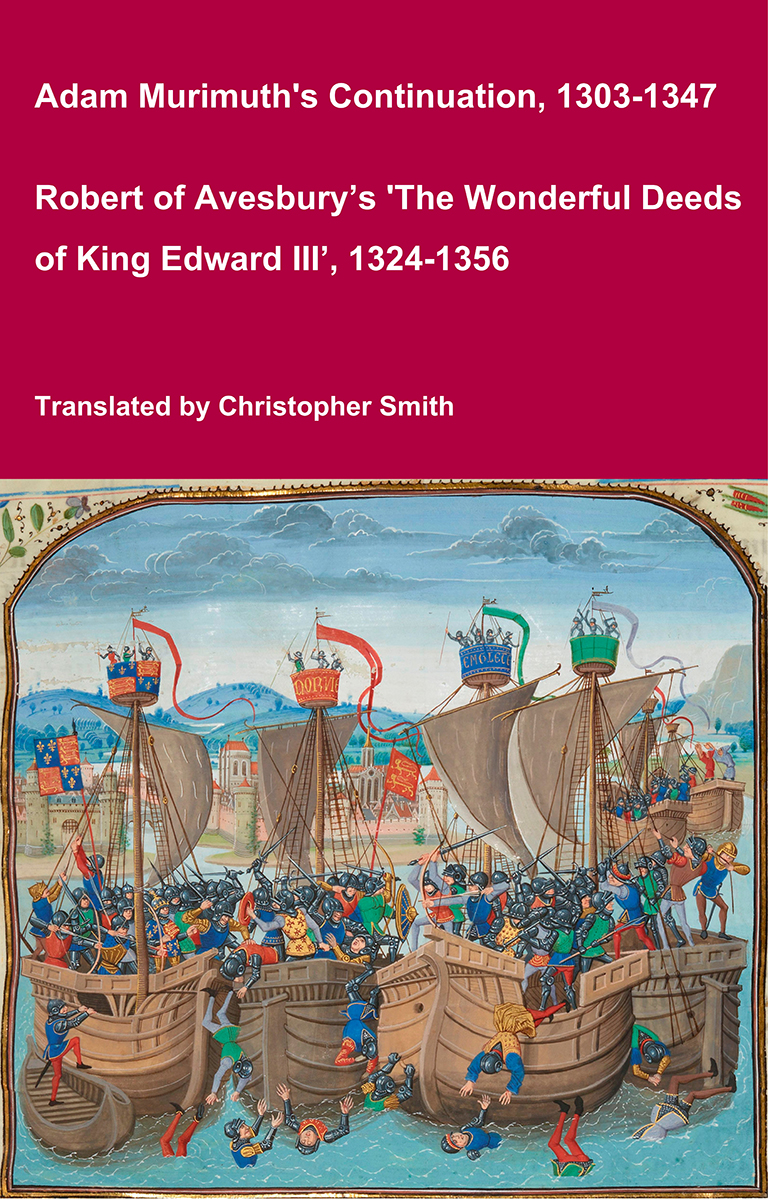 Adam Murimuth Continuation. In the same year, on the Friday following the feast of the Purification of the Blessed Virgin Mary [2nd February], Simon, archbishop of Canterbury, held a provincial council in London. There he established certain regulations, though of little importance: namely, that all servile work should cease on Good Friday and on the commemoration of All Souls. He and all the bishops present also excommunicated and declared excommunicated all those who had killed Walter of Stapeldon, bishop of Exeter, or who had in any way laid violent hands upon him, as well as all who had given them assistance, support, or counsel. The archbishop also decreed, with the consent of the council, that the feast of the Conception of the Blessed Virgin Mary [8th December] should be solemnly celebrated, together with certain other ordinances.
Eodem anno, die Veneris proxima post Purificationem beatæ Mariæ Simon, archiepiscopus Cantuariensis, tenuit concilium provinciale Londoniis, in quo ordinavit aliqua, licet modicum ponderanda: scilicet quod in die Parascevæ et in commemoratione Omnium Animarum ab omni servili opere cessaretur. Item, ipse et omnes episcopi præsentes excommunicarunt et excommunicatos denunciarunt omnes illos qui Walterum de Stapeldone, Exoniensem episcopum, interfecerunt seu in eummanus violentas quomodolibet injecerunt, et omnes qui eis opem, assensum, vel consilium præbuerunt. Item, archiepiscopus statuit, de consensu concilii, quod festum Conceptionis beatæ Mariæ solempniter celebretur; et quædam alia.
Adam Murimuth Continuation. In this year, on the feast of the Conception of the Blessed Virgin [8th December], in the year of the Lord 1339 and the thirteenth year of the reign of Edward III from the Conquest, Richard de Bynteworth, bishop of London, died and on the day after [26th January 1340] the Conversion of Saint Paul, Ralph de Stratford [aged 39] was elected [as Bishop of London]; he was consecrated at Canterbury on the first Sunday of Lent and enthroned on the third Sunday of Lent.
Hoc anno, in festo Conceptionis beatæ Mariæ, anno Domini millesimo CCCXXXIX, regni regis Edwardi tertii a conquæstu XIIJ, moritur Ricardus de Bynteworth, episcopus Londoniensis, et in crastino Conversionis sancti Pauli eligitur Radulphus de Streteford, Dominica prima: Quadragesimæ Cantuariæ consecratus, et Dominica IIJ Quadragesimæ inthronizatus.
Henrici Quinti, Angliæ Regis, Gesta, is a first-hand account of the Agincourt Campaign, and subsequent events to his death in 1422. The author of the first part was a Chaplain in King Henry's retinue who was present from King Henry's departure at Southampton in 1415, at the siege of Harfleur, the battle of Agincourt, and the celebrations on King Henry's return to London. The second part, by another writer, relates the events that took place including the negotiations at Troye, Henry's marriage and his death in 1422.
Available at Amazon in eBook and Paperback format.
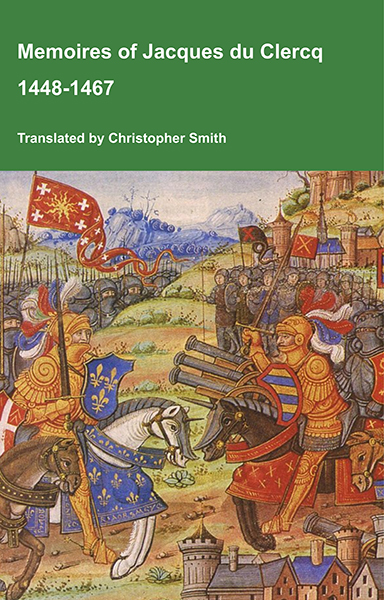 Memoires Jacques du Clercq. On the 8th day of December, in the year 1457, in the city of Tours in Touraine, there entered and arrived the embassy sent by Ladislaus, King of Hungary and Bohemia, in great and noble array, and they were of three nations: Hungary, Bohemia, and Austria. Of Hungary were the archbishop of Kalocsa and Sir Ladislaus of Polna; of Bohemia, the lord of Sternberg, Sir Ozera Zetzinges and Sir James Strop; and there were also the provost of Trier, the lord of Rodenaguet, Sir Adam of Castenoy, and twelve or thirteen other knights, and about thirty gentlemen of good household. They entered the said city in very fine order, with some seven hundred horses or thereabout, and twenty-six wagons richly harnessed with fine horses. It was a fine thing to see their entry. But before they arrived at the city, Charles, King of France, sent out to meet them a great and noble company: first the Cardinal of Constance, the Archbishop of Tours, the lord of Le Mans, and many churchmen; then came the men of the city of Tours; after them the Chancellor of France and those of the council; and last, Philip, Duke of Savoy, the Count of Foix, the Count of La Marche, the Count of Dunois, the Marquis of Saluzzo, the lord of La Tour, the great seneschal of Normandy, and all the nobility then present at Tours. When the king's people met the ambassadors, each party drew up in good order, and the Chancellor of France made them a fine and notable address. Then churchmen joined with churchmen, knights and squires with knights and squires, and thus they entered the city of Tours with great rejoicing. The King of France, Charles, his second son, the queen, and Lady Magdalene, daughter of the king, were lodged at Montils, near the said city; and the king had been ill, so that the ambassadors could not speak with him until ten days after their entry. On that day, the 18th of December, the ambassadors went to Montils, spoke with King Charles, and made their reverence and delivered the greetings of King Ladislaus, their sovereign lord. By the mouth of the said archbishop was made a fine oration in Latin, setting forth the close kinship between King Charles and King Ladislaus, and also the great love that had always existed between the kingdoms of Hungary and Bohemia and the most Christian house of France. He said to the king that nothing was so fair as peace, and that they had come to establish love between him and King Ladislaus, saying: "When peace and love shall be between you and my sovereign lord, who in the world could harm you? Your predecessors and our sovereign kings of Hungary and Bohemia have been friends and allies; we too have come for this cause. You are the pillar of Christendom, and my sovereign lord is the shield; you are the Christian house, and my sovereign lord is the wall". Among many other fine words, he concluded by asking the king for his child, namely Lady Magdalene, to be wife and spouse to the King of Hungary and Bohemia. And indeed King Ladislaus had several times previously requested the said Magdalene from King Charles, who had always replied that if he sent a notable embassy with sufficient authority for the marriage, he would willingly consider it. Therefore King Charles received the embassy, and seeing also that he could not make a better alliance for his daughter, agreed to the marriage; and persons were appointed on the king's behalf to confer with the ambassadors to arrange and conclude it. Meanwhile the princes and lords at the court of King Charles prepared to entertain the ambassadors. First began the Count of Foix, who, on the 22nd of December, gave them a very fine dinner in the city of Tours. At the high table sat all the chief members of the embassy and the Chancellor of France; at the second table, all the knights and squires of the embassy; at the third table sat Mademoiselle de Châtillon at the head, then Mademoiselle de Villeclerc, then Charles d'Angier, lord of Maine, brother of the Queen of France, then the lady of Châtillon, the lord and Count of Vendôme, Mademoiselle de Châteaubrun, the damsel of Rony, and many other ladies, knights, and squires. The embassy numbered about two hundred persons, and there was a great number of men-at-arms, heralds, trumpeters, and minstrels. In the hall did not sit the Count of Foix, the Count of La Marche, Philip son of the Duke of Savoy, the Count of Dunois, the Marquis of Saluzzo, the lord of La Tour, the great marshal of Normandy, the lord of Prie, and many other great lords, who dined in another chamber and for the most part went before the courses. The tables were served with many dishes, which I shall pass over, but I will speak somewhat of the entertainments. The first entertainment was a castle with four small towers and, in the middle, a great tower with four windows, and at each window the face of a maiden with her hair behind, so that only the face was seen; and at the top was a banner bearing the arms of King Ladislaus, and around the four small towers the arms of the chiefs of the embassy; and within the tower were six children who sang so well that it seemed as though the maidens themselves were singing. The second entertainment was a fearsome beast called a tiger, with a thick, squat body, a terrible and hideous head, and two short sharp horns; within its head was a man who made it move as if alive, and it cast fire from its mouth in a frightful manner; it was carried by four gentlemen dressed in the fashion of Bern, who danced in the manner of that country. The third entertainment was a great rock containing a fountain, with white rabbits and other things, and five little 'wild' children who came out of the rock and began to dance. The fourth entertainment was a very skillful squire who appeared to be on horseback, with false legs outside, he and his horse richly dressed and caparisoned; he made the horse prance and leap, and held in his hand a vessel of various colors from which issued many flowers; above all there was a very fine bed covered with fleurs-de-lis, which he set upon the high table so that those who wished might make vows. Two knights of the embassy did so: first, James Strop vowed that, for the love of Mademoiselle de Villeclerc, who sat nearest to him, he would never sit at table to dine or sup until he had performed deeds of arms; another knight of Hungary vowed to the ladies and to the peacock that, within a month after his return to Hungary, he would break two lances with blunted tips for the love of the damsel of Châteaubrun, and would wear only black until he had fulfilled his vow. At the end, without washing, dishes of sugared spices, what one might call comfits, were brought to the high table, fashioned very finely in the shapes of stags, hinds, boars, bears, monkeys, unicorns, lions, tigers, and other beasts, and on each dish were the arms of those served at that dinner. The officers of arms, trumpeters, and minstrels received gifts and largesse, and in addition the Count of Foix gave to the King of Arms of Hungary ten ells of velvet cloth. After grace, they began to dance, though not for long.
Le huictiesme jour de decembre, mil iiija lvij, en la ville de Tours en Tourraine, entra et arriva l'ambassade que envoyoit Lanselot, roy de Hongrie et de Behaigne, entre grandes et nobles ordonnances, et estoient de trois nations, de Hongrie, de Behaigne et d'Autriche: de Hongrie, l'archevesque Croldoffam, messire Laxilan de Polui; de Behaigne, le St Desternembourg, messire Ozeran Zetzinges et messire Jacques Strop, et sy en estoit le prevost de Tresves, le St Delrodenaguet, messire Adam de Castenoy et douze ou treize aultres chevalliers, et bien trente gentilhommes es bon hostel, lesquels entrerent en ladite ville en très belle ordonnance, et estoient bien sept cens chevaulx ou environ, et vingt six charriots bien et richement attelés de beaux chevaulx; belle chose estoit a veoir ladite entrée, mais ains qu'ils arrivassent en ladite ville, envoya Charles, roy de Franche, a l'encontre d'eulx une grande et noble compagnie: premier, le cardinal de Constance, l'archevesque de Tours, le St du Mans et plusieurs gens d'eglise, et après alloient ceulx de la ville de Tours, et après eulx le chancellier de Franche et ceulx du conseil; après estoient, qui estoit la derniere compagnie, Philippe duc de Savoye, le comte de Foix, le comte de la Marche, le comte de Dunois, le marquis de Saluces, le Sr de la Tour, le grand seneschal de Normandie et toute la suite de la noblesse, estant en la ville de Tours; et quant les gens du roy de Franche trouverent lesdits ambassadeurs, chacun se meit en belle ordonnance, et leur feit le chancellier de Francie une belle et notable proposition. Et après, se meirent les gens d'eglise avecq les gens d'eglise, les chevalliers et escuyers avecq chevalliers et escuyers, et ainsy entrerent en la ville de Tours en très grande joye: le roy de Franche, Charles, son second fils, la royne et madame Magdelaine, fille du roy de Franche, estoient logés au Motis, assés près de ladite ville, et avoit esté le roy Charles malade, et pour tant ne peurent lesdits ambassadeurs parler a lui qu'il ne fust dix jours après ladite entrée, auquel jour qui fust le dix huictiesme dudit mois de decembre, lesdits ambassadeurs feurent audit lieu de Motis et parlerent au roy Charles, et lui feirent la reverence et recommandations du roy Lanselot, leur souverain seigneur et maitre, et par la bouche du dessusdit archevesque de Croldestam fust faite une belle propositionen latin, remontrant le prochain lignaige entre ledit roy Charles et ledit roy Lanselot; aussy le grand amour que de tout temps avoit eu entre ceulx des royaumes de Hongrie et de Behaigne et la très chrestienne maison de Franche, et dit au roy, qu'il n'estoit sy belle chose que de paix; pour avoir amour entre lui et le roy Lanselot ils estoient venus, en disant au roy Charles: "Quant paix et amour sera entre toy et mon souverain seigneur, qui seroit au monde ceulx qui vous pourront nuire Tes predecesseurs et nos souverains royx de Hongrie et de Behaigne ont esté amys et alliés ensemble, encoires y sommes nous venus pour ceste cause. Tu es la colompne de la chrestienneté, et mon souverain seigneur est l'escu; tu es la chrestienne maison, et mon souverain seigneur est la muraille". Plusieurs aultres belles parolles dit au roy, en concluant, demanda et requist ledit archevesque au roy son enfant, c'est a sçavoir: dame Magdelaine pour estre femme et espouse du roy de Hongrie et de Behaigne; et est vray que le roy Lanselot avoit fait demander par avant par plusieurs fois ladite Magdelaine audit roy Charles, lequel lui avoit toujours rescript que quant il envoyeroit devers lui ambassades notables, ayant pouvoir souffisant dudit roy Lanselot pour ledit marriage, qu'il y entendroit vollontiers; pourquoy le roy Charles olt l'ambassade, et voyant aussy que mieulx ne pourroit allier sa fille, conclut d'entendre au marriage; et feurent, de par le roy, gens desputés a communiquer avecq les ambassadeurs pour pratiquer, ordonner et conclure ledit marriage; et cependant les princes et seigneurs estant en la cour du roy Charles se preparerent a festoyer les ambassadeurs, et premier commencha le comte. de Foix, lequel festoya lesdits ambassadeurs en ladite ville de Tours le xxije de decembre l'an dessusdit, et leur feit et donna un très beau disner, et feurent assis a la table touts chiefs de l'ambassade dudit roy de Hongrie et le chancellier de Franche; a la seconde table, touts les chevallie's et escuyers de ladite ambassade; a la tierche table, mademoiselle de Chastillon au haut estoit, après mademoiselle de Vileclerc, après Charles Dangier, S du Maisne, frère de la royne de Franche, après la dame de Chastillon, après le S et comte de Vendosme, après mademoiselle de Chasteau Brun, après la damoiselle de Rony et plusieurs aultres damoiselles, chevalliers et escuyers; et estoient de ladite ambassade bien deux cens, ou environ, et y avoit grand nombre de gensdarmes, heraulx et trompettes, et menestriers; en icelle salle ne feurent point assis le comte de Foix, le comte de la Marche, Philippe, fils du duc de Savoye, le comte de Dunois, le marquis de Saluces, le S de la Tour, le grand mareschal de Normandie le Sº de Prie, et plusieurs aultres grands seigneurs, lesquels disnerent en une aultre chambre, et alloient la pluspart d'eulx devant les imez: les tables feurent servies de plusieurs mez, desquels je me tairay, mais des entremez je vous parleray ung peu. Le premier entremez estoit un chasteau, ou il y avoit quatre petites tours, et au milieu une grande tour a quatre fenestres et a chacune fenestre ung visage de damoiselle, leurs cheveulx derriere, et ne voyoit on que leur visage, et sy avoit tout au plus haut une banniere des armes du roy Lanselot, et tout autour des quatre tourettes, les armes des chiefs de ladite ambassade, et dedans ladite tour avoit six enfants très bien chantants, lesquels chantoient en elle maniere qu'il sembloit que ce feussent lesdites damoiselles; le second entremez estoit une terrible beste nommée tigre; le corps gros, court et arrassé, la teste terrible et hideuse, et avoit deux cornes courtes et agues. Dedans ladite teste avoit ung homme qui la faisoit remuer, comme sy elle fust en vie, et jettoit feu par la gueule très hideusement, et fust portée par quatre gentilhommes habilliés a la mode de Bierne, et danserent a la fachon du pays; le troisiesme entresinez estoit une grande roche ou il y avoit dedans une fontaine et faisant y connins blancs et aultres, et y avoit cinq petits enfants sauvages, lesquels issirent d'icelle roche et commencherent a danser la movoisse; le quatriesme entremez fust ung très habile escuyer qui sembloit estre a cheval et avoit faulses jambes par dehors, et estoit lui et son cheval gentement vestus et housiés, et que lui advenoit a faire bandir et saillir son cheval, et tenoit en sa main ung pot de diverses couleurs, et d'icelluy pot issoient plusieurs fleurs, et par dessus tout avoit ung très beau lit bien chargié de fleurs de lis, et le assit sur la grande table adfin de vouer ceulx qui voudroient vouer. Sy vouerent deux chevalliers de ladite ambassade; premier, Jacques Strop feit veu que pour l'amour de mademoiselle de Villecler, laquelle estoit assise plus près de lui, que jamais ne seroit a table a disner et soupper, tant et jusques a ce qu'il auroit fait armes; ung chevallier de Hongrie feit voeu aulx dames et au paon, que ung mois après qu'il seroit arrivé audit pays de Hongrie, il romproit deux lances a fers a moulins pour l'amour de la damoiselle de Chateau Brun, et sy ne se vestiroit que de noir jusques a ce qu'il auroit accomply son voeu pour l'amour de ladite damoiselle, qui estoit vefve. En la fin sans laver feurent portés a la grande table, plats pleins d'espices confites, comme on diroit dragerie, très bien faites en fachon de cerfs, biches, sangliers, ours, singes, licornes, lyons, tigres et aultres bestes, et en chacun plat les armes de ceulx que on servoit a icelluy disner. Les officiers d'armes, trompettes et menestriers olrent dons et largesses, et oultre donna le comte de Foix, au roy d'armes de Hongrie, dix aulnes de drap de velour, et après graces on commencha a danser, mais ce ne fust guerres mais des entremez je vous parleray ung peu. Le premier entremez estoit un chasteau, ou il y avoit quatre petites tours, et au milieu une grande tour a quatre fenestres et a chacune fenestre ung visage de damoiselle, leurs cheveulx derriere, et ne voyoit on que leur visage, et sy avoit tout au plus haut une banniere des armes du roy Lanselot, et tout autour des quatre tourettes, les armes des chiefs de ladite ambassade, et dedans ladite tour avoit six enfants très bien chantants, lesquels chantoient en elle maniere qu'il sembloit que ce feussent lesdites damoiselles; le second entremez estoit une terrible beste nommée tigre; le corps gros, court et arrassé, la teste terrible et hideuse, et avoit deux cornes courtes et agues. Dedans ladite teste avoit ung homme qui la faisoit remuer, comme sy elle fust en vie, et jettoit feu par la gueule très hideusement, et fust portée par quatre gentilhommes habilliés a la mode de Bierne, et danserent a la fachon du pays; le troisiesme entresinez estoit une grande roche ou il y avoit dedans une fontaine et faisant y connins blancs et aultres, et y avoit cinq petits enfants sauvages, lesquels issirent d'icelle roche et commencherent a danser la movoisse; le quatriesme entremez fust ung très habile escuyer qui sembloit estre a cheval et avoit faulses jambes par dehors, et estoit lui et son cheval gentement vestus et housiés, et que lui advenoit a faire bandir et saillir son cheval, et tenoit en sa main ung pot de diverses couleurs, et d'icelluy pot issoient plusieurs fleurs, et par dessus tout avoit ung très beau lit bien chargié de fleurs de lis, et le assit sur la grande table adfin de vouer ceulx qui voudroient vouer. Sy vouerent deux chevalliers de ladite ambassade; premier, Jacques Strop feit veu que pour l'amour de mademoiselle de Villecler, laquelle estoit assise plus près de lui, que jamais ne seroit a table a disner et soupper, tant et jusques a ce qu'il auroit fait armes; ung chevallier de Hongrie feit voeu aulx dames et au paon, que ung mois après qu'il seroit arrivé audit pays de Hongrie, il romproit deux lances a fers a moulins pour l'amour de la damoiselle de Chateau Brun, et sy ne se vestiroit que de noir jusques a ce qu'il auroit accomply son voeu pour l'amour de ladite damoiselle, qui estoit vefve. En la fin sans laver feurent portés a la grande table, plats pleins d'espices confites, comme on diroit dragerie, très bien faites en fachon de cerfs, biches, sangliers, ours, singes, licornes, lyons, tigres et aultres bestes, et en chacun plat les armes de ceulx que on servoit a icelluy disner. Les officiers d'armes, trompettes et menestriers olrent dons et largesses, et oultre donna le comte de Foix, au roy d'armes de Hongrie, dix aulnes de drap de velour, et après graces on commencha a danser, mais ce ne fust guerres.
Patent Rolls. 8th December 1460. Commission of oyer and terminer to Richard, duke of York, Richard, earl of Warwick, Richard [aged 60], earl of Salisbury, Richard [rectius Ralph] carl of Westmorland, William, viscount of Beaumont, Henry Grey, Leo de Wellys, knight, Richard Wellys, knight, Henry Fitz Hugh, knight, Ralph Graystok, knight, John Nevile of Nevile, knight, Thomas Nevile, knight, John Prysot, knight, Peter Ardern, knight, William Yelverton, John Markham, Richard Byngham, Nicholas Ayssheton, Robert Danvers, Robert Danby, Walter Moyle, John Nedeham, Thomas Haryngton, knight, William Eure, knight, James Strangueys, knight, Willlam Gascoigne, knight, and William Rither, knight, in the counties of Northampton, Leicester, Warwick, Lincoln, Nottingham, Derby, York, Northumberland, Cumberland and Westmoreland, in the cities of York and Lincoln and in the towns of Kyngeston upon Hull, Notyngham and Newcastle upon Tyne, touching treasons, insurrections, rebellions, felonies, trespasses, lollardries, convocations, combinations, associations, con- spiracies, false allegiances, riots, routs, robberies, plunderings, homi- cides, murders, rapes of women, congregations, unlawful gatherings, negligences, falsities, deceptions, concealments, contempts, main- tenances, oppressions, extortions, champerties, ambidextries and other offences, and touching liveries contrary to statute. By K. & C.
On 8th December 1521 Christina Queen Consort Denmark Norway and Sweden [aged 59] died.
On 8th December 1529 King Henry VIII of England and Ireland [aged 38] created three Earldoms...
Thomas Boleyn 1st Earl Wiltshire and Ormonde [aged 52] was created 1st Earl Wiltshire, 1st Earl Ormonde. Elizabeth Howard Countess of Wiltshire and Ormonde [aged 49] by marriage Countess Wiltshire, Countess Ormonde. His mother [aged 75] was the daughter of the last Earl Ormonde Thomas Butler 7th Earl Ormonde.
George Hastings 1st Earl Huntingdon [aged 42] was created 1st Earl Huntingdon. Anne Stafford Countess Huntingdon [aged 46] by marriage Countess Huntingdon.
Robert Radclyffe 1st Earl of Sussex [aged 46] was created 1st Earl of Sussex. Elizabeth Stafford Countess Sussex [aged 50] by marriage Countess of Sussex.


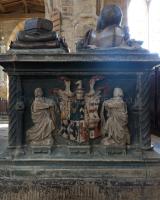
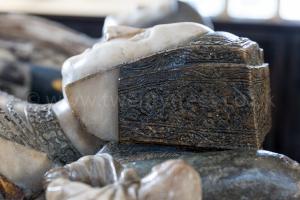
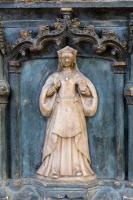
After 8th December 1534. St Mary's Church, Fawsley [Map]. Monument to Richard Knightley [deceased] sculpted by Richard Parker of Burton on Trent. Gabled Headress. Chest with Weepers. Lancastrian Esses Collar with Big Esses. Angels Supporting Pillow.
Richard Knightley: In 1455 he was born to Richard Knightley in Fawsley, Northamptonshire. On 8th December 1534 Richard Knightley died in Fawsley, Northamptonshire. He was buried in St Mary's Church, Fawsley [Map].






On 8th December 1542 Mary Queen of Scots was born to King James V of Scotland [aged 30] and Mary of Guise Queen Consort Scotland [aged 27] at Linlithgow Palace. She a great granddaughter of King Henry VII of England and Ireland. She married (1) 24th April 1558 her third cousin Francis II King France King Consort Scotland (2) 29th July 1565 her half first cousin Henry "Lord Darnley" Stewart, son of Matthew Stewart 4th Earl Lennox and Margaret Douglas Countess Lennox, and had issue (3) 15th May 1567 her half third cousin once removed James "Lord Bothwell" Hepburn 1st Duke Orkney, son of Patrick Hepburn 3rd Earl Bothwell and Agnes Sinclair Countess Bothwell.


Chronicle of Greyfriars. 8th December 1551. Item the viij. day of that monyth was a gret muster at Totehylle [Map] of men of armes befor the kynge [aged 14], of dyvers lordes.


On 8th December 1626 John Davies [aged 57] died of apoplexy.
Samuel Pepys' Diary. 8th December 1662. So to the Duke [aged 29] and Mr. Coventry [aged 34], and alone, the rest being at a Pay and elsewhere, and alone with Mr. Coventry I did read over our letter to my Lord Treasurer [aged 55], which I think now is done as well as it can be.


Samuel Pepys' Diary. 8th December 1662. Then to my Lord Sandwich's [aged 37], and there spent the rest of the morning in making up my Lord's accounts with Mr. Moore, and then dined with Mr. Moore and Battersby his friend, very well and merry, and good discourse.


Samuel Pepys' Diary. 8th December 1663. So home to dinner, and thence by coach to White Hall, where a great while walked with my Lord Tiviott, whom I find a most carefull, thoughtfull, and cunning man, as I also ever took him to be. He is this day bringing in an account where he makes the King [aged 33] debtor to him £10,000 already on the garrison of Tangier [Map] account; but yet demands not ready money to pay it, but offers such ways of paying it out of the sale of old decayed provisions as will enrich him finely.
Samuel Pepys' Diary. 8th December 1663. Anon came my Lord Sandwich [aged 38], and then we fell to our business at the Committee about my Lord Tiviott's accounts, wherein I took occasion to speak now and then, so as my Lord Sandwich did well seem to like of it, and after we were up did bid me good night in a tone that, methinks, he is not so displeased with me as I did doubt he is; however, I will take a course to know whether he be or no.
John Evelyn's Diary. 8th December 1665. To my Lord of Albemarle [aged 57] (now returned from Oxford), who was declared General at Sea, to the no small mortification of that excellent person, the Earl of Sandwich [aged 40], whom the Duke of Albemarle not only suspected faulty about the prizes, but less valiant; himself imagining how easy a thing it were to confound the Hollanders, as well now as heretofore he fought against them upon a more disloyal interest.


Samuel Pepys' Diary. 8th December 1665. Thence after some discourse with Sir G. Carteret [aged 55], who, though he tells me that he is glad of my Lord's being made Embassador, and that it is the greatest courtesy his enemies could do him; yet I find he is not heartily merry upon it, and that it was no design of my Lord's friends, but the prevalence of his enemies, and that the Duke of Albemarle [aged 57] and Prince Rupert [aged 45] are like to go to sea together the next year. I pray God, when my Lord is gone, they do not fall hard upon the Vice-Chamberlain, being alone, and in so envious a place, though by this late Act and the instructions now a brewing for our office as to method of payments will destroy the profit of his place of itself without more trouble.

Anne Boleyn. Her Life as told by Lancelot de Carle's 1536 Letter.
In 1536, two weeks after the execution of Anne Boleyn, her brother George and four others, Lancelot du Carle, wrote an extraordinary letter that described Anne's life, and her trial and execution, to which he was a witness. This book presents a new translation of that letter, with additional material from other contemporary sources such as Letters, Hall's and Wriothesley's Chronicles, the pamphlets of Wynkyn the Worde, the Memorial of George Constantyne, the Portuguese Letter and the Baga de Secrets, all of which are provided in Appendices.
Available at Amazon in eBook and Paperback format.
Samuel Pepys' Diary. 8th December 1665. That done I to the 'Change [Map], and among many other things, especially for getting of my Tangier [Map] money, I by appointment met Mr. Gawden, and he and I to the Pope's Head Taverne, and there he did give me alone a very pretty dinner. Our business to talk of his matters and his supply of money, which was necessary for us to talk on before the Duke of Albemarle [aged 57] this afternoon and Sir G. Carteret [aged 55]. After that I offered now to pay him the £4000 remaining of his £8000 for Tangier [Map], which he took with great kindnesse, and prayed me most frankly to give him a note for £3500 and accept the other £500 for myself, which in good earnest was against my judgement to do, for [I] expected about £100 and no more, but however he would have me do it, and ownes very great obligations to me, and the man indeed I love, and he deserves it. This put me into great joy, though with a little stay to it till we have time to settle it, for for so great a sum I was fearfull any accident might by death or otherwise defeate me, having not now time to change papers.
Samuel Pepys' Diary. 8th December 1665. Up, well pleased in my mind about my Lord Sandwich [aged 40], about whom I shall know more anon from Sir G. Carteret [aged 55], who will be in towne, and also that the Hambrough [ships] after all difficulties are got out. God send them good speed!

Samuel Pepys' Diary. 8th December 1666. Up, and to the office, where we sat all the morning, and at noon home to dinner, and there find Mr. Pierce and his wife and Betty, a pretty girle, who in discourse at table told me the great Proviso passed the House of Parliament yesterday; which makes the King [aged 36] and Court mad, the King having given order to my Lord Chamberlain [aged 64] to send to the playhouses and bawdy houses, to bid all the Parliament-men that were there to go to the Parliament presently. This is true, it seems; but it was carried against the Court by thirty or forty voices. It is a Proviso to the Poll Bill, that there shall be a Committee of nine persons that shall have the inspection upon oath, and power of giving others, of all the accounts of the money given and spent for this warr. This hath a most sad face, and will breed very ill blood. He tells me, brought in by Sir Robert Howard [aged 40], who is one of the King's servants, at least hath a great office, and hath got, they say, £20,000 since the King come in.
Samuel Pepys' Diary. 8th December 1666. Very good company we were at dinner, and merry, and after dinner, he being gone about business, my wife and I and Mrs. Pierce and Betty and Balty [aged 26], who come to see us to-day very sick, and went home not well, together out, and our coach broke the wheel off upon Ludgate Hill [Map]. So we were fain to part ourselves and get room in other people's coaches, and Mrs. Pierce and I in one, and I carried her home and set her down, and myself to the King's playhouse, which troubles me since, and hath cost me a forfeit of 10s., which I have paid, and there did see a good part of "The English Monsiuer", which is a mighty pretty play, very witty and pleasant. And the women do very well; but, above all, little Nelly [aged 16]; that I am mightily pleased with the play, and much with the House, more than ever I expected, the women doing better than ever I expected, and very fine women. Here I was in pain to be seen, and hid myself; but, as God would have it, Sir John Chichly [aged 26] come, and sat just by me.


Samuel Pepys' Diary. 8th December 1666. Mr. Pierce did also tell me as a great truth, as being told it by Mr. Cowly [aged 48], who was by, and heard it, that Tom Killigrew [aged 54] should publiquely tell the King [aged 36] that his matters were coming into a very ill state; but that yet there was a way to help all, which is, says he, "There is a good, honest, able man, that I could name, that if your Majesty would employ, and command to see all things well executed, all things would soon be mended; and this is one Charles Stuart, who now spends his time in employing his lips [Note. Another version includes 'and his prick'] .... about the Court, and hath no other employment; but if you would give him this employment, he were the fittest man in the world to perform it". This, he says, is most true; but the King do not profit by any of this, but lays all aside, and remembers nothing, but to his pleasures again; which is a sorrowful consideration.


Samuel Pepys' Diary. 8th December 1667. At noon to dinner, where W. How with us, and after dinner, he being gone, I to my chamber again till almost night, and then took boat, the tide serving, and so to White Hall, where I saw the Duchesse of York [aged 30], in a fine dress of second mourning for her mother, being black, edged with ermine, go to make her first visit to the Queene [aged 58] since the Duke of York [aged 34] was sick; and by and by, she being returned, the Queene come and visited her. But it was pretty to observe that Sir W. Coventry [aged 39] and I, walking an hour and more together in the Matted Gallery, he observed, and so did I, how the Duchesse, as soon as she spied him, turned her head a one side. Here he and I walked thus long, which we have not done a great while before. Our discourse was upon everything: the unhappiness of having our matters examined by people that understand them not; that it was better for us in the Navy to have men that do understand the whole, and that are not passionate; that we that have taken the most pains are called upon to answer for all crimes, while those that, like Sir W. Batten and Sir J. Minnes [aged 68], did sit and do nothing, do lie still without any trouble; that, if it were to serve the King [aged 37] and kingdom again in a war, neither of us could do more, though upon this experience we might do better than we did; that the commanders, the gentlemen that could never be brought to order, but undid all, are now the men that find fault and abuse others; that it had been much better for the King to have given Sir J. Minnes and Sir W. Batten £1000 a-year to have sat still, than to have had them in his business this war: that the serving a Prince that minds not his business is most unhappy for them that serve him well, and an unhappiness so great that he declares he will never have more to do with a war, under him. That he hath papers which do flatly contradict the Duke of Albemarle's [aged 59] Narrative; and that he hath been with the Duke of Albemarle and shewed him them, to prevent his falling into another like fault: that the Duke of Albemarle seems to be able to answer them; but he thinks that the Duke of Albemarle and the Prince are contented to let their Narratives sleep, they being not only contradictory in some things (as he observed about the business of the Duke of Albemarle's being to follow the Prince upon dividing the fleete, in case the enemy come out), but neither of them to be maintained in others. That the business the other night of my Lord Anglesey [aged 53] at the Council was happily got over for my Lord, by his dexterous silencing it, and the rest, not urging it further; forasmuch as, had the Duke of Buckingham [aged 39] come in time enough, and had got it by the end, he, would have toused him in it; Sir W. Coventry telling me that my Lord Anglesey did, with such impudence, maintain the quarrel against the Commons and some of the Lords, in the business of my Lord Clarendon [aged 58], that he believes there are enough would be glad but of this occasion to be revenged of him. He tells me that he hears some of the Thomsons [aged 60] are like to be of the Commission for the Accounts, and Wildman [aged 46], which he much wonders at, as having been a false fellow to every body, and in prison most of the time since the King's coming in. But he do tell me that the House is in such a condition that nobody can tell what to make of them, and, he thinks, they were never in before; that every body leads, and nobody follows; and that he do now think that, since a great many are defeated in their expectation of being of the Commission, now they would put it into such hands as it shall get no credit from: for, if they do look to the bottom and see the King's case, they think they are then bound to give the King money; whereas, they would be excused from that, and therefore endeavour to make this business of the Accounts to signify little. I spoke with him about my Lord Sandwich's [aged 42] business, in which he is very friendly, and do say that the unhappy business of the prizes is it that hath brought all this trouble upon him, and the only thing that made any thing else mentioned, and it is true. So having discoursed with him, I spent some time with Sir Stephen Fox [aged 40] about the business of our adjusting the new method of the Excise between the Guards household and Tangier, the Lords Commissioners of the Treasury being now resolved to bring all their management into a course of payment by orders, and not by tallies, and I am glad of it, and so by water home late, and very dark, and when come home there I got my wife to read, and then come Captain Cocke [aged 50] to me; and there he tells me, to my great satisfaction, that Sir Robert Brookes [aged 30] did dine with him today; and that he told him, speaking of me, that he would make me the darling of the House of Commons, so much he is satisfied concerning me. And this Cocke did tell me that I might give him thanks for it; and I do think it may do me good, for he do happen to be held a considerable person, of a young man, both for sobriety and ability. Then to discourse of business of his own about some hemp of his that is come home to receive it into the King's stores, and then parted, and by and by my wife and I to supper, she not being well, her flux being great upon her, and so to bed.

Samuel Pepys' Diary. 8th December 1668. Up, and Sir H. Cholmly [aged 36] betimes with me, about some accounts and moneys due to him: and he gone, I to the Office, where sat all the morning; and here, among other things, breaks out the storm W. Hewer [aged 26] and I have long expected from the Surveyor, [Colonel Middleton.] about W. Hewer's conspiring to get a contract, to the burdening of the stores with kerseys and cottons, of which he hath often complained, and lately more than ever; and now he did it by a most scandalous letter to the Board, reflecting on my Office: and, by discourse, it fell to such high words between him and me, as can hardly ever be forgot; I declaring I would believe W. Hewer as soon as him, and laying the fault, if there be any, upon himself; he, on the other hand, vilifying of my word and W. Hewer's, calling him knave, and that if he were his clerk, he should lose his ears. At last, I closed the business for this morning with making the thing ridiculous, as it is, and he swearing that the King [aged 38] should have right in it, or he would lose his place. The Office was cleared of all but ourselves and W. Hewer; but, however, the world did by the beginning see what it meant, and it will, I believe, come to high terms between us, which I am sorry for, to have any blemish laid upon me or mine, at this time, though never so unduly, for fear of giving occasion to my real discredit: and therefore I was not only all the rest of the morning vexed, but so went home to dinner, where my wife tells me of my Lord Orrery's [aged 47] new play "Tryphon", at the Duke of York's [aged 35] house, which, however, I would see, and therefore put a bit of meat in our mouths, and went thither; where, with much ado, at half-past one, we got into a blind hole in the 18d. place, above stairs, where we could not hear well, but the house infinite full, but the prologue most silly, and the play, though admirable, yet no pleasure almost in it, because just the very same design, and words, and sense, and plot, as every one of his plays have, any one of which alone would be held admirable, whereas so many of the same design and fancy do but dull one another; and this, I perceive, is the sense of every body else, as well as myself, who therefore showed but little pleasure in it.
On 8th December 1699 Maria Josepha of Austria was born to Joseph I Holy Roman Emperor [aged 21] and Wilhelmine Amalie of Brunswick [aged 26]. She a great x 3 granddaughter of King James I of England and Ireland and VI of Scotland. She married 20th August 1719 her second cousin once removed Augustus III King Poland and had issue.
John Evelyn's Diary. 8th December 1700. Great alterations of officers at Court, and elsewhere, - Lord Chief Justice Treby died; he was a learned man in his profession, of which we have now few, never fewer; the Chancery requiring so little skill in deep law-learning, if the practicer can talk eloquently in that Court; so that probably few care to study the law to any purpose. Lord Marlborough [aged 50] Master of the Ordnance, in place of Lord Romney [aged 59] made Groom of the Stole. The Earl of Rochester [aged 58] goes Lord Lieutenant of Ireland.


On 8th December 1708 Francis I Holy Roman Emperor was born to Leopold Duke of Lorraine [aged 29] and Élisabeth Charlotte Bourbon Duchess Lorraine [aged 32]. He a great x 3 grandson of King James I of England and Ireland and VI of Scotland. He married 14th February 1736 his third cousin Maria Theresa Habsburg Spain Holy Roman Empress and had issue.
On 8th December 1722 Elizabeth Charlotte Palatinate Simmern Duchess Orléans [aged 70] died.
The History of William Marshal was commissioned by his son shortly after William’s death in 1219 to celebrate the Marshal’s remarkable life; it is an authentic, contemporary voice. The manuscript was discovered in 1861 by French historian Paul Meyer. Meyer published the manuscript in its original Anglo-French in 1891 in two books. This book is a line by line translation of the first of Meyer’s books; lines 1-10152. Book 1 of the History begins in 1139 and ends in 1194. It describes the events of the Anarchy, the role of William’s father John, John’s marriages, William’s childhood, his role as a hostage at the siege of Newbury, his injury and imprisonment in Poitou where he met Eleanor of Aquitaine and his life as a knight errant. It continues with the accusation against him of an improper relationship with Margaret, wife of Henry the Young King, his exile, and return, the death of Henry the Young King, the rebellion of Richard, the future King Richard I, war with France, the death of King Henry II, and the capture of King Richard, and the rebellion of John, the future King John. It ends with the release of King Richard and the death of John Marshal.
Available at Amazon in eBook and Paperback format.
On 8th December 1731 Francis Howard 1st Earl of Effingham [aged 48] was created 1st Earl of Effingham by King George II of Great Britain and Ireland [aged 48].


On 8th December 1746 Charles Radclyffe Earl Newburgh [aged 53] was executed at Tower Hill [Map] for his having joined the 1715 insurrection.
On 8th December 1754 Thomas Middleton [aged 63] died. Monument in St Giles' Church, Wrexham [Map] sculpted by Louis Francois Roubiliac [aged 52].
Thomas Middleton: Around 1691 he was born to John Middleton. Before 8th December 1754 he and Arabella Hacker were married.


On 8th December 1754 Charlotte Elizabeth Boyle Marchioness Hartington [aged 23] died. Her son William [aged 6] succeeded 7th Baron Clifford.


On 8th December 1793 Jeanne Bécu Comtesse du Barry [aged 50] was guillotined on the Place de la Révolution. On the way to the guillotine, she collapsed in the tumbrel and cried, "You are going to hurt me! Why?!" Terrified, she screamed for mercy and begged the watching crowd for help. Her last words to the executioner are said to have been: «De grâce, monsieur le bourreau, encore un petit moment!» – "One more moment, Mr. Executioner, I beg you!" She was buried in the Madeleine Cemetery


Ten Years' Digging. On the 8th of December we reopened the smaller of the barrows at Three Lows [Either Three Lows Barrow 1 [Map] or Three Lows Barrow 2 [Map]?], which was examined without any decisive result, in the summer of 1848. We now discovered two interments in it, the principal being deposited in a cist made of four thin stones in the centre, close to where the former cutting was discontinued. Its dimensions were twenty inches long, seventeen wide, and twenty deep. It contained a deposit of calcined bones, with which were two neat pointed instruments of flint, a bone pin, and part of a small vase of dark-coloured clay, 3¾ inches diameter, with a broad border two inches deep, very carefully ornamented: all these, including the vase, had passed through the fire - that, probably, which had consumed the dead; and it was owing to this that the whole of the vase was not to be found. South from the cist was the skeleton of an aged person, lying within a foot of the surface, surrounded and covered with stones, the head pointing north-west. Nothing was found with it. Outside the cist we observed two pieces of pottery and two flints. The mound was composed of earth, sprinkled with charcoal in all parts except where the interments had been laid.
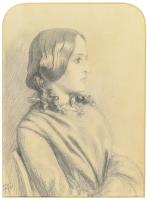
8th December 1853. Dante Gabriel Rossetti [aged 25]. Portrait of Margaret Anne Thomson [aged 20].

On 8th December 1907 King Oscar II of Sweden and Norway [aged 78] died. His son Gustav [aged 49] succeeded V King Sweden.
On 8th December 1914 two armoured cruisers, SMS Scharnhorst and Gneisenau, the light cruisers SMS Nürnberg, Dresden and Leipzig, and the colliers SS Baden, SS Santa Isabel, and SS Seydlitz, commanded by Admiral Graf Maximilian von Spee, attempted to raid the British supply base at Stanley in the Falkland Islands. A British squadron consisting of the battlecruisers HMS Invincible and Inflexible, the armoured cruisers HMS Carnarvon, Cornwall and Kent, the armed merchant cruiser HMS Macedonia and the light cruisers HMS Bristol and Glasgow had arrived in the port the day before. By nine o'clock that morning, the British battlecruisers and cruisers were in pursuit of the German vessels. All except Dresden and Seydlitz were tracked down and sunk.
The battle is commemorated every year on 8 December in the Falkland Islands as a public holiday.

SMS Scharnhorst, flagship of the German squadron.
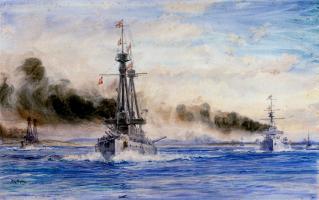
8th December 1914. William Lionel Wyllie [aged 63]. "Invincible and Inflexible steaming out of Port Stanley in chase".
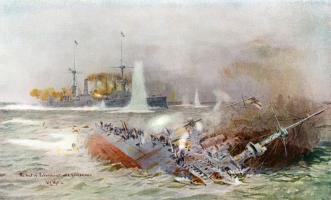
8th December 1914. William Lionel Wyllie [aged 63]. "Scharnhorst rolls over and sinks while Gneisenau continues to fight".

On 8th December 1922 Lucian Freud was born to Ernest Freud [aged 30] at Berlin.
On 8th December 1931 Eleanor "Nellie" Souray Viscountess Torrington [aged 51] died.


On 8th December 1933 Blanche Adeliza Fitzroy [aged 94] died at Regent's Park. Memorial at the Rosslyn Chapel [Map]
Blanche Adeliza Fitzroy: On 22nd August 1839 she was born to Henry Fitzroy in Salcey Lawn, Northamptonshire and Jane Elizabeth Beauclerk. On 13th October 1860 Charles Henry Maynard and she were married. The difference in their ages was 25 years. On 8th November 1866 Robert St Clair-Erskine 4th Earl of Rosslyn and she were married.


Abbot John Whethamstede’s Chronicle of the Abbey of St Albans
Abbot John Whethamstede's Register aka Chronicle of his second term at the Abbey of St Albans, 1451-1461, is a remarkable text that describes his first-hand experience of the beginning of the Wars of the Roses including the First and Second Battles of St Albans, 1455 and 1461, respectively, their cause, and their consequences, not least on the Abbey itself. His text also includes Loveday, Blore Heath, Northampton, the Act of Accord, Wakefield, and Towton, and ends with the Coronation of King Edward IV. In addition to the events of the Wars of the Roses, Abbot John, or his scribes who wrote the Chronicle, include details in the life of the Abbey such as charters, letters, land exchanges, visits by legates, and disputes, which provide a rich insight into the day-to-day life of the Abbey, and the challenges faced by its Abbot.
Available at Amazon in eBook and Paperback format.
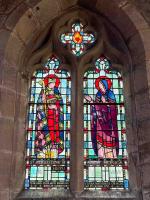
St Cuthbert's Church, Doveridge [Map]. Window in memory of Dora May Peach nee Hawthorn, died 8th December 1958.
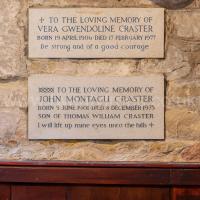
After 8th December 1975. Church of the Holy Trinity Embleton [Map]. Memorials to Vera Gwendoline Durward [aged 69] and John Montagu Craster [deceased].
Vera Gwendoline Durward: On 19th April 1906 she was born. Before 8th December 1975 John Montagu Craster and she were married. On 17th February 1977 she died.
John Montagu Craster: On 5th June 1901 he was born to Thomas William Craster of Craster Tower and Hilda Osborn. On 8th December 1975 John Montagu Craster died.
On 8th December 1980 at around ten to eleven in the evening John Lennon [aged 40] was shot and killed by Mark David Chapman outside of The Dakota, Upper West Side, Manhattan where he lived. Lennon was rushed to Roosevelt Hospital Midtown West Manhattan where he was pronounced dead on arrival.
On 8th December 1207 William Longespée was born to William Longespée Earl Salisbury [aged 31] and Ela of Salisbury 3rd Countess of Salisbury [aged 20]. He a grandson of King Henry "Curtmantle" II of England. He married before 8th October 1240 Idoine Camville and had issue.
On 8th December 1542 Mary Queen of Scots was born to King James V of Scotland [aged 30] and Mary of Guise Queen Consort Scotland [aged 27] at Linlithgow Palace. She a great granddaughter of King Henry VII of England and Ireland. She married (1) 24th April 1558 her third cousin Francis II King France King Consort Scotland (2) 29th July 1565 her half first cousin Henry "Lord Darnley" Stewart, son of Matthew Stewart 4th Earl Lennox and Margaret Douglas Countess Lennox, and had issue (3) 15th May 1567 her half third cousin once removed James "Lord Bothwell" Hepburn 1st Duke Orkney, son of Patrick Hepburn 3rd Earl Bothwell and Agnes Sinclair Countess Bothwell.

On 8th December 1678 Horatio Walpole 1st Baron Walpole was born to Colonel Robert Walpole [aged 28]. He married 21st July 1720 Mary Magdalen Lombard and had issue.
On 8th December 1699 Maria Josepha of Austria was born to Joseph I Holy Roman Emperor [aged 21] and Wilhelmine Amalie of Brunswick [aged 26]. She a great x 3 granddaughter of King James I of England and Ireland and VI of Scotland. She married 20th August 1719 her second cousin once removed Augustus III King Poland and had issue.
On 8th December 1708 Francis I Holy Roman Emperor was born to Leopold Duke of Lorraine [aged 29] and Élisabeth Charlotte Bourbon Duchess Lorraine [aged 32]. He a great x 3 grandson of King James I of England and Ireland and VI of Scotland. He married 14th February 1736 his third cousin Maria Theresa Habsburg Spain Holy Roman Empress and had issue.
On 8th December 1752 John Barrington 9th Baronet was born to Fitzwilliam Barrington 8th Baronet [aged 44].

On 8th December 1781 Thomas de Grey 2nd Earl de Grey was born to Thomas Robinson 2nd Baron Grantham [aged 43] and Mary Jemima Yorke Baroness Grantham [aged 25]. He married 20th July 1805 Henrietta Cole Countess de Grey, daughter of William Willoughby Cole 1st Earl Enniskillen and Anne Lowry-Corry Countess Enniskillen, and had issue.
On 8th December 1795 Captain John France St John-Mildmay was born to Henry Paulet St John-Mildmay 3rd Baronet [aged 31] and Jane Mildmay Lady St-John Mildmay [aged 30].
Annals of the six Kings of England by Nicholas Trivet
Translation of the Annals of the Six Kings of England by that traces the rise and rule of the Angevin aka Plantagenet dynasty from the mid-12th to early 14th century. Written by the Dominican scholar Nicholas Trivet, the work offers a vivid account of English history from the reign of King Stephen through to the death of King Edward I, blending political narrative with moral reflection. Covering the reigns of six monarchs—from Stephen to Edward I—the chronicle explores royal authority, rebellion, war, and the shifting balance between crown, church, and nobility. Trivet provides detailed insight into defining moments such as baronial conflicts, Anglo-French rivalry, and the consolidation of royal power under Edward I, whose reign he describes with particular immediacy. The Annals combines careful year-by-year reporting with thoughtful interpretation, presenting history not merely as a sequence of events but as a moral and political lesson. Ideal for readers interested in medieval history, kingship, and the origins of the English state, this chronicle remains a valuable and accessible window into the turbulent world of the Plantagenet kings.
Available at Amazon in eBook and Paperback format.
On 8th December 1797 Elizabeth Tollemache Countess Cardigan was born to Admiral John Richard Delap-Halliday aka Delap-Tollemache [aged 25] and Elizabeth Stratford. She married 19th June 1826 James Brudenell 7th Earl Cardigan, son of Robert Brudenell 6th Earl Cardigan and Penelope Cooke Countess Cardigan.
On 8th December 1804 John Gerard 12th Baronet was born to John Gerard of Windle Hall, Lancashire and Elizabeth Ferrers [aged 25]. He married 3rd December 1827 Monica Strickland-Standish.

On 8th December 1816 Elizabeth Dorothy Anne Howard was born to George Howard 6th Earl Carlisle [aged 43] and Georgiana Cavendish Countess Carlisle [aged 33]. She married 12th August 1840 her third cousin Francis Richard Grey, son of Charles Grey 2nd Earl Grey and Mary Elizabeth Ponsonby Countess Grey.
On 8th December 1822 Francis Sylvester Grimston was born to James Walter Grimston 1st Earl Verulam [aged 47] and Charlotte Jenkinson Countess Verulam at Gorhambury House, Hertfordshire [Map].
On 8th December 1824 Robert Sheffield 5th Baronet was born to Robert Sheffield 4th Baronet [aged 38] and Julia Brigidia Newbolt [aged 24]. He married in or before 1869 Priscilla Isabella Laura Dumaresq and had issue.
On 8th December 1826 Edmund Shirley 3rd Baronet was born to Edmund Hungerford Lechmere 2nd Baronet [aged 34] and Maria Clara Murray Lady Lechmere.
On 8th December 1837 Robert Anderson 1st Baronet was born.

On 8th December 1847 Philip Stanhope 1st Baron Weardale was born to Philip Stanhope 5th Earl Stanhope [aged 42] and Emily Harriet Countess Stanhope.
On 8th December 1850 Francis Baring 2nd Earl Northbrook was born to Thomas Baring 1st Earl Northbrook [aged 24] and Elizabeth Sturt Baroness Northbrook. He married (1) 26th June 1894 Ada Ethel Sophie Davidson (2) 1899 Florence Anita Coote Countess Northbrook.


On 8th December 1851 William Nelson 1st Baronet was born.
On 8th December 1863 Herbert Cecil Boothby 12th Baronet was born to Reverend Brooke William Boothby 9th Baronet [aged 54] and Martha Serena Boothby. Coefficient of inbreeding 3.12%.
On 8th December 1863 Francis Arthur Stanley ffolkes 5th Baronet was born to Reverend Henry Edward Browne ffolkes [aged 39].
William of Worcester's Chronicle of England
William of Worcester, born around 1415, and died around 1482 was secretary to John Fastolf, the renowned soldier of the Hundred Years War, during which time he collected documents, letters, and wrote a record of events. Following their return to England in 1440 William was witness to major events. Twice in his chronicle he uses the first person: 1. when writing about the murder of Thomas, 7th Baron Scales, in 1460, he writes '… and I saw him lying naked in the cemetery near the porch of the church of St. Mary Overie in Southwark …' and 2. describing King Edward IV's entry into London in 1461 he writes '… proclaimed that all the people themselves were to recognize and acknowledge Edward as king. I was present and heard this, and immediately went down with them into the city'. William’s Chronicle is rich in detail. It is the source of much information about the Wars of the Roses, including the term 'Diabolical Marriage' to describe the marriage of Queen Elizabeth Woodville’s brother John’s marriage to Katherine, Dowager Duchess of Norfolk, he aged twenty, she sixty-five or more, and the story about a paper crown being placed in mockery on the severed head of Richard, 3rd Duke of York.
Available at Amazon in eBook and Paperback format.
On 8th December 1864 Henry Walter Hepburn-Stuart-Forbes-Trefusis was born to Charles Hepburn-Stuart-Forbes-Trefusis 20th Baron Clinton [aged 30] and Harriet Williamina Hepburn-Forbes Baroness Clinton [aged 29]. Coefficient of inbreeding 6.28%. He married 1905 Mary Lygon, daughter of Frederick Lygon 6th Earl Beauchamp and Mary Catherine Stanhope Countess Beauchamp.
On 8th December 1881 Lilian Lambton Countess of Home was born to Frederick Lambton 4th Earl Durham [aged 26] and Beatrix Bulteel Countess Durham [aged 22]. Coefficient of inbreeding 1.57%. She married 14th July 1902 her third cousin once removed Charles Cospatrick Douglas-Home 13th Earl of Home, son of Charles Douglas-Home 12th Earl of Home and Maria Gray Countess of Home, and had issue.
On 8th December 1904 Christopher Addison 2nd Viscount Addison was born to Christopher Addison 1st Viscount Addison [aged 36] and Isobel Gray. He married 10th September 1928 Brigit Williams Viscountess Addison.

On 8th December 1907 Gilbert James Heathcote-Willoughby-Drummond 3rd Earl Ancaster was born to Gilbert Heathcote-Willoughby-Drummond 2nd Earl Ancaster [aged 40] and Eloise Lawrence Breese Countess Ancaster [aged 25]. He married 27th July 1933 Nancy Phyllis Louise Astor Countess Astor, daughter of Waldorf Astor 2nd Viscount Astor and Nancy Witcher Langhorne Viscountess Astor, and had issue.
On 8th December 1917 Thomas Cospatric Hamilton-Spencer-Smith 6th Baronet was born to Drummond Cospatric Hamilton-Spencer-Smith 5th Baronet [aged 41].
On 8th December 1922 Lucian Freud was born to Ernest Freud [aged 30] at Berlin.
On 8th December 1930 William Robertson 2nd Baron Robertson was born to Brian Robertson 1st Baron Robertson of Oakridge [aged 34].
On 8th December 1938 Robert Walpole 10th and 8th Baron Walpole was born to Robert Walpole 9th and 7th Baron Walpole [aged 25].
On 8th December 1940 James Waldegrave 13th Earl Waldegrave was born to Geoffrey Waldegrave 12th Earl Waldegrave [aged 35] and Mary Hermione Grenfell Countess Waldegrave [aged 30].
On 8th December 1948 Anthony Robert Milnes-Coates 4th Baronet was born to Lieutenant-Colonel Robert Edward James Clive Milnes-Coates 3rd Baronet [aged 41] and Ethel Patricia Hare Lady Milnes-Coates [aged 36].

On 8th December 1743 John Cust 3rd Baronet [aged 25] and Etheldreda Payne Lady Cust [aged 23] were married. She by marriage Lady Cust of Stamford in Lincolnshire.
Abbot John Whethamstede’s Chronicle of the Abbey of St Albans
Abbot John Whethamstede's Register aka Chronicle of his second term at the Abbey of St Albans, 1451-1461, is a remarkable text that describes his first-hand experience of the beginning of the Wars of the Roses including the First and Second Battles of St Albans, 1455 and 1461, respectively, their cause, and their consequences, not least on the Abbey itself. His text also includes Loveday, Blore Heath, Northampton, the Act of Accord, Wakefield, and Towton, and ends with the Coronation of King Edward IV. In addition to the events of the Wars of the Roses, Abbot John, or his scribes who wrote the Chronicle, include details in the life of the Abbey such as charters, letters, land exchanges, visits by legates, and disputes, which provide a rich insight into the day-to-day life of the Abbey, and the challenges faced by its Abbot.
Available at Amazon in eBook and Paperback format.
On 8th December 1817 Thomas Lyon Bowes 11th Earl Strathmore and Kinghorne [aged 44] and Marianna Cheape Countess Earl Strathmore and Kinghorne [aged 44] were married at the Charlotte Square Chapel, Edinburgh. He the son of John Lyon 9th Earl Strathmore and Kinghorne and Mary Bowes Countess Strathmore.
On 8th December 1818 Robert Sheffield 4th Baronet [aged 32] and Julia Brigidia Newbolt [aged 18] were married.
On 8th December 1829 William Henry Ord [aged 25] and Frances Vere Loraine Lady Blackett [aged 29] were married at St Nicholas Church, Gosforth [Map].

On 8th December 1876 Robert Curzon 15th Baron Zouche [aged 25] and Annie Mary Eleanor Fraser [aged 19] were divorced.

On 8th December 1915 Robert Arthur James Gascoyne-Cecil 5th Marquess Salisbury [aged 22] and Elizabeth Vere Cavendish Marchioness Salisbury [aged 20] were married. He the son of James Gascoyne-Cecil 4th Marquess Salisbury [aged 54] and Cicely Anne Gore Marchioness Salisbury [aged 48].
On 8th December 1034 Bishop Æthelric died.
On 8th December 1228 Bishop Geoffrey Burgh [aged 48] died.
On 8th December 1292 Archbishop John Peckham [aged 62] died.
On 8th December 1339 Bishop Richard de Wentworth died.
On 8th December 1485 Malise Graham 3rd Earl Strathearn 1st Earl Menteith [aged 78] died. His son Alexander [aged 13] succeeded 2nd Earl Menteith.
On 8th December 1498 Edmund Cornwall 7th Baron Burford [aged 50] died at Bridgnorth, Shropshire [Map]. His son Thomas [aged 31] succeeded 8th Baron Burford of Burford in Shropshire.
Chronicle of Geoffrey le Baker of Swinbroke
Baker was a secular clerk from Swinbroke, now Swinbrook, an Oxfordshire village two miles east of Burford. His Chronicle describes the events of the period 1303-1356: Gaveston, Bannockburn, Boroughbridge, the murder of King Edward II, the Scottish Wars, Sluys, Crécy, the Black Death, Winchelsea and Poitiers. To quote Herbert Bruce 'it possesses a vigorous and characteristic style, and its value for particular events between 1303 and 1356 has been recognised by its editor and by subsequent writers'. The book provides remarkable detail about the events it describes. Baker's text has been augmented with hundreds of notes, including extracts from other contemporary chronicles, such as the Annales Londonienses, Annales Paulini, Murimuth, Lanercost, Avesbury, Guisborough and Froissart to enrich the reader's understanding. The translation takes as its source the 'Chronicon Galfridi le Baker de Swynebroke' published in 1889, edited by Edward Maunde Thompson.
Available at Amazon in eBook and Paperback format.
On 8th December 1521 Christina Queen Consort Denmark Norway and Sweden [aged 59] died.
On 8th December 1680 Henry Pierrepont 1st Marquess Dorchester [aged 74] died. He was buried at Holme Pierrepoint, Nottinghamshire [Map]. Marquess Dorchester extinct. His great nephew Robert [aged 20] succeeded 3rd Earl Kingston upon Hull, 3rd Viscount Newark, 3rd Baron Pierrepont of Holme Pierrepoint.
On 8th December 1722 Elizabeth Charlotte Palatinate Simmern Duchess Orléans [aged 70] died.
On 8th December 1725 John Thornycroft 1st Baronet [aged 66] died. He was buried at St Mary's Church, Bloxham. His son John [aged 34] succeeded 2nd Baronet Thornycroft of Milcombe in Oxfordshire.
On 8th December 1734 Humphrey Briggs 4th Baronet [aged 64] died unmarried. His brother Hugh [aged 50] succeeded 5th Baronet Briggs of Haughton in Shropshire.
On 8th December 1746 Charles Radclyffe Earl Newburgh [aged 53] was executed at Tower Hill [Map] for his having joined the 1715 insurrection.
On 8th December 1746 Sophia Osborne Baroness Leominster [aged 85] died.
On 8th December 1749 John Cope 6th Baronet [aged 76] died. His son Monoux [aged 53] succeeded 7th Baronet Cope of Hanwell in Oxfordshire.
On 8th December 1754 Charlotte Elizabeth Boyle Marchioness Hartington [aged 23] died. Her son William [aged 6] succeeded 7th Baron Clifford.
On 8th December 1754 Thomas Middleton [aged 63] died. Monument in St Giles' Church, Wrexham [Map] sculpted by Louis Francois Roubiliac [aged 52].
Thomas Middleton: Around 1691 he was born to John Middleton. Before 8th December 1754 he and Arabella Hacker were married.
On 8th December 1756 William Stanhope 1st Earl of Harrington [aged 73] died. His son William [aged 36] succeeded 2nd Earl Harrington, 2nd Viscount Petersham, 2nd Baron Harrington. Caroline Fitzroy Countess Harrington [aged 34] by marriage Countess Harrington.

On 8th December 1791 Robert Throckmorton 4th Baronet [aged 89] died. His grandson John [aged 38] succeeded 5th Baronet Throckmorton of Coughton in Warwickshire.
Annals of the six Kings of England by Nicholas Trivet
Translation of the Annals of the Six Kings of England by that traces the rise and rule of the Angevin aka Plantagenet dynasty from the mid-12th to early 14th century. Written by the Dominican scholar Nicholas Trivet, the work offers a vivid account of English history from the reign of King Stephen through to the death of King Edward I, blending political narrative with moral reflection. Covering the reigns of six monarchs—from Stephen to Edward I—the chronicle explores royal authority, rebellion, war, and the shifting balance between crown, church, and nobility. Trivet provides detailed insight into defining moments such as baronial conflicts, Anglo-French rivalry, and the consolidation of royal power under Edward I, whose reign he describes with particular immediacy. The Annals combines careful year-by-year reporting with thoughtful interpretation, presenting history not merely as a sequence of events but as a moral and political lesson. Ideal for readers interested in medieval history, kingship, and the origins of the English state, this chronicle remains a valuable and accessible window into the turbulent world of the Plantagenet kings.
Available at Amazon in eBook and Paperback format.
On 8th December 1795 James Stonhouse 11th and 8th Baronet [aged 79] died. His son Thomas [aged 51] succeeded 12th Baronet Stonhouse of Radley, 9th Baronet Stonhouse of Radley.
On 8th December 1797 Henry Burgh 1st Marquess Clarincade [aged 55] died without issue. Marquess Clarincade extinct. His brother John [aged 53] succeeded 13th Earl Clanricarde.
On 8th December 1798 Edward Dering 6th Baronet [aged 66] died. His son Edward [aged 41] succeeded 7th Baronet Dering of Surrenden Dering in Kent.
On 8th December 1843 Henry Windsor 8th Earl Plymouth [aged 75] died without issue. Earl Plymouth extinct.
On 8th December 1847 Maria Dickonson Lady Nightingale [aged 58] died.
On 8th December 1873 William Meredyth Somerville 1st Baron Meredyth and Athlumney [aged 71] died. His son James [aged 8] succeeded 2nd Baron Athlumney of Somerville and Dollarstown in County Meath, 2nd Baron Meredyth of Dollardstown in County Meath, 6th Baronet Somerville of Somerville in County Meath.
On 8th December 1901 Fanny Catherine Lonsdale Baroness Beckett [aged 78] died.
On 8th December 1907 King Oscar II of Sweden and Norway [aged 78] died. His son Gustav [aged 49] succeeded V King Sweden.
On 8th December 1913 Granville Waldegrave 3rd Baron Radstock [aged 80] died in Paris [Map]. His son Granville [aged 54] succeeded 4th Baron Radstock of Castletown in the Queen's County.
On 8th December 1921 Edgar Clifford Arundell 14th Baron Arundel [aged 61] died at Fiddington, Somerset [Map]. His brother Gerald [aged 59] succeeded 15th Baron Arundel of Wardour in Wiltshire.
On 8th December 1923 Evelyn Henrietta Pennefather Countess Stanhope died.
On 8th December 1930 Admiral Richard Poore 4th Baronet [aged 77] died. His nephew Edward [aged 36] succeeded 5th Baronet Poore of Rushall in Wiltshire.
On 8th December 1931 Eleanor "Nellie" Souray Viscountess Torrington [aged 51] died.
Abbot John Whethamstede’s Chronicle of the Abbey of St Albans
Abbot John Whethamstede's Register aka Chronicle of his second term at the Abbey of St Albans, 1451-1461, is a remarkable text that describes his first-hand experience of the beginning of the Wars of the Roses including the First and Second Battles of St Albans, 1455 and 1461, respectively, their cause, and their consequences, not least on the Abbey itself. His text also includes Loveday, Blore Heath, Northampton, the Act of Accord, Wakefield, and Towton, and ends with the Coronation of King Edward IV. In addition to the events of the Wars of the Roses, Abbot John, or his scribes who wrote the Chronicle, include details in the life of the Abbey such as charters, letters, land exchanges, visits by legates, and disputes, which provide a rich insight into the day-to-day life of the Abbey, and the challenges faced by its Abbot.
Available at Amazon in eBook and Paperback format.

On 8th December 1932 Florence Jane Helen Wellesley Baroness Nunburnholme [aged 79] died.
On 8th December 1966 Algernon George de Vere Capell 8th Earl of Essex [aged 82] died. His son Reginald [aged 60] succeeded 9th Earl Essex, 10th Baron Capell Hadham.


On 8th December 1979 Robert Villiers Grimston 1st Baron Grimston [aged 82] died. His son Robert [aged 54] succeeded 2nd Baron Grimston of Westbury in Wiltshire, 2nd Baronet Grimston of Westbury in Wiltshire. June Mary Ponsonby Baroness Grimston [aged 55] by marriage Baroness Grimston of Westbury in Wiltshire.
On 8th December 2011 Anthony Philip Harbord-Hamond 11th Baron Suffield [aged 89] died. His son Charles [aged 58] succeeded 12th Baron Suffield, 13th Baronet Harbord-Hamond of Suffield in Norfolk.