

11 Nov is in November.
1100 Marriage of Henry I and Matilda
1517 Sweating Sickness Outbreak
Anglo-Saxon Chronicle. 919. This year King Edward [aged 45] went with his army to Bedford [Map], before Martinmas, and conquered the town; and almost all the burgesses, who obeyed him before, returned to him; and he sat there four weeks, and ordered the town to be repaired on the south side of the water, ere he departed thence.
Chronicon ex Chronicis by Florence and John of Worcester. 1029. Canute [aged 34], king of England, Denmark, and Norway, returned to England, and after the feast of St. Martin [11 Nov] banished Hakon, a Danish earl, who had married the noble lady Gunilda, his sister's daughter by Wyrtgeorn, king of the Winidi, sending him away under pretence of an embassy; for he feared that the earl would take either his life or his kingdoms.
On 11th November 1050 Henry Holy Roman Emperor was born to Henry "Black Pious" Salian III Holy Roman Emperor [aged 33] and Agnes Poitiers. He married June 1066 Bertha Savoy and had issue.
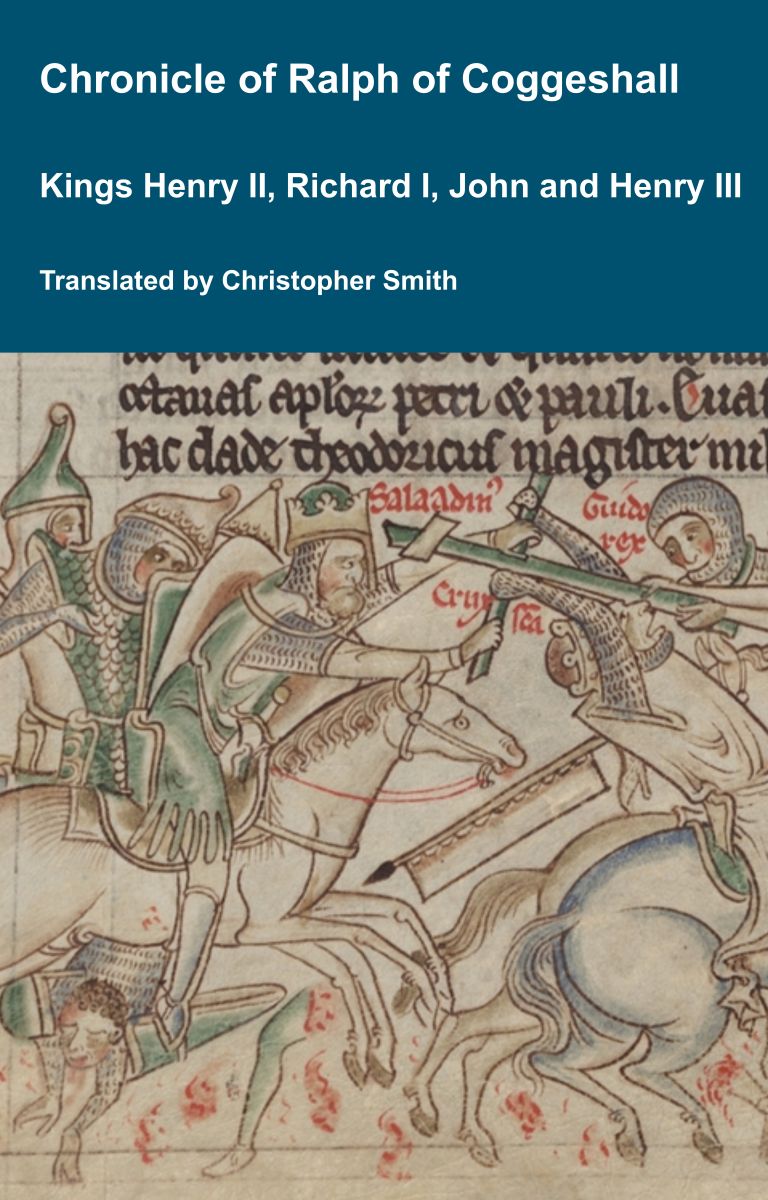 Chronicum Anglicanum by Ralph Coggeshall. In the year 1100, King William II, while engaged in hunting in the New Forest, was struck by an arrow shot1 by a certain Frenchman, Walter, surnamed Tyrrel, and met his death on the fourth day before the Nones of August [2nd August], on a Thursday, having reigned for thirteen years and thirty-eight days. His brother Henry succeeded him to the throne and was immediately crowned king on the Nones of August [5th August], a Sunday, at Westminster by Maurice, Bishop of London. On the feast of Saint Martin [11th November], Matilda, daughter of King Malcolm of Scotland, was consecrated as Queen of England by Archbishop Anselm.
MC. Guillelmus rex junior in Nova Foresta, cum fuisset venatu occupatus, a quodam Franco, Gualtero, cognomine Tirel, sagitta percussus vitam finivit quarto nonas Augusti, feria quinta, cum regnasset tredecim annis, octo et triginta diebus miniis. Cui successit frater ejus Henricus in regnum; et mox nonis Augusti, die Dominica, in Westmonasterio a Mauritio Londoniensi episcopo in regem est consecratus. Die vero Sancti Martini consecrata est Matildis, filia regis Scottorum Malcolmi, in reginam Anglorum ab Anselmo archiepiscopo.
Note 1. Eadmer: "For he did not believe that the Apostolic See could have any jurisdiction in his kingdom unless it was permitted by him. How he behaved thereafter, it is not fitting to write here while hastening on to other matters. Nevertheless, he was not allowed to enjoy for long the liberty he so proudly claimed to have attained. For before a year had passed, he was struck down by an unexpected and sudden death and lost it. October heard him boast; the second day of the following August saw him breathe his last. Indeed, on that morning he had eaten and gone into the forest to hunt, and there, pierced in the heart by an arrow, he died instantly, unrepentant and unconfessed, and was immediately abandoned by all. Whether the arrow, thrown, as some say, struck him, or whether, as more affirm, he stumbled and fell upon it, we think it idle to investigate; it is enough to know that he was struck down and killed by the just judgment of God."
Suger: "So he [King William II] crossed back into England and gave himself over lustfully to the desires of his heart. And one day while he was hotly pursuing game in the New Forest, he was struck suddenly by an untimely arrow and died. Some people, believing their opinion to be true, judged that divine vengeance had struck the man down, for he had burdened the poor beyond endurance and had cruelly extorted from churches. Whenever bishops or prelates died, he kept their possessions for himself and squandered them, showing no respect. Several people claimed that the very noble Walter Tirel shot him with the arrow; but we have quite often heard Walter Tirel, when he had nothing to fear or gain, affirm on oath as if he were swearing on a holy relic, that he had not come into that part of the forest where the king was hunting on that day, and that he had never even seen the king in the forest!"
Orderic Vitalis: "The king and Walter de Poix posted themselves with a few others in one part of the forest, and stood with their weapons in their hands eagerly watching for the coming of the game, when a stag suddenly running between them, the king quitted his station, and Walter [Tirel] shot an arrow. It grazed the beast's grizzly back, but glancing from it, mortally wounded the king who stood within its range. He immediately fell to the ground, and alas! suddenly expired."
On 11th November 1100, three months after acceeding to the throne, King Henry I "Beauclerc" England [aged 32] and Matilda of Scotland [aged 20] were married. She was crowned Queen Consort England. Baptised Edith she took the regnal name Matilda. The marriage brought together the houses of Normandy and Wessex; she was a great granddaughter of King Edmund I of England. She the daughter of King Malcolm III of Scotland and Margaret Wessex Queen Consort Scotland. He the son of King William "Conqueror" I of England and Matilda Flanders Queen Consort England.
Anglo-Saxon Chronicle. [11th November 1100]. And soon hereafter the king [aged 32] took him to wife Maud [aged 20], daughter of Malcolm, King of Scotland, and of Margaret the good queen, the relative of King Edward, and of the right royal132 race of England. And on Martinmas day she was publicly given to him with much pomp at Westminster, and the Archbishop Anselm [aged 67] wedded her to him, and afterwards consecrated her queen.
Note 132. This expression shows the adherence of the writer to the Saxon line of kings, and his consequent satisfaction in recording this alliance of Henry with the daughter of Margaret of Scotland.
 History of the Dukes of Normandy by William of Jumieges. When King William was slain, as we have already said, his brother Henry immediately had his body carried to Winchester, and there he placed it in the church of Saint Peter, before the high altar, for burial. When he had been buried, Henry came to London, and at Westminster, with the agreement of all the Normans and the English, on the fourth day after his brother's death, he received the royal crown. Many rejoiced greatly that they now at last had a king born of a king and queen, and born and raised in England. And so that the king might live in lawful wedlock, he took that same year the venerable Matilda, daughter of Malcolm, King of Scotland, and of Margaret. What great holiness and learning, both secular and spiritual, was possessed by both queens, Margaret and Matilda, is clearly described in the book that has been written concerning their life. Nor must we omit that Matilda was betrothed to King Henry the most noble, by Anselm, Archbishop of Canterbury of holy memory, on the feast of Saint Martin [11th November 1100] at Westminster, and that on the same day she was crowned with the royal diadem. King Henry was a man endowed with many virtues: a lover of justice and peace, a friend of religion, a most zealous punisher of the wicked and of thieves, and a most fortunate conqueror not only of his enemies among powerful princes and counts, but even among renowned kings.
Occiso itaque Willelmo rege, ut præmisimus, statim frater suus Henricus corpus ejus Wintomiam deferri fecit, ibique in ecclesia sancti Petri ante majus altare sepulturæ tradidit. Quo sepulto, Lundoniam venit, atque apud Westmonasterium, annuentibus cunctis Francis et Anglis, quarto die post mortem fratris regale diadema suscepit. Undo plurimi sunt lætati quod modo regem natum de rege et regina, natum et nutritum in Anglia habere meruissent. Ut autem idem rex legaliter viveret, duxit eodem anno venerabilem Mathildem filiam Malcomi regis Scotia et Margaretæ. Quantæ autem sanctitatis et scientiae tam sæcularis quam spiritualis utraque regina, Margareta scilicet et Mathildis, fuerint; liber qui de Vita ipsarum scriptus est, plano sermone describit. Nec illud prætermittendum quod a sanctæ recordationis Anselmo Cantuariensi archiepiscopo eadein Mathildis in festivitate sancti Martini apud Westmonasterium Henrico regi nobilissimo desponsata et eodem die regali diademate insignita est. Fuit autem rex Henricus vir pluribus virtutibus præditus, justitiæ ac pacis sectator, religionis amator, iniquorum et furum ferventissimus punitor, inimicorum suorum non solum excellentium principum et comitum, verum et nominatissimorum regum felicissimus triumphator.
On 11th November 1154 Sancho "Populator" I King Portugal was born to Afonso "Conqueror Founder Great" I King Portugal [aged 45] and Malfada Savoy Queen Consort Portugal [aged 29]. His nickname "Populator" not a consequence of the number of children he fathered, over sixty apparently, but his policy of populating remote areas in the northern Christian regions of Portugal. He married his fifth cousin Dulce Barcelona Queen Consort Portugal, daughter of Raymond V Count Barcelona, and had issue.
On 11th November 1155 Alfonso VIII King Castile was born to Sancho III King Castile [aged 21] and Blanche Ramirez Queen Consort Castile [aged 22]. He married before 17th September 1177 his half fourth cousin Eleanor Plantagenet Queen Consort Castile, daughter of King Henry "Curtmantle" II of England and Eleanor of Aquitaine Queen Consort Franks and England, and had issue.
Chronicle of a Bourgeois of Valenciennes
Récits d’un bourgeois de Valenciennes aka The Chronicle of a Bourgeois of Valenciennes is a vivid 14th-century vernacular chronicle written by an anonymous urban chronicler from Valenciennes in the County of Hainaut. It survives in a manuscript that describes local and regional history from about 1253 to 1366, blending chronology, narrative episodes, and eyewitness-style accounts of political, military, and social events in medieval France, Flanders, and the Low Countries. The work begins with a chronological framework of events affecting Valenciennes and its region under rulers such as King Philip VI of France and the shifting allegiances of local nobility. It includes accounts of conflicts, sieges, diplomatic manoeuvres, and the impact of broader struggles like the Hundred Years’ War on urban life in Hainaut. Written from the perspective of a burgher (bourgeois) rather than a monastery or royal court, the chronicle offers a rare lay viewpoint on high politics and warfare, reflecting how merchants, townspeople, and civic institutions experienced the turbulence of the 13th and 14th centuries. Its narrative style combines straightforward reporting of events with moral and civic observations, making it a valuable source for readers interested in medieval urban society, regional politics, and the lived experience of war and governance in pre-modern Europe.
Available at Amazon in eBook and Paperback format.
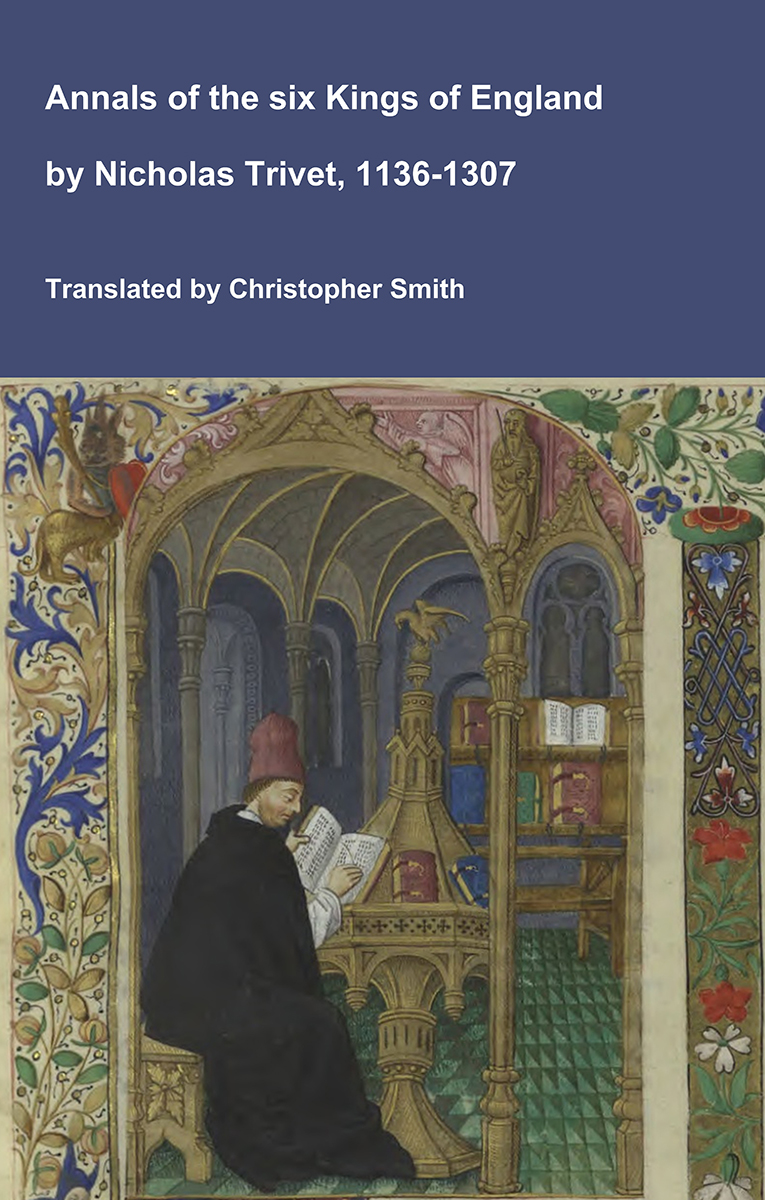 Annals of Six Kings of England by Nicholas Trivet. Afterward, at the request of the king of the Franks, the king of England sent Margaret, the wife of his son, into England. There he had her anointed by the archbishop of Rouen and crowned queen of England. Around the feast of Saint Martin [11th November 1172], the young king Henry and his wife came from England to the king of the Franks, who received them very honourably and treated them with great distinction.
Deinde, ad voluntatem regis Francorum, misit rex Anglorum Margaretam uxorem filii sui in Angliam, quam per manum Rothomagensis archiepiscopi fecit inungi, et in reginam Angliæ coronari. Circa festum vero S. Martini, venerunt de Anglia Henricus rex junior et uxor sua ad regem Francorum, quos ille decentissime suscipiens plurimum honoravit.
On 11th November 1220 Alphonse Count Poitiers II Count Toulouse was born to King Louis VIII of France [aged 33] and Blanche Ivrea Queen Consort France [aged 32] at Poissy, Yvelines. He a great grandson of King Henry "Curtmantle" II of England. He married 1237 his second cousin Joan Countess of Toulouse, daughter of Raymond Rouerge VII Count Toulouse and Sancha Barcelona Countess Toulouse.
Chronica Majora by Matthew Paris. 11th November 1236. On the day after the feast of St. Martin, and within the octaves of that feast, great inundations of the sea suddenly broke forth by night, and a fierce storm of wind arose, which caused inundations of the rivers as well as of the sea, and in places, especially on the coast, drove the ships from their ports, tearing them from their anchors, drowned great numbers of people, destroyed flocks of sheep, and herds of cattle, tore up trees by the roots, overthrew houses, and ravaged the coast. The sea rose for two days and the intermediate night, a circumstance before unheard of, and did not ebb and flow in its usual way, being impeded (as was said) by the violence of the opposing winds. The dead bodies of those drowned were seen lying unburied in caves formed by the sea, near the coast, and at Wisbeach [Map] and the neighbouring villages, and along the seacoast, an endless number of human beings perished: in one town, and that not a populous one, about a hundred bodies were consigned to the tomb in one day.
Chronicle of the Mayors and Sheriffs of London by Arnold Fitz Thedmar, 1201-1275. In this year, because dissensions had arisen on the Feast of Simon and Jude in reference to the election of the Mayor, as in the two preceding leaves is more fully set forth, his lordship the King, on the Feast of Saint Martin [11th November 1272] appointed Henry de Frowyk Warden, in place of the Mayor.
Annals of Dunstable. In the same year, on the feast of Saint Martin [11th November 1283], we paid to Ralph of Goldington, sheriff of Bedfordshire, the thirtieth of our temporalities for the expedition of the lord king in Wales. This payment, however, was put in respite on account of the favor which we had granted to the lord king at the instance of John of Kirkby; namely, the favor which we then paid in this payment counted for us as already paid. Likewise, our burgesses who had made such a favor were excused in the same way.
Eodem anno, in festo Sancti Martini, solvimus Radulfo de Goldintone, vicecomiti Bedefordiæ, tricesimam sheriff, temporalium nostrorum pro expeditione domini regis in Wallia. Quæ quidem solutio ponebatur in respectum pro gratia quam domino regi fecimus ad instantiam Johannis de Kyrkeby; scilicet gratia, quam tune solvimus in ista solutione, nobis cessit pro soluto. Similiter burgenses nostri, qui gratiam fecerant, per eandem viam transierunt.
On 11th November 1285 Peter III King Aragon [aged 45] died. His son Alfonso [aged 20] succeeded III King Aragon.
 Chronicle of Walter of Guisborough. When the king heard of these things, he immediately gathered his army and turned aside there, sending letters to his brother Lord Edmund and to the Earl of Lincoln1, who at that time were in the port of Portsmouth with many thousands of armed men, prepared to cross over into Gascony, ordering them to return to him in Wales with all haste. Upon hearing this, they hurried to him and remained there until nearly the middle of Lent. Now it happened that on the Feast of Saint Martin [11th November 1294] in winter, while the Earl of Lincoln was hastening before our king to his own castle of Denbigh, hoping perhaps to save it. as he believed, he was intercepted by his own Welsh men, he had many possessions and castles there, who engaged him in a fierce battle. These Welshmen of his ultimately prevailed against him, and after many on both sides had been killed, they finally forced him to flee with a few men, although he had fought bravely for a long time. Our king also, after crossing the river Conway, while making his way to the castle [Map], was not followed by the whole army. And so, as the sea waters and sudden tides overflowed, he was besieged by the Welsh for some time. Thus separated from his men and cut off, he suffered for a short time both hunger and thirst, drinking water mixed with honey and not eating bread to satisfaction; for the Welsh had overtaken his wagons, seized his supplies, and slaughtered the men they could catch. When they had only a small amount of wine, barely a flask's2 worth, which they had decided to preserve for the king, the king refused it and said: "In necessity all things ought to be held in common, and we shall all endure one and the same meagre fare until God Himself from on high looks down upon us. I will not be preferred to you in food, since I am the very cause and origin of this hardship." But soon after, God Almighty visited them with mercy: the waters receded, the whole army came to the king, and the Welsh were turned to flight. After many events and various battles, the Welsh were so harassed and pressed that, after many messengers were sent and returned, Madog himself and his followers were admitted to the king's peace, on the condition, however, that he would pursue and capture the other, namely Morgan, and hand him over to the royal prison within a set time. This agreement he kept and fulfilled, and so he obtained full peace. Many nobles from all over Wales were taken as hostages and sent to various castles in England to be held there until the king gave further orders; and they remained in those places until nearly the end of the war in Scotland. In the same year, a severe famine afflicted England, and many thousands of the poor died. A quarter of wheat was sold for sixteen shillings, and often for twenty.
Quæ cum audisset rex, mox congregato exercitu declinavit ibidem, missisque literis ad dominum Edmundum fratrem suum et comitem Lincolniæ, qui tunc temporis in portu de Portesmuth cum multis millibus armatorum parati fuerant in Vasconiam transfretare, ut ad eum in Walliam cum omni festinatione redirent; qui cum audissent talia properabant ad eum, et manserunt ibidem usque and defeat fere ad medium Quadragesimæ. Contigit autem quod die sancti Martini in hyeme dum idem comes Lincolniæ ad castrum suum de Tynebech ante regem nostrum festinaret, si forte illud salvare posset, sicut credidit, obviatus est ab hominibus suis propriis Wallensibus, habet enim ibidem multas possessiones et castra, qui quidem Wallenses sui commisso cum eo gravi prœlio prævaluerunts adversus eum, et interfectis hinc inde multis, ipsum tandem, cum jam diu strenue militasset, in fugam cum paucis converterunt. Rex etiam noster, transito flumine de Conway, dum ad castrum declinaret non est eum secutus totus exercitus, unde superabundantibus aquis maris et fluctuum subitorum obsessus est a Wallensibus per tempus aliquod. Sic separatus a suis et exclusus passusque est ad tempus modicum et famem et sitim, bibitque aquam cum melle mixtam et panem in saturitate non comedit; præoccupaverant enim Wallenses quadrigas suas, et victualibus acceptis et ablatis, homines quos poterant detruncabant. Cumque haberent modicum vini, vix unius lagenæ costrellum, quod pro rege salvare decreverant, non adquievit ipse rex, sed ait, "Omnia in necessitate debent esse communia, et omnes unam et similem dietam patiemur quousque respiciat nos ipse Deus ab alto, nec præficiar vobis in esu qui coarctationis istius origo et causa sum;" cito autem post visitavit Deus omnipotens eos, et decrescentibus aquis, venit ad regem exercitus totus et ipsi Wallenses in fugam versi sunt. Post multos autem eventus et conflictus varios in tantum Wallenses sunt agitati et astricti, quod missis et remissis nuntiis ipse Maddoch cum suis ad pacem regis admissus est, sub conditione tamen tali quod alterum scilicet Morgan prosequeretur et caperet, et infra certum tempus regio carceri manciparet. Quod quidem pactum tenuit et fecit, et plenam pacem adeptus est; acceptique sunt obsides multi de nobilioribus and gives totius Walliæ, et missi sunt in Angliam ad diversa castra ut custodirentur in eis usque ad jussionem regis, manseruntque in eisdem usque ad guerram Scotia fere finitam. Eodem anno fames valida Angliam afflixit et moriebantur pauperum multa millia, vendebatur enim quarterium frumenti pro XVI solidis et multotiens pro XX.
Note 1. Henry de Lacy, third earl of Lincoln, succeeded his father in 1257. In the preceding year, having espoused Margaret, daughter and co-heir of William de Longespee, (son of William de Longespee, Earl of Salisbury,) he became, jure uxoris i.e. by right of his wife, Earl of Salisbury.
Note 2. The capacity of the 'lagena' i.e. flask is thus given in an Assize of David, King of Scotland, concerning weights and measures. The lagena should be capable of containing twelve pounds of water, four pounds of sea-water, four of stagnant water, and four of pure. Its depth should be six inches and a-half, its breadth at the foot should be eight inches and a-half, taking the thickness of the wood on either side; at the higher extremity it should measure in circumference twenty-seven inches, and at the lower twenty-three. The lagena was also a dry measure, as we read of it in connection with corn and butter.
Annals of Six Kings of England by Nicholas Trivet. At the same time the Welsh, rising against the king, in different regions set up different leaders over themselves. For the northerners, who dwell about the parts of Snowdonia, having as their captain and leader a certain man of the lineage of Llywelyn, the last prince, named Madog, burned the town and castle of Caernarfon, a great number of Englishmen, who had come to the fair suspecting nothing of the kind, having been slain. The western Welsh, however, having set over themselves a certain youth named Maelgwn, committed many outrages in the parts of Pembroke and Carmarthen. There was also a certain man called Morgan, who, stirring up the southern Welsh, drove out and expelled the Earl of Gloucester, Gilbert, who had disinherited his ancestors from their land, which is called Glamorgan. The King of England, entering Wales, recalled to himself into Wales his brother Edmund and Henry, Earl of Lincoln, who were preparing to cross over into Gascony with an army. As they approached on the day of Saint Martin [11th November 1294] towards the castle of the Earl of Lincoln at Denbigh, the Welsh met them in great force, and, a fierce battle having been joined, drove them back.
Eodem tempore Wallenses, insurgentes contra regem, in diversis partibus diversos sibi principes præfecerunt. Aquilonares enim, qui circa partes Snowdoniæ habitant, capitaneum habentes et ducem quemdam de genere Lewelini principis ultimi, Madocum nomine, villam et castrum de Karnervan combusserunt; magna Anglicorum multitudine, qui nihil tale suspicantes ad nundinas venerant, interfecta. Occidentales vero Wallenses, præposito sibi juvene quodam Mailgone, in partibus Penbrochiæ et Kaermerdyn mala plurima perpetrarunt. Qui dam etiam Morganus dictus, Wallenses australes concitans, comitem Gloverniæ Gilbertum, qui progenitores suos exheredaverat de terra sua, quæ Glamorgan dicitur, fugavit et expulit. Rex Angliæ Walliam ingressus, Eadmundum germanum suum et Henricum comitem Lincolniæ, parantes se ad transfretandum in Vasconiam cum exercitu, ad se in Walliam revocavit. Quibus in die sancti Martini appropinquantibus castello comitis Lincolniæ de Dunbey, Wallenses in magna virtute occurrerunt, et conserto gravi prælio repulerunt.
Chronicle of Walter of Guisborough. On the feast of Saint Martin [11th November 1297] and during the following octave, the Scots gathered together and went forth everywhere, laying waste to all things. When they came to Carlisle, they sent to the city a certain priest without a deacon, who said these words: "My lord William the Conqueror commands you, for the sake of your lives, to surrender the town and castle to him without bloodshed; and he will grant you your lives, limbs, and all your possessions. But if you do not do so immediately, he will attack you and utterly destroy you." But they replied to him, "Who is this Conqueror?" And he answered, "William, whom you call Wallace." They replied, "Our king has entrusted the care and custody of this city and castle to us in his name and that of his heirs, and we believe he would neither approve nor wish us to hand it over to your lord William. But go, and tell him that if he wishes to have it, let him come in the manner of a true conqueror and take the place by force; and if he can, let him have the city, the castle, and all that is within." So when the envoy had departed, they set up their siege engines and prepared themselves to resist. When the Scots saw this, they turned away from the city and laid waste to all through the forest of Inglewood, Cumberland, and Allendale, as far as the river Derwent at Cockermouth. Their eyes spared neither order, sex, nor age, and even burning the churches of God, they treated His sanctuaries as nothing. And when they planned to turn their forces toward the bishopric of Durham, God and His glorious patron of that place, Saint Cuthbert, hindered them. A mighty storm arose, of hail, snow, and hard frost, within the same octave of Saint Martin, so that many of the Scots perished from hunger and cold. Their scouts who came forward reported that the bishopric was well armed and prepared with an immense host, though in truth there were not more than one hundred armed men and barely three thousand selected foot soldiers. Though many more had formerly remained at the frontier to resist, at that time they fled home in terror. But though the people failed, that glorious Cuthbert did not; for, as is piously believed, the Scots' plan was shattered by his holy prayers.
In festo vero sancti Martini, et per octavas sequentes, conglobati Scoti processerunt ubique vastantes omnia. Cumque venissent Carliolum, miserunt ad urbem sacerdotem quendam absque levita, qui diceret hæc; "Mandat vobis dominus meus Willelmus Conquæstor, ut vitæ vestræ consulentes, absque sanguinis effusione reddatis ei villam et castrum, dabitque vobis vitas et membra et omnia catalla vestra; quod si non feceritis confestim expugnabit vos, et ad internecionem usque delebit." At illi responderunt ei, "Quis est ille Conquæstor?" At ille: "Willelmus, quem Walays nominatis." Adjecerunt et illi: "Rex noster," inquiunt, "curam et custodiam civitatis istius et castri vice et nomine suo et hæredum suorum nobis tradidit, et credimus eum non habere gratum vel ratum habere velle ut domino tuo Willelmo ea liberemus; sed vade, et dic ei ut si ea, habere voluerit veniat ad modum boni Conquæstoris et locum expugnet, habeatque si possit civitatem et castrum et universa contenta." Moxque illo recedente tetenderunt machinas et ad resistendum paraverunt se. Quod videntes Scoti declinaverunt ab urbe, vastaveruntque universa per medium forestæ de Inglewode, Cumberland et Allendales usque Derewent ad Cokermouth; non enim pepercit eorum oculus ordini, sexui vel ætati, quinetiam ecclesias Dei concremantes ejus sanctuaria quasi pro nihilo reputabant. Et cum propositum ut in episcopatu Dunolmensi acies dirigerent, impedivit eos Deus et gloriosus ejusScotland. dem loci patronus sanctus Cuthbertus. Supervenit enim tempestas maxima grandinis, nivis et fortis gelu infra easdem octavas beati Martini, ita quod Scotorum multi fame et frigore perierunt. Exploratores etiam eorum venientes, dicebant eundem episcopatum armis præparatum et bene munitum immenso populo, et tamen non erant centum armati et vix III millia peditum electorum. Qui licet multo plures ante ad resistendum in confinio manserant, eodem tamen tempore perterriti ad propria fugerunt. Sed deficiente populo non defuit gloriosus ille Cuthbertus, quin, ut pie creditur, Scotorum propositum suis sanctis precibus quassatum est.
Chronicle of Walter of Guisborough. On the Feast of Saint Martin in Winter [11th November 1299], the king held a parliament at York, and from there set out with his army, intending to break the siege laid by the Scots around the castle of Stirling. But when they reached Berwick and were preparing to go further, the magnates objected to the untimeliness of the winter season. They added that the confirmation of the aforesaid Charters had not been observed in their articles, and that they were not willing to labour in vain unless the king fulfilled his promises. And so they turned back, having received, however, a summons from the king to appear in London at the beginning of Lent. The king himself, after celebrating Christmas there, set out and held his parliament at Westminster in London during the following Lent, where he renewed the confirmations of the aforesaid Charters and made statutes upon the same, together with many other provisions. The statutes issued there begin thus: "Because the points of the Great Charter of liberties, and the Charter of the Forest, etc."1
In festo Sancti Martini in hyeme tenuit rex parliamentum apud Eborum, et inde profectus est cum exercitu, volens infringere obsidionem Scotorum circa castellum de Strivelin. Cumque venissent apud Berewyk, disponens ulterius proficisci, causabantur magnates inopportunitatem temporis brumalis; adjicientes confirmationem Cartarum prædictarum in suis articulis non esse observatam, nec se velle in vanum laborare nisi rex ipse promissa adimpleret; et sic reversi sunt, accepto tamen a rege quod Londoniis comparerent in principio Quadragesimæ. Rex etiam post celebratum Natale ibidem profectus est, et tenuit parliamentum suum apud Westmonasterium Londoniis in sequenti Quadragesima, ubi confirmationes prædictarum Cartarum renovavit, et statuta fecit super eisdem, cum aliis contentis plurimis. Ipsa autem statuta ibidem edita sic incipiunt: "Pur ceo ke les poinz de la Grant Chartre des franchises, e la Chartre de la Foreste," etc.
Note 1. By these Articles, printed in the Statutes of the Realm, 28 Edward I vol. 1.136, three Justices were appointed in each shire to inquire concerning offences against the charters; regulations were framed concerning the royal purveyors, and many other excellent enactments made; all, however, with the clause of saving the right and prerogative of the Crown.
Annals of Six Kings of England by Nicholas Trivet. On the feast of Saint Martin [11th November 1299], a parliament having been held at York, the king advanced to Berwick, intending, by proceeding further, to raise the siege of the Scots around the castle of Stirling, where those besieged were very hard pressed, but the leading men alleging that the marshy places were impassable because of the winter season, the besieged having been carefully warned to surrender the castle with life and limb preserved, after Christmas, which he kept there, he returned into England. During the Christmas season the coinage of foreigners, introduced in imitation of sterling, was prohibited1. In this year, about the Assumption of the Blessed Virgin Mary, Henry, Archbishop of York, died, and was succeeded by Thomas of Corbridge, a distinguished doctor of theology.
In festo S. Martini, parliamento habito apud Eboracum, rex Berewicum progreditur; intendens ulterius procedendo amovere obsidionem Scotorum circa castrum de Strivelin, ubi valde artati fuerunt obsessi; sed causantibus majoribus loca palustria propter brumalem intemperiem immeabilia esse, præmonitis caute obsessis, ut salvis vita et membris castrum redderent, post Natale, quod ibidem tenuit, in Angliam est reversus. Infra Natalis solemnia prohibita est moneta alienigenarum, sub similitudine sterlingorum introducta. Hoc anno, circa Assumptionem beatæ Virginis Mariæ, obiit Henricus, Eboracensis archiepiscopus, cui successit Thomas de Colebruge, doctor in theologia eximius.
Note 1. Chronicle of Walter of Guisborough: 'In the same year, during the Christmas season, the king prohibited all foreign coinage in his land from circulating any longer as sterling. Foreign merchants had introduced into England a large number of base coins of the worst metal, pollards, crocards, Brabantine scaldings, eagles, sleeping lions, and other coins of various names. All of these coins were white in appearance, pretending to be silver, but were artificially composed of silver, copper, and sulphur, and in four or five of them there was not the weight of even one penny of true silver. By the king's order, two of them passed for one sterling penny until Easter. It was a terrible time for debased currency, and many unfair exchanges were made in buying and selling goods. At the following Easter, however, the king completely banned these coins, and established exchange offices in many places, where five or six of the foreign coins were given for a single sterling penny. Still, people cared little for them due to the worthlessness of the coinage. Yet within the year, after people learned by experiment how to purify the metal using melted lead in fire, two of those coins came to be worth one penny, just as the proverb of Cato says: "What is cheap, consider dear; what is dear, consider cheap."'

Anne Boleyn. Her Life as told by Lancelot de Carle's 1536 Letter.
In 1536, two weeks after the execution of Anne Boleyn, her brother George and four others, Lancelot du Carle, wrote an extraordinary letter that described Anne's life, and her trial and execution, to which he was a witness. This book presents a new translation of that letter, with additional material from other contemporary sources such as Letters, Hall's and Wriothesley's Chronicles, the pamphlets of Wynkyn the Worde, the Memorial of George Constantyne, the Portuguese Letter and the Baga de Secrets, all of which are provided in Appendices.
Available at Amazon in eBook and Paperback format.
 Adam Murimuth Continuation. In this year, around the feast of Saint Martin [11th November], Edward Bohun [aged 24] was drowned1 on the Scottish march while trying to rescue his squire who was pursuing stolen livestock, and neither of them escaped.
Hoc anno, circa festum sancti Martini, dominus Edwardus le Boun fuit submersus in marchia Scociæ, dum voluit liberare domicellum suum fugantem prædam animalium, ita quod neuter evasit.
Note 1. Chronicle of Geoffrey le Baker of Swinbroke: "In this year [1334], around the feast of Saint Martin, Lord Edward le Bohun, a nobleman of high character, was drowned in the Scottish March. He saw his young squire in danger, attempting to drive a herd of livestock across a river. To aid him, he directed his warhorse into the riverbed. But because of the slipperiness of large, round stones over which the water flowed, the horse, unable to keep its footing, fell along with his armoured master. Before anyone could come to his aid, he was submerged in the depths and drowned."
 Chronicle of Geoffrey le Baker of Swinbroke. In this year [1334], around the feast of Saint Martin [11th November], Lord Edward le Bohun [aged 24],1 a nobleman of high character, was drowned in the Scottish March. He saw his young squire in danger, attempting to drive a herd of livestock across a river. To aid him, he directed his warhorse into the riverbed. But because of the slipperiness of large, round stones over which the water flowed, the horse, unable to keep its footing, fell along with his armoured master. Before anyone could come to his aid, he was submerged in the depths and drowned.
Hoc anno, circa festum sancti Martini, dominus Edwardus le Bohun, nobilis indolis, fuit in marchia Scocie submersus. Domicellum nempe suum volentem predam pecudum trans flumen fugare percepit periclitantem, in cuius adiutorium dextrarium suum in alveum direxit, ubi, pre limpitudine lapidum grossorum et spericorum super quos aqua decurrebat, dextrarius impotens stabilire pedem cecidit cum domino suo armato, antequam aliquis poterat iuvare, submerso in profundum.
Note 1. Brother of John, earl of Hereford, and son of Humphrey, earl of Hereford, who was slain at Boroughbridge.
Adam Murimuth Continuation. When the said council in London was finished, and its business dispatched, the lord king went northward to strengthen the Scottish Marches against the Scots. And about the feast of Saint Martin [11th November 1345] there came into England the Archbishop of Ravenna1, a papal envoy, with letters of credence addressed to the king. But since he was unwilling to present, in the king's absence, the matter for which he had come before the king's council, messengers were sent to obtain the king's decision. The king at once wrote back that he would not abandon the journey he had begun, nor return on that account. Thus, the aforesaid nuncio remained in London.
Finito dicto concilio Londoniis et in eo modicis expeditis, dominus rex se transtulit versus partes boreales, ad roborandum marchiam Scocia contra Scotos. Et circa festum sancti Martini venit in Angliam archiepiscopus Ravennatensis, nuncius papæ, cum literis credentiæ regi directis. Qui cum nollet negotium pro quo venerat regis concilio intimare, ipso rege absente, missum fuit pro deliberatione regis habenda; qui statim rescripsit se nolle iter inceptum dimittere nec ex illa causa redire. Sicque remansit Londoniis nuncius supradictus.
Note 1. Ravenatensis. Ravematensis, H. A. The archbishop was Nicolò Canali, a Venetian.
Deeds of King Edward III by Robert of Avesbury. On the second day of November [1355], namely on the Feast of the Commemoration of All Souls, the Lord King of England, with his army, departed from the town of Calais toward the town of Saint-Omer, devastating the entire area in between, taking plunder and spoils. Hearing of this, King John of France, who was at Saint-Omer with a very large army, sent a certain knight named Sire Boucicaut, who had once been captured in Gascony and had long remained a prisoner of the King of England, but had at that time been released from prison after paying a ransom, to speak with the King of England and to observe his army. This knight, coming to meet the King of England, was, by the king's permission, allowed to inspect the English forces, and he observed three divisions of the English army, nobly arrayed, composed of brave men, ready for battle, and remarkably courageous. He marvelled that the King of England had such great strength in the field, especially since his son, the Prince of Wales, was at the same time leading such a large army in Gascony. Returning to King John of France, he reported all he had seen. Then King John, greatly disturbed, and fearing to face the bold King of England, sought excuses and retreated with his army. As he withdrew ahead of the English king, he destroyed and consumed provisions, so that the English could not use them. The King of England, nevertheless, pursued his fleeing adversary daily, but found very few provisions, such that the shortage of drink was so great that the greater part of the English army drank only water for three days. And when the King of England was beyond the town of Hesdin, marching toward Amiens, and saw the foolishness of his adversary, who refused to face the outcome of battle, and also considered the scarcity of provisions, lest his people perish along the way from want, he turned back through more fertile regions toward Boulogne, continually capturing plunder and spoils, and burning as he went. On the tenth day after his departure, namely on the Feast of Saint Martin [11th November 1355], which fell on a Wednesday that year, he returned to the town of Calais.
Secundoque die mensis Novembris, videlicet in festo Commemorationis Animarum, dominus rex Angliæ cum suo exercitu egressus est villam de Caleys versus villam de Sancto Omero, totam partem in medio, captis prædis et spoliis, devastando. Hoc audiens rex Franciæ Johannes, exsistens apud Sanctum Omerum cum suo exercitu magno valde, misit quemdam militem, cognominatum sire Bursyngaud, qui captus fuit in Vasconia et captivus regis Angliæ diu remanserat, sed pro tunc fuit a carcere liberatus per redemptionem factam, ad loquendum cum rege Angliæ et ad videndum suum exercitum. Qui, veniens in occursum regis Angliæ, de ipsius licentia permissus, consideravit tres acies Anglicorum nobiliter ordinatas, de viris utique strenuis et ad prœlium promptis et mirabiliter animosis, et mirabatur quod dominus rex Angliæ habuit ibidem tantam potentiam, ex quo dominus princeps Walliæ, filius suus primogenitus, tam magnum exercitum habuit in Vasconia; et, rediens ad regem Franciæ Johannem, sibi que viderat nunciavit. Tune rex Franciæ Johannes, multum turbatus, magnanimi regis Angliæ faciem videre timens et quærens subterfugia, cum suo exercitu retrocessit et, præcedens regem Angliæ, in quantum potuit, devastavit victualia, ne Anglici uterentur eisdem. Rex vero Angliæ dictum adversarinm suum fugientem indies sequebatur, victualia inveniens valde pauca; tanta enim fuit penuria potus, quod major pars exercitus Anglicorum per tres dies non potaverat nisi aquam. Et cum rex Angliæ esset ulvra villam de Hoden versus Amyens, videns vecordiam svi adversarii eventum belli exspectare nolentis, et considerans parcitatem victualium, ne gens sua propter defectum victualium deficeret in via, per alia loca versus Bononiam fertiliora, continue captis prædis et spoliis, comburendo rediens, X die ex quo egrediebatur, videlicet in festo sancti Martini tunc contingente die Mercurii, ad villam de Caleys pervenit.
 Chronicle of Jean le Bel Volume 2. So the King of England left that abbey and returned by way of Fauquembergues and through the county of Boulogne, burning, plundering, and ravaging everything, until he came to Calais on the night of Saint Martin1 [11th November 1355]. There he gave supper joyfully to his knights in honour of Saint Martin.
Si se parti le roy d'Angleterre de celle abbaye, et s'en retourna par devers Faukenberge et parmy la conté de Boulongne ardant, robant et exillant tout, tant qu'il vint la nuit de la Saint Martin à Kalays, et y donna à souper à ses chevaliers joyeusement pour l'onneur de la Saint Martin.
Note 1. Jean le Bel is in perfect agreement with Deeds of King Edward III by Robert of Avesbury regarding the date of Edward III’s return to Calais: 'On the tenth day after his departure, namely on the Feast of Saint Martin [11th November 1355], which fell on a Wednesday that year, he returned to the town of Calais.'
1. Jean le Bel est parfaitement d'accord avec Robert d'Avesbury (p.429) pour la date de la rentrée d'Édouard III à Calais.
Chronicle of Geoffrey le Baker of Swinbroke. On Wednesday, namely the Feast of Saint Martin [11th November 1355], they travelled a long and difficult road, especially hard on the horses, as it was rocky, with no water and lacking other provisions. The horses were given wine to drink in place of water, and for cooking food, nothing liquid could be found except wine or oil.
Die Mercurii, scilicet in festo sancti Martini, per longum iter et malum, set equis precipue nocivum quia petrosum, et sine aquis, aliis eciam victualibus, equi pro aquis potarunt vinum, et, in vino cibis coctis, nihil liquidum nisi vinum aut oleum reperiebatur.
After 11th November 1375. Tewkesbury Abbey [Map]. Chantry of Edward Despencer 1st Baron Despencer, Baron Burghesh [deceased]. Beautifully carved tomb in the Early English Perpendicular Style with a statue of him kneeling above the tomb facing the alter.


On 11th November 1430 William "Jackanapes" de la Pole 1st Duke of Suffolk [aged 34] and Alice Chaucer Duchess Suffolk [aged 26] were married. She by marriage Countess Suffolk. He the son of Michael de la Pole 2nd Earl Suffolk and Katherine Stafford Countess Suffolk. They were fourth cousin once removed. He a great x 4 grandson of King Edward I of England.
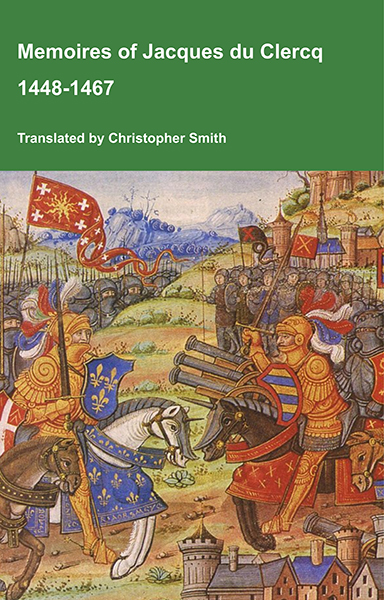 Memoires Jacques du Clercq. After what has been said, in great joy and celebration the King of France kept the feast of All Saints [1st November] at the place of Sainte-Catherine near Rouen; then he set out on the following Monday, the 11th day of the month of November, the eve of St Martin in winter, to enter the city of Rouen, accompanied by the King of Sicily and other lords of his blood hereafter named, in very great and rich attire. Some of them and their horses were covered in cloth of damask and satin in many fashions; others bore large white crosses, and others were adorned differently. Among them, after the King of France, those most richly arrayed were the Counts of Saint-Pol and of Nevers. The Count of Saint-Pol was armed entirely in white, mounted on a charger harnessed in black satin, adorned with goldsmith's work; after him came his pages, dressed and with their horses harnessed in the same manner as their lord's, one carrying a lance covered with crimson velvet, another with cloth of gold, a third bearing a helmet entirely of fine gold richly wrought; after them came the palfrey-keeper richly dressed and equipped like the others, leading a great charger covered entirely in cloth of gold down to the feet. The Count of Nevers had twelve gentlemen behind him, their horses covered in crimson satin with large white crosses. The King of France was mounted and armed in all pieces upon a courser covered to the feet with blue velvet embroidered with golden fleurs-de-lis; upon his head he wore a chaplet of crimson velvet with a tassel of gold thread. Behind him were his pages dressed in red, their sleeves entirely covered with goldsmith's work, carrying his helmets of fine gold of various designs, adorned with plumes of ostrich feathers of different colours. At his right was the King of Sicily, at his left the Count of Maine his brother, both armed in white, their horses richly harnessed and covered with white crosses strewn with tassels of gold thread, and their pages similarly arrayed. After them came the Count of Clermont and other lords of France, each according to his rank, very richly dressed. The lord of Culant, grand master of the household, followed, armed at all points upon a richly covered courser, with a scarf of fine gold hanging from his neck to the croup of his horse, and his pages before him; he commanded the battle, in which there were six hundred lances, each bearing a pennon of crimson satin with a golden sun. Behind the grand master was a squire carrying the standard of the King of France, dressed in crimson satin strewn with golden suns, and near him were the six hundred lances. A little ahead was the king's carver, mounted on a great charger, carrying the king's banner, which was of blue velvet embroidered with three golden fleurs-de-lis bordered with pearls. Before the king, very near him, was the lord of Treilley, bailiff of Berry and the king's grand squire, fully armed in white, mounted on a great charger harnessed in blue velvet adorned with large gilt silver fittings; he bore in a baldric the great ceremonial sword of the king, whose pommel, cross, chape, and tip were of gold, and whose scabbard was covered in blue velvet strewn with golden fleurs-de-lis.
APRÉS ce que dict est, en moult grande joye et liesse feit le roy de Franche sa feste de Toussaint audit lieu de Saincte Catherine, pres de Rouan, puis se parteit le lundy ensuivant xje jour du mois de novembre, veille de St Martin d'hyver, pour entrer en la ville de Rouan, accompagnié du roy de Cecille et aultres sieurs de son sang cy aprés nommés, en moult grands et riches habillements, les aulcuns eulx et leurs chevaulx couverts de drap de damas et de satin, én maintes guises, les aultres a grandes croix blanches, et les aultres aultrement, entre lesquels aprés le roy de Franche estoient en plus grands habillements, les comtes de St PoI et de Nevers. Le comte de St PoI estoit armé tout au bl ancq, monté sur un destrier enharnaché de satin noir, semé d'orfevrerie; aprés lui ses pages ves tus et leurs chevaulx harnachés de mesme comme celluy de leur seigneur, dont l'ung portoit une lanche couverte de velour vermeil; le second couvert de drap d'or; le tiers ung armet enla teste tout de fin or richement ouvré; aprés estoit le palfreniera ichernent vestu et harnaché comme les aultres pages, lequel menoit ung grand destrier en main, tout couvert de drap d'or jusqu'aulx pieds. Le comte de Nevers avoit douze gentilhommes après lui, leurs chevaulx couverts de satin vermeil a grandes croix blanches. Le roy de Franche estoit monté et armé de toutes pieches sur ung coursier couvert jusques aulx pieds de velour d'azur, semé de fleur de lys d'or de brodure; en sa teste avoit un Chappel de velour vermeil ou avoit au bout une houppe defil d'or; aprés lui ses pages vestus de vermeil, les manches toutes couvertes d'orfevrerie; lesquels portoient ses harnois de teste couverts de fin or de diverses fagons et plumes d'autruche, de diverses couleurs; a sa dextre estoit le roy de Cecille, a sa senestre le comte de Maines son frere, armés touts a blancq, leurs chevaulx richement harnachés et couverts de croix blanches semées de houppes de fil d'or, et leurs pages semblablement; aprés estoit le comte de Clermont et aultres Srs de Franche, chacun selon son degré., moult richernent habillé. Le Sr de Cullant, grand maitre d'hostel, venoit apros armé de toutes pieches, sur ung coursier moult richement couvert, en son col une escharpe de fin or pendant jusqu'a la croupe de son cheval, et de-vant lui ses pages; lequel estoit gouverneur de la bataille, ou y avoit vj cens lanches et. eu chacune ung panoncel de satin vermeil a ung soleil d'or. Derriere le grand maitre d'hostel estoit ung escuyer: qui portoit l'estendard du roy de Franche, Jequel estoit vestu de satin cramoisy semé de soleils d'or, et joindant de lui estoient les vj cens lancbes, ung peu devant estoit son escuyer tranchant, monté sur un grand destrier qui portoit le lequel estoit de velour azuré a trois fleurs de lys d'or de broderie, bordées de perles; devant le roy tout joignant estoit le Sr de Treilley bailly de berry et grand escuyer du ray, tout armé au blancq, monté sur ung grand destrier, enharnaché de velour azuré a grands affiquets d'argent doré, lequel portoit en escharpe la grande espée de parement du roy, dont le pomel, la croix et le morges et la bouterolle dela gayne estoient d'or, et la couverture de la gayne estoit converte de velour azuré semé de fleurs de lys d'or.
The Gentleman's Magazine Volume 101. This last entry is by a second hand; but at folio 73 of the same MS. we meet with a more correct notice of this Princess's [Bridget York] birth, to which is added the ceremonial of her Christening, and as it is short, and has never been noticed, I shall transcribe it here.
Md that in the yere of our lorde Ml iiije iiijxx And the xxth yere of the Reigne of Kinge Edwarde the iiijth on Sainte Martyns even, was Borne the lady Brigette, And Cristened on the morne on Sainte Martyns daye [11th November 1480] In the Chappell' of Eltham, by the Busshoppe of Chichester in order As ensuethe.
Furste C Torches borne by Knightes, Esquiers, and other honneste Parsonnes.
The Lorde Matreuers [aged 30], Beringe the Basen, Havinge A Towell' aboute his necke.
Therle of Northumberlande [aged 31] beringe A Taper not light'.
Therle of Lincolne [aged 18] the Salte.
The Canapee borne by iij Knightes and A Baron.
My lady Matrauers [aged 26] dyd bere A Ryche Crysom Pynned Ouer her lefte breste.
The Countesse of Rychemond [aged 37] did Bere The Princesse.
My lorde Marques Dorsette [aged 25] Assisted her.
My lady the Kinges Mother [aged 65], and my lady Elizabethe [aged 14], were godmothers at the Fonte.
The Busshoppe of Winchester [aged 82] Godfather.
And in the Tyme of the christeninge, The officers of Armes caste on theire cotes.
And then were light' all' the foresayde Torches.
Presente, theise noble men enseuenge.
The Duke of Yorke [aged 7].
The lorde Hastinges [aged 49], the Kinges chamberlayn.
The lorde Stanley [aged 45], Stewarde of the Kinges house.
The lorde Dacres [aged 65] the quenes chamberlein, and many other astates.
And when the sayde Princesse was christened, A Squier helde the Basens to the gossyppes, and even by the Fonte my lady Matravers was godmother to the conformacion.
And from thens she was borne before the high' aulter, And that Solempnitee doon she was Borne eftesonys into her Parclosse,1 Accompenyed wt the Astates Aforesayde.
And the lorde of Sainte Joanes brought' thither A Spice plate.
And At the sayde Parclose the godfather and the godmother gaue greate gyftes to the sayde princesse.
Whiche gyftes were borne by Knightes and esquiers before the sayde Princesse, turneng to the quenes chamber Againe, well' Accompanyed As yt Apperteynethe, and after the custume of this Realme. Deo gr'as.
It must be remarked, that the above memoranda confirm the order of the births of King Edward's children, as stated by Mr. Nicolas, and prove Sandford to have been mistaken. The name of George of Shrewsbury, the third son of Edward, is omitted, and the date of his birth is unknown; but on making an excavation in St. George's Chapel, at Windsor, in 1810, his body was found in a leaden coffin, and an inscription, partly obliterated, which fixes his death to March, 1473. Lysons's Berksh. p. 471.
Yours, & c.
F. M.
Note 1. "Parclos to parte two roumes, separation." — Palsgrave.


Letters and Papers Foreign and Domestic Henry VIII 1517. 11th November 1517. Giust. Desp. II. 135. 3788. Sebastian Giustinian [aged 57] to the DOGE.
Has received their letters, which he communicated to the Cardinal, who is now gone to a place of his in consequence of the sickness. The Bp. of Paris and De la Guiche have arrived as ambassadors from France. They could not obtain admission to the King through fear of the plague. "I endeavoured to learn the cause of their coming, but the Reverend Bishop of Ely having made his appearance, I had no opportunity. It is said that they have come about certain reprisals, but I do not believe that envoys of such dignity would have been sent on so trivial an errand, especially as the aforesaid Bishop of Ely and the Lord Chamberlain, who had been appointed as envoys to France, will now not go there." The King is abroad, and moves from place to place on account of the plague, which makes great ravages in the royal Household. Some of the pages who slept in his chamber have died. None remain with him except three favorite gentlemen and Memo. Violent storms have destroyed the shipping. London, 11 Nov. 1517.
On 11th November 1532 Henry VIII [aged 41] and Queen Anne Boleyn of England [aged 31] met with King Francis I of France [aged 38] at Calais [Map]. Henry Howard Earl of Surrey [aged 16] was present.
Those listed as travelling with Henry and Anne include:
Thomas Manners 1st Earl of Rutland [aged 40] and Eleanor Paston Countess Rutland [aged 37].
William Stafford [aged 24]; this may have been when he first met Mary Boleyn [aged 33].
Chronicle of Walter of Guisborough
A canon regular of the Augustinian Guisborough Priory, Yorkshire, formerly known as The Chronicle of Walter of Hemingburgh, describes the period from 1066 to 1346. Before 1274 the Chronicle is based on other works. Thereafter, the Chronicle is original, and a remarkable source for the events of the time. This book provides a translation of the Chronicle from that date. The Latin source for our translation is the 1849 work edited by Hans Claude Hamilton. Hamilton, in his preface, says: 'In the present work we behold perhaps one of the finest samples of our early chronicles, both as regards the value of the events recorded, and the correctness with which they are detailed; Nor will the pleasing style of composition be lightly passed over by those capable of seeing reflected from it the tokens of a vigorous and cultivated mind, and a favourable specimen of the learning and taste of the age in which it was framed.'
Available at Amazon in eBook and Paperback format.
Spanish Chronicle Chapter 16. How the King went to Calais with his Queen Anne.
Letters and Papers Foreign and Domestic Henry VIII 1541. 11 Nov [1541]. 1331. The Privy Council to [Cranmer, and Others]. R. O. St. P., i. 691.
The King, having considered their letters, wills them to persevere in attaining knowledge of the truth and to execute his pleasure before signified to them; foreseeing that they take not from the Queen her privy keys till they have done all the rest. She is to be removed to Syon House [Map], and there lodged moderately, as her life has deserved, without any cloth of estate, with a chamber for Mr. Baynton [aged 49] and the rest to dine in, and two for her own use, and with a mean number of servants, as in a book herewith. She shall have four gentlewomen and two chamberers at her choice, save that my lady Baynton shall be one, whose husband shall have the government of the whole house and be associated with the Almoner. The rest of her servants shall depart on Monday next. Sir John Dudley shall conduct my lady Mary to my lord Prince's, with a convenient number of the Queen's servants; and lady Margaret Douglas shall go to Keningale, in Norfolk, with my lady of Richmond, if my lord her father and she are content. Order is to be taken for the maidens to return to their friends, save Mrs. Bassett, whom the King, "in consideration of the calamity of her friends, will, at his charges, specially provide for." If any others have no home or friends, their names are to be signified, that the household may be dismissed with the satisfaction of the parties.
Tomorrow the lord Chancellor, assembling all the King's councillors, spiritual and temporal, judges and learned counsel, shall declare to them the abominable demeanour of the Queen, without calling Deram, as was intended, or mentioning any pre-contract, which might serve for her defence, but only to show the King's just cause of indignation. Also those who know the whole matter, and how and by whom it came to the King's knowledge, "and the King's sorrowful behaviour and careful proceeding in it," shall, on Sunday next, assemble all the ladies, gentlewomen, and gentlemen of "that household," and declare to them the whole matter, omitting all mention of precontract, but setting forth "such matter as might engreave and 'consome' their misdemeanour" and set forth the King's goodness. The Queen's departing to Syon shall be on Monday next or later. The ladies and others appointed to depart shall do so on Monday, and only such remain at Hampton Court as shall attend her to Syon. Mr. Controller shall understand that Mr. Weldon, master of the Household, has been spoken to, to make provision "of wine, beer, and other necessaries" at Syon. Westm., 11 Nov., at night. Signed by Norfolk, Southampton, Sussex, Russell, Sir Ant. Browne, Sir Ant. Wyngfeld, and Ralph Sadleyr.
Pp. 4. Slightly mutilated. Flyleaf, with address gone.
On 11th November 1562 Bishop Richard Howand [aged 22] was elected a Fellow of Peterhouse College, Cambridge University [Map] and proceeded M. A. in 1564.
On 11th November 1583 Gerald Fitzgerald 14th Earl Desmond [aged 50] was beheaded in Glenageenty Wood near Tralee, County Kerry. See account of his execution in Selections from Old Kerry Records.
Selections from Old Kerry Records Page 117. In the dawning of the day on Mundaye, the 11th of November [1583], they put themselves in order to set upon the traytors in their cabins; this examinate with his brother Donnil with their kerne broke the foreward, (went first) and appointed the souldiers to keepe the rereward, saving that one Daniel O'Kelly, a souldier, which had but his sword and target stood in the forewarde with them; they all making a greate crye entered the cabbin, where the Earle lay, and this Deponent ran round throwe the cabbin after the Earle's companie which fledde to the woode, and at his return backe to the cabbin doore, the Earle being stroken by one of the companie by whom certayne hee knoweth not, (but that alle the footemenne and souldiers were together within the cabbin.) hee discovered himselfe sayinge, "I am the Earle of Desmond [aged 50]. Save my lyfe!" To whom this Deponent answered, — "thou hast killed thyself long agone, and noue thou shalt be prisoner to the Queen's Majestie and to the Earl of Ormonde, Lord Generall of Munster." whereon this Deponent took him by his arme being cutte, and willed the Earle to make spcede else they would carrye awayc his headc seeing the traytours drew very neare to have him rescued. Whereupon Donnil Mae Donnil sayde, " I will carry him on my backe awhile and so shall every one of you;" Donnil carried him a good while and being weary he put him ofTe, the traytors being at hande all the companie refused to carry him anie furtherfrom Castle Mang sent after the track declared they would proceed no further, but Deponent promised them "two beeves of the prey" if they succeeded in recovering it. The men agreeing, the party went forward, and the track was followed by daylight to Ballyore, and by moonlight toward Glamiageeiitie at Slieve Loughra, when the Deponent and his elder brother got up above the glenne to view whether they might see anie fire in the woode, or heare anie stirre, and having come to the heighte over the glin they saw a fire underneath them. Donnil went to spy and returned reporting there were some persons there, but no cattel; they agreed to wait until the preye was found with them. In the dawning of the day on Mundaye, the nth of November, they put themselves in order to set upon the traytors in their cabins; this examinate with his brother Donnil with their kerne broke the foreward, (went first) and appointed the souldiers to kecpe the rereward, saving that one Daniel O'Kelly, a souldier, which had but his sword and target stood in the forewarde with them; they all making a greate cryc entered the cabbin, where the Earle lay, and this Deponent ran round throwe the cabbin after the Earle's companie which fledde to the woode, and at his return backe to the cabbin doore, the Earle being stroken by one of the companie by whom certayne hee knoweth not, (but that alle the footemenne and souldiers were together within the cabbin.) hee discovered himselfe sayinge, " I am the Earle of Desmond.' Save my lyfe!" To whom this Deponent answered, — "thou hast killed thyself long agone, and noue thou shalt be prisoner to the Queen's Majestic and to the Earl of Ormonde, Lord Gcnerall of Munster." whereon this Deponent took him by his arme being cutte, and willed the Earle to make speede else they would carrye awayc his headc seeing the traytours drew very neare to have him rescued. Whereupon Donnil Mae Donnil sayde, "I will carry him on my backe awhile and so shall every one of you;" Donnil carried him a good while and being weary he put him offe, the traytors being at hande all the companie refused to carry him anie further considering the eminent danger they stood in, the traytours drawing ncarc. Whereat this Deponent willed the souldier, Daniel CPKelly, to cut off the Erie's head for that they could not apply to fight and to carry him away, to whose direction Kelly obeyed, drawing out his sword and striking off the Erie's head, which they brought to Castle Mang to be kept there, till they were ready to take it to the Lord General. Daniel OKelly being examined testified to the above narrative, and stated that he himself wounded the Erie in the cabbin. Saide before the Right Honourable the Erie of Ormonde, the Bishop of Ossory and the Sovereign of Kilkenny.
On 11th November 1612 August Philipp Oldenburg I Duke Schleswig-Holstein-Sonderburg-Beck was born to Alexander Oldenburg I Duke Schleswig Holstein Sonderburg [aged 39] and Dorothea Schwarzburg Duchess Schleswig Holstein Sonderburg [aged 33] at Sønderborg. He married 12th April 1651 Marie Sibylle Nassau Saarbrücken Duchess Schleswig-Holstein-Sonderburg-Beck and had issue.

Hudibras On Samuel Butler Author of Hudibras. Lord Dorset [aged 40] is said to have first introduced Hudibras to court. November 11, 1662, the author obtained an imprimatur, signed J. Berkenhead, for printing his poem; accordingly in the following year he published the first part, containing 125 pages. Sir Roger L'Estrange granted an imprimatur for the second part of Hudibras, by the author of the first, November 5, 1663, and it was printed by T. R. for John Martin, 1664.
Samuel Pepys' Diary. 11th November 1664. Up, and with Sir J. Minnes [aged 65] and Sir W. Batten [aged 63] to the Council Chamber at White Hall, to the Committee of the Lords for the Navy, where we were made to wait an houre or two before called in. In that time looking upon some books of heraldry of Sir Edward Walker's making, which are very fine, there I observed the Duke of Monmouth's [aged 15] armes are neatly done, and his title, "The most noble and high-born Prince, James Scott, Duke of Monmouth, &c."; nor could Sir J. Minnes, nor any body there, tell whence he should take the name of Scott? And then I found my Lord Sandwich [aged 39], his title under his armes is, "The most noble and mighty Lord, Edward, Earl of Sandwich, &c".


Samuel Pepys' Diary. 11th November 1664. By and by we were called in, where a great many lords: Annesly [aged 50] in the chair. But, Lord! to see what work they will make us, and what trouble we shall have to inform men in a business they are to begin to know, when the greatest of our hurry is, is a thing to be lamented; and I fear the consequence will be bad to us.
Samuel Pepys' Diary. 11th November 1664. After dinner out again by coach to my Chancellor's [aged 55], but could not speak with him, then up and down to seek Sir Ph. Warwicke [aged 54], Sir G. Carteret [aged 54], and my Lord Berkeley [aged 62], but failed in all, and so home and there late at business. Among other things Mr. Turner making his complaint to me how my clerks do all the worke and get all the profit, and he hath no comfort, nor cannot subsist, I did make him apprehend how he is beholding to me more than to any body for my suffering him to act as Pourveyour of petty provisions, and told him so largely my little value of any body's favour, that I believe he will make no complaints again a good while.


Samuel Pepys' Diary. 11th November 1667. Thence with him and Lord Bruncker [aged 47] to Captain Cocke's [aged 50] (he out of doors), and there drank their morning draught, and thence Sir G. Carteret [aged 57] and I toward the Temple [Map] in coach together; and there he did tell me how the King [aged 37] do all he can in the world to overthrow my Chancellor [aged 58], and that notice is taken of every man about the King that is not seen to promote the ruine of the Chancellor; and that this being another great day in his business, he dares not but be there. He tells me that as soon as Secretary Morrice [aged 65] brought the Great Seale from my Chancellor, Bab. May [aged 39] fell upon his knees, and catched the King about the legs, and joyed him, and said that this was the first time that ever he could call him King of England, being freed from this great man: which was a most ridiculous saying. And he told me that, when first my Lord Gerard [aged 49], a great while ago, come to the King, and told him that the Chancellor did say openly that the King was a lazy person and not fit to govern, which is now made one of the things in the people's mouths against the Chancellor, "Why", says the King, "that is no news, for he hath told me so twenty times, and but the other day he told me so"; and made matter of mirth at it: but yet this light discourse is likely to prove bad to him. I 'light at the Temple [Map], and went to my tailor's and mercer's about a cloake, to choose the stuff, and so to my bookseller's and bought some books, and so home to dinner, and Simpson my joyner with me, and after dinner, my wife, and I, and Willett, to the King's play-house, and there saw "The Indian Emperour", a good play, but not so good as people cry it up, I think, though above all things Nell's ill speaking of a great part made me mad.

This is a translation of the 'Memoires of Jacques du Clercq', published in 1823 in two volumes, edited by Frederic, Baron de Reissenberg. In his introduction Reissenberg writes: 'Jacques du Clercq tells us that he was born in 1424, and that he was a licentiate in law and a counsellor to Philip the Good, Duke of Burgundy, in the castellany of Douai, Lille, and Orchies. It appears that he established his residence at Arras. In 1446, he married the daughter of Baldwin de la Lacherie, a gentleman who lived in Lille. We read in the fifth book of his Memoirs that his father, also named Jacques du Clercq, had married a lady of the Le Camelin family, from Compiègne. His ancestors, always attached to the counts of Flanders, had constantly served them, whether in their councils or in their armies.' The Memoires cover a period of nineteen years beginning in in 1448, ending in in 1467. It appears that the author had intended to extend the Memoirs beyond that date; no doubt illness or death prevented him from carrying out this plan. As Reissenberg writes the 'merit of this work lies in the simplicity of its narrative, in its tone of good faith, and in a certain air of frankness which naturally wins the reader’s confidence.' Du Clercq ranges from events of national and international importance, including events of the Wars of the Roses in England, to simple, everyday local events such as marriages, robberies, murders, trials and deaths, including that of his own father in Book 5; one of his last entries.
Available at Amazon in eBook and Paperback format.
Samuel Pepys' Diary. 11th November 1668. Up, and my wife with me as before, and so to the Office, where, by a speciall desire, the new Treasurers come, and there did shew their Patent, and the Great Seal for the suspension of my Lord Anglesey [aged 54]: and here did sit and discourse of the business of the Office: and brought Mr. Hutchinson with them, who, I hear, is to be their Paymaster, in the room of Mr. Waith. For it seems they do turn out every servant that belongs to the present Treasurer: and so for Fenn, do bring in Mr. Littleton, Sir Thomas's [aged 47] brother, and oust all the rest. But Mr. Hutchinson do already see that his work now will be another kind of thing than before, as to the trouble of it. They gone, and, indeed, they appear, both of them, very intelligent men, I home to dinner, and there with my people dined, and so to my wife, who would not dine with [me] that she might not have the girle come in sight, and there sat and talked a while with her and pretty quiet, I giving no occasion of offence, and so to the office1, and there having done, I home and to supper and to bed, where, after lying a little while, my wife starts up, and with expressions of affright and madness, as one frantick, would rise, and I would not let her, but burst out in tears myself, and so continued almost half the night, the moon shining so that it was light, and after much sorrow and reproaches and little ravings (though I am apt to think they were counterfeit from her), and my promise again to discharge the girle myself, all was quiet again, and so to sleep.
Note 1. and then by coach to my cozen Roger Pepys [aged 51], who did, at my last being with him this day se'nnight, move me as to the supplying him with £500 this term, and £500 the next, for two years, upon a mortgage, he having that sum to pay, a debt left him by his father, which I did agree to, trusting to his honesty and ability, and am resolved to do it for him, that I may not have all I have lie in the King's hands. Having promised him this I returned home again, where to the office.

On 11th November 1670 Anne Bourbon Condé was born to Henri Jules Bourbon Condé Prince Condé [aged 27] and Anne Henriette Palatinate Simmern [aged 22]. She a great x 2 granddaughter of King James I of England and Ireland and VI of Scotland. She died aged four in 1675.
John Evelyn's Diary. 11th November 1677. I was all this week composing matters between old Mrs. Howard [aged 51] and Sir Gabriel Sylvius, upon his long and earnest addresses to Mrs. Anne [aged 24], her second daughter, maid of honor to the Queen [aged 38]. My friend, Mrs. Godolphin [aged 25] (who exceedingly loved the young lady) was most industrious in it, out of pity to the languishing knight; so as though there were great differences in their years, it was at last effected, and they were married the 13th, in Henry VII.'s Chapel [Map], by the Bishop of Rochester [aged 52], there being besides my wife [aged 42] and Mrs. Graham [aged 26], her sister, Mrs. Godolphin, and very few more. We dined at the old lady's, and supped at Mr. Graham's [aged 28] at St. James's.


On 11th November 1684 Algernon Seymour 7th Duke of Somerset was born to Charles Seymour 6th Duke of Somerset [aged 22] and Elizabeth Percy Duchess Somerset [aged 17]. He married 5th July 1715 his third cousin once removed Frances Thynne Duchess Somerset and had issue.


On 11th November 1691 Peregrine Osborne 3rd Duke Leeds was born to Peregrine Osborne 2nd Duke Leeds [aged 32] and Bridget Hyde Duchess Leeds [aged 29]. He married (1) 16th December 1712 Elizabeth Harley, daughter of Robert Harley 1st Earl of Oxford and Earl Mortimer and Elizabeth Foley Countess of Oxford and Mortimer, and had issue (2) 17th September 1719 his fifth cousin Anne Seymour, daughter of Charles Seymour 6th Duke of Somerset and Elizabeth Percy Duchess Somerset.

Minutes of the Society of Antiquaries. 11th November 1718. Mr Le Neve President [aged 57] exhibited to the Society a drawing of of the West View of the Abbey Gates of St Bennetts in the Holme [Map] in Norfolk, another view of the East side of the same, a view of the Gatehouse of the Lord Scales Palace at Middleton.
On 11th November 1748 Charles IV King Spain was born to Charles III King Spain [aged 32] and Maria Amalia of Saxony Queen Consort Spain [aged 23]. He married 1765 his first cousin Maria Luisa of Parma, daughter of Infante Philip of Spain and Louise Elisabeth of France, and had issue.


On 11th November 1749 Frederick William Oldenburg II Duke Schleswig-Holstein-Sonderburg-Beck [aged 62] died. His brother Peter [aged 51] succeeded Aug I Duke Schleswig-Holstein-Sonderburg-Beck.
On 11th November 1762 Brownlow Bertie 5th Duke Ancaster and Kesteven [aged 33] and Harriot Pitt [aged 17] were married at Cork Street. She died five months later. He the son of Peregrine Bertie 2nd Duke Ancaster and Kesteven and Jane Brownlow Duchess Ancaster and Kesteven.

On 11th November 1777 Harriet Mellon Duchess St Albans was born to Matthew Mellon. Memoirs of Miss Mellon, 1886: "In the course of shop-gossip the intelligence respecting a new comer was easily obtained; so, before the evening, the history of this gentleman, as far as he had chosen to give it, was universally known. He described himself as 'Lieutenant Mathiew Mellon, of the Madras Native Infantry, who had come to Europe on sick leave, and was travelling through Ireland for chaiige of air.' Who this self-styled Lieutenant Mathew Mellon really luas will always remain a mystery. The name, which sounds unreal, most probably was assumed only while travelling by some young Englishman seeking adventures in Ireland. If it had been a genuine name, surely some connexion of his would gladly have answered the anxious inquiries of the duchess, even supposing his immediate relations were deceased. Mrs. Entwisle [Harriet's mother], who had all the reverence of her country for high rank, used to make the most extraordinary declarations confidentially respecting his being a nobleman! She married (1) 1816 Thomas Coutts (2) 16th June 1827 William Beauclerk 9th Duke St Albans, son of William Beauclerk 8th Duke St Albans and Maria Janetta Nelthorpe Duchess St Albans.
Adam Murimuth's Continuation and Robert of Avesbury’s 'The Wonderful Deeds of King Edward III'
This volume brings together two of the most important contemporary chronicles for the reign of Edward III and the opening phases of the Hundred Years’ War. Written in Latin by English clerical observers, these texts provide a vivid and authoritative window into the political, diplomatic, and military history of fourteenth-century England and its continental ambitions. Adam Murimuth Continuatio's Chronicarum continues an earlier chronicle into the mid-fourteenth century, offering concise but valuable notices on royal policy, foreign relations, and ecclesiastical affairs. Its annalistic structure makes it especially useful for establishing chronology and tracing the development of events year by year. Complementing it, Robert of Avesbury’s De gestis mirabilibus regis Edwardi tertii is a rich documentary chronicle preserving letters, treaties, and official records alongside narrative passages. It is an indispensable source for understanding Edward III’s claim to the French crown, the conduct of war, and the mechanisms of medieval diplomacy. Together, these works offer scholars, students, and enthusiasts a reliable and unembellished account of a transformative period in English and European history. Essential for anyone interested in medieval chronicles, the Hundred Years’ War, or the reign of Edward III.
Available at Amazon in eBook and Paperback format.
On 11th November 1789 Pietro Tenerani was born at Torano.
On 11th November 1808 James Fitzherbert [aged 85] died unmarried. He was buried at St Mary's Church, Tissington [Map].
James Fitzherbert: In In 1723 he was born to William Fitzherbert and Rachel Bagshaw.
On 11th November 1810 Johan Joseph Zoffany [aged 77] died. He was buried at St Anne's Church Kew, Surrey.

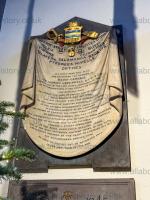
On 11th November 1823 Sophia Cecil [aged 31] died. Church of St Edmund, Holme Pierrepoint [Map]. Probably sculpted by Pierre Bazzanti.
Sophia Cecil: In February 1792 she was born to Henry Cecil 1st Marquess Exeter and Sarah Hoggins Countess Exeter at Great Bolas, Shropshire. In 1818 Henry Manvers Pierrepont and she were married. She the daughter of Henry Cecil 1st Marquess Exeter and Sarah Hoggins Countess Exeter. He the son of Charles Medows aka Pierrepont 1st Earl Manvers and Anne Mills Countess Manvers.
On 11th November 1844 Major-General Leonard Greenwell died. He was buried at the Cathedral Church St Nicholas, Newcastle upon Tyne [Map].
On 11th November 1847 twins Percy St Maur and Ernest St Maur were born to Algernon St Maur 14th Duke of Somerset [aged 33] and Horatia Isabella Harriet Morier Duchess Somerset [aged 28].
Ten Years' Digging. November 11th [1848] we continued the examination without success until near dark when we found a long grave in the rock parallel with the depression occupied by the former skeleton, and not more than a yard from it. It was eighteen inches deep, and covered with large stones; in it lay the skeleton of a young female, as usual on the left side, in a contracted posture. Before the face were indications of the skeleton of a very young child, and a highly-ornamented drinking cup of red clay, which lay crushed upon its side with the mouth towards the feet of the skeleton: it contained one broken instrument of flint. It was evident that the grave had been occupied by a previous tenant, whose bones, together with the remains of another drinking cup beautifully decorated, and a bit of stages horn, had been collected and placed under one of the large stones that covered the grave. This had clearly been done at the time when the female was buried. Owing to the lateness of the hour at which this interment was found, we were obliged to clear out the grave by candlelight, and thinking that something further might be discovered by day, we resumed the search on the 13th of November, but found only one rude flint arrow point in the grave; and a piece of a sandstone quern in refilling the excavation. There were many rats' bones in some parts of the mound, but not in the profusion sometimes met with.
On 11th November 1850 Catherine Emily Brown was born illegitimately to Ford Madox Brown [aged 29] and Emma Matilda Hill [aged 21].
On 11th November 1856 Alfred Drury was born to Richard Drury [aged 22].

On 11th November 1864 Constance Harriett Campbell was born to George Douglas Campbell 8th Duke Argyll [aged 41] and Elizabeth Georgiana Leveson-Gower Duchess Argyll.
The History of William Marshal was commissioned by his son shortly after William’s death in 1219 to celebrate the Marshal’s remarkable life; it is an authentic, contemporary voice. The manuscript was discovered in 1861 by French historian Paul Meyer. Meyer published the manuscript in its original Anglo-French in 1891 in two books. This book is a line by line translation of the first of Meyer’s books; lines 1-10152. Book 1 of the History begins in 1139 and ends in 1194. It describes the events of the Anarchy, the role of William’s father John, John’s marriages, William’s childhood, his role as a hostage at the siege of Newbury, his injury and imprisonment in Poitou where he met Eleanor of Aquitaine and his life as a knight errant. It continues with the accusation against him of an improper relationship with Margaret, wife of Henry the Young King, his exile, and return, the death of Henry the Young King, the rebellion of Richard, the future King Richard I, war with France, the death of King Henry II, and the capture of King Richard, and the rebellion of John, the future King John. It ends with the release of King Richard and the death of John Marshal.
Available at Amazon in eBook and Paperback format.
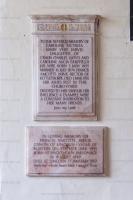
On 11th November 1876 Reverend Edwin George Jarvis [aged 60] died. Memorial at St Peter's Church, Doddington [Map].
Reverend Edwin George Jarvis: On 19th February 1816 he was born. On 26th March 1841 he and Frances Amcotts were married.
On 11th November 1882 Gustaf Adolph VI King Sweden was born to Gustav V King Sweden [aged 24]. He married (1) 15th June 1905 his fourth cousin twice removed Margaret "Daisy" Windsor, daughter of Prince Arthur Windsor 1st Duke Connaught and Strathearn and Luise Margarete Hohenzollern Duchess Connaught, and had issue (2) 3rd November 1923 his fifth cousin once removed Louise Mountbatten Queen Consort Sweden, daughter of Prince Louis of Battenburg 1st Marquess Milford Haven and Victoria Hesse Darmstadt Marchioness Milford Haven.

On 11th November 1904 Valentine Cameron Prinsep [aged 66] died. He was buried at Brompton Cemetery, Kensington.
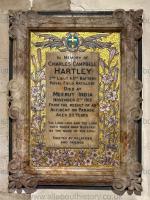
St Michael's Church, Rocester [Map]. Memorial to Charles Campbell Hartley, 2nd Lieutenant, 63rd Battery Royal Field Artillery. Died at Meerut, India, 11th November 1912 from the result of an accident on parade, aged 23 years.
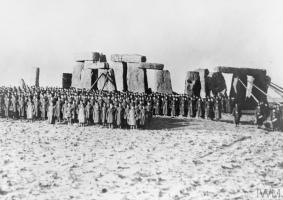
11th November 1915. Soldiers of the 8th Battalion, 90th Winnipeg Rifles attending the Divine Service at Stonehenge.

After 11th November 1916. All Saints Church, Sudbury [Map]. Memorial to George Francis Augustus Venables-Vernon 8th Baron Vernon [deceased].
George Francis Augustus Venables-Vernon 8th Baron Vernon: In 1888 he was born to George William Henry Venables-Vernon 7th Baron Vernon and Frances Margaret Lawrance Baroness Vernon. On 15th December 1898 George William Henry Venables-Vernon 7th Baron Vernon died. His son George succeeded 8th Baron Vernon of Kinderton in Cheshire. On 11th November 1916 George Francis Augustus Venables-Vernon 8th Baron Vernon died at Malta. His brother Francis succeeded 9th Baron Vernon of Kinderton in Cheshire. Violet Miriam Nightingale Clay Baroness Vernon by marriage Baroness Vernon of Kinderton in Cheshire.
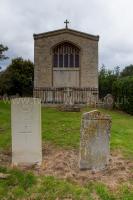
After 11th November 1918. All Saints Church, Barnwell [Map]. Commonwealth War Grave of Joseph Herbert Abbott [deceased], Depot Bn. Northamptonshire Regiment, 17990, who died of sickness aged forty-one, on the day the Armistice was signed.
Joseph Herbert Abbott: In 1877 he was born to Thomas Abbott and Jane Ginn at Polebrook, Northamptonshire. On 11th November 1918 he died of sickness.
On 11th November 1931 Archie Primrose [aged 21] died of blood poisoning at Oxford, Oxfordshire [Map].
On 11th November 1954 Anne Francis Seymour was born to Percy Hamilton Seymour 18th Duke of Somerset [aged 44] and Gwendoline Collette Jane Thomas Duchess Somerset.
On 11th November 1970 Charles Alfred Euston Fitzroy 10th Duke Grafton [aged 78] died. His son Hugh [aged 51] succeeded 11th Duke Grafton, 11th Earl Euston, 11th Viscount Ipswich, 11th Baron Sudbury. Ann Fortune Smith Duchess Grafton [aged 50] by marriage Duchess Grafton.
On 11th November 1050 Henry Holy Roman Emperor was born to Henry "Black Pious" Salian III Holy Roman Emperor [aged 33] and Agnes Poitiers. He married June 1066 Bertha Savoy and had issue.
On 11th November 1082 Raymond III Count Barcelona was born to Ramon Berenguer "Towhead" Barcelona II Count Barcelona [aged 29] in Rodez. He married 3rd February 1112 Douce Gevaudan Countess Barcelona and had issue.
On 11th November 1154 Sancho "Populator" I King Portugal was born to Afonso "Conqueror Founder Great" I King Portugal [aged 45] and Malfada Savoy Queen Consort Portugal [aged 29]. His nickname "Populator" not a consequence of the number of children he fathered, over sixty apparently, but his policy of populating remote areas in the northern Christian regions of Portugal. He married his fifth cousin Dulce Barcelona Queen Consort Portugal, daughter of Raymond V Count Barcelona, and had issue.
On 11th November 1155 Alfonso VIII King Castile was born to Sancho III King Castile [aged 21] and Blanche Ramirez Queen Consort Castile [aged 22]. He married before 17th September 1177 his half fourth cousin Eleanor Plantagenet Queen Consort Castile, daughter of King Henry "Curtmantle" II of England and Eleanor of Aquitaine Queen Consort Franks and England, and had issue.
On 11th November 1220 Alphonse Count Poitiers II Count Toulouse was born to King Louis VIII of France [aged 33] and Blanche Ivrea Queen Consort France [aged 32] at Poissy, Yvelines. He a great grandson of King Henry "Curtmantle" II of England. He married 1237 his second cousin Joan Countess of Toulouse, daughter of Raymond Rouerge VII Count Toulouse and Sancha Barcelona Countess Toulouse.
This is a translation of the 'Memoires of Jacques du Clercq', published in 1823 in two volumes, edited by Frederic, Baron de Reissenberg. In his introduction Reissenberg writes: 'Jacques du Clercq tells us that he was born in 1424, and that he was a licentiate in law and a counsellor to Philip the Good, Duke of Burgundy, in the castellany of Douai, Lille, and Orchies. It appears that he established his residence at Arras. In 1446, he married the daughter of Baldwin de la Lacherie, a gentleman who lived in Lille. We read in the fifth book of his Memoirs that his father, also named Jacques du Clercq, had married a lady of the Le Camelin family, from Compiègne. His ancestors, always attached to the counts of Flanders, had constantly served them, whether in their councils or in their armies.' The Memoires cover a period of nineteen years beginning in in 1448, ending in in 1467. It appears that the author had intended to extend the Memoirs beyond that date; no doubt illness or death prevented him from carrying out this plan. As Reissenberg writes the 'merit of this work lies in the simplicity of its narrative, in its tone of good faith, and in a certain air of frankness which naturally wins the reader’s confidence.' Du Clercq ranges from events of national and international importance, including events of the Wars of the Roses in England, to simple, everyday local events such as marriages, robberies, murders, trials and deaths, including that of his own father in Book 5; one of his last entries.
Available at Amazon in eBook and Paperback format.
On 11th November 1279 Pain Tiptoft 1st Baron Tibetot was born to Robert Tiptoft [aged 32] and Eva Chaworth [aged 27]. He married before 1313 Agnes Ros Baroness Tibetot, daughter of William Ros 1st Baron Ros Helmsley and Maud Vaux Baroness Ros, and had issue.
On 11th November 1289 Nicholas Audley 1st Baron Audley of Heighley was born to Nicholas Audley [aged 31] and Katharine Giffard. He a great x 3 grandson of King Henry "Curtmantle" II of England. He married 1312 Joan Fitzmartin Countess Lincoln and had issue.
On 11th November 1328 Roger Mortimer 2nd Earl March was born to Edmund Mortimer [aged 25] and Elizabeth Badlesmere Countess Northampton [aged 15] at Ludlow Castle [Map]. He married before 1352 Philippa Montagu Countess March, daughter of William Montagu 1st Earl Salisbury and Catherine Grandison Countess of Salisbury, and had issue.
On 11th November 1390 Joan Bardolf was born to Thomas Bardolf 5th Baron Bardolf [aged 20] and Avice Cromwell Baroness Bardolf [aged 20]. She a great x 4 granddaughter of King Edward I of England. She married before 1407 William Phelip and had issue.
On 11th November 1612 August Philipp Oldenburg I Duke Schleswig-Holstein-Sonderburg-Beck was born to Alexander Oldenburg I Duke Schleswig Holstein Sonderburg [aged 39] and Dorothea Schwarzburg Duchess Schleswig Holstein Sonderburg [aged 33] at Sønderborg. He married 12th April 1651 Marie Sibylle Nassau Saarbrücken Duchess Schleswig-Holstein-Sonderburg-Beck and had issue.
On 11th November 1633 George Savile 1st Marquess Halifax was born to William Savile 3rd Baronet [aged 21] and Anne Coventry Baroness Savile [aged 21] at Thornhill. He married (1) 1656 his half sixth cousin Dorothy Spencer Lady Savile, daughter of Henry Spencer 1st Earl of Sunderland and Dorothy Sidney Countess Sunderland, and had issue (2) 1672 his third cousin Gertrude Pierrepont Marchioness Halifax and had issue.


On 11th November 1635 Charles Hatton was born to Christopher Hatton 1st Baron Hatton [aged 30] and Elizabeth Montagu Baroness Hatton [aged 23]. He married before January 1708 Elizabeth Scroggs.
On 11th November 1670 Anne Bourbon Condé was born to Henri Jules Bourbon Condé Prince Condé [aged 27] and Anne Henriette Palatinate Simmern [aged 22]. She a great x 2 granddaughter of King James I of England and Ireland and VI of Scotland. She died aged four in 1675.
On 11th November 1684 Algernon Seymour 7th Duke of Somerset was born to Charles Seymour 6th Duke of Somerset [aged 22] and Elizabeth Percy Duchess Somerset [aged 17]. He married 5th July 1715 his third cousin once removed Frances Thynne Duchess Somerset and had issue.
On 11th November 1691 Peregrine Osborne 3rd Duke Leeds was born to Peregrine Osborne 2nd Duke Leeds [aged 32] and Bridget Hyde Duchess Leeds [aged 29]. He married (1) 16th December 1712 Elizabeth Harley, daughter of Robert Harley 1st Earl of Oxford and Earl Mortimer and Elizabeth Foley Countess of Oxford and Mortimer, and had issue (2) 17th September 1719 his fifth cousin Anne Seymour, daughter of Charles Seymour 6th Duke of Somerset and Elizabeth Percy Duchess Somerset.
Jean de Waurin's Chronicle of England Volume 6 Books 3-6: The Wars of the Roses
Jean de Waurin was a French Chronicler, from the Artois region, who was born around 1400, and died around 1474. Waurin’s Chronicle of England, Volume 6, covering the period 1450 to 1471, from which we have selected and translated Chapters relating to the Wars of the Roses, provides a vivid, original, contemporary description of key events some of which he witnessed first-hand, some of which he was told by the key people involved with whom Waurin had a personal relationship.
Available at Amazon in eBook and Paperback format.
On 11th November 1720 John Smith Burgh 11th Earl Clanricarde was born to Michael Burke 10th Earl Clanricarde [aged 34]. He married 1st July 1740 Hester Amelia Vincent Countess Clanricarde, daughter of Henry Vincent 6th Baronet, and had issue.
On 11th November 1727 Charles Turner 1st Baronet was born.
On 11th November 1732 Charlotte Bouverie was born to Jacob Bouverie 1st Viscount Folkestone [aged 38] and Mary Clarke. She married 30th June 1788 John Grant.
On 11th November 1748 Charles IV King Spain was born to Charles III King Spain [aged 32] and Maria Amalia of Saxony Queen Consort Spain [aged 23]. He married 1765 his first cousin Maria Luisa of Parma, daughter of Infante Philip of Spain and Louise Elisabeth of France, and had issue.
On 11th November 1752 John Turner aka Dryden 1st Baronet was born to Edward Turner 2nd Baronet [aged 33] and Cassandra Leigh 1739 1827 Lady Turner [aged 29]. He married 14th May 1781 Elizabeth Dryden and had issue.
On 11th November 1756 Francis Henry Egerton 8th Earl Bridgewater was born to Bishop John Egerton [aged 34] and Anne Sophia Grey [aged 26]. Coefficient of inbreeding 6.25%.
On 11th November 1765 John Evans 6th Baron Carbery was born to John Evans [aged 22] and Elizabeth Gore. He married 25th January 1783 his first cousin Catherine Charlotte Gore Baroness Carbery, daughter of Arthur Saunders Gore 2nd Earl Arran and Catherine Annesley.
On 11th November 1769 Alexander Ramey Home 10th Earl of Home was born to Alexander Home 9th Earl of Home and Abigail Browne Ramey Countess Home. He married 6th November 1798 his fourth cousin once removed Elizabeth Scott Countess Home, daughter of Henry Scott 3rd Duke Buccleuch and Elizabeth Montagu Duchess Buccleuch, and had issue.
On 7th November 1774 Richard Noel-Hill 4th Baron Berwick was born to Noel Hill 1st Baron Berwick [aged 29] and Anna Vernon [aged 26]. He was baptised at St Martin in the Fields Church [Map] on 11th November 1774. He married before 22nd November 1800 Frances Maria Owen and had issue.
On 11th November 1777 Harriet Mellon Duchess St Albans was born to Matthew Mellon. Memoirs of Miss Mellon, 1886: "In the course of shop-gossip the intelligence respecting a new comer was easily obtained; so, before the evening, the history of this gentleman, as far as he had chosen to give it, was universally known. He described himself as 'Lieutenant Mathiew Mellon, of the Madras Native Infantry, who had come to Europe on sick leave, and was travelling through Ireland for chaiige of air.' Who this self-styled Lieutenant Mathew Mellon really luas will always remain a mystery. The name, which sounds unreal, most probably was assumed only while travelling by some young Englishman seeking adventures in Ireland. If it had been a genuine name, surely some connexion of his would gladly have answered the anxious inquiries of the duchess, even supposing his immediate relations were deceased. Mrs. Entwisle [Harriet's mother], who had all the reverence of her country for high rank, used to make the most extraordinary declarations confidentially respecting his being a nobleman! She married (1) 1816 Thomas Coutts (2) 16th June 1827 William Beauclerk 9th Duke St Albans, son of William Beauclerk 8th Duke St Albans and Maria Janetta Nelthorpe Duchess St Albans.

The True Chronicles of Jean le Bel Volume 1 Chapters 1-60 1307-1342
The True Chronicles of Jean le Bel offer one of the most vivid and immediate accounts of 14th-century Europe, written by a knight who lived through the events he describes, and experienced some of them first hand. Covering the early decades of the Hundred Years’ War, this remarkable chronicle follows the campaigns of Edward III of England, the politics of France and the Low Countries, and the shifting alliances that shaped medieval warfare. Unlike later historians, Jean le Bel writes with a strong sense of eyewitness authenticity, drawing on personal experience and the testimony of fellow soldiers. His narrative captures not only battles and sieges, but also the realities of military life, diplomacy, and the ideals of chivalry that governed noble society. A key source for Jean Froissart, Le Bel’s chronicle stands on its own as a compelling and insightful work, at once historical record and literary achievement. This translation builds on the 1905 edition published in French by Jules Viard, adding extensive translations from other sources Rymer's Fœdera, the Chronicles of Adam Murimuth, William Nangis, Walter of Guisborough, a Bourgeois of Valenciennes, Geoffrey le Baker of Swinbroke and Richard Lescot to enrich the original text and Viard's notes.
Available at Amazon in eBook and Paperback format.
On 11th November 1787 Anne Cavendish was born to George Augustus Henry Cavendish 1st Earl Burlington [aged 33] and Elizabeth Compton Countess Burlington [aged 27]. She married 25th October 1825 her fourth cousin Charles Fitzroy, son of George Henry Fitzroy 4th Duke Grafton and Charlotte Maria Waldegrave, and had issue.
On 11th November 1789 Pietro Tenerani was born at Torano.
On 11th November 1798 John Duncan Bligh was born to John Bligh 4th Earl Darnley [aged 31].
On 11th November 1811 Thomas Winnington 4th Baronet was born to Thomas Winnington 3rd Baronet [aged 31] and Joanna Taylor Lady Winnington. He married in or before 1848 Helen Domvile, daughter of Compton Domvile 1st Baronet, and had issue.
On 11th November 1816 Charles Hugh Lindsay was born to James Lindsay 7th Earl Balcarres 24th Earl of Crawford [aged 33] and Maria Pennington Countess Balcarres and Crawford [aged 32] at Muncaster Castle, Ravenglass [Map]. He married 24th April 1851 Emilia Anne Browne and had issue.
On 11th November 1828 Joseph Wallis O'Bryen Hoare 5th Baronet was born to Edward Hoare 4th Baronet [aged 26].

On 11th November 1829 Selina Constance de Burgh Baroness Ward was born to Hubert de Burgh and Marianne Tollemache. She married 24th April 1851 William Ward 1st Earl of Dudley, son of William Humble Ward 10th Baron Ward.
On 11th November 1837 Emma Caroline Cholmondeley was born to William Cholmondeley 3rd Marquess Cholmondeley [aged 37] and Marcia Emma Georgiana Arbuthnot Marchioness Cholmondeley [aged 33]. She died aged one in 1839.
On 11th November 1838 Francis Blackwood 4th Baronet was born to Henry Blackwood 2nd Baronet [aged 37].
On 11th November 1847 twins Percy St Maur and Ernest St Maur were born to Algernon St Maur 14th Duke of Somerset [aged 33] and Horatia Isabella Harriet Morier Duchess Somerset [aged 28].
On 11th November 1850 Catherine Emily Brown was born illegitimately to Ford Madox Brown [aged 29] and Emma Matilda Hill [aged 21].
On 11th November 1856 Alfred Drury was born to Richard Drury [aged 22].
Anne Boleyn. Her Life as told by Lancelot de Carle's 1536 Letter.
In 1536, two weeks after the execution of Anne Boleyn, her brother George and four others, Lancelot du Carle, wrote an extraordinary letter that described Anne's life, and her trial and execution, to which he was a witness. This book presents a new translation of that letter, with additional material from other contemporary sources such as Letters, Hall's and Wriothesley's Chronicles, the pamphlets of Wynkyn the Worde, the Memorial of George Constantyne, the Portuguese Letter and the Baga de Secrets, all of which are provided in Appendices.
Available at Amazon in eBook and Paperback format.
On 11th November 1864 Constance Harriett Campbell was born to George Douglas Campbell 8th Duke Argyll [aged 41] and Elizabeth Georgiana Leveson-Gower Duchess Argyll.
On 11th November 1869 Charles Yorke 8th Earl of Hardwicke was born to John Manners Yorke 7th Earl of Hardwicke [aged 29] and Edith Mary Oswald Countess of Hardwicke.
On 11th November 1880 James Richard Stanhope 7th Earl Stanhope 13th Earl Chesterfield was born to Arthur Philip Stanhope 6th Earl Stanhope [aged 42] and Evelyn Henrietta Pennefather Countess Stanhope. He married before September 1940 Eileen Agatha Browne Countess Stanhope.
On 11th November 1882 Gustaf Adolph VI King Sweden was born to Gustav V King Sweden [aged 24]. He married (1) 15th June 1905 his fourth cousin twice removed Margaret "Daisy" Windsor, daughter of Prince Arthur Windsor 1st Duke Connaught and Strathearn and Luise Margarete Hohenzollern Duchess Connaught, and had issue (2) 3rd November 1923 his fifth cousin once removed Louise Mountbatten Queen Consort Sweden, daughter of Prince Louis of Battenburg 1st Marquess Milford Haven and Victoria Hesse Darmstadt Marchioness Milford Haven.
On 11th November 1883 John Wodehouse 3rd Earl Kimberley was born to John Wodehouse 2nd Earl Kimberley [aged 35] and Isabel Geraldine Stracey Countess Kimberley. He married 5th May 1922 Frances Margaret Irby Countess Kimberley and had issue.
On 11th November 1934 Timothy Edward Charles Hoare 8th Baronet was born to Edward O'Bryen Hoare 7th Baronet [aged 36] and Nina Mary Hope-Wallace Lady Hoare [aged 28].
On 11th November 1954 Fiona Morrison Viscountess Trenchard was born to James Morrison 2nd Baron Margadale [aged 24]. She married 9th April 1975 Hugh Trenchard 3rd Viscount Trenchard, son of Thomas Trenchard 2nd Viscount Trenchard.
On 11th November 1954 Anne Francis Seymour was born to Percy Hamilton Seymour 18th Duke of Somerset [aged 44] and Gwendoline Collette Jane Thomas Duchess Somerset.
On 11th November 1974 Charles Cavendish 7th Baron Chesham was born to Nicholas Cavendish 6th Baron Chesham [aged 33].
On 11th November 1100, three months after acceeding to the throne, King Henry I "Beauclerc" England [aged 32] and Matilda of Scotland [aged 20] were married. She was crowned Queen Consort England. Baptised Edith she took the regnal name Matilda. The marriage brought together the houses of Normandy and Wessex; she was a great granddaughter of King Edmund I of England. She the daughter of King Malcolm III of Scotland and Margaret Wessex Queen Consort Scotland. He the son of King William "Conqueror" I of England and Matilda Flanders Queen Consort England.
On 11th November 1430 William "Jackanapes" de la Pole 1st Duke of Suffolk [aged 34] and Alice Chaucer Duchess Suffolk [aged 26] were married. She by marriage Countess Suffolk. He the son of Michael de la Pole 2nd Earl Suffolk and Katherine Stafford Countess Suffolk. They were fourth cousin once removed. He a great x 4 grandson of King Edward I of England.
Chronicle of a Bourgeois of Valenciennes
Récits d’un bourgeois de Valenciennes aka The Chronicle of a Bourgeois of Valenciennes is a vivid 14th-century vernacular chronicle written by an anonymous urban chronicler from Valenciennes in the County of Hainaut. It survives in a manuscript that describes local and regional history from about 1253 to 1366, blending chronology, narrative episodes, and eyewitness-style accounts of political, military, and social events in medieval France, Flanders, and the Low Countries. The work begins with a chronological framework of events affecting Valenciennes and its region under rulers such as King Philip VI of France and the shifting allegiances of local nobility. It includes accounts of conflicts, sieges, diplomatic manoeuvres, and the impact of broader struggles like the Hundred Years’ War on urban life in Hainaut. Written from the perspective of a burgher (bourgeois) rather than a monastery or royal court, the chronicle offers a rare lay viewpoint on high politics and warfare, reflecting how merchants, townspeople, and civic institutions experienced the turbulence of the 13th and 14th centuries. Its narrative style combines straightforward reporting of events with moral and civic observations, making it a valuable source for readers interested in medieval urban society, regional politics, and the lived experience of war and governance in pre-modern Europe.
Available at Amazon in eBook and Paperback format.
On 11th November 1565 Ambrose Dudley 3rd Earl Warwick [aged 35] and Anne Russell Countess Warwick [aged 17] were married. She by marriage Countess Warwick. She the daughter of Francis Russell 2nd Earl Bedford [aged 38] and Margaret St John Countess Bedford. He the son of John Dudley 1st Duke Northumberland and Jane Guildford Duchess Northumberland.

On 11th November 1610 Thomas Leigh 1st Baron Leigh [aged 15] and Mary Egerton Baroness Leigh [aged 15] were married.
On 11th November 1657 Robert Rich [aged 23] and Frances Cromwell Baroness Russell [aged 19] were married. He died three months later. She the daughter of Oliver Cromwell [aged 58] and Elizabeth Bourchier [aged 59]. He the son of Robert Rich 3rd Earl Warwick [aged 46] and Anne Cavendish Countess Warwick.


On 11th November 1749 James Radclyffe 4th Earl of Newburgh [aged 24] and Barbara Kemp Countess Newburgh were married. He the son of Charles Radclyffe Earl Newburgh and Charlotte Livingstone 3rd Countess Newburgh [aged 55]. They were third cousins. He a great grandson of King Charles II of England Scotland and Ireland.
On 11th November 1762 Brownlow Bertie 5th Duke Ancaster and Kesteven [aged 33] and Harriot Pitt [aged 17] were married at Cork Street. She died five months later. He the son of Peregrine Bertie 2nd Duke Ancaster and Kesteven and Jane Brownlow Duchess Ancaster and Kesteven.
On 11th November 1810 Thomas Winnington 3rd Baronet [aged 30] and Joanna Taylor Lady Winnington were married. She by marriage Lady Winnington of Stanford Court in Worcestershire. They had three sons and four daughters
On 11th November 1819 Nicholas Conway Colthurst 4th Baronet [aged 30] and Elizabeth Vesey Lady Colthurst were married. She by marriage Lady Colthurst of Ardum in County Cork.
On 11th November 1886 Anthony Charles Abdy 3rd Baronet [aged 38] and Alexandrina Victoria Macdonald [aged 26] were married.
On 11th November 1928 John Charles Peniston Milbanke 11th Baronet [aged 26] and Margaret Sheila MacKellar Chisholm [aged 30] were married at the Savoy Chapel Royal [Map]. Their wedding 1928 caused chaos in central London with people climbing on to parked cars to get a glimpse of the couple.


On 11th November 1285 Peter III King Aragon [aged 45] died. His son Alfonso [aged 20] succeeded III King Aragon.
Chronicle of a Bourgeois of Valenciennes
Récits d’un bourgeois de Valenciennes aka The Chronicle of a Bourgeois of Valenciennes is a vivid 14th-century vernacular chronicle written by an anonymous urban chronicler from Valenciennes in the County of Hainaut. It survives in a manuscript that describes local and regional history from about 1253 to 1366, blending chronology, narrative episodes, and eyewitness-style accounts of political, military, and social events in medieval France, Flanders, and the Low Countries. The work begins with a chronological framework of events affecting Valenciennes and its region under rulers such as King Philip VI of France and the shifting allegiances of local nobility. It includes accounts of conflicts, sieges, diplomatic manoeuvres, and the impact of broader struggles like the Hundred Years’ War on urban life in Hainaut. Written from the perspective of a burgher (bourgeois) rather than a monastery or royal court, the chronicle offers a rare lay viewpoint on high politics and warfare, reflecting how merchants, townspeople, and civic institutions experienced the turbulence of the 13th and 14th centuries. Its narrative style combines straightforward reporting of events with moral and civic observations, making it a valuable source for readers interested in medieval urban society, regional politics, and the lived experience of war and governance in pre-modern Europe.
Available at Amazon in eBook and Paperback format.
On 11th November 1288 Beatrix Reginar Countess Flanders [aged 63] died.
On 11th November 1375 Edward Despencer 1st Baron Despencer, Baron Burghesh [aged 40] died at Llanblethian. He was buried at Tewkesbury Abbey [Map]. His son Thomas [aged 2] succeeded 2nd Baron Despencer.
On 11th November 1462 Anne Cyprus Countess Savoy [aged 44] died.
On 11th November 1555 John Erskine 17th Earl of Mar [aged 68] died. His son John succeeded 18th Earl Mar, 6th Lord Erskine.
On 11th November 1583 Gerald Fitzgerald 14th Earl Desmond [aged 50] was beheaded in Glenageenty Wood near Tralee, County Kerry. See account of his execution in Selections from Old Kerry Records.
On 11th November 1652 Bishop John Bridgeman [aged 75] died at Moreton, Shropshire. He was buried at Kinnerley, Shropshire.
On 11th November 1680 Rachael Fane Countess Bath and Middlesex [aged 67] died.
On 11th November 1694 Mary Vavasour Lady Assheton [aged 28] died.
On 11th November 1702 Robert Sidney 4th Earl of Leicester [aged 53] died. His son Philip [aged 26] succeeded 5th Earl of Leicester, 5th Viscount Lisle.
On 11th November 1704 Wilfrid Lawson 2nd Baronet [aged 40] died. His son Wilfrid [aged 7] succeeded 3rd Baronet Lawson of Isel Hall in Cumbria.
Chronicle of a Bourgeois of Valenciennes
Récits d’un bourgeois de Valenciennes aka The Chronicle of a Bourgeois of Valenciennes is a vivid 14th-century vernacular chronicle written by an anonymous urban chronicler from Valenciennes in the County of Hainaut. It survives in a manuscript that describes local and regional history from about 1253 to 1366, blending chronology, narrative episodes, and eyewitness-style accounts of political, military, and social events in medieval France, Flanders, and the Low Countries. The work begins with a chronological framework of events affecting Valenciennes and its region under rulers such as King Philip VI of France and the shifting allegiances of local nobility. It includes accounts of conflicts, sieges, diplomatic manoeuvres, and the impact of broader struggles like the Hundred Years’ War on urban life in Hainaut. Written from the perspective of a burgher (bourgeois) rather than a monastery or royal court, the chronicle offers a rare lay viewpoint on high politics and warfare, reflecting how merchants, townspeople, and civic institutions experienced the turbulence of the 13th and 14th centuries. Its narrative style combines straightforward reporting of events with moral and civic observations, making it a valuable source for readers interested in medieval urban society, regional politics, and the lived experience of war and governance in pre-modern Europe.
Available at Amazon in eBook and Paperback format.
On 11th November 1718 Edward Irby 1st Baronet [aged 42] died intestate at Kings Cliffe, Northamptonshire. His son William [aged 11] succeeded 2nd Baronet Irby of Whaplode and Boston.
On 11th November 1749 Frederick William Oldenburg II Duke Schleswig-Holstein-Sonderburg-Beck [aged 62] died. His brother Peter [aged 51] succeeded Aug I Duke Schleswig-Holstein-Sonderburg-Beck.
On 11th November 1771 Frances Shelley Viscountess Fitzwilliam [aged 86] died.
On 11th November 1780 Anne Hamilton Countess Donegal [aged 42] died.
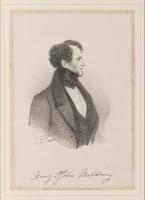
On 11th November 1808 Henry Paulet St John-Mildmay 3rd Baronet [aged 44] died. His son Henry [aged 21] succeeded 4th Baronet St John-Mildmay of Farley in Southampton.
On 11th November 1810 Johan Joseph Zoffany [aged 77] died. He was buried at St Anne's Church Kew, Surrey.
On 11th November 1817 Montagu Roger Burgoyne 8th Baronet [aged 44] died. His son John [aged 21] succeeded 9th Baronet Burgoyne of Sutton in Bedfordshire.
On 11th November 1821 Henrietta Frances Spencer Countess Bessborough [aged 60] died.


On 11th November 1823 Sophia Cecil [aged 31] died. Church of St Edmund, Holme Pierrepoint [Map]. Probably sculpted by Pierre Bazzanti.
Sophia Cecil: In February 1792 she was born to Henry Cecil 1st Marquess Exeter and Sarah Hoggins Countess Exeter at Great Bolas, Shropshire. In 1818 Henry Manvers Pierrepont and she were married. She the daughter of Henry Cecil 1st Marquess Exeter and Sarah Hoggins Countess Exeter. He the son of Charles Medows aka Pierrepont 1st Earl Manvers and Anne Mills Countess Manvers.
On 11th November 1828 Cecil Bishopp 12th Baron Zouche [aged 75] died. Baron Zouche Harringworth abeyant. His first cousin George [aged 37] succeeded 9th Baronet Bishopp of Parham in Sussex.
Jean de Waurin's Chronicle of England Volume 6 Books 3-6: The Wars of the Roses
Jean de Waurin was a French Chronicler, from the Artois region, who was born around 1400, and died around 1474. Waurin’s Chronicle of England, Volume 6, covering the period 1450 to 1471, from which we have selected and translated Chapters relating to the Wars of the Roses, provides a vivid, original, contemporary description of key events some of which he witnessed first-hand, some of which he was told by the key people involved with whom Waurin had a personal relationship.
Available at Amazon in eBook and Paperback format.
On 11th November 1836 George Murray 5th Earl Dunmore [aged 74] died at Glen Finart. His son Alexander [aged 32] succeeded 6th Earl Dunmore, 2nd Baron Dunmore of Dunmore in the Forest of Athole in Perthshire.
On 11th November 1837 George O'Brien Wyndham 3rd Earl Egremont [aged 85] died at Petworth House. His nephew George [aged 51] succeeded 4th Earl Egremont, 6th Baronet Wyndham of Orchard in Somerset. Jane Roberts Countess Egremont by marriage Countess Egremont. His left Petworth House to his illegitimate son George Wyndham 1st Baron Leconfield [aged 50].


On 11th November 1842 Charles Vereker 2nd Viscount Gort [aged 74] died. His son John [aged 52] succeeded 3rd Viscount Gort. Maria O'Grady Viscountess Gort [aged 51] by marriage Viscountess Gort.
On 11th November 1855 John Robert Cave-Browne-Cave 10th Baronet [aged 57] died. His son Mylles [aged 33] succeeded 11th Baronet Cave of Stanford in Northamptonshire.
On 11th November 1856 Susan Emily Paton Lady Cunliffe [aged 49] died.
On 11th November 1865 Richard Brooke 6th Baronet [aged 80] died. His son Richard [aged 50] succeeded 7th Baronet Brooke of Norton Priory in Cheshire.
On 11th November 1867 Margaret Mercer Elphinstone Countess Flahaut and 2nd Baroness Keith [aged 79] died at the Palais de la Légion d'Honneur. Baron Keith of Stonehaven Marrischal and Baron Keith of Banheath in Dumbarton extinct.
On 11th November 1874 Emma Green Lady Molyneux [aged 59] died.
On 11th November 1887 George Rushout 3rd Baron Northwick [aged 76] died. Baron Northwich of Northwick Park in Worcestershire, Baronet Rushout of Northwick Park in Worcestershire extinct. He was buried at St Mary's Church, Burford [Map].
On 11th November 1891 Albreda Elizabeth Wentworth-Fitzwilliam Baroness Lyveden [aged 62] died.
William of Worcester's Chronicle of England
William of Worcester, born around 1415, and died around 1482 was secretary to John Fastolf, the renowned soldier of the Hundred Years War, during which time he collected documents, letters, and wrote a record of events. Following their return to England in 1440 William was witness to major events. Twice in his chronicle he uses the first person: 1. when writing about the murder of Thomas, 7th Baron Scales, in 1460, he writes '… and I saw him lying naked in the cemetery near the porch of the church of St. Mary Overie in Southwark …' and 2. describing King Edward IV's entry into London in 1461 he writes '… proclaimed that all the people themselves were to recognize and acknowledge Edward as king. I was present and heard this, and immediately went down with them into the city'. William’s Chronicle is rich in detail. It is the source of much information about the Wars of the Roses, including the term 'Diabolical Marriage' to describe the marriage of Queen Elizabeth Woodville’s brother John’s marriage to Katherine, Dowager Duchess of Norfolk, he aged twenty, she sixty-five or more, and the story about a paper crown being placed in mockery on the severed head of Richard, 3rd Duke of York.
Available at Amazon in eBook and Paperback format.
On 11th November 1904 Valentine Cameron Prinsep [aged 66] died. He was buried at Brompton Cemetery, Kensington.

On 11th November 1916 George Francis Augustus Venables-Vernon 8th Baron Vernon [aged 28] died at Malta. His brother Francis [aged 27] succeeded 9th Baron Vernon of Kinderton in Cheshire. Violet Miriam Nightingale Clay Baroness Vernon [aged 21] by marriage Baroness Vernon of Kinderton in Cheshire.
On 11th November 1924 James Walter Grimston 3rd Earl Verulam [aged 72] died. His son James [aged 44] succeeded 4th Earl Verulam, 4th Viscount Grimston, 7th Viscount Grimston, 5th Baron Verulam of Gorhambury in Hertfordshire, 11th Baronet Grimston of Little Waltham in Essex. Violet Constance Maitland Brabazon Countess Verulam [aged 38] by marriage Countess Verulam.
On 11th November 1929 Rupert Carrington 4th Baron Carrington [aged 76] died. His son Rupert [aged 37] succeeded 5th Baron Carrington of Bulcote Lodge, 5th Baron Carrington of Upton in Nottinghamshire.
On 11th November 1937 Claude Albert Frederick Ricketts 6th Baronet [aged 57] died. His son Robert [aged 20] succeeded 7th Baronet Ricketts of The Elms in Gloucestershire and Beaumont Leyes in Leicestershire.
On 11th November 1970 Charles Alfred Euston Fitzroy 10th Duke Grafton [aged 78] died. His son Hugh [aged 51] succeeded 11th Duke Grafton, 11th Earl Euston, 11th Viscount Ipswich, 11th Baron Sudbury. Ann Fortune Smith Duchess Grafton [aged 50] by marriage Duchess Grafton.
On 11th November 1971 William Joshua Rowley 6th Baronet [aged 80] died. His son Charles [aged 45] succeeded 7th Baronet Rowley of Hill House in Berkshire.
On 11th November 1974 Muriel Grace Adderley Lady Waller [aged 92] died.
On 11th November 2000 Diana Evelyn Legh Countess Kimberley [aged 76] died.
On 11th November 2000 William James Harris 6th Earl Malmesbury [aged 92] died. His son James [aged 54] succeeded 7th Earl Malmesbury, 7th Viscount Fitz-Harris of Hurn Court in Hampshire, 7th Baron Malmesbury.
On 11th November 2005 Thomas Patrick John Anson 5th Earl Lichfield [aged 66] died at John Radcliffe Hospital, Oxford. His son Thomas [aged 27] succeeded 6th Earl Lichfield, 7th Viscount Anson of Shugborough and Orgrave in Staffordshire and 7th Baron Soberton of Soberton in Hampshire.