

19 Jul is in July.
1503 Margaret Tudor's Journey to Scotland
1540 Execution of Thomas Cromwell
1545 Battle of the Solent and the Sinking of the Mary Rose
Anglo-Saxon Chronicle. 625. This year Paulinus was invested bishop of the Northumbrians, by Archbishop Justus, on the twelfth day before the calends of August.
On 19th July 627 Archbishop Paulinus of York was was appointed the first Bishop of York.
On 19th July 1234 Floris Gerulfing IV Count Holland [aged 24] was killed in a tournament.
On 19th July 1333 King Edward I of Scotland [aged 50] was restored I King Scotland.
On 19th July 1333 King Edward III of England [aged 20] defeated the Scots army at the Battle of Halidon Hill near Berwick-upon-Tweed, Northumberland [Map]. John of Eltham 1st Earl Cornwall [aged 16] commanded.
English archers, just as at the Battle of Dupplin Moor one year previously, had a significant impact on the massed ranks of Scottish schiltrons. Edward's army included: Thomas of Brotherton 1st Earl Norfolk [aged 33], who commanded the right wing, Hugh Courtenay 1st or 9th Earl Devon [aged 56], Robert Pierrepont, Hugh Courtenay 2nd or 10th Earl Devon [aged 30], Henry Beaumont Earl Buchan [aged 54] and John Sully [aged 50]. One of the few English casualties was John Neville [aged 34] who was killed.
The Scottish army included King David II of Scotland [aged 9]. Alexander Bruce, Alan Stewart [aged 61], James Stewart [aged 57], John Stewart, William Douglas 1st Earl Atholl, Archibald Douglas [aged 35] who were all killed.
Hugh 4th Earl Ross [aged 36] was killed. His son William succeeded 5th Earl Ross.
Malcolm Lennox 2nd Earl Lennox was killed. His son Domhnall succeeded Earl Lennox.
Kenneth de Moravia Sutherland 4th Earl Sutherland was killed. His son William succeeded 5th Earl Sutherland. Johanna Menteith Countess Sutherland by marriage Countess Sutherland.
 Adam Murimuth Continuation. The king of England, considering the many injuries inflicted upon him and his predecessors by the Scots, and that the peace made between him and them had been concluded through treachery while he was clearly under age and in the custody of his mother, who ruled entirely according to the counsel of Roger Mortimer, his traitor, gathered a large force of armed men and advanced powerfully and bravely to Berwick, against his mother's advice, and remained there for some time. Those holding the castle and town engaged in many deceitful negotiations with him in order to await help from outside, as the outcome later showed. On the vigil [19th July] of Saint Margaret the Virgin, in the year 1333, the Scots arrived in great numbers, gathered from all Scotland, intending to raise the siege if they could. The king of England, marching on foot with his army and going before it himself, encouraged all with a bold spirit and confident countenance. After some had been killed and they had fought hand to hand, the whole Scottish army was put to flight. The king and his army pursued them for five miles, killing and scattering them, so that scarcely any of the leading men escaped, except a few foot soldiers and peasants. The number of the slain and the fugitives was estimated at forty thousand. Soon afterwards the king returned to those who had remained at the siege of the castle and town of Berwick, which were shortly surrendered to him. It was then publicly said that the war in Scotland had finally been ended, because no one remained of that nation who could, knew how to, or wished to gather men for battle or lead them when assembled. Yet this was not true, as will appear later.
Rex autem Anglie, considerans multa vituperia sibi et antecessoribus suis per Scotos illata, et quod concordia facta inter ipsum et Scotos fuit inita per proditionem, et ipso in minori state notorie constituto et in custodia matris sus exsistente, quse consilio domini Rogeri de Mortuo mari proditoris sui per omnia regebatur, contra consilium matris sus, collecta multitudine armatorum, ad Berewyk viriliter et potenter accessit, et ibi aliquamdiu permansit. Ubi tenentes castrum et villam habuerunt cum eo multos dolosos tractatus, ut ab extra adjutorium exspectarent, sicut exitus declaravit. In vigilia enim sancte Margaretæ virginis, anno Domini MCCCXXXIII, venerunt Scoti in magna multitudine, de tota Scocia congregati, volentes obsidionem removere, si possent; quibus rex Angliæ cum suo exercitu peditando, et ipso rege exercitum præcedente et omnes bono vultu et audaci animo confortante, ita viriliter se habebat quod post aliqualem numerum occisorum, dum manu ad manum pugnaverunt, universi Scoti sunt in fugam conversi; quos dominus rex et suus exercitus occidendo et fugando per quinque milliaria sequebantur, ita quod vix evaserunt aliqui magni, nisi pedites et agrestes. Numerus vero occisorum et fugatorum per æstimationem se extendebat ad IIIJ X. millia. Et cito postea reversus est rex ad eos quos dimisit cirea obsidionem castri et ville de Berewyk, quod castrum et quæ villa cito reddebantur eidem. Et sic dicebatur publice quod guerra in Scocia fuit finaliter finita et terminata, quia nullus remansit de natione illa, qui posset, sciret, aut vellet homines ad prœlium congregare aut regere congregatos. Non tamen fuit verum, sicut inferius apparebit.
 Chronicle of Walter of Guisborough. On the seventh day, however, at the request and persuasion of those in the castle and town of Berwick, especially Sir William de Keith, who informed them that if they returned and prepared to fight with the two kings, they would undoubtedly prevail, for they trusted in the multitude of their own people, since, compared with the Scots, the English army seemed very small, they returned and drew up four battle lines. In the first line were the Earl of Moray, Sir James Fraser, Sir Simon Fraser, and other barons; noble knights Walter Stewart, Reginald Cheyne, Patrick Graham, John Grant, John de Bardale, Patrick de Berchere, Robert de Caldecotes, Philip de Meldrum, William de Gardin, Thomas de Kirkpatrick, Gilbert Wiseman, Adam Gordon, William Gordon, James Garnegarth, Alan Grant, Robert Boyd, with 300 men-at-arms and 2,200 lightly armed from the commons. In the second line were the Steward of Scotland, his uncle James, Malcolm Fleming, William Douglas son of James Douglas, Duncan Campbell, David Lindsay, barons, William de Keith marshal of the army, and more than eleven knights, with 300 men-at-arms and 3,000 lightly armed from the commons. In the third line were the Lord of Carrick, Archibald Douglas, Alexander Bruce, the Earl of Lennox, John Campbell, and more than seventeen knights, with 300 men-at-arms and 4,300 lightly armed from the commons. In the fourth line were the Earls of Ross, Sutherland, Strathearn, and more than twelve knights, with 200 men-at-arms and 4,000 lightly armed from the commons. On the 14th day before the Kalends of August [19th July 1333], these attacked the said kings, but by divine power they were defeated, and almost all the nobles of Scotland, with a very great multitude of the people, fell, with only one knight and ten foot soldiers slain on the English side1. The English that day were indeed in a narrow place, enclosed on almost every side by four kinds of foes: on one side was the sea, on another the River Tweed in full flow and very broad, on the third the town of Berwick full of enemies, and on the fourth the great host of Scots covering the land like locusts.
Septimo vero die per suos de castro et villa Berwici, præcipueque per Willelmum de Keth militem rogati et informati quod si redirent, et ad pugnandum cum duobus regibus se disponerent, indubitanter prævalerent; confidebant enim in multitudine populi sui, quia, respectu Scotorum, exiguus valde videbatur exercitus Anglicorum; redierunt igitur et quatuor acies disposuerunt, in quarum prima fuit comes Moraviæ, dominus Jacobus Frisel, dominus Simon Frisel, barones; milites vero nobiles Walterus Steward, Reginaldus de Chene, Patricius de Grame, Johannes Graunt, Johannes de Bardale, Patricius de Berechere, Robertus de Caldecotes, Philippus de Meldrom, Willelmus de Gardin, Thomas de Kyrkpatrick, Gilbertus Wiseman, Adam Gordun, Willelmus Gordoun, Jacobus Garnegarth, Alanus Graunt, Robertus Boid et cum illis CCC armatorum et MM CC de communitate leviter armati. In secunda acie senescallus Scotia, Jacobus avunculus suus, Malcolmus Fleming, Willelmus Douglas, filius Jacobus Douglas, Dunecanus de Cambel, David de Lyndesey, barones, Willelmus de Keth marescallus exercitus et plures quam undecim milites, cum CCC armatis, et de communitate MMM leviter armatorum. In tertia acie dominus de Carich, Archebaudus Douglas, Alexander Brus, comes de Levenax, Johannes Cambel, et plures quam XVII milites, cum CCC armatis, et de communitate MMMM CCC leviter armati. In quarta acie comites de Ros, de Sonderland, de Stretherne, et plures quam XII milites cum CC armatis et de communitate MMMM leviter armati. Hi enim XIV kalendas Augusti dictos reges invaserunt, sed virtute divina victi sunt, et cuncti fere proceres Scotia cum multitudine maxima corruerunt populi, uno tantum milite et peditibus decem Anglicis interfectis. In arcto utique positi sunt Anglici die illo, et inter quatuor genera hostium quasi undique conclusi: ex una parte erat mare, altera Tweda fluvius in fluxu suo valde spatiosus, tertia villa Berwici hostibus plena, et in quarta Scotorum exercitus copiosus, terram operiens sicut locustæ.
Note 1. Mr. Tytler, in his History of Scotland, justly remarks that we must consider this statement as a gross exaggeration and totally incredible. Edward, in his letter to the archbishops ordaining a general thanksgiving on occasion of his victory, says it was gained "without great injury, praised be the Most High, of our nation," an expression of itself amply sufficient to refute the assertion of the English historians.
 Chronicle of Jean le Bel Volume 2. In that same year, a great war broke out between the Bishop of Liège, Sir Engelbert de la Marck, and the people of the city of Liège and of Huy1. Because of this, the said bishop, who was quite newly appointed2, made a great assembly of German lords. Never had a greater one been seen in the country, especially of foreigners. The said bishop came before the city to a little town called Vottem3, intending to banish certain burgesses of the city who had done wrong. The people of the city wished to defend themselves, and came out with all their banners, fully armed, and those of Huy likewise. They could not believe that the said bishop had even a twentieth part as many men as he had. So they drew themselves up in a great ditch in the middle of the fields before they had seen anyone coming from the bishop’s side. Had they known his great force, they would have taken thought, for when they saw so many people coming, they defeated themselves, and fled, so that not a quarter of them remained at the ditches. Some of the lords, seeing this, at once charged them, some after the fugitives, others against those who had stayed behind. They lost a great many men-at-arms, knights, and squires who foolishly dismounted, for their companions had remained behind them on horseback and gave them no help at all. Instead, they turned back, I do not know how, and looked on at them. Perhaps this was because they did not wish to have their horses killed, although they were ten times more numerous. This was a very great marvel, that they did not charge them, even though they had killed their brothers, companions, and kinsmen. They were truly bewitched, for when they had looked at them long enough, they all at once turned back to their lodgings. One may therefore tell it as a marvellous adventure.
En celle année mesmements esmutune grosse guerre entre l'evesque de Liege, messire Englebert de la Marche et ceulx de la cité du Liege et de Huy, par quoy ledit evesque qui estoit assez nouvel fit une grande assemblée de seigneurs d'Alemaigne. Oncques plus grande ne fust weue ou pays, mesmement d'estrangiers, et s'en vint ledit evesque par devant la cité à une villete qu'on appelle Voteme, à entencion de forbannir aucuns bourgoys de la cité qui meffait avoient. Ceulx de la cité se voulurent deffendre et issirent hors à tout leurs banieres, tous armés, et ceulx de Huy aussy, et ne pouoient croire que ledit evesque eust de la XXeme partie tant de gens comme il avoit. Si se rengierrent en ung grand fossé enmy les champs ainchois qu'ilz eussent veu venir nul de la part de l'evesque, car s'ilz eussent sceu la grande poissance, ilz se fussent avisez, car quant ilz virent tant de gent venir, ilz se desconfirent par eulx mesmement et s'enfuirent, tant qu'il n'en demoura pas la quarte part sur les fossez. Aucuns des seigneurs qui ce virent, tantost coururent dessus, les ungs aprez les fuyans, les aultres dessus les demourez, et perdirent grand foison de gens d'armes, de chevaliers et d'escuiers qui descendirent à pyé sottement, car leurs compaignons estoient demourez derriere eulx à cheval, et si ne les ayderrent en riens, ains s'en retournerrent arriere, je ne sçay comment, et les regardoïent, par aventure fut ce pour ce qu''ilz ne vouloient pas faire tuer leurs chevaulx, et sy estoient X foys plus de gens; dont ce fut merveille grand que sus ne leur couroient, et avoient tué leurs freres, compaignons et parens. Bien enfantosmés estoient, car quant ilz les eurent assez regardez, ilz s'en tournerrent arriere tout à ung cop à leurs hostelz. Si le pœut on conter pour une merveilleuse aventure.
Note 1. It was following the murder of one of the Bishop of Liège’s subjects by a burgess of Huy that this war took place.
1. C'est à la suite du meurtre d'un sujet de l'évêque de Liège par un bourgeois de Huy que cette guerre eut lieu. Voy. Zantfliet, chronique publiée dans l'Amplissima collectio de Martène et Durand, t. V, col. 242.
Note 2. Engelbert de la Marck, provost of the church of Liège and nephew of the preceding bishop, Adolphe de la Marck, was appointed his successor on 23rd August 1345 by Clement VI, with whom he was then at Avignon. He made his solemn entry into Liège on the following 12th April 1346.
2. Engilbert de la Marck, prévêt de l'église de Liège et neveu du précédent évque, Adolphe de la Marck, lui fut donné pour successeur le 23 février 1345 par Clément VI, auprès duquel 1 était alors à Avignon. Il ft son entrée solennelle à Liège le 12 avril suivant.
Note 3. The Battle of Vottem took place on 19th July 1346.
3. Sur la batille de Vottem, qui eut liou le 19 juillet 1346, cf. Zantfliet, op. eit., col. 243, el Jean d'Outremeuse, la Geste de Liège, publiée à la suite de sa chronique, éd. S. Bormans, &. VI, p. 699 à 702. Voy. aussi L. Polain, Histoire de l'ancien pays de Liège, t. W, p. 161 et suive
 Chronicle of Jean le Bel Volume 1. That Sir Charles1, elected King of the Romans as has been said, could not be crowned as soon as he wished at Aachen after the death of his noble father. Instead, he had to be crowned in the city of Bonn, which lies on the Rhine, because two of his electors opposed him and had chosen another at Frankfurt, where, according to ancient custom as they said, the kings of Germany ought to be elected. Sir Charles had been elected at Rhens on the Rhine, and therefore he could not at once be crowned peacefully at Aachen, but had to wage war for a long time, for these two electors, namely the Duke of Bavaria and the Margrave of Brandenburg, were strongly against him. In the end, he had to make peace with them, and he took as his wife the sister of the young Duke of Bavaria. Then, by common agreement, he was crowned again at Aachen, and his wife, the young queen, and all the high barons of Germany were there in great state. This was in the year of grace 1349, in the month of August.
Cil messire Charles, esleu à roy des Rommains, ainsy que dit est, ne pœut estre couronné si tost comme il voulsist à Ayz, aprez la mort de son gentil pere, ains le convint couronner en la ville de Zantes, qui siet sur le Rin, car il avoit II de ses esliseurs contraires qui avoient esleu ung aultre à Frankenwort, là où l'en debvoit, par coustume ancienne, eslire les roys d'Alemaigne, si comme ilz disoient, et on avoit eslut messire Charles à Convalence sur le Rin, par quoy ledit messire Charles ne pœut, si tost comme il voulsist, estre couronné à Aiz par paix, ains luy convint longuement guerrier, car ces II esliseurs, c'est assavoir le duc de Baviere et le marquis de Brandebourch luy estoient moult durement contraires. A la parfin, lui convint faire paix avecques eulx, et prist à femme le seur du jœune duc de Baviere, et fut, par commun accord, recouronné à Aiz, et sa femme, la jœune royne, el tous les haults barons d'Alemaigne y furent en grand eslat. Ce fut l'an de grace mil CCCXLIX, ou moys d'aoust.
Note 1. Charles IV, elected King of the Romans at the Diet of Rhens on 19th July 1346, was crowned at Bonn in the month of November following. He was crowned at Aachen only in 1349.
1. Charles IV, élu roi des Romains dans la diète de Rentz le 19 juillet 1346, fut couronné à Bonn dans le mois de novembre suivant. Il fut sacré à Aix-la-Chapelle, seulement en 1349.
Adam Murimuth's Continuation and Robert of Avesbury’s 'The Wonderful Deeds of King Edward III'
This volume brings together two of the most important contemporary chronicles for the reign of Edward III and the opening phases of the Hundred Years’ War. Written in Latin by English clerical observers, these texts provide a vivid and authoritative window into the political, diplomatic, and military history of fourteenth-century England and its continental ambitions. Adam Murimuth Continuatio's Chronicarum continues an earlier chronicle into the mid-fourteenth century, offering concise but valuable notices on royal policy, foreign relations, and ecclesiastical affairs. Its annalistic structure makes it especially useful for establishing chronology and tracing the development of events year by year. Complementing it, Robert of Avesbury’s De gestis mirabilibus regis Edwardi tertii is a rich documentary chronicle preserving letters, treaties, and official records alongside narrative passages. It is an indispensable source for understanding Edward III’s claim to the French crown, the conduct of war, and the mechanisms of medieval diplomacy. Together, these works offer scholars, students, and enthusiasts a reliable and unembellished account of a transformative period in English and European history. Essential for anyone interested in medieval chronicles, the Hundred Years’ War, or the reign of Edward III.
Available at Amazon in eBook and Paperback format.
Chronicle of Jean le Bel Volume 1. In the year of grace 1345, Emperor Louis of Bavaria passed away1, and immediately after him the most noble king who was the King of Bohemia laboured so that Sir Charles, his eldest son, was elected2 by the greater part of the electors of the King of Germany, with the consent of Pope Clement VI and of the whole court of Rome. But afterward he had much to do and met with adverse fortune, after the death of his said father, the King of Bohemia, who died at the battle that was fought at Blanche Tache, near Crécy in Ponthieu, where the noble King Edward defeated, with few men, King Philip of France with all his great power. And there were slain the noble king, the Count of Alençon, brother german to the King of France, the Count of Blois, son of his sister, the Count of Flanders, the Duke of Lorraine, and many other great lords and barons, of whom you shall hear spoken in this history, if there be one who completes it.
L'an de grace mil CCCXLV trespassa l'empereur Loys de Baviere, et tantost pourchassa aprez luy le plus noble roy qui fut le roy de Boheme, par son sens que messire Charles, son aisné filx, fut eslut par la plus grande partie des esliseurs du roy d'Alemaigne, et par le consentement du pape Clement VI et par toute la court de Romme; mais il eust depuis assez à faire et de contraire fortune, aprez la mort de sondit pere, le roy de Boheme, qui moru à la bataille qui fut à la Blanche Tache, assez prez de Crecy en Pontieu, là où le noble roy Edowart desconfit, à petit de gens, le roy Philippe de France, à tout son grand pouoir; et là fut tué le gentil roy, le conte d'Alenchon, frere au roy de France germain, le conte de Bloys, filz de sa seur, le conte de Flandres, le duc de Lorraine et pluseurs aultres grands seigneurs et barons desquelz vous orrez parler en ceste hystoire, s'il est qui le parface.
Note 1. Louis of Bavaria died on 11th October 1347.
1. Louis de Bavière mourut le II octobre 1347. (Voy. C. Muller, Der Kampf Ludwigs des Baiïern mit der rômischen Curie, t. II, p. 225.)
Note 2. Charles was elected King of the Romans on 19th July 1346, during the lifetime of Louis of Bavaria, whom Clement VI had deposed by a bull dated 13th April 1346.
2. Charles fut élu roi des Romains le 19 juillet 1346, du vivant de Louis de Bavière que Clément VI avait déposé par une bulle du 13 avril 1346.
On 19th July 1349 Archbishop Thomas Bradwardine [aged 49] was consecrated Archbishop of Canterbury. He died a month later of plague.
Deeds of King Edward III by Robert of Avesbury. In the same year, a certain English archer among the paid soldiers in Calais, named John of Lancaster, having been granted permission by the captain of Calais, took with him about 400 English men-at-arms and archers, and, as the feast of Saint Vincent [19th July 1351] approached, in the quarter of the night before daybreak, he came to the castle of Guînes, which was strongly garrisoned with men-at-arms. He found them asleep, not mindful of the teaching of the Evangelist who said: "Watch, for you do not know at what hour the thief is coming." There was a stream beside the castle, with water above thigh-deep, which they all crossed on foot at once. Then, with ladders prepared in advance, they secretly climbed the walls of the castle, while three or four French guards assigned to the night watch were patrolling a different part of the wall. Meeting those patrolling guards unawares on the walls, they killed them silently and threw their bodies over the walls. Thus, the English found themselves within the castle, with the gates shut behind them. They awakened the sleeping garrison, and a few of the French who resisted were killed, while the rest, who wished to surrender peaceably, were allowed to go without harm. The said castle, well-provisioned as they found it, was retained under the dominion of the King of England.
Anno vero prædicto, quidam sagittarius Anglicus de stipendiariis in Caleys, nomine Johannes de Dancastre, per capitaneum de Caleys licentiatus, assumptis secum hominibus armorum et sagittariis Anglicis circiter IIIJxx, tunc instante festo sancti Vincencii, per quarterium noctis ante diem, ad castrum de Gynes, hominibus armorum fortiter munitum, pervenit et invenit eos dormientes, non habentes in memoriam doctrinam evangelistee dicentis: "Vigilate, quia nescitis qua hora fur venturus est" Et ibidem quandam aquam in alveo juxta castrum, ultra femora profundam, omnes illico transierunt pedes, et cum scalis, ad hoc præordinatis, muros castri, tribus vel quatuor deputatis ad vigiliam noctis supra muros ex alia parte castri tunc vagantibus, secretius ascenderunt, et, latenter eisdem vagantibus dantes obviam supra muros, occiderunt eosdem et ultra muros projecerunt. Sicque Anglici, infra dictum castrom clausis januis constituti, dormientes excitarunt a sompno et paucos de Francigenis recalcitrantes interfecerunt, alios vero omnes volentes se reddere legitime et sine lasione recedere permiserunt, dictumque castrum, cum victualibus, prout invenerant, sufficienter munitum, ditioni regis Anglie retinuerunt.
On 19th July 1352 Archbishop William Zouche died at Cawood, North Yorkshire [Map]. He was buried at York Minster [Map].
On 19th July 1415 Philippa of Lancaster Queen Consort Portugal [aged 55] died at Sacavém.
On 19th July 1483 Edward York Prince of Wales [aged 9] was appointed Lord Lieutenant of Ireland.
Collectanea by John Leland [1502-1552]. The XIXth Day of the said Monneth [19th July 1503] the Qwene departed from Allerton, in fayr Aray and noble Companyd; and Syr James Straungwysch, Knyght, Sheryff of the said Lordschyp for the said Bischop, mett hyr welle acompanyd.
After sche drew to Darneton [Map], to hyr Bed. And Thre Mylle from the said Place cam to hyr the Lord Lomley and hys Son, acompanyd of many Gentylmen and others, well apoynted. Ther Folks arayd with their Liveray, and well monted, to the Nombre of IIIJxx Horsys.
At the Village of Hexham1 she was mett by Sir Rawf Bowes and Syre William Aylton, well appointed, with a fayr Company arayd in their Liverays, to the Nombre of XL Horsys, well apoynted and well horst.
In the said Place of Hexham was the said Queen receyved with the Abbasse and Religyonses, with the Crosse without the Gatt. And the Byschop of Durham gaffe hyr the sayd Crosse for to kisse.
At Two Mylle ny to the said Towne of Darneton, mett the Qwene, Syr William Boummer, Sheriff of the Lordship of Durham. In Company with hym was Syr William Ewers, and many other Folks of Honor of that Contre, in fayr Ordre, well appoynted of Liverays, and horst; to the Nombre of Six score Horfys.
By the said Company was sche conveyde to Darnton. And at the Gatt of the Church of the said Place, war revested the Vicayr and Folks of the Church, wer doing as sche had done on the Dayes before, sche was led to the Manayer of the said Byschop of Dnrham [Map], for that Nyght.
Note 1. 'Hexham'. Location uncertain.

Chronicle of Edward Hall [1496-1548]. The xix. day of July [Note. Cromwell was arrested on 10th June 1540 ], Thomas Lord Cromwell [aged 55], late made Earl of Essex, as before you have hard, being in the counsel chamber, was suddenly apprehended, and committed to the Tower of London [Map], the which many lamented, but more rejoiced, and especially such, as ether had been religious men, or favoured religious persons, for they banqueted, and triumphed together that night, many wishing that that day had been seven years before, and some fearing least he should escape, although he were imprisoned, could not be merry. Other who knew nothing but truth by him, both lamented him, and heartily prayed for him. But this is true that of certain of the clergy, he was detestably hated, and specially of such as had borne swinge, and by his meanes was put from it, for in deed he was a man, that in all his doings, seemed not to favour any kind of Popery, nor could not abide the snoffing pride of some prelates, which undoubtedly whatsoever else was the cause of his death, did shorten his life, and procured the end that he was brought unto which was that the xix day of the said month, he was attainted by Parliament, and never came to his answer, which law many reported, he was the causer of the making thereof, but the truth thereof I know not. The Articles for which he died, appear in the Record, where his attainder is written, which are too long to be here rehearsed, but to conclude he was there attainted of heresy, and high treason.

On 19th July 1545 during the Battle of the Solent the Mary Rose sank. Roger Grenville [aged 27] and George Carew [aged 41] drowned.
Chronicle of Edward Hall [1496-1548]. 19th July 1545. After the departyng of thenglyshe nauy, from Newhaven, the Admyrall of Fraunce, called the Lorde Dombalt, a man of greate expteryence, halsed vp hys sayles, and with hys whole navie, came to the point of the Isle of Wyght, called. S. Helenes poynt, and there in good ordre cast their Ankers, and sent. xvi. Galies dayly, to the very haven of Portesmouthe. Thenglyshe nauye liyngin the haven, made them prest and set out towardes the, and styl the one shot at the other. But one day aboue all other, the whole navie of the Englishmen made out, and purposed to set on the Frenchmen: but in their settyng forward, a goodly ship of Englande called the Mary Rose, was by to much foly, drouned in the middest of the haven, for she was laden wyth much ordinaunee, and the portes left open, which were very lowe, and the great ordinaunce, vnbreched, so that when the ship should turne, the water entred, and sodainly she sanke. In her was sir George Carewe knight, Capitain of thesaid shyppe, and foure hundreth men, and much ordinaunce.
Holinshed's Chronicle [1525-1582]. 19th July 1545. The twentith of Iulie1, the whole nauie of the Englishmen made out, & purposed to set on the Frenchmen, but in setting forward, thorough too much follie, one of the kings ships called the Marie Rose was drowned in the middest of the hauen, by reason that she was ouerladen with ordinance, and had the ports left open, which were verie low, and the great artillerie vnbreeched; so that when the ship should turne, the water entered, and suddenlie she suncke. In hir was sir George Carew [aged 41] knight and foure hundred soldiours vnder his guiding. There escaped not past fortie persons of all the whole number. On the morrow after about two thousand of the Frenchmen landed in the Ile of Wight, where one of their chiefe capteins named le cheualier Daux, a Prouencois was slaine with manie other, and the residue with losse and shame driven backe againe to their gallies.
Note. Most sources say 19th July 1545.
Calendar of State Papers of Spain. 19th July 1545. Towards evening, through misfortune and carelessness, the ship [Mary Rose] of Vice-Admiral George Garew foundered, and all hands on board, to the number of about 500, were drowned, with the exception of about five and twenty or thirty servants, sailors and the like, who escaped. I made enquiries of one of the survivors, a Fleming, how the ship perished, and he told me that the disaster was caused by their not having closed the lowest row of gun ports on one side of the ship. Having fired the guns on that side, the ship was turning, in order to fire from the other, when the wind caught her sails so strongly as to heel her over, and plunge her open gunports beneath the water, which flooded and sank her. They say, however that they can recover the ship and guns.
On 19th July 1549 Edmund Sheffield 1st Baron Sheffield [aged 27] was killed at Cathedral Close, Norwich Cathedral [Map] during Kett's Rebellion. His son John [aged 11] succeeded 2nd Baron Sheffield of Butterwick in Lincolnshire.
Diary of Edward VI. 19th July 1550. The bishop of Winchester [aged 67] was sequestred from his frutes for 3 monthes.2
Note 2. This took place "at the time of even-song, in the chapel of the court of Westminster," whither the bishop was brought before the lords of the council: see his answer to the 15th article objected against him, in Foxe (edit. Cattley), iv. 75, and paragraph Ixxvi. of his justificatory narrative, at p. 116.
Chronicle of Queen Jane and Two Years of Queen Mary 1553. 19th July 1553. Note here, the xlx th day at night he harde howe that quene Mary [aged 37] was proclaymed in London. And the next morning he called for a herolde and proclaymed hir himself.b Within an hower after he had lettresc from the counsell here that he should forthwith dismysse his armye, and not to come within x. myles of London, or els they wolde fight with him. The rumour hereof was no sooner abrode but every man departyd. Then was the duke [aged 49] arested, by the mayre of the towne of Cambridge [Map] some say, some say by mr. Thomas Myldemay at the quenes commandement.d At last cam lettres from the counsell of London that all men shoulde go eche his waye. Then saide the duke to certayn that kepte him, "Ye do me wrong to withdrawe my libertye; se you not the counselles lettres, without exception, that all men should go whether they wolde?" At which wordes they than sett them agayn at libertye, and so contynued they all night; in so moche that the erle of Warwicke [aged 26] was booted redy to have ryden in the mornynge. Then came the erle of Arundell [aged 41], who had ben with the quene, to the duke into his chamber; and when the duke knewe therof he came out to mete him; and assone as ever he sawe the erle of Arundell he fell downe on his knees and desyred him to be goode to him, for the love of God. "And consider (saith he) I have done nothing but by the concentes of you and all the hole counsell." "My lorde (quod he), I am sent hether by the quenes majestic, and in hir name I do arest you." "And I obey it, my lorde (quod he), and I beseeche you, my lorde of Arundell (quod the duke), use mercy towardes me, knowing the case as yt is." "My lorde (quod the erle), ye shoulde have sought for mercy sooner; I must do according to my commandement." And therwith he commytted the charge of him to diverse of the garde and gentyllmen that stoode by. And so the duke contynued walking up and downe in the utter chamber almost ij howers; and once or twyce he wolde have gone to the bedd-chamber about some busynes, but he coulde not be sufferyd. Then was Thome and Coxe from him.


Chronicle of a Bourgeois of Valenciennes
Récits d’un bourgeois de Valenciennes aka The Chronicle of a Bourgeois of Valenciennes is a vivid 14th-century vernacular chronicle written by an anonymous urban chronicler from Valenciennes in the County of Hainaut. It survives in a manuscript that describes local and regional history from about 1253 to 1366, blending chronology, narrative episodes, and eyewitness-style accounts of political, military, and social events in medieval France, Flanders, and the Low Countries. The work begins with a chronological framework of events affecting Valenciennes and its region under rulers such as King Philip VI of France and the shifting allegiances of local nobility. It includes accounts of conflicts, sieges, diplomatic manoeuvres, and the impact of broader struggles like the Hundred Years’ War on urban life in Hainaut. Written from the perspective of a burgher (bourgeois) rather than a monastery or royal court, the chronicle offers a rare lay viewpoint on high politics and warfare, reflecting how merchants, townspeople, and civic institutions experienced the turbulence of the 13th and 14th centuries. Its narrative style combines straightforward reporting of events with moral and civic observations, making it a valuable source for readers interested in medieval urban society, regional politics, and the lived experience of war and governance in pre-modern Europe.
Available at Amazon in eBook and Paperback format.
Henry Machyn's Diary. 19th July 1553. The xix day of July was qwene Mare [aged 37] proclamyd qwene of England, France, and Yrland, and alle domy(ni)ons, [as the] syster of the late kyng Edward the vj. and doythur unto the nobull kyng Henry the viij. be-twyn v and vj of the cloke at nyght, and ther wher at proclamasyon iiij trumpeters and ij harold(s) of armes, and the erle of Arundell [aged 41], the erle of Shrossbery [aged 53], th'erle Penbroke [aged 52], my lord Tressorer [aged 70], my lord of Preveselle, my lord Cobham [aged 56], my lord Warden, master Masun, and my lord Mare, and dyvers odur nobull men; and thys was done at the crosse [Map] in Chepe, and from that plasse thay whent unto Powlls and ther was Te Deum Laudamus, with song, and the organes playhyng, and all the belles ryngyng thrugh London, and bone-fyres, and tabuls in evere strett, and wyne and bere and alle, and evere strett full of bonfyres, and ther was money cast a-way.
Note. Proclamation of queen Mary. A printed copy of the proclamation making known the title of queen Mary, is at the Society of Antiquaries.


On 19th July 1553 Lady Jane Grey [aged 17] Abdicated I King of England. Her first cousin once removed Mary [aged 37] succeeded I Queen of England.

On 19th July 1553 Jane Grey I Queen England and Ireland [aged 17] requested tents from Thomas Cawarden of Bletchingly and Nonsuch.
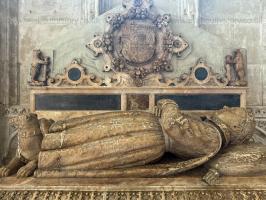
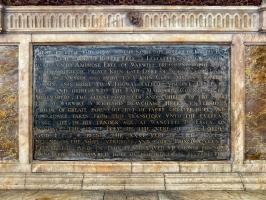
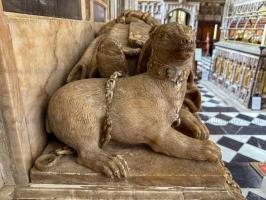
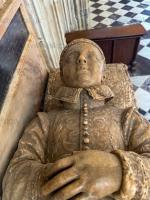
On 19th July 1584 Robert Dudley [aged 3] died at Wansted House, Essex. He was buried in the Beauchamp Chapel [Map]. The inscription:
Here resteth the Body af the Noble Impe Robert of Dudley , Baron of Denbigh , Sonne of Robert Erle of Leicester ; Nephew and Heir unto Ambrose Erle of Warwicke Brethren both sons of the mightie Prince John late Duke of Northumberland ; that was Cousin and Heir to Sir John Gray , Viscount Lisle , Cousin and Heir to Sir Thomas Falbot . Viscount Lisle . Ne- phew and Heir to the Lady Margaret Countess of Shrewsbury , the eldest Daughter and Coheir of the noble Earl of Warwick , Sir Richard Beauchamp , here interred. A Child of greate Parentage but of farr greater hope and towardness , taken from this transitory unto the eve everlasting Life in his tender Age , at Wanstead in Essex , on Sundaye the 19th of July , in the year of our Lord God 1584 - being the 26th yeare of the happy Reigne of the most virtuous and godly Princis Queene Eliza- bethe , and in this Place layed up among his noble Auncestors in assured hope of the general Resurrection.
Robert Dudley: In 1581 he was born to Robert Dudley 1st Earl of Leicester and Lettice Knollys Countess Essex and Leicester.
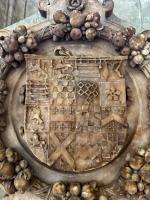
On 19th July 1603 Walter Raleigh [aged 49] arrested for his part in the Main and Bye Plots.


On 19th July 1644 John Gordon 1st Baronet [aged 34] was beheaded for treason. His son John [aged 12] succeeded 2nd Baronet Gordon of Haddo for suppressing the Conventers.
John Evelyn's Diary. 19th July 1664. To London, to see the event of the lottery which his Majesty [aged 34] had permitted Sir Arthur Slingsby [aged 41] to set up for one day in the Banqueting House, Whitehall Palace [Map], at Whitehall; I gaining only a trifle, as well as did the King, Queen-Consort [aged 25], and Queen-Mother [aged 54], for near thirty lots; which was thought to be contrived very unhandsomely by the master of it, who was, in truth, a mere shark.


On 19th July 1664 the Habsburg Imperial Army commanded by Jean-Louis Raduit Count de Souches [aged 55] defeated an Ottoman army under the command of Ali Pasha. Ali Pasha was killed.

John Evelyn's Diary. 19th July 1667. I went to Gravesend, Kent [Map]; the Dutch fleet still at anchor before the river, where I saw five of his Majesty's [aged 37] men-at-war encounter above twenty of the Dutch, in the bottom of the Hope, chasing them with many broadsides given and returned toward the Buoy of the Nore, where the body of their fleet lay, which lasted till about midnight. One of their ships was fired, supposed by themselves, she being run on ground. Having seen this bold action, and their braving us so far up the river, I went home the next day, not without indignation at our negligence, and the nation's reproach. It is well known who of the Commissioners of the Treasury gave advice that the charge of setting forth a fleet this year might be spared, Sir W. C. (William Coventry [aged 39]) by name.
Samuel Pepys' Diary. 19th July 1668. Lord's Day. Up, and to my chamber, and there I up and down in the house spent the morning getting things ready against noon, when come Mr. Cooper [aged 59], Hales [aged 68], Harris [aged 34], Mr. Butler, that wrote Hudibras, and Mr. Cooper's cozen Jacke; and by and by comes Mr. Reeves and his wife, whom I never saw before: and there we dined: a good dinner, and company that pleased me mightily, being all eminent men in their way. Spent all the afternoon in talk and mirth, and in the evening parted, and then my wife and I to walk in the garden, and so home to supper, Mrs. Turner [aged 45] and husband and daughter with us, and then to bed.
John Evelyn's Diary. 19th July 1675. The Lord Treasurer's [aged 43] Chaplain preached at Wallingford House.
John Evelyn's Diary. 19th July 1678. The Earl of Ossory [aged 44] came to take his leave of me, going into Holland to command the English forces.
On 19th July 1681 Henrietta Churchill 2nd Duchess of Marlborough was born to John Churchill 1st Duke of Marlborough [aged 31] and Sarah Jennings Duchess of Marlborough [aged 21]. She married March 1698 Francis Godolphin 2nd Earl Godolphin, son of Sidney Godolphin 1st Earl Godolphin and Margaret Blagge, and had issue.


John Evelyn's Diary. 19th July 1683. George, Prince of Denmark [aged 30], who had landed this day, came to marry the Lady Anne [aged 18], daughter to the Duke [aged 49]; so I returned home, having seen the young gallant at dinner at Whitehall [Map].


Chronicle of Abbot Ralph of Coggeshall
The Chronicle of Abbot Ralph of Coggeshall (Chronicon Anglicanum) is an indispensable medieval history that brings to life centuries of English and European affairs through the eyes of a learned Cistercian monk. Ralph of Coggeshall, abbot of the Abbey of Coggeshall in Essex in the early 13th century, continued and expanded his community’s chronicle, documenting events from the Norman Conquest of 1066 into the tumultuous reign of King Henry III. Blending eyewitness testimony, careful compilation, and the monastic commitment to record-keeping, this chronicle offers a rare narrative of political intrigue, royal power struggles, and social upheaval in England and beyond. Ralph’s work captures the reigns of pivotal figures such as Richard I and King John, providing invaluable insights into their characters, decisions, and the forces that shaped medieval rule. More than a simple annal, Chronicon Anglicanum conveys the texture of medieval life and governance, making it a rich source for scholars and readers fascinated by English history, monastic authorship, and the shaping of the medieval world.
Available at Amazon in eBook and Paperback format.
John Evelyn's Diary. 19th July 1687. I went to Wotton. In the way, I dined at Ashted, with my Baroness Mordaunt [aged 65].
John Evelyn's Diary. 19th July 1689. The Convention (or Parliament as some called it) sitting, exempt the Duke of Hanover [aged 29] from the succession to the crown, which they seem to confine to the present new King [aged 38], his wife [aged 27], and Princess Anne of Denmark [aged 24], who is so monstrously swollen, that it is doubted whether her being thought with child may prove a TYMPANY only, so that the unhappy family of the Stuarts seems to be extinguishing; and then what government is likely to be next set up is unknown, whether regal and by election, or otherwise, the Republicans and Dissenters from the Church of England evidently looking that way.


John Evelyn's Diary. 19th July 1689. The Scots have now again voted down Episcopacy there. Great discontents through this nation at the slow proceedings of the King [aged 38], and the incompetent instruments and officers he advances to the greatest and most necessary charges.
John Evelyn's Diary. 19th July 1689. The Marshal de Schomberg [aged 73] went now as General toward Ireland, to the relief of Derry aka Londonderry. Our fleet lay before Brest. The Confederates passing the Rhine, besiege Bonn and Mayence, to obtain a passage into France. A great victory gotten by the Muscovites, taking and burning Perecop. A new rebel against the Turks threatens the destruction of that tyranny. All Europe in arms against France, and hardly to be found in history so universal a face of war.
John Evelyn's Diary. 19th July 1691. The great victory of King William's army in Ireland was looked on as decisive of that war. The French General, St. Ruth, who had been so cruel to the poor Protestants in France, was slain, with divers of the best commanders; nor was it cheap to us, having 1,000 killed, but of the enemy 4,000 or 5,000.
John Evelyn's Diary. 19th July 1691. In the morning Dr. Tenison [aged 54] preached the first sermon, taking his text from Psalm xxvi. 8. "Lord, I have loved the habitation of thy house, and the place where thine honor dwelleth". In concluding, he gave that this should be made a parish church so soon as the Parliament sat, and was to be dedicated to the Holy Trinity, in honor of the three undivided persons in the Deity; and he minded them to attend to that faith of the church, now especially that Arianism, Socinianism, and atheism began to spread among us. In the afternoon, Mr. Stringfellow preached on Luke vii. 5. "The centurion who had built a synagogue". He proceeded to the due praise of persons of such public spirit, and thence to such a character of pious benefactors in the person of the generous centurion, as was comprehensive of all the virtues of an accomplished Christian, in a style so full, eloquent, and moving, that I never heard a sermon more apposite to the occasion. He modestly insinuated the obligation they had to that person who should be the author and promoter of such public works for the benefit of mankind, especially to the advantage of religion, such as building and endowing churches, hospitals, libraries, schools, procuring the best editions of useful books, by which he handsomely intimated who it was that had been so exemplary for his benefaction to that place. Indeed, that excellent person, Dr. Tenison, had also erected and furnished a public library [in St. Martin's]; and set up two or three free schools at his own charges. Besides this, he was of an exemplary, holy life, took great pains in constantly preaching, and incessantly employing himself to promote the service of God both in public and private. I never knew a man of a more universal and generous spirit, with so much modesty, prudence, and piety.
On 19th July 1766 Henry Cheere 1st Baronet [aged 63] was created 1st Baronet Cheere of St Margaret's in Westminster.
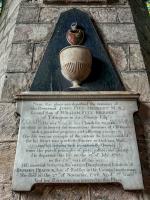
On 19th July 1785 Reverend John Fitzherbert [aged 68] died. He was buried at St Cuthbert's Church, Doveridge [Map].
Reverend John Fitzherbert: Around 1717 he was born to William Fitzherbert and Rachel Bagshaw. Before 19th July 1785 Reverend John Fitzherbert and Susanna Peacock were married.
On 19th July 1788 William Pole Tylney Long Wellesley 4th Earl Mornington was baptised at St George's Church, Hanover Square.
On 19th July 1798 Christian August Oldenburg II Duke Schleswig Holstein Sonderburg Augustenburg was born to Frederick Christian Oldenburg II Duke Schleswig Holstein Sonderburg Augustenburg [aged 32] and Louise Auguste Oldenburg Duchess Schleswig Holstein Sonderburg Augustenburg [aged 27] at Copenhagen. He a great x 2 grandson of King George II of Great Britain and Ireland. He married 1820 Louise Sophie Danneskiold Samsøe Duchess Schleswig Holstein Sonderburg Augustenburg and had issue.
On 19th July 1799 John Frederick Sackville 3rd Duke Dorset [aged 54] died. His son George [aged 5] succeeded 4th Duke Dorset, 10th Earl Dorset, 5th Earl Middlesex, 10th Baron Buckhurst, 5th Baron Cranfield of Cranfield in Middlesex.


On 7th July 1800 Captain John Granville [aged 21] died of rapid consumption at Hot Wells, Bristol. He was buried at St Peter's Church, Ellastone on 19th July 1800. His nephew Court D'Ewes aka Granville [aged 21] inherited Calwich Abbey, Staffordshire [Map] and changed his surname from D'Ewes to Granville.
Underneath this Stone In the Family Vault Lies Interred the Body of John Granville, only son of John and Harriett Granville of Calwich and late Captain in the Staffordshire Regiment of Militia who was suddenly cut off in the Prime of his Life, to the inexpressible Grief of his Parents and Sorrow of All who knew him July the 7th 1800 in the 21st Year of his Age. In the same vault are deposited the remains of their infant daughter. Also the remains of the above named Harriet Joan Granville Died at Calwich 25th March 1825, aged 71.
Captain John Granville: Around 1779 he was born to Reverend John D'Ewes aka Granville and Harriet de la Bere.
Court D'Ewes aka Granville: In 1779 he was born to Bernard D'Ewes. In 1848 Court D'Ewes aka Granville died.


On 19th July 1821 Kenneth Alexander Howard 1st Earl of Effingham [aged 53] attended as Deputy Earl Marshal as a result of Henry Howard-Molyneux-Howard [aged 54] being ill at Westminster Abbey [Map] during the Coronation of William IV.
On 19th July 1821 King George IV of Great Britain and Ireland [aged 58] was crowned IV King Great Britain and Ireland.
King George IV of Great Britain and Ireland barred Caroline of Brunswick Queen Consort England [aged 53] from attending the Coronation. She attempted to attend but was turned away at the doors of Westminster Abbey. Refused entry at both the doors to the East Cloister and the doors to the West Cloister, Caroline attempted to enter via Westminster Hall, where many guests were gathered before the service began. A witness described how the Queen stood at the door fuming as bayonets were held under her chin until the deputy lord chamberlain had the doors slammed in her face. Henry Brougham recorded his distaste.1. She died three weeks later.
William Cavendish 6th Duke Devonshire [aged 31] carried the Orb at Westminster Abbey [Map].
Kenneth Alexander Howard 1st Earl of Effingham [aged 53] attended as Deputy Earl Marshal as a result of Henry Howard-Molyneux-Howard [aged 54].
See Creevy Papers.


On 19th July 1823 James Innes-Kerr 5th Duke Roxburghe [aged 87] died. His son James [aged 7] succeeded 6th Duke Roxburghe.

On 19th July 1830 Alfred Waterhouse was born.
On 19th July 1833 George Granville Leveson-Gower 1st Duke Sutherland [aged 75] died. His son George [aged 46] succeeded 2nd Duke Sutherland, 3rd Marquess Stafford, 20th Earl Sutherland, 4th Earl Gower, 5th Baron Gower, 9th Baronet Gower of Stittenham in Yorkshire. Harriet Elizabeth Georgiana Howard Duchess Sutherland [aged 27] by marriage Duchess Sutherland.


Vestiges of the Antiquities of Derbyshire. On the 19th of July, 1843, a small barrow [Map] situated near the edge of a rocky declivity, on Brassington Moor, and not previously known as a sepulchral mound, was opened in such an effectual manner as to cut it into four sections. A secondary interment near the surface was found to have been dug up and buried again some time since; there were a good many rats' bones, and six pieces of flint, three of which were chipped, in order to make some kind of rude instruments whose use is now quite unintelligible; arriving at the centre, a small square cist, haying a flat stone for its base, and another similar for a cover, was found to contain the remains on whose account the tumulus had been first raised, which consisted of a deposit of burnt bones, amongst which were found an arrow- or lance- head of flint, two inches and a half in length, and two instruments of flint of the circular shape, which appeared to have undergone the action of fire; on the outside of the cist a few fragments of an urn of unusual thickness and rude design were found.
Vestiges of the Antiquities of Derbyshire. On the afternoon of the same day, the remains of a large barrow, called Green Lowe [Map], in the same neighbourhood, were examined; all the upper part of this tumulus, which is of large extent, has been long removed, thus exposing to view the cist in the centre of its area; this cist, which is very large, is of the same kind of architecture as those existing at the large barrow at Minning Lowe [Map], and before described; the only difference being, that the one in question is divided into two compartments or vaults, by the introduction of a flat stone placed vertically across the middle; most of the component parts of this tumulus having been taken away as before stated, there was but little probability of discovering any relics, save by digging the soil and other debris out of the double vault, which was accordingly done with the following results: in one of the cists, at about eight inches from the surface, lay a human skeleton, much broken from its being so near the top, a piece of fine slatestone, which appeared to have served the purpose of a hone, and a few fragments of two urns, of a texture widely dissimilar, one being coarse and merely sun-dried, the other evidently baked in a kiln. In the other division of the cist, a few human teeth, a considerable quantity of animal bones, amongst which remains of the horse and dog were found, as well as rats' bones, which were plentifully distributed in both vaults; also a few pieces of the same kiln-baked urn which was discovered in the first cell; from which circumstance it is very certain that the interment had been taken out at the time the mound was removed.
Chronicle of a Bourgeois of Valenciennes
Récits d’un bourgeois de Valenciennes aka The Chronicle of a Bourgeois of Valenciennes is a vivid 14th-century vernacular chronicle written by an anonymous urban chronicler from Valenciennes in the County of Hainaut. It survives in a manuscript that describes local and regional history from about 1253 to 1366, blending chronology, narrative episodes, and eyewitness-style accounts of political, military, and social events in medieval France, Flanders, and the Low Countries. The work begins with a chronological framework of events affecting Valenciennes and its region under rulers such as King Philip VI of France and the shifting allegiances of local nobility. It includes accounts of conflicts, sieges, diplomatic manoeuvres, and the impact of broader struggles like the Hundred Years’ War on urban life in Hainaut. Written from the perspective of a burgher (bourgeois) rather than a monastery or royal court, the chronicle offers a rare lay viewpoint on high politics and warfare, reflecting how merchants, townspeople, and civic institutions experienced the turbulence of the 13th and 14th centuries. Its narrative style combines straightforward reporting of events with moral and civic observations, making it a valuable source for readers interested in medieval urban society, regional politics, and the lived experience of war and governance in pre-modern Europe.
Available at Amazon in eBook and Paperback format.
On 19th July 1843 Emma Lucy Madox Brown was born to Ford Madox Brown [aged 22] and Elizabeth Bromley [aged 24] at Paris [Map]. Coefficient of inbreeding 3.12%. She married 31st March 1874 William Michael Rossetti and had issue.


Diary of a Dean by Merewether. 20th. Opened a flat barrow (No. 1) of about 25 yards from skirt to skirt, and 5 feet from the apex to the level of the surrounding down, situated in the centre of the flat down about a mile and a quarter from Avebury, and at half a mile's distance from any other barrow. At the centre, 18 inches below the surface, were the fragments of a coarse unornamented vase, containing the bones of a child which had cut its first teeth, but had not changed them. In the chalk rubble were numerous pieces of deer's ribs. 2 ft. 6 in. from the surface was a skeleton of an adult (A); the thigh-bones measured 14½ inches, the whole frame compressed, the right hand turned hack under the wrist, the left laid across the face, and the bones of the wrist and forearm between the upper and lower jaws; the skull fractured into minute portions. The crouched posture of the skeleton, the rudeness of the vase with the hones of the child, the flat form and insulated position of the barrow, assign it to the earliest period of sepulture. The molar teeth were much worn, but were evidently those of a young person.
Diary of a Dean by Merewether. 19th. This day employed in visits to the tunnel and in obtaining leave to open barrows, successfully and without loss of time, through the aid of Mr. George Brown, and by the kindness of others in the neighbourhood from time to time; made a circuit over the downs east of. Avebury, Bye Hill Down, and Hacpen, to select barrows for examination. The breaking up of the land for tillage made it very difficult to recognise the exact spots where I had formerly opened some, and observed others.
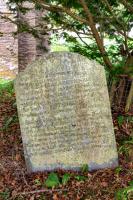
After 19th July 1863. St Cuby's Church, Duloe [Map]. Grave of Thomas Serpell who was "unfortunately drowned at Shallow-pool ... aged 18 years and 10 months."

On 19th July 1884 Charles Edward Saxe Coburg Gotha was born to Leopold Saxe Coburg Gotha 1st Duke Albany and Helena Waldeck Duchess Albany at Claremont House Esher, Surrey. He a grandson of Queen Victoria of the United Kingdom. He married 11th October 1905 his fourth cousin once removed Viktoria Adelheid Glücksburg, daughter of Friedrich Ferdinand Glücksburg Duke Schleswig Holstein Sonderburg Glücksburg and Victoria Friederike Oldenburg Duchess Schleswig Holstein Sonderburg Glücksburg, and had issue.
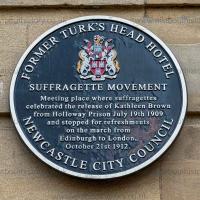
19th July 1909. Former Turks Head Hotel, Grey Street [Map] where suffragettes celebrated the release of Kathleen Brown.
The Thistle Chapel, Edinburgh Cathedral [Map] was completed by autumn of 1910 with funding provided by John Leslie-Melville 12th Earl of Leven 11th Earl of Melville [aged 25] in time for the first St Andrew's Day gathering of the Knights. The Chapel was formally opened amidst much ceremony on 19 July 1911 by King George V [aged 46].


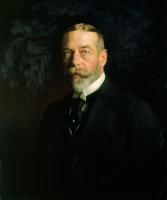


On 28th July 1915 Lieutenant Theodore William Warlow [aged 20] died from wounds received whilst trying to take a wounded man into safety on 19th July 1915. He was buried at Boulogne Eastern Cemetery. Memorial in All Saints Church, Ledsham [Map].
Lieutenant Theodore William Warlow: Around 1895 he was born to Reverend George Edmund Warlow and Ellen Constance Eiloart. Before 19th July 1915 he was appointed Lieutenant of the 6th Battalion King's Own Yorkshire Light Infantry.
On 19th July 1951 Caroline Anne Beauclerk was born to Charles Beauclerk 13th Duke St Albans [aged 35] and Suzanne Marie Fesq Duchess St Albans [aged 30].
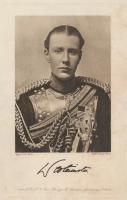
On 19th July 1953 Hugh "Bendor" Grosvenor 2nd Duke Westminster [aged 74] died. His first cousin William [aged 58] succeeded 3rd Duke Westminster, 5th Marquess Westminster, 6th Earl Grosvenor, 12th Baronet Grosvenor of Eaton in Cheshire.
The True Chronicles of Jean le Bel Volume 1 Chapters 1-60 1307-1342
The True Chronicles of Jean le Bel offer one of the most vivid and immediate accounts of 14th-century Europe, written by a knight who lived through the events he describes, and experienced some of them first hand. Covering the early decades of the Hundred Years’ War, this remarkable chronicle follows the campaigns of Edward III of England, the politics of France and the Low Countries, and the shifting alliances that shaped medieval warfare. Unlike later historians, Jean le Bel writes with a strong sense of eyewitness authenticity, drawing on personal experience and the testimony of fellow soldiers. His narrative captures not only battles and sieges, but also the realities of military life, diplomacy, and the ideals of chivalry that governed noble society. A key source for Jean Froissart, Le Bel’s chronicle stands on its own as a compelling and insightful work, at once historical record and literary achievement. This translation builds on the 1905 edition published in French by Jules Viard, adding extensive translations from other sources Rymer's Fœdera, the Chronicles of Adam Murimuth, William Nangis, Walter of Guisborough, a Bourgeois of Valenciennes, Geoffrey le Baker of Swinbroke and Richard Lescot to enrich the original text and Viard's notes.
Available at Amazon in eBook and Paperback format.
On 19th July 1420 William VIII Marquis of Montferrat was born to John Jacob Marquis of Montferrat [aged 25] and Joan of Savoy. He married (1) 19th January 1465 his third cousin once removed Marie Foix Marquis Montferrat, daughter of Gaston IV Count Foix and Eleanor Trastámara Queen Consort Navarre (2) 6th January 1474 his fifth cousin Bernarde de Brosse Marquis Monferrat.

On 19th July 1627 Margaret Spencer Baroness Arundel Wardour was born to William Spencer 2nd Baron Spencer [aged 36] and Penelope Wriothesley Baroness Spencer Wormleighton [aged 28]. She married (1) in or before 1658 her second cousin once removed Robert Lucy (2) in or before 1661 her second cousin once removed Thomas Arundell 4th Baron Arundel, son of Henry Arundell 3rd Baron Arundel and Cicely Compton Baroness Arundel Wardour.

On 19th July 1643 Vere Booth was born to George Booth 1st Baron Delamer [aged 20] and Catherine Clinton.
On 19th July 1681 Henrietta Churchill 2nd Duchess of Marlborough was born to John Churchill 1st Duke of Marlborough [aged 31] and Sarah Jennings Duchess of Marlborough [aged 21]. She married March 1698 Francis Godolphin 2nd Earl Godolphin, son of Sidney Godolphin 1st Earl Godolphin and Margaret Blagge, and had issue.
On 19th July 1703 Jane Calvert was born to Benedict Calvert 4th Baron Baltimore [aged 24] and Charlotte Lee Baroness Baltimore [aged 24] at Epsom, Surrey. She a great granddaughter of King Charles II of England Scotland and Ireland. She married 4th May 1720 John Hyde.
On 19th July 1735 Garrett Wellesley 1st Earl Mornington was born to Richard Colley aka Wesley 1st Baron Mornington [aged 45] and Elizabeth Sale in Dangan Castle, Summerhill, Trim, County Meath. He married 6th February 1759 Anne Hill Countess Mornington, daughter of Arthur Hill aka Hill-Trevor 1st Viscount Dungannon, and had issue.
On 19th July 1770 Eleanor Egerton Marchioness Westminster was born to Thomas Egerton 1st Earl Wilton [aged 20] and Eleanor Assheton Viscountess Wilton [aged 17]. She married 28th April 1794 Robert Grosvenor 1st Marquess Westminster, son of Richard Grosvenor 1st Earl Grosvenor, and had issue.

On 19th July 1775 Charles Beauchamp Kerr was born to William John Kerr 5th Marquess Lothian [aged 38] and Elizabeth Fortescue 5th Marchioness Lothian [aged 30].

On 19th July 1786 Henry Dawson Damer was born to John Dawson 1st Earl Portarlington [aged 41] and Caroline Stuart Countess Portarlington [aged 23].
On 19th July 1795 Cecil Frances Hamilton was born to John Hamilton 1st Marquess Abercorn [aged 39] and Cecil Hamilton Marchioness Abercorn [aged 25] Coefficient of inbreeding 6.25%. She married 16th February 1816 William Howard 4th Earl of Wicklow and had issue.
Jean de Waurin's Chronicle of England Volume 6 Books 3-6: The Wars of the Roses
Jean de Waurin was a French Chronicler, from the Artois region, who was born around 1400, and died around 1474. Waurin’s Chronicle of England, Volume 6, covering the period 1450 to 1471, from which we have selected and translated Chapters relating to the Wars of the Roses, provides a vivid, original, contemporary description of key events some of which he witnessed first-hand, some of which he was told by the key people involved with whom Waurin had a personal relationship.
Available at Amazon in eBook and Paperback format.
On 19th July 1798 Christian August Oldenburg II Duke Schleswig Holstein Sonderburg Augustenburg was born to Frederick Christian Oldenburg II Duke Schleswig Holstein Sonderburg Augustenburg [aged 32] and Louise Auguste Oldenburg Duchess Schleswig Holstein Sonderburg Augustenburg [aged 27] at Copenhagen. He a great x 2 grandson of King George II of Great Britain and Ireland. He married 1820 Louise Sophie Danneskiold Samsøe Duchess Schleswig Holstein Sonderburg Augustenburg and had issue.
On 19th July 1800 Edward Manningham-Buller 1st Baronet was born to Francis Buller-Yarde-Buller 2nd Baronet [aged 33].
On 19th July 1809 Jane Henrietta Ashburnham was born to George Ashburnham 3rd Earl Ashburnham [aged 48] and Charlotte Percy Countess Ashburham [aged 33]. She married before 5th April 1837 Admiral Charles Henry Swinburne and had issue.
On 19th July 1827 Lionel Sackville-West 2nd Baron Sackville was born to George Sackville-West 5th Earl De La Warr [aged 35] and Elizabeth Sackville Countess De La Warr [aged 31].
On 19th July 1830 Alfred Waterhouse was born.
On 19th July 1843 Emma Lucy Madox Brown was born to Ford Madox Brown [aged 22] and Elizabeth Bromley [aged 24] at Paris [Map]. Coefficient of inbreeding 3.12%. She married 31st March 1874 William Michael Rossetti and had issue.
On 19th July 1845 Victoria Alexandrina Murray was born to Alexander Murray 6th Earl Dunmore [deceased] and Catherine Herbert Countess Dunmore [aged 30].
On 19th July 1859 Spencer Maryon-Wilson 11th Baronet was born to Spencer Maryon Wilson 10th Baronet [aged 29].
On 19th July 1866 Charles Thomas Keble Prévost 4th Baronet was born to Charles Prévost 3rd Baronet [aged 35] He married 6th February 1907 Beatrice Mary Burrow Lady Prevost and had issue.
On 19th July 1876 Robert Henry Seymour Dashwood 7th Baronet was born to George John Egerton Dashwood 6th Baronet [aged 24] and Mary Margaret Seymour Lady Dashwood [aged 21].
On 19th July 1881 Charles William Sholto Douglas was born to Sholto Douglas 19th Earl of Morton [aged 36] and Helen Geraldine Ponsonby Countess of Morton [aged 29]. He married (1) 11th December 1920 his third cousin Alice Agnes Fox-Pitt and had issue (2) 15th April 1926 Florence Timson and had issue (3) 19th March 1927 Florence Timson and had issue.
William of Worcester's Chronicle of England
William of Worcester, born around 1415, and died around 1482 was secretary to John Fastolf, the renowned soldier of the Hundred Years War, during which time he collected documents, letters, and wrote a record of events. Following their return to England in 1440 William was witness to major events. Twice in his chronicle he uses the first person: 1. when writing about the murder of Thomas, 7th Baron Scales, in 1460, he writes '… and I saw him lying naked in the cemetery near the porch of the church of St. Mary Overie in Southwark …' and 2. describing King Edward IV's entry into London in 1461 he writes '… proclaimed that all the people themselves were to recognize and acknowledge Edward as king. I was present and heard this, and immediately went down with them into the city'. William’s Chronicle is rich in detail. It is the source of much information about the Wars of the Roses, including the term 'Diabolical Marriage' to describe the marriage of Queen Elizabeth Woodville’s brother John’s marriage to Katherine, Dowager Duchess of Norfolk, he aged twenty, she sixty-five or more, and the story about a paper crown being placed in mockery on the severed head of Richard, 3rd Duke of York.
Available at Amazon in eBook and Paperback format.
On 19th July 1883 Beatrice Mills Countess of Granard was born at Newport, Rhode Island.


On 19th July 1884 Charles Edward Saxe Coburg Gotha was born to Leopold Saxe Coburg Gotha 1st Duke Albany and Helena Waldeck Duchess Albany at Claremont House Esher, Surrey. He a grandson of Queen Victoria of the United Kingdom. He married 11th October 1905 his fourth cousin once removed Viktoria Adelheid Glücksburg, daughter of Friedrich Ferdinand Glücksburg Duke Schleswig Holstein Sonderburg Glücksburg and Victoria Friederike Oldenburg Duchess Schleswig Holstein Sonderburg Glücksburg, and had issue.
On 19th July 1887 Richard St John Jefferyes Colthurst 8th Baronet was born to George St John Colthurst 6th Baronet [aged 36] and Edith Jane Morris Lady Colthurst [aged 27].
On 19th July 1913 Bishop Gerald Fitzmaurice Colin was born.
On 19th July 1927 Gerard Robert Henry Sigismund Newman 3rd Baronet was born to Cecil Gustavus Jacques Neumann aka Newman 2nd Baronet [aged 36] and Joan Grimston Lady Neumann at Burloes Hall, Hertfordshire.
On 19th July 1933 Mark Colville 4th Viscount Colville was born to Charles Colville 3rd Viscount Colville [aged 45].
On 19th July 1951 Caroline Anne Beauclerk was born to Charles Beauclerk 13th Duke St Albans [aged 35] and Suzanne Marie Fesq Duchess St Albans [aged 30].
On 19th July 1978 Thomas Anson 6th Earl of Lichfield was born to Thomas Patrick John Anson 5th Earl Lichfield [aged 39] and Leonora Mary Grosvenor Countess Lichfield [aged 29]. He married December 2009 Henrietta Conyngham Countess Lichfield, daughter of Henry Vivien Conyngham 8th Marquess Conyngham and Iona Charlotte Grimston.

On 19th July 1620 Henry Grey 1st Earl Stamford [aged 21] and Anne Cecil [aged 24] were married. She by marriage Baroness Grey of Groby. She the daughter of William Cecil 2nd Earl Exeter [aged 54] and Elizabeth Drury Countess Exeter [aged 42]. They were fourth cousins.
On 19th July 1696 Rushout Cullen 3rd Baronet [aged 35] and Eleanor Jarrett were married.

On 19th July 1764 Richard Grosvenor 1st Earl Grosvenor [aged 33] and Henrietta Vernon Countess Grosvenor [aged 28] were married.
On 19th July 1774 John Parnell 2nd Baronet [aged 29] and Laetitia Charlotte Brooke were married. They were third cousin once removed.
On 19th July 1810 Charles Jenkinson 3rd Earl Liverpool [aged 26] and Julia Evelyn Medley Shuckburgh-Evelyn were married. He the son of Charles Jenkinson 1st Earl Liverpool and Catherine Bishopp Countess Liverpool [aged 65].
On 19th July 1876 Hamilton John Agmondesham Cuffe 5th Earl of Desart [aged 27] and Margaret Joan Lascelles Countess of Desart [aged 22] were married. She by marriage Countess Desart. She the daughter of Henry Thynne Lascelles 4th Earl Harewood [aged 52] and Elizabeth Joanna Burgh. He the son of John Cuffe 3rd Earl Desart and Elizabeth Lucy Campbell Countess Desart [aged 54]. They were second cousins.
On 19th July 1905 Robert Jocelyn 8th Earl Roden [aged 21] and Elinor Jessie Parr Countess Roden were married. He the son of Robert Jocelyn 7th Earl Roden [aged 60]. They were fifth cousin once removed.
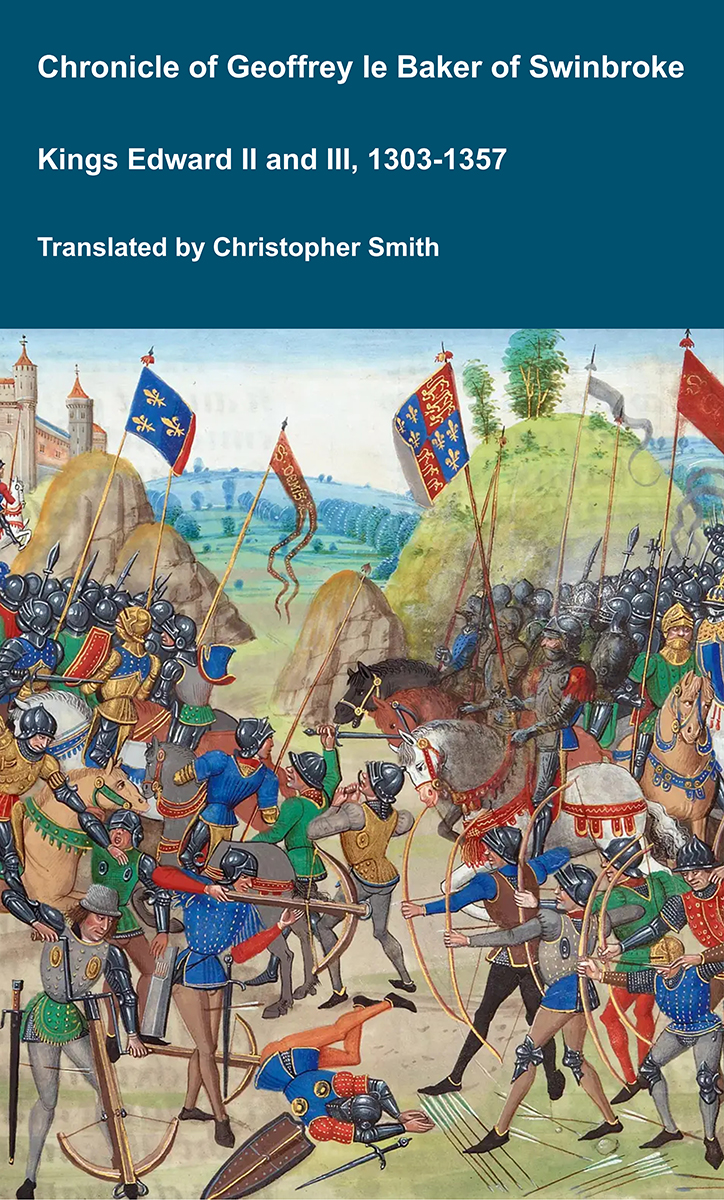
Chronicle of Geoffrey le Baker of Swinbroke
Baker was a secular clerk from Swinbroke, now Swinbrook, an Oxfordshire village two miles east of Burford. His Chronicle describes the events of the period 1303-1356: Gaveston, Bannockburn, Boroughbridge, the murder of King Edward II, the Scottish Wars, Sluys, Crécy, the Black Death, Winchelsea and Poitiers. To quote Herbert Bruce 'it possesses a vigorous and characteristic style, and its value for particular events between 1303 and 1356 has been recognised by its editor and by subsequent writers'. The book provides remarkable detail about the events it describes. Baker's text has been augmented with hundreds of notes, including extracts from other contemporary chronicles, such as the Annales Londonienses, Annales Paulini, Murimuth, Lanercost, Avesbury, Guisborough and Froissart to enrich the reader's understanding. The translation takes as its source the 'Chronicon Galfridi le Baker de Swynebroke' published in 1889, edited by Edward Maunde Thompson.
Available at Amazon in eBook and Paperback format.
On 19th July 1939 Weetman John Pearson 3rd Viscount Cowdray [aged 29] and Anne Pamela Bridgeman Viscountess Cowdray [aged 26] were married. She by marriage Viscountess Cowdray of Cowdray in Sussex. She the daughter of Orlando Bridgeman 5th Earl Bradford [aged 65] and Margaret Cecilia Bruce Countess Bradford [aged 56].
On 19th July 1988 Alastair Morrison 3rd Baron Margadale [aged 30] and Sophia Cavendish Baroness Margdale [aged 31] were married. She the daughter of Andrew Cavendish 11th Duke Devonshire [aged 68] and Deborah Vivien Mitford Duchess Devonshire [aged 68]. They were third cousins.
On 19th July 1131 Raymond III Count Barcelona [aged 48] died. His son Raymond [aged 17] succeeded V Count Barcelona.
On 19th July 1234 Floris Gerulfing IV Count Holland [aged 24] was killed in a tournament.
On 19th July 1333 King Edward III of England [aged 20] defeated the Scots army at the Battle of Halidon Hill near Berwick-upon-Tweed, Northumberland [Map]. John of Eltham 1st Earl Cornwall [aged 16] commanded.
English archers, just as at the Battle of Dupplin Moor one year previously, had a significant impact on the massed ranks of Scottish schiltrons. Edward's army included: Thomas of Brotherton 1st Earl Norfolk [aged 33], who commanded the right wing, Hugh Courtenay 1st or 9th Earl Devon [aged 56], Robert Pierrepont, Hugh Courtenay 2nd or 10th Earl Devon [aged 30], Henry Beaumont Earl Buchan [aged 54] and John Sully [aged 50]. One of the few English casualties was John Neville [aged 34] who was killed.
The Scottish army included King David II of Scotland [aged 9]. Alexander Bruce, Alan Stewart [aged 61], James Stewart [aged 57], John Stewart, William Douglas 1st Earl Atholl, Archibald Douglas [aged 35] who were all killed.
Hugh 4th Earl Ross [aged 36] was killed. His son William succeeded 5th Earl Ross.
Malcolm Lennox 2nd Earl Lennox was killed. His son Domhnall succeeded Earl Lennox.
Kenneth de Moravia Sutherland 4th Earl Sutherland was killed. His son William succeeded 5th Earl Sutherland. Johanna Menteith Countess Sutherland by marriage Countess Sutherland.
On 19th July 1337 Bishop John Langton died.
On 19th July 1352 Archbishop William Zouche died at Cawood, North Yorkshire [Map]. He was buried at York Minster [Map].
On 19th July 1415 Philippa of Lancaster Queen Consort Portugal [aged 55] died at Sacavém.
On 19th July 1529 Thomas Brooke 8th Baron Cobham [aged 59] died. He was buried at St Mary Magdalene New Churchyard, Cobham. His son George [aged 32] succeeded 9th Baron Cobham. Anne Braye Baroness Cobham [aged 28] by marriage Baroness Cobham.

On 19th July 1543 Mary Boleyn [aged 44] died. Her considerable wealth and properties were inherited by her two children from her first marriage Catherine Carey [aged 19] and Henry Carey 1st Baron Hunsdon [aged 17], and her second husband William Stafford [aged 35].
On 19th July 1549 Edmund Sheffield 1st Baron Sheffield [aged 27] was killed at Cathedral Close, Norwich Cathedral [Map] during Kett's Rebellion. His son John [aged 11] succeeded 2nd Baron Sheffield of Butterwick in Lincolnshire.
On 19th July 1629 Matthew Plunkett 5th Baron Louth died. His son Oliver [aged 21] succeeded 6th Baron Louth.
Chronicle of a Bourgeois of Valenciennes
Récits d’un bourgeois de Valenciennes aka The Chronicle of a Bourgeois of Valenciennes is a vivid 14th-century vernacular chronicle written by an anonymous urban chronicler from Valenciennes in the County of Hainaut. It survives in a manuscript that describes local and regional history from about 1253 to 1366, blending chronology, narrative episodes, and eyewitness-style accounts of political, military, and social events in medieval France, Flanders, and the Low Countries. The work begins with a chronological framework of events affecting Valenciennes and its region under rulers such as King Philip VI of France and the shifting allegiances of local nobility. It includes accounts of conflicts, sieges, diplomatic manoeuvres, and the impact of broader struggles like the Hundred Years’ War on urban life in Hainaut. Written from the perspective of a burgher (bourgeois) rather than a monastery or royal court, the chronicle offers a rare lay viewpoint on high politics and warfare, reflecting how merchants, townspeople, and civic institutions experienced the turbulence of the 13th and 14th centuries. Its narrative style combines straightforward reporting of events with moral and civic observations, making it a valuable source for readers interested in medieval urban society, regional politics, and the lived experience of war and governance in pre-modern Europe.
Available at Amazon in eBook and Paperback format.
On 19th July 1644 John Gordon 1st Baronet [aged 34] was beheaded for treason. His son John [aged 12] succeeded 2nd Baronet Gordon of Haddo for suppressing the Conventers.
On 19th July 1648 William Yelverton 2nd Baronet [aged 58] died. His son William succeeded 3rd Baronet Yelverton of Rougham in Norfolk.
On 19th July 1649 Richard Wynn 2nd Baronet [aged 61] died without issue. His brother Owen [aged 57] succeeded 3rd Baronet Wynn of Gwydir.

On 19th July 1721 Bishop Jonathan Trelawny 3rd Baronet [aged 71] died. His son John [aged 29] succeeded 4th Baronet Trelawny of Trelawny in Cornwall.
On 19th July 1731 James Darcy 1st Baron Darcy of Navan [aged 81] died. His grandson James [aged 24] succeeded 2nd Baron Darcy of Navan.
On 19th July 1745 Nicholas Williams 1st Baronet [aged 64] died. Baronet Williams of Edwinsford in Carmarthenshire extinct. His brother Thomas Williams of Edwinsford in Llandeilo [aged 63] inherited his estates.
On 19th July 1748 Elizabeth Wood Lady Isham died.
On 19th July 1786 Lionel Wright Vane-Fletcher 1st Baronet [aged 63] died. His son Frederick [aged 26] succeeded 2nd Baronet Fletcher of Hutton in Cumberland.
On 19th July 1792 Charles Mill 9th Baronet [aged 70] died. His son Charles [aged 27] succeeded 10th Baronet Mill of Camois Court in Sussex.
On 19th July 1799 John Frederick Sackville 3rd Duke Dorset [aged 54] died. His son George [aged 5] succeeded 4th Duke Dorset, 10th Earl Dorset, 5th Earl Middlesex, 10th Baron Buckhurst, 5th Baron Cranfield of Cranfield in Middlesex.

Anne Boleyn. Her Life as told by Lancelot de Carle's 1536 Letter.
In 1536, two weeks after the execution of Anne Boleyn, her brother George and four others, Lancelot du Carle, wrote an extraordinary letter that described Anne's life, and her trial and execution, to which he was a witness. This book presents a new translation of that letter, with additional material from other contemporary sources such as Letters, Hall's and Wriothesley's Chronicles, the pamphlets of Wynkyn the Worde, the Memorial of George Constantyne, the Portuguese Letter and the Baga de Secrets, all of which are provided in Appendices.
Available at Amazon in eBook and Paperback format.
On 19th July 1809 John Macnamara Hayes 1st Baronet [aged 59] died. His son Thomas [aged 15] succeeded 2nd Baronet Hayes of Westminster.
On 19th July 1809 Richard Wingfield 4th Viscount Powerscourt [aged 46] died. His son Richard [aged 18] succeeded 5th Viscount Powerscourt.
On 19th July 1823 James Innes-Kerr 5th Duke Roxburghe [aged 87] died. His son James [aged 7] succeeded 6th Duke Roxburghe.
On 19th July 1833 George Granville Leveson-Gower 1st Duke Sutherland [aged 75] died. His son George [aged 46] succeeded 2nd Duke Sutherland, 3rd Marquess Stafford, 20th Earl Sutherland, 4th Earl Gower, 5th Baron Gower, 9th Baronet Gower of Stittenham in Yorkshire. Harriet Elizabeth Georgiana Howard Duchess Sutherland [aged 27] by marriage Duchess Sutherland.
On 19th July 1855 Hugh Kerr aka McDonnell 4th Earl of Antrim [aged 42] died. His brother Mark [aged 41] succeeded 5th Earl Antrim 2C, 5th Viscount Dunluce. Jane Macan Countess of Antrim [aged 30] by marriage Countess Antrim 2C.
On 19th July 1862 Henry Bold-Hoghton 8th Baronet [aged 63] died. His son Henry [aged 40] succeeded 9th Baronet Hoghton of Hoghton Tower in Lancashire.
On 19th July 1876 Percy Burrell 4th Baronet [aged 64] died. His brother Walter [aged 61] succeeded 5th Baronet Burrell of Valentine House in Essex. Dorothea Jones Lady Burrell [aged 48] by marriage Lady Burrell.
On 19th July 1879 Carnegie Jervis 3rd Viscount St Vincent [aged 53] died. His son John [aged 29] succeeded 4th Viscount St Vincent of Meaford in Staffordshire.
On 19th July 1918 William Randall McDonnell 6th Earl of Antrim [aged 67] died. His son Randall [aged 39] succeeded 7th Earl Antrim 2C, 7th Viscount Dunluce. Margaret Isabel Talbot Countess of Antrim by marriage Countess Antrim 2C.
On 19th July 1930 Thomas Agar-Robartes 6th Viscount Clifden [aged 86] died. His son Francis [aged 47] succeeded 7th Viscount Clifden of Gowran in County Kilkenny, 7th Baron Mendip of Mendip in Somerset, 3rd Baron Robartes of Lanhydrock and of Truro in Cornwall.
On 19th July 1931 May Prinsep Baroness Tennyson [aged 77] died.


On 19th July 1948 Algernon Kerr Butler Osborn 7th Baronet [aged 77] died. His son Danvers [aged 32] succeeded 8th Baronet Osborn of Chicksands in Bedfordshire.
On 19th July 1953 Hugh "Bendor" Grosvenor 2nd Duke Westminster [aged 74] died. His first cousin William [aged 58] succeeded 3rd Duke Westminster, 5th Marquess Westminster, 6th Earl Grosvenor, 12th Baronet Grosvenor of Eaton in Cheshire.
Annals of the six Kings of England by Nicholas Trivet
Translation of the Annals of the Six Kings of England by that traces the rise and rule of the Angevin aka Plantagenet dynasty from the mid-12th to early 14th century. Written by the Dominican scholar Nicholas Trivet, the work offers a vivid account of English history from the reign of King Stephen through to the death of King Edward I, blending political narrative with moral reflection. Covering the reigns of six monarchs—from Stephen to Edward I—the chronicle explores royal authority, rebellion, war, and the shifting balance between crown, church, and nobility. Trivet provides detailed insight into defining moments such as baronial conflicts, Anglo-French rivalry, and the consolidation of royal power under Edward I, whose reign he describes with particular immediacy. The Annals combines careful year-by-year reporting with thoughtful interpretation, presenting history not merely as a sequence of events but as a moral and political lesson. Ideal for readers interested in medieval history, kingship, and the origins of the English state, this chronicle remains a valuable and accessible window into the turbulent world of the Plantagenet kings.
Available at Amazon in eBook and Paperback format.
On 19th July 1966 Fenella Hepburn-Stuart-Forbes-Trefusis [aged 76] died. Her great nephew Gerard [aged 32] abeyance terminated 22nd Baron Clinton.
On 19th July 1971 John Jacob Astor 1st Baron Astor [aged 85] died. His son Gavin [aged 53] succeeded 2nd Baron Astor. Irene Haig Baroness Astor [aged 51] by marriage Baroness Astor.
On 19th July 1993 Guy Theophilus Halswell Campbell 5th Baronet [aged 83] died. His son Lachlan [aged 35] succeeded 6th Baronet Campbell of St Cross Mede in Hampshire.
On 19th July 2001 Richard Gibbs 2nd Baron Wraxall [aged 73] died unmarried. His brother Eustace [aged 72] succeeded 3rd Baron Wraxall of Clyst St George in Devon.
On 19th July 2013 Hugh Smith-Marriott 11th Baronet [aged 88] died. His brother Peter [aged 86] succeeded 12th Baronet Smith of Sydling St Nicholas.