

09 Oct is in October.
On 9th October 1192 King Richard "Lionheart" I of England [aged 35] left the Holy Land for England. Bad weather forced him to land at Corfu [Map]. Richard sailed from Corfu but his ship was wrecked at Aquileia [Map] from where he travelled overland.
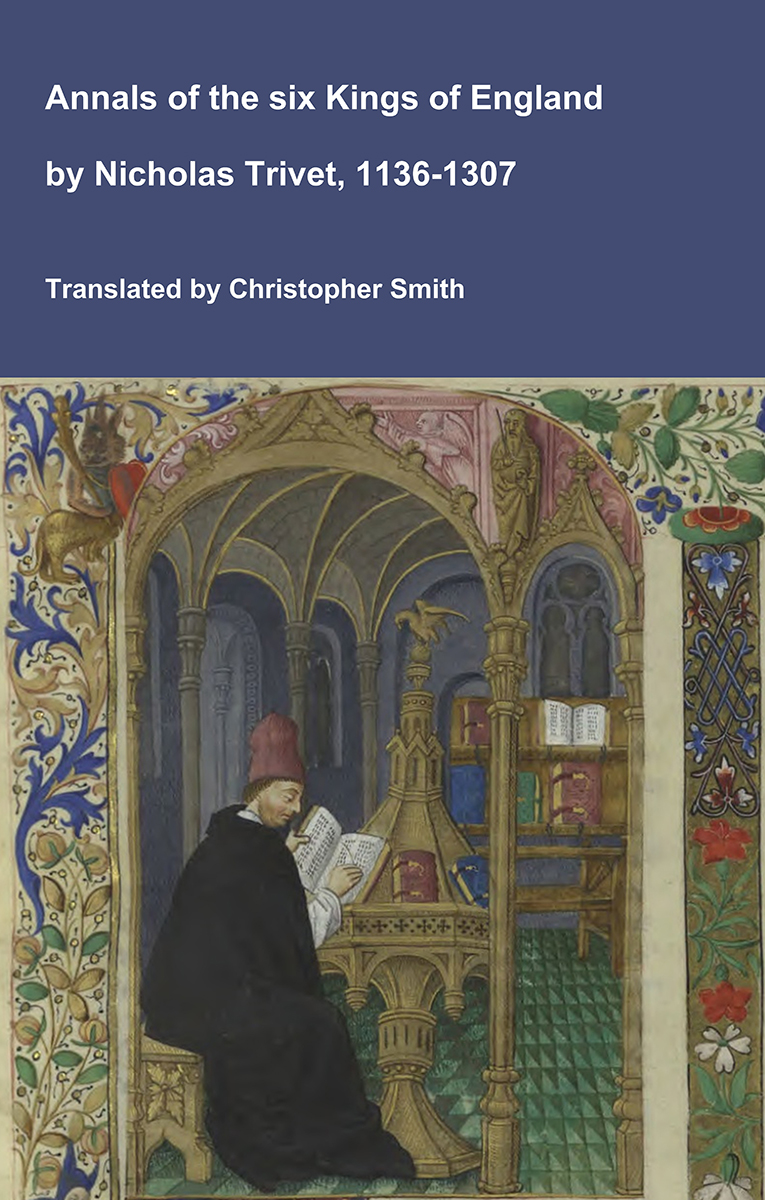 Annals of Six Kings of England by Nicholas Trivet. Meanwhile a ship for King Richard was prepared and all the necessities for his return were made ready. At that time he released ten of the more noble Turks in exchange for the ransom of William of Pratelles. On the feast of St Denis [9th October 1192] King Richard boarded his ships; and about the feast of St Martin [11th November], after a long tossing on the stormy sea and now weary of the voyage, he landed in the territory of the Byzantine Empire. But because he suspected the cunning of the emperor and of the Greeks, and did not wish to be recognized there, he made an agreement with some pirates whom he happened to find. After paying them the fare they demanded, he required them to carry him more quickly to a safer land. Leaving behind the royal fleet and changing his appearance so as to conceal that he was the king, he crossed with only four companions into Slavonia. From there, passing through Aquileia, he entered the land of Leopold, duke of Austria, and was captured in the city of Vienna on the thirteenth day before the Kalends of January [20th December 1192]. Duke Leopold, who hated him because of the death of the Marquis1, of which he suspected the king, threw him into prison. However, concerning that death, the prince of the Assassins, by whose men (as was mentioned above) the Marquis had been killed, cleared King Richard by a letter of the following kind.
Interea regis Ricardi navigium instruitur, et King omnia necessaria ad reditum præparantur. Tunc leaves the pro Willelmo de Pratellis redimendo, decem ex nobilioribus Turcis commutandos liberos dimisit. Die autem S. Dionysii Ricardus rex naves ascendit; et circa festum beati Martini ex diuturna tumultuantis pelagi jactatione, jam pertæsus navigationis, applicuit in terra imperii Constantinopolitani: verum quoniam suspectam habuit imperatoris et Græcorum suorum versutiam, nolens ibi videri, cum piratis forte inventis paciscens, dato quantum postulaverant naulo, exegit ab eis ut expeditius ipsum in terram commodiorem transveherent. Relicta igitur classe regia, habitu mutato se regem dissimulans, cum quatuor tantum sociis transvectus est Sclavoniam: inde pertransiens Aquileiam, cum intrasset terram Limpoldi ducis Austriæ, captus est in civitate Wienna decimotertio cal. Januarii; quem dux Limpoldus exosum habens pro morte Marchisi, de qua suspectum regem habebat, carceri mancipavit. hac tamen morte princeps Hassacenorum, a quibus (ut supra patuit) interfectus est Marchisus, regem Ricardum per litteras hujuscemodi excusavit:
Note 1. Namely, Conrad, marquis of Montferrat and prince of Tyre, whose cause Richard had espoused, the successful competitor for the throne of Jerusalem over Guy of Lusignan. The accusation alluded to in the text was preferred by the emperor, to whom Richard was sold for sixty thousand pounds of silver of Cologne weight; Roger of Wendover: 'King Richard remained a prisoner of the duke of Austria till that prince sold him to the Roman emperor for sixty thousand pounds of silver, Cologne weight, and then on the Tuesday after Palm Sunday he caused him to be carefully guarded; and that he might compel the king to pay an immoderate sum for his ransom, he ordered him to be imprisoned in Treves, from which prison no one who had entered there up to that time had ever come out again,... Into this place was the king put under a strong guard of soldiers and attendants, who accompanied him wherever he went with drawn swords, day and night, and even kept guard by turns round his couch, not allowing any of his own followers to remain with him at night. None of these circumstances could ever cloud the calm countenance of the king, but he always seemed cheerful and agreeable in his conversation, and brave and daring in his acts, as time, place, cause, or person required. To others I leave the relation of his jokes to his guards; how he made them drunk, and assaulted their huge persons by way of amusement.' The ruins of the castle of Tyernstein (now Dürrenstein) still exist as one of the most interesting features of the picturesque banks of the Danube, between Lintz and Vienna.
On 9th October 1212 Philip Flanders I Marquis Namur [aged 37] died of dysentery.
On 20th August 1222 Eleanor Fair Maid of Brittany [aged 38] was moved to Marlborough Castle [Map] where she remained until 9th October 1223.
Chronicle of Henry Knighton. In this year died Saint Robert, called Grosseteste, Bishop of Lincoln, on the seventh day [9th October 1253] before the Ides of October, who, being excellently learned in all the liberal arts, wrote many works especially in logic and astronomy. He sent to Pope Innocent a letter of great force, which begins, Our Lord Jesus Christ, because he seemed to burden the English churches with undue and unusual exactions, and because the pope had granted to his nephew, a boy, a canonry with the next prebend to fall vacant in the church of Lincoln, whom nevertheless Robert refused to admit, writing back to the pope that he neither would nor ought to admit to the care of souls those who did not know nor were able to govern themselves. On account of this he was summoned to the court and excommunicated, and he appealed from the court of Innocent to the tribunal of Christ. It happened that two years after the death of Robert there appeared to the pope, as he slept at night, a certain bishop clothed in pontifical vestments, saying thus, Arise, wretch, come to judgement, and immediately struck the pope in the left side with a pastoral staff as far as the heart, so that in the morning the pope’s bed was found stained with blood, and he died. For this reason, although Robert shone forth with clear miracles, he was not permitted by the court to be canonised. Alexander the Fourth, after Innocent the Fourth, held the papacy for seven years and four months.
Hoc anno obiit sanctus Robertus dictus Grosseteste episcopus Lincolniensis vij. idus Octobris, qui in cunctis liberalibns artibus excellenter eruditus, præcipue in Logica et Astrologia plurima comentatus est. Ad Innocentinm papam misit epistolam satis tonantem, qnæ sic incipit: 'Dominns noster Jesns Christus' pro eo quod ecclesias Anglicanas indebitis et insolitis exactionibus gravare videretnr, et qnia nepotnlo sno puero papa contnlisset canonicatnm cum proxima præbenda vacatura in ecclesia Lincolniensi, quem tamen Robertus admittere noluit, rescribens papæ, se nec velle nec debere tales ad curas animarum admittere, qui se nescirent nec possent regere. Qua de causa ad curiam vocatus et excommunicatus, appellavit a curia Innocentii ad tribunal Christi, unde contigit ut post biennium mortis Roberti, apparuit, papæ de nocte quiescenti quidam episcopus pontificalibus indutus, sic inquiens, 'Surge miser, veni ad judicium.' Et statim cum baculo pastorali pupugit papam in latere sinistro usqne ad cor; unde et lectisleminm papsæ inventum est mane sangninolentem, et ipso defunctus. Hac de causa quamvis Robertus perspicuis effulgoret miraculis nob est permissus a curia canonizari. Alexander quartas post Innocentium iiij. papa sedit annis vij. mensibus iiij.
Annals of Six Kings of England by Nicholas Trivet. 1253. Henry, King of England, at the urging of the prelates, earls, and barons, granted two charters, one of liberties, which is called the Great Charter, and the other which is called the Charter of the Forest. In the parts of England called Holland and Holderness, by an unusual inundation of the sea, a great portion of land with houses and their inhabitants was destroyed. Robert, Bishop of Lincoln, died1, who by many was surnamed Grosseteste. He was a man of outstanding wisdom, of most brilliant learning, and an example of all virtue. Although he drew his origin from humble stock in Suffolk, in the diocese of Norwich, yet, cultivating a good natural disposition by the teachings of Scripture, he produced a noble mind. When he was a master in the arts, he wrote concisely on the book of the Posterior Analytics. He also produced treatises on the Sphere and on the Art of Computation, and many other useful works in philosophy. Being learned in three languages, Latin, Hebrew, and Greek, he drew much from the glosses of the Hebrews, and caused many things to be translated from Greek, such as the Testament of the Twelve Patriarchs and the books of Dionysius, on which he wrote a clear new commentary. Embracing with sincere affection the friars of both the Order of Preachers and the Order of Minors, he constantly kept them in his company, counting it a delight to confer with them on the Scriptures. Above others he held in special familiarity Brother Adam of Marsh of the diocese of Bath, of the Order of Minors, a distinguished and renowned doctor of sacred theology, and out of affection for him he bequeathed all his books by will to the convent of the Friars Minor at Oxford. To this Brother Adam, Boniface, Archbishop of Canterbury, when the election to Ely had been set aside, granted the bishopric of that church, but an appeal having been made to the Roman court, the elect obtained the bishopric, and the archbishop thus lost the power of conferring that see.
Note 1. Grosseteste i.e. 'big head', was one of the loudest in his remonstrances against the papal levies, and all abuses in discipline. Knighton: 'In this year died Saint Robert, called Grosseteste, Bishop of Lincoln, on the seventh day before the Ides of October [9th October 1253], who, being excellently learned in all the liberal arts, wrote many works especially in logic and astronomy. He sent to Pope Innocent a letter of great force, which begins, Our Lord Jesus Christ, because he seemed to burden the English churches with undue and unusual exactions, and because the pope had granted to his nephew, a boy, a canonry with the next prebend to fall vacant in the church of Lincoln, whom nevertheless Robert refused to admit, writing back to the pope that he neither would nor ought to admit to the care of souls those who did not know nor were able to govern themselves. On account of this he was summoned to the court and excommunicated, and he appealed from the court of Innocent to the tribunal of Christ.'
On 9th October 1261 Denis I King Portugal was born to Alfonso III King Portugal [aged 51] and Beatrice Queen Consort Portugal [aged 19]. Denis I King Portugal succeeded I King Portugal. He a great x 2 grandson of King Henry "Curtmantle" II of England. Coefficient of inbreeding 2.41%. He married 1282 his half third cousin once removed Elisabeth Barcelona Queen Consort Portugal, daughter of Peter III King Aragon and Constance Hohenstaufen Queen Consort Aragon, and had issue.
On 9th October 1269 Louis Wittelsbach III Duke Bavaria was born to Henry Wittelsbach I Duke Lower Bavaria I Duke Bavaria [aged 33] and Elizabeth Duchess Bavaria [aged 33]. He a great x 3 grandson of King Henry "Curtmantle" II of England.
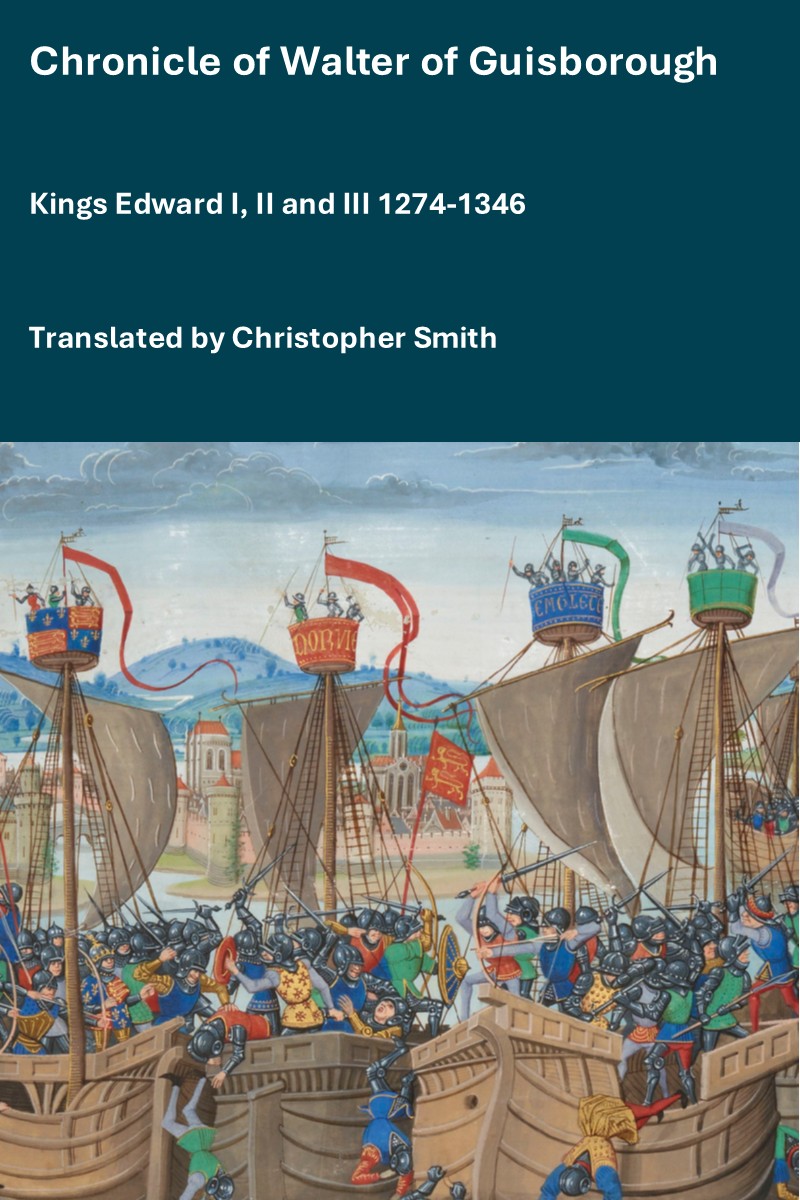 Chronicle of Walter of Guisborough. Upon hearing these things, the king immediately sent five hundred armed knights and twenty thousand foot soldiers into Gascony, under the command of Lord John de St. John, who had formerly served as seneschal of that land, along with Lord John of Brittany and the most valiant knight William Latimer. After all preparations necessary for such an expedition had been completed at Portsmouth, they set out to sea around the Feast of St. Peter in Chains [1st August 1294]. However, due to contrary winds, the fleet was scattered along the coasts of Cornwall. They regrouped again at Plymouth around the Feast of St. Denis [9th October 1294], hoisted sail once more, and after enduring many and various perils of storms, finally landed in Gascony near the Feast of Saints Simon and Jude [28th October 1294], at Castillon, which lies on the banks of the River Garonne. The lord of that town submitted himself to them and to the King of England, received them with great joy, and treated them kindly. From there they marched to Macau, and the citizens surrendered on the Eve of All Saints [31st October 1294]. On the following day, the whole fleet anchored before Bourg-sur-Gironde [Mons Albani]. The townspeople wished to surrender, but they feared the Picards who were stationed in the town's garrison. When the Picards saw that the townspeople intended to surrender, they sallied out from the castle and slew many. The citizens sent messengers to the English reporting what had happened and begging for help. The English quickly came to their aid and drove the royal [French] troops back into the castle. The townspeople then surrendered. In the morning, when our men prepared to storm the castle, the Picards asked for a three-day truce so that they could send a messenger to Bordeaux. They promised to surrender without delay if no help arrived. So a boy was sent, and the Constable of Bordeaux and the Marshal of France replied that they could not come so quickly, but ordered the Picards to defend themselves and resist manfully, especially as they had supplies and all necessities to last six months. Upon hearing this, the Picards surrendered immediately, on condition that their lives, limbs, horses, and arms be spared, and they departed in peace. Eight days later, our forces returned to the town of Blaye, which lies two leagues from Bourg. The garrison there sought a similar truce and obtained it; but as no help came, they surrendered and left. Our troops found a large amount of provisions in both the town and the castle, including around 2,500 barrels of wine.
Hiis auditis mox ipse rex quingentos armatos et viginti millia peditum misit in Vasconiam cum domino Johanne de Sancto Johanne, qui ejusdem terræ olim senescallus extiterat, et cum domino Johanne de Britannia, et illo milite strenuissimo Willelmo Latymer; qui apud Portesmew omnibus ad expeditionem tantam necessariis præparatis, posuerunt se in mari circa festum beati Petri ad Vincula, et irruente vento contrario dispersæ sunt naves per partes Cornubiæ; iterumque recollectæ apud Plumeuthe circa festum beati Dionysii ventis vela iterato laxabant, et post multa variaque tempestatum discrimina tandem circa festum Apostolorum Symonis et Judæ, applicuerunt in Vasconiam apud Chastellon, quæ situatur in littore fluminis Gerundæ; deditque se eis et regi Angliæ dominus urbis illius, et eos cum lætitia magna suscepit, et benigne tractavit. Profectique sunt inde usque ad Makant et dederunt se cives in vigilia Omnium Sanctorum, et in crastino anchoraverunt cum tota classe ante Burgum super mare qui antiquitus dicebatur Mons Albani; cives autem se dare volebant, sed timebant Picardos qui erant in præsidio civitatis; cumque vidissent Picardi quod se dare vellent, exierunt a castro et plurimos peremerunt. Miseruntque cives ad Anglos nunciantes hæc et eorum auxilium exposcentes, qui confestim in eorum auxilium ascenderunt, et retraxerunt se regales in castrum, et cives se dederunt; mane autem facto cum nostri in castrum irruere voluissent, petierunt Picardi inducias triduales, ut misso nuncio Burdegalim si in eorum non venirent auxilium se statim redderent absque dubio. Misso igitur puero remandavit eis constabularius de Burdews et marescallus Franciæ quod ita festinanter venire non poterant, immo se defenderent et viriliter resisterent, præcipue cum haberent victualia et cætera quæque necessaria, pro tempore semestri; quo audito statim dederunt se, salvis sibi vita et membris, equis et armis, et abierunt in pace. Post dies octo reversi sunt nostri ad urbem de Blaynes, quæ distat a Burgo per duas leucas, et similes quasi treugas petierunt castrenses et habuerunt, sed nullo veniente auxilio dederunt se et abierunt, inveneruntque nostri victualia multa in urbe et in castro et dolia vini circiter MMD.
Chronicle of Geoffrey le Baker of Swinbroke
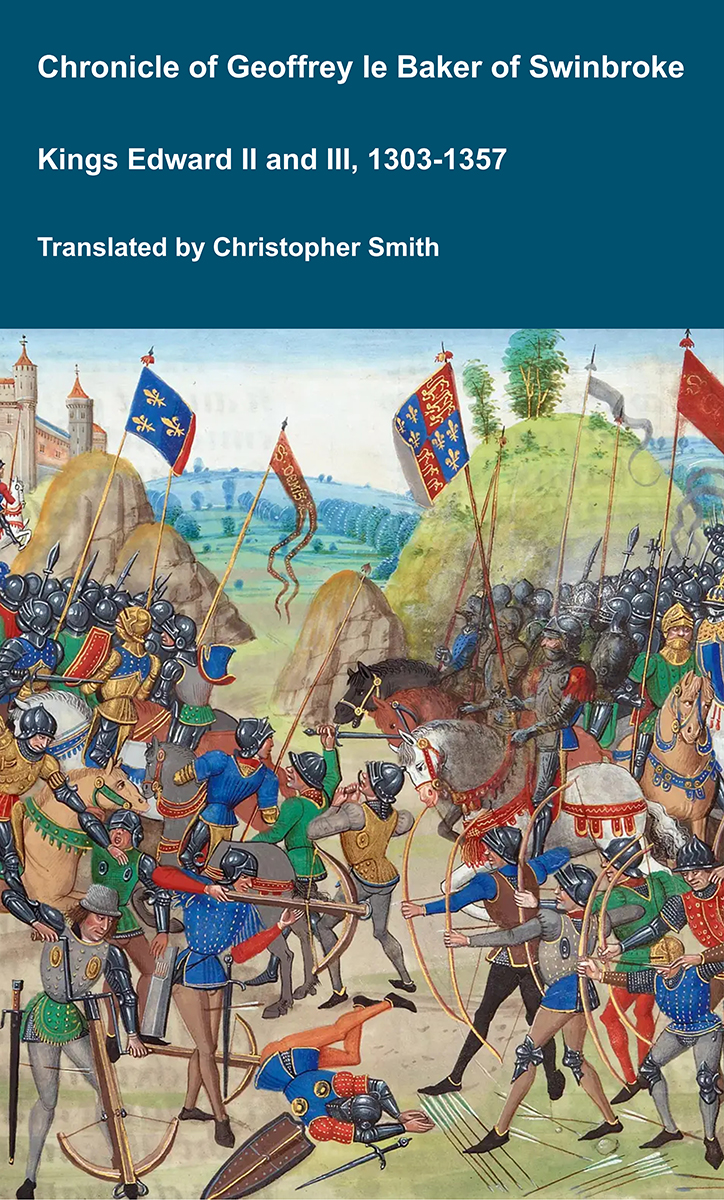
Baker was a secular clerk from Swinbroke, now Swinbrook, an Oxfordshire village two miles east of Burford. His Chronicle describes the events of the period 1303-1356: Gaveston, Bannockburn, Boroughbridge, the murder of King Edward II, the Scottish Wars, Sluys, Crécy, the Black Death, Winchelsea and Poitiers. To quote Herbert Bruce 'it possesses a vigorous and characteristic style, and its value for particular events between 1303 and 1356 has been recognised by its editor and by subsequent writers'. The book provides remarkable detail about the events it describes. Baker's text has been augmented with hundreds of notes, including extracts from other contemporary chronicles, such as the Annales Londonienses, Annales Paulini, Murimuth, Lanercost, Avesbury, Guisborough and Froissart to enrich the reader's understanding. The translation takes as its source the 'Chronicon Galfridi le Baker de Swynebroke' published in 1889, edited by Edward Maunde Thompson.
Available at Amazon in eBook and Paperback format.
On 9th October 1296 Louis Wittelsbach III Duke Bavaria [aged 27] died. His brother Stephen [aged 25] succeeded I Duke Bavaria.
On 9th October 1326 Reginald I Count Guelders [aged 71] died. His son Reginald [aged 31] succeeded II Count Guelders.
On 9th October 1329 Thomas Butler 1st Baron Dunboyne [aged 58] was killed at the Battle of Ardnocher by the Chief of the Clan Geoghegan. His son Piers [aged 35] succeeded 2nd Baron Dunboyne.
Chronicle of Geoffrey le Baker of Swinbroke. In the year of our Lord 1334, the eighth year of King Edward, shortly after the feast of Saint Denis [9th October], John, Archbishop of Canterbury,1 crossed the sea to meet with Philip of Valois, called the King of France whom we should henceforth call a tyrant, for he is an enemy of common justice and an intruder into the aforesaid sacred kingdom [France]. Approaching the said tyrant, the archbishop, a man of great wisdom and a distinguished doctor of both laws, first requested that the friendship between the two kingdoms be continued and prosper through mutual affection between the said so-called King of France and his lord, the King of England. Secondly, he requested from the tyrant that the cities and castles in Aquitaine, seized by the tyrant's father Charles the traitor and still retained, be restored to his lord the king. Thirdly, he asked that the said tyrant withdraw his supporting hand from the Scots, who were of no concern to him, and instead assist, whether by help, counsel, or favour, his cousin the King of England in his cause against them. Finally, he added that his said lord the king, under these conditions, was willingly prepared to travel at his own expense to the Holy Land alongside the said so-called King of France, in a crusade against the enemies of Christ's cross. To these requests, the tyrant replied that the King of England was unworthy of his friendship for as long as he waged unjust war against his Scottish friends whom he called just men, ready to obey all reason. He said he could feel no goodwill toward anyone who so cruelly tormented the Scots with war. To the second petition, he would not agree except under the condition that the expenses and damages which his father Charles of Valois had incurred and suffered while campaigning in Gascony be repaid. To the third point, he claimed to be a friend of the law and of common justice, and that he would never, through kinship or personal affection, stray from justice, which he professed to love. Rather, he intended to increase, by every way and means he knew, the weight of persecution upon all who disturbed the peace of the kingdom of Scotland. 'For,' he said in closing, 'there shall not be perfect peace for Christians until the King of France, sitting in the midst of England as judge upon a royal throne, shall rule over the kingdoms of France, England, and Scotland as judge and emperor.' This prophecy, which he uttered while reigning in that year, he did not elaborate upon further. The envoy departed, deeply offended, and proceeded on to other matters.
Anno Domini MCCCXXXIIIJ, regis Edwardi VIIJ, cito post festum sancti Dionisii Iohannes archiepiscopus Cantuariensis transfretavit versus Philippum de Valesio, vocatum regem Francie, quem libet de cetero vocare tirannum, quia inimicum iusticie communis et predicti sancti regni intrusorem. Ad predictum tirannum accedens episcopus predictus, vir magne sapiencie et doctor egregius utriusque iuris, peciit continuacionem amicicie inter regna fore prosperandam per mutuam dileccionem inter ipsum vocatum regem Francorum et dominum suum regem Anglie. Secundo peciit a tiranno quod civitates et castra, per patrem tiranni Karolum proditorem in Aquitannia capta et ab ipso detenta, domino suo regi forent restituta. Tercio, quod predictus tirannus dimitteret suam manum auxiliatricem a Scotis sibi impertinentibus, et contra illos iuvaret auxilio vel concilio seu favoure suum cognatum, regem Anglie; annectens finaliter dominum suum regem sepedictum sub hiis condicionibus libenter paratum propriis sumptibus ad Terram Sanctam proficisci contra inimicos crucis Christi cum illo vocato rege Francorum. Ad hec tirannus adiudicavit regem Anglie indignum sua amicicia, quamdiu contra suos amicos Scotos, viros iustos et omni racioni, ut asseruit, obedire paratos, guerram iniustam exerceret, nec animum ad aliquem posse benevolum se habere, qui illos, scilicet Scotos, tam inhumaniter guerrando vexaret. Ad secundam peticionem noluit aliter consentire quam quod expense et dampna forent restituta, que pater suus Karolus de Valesio recepit et exposuit in Vasconia militando. Ad terciam respondit se fuisse iuris amicum et iusticie communis, nec unquam per affinitatem aut amiciciam carnalem a iusticia, quam dilexit, declinaturum, set se velle viis et modis quibus sciret aut posset super omnes perturbatores pacis regni Scotorum sue persecucionis iugum aggravare; 'Non enim, inquiens in fine sermonis,' pax erit perfecta Christianis, antequam rex Francie, in medio Anglie consistens pro tribunali, super regna Francie, Anglie et Scocie sit iudex et imperator. Isti prophecie, quam prophetavit, cum esset rex anni illius, non adiecit loqui set indignanter se subtraxit nuncius ad alia profecturus.
Chronicle of Geoffrey le Baker of Swinbroke. So, around the feast of Saint Denis [9th October 1346], King David of Scotland entered England with Scottish forces and the hired troops sent to him. He bypassed Berwick, which was defended by the English, and after passing through the forest of Alnwick and laying waste to the surrounding countryside, they besieged a certain manor1 of the lord of Wake, called Liddel. That place was defended for a time against them by Sir Walter de Selby, a knight of great valour, who at last, overwhelmed by the number of Scots, surrendered himself to them, seeking to be spared through ransom. They accepted his surrender as victors, according to the military law commonly observed in the Scottish and French wars. But when news of the knight's capture reached King David, he ordered him to be killed, despite his pleas for mercy and hope of ransom. Walter begged to be brought alive into the king's presence.
Igitur, circa festum sancti Dionisii, rex Scotorum David cum potencia Scotica et stipendiariis sibi missis ingreditur Angliam, dimittens Berewicum per Anglicos defensum. Tandem, peragrata foresta Alnewici et adiacente patria depredata, oppugnarunt quoddam manerium domini de Wake, vocatum Ludedew. Predictum locum per tempus aliquot contra ipsos defendebat dominus Gualterus de Seleby, miles magne probitatis, qui tandem, mole Scotorum coactus, victori se reddidit pro redemptione conservandus, qui eum in graciam, more victoris de iure militari bellis Scoticis atque Gallicis usitato, cepit. Vite illius captura ad David noticiam ventilata, iubetur occidi illius miserentem atque redempcionem affectantem. Deprecabatur ut ad David conspectum vivus duceretur.
Note 1. The small fortress or pele of Liddel stood on a cliff overhanging a stream of the same name, two miles north of Netherby. It belonged to Thomas, lord Wake, who was sometimes styled 'Thomas de Wake de Lyddel.' It held out till the fourth day of the siege, when it was stormed; Chronicle of Lanercost 345.
On 9th October 1390 John I King Castile [aged 32] died. His son Henry [aged 11] succeeded III King Castile.
On 9th October 1459 Thomas Tresham [aged 39] was elected Speaker of the House of Commons at Coventry, Warwickshire [Map]. The primary purpose of the Parliament was to attaint the Yorkist leaders:
Richard Plantagenet 3rd Duke of York [aged 48], his sons Edward Earl of March [aged 17], Edmund Earl of Rutland [aged 16] were attainted, as were Richard Neville Earl Salisbury [aged 59] and his sons Richard "Kingmaker" Neville Earl Warwick, 6th Earl Salisbury [aged 30] and John Neville 1431-1471 [aged 28].
A Brief Latin Chronicle. 9th October 1459. In the same year, around the feast of Saint Edmund, King and Martyr, a parliament was convened at Coventry, where the said Duke and three Earls, along with many other knights and magnates, were indicted there for grand treason and declared to be attainted traitors by the lords of that parliament; and the actions approved by the said duke and lords regarding their insurrection at the town of St Albans in the previous parliament were completely annulled in this one. And on the feast of Saint Agnes following, the said Duke and lords were publicly proclaimed as attainted traitors in the city of London, and thus remained until about the feast of Saint John the Baptist following.
Eodem anno, circiter festum Sancti Edmundi Regis et Martiris, convocato parliamento apud Coventre, indictati sunt ibidem dicti Dux et tres Comites cum aliis multis militibus et magnatibus super grandi prodicione et declarati pro ateyntid traytowrs per dominos illius parliamenti; et ea que per dictos ducem et dominos de insurreccione sua apud villam Sancti Abani in priori parliamento approbata sunt, in isto penitus sunt cassata. Et in festo Sancte Agnetis proximo sequente, dicti Dux et domini in civitate London. publice proclamati sunt pro ateyntid traytours, et sic manserunt usque circiter festum Sancti Johannis Baptiste proximo sequens.
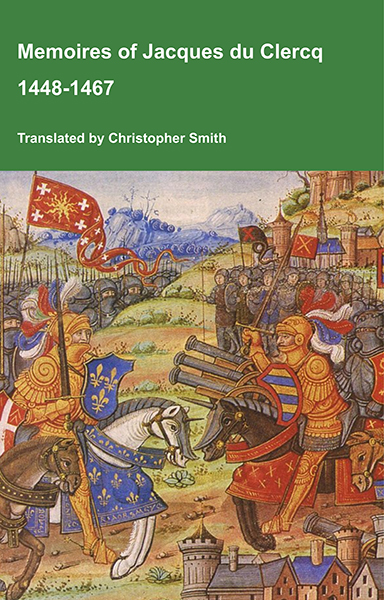 Memoires Jacques du Clercq. Around this time, in the castellany of Lille, a village named Lannoy was enclosed with walls by its lord, who was captain of Holland and governor of Lille, and he made of it a fortified town. The said lord of Lannoy proclaimed a free fair there on the feast of Saint Denis and Saint Ghislain in October [9th], and he gave to each merchant who brought the most money from each trade a certain sum of gold and silver; likewise, to the greatest drinker he gave four measures of wine. These sums amounted, as was said, to seven hundred pounds in the money of Artois or more.
Environ ce temps, ung villaige en la chastellerie de Lille, nommé Lannoy, le seigneur dudit lieu, lequel estoit capitaine d'Hollande et gouverneur de Lille, feit clorre de murs et en feit une ville fermée, et feit ledit S de Lannoy crier francque feste en ladite ville de Lannoy, le jour St Denys et St Guillain en octobre, et donna a chacun marchand qui plus apporteroit de deniers de chacun mestier, a chacun certaine somme d'or et d'argent; mesmement au plus grand buveur quatre lots de vin, lesquelles sommes monterent, comme on disoit, a sept cens livres monnoye d'Artois ou plus.
Memoires Jacques du Clercq. On the ninth day of October 1464, the Duke of Burgundy received letters from the king stating that he would come to see him at Hesdin the following day. It was also said that on that same day, while the duke was at dinner, he received two letters from Holland sent by his son, in which he wrote that he was not safe at Hesdin. For these reasons, as soon as the duke had dined, he mounted his horse with only a small company and departed suddenly from Hesdin. He went to lodge at Saint-Pol, and shortly afterwards everyone from his court followed him. He also ordered that all his baggage be brought along. From Saint-Pol he went to Lille, leaving at Hesdin, to guard the town and the castle, his nephew Adolph of Cleves and the Lord of Créqui, instructing them that if the king should come, they were to open both the town and the castle to him. When this departure of the duke became known to the king, he too soon left Abbeville and went to the town of Rouen in Normandy. Likewise, the Duke of Bourbon, as soon as he learned of his uncle's departure, took leave of the king and went to join him at Lille, where the duke received him with great honour; and from there the Duke of Bourbon went on to Ghent, where the Count of Charolais was, and he too received him warmly and entertained him splendidly.
Le ixe jour d'octobre, mil IIIJc LXIIIJ, le duc de Bourgogne receupt lettres du roy, contenant qu'il le venroit veoir a Hesdin le lendemain; on disoit aussy que ce propre jour le duc receupt, lui estant a son disner, deux lettres venant de Hollande, de par son fils, par lesquelles il lui rescripvoit qu'il n'estoit pas bien a Hesdin; pour lesquelles choses cestuy propre jour, prestement que le duc olt disné, il monta a cheval, et assés a petite compagnie, et soudainement il se partist de Hesdin, et s'en alla au giste a St Pol, et tantost tout chacun de sa cour alla après lui, et commanda aussy que on amenat tout son carroy: de St Pol il alla a Lille, et laissa a Hesdin, pour garder la ville et le chastel, son nepveu Adolphe de Clefves et le St de Crequi, auxquels il chargea, que sy le roy y venoit, que on lui feit ouverture par toute la ville et au chastel. Icelluy partement du duc venu a la cognoissance du roy, assés tost après il se partist d'Abbeville et s'en alla en la ville de Rouen en Normandie. Le duc de Bourbon aussy, tantost qu'il sceust le partement de son oncle, prist congié du roy et s'en alla vers son oncle a Lille, ou le duc le festoya haultément, et d'illecq alla le duc de Bourbon a Gand, ou le comte de Charollois estoit, qu'il lui feit grande chiere, et la fust aussy grandement festoyé.

On 9th October 1495 Ralph Okeover [aged 55] died. He and his wife Agnes Bradbourne were buried at St Cuthbert's Church, Doveridge [Map].
Ralph Okeover: he and Agnes Bradbourne were married. Around 1440 he was born.
Agnes Bradbourne: she was born to John Bradbourne and Ann Vernon.
On 9th October 1514 Louis XII King France [aged 52] and Mary Tudor Queen Consort France [aged 18] were married at Abbeville [Map], Somme. She by marriage Queen Consort France. Thomas Grey 2nd Marquess Dorset [aged 37], Thomas West 8th Baron De La Warr 5th Baron West [aged 57], Thomas Brooke 8th Baron Cobham [aged 44] and his son George Brooke 9th Baron Cobham [aged 17], Bishop Thomas Ruthall [aged 42] and Margaret Wotton Marchioness Dorset [aged 27] attended. The difference in their ages was 33 years. She the daughter of King Henry VII of England and Ireland and Elizabeth York Queen Consort England. He the son of Charles Valois Duke Orléans and Mary de la Marck Duchess Orléans. They were second cousin twice removed.


Wriothesley's Chronicle [1508-1562]. 9th October 1514. A peace betwene the King [aged 23] and French King [aged 52] duringe both their lives; and the Ladie Marie [aged 18], sister to the King, married to the French King,d at Abireld [Map],e in Picardye, in October.f
Note d. The Princess Mary was in her seventeenth year, and her husband Louis XII, to whom she was third wife, in his fifty-fourth year.
Note e. At Abbeville [Map], in Picardy. From which place Mary, three days after her marriage, wrote letters to her brother and Wolsey.
Note f. The marriage ceremony had been preriously celebrated at Greenwich by proxy, but was not consummated till October 9th. For fuller particulars, see Ellis's Original Letters, First and Second Series.

Anne Boleyn. Her Life as told by Lancelot de Carle's 1536 Letter.
In 1536, two weeks after the execution of Anne Boleyn, her brother George and four others, Lancelot du Carle, wrote an extraordinary letter that described Anne's life, and her trial and execution, to which he was a witness. This book presents a new translation of that letter, with additional material from other contemporary sources such as Letters, Hall's and Wriothesley's Chronicles, the pamphlets of Wynkyn the Worde, the Memorial of George Constantyne, the Portuguese Letter and the Baga de Secrets, all of which are provided in Appendices.
Available at Amazon in eBook and Paperback format.
Letters and Papers Foreign and Domestic. 9th October 1514. Vitell. C. XVI., 243. B.M. 3348. Marriage of the French Queen [aged 18].
Declaration by Louis XII [aged 52]. that he takes the Princess Mary [sister] of the King of England as his wife. Signed: Loys. Fr. Vellum, much injured by fire.
Leland's Coll. I., ii., p. 704.
2. [5482.] Names of the Englishmen which were sent in ambassade to the French King, before the Queen's landing, and other gentlemen in their company:—The Earl of Worcester, Lord Chamberlain; the Lord of St. John's, Tho. Docwra; and the Dean of Windsor, Doctor West, ambassadors. The Lord Herbert, son of the Earl of Worcester; Sir John Savage; Sir [blank]; Sir Christopher Garneys; Sir [blank]; Clarenceux King of Arms.
ii. The names of the Lords and other Noblemen of France being at the said marriage:—
The Duke of Valois and Bretagne, the Duke of Alençon, the son of the King Don Frederic of Naples, the Earl of Vendôme, the Duke of Longueville, the Prince de la Roche Suryon, the Duke of Albany, the Earl of St. Poll, the Earl of Guise, brother to the Duke of Lorraine, Louis Monsieur, brother to the Earl of Nevers, the Earl of Roussy, the Lord of Lautrec, the Earl of Sancerre, the Lord de Lespar, the Earl Manfroy, the Lord de la Palice, Grand Maistre de France, the Earl Galiace de Saint Severin, Grand Esquire, the Earl of Alexandrie, the Earl of Maleverer, Grand Seneschal of Normandy, le Sr. de Graville, Admiral, le Sr. de Monmorancy, Premier Baron Chamb., le Sr. de Testeville, le Sr. de la Tremoille, le Prince de Talmon, son fils, le Sr. de Piennes, Lieutenant de Picardie, le Sr. de Bouchaige Chambrelan, le Sr. de Dourriers, le Sr. de Chesnes, le Sr. Daubigny, le Vidame D'Amiens, le Sr. de Boysy, Monsieur de Bonyvet, le Vidame de Chartres, Monsieur de Fou, Monsieur de Cursoll, Monsieur de Wansay, Monsieur Louis D'Ars, le Sr. du Pont de Remy, les trois Generaux de France, viz., Normandie, Languedoie, Languedoc, Monsieur de Beaudiner, Mons. de Gynry, Mons. de Rouville, Grand Veneur, Mons. Denebatt, Cappne des Toilles, Monsieur de Boucheron.
Ibid, p. 701. 3. [5483.] "The names of the lords and gentlemen of England being at the marriage of the Right Excellent Princess the Lady Mary," showing the wages paid to each, all receiving 20 days' wages in hand:—The Duke of Norfolk [aged 71], my Lady his wife [aged 37], the Countess of Oxford [aged 17], and the Lord Edmund Howard [aged 36], with 100 horses; the Marquis of Dorset [aged 37], my Lady his wife [aged 27], and the Lord Edward his brother, 80; the Lord Thomas Rowthall Bishop of Durham [aged 42], 68, the Earl of Surrey [aged 41], son and heir to the Duke of Norfolk, 58, the Lord Lawarre, 30, the Lord Berners, chamberlain to the French Queen, and the Lord Montaigle and my Lady his wife, 30; the Lord Richard Grey, the Lord John Grey, the Lord Leonard Grey, brethren to my Lord Marquis, each 20; Sir Nicholas Vaux, Sir David Owen, Sir Andrew Windsor, Sir John Husee, Sir John Peche and Sir Henry Wyot, bannerets; Sir Morice Berkeley, 20, Sir Wm. Sandes, 20, Sir John Hungerford, 12, Sir Robert Drury, Sir Tho. Botrym, 12, Sir Philipp Calthorp, Sir Thomas Clynton, Sir Robert Cotton, Sir John Heydon, Sir John Carre, Sir Edward Greville, Sir Will. Essex, Sir Philip-Tylney, Sir Nicholas Applyard, Sir Edward Bensted, Sir Will. Rows, and Sir John Wallop, knights; John Broughton, Rich. Weston, Giles Strangways, Tho. Cheyney, Ralph Chamberlain, Rich. Blont, Gerard Danet, and Robert Jonys, esquires; Garter Principal King of Arms, and his four servants; Thomas Pawlet, — Manners, George Cobham, and Anthony Saintliger; Richmond Herald; John Myclow with 50 officers of the King's household servants that were officers with the French Queen; Hen. Webb, gentleman usher; Tho. Rushe and Ambrose [Bradman], serjeant at arms.
The names of the ladies and gentlewomen being at the said marriage:—The Duchess of Norfolk, and in her company the Countess of Oxford, her daughter, the Marquise of Dorset.
Gentlewomen which were appointed to have abidden in France with the French Queen:—Dame Guylford, lady of honor, Lady Elizabeth Grey [aged 17], Eliz. Ferrys. M. Ann Devereux, — Grey of Wilton, M. Boleyne, M. Wotton, Alice Denys and Anne Ferningham [aged 10] (Jerningham?), chamberers, Dr. Denton, almoner, Mr. Palgrave, secretary, — (blank), chaplains.
Note. The "M. Boleyne" may be a reference to either Mary Boleyn [aged 15] or Queen Anne Boleyn of England [aged 13].


On 9th October 1518 King Frederick I of Denmark [aged 47] and Sophie of Pomerania Queen Consort of Denmark and Sweden [aged 20] were married. The difference in their ages was 26 years. He the son of Christian I King of Denmark and Dorothea of Brandenburg.
Letters and Papers Foreign and Domestic Henry VIII 1535. 9th October 1535. R. O. 571. Sir Anthony Wyndesore to Lord Lisle [aged 71].
By a letter in your own hand, written on Midsummer Day last, you desired me to see Sir Edward Seymour [aged 35] paid £100 at the feast of All Saints, according to the award of my Lord Chancellor and Master Secretary, and to take a statute of him. I never saw the award, and can get no knowledge how the money should be paid. I wrote to Leonard Smith what to do, but have had no answer from him yet. I beg to know your pleasure as soon as possible, for you wrote that you trusted Sir Edward Seymour would allow the £60 in part of the £100. Your audit shall begin at Kingston Lisle on the 18th Oct. I have been obliged to attend the King since he came into Hampshire, and have had no leisure to write to you or my Lady. His Grace has been in Hampshire from about the 10th Sept., and intends to be till 19th Oct., except four days that he lieth in Salisbury, and returneth to Hampshire again. He will be at Windsor on Allhallows Eve. He was at Portsmouth and Porchester, but I was not there, for I was then commanded to cause the weirs to be plucked down upon the rivers through the whole shire. The King and Queen [aged 34] were very merry in Hampshire. I enclose a letter for the Purrege (Purbeck) stone sold by Gillot, and have taken account of him before Jas. Hauxhed, which I have written in the end of the letter. Est Meon, 9 Oct. Signed.
P. 1. Add.: Deputy of Calais. Endd.
On 9th October 1564 Stillborn Wettin was born to Johann Wilhelm Wettin Duke Saxe Weimar [aged 34] and Dorothea Susanne Palatine Duchess Saxe Weimar at Weimar.
On 9th October 1569 Dorothea Oldenburg was born to John "Younger" Oldenburg Duke Schleswig Holstein Sonderburg [aged 24] and Elisabeth of Brunswick-Grubenhagen [aged 19].
On 9th October 1574 Elisabeth Renata Lorraine Duchess Bavaria was born to Charles "The Great" Lorraine III Duke Lorraine [aged 31] and Claude Valois Duchess Lorraine [aged 26]. She married 6th February 1595 her first cousin Maximilian "The Great" Wittelsbach I Duke Bavaria I Elector Bavaria, son of William Wittelsbach V Duke Bavaria and Renata Lorraine Duchess Bavaria.


Autobiography Simon D'Ewes. 9th October 1621. Michaelmas Term beginning upon Tuesday, the 9th day of October, John Williams [aged 39], Doctor of Divinity, Dean of Westminster and Bishop of Lincoln, took his place in the Chancery, as Lord Keeper of the Great Seal, Viscount Mandeville [aged 58], Lord President, administering the oath to him. Much talk there was of this divine's sudden rising, being a Welchman by birth, and, but a few years before, a poor subsizar in St. John's College in Cambridge of little regard or learniug. After he had taken his oath, he made a long, learned, and ho&est speech in the Chancery Court; but little practised it, as the sequel too plainly verified. I heard it confidently reported, that the old Lord Chancellor, Sir Thomas Egerton, Lord Ellesmere, prophesied of him, being then his household chaplain, that he would prove another Wolsey, which was as strangely verified many years after by his fall, as now by his rising.
On 9th October 1622 John "Younger" Oldenburg Duke Schleswig Holstein Sonderburg [aged 77] died. His son Alexander [aged 49] succeeded I Duke Schleswig Holstein Sonderburg Augustenburg.
John Evelyn's Diary. 9th October 1641. [Date obscured] I passed by boat to Bruges [Map], taking in at a redoubt a convoy of fourteen musketeers, because the other side of the river, being Contribution-land, was subject to the inroads and depredations of the bordering States. This river was cut by the famous Marquis Spinola, and is in my judgment a wonderful piece of labour, and a worthy public work, being in some places forced through the main rock, to an incredible depth, for thirty miles. At the end of each mile, is built a small redoubt, which communicates a line to the next, and so the whole way, from whence we received many volleys of shot, in compliment to my Lord Marshal [aged 56], who was in our vessel, a passenger with us. At five that evening, we were met by the magistrates of Bruges [Map], who came out to convey my Lord to his lodgings, at whose cost he was entertained that night.
morning after we went to see the Stadt house and adjoining aqueduct, the church, and market-place, where we saw cheeses and butter piled up in heaps; also the fortifications and graffs, which are extremely large.


On 9th October 1646 Balthasar Charles Habsburg Spain Prince Asturias [aged 16] died.

On 9th October 1650 Frances Altham Countess Carbery [aged 29] died in childbirth.
Abbot John Whethamstede’s Chronicle of the Abbey of St Albans
Abbot John Whethamstede's Register aka Chronicle of his second term at the Abbey of St Albans, 1451-1461, is a remarkable text that describes his first-hand experience of the beginning of the Wars of the Roses including the First and Second Battles of St Albans, 1455 and 1461, respectively, their cause, and their consequences, not least on the Abbey itself. His text also includes Loveday, Blore Heath, Northampton, the Act of Accord, Wakefield, and Towton, and ends with the Coronation of King Edward IV. In addition to the events of the Wars of the Roses, Abbot John, or his scribes who wrote the Chronicle, include details in the life of the Abbey such as charters, letters, land exchanges, visits by legates, and disputes, which provide a rich insight into the day-to-day life of the Abbey, and the challenges faced by its Abbot.
Available at Amazon in eBook and Paperback format.

Samuel Pepys' Diary. 9th October 1660. This morning Sir W. Batten [aged 59] with Colonel Birch [aged 45] to Deptford, to pay off two ships. Sir W. Pen [aged 39] and I staid to do business, and afterwards together to White Hall, where I went to my Lord, and found him in bed not well, and saw in his chamber his picture1, very well done; and am with child2 till I get it copied out, which I hope to do when he is gone to sea.
Note 1. Peter Lely [aged 42]. Portrait of Edward Montagu 1st Earl Sandwich [aged 35] in his Garter Robes and Garter Collar.
Note 2. A figurative expression for an eager longing desire, used by Udall and by Spenser. The latest authority given by Dr. Murray in the "New English Dictionary", is Bailey in 1725.
Samuel Pepys' Diary. 9th October 1662. Up early about my business to get me ready for my journey. But first to the office; where we sat all the morning till noon, and then broke up; and I bid them adieu for a week, having the Duke's leave got me by Mr. Coventry [aged 34]. To whom I did give thanks for my newes yesterday of the Duke's words to my Lord Sandwich [aged 37] concerning me, which he took well; and do tell me so freely his love and value of me, that my mind is now in as great a state of quiett as to my interest in the office, as I could ever wish to be. I should this day have dined at Sir W. Pen's [aged 41] at a venison pasty with the rest of our fellows, but I could not get time, but sent for a bit home, and so between one and two o'clock got on horseback at our back gate, with my man Will with me, both well-mounted on two grey horses. We rode and got to Ware, Hertfordshire [Map] before night; and so resolved to ride on to Puckeridge, which we did, though the way was bad, and the evening dark before we got thither, by help of company riding before us; and among others, a gentleman that took up at the same inn, the Falcon, with me, his name Mr. Brian, with whom I supped, and was very good company, and a scholar. He tells me, that it is believed the Queen [aged 23] is with child, for that the coaches are ordered to ride very easily through the streets.


Samuel Pepys' Diary. 9th October 1663. And did keep my bed most of this morning, my body I find being still bound and little wind, and so my pain returned again, though not so bad, but keeping my body with warm clothes very hot I made shift to endure it, and at noon sent word to Mr. Hollyard [aged 54] of my condition, that I could neither have a natural stool nor break wind, and by that means still in pain and frequent offering to make water. So he sent me two bottles of drink and some syrup, one bottle to take now and the other to-morrow morning. So in the evening, after Commissioner Pett [aged 53], who came to visit me, and was going to Chatham, Kent [Map], but methinks do talk to me in quite another manner, doubtfully and shyly, and like a stranger, to what he did heretofore. After I saw he was gone I did drink one of them, but it was a most loathsome draught, and did keep myself warm after it, and had that afternoon still a stool or two, but in no plenty, nor any wind almost carried away, and so to bed. In no great pain, but do not think myself likely to be well till I have a freedom of stool and wind. Most of this day and afternoon my wife and I did spend together in setting things now up and in order in her closet, which indeed is, and will be, when I can get her some more things to put in it, a very pleasant place, and is at present very pretty, and such as she, I hope, will find great content in. So to bed.
Samuel Pepys' Diary. 9th October 1665. Up, my head full of business, and called upon also by Sir John Shaw, to whom I did give a civil answer about our prize goods, that all his dues as one of the Farmers of the Customes are paid, and showed him our Transire; with which he was satisfied, and parted, ordering his servants to see the weight of them. I to the office, and there found an order for my coming presently to the Duke of Albemarle [aged 56], and what should it be, but to tell me, that, if my Lord Sandwich [aged 40] do not come to towne, he do resolve to go with the fleete to sea himself, the Dutch, as he thinks, being in the Downes, and so desired me to get a pleasure boat for to take him in to-morrow morning, and do many other things, and with a great liking of me, and my management especially, as that coxcombe my Lord Craven [aged 57] do tell me, and I perceive it, and I am sure take pains enough to deserve it.


Samuel Pepys' Diary. 9th October 1665. Thence away and to the office at London, where I did some business about my money and private accounts, and there eat a bit of goose of Mr. Griffin's, and so by water, it raining most miserably, to Greenwich, Kent [Map], calling on several vessels in my passage. Being come there I hear another seizure hath been made of our goods by one Captain Fisher that hath been at Chatham, Kent [Map] by warrant of the Duke of Albemarle [aged 56], and is come in my absence to Tooker's and viewed them, demanding the key of the constable, and so sealed up the door. I to the house, but there being no officers nor constable could do nothing, but back to my office full of trouble about this, and there late about business, vexed to see myself fall into this trouble and concernment in a thing that I want instruction from my Lord Sandwich [aged 40] whether I should appear in it or no, and so home to bed, having spent two hours, I and my boy, at Mr. Glanvill's removing of faggots to make room to remove our goods to, but when done I thought it not fit to use it. The newes of the killing of the [King of] France is wholly untrue, and they say that of the Pope too.
On 9th October 1666 John George Wettin III Elector Saxony [aged 19] and Anna Sophie Oldenburg [aged 19] were married. She the daughter of Frederick III King of Denmark [aged 57] and Sophie Amalie Hanover Queen Consort Denmark [aged 38]. He the son of John George Wettin Elector Saxony [aged 53]. They were third cousin once removed.

Samuel Pepys' Diary. 9th October 1667. By and by to dinner, and after dinner I walked up to Hinchingbroke [Map], where my Lady [aged 42] expected me; and there spent all the afternoon with her: the same most excellent, good, discreet lady that ever she was; and, among other things, is mightily pleased with the lady that is like to be her son Hinchingbroke's [aged 19] wife, which I am mightily glad of.
Samuel Pepys' Diary. 9th October 1667. By and by my wife comes with Willet, my wife in her velvett vest, which is mighty fine, and becomes her exceedingly. I am pleased with my Lady Paulina [aged 18] and Anne, who both are grown very proper ladies, and handsome enough. But a thousand questions my Lady [aged 42] asked me, till she could think of no more almost, but walked up and down the house, with me. But I do find, by her, that they are reduced to great straits for money, having been forced to sell her plate, 8 or £900 worth; and she is now going to sell a suit of her best hangings, of which I could almost wish to buy a piece or two, if the pieces will be broke. But the house is most excellently furnished, and brave rooms and good pictures, so that it do please me infinitely beyond Audley End. Here we staid till night walking and talking and drinking, and with mighty satisfaction my Lady with me alone most of the day talking of my Lord's bad condition to be kept in Spayne without money and at a great expense, which (as we will save the family) we must labour to remove.
John Evelyn's Diary. 9th October 1671 and 10th October 1671. I went, after evening service, to London, in order to a journey of refreshment with Mr. Treasurer [aged 41], to Newmarket, Suffolk, where the King [aged 41] then was, in his coach with six brave horses, which we changed thrice, first, at Bishop-Stortford [Map], and last, at Chesterford; so, by night, we got to Newmarket, Suffolk, where Mr. Henry Jermain [aged 35] (nephew to the Earl of St. Alban [aged 66]) lodged me very civilly. We proceeded immediately to Court, the King and all the English gallants being there at their autumnal sports. Supped at the Lord Chamberlain's; and, the next day, after dinner, I was on the heath, where I saw the great match run between Woodcock and Flatfoot, belonging to the King, and to Mr. Eliot, of the bedchamber, many thousands being spectators; a more signal race had not been run for many years.


On 9th October 1690 John Maynard [aged 86] died.
On 9th October 1690 Richard Power 1st Earl Tyrone [aged 60] was sent to the Tower of London [Map] having accussed of treason.
On 9th October 1690 Henry Fitzroy 1st Duke Grafton [aged 27] was killed at Cork [Map] during the Storming of Cork. His son Charles [aged 6] succeeded 2nd Duke Grafton, 2nd Earl Euston, 2nd Viscount Ipswich, 2nd Baron Sudbury.


On 9th October 1690 Francis Boteler [aged 80] died. He was buried at St Etheldreda's Church, Hatfield [Map].
Francis Boteler: Around 1610 he was born to Ralph Boteler. Before 1644 Francis Boteler and Anne Cockayne were married.
Chronicle of Geoffrey le Baker of Swinbroke
Baker was a secular clerk from Swinbroke, now Swinbrook, an Oxfordshire village two miles east of Burford. His Chronicle describes the events of the period 1303-1356: Gaveston, Bannockburn, Boroughbridge, the murder of King Edward II, the Scottish Wars, Sluys, Crécy, the Black Death, Winchelsea and Poitiers. To quote Herbert Bruce 'it possesses a vigorous and characteristic style, and its value for particular events between 1303 and 1356 has been recognised by its editor and by subsequent writers'. The book provides remarkable detail about the events it describes. Baker's text has been augmented with hundreds of notes, including extracts from other contemporary chronicles, such as the Annales Londonienses, Annales Paulini, Murimuth, Lanercost, Avesbury, Guisborough and Froissart to enrich the reader's understanding. The translation takes as its source the 'Chronicon Galfridi le Baker de Swynebroke' published in 1889, edited by Edward Maunde Thompson.
Available at Amazon in eBook and Paperback format.
Autobiography Simon D'Ewes. 31st December 1690. The four lords that came for it were Henry Viscount Mandeville, Lord Treasurer, Lodowick Stewart, Duke of Lennox, Lord Steward of the King's house-hold, William Herbert, Earl of Pembroke, Lord Chamberlain of the same household, and Thomas Earl of Arundel, Earl Marshal of England (whom I should have placed before Pembroke); they, coming to York House [Map] to him, where he lay, told him they were sorry to visit him upon such an occasion, and wished it had been better. "No, my lords," replied he, "the occasion is good;" and then delivering them the great seal, he added, "It was the King's favour that gave me this, and it is my fault that hath taken it away: Rex dedit, culpa abstulit" - or words to that effect. So leaving him, the said four lords carried the gage they had received to Whitehall, to the King, who was overheard by some near him to say upon their delivery of it to him, "Now, by my soul, I am pained at the heart where to bestow this; for as to my lawyers, I think they be all knaves." Which it seemeth his Majesty spake at that time to prepare a way to bestow it on a clergyman, as the Marquis of Buckingham had intended; for otherwise there were at this present divers able wise lawyers, very honest and religious men, fit for the place, in whom there might easily have been found as much integrity, and less fawning and flattery than in the clergy; and, accordingly, Doctor Williams, now Dean of Westminster, and before that time made Bishop of Lincoln, was sworn Lord Keeper, and had the great seal delivered to him. On October the 9th, next ensuing, being the first day of Michaelmas Term, one Lloyd, or Floud, a Papist, being of the Inner Temple, having spoken these buse and opprobrious words following of the distressed Prince Elector Palatine and his royal lady, to wit, - "What is now become of your goodman Palsgrave, and your goodwife Palsgrave?1 - they had, I think, as much right to the kingdom of Bohemia as I have to the principality of Wales," was censured by the House of Commons, to pay a fine to the King, to be imprisoned during the King's pleasure, to ride disgracefully two several days in the open street upon a horse, with his face to the tail of it, and each day to stand in the pillory. The execution was long deferred, his fine and imprisonment remitted, and himself and his fellow Romanists began to boast that nothing should be inflicted. But at last, tho two Houses of Parliament appearing stoutly in the cause, he underwent the first day's punishment on May the 30th, being Wednesday, and the second on Friday the 1st day of June, on which Midsummer Term began. These days' actions I have added a little before the due time, that I might at once finish the relation of this business; in which the faithful zealous affection of the whole state and kingdom, in their body representative, consisting of the two Houses of Parliament, was fully expressed to that royal Princess, our King's only daughter, amidst the many scorns and oppressions of her irreconcilable and bloody enemies.
Note 1. This exclamation is given somewhat differently by Meade in the Harl. MSS. He says, "On Tuesday, Floyd, a counsellor, steward and receiver in Shropshire to the old Lord Chancellor Ellesmere and the Earl of Suffolk, a papist, and prisoner in the Fleet, was censured to ride thrice with papers, and stand in the pillory, and first at Westminster, for saying, Goodman Palsgrave. and Goody Palsgrave may or must go pack their children at their backs and beg. On Wednesday should have been the first time, but his Majesty stayed it. Yesterday the King and House met; his Majesty thanked them for the care they had of his son-in-law, daughter, and grandchildren's honour; if it were in them to censure this prisoner, the censure should be executed, otherwise there should be a punishment equivalent to that they had set down; which gave good content."
On 9th October 1709 Barbara Villiers 1st Duchess of Cleveland [aged 68] died at Chiswick Mall. Her son Charles [aged 47] succeeded 2nd Duke Cleveland, 2nd Earl of Southampton and 2nd Baron Nonsuch. Anne Pulteney Duchess Southampton Duchess of Cleveland [aged 45] by marriage Duchess Cleveland.


On 8th October 1718 Bishop Richard Cumberland [aged 86] died. He was buried the next day at Peterborough Cathedral [Map]. Sculpted by Thomas Green of Camberwell [aged 59].
Bishop Richard Cumberland: On 15th July 1632 he was born In 1691 Bishop Richard Cumberland was elected Bishop of Peterborough. He, apparently, discovered he had been elected when he read it in a newspaper whilst enjoying his habitual morning coffee at a coffe-house in Stamford [Map].
On 9th October 1735 Diana Spencer Duchess Bedford [deceased] was buried at Bedford Chapel, St Michael's Church, Chenies.
On 9th October 1750 Bishop Joseph Butler [aged 58] was enthroned Bishop of Durham by proxy.
On 9th October 1754 Jean-Baptiste Regnault was born.
On 9th October 1757 King Charles X of France was born to Dauphin Louis Bourbon [aged 28] and Dauphine Maria Josepha of France [aged 25]. He a great x 4 grandson of King Charles I of England, Scotland and Ireland. He married 1771 his second cousin once removed Maria Teresa of Savoy, daughter of Victor Amadeus III King Sardinia and Infanta Maria Antonia Spain, and had issue.


On 9th October 1759 Harry Powlett 4th Duke Bolton [aged 68] died. His son Charles [aged 41] succeeded 5th Duke Bolton, 10th Marquess Winchester, 10th Earl Wiltshire, 10th Baron St John.
On 9th October 1771 Carlos Fitz James Stuart 10th Duke Veragua 4th Duke Berwick [aged 19] and Caroline Stolberg Gedern Duchess Veragua Duchess Berwick [aged 16] were married. She by marriage Duchess Veragua, Duchess of Liria, Duchess of Jérica, Duchess Berwick. He the son of James Fitz James 3rd Duke Berwick 10th Duke Veragua [aged 52] and Maria Teresa Silva Duchess Berwick and Veragua [aged 55].
On 9th October 1785 John Cullum 6th Baronet [aged 52] died of consumption. His brother Thomas [aged 43] succeeded 7th Baronet Cullum of Hastede in Suffolk.
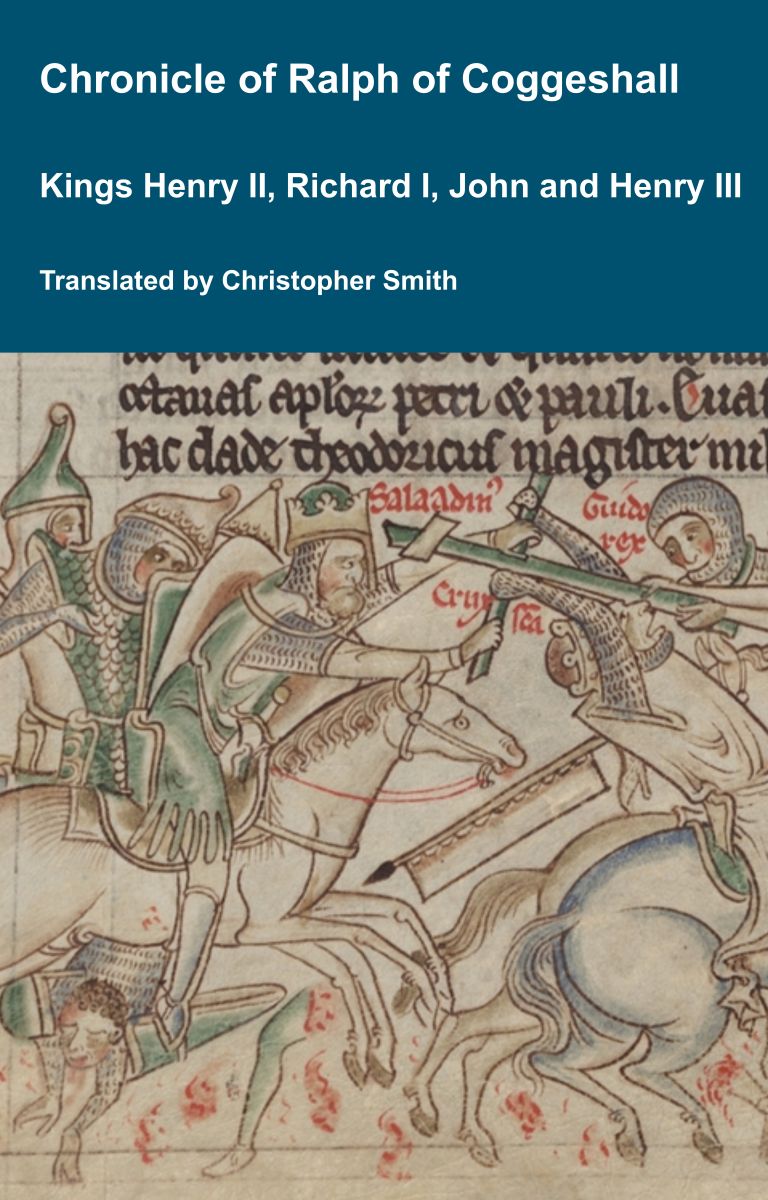
Chronicle of Abbot Ralph of Coggeshall
The Chronicle of Abbot Ralph of Coggeshall (Chronicon Anglicanum) is an indispensable medieval history that brings to life centuries of English and European affairs through the eyes of a learned Cistercian monk. Ralph of Coggeshall, abbot of the Abbey of Coggeshall in Essex in the early 13th century, continued and expanded his community’s chronicle, documenting events from the Norman Conquest of 1066 into the tumultuous reign of King Henry III. Blending eyewitness testimony, careful compilation, and the monastic commitment to record-keeping, this chronicle offers a rare narrative of political intrigue, royal power struggles, and social upheaval in England and beyond. Ralph’s work captures the reigns of pivotal figures such as Richard I and King John, providing invaluable insights into their characters, decisions, and the forces that shaped medieval rule. More than a simple annal, Chronicon Anglicanum conveys the texture of medieval life and governance, making it a rich source for scholars and readers fascinated by English history, monastic authorship, and the shaping of the medieval world.
Available at Amazon in eBook and Paperback format.
Wiltshire Archaeological Magazine 1885 V22 Pages 234-238. "Friday, 9 October [1807]. Fine and mild day. From Marlborough to Everley in a chaise, where I met my "Magnus Apollo," Mr. Cunnington. Mounted my horse and rode with him thus— see large map of Wilts. To the right between East and West Everley, a group of three barrows, viz., a finely formed Druid barrow between two bowl-shaped. A little beyond them on the declivity of a hill is a square earthen work, very perfect on three sides, and corners apparently rounded. In a northerly direction is a very interesting group of eight tumuli — very rude and possessing some novelty in their forms— particularly that of a long barrow within a circle. To the west of these, and a little on the left of the track leading to Pewsey, are two circles connected with each other by a ditch or hollow way [Map]. (The blackness of the soil, and the irregularity of the ground give me good reason to suppose that on digging I shall find the site of a British settlement here.) Turned off to the right, and skirted the ridge of hills, enjoying a most enchanting view of the richly wooded and cultivated vale beneath, terminated by the abrupt and bold Martinshall. On the declivity of the down see an immense irregular long barrow, called vulgarly the Giant's Grave [Map]. Beyond this tumulus and between it and Milton Farm-house, we evidently found the site of British habitations, and picked up a great deal of pottery. From hence crossed over to Easton Hill, where we discovered irregular earthen works, and excavations denoting ancient habitation. Returned to Milton Hill — a group of five tumuli very near each other, and another on the declivity of the hill [Map]. In our way back to Everley saw several others detached, but no earthen works or excavations exciting curiosity.
"A most interesting ride, full of novelty and information.
On 9th October 1811 Friederike Karoline Juliane Glücksburg was born to Friedrich Wilhelm Glücksburg Duke Schleswig Holstein Sonderburg Glücksburg [aged 26] and Louise Caroline Hesse-Kassel Duchess Schleswig Holstein Sonderburg Glücksburg [aged 22]. She a great x 2 granddaughter of King George II of Great Britain and Ireland.
On 9th October 1816 William Harold Cubley was born at Heanor, Derbyshire [Map].
On 9th October 1830 John Williams 1st Baronet [aged 68] died. Memorial at St Asaph Cathedral [Map] sculpted by Richard Westmacott [aged 55]. His son John [aged 36] succeeded 2nd Baronet Williams of Bodelwyddan in Flintshire.
John Williams 1st Baronet: On 22nd December 1761 he was born. On 21st October 1791 he and Margaret Williams Lady Williams were married. On 27th July 1798 John Williams 1st Baronet was created 1st Baronet Williams of Bodelwyddan in Flintshire. Margaret Williams Lady Williams by marriage Lady Williams of Bodelwyddan in Flintshire.
John Hay-Williams 2nd Baronet: On 9th January 1794 he was born to John Williams 1st Baronet and Margaret Williams Lady Williams. In 1842 he and Sarah Elizabeth Amherst were married. She the daughter of William Pitt Amherst 1st Earl Amherst and Sarah Archer Countess Plymouth and Amherst.


On 9th October 1830 Harriet Clark Lady Graham died in a carriage accident in Paris [Map].
On 9th October 1837 Catherine Anguish Duchess Leeds [aged 73] died.

On 9th October 1838 Henry George Jarvis [aged 29] died in Grenada, Caribbean. Memorial at St Peter's Church, Doddington [Map].
Henry George Jarvis: On 18th February 1809 he was born to George Ralph Payne Jarvis and Sarah Delaval.
On 9th October 1840 Simeon Solomon was born to Michael Meyer Solomon.


On 9th October 1856 Frederick William Pomeroy was born.
On 9th October 1895 Henry Adelbert Wellington Fitzroy 9th Duke Beaufort [aged 48] and Louise Emily Harford 9th Duchess Beaufort [aged 31] were married. He the son of Henry Charles Fitzroy Somerset 8th Duke Beaufort [aged 71] and Georgiana Charlotte Curzon Howe Duchess Beaufort [aged 70].

The True Chronicles of Jean le Bel Volume 1 Chapters 1-60 1307-1342
The True Chronicles of Jean le Bel offer one of the most vivid and immediate accounts of 14th-century Europe, written by a knight who lived through the events he describes, and experienced some of them first hand. Covering the early decades of the Hundred Years’ War, this remarkable chronicle follows the campaigns of Edward III of England, the politics of France and the Low Countries, and the shifting alliances that shaped medieval warfare. Unlike later historians, Jean le Bel writes with a strong sense of eyewitness authenticity, drawing on personal experience and the testimony of fellow soldiers. His narrative captures not only battles and sieges, but also the realities of military life, diplomacy, and the ideals of chivalry that governed noble society. A key source for Jean Froissart, Le Bel’s chronicle stands on its own as a compelling and insightful work, at once historical record and literary achievement. This translation builds on the 1905 edition published in French by Jules Viard, adding extensive translations from other sources Rymer's Fœdera, the Chronicles of Adam Murimuth, William Nangis, Walter of Guisborough, a Bourgeois of Valenciennes, Geoffrey le Baker of Swinbroke and Richard Lescot to enrich the original text and Viard's notes.
Available at Amazon in eBook and Paperback format.
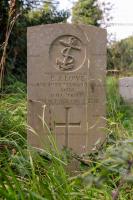
St James' Church, Antony [Map]. 9th October 1916. Grave of Edmund John Lowe, died aged thirty-two, 2nd Ship's Steward, Royal Navy, 343313, HMS Triad,
Ship's Steward 2nd Class 343313, H.M.S. Triad, Royal Navy. Invalided out 15 June 1915, died 9th October 1916. Aged 32. Born 25 November 1883 in Torpoint. Son of Mrs. Lowe, of Torpoint, and the late J. Lowe; husband of Maud Lucretia Lowe (nee Neale), of 13, Wellington St., Torpoint. Married 15 April 1908 in Princes Street Independent Church, Devonport. Prior to enlisting he was a Clerk. Enlisted 12 November 1901 for years, re-enlisted 22 November 1913 to completion. Height 5 feet 9 inches, black hair, grey eyes, sallow complexion. Buried in ANTONY CEMETERY, ANTONY. Section 12. Grave 11.
Funeral At Torpoint. The funeral of Mr. Edmund J. Lowe, late R.N., who died at the residence of his father-in-law, Mr. H. Neale, chief gunner, Wellington-street, Torpoint, took place at Antony Cemetery on Saturday. Rev. C. H. Underwood (pastor of the Congregational Church) officiating. The chief mourners were: —Mr, J. Lowe (father), Mr. H. Neale, RN. (father-in-law), Messrs. W. Vale. R.N., H. Woolcock, R.N, T. Correy, J. Correy, and S, Corroy (cousins), E. Wyatt (nephew). A. Weeks (cousin), W. Leigh (uncle), C. Drew, W. Hoar, and G. Warde (schooimaster). The coffin was completely hidden by beautiful floral tributes from the wife and Ronnie; father, mother, sister and nephew; father and mother-in-law, George, Bert, Edie, Flo, and Freda: Aunt Low, Uncle Charlie, and Alice; Cousins Tom, Jack, and Stanley; Cousins Annie and Arthur; Uncle Bill Leigh, Ethel, Maud, and Minnie; Mr. and Mrs. Warren (aunt and uncle): friends at 3, North-hill; Mr. and Mrs. Charles H.: Mr. and Mr. P. H. Lewis and family; Mr. Hoar, Lily and Charlie; Mr. and Mrs. W. A. T. Jolliffe and family, and Mr. and Mrs. Corens. The bearers were Messrs. W. G. Cropp, W. Banks, A. Collins, S. Woodhouse, W. Thomas, and F. Lewis personal friends. Deceased leaves a widow and young son.
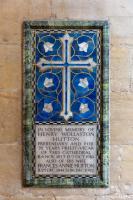
After 9th October 1916. Memorial to Henry Wollaston Hutton at Lincoln Cathedral [Map].

On 9th October 1917 Henry Cecil Vane [aged 35] died from wounds in a hospital at Rouen, France [Map]. He was buried at St Sever Cemetery. He has a memorial at St Mary's Church, Staindrop [Map].
Henry Cecil Vane: On 19th September 1882 he was born to Henry de Vere Vane 9th Baron Barnard and Catherine Sarah Cecil Baroness Barnard. On 25th August 1914 or 25th October 1914 Henry Cecil Vane and Enid Victoria Rachel Fane were married. She the daughter of Anthony Fane 13th Earl of Westmoreland.
On 9th October 1918 Victoria Margaret Cavendish-Bentinck was born to William Arthur Henry Cavendish-Bentinck 7th Duke Portland [aged 25] and Ivy Gordon-Lennox Duchess Portland [aged 31].
On 9th October 1934 Alexander I King Yugoslavia [aged 45] was assassinated at Marseilles, France.

On 9th October 1934 Prince George Windsor 1st Duke Kent [aged 31] was created 1st Duke Kent.
On 9th October 1935 Edward Windsor 2nd Duke Kent was born to Prince George Windsor 1st Duke Kent [aged 32] and Princess Marina Glücksburg Duchess Kent [aged 28]. He a grandson of King George V of the United Kingdom. Coefficient of inbreeding 2.04%. He married 8th June 1961 Katharine Worsley Duchess of Kent, daughter of William Arthington Worsley 4th Baronet and Joyce Morgan Brunner Lady Worsley.


On 9th October 1937 Ernest Louis Hesse Darmstadt Grand Duke [aged 68] died.
On 9th October 1938 Angus Montagu 12th Duke of Manchester was born to Alexander Montagu 10th Duke of Manchester [aged 36] and Nell Vere Stead Duchess Manchester [aged 36].
On 9th October 1945 Ronald Arthur Somerset Gough-Calthorpe 9th Baron Calthorpe [aged 21] died in a plane crash. His brother Peter [aged 18] succeeded 10th Baron Calthorpe of Calthorpe in Norfolk, 11th Gough-Calthorpe of Edgbaston in Warwickshire.
His Mustang III (Serial: HB867) was one of six aircraft from the squadron took off from RAF Horsham at 14:30 hrs on an interception exercise with 65 Squadron. They intercepted at about 20,000 ft near Cromer. A general 'dog-fight' then took place. After which the leader called over the R/T to reform. A couple of minutes prior to the accident two or more aircraft were seen to be 'dog-fighting' at about 10,000 ft. over the area of Blythburgh. (witnesses on the ground confirm this and that they saw these aircraft were flying together and that they were executing violent manoeuvres for several minutes) One of the aircraft was then seen to begin a dive as if to try and catch up with another aircraft ahead of it - both were travelling very fast. The diving aircraft instead of pulling out gradually steepened its dive until it was probably over the vertical. It quickly gained enormous speed and one witness declared that as it is descended. it was executing an aileron turn to its right. It then struck the ground near the Blythburgh Poor Law Institute. Engine at full power it exploded on impact and caught fire.
On 9th October 1953 Hastings William Russell 12th Duke Bedford [aged 64] died. His son John [aged 36] succeeded 13th Duke Bedford, 13th Marquess Tavistock, 17th Earl Bedford, 17th Baron Russell of Cheneys, 15th Baron Russell of Thornhaugh, 13th Baron Howland of Streatham. Lydia Yarde-Buller Duchess Bedford [aged 35] by marriage Duchess Bedford.
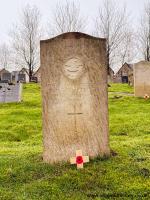
St Peter and St Paul's Church, Longhoughton [Map]. Grave of M4278874 Leading Aircraftman, R.D.S. MacConnell, Royal Air Force, 9th October 1965 age 18.
On 9th October 1200 Isabel Marshal Countess Cornwall, Gloucester and Hertford was born to William Marshal 1st Earl Pembroke [aged 54] and Isabel Clare Countess Pembroke [aged 28]. She married (1) in or before 1218 her third cousin Gilbert Clare 5th Earl Gloucester 4th Earl Hertford, son of Richard Clare 3rd Earl Hertford and Amice Fitzrobert Countess Hertford, and had issue (2) 30th March 1231 her fifth cousin Richard of Cornwall 1st Earl Cornwall, son of King John of England and Isabella of Angoulême Queen Consort England, and had issue.
Chronicle of Geoffrey le Baker of Swinbroke
Baker was a secular clerk from Swinbroke, now Swinbrook, an Oxfordshire village two miles east of Burford. His Chronicle describes the events of the period 1303-1356: Gaveston, Bannockburn, Boroughbridge, the murder of King Edward II, the Scottish Wars, Sluys, Crécy, the Black Death, Winchelsea and Poitiers. To quote Herbert Bruce 'it possesses a vigorous and characteristic style, and its value for particular events between 1303 and 1356 has been recognised by its editor and by subsequent writers'. The book provides remarkable detail about the events it describes. Baker's text has been augmented with hundreds of notes, including extracts from other contemporary chronicles, such as the Annales Londonienses, Annales Paulini, Murimuth, Lanercost, Avesbury, Guisborough and Froissart to enrich the reader's understanding. The translation takes as its source the 'Chronicon Galfridi le Baker de Swynebroke' published in 1889, edited by Edward Maunde Thompson.
Available at Amazon in eBook and Paperback format.
On 9th October 1261 Denis I King Portugal was born to Alfonso III King Portugal [aged 51] and Beatrice Queen Consort Portugal [aged 19]. Denis I King Portugal succeeded I King Portugal. He a great x 2 grandson of King Henry "Curtmantle" II of England. Coefficient of inbreeding 2.41%. He married 1282 his half third cousin once removed Elisabeth Barcelona Queen Consort Portugal, daughter of Peter III King Aragon and Constance Hohenstaufen Queen Consort Aragon, and had issue.
On 9th October 1267 Alan Zouche 1st Baron Zouche Ashby was born to Roger Zouche [aged 25] and Ela Longespée [aged 23] at North Molton, Devon. He a great x 2 grandson of King Henry "Curtmantle" II of England. He married Eleanor Segrave, daughter of Nicholas Segrave 1st Baron Segrave and Maud de Lucy, and had issue.
On 9th October 1269 Louis Wittelsbach III Duke Bavaria was born to Henry Wittelsbach I Duke Lower Bavaria I Duke Bavaria [aged 33] and Elizabeth Duchess Bavaria [aged 33]. He a great x 3 grandson of King Henry "Curtmantle" II of England.
On 9th October 1300 John Grey 1st Baron Grey was born to John Grey [aged 29] and Margaret Oddingseles Baroness Grey Rotherfield at Rotherfield Greys, Oxfordshire. He a great x 3 grandson of King Henry "Curtmantle" II of England. He married (1) before 1st March 1312 Catherine Fitzalan Baroness Grey Rotherfield and had issue (2) before 1343 his half fourth cousin once removed Avice Marmion Baroness Grey Rotherfield and had issue.
On 9th October 1564 Stillborn Wettin was born to Johann Wilhelm Wettin Duke Saxe Weimar [aged 34] and Dorothea Susanne Palatine Duchess Saxe Weimar at Weimar.
On 9th October 1569 Dorothea Oldenburg was born to John "Younger" Oldenburg Duke Schleswig Holstein Sonderburg [aged 24] and Elisabeth of Brunswick-Grubenhagen [aged 19].
On 9th October 1574 Elisabeth Renata Lorraine Duchess Bavaria was born to Charles "The Great" Lorraine III Duke Lorraine [aged 31] and Claude Valois Duchess Lorraine [aged 26]. She married 6th February 1595 her first cousin Maximilian "The Great" Wittelsbach I Duke Bavaria I Elector Bavaria, son of William Wittelsbach V Duke Bavaria and Renata Lorraine Duchess Bavaria.

On 9th October 1609 Thomas Weston 4th Earl of Portland was born to Richard Weston 1st Earl of Portland [aged 32] and Frances Waldegrave Countess Portland [aged 32] at Nayland, Suffolk [Map]. He married after 1666 his half fifth cousin Anne Boteler Countess Newport and Portland, daughter of John Boteler 1st Baron Boteler and Elizabeth Villiers Baroness Boteler Brantfield.
On 9th October 1617 Toby Tyrrell 3rd and 2nd Baronet was born to Edward Tyrrell 1st Baronet [aged 44].
On 9th October 1636 Anne Calvert was born to Cecil Calvert 2nd Baron Baltimore [aged 31] and Ann Arundell Baroness Baltimore [aged 20].
Jean de Waurin's Chronicle of England Volume 6 Books 3-6: The Wars of the Roses
Jean de Waurin was a French Chronicler, from the Artois region, who was born around 1400, and died around 1474. Waurin’s Chronicle of England, Volume 6, covering the period 1450 to 1471, from which we have selected and translated Chapters relating to the Wars of the Roses, provides a vivid, original, contemporary description of key events some of which he witnessed first-hand, some of which he was told by the key people involved with whom Waurin had a personal relationship.
Available at Amazon in eBook and Paperback format.

On 9th October 1684 Simon Harcourt was born to Simon Harcourt 1st Viscount Harcourt [aged 22]. He married 21st July 1709 Elizabeth Evelyn and had issue.
On 9th October 1711 James Grimston 2nd Viscount Grimston was born to William Grimston 1st Viscount Grimston [aged 26].
On 9th October 1723 Jemima Campbell 2nd Marchioness Grey was born to John Campbell 3rd Earl Breadalbaine and Holland [aged 27] and Amabel Grey [aged 25]. She married 1740 Philip Yorke 2nd Earl of Hardwicke, son of Philip Yorke 1st Earl of Hardwicke and Margaret Cocks Countess Hardwicke, and had issue.


On 9th October 1727 David Murray 2nd Earl Mansfield was born to David Murray 6th Viscount Stormont [aged 37]. He married (1) 16th August 1759 Henrietta Frederica von Bünau and had issue (2) 5th May 1776 Louisa Cathcart 2nd Countess Mansfield and had issue.
On 9th October 1750 Gertrude Seymour-Conway was born to Francis Seymour-Conway 1st Marquess Hertford [aged 32] and Isabella Fitzroy Countess Hertford [aged 24]. She a great x 2 granddaughter of King Charles II of England Scotland and Ireland. She married 10th February 1772 her fourth cousin once removed George Mason aka Villiers 2nd Earl Grandison, son of Alan Mason Viscount Grandison and Elizabeth Fitzgerald Villiers 1st Countess Grandison, and had issue.


On 9th October 1754 Jean-Baptiste Regnault was born.
On 9th October 1756 John Pitt 2nd Earl Chatham was born to William "The Elder" Pitt 1st Earl Chatham [aged 47] and Hester Granville Countess Chatham [aged 35]. He married 10th July 1783 his half fifth cousin once removed Mary Elizabeth Townshend Countess Chatham, daughter of Thomas Townshend 1st Viscount Sydney and Elizabeth Powys Viscountess Sydney.


On 9th October 1757 King Charles X of France was born to Dauphin Louis Bourbon [aged 28] and Dauphine Maria Josepha of France [aged 25]. He a great x 4 grandson of King Charles I of England, Scotland and Ireland. He married 1771 his second cousin once removed Maria Teresa of Savoy, daughter of Victor Amadeus III King Sardinia and Infanta Maria Antonia Spain, and had issue.
On 9th October 1763 Charles Edmonstone 2nd Baronet was born to Archibald Edmonstone 1st Baronet [aged 46]. He married (1) 1st June 1794 Emma Wilbraham-Bootle and had issue (2) 5th December 1804 Louisa Hotham October, daughter of Beaumont Hotham 2nd Baron Hotham, and had issue.
On 9th October 1775 Alexander Boswell 1st Baronet was born.
Chronicle of Abbot Ralph of Coggeshall
The Chronicle of Abbot Ralph of Coggeshall (Chronicon Anglicanum) is an indispensable medieval history that brings to life centuries of English and European affairs through the eyes of a learned Cistercian monk. Ralph of Coggeshall, abbot of the Abbey of Coggeshall in Essex in the early 13th century, continued and expanded his community’s chronicle, documenting events from the Norman Conquest of 1066 into the tumultuous reign of King Henry III. Blending eyewitness testimony, careful compilation, and the monastic commitment to record-keeping, this chronicle offers a rare narrative of political intrigue, royal power struggles, and social upheaval in England and beyond. Ralph’s work captures the reigns of pivotal figures such as Richard I and King John, providing invaluable insights into their characters, decisions, and the forces that shaped medieval rule. More than a simple annal, Chronicon Anglicanum conveys the texture of medieval life and governance, making it a rich source for scholars and readers fascinated by English history, monastic authorship, and the shaping of the medieval world.
Available at Amazon in eBook and Paperback format.
On 9th October 1775 Charles Williams-Wynn was born to Watkin Williams-Wynn 4th Baronet [aged 26] and Charlotte Granville Lady Williams-Wynn [aged 21]. He married 1806 Mary Cunliffe, daughter of Foster Cunliffe 3rd Baronet and Harriet Kinloch Lady Cunliffe, and had issue.


On 9th October 1778 General Lionel Smith 1st Baronet was born to Benjamin Smith [aged 36] and Charlotte Turner [aged 29]. He married (1) before 1814 Ellen Marianne Galway (2) 20th November 1819 Isabella Pottinger Lady Smith and had issue.
On 9th October 1778 John Fitzmorris was born to Thomas Fitzmaurice Earl Orkney [aged 36] and Mary O'Brien 4th Countess Orkney [aged 23].
On 9th October 1778 Louisa Hotham October was born to Beaumont Hotham 2nd Baron Hotham [aged 41]. She married 5th December 1804 Charles Edmonstone 2nd Baronet, son of Archibald Edmonstone 1st Baronet, and had issue.
On 9th October 1789 Charles Leonard Irby was born to Frederick Irby 2nd Baron Boston [aged 40] and Christian Methuen.
On 9th October 1811 Friederike Karoline Juliane Glücksburg was born to Friedrich Wilhelm Glücksburg Duke Schleswig Holstein Sonderburg Glücksburg [aged 26] and Louise Caroline Hesse-Kassel Duchess Schleswig Holstein Sonderburg Glücksburg [aged 22]. She a great x 2 granddaughter of King George II of Great Britain and Ireland.
On 9th October 1816 William Harold Cubley was born at Heanor, Derbyshire [Map].
On 9th October 1818 Bishop Harvey Goodwin was born in King's Lynn, Norfolk [Map].
On 9th October 1840 Simeon Solomon was born to Michael Meyer Solomon.
On 9th October 1842 Clotworthy Skeffington 11th Viscount Massereene, 5th Viscount Ferrard was born to John Skeffington 10th Viscount Massereene, 3rd Viscount Ferrard [aged 29] and Olivia Grady Viscountess Massereene. He married 4th October 1870 Florence Elizabeth Whyte-Melville Viscountess Massereene and Ferrard and had issue.
On 9th October 1849 Richard Southwell Stapleton-Cotton was born to Wellington Stapleton-Cotton 2nd Viscount Combermere [aged 30] and Susan Alice Sitwell [aged 30]. He married 18th October 1870 Jane Charlotte Methuen, daughter of Frederick Methuen 2nd Baron Methuen and Anna Horatia Sanford Baroness Methuen, and had issue.
On 9th October 1855 Henry Johnson 4th Baronet was born to Henry Johnson 3rd Baronet [aged 36]. He married (1) 20th March 1886 Ella Dyson Lady Orde-Powlett and had issue (2) 18th August 1897 Georgina Orde-Powlett Lady Orde-Powlett.
The Deeds of the Dukes of Normandy
The Gesta Normannorum Ducum [The Deeds of the Dukes of Normandy] is a landmark medieval chronicle tracing the rise and fall of the Norman dynasty from its early roots through the pivotal events surrounding the Norman Conquest of England. Originally penned in Latin by the monk William of Jumièges shortly before 1060 and later expanded at the behest of William the Conqueror, the work chronicles the deeds, politics, battles, and leadership of the Norman dukes, especially William’s own claim to the English throne. The narrative combines earlier historical sources with firsthand information and oral testimony to present an authoritative account of Normandy’s transformation from a Viking settlement into one of medieval Europe’s most powerful realms. William’s history emphasizes the legitimacy, military prowess, and governance of the Norman line, framing their expansion, including the conquest of England, as both divinely sanctioned and noble in purpose. Later chroniclers such as Orderic Vitalis and Robert of Torigni continued the history, extending the coverage into the 12th century, providing broader context on ducal rule and its impact. Today this classic work remains a foundational source for understanding Norman identity, medieval statesmanship, and the historical forces that reshaped England and Western Europe between 800AD and 1100AD.
Available at Amazon in eBook and Paperback format.
On 9th October 1856 Frederick William Pomeroy was born.
On 9th October 1860 Henry Edmund Every was born to Henry Flower Every 10th Baronet [aged 29] and Mary Isabella Hollond Lady Every [aged 20]. He was baptised on 6th December 1890 at Saint Wilfred's Chuirch, Egginton [Map].
On 9th October 1872 John Peniston Milbanke 10th Baronet was born to Peniston Milbanke 9th Baronet [aged 25] and Elizabeth Margaret Denman Lady Milbanke. He married 6th December 1900 Amelia Madeline Louisa Crichton and had issue.
On 9th October 1873 Kenelm Edgcumbe 6th Earl of Mount Edgcumbe was born to Richard Edgcumbe [aged 30].
On 9th October 1876 Walter Aston Blount 10th Baronet was born to Walter de Sodington Blount 9th Baronet [aged 42].
On 9th October 1887 Charles Stanhope 10th Earl of Harrington was born to Dudley Stanhope 9th Earl of Harrington [aged 28]. He married 23rd April 1919 Margaret Trelawney Seaton and had issue.
On 9th October 1905 Mary Lalle Foley 17th Baroness Berkeley was born to Colonel Frank Wigram Foley and Eva Mary FitzHardinge Milman 16th Baroness Berkeley [aged 30].
On 9th October 1906 John Aymer Dalrymple 13th Earl of Stair was born to John James Dalrymple 12th Earl of Stair [aged 27]. He married 14th January 1960 Davina Katherine Bowes-Lyon and had issue.
On 9th October 1907 Edward Stanley 6th Baron Stanley, 6th Baron Sheffield, 5th Baron Eddisbury was born to Arthur Stanley 5th Baron Stanley, 5th Baron Sheffield, 4th Baron Eddisbury [aged 32]. He married (1) before 18th January 1944 Victoria Audrey Chetwynd-Talbot (2) 18th January 1944 Sylvia Hawkes Baroness Stanley.
On 9th October 1912 William Guy Lowther 5th Baronet was born to Charles Bingham Lowther 4th Baronet [aged 32].
On 9th October 1912 Michael Hicks-Beach 2nd Earl St Aldwyn was born to Michael Hugh Hicks-Beach [aged 35] and Majorie Brocklehurst [aged 29].
Chronicle of Abbot Ralph of Coggeshall
The Chronicle of Abbot Ralph of Coggeshall (Chronicon Anglicanum) is an indispensable medieval history that brings to life centuries of English and European affairs through the eyes of a learned Cistercian monk. Ralph of Coggeshall, abbot of the Abbey of Coggeshall in Essex in the early 13th century, continued and expanded his community’s chronicle, documenting events from the Norman Conquest of 1066 into the tumultuous reign of King Henry III. Blending eyewitness testimony, careful compilation, and the monastic commitment to record-keeping, this chronicle offers a rare narrative of political intrigue, royal power struggles, and social upheaval in England and beyond. Ralph’s work captures the reigns of pivotal figures such as Richard I and King John, providing invaluable insights into their characters, decisions, and the forces that shaped medieval rule. More than a simple annal, Chronicon Anglicanum conveys the texture of medieval life and governance, making it a rich source for scholars and readers fascinated by English history, monastic authorship, and the shaping of the medieval world.
Available at Amazon in eBook and Paperback format.
On 9th October 1914 Richard Morland Tollemache Bethell 4th Baron Westbury was born to Richard Bethel [aged 31].
On 9th October 1918 Victoria Margaret Cavendish-Bentinck was born to William Arthur Henry Cavendish-Bentinck 7th Duke Portland [aged 25] and Ivy Gordon-Lennox Duchess Portland [aged 31].
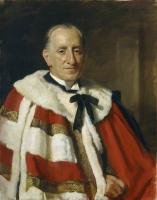
On 9th October 1923 Other Windsor-Clive 3rd Earl of Plymouth was born to Ivor Windsor-Clive 2nd Earl Plymouth [aged 34] and Irene Corona Charteris Countess Plymouth [aged 21].
On 9th October 1935 Edward Windsor 2nd Duke Kent was born to Prince George Windsor 1st Duke Kent [aged 32] and Princess Marina Glücksburg Duchess Kent [aged 28]. He a grandson of King George V of the United Kingdom. Coefficient of inbreeding 2.04%. He married 8th June 1961 Katharine Worsley Duchess of Kent, daughter of William Arthington Worsley 4th Baronet and Joyce Morgan Brunner Lady Worsley.
On 9th October 1935 Henry Paul Channon 1st Baron Kelvedon was born to Henry "Chips" Channon [aged 38] and Honor Guinness [aged 26]. He married 1963 Ingrid Wyndham.
On 9th October 1938 Angus Montagu 12th Duke of Manchester was born to Alexander Montagu 10th Duke of Manchester [aged 36] and Nell Vere Stead Duchess Manchester [aged 36].
On 9th October 1941 Peter Nelson 9th Earl Nelson was born to Captain John Nelson.
On 9th October 1514 Louis XII King France [aged 52] and Mary Tudor Queen Consort France [aged 18] were married at Abbeville [Map], Somme. She by marriage Queen Consort France. Thomas Grey 2nd Marquess Dorset [aged 37], Thomas West 8th Baron De La Warr 5th Baron West [aged 57], Thomas Brooke 8th Baron Cobham [aged 44] and his son George Brooke 9th Baron Cobham [aged 17], Bishop Thomas Ruthall [aged 42] and Margaret Wotton Marchioness Dorset [aged 27] attended. The difference in their ages was 33 years. She the daughter of King Henry VII of England and Ireland and Elizabeth York Queen Consort England. He the son of Charles Valois Duke Orléans and Mary de la Marck Duchess Orléans. They were second cousin twice removed.
On 9th October 1518 King Frederick I of Denmark [aged 47] and Sophie of Pomerania Queen Consort of Denmark and Sweden [aged 20] were married. The difference in their ages was 26 years. He the son of Christian I King of Denmark and Dorothea of Brandenburg.
On 9th October 1666 George Willoughby 7th Baron Willoughby of Parham [aged 27] and Elizabeth Clinton Baroness De La Warr were married.
On 9th October 1666 John George Wettin III Elector Saxony [aged 19] and Anna Sophie Oldenburg [aged 19] were married. She the daughter of Frederick III King of Denmark [aged 57] and Sophie Amalie Hanover Queen Consort Denmark [aged 38]. He the son of John George Wettin Elector Saxony [aged 53]. They were third cousin once removed.
On 9th October 1767 Bennet Sherard 3rd Earl Harborough [aged 58] and Elizabeth Cave Countess Harborough [aged 26] were married at St Nicholas' Church, Stanford-on-Avon [Map]. She by marriage Countess Harborough. The difference in their ages was 31 years. He the son of Philip Sherard 2nd Earl Harborough and Anne Pedley Countess Harborough. They were fifth cousin once removed.
On 9th October 1771 Carlos Fitz James Stuart 10th Duke Veragua 4th Duke Berwick [aged 19] and Caroline Stolberg Gedern Duchess Veragua Duchess Berwick [aged 16] were married. She by marriage Duchess Veragua, Duchess of Liria, Duchess of Jérica, Duchess Berwick. He the son of James Fitz James 3rd Duke Berwick 10th Duke Veragua [aged 52] and Maria Teresa Silva Duchess Berwick and Veragua [aged 55].
On 9th October 1845 Richard William Penn Curzon Howe 1st Earl Howe [aged 48] and Anne Gore Countess Howe were married. She by marriage Countess Howe.
Henrici Quinti, Angliæ Regis, Gesta, is a first-hand account of the Agincourt Campaign, and subsequent events to his death in 1422. The author of the first part was a Chaplain in King Henry's retinue who was present from King Henry's departure at Southampton in 1415, at the siege of Harfleur, the battle of Agincourt, and the celebrations on King Henry's return to London. The second part, by another writer, relates the events that took place including the negotiations at Troye, Henry's marriage and his death in 1422.
Available at Amazon in eBook and Paperback format.
On 9th October 1849 Charles Cornwallis Neville 5th Baron Braybrooke [aged 26] and Florence Maude Baroness Braybrooke were married.
On 9th October 1866 Arthur Thomas Liddell 5th Baron Ravensworth [aged 28] and Sophia Harriett Waller Baroness Ravensworth were married.
On 9th October 1866 Atholl Liddell 3rd Earl of Ravensworth [aged 33] and Caroline Cecelia Edgecumbe Countess Revensworth and Mount Edgecumbe [aged 27] were married. He the son of Henry Thomas Liddell 1st Earl Ravensworth [aged 69] and Isabella Horatia Seymour.
On 9th October 1895 Henry Adelbert Wellington Fitzroy 9th Duke Beaufort [aged 48] and Louise Emily Harford 9th Duchess Beaufort [aged 31] were married. He the son of Henry Charles Fitzroy Somerset 8th Duke Beaufort [aged 71] and Georgiana Charlotte Curzon Howe Duchess Beaufort [aged 70].
On 9th October 1964 Peregrine Nicholas Eliot 10th Earl of St Germans [aged 23] and Jacquetta Lamspon Countess St Germans [aged 21] were married. He the son of Nicholas Eliot 9th Earl of St Germans [aged 50] and Helen Mary Villiers.
On 9th October 1212 Philip Flanders I Marquis Namur [aged 37] died of dysentery.
On 9th October 1296 Louis Wittelsbach III Duke Bavaria [aged 27] died. His brother Stephen [aged 25] succeeded I Duke Bavaria.
On 9th October 1316 Bishop Richard Kellaw died.
On 9th October 1326 Reginald I Count Guelders [aged 71] died. His son Reginald [aged 31] succeeded II Count Guelders.
On 9th October 1329 Thomas Butler 1st Baron Dunboyne [aged 58] was killed at the Battle of Ardnocher by the Chief of the Clan Geoghegan. His son Piers [aged 35] succeeded 2nd Baron Dunboyne.
On 9th October 1390 John I King Castile [aged 32] died. His son Henry [aged 11] succeeded III King Castile.
This is a translation of the 'Memoires of Jacques du Clercq', published in 1823 in two volumes, edited by Frederic, Baron de Reissenberg. In his introduction Reissenberg writes: 'Jacques du Clercq tells us that he was born in 1424, and that he was a licentiate in law and a counsellor to Philip the Good, Duke of Burgundy, in the castellany of Douai, Lille, and Orchies. It appears that he established his residence at Arras. In 1446, he married the daughter of Baldwin de la Lacherie, a gentleman who lived in Lille. We read in the fifth book of his Memoirs that his father, also named Jacques du Clercq, had married a lady of the Le Camelin family, from Compiègne. His ancestors, always attached to the counts of Flanders, had constantly served them, whether in their councils or in their armies.' The Memoires cover a period of nineteen years beginning in in 1448, ending in in 1467. It appears that the author had intended to extend the Memoirs beyond that date; no doubt illness or death prevented him from carrying out this plan. As Reissenberg writes the 'merit of this work lies in the simplicity of its narrative, in its tone of good faith, and in a certain air of frankness which naturally wins the reader’s confidence.' Du Clercq ranges from events of national and international importance, including events of the Wars of the Roses in England, to simple, everyday local events such as marriages, robberies, murders, trials and deaths, including that of his own father in Book 5; one of his last entries.
Available at Amazon in eBook and Paperback format.
On 9th October 1529 Colin Campbell 3rd Earl Argyll [aged 43] died. His son Archibald [aged 22] succeeded 4th Earl Argyll.
On 9th October 1622 John "Younger" Oldenburg Duke Schleswig Holstein Sonderburg [aged 77] died. His son Alexander [aged 49] succeeded I Duke Schleswig Holstein Sonderburg Augustenburg.
On 9th October 1646 Balthasar Charles Habsburg Spain Prince Asturias [aged 16] died.
On 9th October 1650 Frances Altham Countess Carbery [aged 29] died in childbirth.
On 9th October 1680 William Hicks 1st Baronet [aged 84] died. His son William [aged 50] succeeded 2nd Baronet Hicks of Beverston in Gloucestershire.
On 9th October 1690 John Maynard [aged 86] died.
On 9th October 1690 Henry Fitzroy 1st Duke Grafton [aged 27] was killed at Cork [Map] during the Storming of Cork. His son Charles [aged 6] succeeded 2nd Duke Grafton, 2nd Earl Euston, 2nd Viscount Ipswich, 2nd Baron Sudbury.
On 9th October 1709 Barbara Villiers 1st Duchess of Cleveland [aged 68] died at Chiswick Mall. Her son Charles [aged 47] succeeded 2nd Duke Cleveland, 2nd Earl of Southampton and 2nd Baron Nonsuch. Anne Pulteney Duchess Southampton Duchess of Cleveland [aged 45] by marriage Duchess Cleveland.
On 9th October 1711 William Craven 2nd Baron Craven [aged 42] died. His son William [aged 11] succeeded 3rd Baron Craven of Hamstead Marshall in Berkshire.
On 8th October 1718 Bishop Richard Cumberland [aged 86] died. He was buried the next day at Peterborough Cathedral [Map]. Sculpted by Thomas Green of Camberwell [aged 59].
Bishop Richard Cumberland: On 15th July 1632 he was born In 1691 Bishop Richard Cumberland was elected Bishop of Peterborough. He, apparently, discovered he had been elected when he read it in a newspaper whilst enjoying his habitual morning coffee at a coffe-house in Stamford [Map].
On 9th October 1718 Bishop Richard Cumberland [aged 87] died.
Abbot John Whethamstede’s Chronicle of the Abbey of St Albans
Abbot John Whethamstede's Register aka Chronicle of his second term at the Abbey of St Albans, 1451-1461, is a remarkable text that describes his first-hand experience of the beginning of the Wars of the Roses including the First and Second Battles of St Albans, 1455 and 1461, respectively, their cause, and their consequences, not least on the Abbey itself. His text also includes Loveday, Blore Heath, Northampton, the Act of Accord, Wakefield, and Towton, and ends with the Coronation of King Edward IV. In addition to the events of the Wars of the Roses, Abbot John, or his scribes who wrote the Chronicle, include details in the life of the Abbey such as charters, letters, land exchanges, visits by legates, and disputes, which provide a rich insight into the day-to-day life of the Abbey, and the challenges faced by its Abbot.
Available at Amazon in eBook and Paperback format.
On 9th October 1724 Edward Neville 3rd Baron Abergavenny [aged 19] died. Baron Abergavenny abeyant.
On 9th October 1728 James Cecil 5th Earl Salisbury [aged 37] died. His son James [aged 14] succeeded 6th Earl Salisbury.
On 9th October 1759 Harry Powlett 4th Duke Bolton [aged 68] died. His son Charles [aged 41] succeeded 5th Duke Bolton, 10th Marquess Winchester, 10th Earl Wiltshire, 10th Baron St John.
On 9th October 1785 John Cullum 6th Baronet [aged 52] died of consumption. His brother Thomas [aged 43] succeeded 7th Baronet Cullum of Hastede in Suffolk.
On 9th October 1789 James Hamilton 8th Earl Abercorn [aged 76] died. His nephew John [aged 33] succeeded 9th Earl Abercorn. Catherine Moyle Marchioness Abercorn [aged 29] by marriage Countess Abercorn.
On 9th October 1805 Peyton Skipwith 7th Baronet [aged 64] died. He was buried at the Skipwith Family Cemetery, Prestwould. His son Grey [aged 34] succeeded 8th Baronet Skipwith of Prestwould in Leicestershire. Harriet Townsend Lady Skipwith [aged 26] by marriage Lady Skipwith of Prestwould in Leicestershire.
On 9th October 1830 John Williams 1st Baronet [aged 68] died. Memorial at St Asaph Cathedral [Map] sculpted by Richard Westmacott [aged 55]. His son John [aged 36] succeeded 2nd Baronet Williams of Bodelwyddan in Flintshire.
John Williams 1st Baronet: On 22nd December 1761 he was born. On 21st October 1791 he and Margaret Williams Lady Williams were married. On 27th July 1798 John Williams 1st Baronet was created 1st Baronet Williams of Bodelwyddan in Flintshire. Margaret Williams Lady Williams by marriage Lady Williams of Bodelwyddan in Flintshire.
John Hay-Williams 2nd Baronet: On 9th January 1794 he was born to John Williams 1st Baronet and Margaret Williams Lady Williams. In 1842 he and Sarah Elizabeth Amherst were married. She the daughter of William Pitt Amherst 1st Earl Amherst and Sarah Archer Countess Plymouth and Amherst.
On 9th October 1830 Harriet Clark Lady Graham died in a carriage accident in Paris [Map].
On 9th October 1837 Catherine Anguish Duchess Leeds [aged 73] died.
On 9th October 1873 George Robinson 7th Baronet [aged 76] died. He was buried at St. Andrew's Churchyard, Cranford, Northamptonshire. His son John [aged 43] succeeded 8th Baronet Robinson of London.
The Bury and Norwich Post (Bury, Suffolk, England), Tuesday, October 21, 1873, Page 3: "The death is announced of the Rev. Sir George Stamp Robinson, Bart., which occurred on the 9th inst., at Cranford, Northamptonshire, in his 77th year. The first baronet (creation 1660) was Lord Mayor of London and created created a Baronet for his services in the cause of Charles II; he was a nephew of Archbishop Laud. The deceased baronet was the elder son of the late Rev. William V. Robinson, Rector of Grafton Underwood, and nephew of Sir George Robinson, sixth baronet. He succeeded to the title and estates on his uncle's death in 1833, and held the family living of Cranford from 1822 to 1853, when he resigned it. He was also an Honorary Canon of Peterborough Cathedral. Sir George married a daughter of Mr. Robert Willis Blencowe, of Hayes, Middlesex, by who he had , with other issue, a son and successor, Mr. (now Sir) John Blencowe Robinson."
On 9th October 1892 George Henry Waller 3rd Baronet [aged 55] died. His son Francis [aged 12] succeeded 4th Baronet Waller of Braywick Lodge in Berkshire.
On 9th October 1894 Henry George Grey 3rd Earl Grey [aged 91] died. His nephew Albert [aged 42] succeeded 4th Earl Grey, 4th Viscount Grey of Howick in Northumberland, 4th Baron Grey of Howick in Northumberland, 5th Baronet Grey of Howick in Northumberland.
On 9th October 1900 John Crichton-Stuart 3rd Marquis of the Isle of Bute [aged 53] died. His son John [aged 19] succeeded 4th Marquis of the Isle of Bute, 7th Earl Bute, 4th Earl of Windsor, 4th Viscount Mountjoy of the Isle of Wight.
Henrici Quinti, Angliæ Regis, Gesta, is a first-hand account of the Agincourt Campaign, and subsequent events to his death in 1422. The author of the first part was a Chaplain in King Henry's retinue who was present from King Henry's departure at Southampton in 1415, at the siege of Harfleur, the battle of Agincourt, and the celebrations on King Henry's return to London. The second part, by another writer, relates the events that took place including the negotiations at Troye, Henry's marriage and his death in 1422.
Available at Amazon in eBook and Paperback format.
On 9th October 1921 Egerton Bushe Coghill 5th Baronet [aged 68] died. He was buried at St Barrahane's Church, Castletownshend. His son Marmaduke [aged 25] succeeded 6th Baronet Coghill of Coghill Hall in the West Riding of Yorkshire.
On 9th October 1926 Arthur Dyke Acland 13th Baronet [aged 78] died. His son Francis [aged 52] succeeded 14th Baronet Acland of Columb John in Devon.
On 9th October 1935 Mary Isabella Hollond Lady Every [aged 95] died.
On 9th October 1937 Ernest Louis Hesse Darmstadt Grand Duke [aged 68] died.
On 9th October 1941 Priscilla Cecilia Moore Countess Annesley died.


On 9th October 1945 Ronald Arthur Somerset Gough-Calthorpe 9th Baron Calthorpe [aged 21] died in a plane crash. His brother Peter [aged 18] succeeded 10th Baron Calthorpe of Calthorpe in Norfolk, 11th Gough-Calthorpe of Edgbaston in Warwickshire.
His Mustang III (Serial: HB867) was one of six aircraft from the squadron took off from RAF Horsham at 14:30 hrs on an interception exercise with 65 Squadron. They intercepted at about 20,000 ft near Cromer. A general 'dog-fight' then took place. After which the leader called over the R/T to reform. A couple of minutes prior to the accident two or more aircraft were seen to be 'dog-fighting' at about 10,000 ft. over the area of Blythburgh. (witnesses on the ground confirm this and that they saw these aircraft were flying together and that they were executing violent manoeuvres for several minutes) One of the aircraft was then seen to begin a dive as if to try and catch up with another aircraft ahead of it - both were travelling very fast. The diving aircraft instead of pulling out gradually steepened its dive until it was probably over the vertical. It quickly gained enormous speed and one witness declared that as it is descended. it was executing an aileron turn to its right. It then struck the ground near the Blythburgh Poor Law Institute. Engine at full power it exploded on impact and caught fire.
On 9th October 1953 Hastings William Russell 12th Duke Bedford [aged 64] died. His son John [aged 36] succeeded 13th Duke Bedford, 13th Marquess Tavistock, 17th Earl Bedford, 17th Baron Russell of Cheneys, 15th Baron Russell of Thornhaugh, 13th Baron Howland of Streatham. Lydia Yarde-Buller Duchess Bedford [aged 35] by marriage Duchess Bedford.
On 9th October 1956 Una Mary Dawson 25th Baroness de Ros of Helmsley [aged 77] died. Her granddaughter Georgiana [aged 23] succeeded 26th Baroness Ros Helmsley.
On 9th October 1990 Colonel Edward St Lo Malet 8th Baronet [aged 81] died. His son Harry [aged 53] succeeded 9th Baronet Malet of Wilbury in Wiltshire.
On 9th October 2007 Dudley Ryder 7th Earl of Harrowby [aged 84] died. His son Dudley [aged 56] succeeded 8th Earl of Harrowby, 9th Baron Harrowby of Harrowby in Lincolnshire.