

09 Jul is in July.
1503 Margaret Tudor's Journey to Scotland
1528 Sweating Sickness Outbreak
On 9th July 1228 Archbishop Stephen Langton [aged 78] died.
On 9th July 1290 John "Peaceful" Reginar II Duke Brabant [aged 14] and Margaret Plantagenet Duchess Brabant [aged 15] were married. She the daughter of King Edward I of England [aged 51] and Eleanor of Castile Queen Consort England [aged 49]. He the son of John Reginar I Duke Brabant [aged 37] and Margaret Dampierre Duchess Brabant. They were half third cousin twice removed. He a great x 4 grandson of King Stephen I England.
On 9th July 1292 Henry Luxemburg VII Holy Roman Emperor [aged 17] and Margaret Brabant Countess Luxemburg and Namur were married at Tervuren. He the son of Henry Luxemburg VI Count Luxemburg and Beatrice Avesnes Countess Luxemburg.
Rymer's Fœdera Volume 1. The magnates of Scotland submit to the will of the King.
To all those who shall see or hear this letter, Robert Alexander of Lindsay, John, brother of the Seneschal, and William of Douglas, greetings in Jesus Christ. Let it be known to all of you that we, together with the community of our country, rose up against our lord, Sir Edward, by the grace of God, King of England, Lord of Ireland, and Duke of Aquitaine; and against his peace, we have committed in his lordship, in his land of Scotland and of Galloway, arsons, homicides, and various robberies and... done by us and by ours.
We, for ourselves and for all those who were with us from the said community in doing this, submit and hold ourselves bound to the will of our lord the aforesaid King, to make amends, high and low, at his will, for the said homicides, arsons, and robberies: saving to us the points contained in a writing which we have from Sir Henry de Percy to Sir Robert de Clifford, commanders of the host of the noble King of England in the parts of Scotland. In witness whereof, we have affixed our seals to this writing. Written at Sir William's, the ninth day of the month of July [1297], in the twenty-fifth year of the reign of King Edward" With four red seals, hanging from parchment tails.
Magnates Scotia voluntati Regis submittunt.
ATUTZ ceus, qi ceste lettre verrunt ou orront, Robert Alisaundre de Lindesaie, Johan frere le seneschal, e William de Douglas, salutz en JEHU CRIST. Coneve chose seit a vous tutz, qe com nous ensemblement oue la comune de nos pais, esteioms leves encountre nostre seingnur, mon sire Edward, par la grace de DIEUX, Roys de Engleterre, seingnur de Irelaunde, & dux de Gwyene: e, encountre sa pees eioms en sa seingnurie en sa terre de Escose, e de Gauweie, fait arsons, homecides, & divers roberies e.... estre fait par nous, e par les nos:
Nous, pur nous, e pur tuz ceaus, qi de nous furent adhers, de la dita comune, a ceo fayre, estre tenuz, e sousmis a la volente nostre seingnur le Rovs avauntdit, a fayre les amendes, haut e bas, a sa volente, des ditz homecides, arsons & roberies: Sauve a nous les pointz contenuz en un escrit, le quel nous avons de mon sire Henri de Percy, a mon sire Robert de Clifforth, cheventeins de l'ost au noble Rey de Engleterre, es parties de Escoce. En tesmoinaunce de queu choses, a cest escrit avoms mis nos seaus. Escrit a sire Willaume, le noemme jour du mois de Juyl, en le an del regne le Reys Edward vintime quint. Sub quatuor sigillis rub' pendent' à caudis pergam.
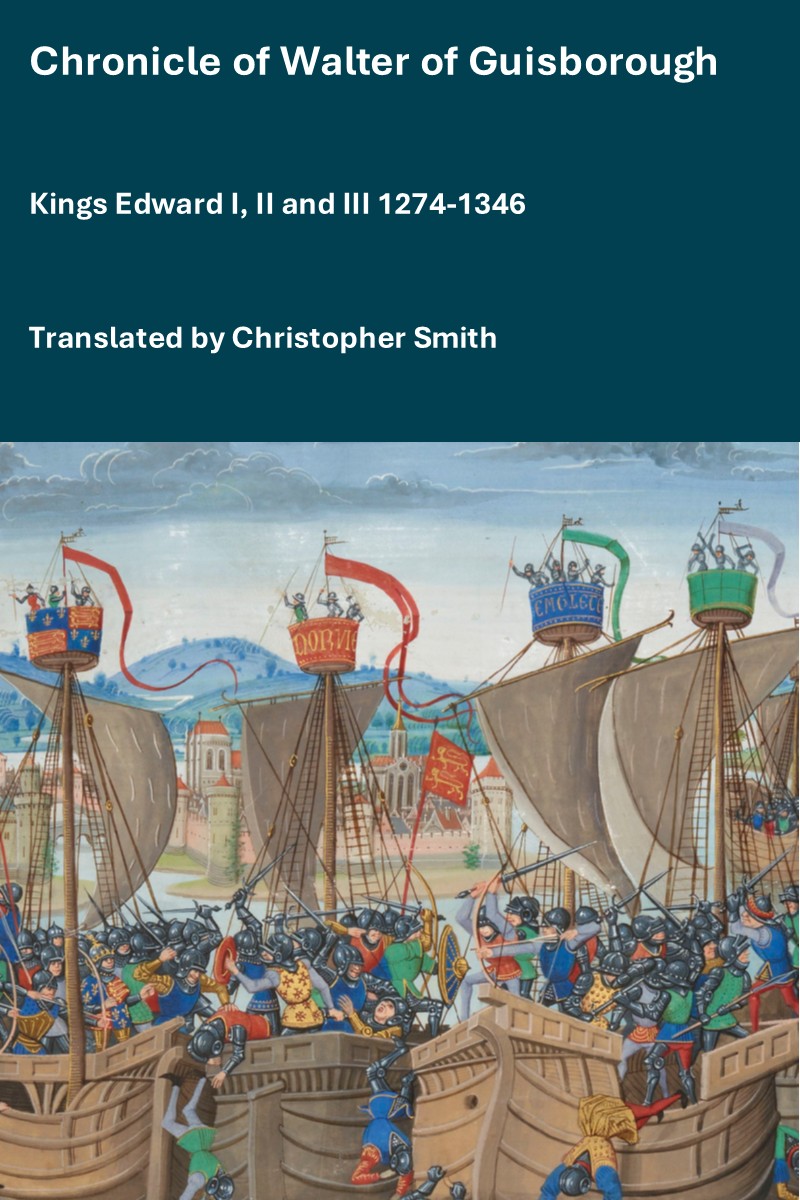 Chronicle of Walter of Guisborough. Three days later, news arrived that the Scottish army was just four leagues [14 miles] away. Early the next morning, our troops broke camp and deployed in the open field near the river Irvine, preparing for battle. The Scottish forces were across a small lake or loch, and both sides could see each other clearly. When the leading Scots, the Bishop of Glasgow, the Steward of Scotland, and William Douglas, saw that they were no match for our knights, even though they outnumbered our foot soldiers two to one, they were afraid. They sent messengers to ask whether anyone authorized by the King of England was present to accept their surrender. Hearing that there was, Sir Richard Lundy, a bold knight, who had never previously sworn fealty to the King of England, came to them with his men and declared himself willing to serve the English king, saying he no longer wished to fight alongside a divided and disordered people. This defection threw the other magnates into disarray, and they promptly surrendered to Lord Henry de Percy1, in the name of our king, under terms that preserved their lives, limbs, lands, and goods, and forgave them all misdeeds up to that day. They provided hostages and formal instruments, and their surrender was accepted conditionally, pending the king's approval. When our forces returned to Irvine, they were told that many of the Scots and Galloway men had robbed their baggage trains, killing over 500 men, women, and children. Our forces pursued them, killing about 1,000, and returned with greatly increased plunder.
Cumque non venissent nisi pauci equestres, nunciatum est eis post triduum quod Scotorum exercitus non distabat ab eis nisi spatio leucarum quatuor. At illi summo mane castra moventes, egressi sunt in campum juxta Irewyn, ordinantes exercitum et ad bellum se parantes; eratque Scotorum exercitus ex parte altera cujusdam laci Many of the modici, et mutuo se videbant. Cumque magnates Scotorum qui ibi aderant, episcopus scilicet Glasguensis, senescallus Scotia, et Willelmus Duglas, viderent se esse impares equestribus nostris, licet pedestres nostros in duplo excederent, timuerunt sibi, et, missis nunciis ad nostros, petierunt utrum esset ibi aliquis ex parte regis Angliæ qui eos ad pacem recipere posset? Et responso quod sic, confestim ad confestim ad eos venit strenuus ille miles Ricardus Lundy, qui nunquam regi nostro fidelitatem fecerat, et se cum suis dedit voluntati regis nostri, dicens se nolle ulterius cum discordantibus et variantibus militare. Quod cum vidissent alii magnates nominati consternati sunt, et continuo se dederunt prædicto domino Henrico de Percy, nomine regis nostri, salvis eis vita et membris, terris et catallis, et quod condonarentur omnia usque ad eundem diem, promissis obsidibus et instrumentis confectis; et conditionaliter admissi sunt, si talia regi complacerent. Cumque reverterentur nostri apud Irewyn, nunciatum est eis quod multi ex Scotis et Galewalensibus eorum sarcinulas hostiliter deprædati sunt, interfectis plusquam quingentis viris cum mulieribus et parvulis, quos insequentes peremerunt ex eis circiter mille viros, et reversi sunt multiplicata præda.
Note 1. This occurred on the 9th July 1297; the letter of submission runs in the name of Robert de Brus Earl of Carrick, James Seneschal of Scotland, Alexander de Lindsey, John brother of the seneschal, and William de Douglas. Rymer, Fœdera, 1.868.
Rymer's Fœdera Volume 2. Likewise, after overcoming the enemy fleets in the port of the Zwin, they propose to advance: the king himself with 100,000 armed men toward Tournai, and Robert of Artois with 50,000 toward Saint-Omer; and likewise concerning money to be raised and quickly sent.
Edward, by the grace of God King of England and of France, and lord of Ireland, to the dukes, archbishops, bishops, earls, barons, and others who will be assembled at our next parliament at Westminster, greetings.
After our arrival in England, we summoned our parliament and had it assembled on an agreed day in the aforesaid place. We set forth before those present—great men and others—our affairs overseas and the great need we had to be aided for their proper accomplishment. We found them well disposed, as they showed us, in the great subsidy which they granted to us.
But because such aid granted cannot at once be converted into ready money, and since we and other great men with us were bound to return to Flanders to keep our faith with those in that land, and elsewhere, in whom we had placed trust—and to which obligation we were firmly committed, as were also the great men of our council who were there—
They advised that we should keep our word. Therefore we resolved to cross over at that time with a certain number of men-at-arms; and afterwards other great men were to come with the second fleet, which had been arranged to be ready at the feast of Saint John, together with all the great men and others who were then appointed to come.
And as we were on our passage, a great part of our horses already embarked, news came to us that our enemy of Valois had prepared a great fleet, which lay before us in the water of the Zwin.
When this news was understood, and considering the danger that might arise if they were allowed to depart—whether to the harm of our realm of England or elsewhere upon our people—and also the encouragement it would give to our enemies, especially to Scotland, if such power should come to them, we resolved immediately to give battle wherever we might find them, as is well known to those of our council who were present at our departure from England.
And we found them, on the day of Saint John, in the said port; and such grace did our Lord Jesus Christ show us over them on that day that the victory remained with us, as we believe is well known to you through those who were there. For this grace we praise God, and we pray you all to give Him thanks.
After the said day of Saint John, the country of Flanders, and likewise other great allies of ours, came to us and showed how our said enemy was on the borders, ready to attack within Flanders or elsewhere among our allies, wherever he might do them the greatest harm and best drive them away from our alliance.
Therefore we, considering the pursuit of our right, the keeping of our pledged word, and the need to resist his malice, with the assent of our said allies and the great men around us from our realm and from the land of Flanders, have resolved to take the field and to divide our army: one part with us toward Tournai, where there will be one hundred thousand armed men from Flanders, and my lord Robert of Artois toward Saint-Omer with fifty thousand, besides all our allies and their forces.
To govern and maintain this army there is need of a very great sum of money, besides the debts which we must necessarily pay before our departure.
Therefore we pray you earnestly, and each of you, that you first consider the right that we have, and the great peril that will arise if we are not speedily supplied with money and goods, to satisfy the said country, our allies, and the soldiers who have previously been retained in our service and who will withdraw if they are not paid. Likewise, if our allies themselves are not paid, they may put themselves at the disposal of our enemy and his malice; and their power being turned to him would place our land, ourselves, our children, and all the great men and others in danger of ruin.
And if we are quickly aided, we hope to bring him to misfortune and to secure for ourselves a lasting advantage. Therefore we ask that you ordain that we be speedily supplied with money or goods sufficient to meet our obligations and to maintain our strength.
The sum that we shortly require, to whom it must be paid, and by what dates, and more fully our intended plan, the earls of Arundel, Huntingdon, and Gloucester, and Sir William Trussell—who have conducted themselves loyally and nobly toward us in this matter—will be able to explain to you orally, for they are coming to you to set forth our condition and our needs. To them, and to each of them, you are to give full faith and credence in what they shall tell you on our behalf.
Given under our privy seal at Bruges, the ninth day of July, in the fourteenth year [1340] of our reign of England and the first of our reign of France.
Qualiter, superatis inimicorum classibus in portu de Swine, proponunt tendere, ipse Rex cum 100,000 armatis versus Tornacum, & Robertus de Artoys cum 50,000 versus Sanctum Audomarum; necnon de pecunid levanda & celeriter transmittenda.
EDWARD, par la grace de DIEU, Roi d'Engleterre & de Fraunce, & seignur d'Irlaund, as ducs, ercevesques, evesques, countes, barons, & autres qi serront assemblez a ceste nostre proschein parlement a Westmonaster, saluz.
Apres nostre venue en Engleterre, nostre parlement somouns, & a jour acordez assemblez en lieu susdit, noz busoignez par decea, & le grande necessite que nous avions d'estre eidez pur le bon complisement d'ycelles, monstres devant ceux qi y estoient, grantz & autres, nous les trovasmes de bone volente quele ils nous monstrerent bonement, en le grant subside q'ils nous granterent.
Mes, pur ceo que tiel eide grantez ne poet mie al heure estre convertez en deniers, & nous estoiens liez, & autres grantz ovesque nous, de returnir devers Flaundres pur tenir nostre foie vers ceux, as queux nous avions fiancez en dit pais, & aillours, a queu chose tenir nous estoions tout ficchez de tenir, & auxiot les grauntz de nostre conseil que y estoient;
Nous doneront pur counseil que nous le tenissions, nous prismes point de passer, od certeine noumbre des gentz d'armes, a cele heure; & apres q' autres grantz deveroient venir a l'autre flote, q' estoit ordenez d'estre apparillez a la Seint Johan, od touz les grantz & autres q' estoient ordenez adonques venir.
Et, sicome nous estoiens sur nostre passage, grante partie de nous chivalx eskippez, nous viodrent noveles que nostre enemy de Valoys si avoit arraiez un grante armee de navie, q' estoit devant nous en l'eawe de Zwyne.
Les noveles entenues, enues, & le perils que purroient avenir, s'ils fuissent departiz, pur damage a nostre roialme d'Engleterre, ou aillours, sur noz gentz considerez, & auxint le comfort q' eust este a noz enemys, & meement a Escoce, si tiel poair lour feust avenuz, preismes point meintenant de la guerre pur ou nous les purroions trover, sicome conue chose est a ceux de nostre counseil q' estoient sur nostre departir d'Engleterre.
Et les trovasmes, le jour de Seint Johan, en dit port, & tiele grace nous monstra nostre Seignur JEHU CRIST sur eux au dit jour, que la victorie nous demora, come nous quidons bien q' assez vous est signifiez par ceux qui y estoient; de quele grace nous leoms DIEUX, & vous prioms touz de lui regracier.
Apres le dit jour de Seint Johan le pays de Flaundres, & auxint autres grantz noz alliez, vindrent a nous, & ont monstrez coment le dit nostre enemy estoit sur les marches, prist d'entre Flaundres, ou autre part sur noz alliez, ou il purroit plus damager a eux, & plus chacier de les retraire de nostre alliance.
Noz, considerantz la pursuite de nostre droit, & de tenir nostre foi sovereinement, & de resister sa malice, per assent de noz ditz alliez & grantz esteantz entour nous de nostre roialme, & du pais de Flaundres, avons prist point d'aler a terre, & a departir nostre host, une partie ovesque nous vers Tourney, ou il y avera cent mill homes de Flaundres armez, & mounseur Robert d'Artoys vers Seint Omer od cynquante mill, outre touz nous alliez & lour poair:
A quele host governer & mesner il busoigne bien grande somme de deniers, outres les dettes que nous covient necessairment paier avant nostre aler.
Vous prions cherement, & a chescun de vous, que primerement vous volliez charger le droit que nous avons, apres le grant peril q'est avenir, si nous ne soions brevement socoures de deniers & des biens, pur faire gree au dit pays, & a noz alliez, & as soudiers que ount estre autre foitz retenuz devers nous, & que se retrerront s'ils ne soient paiez; & aussint si meisme noz alliez ne soient paiez, ils se dorrent en aventure a nostre enemy, & sa malice, & le poair de eux vers lui recoillez, chargez que nostre terre, nous, noz enfauntz, & tous les grantz & autres en point de perdicion.
Et si nous soiens hastiement eidez, nous esperons de lui trover a meschiefe, & nous a touz jours apres a nostre desur, que vous voilliez ordener que nous soions hastivement socourez des deniers, ou de biens en manere de faire gre, par la ou nous sommes tenuz, & de retenir nostre poair.
La somme que nous busoigne brefment, & as queux paier, & as queux jours, & plus pleinement nostre purpos prise vous scievent monstrer de bouche les countes de Arundell, Huntingdon, & Gloucestre, & monsieur William Trussell, qui se ont bien loialment & noblement portez envers nous en ceste busoigne, & que viegnent devers vous, par cause de vous monstrer nostre estat & noz busoignes; as queux & chescun de eux, voulez doner pleine foi & credence de ce q'ils vous dirront de par nous.
Don' souz nostre privie seale a Brugges, le ix. jour de Juyl, l'an de nostre regne d'Engleterre quatorzisme, & de nostre regne de France primer.
On 9th July 1386 Leopold "The Just" Habsburg III Duke Austria [aged 34] died. His son William [aged 16] succeeded Duke Austria.
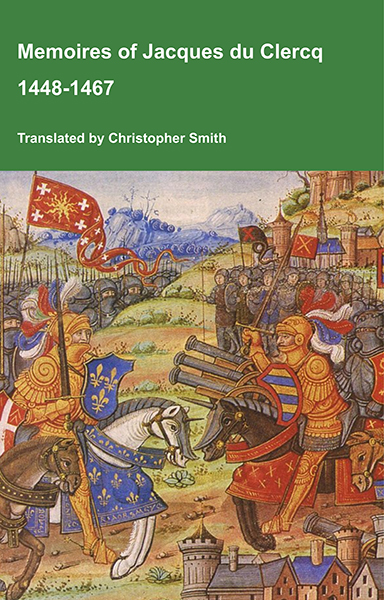 Memoires Jacques du Clercq. At that time, a miller of the town of Verneuil, who had his mill against the walls of the said town, was beaten by an Englishman on watch because he had fallen asleep. Out of spite, he went to the bailiff of Évreux and promised him, in return for certain agreements made between them, to let him into the town. Sir Pierre de Bressay, seneschal of Poitou, the said bailiff of Évreux, Jacques de Clermont, and others assembled, and rode until they all found themselves together on the 9th day of July, in the year 1449, at daybreak, near the walls of the town of Verneuil. The said miller, who was on watch that day, caused the others who were on guard to go down earlier than they were accustomed; and because it was Sunday, they hastened to go to mass before breakfast. With the help of the miller, the French set up ladders by the mill and entered the town without being perceived; there were within about six score Englishmen, some of whom were killed and taken, while the others withdrew in great haste to the castle. The next day, the miller removed part of the water from the castle ditches; the castle was then attacked and defended very valiantly, but in the end it was taken by assault, where many fine feats of arms were performed, especially by the seneschal, and there many English were slain and captured. The others withdrew in great haste into the Grey Tower, which was very strong and impregnable so long as there was food within; for it is high and thick, built outside the castle, well fortified and surrounded by ditches full of water.
EN ce temps, un molnier de la ville de Vernoeul, qui avoit son mouliin contre les murs d'icelle ville, fust battu d'ung Anglois faisant le guct, pour ce qu'il dormoit, lequel alla de depit vers le bailly d'Evreulx et Ini promeict, moyennant certaines convenances faites entre eulx, de le boutter dedans la ville; et s'assemblerent messire Pierre de Bersay, seneschal de Poitou, ledit bailly d'Evreulx, Jacques de Clermont et aultres, et chevaucherent tant, que touts ensemble se trouverent le ixe jour de juillet l'an xlix, au poinct du jour, pres des mursde la ville de Vernoeul. Icelluy molnier, qui faisoit le guet ce jour, feit descendre les aultres qui estoient au guet plus matin qu'ils n'avoient accoustumé, et pour ce qu'il estoit dimanche se hasterent d'aller a la messe pour dejeusner. Les Franchois a l'ayde du molnier dresserent les eschelles au droit du moullin et entrerent en la ville sans estre appercheus; ils estoient dedans six vingts Anglois, dont les aulcuns feurent tués et prins, les aultres se retirerent au chastel a grande haste. Le lendemain lc molnier osta et tollit une partie de l'eaue des fossés du chastel, lequel fust assailly et deffendu moult valeureusement; mais a la fin fust prins d'assault ou il y eust moult belles armes faictes, et par especial par le seneschal, et la feurent morts et prins plusieurs Anglois. Les aultres se retirerent en grande haste en la Tour Grise, laquelle estoit moult forte et imprenable, tant qu'ily eust a mangier dedans; car elle est haute et grosse ferarée hors du chastel, bien garnie et environnée de fossés plains d'eaue.
Memoires Jacques du Clercq. Around this time, an innkeeper of Arras named Quentinet, who was a dice player and one who outrageously cursed and blasphemed God, died in the hospital of Saint John in Lestrée of a sickness of madness, as if deranged. At this time also, on the 9th of July, there were great storms around Arras, and the thunder killed a woman at Monchy-au-Bois while she was making hay, and it was said that she was pregnant. In the same year, around the 12th of July, in the town of Lille, two sodomites were burned, one about sixty years old, and the other a young man who could play the tambourine and who said he was a servant to the lord of Fretin. After they were burned, a sergeant of the provost of Lille named François, because he had found them committing the act and had not denounced them but instead had taken large sums of money from them, both for that and for other offenses, was condemned to death, and his head was cut off. Around this time, in the region of Arras and elsewhere in the county of Artois and in Picardy, many murders were committed, the causes and perpetrators of which were not known. In the said year fifty-nine, April and May were so cold and dry that there was very little oats, and the mencaud of Arras was worth sixteen or seventeen; that is, the load of a horse was worth thirty-three, and grain became more expensive, for there was little of it, and after harvest a horse-load of grain was worth twenty-eight. The year was very late, and for that reason the wines were very green and of little value, especially those from the region of Beaune, which were worth almost nothing and were very unripe.
Environ ce temps un cabartier d'Arras, nommé Quentinet, lequel estoit joueur de dez, regnieur et blasphesmeur de Dieu outrageusement, en l'hostel dieu de St Jehan en Lestrée mourut de maladie de derverie et comme dervé. En ce temps aussy, le ix de juillet, feirent grandes oraiges environ Arras, et tuist le tonnoire une femme a Monchy au Bois, laquelle fenoit foing, et disoit on qu'elle estoit enchainte d'enfant. Oudit an encoires, environ le xij de juillet, en la ville de Lille, feurent ards deux sodomites, l'ung de l'age de la lx ans, et l'aultre josne compagnon qui sçavoit jouer du tambourin, et se disoit estre serviteur au Sr de Fretin; après lesquels ards ung sergeant du prevost de Lille, nommé François, pour tant qu'il les avoit trouvés au peschié et neles avoit point raccusés, ains les avoit composés grands deniers, tant pour ce que pour aultres cas fust ledit François condampné a mort, et euist ledit François le hatreau tranchié. Environ ce temps, entour de la ville d'Arras et ailleurs, en la comté d'Artois et en Picardie, feurent faits plusieurs homicides, dont ne sçait les causes pourquoy ny les noms des aulteurs.: Audit an lix, apvril et may feurent sy froids et sy secqs, qu'il fust bien peu d'avoine, et valloit le mencaud d'Arras, xvj ou xvije; c'estoit la chierge d'un cheval xxxiij, et rencherirent les bleds, car il en estoit peu, et vaillut après aoust, la chierge d'ung cheval, de bled xxviij, et fust l'année très tardive; pourquoy les vins feurent très verds et ne vailloient guerres, mesme ceulx du pays de Bianne ne vaillerent comme riens et feurent très verds.
Collectanea by John Leland [1502-1552]. The next Day after being Sounday, the 9th Day of the fayd Monneth of Jully [9th July 1503], she abode all the Day in the sayd Towne of Grauntham.

Anne Boleyn. Her Life as told by Lancelot de Carle's 1536 Letter.
In 1536, two weeks after the execution of Anne Boleyn, her brother George and four others, Lancelot du Carle, wrote an extraordinary letter that described Anne's life, and her trial and execution, to which he was a witness. This book presents a new translation of that letter, with additional material from other contemporary sources such as Letters, Hall's and Wriothesley's Chronicles, the pamphlets of Wynkyn the Worde, the Memorial of George Constantyne, the Portuguese Letter and the Baga de Secrets, all of which are provided in Appendices.
Available at Amazon in eBook and Paperback format.
On 9th July 1526 Elisabeth Habsburg Spain Queen Consort Poland was born to Ferdinand I Holy Roman Emperor [aged 23] and Anne Jagiellon [aged 22]. She married 5th May 1543 Sigismund II King Poland.


Letters and Papers Foreign and Domestic Henry VIII 1528. 9th July 1528. R. O. St. P. I. 312. 4486. Hennege [aged 48] to Wolsey.
I delivered the King your letters, for which he thanks you, especially for the good news out of Italy from Dr. Stevyns. He has heard that my Lady Marquese of Exeter [aged 25] is sick of the sweat, and he will therefore remove upon Saturday to Ampthill [Map]. He has ordered all who were in the Marquis's company to depart. He is glad you have made your will, "and ordered yourself anenst God," as he has done. He intends to send his will to you, by which you will perceive his hearty mind towards you above all men living. By the death of one of his chapel, divers gifts have fallen, which he desires may be stayed until you have further knowledge of his pleasure. "Also he desireth your Grace that he may hear every second day from you how you do; for I assure you every morning, as soon as he cometh from the Queen, he asketh whether I hear anything from your Grace." He has told Herytage what alterations he desires here. Tittenhanger [Map], 9 July.

Wriothesley's Chronicle [1508-1562]. 9th July 1534. Memorandum: the Lord Dakers [aged 41],c of the North Countrie, was pechid of highe treason, and sett in prison in the Tower of London [Map], and all his goods and landes were seised into the Kinges handes, which was great riches, and the 9th of Julye, 1534, he was arreigned at Westminstre, the Duke of Northfolke [aged 61] sittinge then as high judge,d and there he discharged himselfe of all that his accuserse coulde alledge againste him, and so there he was quitt by a jurie of Lordes, and by the lawe allso.
Note c. William Dacre, third Lord Dacre, of the North.
Note d. Being Lord High Steward.
Note e. Sir Ralph Fenwick [aged 64] and Nicholas Musgrave [aged 37], who brought in their false Scotes for witnesses. — Stow. [Note. Nicholas Musgrave probably a mistake for William Musgrave.]
On 9th July 1539 or 10th July 1539 Thomas Dingley was beheaded. Greyfriars's Chronicle states the 9th, Hall's Chronicle the 10th.
On 9th July 1540 Henry VIII's [aged 49] marriage to Anne of Cleves [aged 24] was annulled. He gave her a generous settlement including Richmond Palace [Map] and Hever Castle, Kent [Map], at an annual rent of £9-13s-3½d.. Bishop Robert Parfew aka Warton signed the delcaration. She was given precedence above all other women other than the King's wife future wives and daughters, referring to her thereafter as The King's Sister. She lived seventeen more years outliving Henry's two next wives Queen Catherine Howard of England [aged 17] and Catherine Parr Queen Consort England [aged 27], and King Edward VI of England and Ireland [aged 2].
Annales of England by John Stow. The 15 of April, the infections sweating sicknesse began at Shrewsbury, Shropshire [Map], which ended not in the North part of England untill the ende of September. "In this space what number died, it cannot be well accompted, but certaine it is that in London in fewe daies 960. gave up the ghost: if began in London the 9. of July, and the 12. of July it was most vehement, which was so terrible, that people being in best health, were sodainly taken, and dead in foure and twenty houres, and twelve, or lesse, for lacke of skill in guiding them in their sweat. And it is to be noted, that this mortalitie fell chiefely or rather on men, and those also of the best age, as betweene thirty and forty yeares, fewe women, nor children, nor olde men died thereof. Sleeping in the beginning was present death, for if they were suffered to sleepe but half a quarter of an houre, they never spake after, nor had any knowledge, but when they wakened fell into panges of death. This was a terrible time in London, for many one lost sodainly his friends, by the sweat, and their money by the proclamation. Seven honest householders did sup together, and before eight of the clocke in the next morning, four them were dead: they that were taken with full stomacks escaped hardly. This sickenesse followed English men as well within the realme, as in strange countries: wherefore this nation was much afeard of it, and for the time began to repent and remember God but as the disease relented, the devotion deceased. The first weeke died in London 800 persons.
Chronicle of Queen Jane and Two Years of Queen Mary 1553. 6th July 1553. KING EDWARD [aged 15] died at Greenwich, on the 6th July 1553, "towards night."a The event was kept perfectly secret during the next day;b but measures were taken to occupy and fortify the Tower of London [Map].c On "the 8. of July the lord maior of London was sent for to the court then at Greenwich, to bring with him sixe aldermen, as many merchants of the staple, and as many merchant adventurers, unto whom by the Councell was secretly declared the death of king Edward, and also how hee did ordaine for the succession of the Crowne by his letters pattents, to the which they were sworne, and charged to keep it secret."d
Note a. Letter of the council to sir Philip Hoby [aged 48], ambassador with the emperor, printed in Strype's Memorials, 1721, ii. 430. It was not written until the 8th of the month, and is silent regarding the successor to the throne. Mary [aged 37], in her letter to the lords of the council, dated from Kenynghall [Map] on the 9th of July (printed in Foxe's Actes and Monuments), also states that she had learned from some advertisement that the king her brother had died on Thursday (the 6th) at night last past.
Note b. Northumberland's [aged 49] intention was to keep the death of the king a secret, until he should have obtained possession of the person of the lady Mary, who had been summoned to visit her brother, and was at no further distance from London than the royal manor of Hunsdon in Hertfordshire. But there were not wanting about the court those who from attachment to Mary, or from self-interest, ventured to incur the hazard of conveying to her this momentous intelligence; whereupon she immediately took alarm, and rode off towards the eastern coast, from which she might have escaped to the continent, had such a step become necessary. Many writers assert that it was the earl of Arundel [aged 41] who made a private communication to her. I have not found any contemporary authority for this statement; but sir Nicholas Throckmorton [aged 38], in his poetical autobiography (MS. Cole, vol xl. p. 272, verses 111, 112, 113, 114), claims the credit of having been the officious person. He had been a favourite servant of king Edward; and on his royal master's death,
"Mourning, from Greenwich I didd strayt departe
To London, to an house which bore our name.
My bretheren guessed by my heavie hearte
The King was dead, and I confess'd the same:
The hushing of his death I didd unfolde,
Their meaninge to proclaime queene Jane I tolde.
And, though I lik'd not the religion
Which all her life queene Marye hadd profest,
Yett in my mind that wicked motion
Right heires for to displace I did detest.
Causeless to proffer any injurie,
I meant it not, but sought for remedie.
Wherefore from four of us the newes was sent,
How that her brother hee was dead and gone;
In post her goldsmith then from London went,
By whome the message was dispatcht anon.
Shee asked,' If wee knewe it certainlie?'
Whoe said,' Sir Nicholas knew it verilie.'
The author bred the errand's greate mistrust:
Shee fear'd a traine to leade her to a trapp.
Shee saide,' If Robert had beene there shee durst
Have gag'd her life, and hazarded the happ.'
Her letters made, shee knewe not what to doe:
Shee sent them oute, butt nott subscrib'd thereto."
By "Robert" the lady Mary meant sir Robert Throckmorton, one of the four brothers.
Note c. See the Diary of Henry Machyn, p. 35. for 07 July 1553.
Note d. It appears most probable that this was the first intimation which the citizens had received of the existence of the letters patent: and that it was on this occasion that, being "sworn to them," they affixed their signatures, although the document had been previously executed on the 21st of June. No fewer than thirty-two signatures follow that of the lord mayor, but the parties were perhaps not all citizens, and from the arrangement of their names in the existing transcript (mentioned in the following note b ) it would be difficult to distinguish which were the aldermen, which the merchants of the staple, and which the merchant adventurers.


Henry Machyn's Diary. 9th July 1553. The ix day of July was sworne unto the qwen Jane [aged 17] alle the hed offesers and the gard as qwen of England ... doythur of the duke of Suffoke [aged 36], and servyd as qwen of ..
Note. P. 35. Proclamation of queen Jane. In consequence of Grafton having printed this proclamation, he was declared to have forfeited the office of queen's printer; see the patent of John Cawoode's appointment in Rymer's Fœdera, vol. xv. p. 356, and Ames's Typographical Antiquities, by Dibdin, vol. iii. p. 482. The proclamation has been reprinted in the Harleian Miscellany, (Park's edition,) vol. i. p. 405.
On 9th July 1553 Maurice Elector of Saxony [aged 32] died. His brother Augustus [aged 26] succeeded Elector Saxony.
On or before 9th July 1563, the date he was baptised at Pisa, Orazio Gentileschi was born.
On 9th July 1578 Ferdinand of Spain II Holy Roman Emperor was born to Charles Habsburg Spain II Archduke Austria [aged 38] and Maria Anna Wittelsbach [aged 27]. Coefficient of inbreeding 13.84%. He married his first cousin Maria Anna Wittelsbach Holy Roman Empress, daughter of William Wittelsbach V Duke Bavaria and Renata Lorraine Duchess Bavaria, and had issue.
On 9th July 1583 John Oldenburg was born to Frederick II King of Denmark [aged 49] and Sophie Mecklenburg-Schwerin Queen Consort Denmark [aged 25].
On 9th July 1611 Jane Seymour died.
Jane Seymour: In or before 1574 Lionel Maddison and she were married.
On 9th July 1614 Thomas Grey 15th Baron Grey of Wilton [aged 38] died at Tower of London [Map] having been imprisoned for eleven years for his involvement in the Bye Plot. Baron Grey of Wilton extinct.
On 9th July 1648 Henry Rich 1st Earl Holland [aged 57] entered St Neots with his army of approximately 400 men.


John Evelyn's Diary. 9th July 1652. We went to see Penshurst [Map], the Earl of Leicester's, famous once for its gardens and excellent fruit, and for the noble conversation which was wont to meet there, celebrated by that illustrious person, Sir Philip Sidney [aged 33], who there composed divers of his pieces. It stands in a park, is finely watered, and was now full of company, on the marriage of my old fellow-collegiate, Mr. Robert Smith, who married my Lady Dorothy Sidney [aged 34], widow of the Earl of Sunderland.


The True Chronicles of Jean le Bel Volume 1 Chapters 1-60 1307-1342
The True Chronicles of Jean le Bel offer one of the most vivid and immediate accounts of 14th-century Europe, written by a knight who lived through the events he describes, and experienced some of them first hand. Covering the early decades of the Hundred Years’ War, this remarkable chronicle follows the campaigns of Edward III of England, the politics of France and the Low Countries, and the shifting alliances that shaped medieval warfare. Unlike later historians, Jean le Bel writes with a strong sense of eyewitness authenticity, drawing on personal experience and the testimony of fellow soldiers. His narrative captures not only battles and sieges, but also the realities of military life, diplomacy, and the ideals of chivalry that governed noble society. A key source for Jean Froissart, Le Bel’s chronicle stands on its own as a compelling and insightful work, at once historical record and literary achievement. This translation builds on the 1905 edition published in French by Jules Viard, adding extensive translations from other sources Rymer's Fœdera, the Chronicles of Adam Murimuth, William Nangis, Walter of Guisborough, a Bourgeois of Valenciennes, Geoffrey le Baker of Swinbroke and Richard Lescot to enrich the original text and Viard's notes.
Available at Amazon in eBook and Paperback format.

On 9th July 1654 Ferdinand IV King of the Romans [aged 20] died.

John Evelyn's Diary. 9th July 1654. Dr. French preached at St. Mary's, on Matt. xii. 42, advising the students the search after true wisdom, not to be had in the books of philosophers, but in the Scriptures alone. In the afternoon, the famous Independent, Dr. Owen, perstringing Episcopacy. He was now Cromwell's Vice-Chancellor. We dined with Dr. Ward [aged 53], Mathematical Professor (since Bishop of Sarum), and at night supped in Baliol College Hall, where I had once been student and fellow-commoner, and where they made me extraordinarily welcome.
On 9th July 1659 Colonel Roger Whitley of Peel in Cheshire [aged 41] was granted arms by King Charles I of England, Scotland and Ireland.


Samuel Pepys' Diary. 9th July 1663. Dined at home, and Mr. Moore in the afternoon comes to me and concluded not to go. Sir W. Batten [aged 62] and I sat a little this afternoon at the office, and thence I by water to Deptford, and there mustered the Yard, purposely, God forgive me, to find out Bagwell [aged 26], a carpenter, whose wife is a pretty woman, that I might have some occasion of knowing him and forcing her to come to the office again, which I did so luckily that going thence he and his wife did of themselves meet me in the way to thank me for my old kindness, but I spoke little to her, but shall give occasion for her coming to me. Her husband went along with me to show me Sir W. Pen's [aged 42] lodging, which I knew before, but only to have a time of speaking to him and sounding him. So left and I went in to Sir W. Pen, who continues ill, and worse, I think, than before. He tells me my Baroness Castlemaine [aged 22] was at Court, for all this talk this week, which I am glad to hear; but it seems the King [aged 33] is stranger than ordinary to her.


Samuel Pepys' Diary. 9th July 1664. Up, and at the office all the morning. In the afternoon by coach with Sir J. Minnes [aged 65] to White Hall, and there to a Committee for Fishing; but the first thing was swearing to be true to the Company, and we were all sworne; but a great dispute we had, which, methought, is very ominous to the Company; some, that we should swear to be true to the best of our power, and others to the best of our understanding; and carried in the last, though in that we are the least able to serve the Company, because we would not be obliged to attend the business when we can, but when we list. This consideration did displease me, but it was voted and so went. We did nothing else, but broke up till a Committee of Guinny was set and ended, and then met again for Tangier and there I did my business about my Lord Peterborough's [aged 42] order and my own for my expenses for the garrison lately.
On 9th July 1665 Stillborn Bourbon was born to Philip Bourbon I Duke Orléans [aged 24] and Princess Henrietta Stewart Duchess Orléans [aged 21]. She a granddaughter of King Charles I of England, Scotland and Ireland. Coefficient of inbreeding 7.50%.


Samuel Pepys' Diary. 9th July 1665. After dinner I took occasion to have much discourse with Mr. Ph. Carteret [aged 24], and find him a very modest man; and I think verily of mighty good nature, and pretty understanding. He did give me a good account of the fight with the Dutch. My Lady Sandwich [aged 40] dined in her chamber.
Samuel Pepys' Diary. 9th July 1665. So back again home and reshifted myself, and so down to my Baroness Carteret's [aged 63], where mighty merry and great pleasantnesse between my Lady Sandwich [aged 40] and the young ladies and me, and all of us mighty merry, there never having been in the world sure a greater business of general content than this match proposed between Mr. Carteret [aged 24] and my Lady Jemimah. But withal it is mighty pretty to think how my poor Lady Sandwich, between her and me, is doubtfull whether her daughter will like of it or no, and how troubled she is for fear of it, which I do not fear at all, and desire her not to do it, but her fear is the most discreet and pretty that ever I did see.
Samuel Pepys' Diary. 9th July 1665. About three o'clock I, leaving my wife there, took boat and home, and there shifted myself into my black silke suit, and having promised Harman [aged 28] yesterday, I to his house, which I find very mean, and mean company. His wife very ill; I could not see her. Here I, with her father and Kate Joyce, who was also very ill, were godfathers and godmother to his boy, and was christened Will. Mr. Meriton christened him. The most observable thing I found there to my content, was to hear him and his clerk tell me that in this parish of Michell's, Cornhill [Map], one of the middlemost parishes and a great one of the towne, there hath, notwithstanding this sickliness, been buried of any disease, man, woman, or child, not one for thirteen months last past; which [is] very strange. And the like in a good degree in most other parishes, I hear, saving only of the plague in them, but in this neither the plague nor any other disease.
John Evelyn's Diary. 2nd July 1667. Called upon my Lord Arlington [aged 49], as from his Majesty [aged 37], about the new fuel. The occasion why I was mentioned, was from what I said in my Sylva three years before, about a sort of fuel for a need, which obstructed a patent of Lord Carlingford [aged 64], who had been seeking for it himself; he was endeavoring to bring me into the project, and proffered me a share. I met my Lord; and, on the 9th, by an order of Council, went to my Lord Mayor, to be assisting. In the meantime they had made an experiment of my receipt of houllies, which I mention in my book to be made at Maestricht, with a mixture of charcoal dust and loam, and which was tried with success at Gresham College (then being the exchange for the meeting of the merchants since the fire) for everybody to see. This done, I went to the Treasury for £12,000 for the sick and wounded yet on my hands.
Next day, we met again about the fuel at Sir J. Armourer's in the Mews.


Samuel Pepys' Diary. 9th July 1667. Up pretty betimes and to the office, where busy till office time, and then we sat, but nothing to do but receive clamours about money. This day my Lord Anglesey [aged 52], our new Treasurer, come the first time to the Board, and there sat with us till noon; and I do perceive he is a very notable man, and understanding, and will do things regular, and understand them himself, not trust Fenn, as Sir G. Carteret [aged 57] did, and will solicit soundly for money, which I do fear was Sir G. Carteret's fault, that he did not do that enough, considering the age we live in, that nothing will do but by solicitation, though never so good for the King [aged 37] or Kingdom, and a bad business well solicited shall, for peace sake, speed when a good one shall not. But I do confess that I do think it a very bold act of him to take upon himself the place of Treasurer of the Navy at this time, but when I consider that a regular accountant never ought to fear any thing nor have reason I then do cease to wonder.
Anne Boleyn. Her Life as told by Lancelot de Carle's 1536 Letter.
In 1536, two weeks after the execution of Anne Boleyn, her brother George and four others, Lancelot du Carle, wrote an extraordinary letter that described Anne's life, and her trial and execution, to which he was a witness. This book presents a new translation of that letter, with additional material from other contemporary sources such as Letters, Hall's and Wriothesley's Chronicles, the pamphlets of Wynkyn the Worde, the Memorial of George Constantyne, the Portuguese Letter and the Baga de Secrets, all of which are provided in Appendices.
Available at Amazon in eBook and Paperback format.

John Evelyn's Diary. 9th July 1669. In the morning was celebrated the Encænia of the New Theater, so magnificently built by the munificence of Dr. Gilbert Sheldon [aged 71], Archbishop of Canterbury, in which was spent,£25,000, as Sir Christopher Wren [aged 45], the architect (as I remember), told me; and yet it was never seen by the benefactor, my Lord Archbishop having told me that he never did or ever would see it. It is, in truth, a fabric comparable to any of this kind of former ages, and doubtless exceeding any of the present, as this University does for colleges, libraries, schools, students, and order, all the universities in the world. To the theater is added the famous Sheldonian printing house. This being at the Act and the first time of opening the Theater (Acts being formerly kept in St. Mary's Church, which might be thought indecent, that being a place set apart for the immediate worship of God, and was the inducement for building this noble pile), it was now resolved to keep the present Act in it, and celebrate its dedication with the greatest splendor and formality that might be; and, therefore, drew a world of strangers, and other company, to the University, from all parts of the nation.
John Evelyn's Diary. 9th July 1685. Just as I was coming into the lodgings at Whitehall [Map], a little before dinner, my Lord of Devonshire [aged 45] standing very neere his Ma's [aged 51] bed-chamber doore in the lobby, came Col. Culpeper [aged 50], and in a rude manner looking my Lord in the face, asked whether this was a time and place for excluders to appeare; my Lord at first tooke little notice of what he said, knowing him to be a hot-headed fellow, but he reiterating it, my Lord ask'd Culpeper whether he meant him; he said, yes, he meant his Lordship. My Lord told him he was no excluder (as indeed he was not); the other affirming it againe, my Lord told him he lied, on which Culpeper struck him a box on the eare, which my Lord return'd and fell'd him. They were soone parted, Culpeper was seiz'd, and his Ma*, who was all the while in his bed-chamber, order'd him to be carried to the Green Cloth Officer, who sent him to the Marshalsea [Map] as he deserv'd. My Lord Devon had nothing said to him. I supp'd this night at Lambeth at my old friend's Mr. Elias Ashmole's [aged 68], with my Lady Clarendon, ye Bishop of St. Asaph [aged 57], and Dr. Tenison [aged 48], when we were treated at a greate feast.


On 9th July 1685 John Hussey [aged 26] died of smallpox.

On 9th July 1713 Louis Henri Bourbon Condé Duke Bourbon [aged 20] and Marie Anne Bourbon Condé Conti [aged 24] were married. They were first cousins. He a great x 3 grandson of King James I of England and Ireland and VI of Scotland. She a great x 3 granddaughter of King James I of England and Ireland and VI of Scotland.
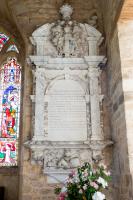
On 9th July 1728 Richard Knightley [aged 70] died in Fawsley, Northamptonshire. He was buried in St Mary's Church, Fawsley [Map].
Richard Knightley: On 24th February 1658 he was born to Lucius Knightley and Elizabeth Dent in Fawsley, Northamptonshire. Before 9th July 1728 Richard Knightley and Elizabeth Waldron were married. They were third cousin twice removed.
On 9th July 1746 Philippe V King Spain [aged 62] died at the El Escorial Palace. His son Ferdinand [aged 32] succeeded VI King Spain. Barbara Queen Consort Spain [aged 34] by marriage Queen Consort Spain.


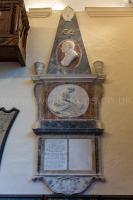
On 9th July 1758 Ann Wrey [deceased] was buried at St Peter's Church, Tawstock [Map]. On 1st December 1766 Thomas Chicot was buried at with his wife.
The inscription: Near this place lie the Remains of Mrs ANN CHILCOT Wife of Mr Thos CHILCOT Organist of Bath And Daughter to the Revd Mr CHICHESTER WREY late Rector of this Parish by his first Wife Margaret Daughter of ROGER PYNE of this County Gent:
She was a Woman of Great Piety Constant in the Duties of Religion both Public and Private and ever inclin'd to Acts of Humanity and Benevolence She died much lamented June 30th 1758 Ætat: 39 Her Disconsolate Husband as a Testimony of his Conjugal Affection Erected this Monument to her Memory.
His panel, missing from the left hand side of the monument, is missing as a consequence of a dispute between the executor of his will and the children of his first marriage.
Ann Wrey: Around 1719 she was born to Chichester Wrey and Margaret Pyne. On 14th September 1749 Thomas Chicot and she were married at Siddington, Gloucestershire. On 30th June 1758 Ann Wrey died.
Thomas Chicot: In 1728 he was appointed organist at Bath Abbey [Map] until his death in 1766 some thirty-eight years later. In 1766 he died.
On 9th July 1764 James Ogilvy 5th Earl Findlater 2nd Earl Seafield [aged 75] committed suicide. His son James [aged 50] succeeded 6th Earl Findlater, 3rd Earl Seafield. Mary Murray Countess Findlater [aged 44] by marriage Countess Findlater.
On 9th July 1768 Christian August Oldenburg was born to Frederick Christian Oldenburg I Duke Schleswig Holstein Sonderburg Augustenburg [aged 47] and Charlotte Amalie Wilhelmine Unknown Duchess Schleswig Holstein Sonderburg Augustenburg.
On 9th July 1788 Aubrey Beauclerk 6th Duke St Albans [aged 22] and Jane Moses [aged 20] were married. He the son of Aubrey Beauclerk 5th Duke St Albans [aged 48] and Catherine Ponsonby Duchess St Albans [aged 45].
Chronicle of Abbot Ralph of Coggeshall
The Chronicle of Abbot Ralph of Coggeshall (Chronicon Anglicanum) is an indispensable medieval history that brings to life centuries of English and European affairs through the eyes of a learned Cistercian monk. Ralph of Coggeshall, abbot of the Abbey of Coggeshall in Essex in the early 13th century, continued and expanded his community’s chronicle, documenting events from the Norman Conquest of 1066 into the tumultuous reign of King Henry III. Blending eyewitness testimony, careful compilation, and the monastic commitment to record-keeping, this chronicle offers a rare narrative of political intrigue, royal power struggles, and social upheaval in England and beyond. Ralph’s work captures the reigns of pivotal figures such as Richard I and King John, providing invaluable insights into their characters, decisions, and the forces that shaped medieval rule. More than a simple annal, Chronicon Anglicanum conveys the texture of medieval life and governance, making it a rich source for scholars and readers fascinated by English history, monastic authorship, and the shaping of the medieval world.
Available at Amazon in eBook and Paperback format.
On 9th July 1799 George Montagu 6th Duke Manchester was born to William Montagu 5th Duke Manchester [aged 27] and Susan Gordon Duchess Manchester at Kimbolton Castle [Map]. He married (1) 8th October 1822 Millicent Sparrow Duchess Manchester and had issue (2) 29th August 1850 Harriet Sydney Dobbs Duchess Manchester and had issue.
The London Gazette 17724. 9th July 1821. Whitehall. .
The King has been pleased to direct letters patent to be passed under the Great Seal, granting the dignities of Viscount, Earl, and Marquess of the United Kingdom of Great Britain and Ireland to Charles Earl of Ailesbury [aged 48], Knight of the Most Ancient aud Most Noble Order of the Thistle, and the heirs male of his body lawfully begotten, by the names, stiles, and titles of Viscount Savernake, of Savernake-Forest, in the county of Wilts, Earl Bruce, of Whorlton, in the county of York, and Marquess of Ailesbury, in the county of BucKingham
The King has also been pleased to direct letters patent to be passed under the Great Seal, granting the dignity of an Earl of the United Kingdom of Great Britain and Ireland to Edward Viscount Falmouth [aged 34], and the heirs male of his body lawfully begotten, by the name, stile, and title of Earl of Falmouth, in the county of Cornwall. [Anne Frances Bankes Countess Falmouth [aged 31] by marriage Countess Falmouth.]
The King has also been pleased to direct letters patent to be passed under the Great Seal, granting the dignity of an Earl of the United Kingdom of Great Britain and Ireland, to Richard William Penn Viscount Curzon [aged 24], and the heirs male of his body lawfully begotten, by the name, stile, and title of Earl Howe. [Note. Harriet Georgiana Brudenell Countess Howe [aged 22] by marriage Countess Howe.]
The King has also been pleased to direct letters patent to be passed under the Great Seal, granting the dignities of Viscount and Earl of the United Kingdom of Great Britain and Ireland, to John Sommers Baron Sommers [aged 61], and the heirs male of his body lawfully begotten, by the names, stiles, and titles of Viscount Eastnor, of Eastnor Castle, in the county of Hereford, and Earl Sommers.
The King has also been pleased to direct letters patent to be passed under the Great Seal, granting the dignities of Viscount and Earl of the United Kingdom of Great Britain and Ireland, to John Baron Rous [aged 71], and the heirs male of his body lawfully begotten, by the names, stiles, and titles of Viscount Dunwich and Earl of Stradbroke, in the county of Suffolk. [Charlotte Maria Whittaker Countess of Stradbroke [aged 52] by marriage Countess Stradbroke.]
The King has also been pleased to direct letters patent to be passed under the Great Seal, granting the dignity of Viscount of the United Kingdom of Great Britain and Ireland, to Richard Earl of Donoughmore [aged 65], and the heirs male of his body lawfully begotten, by the name, stile, and title of Viscount Hutchinson, of Knocklofty, in the county of Tipperary; with remainder, in default of such issue male, to the heirs male of the body of Christian Baroness Donoughmore, deceased (mother of the said Richard Earl of Donoughmore), by John Hely Hutchinson, Esq. also deceased.
The King has also been pleased to direct letters patent to be passed under the Great Seal, granting: the dignity ot a Baron of the United Kingdom of Great Britain and Ireland to William Marquess of Lothian [aged 57], Knight of the Most Ancient and Most Noble Order of the Thistle, and the heirs male of his body lawfully begotton, by the name, stile, and title of Baron Ker, of Kersheugh, in the county of Roxburgh.
The King has also been pleased to direct letters patent to be passed under the Great Seal, granting the dignity of a Baron of the United Kingdom of Great Britain and Ireland to Henry Marquess Conyngham [aged 54], Knight of the Most Illustrious Order of St Patrick, and the heirs male of his body lawfully begotten, by the name, stile, and title of Baron Minster, of Minster-Abbey, in the county of Kent.
The King has also been pleased to direct letters patent to be passed under the Great Seal, granting the dignity of a Baron of the United Kingdom of Great Britain and Ireland to James Earl of Ormonde and Ossory [aged 43], and the heirs male of his body lawfully begotton, by the name, stile, and title of Baron Ormonde, of Llanthony, in the county of Monmouth; with remainder, in default of such issue male, to his brother the Honourable Charles Howard Butler Clarke [aged 40], and the heirs male of his body lawfully begotten. [Note. Grace Louisa Staples Marchioness Ormonde by marriage Baroness Ormonde of Llanthony in Monmouthshire.]
The King has also been pleased to direct letters patent to be passed under the Great Seal, granting the dignity of a Baron of the United Kingdom of Great Britain and Ireland to Francis Earl of Wemyss and March [aged 49], and the heirs male of his body lawfully begotten, by the name, stile, and title of Baron Wemyss, of Wemyss, in the county of Fife.
The King has also been pleased to direct letters patent to be passed under the Great Seal, granting the dignity of a Baron of the United Kingdom of Great Britain and Ireland to Robert Earl of Roden [aged 32], Knight of the Most Illustrious Order of St Patrick, and the heirs male of his body lawfully begotten, by the name, stile, and title of Baron Clanbrassill, of Hyde-Hall, in the county of Hertford, and Dundalk, in the county of Louth.
The King has also been pleased to direct letters patent to be passed under the Great Seal, granting, the dignity of a Baron of the United Kingdom of Great Britain and Ireland, to George Earl of Kingston [aged 50], and the heirs male of his body lawfully begotten, by the name, stile, and title of Baron Kingston, of Mitchelstown, in the county of Cork.
The King has also been pleased to direct letters patent to be passed under the Great Seal, granting the dignity of a Baron of the United Kingdom of Great Britain and Ireland, to Thomas Earl of Longford [aged 47], Knight of the Most Illustrious Order of St Patrick, and the heirs male of his body lawfully begotten, by the name, stile and title of Baron Silchester, of Silchester, in the county of Southampton.
The King has also been pleased to direct letters patent to be passed under the Great Seal, granting the dignity of a Baron of the United Kingdom ef Great Britain and Ireland, to James Murray [aged 39], Esq. (commonly called Lord James Murray), and the heirs male of his body lawfully begotten by the name, stile, and title of Baron Glenlyon of Glenlyon, in the county of Perth. [Note. Emily Frances Percy Baroness Goldolphin Helston [aged 33] by marriage Baroness Glenlyon of Glenlyon in Perthshire.]
The King has also been pleased to direct letters:patent to be passed under the Great Seal, granting1 the dignity of a Baron of the United Kingdom of Great Britain and Ireland, to the Right Honourable William Wellesley Pole [aged 58], and the heirs male of his body lawfully begotten, by the name, stile, and title of Baron Maryborough, of Maryborough, in the Queen's-County.
The King has also been pleased to direct letters patent to be passed under the Great Seal, granting the dignity of a Baron of the United Kingdom of Great Britain and Ireland, to the Right Honourable John Foster [aged 81], and the heirs male of his body lawfully begotton, by the name, stile, and title of Baron Oriel, of Ferrard, in the county of Louth.
The King has also been pleased to direct letters;patent to be passed under the Great Seal, granting the dignity of a Baron of the United Kingdom of Great Britain and Ireland, to the Right Honourtable Sir William Scott [aged 75], Knt and the heirs male of his body lawfully begotten, by the name, stile, and title of Baron Stowell, of Stowell Park, in the county of Gloucester
The King has also been pleased to direct letters matent to be passed under the Great Seal, granting the dignity of a Baron of the United Kingdom of Great Britain and Ireland to Sir Thomas Henry Liddell [aged 46], Bart, and the heirs male of his body lawfully begotten, by the name, stile, and title of Baron Ravensworth, of Ravenswortb-Castle, in the county-palatine of Durham, and of Eslington, in the county of Northumberland. [Note. Maria Susannah Simpson Baroness Calthorpe [aged 48] by marriage Baroness Ravensworth of Ravensworth Castle in County Durham.]
The King has also been pleased to direct letters patent to be passed under the Great Seal, granting the dignity to a Baron of the United Kingdom of Great Britain and Ireland to Thomas Cholmondeley [aged 53], Esq. of Vale-Royal, in the county-palatine of Chester, and to the heirs male of his body lawfully begotten, by the name, stile, and title of Baron Delamere, of Vale-Royal, in the said county. [Note. Henrietta Elizabeth Williams-Wynn Baroness Delamere [aged 50] by marriage Baroness Delamere of Vale Royal in Cheshire.]
The King has also been pleased to direct letters patent to be passed under the Great Seal, granting the dignity of a Baron of the United Kingdom of Great Britain and Ireland to Cecil Weld Forester [aged 54], Esq. of Willey-Park, in the county of Salop, and the heirs male of his body lawfully begotten, by the name, stile, and title of Baron Forester, of Willey-Park, in the said county. [Note. Katherine Mary Manners Baroness Forester by marriage Baroness Forester of Willey Park in Shropshire.]
The King has also been pleased to direct letters patent to be passed under the Great Seal, granting the dignity of a Baroness of the United Kingdom of Great Britain and Ireland to Charlotte Mary Gertrude Strutt [aged 63] (commonly called Lady Charlotte Mary Gertrude Strutt), and the heirs male of her body lawfully begotten, by the name, stile, and title of Baroness Rayleigh, of Terling-place in the county of Essex.


On 9th July 1828 Gilbert Stuart [aged 72] died.

On 9th July 1836 Queen Sophia of Sweden and Norway was born to Duke William of Nassau [aged 44] and Princess Pauline of Württemberg [aged 26]. She a great x 3 granddaughter of King George II of Great Britain and Ireland. She married 6th June 1857 King Oscar II of Sweden and Norway and had issue.
On or before 9th July 1841, the date of his baptism, Samuel Alexander Walker was born.
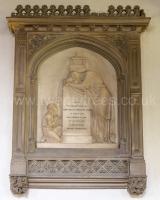
After 9th July 1843. Monument [Map] to Edward Lloyd Kenyon sculpted by Edward Bowring Stephens [aged 27].
Silbury Hill by C Tucker. On the 9th July [1849] the turf was stripped from that part of the meadow where the spoil from the tunnel was to be laid; and on Tuesday the 10th July the excavation of the gallery was commenced. From this time gangs of workmen succeeded each other at stated intervals, so that the work proceeded day and night without interruption.

On 9th July 1849 Frances Rafella FitzHerbert [aged 25] died at Mayfield Hall, Staffordshire [Map]. Memorial at St Mary's Church, Tissington [Map],
Frances Rafella FitzHerbert: On 23rd November 1823 she was born to Henry FitzHerbert 3rd Baronet and Agnes Beresford Lady Fitzherbert. On 13th November 1844 Reverend Godfrey Harry Arkwright and she were married at St Mary's Church, Tissington [Map].
Ten Years' Digging. On the 9th of July, after a very long and cold drive through a mountainous country, we opened two barrows on Eldon Hill, about a mile from the village of Peak Forest, the mountain, in the side of which is the famous chasm called Eldon Hole, formerly considered unfathomable, celebrated in Latin verse by Hobbes, and in English by Charles Cotton.
Ten Years' Digging. The other tumulus [Eldon Hill Barrow 2 [Map]] on the highest point of the mountain, measures 16 yards across, by about 4 feet in height, and is composed of large stones and earth. We found that the centre had been previously disturbed; nevertheless we there met with an immense quantity of rats' bones, a few portions of the skeleton of a child, a few bones from the extremities of a full grown person, and a rhomboidal article of bone, 2¼ inches long, with a hole through the middle, most likely intended to attach it to the dress as a button or fastening of some kind. In the undisturbed part, immediately south of the centre, were eight tines or points from the antlers of stags, some showing marks of tooling, also where they had been partially sawn through before they were broken off; accompanied by the lower jaw and bones of a cow, and other splintered animal bones, all lying about 18 inches from the top. Further south was a scattered deposit of calcined human bones, accompanied by the unburnt skeleton of an infant, a fine spear head of flint much burnt, 2 inches long, and a small vase of the usual imperfectly baked clay, 4¾ inches high, very nicely ornamented, but partly disintegrated. The interments lay about 18 inches above the natural surface, among some large stones which were not arranged so as to guard the deposits, indeed the latter appeared to have been carelessly interred at a period subsequent to the formation of the tumulus.
Ten Years' Digging. The first mound [Eldon Hill Barrow 1 [Map]], placed east of the highest point of the hill, measures not more than 5 yards in diameter, by about 2 feet in height, and is composed of small stones and earth. It yielded rats' bones, the root of a stag's horn, and the lower jaw of a small dog or fox, but produced no human remains, very probably fxom having been reduced in size.
On 9th July 1873 Lillian Maud Spencer-Churchill was born to George Charles Spencer-Churchill 8th Duke of Marlborough [aged 29] and Albertha Frances Anne Hamilton Duchess of Marlborough [aged 26].

On 9th July 1901 Reverend Walter Augustus Gray [aged 66] died. Memorial at the Chapel of St John the Evangelist, Bolton [Map].
Reverend Walter Augustus Gray: In or before 1835 he was born to William Gray and Eleanor Ker.
On 9th July 1927 Marie Alexandra Glücksburg was born to Wilhelm Friedrich Christian Glücksburg Duke Schleswig Holstein Sonderburg Glücksburg [aged 35] and Marie Melita Hohenlohe Langenburg Duchess Schleswig Holstein Sonderburg Glücksburg [aged 28]. She a great x 2 granddaughter of Queen Victoria of the United Kingdom.
On 9th July 1062 Robert Ferrers 1st Earl of Derby was born to Henry Ferrers and Bertha Aigle [aged 22] at Tutbury, Staffordshire. He married before 1096 Hawise de Vitre Countess Derby and had issue.
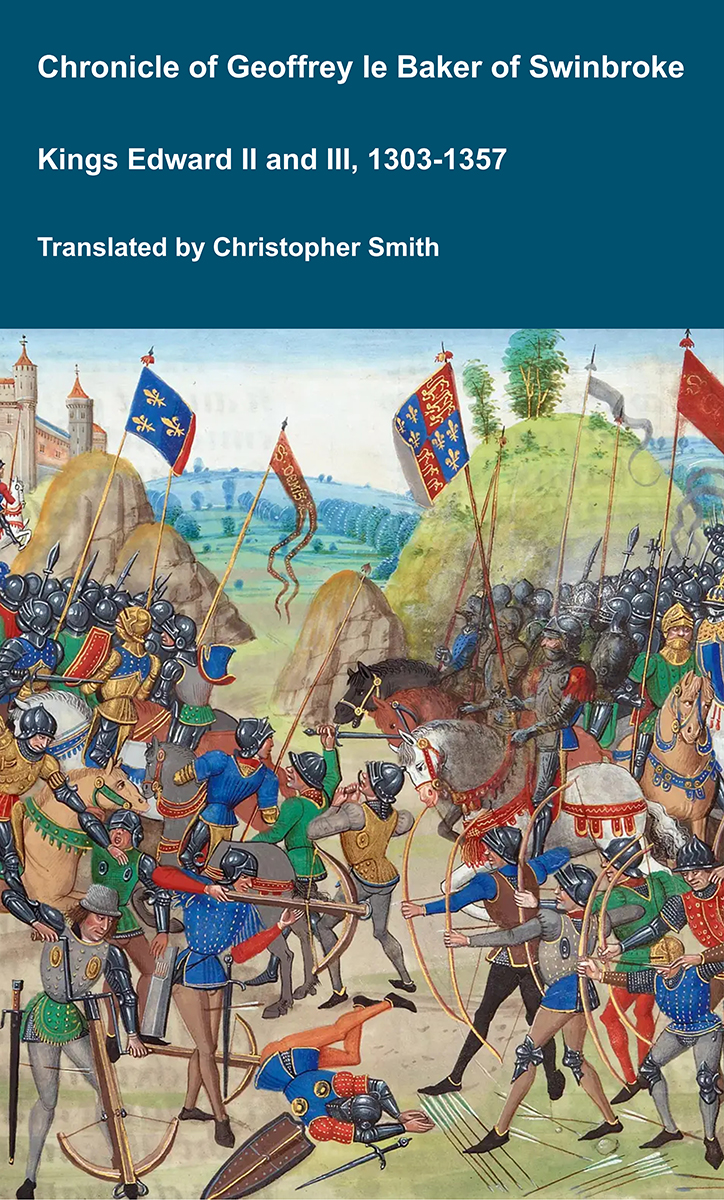
Chronicle of Geoffrey le Baker of Swinbroke
Baker was a secular clerk from Swinbroke, now Swinbrook, an Oxfordshire village two miles east of Burford. His Chronicle describes the events of the period 1303-1356: Gaveston, Bannockburn, Boroughbridge, the murder of King Edward II, the Scottish Wars, Sluys, Crécy, the Black Death, Winchelsea and Poitiers. To quote Herbert Bruce 'it possesses a vigorous and characteristic style, and its value for particular events between 1303 and 1356 has been recognised by its editor and by subsequent writers'. The book provides remarkable detail about the events it describes. Baker's text has been augmented with hundreds of notes, including extracts from other contemporary chronicles, such as the Annales Londonienses, Annales Paulini, Murimuth, Lanercost, Avesbury, Guisborough and Froissart to enrich the reader's understanding. The translation takes as its source the 'Chronicon Galfridi le Baker de Swynebroke' published in 1889, edited by Edward Maunde Thompson.
Available at Amazon in eBook and Paperback format.
On 9th July 1526 Elisabeth Habsburg Spain Queen Consort Poland was born to Ferdinand I Holy Roman Emperor [aged 23] and Anne Jagiellon [aged 22]. She married 5th May 1543 Sigismund II King Poland.
On 9th July 1556 Elizabeth Heneage 1st Countess Winchelsea was born to Thomas Heneage [aged 24] and Anne Poyntz [aged 22]. She married 14th November 1572 Moyle Finch 1st Baronet and had issue.

On 9th July 1576 Thomas West 3rd Baron De La Warr was born to Thomas West 2nd Baron De La Warr [aged 20] and Anne Knollys Baroness De La Warr [aged 21]. He married 25th November 1596 Cecily Shirley Baroness De La Warr and had issue.
On 9th July 1578 Ferdinand of Spain II Holy Roman Emperor was born to Charles Habsburg Spain II Archduke Austria [aged 38] and Maria Anna Wittelsbach [aged 27]. Coefficient of inbreeding 13.84%. He married his first cousin Maria Anna Wittelsbach Holy Roman Empress, daughter of William Wittelsbach V Duke Bavaria and Renata Lorraine Duchess Bavaria, and had issue.
On 9th July 1583 John Oldenburg was born to Frederick II King of Denmark [aged 49] and Sophie Mecklenburg-Schwerin Queen Consort Denmark [aged 25].
On 9th July 1665 Stillborn Bourbon was born to Philip Bourbon I Duke Orléans [aged 24] and Princess Henrietta Stewart Duchess Orléans [aged 21]. She a granddaughter of King Charles I of England, Scotland and Ireland. Coefficient of inbreeding 7.50%.
On 9th July 1716 James Stonhouse 11th and 8th Baronet was born to Richard Stonhouse.

On 9th July 1753 William Waldegrave 1st Baron Radstock was born to John Waldegrave 3rd Earl Waldegrave [aged 35] and Elizabeth Leveson-Gower Countess Waldegrave [aged 29]. He a great x 2 grandson of King James II of England Scotland and Ireland.
On 9th July 1755 Frances Wyndham was born to Charles Wyndham 2nd Earl Egremont [aged 44] and Alicia Carpenter Countess Egremont [aged 29] at Petworth. She married 30th August 1776 Charles Marsham 1st Earl Romney, son of Robert Marsham 2nd Baron Romney and Priscilla Pym Baroness Romney, and had issue.


On 9th July 1768 Christian August Oldenburg was born to Frederick Christian Oldenburg I Duke Schleswig Holstein Sonderburg Augustenburg [aged 47] and Charlotte Amalie Wilhelmine Unknown Duchess Schleswig Holstein Sonderburg Augustenburg.
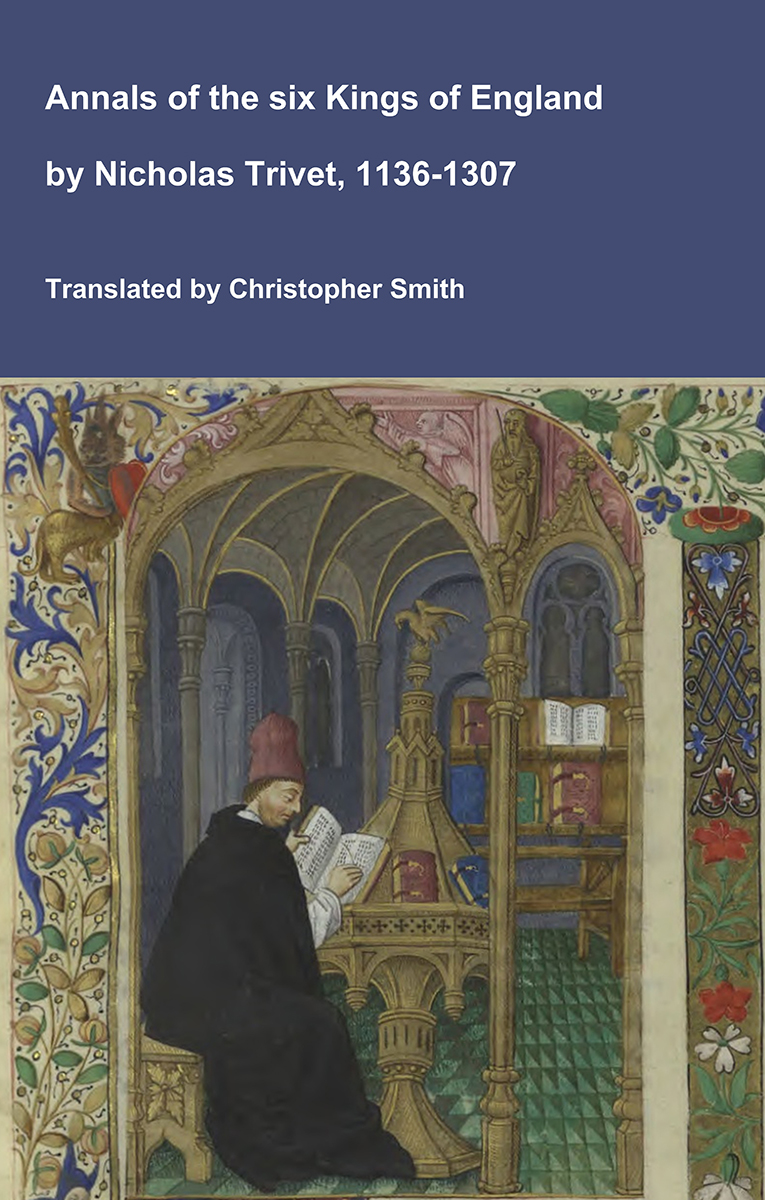
Annals of the six Kings of England by Nicholas Trivet
Translation of the Annals of the Six Kings of England by that traces the rise and rule of the Angevin aka Plantagenet dynasty from the mid-12th to early 14th century. Written by the Dominican scholar Nicholas Trivet, the work offers a vivid account of English history from the reign of King Stephen through to the death of King Edward I, blending political narrative with moral reflection. Covering the reigns of six monarchs—from Stephen to Edward I—the chronicle explores royal authority, rebellion, war, and the shifting balance between crown, church, and nobility. Trivet provides detailed insight into defining moments such as baronial conflicts, Anglo-French rivalry, and the consolidation of royal power under Edward I, whose reign he describes with particular immediacy. The Annals combines careful year-by-year reporting with thoughtful interpretation, presenting history not merely as a sequence of events but as a moral and political lesson. Ideal for readers interested in medieval history, kingship, and the origins of the English state, this chronicle remains a valuable and accessible window into the turbulent world of the Plantagenet kings.
Available at Amazon in eBook and Paperback format.
On 9th July 1799 George Montagu 6th Duke Manchester was born to William Montagu 5th Duke Manchester [aged 27] and Susan Gordon Duchess Manchester at Kimbolton Castle [Map]. He married (1) 8th October 1822 Millicent Sparrow Duchess Manchester and had issue (2) 29th August 1850 Harriet Sydney Dobbs Duchess Manchester and had issue.
On 9th July 1799 Percival Hart Dyke 6th Baronet was born to Percival Hart Dyke 5th Baronet [aged 31].
On 9th July 1799 Edward Berkeley Fitzharding 1st Viscount Portman was born to Edward Berkeley Portman [aged 28]. He married 16th June 1827 Emma Lascelles Baroness Portman, daughter of Henry Lascelles 2nd Earl Harewood and Henrietta Sebright Countess Harewood, and had issue.
On 9th July 1801 Sarah Elizabeth Amherst was born to William Pitt Amherst 1st Earl Amherst [aged 28] and Sarah Archer Countess Plymouth and Amherst [aged 39]. She married 1842 John Hay-Williams 2nd Baronet, son of John Williams 1st Baronet and Margaret Williams Lady Williams.


On 9th July 1813 Tonman Mosley 3rd Baronet was born to Oswald Mosley 2nd Baronet [aged 28] and Sophia Anne Every Lady Mosley. He married 4th February 1847 Catherine Wood and had issue.

On 9th July 1813 Emily Sellwood Baroness Tennyson was born to Henry Sellwood [aged 31] at Market Place, Horncastle. She married 13th June 1850 Alfred Tennyson 1st Baron Tennyson and had issue.
On 9th July 1817 Thomas Peyton 5th Baronet was born to Reverend Algernon Peyton [aged 30].
On 9th July 1824 Elizabeth Grosvenor Baroness Wenlock was born to Richard Grosvenor 2nd Marquess Westminster [aged 29] and Elizabeth Mary Leveson-Gower Marchioness Westminster [aged 27]. She married before 1848 her fifth cousin Beilby Lawley 2nd Baron Wenlock, son of Paul Thompson 1st Baron Wenlock and Caroline Griffin Baroness Wenlock, and had issue.
On 9th July 1829 Charles George Cholmondeley was born to William Cholmondeley 3rd Marquess Cholmondeley [aged 29] and Marcia Emma Georgiana Arbuthnot Marchioness Cholmondeley [aged 25]. He married 31st October 1854 Susan Caroline Dashwood, daughter of George Dashwood 4th Baronet, and had issue.
On 9th July 1836 Queen Sophia of Sweden and Norway was born to Duke William of Nassau [aged 44] and Princess Pauline of Württemberg [aged 26]. She a great x 3 granddaughter of King George II of Great Britain and Ireland. She married 6th June 1857 King Oscar II of Sweden and Norway and had issue.
Abbot John Whethamstede’s Chronicle of the Abbey of St Albans
Abbot John Whethamstede's Register aka Chronicle of his second term at the Abbey of St Albans, 1451-1461, is a remarkable text that describes his first-hand experience of the beginning of the Wars of the Roses including the First and Second Battles of St Albans, 1455 and 1461, respectively, their cause, and their consequences, not least on the Abbey itself. His text also includes Loveday, Blore Heath, Northampton, the Act of Accord, Wakefield, and Towton, and ends with the Coronation of King Edward IV. In addition to the events of the Wars of the Roses, Abbot John, or his scribes who wrote the Chronicle, include details in the life of the Abbey such as charters, letters, land exchanges, visits by legates, and disputes, which provide a rich insight into the day-to-day life of the Abbey, and the challenges faced by its Abbot.
Available at Amazon in eBook and Paperback format.
On 9th July 1845 Gilbert Elliot-Murray-Kynynmound 4th Earl Minto was born to Gilbert Elliot-Murray-Kynynmound 3rd Earl Minto [aged 31] and Emma Eleanor Elizabeth Hislop. He married 28th July 1883 Mary Caroline Grey Countess Minto and had issue.
On 9th July 1873 Lillian Maud Spencer-Churchill was born to George Charles Spencer-Churchill 8th Duke of Marlborough [aged 29] and Albertha Frances Anne Hamilton Duchess of Marlborough [aged 26].
On 9th July 1877 Maud Frederica Elizabeth Dundas Countess Fitzwilliam was born to Lawrence Dundas 1st Marquess Zetland [aged 32] and Lilian Selina Elizabeth Lumley Marchioness Zetland [aged 25]. She married 24th June 1896 her third cousin William Charles de Meuron "Billy" Wentworth-Fitzwilliam 7th and 5th Earl Fitzwilliam and had issue.
On 9th July 1879 Dorothy Maud Vivian was born to Hussey Vivian 3rd Baron Vivian [aged 45] She married 11th July 1905 Field Marshal Douglas Haig 1st Earl Haig and had issue.
On 9th July 1880 Thomas William Coke 4th Earl of Leicester was born to Thomas William Coke 3rd Earl of Leicester [aged 31] and Alice Emily White Countess Leicester [aged 24]. He married 2nd December 1905 Marion Gertrude Trefusis Countess Leicester and had issue.

On 9th July 1894 Edward Montagu Cavendish Stanley was born to Edward George Villiers Stanley 17th Earl of Derby [aged 29] and Alice Maude Olivia Montagu Countess Derby [aged 31]. He married 1917 his third cousin Sibyl Louise Beatrix Cadogan and had issue.
On 9th July 1919 Derek Winn 5th Baron St Oswald was born to Rowland George Winn 3rd Baron St Oswald [aged 25] and Evie Carew Greene.
On 9th July 1927 Marie Alexandra Glücksburg was born to Wilhelm Friedrich Christian Glücksburg Duke Schleswig Holstein Sonderburg Glücksburg [aged 35] and Marie Melita Hohenlohe Langenburg Duchess Schleswig Holstein Sonderburg Glücksburg [aged 28]. She a great x 2 granddaughter of Queen Victoria of the United Kingdom.
On 9th July 1937 Henry Crichton 6th Earl Erne was born to John Crichton 5th Earl Erne [aged 29] and Davidema Katharine Bulwer-Lytton Countess Erne [aged 28]. He married 5th November 1958 Camilla Marguerite Roberts Countess Erne and had issue.
On 9th July 1938 Sheriden Frederick Terence Hamilton-Temple-Blackwood 5th Marquess of Dufferin and Ava was born to Basil Sheridan Hamilton-Temple-Blackwood 4th Marquess of Dufferin and Ava [aged 29] and Maureen Constance Guinness Marchioness of Dufferin and Ava [aged 31]. He married 21st October 1964 his half fourth cousin Serena Belinda Rosemary Guinness Marchioness of Dufferin and Ava.
On 9th July 1957 William Lowther 9th Earl Lonsdale was born to James Lowther 7th Earl Londsdale [aged 34] and Jennifer Lowther Countess Lonsdale [aged 25].
Henrici Quinti, Angliæ Regis, Gesta, is a first-hand account of the Agincourt Campaign, and subsequent events to his death in 1422. The author of the first part was a Chaplain in King Henry's retinue who was present from King Henry's departure at Southampton in 1415, at the siege of Harfleur, the battle of Agincourt, and the celebrations on King Henry's return to London. The second part, by another writer, relates the events that took place including the negotiations at Troye, Henry's marriage and his death in 1422.
Available at Amazon in eBook and Paperback format.
On 9th July 1974 Peregrine Cust 8th Baron Brownlow was born to Edward John Peregrine Cust 7th Baron Brownlow [aged 38] and Shirlie Edith Yeomans.
On 9th July 1290 John "Peaceful" Reginar II Duke Brabant [aged 14] and Margaret Plantagenet Duchess Brabant [aged 15] were married. She the daughter of King Edward I of England [aged 51] and Eleanor of Castile Queen Consort England [aged 49]. He the son of John Reginar I Duke Brabant [aged 37] and Margaret Dampierre Duchess Brabant. They were half third cousin twice removed. He a great x 4 grandson of King Stephen I England.
On 9th July 1292 Henry Luxemburg VII Holy Roman Emperor [aged 17] and Margaret Brabant Countess Luxemburg and Namur were married at Tervuren. He the son of Henry Luxemburg VI Count Luxemburg and Beatrice Avesnes Countess Luxemburg.
On 9th July 1301 Robert Lisle 1st Baron Lisle [aged 13] and Margaret Beauchamp Baroness Lisle [aged 6] were married. They were fourth cousin twice removed. She a great x 4 granddaughter of King Henry I "Beauclerc" England.
On 9th July 1604 John St John 1st Baronet [aged 18] and Anne Leighton were married.

On 9th July 1681 James Graham 3rd Marquess Montrose [aged 23] and Christian Leslie Marchioness Montrose [aged 19] were married. She by marriage Marchioness Montrose. She the daughter of John Leslie 1st Duke Rothes [aged 51] and Anne Lindsay Duchess Rothes. He the son of James Graham 2nd Marquess Montrose and Isabel Douglas Marchioness Montrose. They were half fourth cousins.
On 9th July 1684 Henry Hobart 4th Baronet [aged 27] and Elizabeth Maynard Lady Hobart were married. She by marriage Lady Hobart of Intwood in Norfolk.
On 9th July 1713 Louis Henri Bourbon Condé Duke Bourbon [aged 20] and Marie Anne Bourbon Condé Conti [aged 24] were married. They were first cousins. He a great x 3 grandson of King James I of England and Ireland and VI of Scotland. She a great x 3 granddaughter of King James I of England and Ireland and VI of Scotland.

On 9th July 1725 Samuel Sandys 1st Baron Sandes [aged 29] and Letitia Tipping were married.
On 9th July 1728 Robert Kemp 3rd Baronet [aged 61] and Amy Phillips Lady Kemp were married. She by marriage Lady Kemp of Gissing in Norfolk. There was no issue from the marriage.
On 9th July 1741 Thomas Frankland 3rd Baronet [aged 56] and Sarah Moseley Lady Thirkleby were married. She by marriage Lady Frankland of Thirkleby in Yorkshire.
Chronicle of a Bourgeois of Valenciennes
Récits d’un bourgeois de Valenciennes aka The Chronicle of a Bourgeois of Valenciennes is a vivid 14th-century vernacular chronicle written by an anonymous urban chronicler from Valenciennes in the County of Hainaut. It survives in a manuscript that describes local and regional history from about 1253 to 1366, blending chronology, narrative episodes, and eyewitness-style accounts of political, military, and social events in medieval France, Flanders, and the Low Countries. The work begins with a chronological framework of events affecting Valenciennes and its region under rulers such as King Philip VI of France and the shifting allegiances of local nobility. It includes accounts of conflicts, sieges, diplomatic manoeuvres, and the impact of broader struggles like the Hundred Years’ War on urban life in Hainaut. Written from the perspective of a burgher (bourgeois) rather than a monastery or royal court, the chronicle offers a rare lay viewpoint on high politics and warfare, reflecting how merchants, townspeople, and civic institutions experienced the turbulence of the 13th and 14th centuries. Its narrative style combines straightforward reporting of events with moral and civic observations, making it a valuable source for readers interested in medieval urban society, regional politics, and the lived experience of war and governance in pre-modern Europe.
Available at Amazon in eBook and Paperback format.
On 9th July 1772 George Carpenter 2nd Earl Tyrconnel [aged 22] and Frances Manners Countess Tyrconnel [aged 19] were married. She by marriage Countess Tyrconnel. He the son of George Carpenter 1st Earl Tyrconnel and Frances Clifton Countess Tyrconnel.
On 9th July 1788 Aubrey Beauclerk 6th Duke St Albans [aged 22] and Jane Moses [aged 20] were married. He the son of Aubrey Beauclerk 5th Duke St Albans [aged 48] and Catherine Ponsonby Duchess St Albans [aged 45].
On 9th July 1804 George Montagu 6th Earl Sandwich [aged 31] and Louisa Lowry-Corry Countess of Sandwich [aged 23] were married. She the daughter of Armar Lowry-Corry 1st Earl Belmore and Harriet Hobart Viscountess Belmore [aged 42]. He the son of John Montagu 5th Earl Sandwich [aged 60] and Maria Henrietta Powlett.


On 9th July 1828 George Charles Mostyn 6th Baron Vaux of Harrowden [aged 24] and Caroline Vansittart Baroness Vaux were married.
On 9th July 1832 Ferdinand Dalberg-Acton 7th Baronet [aged 30] and Marie Louise Pelline de Dalberg Lady Acton [aged 19] were married. She by marriage Lady Acton of Aldenham Hall.
On 9th July 1844 William Molesworth 8th Baronet [aged 34] and Andalusia Carstairs [aged 34] were married at St George's Church, Hanover Square. They had met only four months before.
On 9th July 1861 Frederick Pollock [aged 46] and Laura Caroline Montagu were married.
On 9th July 1892 Charles Fitzroy 4th Baron Southampton [aged 25] and Hilda Mary Dundas Baroness Southampton [aged 19] were married. She by marriage Baroness Southampton. She the daughter of Lawrence Dundas 1st Marquess Zetland [aged 47] and Lilian Selina Elizabeth Lumley Marchioness Zetland [aged 40].
On 9th July 1228 Archbishop Stephen Langton [aged 78] died.
On 9th July 1328 Emmeline Heron Countess Kildare died.
On 9th July 1386 Leopold "The Just" Habsburg III Duke Austria [aged 34] died. His son William [aged 16] succeeded Duke Austria.
The True Chronicles of Jean le Bel Volume 1 Chapters 1-60 1307-1342
The True Chronicles of Jean le Bel offer one of the most vivid and immediate accounts of 14th-century Europe, written by a knight who lived through the events he describes, and experienced some of them first hand. Covering the early decades of the Hundred Years’ War, this remarkable chronicle follows the campaigns of Edward III of England, the politics of France and the Low Countries, and the shifting alliances that shaped medieval warfare. Unlike later historians, Jean le Bel writes with a strong sense of eyewitness authenticity, drawing on personal experience and the testimony of fellow soldiers. His narrative captures not only battles and sieges, but also the realities of military life, diplomacy, and the ideals of chivalry that governed noble society. A key source for Jean Froissart, Le Bel’s chronicle stands on its own as a compelling and insightful work, at once historical record and literary achievement. This translation builds on the 1905 edition published in French by Jules Viard, adding extensive translations from other sources Rymer's Fœdera, the Chronicles of Adam Murimuth, William Nangis, Walter of Guisborough, a Bourgeois of Valenciennes, Geoffrey le Baker of Swinbroke and Richard Lescot to enrich the original text and Viard's notes.
Available at Amazon in eBook and Paperback format.
On 9th July 1388 Maud Ros Baroness Welles died.
On 9th July 1398 Elizabeth Meinhill Baroness Darcy Knayth and Haversham [aged 66] died at Yarm Cleveland.
On 9th July 1553 Maurice Elector of Saxony [aged 32] died. His brother Augustus [aged 26] succeeded Elector Saxony.
On 9th July 1614 Thomas Grey 15th Baron Grey of Wilton [aged 38] died at Tower of London [Map] having been imprisoned for eleven years for his involvement in the Bye Plot. Baron Grey of Wilton extinct.
On 9th July 1654 Ferdinand IV King of the Romans [aged 20] died.
On 9th July 1676 William Fenwick 2nd Baronet [aged 59] died. His son John [aged 31] succeeded 3rd Baronet Fenwick of Fenwick in Northumberland.
On 9th July 1714 Letitia Isabella Smythe Countess Radnor [aged 84] died.
On 9th July 1740 Charles Crispe 5th Baronet [aged 60] died. Baronet Crispe of Hammersmith in Middlesex extinct. His estates were inherited by
On 9th July 1746 Philippe V King Spain [aged 62] died at the El Escorial Palace. His son Ferdinand [aged 32] succeeded VI King Spain. Barbara Queen Consort Spain [aged 34] by marriage Queen Consort Spain.
On 9th July 1764 James Ogilvy 5th Earl Findlater 2nd Earl Seafield [aged 75] committed suicide. His son James [aged 50] succeeded 6th Earl Findlater, 3rd Earl Seafield. Mary Murray Countess Findlater [aged 44] by marriage Countess Findlater.
On 9th July 1811 Thomas Pilkington 7th Baronet [aged 37] died. His brother William [aged 35] succeeded 8th Baronet Pilkington of Stanley in Yorkshire.
On 9th July 1828 Gilbert Stuart [aged 72] died.
The History of William Marshal was commissioned by his son shortly after William’s death in 1219 to celebrate the Marshal’s remarkable life; it is an authentic, contemporary voice. The manuscript was discovered in 1861 by French historian Paul Meyer. Meyer published the manuscript in its original Anglo-French in 1891 in two books. This book is a line by line translation of the first of Meyer’s books; lines 1-10152. Book 1 of the History begins in 1139 and ends in 1194. It describes the events of the Anarchy, the role of William’s father John, John’s marriages, William’s childhood, his role as a hostage at the siege of Newbury, his injury and imprisonment in Poitou where he met Eleanor of Aquitaine and his life as a knight errant. It continues with the accusation against him of an improper relationship with Margaret, wife of Henry the Young King, his exile, and return, the death of Henry the Young King, the rebellion of Richard, the future King Richard I, war with France, the death of King Henry II, and the capture of King Richard, and the rebellion of John, the future King John. It ends with the release of King Richard and the death of John Marshal.
Available at Amazon in eBook and Paperback format.
On 9th July 1834 Michael Seymour 1st Baronet [aged 65] died at Rio de Janeiro. He was buried at the Cemitério dos Ingleses, Gamboa on 15th July 1834. His son John [aged 34] succeeded 2nd Baronet Seymour of High Mount in Cork and Friery Park in Devon.
On 9th July 1843 Charles Ethelston Nightingale 11th Baronet [aged 58] died. His son Charles [aged 34] succeeded 12th Baronet Nightingale of Newport Pond in Essex.

On 9th July 1855 Mary Nisbet Countess Elgin [aged 77] died.
On 9th July 1860 Louise Rouse-Boughton Baroness St John [aged 75] died.
On 9th July 1903 Maria Frances Catherine Stapleton Countess Roden died.
On 9th July 1908 Robert John Dashwood 9th Baronet [aged 49] died. His son John [aged 12] succeeded 10th Baronet Dashwood of West Wycombe in Buckinghamshire.

On 9th July 1909 George Frederick Samuel Robinson 1st Marquess Ripon [aged 81] died. His son Frederick [aged 57] succeeded 2nd Marquess Ripon, 4th Earl de Grey, 3rd Earl Ripon, 3rd Viscount Gooderich of Nocton in Lincolnshire, 5th Baron Grantham, 8th Baronet Robinson of Newby in Yorkshire. Constance Gwladys Herbert Marchioness Ripon [aged 50] by marriage Marchioness Ripon.
On 9th July 1931 George Montagu Bennet 7th Earl Tankerville [aged 79] died at Chillingham Castle, Northumberland [Map]. He was buried at St Peter's Church, Chillingham [Map]. His son Charles [aged 33] succeeded 8th Earl Tankerville, 9th Baron Ossulston of Ossulston in Middlesex.
On 9th July 1943 George Reresby Sitwell 4th Baronet [aged 83] died. His son Francis [aged 50] succeeded 5th Baronet Sitwell of Renishaw Hall in Derbyshire.

On 9th July 1943 Francis Douglas Stuart 18th Earl of Moray [aged 50] died.
William of Worcester's Chronicle of England
William of Worcester, born around 1415, and died around 1482 was secretary to John Fastolf, the renowned soldier of the Hundred Years War, during which time he collected documents, letters, and wrote a record of events. Following their return to England in 1440 William was witness to major events. Twice in his chronicle he uses the first person: 1. when writing about the murder of Thomas, 7th Baron Scales, in 1460, he writes '… and I saw him lying naked in the cemetery near the porch of the church of St. Mary Overie in Southwark …' and 2. describing King Edward IV's entry into London in 1461 he writes '… proclaimed that all the people themselves were to recognize and acknowledge Edward as king. I was present and heard this, and immediately went down with them into the city'. William’s Chronicle is rich in detail. It is the source of much information about the Wars of the Roses, including the term 'Diabolical Marriage' to describe the marriage of Queen Elizabeth Woodville’s brother John’s marriage to Katherine, Dowager Duchess of Norfolk, he aged twenty, she sixty-five or more, and the story about a paper crown being placed in mockery on the severed head of Richard, 3rd Duke of York.
Available at Amazon in eBook and Paperback format.
On 9th July 1947 Reginald Arthur Hobhouse 5th Baronet [aged 69] died. His son Charles [aged 40] succeeded 6th Baronet Hobhouse of Chantry House Wiltshire and Westbury College in Gloucestershire.
On 9th July 1956 Thomas Fremantle 3rd Baron Cottesloe [aged 94] died. His son John [aged 56] succeeded 4th Baron Cottesloe of Swanbourne and Hardwick in Buckinghamshire, 4th Baronet Fremantle of Swanborne in Buckinghamshire. Elizabeth Harris Baroness Cottesloe [aged 50] by marriage Baroness Cottesloe of Swanbourne and Hardwick in Buckinghamshire.
On 9th July 1964 Marjorie Ellinor Trotter Countess Fortescue [aged 70] died.
On 9th July 1966 John Lindsay Dashwood 10th Baronet [aged 70] died. His son Francis [aged 40] succeeded 11th Baronet Dashwood of West Wycombe in Buckinghamshire.
On 9th July 1969 Oliver Hart Dyke 8th Baronet [aged 83] died. His son Derek [aged 44] succeeded 9th Baronet Dyke of Horeham in Sussex.
On 9th July 2014 Robert Methuen 7th Baron Methuen [aged 82] died. His first cousin once removed James [aged 62] succeeded 8th Baron Methuen of Corsham in Wiltshire.
On 9th July 2019 Peter Carrington 6th Baron Carrington died. His son Rupert [aged 70] succeeded 7th Baron Carrington of Bulcote Lodge, 7th Baron Carrington of Upton in Nottinghamshire.