

15 Aug is in August.
Anglo-Saxon Chronicle. 765. This year Eanbert was invested archbishop, on the fortieth day over mid-winter; and Frithwald, Bishop of Whitern, died on the nones of May. He was consecrated at York, on the eighteenth day before the calends of September, in the sixth year of the reign of Ceolwulf, and was bishop nine and twenty winters. Then was Petwin consecrated Bishop of Whitern at Adlingfleet, on the sixteenth day before the calends of August.
On 15th August 1057 King Macbeth of Scotland [aged 52] died. Lulach King Scotland succeeded King Scotland.
Chronicon ex Chronicis by Florence and John of Worcester. 15th August 1127. Richard, bishop of Hereford, died at his vill, called Dydelebyrig [Map]1, on Monday the eighteenth of the calends of September [15th August]; his body was carried to Hereford [Map], and buried in the church there, with the bishops his predecessors.
On 15th August 1171 Alfonso IX King Leon was born to Ferdinand II King Leon [aged 34] and Urraca Burgundy Queen Consort Leon [aged 23]. Coefficient of inbreeding 2.00%. He married (1) 1191 his first cousin Theresa of Portugal Queen Consort Leon, daughter of Sancho "Populator" I King Portugal and Dulce Barcelona Queen Consort Portugal, and had issue (2) 1197 his first cousin once removed Berengaria Ivrea I Queen Castile, daughter of Alfonso VIII King Castile and Eleanor Plantagenet Queen Consort Castile, and had issue.
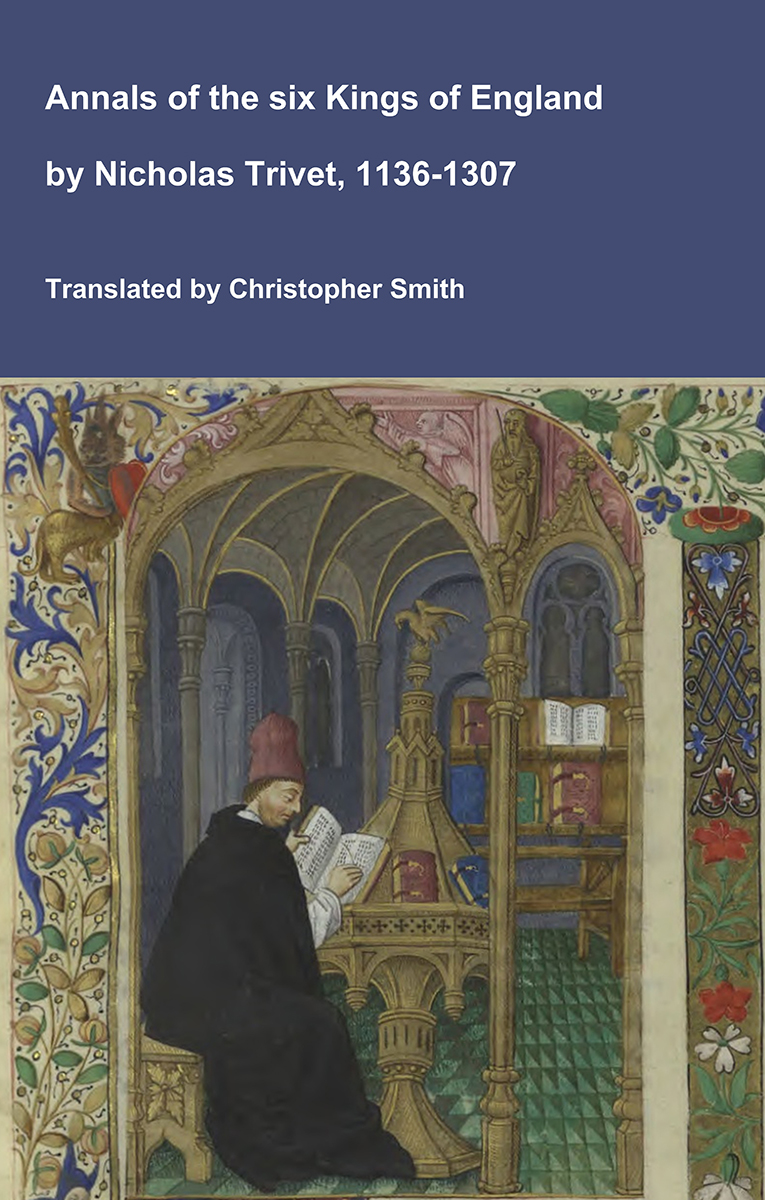 Annals of Six Kings of England by Nicholas Trivet. When the month of July was ending, the king of France, Philip, preparing to return home, left the duke of Burgundy in his place. Before his departure, however, he swore to King Richard an agreement of mutual fidelity and security, that neither he nor his men would harm him or his lands before forty days had passed. Thus the king of France departed from the Holy Land on the feast of St Peter in Chains, King Richard having granted him two galleys at his request. Yet he, forgetful both of the favour and of his oath, on his return to France invaded the lands of King Richard. After the departure of the king of France, King Richard devoted all his efforts to repairing the walls of the city of Acre more strongly and completely. The king of France had left in the hands of the duke of Burgundy and the Marquis his share of the hostages, so that from their ransom, which he estimated would amount to one hundred thousand gold pieces, the army left there might be maintained until Easter. But since the French had no other source of support, much murmuring and contention arose among them, until King Richard lent the duke of Burgundy five thousand marks concerning the hostages entrusted to him. When the term for the ransom had expired, and after waiting one further week with no one appearing to redeem them, with the consent of all, the hostages were beheaded by the guards on the day after the feast of the Assumption of the glorious Virgin [15th August 1191], only a few of the more important ones being spared, in case they might themselves be ransomed or some Christian captives be released in exchange for them. After this the Christian army set out, with King Richard as its leader, toward the coastal city of Ascalon.
Exeunte itaque mense Julii, rex Francorum Philip repatriare disponens ducem Burgundiæ loco France. suo reliquit. Ante tamen discessum suum, conventus a rege Ricardo de mutua conservanda fidelitate securitatis, juravit quod suis aut terræ suæ non noceret terram suam ante dies quadraginta exactos. Discessit igitur rex Francorum a Terra Sancta in die S. Petri ad vincula, datis ei ad rogatum suum a rege Ricardo galeis duabus; qui, tam beneficii quam juramenti immemor, in suo reditu in Franciam terras regis Ricardi invasit. Rex Ricardus, post discessum regis Francorum, omnem adhibuit operam muris civitatis Achon in altius et perfectius reparandis. Reliquerat autem rex Franciæ in manu ducis Burgundiæ et Marchisi partem suam obsidum, ut de eorum redemptione, quam æstimabat ascendere ad centum millia aureorum, usque ad Pascha relictam ibi militiam exhiberet. Cum autem Gallici aliam penitus non haberent exhibitionem, plurimum murmuris et contentionis inter eos ortum est, quousque rex Ricardus duci Burgundiæ super obsides sibi relictos marcarum quinque millia commodaret. Exeunte autem redemptionis termino, et exspectata ulterius una septimana, cum non esset qui de redimendis curaret, de assensu omnium in crastino Assumptionis Virginis gloriosæ obsides omnes, reservatis tantum aliquibus majoribus, si forte vel ipsi redimerentur, vel pro eis aliqui Christiani captivi liberarentur, a satellitibus decollantur. Exinde progreditur Christianus exercitus, duce rege Ricardo, versus Ascaloniam maritimam civitatem.
On 15th August 1191 Henry Hohenstaufen VI Holy Roman Emperor [aged 25] was crowned VI Holy Roman Emperor.
On 15th August 1193 King Philip II of France [aged 27] and Ingeborg Estridsen Queen Consort France [aged 19] were married. She by marriage Queen Consort of France. She the daughter of Valdemar "Great" I King of Denmark. He the son of Louis VII King of the Franks and Adèle Queen of the Franks.
Images of Histories by Ralph Diceto. Philip, king of the Franks, took to wife the sister of the king of Denmark; but because the divorce between them was solemnly carried out unexpectedly, this was spoken of among the people far more than the royal wedding which had previously taken place at the city of Amiens on the feast of the Assumption of the Blessed Virgin [15th August 1193]. Separated from the king, the queen preferred to live among the nuns at Soissons rather than to return to her father's home in Denmark.
Philippus rex Francorum uxorem duxit sororem regis Danemarcniæ sed quia divortium inter ipsos sollempniter celebratum est ex insperato, plus hoc in ore populorum versatur, quam quod apud urbem Ambianensium in Assumptione Beatæ Virginis nuptiæ regales præcesserant. A rege disjuncta regina maluit Suessionis inter sanctimoniales degere quam lares paternos in Danemarchia visitare.
Chronicle of Burchard of Ursperg. 15th August 1196. At that time in Alamannia, Conrad [aged 24], the emperor's brother and Duke of the Swabians, raised an army against Duke Bertold of Zähringen by the emperor's will. While he stayed in a certain town named Durlach, he died and was buried in the monastery of Lorch. Many asserted that he was killed by someone whose wife he had violently violated, or by the wife herself. For he was a man completely devoted to adulteries, fornications, and rapes, indulging in all sorts of luxuries and filth, yet he was vigorous in wars and fierce and generous to friends, and both his own people and foreigners trembled under him. Then the emperor conferred the Duchy of Swabia to the aforementioned Philip [aged 19], his brother, who, having left parts of Italy, crossed into Alamannia with his wife, placing her in the castle of Schwäbisch Hall. At that time, by the emperor's command, he also placed the royal diadem on King Ottokar of Bohemia.
In tempore illo in Alamannia Cuonradus, frater imperatoris, dux Suevorum, movit exercitum contra Bertoldum ducem Zaringiae de voluntate imperatoris. Cumque maneret in quodam opido Durlaich nomine, obiit et sepultus est in monasterio Loricensi. Multi asserebant, eum fuisse interfectum a quodam, cuius uxorem adulteravit violenter, sive ab ipsa uxore. Erat enim vir totus inserviens adulteriis et fornicationibus et stupris, quibuslibet luxuriis et immundiciis, strennuus tamen erat in bellis et ferox et largus amicis, et tam sui quam extranei tremebant sub eo. Tune imperator ducatum Sueviae contulit prefato Philippo, fratri suo, qui relictis partibus Italiae transivit in Alamanniam cum uxore sua, ponens eam in castro Suainhusen. Tunc etiam de mandato imperatoris regium diadema imposuit regi Boemorum Otakero.
Annals of Konrad von Scheyern. 15th August 1196. Conrad, Duke of the Swabians [aged 24], launched an expedition against the Duke of Zähringen; during which, while attempting to deflower a girl by force, he was bitten on the left nipple, and a black swelling grew. Not wanting to be slowed by this, he died on the third day in Oppenheim, and was buried in Speyer. Philip [aged 19], his brother, succeeded him in the duchy.
Chounradus dux Suevorum expeditionem adversus ducem de Zaringen movit; in qua per amplexum cuiusdam puellae, quam vi devirginare conabatur, morsu in sinistra papilla tactus, vesica crescente nigra, nec per hoc eo tardare volente, tercia die obiit in Oppenheim, Spiraeque sepelitur. Philippus frater eius succedit in ducatu,

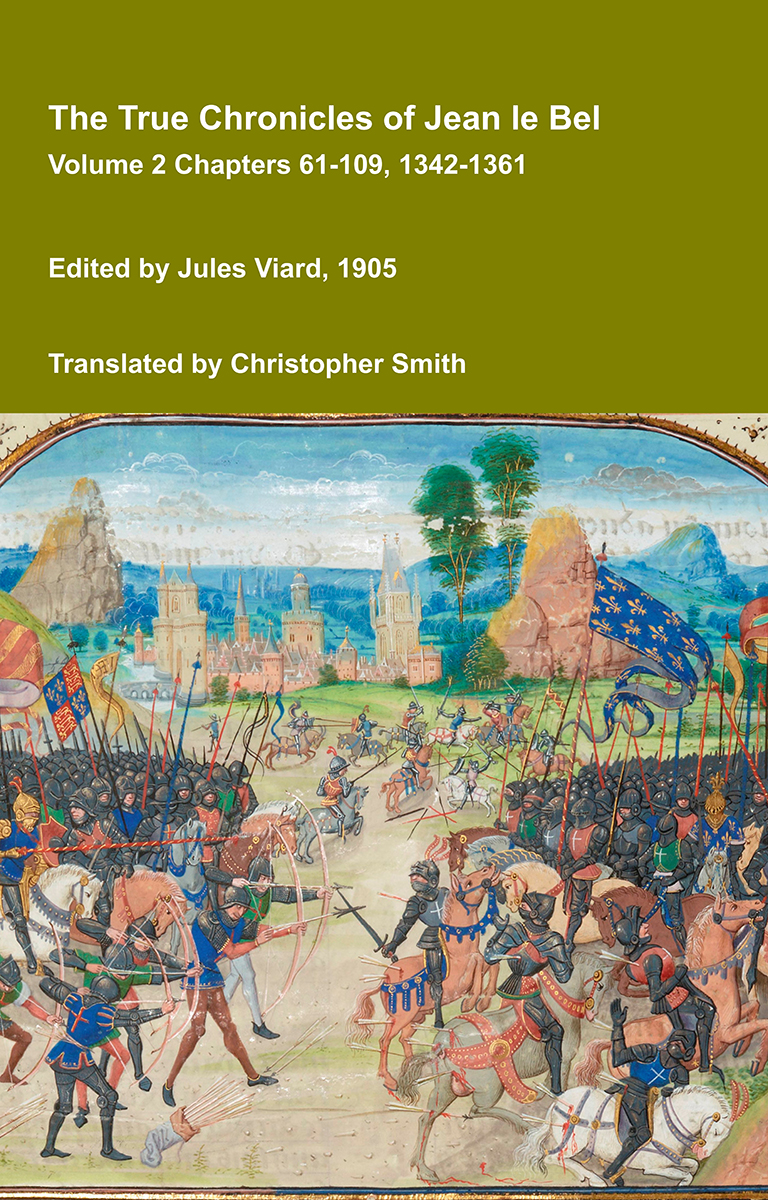
The True Chronicles of Jean le Bel Volume 1 Chapters 1-60 1307-1342
The True Chronicles of Jean le Bel offer one of the most vivid and immediate accounts of 14th-century Europe, written by a knight who lived through the events he describes, and experienced some of them first hand. Covering the early decades of the Hundred Years’ War, this remarkable chronicle follows the campaigns of Edward III of England, the politics of France and the Low Countries, and the shifting alliances that shaped medieval warfare. Unlike later historians, Jean le Bel writes with a strong sense of eyewitness authenticity, drawing on personal experience and the testimony of fellow soldiers. His narrative captures not only battles and sieges, but also the realities of military life, diplomacy, and the ideals of chivalry that governed noble society. A key source for Jean Froissart, Le Bel’s chronicle stands on its own as a compelling and insightful work, at once historical record and literary achievement. This translation builds on the 1905 edition published in French by Jules Viard, adding extensive translations from other sources Rymer's Fœdera, the Chronicles of Adam Murimuth, William Nangis, Walter of Guisborough, a Bourgeois of Valenciennes, Geoffrey le Baker of Swinbroke and Richard Lescot to enrich the original text and Viard's notes.
Available at Amazon in eBook and Paperback format.
On 15th August 1209 Frederick I King Jerusalem II Holy Roman Emperor [aged 14] and Constance Barcelona [aged 30] were married at Messina, Sicily [Map]. She the daughter of Alfonso II King Aragon and Sancha Ivrea Queen Consort Aragon. He the son of Henry Hohenstaufen VI Holy Roman Emperor. They were third cousin once removed.
Annals of Six Kings of England by Nicholas Trivet. From the second general chapter of the Order of Preachers, which was held at Bologna under Saint Dominic, in this year the friars Preachers were sent to England. They were thirteen in number, having as prior brother Gilbert of Fraxineto, and, in the company of the venerable father Peter des Roches, bishop of Winchester, they arrived at Canterbury. When they had presented themselves to Stephen Langton [aged 71], archbishop of Canterbury, and he heard that they were Preachers, he immediately ordered brother Gilbert to deliver a sermon before him in a certain church in which he himself had intended to preach that same day. The archbishop was greatly edified by his words, and thereafter, throughout his life, he supported the Order of Preachers and its work with favour and goodwill. Setting out from Canterbury, the friars came to London on the feast of Saint Lawrence [10th August 1221], and then went on to Oxford on the feast of the Assumption of the Blessed Virgin [15th August]. There they built an oratory in her honor, and occupied the schools which are now called those of Saint Edward, in whose parish they had received a place and where they stayed for some time. But since the site could not be sufficiently enlarged, they moved to another place granted to them by the king, where they now dwell outside the walls.
De secundo capitulo generali fratrum ordinis Prædicatorum, quod sub beato Dominico celebratum est Bononiæ, hoc anno missi sunt fratres Prædicatores in Angliam, qui numero tredecim, habentes priorem fratrem Gilbertum de Fraxineto, in comitiva venerabilis patris domini Petri de Rupibus, Wintoniensis episcopi, Cantuariam pervenerunt: ubi cum se domino Stephano Cantuariensi archipræsuli præsentassent, audito quod Prædicatores essent, statim fratri Gilberto imposuit, ut coram se sermonem faceret in ecclesia quadam, in qua ipsemet proposuerat eodem die prædicare. Cujus verbis admodum ædificatus pontifex, toto suo tempore, religionem fratrum Prædicatorum et officium prosecutus est gratia et favore. Progredientes autem fratres de Cantuaria, venerunt Londonias in festo sancti Laurentii; et ulterius Oxoniam in festo Assumptionis Virginis gloriosæ, in cujus honore oratorium construxerunt: et habebant scholas illas, quæ nunc sancti Edwardi dicuntur, in cujus parochia locum acceperant, in quo tempore aliquo morabantur. Sed cum non esset opportunitas locum sufficienter dilatandi, transtulerunt se ad locum a rege eis concessum, ubi nunc habitant extra muros.
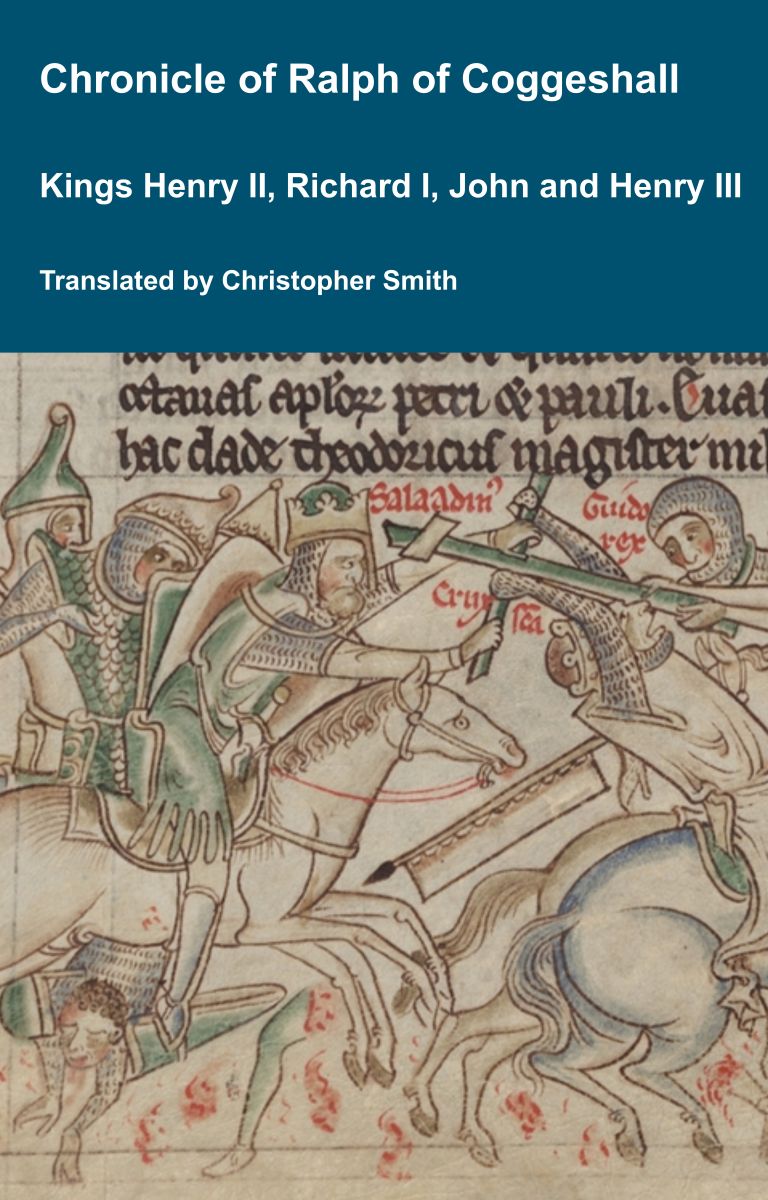 Chronicum Anglicanum by Ralph Coggeshall. At length the besiegers, by the continual hurling of heavy stones and by the battering of the walls and towers, with great fighting and conflict, won the outer barbican, and drove the besieged back to another wall as far as the tower. But the barbicans with their towers were so strongly fortified at the tops with huge beams, hewn and armed with iron, that the besieged could safely hide beneath them, and for a while had little to fear from the stones and other missiles, until the miners dug beneath the foundations of the tower and walls, and the timbers placed in the tunnels were set on fire. When these were burned, a great part of the tower and walls collapsed. And so afterwards, while the besieged were feasting in certain hiding places of the same tower and keeping less careful watch, they were suddenly assaulted and taken, and were hanged upon gibbets, both knights and men-at-arms, on the feast of the Assumption of the Blessed Virgin Mary [15th August 1224], to the number of eighty-three. On that day, the counsel and aid of the lord archbishop of Canterbury, and of the other bishops and abbots, especially shone forth in the siege, for they adhered to the king with the utmost zeal, sparing neither money nor toil for their men in any respect. But the monks of Warden Abbey suffered a great and irreparable loss from this siege, for their tall woods, and especially the trees around the abbey, were cut down to prepare those machines.
Tandem primum exterius antemurale ex assiduo lapidum ponderosorum jactu, et murorum ac turrium conquassatione, cum magno pugnæ conflictu obsidentes obtinuerunt, atque obsessos in alium murum usque ad turrim effugarunt; sed antemuralia cum turribus ita in summitatibus erant munita maximis et dolatis et armatis trabibus et lignis, quod obsessi sub eis securiter delitescerent, jactusque lapidum ponderosorum ac cætera missilia parumper formidarent, donec fossarii minitores fundamenta turris et murorum suffoderent, et ligna supposita in cuniculis igne apposito concremarent; quibus combustis, corruit maxima pars turris et murorum. Sicque postmodum obsessi, dum in quibusdam latebris ejusdem turris epularentur et minus caute se custodirent, subito invaduntur et capiuntur, atque in patibulis suspenduntur, tam milites quam servientes, die Assumptionis beatæ Mariæ virginis, numero octoginta-tres. In hac autem die de obsidione specialiter claruit consilium et auxilium domni Cantuariensis et aliorum episcoporum et abbatum, qui nimis fideliter regi cum toto conamine adhæserunt, qui pecuniis ac laboribus nihil hominibus suis in aliquo pepercerunt. Monachi autem de Wardona magnum et irrecuperabile damnum ex hac obsidione perpessi sunt, quia nemora eorum excelsa, et præcipue arbores circa abbatiam, succisæ sunt ad machinas illas præparandas.
Annals of Six Kings of England by Nicholas Trivet. 1224. Louis, King of the French, setting aside the oath which he had formerly sworn in England, and pursuing his father's undertakings against the King of England, took the town of Saint-Jean-d'Angély, and the castle of Niort in Poitou, entrusted to the keeping of Savary de Mauléon, was surrendered to the King of the French, with safe conduct for him and his men. He also laid siege to La Rochelle, into which the aforesaid Savary had lately entered with three hundred knights. At first they defended themselves bravely, and often harassed the king's army, but at length the town was surrendered to the King of the French, and Savary de Mauléon crossed over into England, but while at sea, considering that he would be suspected of treachery by the King of England, he turned his ship towards France, and becoming a deserter, wholly submitted himself to King Louis. In the same year Fawkes de Bréauté, rising against the King of England, fortified the castle of Bedford with arms, provisions, and stout men well fitted for war. When the king had surrounded it with a siege, and had violently taken it on the Feast of the Assumption of the Blessed Virgin [15th August 1224], he caused all those who had held it against the royal will to be hanged, as a terror to others. Fawkes himself, struck suddenly by a turn of fortune and cast down from great wealth, fell within a year into such poverty that, though he had shortly before seemed to surpass the other nobles of England in riches, he was now driven into exile, seeking a meagre livelihood in Gaul, and did not even have a place to lay his head. Thus, his enemies throughout England having been subdued, the king began to govern the kingdom in peace, but he still lacked the means to recover what had been lost in the regions of France. In this year the Order of Friars Minor was confirmed by Pope Honorius.
Liber de Antiquis Legibus 1255. In the same year, the King of Scotland [aged 13] and his Queen [aged 14], daughter of the King of England, came into England, and, on the Assumption of Saint Mary [15th August 1255] were with his lordship the King at Wudestok [Map]; upon which day, the said King held a great and most noble Court, nearly all his Earls and Barons being present.
Annals of Six Kings of England by Nicholas Trivet. 1289. Charles, Prince of Achaea, coming to Rome, is absolved by Pope Nicholas from the oath made to the King of Aragon, and is crowned King of Sicily. Between James, occupier of Sicily, and the Count of Artois, a truce of two years is established. The King of England, having returned from Gascony, is solemnly received in London about the feast of the Assumption of the glorious Virgin [15th August 1289], who in the same year, having expelled all the Jews from England, after expenses had been granted for their passage into France, confiscated their remaining goods. Moreover, having heard the complaints of those who wished to complain of the king’s ministers, the king, administering justice to all, removed almost all the justices, having been found guilty of corruption, from their office, punishing them severely according to their deserts. In this year the king held a parliament in London, in which statutes were issued which are called the 'Third Statute of Westminster', in which also, for the expulsion of the Jews, there was granted to the king by the people a fifteenth part of their goods.
1289. CAROLUS, princeps Achaiæ, Romam veniens, per papam Nicolaum a juramento regi Aragonum præstito absolvitur, et in regem Siciliæ coronatur. Inter Jacobum occupatorem Siciliæ et comitem Atrebatensem firmantur induciæ biennales. Rex Angliæ, de Vasconia reversus, Londoniis solemniter recipitur circa festum Assumptionis Virginis gloriosæ; qui Judæos omnes eodem anno expellens de Anglia, datis expensis in Gallias, bona eorum reliqua confiscavit. Auditis autem querimoniis eorum, qui de regis ministris conqueri volebant, rex omnibus exhibens justitiam, justitiarios fere omnes de falsitate deprehensos a suo officio deposuit, ipsos juxta demerita puniens gravi multa Tenuit hoc anno rex parliamentum Londoniis, in quo edita sunt statuta quæ dicuntur 'Westmonasterii tertia'; in quo etiam pro expulsione Judæorum concessa est regi a populo quinta decima pars bonorum.
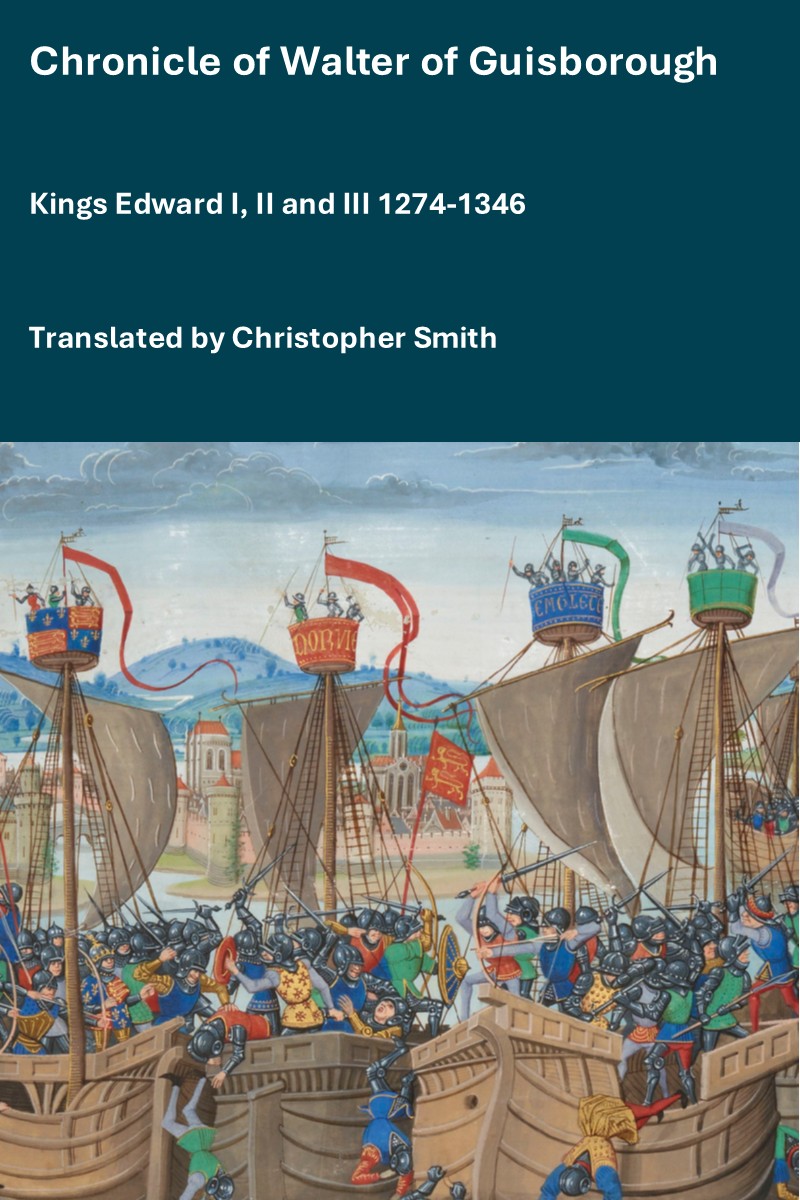 Chronicle of Walter of Guisborough. In the same year, Henry of Newark, Archbishop of York, died on the Feast of the Assumption [15th August 1299], being assumed on that day; he was succeeded by Thomas of Corbridge, who was elected on the morrow of Saint Martin [12th November 1299] and confirmed in the papal court that same year.
Eodem anno obiit Henricus de Newerk, Eborum archiepiscopus, in die Assumptionis assumptus; cui successit Thomas de Corebrygge in crastino Sancti Martini electus, et in curia Thursday, papæ confirmatus eodem anno.
On 15th August 1299 Archbishop Henry of Newark died.
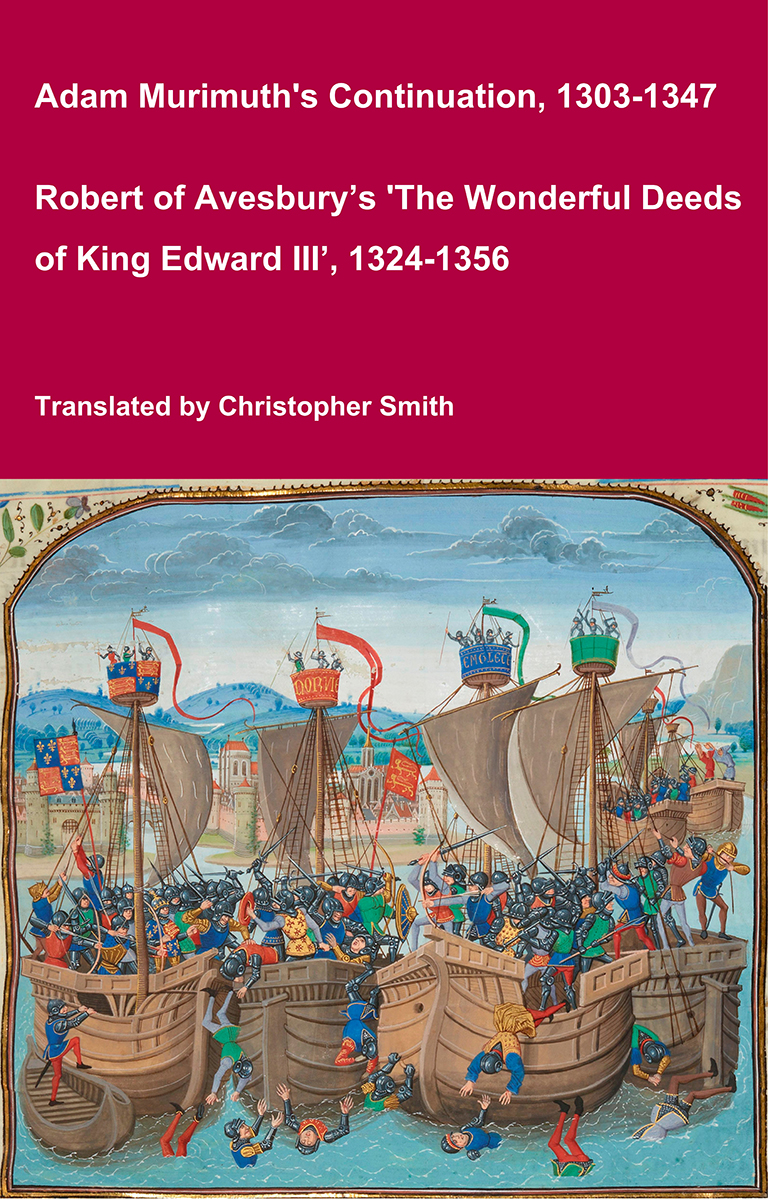 Adam Murimuth Continuation. In this [papal] year Emperor Henry died, said to have been killed by poison, in a certain castle near the city of Pisa, on the feast of the Assumption of the Blessed Mary [15th August 1313].
Hoc anno mortuus fuit Henricus imperator, veneno exstinctus, ut dicebatur, in quodam castro juxta civitatem Brixiensem, in festo Assumptionis beatæ Mariæ.
On 15th August 1316 John of Eltham 1st Earl Cornwall was born to King Edward II of England [aged 32] and Isabella of France Queen Consort England [aged 21] at Eltham Palace, Kent [Map]. Coefficient of inbreeding 2.17%.
Adam Murimuth Continuation. In the same year, out of hatred for Lord Hugh le Despenser the younger, who ruled the king entirely according to his own will and did not allow the king to be of use to anyone except himself, and who did not allow any noble of the realm to obtain an audience with the king except rarely, with Hugh himself hearing the words and giving the reply according to his own pleasure, the earls and barons of England rose in rebellion. They seized all the goods of the said Hugh and of his father and of their adherents in Wales and the March, and they ravaged them in England. The leaders of the barons were the earl of Hereford, two Rogers of Mortimer, Roger of Amory, Bartholomew de Badlesmere, Henry Tyes, Maurice de Berkeley, and many others openly. The earl of Lancaster openly consented to them, and the earl of Pembroke secretly. The said Hugh at times hid overseas and at other times at sea by arrangement of the king. Finally, in a parliament held at Westminster at the feast of the Assumption [15th August 1320], the said Hugh and his father were exiled in their absence, against the will of the king; nevertheless the king did not dare to oppose the decision. The father obeyed the sentence, but the son did not, and continued to hide at sea until the parliament was dissolved. Afterwards the king went to him and brought him by sea to Harwich, where they arranged how they might take vengeance on the barons. This happened shortly before the feast of Saint Michael [29th September].
Hoc anno, in odium domini Hugonis le Despenser, filii qui duxit regem ad nutum nec permisit regem alicui esse utilem nisi sibi, nec permisit aliquem nobilem de regno cum rege colloquium optinere nisi raro, ipsomet Hugone verba audiente et responsionem ad libitum suum dante, insurrexerunt comites et barones Angliæ, et omnia bons dicti Hugonis et patris sui ac eis adhærentium in Wallia et in marchia riflantur occuparunt et in Anglia devastarunt. Et fuerunt capitanei baronum comes Herefordiæ et duo R de Mortuo mari, Rogerus de Amory, B. de Badelesmere H. Tyes Mauricius de Berkeleye, et multi alli, manifeste; comes vero Lancastriæ consensit eis expresse, et comes de Pembroke occulte. Dictus tamen Hugo quandoque trans mare, quandoque in mari, de ordinatione regis navigio latitavit. Ac demum in Parliamento apud Westmonasterium, ad festum Assumptionis celebrato, fuerunt exulati dicti domini Hugones absentes, contra voluntatem regis; tamen contradicere non audebat. Oui sententiæ paruit pater; filius vero non, ed semper latitavit in mari, et quousque esset parliamentum solutum. Et postmodum rex ivit ad eum et duxit eum per mare ad Herewych, ubi ordinaverunt quomodo possent de baronibus vindicari. Et hoc fuit parum ante festum sancti Michaelis.
Adam Murimuth Continuation. Around the Feast of the Assumption of the Blessed Virgin Mary [15th August 1344], the king, for the benefit of his kingdom, prohibited the old florin coinage and introduced a new one: a larger florin valued at half a mark, a smaller florin worth 3 shillings 4 pence, and the smallest worth 20 pence. These coins were called 'nobles', and rightly so, because they were noble in beauty and purity.
Circa festum Assumptionis beats Marie, dominus rex ad utilitatem regni sui prohibuit antiquam monetam florenorum, et ordinavit novam, scilicet majorem florenum de dimidia marca, minorem de IIJ solidis IIIJ denariis, et minimum de XX denariis; et vocantur nobiles, et digne, quia nobiles sunt, pulchri et puri.
Abbot John Whethamstede’s Chronicle of the Abbey of St Albans
Abbot John Whethamstede's Register aka Chronicle of his second term at the Abbey of St Albans, 1451-1461, is a remarkable text that describes his first-hand experience of the beginning of the Wars of the Roses including the First and Second Battles of St Albans, 1455 and 1461, respectively, their cause, and their consequences, not least on the Abbey itself. His text also includes Loveday, Blore Heath, Northampton, the Act of Accord, Wakefield, and Towton, and ends with the Coronation of King Edward IV. In addition to the events of the Wars of the Roses, Abbot John, or his scribes who wrote the Chronicle, include details in the life of the Abbey such as charters, letters, land exchanges, visits by legates, and disputes, which provide a rich insight into the day-to-day life of the Abbey, and the challenges faced by its Abbot.
Available at Amazon in eBook and Paperback format.
 Chronicle of Jean le Bel Volume 2. When the noble King Edward had had the bridge at Poissy repaired and had crossed the river Seine with all his army, as you have heard, he clearly saw that King Philip had no wish to come and fight him, whatever signs he had shown him1. He took his road and his return towards the city of Beauvais and the Beauvaisis. As he was going, Sir Geoffrey de Harcourt, his marshal, who was riding on one side and was leading the vanguard, encountered a great many burgesses of Amiens2, both horse and foot, who were going to Paris at the king’s summons. He attacked them and defeated them, and there were a great many killed and taken prisoner, at which the king had great joy. And he went on continually from day to day, burning and ravaging all the country far and wide, just as he had done in the land of Normandy.
Quant le noble roy Edowart eut fait refaire le pont de Poissy et passé la riviere de Sayne à tout son ost, ainsy que vous avez ouy, il vit bien que le roy Philippe n'avoit talent de venir combatre à luy pour ensaignes que monstré luy eut; il prit son chemin et son retour par devers la cité de Beauvaiz et le pays de Beauvoisyn. Ainsy qu'il s’en aloit, messire Godeffroy de Harecourt, son mareschal, qui chevauchoit d’ung costé et faisoit l’avangarde, encontra grand foison de bourgoys d'Amiens, à cheval et à pyé, qui s’en aloient au mandement du roy à Parys. Il leur courut sus et les desconfit, el y eut grand foison de mors et de pris, de quoy le roy eut grand joye, et s'en ala toudis avant de jour en jour, ardant et exillant tout le pays de long en lé. Ainsy s'en aloit que alé estoit ou pays de Normendie.
Note 1. From Auteuil, on 15th August, Edward III defied the King of France. This act was published by Kervyn de Lettenhove, Froissart, from a Cambridge manuscript. We have found the original at the Record Office, Norman Rolls:
Letter sent to Philip of Valois.
Philip of Valois, We have understood the letters by which you have signified to us that you wish to fight with us and with all our power between Saint-Germain-des-Prés and Vaugirard near Paris, or between Franconville and Pontoise, this Thursday, Saturday, Sunday, or the following Tuesday, provided that we and our people do not commit damage, burning, or robbery. In response to this, we make known to you that, in reliance upon God and upon the clear right which we have to the crown of France, which you wrongfully occupy, to our disinheritance, against God and justice, we have come, not in pride nor presumption, into our kingdom of France, making our way towards you in order to bring the war to an end by battle. But you, who could thus have had the battle, had the bridges broken between us and you, so that we could neither approach nor cross the water of the Seine, until we came to Poissy. There we had the bridge repaired, which you had caused to be broken down, and there we remained three days awaiting you and the force which you had assembled. At that place you could also have come on one side or the other at your will. And because we could not have battle with you there, we resolved to pass further into our said kingdom, in order to chastise our rebels and to comfort our friends and faithful men, whom you wrongly call your subjects. We intend to remain in the said kingdom, without departing, in order to carry on our war as best we can, to our advantage and to the harm of our adversaries. Therefore, if you have the will, as your said letters set forth, to fight with us and to save those whom you call your subjects, you can now show it, for at whatever hour you come, you will find us ready in the field to meet you, with the help of God. This is what we most earnestly desire, for the common profit of Christendom, since you disdain to offer or accept any reasonable way of peace. But we are not minded to be appointed by you, nor to take from you a place or day of battle, especially on the conditions written above. Given under our great seal at Auteuil, on the fifteenth day of August.
1. D'Auteuil, le 15 août, Édouard III défia le roi de France. Cet acte a été publié par Kervyn de Lettenhove, éd. Froissart, &.IV, p. 497, d'après un ms. de Cambridge. Nous en avons retrouvé l'original au Record office (Norman Rolls, n° 639, m. 21):
Leure envoiée à Philippe de Valois.
Phelipe de Valois. Nous avons entenduz les lettres par queles vous nous avez signifié que vous veulliez combatre od nous et od tout nostre poair entre Seint Germain de Preez et Valgirat de lé Paris ou entre Fanconville et Ponthoix yce joedy, samady, dymenge ou mardi proschein ensuantz, porveu que nous et nos gentz ne faceons damage, arsons ne roberies, sur quoi vous faisons savoir que en asseurance de Dieu et du cler droit que nous avons à la coronne de France quele vous oceupez torceneusement en desheritance de nous, contre Dieu et droiture, et sumes venuz ne mie en orgoill, ne surquidance en nostre roialme de France, tenant nostre chemyn devers vous pur faire fin de la guerre par bataille; mès vous, qui poeistes ensi avoir eue la bataille, feistes briser les pountz entre nous et vous issint que nous poaismes approcher ne passer l'ewe de Seyne, tant quez nous veinsmes à Poyssy et illoeges feismes reparailler le pount que vous y aviez fait debriser, et y demorasmes trois jours attendantz vous et le poair que vous avez assemblé, à quel lieu vous poaistes aussint aver venue d'une part ou d'autre à vostre voluntée, et par cause que nous ne y poeismes avoir la bataille od vous, si preismes pourpos de passer outre en nostre dit roialme pur chastier noz rebealx et pour conforter noz amys et foialx queux vous clamez à tort voz subgetz, et si volons demorer en dit roialme sanz departir pour exploiter nostre guerre à mieltz que nous purrons en avantage de nous et grevance de noz contrairs, pur quei si vous eïez volunté, si come voz dites lettres purportent, de combatre od nous et de sauver ceux queux vous clamez ens voz subgetz, si le poez ore monstrer que quele heure que vous viegnez vous nous troverez prest en champs de vous encontrer, ove l'eide de Dieu, quele chose nous desirrons sovereinement pur commun profit de la cristieneté, puis qe vous ne dedeignez nulle resonable voie de pees tendre ne accepter; mès nous ne sumes mie avisez d'estre taillé par vous, ne de prindre de vous lieu ne jour de bataille nomément sur les condicions sus escrites. Donné souz nostre grant seal à Autés le XVe jour d'augst.
Note 2. Jean le Bel is no doubt referring to the attempt made by the men of the communes, and in particular those of Amiens, to oppose the repair of the bridge at Poissy by the English. According to the testimony of Michael de Northburgh in Deeds of King Edward III by Robert of Avesbury, it was the Earl of Northampton who drove them back: 'And in the re-making of the bridge there came men of arms in great numbers with the commons of the country and of Amiens, well armed. And the earl of Northampton and his men went out against them, so that there were slain more than five hundred of our enemies, thanks be to God; and the others were horsemen.'
2. Jean le Bel veut parler sans doute de la tentative faite par les gens des communes, et en particulier par ceux d'Amiens, pour s'opposer à la réfection du pont de Poissy par les Anglais. D'après le témoignage de Michel de Northburgh, ce serait le comte de Northampton qui les aurait repoussés. (Robert d'Avesburÿ, De gestis Edwardi tertii, éd. Thompson, p. 367.)
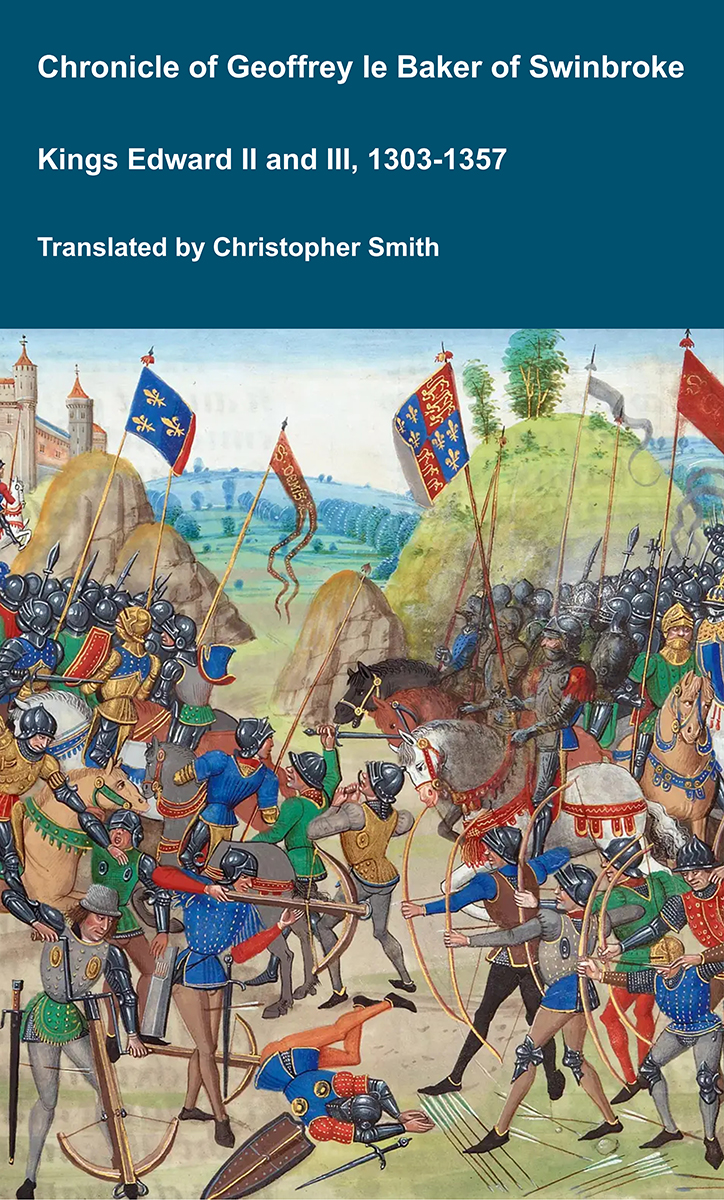 Chronicle of Geoffrey le Baker of Swinbroke. In the year of Christ 1349, the 23rd year of the king's reign, a widespread plague arising from the East, from the lands of the Indians1 and Turks, infected the central regions of the inhabited world. It ravaged the Saracens, Turks, Syrians, and Palestinians, and finally the Greeks, with such slaughter that many, driven by terror, considered it wise to receive the faith and sacraments of Christ, hearing that death had struck Christians on this side of the Greek sea neither as frequently nor as suddenly as it did among them. At last, this cruel plague rolled onward to the transalpine regions, and from there to the western lands of Gaul and the Germanic peoples, and in the seventh year after its outbreak, it reached England. First, it struck the seaports of Dorset, nearly depopulating the region, and then swept through Devon and Somerset as far as Bristol with such ferocity that the people of Gloucester refused to let those from Bristol enter their area, fearing that even the breath of the living among the dying was contagious.
Anno Christi MCCCXLIX, regni regis anno XXIIJ, ab oriente Indorum et Turcorum repens pestilencia generalis, medium nostri habitabilis inficiens, Saracenos, Turkos, Siriacos, Palestinos, et demum Grecos depopulavit tanta strage, quod terrore compulsi fidem atque sacramenta Christ! recipere consult! diiudicabant, audientes quod Christianos cis mare Grecum mors non terruit crebrius aut magis repente consueto. Tandem ad partes transalpinas et abhinc ad Gallias hesperias et Teutonicas seva clades successive devoluta, anno septimo sue incoacionis ad Angliam devenit. Primo quidem portus maris in Dorsetia et rursus patriam suis incolis fere privavit, et abhinc Devonian! ac Somersetiam usque Bristolliam ita desevit, quod Glovernienses illis de Bristollia ad suas partes denegarunt accessus, quolibet putante anelitus vivencium inter sic morientes fuisse infectivos.
Note 1. Stow Annales 384.
The Black Death, so called from the dark blotches which appeared on the skin, owing to the infiltration of the blood into the disorganized tissues, was the Levant or oriental plague. This fearful outbreak is said to have had its origin in central China, in 1333. It reached Europe in 1347, and appeared at Avignon at the beginning of 1348. Thence it spread northwards through France and Germany, and reached England in August of that year. It is said to have extended even to Iceland and Greenland. After making the circuit of Europe it visited Russia in 1351, and seems to have been finally stopped at the Caucasus. Baker's account of its progress in England has formed the chief basis of all later notices, through the medium of Stow's Annales. According to Professor Thorold Rogers, from one-third to one-half the population of the country perished. See Hecker, Epidemics of the Middle Ages (Sydenham Society), 1846; Rogers, History of Agriculture and Prices in England, 1.292; also, with regard to the extent of its ravages, see papers by Mr. Seebohm and Professor Rogers in The Fortnightly Review, 2.149, 268, 3.191; and The Black Death in East Anglia, by Dr. Jessopp, in The Nineteenth Century, 16.915, 17.599.
It will be observed that Baker dates its appearance at Bristol on the festival of the Assumption of the Virgin [15th August 1348]; its first entry into the country on the Dorsetshire coast is placed by Deeds of King Edward III by Robert of Avesbury.
According to the Eulogium Historiarum (Rolls Series), 3.213.
Baker states that London was attacked about Michaelmas; Avesbury, about All Saints. The progress of the epidemic into the Eastern counties was remarkably slow, for it does not seem to have made its mark in Norfolk until about the end of March 1349.
Vetera Monumenta Hibernorum et Scotorum DCI. Clement, etc. Unto a beloved son, a noble man, Thomas Earl of Mar [aged 22], and a beloved daughter in Christ, Margaret [aged 18], widow of the late John of Moray, of the diocese of Aberdeen, greeting. The watchful providence of the apostolic see, tempering at times the rigour of justice with kindness, with gracious benignity permits what the institutes of the sacred canons forbid, regard being had to the quality of the persons and the times, as may appear usefully expedient in the Lord. Forasmuch as your petition laid before us showed that you, son Earl, cannot readily find in all the kingdom of Scotland, whence you are sprung, any woman but thee, daughter Margaret, with whom you may marry as becomes your rank, and that you accordingly desire to be united in marriage, but because you are related in the third and fourth degrees of affinity, you cannot conveniently nor lawfully fulfil this your desire without obtaining the apostolic dispensation thereupon; wherefore you have humbly besought us that we would graciously vouchsafe to provide thercanent by a suitable dispensation: We, therefore, for these and certain other causes explained to us, yielding to these supplications, do, by apostolic authority, and by a special gift of gracz, by the tenor of these presents, dispense, that ye may, notwithstanding the impediment arising from this consanguinity, be free to contract marriage, and after it shall have been contracted, to abide lawfully therein, declaring that the offspring to be conceived of this marriage shall be legitimate. Therefore let no man whatever break this page of our dispensation, or oppose it by rash daring, but if any one presume to attempt this let him know that he will incur the wrath of Almighty God and the blessed apostles Peter and Paul. Given at Avignon, 15th August, in the eleventh year of our pontificate (1352).
Cum Thoma comite de Marre et Margareta de Moravia dispensatur super matrimonio. Rng. An. XI. Com. Iib. I. fol, 311.
Clemens episcopus etc. Dilecto filio nobili viro Tbome Comiti de Marre, et dilecte in Christo filie Margarete, relicte quondam Iobaunis de Moravia vidue, Aberdonensis diocesis, salutem etc. Sedis apostolico providentia circumspecta nonnunquam rigorem iustitie mansuetudine temperans, quod sacrorum canonum prohibent instituta, de gratia benignitatis indulget, prout personarum ct temporum qualitate pensata, id in deo (utiliter viderit expedire. Exposita siquidem nobis vestra petitio continebat), quod tu, fili ComeB, in toto regno Scotie, unde oriundus existis, aliquam mulierem, nisi te, filia Margerita, cum qua secundum tui status decentiam matrimonialiter copulari valeas, comode invenire non potes, et quod vos perinde matrimonialiter coniungi invicem affectatis: sed quia tertio et quarto affinitatis gradu vobis mutuo attinetis, huiusmodi vestrum desiderium adimplere comode (licite, dispensatione super boc apostolica non obtenta,) non potestis: quare nobis humiliter supplicastis, ut providere vobis super hoc de oportune dispensationis gratia dignaremur. Nos igitur ox hiis et aliis certis causis nobis expositis huiusmodi supplicationibus inclinati, vobiscum, ut impedimento, quod cx huiusmodi affinitate provenit, non obstante, matrimonium invicem contrahere libere et in eo, postquam contractum fuerint, remanere licite valeatis, auctoritate apostolica de speciali dono gratie tenore presentium dispensamus, prolem suscipiendam ex huiusmodi matrimonio legitimam nunciantes. Nulli ergo omnino hominum liceat hanc paginam nostre dispensationis infringere etc. Si quis autem etc. Datum Avinione xvm. Kal. Septembris Pontificatus nostri anno undecimo.
Deeds of King Edward III by Robert of Avesbury. At that time, the lord King of England ordered around forty of his large ships to be prepared on the Thames, near Rotherhithe, each provisioned with victuals for a quarter of a year. Every one of these ships bore the principal banners of Lord Henry, Duke of Lancaster, and they were fully loaded with chosen armed men and archers, but no horses were taken on board. The Duke himself commanded the entire force and had with him two of the king's sons, namely, Lord Lionel of Antwerp and John of Gaunt, the elder of whom was 16 years old. Also present were the Earls of Northampton, La Marche, and Stafford, along with many barons and knights. On the 10th of July, they set sail as far as Greenwich, and remained there and at Sandwich almost until the feast of the Assumption of the Blessed Virgin Mary [15th August 1355], because the wind remained constantly from the west or south during that entire time, so that they could not sail toward the destination they intended, which remained unknown to the common soldiers. At last, and with difficulty, the fleet came to Winchelsea, and then to the Isle of Wight.
Dicto tempore dominus rex Anglorum parari fecit in Tamisia, juxta Rutherhithe, circiter XL magnas naves suas cum victualibus pro quarterio unius anni, quarum navium singulæ habuerunt stremers principales domini Henrici, ducis Lancastriæ, et onustæ fuerunt ad plenum cum electis hominibus armatis et sagittariis, nullis equis secum assumptis; quibus omnibus idem dominus dux præfuit, et secum habuit duos filios regis, videlicet dominum Leonellum de Andwerpe et Johannem de Gaunt, quorum senior fuit XVJ anno rum, ac etiam de Northamptone, de la Marche, et de Stafforde comites ac barones et milites plures; decimoque die mensis Julii incepit navigare usque Grenewiche. Et ibidem et apud Sandwycum moram traxit fere usque festum Assumptionis beatæ Mariæ vento in occidente vel in austro per totum dictum tempus quasi continue exsistente, ita quod non potuit navigare ad partes quas volebat, latuit enim communitatem totius exercitus quo proposuit declinare. Tandem vero cum difficultate navigio venit apud Wynchelse, deinde apud insulam Vectam.
On 15th August 1369 Philippa of Hainaut Queen Consort England [aged 59] died at Windsor Castle [Map]. Her husband King Edward III of England [aged 56] and youngest son Thomas of Woodstock 1st Duke of Gloucester [aged 14] were present. She was given a state funeral six months later on 9th January 1370 at which she was interred at on the northeast side of the Chapel of St Edward the Confessor, Westminster Abbey [Map]. Her alabaster effigy was executed by sculptor Jean de Liège.
On 15th August 1393 Leopold "The Fat" Habsburg IV Duke Austria [aged 22] and Catherine Valois Duchess Austria [aged 15] were married. She the daughter of Philip "Bold" Valois II Duke Burgundy [aged 51] and Margaret Dampierre Duchess Burgundy [aged 45]. He the son of Leopold "The Just" Habsburg III Duke Austria and Viridis Visconti Duchess Austria [aged 41]. They were third cousin once removed. She a great x 3 granddaughter of King Edward I of England.
Life Charles VI by a Monk of St Denis [~1420]. Among all that was to be done, the king, with utmost diligence, intended to make the marriage of his firstborn daughter Lady Isabella [aged 6] and the King of England conspicuous and in his presence; having been prevailed upon by the king with strong prayers, he sent to him the Duke of Burgundy, his uncle, to inquire how this could be accomplished more advantageously and honourably. He, according to the custom of the firstborn, recommending his departure to blessed Denis, when he had reached Guînes, a town in Picardy, on the vigil of the Assumption of the Blessed Virgin Mary [15th August 1396], met the Counts of the Marshal and of Rutland [aged 23]; thence he encountered the prelates of the kingdom of England, and subsequently the Dukes of Lancaster [aged 56] and Gloucester [aged 41], the king's uncles, accompanied by five hundred knights and squires, who escorted him with musical instruments all the way to Calais.
Inter omnia gerenda, rex, summa sollicitudine intendens connubium filie sue primogenite domine Ysabellis et regis Anglie reddere conspicuum et in ejus presencia, ipsius regis victus vallidis precibus, ad eum ducem Burgundie patruum suum misit, ad querendum qualiter id commodius et honorificencius agi posset. Qui, primogenitorum more, recessum suum beato Dyonisio recommendans, cum Guinnas, Picardie villam, attigisset, vigilia Assumpcionis beate Marie, comites Marescalli ac Rotlandi obvios habuit, inde regni Anglie prelatos, ac successive Lencastrie et Glocestrie duces, patruos regis, quingentis militibus et armigeris stipatos, qui eum cum instrumentis musicis usque Calesium conduxerunt.
On 15th August 1402 Humphrey Stafford was born to Edmund Stafford 5th Earl Stafford [aged 24] and Anne of Gloucester Plantagenet Countess Eu and Stafford [aged 19]. He a great grandson of King Edward III of England. He married before 18th October 1424 his second cousin Anne Neville Duchess Buckingham, daughter of Ralph Neville 1st Earl of Westmoreland and Joan Beaufort Countess of Westmoreland, and had issue.
Chronicle of Gregory. 15th August 1416. Alle so that same year the Duke of Bedforde [aged 27] and the Erle of Marche [aged 24], on our Lady Day the Assumpsyon, they fought whythe viij grete carykys of Jene and whythe l. othyr shyppys, and they toke them whythe her patronys and drownyde a grette hulke of the contre of Flaundrys.
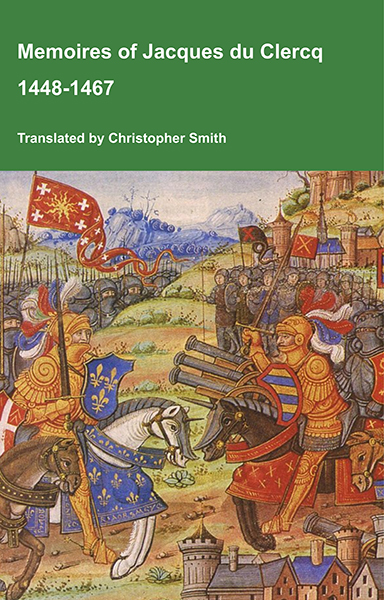 Memoires Jacques du Clercq. On the 15th day of August, in the said year fifty-eight, Philip, Duke of Burgundy, being in the city of Lille, Charles, Count of Charolais, Charles, Count of Nevers, Adolf of Cleves, and several other princes and lords mounted on horseback and went out to meet the wife of the said Charles, Count of Nevers, who was the daughter of the lord of Albret in Auvergne, and who was coming to see the duke; and they met her about a league from the city. She was escorted by Jean, Count of Étampes, brother of the Count of Nevers, who had gone to fetch her in Rethel. Of the honour that the duke showed to the said lady, and of the entertainments, fine companies, and pageants that the people of the city made at her entry, it would be a long matter to recount, so I shall be silent on it; but when she arrived in the city, she lodged at the house of the said Count of Étampes, and the duke dismounted from his horse to help her down from her palfrey, and then led her to her chamber. And throughout the whole night plays were performed before her lodging. The next day the Countess of Eu, daughter of the lord of Antoing, came into the said city, and the duke went out to meet her and brought her back to her lodging. And the following day Sir Philippe de Lallaing, knight, held a joust of seven courses of lances against all comers; and the following Saturday Adolf of Cleves jousted against all comers; and on the following Sunday Charles, son of the said duke, and Anthony, bastard of Burgundy, his brother, with twenty companions, held a tournament against twenty others, among whom were Sir Philippe St Pol, Philippe de Bourbon, the bastard of Brabant, the said Adolf of Cleves, and several other great lords. During that time they held banquets and feasts as rich as could be imagined: one given by the duke, another by Adolf, and then one by the townspeople, where there were ladies, damsels, and women of the town; and thus the said lady was entertained for ten days. And on the 11th day the said Lady of Nevers departed from the city to go to Enghien, where the Countess of Étampes, her sister-in-law, was; and the duke and the said Adolf accompanied her, six in all, armed in white, each with his lance behind him. And as they escorted her, about a quarter of a league from the city, at a small bridge, there came to meet the said ladies Charles, Count of Charolais, son of the said duke, and Sir Anthony, the duke's bastard, with four others, six in all, armed in full armour. They came to the bridge and asked Adolf who he was and where he was taking the ladies. He replied that it was none of their concern and that they should let them pass, for they sought nothing. Then the said Charles, Count of Charolais, and his men lowered their lances, and Adolf did likewise, and they charged one another and each broke his lance; then they took up their swords, which were rebated and blunted, and there, as in a tournament, struck each other until each yielded. When each had yielded, they removed their helmets and came to the ladies, and led them to a very fine house near the bridge, belonging to Master Betremy de la Truye, formerly master of the duke's chamber of accounts, where the said Count of Charolais had prepared a very rich meal; and after eating they sang and danced. After all this, the ladies remounted their horses, and there the duke took leave of them and returned to Lille, while the ladies, the Count of Nevers, and the Count of Étampes went on to Enghien.
Le quinziesme d'aoust, audit an cinquante huict, Philippe, duc de Bourgogne, estant en la ville de Lille, Charles, comte de Charollois, Charles, comte de Nevers, Adolf de Clefves, et plusieurs aultres princes et sieurs monterent à cheval et allerent allencontre de la femme dudit Charles, comte de Nevers, laquelle estoit fille du S de Labret, en Auvergne, et laquelle venoit veoir le duc, et la rencontrerent environ une lieue près de la ville. Le amenoit Jehan, comte d'Estampes, frere du comte de Nevers, lequel l'estoit allé querir en Retelois. De l'honneur que le duc feit a ladite dame, et des esbatements, belles compagnies et misteres que ceulx de la ville feirent a l'entrée de ladite dame, longue chose seroit a racompter, sy m'en tairay; mais elle venue en ladite ville, descendit a l'hostel dudit comte d'Estampes, et descendit le duc de son cheval pour la mectre jus de sa hacquenée; sur quoy elle seoit, et puis la mena en sa chambre, et durant toute la nuict on joua jeus de personnages devant son hostel; et le lendemain vint en ladite ville la comtesse d'Eu, fille du S d'Antoing, allencontre de laquelle le duc alla et la ramena jusques en son hostel; et le lendemain messire Philippe de Lallaing, chevallier, feit une jouste de sept courses de lanches contre touts venants; et le samedy ensuivant Adolf de Clefves jousta contre touts venants; et le dimanche ensuivant Charles, fils dudit duc Anthoine, bastard de Bourgogne, son frere, eulx vingt, tournoyerent contre aultres vingt, lesquels estoient messire Philippe Pol, et Philippe de Bourbon, le bastard de Brembant, ledit Adolf de Clefves et plusieurs aultres grands sieurs; et ce temps durant feirent banquet et mangers les plus riches que l'on pourroit dire, et en feit ung ledit duc, ledit Adolf, et puis en feirent ung ceulx de la ville, ou estoient dames, damoiselles et bourgeoises de la ville, et ainsy fust ladite dame festoyée dix jours durant; et le xje jour ladite dame de Nevers se partist de ladite ville, pour aller a Englemoustier, ou estoit la comtesse d'Estampes, sa belle soeur, et la convoya le duc et ledit Adolf avecq lui, lui vje armé au blanc, chacun ayant sa lanche derriere; et comme ils la convoyoient, environ ung quart de lieue près ladite ville, a ung ponchelet, vindrent a l'encontre desdites dames Charles, comte de Charollois, fils dudit duc, et messire Anthoine, bastard dudit duc, eulx sixiesmes armés tout au clair, lesquels vindrent audit ponchelet, demanderent audit Adolf, qui il estoit, et ou il menoit ces dames; lequel leur respondit qu'il ne leur chaussit, et qu'ils les laissassent passer leur chemin, car ils ne demandoient riens; lors ledit Charles, comte de Charollois, lui et ses gens avallerent leurs lanches, et ledit Adolf pareillement, et se ferirent ensemble, et rompit chacun sa lanche puis saisirent leurs espées, lesquelles estoient rabattues et tournantes, et illecq comme en ung tournois battirent tant l'ung l'aultre, que chacun se recrandist; et quant chacun fust recrand, ils osterent leurs heaulmes, et vindrent aulx dames, et les meirent en ung très bel hostel assés près dudit pont, qui estoit au frere maitre Betremy, a le Truye, jadis maitre de la chambre des comptes dudit duc, auquel lieu ledit comte de Charollois avoit fait appointer ung moult riche mangier, et après mangier chanterent et danserent, et après tout ce, les dames remonterent a cheval, et illecq print congié le duc aulx dames, et s'en retourna a Lille, et les dames et ledit comte de Nevers, et comte d'Estampes a Englemoustier.
On 15th August 1461 King Louis XI of France [aged 38] was crowned XI King France: Capet Valois.
Memoires Jacques du Clercq. And the next day, the Feast of the Assumption of Our Lady the glorious Virgin Mary [15th August 1461], the said Louis was consecrated and crowned King of France by the Archbishop of Reims, in the cathedral church of Notre-Dame of Reims, in the presence of the peers of France, or their representatives. And because the Duke of Burgundy was a peer in two capacities, he had his nephew, the Duke of Cleves, dressed and appointed as a peer representing him. And when King Louis was dressed and ready to be consecrated, he drew his sword and gave it to the Duke of Burgundy, asking him to give him the accolade and make him a knight, which was something no king had ever done before. For it is held that all the kings of France are knights from the baptismal font. At this request, the duke complied and made him a knight. After he himself had been made a knight, he created five or six knights, namely: the Lord of Beaujeu and Jacques his brother, sons of the late Duke of Bourbon; the two sons of the Lord of Croy; and Master Jean Bareau, treasurer of France. Then he said to the Duke of Burgundy that he was very tired from the labour he had endured, and asked that the duke make the other knights who requested it. The duke agreed and created many with his own hand; and when he too became weary, he appointed certain lords and knights to continue, who made many more. Thus, on that day, many were made knights, both by the hand of the said duke and by others.
Et le lendemain jour de l'Assomption de Notre Dame la glorieuse Vierge Marie, par l'archevesque de Raims, en l'eglise cathedrale de Notre Dame de Raims, fut sacré et courronné roy de Franche, ledit Loys, presens les pairs de Franche, ou personne de par eulx, et feit le duc de Bourgogne, pourtant qu'il estoit pair deux fois, habillier comme pair representant saper sonne, son nepveu le duc de Clefves; et comme ledit roy Loys fust habillié et prest pour estre sacré, il tira l'espée et la baillia au duc de Bourgogne, en lui priant qu'il lui donnat l'ascollée et le feit chevallier, et feit ce que oncques mais roy n'avoit fait; car on maintient que touts les enfants de Franche sont chevalliers sur les fons; a laquelle prière et requete le duc obeit et le feit chevallier. Apres ce qu'il fust chevallier, il feit cinq ou six chevalliers; c'est a sçavoir, le. S de Beaujeu et Jacques, son frere, enfans du duc de Bourbon, dernier mort; les deux fils du S de Croy et maitre Jehan Bareau, thresorier de Franche; puis dit au duc de Bourgogne, qu'il estoit tout las pour le traveil qu'il avoit eu, et qu'il feit les aultres chevalliers qui le requeroient; a quoy ledit duc obeit, et en feit plusieurs de sa main; et quant il fut tammé et las, sy commist aulcuns sieurs chevalliers pour les faire, lesquels en feirent plusieurs; c'est a sçavoir, et furent chevalliers, celuy jour, tant par la main dudit duc que d'aultres:
Memoires Jacques du Clercq. On the 15th day of August in the said year 1464, Pope Pious II passed away. It was said that at the hour of his death, around Rome and elsewhere, vineyards, trees, and other produce of the land were struck down by violent storms and lightning. It was also said that he died in a troubled manner and in great peril for his soul, and people spoke of it unfavourably. Indeed, to tell the truth, in the time of Pope Pius and even before, everything was in very poor order within the Church. Benefices were granted at the request of princes and lords or through the force of money, and a single cardinal or bishop held several benefices. Cardinals in particular held in commendam twenty or thirty bishoprics, abbeys, and conventual priories, and no prelate was elected by chapters or convents. Many sons of princes were made archbishops or bishops without even being priests, and likewise held abbeys in commendam. At that time, most churchmen, from the greatest to the least, including mendicant friars and others, were so given over to pride, lust, and greed that it would be impossible to describe it fully. In this, secular people exceeded all bounds as well. After the death of Pope Pius, Paul II became pope.
LE XVe jour d'aoust, l'an dessusdit mil iiije lxiiij, cloist son dernier jour le pape Pius, et disoit on, que a l'heure de sa mort, autour de Rome et ailleurs, les vignes, les arbres et aultres biens de terre feurent fouldroyés par tempeste d'orage, et mourut icelluy pape, comme on disoit, de mort diverse et en grand dangier pour son ame, et en parloit on en mauvaise maniere; et aussy au vray dire, au temps dudit pape Pius et devant, tout alloit très mal en l'Eglise, car les benefices estoient donnés a la requette des princes et sieurs ou par forche d'argent, et avoit ung cardinal ou ung evesque plusieurs benefices; par especial les cardinaulx tenoient en commanderie vingt ou trente que evesquiés, que abbayes, que priorés conventueulx, et n'y avoit nul preslat eleu par les colleges ou couvents; plusieurs fils de prince on faisoit archevesques ou evesques sans estre prestres, et tenoient abbayes en commanderie, et en ce temps le plus de gens d'eglise, les grands jusques aux moindres mendians et aultres, estoient sy abbandonnés et oultrageulx en orgueil, luxure et convoitise, qu'on ne polroit plus dire. En ce passoient oultre mesure toutes gens seculiers. Après la mort du pape Pius, fust pape Paulus second.
Around 15th August 1469 King Edward IV of England [aged 27] was imprisoned at Middleham Castle [Map].
On 15th August 1485 King Richard [aged 32] was at Bestwood. King Richard spent a few days of August 1485 at the royal hunting lodge at Bestwood, (then known as Beskwood) in Nottingham. The news of Henry Tudor's invasion was brought to the King while he was there.
Croyland Chronicle 1485. [15th August 1485]. A battle of the greatest severity now ensuing between the two sides, the earl of Richmond, together with his knights, made straight for king Richard: while the earl of Oxford, who was next in rank to him in the whole army and a most valiant soldier, drew up his forces, consisting of a large body of French and English troops, opposite the wing in which the duke of Norfolk had taken up his position. In the part where the earl of Northumberland was posted, with a large and wellprovided body of troops, there was no opposition made, as not a blow was given or received during the battle. At length a glorious victory was granted by heaven to the said earl of Richmond, now sole king, together with the crown, of exceeding value, which king Richard had previously worn on his head. For while fighting, and not in the act of flight, the said king Richard was pierced with numerous deadly wounds, and fell in the field like a brave and most valiant prince; upon which, the duke of Norfolk, before-mentioned, Sir Richard Ratclyffe, Sir Robert Brackenbury, keeper of the Tower of London, John Kendall, secretary, Sir Robert Percy, controller of the king's household, and Walter Devereux, lord Ferrers, as well as many others, chiefly from the north, in whom king Richard put the greatest confidence, took to flight without engaging; and there was left no part of the opposing army of sufficient importance or ability for the glorious conqueror Henry the Seventh to engage, and so add to his experience in battle, won.

Anne Boleyn. Her Life as told by Lancelot de Carle's 1536 Letter.
In 1536, two weeks after the execution of Anne Boleyn, her brother George and four others, Lancelot du Carle, wrote an extraordinary letter that described Anne's life, and her trial and execution, to which he was a witness. This book presents a new translation of that letter, with additional material from other contemporary sources such as Letters, Hall's and Wriothesley's Chronicles, the pamphlets of Wynkyn the Worde, the Memorial of George Constantyne, the Portuguese Letter and the Baga de Secrets, all of which are provided in Appendices.
Available at Amazon in eBook and Paperback format.
Historia Regis Henrici Septimi by Bernado Andrea. [15th August 1485] This battle, although I have learned of it by hearsay, nevertheless Bosworth, in this matter, has the eye as a surer judge than the ear. Therefore the day, the place, and the order of the battle, because, as I have said, I am deprived of the light of the eyes in this matter, lest I affirm anything rashly, I pass over. And for so martial a field, until I shall have been more fully instructed, I likewise leave this broad field blank upon the page.
Hoc ego bellum quamvis auribus acceperim, tamen Bosworth. hac in parte certior aure arbiter est oculus. Diem, igitur, locum, ac belli ordinem, quia ut dixi sum privatus hac luce oculorum, ne quid temerarie affirmem, supersedeo. Et pro tam bellico campo, donec plenius instructus fuero, campum quoque latum hoc in albo relinquo.
Chronicles of London Vitellius A XVI. [15th August 1485] And after the ffeeld doon, the said Kyng Richard was caried vpon an hors behynd a man all naked to Leyciter, fast by the ffeeld; and there buryed wt in the ffreres [Map].
On 15th August 1496 Isabella Aviz Queen Consort Castile [aged 68] died.
The Love Letters of Henry VIII to Anne Boleyn. Letter 15. Henry VIII [aged 37] to Anne Boleyn [aged 27].
Darling, Though I have scant leisure, yet, remembering my promise, I thought it convenient to certify you briefly in what case our affairs stand. As touching a lodging for you, we have got one by my lord cardinal's means, the like whereof could not have been found hereabouts for all causes, as this bearer shall more show you. As touching our affairs, I assure you there can be no more done, nor more diligence used, nor all manner of dangers better both foreseen and provided for, so that I trust it shall be hereafter to both our comforts, the specialities whereof were both too long to be written, and hardly by messenger to be declared. Wherefore, till you repair hither, I keep something in store, trusting it shall not be long to; for I have caused my lord, your father, to make his provisions with speed; and thus for lack of time, darling, I make an end of my letter, written with the hand of him which I would were yours.
H.R.
Note. The date of this letter is presumed to be middle August 1528.


Henry Machyn's Diary. 15th August 1555. The xv day of August was a grett ffett on the see [fight on the sea] be-twyn the Frencmen and the Flemmyng, and ther wher dyvers of boyth partes slene, and boyth men and shypes and dyvers taken, and the goodes.
On 15th August 1557 Bishop Thomas Watson [aged 42] was consecrated Bishop of Lincoln by Archbishop Nicholas Heath [aged 56].
Henry Machyn's Diary. 15th August 1559. The xv day of August the Quen('s) [aged 25] grace returned from Hamtun cowrte [Map] unto ( ... ) my lord [admiral's] [aged 49] place; and ther her had grett cher, for my lord [admiral] byldyd a goodly banketthowsse [banquet house] for her grace; [it was] gyldyd rychely and pentyd, for he kept a gret [many] of penters [painters] a grett wylle in the contrey.


On 15th August 1575 Diego Prince of Asturias was born to Philip "The Prudent" II King Spain [aged 48] and Anna of Austria Queen Consort Spain [aged 25]. Coefficient of inbreeding 21.27%. He died aged seven in 1582.


On 15th August 1591 Queen Elizabeth I of England and Ireland [aged 57] arrived at Cowdray House [Map] the home of Anthony Browne 1st Viscount Montagu [aged 62] and Magdalen Dacre Viscountess Montague [aged 53]. She was welcomed by a breakfast for some 300 guests. George Browne [aged 36] was knighted. Henry Browne organised the hunting. Elizabeth stayed until the 21 Aug 1591.

On 15th August 1604 and 16th August 1604 Prince Charles [aged 3] and Alexander Seton [aged 49] lodged at the Leicester townhouse of William Skipwith [aged 40] on their way to London.


On 15th August 1621 Maria Margaret Habsburg Spain died.
On 15th August 1642 Henry Bourchier 5th Earl Bath [aged 55] rejected a summons from the House of Lords which required his attendance at Parliament. On 23rd August 1642 his arrest was ordered. On 28th September 1642 he was arrested at Tawstock Court, Devon and imprisoned at the Tower of London [Map].
Jean de Waurin's Chronicle of England Volume 6 Books 3-6: The Wars of the Roses
Jean de Waurin was a French Chronicler, from the Artois region, who was born around 1400, and died around 1474. Waurin’s Chronicle of England, Volume 6, covering the period 1450 to 1471, from which we have selected and translated Chapters relating to the Wars of the Roses, provides a vivid, original, contemporary description of key events some of which he witnessed first-hand, some of which he was told by the key people involved with whom Waurin had a personal relationship.
Available at Amazon in eBook and Paperback format.
John Evelyn's Diary. 15th August 1654. We passed next through Sherwood Forest, accounted the most extensive in England. Then, Paplewick, an incomparable vista with the pretty castle near it. Thence, we saw Newstead Abbey [Map], belonging to the Lord Byron [aged 48], situated much like Fontainebleau in France, capable of being made a noble seat, accommodated as it is with brave woods and streams; it has yet remaining the front of a glorious abbey church. Next, by Mansfield town; then Welbeck [Map], the house of the Marquis of Newcastle [aged 61], seated in a bottom in a park, and environed with woods, a noble yet melancholy seat. The palace is a handsome and stately building. Next to Worksop Abbey [Map], almost demolished; the church has a double flat tower entire, and a pretty gate. The manor belongs to the Earl of Arundel [aged 27], and has to it a fair house at the foot of a hill in a park that affords a delicate prospect. Tickel, a town and castle, has a very noble prospect. All these in Nottinghamshire.
Samuel Pepys' Diary. 15th August 1661. Thence to the Opera, which begins again to-day with "The Witts", never acted yet with scenes; and the King and Duke [aged 27] and Duchess [aged 24] were there (who dined to-day with Sir H. Finch [aged 39], reader at the Temple [Map], in great state); and indeed it is a most excellent play, and admirable scenes. So home and was overtaken by Sir W. Pen [aged 40] in his coach, who has been this afternoon with my Lady Batten, &c., at the Theatre [Map].


John Evelyn's Diary. 15th August 1662. Came my Lord Chancellor (the Earl of Clarendon) [aged 53] and his lady [aged 45], his purse and mace borne before him, to visit me. They were likewise collationed with us, and were very merry. They had all been our old acquaintance in exile, and indeed this great person had ever been my friend. His son, Lord Cornbury, was here, too.


Samuel Pepys' Diary. 15th August 1665. Up by 4 o'clock and walked to Greenwich, Kent [Map], where called at Captain Cocke's [aged 48] and to his chamber, he being in bed, where something put my last night's dream into my head, which I think is the best that ever was dreamt, which was that I had my Baroness Castlemayne [aged 24] in my armes and was admitted to use all the dalliance I desired with her, and then dreamt that this could not be awake, but that it was only a dream; but that since it was a dream, and that I took so much real pleasure in it, what a happy thing it would be if when we are in our graves (as Shakespeere resembles it) we could dream, and dream but such dreams as this, that then we should not need to be so fearful of death, as we are this plague time. Here I hear that news is brought Sir G. Carteret [aged 55] that my Lord Hinchingbrooke is not well, and so cannot meet us at Cranborne to-night. So I to Sir G. Carteret's; and there was sorry with him for our disappointment. So we have put off our meeting there till Saturday next. Here I staid talking with Sir G. Carteret, he being mighty free with me in his business, and among other things hath ordered Rider and Mr. Cutler to put into my hands copper to the value of £5,000 (which Sir G. Carteret's share it seems come to in it), which is to raise part of the money he is to layout for a purchase for my Lady Jemimah.


John Evelyn's Diary. 15th August 1665. There perished this week 5,000. See Great Plague of London.
Samuel Pepys' Diary. 15th August 1665. Thence he and I to Sir J. Minnes's [aged 66] by invitation, where Sir W. Batten [aged 64] and my Lady, and my Lord Bruncker [aged 45], and all of us dined upon a venison pasty and other good meat, but nothing well dressed. But my pleasure lay in getting some bills signed by Sir G. Carteret [aged 55], and promise of present payment from Mr. Fenn, which do rejoice my heart, it being one of the heaviest things I had upon me, that so much of the little I have should lie (viz. near £1000) in the King's hands. Here very merry and (Sir G. Carteret being gone presently after dinner) to Captain Cocke's [aged 48], and there merry, and so broke up and I by water to the Duke of Albemarle [aged 56], with whom I spoke a great deale in private, they being designed to send a fleete of ships privately to the Streights. No news yet from our fleete, which is much wondered at, but the Duke says for certain guns have been heard to the northward very much. It was dark before I could get home, and so land at Church-yard stairs, where, to my great trouble, I met a dead corps of the plague, in the narrow ally just bringing down a little pair of stairs. But I thank God I was not much disturbed at it. However, I shall beware of being late abroad again.


Samuel Pepys' Diary. 15th August 1666. Mighty sleepy; slept till past eight of the clock, and was called up by a letter from Sir W. Coventry [aged 38], which, among other things, tells me how we have burned one hundred and sixty ships of the enemy within the Fly1. I up, and with all possible haste, and in pain for fear of coming late, it being our day of attending the Duke of Yorke [aged 32], to St. James's, where they are full of the particulars; how they are generally good merchant ships, some of them laden and supposed rich ships. We spent five fire-ships upon them. We landed on the Schelling (Sir Philip Howard [aged 35] with some men, and Holmes [aged 44], I think; with others, about 1000 in all), and burned a town; and so come away.
Note 1. On the 8th August the Duke of Albemarle [aged 57] reported to Lord Arlington [aged 48] that he had "sent 1000 good men under Sir R. Holmes and Sir William Jennings to destroy the islands of Vlie and Schelling". On the 10th James Hayes wrote to Williamson: "On the 9th at noon smoke was seen rising from several places in the island of Vlie, and the 10th brought news that Sir Robert had burned in the enemy's harbour 160 outward bound valuable merchant men and three men-of-war, and taken a little pleasure boat and eight guns in four hours. The loss is computed at a million sterling, and will make great confusion when the people see themselves in the power of the English at their very doors. Sir Robert then landed his forces, and is burning the houses in Vlie and Schelling as bonfires for his good success at sea" (Calendar of State Papers, 1666-67, pp. 21,27).


Samuel Pepys' Diary. 15th August 1666. By and by the Duke of Yorke [aged 32] with his books showed us the very place and manner, and that it was not our design or expectation to have done this, but only to have landed on the Fly, and burned some of their store; but being come in, we spied those ships, and with our long boats, one by one, fired them, our ships running all aground, it being so shoal water. We were led to this by, it seems, a renegado captain of the Hollanders, who found himself ill used by De Ruyter [aged 59] for his good service, and so come over to us, and hath done us good service; so that now we trust him, and he himself did go on this expedition. The service is very great, and our joys as great for it. All this will make the Duke of Albemarle [aged 57] in repute again, I doubt, though there is nothing of his in this. But, Lord! to see what successe do, whether with or without reason, and making a man seem wise, notwithstanding never so late demonstration of the profoundest folly in the world.

John Evelyn's Diary. 15th August 1673. Came to visit me my Lord Chancellor, the Earl of Shaftesbury [aged 52].


John Evelyn's Diary. 15th August 1676. Came to dine with me my Lord Halifax [aged 42], Sir Thomas Meeres [aged 42], one of the Commissioners of the Admiralty, Sir John Clayton, Mr. Slingsby [aged 55], Mr. Henshaw [aged 58], and Mr. Bridgeman.
John Evelyn's Diary. 15th August 1685. Came to visite us Mr. Boscawen [aged 57] with my Lord Godolphin's [aged 40] little son [aged 6], with whose education hither his father had intrusted me.


John Evelyn's Diary. 15th August 1687. I went to visit Lord Clarendon at Swallowfield, where was my Lord Cornbury [aged 25] just arrived from Denmark, whither he had accompanied the Prince of Denmark [aged 34] two months before, and now come back. The miserable tyranny under which that nation lives, he related to us; the King keeps them under an army of 40,000 men, all Germans, he not daring to trust his own subjects. Notwithstanding this, the Danes are exceedingly proud, the country very poor and miserable.


Annals of the six Kings of England by Nicholas Trivet
Translation of the Annals of the Six Kings of England by that traces the rise and rule of the Angevin aka Plantagenet dynasty from the mid-12th to early 14th century. Written by the Dominican scholar Nicholas Trivet, the work offers a vivid account of English history from the reign of King Stephen through to the death of King Edward I, blending political narrative with moral reflection. Covering the reigns of six monarchs—from Stephen to Edward I—the chronicle explores royal authority, rebellion, war, and the shifting balance between crown, church, and nobility. Trivet provides detailed insight into defining moments such as baronial conflicts, Anglo-French rivalry, and the consolidation of royal power under Edward I, whose reign he describes with particular immediacy. The Annals combines careful year-by-year reporting with thoughtful interpretation, presenting history not merely as a sequence of events but as a moral and political lesson. Ideal for readers interested in medieval history, kingship, and the origins of the English state, this chronicle remains a valuable and accessible window into the turbulent world of the Plantagenet kings.
Available at Amazon in eBook and Paperback format.

John Evelyn's Diary. 15th August 1688. I went to Althorpe [Map], in Northamptonshire, seventy miles. A coach and four horses took up me and my son at Whitehall, and carried us to Dunstable [Map], where we arrived and dined at noon, and from thence another coach and six horses carried us to Althorpe [Map], four miles beyond Northampton, where we arrived by seven o'clock that evening. Both these coaches were hired for me by that noble Countess of Sunderland [aged 42], who invited me to her house at Althorpe, where she entertained me and my son with very extraordinary kindness; I stayed till the Thursday.
On 15th August 1689 Sophie Charlotte Oldenburg was born to Frederick Louis Oldenburg I Duke Schleswig-Holstein-Sonderburg-Beck [aged 36] and Louise Charlotte Oldenburg Duchess Schleswig-Holstein-Sonderburg-Beck [aged 31]. Coefficient of inbreeding 7.82%. She died aged four in 1693.
John Evelyn's Diary. 3rd August 1690. The French landed some soldiers at Teignmouth [Map], in Devon, and burned some poor houses. The French fleet still hovering about the western coast, and we having 300 sail of rich merchant-ships in the bay of Plymouth [Map], our fleet began to move toward them, under three admirals. The country in the west all on their guard. A very extraordinary fine season; but on the 12th was a very great storm of thunder and lightning, and on the 15th the season much changed to wet and cold. The militia and trained bands, horse and foot, which were up through England, were dismissed. The French King having news that King William [aged 39] was slain, and his army defeated in Ireland, caused such a triumph at Paris, and all over France, as was never heard of; when, in the midst of it, the unhappy King James [aged 56] being vanquished, by a speedy flight and escape, himself brought the news of his own defeat.


On or before 15th August 1690 Charles Tuke 2nd Baronet [aged 19] died of wound received at the Battle of the Boyne fighting for King James II of England Scotland and Ireland [aged 56]. Baronet Tuke of Cressing Temple extinct.
John Evelyn's Diary. 15th August 1690. I was desired to be one of the bail of the Earl of Clarendon, for his release from the Tower [Map], with divers noblemen. The Bishop of St. Asaph [aged 62] expounds his prophecies to me and Mr. Pepys [aged 57], etc. The troops from Blackheath [Map] march to Portsmouth [Map]. That sweet and hopeful youth, Sir Charles Tuke [aged 19], died of the wounds he received in the fight of the Boyne, to the great sorrow of all his friends, being (I think) the last male of that family, to which my wife [aged 55] is related. A more virtuous young gentleman I never knew; he was learned for his age, having had the advantage of the choicest breeding abroad, both as to arts and arms; he had traveled much, but was so unhappy as to fall in the side of his unfortunate King [aged 56].


John Evelyn's Diary. 15th August 1690. The unseasonable and most tempestuous weather happening, the naval expedition is hindered, and the extremity of wet causes the Siege of Limerick to be raised, King William [aged 39] returned to England. Lord Sidney [aged 41] left Governor of what is conquered in Ireland, which is near three parts [in four].
On 15th August 1718 Magdalena Sibylle Saxe Coburg Altenburg was born to Frederick Saxe Coburg Altenburg II Duke Saxe Gotha Altenburg [aged 42] and Magdalena Augusta Anhalt-Zerbst Duchess Saxe Gotha Altenburg at Gotha. She died aged less than one years old.
In 15th August 1776 John Damer [aged 32] shot himself at the Bedford Arms Covent Garden being heavily in debt.
On 15th August 1790 Mary Lennox was born to Charles Lennox 4th Duke Richmond [aged 25] and Charlotte Gordon Duchess Richmond [aged 21]. She a great x 3 granddaughter of King Charles II of England Scotland and Ireland. She married 11th March 1820 her half fourth cousin once removed Charles Augustus Fitzroy and had issue.

On 15th August 1802 George Legge 3rd Earl Dartmouth [aged 46] was appointed Lord Steward of the Household.

On 15th August 1802 Aubrey Beauclerk 6th Duke St Albans [aged 36] and Louisa Grace Manners Duchess St Albans [aged 25] were married. She by marriage Duchess St Albans. She the daughter of John Manners and Louisa Tollemache 7th Countess Dysart [aged 57]. He the son of Aubrey Beauclerk 5th Duke St Albans and Catherine Ponsonby Duchess St Albans. They were half third cousins. He a great x 2 grandson of King Charles II of England Scotland and Ireland.
1911 Encyclopædia Britannica. After doing his best to set things going comfortably between Byron and Hunt, Shelley [aged 29] returned on board with Williams on the 8th of July. It was a day of dark, louring, stifling heat. Trelawny took leave of his two friends, and about half-past six in the evening found himself startled from a doze by a frightful turmoil of storm. The "Don Juan" had by this time made Via Reggio; she was not to be seen, though other vessels which had sailed about the same time were still discernible. Shelley, Williams, and their only companion, a sailor-boy, perished in the squall. The exact nature of the catastrophe was from the first regarded as somewhat disputable. The condition of the "Don Juan" when recovered did not favour any assumption that she had capsized in a heavy sea - rather that she had been run down by some other vessel, a felucca or fishing-smack. In the absence of any counter evidence this would be supposed to have occurred by accident; but a rumour, not strictly verified and certainly not refuted, exists that an aged Italian seaman on his deathbed confessed that he had been one of the crew of the fatal felucca, and that the collision was intentional, as the men had plotted to steal a sum of money supposed to be on the "Don Juan," in charge of Lord Byron. In fact there was a moderate sum there, but Byron had neither embarked nor intended to embark. This may perhaps be the true account of the tragedy; at any rate Trelawny, the best possible authority on the subject, accepted it as true. He it was who laboriously tracked out the shore washed corpses of Williams and Shelley, and who undertook the burning of them, after the ancient Greek fashion, on the shore near Via Reggio, on the 15th and 16th of August. The great poet's ashes were then collected, and buried in the new Protestant cemetery in Rome. He was, at the date of his untimely death, within a month of completing the thirtieth year of his age – a surprising example of rich poetic achievement for so young a man.


On 15th August 1824 Louis II Grand Duke of Baden was born to Leopold Grand Duke of Baden [aged 33] and Princess Sophie of Sweden [aged 23]. He a great x 3 grandson of King George II of Great Britain and Ireland.


Abbot John Whethamstede’s Chronicle of the Abbey of St Albans
Abbot John Whethamstede's Register aka Chronicle of his second term at the Abbey of St Albans, 1451-1461, is a remarkable text that describes his first-hand experience of the beginning of the Wars of the Roses including the First and Second Battles of St Albans, 1455 and 1461, respectively, their cause, and their consequences, not least on the Abbey itself. His text also includes Loveday, Blore Heath, Northampton, the Act of Accord, Wakefield, and Towton, and ends with the Coronation of King Edward IV. In addition to the events of the Wars of the Roses, Abbot John, or his scribes who wrote the Chronicle, include details in the life of the Abbey such as charters, letters, land exchanges, visits by legates, and disputes, which provide a rich insight into the day-to-day life of the Abbey, and the challenges faced by its Abbot.
Available at Amazon in eBook and Paperback format.
On 15th August 1835 George V King Hanover [aged 16] was appointed 675th Knight of the Garter by King William IV of the United Kingdom [aged 69].
On 15th August 1845 Walter Crane was born to Thomas Crane [aged 37] and Marie Kearsley in Liverpool, Lancashire [Map] at Maryland Street, Liverpool [Map]. Her father was a "maltster," a prosperous man in a good position in Chester. His mother seems to have died early, and her father married a second time. He married 6th September 1871 Mary Frances Andrews and had issue.


Thomas Bateman 1846. On the 15th of August 1846, another barrow [Bole Hill Barrow [Map]], on higher ground, a little farther on the opposite side of the road to Buxton, was opened. Its diameter is greater than that of the last, but, like it, is surrounded by a circle of very large stones. In the centre was an erection of very large flat stones, regularly walled in courses, and having for its base a piece of rock four feet by five, and one foot thick, approaching to a ton weight, so that if the earthy part of this barrow had been carefully removed so as to leave these stones undisturbed, there would, according to the old school of antiquarianism, have been a complete druidical circle, with a cromlech or altar for human sacrifices standing in the centre; more particularly, as the flat stone at the top of the central pile had a considerable inclination towards one side, which peculiarity in similar structures has been gravely accounted for as an intentional provision to carry off the blood of the unfortunate victims now and then sacrificed by the Druids. But to return to the funereal discoveries made in this barrow; on removing the aforesaid large stone, a few pieces of an unusually coarse urn, some calcined human bones, and the remains of a host of rats, with here and there a skull of the weasel, appeared; though level with the surrounding field, the earth under the stone was loose, and had been removed to form a cist, 'which had for its floor a level surface of rock, some three feet below the natural soil, and which was neatly walled round with flat stones; in this grave was a skeleton of large dimensions, lying on its left side, in a contracted posture; behind the head was a brass dagger of the usual type, measuring six inches and a quarter in length, and in the highest preservation; it has the appearance of having been silvered, and still retains a brilliant polish; when deposited it had been inclosed in a wooden sheath, the remains of which were very perceptible at the time of its discovery. Near it were two instruments of flint, and two more were found during the progress of the examination of the tumulus.
Ten Years' Digging. On the 15th of August we examined the site of a large barrow, near the last, 25 yards across, the circle being yet well defined from the foundation of the mound consisting of very large stones round the verge. The interior had been completely destroyed, about 6 inches only of factitious earth remaining, which, near the centre was mixed with an enormous quantity of rats' bones.
On 15th August 1855 Edward Seymour 11th Duke of Somerset [aged 80] died at Somerset House 40 Park Lane. He was buried at Kensal Green Cemetery [Map]. His son Edward [aged 50] succeeded 12th Duke Somerset, 10th Baronet Seymour of Berry Pomeroy. Jane Georgiana Sheridan Duchess Somerset [aged 45] by marriage Duchess Somerset.
On 15th August 1862 Alice Maude Olivia Montagu Countess Derby was born to William Drogo Montagu 7th Duke Manchester [aged 38] and Louisa Vonalten Duchess Devonshire and Manchester [aged 30]. She married 5th January 1889 Edward George Villiers Stanley 17th Earl of Derby, son of Frederick Arthur Stanley 16th Earl of Derby and Constance Villiers Countess Derby, and had issue.
On 15th August 1874 Ernest Tatham Richmond was born to William Blake Richmond [aged 31] and Clara Jane Richards [aged 28]. He married 17th July 1906 Margaret Muriel Lubbock.
On 15th August 1883 Arthur John Hamilton was born to James Hamilton 2nd Duke of Abercorn [aged 44] and Mary Anna Curzon Howe Duchess Abercorn [aged 35]. He was baptised privately at Mothecombe on the same day.
On 15th August 1895 Charles Henry Gordon-Lennox was born to Charles Gordon-Lennox 8th Duke Richmond [aged 24] and Hilda Madeline Brassey Duchess Richmond [aged 23]. He died aged less than one years old.
On 15th August 1909 Laura Theresa Epps [aged 57] died.



On 15th August 1920 Captain Willoughby Thornton Wrigley [aged 25] was killed in action by rebels at Sharaban in Iraq. He was buried at the Baghdad North Gate Cemetery.
On 15th August 1941 James Herbert Croft 11th Baronet [aged 34] was killed in action. His uncle Hugh [aged 67] succeeded 12th Baronet Croft of Croft Castle in Herefordshire
On 15th August 1947 Maria Tuke aka Sainsbury [aged 86] died.

On 15th August 1950 Princess Anne Windsor was born to Philip Mountbatten Duke Edinburgh [aged 29] and Queen Elizabeth II of the United Kingdom [aged 24].

On 15th August 1963 Averil Russell [aged 57] died. She was buried at St Michael's Church, Chenies [Map].
Averil Russell: On 24th June 1906 she was born to Victor Alexander Frederick Villiers Russell and Annora Margaret Bromley Martin.
Anne Boleyn. Her Life as told by Lancelot de Carle's 1536 Letter.
In 1536, two weeks after the execution of Anne Boleyn, her brother George and four others, Lancelot du Carle, wrote an extraordinary letter that described Anne's life, and her trial and execution, to which he was a witness. This book presents a new translation of that letter, with additional material from other contemporary sources such as Letters, Hall's and Wriothesley's Chronicles, the pamphlets of Wynkyn the Worde, the Memorial of George Constantyne, the Portuguese Letter and the Baga de Secrets, all of which are provided in Appendices.
Available at Amazon in eBook and Paperback format.
On 15th August 1171 Alfonso IX King Leon was born to Ferdinand II King Leon [aged 34] and Urraca Burgundy Queen Consort Leon [aged 23]. Coefficient of inbreeding 2.00%. He married (1) 1191 his first cousin Theresa of Portugal Queen Consort Leon, daughter of Sancho "Populator" I King Portugal and Dulce Barcelona Queen Consort Portugal, and had issue (2) 1197 his first cousin once removed Berengaria Ivrea I Queen Castile, daughter of Alfonso VIII King Castile and Eleanor Plantagenet Queen Consort Castile, and had issue.
On 15th August 1299 Ralph Greystoke 1st Baron Greystoke was born to Robert Fitzralph [aged 23] and Elizabeth Neville [aged 28]. He married before 14th July 1323 Alice Audley Baroness Greystoke and Neville, daughter of Hugh Audley 1st Baron Audley of Stratton Audley and Iseult Mortimer, and had issue.
On 15th August 1301 Roger Strange 4th Baron Strange Knockin was born to John Strange 2nd Baron Strange Knockin [aged 19] and Isolde Chaworth Baroness Strange Knockin at Knockyn, Shropshire. He married in or before 1326 Joan Ightham Baroness Strange Knockin and had issue.
On 15th August 1316 John of Eltham 1st Earl Cornwall was born to King Edward II of England [aged 32] and Isabella of France Queen Consort England [aged 21] at Eltham Palace, Kent [Map]. Coefficient of inbreeding 2.17%.
On 15th August 1366 John de Lisle 5th Baron Lisle was born to John de Lisle 4th Baron Lisle [aged 30].
On 15th August 1385 Richard de Vere 11th Earl of Oxford was born to Aubrey de Vere 10th Earl of Oxford [aged 47] and Alice Fitzwalter Countess of Oxford. He married (1) before 1399 his fifth cousin Alice Holland Countess of Oxford, daughter of John Holland 1st Duke Exeter and Elizabeth Lancaster Duchess Exeter (2) 1406 Alice Sergeaux Countess Oxford and had issue.
On 15th August 1402 Humphrey Stafford was born to Edmund Stafford 5th Earl Stafford [aged 24] and Anne of Gloucester Plantagenet Countess Eu and Stafford [aged 19]. He a great grandson of King Edward III of England. He married before 18th October 1424 his second cousin Anne Neville Duchess Buckingham, daughter of Ralph Neville 1st Earl of Westmoreland and Joan Beaufort Countess of Westmoreland, and had issue.
On 15th August 1569 Edward Denny 1st Earl Norwich was born to Henry Denny [aged 29] and Honora Grey [aged 29]. He married before 1614 his half second cousin once removed Mary Cecil Countess Norwich, daughter of Thomas Cecil 1st Earl Exeter and Dorothy Neville Countess Exeter, and had issue.
On 15th August 1575 John Brooke 1st Baron Cobham was born to Henry Brooke [aged 37] and Anne Sutton [aged 39]. He married (1) in or before 1625 Anne Milner (2) before October 1636 Frances Bampfield Baroness Cobham.
On 15th August 1575 Diego Prince of Asturias was born to Philip "The Prudent" II King Spain [aged 48] and Anna of Austria Queen Consort Spain [aged 25]. Coefficient of inbreeding 21.27%. He died aged seven in 1582.
On 15th August 1608 Henry Howard 15th or 22nd Earl of Arundel 5th Earl of Surrey 2nd Earl Norfolk was born to Thomas Howard 14th or 21st Earl of Arundel 4th Earl of Surrey 1st Earl Norfolk [aged 23] and Alethea Talbot Countess Arundel, Surrey and Norfolk [aged 23]. He married 7th March 1626 his half fifth cousin Elizabeth Stewart Countess Arundel and Norfolk, daughter of Esmé Stewart 3rd Duke Lennox and Katherine Clifton Duchess Lennox, and had issue.


On 15th August 1648 Henry Godolphin was born to Francis Godolphin [aged 42] and Dorothy Berkeley [aged 46] at Godolphin House, Helston. He married before 1706 his second cousin once removed Mary Godolphin and had issue.

On 15th August 1649 William Egerton was born to John Egerton 2nd Earl Bridgewater [aged 26] and Elizabeth Cavendish Countess Bridgewater [aged 22]. He married his second cousin once removed Honora Leigh Lady Willougby and had issue.
Anne Boleyn. Her Life as told by Lancelot de Carle's 1536 Letter.
In 1536, two weeks after the execution of Anne Boleyn, her brother George and four others, Lancelot du Carle, wrote an extraordinary letter that described Anne's life, and her trial and execution, to which he was a witness. This book presents a new translation of that letter, with additional material from other contemporary sources such as Letters, Hall's and Wriothesley's Chronicles, the pamphlets of Wynkyn the Worde, the Memorial of George Constantyne, the Portuguese Letter and the Baga de Secrets, all of which are provided in Appendices.
Available at Amazon in eBook and Paperback format.

On 15th August 1679 Thomas Egerton was born to John Egerton 3rd Earl Bridgewater [aged 32] and Jane Paulet Countess Bridgewater [aged 23]. He died aged seven in 1687.
On 15th August 1689 Sophie Charlotte Oldenburg was born to Frederick Louis Oldenburg I Duke Schleswig-Holstein-Sonderburg-Beck [aged 36] and Louise Charlotte Oldenburg Duchess Schleswig-Holstein-Sonderburg-Beck [aged 31]. Coefficient of inbreeding 7.82%. She died aged four in 1693.
On 15th August 1714 Lucy Stanhope was born to James Stanhope 1st Earl Stanhope [aged 41] and Lucy Pitt Countess Stanhope [aged 22].
On 15th August 1714 Philip Stanhope 2nd Earl Stanhope was born to James Stanhope 1st Earl Stanhope [aged 41] and Lucy Pitt Countess Stanhope [aged 22]. He married 25th July 1745 Grizel Hamilton Countess Stanhope and had issue.
On 15th August 1718 Magdalena Sibylle Saxe Coburg Altenburg was born to Frederick Saxe Coburg Altenburg II Duke Saxe Gotha Altenburg [aged 42] and Magdalena Augusta Anhalt-Zerbst Duchess Saxe Gotha Altenburg at Gotha. She died aged less than one years old.

On 15th August 1732 Maria Gunning Countess Coventry was born to John Barnaby Gunning [aged 29] and Bridget Bourke at Hemingford Grey. She married 5th March 1752 George Coventry 6th Earl Coventry, son of William Coventry 5th Earl Coventry and Elizabeth Allen Countess Coventry, and had issue.
On 15th August 1740 Booth Grey was born to Henry Grey 4th Earl Stamford [aged 25] and Mary Booth Countess Stamford [aged 36]. He married before 1783 Elizabeth Mainwaring and had issue.


On 15th August 1765 James Stopford 3rd Earl of Courtown was born to James Stopford 2nd Earl of Courtown [aged 34]. He married 1791 Mary Scott Countess of Courtown, daughter of Henry Scott 3rd Duke Buccleuch and Elizabeth Montagu Duchess Buccleuch, and had issue.
On 15th August 1789 Rear-Admiral William Ramsden was born to John Ramsden 4th Baronet [aged 33] and Louise Ingram Lady Ramsden [aged 23]. He married 6th August 1827 Annabella Paulet, daughter of Charles Burroughs-Paulet 13th Marquess Winchester and Anne Andrews Marchioness of Winchester.
On 15th August 1790 Mary Lennox was born to Charles Lennox 4th Duke Richmond [aged 25] and Charlotte Gordon Duchess Richmond [aged 21]. She a great x 3 granddaughter of King Charles II of England Scotland and Ireland. She married 11th March 1820 her half fourth cousin once removed Charles Augustus Fitzroy and had issue.
Annals of the six Kings of England by Nicholas Trivet
Translation of the Annals of the Six Kings of England by that traces the rise and rule of the Angevin aka Plantagenet dynasty from the mid-12th to early 14th century. Written by the Dominican scholar Nicholas Trivet, the work offers a vivid account of English history from the reign of King Stephen through to the death of King Edward I, blending political narrative with moral reflection. Covering the reigns of six monarchs—from Stephen to Edward I—the chronicle explores royal authority, rebellion, war, and the shifting balance between crown, church, and nobility. Trivet provides detailed insight into defining moments such as baronial conflicts, Anglo-French rivalry, and the consolidation of royal power under Edward I, whose reign he describes with particular immediacy. The Annals combines careful year-by-year reporting with thoughtful interpretation, presenting history not merely as a sequence of events but as a moral and political lesson. Ideal for readers interested in medieval history, kingship, and the origins of the English state, this chronicle remains a valuable and accessible window into the turbulent world of the Plantagenet kings.
Available at Amazon in eBook and Paperback format.
On 15th August 1795 Richard Meade 3rd Earl Clanwilliam was born to Richard Meade 2nd Earl Clanwiliam [aged 29].
On 15th August 1798 Henry Labouchere 1st Baron Taunton was born to Peter Caesar Labouchere [aged 27] and Dorothy Elizabeth Baring [aged 27] at Over Stowey, Somerset. He married (1) 1840 his first cousin Frances Baring, daughter of Thomas Baring 2nd Baronet and Mary Ursula Sealy Lady Baring, and had issue (2) 1852 Mary Matilda Georgiana Howard Baroness Taunton, daughter of George Howard 6th Earl Carlisle and Georgiana Cavendish Countess Carlisle.
On 15th August 1807 Georgiana Sarah Ponsonby was born to John Ponsonby 4th Earl Bessborough [aged 25] and Maria Fane [aged 20].

On 15th August 1810 George Augustus Craven was born to William Craven 1st Earl Craven [aged 39] and Louisa Brunton Countess Craven [aged 25]. He a great x 4 grandson of King Charles II of England Scotland and Ireland.
On 15th August 1824 Louis II Grand Duke of Baden was born to Leopold Grand Duke of Baden [aged 33] and Princess Sophie of Sweden [aged 23]. He a great x 3 grandson of King George II of Great Britain and Ireland.
On 15th August 1825 William John Pepys 3rd Earl of Cottenham was born to Charles Christopher Pepys 1st Earl of Cottenham [aged 44] and Charlotte Maria Wingfield. He married 11th October 1870 Theodesia Selina Dallas Countess Cottenham, daughter of Robert Dallas 2nd Baronet, and had issue.

On 15th August 1825 Thomas George Anson 2nd Earl Lichfield was born to Thomas William Anson 1st Earl Lichfield [aged 29] and Louisa Barbara Catherine Phillips Countess Lichfield [aged 25]. He married 10th April 1855 Harriet Georgiana Louisa Hamilton Countess Lichfield, daughter of James Hamilton 1st Duke of Abercorn and Louisa Jane Russell Duchess Abercorn, and had issue.
On 15th August 1837 Edward Turnour 5th Earl Winterton was born.

On 15th August 1842 Edward George Littleton 3rd Baron Hatherton was born to Edward Richard Littleton 2nd Baron Hatherton [aged 26] and Margaret Percy Baroness Hatherton [aged 29]. He married before 1868 Charlotte Louisa Rowley Baroness Hatherton, daughter of Charles Robert Rowley 4th Baronet and Maria Louisa Vanneck, and had issue.
On 15th August 1842 Francis Foljambe Anderson was born to Charles Henry John Anderson 9th Baronet [aged 37] and Emma Foljambe Lady Anderson [aged 38].
On 15th August 1845 Walter Crane was born to Thomas Crane [aged 37] and Marie Kearsley in Liverpool, Lancashire [Map] at Maryland Street, Liverpool [Map]. Her father was a "maltster," a prosperous man in a good position in Chester. His mother seems to have died early, and her father married a second time. He married 6th September 1871 Mary Frances Andrews and had issue.
Henrici Quinti, Angliæ Regis, Gesta, is a first-hand account of the Agincourt Campaign, and subsequent events to his death in 1422. The author of the first part was a Chaplain in King Henry's retinue who was present from King Henry's departure at Southampton in 1415, at the siege of Harfleur, the battle of Agincourt, and the celebrations on King Henry's return to London. The second part, by another writer, relates the events that took place including the negotiations at Troye, Henry's marriage and his death in 1422.
Available at Amazon in eBook and Paperback format.
On 15th August 1862 Alice Maude Olivia Montagu Countess Derby was born to William Drogo Montagu 7th Duke Manchester [aged 38] and Louisa Vonalten Duchess Devonshire and Manchester [aged 30]. She married 5th January 1889 Edward George Villiers Stanley 17th Earl of Derby, son of Frederick Arthur Stanley 16th Earl of Derby and Constance Villiers Countess Derby, and had issue.
On 15th August 1866 Henry Alexander Gordon Howard 4th Earl of Effingham was born to Henry Howard 3rd Earl of Effingham [aged 29].
On 15th August 1874 Ernest Tatham Richmond was born to William Blake Richmond [aged 31] and Clara Jane Richards [aged 28]. He married 17th July 1906 Margaret Muriel Lubbock.
On 15th August 1882 Henry George Orlando Bridgeman was born to George Cecil Orlando Bridgeman 4th Earl Bradford [aged 37] and Ida Frances Annabella Lumley Countess Bradford [aged 33]. He married 30th December 1930 Joan Constable-Maxwell and had issue.
On 15th August 1883 Arthur John Hamilton was born to James Hamilton 2nd Duke of Abercorn [aged 44] and Mary Anna Curzon Howe Duchess Abercorn [aged 35]. He was baptised privately at Mothecombe on the same day.
On 15th August 1895 Charles Henry Gordon-Lennox was born to Charles Gordon-Lennox 8th Duke Richmond [aged 24] and Hilda Madeline Brassey Duchess Richmond [aged 23]. He died aged less than one years old.
On 15th August 1901 Evelyn Leonora Almina Herbert was born to George Edward Stanhope Molyneux Herbert 5th Earl Carnarvon [aged 35] and Almina Wombwell Countess Carnarvon [aged 25]. She married 8th October 1923 Brograve Beauchamp 2nd Baronet, son of Edward Beauchamp 1st Baronet.
On 15th August 1929 Henry Hardinge 5th Viscount Hardinge was born to Caryl Nicholas Hardinge 4th Viscount Hardinge [aged 23]. He married (1) 13th October 1955 Zoe Ann Molson Countess Hardinge and had issue.
On 15th August 1950 Princess Anne Windsor was born to Philip Mountbatten Duke Edinburgh [aged 29] and Queen Elizabeth II of the United Kingdom [aged 24].
On 15th August 1193 King Philip II of France [aged 27] and Ingeborg Estridsen Queen Consort France [aged 19] were married. She by marriage Queen Consort of France. She the daughter of Valdemar "Great" I King of Denmark. He the son of Louis VII King of the Franks and Adèle Queen of the Franks.
The True Chronicles of Jean le Bel Volume 1 Chapters 1-60 1307-1342
The True Chronicles of Jean le Bel offer one of the most vivid and immediate accounts of 14th-century Europe, written by a knight who lived through the events he describes, and experienced some of them first hand. Covering the early decades of the Hundred Years’ War, this remarkable chronicle follows the campaigns of Edward III of England, the politics of France and the Low Countries, and the shifting alliances that shaped medieval warfare. Unlike later historians, Jean le Bel writes with a strong sense of eyewitness authenticity, drawing on personal experience and the testimony of fellow soldiers. His narrative captures not only battles and sieges, but also the realities of military life, diplomacy, and the ideals of chivalry that governed noble society. A key source for Jean Froissart, Le Bel’s chronicle stands on its own as a compelling and insightful work, at once historical record and literary achievement. This translation builds on the 1905 edition published in French by Jules Viard, adding extensive translations from other sources Rymer's Fœdera, the Chronicles of Adam Murimuth, William Nangis, Walter of Guisborough, a Bourgeois of Valenciennes, Geoffrey le Baker of Swinbroke and Richard Lescot to enrich the original text and Viard's notes.
Available at Amazon in eBook and Paperback format.
On 15th August 1209 Frederick I King Jerusalem II Holy Roman Emperor [aged 14] and Constance Barcelona [aged 30] were married at Messina, Sicily [Map]. She the daughter of Alfonso II King Aragon and Sancha Ivrea Queen Consort Aragon. He the son of Henry Hohenstaufen VI Holy Roman Emperor. They were third cousin once removed.
On 15th August 1393 Leopold "The Fat" Habsburg IV Duke Austria [aged 22] and Catherine Valois Duchess Austria [aged 15] were married. She the daughter of Philip "Bold" Valois II Duke Burgundy [aged 51] and Margaret Dampierre Duchess Burgundy [aged 45]. He the son of Leopold "The Just" Habsburg III Duke Austria and Viridis Visconti Duchess Austria [aged 41]. They were third cousin once removed. She a great x 3 granddaughter of King Edward I of England.
On 15th August 1626 Bishop John Cosins [aged 31] and Frances Blakiston were married at St Margaret's Church.
On 15th August 1630 George "Fairy Earl" Fitzgerald 16th Earl of Kildare [aged 18] and Joan Boyle Countess Kildare [aged 19] were married. She the daughter of Richard Boyle 1st Earl Cork [aged 63] and Catherine Fenton Countess Cork.

On 15th August 1782 James Maitland 8th Earl Lauderdale [aged 23] and Eleanor Todd Countess Lauderdale [aged 20] were married. He the son of John Maitland 7th Earl Lauderdale [aged 64] and Mary Turner Lombe Countess Launderdale.
On 15th August 1802 Aubrey Beauclerk 6th Duke St Albans [aged 36] and Louisa Grace Manners Duchess St Albans [aged 25] were married. She by marriage Duchess St Albans. She the daughter of John Manners and Louisa Tollemache 7th Countess Dysart [aged 57]. He the son of Aubrey Beauclerk 5th Duke St Albans and Catherine Ponsonby Duchess St Albans. They were half third cousins. He a great x 2 grandson of King Charles II of England Scotland and Ireland.
On 15th August 1867 Francis Power Plantagenet Hastings 14th Earl Huntingdon [aged 25] and Mary Anne Westenra Countess Huntingdon [aged 20] were married. He the son of Francis Theophilus Henry Hastings 13th Earl Huntingdon [aged 59].

On 15th August 1889 Edward George Bootle Wibraham 2nd Earl Lathom [aged 24] and Wilma Pleydell-Bouverie Countess Lathom [aged 19] were married. She the daughter of William Pleydell-Bouverie 5th Earl Radnor [aged 48] and Helen Matilda Chaplin Countess Radnor [aged 43]. He the son of Edward Bootle Wibraham 1st Earl Lathom [aged 51] and Alice Villiers Countess Lathom [aged 48]. They were second cousins.
On 15th August 1942 Robert Charles Darling 2nd Baron Darling [aged 23] and Bridget Rosemary Whishaw Dickson Baroness Darling [aged 24] were married. She by marriage Baroness Darling of Langham in Essex. His mother Eleanor Joan Martin Powell would, in 1945, marry her father Reverend Frances Cyprian Dickson of Emery Down in Hampshire.
On 15th August 1057 King Macbeth of Scotland [aged 52] died. Lulach King Scotland succeeded King Scotland.
On 15th August 1299 Archbishop Henry of Newark died.
Henrici Quinti, Angliæ Regis, Gesta, is a first-hand account of the Agincourt Campaign, and subsequent events to his death in 1422. The author of the first part was a Chaplain in King Henry's retinue who was present from King Henry's departure at Southampton in 1415, at the siege of Harfleur, the battle of Agincourt, and the celebrations on King Henry's return to London. The second part, by another writer, relates the events that took place including the negotiations at Troye, Henry's marriage and his death in 1422.
Available at Amazon in eBook and Paperback format.
On 15th August 1345 Bartholomew de Lisle 3rd Baron Lisle [aged 37] died. His son John [aged 9] succeeded 4th Baron Lisle.
On 15th August 1369 Philippa of Hainaut Queen Consort England [aged 59] died at Windsor Castle [Map]. Her husband King Edward III of England [aged 56] and youngest son Thomas of Woodstock 1st Duke of Gloucester [aged 14] were present. She was given a state funeral six months later on 9th January 1370 at which she was interred at on the northeast side of the Chapel of St Edward the Confessor, Westminster Abbey [Map]. Her alabaster effigy was executed by sculptor Jean de Liège.
On 15th August 1371 Jeanne Chatillon Countess La Marche [aged 51] died.
On 15th August 1496 Isabella Aviz Queen Consort Castile [aged 68] died.
On 15th August 1560 Thomas Stanley 2nd Baron Monteagle [aged 53] died at Hornby. His son William [aged 32] succeeded 3rd Baron Monteagle. Anne Spencer Countess Dorset by marriage Baroness Monteagle.
On 15th August 1621 Maria Margaret Habsburg Spain died.
On 15th August 1678 Frances Cavendish Countess Bolingbroke died.
On 15th August 1717 William Buck 2nd Baronet [aged 62] died. His son Charles [aged 25] succeeded 3rd Baronet Buck of Hamby Grange in Lincolnshire.

On 15th August 1718 William Constable 4th Viscount Dunbar [aged 64] died without legitimate issue. Viscount Dunbar extinct.
On 15th August 1730 James Ogilvy 1st Earl Seafield 4th Earl Findlater [aged 67] died. His son James [aged 41] succeeded 5th Earl Findlater, 2nd Earl Seafield. Sophia Hope Countess Findlater [aged 28] by marriage Countess Findlater.
The Deeds of the Dukes of Normandy
The Gesta Normannorum Ducum [The Deeds of the Dukes of Normandy] is a landmark medieval chronicle tracing the rise and fall of the Norman dynasty from its early roots through the pivotal events surrounding the Norman Conquest of England. Originally penned in Latin by the monk William of Jumièges shortly before 1060 and later expanded at the behest of William the Conqueror, the work chronicles the deeds, politics, battles, and leadership of the Norman dukes, especially William’s own claim to the English throne. The narrative combines earlier historical sources with firsthand information and oral testimony to present an authoritative account of Normandy’s transformation from a Viking settlement into one of medieval Europe’s most powerful realms. William’s history emphasizes the legitimacy, military prowess, and governance of the Norman line, framing their expansion, including the conquest of England, as both divinely sanctioned and noble in purpose. Later chroniclers such as Orderic Vitalis and Robert of Torigni continued the history, extending the coverage into the 12th century, providing broader context on ducal rule and its impact. Today this classic work remains a foundational source for understanding Norman identity, medieval statesmanship, and the historical forces that reshaped England and Western Europe between 800AD and 1100AD.
Available at Amazon in eBook and Paperback format.
On 15th August 1740 John Tynte 4th Baronet [aged 33] died unmarried. His brother Charles [aged 30] succeeded 5th Baronet Tynte of Halswell in Somerset. Anne Busby Lady Tynte by marriage Lady Tynte of Halswell in Somerset.

On 15th August 1816 Joshua Vanneck 1st Baron Huntingfield [aged 70] died. His son Joshua [aged 38] succeeded 2nd Baron Huntingfield of Heveningham Hall in Suffolk, 4th Baronet Vanneck of Putney.
On 15th August 1846 Benjamin Bloomfield 1st Baron Bloomfield [aged 78] died. His son John [aged 43] succeeded 2nd Baron Bloomfield of Ciamhaltha in County Tipperary. Georgiana Liddell Baroness Bloomfield [aged 24] by marriage Baroness Bloomfield of Ciamhaltha in County Tipperary.
On 15th August 1850 Edward Bowyer-Smijth 10th Baronet [aged 65] died. His son William [aged 36] succeeded 11th Baronet Bowyer-Smijth of Hill Hall in Essex. Marianne Frances Meux Lady Bowyer-Smijth by marriage Lady Smith of Hill Hall in Essex.
On 15th August 1855 Edward Seymour 11th Duke of Somerset [aged 80] died at Somerset House 40 Park Lane. He was buried at Kensal Green Cemetery [Map]. His son Edward [aged 50] succeeded 12th Duke Somerset, 10th Baronet Seymour of Berry Pomeroy. Jane Georgiana Sheridan Duchess Somerset [aged 45] by marriage Duchess Somerset.

On 15th August 1874 Bishop Charles Richard Sumner died.
On 15th August 1876 Henry Lowther 3rd Earl Lonsdale [aged 58] died. His son George [aged 20] succeeded 4th Earl Lonsdale, 5th Viscount Lowther, 5th Baron Lowther.
On 15th August 1902 John Gage Prendergast 5th Viscount Gort [aged 53] died. His son John [aged 16] succeeded 6th Viscount Gort.
On 15th August 1909 Laura Theresa Epps [aged 57] died.
On 15th August 1924 Charles Henry Wellesley Wilson 2nd Baron Nunburnholme [aged 49] died. His son Charles [aged 20] succeeded 3rd Baron Nunburnholme.
Jean de Waurin's Chronicle of England Volume 6 Books 3-6: The Wars of the Roses
Jean de Waurin was a French Chronicler, from the Artois region, who was born around 1400, and died around 1474. Waurin’s Chronicle of England, Volume 6, covering the period 1450 to 1471, from which we have selected and translated Chapters relating to the Wars of the Roses, provides a vivid, original, contemporary description of key events some of which he witnessed first-hand, some of which he was told by the key people involved with whom Waurin had a personal relationship.
Available at Amazon in eBook and Paperback format.
On 15th August 1924 Francis Knollys 1st Viscount Knollys [aged 87] died. His son Edward [aged 29] succeeded 2nd Viscount Knollys of Caversham in Oxfordshire, 2nd Baron Knollys of Caversham in Oxfordshire.
On 15th August 1941 James Herbert Croft 11th Baronet [aged 34] was killed in action. His uncle Hugh [aged 67] succeeded 12th Baronet Croft of Croft Castle in Herefordshire
On 15th August 1947 Maria Tuke aka Sainsbury [aged 86] died.
On 15th August 1947 Herbert Edward Morris 7th Baronet [aged 63] died. His first cousin once removed George [aged 88] succeeded 8th Baronet Morris of Clasemont in Glamorganshire.
On 15th August 1957 Elisabeth Knatchbull-Hugessen Lady Young [aged 42] died.
On 15th August 1967 James Richard Stanhope 7th Earl Stanhope 13th Earl Chesterfield [aged 86] died without issue. Earl Stanhope, Earl Chesterfield, Baron Stanhope of Shelford in Nottinghamshire, Baronet Stanhope of Stanwell extinct.
On 15th August 1987 Gerard Robert Henry Sigismund Newman 3rd Baronet [aged 60] died. His son Francis [aged 24] succeeded 4th Baronet Neumann of Cecil Lodge.