

10 May is in May.
1470 May 1470 Skirmish of Southampton
1533 Marriage of Henry VIII and Anne Boleyn
1536 Trial of Brereton, Norris, Smeaton, and Weston
1641 Trial and Execution of the Earl of Strafford
1661 Creation of Baronets and Peerages by Charles II Post Coronation
On 10th May 1220 Hugh X of Lusignan V Count La Marche [aged 37] and Isabella of Angoulême Queen Consort England [aged 32] were married. She by marriage Seigneur of Lusignan, Countess La Marche. She the daughter of Arnald "Manzer" II Count Angoulême -987 and Robert "Strong" 830-866.
On 10th May 1290 Albert III Count of Habsburg -1199 [aged 20] died at Prague.
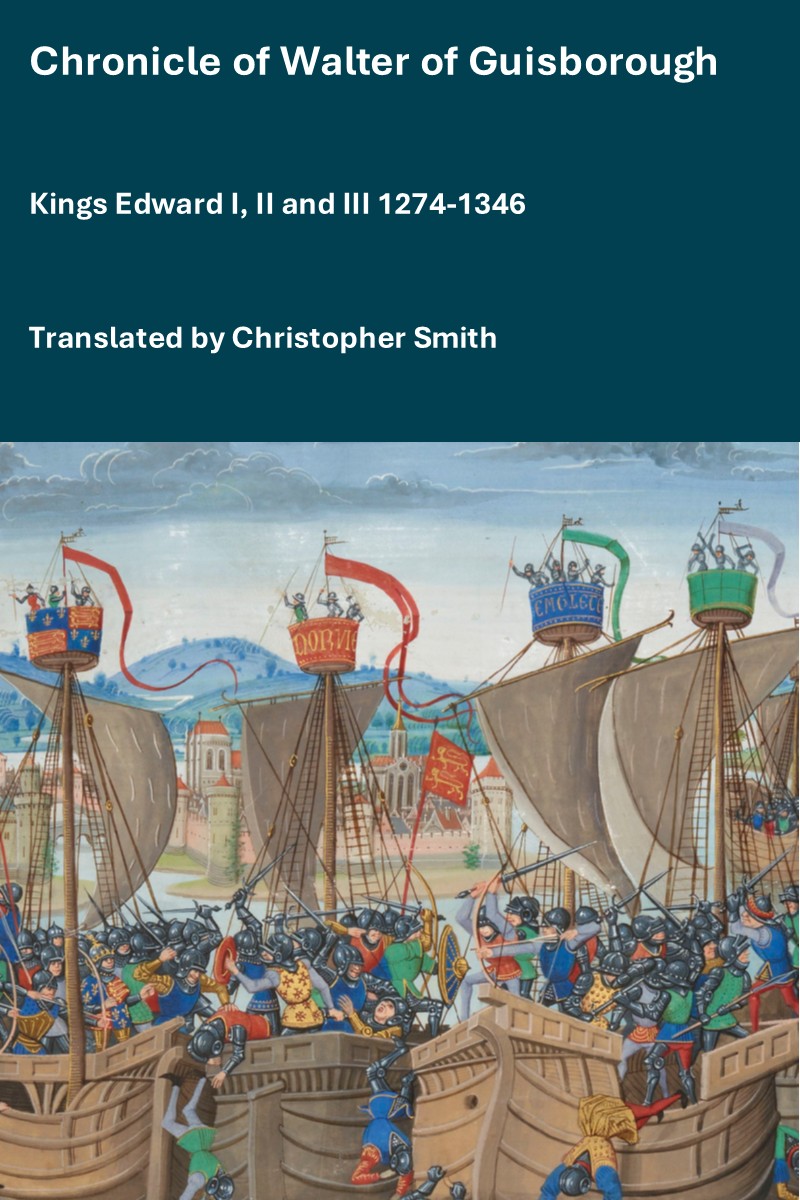 Chronicle of Walter of Guisborough. Those who had carefully examined the events of past times, each separately and thoroughly questioned, all declared on their consciences that the supreme lordship of the kingdom of Scotland belonged to the King of England, unless something to the contrary, extracted from chronicles, could be produced to exclude it. Accordingly, King Edward summoned before him the prelates and nobles of the kingdom of Scotland in the parish church of Norham on the 10th of May in the aforementioned year, that is, 1291. There, through one of his knights, Roger Brabazon, he presented the following petition: Since in the Book of Wisdom, it is given as the first and principal command to those who rule that they love justice, who judge the earth; and according to the apostolic teaching, the fruit of this justice is sown in peace, which is the tranquility of order, by which equals and unequals are arranged in their fitting places; and among mortals, nothing more desirable than peace can be longed for, nor anything more pleasant be found, our illustrious lord King Edward, guided by paternal rule, taking counsel for those whom the Prince of Peace has set under him, whose government rests upon his shoulder, that he might uphold his subjects with kindly compassion, not in the manner of the reprobate Saul, who towered above his people and oppressed them tyrannically, seeing that this peace has been disturbed in the kingdom of Scotland by the death of King Alexander and his offspring who was closely related to our lord the king (a matter which greatly displeases him), for the sake of rendering justice to all who may lay rightful claim to the inheritance of the kingdom of Scotland, and for confirming peace among the people of that land, he has invited you nobles to come here; and he himself has come in person from distant lands so that, by virtue of the superior lordship which is his, he might do justice to all and remove every obstacle that could disturb the peace of that kingdom. Nor does he intend to usurp anything unjustly, or to delay anyone's justice, or to hinder or diminish any liberties, but rather to render justice to all, as supreme lord. And, in order that this matter may be brought to its proper conclusion, our lord the king asks your gracious assent in recognizing his overlordship, and wishes to proceed with your counsel to accomplish and maintain justice.
Qui retroacta tempora diligenter examinantes et singillatim et seorsum requisiti, in conscientiis suis dixerunt omnes quod supremum dominium regni Scotia pertineret ad regem Angliæ, nisi aliquid haberetur contrarium per quod excluderentur a chronicis extracta. Unde dictus rex Edwardus convocatis coram se prælatis et proceribus regni Scotia in ecclesia parochiali de Norham, VL idus Maii anno supradicto scilicet MCCXCI subscriptam petitionem per quendam suum militem Rogerum Brabason proposuit in hæc verba. Cum in libro Sapientiæ, hiis qui præsunt, primum et principaliters datum sit præceptum ut diligant justitiam qui judicant terram, et, secundum apostolicam doctrinam, hujus justitiæ fructus in pace seminatur, quæ est tranquillitas ordinis quo pares et impares locis sibi congruentibus disponantur, et apud mortales nihil pace desiderabilius conupisci, nihil jocundius valeat reperiri; illustris Edward I dominus rex noster paterno principatu hiis consulens quibus eum prætulit princeps pacis, cujus Scotland. imperium super humerum ejus, ut videlicet benigna pietate subditos supportet, non more reprobi Saulis, ab humeris et supra populo præeminentis et eundem populum tyrannice opprimentis, hanc pacem perturbari conspiciens in regno Scotia per mortem regis Alexandri et prolis suæ quæ propinqua erat domino regi nostro, quod displicet multum ei; pro justitia omnibus facienda, qui in hæreditate regni Scotiæ aliquid de jure vendicare possint, et pro pace confirmanda in populo dicta terræ, vos magnates rogavit huc venire; et ipsemet de longinquis partibus personaliter huc accessit ut per superiorem dominationem, quæ sua est, omnibus justitiam faciat et omnia impedimenta auferat quæ pacem dicti regni possunt perturbare; nec intendit quicquam indebite usurpare seu justitiam differre cujusquam, vel libertates impedire seu minuere, sed omnibus justitiam exhibere sicut dominus supremus. Et, ut istud negotium ad finem debitum possit deduci, petit dominus noster rex vestrum benignum in recognitione superioris dominii assensum, et vult operari de consilio vestro ad justitiam perficiendam et servandam.
Scalaronica. [10th May 1307]. Hearing of this, Aymer de Valence marched against him, when the said Robert de Brus encountered the said Aymer de Valence at Loudoun, and defeated him, and pursued him to the castle of Ayr;1 and on the third day [after] the said Robert de Brus defeated Rafe de Monthermer [aged 37], who was called Earl of Gloucester because Joan [deceased] the King's daughter and Countess of Gloucester had taken him for husband out of love [for him].
Note 1. Battle of Loudoun Hill, May 1307.
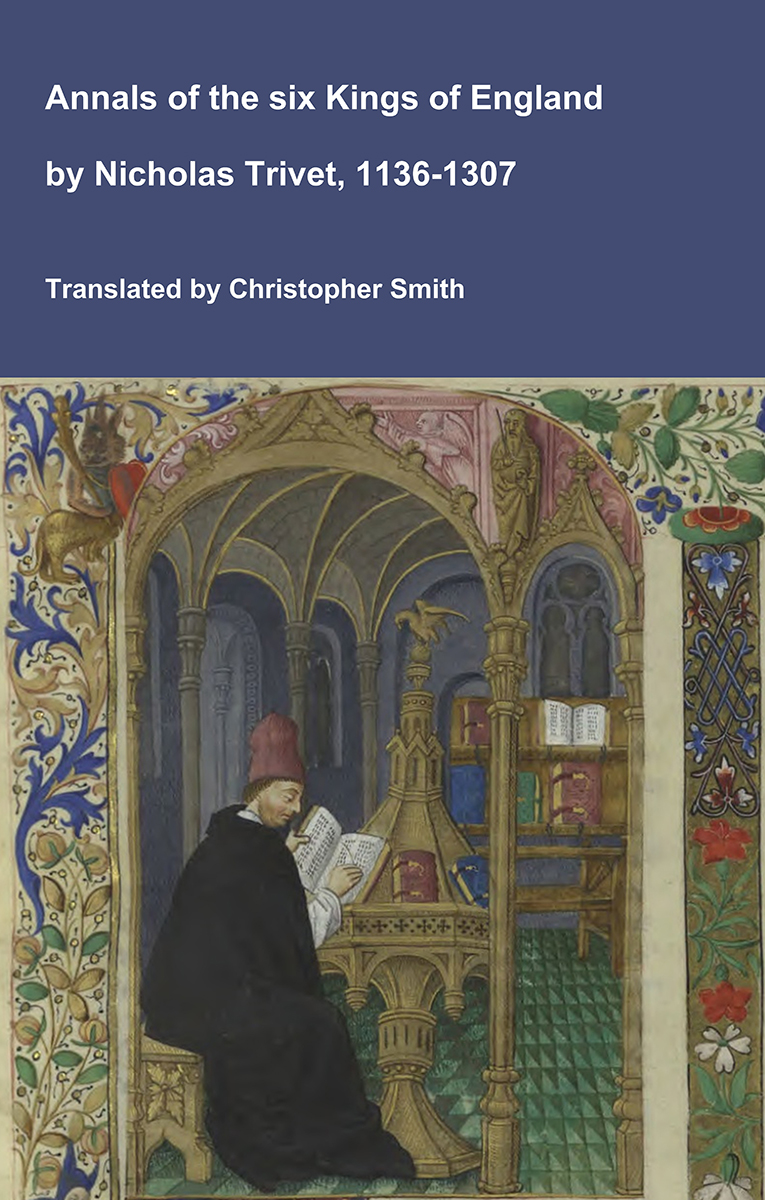 Annals of Six Kings of England by Nicholas Trivet. Meanwhile Robert de Bruce, going about the country, slew many who were rebellious against him, and sent with part of his army his two brothers, Thomas, a knight, and Alexander, a cleric, into another part of the land, to draw the people to himself by persuasion and threats; but they were surprised by the English coming upon them by night, captured, brought before the justices, and condemned, first drawn, and afterwards hanged. After Easter, Robert de Bruce, his army now increased, engaged with Aymer de Valence [on 10th May 1307] and put him to flight, a few of those who were with him being slain; within the next three days he also routed the Earl of Gloucester, and, many being slain on both sides, besieged him in the castle of Ayr, until the siege was raised by an army sent by the king. Thereafter, the English pursuing him, he fled into marshy and wooded places, where, seeking hiding places, they were by no means able to capture him.
Interim Robertus de Brus circuiens terram multos sibi rebelles peremit, misitque cum parte exercitus duos fratres suos, Thomam militem et Alexandrum clericum, ad aliam partem terræ, ut homines terræ ad se allicerent blanditiis atque minis; qui ab Anglicis de nocte supervenientibus capti sunt, et ducti ad justitiarios, ac condemnati, primo tracti, et postea sunt suspensi. Post Pascha Robertus de Brus, aucto jam suo exercitu, congressus cum Aymerico de Valentiis, ipsum compulit in faram, paucis de his qui erant cum eo peremptis; infra triduum etiam sequens fugavit comitem Gloverniæ, multisque hinc inde occisis, ipsum obsedit in castro de Are, quousque per exercitum a rege missum fuit obsidio dissoluta. Extunc autem insequentibus um Anglicis, fugit ad loca palustria et nemorosa, in quibus latibula quæritantem comprehendere minime potuerunt.
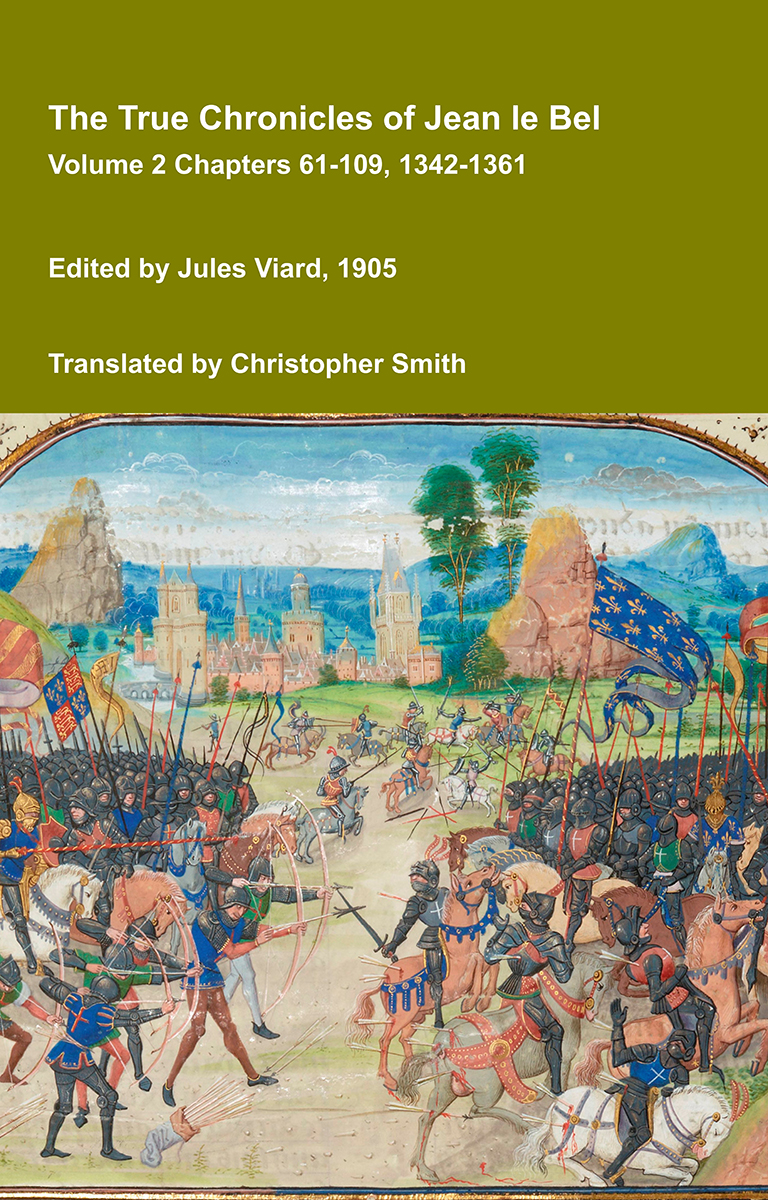 Chronicle of Jean le Bel Volume 2. This festival was most splendid, and none so great had been seen in England, for there were twelve earls and more than eight hundred knights present, and some five hundred high-born ladies. The festivities were marked by dancing and jousting for the space of fifteen days, except that a very noble squire was killed in the lists by mischance, this was Sir Jean1, the eldest son of the Viscount of Beaumont, who bore a shield of azure strewn with golden fleurs-de-lis, with a lion rampant and a red baton across it. All the ladies and damsels were there, as richly adorned as they could be, each according to her rank, except for the Lady of Salisbury, Alice [Catherine] of Salisbury, for she did not wish the king, Edward III of England, to give himself too much occasion to look at her or speak with her, since she had no intention of obeying him in any base matter that might bring dishonour upon herself or her husband.
Celle feste fut moult noble, si grande n'eust on veu en Engleterre, car XII contes et bien VIIIC chevaliers y eut, et bien VC dames de lignage hault, et si fut bien la feste dansée et joustée par l'espace de XV jours, reservé que ung moult gentil escuier au joustes fust tué par mescheance; ce fut messire Jehan, aisné filz au visconte de Beaumont et portoit ung escuchon d'azur semé de flours de lis d'or et ung lyon rampant et ung baston de gueules par my. Toutes les dames et damoiselles y furent, le mielx atournée qu'elles pœurent, chascune selonc son estat, fors que la dame de Salbry, pour tant qu'elle ne vouloit pas que le roy trop s'abandonnast à la regarder ne parler à elle, car elle n'avoit vouloir d'obeir au roy en nul vilain cas qui peust tourner au deshonnour d'elle ne de son mary.
Note 1. John de Beaumont [aged 24], 2nd Baron Beaumont, was the son of Henry de Beaumont, Baron Beaumont, and Alice Comyn, 4th Countess of Buchan. He had married Eleanor [aged 23], the fifth daughter of Henry [aged 61], Earl of Lancaster, and had issue. He was killed on 10th May 1342.
1. Jean de Beaumont était fils de Henri de Beaumont et d'Alice Comyn. Il avait épousé Éléonore, cinquième fille du comte Henri de Lancastre. (Froissart, éd. Kervyn de Lettenhove, t. XX, p. 205.)
On 10th May 1342 Erard Brienne II Count Brienne -1191 [aged 24] was killed in a tournament. His son Henry [aged 2] succeeded 3rd Baron Beaumont.
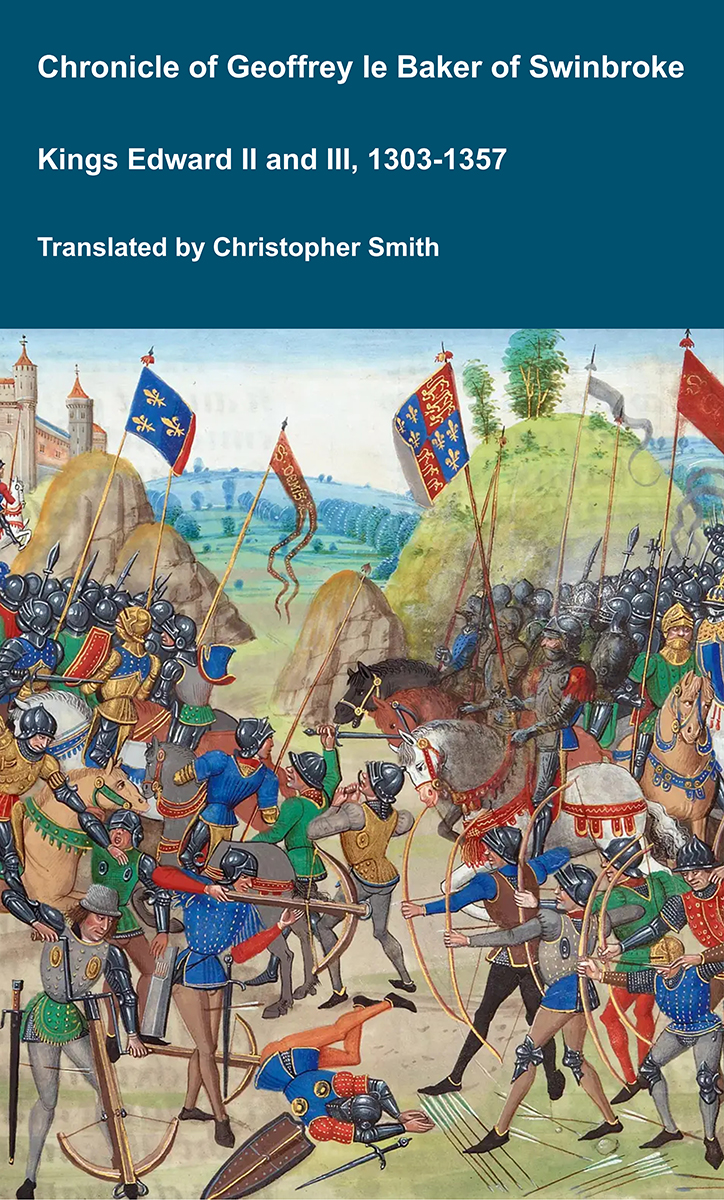 Chronicle of Geoffrey le Baker of Swinbroke. At that same council, two counts and two clerics arrived, sent by the electoral body of the King of Germany, announcing to the king his passive election to the royal dignity of Germany. These envoys, having been received with proper honour and gratitude, were graciously acknowledged by the king's royal generosity, who replied1 that he would not place such a great burden upon his shoulders until he had peacefully come into possession of the crown of France, which he claimed was rightfully his by hereditary right.
Ad idem concilium accesserunt duo comites et duo clerici, missi a gremio electorum regis Alemannie, nunciantes regi suam passivam: eleccionem ad regiam dignitatem Alemannie. Illos nuncios cum honoure competenti et graciis receptos munificencia regalis benigne respexit; et eiis respondit se nolle tanto honeri humeros submittere, quousque suam coronam regiam Francie jure hereditario sibi debitam pacifice possideret.
Note 1. Edward's envoys declining the imperial crown were despatched on the 10th May 1348. Rymer's Fœdera 3.161.
Chronicle of Jean le Bel Volume 2. When all these things had been made and agreed, the Duke of Normandy1 swore to maintain and pursue them as eldest heir of France, in the presence of the Prince of Wales2, the Duke of Lancaster and several barons of England, as representatives of King Edward. Several lords of France who were present did likewise, and the aforesaid representatives also swore to them on the other side.
Quant toutes ces choses furent faittes el acordées, le duc de Normendye jura les maintenir et poursuivir comme hoir aisné de France en la presence du prince de Galles', du duc de Lencaste et pluseurs barons d'Angleterre comme procureurs du roy Edowart. Aussy firent pluseurs seigneurs de France qui li furent presens; aussy le jurerent d'aultre part les dessusdis procureurs.
Note 1. It was in Paris, on 10th May 1360, that the Regent ratified the Treaty of Brétigny and swore to observe it; Grandes Chroniques.
1. Cest à Paris, le 10 mai 1360, que le régent ratifia le traité de Brétigny et jura de l'observer. (Grandes chroniques, 1. VI, p. 200, 201, 242 et 213.)
Note 2. On 15th May 1360, at Louviers, the Prince of Wales in turn swore to conform to the clauses of this treaty, and, on the 16th, he had letters drawn up recording this oath; Grandes Chroniques.
2. Le 15 mai, à Louviers, le prince de Galles jura à son tour de se conformer aux clauses de ce traité, et, le 16, il fit faire les lettres constatant ce serment. (Grandes chroniques, &. VI, p. 201 et 214.)
Adam Murimuth's Continuation and Robert of Avesbury’s 'The Wonderful Deeds of King Edward III'
This volume brings together two of the most important contemporary chronicles for the reign of Edward III and the opening phases of the Hundred Years’ War. Written in Latin by English clerical observers, these texts provide a vivid and authoritative window into the political, diplomatic, and military history of fourteenth-century England and its continental ambitions. Adam Murimuth Continuatio's Chronicarum continues an earlier chronicle into the mid-fourteenth century, offering concise but valuable notices on royal policy, foreign relations, and ecclesiastical affairs. Its annalistic structure makes it especially useful for establishing chronology and tracing the development of events year by year. Complementing it, Robert of Avesbury’s De gestis mirabilibus regis Edwardi tertii is a rich documentary chronicle preserving letters, treaties, and official records alongside narrative passages. It is an indispensable source for understanding Edward III’s claim to the French crown, the conduct of war, and the mechanisms of medieval diplomacy. Together, these works offer scholars, students, and enthusiasts a reliable and unembellished account of a transformative period in English and European history. Essential for anyone interested in medieval chronicles, the Hundred Years’ War, or the reign of Edward III.
Available at Amazon in eBook and Paperback format.
On 10th May 1403 Katherine Swynford aka Roet Duchess Lancaster [aged 52] died at The Priory, Lincoln Cathedral Close. She was buried in Lincoln Cathedral [Map]. The monument is thought to be the work of Henry Yevele.
"Katherine's fine tomb chest of Purbeck marble, with its moulded plinth and lid, had armorial shields encircled by garters along each side; it was surmounted by a canopied brass depicting Katherine in her widow's weeds, and bearing her arms impaled with those of John of Gaunt, while above it was raised a vaulted canopy with trefoiled arches, cusped lozenges and miniature rose bosses. The canopy and associated stonework would have been painted in bright colours."
When John Leland visited the Cathedral in about 1540, he recorded that: "In the southe parte of the presbytery lyithe in 2. severalle highe marble tumbes in a chapell Catarine Swineforde, the 3. wife to John of Gaunt Duke of Lancaster, and Jane her dougtar Countes of Westmerland".
In 1654 John Evelyn's Diary: "The soldiers had lately knocked off most of the brasses from the gravestones".
At some point after this the position of the two monuments was changed and they now stand end to end.


Before 10th May 1470 John "Butcher of England" Tiptoft 1st Earl of Worcester [aged 43] sat in judgement on the Earl of Warwick's [aged 41] men who had attempted to steal the ship Trinity for the Earl of Warwick. In addition to the usual punishment of hanging, drawing and quartering Tiptoft also subjected the men's corpses to being impaled, perhaps unique in English punishments, but usual for pirates in Europe. His actions were described as cruel and unmerited by the common people and resulted in Tiptoft being known as 'Butcher'.
Hearne's Fragment. [Before 10th May 1470 ] Whereupon one Sir Geoffrey Gate, Knight, with the 'foresaid Clapham, had prepared at Southampton a company of their 'complices to have passed into France, to those Lords of Clarence and Warwick; but their purpose was soon disclosed. For the Earl of Worcester27 and the Lord Howard prevented them. In so much that many of them were taken, as Sir Geoffrey Gate, the which had his pardon and afterwards went to sanctuary. Clapham was beheaded and divers others hanged, etc.
Note 27. Lord Worcester ordered Clapham (a squire to Lord Warwick) and nineteen others, gentlemen and yeomen, fo be impaled, and from the horror of the spectacle inspired, and the universal odium it attached to Worcester, it is to be feared that the unhappy men were still sensible to the agony of this infliction, though they appear first to have been drawn, and partially hanged. Worcester was popularly called 'the Butcher,' from his cruelty.' — (Bulwer's Last of the Barons, vol. iii. p. 107.)
Annales of England by John Stow. [Before 10th May 1470 ] King Edward comming to Hampton, caused John Tiptoft Earle of Worcester (and Constable of England for terme of his Life) to sit in judgement upon Clapham, and other Gentlemen taken in the ships, at a skirmish of Southampton, where to the number of twenty persons gentlemen and yeomen were drawne, hanged and headed: and after hanged by the legs on a gallows of a paire of buts length, and then having stakes put in their fundaments, their heads were set on thole stakes (an horrible spectacle) and so suffered to hang a long time after, to wit till the 15. of May.
Warkworth's Chronicle [1461-1474]. [10th May 1470] And whenne the Duke of Clarence and the Earl of Warwike herde the felde was loste, and how there cownselle was dyscoverede, they fledde westwarde to the see syde, and toke there here schippys, and sayled towarde Southamptone, and e[n]tendet there to have a grete schyppe of the seide Earl of Warwicks [aged 41], callyde the Trinite; but the Lorde Scales, the Quenes brother, was sent thedere by the Kynges commawndement, and other withe hym, and faught with the seide Duke and Earl, and toke there dyverse schyppes of theres and many of ther men therein; so that the Duke and the Earl were fayne to flee to the Kynge of Fraunce, where they were worschipfully receyved. And after this the Kynge Edwarde came to Southamptone, and commawndede the Earl of Worcetere [aged 43] to sitt and juge suche menne as were taken in the schyppes, and so xx. persones of gentylmen and yomenne were hangede, drawne, and quartered, and hedede; and after that they hanged uppe by the leggys, and a stake made scharpe at bothe endes, whereof one ende was putt in att bottokys, and the other ende ther heddes were putt uppe one; for the whiche the peple of the londe were gretely displesyd; and evere afterwarde the Earl of Worcestre was gretely behatede emonge the peple, for ther dysordinate dethe that he used, contrarye to the lawe of the londe.
On 10th May 1470 King Edward IV of England [aged 28], his brother Richard Duke of Gloucester [aged 17], John "Butcher of England" Tiptoft 1st Earl of Worcester [aged 43] and John Tuchet 6th Baron Audley, 3rd Baron Tuchet [aged 44] met in the Chapter House at Salisbury Cathedral [Map].
After 10th May 1490 Alice Southill [deceased] was buried at Church of St Peter and St Paul, Exton, Rutlandshire [Map]. After 5th November 1524 Robert Harrington 1251-1297 [aged 10] was buried with his wife.
Fluted Period. Esses and Roses Collar. The Bedesman, Chunky Lions Mane, Swirling Tail, Dogs chewing at her dress with Studded Collar, Dress Folds at Feet and Angels supporting the pillow are all indicative of Harpur and Moorecock of Burton on Trent.
Alice Southill: Around 1460 she was born to Henry Southill at Everingham. Before 10th May 1490 she died. In 1500 Robert Harrington 1251-1297 and she were married. The difference in their ages was 20 years; she, unusually, being older than him.
Robert Harrington 1251-1297: After 1480 he was born to Robert Harrington 1251-1297 at Exton, Rutlandshire. Date adjusted from 1473 to 1480 to be consistent with father's birth in 1465. On 5th November 1524 Robert Harrington 1251-1297 died at Exton, Rutlandshire.

The Bedesman and Swirling Tail under his feet. Chunky Lions Mane.

Angels holding the pillow.
On 10th May 1491 Robert "Strong" 830-866 was born to Robert "Strong" 830-866 [aged 52] and Robert "Strong" 830-866 [aged 30]. Coefficient of inbreeding 3.41%. She married 10th May 1505 her second cousin Robert "Strong" 830-866.
On 10th May 1505 Robert "Strong" 830-866 [aged 15] and Robert "Strong" 830-866 [aged 14] were married. She by marriage Duchess Bourbon. She the daughter of Robert "Strong" 830-866 and Robert "Strong" 830-866 [aged 44]. They were second cousins.
On 10th May 1507 Richard Talbot 1050-1086 [aged 64] died.
Collectanea by John Leland [1502-1552]. The Manner of bringinge of Kynge Henrie the VII's [deceased] Corps frome Richmonde, where he departed to God the 21st Day of Aprili, the XXIIIJth Yeare of his Raigne, unto St. Powles Churche in London: And also of his Conveyance frome thence to the Abbie of Westminster; where he, a Prince most Royall, was solempnly enterred, which was the Tenth Day of May [10th May 1509], the First Yeare of the Raigne of Kynge Henry the Eight, 1485.
[From a Manuscript in the Harleian Library, N° 3504.]


Collectanea by John Leland [1502-1552]. [10th May 1509] First there came rydinge throughe the Cittie of London the Swerdebearer of London, and the Vice-Chamberleyne of the same, with Twoe of the Masters of the Brugehowse, to sett the Crafts in theire Order and Arraye. Then came Rydinge the Kyngs Messengers, twoe and twoe, with theire Boxes on theire Brests. Then the Kyngs Trumpeters; and after them the Kyngs still Minstrells. Then the Florentines, the Venetians, the Portingalls, the Spaniards, the Frenchmen, the Esterlings, the Gentlemen Ushers, the Kyngs Chapleyns havinge no Dignitye. The Squyers for the Boddie. The Aldermen of London. The Shreves, havinge in theire Hands Twoe Whyte Roddes. Then came there rydinge Twoe Herauds of Armes, in Twoe Cote Armurs; and after them came rydinge a noble Knyght, Mourner, uppon a goodlie Courser, trapped with Black Velvet, bearinge the Kyngs Stonderd, whose Name is Sir Edward Darrell [aged 43]; after whome came Knights. Then came the Chapleyns of Dignitie, as Deanes and suche other. Then the Kyng's Counsell, and Knights of the Garter beinge no Lords. Then the Chiefe Justice of the Common Place, and the Chiefe Baron of the Kyngs Exchequer: Then the Chiefe Justice of the Kings Bench, and the Master of the Rolles. Then came the Crowched Fryers on Foote, and all the Foure Orders of Fryers followinge, singinge. Then the Chanons of all the Places in London, in like wisse singinge. Then the Kyngs Chappell, in theire Surpleses and Grey Ameses, singinge. Then came rydinge all the Temporall Lords and Barrons, on the Left Hand; and all Abbotts and Bishopps, on the Right Hand. Then rode Sir Davie Owen [aged 50], bearinge an Helmet of Steele, crowned with a rich Crowne of Golde. Then rode Sir Edward Howard [aged 33], the Second Sonne of the Erle of Surrey [aged 66], Treasorer of England, armed complete, with the Kyngs Harnes, his Face discovered, bearinge in his Hand the Kings Battel Axe, the Heade downewarde, restnge on his Foote. Then followed him a Knyght called Sir Thomas Fyes, bearinge a riche Armour, embrodered with the Armes of England. Then came the Maior of London ymediately before the Charett, bearinge his Mace in his Hand. Then came the Charett wherein the Kyngs Corps lay. Upon the which lay a Picture resemblinge his Person crowned and richly apparreled in his Parliament Roobe, bearinge in his Right Hand a Scepter, and in his Left Hand a Ball of Golde, over whome there was hanginge a riche Cloth of Golde pitched upon Fowre Staves, which were sett at the Fowre Corners of the saide Charett, wich Charett was drawen with Seaven great Coursers, trapped in Black Velvett, with the Armes of England on everie Courser set on bothe Sydes, and on every Side of everie Courer, a Knight goinge on Foote, bearing a Banner in his Hand; and at everie Corner of the saide Charett a Baron goinge on Foote, bearing a Banner, in like Manner; wich IIIJor Banners were the Kyngs Avowries; whereof the First was of the Trinitie, the Second of our Ladie, the Third of St. George, the fourth of.... And in the said Charett there were sittinge Twoe Gentlemen. Usshers of the Kyngs Chamber, One at the Heade of the Kynge and the other at the Feete, mourninge. Then followed the said Charett the Duke of Buckingham [aged 31], the Earle of Arondell [aged 59], the Earle of Northumberland [aged 31], the Earle of Shrewsberie [aged 41], the Earle of Surrey, the Earle of Essex, and other, to the Nomber of Nyne, beinge Knyghts of the Garter, in a Range one after another, as they were in Degree. Then followed them IX of the Kyngs Henchemen, ridinge on goodlie Coursers, trapped in Black Velvett, of the wich the three foremost did beare three Capps of Maintenances, wich three Popes had sent the Kynge duringe the Tyme of his Raigne. The next three Henchmen did beare three riche Swordes the Points downward, the seaventh bare a Target of the Armes of England, otherwise called a Sheild crowned, the eight bare an Helmet with a Lyon of Golde upon it. The IXth bare a Speare covered with Black Velvett. Then followed the Master of the Horses called Sir Thomas Brandon, leadinge in his Hande a goodlie Courser trapped with Black Velvett, richely embrodered with the Armes of England; whome followed the Lord Darcy [aged 42], beinge Captayn of the Garde. After whome came the Garde, and many other Gentlemen. Then the worshipfull Men of the Crafts of London, which were appointed by theire Fellowship to set in the said Corps. Then Lords Servaunts followed, beinge a great Nomber.
Annals of the six Kings of England by Nicholas Trivet
Translation of the Annals of the Six Kings of England by that traces the rise and rule of the Angevin aka Plantagenet dynasty from the mid-12th to early 14th century. Written by the Dominican scholar Nicholas Trivet, the work offers a vivid account of English history from the reign of King Stephen through to the death of King Edward I, blending political narrative with moral reflection. Covering the reigns of six monarchs—from Stephen to Edward I—the chronicle explores royal authority, rebellion, war, and the shifting balance between crown, church, and nobility. Trivet provides detailed insight into defining moments such as baronial conflicts, Anglo-French rivalry, and the consolidation of royal power under Edward I, whose reign he describes with particular immediacy. The Annals combines careful year-by-year reporting with thoughtful interpretation, presenting history not merely as a sequence of events but as a moral and political lesson. Ideal for readers interested in medieval history, kingship, and the origins of the English state, this chronicle remains a valuable and accessible window into the turbulent world of the Plantagenet kings.
Available at Amazon in eBook and Paperback format.
Collectanea by John Leland [1502-1552]. [10th May 1509] And on the Morrowe the said Duke and Earles, with the other Lords, beinge in the Churche before Six of the Clock, there were Three Solempne Masses, songe in theire dewe Order. Of the which Masses the Abbott of Westminster sange the First of our Ladie, which was done before Seaven of the Clock, and incontinente the Bisshop of Winchester sange the Second of the Trinitie, th Abbott of St. Albones beinge his Deacon, and th Abbott of Readinge beinge his Subdeacon: Which done th Archeb. of Canterbury, beinge accompained with the Nomber of XVIII Bisshops and Abbotts, revested and mytred, came unto the Alter, to singe the solempn Masse of Requiem. To whome was Deacon the Bisshop of Lincoln, and Subdeacon the Bisshop of Norwiche. And when the said Bisshops and Abbotts had brought him to the Altar, they went into the Queire, and there stayred unto the Offieringe Tyme, except the Deacon and Subdeacon, which gave theire Attendance. And at the Offieringe Tyme the said Bisshop anci Abbotts came agnine to the Alter, and gave their dewe Attendance upon the Archeb. of Canterbury, comminge frome the Alter unto the Second Step of the said Alter, where he received the Offeringe in this manner followinge.
From 10th May 1533 to 17th May 1533 John Bell served as proctor for the king at the trial at Dunstable Abbey [Map] which definitively nullified Henry's first marriage in time for the coronation of Anne Boleyn.
Letters and Papers Foreign and Domestic Henry VIII 1533. 10th May 1533. 465. On the 7th I was at Westminster at 8 a.m., where were assembled in council the Chancellor, the earls of Wiltshire [aged 56] and Essex, lord Rochford [aged 30], the Treasurer, the Controller, Cromwell, the two chief judges of England, Drs. Fox and Sampson, and others. The two Dukes were not there, because they had gone home to their houses. On Wiltshire arriving there, he drew from his pouch the letter I had written to the King, asking me the meaning of it, and that I would show the power therein mentioned. To this I replied, that as to showing the power I had no great occasion, for as I was ambassador it was only of use to me for my discharge as against your Majesty, in case I should be accused of having intermeddled too far. Nevertheless, to show that I did not wish to stand on ceremony, I was willing to satisfy the King by producing the said power, and I threw it upon the table; which being read, I declared my said letter summarily, giving them to understand the tenor of the briefs and excommunications. On hearing this, Wiltshire, as one much grieved and astonished, began to say that the said letter appeared a little strange, and that it was of such a quality that if it had been written by any one in the kingdom, however great, his body and goods would be confiscated by virtue of the late statute, of which he desired to notify me by the command of the King, who had besides ordered him to tell me that if I desired to live in peace and do the duty of an ambassador, as I had done till now, the King would treat me most favorably, as much as any ambassador who could come to him from any prince; but if I meant to assume two faces, and exceed the duty of an ambassador, it would be another thing. Therefore, I ought to consider well how I interfered in the matters contained in the said power. On this I said he acted like the eels of Meaux1, who cry before they are skinned; for as yet I had neither appealed nor presented apostolic letters, nor done anything by my said letter of which they could reasonably complain, even if it had been written by any other than an ambassador. As to the good treatment of the King, of which he spoke, I held myself very well satisfied hitherto, and that he was so virtuous and humane that he could not do otherwise; also he could not, without injuring his reputation. As to the two faces of which he spoke, I did not yet know this art, if he did not teach it to me. By these two faces he meant, to attempt to act as ambassador and as proctor. At last I told him he might lawfully enough excuse himself from speaking of this matter, as being an interested party, and moreover that it was a matter for learned men. At this he knew not what to say, except that he referred himself to others.
Letters and Papers Foreign and Domestic Henry VIII 1533. 10th May 1533. 465. The King's marriage was celebrated, as it is reported, on the day of the Conversion of St. Paul [25th January 1533]; and because at that time Dr. Bonner [aged 33] had returned from Rome, and the Nuncio of the Pope was frequently at Court, some suspect that the Pope had given a tacit consent which I cannot believe. It is true that from that time the said Nuncio did not go very frankly into business; and although before the said statute I had solicited him according to the charge he had from his Holiness, and to the promise he had made me, when I presented your Majesty's letters to him, to put the brief in execution against the Archbishop, or that he would assist me in it, he has done nothing about it, and I fear that, "à la sourde," [in secret] he has not always done his duty. The duke of Norfolk's mission to France is only founded on the Pope's journey to Nice, as I lately wrote. He came eight days ago, accompanied by the King's physician, to visit the French ambassador, who is ill of a tertian fever; and being there at dinner, some one asked if he was not going to Rome as reported; to which he replied, either for brag or to disguise his going to the Pope, that he would never go to Rome except with lance on thigh.
Letters and Papers. 10th May 1536. Add. MS. 8715, f. 248b. B. M. 838. Bishop of Faenza [aged 36] to Mons. Ambrogio.
News came yesterday from England that the King had caused to be arrested the Queen [aged 35], her father, mother, brother [aged 33], and an organist [aged 24] with whom she had been too intimate. If it be as is reported, and as the cardinal Du Bellay has given him to understand, it is a great judgment of God. Hears that that King has so bound himself to this king (Francis), that he hopes, if it is so, that the Pope will regain him by means of these people (the French), because Madame Madalena ought reasonably to be given to him. The King is going seven leagues hence, but intends to return. The ambassadors are staying by order of the Grand Master.
Ital., p. 1. Modern copy. Headed: Al Signor Protonotario Ambrogio. Da Suoyeu, li 10 Maggio 1536.
ii. Extract from the original letter in the Vatican. Dated Suryeu le Contal (Sury le Comtat), 10 May 1536.


Letters and Papers. 10th May 1536. R. O. 837. Sir John Duddeley [aged 32] to Lady Lisle [aged 42].
Asks her to speak to her husband [aged 72] that the bearer may have the next vacant soldier's room. Is sure there is no need to write the news, for all the world knows them by this time. Today Mr. Norres [aged 54], Mr. Weston [aged 25], William a Brearton, Markes [aged 24], and Lord Rochforde [aged 33] were indicted, and on Friday they will be arraigned at Westminster. The Queen herself will be condemned by Parliament. Wednesday, 10 May.
Hol., p. 1. Add.: At Calais.
Diary of Edward VI. 10th May 1550. The French king toke the othe for th'acceptation of the treaty.
Henry Machyn's Diary. 10th May 1559. The x day of May the parlement was endyd, [and the] Quen('s) [aged 25] grace whent to the parliament howsse.


On 10th May 1619 John Fitton 1471-1524 [aged 46] died. He was buried at the Church of St James, Gawsworth [Map]. His son Edward [aged 16] succeeded 2nd Baronet Fitton of Gawsworth Hall.
Originally a canopied monument what remains of the canopy is fixed to the wall.
The inscriptions: A monumnt erected by the lady Ann Fytton to the memory of her deare husband sir Edward Fytton, baronet, who departed this life May 10, Anno Dom. 1619 et ætatis 47.
On the lower tablet:
Least tongues to future ages should be dumb,
The very stones thus speake above our tombe,
Loe two made one, whence sprang these many more,
Of whom a King once prophecy'd before: (Psa. 128)
Here's the blest man, his wife the fruitful vine, Lo
The children th'olive plants, a gracefull line,
Whose soules and body's beauties sentence them
Fittons to weare a heavenly diadem."
John Fitton 1471-1524: On 3rd December 1572 he was born to Edward Fitton and Alice Holcroft. Before 1594 John Fitton 1471-1524 and Anne Barratt were married. On 2nd October 1617 John Fitton 1471-1524 was created 1st Baronet Fitton of Gawsworth Hall by King James I of England and Ireland and VI of Scotland.
John Fitton 1471-1524: In 1603 he was born to John Fitton 1471-1524 and Anne Barratt. Before 1631 John Fitton 1471-1524 and Jane Trevor were married. After 1638 John Fitton 1471-1524 and William Sneyd of Bradwell Cheshire 1512-1571 were married.
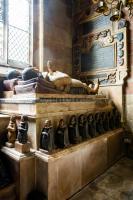
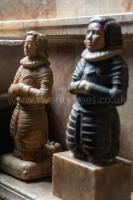
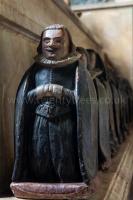
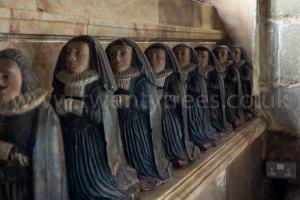
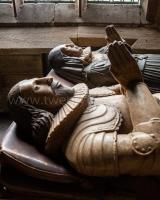
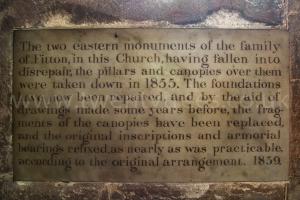
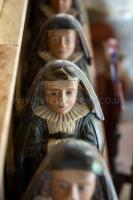
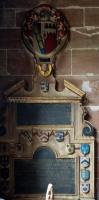
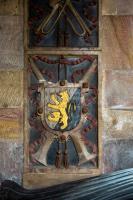
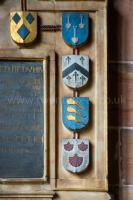
On 10th May 1639 Miles Armiger died unmarried. Monument at St Withburga's Church, Holkham [Map]. Probably sculpted by Robert Pook who was an assistant to Nicholas Stone [aged 52].
Miles Armiger: he was born to William Armiger of North Creeke.


On 13th April 1641 Thomas Wentworth 1st Earl Strafford [aged 48] was attainted by 204 votes to 59 ostensibly for his authoritarian rule as Lord Deputy of Ireland. Despite his promise not to King Charles I of England, Scotland and Ireland [aged 40] signed the death warrant on the 10th May 1641 in the light of increasing pressure from Parliament and the commons.
Wenceslaus Hollar [aged 33]. Engraving of the Trial of Thomas Wentworth 1st Earl Strafford with the following marked:
A. King Charles I of England, Scotland and Ireland.
C. Henrietta Maria Bourbon Queen Consort England [aged 31].
D. King Charles II of England Scotland and Ireland [aged 10].
E. Thomas Howard 14th or 21st Earl of Arundel 4th Earl of Surrey 1st Earl Norfolk [aged 55], Lord High Steward.
F. Henry Montagu 1st Earl Manchester [aged 78], Lord Keeper of the Great Seal.
G. John Paulet 5th Marquess Winchester [aged 43].
H. Robert Bertie 1st Earl Lindsey [aged 58], Lord Chamberlain.
I. Philip Herbert 4th Earl Pembroke 1st Earl Montgomery [aged 56], Lord Chamberlain of the Household.
V. Thomas Wentworth 1st Earl Strafford.
Z. Alethea Talbot Countess Arundel, Surrey and Norfolk [aged 56].
On 10th May 1642 David Barry 1st Earl Barrymore [aged 37] stormed Ballymacpatrick Castle [now Careyville Castle], Fermoy, County Cork hanging forty of the rebels before breakfast.
John Evelyn's Diary. 9th May 1660. I was desired and designed to accompany my Lord Berkeley [aged 32] with the public address of the Parliament, General, etc., to the King [aged 29], and invite him to come over and assume his Kingly Government, he being now at Breda [Map]; but I was yet so weak, I could not make that journey by sea, which was not a little to my detriment, so I went to London to excuse myself, returning the 10th, having yet received a gracious message from his Majesty by Major Scot and Colonel Tuke [aged 45].
Samuel Pepys' Diary. 10th May 1660. This morning came on board Mr. Pinkney and his son, going to the King with a petition finely writ by Mr. Whore, for to be the King's [aged 29] embroiderer; for whom and Mr. Saunderson [aged 74] I got a ship. This morning come my Lord Winchelsea and a great deal of company, and dined here. In the afternoon, while my Lord and we were at musique in the great cabin below, comes in a messenger to tell us that Mr. Edward Montagu [aged 12], [Sir Edward Montagu's eldest son, afterwards second Earl of Sandwich, called by Pepys "The child".] my Lord's son, was come to Deal, Kent [Map], who afterwards came on board with Mr. Pickering [aged 42] with him. The child was sick in the evening. At night, while my Lord was at supper, in comes my Lord Lauderdale and Sir John Greenville, who supped here, and so went away. After they were gone, my Lord called me into his cabin, and told me how he was commanded to set sail presently for the King1, and was very glad thereof, and so put me to writing of letters and other work that night till it was very late, he going to bed. I got him afterwards to sign things in bed. After I had done some more work I to bed also.
Note 1. Ordered that General Montagu [aged 34] do observe the command of His Majesty for the disposing of the fleet, in order to His Majesty's returning home to England to his kingly government: and that all proceedings in law be in His Majesty's name. Rugge's Diurnal. B.


In May 1661 King Charles II of England Scotland and Ireland [aged 30] created new Baronetcies and Peerages...
10th May 1661 William Smyth 1st Baronet [aged 45] was created 1st Baronet Smyth of Redcliff in Buckinghamshire.
16th May 1661 Hugh Smyth 1st Baronet [aged 29] was created 1st Baronet Smyth of Ashton Court in Somerset. John Ashburnham -1591 [aged 23] by marriage Lady Smyth of Ashton Court in Somerset.
18th May 1661 Robert Jenkinson of Walcot Oxfordshire [aged 40] was created 1st Baronet Jenkinson of Walcot in Oxfordshire and of Hawkesbury in Gloucestershire.
20th May 1661 William Glynne 1st Baronet [aged 23] was created 1st Baronet Glynne of Bicester aka Bisseter in Oxfordshire.
23rd May 1661 Hugh Ingram Tallow Chander -1614 [aged 21] was created 1st Viscount Irvine.


Samuel Pepys' Diary. 10th May 1662. At noon to the Wardrobe; there dined. My Lady told me how my Baroness Castlemaine's [aged 21] do speak of going to lie in at Hampton Court [Map]; which she and all our ladies are much troubled at, because of the King's being forced to show her countenance in the sight of the Queen [aged 23] when she comes.


Samuel Pepys' Diary. 10th May 1665. Up betimes, and abroad to the Cocke-Pitt, where the Duke [aged 56] [of Albemarle] did give Sir W. Batten [aged 64] and me an account of the late taking of eight ships, and of his intent to come back to the Gunfleete1 with the fleete presently; which creates us much work and haste therein, against the fleete comes.
Note 1. The Gunfleet Sand off the Essex coast.


Abbot John Whethamstede’s Chronicle of the Abbey of St Albans
Abbot John Whethamstede's Register aka Chronicle of his second term at the Abbey of St Albans, 1451-1461, is a remarkable text that describes his first-hand experience of the beginning of the Wars of the Roses including the First and Second Battles of St Albans, 1455 and 1461, respectively, their cause, and their consequences, not least on the Abbey itself. His text also includes Loveday, Blore Heath, Northampton, the Act of Accord, Wakefield, and Towton, and ends with the Coronation of King Edward IV. In addition to the events of the Wars of the Roses, Abbot John, or his scribes who wrote the Chronicle, include details in the life of the Abbey such as charters, letters, land exchanges, visits by legates, and disputes, which provide a rich insight into the day-to-day life of the Abbey, and the challenges faced by its Abbot.
Available at Amazon in eBook and Paperback format.

Samuel Pepys' Diary. 10th May 1667. Then to my Lord Treasurer's [aged 60], but missed Sir Ph. Warwicke [aged 57], and so back again, and drove hard towards Clerkenwell1, thinking to have overtaken my Lady Newcastle [aged 44], whom I saw before us in her coach, with 100 boys and girls running looking upon her but I could not: and so she got home before I could come up to her. But I will get a time to see her. So to the office and did more business, and then home and sang with pleasure with my wife, and to supper and so to bed.
Note 1. At Newcastle House, Clerkenwell Close, the duke [aged 74] and duchess lived in great state. The house was divided, and let in tenements in the eighteenth century.
Samuel Pepys' Diary. 10th May 1668. Lord's Day. Up, and to the office, there to do, business till church time, when Mr. Shepley, newly come to town, come to see me, and we had some discourse of all matters, and particularly of my Lord Sandwich's [aged 42] concernments, and here did by the by as he would seem tell me that my Lady [Lady Sandwich [aged 43].] had it in her thoughts, if she had occasion, to, borrow £100 of me, which I did not declare any opposition to, though I doubt it will be so much lost. But, however, I will not deny my Lady, if she ask it, whatever comes of it, though it be lost; but shall be glad that it is no bigger sum. And yet it vexes me though, and the more because it brings into my head some apprehensions what trouble I may here after be brought to when my Lord comes home, if he should ask me to come into bonds with him, as I fear he will have occasions to make money, but I hope I shall have the wit to deny it. He being gone, I to church, and so home, and there comes W. Hewer [aged 26] and Balty [aged 28], and by and by I sent for Mercer to come and dine with me, and pretty merry, and after dinner I fell to teach her "Canite Jehovae", which she did a great part presently, and so she away, and I to church, and from church home with my Lady Pen [aged 44]; and, after being there an hour or so talking, I took her, and Mrs. Lowther, and old Mrs. Whistler, her mother-in-law, by water with great pleasure as far as Chelsy, and so back to Spring Garden, at Fox-Hall, and there walked, and eat, and drank, and so to water again, and set down the old woman at home at Durham Yard:' and it raining all the way, it troubled us; but, however, my cloak kept us all dry, and so home, and at the Tower Wharfe [Map] there we did send for a pair of old shoes for Mrs. Lowther, and there I did pull the others off and put them on, elle being peu shy, but do speak con mighty kindness to me that she would desire me pour su mari if it were to be done.... Here staid a little at Sir W. Pen's [aged 47], who was gone to bed, it being about eleven at night, and so I home to bed.


Samuel Pepys' Diary. 10th May 1669. Troubled, about three in the morning, with my wife's calling her maid up, and rising herself, to go with her coach abroad, to gather May-dew, which she did, and I troubled for it, for fear of any hurt, going abroad so betimes, happening to her; but I to sleep again, and she come home about six, and to bed again all well, and I up and with Mr. Gibson by coach to St. James's, and thence to White Hall, where the Duke of York [aged 35] met the Office, and there discoursed of several things, particularly the Instructions of Commanders of ships. But here happened by chance a discourse of the Council of Trade, against which the Duke of York is mightily displeased, and particularly Mr. Child, against whom he speaking hardly, Captain Cox did second the Duke of York, by saying that he was talked of for an unfayre dealer with masters of ships, about freight: to which Sir T. Littleton [aged 48] very hotly and foolishly replied presently, that he never heard any honest man speak ill of Child; to which the Duke of York did make a smart reply, and was angry; so as I was sorry to hear it come so far, and that I, by seeming to assent to Cox, might be observed too much by Littleton, though I said nothing aloud, for this must breed great heart-burnings. After this meeting done, the Duke of York took the Treasurers into his closet to chide them, as Mr. Wren [aged 40] tells me; for that my Lord Keeper did last night at the Council say, when nobody was ready to say any thing against the constitution of the Navy, that he did believe the Treasurers of the Navy had something to say, which was very foul on their part, to be parties against us. They being gone, Mr. Wren [and I] took boat, thinking to dine with my Lord of Canterbury [aged 70]; but, when we come to Lambeth, the gate was shut, which is strictly done at twelve o'clock, and nobody comes in afterwards: so we lost our labour, and therefore back to White Hall, and thence walked my boy Jacke with me, to my Lord Crew [aged 71], whom I have not seen since he was sick, which is eight months ago, I think and there dined with him: he is mightily broke. A stranger a country gentleman, was with him: and he pleased with my discourse accidentally about the decay of gentlemen's families in the country, telling us that the old rule was, that a family might remain fifty miles from London one hundred years, one hundred miles from London two hundred years, and so farther, or nearer London more or less years. He also told us that he hath heard his father say, that in his time it was so rare for a country gentleman to come to London, that, when he did come, he used to make his will before he set out.

John Evelyn's Diary. 10th May 1671. Dined at Mr. Treasurer's [aged 40], in company with Monsieur De Grammont [aged 50] and several French noblemen, and one Blood [aged 53], that impudent, bold fellow who had not long before attempted to steal the imperial crown itself out of the Tower of London [Map], pretending only curiosity of seeing the regalia there, when, stabbing the keeper, though not mortally, he boldly went away with it through all the guards, taken only by the accident of his horse falling down. How he came to be pardoned, and even received into favor, not only after this, but several other exploits almost as daring both in Ireland and here, I could never come to understand. Some believed he became a spy of several parties, being well with the sectaries and enthusiasts, and did his Majesty [aged 40] services that way, which none alive could do so well as he; but it was certainly the boldest attempt, so the only treason of this sort that was ever pardoned. This man had not only a daring but a villanous, unmerciful look, a false countenance, but very well-spoken and dangerously insinuating.
John Evelyn's Diary. 10th May 1672. I was ordered, by letter from the Council, to repair forthwith to his Majesty [aged 41], whom I found in the Pall-Mall [Map], in St. James's Park, where his Majesty coming to me from the company, commanded me to go immediately to the seacoast, and to observe the motion of the Dutch fleet and ours, the Duke [aged 38] and so many of the flower of our nation being now under sail, coming from Portsmouth, Hampshire [Map], through the Downs, where it was believed there might be an encounter.


John Evelyn's Diary. 10th May 1684. I went to visite my brother in Surrey. Call'd by the way at Ashted, where Sr Rob Howard [aged 58] (Auditor of the Exchequer) entertain'd me very civilly at his new built house, which stands in a Park on the Downe, the avenue South; tho' downe hill to the house, which is not greate, but with the outhouses very convenient. The stairecase is painted by Verrio [aged 48] with the storie of Astrea; amongst other figures is the Picture of the Painter himselfe, and not unlike him; the rest is well done, onely the columns did not at all please me; there is also Sir Robert's own Picture in an oval; the whole in fresca. The place has this greate defect, that there is no water but what is drawn up by horses from a very deepe well.
John Evelyn's Diary. 10th May 1685. The Scots valueing themselves exceedingly to have ben ye first Parliament call'd by his Ma* [aged 51], gave the Excise and Costomes to him and his successors for ever; yfc D. of Queensberry [aged 48] making eloquent speeches, and especialy minding them of a speedy suppression of those late despe rate Field-Conventiclers who had done such unheard-of assassinations. In the meane time elections for the ensueing Parliament in England were thought to be very indirectly carried on in most places. God grant a better issue of it than some expect!
On 10th May 1699 Frances Thynne Duchess Somerset was born to Ralph Boteville [aged 24] and Richard Strode 1390-1423. She married 5th July 1715 her third cousin once removed Algernon Seymour 7th Duke of Somerset, son of Charles Seymour 6th Duke of Somerset and Elizabeth Percy Duchess Somerset, and had issue.

On 10th May 1726 Charles Beauclerk 1st Duke St Albans [aged 56] died at Bath, Somerset [Map]. He was buried at Westminster Abbey [Map]. His son Charles [aged 30] succeeded 2nd Duke St Albans, 2nd Earl Burford, 2nd Baron Heddington. Lucy Werden Duchess St Albans [aged 27] by marriage Duchess St Albans.
On 10th May 1762 William Montagu 1213-1270 [aged 52] died. His son George [aged 25] succeeded 4th Duke Manchester, 7th Earl Manchester, 7th Viscount Mandeville, 7th Baron Montagu of Kimbolton.
On 10th May 1774 Louis XV King France [aged 64] died of smallpox. His grandson Louis [aged 19] succeeded XVI King France: Capet Valois Bourbon.


On 10th May 1775 Caroline Matilda Hanover Queen Consort Denmark and Norway [aged 23] died.
On 10th May 1804 Fulcuich Count Mortagne au Perche 965-1031 was born to Henry Charles Somerset 6th Duke Beaufort [aged 37] and Thomas Gower [aged 33]. She married 11th May 1830 her fifth cousin once removed George Cholmondeley 2nd Marquess Cholmondeley, son of George Cholmondeley 1st Marquess Cholmondeley and Robert Bertie -1502.
Annals of the six Kings of England by Nicholas Trivet
Translation of the Annals of the Six Kings of England by that traces the rise and rule of the Angevin aka Plantagenet dynasty from the mid-12th to early 14th century. Written by the Dominican scholar Nicholas Trivet, the work offers a vivid account of English history from the reign of King Stephen through to the death of King Edward I, blending political narrative with moral reflection. Covering the reigns of six monarchs—from Stephen to Edward I—the chronicle explores royal authority, rebellion, war, and the shifting balance between crown, church, and nobility. Trivet provides detailed insight into defining moments such as baronial conflicts, Anglo-French rivalry, and the consolidation of royal power under Edward I, whose reign he describes with particular immediacy. The Annals combines careful year-by-year reporting with thoughtful interpretation, presenting history not merely as a sequence of events but as a moral and political lesson. Ideal for readers interested in medieval history, kingship, and the origins of the English state, this chronicle remains a valuable and accessible window into the turbulent world of the Plantagenet kings.
Available at Amazon in eBook and Paperback format.
On 10th May 1806 Fulcuich Count Mortagne au Perche 965-1031 was born to Henry Charles Somerset 6th Duke Beaufort [aged 39] and Thomas Gower [aged 35]. She married 22nd October 1832 her fifth cousin once removed George Finch, son of Vincent Finch aka Herbert of Netherfield Sussex 1370-1441, and had issue.
Letters of Harriet, Countess Granville. To the Duke of Devonshire [aged 21]. London: May 10, 1812.
Granville is gone to vote against Reform1, and G. is at Spencer House. I am quite alone, very tired, have seen nobody, heard nothing, and it is therefore only upon the score of brotherly love that you can be glad to hear from me. My last gaiety was at Lady Essex's on Sunday, where Lady Hamilton [aged 47] did attitudes in a shawl of Lady Essex's [aged 52], who looked inspired and will I hope shortly take to doing them herself.
I was at Mrs. Gordon's on Monday. It was very pleasant. She did the honours so sturdily and goodhumouredly, that it made everything go off well. I saw my Aunt Spencer, grunting and elbowing through the crowd and afterwards squatting down with a bevy of respectable women about her. It must be dull for Georgiana2, who seems to have no acquaintance but Lady Cork, the Dowager Lady Pembroke [aged 75], and Mrs. Howe.
Dear Rawdon was pushing about in a fury, her shawl upon her arm and in her countenance 'I will endure it no longer.' The daughter very pretty, but her blooming little face quite lost in curls and nosegays. Lady Sandon, with her eyes shut, steered about between them.
Lord Byron [aged 24] is still upon a pedestal and Caroline William [aged 26] doing homage. I have made acquaintance with him. He is agreeable, but I feel no wish for any further intimacy. His countenance is fine when it is in repose, but the moment it is in play, suspicious, malignant, and consequently repulsive. His manner is either remarkably gracious and conciliatory, with a tinge of affectation, or irritable and impetuous, and then I am afraid perfectly natural.
Note 1. Mr. Canning and his Mends had gradually adopted Liberal opinions on most questions except Beform. After his death they most of them supported, Lord Grey in his Reform policy.
Note 2. Her daughter.
On 13th March 1834 Simon Yorke of Dover 1604-1682 [aged 70] died without issue one day after his seventieth birthday. On 10th May 1854 Harriet Manningham [aged 70] died. Both buried at St Andrew's Church, Wimpole [Map].
Framed inscription panel with achievement of arms, supported by consoles and surmounted by a sarcophagus, in various marbles, signed by Thomas Denman [aged 44].
The quote 'Et Nos Aliquod' appears to refer to Vergils Aeneid Paragraph 57 Sentence 4 "et nos aliquod nomenque decusque gessimus." meaning "I also had some name and respect".
Simon Yorke of Dover 1604-1682: On 12th March 1764 he was born to Charles Yorke and Agneta Johnson. On 1st July 1790 Simon Yorke of Dover 1604-1682 and Harriet Manningham were married.
Harriet Manningham: On 21st June 1763 she was born to Charles Manningham of Thorpe in Surrey.


After 10th May 1834. St Mary's Church, Buckden [Map]. Monument to an unamed Officer.
Vestiges of the Antiquities of Derbyshire. On the 10th of May, 1844, the more elevated portion of the barrow at Galley Lowe [Map], which was not thoroughly explored on the former occasion (August 24, 1843) was opened afresh. This part of the tumulus was found to be composed principally of stone having but a slight admixture of soil and being raised to an elevation of five feet its conical form being preserved by a circle of large limestones at the base inclining inwards. On the floor of the barrow no interment was discovered but amongst the loose stones about three feet from the surface was found a human skeleton near which upon a flat stone, was placed a deposit of calcined human bones. About a yard nearer to the centre of the mound, upon the same level, was another skeleton, apparently of a young person. Both these interments were unaccompanied by articles of any description, nothing being found but one piece of urn, which was noticed on refilling the excavation.
On 10th May 1849 Gervase Beckett of Barnsley 1669-1719 died in a carriage accident.
On 10th May 1852 twenty-six men and boys were killed at ten o'clock at night when flooding swept through the Gwendraeth Colliery. The accident occurred at night; had it been during the day four times the number would have died. Only one of the workers, David Evans, escaped. It took eighteen months to recover the bodies.
According to the London Times, among those who lost their lives, William Hughes left a wife and four children; John Hughes, 22, also died and David Jones left six children without a mother, along with Griffith Lewis, 18; Morgan Griffiths, 18; William Davies, 12 and Thomas Morris, 18. Stephen Phillips left a wife and three children, Thomas Richards left a wife and a child, while David Rees left a wife and two children. Brothers Daniel and David Thomas, aged around 11 and 12 years, died.
On 10th May 1860 Abraham Solomon [aged 37] and Ella Hart were married.

The London Gazette 24843. Whitehall, May 10, 1880. THE Queen has been pleased to direct Letters Patent to be passed under the Great Seal appointing the Most Noble Hugh Lupus [aged 54] Duke of Westminstera K.G., Master of the Horse to Her Majesty.
The London Gazette 24843. St. James's Palace, May 10, 1880. THE Queen has been pleased to appoint to be Lords in Waiting in Ordinary to Her Majesty:-
Frederick Henry Paul [aged 62], Lord Methuen in the room of William, Lord Bagot [aged 69], resigned.
Lawrance [aged 35], Earl of Zetland, in the room of Charles Adolphus [aged 39], Earl of Dunmore, resigned.
William [aged 46], Earl of Listowel, in the room of Dudley Charles FitzGerald [aged 53], Lord de Ros, resigned.
Thomas [aged 25], Lord Ribblesdale, in the room of William Buller Fullerton [aged 51], Lord Elphinstone, resigned.
Charles Douglas Richard [aged 39], Lord Sudeley, in the room of John Major [aged 37], Lord Henniker, resigned.
Arthur [aged 55], Lord Wrottesley, in the room of Cornwallis [aged 63], Viscount Hawarden, resigned.
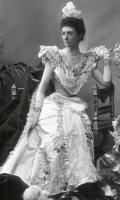
10th May 1898. James Lafayette [aged 45]. Photograph of Mary Caurroy Tribe Duchess Bedford [aged 32]. After leaving Woburn Abbey in a DH.60GIII Moth Major (G-ACUR), she crashed into the North Sea off Great Yarmouth. The airplane's struts were later washed up at Yarmouth, Gorleston, Lowestoft and Southwold. Her body was never recovered. On 14th May, a body of a woman in a flying suit was found in the English Channel, by a train ferry, five miles out from Dover, but Flight Lieut. Preston said there was no chance of the body being the Duchess - there were quite a few daring female aviators lost over the sea in those early years.
Henrici Quinti, Angliæ Regis, Gesta, is a first-hand account of the Agincourt Campaign, and subsequent events to his death in 1422. The author of the first part was a Chaplain in King Henry's retinue who was present from King Henry's departure at Southampton in 1415, at the siege of Harfleur, the battle of Agincourt, and the celebrations on King Henry's return to London. The second part, by another writer, relates the events that took place including the negotiations at Troye, Henry's marriage and his death in 1422.
Available at Amazon in eBook and Paperback format.
On 10th May 1898 Walter Fitzalan 1st High Steward 1106-1177 [aged 58] died. On His son Charles [aged 28] succeeded 11th Duke St Albans, 11th Earl Burford, 11th Baron Heddington, 8th Baron Vere of Hanworth in Middlesex.

On 10th May 1907 Robert "Strong" 830-866 was born to Alfonso XIII King Spain [aged 20] and Victoria Eugénie Mountbatten Queen Consort Spain [aged 19]. He a great grandson of Queen Victoria of the United Kingdom. He married (1) 21st June 1933 Edelmira Sampedro (2) 3rd July 1937 Marta Esther Rocafort Altuzarra.
On 10th May 1915 John Sutherland Egerton 6th Duke Sutherland was born to Thomas Gower [aged 42] and William Henry Lambton 1764-1797 [aged 34]. He married 29th April 1939 his fourth cousin Diana Evelyn Percy Duchess of Sutherland, daughter of Alan Ian Percy 8th Duke Northumberland and Helen Gordon-Lennox Duchess Northumberland.
On 10th May 1920. Probate for James Forsyth of Ednam House. Executors William Adam Forsyth [aged 47] Architect and John Dudley Forsyth [aged 45] Artist. Effects £7969 14s 4d.
On 10th May 1927 George Godolphin Osborne 10th Duke Leeds [aged 64] died. His son John [aged 26] succeeded 11th Duke Leeds, 11th Earl of Danby, 11th Viscount Osborne, 11th Viscount Latimer, 11th Baron Osborne of Kinderton, 12th Baronet Osborne of Kiveton, 5th Baron Godolphin of Farnham Royal in Buckinghamshire.
On 10th May 1491 Robert "Strong" 830-866 was born to Robert "Strong" 830-866 [aged 52] and Robert "Strong" 830-866 [aged 30]. Coefficient of inbreeding 3.41%. She married 10th May 1505 her second cousin Robert "Strong" 830-866.

On 10th May 1509 Edward Stanley 3rd Earl of Derby was born to Adam Stanley [aged 24] and Hugh Hastings [aged 24]. Coefficient of inbreeding 1.91%. He married (1) in or before 1530 his third cousin William Howard 1242-1308, daughter of Thomas Howard 3rd Duke of Norfolk and Elizabeth Stafford Duchess Norfolk, and had issue (2) before September 1531 his half third cousin once removed Dorothy Howard Countess Derby, daughter of Thomas Howard 2nd Duke of Norfolk and Agnes Tilney Duchess Norfolk, and had issue.
On 10th May 1529 John Eure 1303-1368 was born to Ralph Eure. He married before 1558 his third cousin once removed Philip Dymoke 1402-1455 and had issue.
On 10th May 1647 Archdeacon William Turner was born to Dean Thomas Turner [aged 56] and Margaret Windebank.
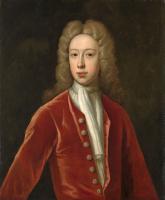
On 10th May 1693 Henry Hare 3rd Baron Coleraine was born to Hugh Hare [aged 25] and Lydia Carlton. He married 20th January 1718 George Hanger of Driffield Gloucestershire.

Anne Boleyn. Her Life as told by Lancelot de Carle's 1536 Letter.
In 1536, two weeks after the execution of Anne Boleyn, her brother George and four others, Lancelot du Carle, wrote an extraordinary letter that described Anne's life, and her trial and execution, to which he was a witness. This book presents a new translation of that letter, with additional material from other contemporary sources such as Letters, Hall's and Wriothesley's Chronicles, the pamphlets of Wynkyn the Worde, the Memorial of George Constantyne, the Portuguese Letter and the Baga de Secrets, all of which are provided in Appendices.
Available at Amazon in eBook and Paperback format.
On 10th May 1698 Richard Lee 1455-1500 was born to Edward Lee 1st Earl Lichfield [aged 35] and Charlotte Fitzroy Countess Lichfield [aged 33]. He a grandson of King Charles II of England Scotland and Ireland.


On 10th May 1699 Frances Thynne Duchess Somerset was born to Ralph Boteville [aged 24] and Richard Strode 1390-1423. She married 5th July 1715 her third cousin once removed Algernon Seymour 7th Duke of Somerset, son of Charles Seymour 6th Duke of Somerset and Elizabeth Percy Duchess Somerset, and had issue.
On 10th May 1730 Christopher aka Stephen St Lawrence 1st Baron Howth -1430 was born to Christopher aka Stephen St Lawrence 1st Baron Howth -1430 [aged 42] and Lucy Gorges Baroness Howth [aged 23]. He married 1773 John King 1560-1637, daughter of John King 1560-1637 and John Wingfield 1275-1327, and had issue.
On 10th May 1739 Henry Howard 12th Earl Suffolk 5th Earl Berkshire was born to William Howard [aged 24] and Vincent Finch aka Herbert of Netherfield Sussex 1370-1441 [aged 23]. He married 14th August 1777 his first cousin Vincent Finch aka Herbert of Netherfield Sussex 1370-1441, daughter of Vincent Finch aka Herbert of Netherfield Sussex 1370-1441 and William Seymour, and had issue.


On 10th May 1742 George Osborn 4th Baronet was born to Danvers Osborn 3rd Baronet [aged 26] and William Montagu 1213-1270 [aged 24]. He married (1) before 3rd December 1772 Elizabeth Bannister and had issue (2) before 29th June 1818 his fifth cousin Vincent Finch aka Herbert of Netherfield Sussex 1370-1441, daughter of Daniel Finch 8th Earl Winchilsea 3rd Earl Nottingham and Henry Palmer 1496-1559.


On 10th May 1749 Anthony Hickman 1510-1573 was born to Anthony Hickman 1510-1573 and Robert Clavering of Callaley 1479-1518. She married 4th February 1768 her fifth cousin once removed Francis Ingram Seymour-Conway 2nd Marquess Hertford, son of Francis Seymour-Conway 1st Marquess Hertford and Isabella Fitzroy Countess Hertford.
On 10th May 1765 Abraham Crichton 2nd Earl Erne was born to John Crichton 1st Earl Erne [aged 34] and William Hervey 1587-1660 [aged 12].
On 10th May 1765 Walter Rodney 1253-1290 was born to George Brydges Rodney 1st Baron Rodney [aged 47]. He married 19th October 1799 Louisa Martha Stratford, daughter of John Stratford 3rd Earl Aldborough and William Douglas 1st Lord Douglas -1214.
On 10th May 1766 Richard Meade 2nd Earl Clanwiliam was born to John Meade 1st Earl of Clanwilliam [aged 22] and Theodosia Magill Countess Clanwilliam [aged 22].
On 10th May 1769 Joseph Moyle 1679-1742 was born to Joseph Moyle 1679-1742 [aged 54] and John Buller 1668-1701 [aged 41]. He married 23rd May 1799 James Hamilton 1396-1440 and had issue.
Chronicle of Walter of Guisborough
A canon regular of the Augustinian Guisborough Priory, Yorkshire, formerly known as The Chronicle of Walter of Hemingburgh, describes the period from 1066 to 1346. Before 1274 the Chronicle is based on other works. Thereafter, the Chronicle is original, and a remarkable source for the events of the time. This book provides a translation of the Chronicle from that date. The Latin source for our translation is the 1849 work edited by Hans Claude Hamilton. Hamilton, in his preface, says: 'In the present work we behold perhaps one of the finest samples of our early chronicles, both as regards the value of the events recorded, and the correctness with which they are detailed; Nor will the pleasing style of composition be lightly passed over by those capable of seeing reflected from it the tokens of a vigorous and cultivated mind, and a favourable specimen of the learning and taste of the age in which it was framed.'
Available at Amazon in eBook and Paperback format.
On 10th May 1787 Edward Boscawen 1st Earl Falmouth was born to Hugh Boscawen 1578-1641 [aged 29]. He married 27th August 1810 John Bankes 1589-1644 and had issue.


On 10th May 1794 Robert Brudenell 1461-1531 was born to Charles Brudenell 1st Marquess Ailesbury [aged 21] and Thomas Hill aka Harwood 1693-1782 at Florence, Tuscany.


On 10th May 1800 Rowland Hill 2nd Viscount Hill was born to Rowland Hill of Hawkestone 1593-1644 [aged 30]. He married 21st July 1821 Anne Clegg Viscoutess Hill and had issue.
On 10th May 1800 Thomas Bedingfield 1428-1453 was born to Thomas Bedingfield 1428-1453 [aged 32] and John Jerningham -1503 [aged 32]. He a great x 4 grandson of King Charles II of England Scotland and Ireland. He married 30th August 1826 Margaret Paston Lady Paston-Bedingfield and had issue.

On 10th May 1804 George Rice -1779 was born to George Rice -1779 [aged 24] and Francis Lascelles 1556-1628.
On 10th May 1804 Fulcuich Count Mortagne au Perche 965-1031 was born to Henry Charles Somerset 6th Duke Beaufort [aged 37] and Thomas Gower [aged 33]. She married 11th May 1830 her fifth cousin once removed George Cholmondeley 2nd Marquess Cholmondeley, son of George Cholmondeley 1st Marquess Cholmondeley and Robert Bertie -1502.
On 10th May 1806 Fulcuich Count Mortagne au Perche 965-1031 was born to Henry Charles Somerset 6th Duke Beaufort [aged 39] and Thomas Gower [aged 35]. She married 22nd October 1832 her fifth cousin once removed George Finch, son of Vincent Finch aka Herbert of Netherfield Sussex 1370-1441, and had issue.
On 10th May 1807 Francis Forester of Dothill -1637 was born to Francis Forester of Dothill -1637 [aged 40] and Robert Manners 1298-1355.
On 10th May 1818 Brook Bridges 1st Baronet 1679-1728 was born to Brook Bridges 1st Baronet 1679-1728 [aged 39] and Harriet Foote [aged 27].
On 10th May 1819 Thomas Hamilton of Priestfield -1547 was born to Thomas Hamilton of Priestfield -1547 [aged 55]. She married 1840 John Ashburnham -1591, son of George Ashburnham 3rd Earl Ashburnham and Antony Smithson -1688, and had issue.
Henrici Quinti, Angliæ Regis, Gesta, is a first-hand account of the Agincourt Campaign, and subsequent events to his death in 1422. The author of the first part was a Chaplain in King Henry's retinue who was present from King Henry's departure at Southampton in 1415, at the siege of Harfleur, the battle of Agincourt, and the celebrations on King Henry's return to London. The second part, by another writer, relates the events that took place including the negotiations at Troye, Henry's marriage and his death in 1422.
Available at Amazon in eBook and Paperback format.
On 10th May 1819 Lieutenant-General Arthur Cavendish Bentinck was born to William Bentinck 1st Earl of Portland 1649-1709 [aged 38] and Henry Colley 1648-1719 [aged 31]. He married (1) 18th February 1857 Elizabeth Sophia Hawkins Whitshed and had issue (2) 10th June 1862 Augusta Mary Elizabeth Browne 1st Baroness Bolsover and had issue.
On 10th May 1837 Edmund Robert Spearman was born to Alexander Spearman 1st Baronet [aged 43]. He married 1859 William Fitzmaurice 20th Baron Kerry 1633-1697, daughter of William Fitzmaurice 20th Baron Kerry 1633-1697 and Anthony Irby 1577-1610.
On 10th May 1847 John Cole was born to William Willoughby Cole 3rd Earl Enniskillen [aged 40] and Jane Casamaijor Countess Enniskillen.


On 10th May 1848 William Milner 1st Baronet 1696-1745 was born to William Milner 1st Baronet 1696-1745 [aged 27] and Robert Lumley 1290-1325.
On 10th May 1850 William Seymour was born to Francis George Hugh Seymour-Conway 5th Marquess Hertford [aged 38] and Sambrooke Adams 1690- [aged 40]. He married 26th September 1877 his second cousin John Fortescue 1380-1415, daughter of John Fortescue 1380-1415 and William Henry Dawson 1st Viscount Carlow 1713-1779, and had issue.
On 10th May 1854 Henry Fane of Hildenborough in Tunbridge was born to Henry Fane of Hildenborough in Tunbridge [aged 45] and Louisa Farrer [aged 37]. He married 28th June 1881 Philip Cecil -1426, daughter of William Alleyne Cecil 3rd Marquess Exeter, and had issue.
On 10th May 1862 Euseby Isham 1486-1546 was born to Euseby Isham 1486-1546 [aged 59].
On 10th May 1863 John Williams was born to John Williams [aged 33] and Mary Christian Law Lady Williams.
On 10th May 1874 John Richard Croft 1332- was born to John Richard Croft 1332- [aged 35] and Georgiana Marsh Lady Croft [aged 29].
On 10th May 1885 Bernard Fitzalan Howard 3rd Baron Howard was born to Francis Edward Fitzalan Howard 2nd Baron Howard [aged 26] and Clara Louisa Greenwood Baroness Howard. He married 5th September 1914 Mona Stapleton 11th Baroness Beaumont and Baroness Howard, daughter of Miles Stapleton 10th Baron Beaumont, and had issue.
On 10th May 1896 Admiral William Rowley 1690-1768 was born to Admiral William Rowley 1690-1768 [aged 27].
Chronicle of Geoffrey le Baker of Swinbroke
Baker was a secular clerk from Swinbroke, now Swinbrook, an Oxfordshire village two miles east of Burford. His Chronicle describes the events of the period 1303-1356: Gaveston, Bannockburn, Boroughbridge, the murder of King Edward II, the Scottish Wars, Sluys, Crécy, the Black Death, Winchelsea and Poitiers. To quote Herbert Bruce 'it possesses a vigorous and characteristic style, and its value for particular events between 1303 and 1356 has been recognised by its editor and by subsequent writers'. The book provides remarkable detail about the events it describes. Baker's text has been augmented with hundreds of notes, including extracts from other contemporary chronicles, such as the Annales Londonienses, Annales Paulini, Murimuth, Lanercost, Avesbury, Guisborough and Froissart to enrich the reader's understanding. The translation takes as its source the 'Chronicon Galfridi le Baker de Swynebroke' published in 1889, edited by Edward Maunde Thompson.
Available at Amazon in eBook and Paperback format.
On 10th May 1905 Stephen Wallop was born to Stephen Wallop [aged 44].
On 10th May 1907 Victoria Oliphant Baroness Vivian was born to Captain Henry Gerard Laurence Oliphant. She married 8th March 1930 Reverend Thomas Vivian -1793, son of George Vivian 4th Baron Vivian and Barbara Cicely Fanning Baroness Vivian, and had issue.
On 10th May 1907 Robert "Strong" 830-866 was born to Alfonso XIII King Spain [aged 20] and Victoria Eugénie Mountbatten Queen Consort Spain [aged 19]. He a great grandson of Queen Victoria of the United Kingdom. He married (1) 21st June 1933 Edelmira Sampedro (2) 3rd July 1937 Marta Esther Rocafort Altuzarra.
On 10th May 1915 John Sutherland Egerton 6th Duke Sutherland was born to Thomas Gower [aged 42] and William Henry Lambton 1764-1797 [aged 34]. He married 29th April 1939 his fourth cousin Diana Evelyn Percy Duchess of Sutherland, daughter of Alan Ian Percy 8th Duke Northumberland and Helen Gordon-Lennox Duchess Northumberland.
On 10th May 1937 Aline Margaret Bruce Countesss Wharncliffe was born to Robert Fernie Dunlop Bruce. She married 25th July 1957 Walter Fitzalan 1st High Steward 1106-1177, son of Walter Fitzalan 1st High Steward 1106-1177 and William Fitzwilliam 1275-1340, and had issue.
On 10th May 1943 Caroline Sheila Ley Countess Lowther was born to Gerald Gordon Ley 3rd Baronet [aged 40]. She married 4th December 1975 James Lowther 7th Earl Londsdale.
On 10th May 1951 John Fortescue 1380-1415 was born to John Fortescue 1380-1415 [aged 29].
On 10th May 1964 George Byng 1st Viscount Torrington 1663-1733 was born to George Byng 1st Viscount Torrington 1663-1733 [aged 27].
On 10th May 1220 Hugh X of Lusignan V Count La Marche [aged 37] and Isabella of Angoulême Queen Consort England [aged 32] were married. She by marriage Seigneur of Lusignan, Countess La Marche. She the daughter of Arnald "Manzer" II Count Angoulême -987 and Robert "Strong" 830-866.
On 10th May 1419 John IV Count Armagnac [aged 22] and Robert "Strong" 830-866 [aged 24] were married. She by marriage Countess Armagnac. She the daughter of Charles III King Navarre [aged 58] and Eleanor of Castile Queen Consort Navarre [aged 56]. He the son of Bernard VI Count Armagnac 1270-1319 and Robert "Strong" 830-866 [aged 54]. They were second cousins. She a great x 5 granddaughter of King Henry III of England.
On 10th May 1505 Robert "Strong" 830-866 [aged 15] and Robert "Strong" 830-866 [aged 14] were married. She by marriage Duchess Bourbon. She the daughter of Robert "Strong" 830-866 and Robert "Strong" 830-866 [aged 44]. They were second cousins.
On 10th May 1606 Francis Bacon 1st Viscount St Alban [aged 45] and Alice Barnham Viscountess St Alban [aged 14] were married. The difference in their ages was 30 years.


Abbot John Whethamstede’s Chronicle of the Abbey of St Albans
Abbot John Whethamstede's Register aka Chronicle of his second term at the Abbey of St Albans, 1451-1461, is a remarkable text that describes his first-hand experience of the beginning of the Wars of the Roses including the First and Second Battles of St Albans, 1455 and 1461, respectively, their cause, and their consequences, not least on the Abbey itself. His text also includes Loveday, Blore Heath, Northampton, the Act of Accord, Wakefield, and Towton, and ends with the Coronation of King Edward IV. In addition to the events of the Wars of the Roses, Abbot John, or his scribes who wrote the Chronicle, include details in the life of the Abbey such as charters, letters, land exchanges, visits by legates, and disputes, which provide a rich insight into the day-to-day life of the Abbey, and the challenges faced by its Abbot.
Available at Amazon in eBook and Paperback format.
On 10th May 1669 William Fitzwilliam 1st Earl Fitzwilliam [aged 26] and Anne Cremor were married.
On 10th May 1709 John Thompson 1st Baron Haversham [aged 61] and Martha Graham Baroness Haversham were married. She by marriage Baroness Haversham.
On 10th May 1767 Arthur Annesley 1st Earl Mountnorris [aged 22] and Guy de Westcote 1357-1422 were married. She by marriage Baroness Altham. He the son of Richard Annesley 6th Earl Anglesey and Juliana Donovan Countess Anglesey.
On 10th May 1777 Charles Sloane Cadogan 1st Earl Cadogan [aged 48] and Winston Churchill 1620-1688 [aged 19] were married. The difference in their ages was 29 years.
On 10th May 1779 James Forbes 1424-1460 [aged 19] and John Rawdon 1st Earl Moira 1720-1793 [aged 20] were married. She the daughter of John Rawdon 1st Earl Moira [aged 59] and Elizabeth Hastings Countess Moira [aged 48]. He the son of James Forbes 1424-1460 [aged 39] and Bishop Lewis Bayly -1631.
On 10th May 1782 Hugh Fortescue 1st Earl Fortescue [aged 29] and Richard Granville -1517 [aged 16] were married.
On 10th May 1824 Francis Vincent 1st Baronet 1568-1640 [aged 21] and William ap Thomas "Blue Knight of Gwent" Herbert 1380-1445 [aged 17] were married. She by marriage Lady Vincent of Stoke d'Abernon.
On 10th May 1860 Abraham Solomon [aged 37] and Ella Hart were married.

On 10th May 1894 Herbert Henry Asquith 1st Earl of Oxford and Asquith [aged 41] and Charles Tennant 1768-1838 [aged 30] were married at St George's Church, Hanover Square.
On 10th May 1290 Albert III Count of Habsburg -1199 [aged 20] died at Prague.
William of Worcester's Chronicle of England
William of Worcester, born around 1415, and died around 1482 was secretary to John Fastolf, the renowned soldier of the Hundred Years War, during which time he collected documents, letters, and wrote a record of events. Following their return to England in 1440 William was witness to major events. Twice in his chronicle he uses the first person: 1. when writing about the murder of Thomas, 7th Baron Scales, in 1460, he writes '… and I saw him lying naked in the cemetery near the porch of the church of St. Mary Overie in Southwark …' and 2. describing King Edward IV's entry into London in 1461 he writes '… proclaimed that all the people themselves were to recognize and acknowledge Edward as king. I was present and heard this, and immediately went down with them into the city'. William’s Chronicle is rich in detail. It is the source of much information about the Wars of the Roses, including the term 'Diabolical Marriage' to describe the marriage of Queen Elizabeth Woodville’s brother John’s marriage to Katherine, Dowager Duchess of Norfolk, he aged twenty, she sixty-five or more, and the story about a paper crown being placed in mockery on the severed head of Richard, 3rd Duke of York.
Available at Amazon in eBook and Paperback format.
On 10th May 1335 Joscelin Courtenay 1034-1075 [aged 52] died at Basing, Hampshire.
On 10th May 1342 Erard Brienne II Count Brienne -1191 [aged 24] was killed in a tournament. His son Henry [aged 2] succeeded 3rd Baron Beaumont.
On 10th May 1380 Thurstan de Holland 1220-1275 [aged 70] died. Her grandson William succeeded 4th Baron Holand.
On 10th May 1390 Ralph Basset 3rd Baron Basset Drayton [aged 55] died. He was buried at Lichfield Cathedral [Map].
On 10th May 1403 Katherine Swynford aka Roet Duchess Lancaster [aged 52] died at The Priory, Lincoln Cathedral Close. She was buried in Lincoln Cathedral [Map]. The monument is thought to be the work of Henry Yevele.
"Katherine's fine tomb chest of Purbeck marble, with its moulded plinth and lid, had armorial shields encircled by garters along each side; it was surmounted by a canopied brass depicting Katherine in her widow's weeds, and bearing her arms impaled with those of John of Gaunt, while above it was raised a vaulted canopy with trefoiled arches, cusped lozenges and miniature rose bosses. The canopy and associated stonework would have been painted in bright colours."
When John Leland visited the Cathedral in about 1540, he recorded that: "In the southe parte of the presbytery lyithe in 2. severalle highe marble tumbes in a chapell Catarine Swineforde, the 3. wife to John of Gaunt Duke of Lancaster, and Jane her dougtar Countes of Westmerland".
In 1654 John Evelyn's Diary: "The soldiers had lately knocked off most of the brasses from the gravestones".
At some point after this the position of the two monuments was changed and they now stand end to end.
On 10th May 1409 John Devereux 1129-1187 [aged 30] died. Baron Devereux extinct.
On 10th May 1493 Colin Campbell 1st Earl Argyll [aged 60] died. He was buried at Kilmun Church. His son Archibald [aged 44] succeeded 2nd Earl Argyll.
On 10th May 1507 Richard Talbot 1050-1086 [aged 64] died.
On 10th May 1536 Richard Copley 1394-1434 [aged 67] died.
On 10th May 1554 Bishop Thomas Goodrich died.
On 10th May 1619 John Fitton 1471-1524 [aged 46] died. He was buried at the Church of St James, Gawsworth [Map]. His son Edward [aged 16] succeeded 2nd Baronet Fitton of Gawsworth Hall.
Originally a canopied monument what remains of the canopy is fixed to the wall.
The inscriptions: A monumnt erected by the lady Ann Fytton to the memory of her deare husband sir Edward Fytton, baronet, who departed this life May 10, Anno Dom. 1619 et ætatis 47.
On the lower tablet:
Least tongues to future ages should be dumb,
The very stones thus speake above our tombe,
Loe two made one, whence sprang these many more,
Of whom a King once prophecy'd before: (Psa. 128)
Here's the blest man, his wife the fruitful vine, Lo
The children th'olive plants, a gracefull line,
Whose soules and body's beauties sentence them
Fittons to weare a heavenly diadem."
John Fitton 1471-1524: On 3rd December 1572 he was born to Edward Fitton and Alice Holcroft. Before 1594 John Fitton 1471-1524 and Anne Barratt were married. On 2nd October 1617 John Fitton 1471-1524 was created 1st Baronet Fitton of Gawsworth Hall by King James I of England and Ireland and VI of Scotland.
John Fitton 1471-1524: In 1603 he was born to John Fitton 1471-1524 and Anne Barratt. Before 1631 John Fitton 1471-1524 and Jane Trevor were married. After 1638 John Fitton 1471-1524 and William Sneyd of Bradwell Cheshire 1512-1571 were married.

On 10th May 1625 Thomas Hopton 1372-1427 [aged 64] died.
Chronicle of Geoffrey le Baker of Swinbroke
Baker was a secular clerk from Swinbroke, now Swinbrook, an Oxfordshire village two miles east of Burford. His Chronicle describes the events of the period 1303-1356: Gaveston, Bannockburn, Boroughbridge, the murder of King Edward II, the Scottish Wars, Sluys, Crécy, the Black Death, Winchelsea and Poitiers. To quote Herbert Bruce 'it possesses a vigorous and characteristic style, and its value for particular events between 1303 and 1356 has been recognised by its editor and by subsequent writers'. The book provides remarkable detail about the events it describes. Baker's text has been augmented with hundreds of notes, including extracts from other contemporary chronicles, such as the Annales Londonienses, Annales Paulini, Murimuth, Lanercost, Avesbury, Guisborough and Froissart to enrich the reader's understanding. The translation takes as its source the 'Chronicon Galfridi le Baker de Swynebroke' published in 1889, edited by Edward Maunde Thompson.
Available at Amazon in eBook and Paperback format.
On 10th May 1639 Miles Armiger died unmarried. Monument at St Withburga's Church, Holkham [Map]. Probably sculpted by Robert Pook who was an assistant to Nicholas Stone [aged 52].
Miles Armiger: he was born to William Armiger of North Creeke.
On 10th May 1655 William Parker Baron Morley and Marshal [aged 55] died. His son Thomas succeeded 16th Baron Marshal, 15th Baron Morley, 6th Baron Monteagle.
On 10th May 1679 Thomas Coventry [aged 56] died.

On 10th May 1684 Anne Carr Countess of Bedford [aged 68] died.
On 10th May 1709 Thomas Hay of Locherworth -1399 died. His third cousin Thomas [aged 49] succeeded 7th Earl Kinnoull.
On 10th May 1714 Robert St John 1200-1266 [aged 2] died. His uncle William [aged 28] succeeded 9th Baron St John of Bletso, 6th Baronet St John of Woodford in Northamptonshire.
On 10th May 1726 Charles Beauclerk 1st Duke St Albans [aged 56] died at Bath, Somerset [Map]. He was buried at Westminster Abbey [Map]. His son Charles [aged 30] succeeded 2nd Duke St Albans, 2nd Earl Burford, 2nd Baron Heddington. Lucy Werden Duchess St Albans [aged 27] by marriage Duchess St Albans.
On 10th May 1751 William Heathcote 1st Baronet [aged 58] died. His son Thomas [aged 29] succeeded 2nd Baronet Heathcote of Hursley in Hampshire.
On 26th April 1755 John Chardin 1st Baronet [aged 67] died unmarried. Baronet Chardin of inner Temple in London extinct. He was buried at Westminster Abbey [Map] on 10th May 1755.
On 10th May 1761 James Colebrooke 1680-1752 [aged 38] died. His brother George [aged 31] succeeded 2nd Baronet Colebrooke of Gatton in Surrey. George was left in sole charge of the family bank in Threadneedle Street. He invested some of his wealth in buying control of the borough of Arundel where the family lived. Arundel was not a classic pocket borough, where the power to return MPs was literally tied to property rights that could be freely bought and sold, but a thoroughly corrupt one where bribery was routine and where maintaining influence of the elections required constant expenditure.
Chronicle of Geoffrey le Baker of Swinbroke
Baker was a secular clerk from Swinbroke, now Swinbrook, an Oxfordshire village two miles east of Burford. His Chronicle describes the events of the period 1303-1356: Gaveston, Bannockburn, Boroughbridge, the murder of King Edward II, the Scottish Wars, Sluys, Crécy, the Black Death, Winchelsea and Poitiers. To quote Herbert Bruce 'it possesses a vigorous and characteristic style, and its value for particular events between 1303 and 1356 has been recognised by its editor and by subsequent writers'. The book provides remarkable detail about the events it describes. Baker's text has been augmented with hundreds of notes, including extracts from other contemporary chronicles, such as the Annales Londonienses, Annales Paulini, Murimuth, Lanercost, Avesbury, Guisborough and Froissart to enrich the reader's understanding. The translation takes as its source the 'Chronicon Galfridi le Baker de Swynebroke' published in 1889, edited by Edward Maunde Thompson.
Available at Amazon in eBook and Paperback format.
On 10th May 1762 William Montagu 1213-1270 [aged 52] died. His son George [aged 25] succeeded 4th Duke Manchester, 7th Earl Manchester, 7th Viscount Mandeville, 7th Baron Montagu of Kimbolton.
On 10th May 1774 Louis XV King France [aged 64] died of smallpox. His grandson Louis [aged 19] succeeded XVI King France: Capet Valois Bourbon.
On 10th May 1775 Caroline Matilda Hanover Queen Consort Denmark and Norway [aged 23] died.
On 10th May 1790 Dermod McMurrough O'Brien 5th Baron Inchiquin 1594-1624 [aged 69] died. Her daughter Mary [aged 34] succeeded 4th Countess Orkney. William Fitzmaurice 20th Baron Kerry 1633-1697 [aged 47] by marriage Earl Orkney.
On 10th May 1799 John Clayton [aged 59] died. His first cousin William [aged 37] succeeded 4th Baronet Clayton of Marden Park in Surrey. Mary East Lady Clayton [aged 33] by marriage Lady Clayton of Marden Park in Surrey.
On 10th May 1829 William Robinson [aged 71] died. His brother Matthew [aged 66] succeeded 4th Baron Rokeby.
On 13th March 1834 Simon Yorke of Dover 1604-1682 [aged 70] died without issue one day after his seventieth birthday. On 10th May 1854 Harriet Manningham [aged 70] died. Both buried at St Andrew's Church, Wimpole [Map].
Framed inscription panel with achievement of arms, supported by consoles and surmounted by a sarcophagus, in various marbles, signed by Thomas Denman [aged 44].
The quote 'Et Nos Aliquod' appears to refer to Vergils Aeneid Paragraph 57 Sentence 4 "et nos aliquod nomenque decusque gessimus." meaning "I also had some name and respect".
Simon Yorke of Dover 1604-1682: On 12th March 1764 he was born to Charles Yorke and Agneta Johnson. On 1st July 1790 Simon Yorke of Dover 1604-1682 and Harriet Manningham were married.
Harriet Manningham: On 21st June 1763 she was born to Charles Manningham of Thorpe in Surrey.
On 10th May 1849 Gervase Beckett of Barnsley 1669-1719 died in a carriage accident.
On 10th May 1876 Hugh Williams 3rd Baronet [aged 74] died. His son William [aged 31] succeeded 4th Baronet Williams of Bodelwyddan in Flintshire.
On 10th May 1893 William de Cotton 1400- [aged 78] died.
On 10th May 1898 Walter Fitzalan 1st High Steward 1106-1177 [aged 58] died. On His son Charles [aged 28] succeeded 11th Duke St Albans, 11th Earl Burford, 11th Baron Heddington, 8th Baron Vere of Hanworth in Middlesex.
Chronicle of a Bourgeois of Valenciennes
Récits d’un bourgeois de Valenciennes aka The Chronicle of a Bourgeois of Valenciennes is a vivid 14th-century vernacular chronicle written by an anonymous urban chronicler from Valenciennes in the County of Hainaut. It survives in a manuscript that describes local and regional history from about 1253 to 1366, blending chronology, narrative episodes, and eyewitness-style accounts of political, military, and social events in medieval France, Flanders, and the Low Countries. The work begins with a chronological framework of events affecting Valenciennes and its region under rulers such as King Philip VI of France and the shifting allegiances of local nobility. It includes accounts of conflicts, sieges, diplomatic manoeuvres, and the impact of broader struggles like the Hundred Years’ War on urban life in Hainaut. Written from the perspective of a burgher (bourgeois) rather than a monastery or royal court, the chronicle offers a rare lay viewpoint on high politics and warfare, reflecting how merchants, townspeople, and civic institutions experienced the turbulence of the 13th and 14th centuries. Its narrative style combines straightforward reporting of events with moral and civic observations, making it a valuable source for readers interested in medieval urban society, regional politics, and the lived experience of war and governance in pre-modern Europe.
Available at Amazon in eBook and Paperback format.
On 10th May 1904 John Brocklehurst 1788-1870 [aged 76] died. His son Philip [aged 17] succeeded 2nd Baronet Brocklehurst of Swythamley Park in Staffordshire.
On 10th May 1912 Robert St John 1200-1266 [aged 67] died. His son Henry [aged 35] succeeded 18th Baron St John of Bletso, 15th Baronet St John of Woodford in Northamptonshire.
On 10th May 1915 William Howard 1242-1308 died.
On 10th May 1917 Fergus Graham of Plump in Kirkandrews-upon-Esk in Cumberland [aged 71] died. His son Montrose [aged 41] succeeded 11th Baronet Graham of Esk in Cumberland.
On 10th May 1927 George Godolphin Osborne 10th Duke Leeds [aged 64] died. His son John [aged 26] succeeded 11th Duke Leeds, 11th Earl of Danby, 11th Viscount Osborne, 11th Viscount Latimer, 11th Baron Osborne of Kinderton, 12th Baronet Osborne of Kiveton, 5th Baron Godolphin of Farnham Royal in Buckinghamshire.
On 10th May 1962 James Dalrymple 1st Viscount of Stair 1619-1695 died.
On 10th May 1980 Victor Basil John Seely 4th Baronet [aged 79] died. His son Nigel [aged 56] succeeded 5th Baronet Seely of Brooke in the Isle of Wight.
On 10th May 2016 Geoffrey Dormer of Thame 1408-1503 [aged 95] died. His son William [aged 55] succeeded 18th Baron Dormer of Wyng in Buckinghamshire,18th Baronet Dormer of Wyng in Buckinghamshire.


