

17 May is in May.
1220 Westminster Coronation of Henry III
1521 Trial and Execution of the Duke of Buckingham
1535 Execution of the Carthusians
1536 Execution of George Boleyn, Brereton, Norris, Smeaton and Weston
The Second Battle of Ramla was foight on 17th May 1102 between the Kingdom of Jerusalem and the Fatimids of Egypt at which the Crusader army defeated the army of Sharaf al-Ma'ali.
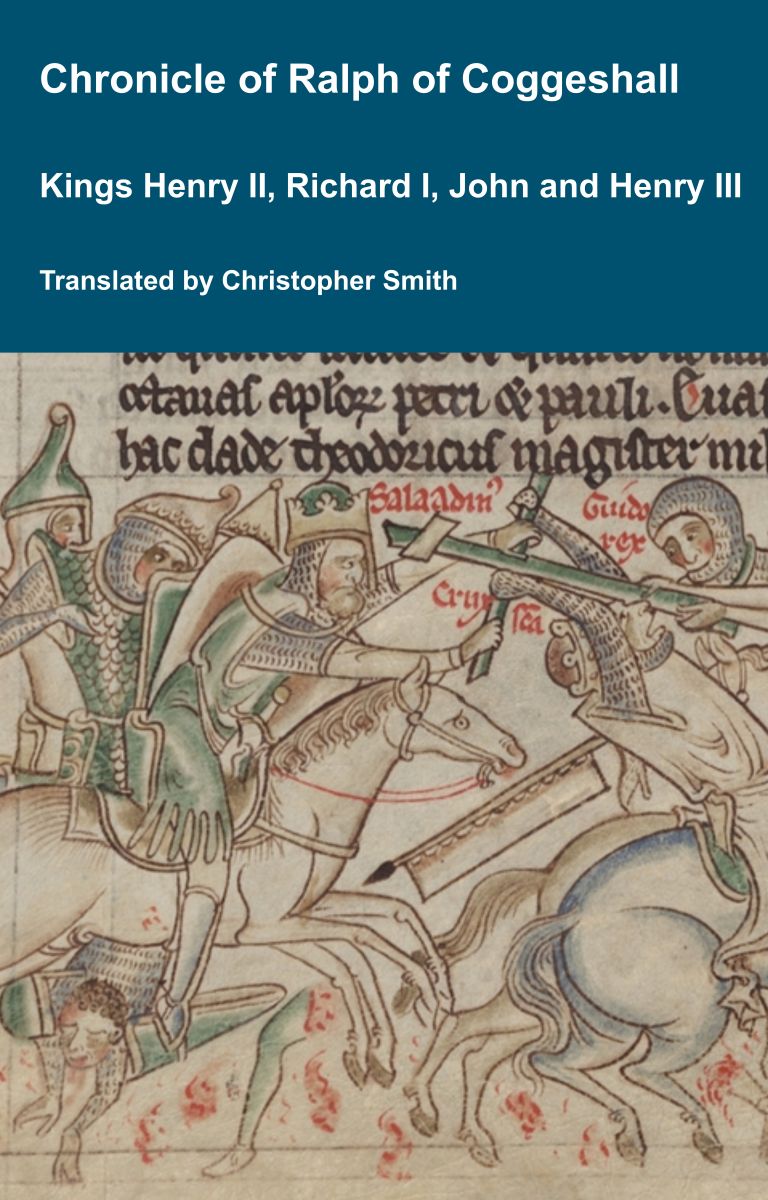 Chronicum Anglicanum by Ralph Coggeshall. The barons of England defied their king and renounced their homage to him; after seizing Northampton, they attacked certain of the king's castles and boldly plundered his lands. Then, having made alliances through envoys with the citizens of London, and with the earl of Salisbury coming to London, on the sixteenth day before the Kalends of June [17th May 1215], on Sunday morning, they advanced in ranks to the city, and, while the citizens were occupied in divine service, they entered without resistance. Having entered, they seized the king's supporters whom they found, and plundered their goods; they invaded the houses of the Jews, broke open the shops and coffers, and, long after their purses had been emptied in this religious expedition, they abundantly refilled them. Then Robert fitzWalter, marshal of the army of God and Holy Church, and Geoffrey de Mandeville, earl of Essex and Gloucester, zealously applied themselves every day to rebuilding the city walls with the stone houses of the Jews; but the Tower of London they did not capture, though a few within resisted bravely. And when it spread far and wide throughout the kingdom that the barons had occupied the royal metropolis, all (except the earls of Warenne, Arundel, Chester, Pembroke, Ferrers, and Salisbury, and the barons William Brewer and a few others, although, in fact, the knights of both those earls and those barons had all gone over to the barons' side), all the rest, I say, day by day flocked in crowds into the army of God, until four very powerful armies were organized throughout England, and so great a terror beset the king that he no longer dared go anywhere beyond Windsor.
Barones Angliæ regem suum diffidant et ei homagia sua resignant; occupata Norhantona, quædam castella regis invadunt, prædas ex prædiis ejus viriliter diripiunt. Inde, pactis confoederationibus per internuncios cum civibus Londoniæ, et comite Saresberiæ adveniente Londoni, XVI kalendas Junii, die Dominica mane, dispositis agminibus ad civitatem accedunt, et civibus ad officium divinum occupatis, sine contradictione irruptionem faciunt. Ingressi vero, regios fautores quos invenerunt, ceperunt et eorum bona diripuerunt ; Judæorum domos invaserunt; apothecas et scrinia confregerunt, et exhaustas multo tempore in hac expeditione religiosa crumenas abunde refarcierunt. Inde Robertus filius Walteri, marescallus exercitus Domini et sanctæ ecclesiæ, et Gaufridus de Mandaville, comes Estsexiæ et Glowecestriæ, instaurandis muris civitatis ex lapideis domibus Judæorum quotidie vigilanter intendunt; turrem tamen Londoniæ non acceperunt, paucis licet intus viriliter resistentibus. Cumque per regnum longe lateque percrebuisset quod barones regiam metropolim occupassent, omnes, (exceptis comitibus Warennæ, Arundelli, Cestriæ, Penbroc, Ferrariis, et Saresberiæ, et baronibus Willelmo Briwere aliisque paucis, quorum tamen, tam comitum quam baronum, milites omnes in partem baronum transierant,) cæteri, inquam omnes, de die in diem catervatim in exercitum Dei transierunt, donec ordinarentur per Angliam quatuor fortissimi exercitus, tantusque terror egem obsideret, ut jam extra Windleshoram nusquam progredi auderet.
On 17th May 1220 Henry [aged 12] was crowned III King of England at Westminster Abbey [Map] since the Pope didn't consider the earlier Gloucester Coronation of Henry III to have been performed correctly. Archbishop Stephen Langton [aged 70] presided.
Chronicum Anglicanum by Ralph Coggeshall. In the same year [1220], on the day of Pentecost, namely the sixteenth day before the Kalends of June [17th May 1220], Henry, king of England, the son of King John, was crowned1 at Westminster by Lord Stephen Langton [aged 70], archbishop of Canterbury, in the presence of Lord Pandulf the legate, and of bishops and other prelates and earls and magnates of England. By that same archbishop it was there proclaimed that the taking of the cross should be preached, and that the canonization of Saint Hugh the bishop should be celebrated on the fifteenth day before the Kalends of December [17th November 1220].
Eodem anno, die Pentecosten, videlicet XVI kalendarum Junii, coronatur Henricus rex Angliæ, filius regis Johannis, apud Westmonasterium, a domno Stephano de Langetune, Cantuariensi archiepiscopo, præsentibus domno Pandulfo legato, et episcopis et aliis prælatis et comitibus et majoribus Angliæ; a quo archiepiscopo prædicatur ibidem crucis signatio, et Sancti Hugonis episcopi canonizatio celebranda, XV kalendas Decembris.
Note 1. King Henry III's second coronation. His first had taken place at Gloucester in October 1216, officiated by Cardinal Guala Bicchieri [aged 70], the papal legate, when London was held by rebels.
Roger of Wendover: "In the year of our Lord 1220, King Henry was at Christmas at Marlborough, still under the guardianship of Peter, Bishop of Winchester. In that same year the same king was crowned at Westminster, on the holy day of Pentecost, by Stephen, Archbishop of Canterbury, in the presence of the clergy and people of the whole realm, on the sixteenth day before the Kalends of June (that is, May 17), in the fifth year of his reign. In testimony and memory of this event there went forth a royal command and proclamation that everyone, except those in holy orders, should wear garlands of flowers."
On 17th May 1296 Agnes Přemyslid Duchess Austria [aged 26] died.
Archaeologia Volume 35 1853 XXXIII. On the 17th [May 1358], a memorandum is made, that the Queen of Scotland [aged 36] was with the King at Haveryng.
A few visitors arrived between the 20th and the 23rd of May, but the injury to the manuscript has effaced their names.
On 17th May 1365 Louis "The Roman" Wittelsbach VI Duke Upper Bavaria [aged 37] died.
Life of Charles VI by a Monk of St Denis. On the seventeenth day of the month of May [1381], in the parvisENDNOTE1ENDNOTE of Notre-Dame and upon a place raised up from hewn wooden planks, he was set there; and, with knees bent and without a hood, seeking the benefit of absolution and offering wax votives for the Jewish children who had been baptized and then returned to their parents, he was absolved by the Bishop of Paris, with the rector and the doctors standing by. After a discourse had been delivered and the enormity of the crimes publicly proclaimed by the inquisitor of heretical depravity, the bishop, clothed in sacred vestments, condemned him publicly: as a supporter of Jewish perfidy, a despiser of the sacraments of the Church, and as one who, like a heretic, believed and taught heresy; and also as one who had repeatedly scorned the keys of the Church, by which he had incurred sentences of excommunication and had endured them for a year and more with a stubborn mind. Therefore he was condemned to perform penance perpetually on the bread of sorrow and the water of affliction.
Mensis namque maii decima septima die, in parviso Nostre Domine et in loco ex lignis dolatilibus sursum elevato constitutus, et flexis genibus, absque capucio, absolucionis beneficium requirens, proque pueris Judeorum baptizatis et parentibus re-stitutis vota cerea offerens, ab episcopo Parisiensi, rectore et doctoribus astantibus absolvitur. Peractaque collacione ac enormitate casuum per inquisitorem heretice pravitatis publice promulgata, ab episcopo sacris vestibus induto, ut perfidie judaice fautor, sacramentorum Ecclesie contemptor, et tanquam hereticus credens et dogmatizans heresim,.clayes quoque Ecclesie multipliciter contempnens, ex quibus sentencias excommunicacionis incurrerat, ipsasque sustinuerat per annum et amplius animo pertinaci, ad agendum penitenciam perpetuo in pane tristicie et aqua doloris publice condempnatur.
Note 1. Parvis. A court or enclosed space before a building.
On 17th May 1395 Mary Hungary I Queen Hungary [aged 24] died.
On 17th May 1443 Edmund York 1st Earl of Rutland was born to Richard Plantagenet 3rd Duke of York [aged 31] and Cecily "Rose of Raby" Neville Duchess York [aged 28] at Rouen, France [Map]. He a great x 2 grandson of King Edward III of England. Coefficient of inbreeding 2.42%.
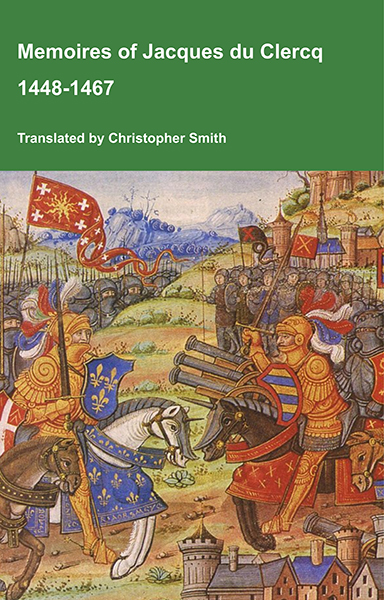 Memoires Jacques du Clercq. The duke was at Dendermonde; desiring to enter that country and conquer it, he had a bridge built and constructed to enter the land of Waas. And when the bridge was ready to be raised, a bold and valiant knight named Sir Jacques de Lallaing, eldest son of the lord Jacques de Lallaing, begged and requested the duke to grant him leave to enter the said land; which the duke granted, and ordered all his body archers to go with him. The said Sir Jacques, having obtained the duke's permission, on the 17th day of May [1452], with a rather small company of men-at-arms, entered the land of Waas and crossed the bridge which the duke had had made. But he had not gone far into the country before he encountered a large company of Ghent men-at-arms, by whom, before he had fully perceived them, he was quickly surrounded and attacked. And when Sir Jean, bastard of Renty, knight and captain of the duke's body archers, who carried the banner bearing the duke's arms, saw the Ghenters surrounding and attacking them, he dropped the banner to the ground and took shameful flight. Then the Ghenters fell upon the Picards very valiantly and at first onset killed seven of them, three of whom were the duke's archers, one named Jennin de Cocquerel from the town of Arras; and they had already slain the horse of Sir Philippe de Lallaing, brother of Sir Jacques, a young knight, and would have killed him, although he defended himself as best he could, had not Sir Jacques, like a bold and valiant knight, charged into the midst of the Ghenters, set his brother back on horseback, he being on foot in a ditch, and rallied him. And when several of the duke's archers saw the valour and boldness of Sir Jacques, although their captain had fled, they took heart again, stripped off the jackets they wore so as to be lighter, and stood in their doublets, and began to shoot at the Ghenters, so that by force of arrows they drove them back. Then Sir Jacques de Lallaing, seeing and perceiving that part of his men had fled and that in the end he could not subdue or defeat the Ghenters, gathered together all the men he still had, re-formed them in good order, and withdrew without any more of his men being killed, except the seven mentioned above; but before he withdrew, several Ghenters were slain. Thus he returned toward the duke.
Le duc estoit a Terremonde; desirant entrer audit pays et le conquester, feit faire et carpenter ung pont pour entrer au pays de Wast, et comme le pont fust prest a lever, ung hardy et valliant chevallier nommé messire Jacques de Lallaing, fils aisné du St Jacques de Lallaing, pria et requist au duc qu'il lui volsit donner congié d'entrer au dit pays, lequel duc lui octroya et commanda a touts ses archiers de corps qu'ils allassent avecq lui; lequel messire Jacques, ayant l'octroy du duc, le xviije jour de may, en assés petite compagnie de gensdarmes entra au pays de Wast, et passa le pont que le duc avoit fait faire, auquel pays il n'alla guerres avant, qu'il trouva une grosse compagnie de gensdarmes gantois, desquels anchois qu'il s'en apperchut, fust incontinent enclos et assailly, et comme messire Jehan, bastard de Renty, chevallier et capitaine des archiers de corps du duc, lequel portoit la banniere ou estoient les armes du duc, per chut les Gantois qui les encloyoient et venoient assaillir, il laissa cheoir par terre la banniere et se meit en villaine fuite: lors se ferrer les Gantois es Picards moult valliamment et de prime face en occirent sept, dont les trois estoient archiers du duc, l'ung nommé Jennin de Cocquerel, de la ville d'Arras, et mesmement avoit ja occis le cheval de messire Philippe de Lallaing, frere de messire Jacques, josne chevallier, et ja le euissent mis a mort combien qu'il se deffendit au mieux qu'il pooit, quant messire Jacques, comme hardy et valliant chevallier se ferit au millieu des Gantois, remonta son frere sur ung cheval, qui estoit a pied en ung fossé, et quant plusieurs des archiers du duc veirent la valliance et hardiesse dudit messire Jacques, jasoit ce que leur capitaine s'en fust fuy, sy reprindrent ils couraige et despouillerent les jacquets qu'ils avoient vestus, pour estre plus legiers, et se mirent en leurs pourpoincts, et commencherent a tirer sur les Gantois, tellement que par forche de traits feirent reculler les Gantois, et lors messire Jacques de Lallaing, voyant et apperchevant que une partye de ses gens s'en estoient fuis, et que a la longue il ne polroit matter ne vaincre lesdits Gantois, comme très hardy et valliant chevallier, recueilla touts ses gens qu'il avoit, et se remit en belle ordonnance et s'en retourna sans ce que nuls de ses gens y mourussent, sinon les sept dessus nommés; mais ains qu'il s'en retournast, y olt plusieurs Gantois tués, et ainsy s'en retourna vers le duc.
Memoires Jacques du Clercq. On the 17th of the month, the said Jennin was, as has been said, burned; he had spread this accursed sin through several towns, for he confessed to having committed it at Amiens, Saint-Quentin, the city, and elsewhere, and to having continued it for the space of eighteen years. He accused several others, of whom two men were arrested at Arras: one named Oudinet Blas, a native of Blangy in Ternois, a pike-man; the other named Hacquinet l'Hoste, a native of Bouchain, a brewer. The said Oudinet admitted having committed the said sin only since the past Easter, together with certain thefts, for which he was condemned by the aldermen of Arras to be burned, and was burned near the city gallows on the 17th of May. And the said Hacquinet was claimed, as a cleric, by the bishop; but the aldermen of Arras would not surrender him, and instead sent to the Duke of Burgundy, their lord, to know what he wished to be done. The duke wrote back that he wished that all those found guilty, whether priests, clerics, or laymen, should be burned. Upon receiving this response, the said aldermen condemned the said Hacquinet to be burned, and he was burned at the same place where the said Oudinet had been, namely at the gallows of Arras, on the 25th of May following.
Le dıx septiesme du mois, fust, comme dit est, ards ledit Jennin, lequel avoit empunaisié de cestuy maudit peschić plusieurs bonnes villes, car il confessa l'avoir commis a Amiens, St Quentin, cité et ailleurs, et l'avoir continué l'espace de dix huict ans; il en accusa plusieurs, dont il en y olt prins a Arras deux compagnons, l'un nommé Oudinet Blas, natif de Blangy en Ternois, piqueur; l'aultre nommé Hacquinet l'Hoste, natif de Bouchain, brasseur; lequel Oudinet congnut avoir fait ledit pechié depuis Pasques passés seulement, avecq aulcuns larchins, pourquoy il fust condamné par les eschevins d'Arras a estre ards, et fust ards lez le gibet de la ville, le xviije de may, et ledit Hacquinet fust requis, comme clercq, par l'evesque; mais les eschevins d'Arras ne le vollurent rendre, ains envoyerent devers le duc de Bourgogne, leur sieur, pour sçavoir ce qu'il volloit que on en feit; lequel duc leur rescripvit qu'il volloit que aultant que on trouvoit, feussent prestres, clercqs ou lais, que on les ardist; cette response eue par lesdits eschevins, condempnerent ledit Hacquinet a estre ards, et fust ards au lieu ou ledit Oudinet avoit esté, a sçavoir, audit gibet d'Arras, le xxve de may ensuivant.
On 17th May 1464 at Newcastle upon Tyne, Northumberland [Map]
Thomas Ros 9th Baron Ros Helmsley [aged 36] was beheaded. His son Edmund [aged 9] succeeded 10th Baron Ros Helmsley. Thomas' lands however, including Belvoir Castle [Map], were given by King Edward IV of England [aged 22] to William Hastings 1st Baron Hastings [aged 33].
Robert Hungerford 3rd Baron Hungerford 1st Baron Moleyns [aged 33] was beheaded. He was buried at the Hungerford Chapel at Salisbury Cathedral [Map]. His daughter Mary Hungerford Baroness Hastings, 4th Baroness Hungerford, 5th Baroness Botreaux and 2nd Baroness Moleyns became the ward of William Hastings 1st Baron Hastings whose son Edward Hastings 2nd Baron Hastings Baron Botreaux, Hungerford and Moleyns she subsequently married.
Chronicle of Gregory. 17th May 1464. At the Newecastelle [Map], the xvij day of May, he let to be smete of the heddys, as the namys of them done appere here aftyr in wrytynge: first, the hedde of the Lord Hungerforde [aged 33], the Lord Roos [aged 36], Syr Thomas Fyndorne, Barnarde de la Mare, Nycholas Massam.
Chronicle of Abbot Ralph of Coggeshall
The Chronicle of Abbot Ralph of Coggeshall (Chronicon Anglicanum) is an indispensable medieval history that brings to life centuries of English and European affairs through the eyes of a learned Cistercian monk. Ralph of Coggeshall, abbot of the Abbey of Coggeshall in Essex in the early 13th century, continued and expanded his community’s chronicle, documenting events from the Norman Conquest of 1066 into the tumultuous reign of King Henry III. Blending eyewitness testimony, careful compilation, and the monastic commitment to record-keeping, this chronicle offers a rare narrative of political intrigue, royal power struggles, and social upheaval in England and beyond. Ralph’s work captures the reigns of pivotal figures such as Richard I and King John, providing invaluable insights into their characters, decisions, and the forces that shaped medieval rule. More than a simple annal, Chronicon Anglicanum conveys the texture of medieval life and governance, making it a rich source for scholars and readers fascinated by English history, monastic authorship, and the shaping of the medieval world.
Available at Amazon in eBook and Paperback format.
A Brief Latin Chronicle. 17th May 1464 On the seventeenth day of the month of May, at Newcastle, were beheaded Lord Hungerford, Lord Roos, Lord Thomas Fynderne, Edward de la Mare, and Nicholas Massam.
Decimo septimo die mensis Maii apud Novum Castrum decapitati sunt dominus de Hungarford, dominus Roos, dominus Thomas Fynderne, Edwardus de la Mare, Nicholaus Massam.
 Chronicle of England by William of Worcester. Within the next three days, Thomas Lord Roos [aged 36] and Robert Lord Hungerford [aged 33], hiding in a certain forest near Hexham, were captured and condemned before the said Lord Montagu at Newcastle and beheaded there [on 17th May 1464], along with Thomas Fynderne, knight.
Et infra tres dies sequentes Thomas dominus Roos et Robertus dominus Hungerford, in quadam silva prope Hexham absconditi, capti sunt, ac apud Novum Castrum coram dicto domino Mountagu damnati et [cum] Thoma Fynderne, milite, ibidem decollati sunt.

On 17th May 1490 Albert "The Elder" Hohenzollern I Duke Prussia was born to Frederick Hohenzollern I Margrave Brandenburg-Ansbach [aged 30] and Sophia Jagiellon Margravine of Brandenburg-Ansbach [aged 26]. He married (1) 1526 his half first cousin once removed Dorothea Oldenburg, daughter of King Frederick I of Denmark and Anna of Brandenburg, and had issue (2) 1550 his fifth cousin Anna Maria Guelph Duchess Prussia, daughter of Eric "The Elder" Guelph I Duke Brunswick-Lüneburg, and had issue.
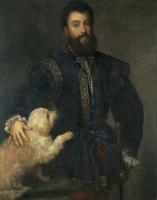
On 17th May 1500 Federico Gonzaga II Duke Mantua was born to Francesco Gonzaga II Marquess of Mantua [aged 33] and Isabella Este [aged 25]. He married Margaret Palaeologina Duchess Mantua, daughter of William IX Marquis of Montferrat and Anne Valois Marchioness of Montferrat, and had issue.
On 17th May 1521 Edward Stafford 3rd Duke of Buckingham [aged 43] was beheaded at Tower Hill [Map]. Duke of Buckingham, Earl Stafford and Baron Stafford forfeit.
He was executed for no specific reason other than his having a significant amount of Plantagenet blood and was, therefore, considered a threat by Henry VIII [aged 29]. He was posthumously attainted by Act of Parliament on 31 July 1523, disinheriting his children. He was buried at St Peter's Church, Britford [Map].


Wriothesley's Chronicle [1508-1562]. 17th May 1521. This yeare, on Fridaye before Whitsonday, beinge the 17 day of Maye, Edward Duke of Buckingham [aged 43]a was beheaded at Tower Hill [Map].
Note a. Edward Stafford, Duke of Buckingham, was restored in 1486 by Henry VII. to his honours and estates. He commanded the select guard of Henry VIII [aged 29] in the battle of the Spurs, 1613, but his observation, that the "Field of the Cloth of Gold" entailed ruin on the English nobles, so irritated the King that he determined on his ruin. It is also asserted that the King was jealons of his descent from Thomas of Woodstock and Edward III.
From 10th May 1533 to 17th May 1533 John Bell served as proctor for the king at the trial at Dunstable Abbey [Map] which definitively nullified Henry's first marriage in time for the coronation of Anne Boleyn.
Letters and Papers Foreign and Domestic Henry VIII 1535. 17th May 1535. 726. There is strange news here of the cruelty of the king of England to certain religious men. He caused them to be ripped up in each other's presence, their arms torn off (con farli scarpar le braccia), their hearts cut out and rubbed upon their mouths and faces; and this for having caused remorse (per haver fatto coscienza) to certain ecclesiastics who had sworn that the King was Head of the English Church, and not the Pope. Has seen a letter of the 5th from London, saying that on the 4th a prior of one of the three Charterhouses, two friars of the Order, a prior of Sion, and a priest, who refused to swear to the King's supremacy, were hanged without degradation, as rebels. They were dragged through the streets in carts, their heads and feet were to be placed on the public gates, and the rest of their bodies burnt. The whole city is displeased, as they were of exemplary and holy life. It was thought that 10 or 12 priests now in the Tower would be also executed for the same cause. The same letter states that this "Gherardo" (Fitzgerald) in Ireland has lost a strong castle, and retired with 50 horse to the bogs, where he is safe while the wet weather lasts; but when it changes it will be easy for the King to take him dead or alive, for most of his followers have returned to their allegiance.

Letters and Papers Foreign and Domestic Henry VIII 1535. 17th May 1535. 726. The Duke of Norfolk [aged 62] with other English gentlemen and about 300 horses were to start on the 12th. In place of Cromwell, who cannot leave, having the control of everything in his hands, Lord Rochford [aged 32], the brother of the new Queen [aged 34], or a bishop, her almoner, will come.
News has come of the capture, by the king of the Romans, of the prothonotary Casale, who was sent to king John on the part of England.
Hol., pp. 13. Copy. Headed: A M. Ambrogio da Carlemesnel, alli 17 di Maggio, ritenuta fino alli 18, &c.
Letters and Papers. 17 May [1536]. Wilkins, iii. 803. 896. Anne Boleyn [aged 35].
Sentence pronounced by the archbishop of Canterbury of the nullity of the marriage between the King and Anne Boleyn, in the presence of Sir Thomas Audeley, Chancellor, Charles Duke of Suffolk [aged 52], John Earl of Oxford [aged 65], and others, at Lambeth, 17 May 1536.
Memorandum.—This was sealed on the 10th June, and subscribed by both Houses of Convocation on the 28th.


On 17th May 1536 George Boleyn Viscount Rochford [aged 33], Henry Norreys [aged 54], Francis Weston [aged 25], William Brereton and Mark Smeaton [aged 24] were beheaded at Tower Hill [Map]. They were buried at St Peter ad Vincula Church, Tower of London [Map].
Chronicle of Edward Hall [1496-1548]. 17th May 1536. And all the gentlemen were beheaded on the scaffold at the Tower hyll.
Letters and Papers. 17th May 1536. 908. Chapuys [aged 46] to Charles V.
Today1 Rochford [aged 33] has been beheaded before the Tower, and the four others above named, notwithstanding the intercession of the Bishop of Tarbes, the French ambassador resident, and the sieur de Tinteville, who arrived the day before yesterday, in behalf of one named Weston [aged 25]. The Concubine [aged 35] saw them executed from the Tower, to aggravate her grief. Rochford disclaimed all that he was charged with, confessing, however, that he had deserved death for having been so much contaminated and having contaminated others with these new sects, and he prayed everyone to abandon such heresies. The Concubine will certainly be beheaded tomorrow, or on Friday at the latest, and I think the King feels the time long that it is not done already. The day before the putain's condemnation he sent for Mrs. Semel [Jane Seymour [aged 27]] by the Grand Esquire and some others, and made her come within a mile of his lodging, where she is splendidly served by the King's cook and other officers. She is most richly dressed. One of her relations, who dined with her on the day of the said condemnation, told me that the King sent that morning to tell her that he would send her news at 3 o'clock of the condemnation of the putain, which he did by Mr. Briant, whom he sent in all haste. To judge by appearances, there is no doubt that he will take the said Semel [Jane Seymour] to wife; and some think the agreements and promises are already made.
Note 1. This part of the letter was written on the 17th. See further on, at the beginning of the last paragraph.

Wriothesley's Chronicle [1508-1562]. 17th May 1536. Allso the 17th day of May, beinge Weddensday, the Lord of Rochforde [aged 33], Mr. Norys [aged 54], Mr. Bruton, Sir Francis Weston [aged 25], and Markys [aged 24], were all beheaded [Note. Smeaton was hanged] at the Tower-hill [Map]; and the Lord of Rocheforde, brother to Queene Anne, sayde these wordes followinge on the scaffolde to the people with a lowde voyce: Maisters all, I am come hither not to preach and make a sermon, but to dye, as the lawe hath fownde me, and to the lawe I submitt me, desiringe you all, and speciallie you my maisters of the Courte, that you will trust on God speciallie, and not on the vanities of the worlde, for if I had so done, I thincke I had bene alyve as yee be now; allso I desire you to helpe to the settinge forthe of the true worde of God; and whereas I am sclaundered by it, I have bene diligent to reade it and set it furth trulye; but if I had bene as diligent to observe it, and done and lyved thereafter, as I was to read it and sett it forthe, I had not come hereto, wherefore I beseche you all to be workers and lyve thereafter, and not to reade it and lyve not there after. As for myne offences, it can not prevayle you to heare them that I dye here for, but I beseche God that I may be an example to you all, and that all you may be wayre by me, and hartelye I require you all to pray for me, and to forgive me if I have offended you, and I forgive you all, and God save the Kinge. Their bodies with their heades were buried within the Tower of London [Map]; the Lord of Rochfordes bodie and head within the chappell of the Tower [Map], Mr. Weston and Norys in the church yeard of the same [Map] in one grave, Mr. Bruton and Markes in another grave in the same churche yerde within the Tower of London.
Memorial of George Constantyne. 17th May 1536. But at his [William Brereton's] deeth these were his wordes: "I haue deserved to dye if it were a thousande deethes, But the cause wherfore I dye judge not: But yf ye judge, judge the best." This he spake iij or foure tymes. If he were gyltie, I saye therfore that he dyed worst of them all.
William of Worcester's Chronicle of England
William of Worcester, born around 1415, and died around 1482 was secretary to John Fastolf, the renowned soldier of the Hundred Years War, during which time he collected documents, letters, and wrote a record of events. Following their return to England in 1440 William was witness to major events. Twice in his chronicle he uses the first person: 1. when writing about the murder of Thomas, 7th Baron Scales, in 1460, he writes '… and I saw him lying naked in the cemetery near the porch of the church of St. Mary Overie in Southwark …' and 2. describing King Edward IV's entry into London in 1461 he writes '… proclaimed that all the people themselves were to recognize and acknowledge Edward as king. I was present and heard this, and immediately went down with them into the city'. William’s Chronicle is rich in detail. It is the source of much information about the Wars of the Roses, including the term 'Diabolical Marriage' to describe the marriage of Queen Elizabeth Woodville’s brother John’s marriage to Katherine, Dowager Duchess of Norfolk, he aged twenty, she sixty-five or more, and the story about a paper crown being placed in mockery on the severed head of Richard, 3rd Duke of York.
Available at Amazon in eBook and Paperback format.
Memorial of George Constantyne. 17th May 1536. George. The lorde of Ratchforde [aged 33], after many wordes, to the effecte sayed this. I desyre you that no man wilbe discoraged from the Gospell for my fall. For if I had lyved accordinge to the gospel as I loved it, and spake of it, I had never come to this. Wherfore sayed he Syrs for Gods love, leave not the gospel, but speake lesse and lyve better. For I had rather have one good lyver accordinge to the gospel then ten bablers.
Excerpta Historica Page 260. [17th May 1536]. When that sorrowful day came, which was to bring their last hour to those unhappy wretches who had bought a brief pleasure with a dreadful peril, even the peril of their life and honour, a scaffold was built up before the Tower of London, on a Wednesday, which was the 17th day of May. And then they led out of the Tower wherein they had been imprisoned, the Queen's brother and the four accused gentlemen, all closely guarded as they are wont to guard those guilty of such things. And my Lord of Reujafort, [Rochford,] for that was the name of the Queen's brother, said, three several times, with a loud voice, to the whole city there gathered together — "O ye gentlemen and Christians, I was born under the law, and I die under the law, forasmuch as it is the law which hath condemned me." And then he proceeded to speak in this wise. "Ye gentlemen here present, I come not hither to preach unto you, but to die. Nor do I now seek for any thing, in the sorrowful plight in which I here stand, save that I may soon bathe my dry and parched lips in the living fountain of God's everlasting and infinite mercy. And I beseech you all, in his holy name, to pray unto him for me, confessing truly that I deserve death, even though I had a thousand lives — yea even to die with far more and worse shame and dishonour than hath ever been heard of before. For I am a miserable sinner, who have grievously and often times offended; nay and in very truth, I know not of any more perverse or wicked sinner than I have been up until now. Nevertheless, I mean not openly now to relate what my many sins may have been, since in sooth it can yield you no profit, nor me any pleasure here to reckon them up; enough be it that God knoweth them all. And ye, Gentlemen of the Court, mine especial and ancient familiars, I beseech you, of all love, that ye take heed not to fall into the error of my ways, and that ye be warned by my example; and I pray to the Father, Son, and Holy Ghost, Three Persons in One God, that ye may wisely profit by the same, and that from my mishap ye may learn not to set your thoughts upon the vanities of this world, and least of all, upon the flatteries of the Court, and the favours and treacheries of Fortune, which only raiseth men aloft that with so much the greater force she may dash them again upon the ground. She in truth it is who is the cause that, as ye all witness, my miserable head is now to be dissevered from my neck; or rather, in greater truth, the fault is mine, and it is I who ought to be blamed for having adventured to lean on Fortune, who hath proved herself fickle and false unto me, and who now maketh me a sad example to you all and to the whole world. And do ye all, Sirs, take notice, that in this my sorrowful condition, I pray for the mercy of God Almighty, and that I do moreover forgive all men, with all my heart and mind, even as truly as I hope that the Lord God will forgive me. And if so be that I should in aught have offended any man not now here present, do ye entreat him, when ye chance to meet him, that he also may of his charity forgive me; for, having lived the life of a sinner, I would fain die the death of a Christian man.
Nor must I fail (while it be yet time) to tell you all, gentle and simple, now hearkening to me, that I was a great reader and a mighty debater of the Word of God, and one of those who most favoured the Gospel of Jesu Christ.2 Wherefore, lest the Word of God should be brought into reproach on my account, I now tell you all, Sirs, that if I had, in very deed, kept his holy Word, even as I read and reasoned about it with all the strength of my wit, certain am I that I should not be in the piteous condition wherein I now stand. Truly and diligently did I read the Gospel of Christ Jesu, but I turned not to profit that which I did read; the which had I done, of a surety I had not fallen into so great errors. Wherefore I do beseech you all, for the love of our Lord God, that ye do at all seasons, hold by the truth, and speak it, and embrace it; for beyond all peradventure, better profiteth he who readeth not and yet doeth well, than he who readeth much and yet liveth in sin."
Having made an end of speaking, he knelt down upon his knees, and his head was stricken off. And so befell it likewise to the other four gentlemen; one was called Monsire Nestorn [Weston]; another Breton, [Brereton]; another Norris, Chamberlain to the King's Majesty; and the fourth of this sorrowful company was Mark [Smeton]; the which said no more than that they besought the bystanders to pray for them, and that they yielded themselves to death with joy and exceeding gladness of heart.
Note 1. E daquelle q' mais com emveija e ciumes q' amor q' tivesse ha El Rey, descubryo ho malvado segredo.
Note 2. Que eu fuy grande ledor e argumentador da palavra de Ds. e eu fuy hū daquelles q' mto favorecerao ho Evangello de I. C.
Memorial of George Constantyne. 17th May 1536 ... And Weston sayed [aged 25], I had thought to haue lyved in abhominacion yet this twenty or thrittie yeres & then to haue made amendes. I thought little it wold haue come to this: willinge all other to take example at hym. And Markes [aged 24] sayed: Masters I pray you all praye for me, for I haue deserved the deeth. And the Quene [aged 35] sayed: I do not entende to reason my cause, but I committe me to Christ wholy, in whome ys my whole trust, desirynge you all to praye for the Kynges maiestie that he maye longe regne over you, for he ys a veraye noble prince and full gently hath handled me.
Spanish Chronicle Chapter 30. 17th May 1536. How the Duke, and Norris, and Brereton, and Mark were beheaded the next day1.
Letters and Papers. 19th May 1536. Vienna Archives. 911. Anne Boleyn [aged 35], Rochford [deceased], &c.
"Execution criminal hecha en Inglatierra el 16 de Mayo 15361."
The count (Viscount) Rochefort, brother of the Queen (unjustly so called) Anne Boleyn, was beheaded with an axe upon a scaffold before the Tower of London. He made a very catholic address to the people, saying he had not come thither to preach, but to serve as a mirror and example, acknowledging his sins against God and the King, and declaring he need not recite the causes why he was condemned, as it could give no pleasure to hear them. He first desired mercy and pardon of God, and afterwards of the King and all others whom he might have offended, and hoped that men would not follow the vanities of the world and the flatteries of the Court, which had brought him to that shameful end. He said if he had followed the teachings of the Gospel, which he had often read, he would not have fallen into this danger, for a good doer was far better than a good reader. In the end, he pardoned those who had condemned him to death, and asked the people to pray for his soul. After him Norris [aged 54] was beheaded, then Weston [aged 25] and Brereton, and Marc [aged 24], the player on the spinnet, who said scarcely anything except to cry mercy of God and the King, and beg people to pray for their souls. Brereton and Marc were afterwards quartered.

Wriothesley's Chronicle [1508-1562]. And the same day, in the after-noone, at a solemne court kept at Lambeth by the Lord Archbishoppe of Canterburie [aged 46] and the doctors of the lawe, the King was divorced from his wife Queene Anne [aged 35], and there at the same cowrte was a privie contract approved that she had made to the Earle of Northumberlande [aged 34] afore the Kings tyme; and so she was discharged, and was never lawfull Queene of England, and there it was approved the same.
Henry Machyn's Diary. 17th May 1551. The xvij day my lade Marie [aged 35] rod thrugh from Saynt [John's through] Flettstrett unto the court to Westmynster [with many] nobull men of lordes and knyghtes and gentyllmen and ladies and gentyllwomen, and at the court gatte she a-lyttyd, and M. [Wingfield] [aged 64], the comtroller of the kynges howse, and mony lordes and [knights], and so she was browth thrught the halle unto the cham[ber of] pressens; and so she tared there and ade a goodly ba[nquet] ij owrs, and sone after she toke her horse and rod unto Sy[nt John's;] and ther she laie alle nyght, and on the morowe her [Grace] rod to Nuw Hall in Exsex, and ther byd yn grasse with honor, thanke be God and the kyng her brodur.


Henry Machyn's Diary. 17th May 1555. The xvij day of May was bered the contesse of Vestmerland [deceased] at Sordyche [Map], for ther was a goodly hersse with iiij banars of emages, and iiij banars-rolles, and mony mornars, and ther was master Garter and Ruge-crosse, and after all done a gret dener.
Note. Page 88. Funeral of the countess of Westmerland. Katharine, daughter of Edward Stafford, duke of Buckingham, K.G. and wife of Ralph earl of Westmerland. A letter from her to the earl of Shrewsbury, 25 Apr. 1544, has been published in Miss Wood's Letters of Ladies, iii. 182. She died at Holywell, the house of her son-in-law the earl of Rutland [aged 28], in the parish of Shoreditch, on Tuesday, May 14, 1555. (MS. Harl. 897, fol. 78b, 80.) In that church was erected a joint monument, with four kneeling effigies, representing Elinor (Paston) countess of Rutland, who died in 1551; this countess of Westmerland; her daughter Margaret countess of Rutland, who died 1560 (see Note hereafter to p. 215); and lady Katharine Constable, who died 1591, a granddaughter of the first; which see engraved in Ellis's Shoreditch, p. 56, or Nichols's Leicestershire, vol. ii. pl. xii.
On 16th May 1568 Mary Queen of Scots [aged 25] escaped across the Solway Firth into England. The following day, 17th May 1568 she wrote to her cousin Queen Elizabeth I of England and Ireland [aged 34] from Workington Hall [Map]. The letter states...
describes the treasonable actions of her enemies, who 'have robbed me of everything I had in the world' and expresses her confidence in Elizabeth 'not only for the safety of my life, but also to aid and assist me in my just quarrel'. Describing herself as Elizabeth's 'very faithful and affectionate good sister, cousin and escaped prisoner, Mary begs for an audience; 'I entreat you to send to fetch me as soon as you possibly can', for 'I am', she bemoans, 'in a pitiable condition, not only for a queen, but for a gentlewoman, for I have nothing in the world but what I had on my person when I made my escape, travelling sixty miles across the country the first day, and not having since ever ventured to proceed except by night, as I hope to declare before you if it pleases you to have pity, as I trust you will, upon my extreme misfortune.'
On 17th May 1569 George Dacre 5th Baron Dacre Gilsland 9th Baron Greystoke [aged 8] died. Baron Greystoke abeyant. There was a dispute as to whether his uncle Leonard Dacre should inherit Baron Dacre Gilsland which would be the case if it was created by letters patent, or whether the Barony was in abeyance between the 5th Baron's three sisters which would be the case of the barony had been created through a writ of summons. Such decisions would normally be referred to the Duke of Norfolk [aged 33] in his capacity as Earl Marshal but he, Thomas Howard 4th Duke of Norfolk, had married Elizabeth Leybourne Duchess Norfolk, the mother of the three daughters although she had died in the meantime; he was not impartial - the three daughters were now his step-daughters. The matter was referred to Commissioners who decided the Barony had been created by writ between and was, therefore, abeyant between the three daughters who were now the step-daughters of Thomas Howard 4th Duke of Norfolk. He, Thomas Howard 4th Duke of Norfolk subsequently married his eldest son Philip Howard 13th or 20th Earl of Arundel [aged 11] to his eldest step-daughter Anne Dacre Countess Arundel [aged 12]. After Thomas Howard's execution in 1572 the two remaining daughters, Mary Dacre [aged 5] and Elizabeth Dacre [aged 4] were married to his two remaining sons Thomas Howard 1st Earl Suffolk [aged 7] and William Howard [aged 5] respectively ensuring all of the Dacre and Greystoke wealth and estates in Cumberland, Yorkshire and Northumberland would become the property of the Howard family.


On 17th May 1575 Archbishop Matthew Parker [aged 70] died.
Jean de Waurin's Chronicle of England Volume 6 Books 3-6: The Wars of the Roses
Jean de Waurin was a French Chronicler, from the Artois region, who was born around 1400, and died around 1474. Waurin’s Chronicle of England, Volume 6, covering the period 1450 to 1471, from which we have selected and translated Chapters relating to the Wars of the Roses, provides a vivid, original, contemporary description of key events some of which he witnessed first-hand, some of which he was told by the key people involved with whom Waurin had a personal relationship.
Available at Amazon in eBook and Paperback format.
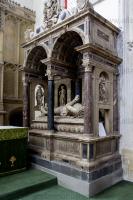
On 17th May 1581 William Cordell [aged 59] died. Monument at Holy Trinity Church, Long Melford [Map].
William Cordell: Around 1522 he was born. In 1554 William Cordell bought the manor of Long Melford and other lands, formerly owned by Bury St Edmunds Abbey, from the crown and started building Melford Hall, Long Melford [Map]. He entertained Queen Elizabeth I of England and Ireland there in 1578/ Before 17th May 1581 he and Mary Clopton were married.

Diary of Anne Clifford. 17th May 1616. Upon the 17th my Lord [aged 27] and I after supper had some talk about these businesses, Matthew being in the room where we all fell out and so parted for that night.
Diary of Anne Clifford. 17th May 1617. The 17th the Steward came from London and told me my Lord [aged 28] was much discontented with me, for not doing this business, because he must be fain to buy land for the payment of the money which will much encumber his estate.
Diary of Anne Clifford. 17th May 1619. The 17th my Lord [aged 30] and I and all the household came down to Knole. I took my leave also of the two tenants and gave them gold and silver. The 24, 25, 26, and 27th I went abroad with my Brother Sackville, sometimes early in the morning and sometimes after supper he and I being kind and having better correspondence than we have had.

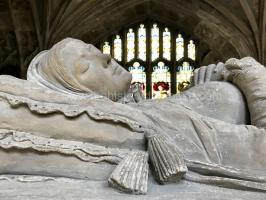
On 17th May 1633 Penelope Noel [aged 22] died of blood poisoning after having pricked herself with a needle whilst sewing with silk thread. Monument in St James' Church, Chipping Campden [Map]. Sculpted by John Christmas [aged 34] or possibly his brother Mathias. The material held in her left hand may represent the material she was sewing.
"The most exquisite model of natures best workmanship, ye richest magazine of all divine and moral vertues, Penelope Noel having added to the nobilitie of her birth, a brighter shyne of true noblesnesse, ye exemplary sweetness of her conversation, he contempt of earthly vanities and her zealous affection towards heaven, after 22 yeares devotions, commended her virgin sowle into ye hands of its true brydegroome Jesus Christ, May 17th AD 1633 over whose pretious dust here reserved, her sad parents Edward Lord Noel, Viscount Campden and the Lady Julian his wife, dropt theyr teares and erected this marble to the deare memorie of theyre unvaluable losse - Superata tellus Sidera donat i.e. The earth, once conquered, grants the stars."
Penelope Noel: On 22nd August 1610 she was born to Edward Noel 2nd Viscount Campden and Juliana Hicks Viscountess Campden.
Samuel Pepys' Diary. 17th May 1660. Up early to write down my last two days' observations. Dr. Clerke came to me to tell me that he heard this morning, by some Dutch that are come on board already to see the ship, that there was a Portuguese taken yesterday at the Hague, that had a design to kill the King. But this I heard afterwards was only the mistake upon one being observed to walk with his sword naked, he having lost his scabbard. Before dinner Mr. Edw. Pickering [aged 42] and I, W. Howe, Pim, and my boy [aged 12], to Scheveling, where we took coach, and so to the Hague, where walking, intending to find one that might show us the King incognito, I met with Captain Whittington (that had formerly brought a letter to my Lord from the Mayor of London) and he did promise me to do it, but first we went and dined at a French house, but paid 16s. for our part of the club. At dinner in came Dr. Cade, a merry mad parson of the King's [aged 29]. And they two after dinner got the child and me (the others not being able to crowd in) to see the King, who kissed the child very affectionately. Then we kissed his, and the Duke of York's, and the Princess Royal's hands. The King seems to be a very sober man; and a very splendid Court he hath in the number of persons of quality that are about him, English very rich in habit. From the King to the Lord Chancellor1, who did lie bed-rid of the gout: he spoke very merrily to the child and me. After that, going to see the Queen of Bohemia, I met with Dr. Fullers whom I sent to a tavern with Mr. Edw. Pickering, while I and the rest went to see the Queen [aged 50], who used us very respectfully; her hand we all kissed. She seems a very debonaire, but plain lady. After that to the Dr.'s, where we drank a while or so. In a coach of a friend's of Dr. Cade we went to see a house of the Princess Dowager's [aged 28]2 in a park about half-a-mile or a mile from the Hague, where there is one, the most beautiful room for pictures in the whole world. She had here one picture upon the top, with these words, dedicating it to the memory of her husband:-"Incomparabili marito, inconsolabilis vidua".
Note 1. On January 29th, 1658, Charles II entrusted the Great Seal to Sir Edward Hyde [aged 51], with the title of Lord Chancellor, and in that character Sir Edward accompanied the King to England.
Note 2. Mary, Princess Royal, eldest daughter of Charles I, and widow of William of Nassau, Prince of Orange. She was not supposed to be inconsolable, and scandal followed her at the court of Charles II, where she died of small-pox, December 24th, 1660.


Samuel Pepys' Diary. 17th May 1662. So to Whitehall and there met Mr. Moore, and I walked long in Westminster Hall [Map], and thence with him to the Wardrobe to dinner, where dined Mrs. Sanderson, the mother of the maids, and after dinner my Lady and she and I on foot to Pater Noster Row [Map] to buy a petticoat against the Queen's [aged 23] coming for my Lady, of plain satin, and other things; and being come back again, we there met Mr. Nathaniel Crew [aged 29]1 at the Wardrobe with a young gentleman, a friend and fellow student of his, and of a good family, Mr. Knightly, and known to the Crews, of whom my Lady privately told me she hath some thoughts of a match for my Lady Jemimah. I like the person very well, and he hath £2000 per annum.
Note 1. Nathaniel Crew, born 1633, fifth son of John, first Lord Crew; he himself became third Lord Crew in 1697. Sub-Rector of Lincoln College, Oxford, 1659. Took orders in 1664, and was Rector of Lincoln College in 1668; Dean of Chichester, 1669; Bishop of Oxford, 1671; Bishop of Durham, 1674; sworn of the Privy Council in 1676. He was very subservient to James II, and at the Revolution was excepted from the general pardon of May, 1690, but he was allowed to keep possession of the bishopric of Durham.


On 17th May 1662 William Wettin Duke Saxe Weimar [aged 64] died at Weimar.
John Evelyn's Diary. 17th May 1663. I saluted the old Bishop of Durham, Dr. Cosin [aged 68], to whom I had been kind, and assisted in his exile; but which he little remembered in his greatness.
Samuel Pepys' Diary. 17th May 1665. Thence home, and after dinner to the office, where late, and so home to supper and to bed. Sir J. Minnes [aged 66] and I had an angry bout this afternoon with Commissioner Pett [aged 54] about his neglecting his duty and absenting himself, unknown to us, from his place at Chatham, Kent [Map], but a most false man I every day find him more and more, and in this very full of equivocation. The fleete we doubt not come to Harwich, Essex [Map] by this time. Sir W. Batten [aged 64] is gone down this day thither, and the Duchesse of Yorke [aged 28] went down yesterday to meet the Duke [aged 31].


Annals of the six Kings of England by Nicholas Trivet
Translation of the Annals of the Six Kings of England by that traces the rise and rule of the Angevin aka Plantagenet dynasty from the mid-12th to early 14th century. Written by the Dominican scholar Nicholas Trivet, the work offers a vivid account of English history from the reign of King Stephen through to the death of King Edward I, blending political narrative with moral reflection. Covering the reigns of six monarchs—from Stephen to Edward I—the chronicle explores royal authority, rebellion, war, and the shifting balance between crown, church, and nobility. Trivet provides detailed insight into defining moments such as baronial conflicts, Anglo-French rivalry, and the consolidation of royal power under Edward I, whose reign he describes with particular immediacy. The Annals combines careful year-by-year reporting with thoughtful interpretation, presenting history not merely as a sequence of events but as a moral and political lesson. Ideal for readers interested in medieval history, kingship, and the origins of the English state, this chronicle remains a valuable and accessible window into the turbulent world of the Plantagenet kings.
Available at Amazon in eBook and Paperback format.

Samuel Pepys' Diary. 17th May 1668. By and by Gayet goes away, being a Catholick, to her devotions, and Mercer to church; but we continuing an hour or two singing, and so parted; and I to Sir W. Pen's [aged 47], and there sent for a Hackney-coach; and he and she [Lady Pen [aged 44]] and I out, to take the gyre. We went to Stepney, and there stopped at the Trinity House, Deptford [Map], he to talk with the servants there against to-morrow, which is a great day for the choice of a new Master, and thence to Mile End [Map], and there eat and drank, and so home; and I supped with them-that is, eat some butter and radishes, which is my excuse for not eating any other of their victuals, which I hate, because of their sluttery: and so home, and made my boy read to me part of Dr. Wilkins's [aged 54] new book of the "Real Character"; and so to bed.
John Evelyn's Diary. 17th May 1671. Dined at Mr. Treasurer's [aged 40] with the Earl of Arlington [aged 53], Carlingford, Lord Arundel of Wardour [aged 63], Lord Almoner to the Queen, a French Count and two abbots, with several more of French nobility; and now by something I had lately observed of Mr. Treasurer's conversation on occasion, I suspected him a little warping to Rome.


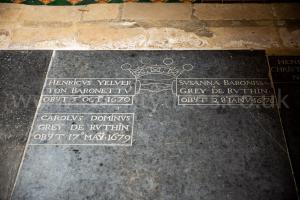
After 17th May 1679. Church of St Peter and St Paul, Easton Maudit [Map]. Monument to Charles Yelverton 14th Baron Grey of Ruthyn [deceased].
Charles Yelverton 14th Baron Grey of Ruthyn: On 21st August 1657 he was born to Henry Yelverton Baron Grey of Ruthyn and Susan Longueville 13th Baroness Grey of Ruthyn. On 30th October 1670 Henry Yelverton Baron Grey of Ruthyn died. He was buried at the Church of St Peter and St Paul, Easton Maudit [Map]. His son Charles succeeded 3rd Baronet Yelverton of Easton Maudit in Northamptonshire. On 28th January 1676 Susan Longueville 13th Baroness Grey of Ruthyn died. She was buried at the Church of St Peter and St Paul, Easton Maudit [Map]. Her son Charles succeeded 14th Baron Grey of Ruthyn. On 17th May 1679 Charles Yelverton 14th Baron Grey of Ruthyn died. His brother Henry succeeded 15th Baron Grey of Ruthyn, 4th Baronet Yelverton of Easton Maudit in Northamptonshire. Barbara Talbot Viscountess Longueville by marriage Baroness Grey of Ruthyn.
Calendar of Treasury Papers. Around 17th May 1694. 4. Papers relating to certain guns which had been sunk in their Majesties' ship the "London," near the buoy at the Nore, which guns Sir William Pritchard had entered into agreement with the Office of Ordnance to recover, receiving half the value, and, having recovered them, refused to deliver the half of them on account of a debt due to him for stores. Including the Solicitor-General's opinion thereon; signed "Tho. Trevor." A report on the subject is dated 17 May 1694.
There is the following entry in the Minute Book, Vol. VI., p. 112, 26 Nov. 1695: "Officers of Ordnance and Sr Wm Pritchard abt ye guns taken out of ye 'London' wreck 17 or 18 years ago. He took them up on articles to have half; he would have ye ks half towd an old debt in ye Office of Ordnce. My Lords cannot pay this debt."
John Evelyn's Diary. 17th May 1701. Very plentiful showers, the wind coming west and south. The Bishops and Convocation at difference concerning the right of calling the assembly and dissolving. Atterbury [aged 38] and Dr. Wake writing one against the other.
On 17th May 1711 William Henry Granville 3rd Earl of Bath [aged 19] died of smallpox. Earl Bath, Baron Granville of Kilkhampton and Biddeford extinct.

On 17th May 1714 Anne Charlotte Lorraine was born to Leopold Duke of Lorraine [aged 34] and Élisabeth Charlotte Bourbon Duchess Lorraine [aged 37]. She a great x 3 granddaughter of King James I of England and Ireland and VI of Scotland.
On 17th May 1731 Charles Noel Somerset 4th Duke Beaufort [aged 21] was elected MP Monmouthshire at a by-election.
On 17th May 1765 John Vardy [aged 47] died.

On 17th May 1767 Sarah Hussey [aged 80] died. She was buried at the Church of St John the Baptist, Great Hale [Map].
Sarah Hussey: Around 1687 she was born to Edward Hussey 3rd Baronet and Charlotte Brevint. Before 18th October 1728 Robert Cawdron and she were married.
On 17th May 1768 Caroline of Brunswick Queen Consort England was born to Charles William Ferdinand Brunswick Bevern [aged 32] and Princess Augusta Charlotte Hanover [aged 30]. She a great granddaughter of King George II of Great Britain and Ireland. She married 8th April 1795 her first cousin King George IV of Great Britain and Ireland, son of King George III of Great Britain and Ireland and Charlotte Mecklenburg Strelitz Queen Consort England, and had issue.


On 17th May 1802 Sophia Antonia Brunswick-Wolfenbüttel Duchess Saxe Coburg Saalfeld [aged 78] died.
On 17th May 1822 Duke Augustus of Saxe Coburg Altenburg [aged 49] died. His brother Duke [aged 47] succeeded IV Duke Saxe Gotha Altenburg.
On 17th May 1845 Algernon St Maur 14th Duke of Somerset [aged 31] and Horatia Isabella Harriet Morier Duchess Somerset [aged 25] were married. He the son of Edward Seymour 11th Duke of Somerset [aged 70] and Charlotte Hamilton Duchess Somerset.
Adam Murimuth's Continuation and Robert of Avesbury’s 'The Wonderful Deeds of King Edward III'
This volume brings together two of the most important contemporary chronicles for the reign of Edward III and the opening phases of the Hundred Years’ War. Written in Latin by English clerical observers, these texts provide a vivid and authoritative window into the political, diplomatic, and military history of fourteenth-century England and its continental ambitions. Adam Murimuth Continuatio's Chronicarum continues an earlier chronicle into the mid-fourteenth century, offering concise but valuable notices on royal policy, foreign relations, and ecclesiastical affairs. Its annalistic structure makes it especially useful for establishing chronology and tracing the development of events year by year. Complementing it, Robert of Avesbury’s De gestis mirabilibus regis Edwardi tertii is a rich documentary chronicle preserving letters, treaties, and official records alongside narrative passages. It is an indispensable source for understanding Edward III’s claim to the French crown, the conduct of war, and the mechanisms of medieval diplomacy. Together, these works offer scholars, students, and enthusiasts a reliable and unembellished account of a transformative period in English and European history. Essential for anyone interested in medieval chronicles, the Hundred Years’ War, or the reign of Edward III.
Available at Amazon in eBook and Paperback format.
On 17th May 1852 Montagu Lowther Chapman 3rd Baronet [aged 43] died at sea unmarried when the vessel in which he was sailing disappeared without trace. His brother Benjamin [aged 42] succeeded 4th Baronet Chapman of Killua Castle.
On 17th May 1869 Alice Susan Godolphin Osborne was born to George Godolphin Osborne 9th Duke Leeds [aged 40] and Fanny Georgiana Pitt-Rivers Duchess Leeds [aged 32]. Coefficient of inbreeding 3.94%. She married her half third cousin William Francis Leveson-Gower and had issue.
On 17th May 1869 Edward Richardson [aged 57] died at Melbury Terrace, Marylebone.
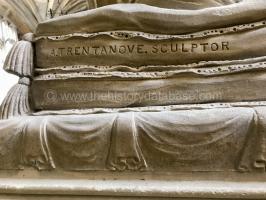
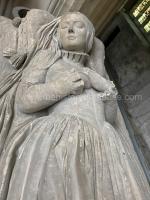
On 17th May 1876 Corisande Emma Bennet Countess Malmesbury [aged 68] died. Memorial in Christchurch Priory [Map] sculpted by Gaetano Trentanove [aged 18].
Sacred To The Memory Of Corisande Emma Countess Of Malmesbury, Daughter Of Charles Fifth Earl Of Tankerville, And Corisande, Daughter Of The Duke De Gramont. Born Aug. 19, 1807. Died May 17, 1876.
From her it never was our fate to find a deed ungentle or a word unkind, the mildes manners with the bravest mind."
Corisande Emma Bennet Countess Malmesbury: On 10th August 1807 she was born to Charles Augustus Bennet 5th Earl Tankerville and Corisande Armandine Sophie Léonie Hélène Gramont Countess Tankerville. On 13th May 1830 James Harris 3rd Earl Malmesbury and she were married. She by marriage Countess Malmesbury. She the daughter of Charles Augustus Bennet 5th Earl Tankerville and Corisande Armandine Sophie Léonie Hélène Gramont Countess Tankerville. He the son of James Edward Harris 2nd Earl Malmesbury and Harriet Susan Dashwood.

On 17th May 1882 William Richard Percy was born to Henry George Percy 7th Duke Northumberland [aged 35] and Edith Campbell Duchess Northumberland [aged 32].
On 25th November 1885 Alfonso XII King Spain [aged 27] died. On 17th May 1886 His son Alfonso succeeded posthumously XIII King Spain when he was born some seven months later.
On 17th May 1886 Alfonso XIII King Spain was born to Alfonso XII King Spain and Maria Christina of Austria Queen Consort Spain [aged 27] at Madrid [Map]. Coefficient of inbreeding 3.57%. He married 1906 his fifth cousin once removed Victoria Eugénie Mountbatten Queen Consort Spain and had issue.

On 17th May 1891 Princess Alexandra Duff Duchess Fife was born to Alexander Duff 1st Duke Fife [aged 41] and Louise Windsor Duchess Fife [aged 24]. She a granddaughter of King Edward VII of the United Kingdom. She married 15th October 1913 her first cousin once removed Prince Arthur of Connaught, son of Prince Arthur Windsor 1st Duke Connaught and Strathearn and Luise Margarete Hohenzollern Duchess Connaught, and had issue.

After 17th May 1921. Memorial at St Mary the Virgin Church, Ingestre [Map] to Charles Chetwynd-Talbot 20th Earl of Shrewsbury 5th Earl Talbot [deceased] commissioned by his sister Muriel Frances Louisa Chetwynd-Talbot [aged 61].

On 17th May 1965, a mining accident occurred at the Cambrian Colliery, the location of an explosion in 1905. Poor ventilation allowed a build-up of flammable gas which ignited and killed 31 miners.
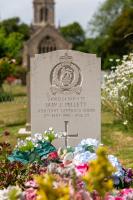
After 17th May 1996. Monument to Iain J Pellett died 17 May 1996 aged twenty-three.
Adam Murimuth's Continuation and Robert of Avesbury’s 'The Wonderful Deeds of King Edward III'
This volume brings together two of the most important contemporary chronicles for the reign of Edward III and the opening phases of the Hundred Years’ War. Written in Latin by English clerical observers, these texts provide a vivid and authoritative window into the political, diplomatic, and military history of fourteenth-century England and its continental ambitions. Adam Murimuth Continuatio's Chronicarum continues an earlier chronicle into the mid-fourteenth century, offering concise but valuable notices on royal policy, foreign relations, and ecclesiastical affairs. Its annalistic structure makes it especially useful for establishing chronology and tracing the development of events year by year. Complementing it, Robert of Avesbury’s De gestis mirabilibus regis Edwardi tertii is a rich documentary chronicle preserving letters, treaties, and official records alongside narrative passages. It is an indispensable source for understanding Edward III’s claim to the French crown, the conduct of war, and the mechanisms of medieval diplomacy. Together, these works offer scholars, students, and enthusiasts a reliable and unembellished account of a transformative period in English and European history. Essential for anyone interested in medieval chronicles, the Hundred Years’ War, or the reign of Edward III.
Available at Amazon in eBook and Paperback format.
On 17th May 1443 Edmund York 1st Earl of Rutland was born to Richard Plantagenet 3rd Duke of York [aged 31] and Cecily "Rose of Raby" Neville Duchess York [aged 28] at Rouen, France [Map]. He a great x 2 grandson of King Edward III of England. Coefficient of inbreeding 2.42%.
On 17th May 1490 Albert "The Elder" Hohenzollern I Duke Prussia was born to Frederick Hohenzollern I Margrave Brandenburg-Ansbach [aged 30] and Sophia Jagiellon Margravine of Brandenburg-Ansbach [aged 26]. He married (1) 1526 his half first cousin once removed Dorothea Oldenburg, daughter of King Frederick I of Denmark and Anna of Brandenburg, and had issue (2) 1550 his fifth cousin Anna Maria Guelph Duchess Prussia, daughter of Eric "The Elder" Guelph I Duke Brunswick-Lüneburg, and had issue.
On 17th May 1500 Federico Gonzaga II Duke Mantua was born to Francesco Gonzaga II Marquess of Mantua [aged 33] and Isabella Este [aged 25]. He married Margaret Palaeologina Duchess Mantua, daughter of William IX Marquis of Montferrat and Anne Valois Marchioness of Montferrat, and had issue.
On 17th May 1663 William Glynne 2nd Baronet was born to William Glynne 1st Baronet [aged 25] and Penelope Anderson Lady Bicester aka Bisseter. He married 5th July 1688 Mary Evelyn Lady Bicester aka Bisseter, daughter of Edward Evelyn 1st Baronet, and had issue.
On 17th May 1698 John Major 1st Baronet was born to John Major and Elizabeth Tennant at Bridlington. He married 1724 Elizabeth Dale and had issue.
On 17th May 1714 Anne Charlotte Lorraine was born to Leopold Duke of Lorraine [aged 34] and Élisabeth Charlotte Bourbon Duchess Lorraine [aged 37]. She a great x 3 granddaughter of King James I of England and Ireland and VI of Scotland.
On 17th May 1718 Robert Darcy 4th Earl Holderness was born to Robert Darcy 3rd Earl Holderness [aged 36] and Frederica Schomberg Countess Holderness and Fitzwalter [aged 31]. He a great x 3 grandson of King James I of England and Ireland and VI of Scotland.


On 17th May 1719 Robert Cunliffe 2nd Baronet was born to Foster Cunliffe [aged 37]. He married 1752 Mary Wright Lady Cunliffe and had issue.
On 17th May 1758 John St Aubyn 5th Baronet was born to John St Aubyn 4th Baronet [aged 31] and Elizabeth Wingfield Lady St Aubyn at Golden Square Soho.
On 17th May 1768 Henry William Paget 1st Marquess Anglesey was born to Henry Bayly-Paget 1st Earl Uxbridge [aged 23] and Jane Champagné Countess Uxbridge [aged 26]. He married (1) 5th July 1795 Caroline Elizabeth Villiers Duchess Argyll, daughter of George Bussy Villiers 4th Earl Jersey and Frances Twysden, and had issue (2) after 29th November 1810 Charlotte Cadogan Marchioness Anglesey, daughter of Charles Sloane Cadogan 1st Earl Cadogan and Mary Churchill Countess Cadogan, and had issue.


On 17th May 1768 Caroline of Brunswick Queen Consort England was born to Charles William Ferdinand Brunswick Bevern [aged 32] and Princess Augusta Charlotte Hanover [aged 30]. She a great granddaughter of King George II of Great Britain and Ireland. She married 8th April 1795 her first cousin King George IV of Great Britain and Ireland, son of King George III of Great Britain and Ireland and Charlotte Mecklenburg Strelitz Queen Consort England, and had issue.
On 17th May 1775 John Beckett 2nd Baronet was born to John Beckett 1st Baronet [aged 32] and Mary Wilson Lady Beckett [aged 26]. Educated at Leeds Grammar School, Trinity College, Cambridge (matriculated 1791; BA 1795; MA 1798), Inner Temple (admitted 1795; bencher, 1840) and Middle Temple (admitted 1799; called 1803). Barrister-at-law on the Northern Circuit. Fellow of Trinity College, Cambridge, 1797-1816. He married 20th January 1817 Anne Lowther Lady Beckett, daughter of William Lowther 1st Earl Lonsdale and Augusta Fane Countess Lonsdale.
Chronicle of a Bourgeois of Valenciennes
Récits d’un bourgeois de Valenciennes aka The Chronicle of a Bourgeois of Valenciennes is a vivid 14th-century vernacular chronicle written by an anonymous urban chronicler from Valenciennes in the County of Hainaut. It survives in a manuscript that describes local and regional history from about 1253 to 1366, blending chronology, narrative episodes, and eyewitness-style accounts of political, military, and social events in medieval France, Flanders, and the Low Countries. The work begins with a chronological framework of events affecting Valenciennes and its region under rulers such as King Philip VI of France and the shifting allegiances of local nobility. It includes accounts of conflicts, sieges, diplomatic manoeuvres, and the impact of broader struggles like the Hundred Years’ War on urban life in Hainaut. Written from the perspective of a burgher (bourgeois) rather than a monastery or royal court, the chronicle offers a rare lay viewpoint on high politics and warfare, reflecting how merchants, townspeople, and civic institutions experienced the turbulence of the 13th and 14th centuries. Its narrative style combines straightforward reporting of events with moral and civic observations, making it a valuable source for readers interested in medieval urban society, regional politics, and the lived experience of war and governance in pre-modern Europe.
Available at Amazon in eBook and Paperback format.
On 17th May 1790 Lucy Juliana Byng Lady Morris was born to John Byng 5th Viscount Torrington [aged 47] and Bridget Forrest Viscountess Byng [aged 41]. She married 5th October 1809 John Morris 2nd Baronet, son of John Morris 1st Baronet and Henrietta Musgrave Lady Morris, and had issue.
On 17th May 1791 George Shiffner 3rd Baronet was born to George Shiffner 1st Baronet [aged 28] and Mary Bridger.
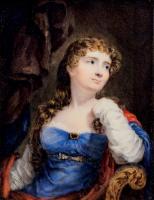
On 17th May 1792 Anne Isabella Noel Baroness Byron 11th Baroness Wentworth was born to Ralph Milbanke aka Noel 6th Baronet [aged 44] and Judith Noel [aged 41] at Elemore Hall, County Durham. She married 2nd January 1815 George "Lord Byron" 6th Baron Byron and had issue.
On 17th May 1792 Edmund Antrobus 2nd Baronet was born to John Antrobus [aged 31]. He married 16th October 1817 Ann Lindsay Lady Antrobus.
On 17th May 1794 Richard Butler was born to Richard Butler 1st Earl Glengall [aged 18].
On 17th May 1797 William Bligh was born to John Bligh 4th Earl Darnley [aged 29]. He died aged ten in 1807.

On 17th May 1801 William Heathcote 5th Baronet was born to Reverend William Heathcote [aged 29]. He married (1) 8th November 1825 Caroline Frances Perceval Lady Heathcote, daughter of Charles George Perceval 1st and 2nd Baron Arden and Margaretta Elizabeth Wilson Baroness Arden, and had issue (2) 18th May 1841 Selina Shirley Lady Heathcote.
On 17th May 1801 Frances Charlotte Chetwynd-Talbot Countess Dartmouth was born to Charles Chetwynd-Talbot 2nd Earl Talbot [aged 24] and Frances Thomasina Lambart Countess Talbot [aged 29]. She married 5th April 1820 William Legge 4th Earl Dartmouth, son of George Legge 3rd Earl Dartmouth and Frances Finch Countess Dartmouth, and had issue.


On 17th May 1821 Laura Waldegrave Countess Selborne was born to William Waldegrave 8th Earl Waldegrave [aged 32] in Cardington, Bedfordshire. She a great x 4 granddaughter of King James II of England Scotland and Ireland. She married 2nd February 1848 Roundell Palmer 1st Earl Selborne and had issue.

On 17th May 1823 Emily Augusta Lambton was born to John "Radical Jack" Lambton 1st Earl Durham [aged 31] and Louisa Elizabeth Grey Countess Durham [aged 26]. She married her third cousin once removed William Henry Frederick Cavendish and had issue.
Adam Murimuth's Continuation and Robert of Avesbury’s 'The Wonderful Deeds of King Edward III'
This volume brings together two of the most important contemporary chronicles for the reign of Edward III and the opening phases of the Hundred Years’ War. Written in Latin by English clerical observers, these texts provide a vivid and authoritative window into the political, diplomatic, and military history of fourteenth-century England and its continental ambitions. Adam Murimuth Continuatio's Chronicarum continues an earlier chronicle into the mid-fourteenth century, offering concise but valuable notices on royal policy, foreign relations, and ecclesiastical affairs. Its annalistic structure makes it especially useful for establishing chronology and tracing the development of events year by year. Complementing it, Robert of Avesbury’s De gestis mirabilibus regis Edwardi tertii is a rich documentary chronicle preserving letters, treaties, and official records alongside narrative passages. It is an indispensable source for understanding Edward III’s claim to the French crown, the conduct of war, and the mechanisms of medieval diplomacy. Together, these works offer scholars, students, and enthusiasts a reliable and unembellished account of a transformative period in English and European history. Essential for anyone interested in medieval chronicles, the Hundred Years’ War, or the reign of Edward III.
Available at Amazon in eBook and Paperback format.
On 17th May 1859 Randolph Seaton Gordon was born to Charles Gordon 10th Marquess Huntly [aged 67] and Maria Antoinetta Pegus Marchioness Huntly [aged 38]. He died aged less than one years old.
On 17th May 1863 Arthur George Egerton 5th Earl Wilton was born to Seymour Egerton 4th Earl Wilton [aged 24] and Laura Caroline Russell Countess Wilton [aged 21]. He married 28th August 1895 Mariota Thellusson Countess Wilton, daughter of Frederick Thellusson 5th Baron Rendlesham and Egidia Montgomerie Baroness Rendlesham, and had issue.
On 17th May 1869 Alice Susan Godolphin Osborne was born to George Godolphin Osborne 9th Duke Leeds [aged 40] and Fanny Georgiana Pitt-Rivers Duchess Leeds [aged 32]. Coefficient of inbreeding 3.94%. She married her half third cousin William Francis Leveson-Gower and had issue.
On 17th May 1882 William Richard Percy was born to Henry George Percy 7th Duke Northumberland [aged 35] and Edith Campbell Duchess Northumberland [aged 32].
On 17th May 1886 Alfonso XIII King Spain was born to Alfonso XII King Spain and Maria Christina of Austria Queen Consort Spain [aged 27] at Madrid [Map]. Coefficient of inbreeding 3.57%. He married 1906 his fifth cousin once removed Victoria Eugénie Mountbatten Queen Consort Spain and had issue.
On 17th May 1886 William Frederick Williams 4th Baronet was born to William Robert Williams 3rd Baronet [aged 26].
On 17th May 1891 Princess Alexandra Duff Duchess Fife was born to Alexander Duff 1st Duke Fife [aged 41] and Louise Windsor Duchess Fife [aged 24]. She a granddaughter of King Edward VII of the United Kingdom. She married 15th October 1913 her first cousin once removed Prince Arthur of Connaught, son of Prince Arthur Windsor 1st Duke Connaught and Strathearn and Luise Margarete Hohenzollern Duchess Connaught, and had issue.
On 17th May 1894 Alec Hardinge 2nd Baron Hardinge was born to Charles Hardinge 1st Baron Penshurt [aged 35] and Winifred Selina Sturt [aged 26]. Coefficient of inbreeding 7.81%. He married 8th February 1921 Helen Mary and had issue.
On 17th May 1899 Henry Wilmot Chamberlain 5th Baronet was born to Henry Hamilton Erroll Chamberlain 4th Baronet [aged 41].
On 17th May 1900 John Campbell 5th Earl Cawdor was born to Hugh Campbell 4th Earl Cawdor [aged 30] and Joan Emily Thynne Countess Cawdor [aged 27].
The Deeds of the Dukes of Normandy
The Gesta Normannorum Ducum [The Deeds of the Dukes of Normandy] is a landmark medieval chronicle tracing the rise and fall of the Norman dynasty from its early roots through the pivotal events surrounding the Norman Conquest of England. Originally penned in Latin by the monk William of Jumièges shortly before 1060 and later expanded at the behest of William the Conqueror, the work chronicles the deeds, politics, battles, and leadership of the Norman dukes, especially William’s own claim to the English throne. The narrative combines earlier historical sources with firsthand information and oral testimony to present an authoritative account of Normandy’s transformation from a Viking settlement into one of medieval Europe’s most powerful realms. William’s history emphasizes the legitimacy, military prowess, and governance of the Norman line, framing their expansion, including the conquest of England, as both divinely sanctioned and noble in purpose. Later chroniclers such as Orderic Vitalis and Robert of Torigni continued the history, extending the coverage into the 12th century, providing broader context on ducal rule and its impact. Today this classic work remains a foundational source for understanding Norman identity, medieval statesmanship, and the historical forces that reshaped England and Western Europe between 800AD and 1100AD.
Available at Amazon in eBook and Paperback format.
On 17th May 1901 Vere Hobart-Hampden 9th Earl of Buckinghamshire was born to Arthur Ernest Hobart-Hampden [aged 36].
On 17th May 1912 Richard Bellingham Graham 10th Baronet was born to Reginald Guy Graham 9th Baronet [aged 33].
On 17th May 1912 Lieutenant Christopher Furness was born to Marmaduke Furness 1st Viscount Furness [aged 28] and Ada "Daisy" Hogg Viscountess Furness.
On 17th May 1953 Nicholas Bacon 15th and 14th Baronet was born to Edmund Castell Bacon 14th and 13th Baronet [aged 50] and Priscilla Dora Ponsonby [aged 40].
On 17th May 1558 James Blount 6th Baron Mountjoy [aged 25] and Catherine Leigh Baroness Mountjoy [aged 26] were married. She by marriage Baroness Mountjoy.

On 17th May 1724 Bussy Mansel 4th Baron Mansel [aged 3] and Elizabeth Hervey [aged 26] were married. The difference in their ages was 23 years; she, unusually, being older than him. She the daughter of John Hervey 1st Earl Bristol [aged 58] and Elizabeth Felton Countess Bristol [aged 47].
On 17th May 1748 William Dolben 3rd Baronet [aged 21] and Judith English Lady Dolben were married. She a wealthy heiress who brought a considerable fortune.
On 17th May 1750 Jacob Garrard Downing 4th Baronet [aged 33] and Margaret Price were married. She by marriage Lady Downing of East Hatley in Cambridgeshire.
On 17th May 1820 George Bishopp 9th Baronet [aged 28] and Catherine Elizabeth Sproule were married. The had three sons and three daughters.
On 17th May 1845 Algernon St Maur 14th Duke of Somerset [aged 31] and Horatia Isabella Harriet Morier Duchess Somerset [aged 25] were married. He the son of Edward Seymour 11th Duke of Somerset [aged 70] and Charlotte Hamilton Duchess Somerset.

The True Chronicles of Jean le Bel Volume 1 Chapters 1-60 1307-1342
The True Chronicles of Jean le Bel offer one of the most vivid and immediate accounts of 14th-century Europe, written by a knight who lived through the events he describes, and experienced some of them first hand. Covering the early decades of the Hundred Years’ War, this remarkable chronicle follows the campaigns of Edward III of England, the politics of France and the Low Countries, and the shifting alliances that shaped medieval warfare. Unlike later historians, Jean le Bel writes with a strong sense of eyewitness authenticity, drawing on personal experience and the testimony of fellow soldiers. His narrative captures not only battles and sieges, but also the realities of military life, diplomacy, and the ideals of chivalry that governed noble society. A key source for Jean Froissart, Le Bel’s chronicle stands on its own as a compelling and insightful work, at once historical record and literary achievement. This translation builds on the 1905 edition published in French by Jules Viard, adding extensive translations from other sources Rymer's Fœdera, the Chronicles of Adam Murimuth, William Nangis, Walter of Guisborough, a Bourgeois of Valenciennes, Geoffrey le Baker of Swinbroke and Richard Lescot to enrich the original text and Viard's notes.
Available at Amazon in eBook and Paperback format.
On 17th May 1884 John Lubbock 1st Baron Avebury [aged 50] and Alice Lane Fox-Pitt Baroness Avebury [aged 22] were married. She by marriage Lady Lubbock of Lammas in Norfolk. The difference in their ages was 27 years. She the daughter of Augustus Henry Fox Pitt-Rivers [aged 57] and Alice Margaret Stanley [aged 56].


On 17th May 1887 James Gascoyne-Cecil 4th Marquess Salisbury [aged 25] and Cicely Anne Gore Marchioness Salisbury [aged 19] were married. She the daughter of Arthur Saunders Gore 5th Earl Arran [aged 48] and Edith Jocelyn. He the son of Robert Gascoyne-Cecil 3rd Marquess Salisbury [aged 57] and Georgina Alderson Marchioness of Salisbury [aged 60].
On 17th May 1933 David George Arbuthnot [aged 28] and Elisabeth Kemeys-Tynte 10th Baroness Wharton [aged 27] were married.
On 17th May 1296 Agnes Přemyslid Duchess Austria [aged 26] died.
On 17th May 1341 Maud Burnell Baroness Lovel and Burnell [aged 51] died.
On 17th May 1365 Louis "The Roman" Wittelsbach VI Duke Upper Bavaria [aged 37] died.
On 17th May 1395 Mary Hungary I Queen Hungary [aged 24] died.
On 17th May 1464 at Newcastle upon Tyne, Northumberland [Map]
Thomas Ros 9th Baron Ros Helmsley [aged 36] was beheaded. His son Edmund [aged 9] succeeded 10th Baron Ros Helmsley. Thomas' lands however, including Belvoir Castle [Map], were given by King Edward IV of England [aged 22] to William Hastings 1st Baron Hastings [aged 33].
Robert Hungerford 3rd Baron Hungerford 1st Baron Moleyns [aged 33] was beheaded. He was buried at the Hungerford Chapel at Salisbury Cathedral [Map]. His daughter Mary Hungerford Baroness Hastings, 4th Baroness Hungerford, 5th Baroness Botreaux and 2nd Baroness Moleyns became the ward of William Hastings 1st Baron Hastings whose son Edward Hastings 2nd Baron Hastings Baron Botreaux, Hungerford and Moleyns she subsequently married.
On 17th May 1521 Edward Stafford 3rd Duke of Buckingham [aged 43] was beheaded at Tower Hill [Map]. Duke of Buckingham, Earl Stafford and Baron Stafford forfeit.
He was executed for no specific reason other than his having a significant amount of Plantagenet blood and was, therefore, considered a threat by Henry VIII [aged 29]. He was posthumously attainted by Act of Parliament on 31 July 1523, disinheriting his children. He was buried at St Peter's Church, Britford [Map].
On 17th May 1569 George Dacre 5th Baron Dacre Gilsland 9th Baron Greystoke [aged 8] died. Baron Greystoke abeyant. There was a dispute as to whether his uncle Leonard Dacre should inherit Baron Dacre Gilsland which would be the case if it was created by letters patent, or whether the Barony was in abeyance between the 5th Baron's three sisters which would be the case of the barony had been created through a writ of summons. Such decisions would normally be referred to the Duke of Norfolk [aged 33] in his capacity as Earl Marshal but he, Thomas Howard 4th Duke of Norfolk, had married Elizabeth Leybourne Duchess Norfolk, the mother of the three daughters although she had died in the meantime; he was not impartial - the three daughters were now his step-daughters. The matter was referred to Commissioners who decided the Barony had been created by writ between and was, therefore, abeyant between the three daughters who were now the step-daughters of Thomas Howard 4th Duke of Norfolk. He, Thomas Howard 4th Duke of Norfolk subsequently married his eldest son Philip Howard 13th or 20th Earl of Arundel [aged 11] to his eldest step-daughter Anne Dacre Countess Arundel [aged 12]. After Thomas Howard's execution in 1572 the two remaining daughters, Mary Dacre [aged 5] and Elizabeth Dacre [aged 4] were married to his two remaining sons Thomas Howard 1st Earl Suffolk [aged 7] and William Howard [aged 5] respectively ensuring all of the Dacre and Greystoke wealth and estates in Cumberland, Yorkshire and Northumberland would become the property of the Howard family.

On 17th May 1573 Reginald Grey 5th Earl Kent [aged 33] died. His brother Henry [aged 32] succeeded 6th Earl Kent, 9th Baron Grey of Ruthyn.
On 17th May 1575 Archbishop Matthew Parker [aged 70] died.
Chronicle of a Bourgeois of Valenciennes
Récits d’un bourgeois de Valenciennes aka The Chronicle of a Bourgeois of Valenciennes is a vivid 14th-century vernacular chronicle written by an anonymous urban chronicler from Valenciennes in the County of Hainaut. It survives in a manuscript that describes local and regional history from about 1253 to 1366, blending chronology, narrative episodes, and eyewitness-style accounts of political, military, and social events in medieval France, Flanders, and the Low Countries. The work begins with a chronological framework of events affecting Valenciennes and its region under rulers such as King Philip VI of France and the shifting allegiances of local nobility. It includes accounts of conflicts, sieges, diplomatic manoeuvres, and the impact of broader struggles like the Hundred Years’ War on urban life in Hainaut. Written from the perspective of a burgher (bourgeois) rather than a monastery or royal court, the chronicle offers a rare lay viewpoint on high politics and warfare, reflecting how merchants, townspeople, and civic institutions experienced the turbulence of the 13th and 14th centuries. Its narrative style combines straightforward reporting of events with moral and civic observations, making it a valuable source for readers interested in medieval urban society, regional politics, and the lived experience of war and governance in pre-modern Europe.
Available at Amazon in eBook and Paperback format.
On 17th May 1631 Nicholas Saunderson 1st Viscount Castleton [aged 69] died. His son Nicholas succeeded 2nd Viscount Castleton.
On 17th May 1633 Penelope Noel [aged 22] died of blood poisoning after having pricked herself with a needle whilst sewing with silk thread. Monument in St James' Church, Chipping Campden [Map]. Sculpted by John Christmas [aged 34] or possibly his brother Mathias. The material held in her left hand may represent the material she was sewing.
"The most exquisite model of natures best workmanship, ye richest magazine of all divine and moral vertues, Penelope Noel having added to the nobilitie of her birth, a brighter shyne of true noblesnesse, ye exemplary sweetness of her conversation, he contempt of earthly vanities and her zealous affection towards heaven, after 22 yeares devotions, commended her virgin sowle into ye hands of its true brydegroome Jesus Christ, May 17th AD 1633 over whose pretious dust here reserved, her sad parents Edward Lord Noel, Viscount Campden and the Lady Julian his wife, dropt theyr teares and erected this marble to the deare memorie of theyre unvaluable losse - Superata tellus Sidera donat i.e. The earth, once conquered, grants the stars."
Penelope Noel: On 22nd August 1610 she was born to Edward Noel 2nd Viscount Campden and Juliana Hicks Viscountess Campden.
On 17th May 1662 William Wettin Duke Saxe Weimar [aged 64] died at Weimar.
On 17th May 1675 Andrew Henley 1st Baronet [aged 53] died. His son Robert [aged 20] succeeded 2nd Baronet Henley of Henley in Somerset.

On 17th May 1679 Charles Yelverton 14th Baron Grey of Ruthyn [aged 21] died. His brother Henry succeeded 15th Baron Grey of Ruthyn, 4th Baronet Yelverton of Easton Maudit in Northamptonshire. Barbara Talbot Viscountess Longueville [aged 14] by marriage Baroness Grey of Ruthyn.
On 17th May 1711 William Henry Granville 3rd Earl of Bath [aged 19] died of smallpox. Earl Bath, Baron Granville of Kilkhampton and Biddeford extinct.
On 17th May 1731 Bishop Samuel Bradford [aged 78] died in the Deanery, Westminster Abbey [Map]. He was buried in Westminster Abbey [Map].
On 17th May 1749 Judith Tichborne Countess Sunderland [aged 64] died.
On 17th May 1765 John Vardy [aged 47] died.
On 17th May 1774 Margaret Verney Lady Cave died.
On 17th May 1777 Thomas Maude 1st Baron Montalt [aged 50] died unmarried. Baron Montalt of Hawarden in Tipperary extinct. His brother Cornwallis [aged 47] succeeded 3rd Baronet of Dundrum in Tipperary. Anne Isabella Monck Viscountess Hawarden [aged 18] by marriage Lady of Dundrum in Tipperary.

Anne Boleyn. Her Life as told by Lancelot de Carle's 1536 Letter.
In 1536, two weeks after the execution of Anne Boleyn, her brother George and four others, Lancelot du Carle, wrote an extraordinary letter that described Anne's life, and her trial and execution, to which he was a witness. This book presents a new translation of that letter, with additional material from other contemporary sources such as Letters, Hall's and Wriothesley's Chronicles, the pamphlets of Wynkyn the Worde, the Memorial of George Constantyne, the Portuguese Letter and the Baga de Secrets, all of which are provided in Appendices.
Available at Amazon in eBook and Paperback format.

On 17th May 1794 Thomas Dyke Acland 9th Baronet [aged 42] died. His son Thomas [aged 7] succeeded 10th Baronet Acland of Columb John in Devon.
On 17th May 1802 Sophia Antonia Brunswick-Wolfenbüttel Duchess Saxe Coburg Saalfeld [aged 78] died.
On 17th May 1808 John Delaval 1st Baron Delaval [aged 80] died without surviving male issue. Baron Delaval of Redford in County Wicklow and Baron Delaval of Seaton Delaval in Northumberland extinct. He was buried at Chapel of St Paul, Westminster Abbey [Map]. Edward Hussey Delaval [aged 79] inherited Doddington Hall [Map].


On 17th May 1810 Alexander Ramsay 1st Baronet [aged 53] died. His son Alexander [aged 25] succeeded 2nd Baronet Ramsay of Balmain in Kincardineshire.
On 17th May 1814 George Onslow 1st Earl Onslow [aged 82] died. His son Thomas [aged 60] succeeded 2nd Earl Onslow, 2nd Viscount Cranley, 5th Baron Onslow, 6th Baronet Onslow of West Clandon in Surrey, 7th Baronet Foote of London.
On 17th May 1822 Duke Augustus of Saxe Coburg Altenburg [aged 49] died. His brother Duke [aged 47] succeeded IV Duke Saxe Gotha Altenburg.
On 17th May 1852 Montagu Lowther Chapman 3rd Baronet [aged 43] died at sea unmarried when the vessel in which he was sailing disappeared without trace. His brother Benjamin [aged 42] succeeded 4th Baronet Chapman of Killua Castle.
On 17th May 1869 Edward Richardson [aged 57] died at Melbury Terrace, Marylebone.
On 17th May 1874 Harry Meysey-Thompson 1st Baronet [aged 65] died. His son Henry [aged 28] succeeded 2nd Baronet Meysey-Thompson of Kirby Hall in the West Riding of Yorkshire.
On 17th May 1876 Corisande Emma Bennet Countess Malmesbury [aged 68] died. Memorial in Christchurch Priory [Map] sculpted by Gaetano Trentanove [aged 18].
Sacred To The Memory Of Corisande Emma Countess Of Malmesbury, Daughter Of Charles Fifth Earl Of Tankerville, And Corisande, Daughter Of The Duke De Gramont. Born Aug. 19, 1807. Died May 17, 1876.
From her it never was our fate to find a deed ungentle or a word unkind, the mildes manners with the bravest mind."
Corisande Emma Bennet Countess Malmesbury: On 10th August 1807 she was born to Charles Augustus Bennet 5th Earl Tankerville and Corisande Armandine Sophie Léonie Hélène Gramont Countess Tankerville. On 13th May 1830 James Harris 3rd Earl Malmesbury and she were married. She by marriage Countess Malmesbury. She the daughter of Charles Augustus Bennet 5th Earl Tankerville and Corisande Armandine Sophie Léonie Hélène Gramont Countess Tankerville. He the son of James Edward Harris 2nd Earl Malmesbury and Harriet Susan Dashwood.
Chronicle of Walter of Guisborough
A canon regular of the Augustinian Guisborough Priory, Yorkshire, formerly known as The Chronicle of Walter of Hemingburgh, describes the period from 1066 to 1346. Before 1274 the Chronicle is based on other works. Thereafter, the Chronicle is original, and a remarkable source for the events of the time. This book provides a translation of the Chronicle from that date. The Latin source for our translation is the 1849 work edited by Hans Claude Hamilton. Hamilton, in his preface, says: 'In the present work we behold perhaps one of the finest samples of our early chronicles, both as regards the value of the events recorded, and the correctness with which they are detailed; Nor will the pleasing style of composition be lightly passed over by those capable of seeing reflected from it the tokens of a vigorous and cultivated mind, and a favourable specimen of the learning and taste of the age in which it was framed.'
Available at Amazon in eBook and Paperback format.
On 17th May 1884 Ellen Frances Horden Lady Lubbock died.
On 25th November 1885 Alfonso XII King Spain [aged 27] died. On 17th May 1886 His son Alfonso succeeded posthumously XIII King Spain when he was born some seven months later.
On 17th May 1889 James Harris 3rd Earl Malmesbury [aged 82] died. His nephew Edward [aged 47] succeeded 4th Earl Malmesbury, 4th Viscount Fitz-Harris of Hurn Court in Hampshire, 4th Baron Malmesbury. Sylvia Georgina Stewart Countess of Malmesbury by marriage Countess Malmesbury.
On 17th May 1914 Harriet Stonor Viscountess Clifden [aged 78] died.
On 17th May 1914 Florence Ann Cole Baroness Delamere [aged 36] died.
On 17th May 1920 Charles Rawdon-Hastings 11th Earl Loudon [aged 65] died. Baron Botreaux, Baron Hungerford, Baron Moleyns and Baron Hastings abeyant. His niece Edith [aged 37] succeeded 12th Countess Loudon. His brother Gilbert [aged 60] succeeded 3rd Baron Donington of Dongington Park in Leicestershire.
On 17th May 1921 Charles Chetwynd-Talbot 20th Earl of Shrewsbury 5th Earl Talbot [aged 60] died. On 7th May 1921 His grandson John [aged 6] succeeded 21st Earl of Shrewsbury, 21st Earl Waterford, 6th Earl Talbot, 6th Viscount Ingestre, 8th Baron Talbot of Hensol in Glamorganshire.
On 17th May 1921 Anthony Charles Abdy 3rd Baronet [aged 72] died. His brother Henry [aged 67] succeeded 4th Baronet Abdy of Albyns in Essex.

On 17th May 1937 Julia Charlotte Sophia Stewart-Mackenzie Marchoness Tweedale [aged 90] died.
On 17th May 1937 Emily Thicknesse-Touchet died. Her sister Mary [aged 78] abeyance terminated 22nd Baroness Audley of Heighley in Staffordshire.
On 17th May 1939 Charlotte Jane Fallon Marchioness of Huntly died.
Chronicle of a Bourgeois of Valenciennes
Récits d’un bourgeois de Valenciennes aka The Chronicle of a Bourgeois of Valenciennes is a vivid 14th-century vernacular chronicle written by an anonymous urban chronicler from Valenciennes in the County of Hainaut. It survives in a manuscript that describes local and regional history from about 1253 to 1366, blending chronology, narrative episodes, and eyewitness-style accounts of political, military, and social events in medieval France, Flanders, and the Low Countries. The work begins with a chronological framework of events affecting Valenciennes and its region under rulers such as King Philip VI of France and the shifting allegiances of local nobility. It includes accounts of conflicts, sieges, diplomatic manoeuvres, and the impact of broader struggles like the Hundred Years’ War on urban life in Hainaut. Written from the perspective of a burgher (bourgeois) rather than a monastery or royal court, the chronicle offers a rare lay viewpoint on high politics and warfare, reflecting how merchants, townspeople, and civic institutions experienced the turbulence of the 13th and 14th centuries. Its narrative style combines straightforward reporting of events with moral and civic observations, making it a valuable source for readers interested in medieval urban society, regional politics, and the lived experience of war and governance in pre-modern Europe.
Available at Amazon in eBook and Paperback format.
On 17th May 1958 Mathew Richard Henry Wilson 4th Baronet [aged 82] died. His son Mathew [aged 51] succeeded 5th Baronet Wilson of Eshton Hall in Yorkshire.
On 17th May 1962 Henry Edmund Fitzalan Howard 2nd Viscount Fitzalan Derwent Derby [aged 78] died. Viscount Fitzalan Derwent Derby extinct.
On 17th May 1977 Alexander Bowyer Spearman 4th Baronet [aged 60] died. His son Alexander [aged 8] succeeded 5th Baronet Spearman of Hanwell in Middlesex.
On 17th May 2012 June Wendy Pelham [aged 87] died. Her sister Diana [aged 91] abeyance terminated 15th Baroness Conyers, 9th Baroness Fauconberg
On 17th May 2017 Eustace Gibbs 3rd Baron Wraxall [aged 87] died. His son Antony [aged 59] succeeded 4th Baron Wraxall of Clyst St George in Devon.