

19 Mar is in March.
1330 Execution of Edmund of Woodstock
1470 March 1470 Welles' Rebellion and Battle of Losecoat Field aka Empingham
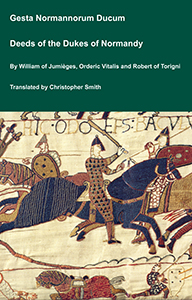 History of the Dukes of Normandy by William of Jumieges. At that time his wife Emma, daughter of Hugh the Great, died [on 19th March 968] without children. He himself not long after took to wife a certain maiden named Gunnor, born of a most noble lineage of the Danes, and he espoused her according to Christian custom. From her he begot sons: namely Richard1 and Robert and Mauger, and two others, and three daughters. Of these, one named Emma2 married King Æthelred of the English, and from her that king begot Edward3 and Alfred, of whom Godwine later, by treacheries, caused the death of one [Alfred]. The second, called Hawise, was joined to Geoffrey, Count of the Bretons, and she brought forth Alan and Eudo, both dukes. The third, Matilda, to Count Odo, of whom mention will be made later. He also begot two sons and two daughters by concubines. One of these sons was called Geoffrey4, and the other was called William. The former was Count of Eu. When he died, his brother took that same county, which his heirs still hold by right of succession; although Count Gilbert, son of Count Godfrey, held that county for a time before he was killed. This Gilbert begot Richard, a most valiant knight, who, both he and his sons, Gilbert, Roger, Walter, and Robert, greatly loved the church of Bec, and enriched it with great possessions; imitating their grandfather, Count Gilbert, who, in founding the aforesaid church, aided the venerable Herluin, its first abbot and builder, both with counsel and with resources. Concerning that church and the said abbot we shall make mention in its proper place in a preceding account, as is fitting. For now, let it be enough to have spoken these things briefly by anticipation.
Qua tempestate Emma uxor ejus, filia Hugonis Magni, absque liberis moritur. Ipse vero non multo post quamdam virginem nomine Gunnor, ex nobilissima Danorum prosapia ortam sibi in matrimonium christiano more desponsavit. Ex qua filios genuit, Richardum videlicet et Robertum atque Malgerium, aliosque duos atque filias tres. Quarum una nomine Emma, Edelrodo regi Anglorum nupsit, de qua idem rex Edwardum et Aluredum. Godwini longo post dolis interemptum procreavit. Secunda vero Hadvis vocata Goiffredo Brittannorum comiti juncta, Alanum et Eudonem duces progenuit. Tertia quidem Mathildis Odoni comiti, de qua sermo in posteris orietur. Genuit etiam duos filios et totidem filias ex concubinis. Quorum unus Godefridus, alter vero dicebatur Willelmus. Horum prior comes fuit Aucensis. Quo defuncto, accepit frater ejus eumdem comitatum quem adhuc hæredes ejusjure successionis possident; licet comes Gislebertus filius Godefredi comitis ipsum comitatum parumper tenuerit, antequam occideretur. Hic Gislebertus genuit Richardum strenuissimum militem, qui tam ipse quam filii ejus, Gislebertus, Rogerius, Walterius, Robertus, ecclesiam Beccensem magno affectu dilexerunt et magnis possessionibus ditaverunt; imitantes comitem Gislebertum avum suum, qui in fundanda prædicta ecclesia venerabilem Herluinum primum abbatem et constructorem ipsius et consilio et rebus juvit. De qua ecclesia et prædicto ejus abbate, pracedenti tractatu, loco competenti prout decet, mentionem faciemus. Hic vero ista per anticipationem breviter dixisse sufficiat.
Note 1. Richard, around 980-1026, II Duke of Normandy. He married 1. Judith, 982-1017, daughter of Conan I of Brittany and Ermengarde, daughter of Geoffrey Count of Anjou, and 2. Poppa, daughter of Richeldis of Envermeu. Richard is the subject of Book 5.
Note 2. Emma of Normandy, around 984-1052. She married (1) 1002, King Æthelred the Unready and (2) 1017 King Cnut. With King Æthelred the Unready she has issue King Edward the Confessor, Godgifu, who married three times, and Alfred Ætheling, who died soon after being blinded by Earl Godwin of Wessex, father of King Harold. With King Cnut she had issue King Harthacnut, and Gunhilda, who married Henry III, King of East Francia and Holy Roman Emperor.
Note 3. King Edward "The Confessor" of England, 1003-1066, and Ælfred Ætheling Wessex, 1005-1036. Both sons of King Æthelred II of England and Emma aka Ælfgyfu of Normandy, Queen Consort England, daughter of Richard, Ist Duke of Normandy and Gunnora, and sister of Richard, 2nd Duke of Normandy.
Note 4. Geoffrey, 1st Count of Eu. Progenitor of the de Clare family, subsequently Earls of Pembroke.
On 19th March 1286 King Alexander III of Scotland [aged 44] died from a fall from a horse at Kinghorn Ness while riding in the dark to visit the Queen [aged 22] at Kinghorn in Fife because it was her birthday the next day. His granddaughter Margaret [aged 2] succeeded I Queen Scotland.
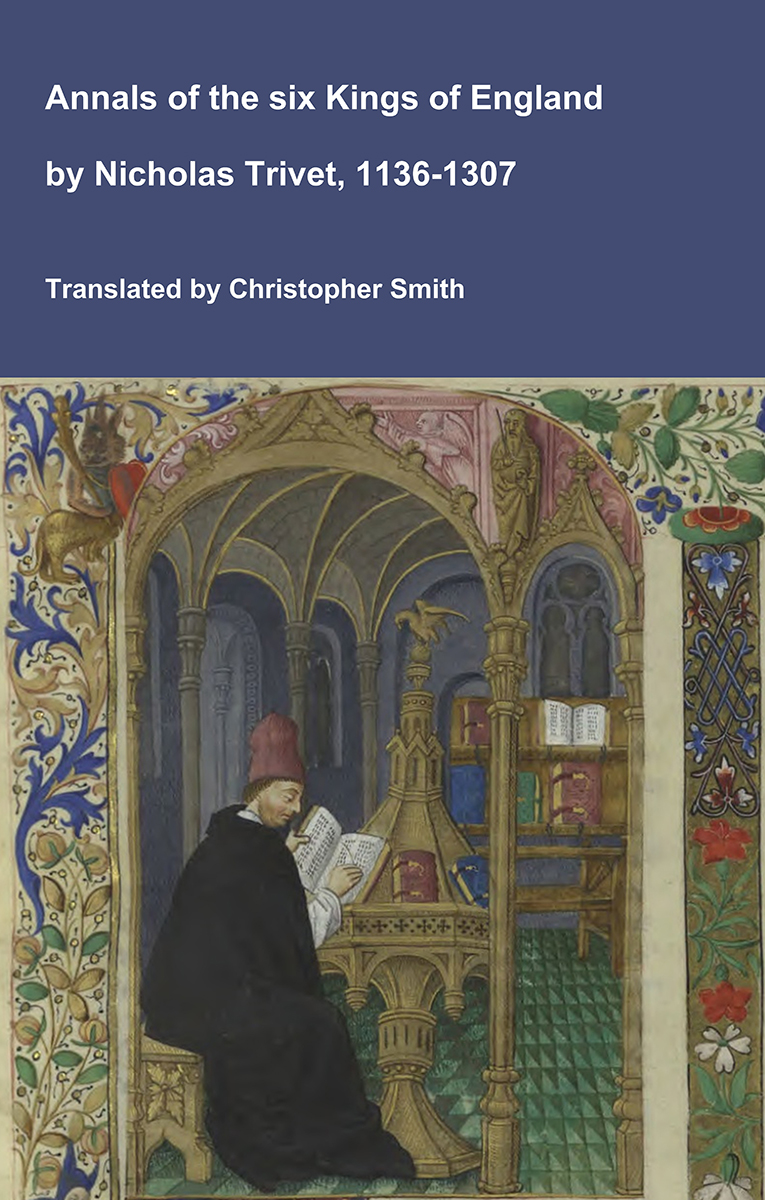 Annals of Six Kings of England by Nicholas Trivet. In the season of Lent of this year, when Alexander [aged 44], King of the Scots, wished to visit his wife, daughter of the Count of Flanders, whom he had married after Margaret, daughter of the King of England, on a certain very dark night, his horse stumbling, he fell and, being grievously injured, died1. He had by his second wife no offspring, but by his first he had twins, namely a son Alexander, and a daughter named Margaret. Alexander, without issue, preceded his father in untimely death, and the daughter Margaret, having been betrothed to the King of Norway, bore a single daughter named Margaret, who survived her mother, now dead. This child, with the King of England having been consulted, was acknowledged by the magnates of Scotland as heir of that kingdom, and when she had been summoned by messengers of the King of England, as she was making for Scotland by ship, having fallen ill at sea, she died in the Orkney Islands.
Tempore Quadragesimali hujus anni, cum Alexander Scotorum rex uxorem suam, filiam comitis Flandriæ, quam post Margaretam filiam regis Angliæ duxerat, nocte quadam admodum obscura visitare voluisset, cespitante equo lapsus, et collisus graviter, exspiravit. Hic de secunda uxore nullam, de prima vero prolem geminam, filium scilicet Alexandrum, et filiam genuit nomine Margaretam. Alexander absque prole patrem immatura morte prævenit; filia Margareta regi Norwegiæ desponsata, filiam unicam peperit nomine Margaretam, quæ matri jam mortuæ supervixit. Hanc, consulto rege Angliæ, magnates Scotiæ regni illius recognoverunt heredem; quæ accersita per nuntios regis Angliæ, cum per navigium tenderet in Scotiam, infirmata in mari, apud Orcades insulas est defuncta.
Note 1. The author places this event in the wrong year. King Alexander III of Scotland died on 19th March 1286. The date being the day before his wife Yolande of Dreux [aged 22], the purpose of his rash journey to be with her on her birthday. His son Alexander had predeceased him aged twenty without issue. His daughter Margaret, Queen of Norway, predeceased him in 1283 shortly after having given birth to a daughter, also Margaret, known as the 'Maid of Norway'. In 1290 Margaret died at Orkney on her journey from Norway to Scotland. Her death led to a succession crisis with numerous claimants to the Scottish throne.
Around 19th March 1311 the nobility attempt to constrain King Edward II of England [aged 26] by imposing a Council of Ordainers upon him. The Council included twenty-one signatories including:
Guy Beauchamp 10th Earl Warwick [aged 39].
Robert Clifford 1st Baron Clifford [aged 36].
Thomas Plantagenet 2nd Earl of Leicester, 2nd Earl Lancaster, Earl of Salisbury and Lincoln [aged 33].
Gilbert de Clare 8th Earl Gloucester 7th Earl Hertford [aged 19].
Henry Lacy 4th Earl Lincoln, Earl Salisbury.
John Capet 4th Earl Richmond [aged 45].
William Marshal 1st Baron Marshal [aged 33], and.
Aymer de Valence 2nd Earl Pembroke [aged 36].
On 19th March 1330 the King's uncle Edmund of Woodstock 1st Earl Kent [aged 28] was beheaded at Winchester Castle [Map]. Earl Kent forfeit. Edmund had been convicted of plotting against the court believing his brother King Edward II was still alive. It later emerged the plot had been created by Roger Mortimer 1st Earl March [aged 42] to entrap Edmund. King Edward III of England [aged 17] was unable to show leniency risking complicity in the plot. He was buried at Westminster Abbey [Map].
See Parliament Rolls, 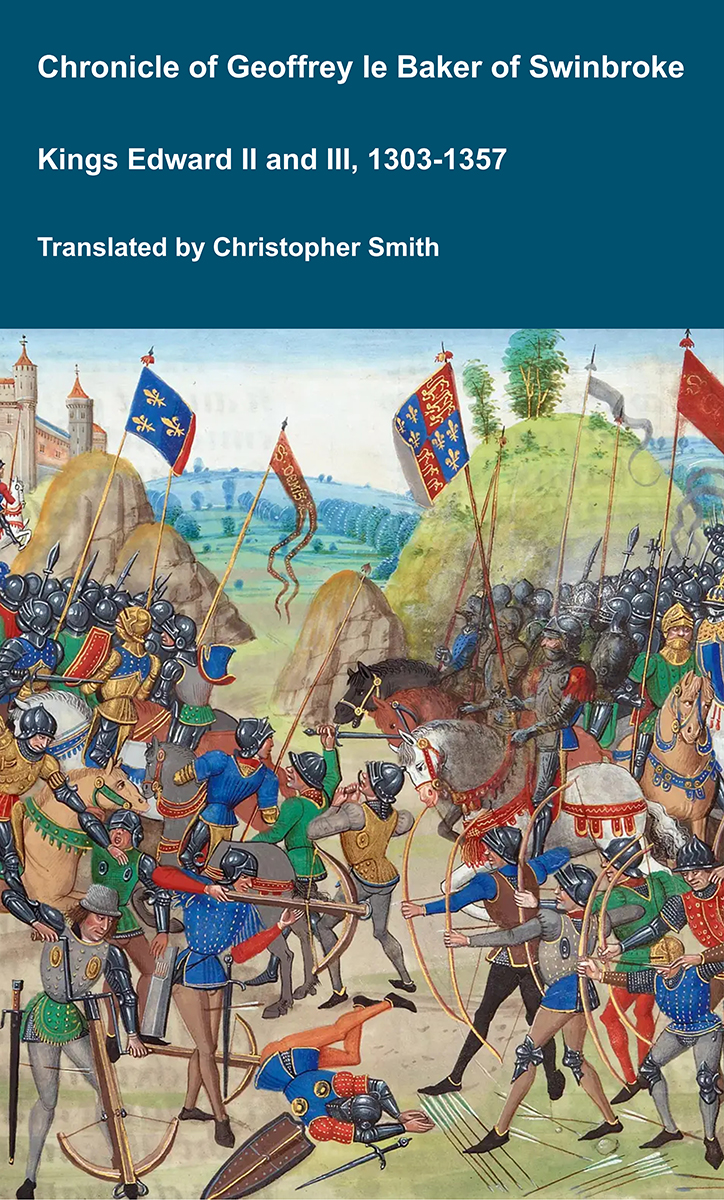 Chronicle of Geoffrey le Baker of Swinbroke,
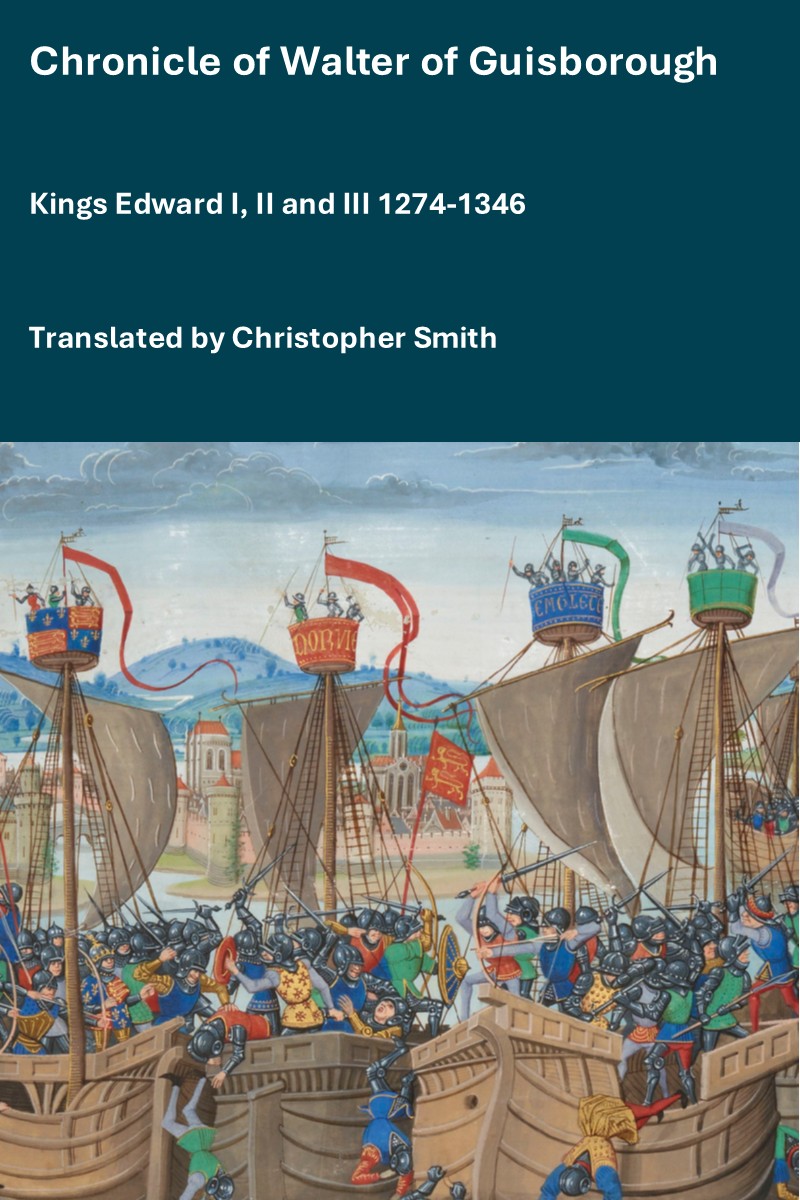 Chronicle of Walter of Guisborough,
Knighton 2555, and
Chronicle of Geoffrey le Baker of Swinbroke. That same year [1330], the third of the king's reign, at the urging of those who hated his father, the king held a parliament at Winchester,1 where, through the influence of his mother and Roger de Mortimer, the said Earl of Kent, his uncle, and many other nobles and religious men including provincials of the Orders of Preachers and Carmelites of Blessed Mary, and Friar Richard de Blytone2 were accused of conspiring, as it was claimed, to free the king's father from prison and restore him to rule, although all of this was false and imagined. Nevertheless, the said earl [Edmund of Woodstock 1st Earl Kent [aged 28]], because of certain confessions he had made and some letters found in his possession though none of those confessions or letters, even if genuine, should have rendered so great a man worthy of such punishment, was beheaded.3 As for the others, the provincials of the Orders of Preachers and Carmelites of Blessed Mary were exiled; the Bishop of London was released from detention; Robert de Taunton,4 a cleric, and certain friars of the Carmelite and Dominican Orders were imprisoned. The death of the said earl displeased the people of the kingdom the less because he had a notorious household, which, while travelling through the land, seized the goods of the common people at royal prices, paying little or nothing for what they took.
Eodem anno, scilicet regni regis tercio, ad instanciam odiencium patrem suum, rex tenuit parliamentum Wyntonie, ubi, procurantibus matre sua et Rogero de Mortuo mari, predictus comes Cancie, patruus regis, et multi alii nobiles et religiosi viri, scilicet provinciales ordinum Predicatorum et Carmelitarum beate Marie, et frater Ricardus de Blitone, fuerunt accusati de eo quod conspiraverunt, ut dicebatur, regis patrem de carcere liberare et ad regni statum reducere, licet totum hoc fuisset falsum et fantasiatum. Tum comes predictus, propter quasdam confessiones suas et quasdam literas secum inventas, licet ulle illarum confessionum seu literarum, etsi vere fuissent, non debuissent tantum virum tali supplicio dignum reddidisse, fuit decapitatus. Alii vero ut provinciales Predicatorum et Carmelitarum beate Marie, fuerunt exulati; episcopus vero Londoniensis fuit manumissioni dimissus; Robertus de Tauntone clericus et fratres quidam de ordinibus Carmelitarum et Predicatorum carceri fuerunt mancipati. Mors predicti comitis eo minus populo regni displicuit, quod malam habuit familiam, res popularium per patriam itinerando precio regali capescentem, parum vel nihil pro emptis solventes.
Note 1. This parliament was summoned on the 25th January 1330, and sat from the 11th to the 23rd March.
Note 2. The provincial of the Carmelites in England at this time was John Baconthorp, who died in 1346. "He was little of stature, but great in wit, and writ such vast volumes that his body could not have borne what his brain produced." Stevens, History of Ancient Abbeys (1723), 2.159, 163. Richard Bliton was provincial from 1319 to 1326 and died at Lincoln in 1330. He was confessor to Edward II Ibid., 2.162.
Note 3. Edmund of Woodstock was beheaded on 19th March 1330. See Knighton 2555.
Chronicle of Walter of Guisborough
Note 4. He is referred to in Kent's confession as the archbishop of York's messenger. See Adam Murimuth Continuation.
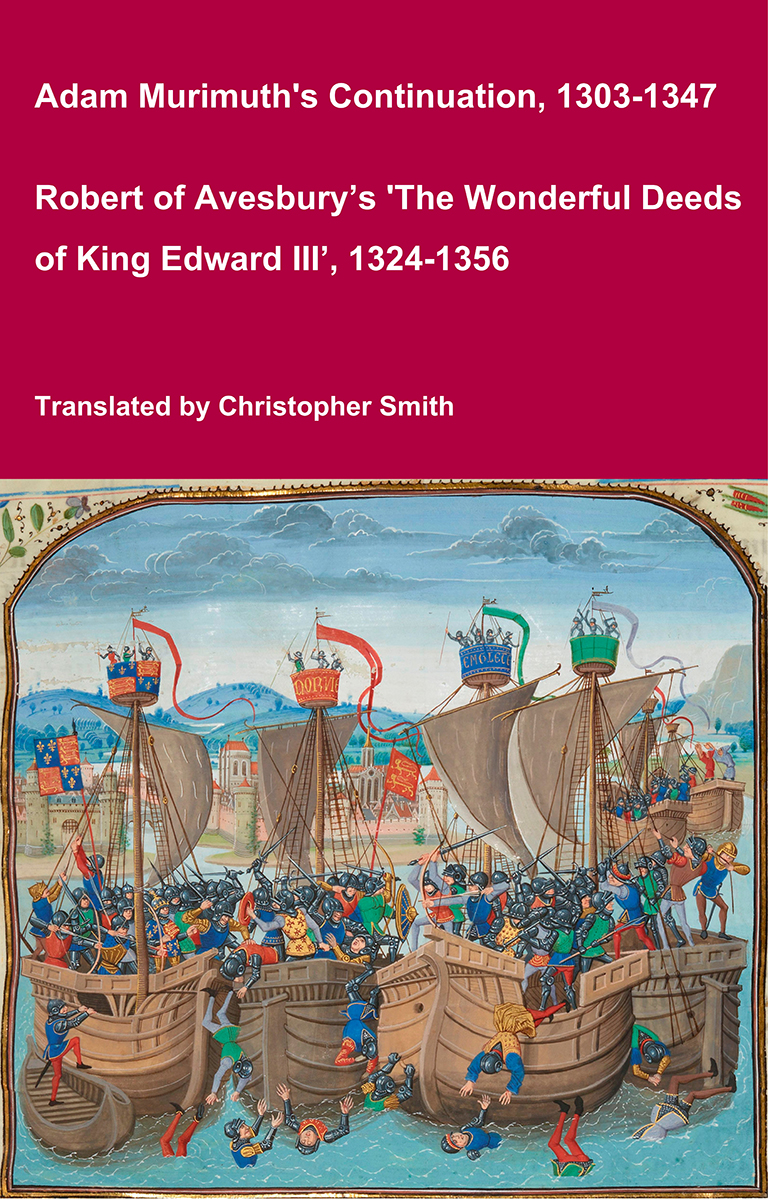 Adam Murimuth Continuation. 1329. In the year of our Lord 1329, in the 14th year of Pope John XXII and the third year of King Edward III, around the middle of Lent, the king held a parliament at Winchester. There, at the instigation of Queen Isabella and Roger Mortimer, the Earl of Kent, the king's uncle, was accused, along with many others. They were charged with falsely claiming that King Edward II was still alive and with conspiring to free him and restore him to the throne. However, this was completely false and an illusion, as later events proved. Nevertheless, the said Earl was beheaded there, due to certain confessions he had made and some letters found in his possession. However, none of these confessions or letters, even if they had been true, should have justified his execution. However, the other accused were released on bail, such as the Bishop of London, while others, including Robert de Taunton and some others, were imprisoned. Nevertheless, the Earl of Kent was less mourned by the people, because he had a bad household, whose members, traveling through the country, seized the property of commoners by their own authority and paid little or nothing for it.
Anno Domini millesimo CCCXXIX, dicti vero Johannis papa XIIIJ, et ipsius regis Edwardi tertio, hoc anno circa mediam Quadragesimam tenuit rex parliamentum Wyntoniæ, ubi, procurante regina et Rogero de Mortuo mari, fuit comes Canciæ, patruus regis accusatus, et fuerunt multi alii accusati de eo quod quidam confingentes patrem regis vivum, et quod conspiraverant eum liberare et ad statum regni reducere, licet hoc totum falsum et phantasma fuisset, sicut rei exitus postmodum comprobavit. Tamen dictus comes, propter quasdam confessiones suas et quasdam literas secum inventas, iicet nullæ illarum confessionum vel literarum, etsi veræ essent, deberent causam tribuere mortis suæ, fuit decollatus ibidem. Alii vero accusati dimissi fuerant sub manucaptione, ut episcopus Londoniensis; alii vero carceri mancipati, ut Robertus de Tantone et quidam alii. Dictus tamen comes eo minus a populo conquerebatur, quod malam habuit familiam, res popularium eundo per patriam auctoritate propria occupantes et parum vel nihil solventes eisdem.
Note 1. See Chronicle of Geoffrey le Baker of Swinbroke: "In the year 1329, certain individuals, wishing to find out what friends Edward II, the recently deceased King of England, still had, fabricated a story that he was living luxuriously in Corfe Castle, though never seen by day. To support this fiction, they held dances many nights upon the castle walls and towers, carrying lit candles and torches, so that they might be perceived by the simple folk of the countryside as keeping watch over some great king to whom they were rendering honours. News spread throughout England that the king's father was still alive. Because of this, the Earl of Kent sent a certain friar of the Order of Preachers to investigate the truth of the matter. Thinking he had bribed the castle's doorkeeper, the friar was deceived. He was brought in and kept hidden by day in the porter's chamber, with the promise that he would see by night the man he wished to see. At night he was led into the hall, ordered to wear secular clothing so as not to be recognized, and there he believed he saw King Edward, the king's father, sitting at a splendid supper. Believing what he saw, he reported to the Earl of Kent that he had seen him. As a result, the earl, in the presence of certain persons to whom he should not have confided such things, swore he would labour to have his brother freed from the imprisonment in which he was held. That same year [1330], the third of the king's reign, at the urging of those who hated his father, the king held a parliament at Winchester,1 where, through the influence of his mother and Roger de Mortimer, the said Earl of Kent, his uncle, and many other nobles and religious men including provincials of the Orders of Preachers and Carmelites of Blessed Mary, and Friar Richard de Blytone2 were accused of conspiring, as it was claimed, to free the king's father from prison and restore him to rule, although all of this was false and imagined. Nevertheless, the said earl, because of certain confessions he had made and some letters found in his possession though none of those confessions or letters, even if genuine, should have rendered so great a man worthy of such punishment, was beheaded. As for the others, the provincials of the Orders of Preachers and Carmelites of Blessed Mary were exiled; the Bishop of London was released from detention; Robert de Taunton, a cleric, and certain friars of the Carmelite and Dominican Orders were imprisoned. The death of the said earl displeased the people of the kingdom the less because he had a notorious household, which, while travelling through the land, seized the goods of the common people at royal prices, paying little or nothing for what they took."
Chronicle of Walter of Guisborough. On the First Sunday of Lent, Philippa, queen of England, was crowned at Westminster. In the first week of Lent, a parliament was held at Westminster in Winchester, where, on the day after the feast of Saint Gregory, Edmund, earl of Kent, the king's uncle, was arrested and, on the eve [19th March 1330] of Saint Cuthbert, condemned to death1. From the first hour of the day until evening, he stood outside the gates, no one willing to lay a hand on him, until at last a certain unfortunate man from the Marshal's office was ordered to behead him.
Dominica Quadragesima Philippa regina Angliæ apud Westmonasterium coronatur. Prima is septimana Quadragesimæ factum est parliamentum Westmins apud Wintoniam, ubi, in crastino Sancti Gregorii, Edmundus comes Cantiæ, avunculus regis, fuit Parliament arrestatus et in vigilia Sancti Cuthberti morti adjudicatus: ab hora vero diei prima usque ad vesperas extra portas, nullo in eum manum mittere volente, stetit condemnatus, donec miser quidam de Marescallia eum jussus est decollare.
Note 1. Prince Edmund was condemned to death on the charge of having entered into a conspiracy to set his brother, Edward II, at liberty, an enterprise into which he had been inveigled by the artifices of Mortimer and the queen-mother, who had led him to believe that the unfortunate King was still alive in Corfe Castle. T, Walsingham, 129, ed., Camden; See also Rapin, Hist. 1.410, ed. 1732 and H. Knyghton, 2555.
On 19th March 1470 Robert Welles 8th Baron Willoughby 8th Baron Welles was beheaded at Doncaster [Map]. He was buried at Whitefriars Doncaster [Map]. Baron Welles forfeit. His sister Joan succeeded 9th Baroness Willoughby de Eresby. Richard Hastings Baron Willoughby [aged 37] by marriage Baron Willoughby de Eresby. He, Hastings, a favourite of King Edward IV of England [aged 27], younger brother of Edward's great friend William Hastings 1st Baron Hastings [aged 39].
On 19th March 1553 Alberta Palatinate Simmern [aged 14] died. Her brother Louis [aged 13] succeeded VI Elector Palatine Rhine.

After 19th March 1553. St Martin's Church, Stamford [Map]. Monument to Richard Cecil [deceased] and his wife Jane Heckington. Kneeling figures under an elaborate cornice. Attributed to Cornelius Cure. Elizabethan Period.
Jane Heckington: she was born to William Heckington. Before 1520 Richard Cecil and she were married. On 10th March 1587 she died.
On 19th March 1554 Bishop John Harley was deprived of his see of Bishop of Hereford for being a Protestant, and because he was married.

Anne Boleyn. Her Life as told by Lancelot de Carle's 1536 Letter.
In 1536, two weeks after the execution of Anne Boleyn, her brother George and four others, Lancelot du Carle, wrote an extraordinary letter that described Anne's life, and her trial and execution, to which he was a witness. This book presents a new translation of that letter, with additional material from other contemporary sources such as Letters, Hall's and Wriothesley's Chronicles, the pamphlets of Wynkyn the Worde, the Memorial of George Constantyne, the Portuguese Letter and the Baga de Secrets, all of which are provided in Appendices.
Available at Amazon in eBook and Paperback format.
Henry Machyn's Diary. 19th March 1555. The xix day of Marche in the mornyng the Kyng('s) [aged 27] grace rune at the tylt a-gaynst odur Spaneards, and brake iiij stayffes by viij of the cloke in the mornyng.


Henry Machyn's Diary. 19th March 1558. The xix day of Marche my lord mayre and the althermen whent unto Yeld-halle [Map], and ther all the craftes in London browth in the bylles what ther compene wold lend unto the quen('s) [aged 42] grace for to helpe her in her fa ... toward the wars.
Note. P. 168. Loan from the city to the queen. A loan was then called a "prest," which is probably the word our diarist could not remember. The amount of this prest was 20,000l. and it was to bear interest at 12 per cent. (Stowe.)


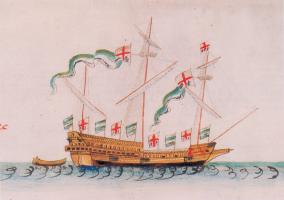
On 19th March 1563 the Greyhound was wrecked on its journey to Le Havre with the loss of around two-hundred lives.
Captain Thomas Finch [aged 51], Arthur Brooke, and brothers John Wentworth [aged 25] and James Wentworth [aged 23] drowned.
The Greyhound in 1546 from the Anthony Roll.

On 19th March 1604 John IV King Portugal was born to Teodosio II Duke of Braganza [aged 35] and Ana de Velasco y Téllez Girón Duchess Braganza [aged 19]. He married 1633 Luisa de Guzman Queen Consort Portugal and had issue.
On 19th March 1609 Maud Babington [aged 38] was murdered. A servant, Honora ny Caffry, was burned at the stake for the petty treason of the murder of a mistress. Another, a man, later confessed to the murder.
After 19th March 1612. Stuart Hooded Monument monument with a figure leaning on their elbow to Mary Dawnay Baroness Eure [deceased] at St Laurence's Church, Ludlow [Map]. The monument is now in the south transept but was originally in a more prestigious position at the east end of the chancel, on the south side, opposite the Townshend tomb. It was moved when the chancel was restored by Scott in 1859-60. The figure of Lady Eure was originally painted: traces of black paint can still be seen in the folds of her elaborate dress. The inscription ... Here lyeth expecting a joyful resurrection the body of Dame Mary Eure late wife to the Right Ho Ralph Lord Eure [aged 53] Baron of Malton, Lord President of the Principality and Marches of Wales and Leiutenant of the same and daughter of Sir John Dawney of Sessey in the County of York she departed this life the 19th day of March 1612 at the age of 55.
Mary Dawnay Baroness Eure: Around 1557 she was born to John Dawnay of Sessay, Yorkshire and Elizabeth Tunstall. In or before 1578 Ralph Eure 3rd Baron Eure and she were married. They were half fourth cousins. In 1594 William Eure 2nd Baron Eure died. In 1594 His son Ralph succeeded 3rd Baron Eure. She by marriage Baroness Eure. On 19th March 1612 Mary Dawnay Baroness Eure died.


On 19th March 1616 Henry Pierrepont [aged 70] died. Church of St Edmund, Holme Pierrepoint [Map]. Designed by John Smythson. Probably carved by Hugh Hall who also carved the monument to Thomas Smith originally at Wybynbury but since moved to Nantwich [Map]. Elizabethan Period. Armorials:
Top left  Cavendish Arms - he was married to Frances Cavendish [aged 67] daughter of William Cavendish and Bess of Hardwick.
Top right  Pierrepoint Arms.
Centre Bottom: Quartered 1&4 Pierrepoint Arms 2&3 Unknown Arms impaled Quartered 1&4 Cavendish Arms 2&3 Unknown Arms.
Frances Cavendish: On 18th June 1548 she was born to William Cavendish and Bess of Hardwick. Before 1584 Henry Pierrepont and she were married. She the daughter of William Cavendish and Bess of Hardwick Countess Shrewsbury and Waterford. They were sixth cousins. In January 1632 Frances Cavendish died.


On 19th March 1643 William Compton [aged 18] and James Compton 3rd Earl of Northampton [aged 20] fought for the Royalist army at Hopton Heath, Staffordshire.
Spencer Compton 2nd Earl of Northampton [aged 41] was killed. His son James succeeded 3rd Earl of Northampton, 4th Baron Compton of Compton in Warwickshire.


Samuel Pepys' Diary. 19th March 1660. Early to my Lord, where infinity of business to do, which makes my head full; and indeed, for these two or three days, I have not been without a great many cares and thoughts concerning them. After that to the Admiralty, where a good while with Mr. Blackburne, who told me that it was much to be feared that the King would come in, for all good men and good things were now discouraged. Thence to Wilkinson's, where Mr. Sheply and I dined; and while we were at dinner, my Lord Monk's [aged 51] lifeguard come by with the Serjeant at Arms before them, with two Proclamations, that all Cavaliers do depart the town; but the other that all officers that were lately disbanded should do the same. The last of which Mr. R. Creed, I remember, said, that he looked upon it as if they had said, that all God's people should depart the town. Thence with some sea officers to the Swan [Map], where we drank wine till one comes to me to pay me some money from Worcester, viz., £25. His name is Wilday. I sat in another room and took my money and drank with him till the rest of my company were gone and so we parted. Going home the water was high, and so I got Crockford to carry me over it. So home, and left my money there. All the discourse now-a-day is, that the King will come again; and for all I see, it is the wishes of all; and all do believe that it will be so. My mind is still much troubled for my poor wife, but I hope that this undertaking will be worth my pains. To Whitehall and staid about business at the Admiralty late, then to Tony Robins's, where Capt. Stokes, Mr. Luddington and others were, and I did solicit the Captain for Laud Crisp, who gave me a promise that he would entertain him. After that to Mrs. Crisp's where Dr. Clodius and his wife were. He very merry with drink. We played at cards late and so to bed. This day my Lord dined at my Lord Mayor's [Allen], and Jasper was made drunk, which my Lord was very angry at.


Samuel Pepys' Diary. 19th March 1665. Being very glad of this news Mr. Povy [aged 51] and I in his coach to Hyde Parke, being the first day of the tour there. Where many brave ladies; among others, Castlemayne [aged 24] lay impudently upon her back in her coach asleep, with her mouth open. There was also my Lady Kerneguy [aged 26]1, once my Lady Anne Hambleton, that is said to have given the Duke a clap upon his first coming over. Here I saw Sir J. Lawson's [aged 50] daughter and husband, a fine couple, and also Mr. Southwell [aged 29] and his new lady [aged 17], very pretty.
Note 1. Daughter of William, Duke of Hamilton, wife of Lord Carnegy [aged 16], who became Earl of Southesk on his father's death. She is frequently mentioned in the "Memoires de Grammont", and in the letters of the second Earl of Chesterfield. B.
Samuel Pepys' Diary. 19th March 1665. Lord's Day. Mr. Povy [aged 51] sent his coach for me betimes, and I to him, and there to our great trouble do find that my Lord FitzHarding [aged 35] do appear for Mr. Brunkard [aged 38]1 to be Paymaster upon Povy's going out, by a former promise of the Duke's [aged 31], and offering to give as much as any for it. This put us all into a great dumpe, and so we went to Creed's new lodging in the Mewes, and there we found Creed with his parrot upon his shoulder, which struck Mr. Povy coming by just by the eye, very deep, which, had it hit his eye, had put it out. This a while troubled us, but not proving very bad, we to our business consulting what to do; at last resolved, and I to Mr. Coventry [aged 37], and there had his most friendly and ingenuous advice, advising me not to decline the thing, it being that that will bring me to be known to great persons, while now I am buried among three or four of us, says he, in the Navy; but do not make a declared opposition to my Lord FitzHarding.
Note 1. Henry Brouncker, younger brother of William, Viscount Brouncker, President of the Royal Society. He was Groom of the Bedchamber to the Duke of York, and succeeded to the office of Cofferer on the death of William Ashburnham in 1671. His character was bad, and his conduct in the sea-fight of 1665 was impugned. He was expelled from the House of Commons, but succeeded to his brother's title in 1684. He died in January, 1687.


Samuel Pepys' Diary. 19th March 1665. Thence I to Creed, and walked talking in the Park an hour with him, and then to my Lord Sandwich's [aged 39] to dinner, and after dinner to Mr. Povy's [aged 51], who hath been with the Duke of Yorke [aged 31], and, by the mediation of Mr. Coventry [aged 37], the Duke told him that the business shall go on, and he will take off Brunkerd, and my Lord FitzHarding [aged 35] is quiett too. But to see the mischief, I hear that Sir G. Carteret [aged 55] did not seem pleased, but said nothing when he heard me proposed to come in Povy's room, which may learn me to distinguish between that man that is a man's true and false friend.


Anne Boleyn. Her Life as told by Lancelot de Carle's 1536 Letter.
In 1536, two weeks after the execution of Anne Boleyn, her brother George and four others, Lancelot du Carle, wrote an extraordinary letter that described Anne's life, and her trial and execution, to which he was a witness. This book presents a new translation of that letter, with additional material from other contemporary sources such as Letters, Hall's and Wriothesley's Chronicles, the pamphlets of Wynkyn the Worde, the Memorial of George Constantyne, the Portuguese Letter and the Baga de Secrets, all of which are provided in Appendices.
Available at Amazon in eBook and Paperback format.
Samuel Pepys' Diary. 19th March 1667. This afternoon I am told again that the town do talk of my Lord Arlington's [aged 49] being to be Lord Treasurer, and Sir W. Coventry [aged 39] to be Secretary of State; and that for certain the match is concluded between the Duke of Richmond [aged 28] and Mrs. Stewart [aged 19], which I am well enough pleased with; and it is pretty to consider how his quality will allay people's talk; whereas, had a meaner person married her, he would for certain have been reckoned a cuckold at first-dash.


Samuel Pepys' Diary. 19th March 1669. Thence to the plaisterer's, and took my face, and my Duke of Albemarle's [aged 60] home with me by coach, they being done to my mind; and mighty glad I am of understanding this way of having the pictures of any friends. At home to dinner, where Mr. Sheres dined with us, but after dinner I left him and my wife, and with Commissioner Middleton and Kempthorne [aged 49] to a Court-martiall, to which, by virtue of my late Captainship, I am called, the first I was ever at; where many Commanders, and Kempthorne president. Here was tried a difference between Sir L. Van Hemskirke, the Dutch Captain who commands "The Nonsuch", built by his direction, and his Lieutenant; a drunken kind of silly business. We ordered the Lieutenant to ask him pardon, and have resolved to lay before the Duke of York [aged 35] what concerns the Captain, which was striking of his Lieutenant and challenging him to fight, which comes not within any article of the laws martiall. But upon discourse the other day with Sir W. Coventry [aged 41], I did advise Middleton, and he and I did forbear to give judgment, but after the debate did withdraw into another cabin, the Court being held in one of the yachts, which was on purpose brought up over against St. Katharine's, it being to be feared that this precedent of our being made Captains, in order to the trying of the loss of "The Defyance", wherein we are the proper persons to enquire into the want of instructions while ships do lie in harbour, evil use might be hereafter made of the precedent by putting the Duke of Buckingham [aged 41], or any of these rude fellows that now are uppermost, to make packed Courts, by Captains made on purpose to serve their turns. The other cause was of the loss of "The Providence" at Tangier, where the Captain's being by chance on shore may prove very inconvenient to him, for example's sake, though the man be a good man, and one whom, for Norwood's sake, I would be kind to; but I will not offer any thing to the excusing such a miscarriage. He is at present confined, till he can bring better proofs on his behalf of the reasons of his being on shore. So Middleton and I away to the Office; and there I late busy, making my people, as I have done lately, to read Mr. Holland's' Discourse of the Navy, and what other things I can get to inform me fully in all; and here late, about eight at night, comes Mr. Wren [aged 40] to me, who had been at the Tower to Coventry. He come only to see how matters go, and tells me, as a secret, that last night the Duke of York's closet was broken open, and his cabinets, and shut again, one of them that the rogue that did it hath left plate and a watch behind him, and therefore they fear that it was only for papers, which looks like a very malicious business in design, to hurt the Duke of York; but they cannot know that till the Duke of York comes to town about the papers, and therefore make no words of it. He gone, I to work again, and then to supper at home, and to bed.


On 19th March 1675 Catherine Manners Baroness Gower was born to John Manners 1st Duke Rutland [aged 36] and Catherine Noel Duchess Rutland [aged 18]. She married September 1692 John Leveson-Gower 1st Baron Gower, son of William Leveson-Gower 4th Baronet and Jane Granville Baroness Gower, and had issue.
John Evelyn's Diary. 19th March 1676. Dr. Lloyd [aged 39], late Curate of Deptford, but now Bishop of Llandaff, preached before the King [aged 45], on 1 Cor. xv. 57, that though sin subjects us to death, yet through Christ we become his conquerors.
On 19th March 1683 Thomas Killigrew [aged 71] died at Whitehall Palace [Map].


John Evelyn's Diary. 19th March 1693. A new Secretary of State, Sir John Trenchard [aged 43]; the Attorney-General, Somers [aged 42], made Lord-Keeper, a young lawyer of extraordinary merit. King William [aged 42] goes toward Flanders; but returns, the wind being contrary.


On 19th March 1701 John Egerton 3rd Earl Bridgewater [aged 54] died. He was buried in the Bridgewater Chapel, St Peter and St Paul Church, Little Gaddesden. His son Scroop [aged 19] succeeded 4th Earl Bridgewater, 5th Viscount Brackley, 5th Baron Ellesmere.
John Egerton 3rd Earl Bridgewater: On 9th November 1646 he was born to John Egerton 2nd Earl Bridgewater and Elizabeth Cavendish Countess Bridgewater. On 7th November 1664 John Egerton 3rd Earl Bridgewater and Elizabeth Cranfield were married. She the daughter of James Cranfield 2nd Earl Middlesex and Anne Bourchier Countess Middlesex. He the son of John Egerton 2nd Earl Bridgewater and Elizabeth Cavendish Countess Bridgewater. They were fourth cousins. He a great x 5 grandson of King Henry VII of England and Ireland. On 2nd April 1673 John Egerton 3rd Earl Bridgewater and Jane Paulet Countess Bridgewater were married at St Dionis Backchurch. She the daughter of Charles Paulet 1st Duke Bolton and Mary Scrope 6th Marchioness Winchester. He the son of John Egerton 2nd Earl Bridgewater and Elizabeth Cavendish Countess Bridgewater. They were fourth cousin once removed. He a great x 5 grandson of King Henry VII of England and Ireland.
On 19th March 1703 Ann Howard died. Monument in St Peter's Church, Elford [Map].
Ann Howard: she was born to Craven Howard and Anne Ogle1652-1682.
On 19th March 1719 Melusine Schulenburg 1st Duchess Munster 1st Duchess Kendal [aged 51] was created 1st Duchess Kendal, 1st Countess Feversham, 1st Baroness Glastonbury.
On 19th March 1722 Leonard Smelt [aged 39] was elected MP Northallerton during the 1722 General Election.
On 19th March 1722 Thomas Frankland 3rd Baronet [aged 37] was elected MP Thirsk during the 1722 General Election.
Jean de Waurin's Chronicle of England Volume 6 Books 3-6: The Wars of the Roses
Jean de Waurin was a French Chronicler, from the Artois region, who was born around 1400, and died around 1474. Waurin’s Chronicle of England, Volume 6, covering the period 1450 to 1471, from which we have selected and translated Chapters relating to the Wars of the Roses, provides a vivid, original, contemporary description of key events some of which he witnessed first-hand, some of which he was told by the key people involved with whom Waurin had a personal relationship.
Available at Amazon in eBook and Paperback format.
On 20th February 1723 Hayman Rooke was born. He was baptised at St Martin in the Fields Church [Map] on 19th March 1723.
On 19th March 1737 Elizabeth Noel Duchess Portland [aged 49] died.
On 19th March 1749 Louisa Hanover was born to Frederick Louis Hanover Prince of Wales [aged 42] and Augusta Saxe Coburg Altenburg [aged 29]. She a granddaughter of King George II of Great Britain and Ireland.


Letters of Horace Walpole. P. S. Saturday. — I forgot to tell you that Lord Hardwicke has written some verses to Lord Lyttelton, upon those the latter made on Lady Egremont [aged 35].1 If I had been told that he had put on a bag, and was gone off with Kitty Fisher [aged 19],2 I should not have been more astonished.
Note 1. The following are the lines alluded to, "Addition extempore to the verses on Lady Egremont:
"Fame heard with pleasure — straight replied.
First on my roll stands Wyndham's bride,
My trumpet oft I 've raised to sound Her modest praise the world around;
But notes were wanting — canst thou find A muse to sing her face, her mind?
Believe me, I can name hut one,
A friend of yours — 'tis Lyttelton."
Note 2. A celebrated courtesan of the day. — E.


Letters of Horace Walpole. To George Montagu, Esq.
Arlington Street, March 19, 1761.
I can now tell you, with great pleasure, that your cousin [aged 44]1 is certainly named lord-lieutenant. I wish you joy. You will not be sorry too to hear that your Lord North is much talked of for succeeding him at the board of trade. I tell you this with great composure, though to-day has been a day of amazement. All the world is staring, whispering, and questioning. Lord Holderness has resigned the seals,2 and they are given to Lord Bute. Which of the two secretaries of state is first minister? the latter or Mr. Pitt? Lord Holderness received the command but yesterday, at two o'clock, till that moment thinking himself extremely well at court; but it seems the King said he was tired of having two secretaries, of which one would do nothing, and t'other could do nothing; he would have a secretary who both could act and would. Pitt had as short notice of this resolution as the sufferer, and was little better pleased. He is something softened for the pre¬ sent by the offer of cofferer for Jemmy Grenville, which is to be ceded by the Duke of Leeds, who returns to his old post of justice in eyre, from whence Lord Sandy s is to be removed, some say to the head of the board of trade. Newcastle, who enjoys this fall of Holderness's, who had deserted him for Pitt, laments over the former, but seems to have made his terms with the new favourite: if the Bedfords have done so too, will it surprise you? It will me, if Pitt submits to this humiliation; if he does not, I take for granted the Duke of Bedford will have the other seals. The temper with which the new reign has hitherto proceeded, seems a little impeached by this sudden act, and the Earl now stands in the direct light of a minister, if the House of Commons should cavil at him. Lord Delawar kissed hands to-day for his earldom; the other new peers are to follow on Monday.
Note 1. The Earl of Halifax.
Note 2. Lord Barrington, in a letter to Mr. Mitchell, of the 23rd, says, "Our friend Holderness is finally in harbour; he has four thousand a-year for life, with the reversionship of the cinque-ports, after the Duke of Dorset; which he likes better than having the name of pensioner. I never could myself understand the difference between a pension and a sinecure place." — E.


On 19th March 1776 Ramsay Richard Reinagle was born.

On 19th March 1783 Archbishop Frederick Cornwallis [aged 70] died. He was buried at St Mary at Lambeth Church, Surrey [Map].

On 19th March 1786 Louisa Barbara Venables-Vernon was buried at All Saints Church, Sudbury [Map].
Louisa Barbara Venables-Vernon: Around 1764 she was born to George Venables-Vernon 2nd Baron Vernon and Louisa Barbara Mansel In December 1785 Louisa Barbara Venables-Vernon died in the South of France.
After 19th March 1791. Monument to Penelope Boothby [deceased] at St Oswald's Church, Ashbourne [Map] sculpted by Thomas Banks [aged 55]. Her epitaph reads "She was in form and intellect most exquisite. The unfortunate Parents ventured their all on this frail Bark. And the wreck was total."
Penelope Boothby: On 11th April 1785 she was born to Brooke Boothby 6th Baronet in Lichfield, Staffordshire [Map]. On 19th March 1791 Penelope Boothby died at Ashbourne Hall, Derbyshire [Map]. She was buried in St Oswald's Church, Ashbourne [Map].


On 19th March 1808 Charles IV King Spain [aged 59] abdicated as King Spain. Ferdinand VII King Spain [aged 23] succeeded VII King Spain.


Anne Boleyn. Her Life as told by Lancelot de Carle's 1536 Letter.
In 1536, two weeks after the execution of Anne Boleyn, her brother George and four others, Lancelot du Carle, wrote an extraordinary letter that described Anne's life, and her trial and execution, to which he was a witness. This book presents a new translation of that letter, with additional material from other contemporary sources such as Letters, Hall's and Wriothesley's Chronicles, the pamphlets of Wynkyn the Worde, the Memorial of George Constantyne, the Portuguese Letter and the Baga de Secrets, all of which are provided in Appendices.
Available at Amazon in eBook and Paperback format.
On 19th March 1825 William Owen [deceased] was buried St Luke's Church Chelsea in a private ceremony attended by family and close friends, including Thomas Lawrence [aged 55], Richard Westmacott [aged 49], Thomas Phillips [aged 54] and 'Thompson' [probably Thomas Clement Thompson [aged 45]].


Archaeologia Volume V32 1847 Appendix. Monumental Inscription for Richard Lord Grey de Wilton.
19th March, 1846. Thomas W. King, Esq. F.S.A., communicated some observations on the monumental inscription to the memory of Richard Lord Grey de Wilton, in Eton College Chapel, accompanied by a pedigree, in illustration of the facsimile exhibited by Dr. Bromet on March 5. Richard Grey died in 1521, a minor and without issue; it is not easy to explain why he should be styled "one of the heyrs apparant to Richard Erll of Kent;" both were descended from John Lord Grey de Wilton, who died 17 Edward II., but the Earl had a brother living in 1521, who succeeded him. It is equally inexplicable why Richard Grey should be styled "Lord Grey Cotenore, Wylton, Ruthyn," as these baronies never merged in one individual. The barony of Grey de Codnor fell into abeyance in 1496, among the aunts of Henry, the last lord; and, had it been a barony limited to heirs male of the first baron, the Greys of Barton, a family existing at the time of Richard's death, would have had a prior claim. As regards the style of Ruthyn, Mr. King remarked that Richard's grandfather married the daughter of Edmund Lord Grey de Ruthyn; but his descent, thus deduced from that family, could in no wise have entitled him to the designation of that barony. Richard Earl of Kent died within three years after the decease of Richard Lord Grey de Wilton, and it seems pro bable, from the expression, "one of the heyrs apparant," that the monument at Eton was erected soon after; the insertion of the style "Lord Grey Cotenore, Wylton, Ruthyn," may possibly have been intended merely to indicate his connexion with the other ennobled branches of his ancient family.
Archaeologia Volume V32 1847 Section VI. Observations on the Monumental Inscription to Richard Grey, Lord Grey de Wilton, in the Chapel of Eton College, Bucks. By Thomas William King, Rouge Dragon, F.S.A., in a Letter to William Bromet, M.D., F.S.A. Read 19th March, 1846.
Thomas Bateman 1846. On March 19th three unimportant barrows in the neighbourhood of Thorpe were opened; the first of which, placed in a low situation, was composed solely of earthy in which fragments of charcoal were apparently the only indications of its haying been raised by man.
The next was on more elevated ground had been partially removed and produced some trifling remains of bone and a small piece of Samian ware much worn.
The last one placed in the hollow between two hills, contained numerous human bones chiefly from the extremities, and a few teeth which indicate the interment of an infant and a full-grown individual.
On 19th March 1852 Caroline Sophia Wyndham [aged 22] died in childbirth at Drove Westhampnett. She and the child, who died on the same day, were buried at Bartons Lane Cemetery Petworth.

On 19th March 1869 Robert Edward Grosvenor was born to Hugh Lupus Grosvenor 1st Duke Westminster [aged 43] and Constance Leveson-Gower Duchess Westminster [aged 34]. Coefficient of inbreeding 7.06%.
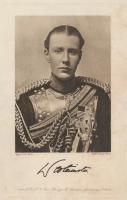
On 19th March 1879 Hugh "Bendor" Grosvenor 2nd Duke Westminster was born to Victor Alexander Grosvenor [aged 25] and Sibell Mary Lumley [aged 23]. He married (1) 16th February 1901 Constance Edwina "Shelagh" Cornwallis-West Duchess Westminster and had issue (2) 26th November 1920 Violet Mary Nelson Duchess Westminster, daughter of William Nelson 1st Baronet (3) 20th February 1930 his fourth cousin once removed Loelia Mary Ponsonby Duchess Westminster, daughter of Frederick "Fritz" Ponsonby 1st Baron Sysonby (4) 7th February 1947 Anne Winifred Sullivan Marchioness Westminster.

On 19th March 1882 Élaine Greffulhe Duchess Gramont was born.
On 19th March 1885 Friedrich Ferdinand Glücksburg Duke Schleswig Holstein Sonderburg Glücksburg [aged 29] and Victoria Friederike Oldenburg Duchess Schleswig Holstein Sonderburg Glücksburg [aged 25] were married. She the daughter of Frederick Christian Oldenburg II Duke Schleswig Holstein Sonderburg Augustenburg and Adelheid Hohenlohe Langenburg Duchess Schleswig Holstein Sonderburg Augustenburg. He the son of Friedrich Glücksburg Duke Schleswig Holstein Sonderburg Glücksburg [aged 70] and Adelheid Schasumburg Lippe Duchess Schleswig Holstein Sonderburg Glücksburg. They were third cousin once removed. He a great x 3 grandson of King George II of Great Britain and Ireland. She a great x 4 granddaughter of King George II of Great Britain and Ireland.

On 19th March 1895 Hermione Wilhelmina Duncombe Duchess Leinster [aged 30] died of tuberculosis at Menton.
On 19th March 1896 George Richmond [aged 86] died.
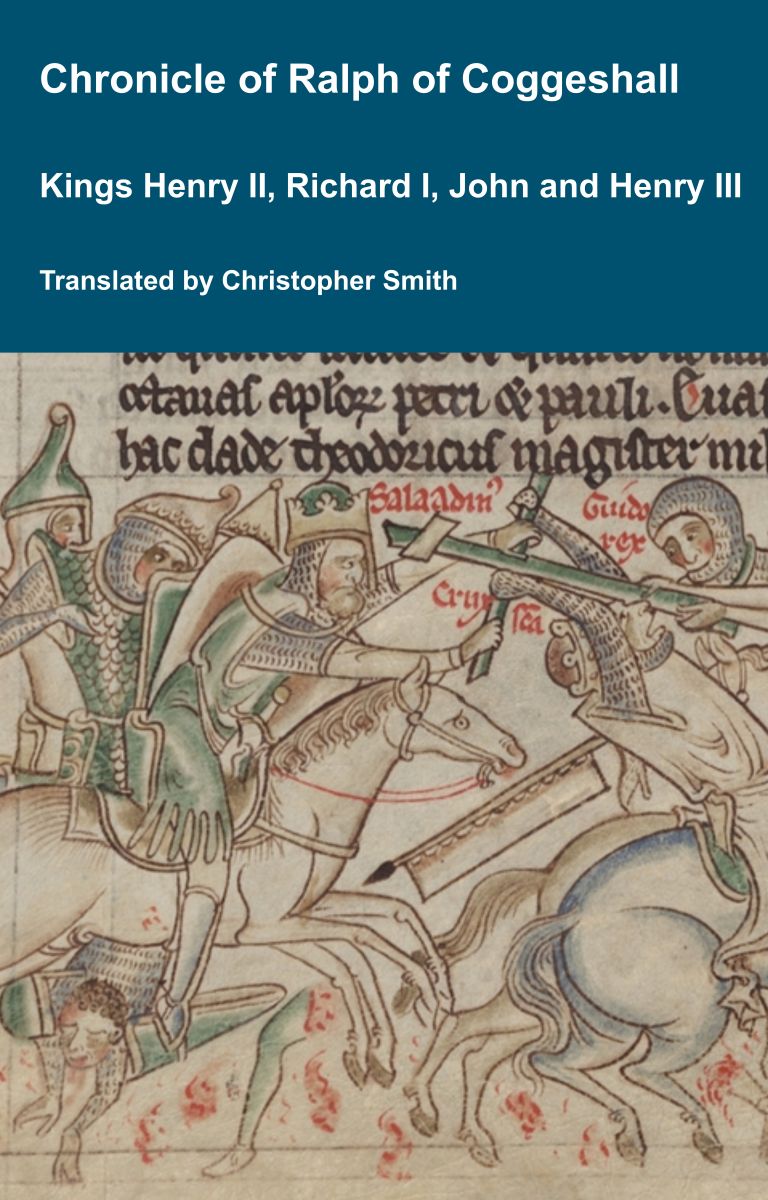
Chronicle of Abbot Ralph of Coggeshall
The Chronicle of Abbot Ralph of Coggeshall (Chronicon Anglicanum) is an indispensable medieval history that brings to life centuries of English and European affairs through the eyes of a learned Cistercian monk. Ralph of Coggeshall, abbot of the Abbey of Coggeshall in Essex in the early 13th century, continued and expanded his community’s chronicle, documenting events from the Norman Conquest of 1066 into the tumultuous reign of King Henry III. Blending eyewitness testimony, careful compilation, and the monastic commitment to record-keeping, this chronicle offers a rare narrative of political intrigue, royal power struggles, and social upheaval in England and beyond. Ralph’s work captures the reigns of pivotal figures such as Richard I and King John, providing invaluable insights into their characters, decisions, and the forces that shaped medieval rule. More than a simple annal, Chronicon Anglicanum conveys the texture of medieval life and governance, making it a rich source for scholars and readers fascinated by English history, monastic authorship, and the shaping of the medieval world.
Available at Amazon in eBook and Paperback format.
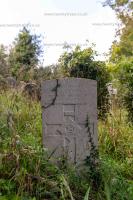
St James' Church, Antony [Map]. 19th March 1915. Grave of 12050 Private F. Lyndon, Worcestershire Regiment.
On 19th March 1947 Charles Beauclerk 13th Duke St Albans [aged 31] and Suzanne Marie Fesq Duchess St Albans [aged 25] were married.
On 19th March 1604 John IV King Portugal was born to Teodosio II Duke of Braganza [aged 35] and Ana de Velasco y Téllez Girón Duchess Braganza [aged 19]. He married 1633 Luisa de Guzman Queen Consort Portugal and had issue.
On 19th March 1662 Catherine Perceval was born to John Perceval 1st Baronet [aged 32] and Catherine Southwell. She married before 1693 William Moore 2nd Baronet.
On 19th March 1663 Thomas Bruce 7th Earl Kincardine was born to Alexander Bruce 4th Earl Kincardine.
On 19th March 1675 Catherine Manners Baroness Gower was born to John Manners 1st Duke Rutland [aged 36] and Catherine Noel Duchess Rutland [aged 18]. She married September 1692 John Leveson-Gower 1st Baron Gower, son of William Leveson-Gower 4th Baronet and Jane Granville Baroness Gower, and had issue.
On 19th March 1680 Elizabeth Tracy was born to William Tracy 4th Viscount Tracy [aged 23] and Frances Devereux [aged 21]. She married before 2nd January 1716 Robert Burdett, son of Robert Burdett 3rd Baronet and Magdalen Aston, and had issue.
On 19th March 1683 Anna Margaretha Bentinck was born to William Bentinck 1st Earl of Portland [aged 33] and Anne Villiers Countess Portland [aged 32].
On 19th March 1708 Henry Gough 1st Baronet was born to Henry Gough [aged 59] and Mary Littleton [aged 53]. He married (1) before 22nd June 1740 Catherine Harpur Lady Gough, daughter of John Harpur 4th Baronet (2) 2nd July 1741 Barbara Calthorpe Lady Gough and had issue.
On 20th February 1723 Hayman Rooke was born. He was baptised at St Martin in the Fields Church [Map] on 19th March 1723.
Abbot John Whethamstede’s Chronicle of the Abbey of St Albans
Abbot John Whethamstede's Register aka Chronicle of his second term at the Abbey of St Albans, 1451-1461, is a remarkable text that describes his first-hand experience of the beginning of the Wars of the Roses including the First and Second Battles of St Albans, 1455 and 1461, respectively, their cause, and their consequences, not least on the Abbey itself. His text also includes Loveday, Blore Heath, Northampton, the Act of Accord, Wakefield, and Towton, and ends with the Coronation of King Edward IV. In addition to the events of the Wars of the Roses, Abbot John, or his scribes who wrote the Chronicle, include details in the life of the Abbey such as charters, letters, land exchanges, visits by legates, and disputes, which provide a rich insight into the day-to-day life of the Abbey, and the challenges faced by its Abbot.
Available at Amazon in eBook and Paperback format.

On 19th March 1727 Charles Ingram 9th Viscount Irvine was born to Colonel Charles Ingram [aged 30]. He married 1758 Frances Shepheard and had issue.
On 19th March 1749 Louisa Hanover was born to Frederick Louis Hanover Prince of Wales [aged 42] and Augusta Saxe Coburg Altenburg [aged 29]. She a granddaughter of King George II of Great Britain and Ireland.
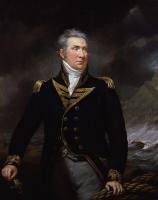
On 19th March 1757 Edward Pellew 1st Viscount Exmouth was born to Samuel Pellew [aged 45] and Constantia Langford [aged 28]. He married 28th May 1783 Susan Frowde Viscountess Exmouth and had issue.

On 19th March 1762 Orlando Bridgeman 1st Earl Bradford was born to Henry Bridgeman 1st Baron Bradford [aged 36] and Elizabeth Simpson Baroness Bradford [aged 27]. He married 29th May 1788 Lucy Elizabeth Byng Countess Bradford, daughter of George Byng 4th Viscount Torrington and Lucy Boyle Viscountess Torrington, and had issue.
On 19th March 1770 Stephen Moore 2nd Earl Mount Cashell was born to Stephen Moore 1st Earl Mount Cashell [aged 39] and Helena Rawdon Countess Mount Cashell. He married 1791 his fifth cousin Margaret King Baroness Monthermer, daughter of Robert King 2nd Earl Kingston and Caroline Fitzgerald, and had issue.
On 19th March 1776 Ramsay Richard Reinagle was born.
On 19th March 1778 Edward "Ned" Pakenham was born to Edward Pakenham 2nd Baron Longford [aged 34] and Catherine Rowley Baroness Longford [aged 30].

On 19th March 1782 Peter Drummond Burrell 2nd Baron Gwydyr 22nd Baron Willoughby was born to Peter Burrell Baron Willoughby, 1st Baron Gwydyr [aged 27] and Priscilla Barbara Elizabeth Bertie 21st Baroness Willoughby of Eresby [aged 21]. He married 19th October 1807 Clementina Sarah Drummond Baroness Gwydyr and Willoughby, daughter of James Drummond 11th Earl Perth and Clementia Elphinstone Countess Perth, and had issue.

On 19th March 1787 Brownlow Paget was born to Henry Bayly-Paget 1st Earl Uxbridge [aged 42] and Jane Champagné Countess Uxbridge [aged 45].
On 19th March 1788 John Somers-Cocks 2nd Earl Somers was born to John Cocks 1st Earl Somers [aged 27]. He married before 14th July 1819 his third cousin Caroline Yorke Countess Somers, daughter of Philip Yorke 3rd Earl of Hardwicke and Elizabeth Lindsay Countess Hardwicke, and had issue.
Chronicle of Abbot Ralph of Coggeshall
The Chronicle of Abbot Ralph of Coggeshall (Chronicon Anglicanum) is an indispensable medieval history that brings to life centuries of English and European affairs through the eyes of a learned Cistercian monk. Ralph of Coggeshall, abbot of the Abbey of Coggeshall in Essex in the early 13th century, continued and expanded his community’s chronicle, documenting events from the Norman Conquest of 1066 into the tumultuous reign of King Henry III. Blending eyewitness testimony, careful compilation, and the monastic commitment to record-keeping, this chronicle offers a rare narrative of political intrigue, royal power struggles, and social upheaval in England and beyond. Ralph’s work captures the reigns of pivotal figures such as Richard I and King John, providing invaluable insights into their characters, decisions, and the forces that shaped medieval rule. More than a simple annal, Chronicon Anglicanum conveys the texture of medieval life and governance, making it a rich source for scholars and readers fascinated by English history, monastic authorship, and the shaping of the medieval world.
Available at Amazon in eBook and Paperback format.
On 19th March 1789 Frederick Adair Roe 1st Baronet was born to William Roe [aged 41] and Susan Margaret Thomas.
On 19th March 1814 Gilbert Elliot-Murray-Kynynmound 3rd Earl Minto was born to Gilbert Elliot-Murray-Kynynmound 2nd Earl Minto [aged 31] and Mary Brydone Countess Minto. He married 1844 Emma Eleanor Elizabeth Hislop, daughter of Thomas Hislop 1st Baronet and Emma Elliott of Madras Lady Hislop, and had issue.
On 19th March 1817 Robert Gifford 2nd Baron Gifford was born to Robert Gifford 1st Baron Gifford [aged 38]. He married 1st April 1845 Frederica Berkeley Baroness Gifford, daughter of Admiral Maurice Berkeley 1st Baron FitzHardinge and Charlotte Lennox, and had issue.
On 19th March 1829 Thomas Edward Pilkington 9th Baronet was born to William Pilkington 8th Baronet [aged 53].
On 19th March 1831 Francis George Stapleton 8th Baronet was born to Francis Jarvis Stapleton 7th Baronet [aged 23].

On 19th March 1845 Alan Egerton 3rd Baron Egerton Tatton was born to Wilbraham Egerton 1st Baron Egerton Tatton [aged 38] and Charlotte Elizabeth Loftus Baroness Egerton Tatton. He married 1867 Anna Louisa Taylor Baroness Egerton and had issue.
On 19th March 1853 Mary Susan Cavendish Viscountess Cobham was born to William George Cavendish 2nd Baron Chesham [aged 37] and Henrietta Frances Lascelles Baroness Chesham at Burlington House. She married 1878 her third cousin once removed Charles Lyttelton 8th Viscount Cobham, son of George William Lyttelton 4th Baron Lyttelton and Mary Glynne Lady Lyttelton, and had issue.
On 19th March 1854 Susan Catherine Harriet Byng was born to George Byng 2nd Earl Strafford [aged 47] and Harriet Cavendish Countess Strafford [aged 33].
On 19th March 1855 Sydney Holland 2nd Viscount Knutsford and Arthur Holland 3rd Viscount Knutsford were born to Henry Holland 1st Viscount Knutsford [aged 29] and Elizabeth Margaret HIbbert Lady Holland [aged 21]. Their mother died two weeks later,


On 19th March 1863 Frederick William Hotham 6th Baron Hotham was born to William Francis Hotham [aged 43] and Emma Carbonnel [aged 41].
Anne Boleyn. Her Life as told by Lancelot de Carle's 1536 Letter.
In 1536, two weeks after the execution of Anne Boleyn, her brother George and four others, Lancelot du Carle, wrote an extraordinary letter that described Anne's life, and her trial and execution, to which he was a witness. This book presents a new translation of that letter, with additional material from other contemporary sources such as Letters, Hall's and Wriothesley's Chronicles, the pamphlets of Wynkyn the Worde, the Memorial of George Constantyne, the Portuguese Letter and the Baga de Secrets, all of which are provided in Appendices.
Available at Amazon in eBook and Paperback format.
On 19th March 1867 Helen Pleydell-Bouverie was born to William Pleydell-Bouverie 5th Earl Radnor [aged 25] and Helen Matilda Chaplin Countess Radnor [aged 20]. She died aged ten in 1877.
On 19th March 1869 Robert Edward Grosvenor was born to Hugh Lupus Grosvenor 1st Duke Westminster [aged 43] and Constance Leveson-Gower Duchess Westminster [aged 34]. Coefficient of inbreeding 7.06%.
On 19th March 1879 Hugh "Bendor" Grosvenor 2nd Duke Westminster was born to Victor Alexander Grosvenor [aged 25] and Sibell Mary Lumley [aged 23]. He married (1) 16th February 1901 Constance Edwina "Shelagh" Cornwallis-West Duchess Westminster and had issue (2) 26th November 1920 Violet Mary Nelson Duchess Westminster, daughter of William Nelson 1st Baronet (3) 20th February 1930 his fourth cousin once removed Loelia Mary Ponsonby Duchess Westminster, daughter of Frederick "Fritz" Ponsonby 1st Baron Sysonby (4) 7th February 1947 Anne Winifred Sullivan Marchioness Westminster.
On 19th March 1882 Élaine Greffulhe Duchess Gramont was born.
On 19th March 1927 John Douglas 21st Earl of Morton was born to Charles William Sholto Douglas [aged 45] and Florence Timson [aged 29] were married. He the son of Sholto Douglas 19th Earl of Morton [aged 82] and Helen Geraldine Ponsonby Countess of Morton [aged 75]. He married 20th September 1949 Mary Sheila Gibbs Countess Morton and had issue.
On 19th March 1931 Anthony Rowland Clegg-Hill 8th Viscount Hill was born to Gerald Rowland Clegg-Hill 7th Viscount Hill [aged 26].
On 19th March 1943 Bryan Bellew 8th Baron Bellew was born to James Bellew 7th Baron Bellew [aged 23].
On 19th March 1955 Sarah Spencer was born to John Spencer 8th Earl Spencer [aged 31] and Frances Ruth Roche Countess Spencer [aged 19]. She married her half fourth cousin Neil Edmund McCorquodale.
On 19th March 1750 Francis Burton aka Conyngham 2nd Baron Conyngham [aged 25] and Elizabeth Clements were married.
On 19th March 1757 Henry Vane 2nd Earl Darlington [aged 30] and Margaret Lowther Countess Darlington [aged 29] were married at London. He the son of Henry Vane 1st Earl Darlington [aged 52] and Grace Fitzroy Countess Darlington [aged 59].
Chronicle of Abbot Ralph of Coggeshall
The Chronicle of Abbot Ralph of Coggeshall (Chronicon Anglicanum) is an indispensable medieval history that brings to life centuries of English and European affairs through the eyes of a learned Cistercian monk. Ralph of Coggeshall, abbot of the Abbey of Coggeshall in Essex in the early 13th century, continued and expanded his community’s chronicle, documenting events from the Norman Conquest of 1066 into the tumultuous reign of King Henry III. Blending eyewitness testimony, careful compilation, and the monastic commitment to record-keeping, this chronicle offers a rare narrative of political intrigue, royal power struggles, and social upheaval in England and beyond. Ralph’s work captures the reigns of pivotal figures such as Richard I and King John, providing invaluable insights into their characters, decisions, and the forces that shaped medieval rule. More than a simple annal, Chronicon Anglicanum conveys the texture of medieval life and governance, making it a rich source for scholars and readers fascinated by English history, monastic authorship, and the shaping of the medieval world.
Available at Amazon in eBook and Paperback format.
On 19th March 1807 Thomas Parker 5th Earl Macclesfield [aged 44] and Eliza Wolstenholme Countess Macclesfield [aged 26] were married. He the son of Thomas Parker 3rd Earl Macclesfield.

On 19th March 1820 Richard William Penn Curzon Howe 1st Earl Howe [aged 23] and Harriet Georgiana Brudenell Countess Howe [aged 21] were married. She the daughter of Robert Brudenell 6th Earl Cardigan [aged 50] and Penelope Cooke Countess Cardigan [aged 50].
On 19th March 1833 George Byng 7th Viscount Torrington [aged 20] and Mary Anne Astley Viscountess Torrington [aged 28] were married. She by marriage Viscountess Torrington.
On 19th March 1885 Edward Baldwin Malet 4th Baronet [aged 47] and Ermytrude Sackville Russell Lady Malet [aged 28] were married. She the daughter of Francis Russell 9th Duke Bedford [aged 65] and Elizabeth Sackville-West Duchess Bedford [aged 66].

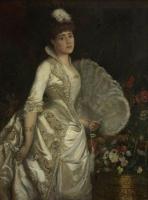
On 19th March 1885 Friedrich Ferdinand Glücksburg Duke Schleswig Holstein Sonderburg Glücksburg [aged 29] and Victoria Friederike Oldenburg Duchess Schleswig Holstein Sonderburg Glücksburg [aged 25] were married. She the daughter of Frederick Christian Oldenburg II Duke Schleswig Holstein Sonderburg Augustenburg and Adelheid Hohenlohe Langenburg Duchess Schleswig Holstein Sonderburg Augustenburg. He the son of Friedrich Glücksburg Duke Schleswig Holstein Sonderburg Glücksburg [aged 70] and Adelheid Schasumburg Lippe Duchess Schleswig Holstein Sonderburg Glücksburg. They were third cousin once removed. He a great x 3 grandson of King George II of Great Britain and Ireland. She a great x 4 granddaughter of King George II of Great Britain and Ireland.
On 19th March 1947 Charles Beauclerk 13th Duke St Albans [aged 31] and Suzanne Marie Fesq Duchess St Albans [aged 25] were married.
On 19th March 1286 King Alexander III of Scotland [aged 44] died from a fall from a horse at Kinghorn Ness while riding in the dark to visit the Queen [aged 22] at Kinghorn in Fife because it was her birthday the next day. His granddaughter Margaret [aged 2] succeeded I Queen Scotland.
On 19th March 1309 Joan Ferrers Baroness Berkeley died.
On 19th March 1330 the King's uncle Edmund of Woodstock 1st Earl Kent [aged 28] was beheaded at Winchester Castle [Map]. Earl Kent forfeit. Edmund had been convicted of plotting against the court believing his brother King Edward II was still alive. It later emerged the plot had been created by Roger Mortimer 1st Earl March [aged 42] to entrap Edmund. King Edward III of England [aged 17] was unable to show leniency risking complicity in the plot. He was buried at Westminster Abbey [Map].
See Parliament Rolls, Chronicle of Geoffrey le Baker of Swinbroke,
Chronicle of Walter of Guisborough,
Knighton 2555, and
On 19th March 1383 Piers Mauley 4th Baron de Mauley [aged 52] died at Nether Hallam Manor West Riding. His grandson Piers [aged 5] succeeded 5th Baron Mauley.
On 19th March 1470 Robert Welles 8th Baron Willoughby 8th Baron Welles was beheaded at Doncaster [Map]. He was buried at Whitefriars Doncaster [Map]. Baron Welles forfeit. His sister Joan succeeded 9th Baroness Willoughby de Eresby. Richard Hastings Baron Willoughby [aged 37] by marriage Baron Willoughby de Eresby. He, Hastings, a favourite of King Edward IV of England [aged 27], younger brother of Edward's great friend William Hastings 1st Baron Hastings [aged 39].

On 19th March 1533 John Bourchier 2nd Baron Berners [aged 66] died at Calais [Map]. His daughter Joan de jure 3rd Baroness Berners. Edmund Knyvet Baron Berners [aged 49] by marriage Baron Berners.
Chronicle of Abbot Ralph of Coggeshall
The Chronicle of Abbot Ralph of Coggeshall (Chronicon Anglicanum) is an indispensable medieval history that brings to life centuries of English and European affairs through the eyes of a learned Cistercian monk. Ralph of Coggeshall, abbot of the Abbey of Coggeshall in Essex in the early 13th century, continued and expanded his community’s chronicle, documenting events from the Norman Conquest of 1066 into the tumultuous reign of King Henry III. Blending eyewitness testimony, careful compilation, and the monastic commitment to record-keeping, this chronicle offers a rare narrative of political intrigue, royal power struggles, and social upheaval in England and beyond. Ralph’s work captures the reigns of pivotal figures such as Richard I and King John, providing invaluable insights into their characters, decisions, and the forces that shaped medieval rule. More than a simple annal, Chronicon Anglicanum conveys the texture of medieval life and governance, making it a rich source for scholars and readers fascinated by English history, monastic authorship, and the shaping of the medieval world.
Available at Amazon in eBook and Paperback format.
On 19th March 1550 John Plunkett 4th Baron Killeen [aged 40] died. His son Patrick [aged 28] succeeded 5th Baron Killeen.
On 19th March 1553 Alberta Palatinate Simmern [aged 14] died. Her brother Louis [aged 13] succeeded VI Elector Palatine Rhine.

On 19th March 1556 Elizabeth Seymour Baroness Cromwell Oakham [aged 38] died. She was buried at St Mary's Church, Basing.
On 19th March 1612 Mary Dawnay Baroness Eure [aged 55] died.
On 19th March 1616 Henry Pierrepont [aged 70] died. Church of St Edmund, Holme Pierrepoint [Map]. Designed by John Smythson. Probably carved by Hugh Hall who also carved the monument to Thomas Smith originally at Wybynbury but since moved to Nantwich [Map]. Elizabethan Period. Armorials:
Top left Cavendish Arms - he was married to Frances Cavendish [aged 67] daughter of William Cavendish and Bess of Hardwick.
Top right Pierrepoint Arms.
Centre Bottom: Quartered 1&4 Pierrepoint Arms 2&3 Unknown Arms impaled Quartered 1&4 Cavendish Arms 2&3 Unknown Arms.
Frances Cavendish: On 18th June 1548 she was born to William Cavendish and Bess of Hardwick. Before 1584 Henry Pierrepont and she were married. She the daughter of William Cavendish and Bess of Hardwick Countess Shrewsbury and Waterford. They were sixth cousins. In January 1632 Frances Cavendish died.
On 19th March 1643 William Compton [aged 18] and James Compton 3rd Earl of Northampton [aged 20] fought for the Royalist army at Hopton Heath, Staffordshire.
Spencer Compton 2nd Earl of Northampton [aged 41] was killed. His son James succeeded 3rd Earl of Northampton, 4th Baron Compton of Compton in Warwickshire.
On 19th March 1658 George Graham 2nd Baronet [aged 34] died. His son Richard [aged 8] succeeded 3rd Baronet Graham of Esk in Cumberland.
On 19th March 1683 Thomas Killigrew [aged 71] died at Whitehall Palace [Map].
On 19th March 1701 John Egerton 3rd Earl Bridgewater [aged 54] died. He was buried in the Bridgewater Chapel, St Peter and St Paul Church, Little Gaddesden. His son Scroop [aged 19] succeeded 4th Earl Bridgewater, 5th Viscount Brackley, 5th Baron Ellesmere.
John Egerton 3rd Earl Bridgewater: On 9th November 1646 he was born to John Egerton 2nd Earl Bridgewater and Elizabeth Cavendish Countess Bridgewater. On 7th November 1664 John Egerton 3rd Earl Bridgewater and Elizabeth Cranfield were married. She the daughter of James Cranfield 2nd Earl Middlesex and Anne Bourchier Countess Middlesex. He the son of John Egerton 2nd Earl Bridgewater and Elizabeth Cavendish Countess Bridgewater. They were fourth cousins. He a great x 5 grandson of King Henry VII of England and Ireland. On 2nd April 1673 John Egerton 3rd Earl Bridgewater and Jane Paulet Countess Bridgewater were married at St Dionis Backchurch. She the daughter of Charles Paulet 1st Duke Bolton and Mary Scrope 6th Marchioness Winchester. He the son of John Egerton 2nd Earl Bridgewater and Elizabeth Cavendish Countess Bridgewater. They were fourth cousin once removed. He a great x 5 grandson of King Henry VII of England and Ireland.
On 19th March 1711 Bishop Thomas Ken [aged 73] died. He was buried in Church of St John the Baptist Frome, Somerset.
On 19th March 1711 John Bruce 2nd Baronet [aged 40] died. Baronet Bruce of Balcaskie extinct.

On 19th March 1717 John Campbell 1st Earl Breadalbaine and Holland [aged 80] died. His son John [aged 54] succeeded 2nd Earl Breadalbaine and Holland. Henrietta Villiers Countess Breadalbaine and Holland by marriage Countess Breadalbaine and Holland.
On 19th March 1720 John King 2nd Baronet [aged 39] died. His brother Henry [aged 39] succeeded 3rd Baronet King of Boyle Abbot.
Chronicle of Geoffrey le Baker of Swinbroke
Baker was a secular clerk from Swinbroke, now Swinbrook, an Oxfordshire village two miles east of Burford. His Chronicle describes the events of the period 1303-1356: Gaveston, Bannockburn, Boroughbridge, the murder of King Edward II, the Scottish Wars, Sluys, Crécy, the Black Death, Winchelsea and Poitiers. To quote Herbert Bruce 'it possesses a vigorous and characteristic style, and its value for particular events between 1303 and 1356 has been recognised by its editor and by subsequent writers'. The book provides remarkable detail about the events it describes. Baker's text has been augmented with hundreds of notes, including extracts from other contemporary chronicles, such as the Annales Londonienses, Annales Paulini, Murimuth, Lanercost, Avesbury, Guisborough and Froissart to enrich the reader's understanding. The translation takes as its source the 'Chronicon Galfridi le Baker de Swynebroke' published in 1889, edited by Edward Maunde Thompson.
Available at Amazon in eBook and Paperback format.
On 19th March 1724 Lewis Watson 1st Earl Rockingham [aged 68] died. His grandson Lewis [aged 10] succeeded 2nd Earl Rockingham, 4th Baron Rockingham of Northampton, 4th Baronet Watson of Rockingham Castle in Northamptonshire. Catherine Furnese Countess Guilford and Rockingham by marriage Countess Rockingham.
On 19th March 1737 Elizabeth Noel Duchess Portland [aged 49] died.
On 13th March 1771 Charles Knollys 5th Earl Banbury [aged 67] died. He was buried on 19th March 1771 at St John the Baptist Church, Burford. His son William [aged 44] de jure 6th Earl Banbury, 6th Viscount Wallingford, 6th Baron Knollys.
On 19th March 1783 Archbishop Frederick Cornwallis [aged 70] died. He was buried at St Mary at Lambeth Church, Surrey [Map].
On 19th March 1843 Jane Rebecca Vyner Lady Biddulph [aged 40] died.
On 19th March 1844 John Lowther 1st Baronet [aged 84] died. His son John [aged 50] succeeded 2nd Baronet Lowther of Swillington in West Yorkshire.
On 19th March 1844 William Lowther 1st Earl Lonsdale [aged 86] died at York House Twickenham, Richmond. His son William [aged 56] succeeded 2nd Earl Lonsdale, 3rd Viscount Lowther, 3rd Baron Lowther.
On 19th March 1859 William Courtenay 10th Earl Devon [aged 81] died. His son William [aged 51] succeeded 11th Earl Devon. Elizabeth Fortescue Countess Devon [aged 57] by marriage Countess Devon.
On 19th March 1869 Frederick Shelley 8th Baronet [aged 59] died. His son John [aged 20] succeeded 9th Baronet Shelley of Mitchelgrove in Sussex.
On 19th March 1875 Marianne Frances Meux Lady Bowyer-Smijth died. Her widower William Bowyer-Smijth 11th Baronet [aged 60] remarried a week later his second bigamous wife Eliza Fechnie Malcolm.
On 19th March 1878 Henry Thomas Liddell 1st Earl Ravensworth [aged 81] died. His son Henry [aged 56] succeeded 2nd Earl Ravensworth, 3rd Baron Ravensworth of Ravensworth Castle in County Durham, 8th Baronet Liddell of Ravensworth Castle.
On 19th March 1881 William Gordon Cornwallis Eliot 4th Earl St Germans [aged 51] died unmarried. He was buried near his mother Jemima Cornwallis Countess St Germans at Kensal Green Cemetery [Map]. His brother Henry [aged 46] succeeded 5th Earl St Germans, 6th Baron Eliot of St Germans in Cornwall.
Chronicle of Geoffrey le Baker of Swinbroke
Baker was a secular clerk from Swinbroke, now Swinbrook, an Oxfordshire village two miles east of Burford. His Chronicle describes the events of the period 1303-1356: Gaveston, Bannockburn, Boroughbridge, the murder of King Edward II, the Scottish Wars, Sluys, Crécy, the Black Death, Winchelsea and Poitiers. To quote Herbert Bruce 'it possesses a vigorous and characteristic style, and its value for particular events between 1303 and 1356 has been recognised by its editor and by subsequent writers'. The book provides remarkable detail about the events it describes. Baker's text has been augmented with hundreds of notes, including extracts from other contemporary chronicles, such as the Annales Londonienses, Annales Paulini, Murimuth, Lanercost, Avesbury, Guisborough and Froissart to enrich the reader's understanding. The translation takes as its source the 'Chronicon Galfridi le Baker de Swynebroke' published in 1889, edited by Edward Maunde Thompson.
Available at Amazon in eBook and Paperback format.
On 19th March 1892 Francis Charles Knowles 3rd Baronet [aged 89] died. His son Charles [aged 60] succeeded 4th Baronet Knowles of Lovell Hill.
On 19th March 1893 John Errington 12th Baronet [aged 82] died. Baronet Errington of Hooton in Cheshire extinct.
On 19th March 1895 Hermione Wilhelmina Duncombe Duchess Leinster [aged 30] died of tuberculosis at Menton.
On 19th March 1896 George Richmond [aged 86] died.
On 19th March 1921 John Montagu Burgoyne 10th Baronet [aged 88] died. Baronet Burgoyne of Sutton in Bedfordshire extinct.
On 19th March 1924 Mariota Thellusson Countess Wilton [aged 50] died.
On 19th March 1930 Arthur James Balfour 1st Earl Balfour [aged 81] died. His brother Gerald [aged 76] succeeded 2nd Earl Balfour of Whittingehame of Haddingtonshire. Elizabeth Bulwer-Lytton Countess Balfour [aged 62] by marriage Countess Balfour of Whittingehame of Haddingtonshire.


On 19th March 1938 George Hay 14th Earl of Kinnoull [aged 35] died. His son William [aged 2] succeeded 15th Earl Kinnoull, 8th Baron Hay of Pedwardine in Herefordshire.
On 19th March 1938 Charles Glynne Earle Welby 5th Baronet [aged 72] died. His son Oliver [aged 35] succeeded 6th Baronet Welby of Denton Manor in Lincolnshire.
On 19th March 1940 Lucy Catherine Fortescue Countess St Aldwyn [aged 89] died.
Jean de Waurin's Chronicle of England Volume 6 Books 3-6: The Wars of the Roses
Jean de Waurin was a French Chronicler, from the Artois region, who was born around 1400, and died around 1474. Waurin’s Chronicle of England, Volume 6, covering the period 1450 to 1471, from which we have selected and translated Chapters relating to the Wars of the Roses, provides a vivid, original, contemporary description of key events some of which he witnessed first-hand, some of which he was told by the key people involved with whom Waurin had a personal relationship.
Available at Amazon in eBook and Paperback format.
On 19th March 1960 William Frederick Victor Mordaunt Milner 8th Baronet [aged 66] died. His second cousin George [aged 49] succeeded 9th Baronet Milner of Nun Appleton Hall in Yorkshire.
On 19th March 1961 Marjorie Seeley Lady Meyer died.
On 19th March 1975 Frederick Villiers Laud Robinson 10th Baronet [aged 94] died. His grandson John [aged 32] succeeded 11th Baronet Robinson of London.
On 19th March 1980 Charles Ingram Courtenay Wood 2nd Earl Halifax [aged 67] died. His son Charles [aged 36] succeeded 3rd Earl Halifax, 4th Viscount Halifax, 7th Baronet Wood of Barnsley in Yorkshire.
On 19th March 1988 David Hawley 7th Baronet [aged 74] died. His son Henry [aged 48] succeeded 8th Baronet Hawley of Leybourne Grange in Kent.
On 19th March 1990 Diana Claudia Carleton Countess of Malmesbury [aged 77] died.
On 19th March 1994 Patricia Herbert Viscountess Hambleden [aged 89] died.
On 19th March 2019 William Simon Pease 3rd Baron Wardington [aged 93] died. Baron Wardington of Alnmouth in Northumberland extinct.