

06 Mar is in March.
Chronicon ex Chronicis by Florence and John of Worcester. 6th March 1052. Elfgiva Emma [aged 67], wife of the kings Ethelred and Canute, died at Winchester, Hampshire [Map] on the second of the nones [the 6th] of March, and was buried there.
Anglo-Saxon Chronicle. 1052. This year, on the second day before the nones of March, died the aged Lady Elfgiva Emma [aged 67], the mother of King Edward [aged 49] and of King Hardacnute, the relict of King Ethelred and of King Knute; and her body lies in the old minster with King Knute.
On 6th March 1052 Emma aka Ælfgyfu of Normandy Queen Consort England [aged 67] died.
 Annals of Six Kings of England by Nicholas Trivet. On the sixth of March [1186], near Gisors, the matters in dispute between the king of France and the count of Flanders concerning the whole holding of Ralph, formerly count of Vermandois, were brought to peace and agreement. Likewise, the dispute which had arisen between the king of England and Margaret, widow of his son the king, both concerning her dowry and the marriage settlement, was brought to an end by an amicable settlement. The king of England, crossing to England together with the queen, landed at the port of Hampton on the fifth day before the Kalends of May [27th April]. William de Vere, a man noble by birth, was consecrated bishop of Hereford on the feast of Saint Lawrence. William of Northall, archdeacon of Worcester, became bishop of the same church.
Sexto Martii juxta Gisortium redacta sunt ad pacem et concordiam, quæ vertebantur inter regem Francorum et comitem Flandriæ, de toto tenemento Radulphi quondam comitis Viromandorum. Quinetiam quæstio, quæ mota fuerat inter regem Anglorum et Margaretam relictam filii sui regis, tam super dote sua quam super donatione propter nuptias, amicabili compositione finem accepit. Rex Anglorum, una cum regina, in Angliam transiens, in portu Hamtonæ applicuit quinto cal. Maii. Willelmus de Veer, vir nobilis genere, consecratus est in die S. Laurentii in episcopum Herefordensem. Willelmus de Norhalla, archidiaconus Wigorniæ, fit ejusdem ecclesiæ episcopus.
Close Rolls Edward II 1307-1313. 6th March 1308 King Edward II of England [aged 23]. Westminster Palace [Map]. To Thomas de la Hide, late steward of Cornwall and Sheriff of the same. Order to deliver to Peter de Gavaston [aged 24], knight, all the farms, rents, and issues of the said County from Michaelmas last, and of the lands of the late Edmund Earl of Cornwall, the king having granted to the said Peter the county of Cornwall, and all the lands of the said Edmund.
The like to John de Tresimple, for the ferms, etc., of the manor, etc.
The like to Walter de Gloucester, escheator this side of Trent, for the ferms, etc., of the manors.
On 6th March 1340 John of Gaunt 1st Duke Lancaster was born to King Edward III of England [aged 27] and Philippa of Hainaut Queen Consort England [aged 29] at the Prinsenhof Palace [Map] in Ghent aka Gaunt. Coefficient of inbreeding 3.00%. He married (1) his half second cousin once removed Blanche Duchess of Lancaster, daughter of Henry of Grosmont 1st Duke Lancaster and Isabel Beaumont Duchess Lancaster, and had issue (2) 21st September 1371 his half third cousin twice removed Constance of Castile Duchess of Lancaster and had issue (3) 13th January 1396 Katherine Swynford aka Roet Duchess Lancaster and had issue.
 Adam Murimuth Continuation. In this year, at the beginning of February, the king returned to England, leaving the queen pregnant at Ghent, where she gave birth to a son named John1. Soon after, he held a parliament at Westminster, where the laity granted him a ninth fleece of wool, a ninth lamb, and a ninth sheaf of all kinds of grain. But the prelates and clergy granted nothing at that time, since before the king's arrival they had already granted him a new tenth, in addition to one previously conceded.
Hoc anno, in principio mensis Februarii, rediit rex in Angliam, regina prægnante in Gandavo dimissa, ubi peperit fillum quem vocavit Johannem. Et cito post habuit parliamentum Westmonasterii; ubi laici concesserunt sibi nonum vellus lanæ, nonum agnum, et nonam garbam cujuscumque generis bladi. Sed prælati et clerus tunc nihil concesserunt, quia, ante adventum regis, clerus concessit sibi unam novam decimam, una cum alia præconcessa currentem.
Note 1. John of Gaunt was born in Ghent on 6th March 1340. He married (1) his half second cousin once removed Blanche, daughter of Henry of Grosmont, 1st Duke Lancaster, and Isabel Beaumont, and had issue (2) 21st September 1371 his half third cousin twice removed Constance of Castile and had issue, and (3) 13th January 1396 Katherine Swynford aka Roet Duchess Lancaster with whom he had previously had issue known a the Beauforts.
Patent Rolls. 6th March 1380. Westminster. The like, at the supplication of the king's kinswoman, Margaret, countess of Norfolk, to William Seman of Hunden, for the death of Richard Redlasch, killed on St. Blaise's day [3rd February], 51 Edward III. By p.s
On 14th February 1400 (exact date not known) King Richard II [aged 33] died at Pontefract Castle [Map] where he had been imprisoned three months before; possibly murdered, possibly starved to death. His death was a consequence of the Epiphany Rising; he was still considered a threat.
Edmund Mortimer 5th Earl March 7th Earl of Ulster [aged 8] de jure Heir to the Throne of England since he was descended from Philippa Plantagenet Countess March 2nd Countess Ulster the daughter of Lionel of Antwerp 1st Duke of Clarence. The new King Henry IV [aged 32] ignored his claim. Edmund Mortimer 5th Earl March 7th Earl of Ulster and his brother Roger Mortimer [aged 6] were imprisoned in Windsor and Berkhamstead castles respectively; they were treated well.
On 17th February 1400 Richard's corpse was displayed at St Paul's Cathedral [Map].
On 6th March 1400 Richard's remains were buried at King's Langley Priory, Hertfordshire [Map].


The History of William Marshal was commissioned by his son shortly after William’s death in 1219 to celebrate the Marshal’s remarkable life; it is an authentic, contemporary voice. The manuscript was discovered in 1861 by French historian Paul Meyer. Meyer published the manuscript in its original Anglo-French in 1891 in two books. This book is a line by line translation of the first of Meyer’s books; lines 1-10152. Book 1 of the History begins in 1139 and ends in 1194. It describes the events of the Anarchy, the role of William’s father John, John’s marriages, William’s childhood, his role as a hostage at the siege of Newbury, his injury and imprisonment in Poitou where he met Eleanor of Aquitaine and his life as a knight errant. It continues with the accusation against him of an improper relationship with Margaret, wife of Henry the Young King, his exile, and return, the death of Henry the Young King, the rebellion of Richard, the future King Richard I, war with France, the death of King Henry II, and the capture of King Richard, and the rebellion of John, the future King John. It ends with the release of King Richard and the death of John Marshal.
Available at Amazon in eBook and Paperback format.
On 6th March 1405 John II King Castile was born to Henry III King Castile [aged 25] and Catherine of Lancaster Queen Consort Castile [aged 31]. He a great grandson of King Edward III of England. Coefficient of inbreeding 2.16%. He married (1) 1418 his first cousin Maria Trastámara Queen Consort Castile, daughter of Ferdinand I King Aragon and Eleanor of Alberquerque Queen Consort Aragon, and had issue (2) after 1445 his half first cousin once removed Isabella Aviz Queen Consort Castile and had issue.
In February 1421 Jacqueline Wittelsbach Duchess Brabant and Gloucester [aged 19] issued a statement where she stated that, because of the destructive behaviour of John IV of Brabant, she wanted the annulment of her marriage. On 6th March 1421 Jacqueline Wittelsbach Duchess Brabant and Gloucester fled to England where she was received by King Henry V whose brother Humphrey Lancaster 1st Duke Gloucester [aged 30] she subsequently married.
On 6th March 1427 John Holland 2nd Duke Exeter [aged 31] and Anne Stafford Duchess Exeter were married. She by marriage Duchess Exeter. She the daughter of Edmund Stafford 5th Earl Stafford and Anne of Gloucester Plantagenet Countess Eu and Stafford [aged 44]. He the son of John Holland 1st Duke Exeter and Elizabeth Lancaster Duchess Exeter. They were second cousins. He a great grandson of King Edward III of England. She a great granddaughter of King Edward III of England.
Chronicle of Enguerrand de Monstrelet [1400-1453]. Soon afterward, sir Thomas fixed his quarters in a small town, called St James de Beuvron, which had been destroyed; but he had it repaired and refortified to serve him as a post to carry on the war against the Bretons, for it was but half a league from their country. Sir Thomas was deputy to the earl of Suffolk, the governor of lower Normandy, and thence he led the English on different excursions through Brittany, carrying on a severe warfare. The duke, to oppose them, assembled a large force of his nobles, whom he gave in charge to his brother the count de Richemont, lately made constable of France. The count led them straight to St James de Beuvron, which he instantly besieged, and commenced his operations with a grand skirmish. Having surrounded it on all sides, he established his quarters, and had his engines pointed against the walls, which greatly damaged them. He attacked the place by storm [on 6th March 1427], which lasted for a considerable time very sharply. A party of Bretons from the lower parts of the duchy had been posted below the town, near to a pond; and to get near the walls, it was necessary to cross the head of this pond, which was very narrow. There was beside it a small bulwark under the command of an english knight, sir Nicholas Bourdet, having with him from sixty to eighty combatants, and near to it was one of the town-gates well guarded by the English. When these Bretons were descending the ditch in great numbers to attack the walls, they heard on each side of them the English shouting, 'Salisbury! Suffolk!' which threw the Bretons into great confusion. Sir Nicholas, seizing the opportunity of their dismay, vigorously fell on them, and, meeting scarcely any defence, put to death or drowned in the pond from seven to eight hundred, and made about fifty prisoners. The English won eighteen standards, and one banner. News of this defeat was speedily carried to the count, who was storming the town on the opposite side. He was much hurt at the intelligence, and ordered the retreat to be sounded, for the siege had been raised on the other side of the place. When the count had collected his men together, he held a council on what should now be done, and it was resolved, that considering the great loss they had sustained, it would be prudent to march away, which was carried into effect; but he waited until midnight, when he returned to the town of Fougeres in a disorderly manner, leaving behind great quantities of provision, stores, bombards, and other artillery. Sir Thomas, with his six hundred men, for he had no more, and the greater part of them were wounded, remained in the town very much rejoiced at his good fortune; and he caused all the things the enemy had left behind them to be brought thither. Two days after this affair, the earl of Suffolk joined sir Thomas with fifteen hundred combatants, whom the latter conducted with some of his own men, to a strong monastery that soon surrendered. The earl thence advanced farther into the country, toward the city of Dol, with the intent to reside there. In the mean time, the duke of Brittany sent a poursuivant with letters to the earl, to request that he would consent to a suspension of arms, according to the inclosed terms, which being agreed to, he remanded sir Thomas and his men, who returned to St James de Beauvron with a very rich booty.
Stonor Letters 06 Mar 1478. 6th March 1478. Elizabeth Croke [aged 38] to William Stonor [aged 28].
Ryght reverent and worschypffull and interely best belovyde husbonde, I recomaunde me unto you in the most harteyste wyse hever more desyryng to here off your goode wellfare, the wyche I pray God longe to contune unto your hartys desyr. Syr, I resayved a tokyn ffrom you by Tawbose, my lorde Lovellys [aged 22] sarvant. And Syr, I have sent my lorde Lovell a tokyn and my ladys, as ye comaunde me to do, schuche as schalle plese them. Syr, ye schalle understonde that þe beschope off Bathe [aged 58] ys browthe in to the Towre [Map] syne you departyd. Allso Syr, ye schalle understonde that þe wolle hooys departe, as to morw is, ffor as I understonde: I pray Jhesu by thayr goode spede: and Goodard. [Goddard Oxbryge.] departys allso: and I pray you that ye wylle sende me som off your sarvantys and myne to wayte upone me, ffor now I ame ryght bare off sarvantys, and þat ye know well. Syr, I sent you halffe a honder welkys by Gardenar, and I wollde have sent you som hoder desys, but truly I cowde not get none: but and I cane get hony to morow, syr Wylliam salle bryng hyt with hym. Syr, I pray you that I may be recomaundehyde unto my masterys your moder, and unto all goode ffrendys. No more unto you at thys tym, but þe blesyde Trenyte have you in hys kepyng now and hever. Amen. At London þe vj day off Marche.
Cossen, I was crasyd þat the makyng off thys letter, but I thanke God I am ryght well amendyd, blesyd by Jhesu.
By your owen wyff Elysabeth Stonore.
To my ryght reverent and worschypffull Cosyn, syr Wyllm. Stonor, knyght.
Calendar of State Papers of Spain. 6th March 1536. 35. Dr. Ortiz to the Empress. Since the above was written I have had a letter from the Imperial ambassador in France, in date of the 15th ultimo, intimating that, according to news received from England, the King wished to marry the Princess to a gentleman of his kingdom, and that king Francis had told the Imperial ambassador that in consequence of a fall from his horse king Henry had been two hours unconscious without speech1; seeing which Ana Bolans [aged 35] (Boleyn) was so struck that she actually miscarried of a son. Great news these, for which we are bound to thank God, because, were the Princess to be married as reported, she may at once be considered out of danger; for her marriage may hereafter be dissolved and declared null, as it would effectually be owing to the violence used, and the evident fear the Princess has of her life, should she not consent to it. At any rate, it must be owned that though the King himself was not converted like St. Paul after his fall, at least his adulterous wife has miscarried of a son.
Note 1. Que el Rey de Inglaterra auia caitlo con su cavallo, y estado mas de dos horas sin habla, de lo qual la Ana tuvo tan grande alteracion que movió un hijo." [That the King of England had fallen with his horse and remained without speech for more than two hours, causing such a great disturbance to Ana that she gave birth to a child.]


Letters and Papers. 6th March 1536. La Ana [aged 35] fears now that the King will leave her to make another marriage. The King has sent ambassadors to Scotland to ask the King to separate himself from the See Apostolic. During their audience there was a great storm and thunder, at which the Scotch king was much frightened, and, crossing himself, said he did not know whether to be more frightened at the thunder or their proposals. He ordered a sermon to be preached before the ambassadors on the obedience due to the Church.
When the Queen's death was known here the bull for the King's privation was already sealed. It has not been published, but the executorials in the principal cause have been obtained, with no little trouble to get them before the Queen's death was known. Rome, 6 March 1536.
Calendar of State Papers of Spain. 6th March 1536. 35. Dr. Ortiz to the Empress. The King having sent his ambassadors into Scotland to persuade the king [aged 23] of that country to separate from, and refuse obedience to, the Apostolic See, it happened that the very day and moment when the English were delivering their embassy a storm arose, and a most tremendous clap of thunder was heard, at which king James horrified rose from his seat, crossed himself, and exclaimed, "I scarcely know which of the two things has caused me most fear and horror, that thunder and lightning we have just heard, or the proposition you have made me." After which, and in the very presence of the English ambassadors, he ordered unconditional obedience to the Church to be proclaimed throughout his dominions.


Calendar of State Papers of Spain. 6th March 1536. 35. Dr. Ortiz to the Empress. Anne Bolans [aged 35] is now in fear of the King deserting her one of these days, in order to marry another lady [aged 27].


Calendar of State Papers of Spain. 6th March 1536. 35. Dr. Ortiz to the Empress..
His last letter, announcing the death and martyrdom of the Queen of England, was dated the 30th of January.
Since then he (Ortiz) has received one, dated the 19th of January, [from Chapuys?], informing him that the Princess [aged 20] (Mary) was in good health. The Queen before dying showed well what her whole life had been; for not only did she ask for, and receive, all the sacraments ordained by the Church, but answered the questions put by the priest with such ardour and devotion that all present were edified. Some of those who were by her bedside, having suggested that it was not yet time to receive the sacrament of Extreme Unction, she replied that she wished to hear and understand everything that was said, and make fitting answers. She preserved her senses to the last, &c.
They say that when the king of England [aged 44] heard of the death of his Queen, dressed in mauve silk as he was at the time, and with a white feather in his cap, he went to solace himself with the ladies of the palace. In fact it may well be said of him and of his kingdom what the Prophet Isaias says, cap. lvii., "Justus periet, et non est qui recogitet in corde suo, et viri misericordia colliguntur quia non est qui intelligat."
Her Highness the Queen was buried with the honours of a Princess [dowager], 18 miles from the place where she died, at an abbey called Yperberu [Map] (Peterborough), the King having only sent thither some ladies of his Court to attend the funeral. The King and the concubine [aged 35] were not in London, but at a place on the road called Octinton [Map] [Huntingdon].


Letters and Papers. 6th March 1536. The Queen was buried as princess, at an abbey 18 miles from where she died, called Yperveru (Peterborough). The King only sent some ladies to assist in the interment. No exequies or honors were performed in London, but only at a town on the road (de camino) called Octuiton [Map].
On 6th March 1537 Thomas Moigne [aged 27] was tried for treason at Lincoln, Lincolnshire [Map]. and sentenced to be hanged, drawn and quartered the following day which sentence was duly carried out. He was attainted, and his estates forfeited. These were recovered by his younger brothers in 1544.
Wriothesley's Chronicle [1508-1562]. The sixth daie of March the great seale of England was taken Lord Sir Thomas Wrythesley, Earle of Southampton [aged 41] and Chauncelor of office, of Englande, which daie was the second Soundaie of Lente, and so was brought to my Lord Protecter [aged 47], and on the morrowe it was delivered to my Lord Sainct John [aged 64], my gret mastera, to keepe as conservator of the same till the counsell had sett further order therin.
Note a. Lord St John was Lord Steward or Lord Great Master of the King's Household.


On 6th March 1616 Francis Beaumont [aged 32] died.
Adam Murimuth's Continuation and Robert of Avesbury’s 'The Wonderful Deeds of King Edward III'
This volume brings together two of the most important contemporary chronicles for the reign of Edward III and the opening phases of the Hundred Years’ War. Written in Latin by English clerical observers, these texts provide a vivid and authoritative window into the political, diplomatic, and military history of fourteenth-century England and its continental ambitions. Adam Murimuth Continuatio's Chronicarum continues an earlier chronicle into the mid-fourteenth century, offering concise but valuable notices on royal policy, foreign relations, and ecclesiastical affairs. Its annalistic structure makes it especially useful for establishing chronology and tracing the development of events year by year. Complementing it, Robert of Avesbury’s De gestis mirabilibus regis Edwardi tertii is a rich documentary chronicle preserving letters, treaties, and official records alongside narrative passages. It is an indispensable source for understanding Edward III’s claim to the French crown, the conduct of war, and the mechanisms of medieval diplomacy. Together, these works offer scholars, students, and enthusiasts a reliable and unembellished account of a transformative period in English and European history. Essential for anyone interested in medieval chronicles, the Hundred Years’ War, or the reign of Edward III.
Available at Amazon in eBook and Paperback format.
John Evelyn's Diary. 6th March 1652. Saw the magnificent funeral of that arch-rebel, Ireton, carried in pomp from Somerset House [Map] to Westminster [Map], accompanied with divers regiments of soldiers, horse and foot; then marched the mourners, General Cromwell [aged 52] (his father-in-law), his mock-parliament-men, officers, and forty poor men in gowns, three led horses in housings of black cloth, two led in black velvet, and his charging horse, all covered over with embroidery and gold, on crimson velvet; then the guidons, ensigns, four heralds, carrying the arms of the State (as they called it), namely, the red cross and Ireland, with the casque, wreath, sword, spurs, etc.; next, a chariot canopied of black velvet, and six horses, in which was the corpse; the pall held up by the mourners on foot; the mace and sword, with other marks of his charge in Ireland (where he died of the plague), carried before in black scarfs. Thus, in a grave pace, drums covered with cloth, soldiers reversing their arms, they proceeded through the streets in a very solemn manner. This Ireton was a stout rebel, and had been very bloody to the King's [aged 21] party, witness his severity at Colchester, when in cold blood he put to death those gallant gentlemen, Sir Charles Lucas [aged 39] and Sir George Lisle. My cousin, R. Fanshawe [aged 43], came to visit me, and informed me of many considerable affairs. Sir Henry Herbert [aged 57] presented me with his brother, my Lord Cherbury's book, "De Veritate"..


Samuel Pepys' Diary. 6th March 1660. This day I hear that the Lords do intend to sit, and great store of them are now in town, and I see in the Hall to-day. Overton at Hull do stand out, but can, it is thought, do nothing; and Lawson [aged 45], it is said, is gone with some ships thither, but all that is nothing. My Lord told me, that there was great endeavours to bring in the Protector again; but he told me, too, that he did believe it would not last long if he were brought in; no, nor the King [aged 29] neither (though he seems to think that he will come in), unless he carry himself very soberly and well. Every body now drinks the King's health without any fear, whereas before it was very private that a man dare do it. Monk [aged 51] this day is feasted at Mercers' Hall, and is invited one after another to all the twelve Halls in London! Many think that he is honest yet, and some or more think him to be a fool that would raise himself, but think that he will undo himself by endeavouring it. My mind, I must needs remember, has been very much eased and joyed at my Lord's great expressions of kindness this day, and in discourse thereupon my wife and I lay awake an hour or two in our bed.


Samuel Pepys' Diary. 6th March 1662. This night my new camelott riding coat to my coloured cloth suit came home. More news to-day of our losses at Brampton by the late storm.
Samuel Pepys' Diary. 6th March 1663. This evening Mr. Povy [aged 49] was with me at my office, and tells me that my Lord Sandwich [aged 37] is this day so ill that he is much afeard of him, which puts me to great pain, not more for my own sake than for his poor family's.


Samuel Pepys' Diary. 6th March 1667. So to the yard and spoke a word or two, and then by water home, wondrous cold, and reading a ridiculous ballad made in praise of the Duke of Albemarle [aged 58], to the tune of St. George, the tune being printed, too; and I observe that people have some great encouragement to make ballads of him of this kind. There are so many, that hereafter he will sound like Guy of Warwicke.
Samuel Pepys' Diary. 6th March 1667. Up, and with Sir W. Pen [aged 45] to White Hall by coach, and by the way agreed to acquaint Sir W. Coventry [aged 39] with the business of Mr. Carcasse, and he and I spoke to Sir W. Coventry that we might move it to the Duke of York [aged 33], which I did in a very indifferent, that is, impartial manner, but vexed I believe Lord Bruncker [aged 47]. Here the Duke of York did acquaint us, and the King [aged 36] did the like also, afterwards coming in, with his resolution of altering the manner of the war this year; that is, we shall keep what fleete we have abroad in several squadrons: so that now all is come out; but we are to keep it as close as we can, without hindering the work that is to be done in preparation to this. Great preparations there are to fortify Sheernesse [Map] and the yard at Portsmouth, Hampshire [Map], and forces are drawing down to both those places, and elsewhere by the seaside; so that we have some fear of an invasion; and the Duke of York himself did declare his expectation of the enemy's blocking us up here in the River, and therefore directed that we should send away all the ships that we have to fit out hence. Sir W. Pen told me, going with me this morning to White Hall, that for certain the Duke of Buckingham [aged 39] is brought into the Tower [Map], and that he hath had an hour's private conference with the King before he was sent thither. To Westminster Hall [Map]. There bought some news books, and, as every where else, hear every body complain of the dearness of coals, being at £4 per chaldron, the weather, too, being become most bitter cold, the King saying to-day that it was the coldest day he ever knew in England.


Samuel Pepys' Diary. 6th March 1667. Thence by coach to my Lord Crew's [aged 69], where very welcome. Here I find they are in doubt where the Duke of Buckingham [aged 39] is; which makes me mightily reflect on the uncertainty of all history, when, in a business of this moment, and of this day's growth, we cannot tell the truth. Here dined my old acquaintance, Mr. Borfett, that was my Lord Sandwich's [aged 41] chaplain, and my Lady Wright and Dr. Boreman, who is preacher at St. Gyles's in the Fields, who, after dinner, did give my Lord an account of two papist women lately converted, whereof one wrote her recantation, which he shewed under her own hand mighty well drawn, so as my Lord desired a copy of it, after he had satisfied himself from the Doctor, that to his knowledge she was not a woman under any necessity.
John Evelyn's Diary. 6th March 1667. I proposed to my Lord Chancellor [aged 58], Monsieur Kiviet's [aged 40] undertaking to wharf the whole river of Thames, or quay, from the Temple [Map] to the Tower [Map], as far as the fire destroyed, with brick, without piles, both lasting and ornamental.-Great frosts, snow and winds, prodigious at the vernal equinox; indeed it had been a year of prodigies in this nation, plague, war, fire, rain, tempest and comet.
Samuel Pepys' Diary. 6th March 1668. Up betimes, and with Sir Prince to Sir W. Coventry's [aged 40] chamber: where the first word he said to me was, "Good-morrow, Mr. Pepys, that must be Speaker of the Parliament-house:" and did protest I had got honour for ever in Parliament. He said that his brother [aged 49], that sat by him, admires me; and another gentleman said that I could not get less than £1000 a-year if I would put on a gown and plead at the Chancery-bar; but, what pleases me most, he tells me that the Sollicitor-Generall did protest that he thought I spoke the best of any man in England. After several talks with him alone, touching his own businesses, he carried me to White Hall, and there parted; and I to the Duke of York's [aged 34] lodgings, and find him going to the Park, it being a very fine morning, and I after him; and, as soon as he saw me, he told me, with great satisfaction, that I had converted a great many yesterday, and did, with great praise of me, go on with the discourse with me. And, by and by, overtaking the King [aged 37], the King and Duke of York come to me both; and he [the King] said, "Mr. Pepys, I am very glad of your success yesterday"; and fell to talk of my well speaking; and many of the Lords there. My Lord Barkeley [aged 66] did cry the up for what they had heard of it; and others, Parliament-men there, about the King, did say that they never heard such a speech in their lives delivered in that manner. Progers, of the Bedchamber, swore to me afterwards before Brouncker [aged 48], in the afternoon, that he did tell the King that he thought I might teach the Sollicitor-Generall. Every body that saw me almost come to me, as Joseph Williamson [aged 34] and others, with such eulogys as cannot be expressed. From thence I went to Westminster Hall [Map], where I met Mr. G. Montagu [aged 45], who come to me and kissed me, and told me that he had often heretofore kissed my hands, but now he would kiss my lips: protesting that I was another Cicero, and said, all the world said the same of me. Mr. Ashburnham [aged 64], and every creature I met there of the Parliament, or that knew anything of the Parliament's actings, did salute me with this honour:-Mr. Godolphin [aged 33];-Mr. Sands, who swore he would go twenty mile, at any time, to hear the like again, and that he never saw so many sit four hours together to hear any man in his life, as there did to hear me; Mr. Chichly [aged 53],-Sir John Duncomb,-and everybody do say that the Kingdom will ring of my abilities, and that I have done myself right for my whole life: and so Captain Cocke [aged 51], and others of my friends, say that no man had ever such an opportunity of making his abilities known; and, that I may cite all at once, Mr. Lieutenant of the Tower did tell me that Mr. Vaughan [aged 64] did protest to him, and that, in his hearing it, said so to the Duke of Albemarle [aged 59], and afterwards to W. Coventry, that he had sat twenty-six years in Parliament and never heard such a speech there before: for which the Lord God make me thankful! and that I may make use of it not to pride and vain-glory, but that, now I have this esteem, I may do nothing that may lessen it! I spent the morning thus walking in the Hall, being complimented by everybody with admiration: and at noon stepped into the Legg with Sir William Warren, who was in the Hall, and there talked about a little of his business, and thence into the Hall a little more, and so with him by coach as far as the Temple [Map] almost, and there 'light, to follow my Lord Brouncker's coach, which I spied, and so to Madam Williams's, where I overtook him, and agreed upon meeting this afternoon, and so home to dinner, and after dinner with W. Pen [aged 46], who come to my house to call me, to White Hall, to wait on the Duke of York, where he again and all the company magnified me, and several in the Gallery: among others, my Lord Gerard [aged 50], who never knew me before nor spoke to me, desires his being better acquainted with me; and [said] that, at table where he was, he never heard so much said of any man as of me, in his whole life. We waited on the Duke of York, and thence into the Gallery, where the House of Lords waited the King's coming out of the Park, which he did by and by; and there, in the Vane-room, my Lord Keeper delivered a message to the King, the Lords being about him, wherein the Barons of England, from many good arguments, very well expressed in the part he read out of, do demand precedence in England of all noblemen of either of the King's other two kingdoms, be their title what it will; and did shew that they were in England reputed but as Commoners, and sat in the House of Commons, and at conferences with the Lords did stand bare. It was mighty worth my hearing: but the King did only say that he would consider of it, and so dismissed them.
Samuel Pepys' Diary. 6th March 1669. Up, and to the office, where all the morning, only before the Office I stepped to Sir W. Coventry [aged 41] at the Tower, and there had a great deal of discourse with him; among others, of the King's putting him out of the Council yesterday, with which he is well contented, as with what else they can strip him of, he telling me, and so hath long done, that he is weary and surfeited of business; but he joins with me in his fears that all will go to naught, as matters are now managed. He told me the matter of the play that was intended for his abuse, wherein they foolishly and sillily bring in two tables like that which he hath made, with a round hole in the middle, in his closet, to turn himself in; and he is to be in one of them as master, and Sir J. Duncomb in the other, as his man or imitator: and their discourse in those tables, about the disposing of their books and papers, very foolish. But that, that he is offended with, is his being made so contemptible, as that any should dare to make a gentleman a subject for the mirth of the world: and that therefore he had told Tom Killigrew [aged 57] that he should tell his actors, whoever they were, that did offer at any thing like representing him, that he would not complain to my Lord Camberlain, which was too weak, nor get him beaten, as Sir Charles Sidly is said to do, but that he would cause his nose to be cut. He told me the passage at the Council much like what my Lord Bellassis [aged 54] told me. He told me how that the Duke of Buckingham [aged 41] did himself, some time since, desire to join with him, of all men in England, and did bid him propound to himself to be Chief Minister of State, saying that he would bring it about, but that he refused to have anything to do with any faction; and that the Duke of Buckingham did, within these few days, say that, of all men in England, he would have chosen W. Coventry to have joined entire with. He tells me that he fears their prevailing against the Duke of York [aged 35]; and that their violence will force them to it, as being already beyond his pardon. He repeated to me many examples of challenging of Privy-Councillors and others; but never any proceeded against with that severity which he is, it never amounting to others to more than a little confinement. He tells me of his being weary of the Treasury, and of the folly, ambition, and desire of popularity of Sir Thomas Clifford [aged 38]; and yet the rudeness of his tongue and passions when angry. This and much more discourse being over I with great pleasure come home and to the office, where all the morning, and at noon home to dinner, and thence to the office again, where very hard at work all the afternoon till night, and then home to my wife to read to me, and to bed, my cold having been now almost for three days quite gone from me. This day my wife made it appear to me that my late entertainment this week cost me above £12, an expence which I am almost ashamed of, though it is but once in a great while, and is the end for which, in the most part, we live, to have such a merry day once or twice in a man's life.


On 6th March 1685 Thomas Spencer 3rd Baronet [aged 46] died of apoplexy. He was buried in the Spencer Chapel at Church of St Bartholomew, Yarnton. His first cousin Thomas succeeded 4th Baronet Spencer of Yarnton in Oxfordshire.
This is a translation of the 'Memoires of Jacques du Clercq', published in 1823 in two volumes, edited by Frederic, Baron de Reissenberg. In his introduction Reissenberg writes: 'Jacques du Clercq tells us that he was born in 1424, and that he was a licentiate in law and a counsellor to Philip the Good, Duke of Burgundy, in the castellany of Douai, Lille, and Orchies. It appears that he established his residence at Arras. In 1446, he married the daughter of Baldwin de la Lacherie, a gentleman who lived in Lille. We read in the fifth book of his Memoirs that his father, also named Jacques du Clercq, had married a lady of the Le Camelin family, from Compiègne. His ancestors, always attached to the counts of Flanders, had constantly served them, whether in their councils or in their armies.' The Memoires cover a period of nineteen years beginning in in 1448, ending in in 1467. It appears that the author had intended to extend the Memoirs beyond that date; no doubt illness or death prevented him from carrying out this plan. As Reissenberg writes the 'merit of this work lies in the simplicity of its narrative, in its tone of good faith, and in a certain air of frankness which naturally wins the reader’s confidence.' Du Clercq ranges from events of national and international importance, including events of the Wars of the Roses in England, to simple, everyday local events such as marriages, robberies, murders, trials and deaths, including that of his own father in Book 5; one of his last entries.
Available at Amazon in eBook and Paperback format.
After 6th March 1764. St Andrew's Church, Wimpole [Map]. Monument to Philip Yorke 1st Earl of Hardwicke [deceased] and Margaret Cocks Countess Hardwicke.
Framed inscription panel in white marble surmounted by an enriched sarcophagus in brown veined marble against a grey obelisk to which is affixed an achievement of arms in oval frame; around the base are putti with wreaths and emblems of office; on each side, life-size figures, one of Athene; two medallions on the sarcophagus depict the Earl and Countess; signed 'J. STUART [aged 51], INVT P. SCHEEMAKERS, SCULPR [aged 73].'


On 6th March 1766 George Spencer-Churchill 5th Duke of Marlborough was born to George Spencer 4th Duke of Marlborough [aged 27] and Caroline Russell Duchess of Marlborough [aged 23]. He married 15th September 1791 Susan Stewart Duchess of Marlborough, daughter of John Stewart 7th Earl Galloway and Anne Dashwood Countess Galloway, and had issue.
On 6th March 1776 Francis Saxe Coburg Gotha I Duke Saxe Coburg Gotha [aged 25] and Sophie Saxe Hildburghausen Duchess Saxe Coburg Gotha were married. She by marriage Duchess Saxe Coburg Gotha. She the daughter of Ernst Friedrich Saxe Hildburghausen 2nd Duke Saxe Hildburghausen. He the son of Ernest Frederick Saxe Coburg Saalfeld Duke Saxe Coburg Saalfeld [aged 51] and Sophia Antonia Brunswick-Wolfenbüttel Duchess Saxe Coburg Saalfeld [aged 52].

In April 1813 Fanny Mary ffolkes [aged 36] died.
On 6th March 1869 Fanny Anna West [aged 43] died.
On 16th November 1867 William John Browne ffolkes [aged 47] died.
Memorials in Church of St Mary, Hillington [Map].
Fanny Mary ffolkes: In April 1777 she was born to Martin ffolkes 1st Baronet and Fanny Turner. On 28th May 1802 Gilbert Hervey West and she were married.
Fanny Anna West: In 1826 she was born to Edward West and Lucretia Georgiana ffolkes at Bombay, India. Before 6th March 1869 Lieutenant Colonel Robert Gregory Wale and she were married.
William John Browne ffolkes: On 13th January 1820 he was born to William Browne ffolkes 2nd Baronet and Charlotte Philippa Browne.
On 6th March 1817 Princess Clémentine Orléans was born to King Louis Philippe I of France [aged 43] at Chateau Neuilly. She married 20th April 1843 August Victor Saxe Coburg Gotha and had issue.

After 6th March 1821. Monument in Ripon Cathedral [Map] to George Coates of Bishopton sculpted by Fisher of York.
On 6th March 1835 Margaret Williams Lady Williams [aged 66] died. Memorial at St Asaph Cathedral [Map] sculpted by Richard Westmacott [aged 59].
Margaret Williams Lady Williams: On 25th April 1768 she was born. On 21st October 1791 John Williams 1st Baronet and she were married. On 27th July 1798 John Williams 1st Baronet was created 1st Baronet Williams of Bodelwyddan in Flintshire. She by marriage Lady Williams of Bodelwyddan in Flintshire.


Thomas Bateman 1846. On the 6th of March, 1847, a small excavation was made within the circle inclosed by the six stones standing in the "Nine Stone Close [Map]" upon Harthill Moor, with a view of noting the claim of such stone circles to be considered sepulchral structures. The result in this instance was favorable to this opinion of their origin and purpose as several fragments of imperfectly-baked pottery, accompanied by pieces of flint, both in a natural and calcined state, were dug up.
These remains probably would have been more complete, had not the repeated passage of the plough in the progress of cultivation materially reduced the height of the land within the inclosed area.
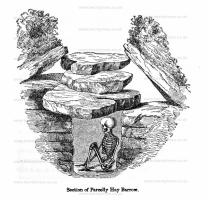
Ten Years' Digging. March 6th [1848] was passed in opening a cairn or tumulus [Parsley Hay Barrow [Map]] of stone in a plantation near the Parcelly Hay wharf of the Cromford and High Peak Railway. We found the primary interment beneath the middle of the barrow, in a small oval excavation in the rook below the natural surface of the land, about three feet in depth, and not exceeding the same in its greatest diameter, consequently the body had been placed upright in a sitting or crouching posture, as was abundantly evident from the order in which the bones were found. The grave was roughly covered in with large flat slabs of limestone, which had prevented the material of the tumulus from quite filling it up; a good deal of earth had, however, been washed in, which had the effect of preserving the bones in unusual perfection. The remains accompanying the body were of the poorest description, consisting merely of three pieces of chipped flint, some shreds from a drinking cup, and various animal bones and teeth, some of which were calcined. The fine skull from this interment has been engraved in the magnificent work by Messrs. Davis and Thumam, entitled "Crania Britannica," where its internal capacity is given at 72½ ounces; length of the femur, 18.3 inches. The high antiquity of this interment may be inferred when we take into consideration the fact, that upon the covering stones there lay another skeleton, quite unprotected from the loose stone of the barrow, and accompanied by weapons indicating that the owner lived at a very remote period. This body was badly preserved, owing to the percolation of water through the over lying stones, but it appeared to have been laid as usual upon the lefl side, with the knees slightly advanced; near the upper part of the person were placed a very elegantly formed axe head of granite, with a hole for the shaft, and a very fine bronze dagger of the earliest or archaic bronze period, with three studs for fastening the handle. The engraving gives an accurate section of this remarkable barrow,
On 6th March 1854 Charles William Vane 3rd Marquess Londonderry [aged 76] died at Londonderry House Park Lane. His son Frederick [aged 48] succeeded 4th Marquess Londonderry.
Monument at St Mary's Church, Long Newton [Map].
Frederick William Robert Stewart 4th Marquess Londonderry: On 7th July 1805 he was born to Charles William Vane 3rd Marquess Londonderry and Catherine Bligh. On 25th November 1872 Frederick William Robert Stewart 4th Marquess Londonderry died. His half brother George succeeded 5th Marquess Londonderry. Mary Cornelia Edwards Marchioness Londonderry by marriage Marchioness Londonderry.


Jean de Waurin's Chronicle of England Volume 6 Books 3-6: The Wars of the Roses
Jean de Waurin was a French Chronicler, from the Artois region, who was born around 1400, and died around 1474. Waurin’s Chronicle of England, Volume 6, covering the period 1450 to 1471, from which we have selected and translated Chapters relating to the Wars of the Roses, provides a vivid, original, contemporary description of key events some of which he witnessed first-hand, some of which he was told by the key people involved with whom Waurin had a personal relationship.
Available at Amazon in eBook and Paperback format.
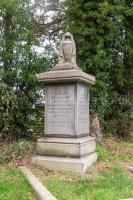
After 6th March 1857. St Peter and St Paul's Church, Rock [Map]. Memorial to Leopold Reiss [deceased] and Caroline m Reiss [aged 43].
Caroline m Reiss: Around 1814 she was born. Before 9th June 1833 Leopold Reiss and she were married. In 1841 Leopold Reiss and Caroline m Reiss lived at Crumpsall Crescent, Crumpsall, Manchester. On 10th January 1893 she died at Swyncombe, Henley-on-Thames.
The Diary of George Price Boyce 1859. 6th March 1859. (Sunday). (At Oxford.) Crowe, Faulkner, Jones and self rowed to Godstow where we saw the "Stunner" [Jane Morris nee Burden [aged 19]] (the future Mrs. William Morris); on our return we all dined (Swinburne included) at Topsy's (Morris'). He and Swinburne [aged 21] mad and deafening with excitement; adjourned to Crowe's to dessert; the chaff and row continued with great spirit and cleverness. Swinburne, a man of great reading, memory, and intellectual cleverness and accomplishment, seemed to be wanting in human feeling. In the evening we all went round to Johnson's, where we looked over a bundle of sketches among which were some beautiful things of Rossetti's.
On 6th March 1862 Alfred Douglas-Hamilton 13th Duke of Hamilton 10th Duke Brandon was born to Charles Henry Douglas-Hamilton [aged 53].

On 6th March 1866 William Whewell [aged 71] died.
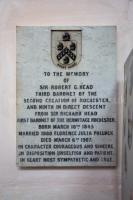
After 6th March 1907 Robert Garnet Head 3rd Baronet [deceased]. Monument in Rochester Cathedral [Map].
Robert Garnet Head 3rd Baronet: On 18th March 1845 he was born to Francis Somerville Head 2nd Baronet. On 26th August 1887 Francis Somerville Head 2nd Baronet died. His son Robert succeeded 3rd Baronet Head of Rochester in Kent. On 6th March 1907 Robert Garnet Head 3rd Baronet died. His son Robert succeeded 4th Baronet Head of Rochester in Kent.
On 6th March 1923 James Jebusa Shannon [aged 61] died.
On 6th March 1927 Marie Spartali aka Stillman [aged 82] died at Ashburn Place, Kensington. She was buried with her husband at Brookwood Cemetery, Woking.


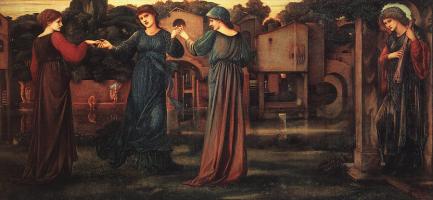


On 6th March 1930 Herbert Gladstone 1st Viscount Gladstone [aged 76] died. Memorial at the Church of St Deiniol, Hawarden, Flintshire. Viscount Gladstone of Lanarkshire extinct.
Herbert Gladstone 1st Viscount Gladstone: On 7th January 1854 he was born to William Ewart Gladstone and Catherine Glynne. In 1901 Herbert Gladstone 1st Viscount Gladstone and Dorothy Mary Viscountess Gladstone were married. The difference in their ages was 21 years.
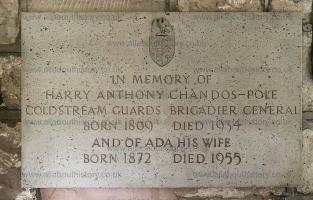
On 6th March 1934 Brigadier-General Harry Anthony Chandos-Pole [aged 61] died. Memorial to him and his wife Ada Ismay, and grave, at St Andrew's Church, Radbourne [Map]. Curiously the memorial and the grave have different dates of birth, 1869 and 1872, respectively; the latter date is believed correct.
Brigadier-General Harry Anthony Chandos-Pole: On 19th November 1872 he was born to Henry Chandos-Pole-Gell and Teresa Charlotte Manningham-Buller.
On 6th March 1964 Paul I King Greece [aged 62] died.
On 6th March 1340 John of Gaunt 1st Duke Lancaster was born to King Edward III of England [aged 27] and Philippa of Hainaut Queen Consort England [aged 29] at the Prinsenhof Palace [Map] in Ghent aka Gaunt. Coefficient of inbreeding 3.00%. He married (1) his half second cousin once removed Blanche Duchess of Lancaster, daughter of Henry of Grosmont 1st Duke Lancaster and Isabel Beaumont Duchess Lancaster, and had issue (2) 21st September 1371 his half third cousin twice removed Constance of Castile Duchess of Lancaster and had issue (3) 13th January 1396 Katherine Swynford aka Roet Duchess Lancaster and had issue.
On 6th March 1405 John II King Castile was born to Henry III King Castile [aged 25] and Catherine of Lancaster Queen Consort Castile [aged 31]. He a great grandson of King Edward III of England. Coefficient of inbreeding 2.16%. He married (1) 1418 his first cousin Maria Trastámara Queen Consort Castile, daughter of Ferdinand I King Aragon and Eleanor of Alberquerque Queen Consort Aragon, and had issue (2) after 1445 his half first cousin once removed Isabella Aviz Queen Consort Castile and had issue.
Jean de Waurin's Chronicle of England Volume 6 Books 3-6: The Wars of the Roses
Jean de Waurin was a French Chronicler, from the Artois region, who was born around 1400, and died around 1474. Waurin’s Chronicle of England, Volume 6, covering the period 1450 to 1471, from which we have selected and translated Chapters relating to the Wars of the Roses, provides a vivid, original, contemporary description of key events some of which he witnessed first-hand, some of which he was told by the key people involved with whom Waurin had a personal relationship.
Available at Amazon in eBook and Paperback format.
On 6th March 1663 Bishop Francis Atterbury was born.
On 24th February 1683 John Finch 6th Earl Winchilsea was born to Heneage Finch 3rd Earl Winchilsea [aged 55] and Elizabeth Ayres Countess Winchelsea. He was christened on 6th March 1683 at Eastwell, Kent.
On 6th March 1693 Bishop Edward Willes was born.
On 6th March 1704 John Ward 1st Viscount Dudley and Ward was born to William Ward [aged 27] and Mary Grey. Coefficient of inbreeding 3.15%.
On 6th March 1758 John Kennaway 1st Baronet was born.
On 6th March 1766 Lawrence Palk 2nd Baronet was born to Robert Palk 1st Baronet [aged 48] and Anne van Sittart Lady Palk. He married 15th May 1792 Dorothy Elizabeth Vaughan, daughter of Wilmot Vaughan 1st Earl Lisburne and Dorothy Shafto Countess Lisburne, and had issue.
On 6th March 1766 George Spencer-Churchill 5th Duke of Marlborough was born to George Spencer 4th Duke of Marlborough [aged 27] and Caroline Russell Duchess of Marlborough [aged 23]. He married 15th September 1791 Susan Stewart Duchess of Marlborough, daughter of John Stewart 7th Earl Galloway and Anne Dashwood Countess Galloway, and had issue.
On 6th March 1786 Henry St John 4th Viscount Bolingbroke 5th Viscount St John was born to George Richard St John 4th Viscount St John 3rd Viscount Bolingbroke [aged 25] and Charlotte Collins. He married 1812 Maria St John-Mildmay Viscountess Bolingbroke and St John, daughter of Henry Paulet St John-Mildmay 3rd Baronet and Jane Mildmay Lady St-John Mildmay, and had issue.
On 6th March 1792 Elizabeth Wilson was born to Reverend Henry Wilson 10th Baron Berners [aged 29]. She married 8th January 1810 Reverend William Chester and had issue.
On 6th March 1795 Elizabeth Anne Brudenell was born to Robert Brudenell 6th Earl Cardigan [aged 25] and Penelope Cooke Countess Cardigan [aged 25]. She married (1) 20th August 1816 John Perceval, son of Charles George Perceval 1st and 2nd Baron Arden and Margaretta Elizabeth Wilson Baroness Arden (2) 16th March 1824 her fifth cousin William Brodrick 7th Viscount Midleton.
On 6th March 1795 Mary Louisa Cavendish was born to George Augustus Henry Cavendish 1st Earl Burlington [aged 40] and Elizabeth Compton Countess Burlington [aged 34]. She died aged less than one years old.
William of Worcester's Chronicle of England
William of Worcester, born around 1415, and died around 1482 was secretary to John Fastolf, the renowned soldier of the Hundred Years War, during which time he collected documents, letters, and wrote a record of events. Following their return to England in 1440 William was witness to major events. Twice in his chronicle he uses the first person: 1. when writing about the murder of Thomas, 7th Baron Scales, in 1460, he writes '… and I saw him lying naked in the cemetery near the porch of the church of St. Mary Overie in Southwark …' and 2. describing King Edward IV's entry into London in 1461 he writes '… proclaimed that all the people themselves were to recognize and acknowledge Edward as king. I was present and heard this, and immediately went down with them into the city'. William’s Chronicle is rich in detail. It is the source of much information about the Wars of the Roses, including the term 'Diabolical Marriage' to describe the marriage of Queen Elizabeth Woodville’s brother John’s marriage to Katherine, Dowager Duchess of Norfolk, he aged twenty, she sixty-five or more, and the story about a paper crown being placed in mockery on the severed head of Richard, 3rd Duke of York.
Available at Amazon in eBook and Paperback format.
On 6th March 1803 Frances Isabella Selina Poyntz Marchioness of Exeter was born to William Stephen Poyntz [aged 33] and Elizabeth Mary Browne [aged 35]. She married (1) 12th May 1824 Brownlow Cecil 2nd Marquess Exeter, son of Henry Cecil 1st Marquess Exeter and Sarah Hoggins Countess Exeter, and had issue (2) July 1835 her third cousin Horace Beauchamp Seymour-Conway.
On 6th March 1817 Princess Clémentine Orléans was born to King Louis Philippe I of France [aged 43] at Chateau Neuilly. She married 20th April 1843 August Victor Saxe Coburg Gotha and had issue.
On 6th March 1821 Frederick John Hobart-Hampden was born to Augustus Edward Hobart-Hampden 6th Earl Buckinghamshire [aged 27].
On 6th March 1826 Edward Poore 3rd Baronet was born to Edward Poore 2nd Baronet [aged 30] and Agnes Marjoribanks Lady Poore [aged 26].
On 6th March 1835 Greville Richard Vernon was born to Robert Smith aka Vernon 1st Baron Lyveden [aged 35] and Emma Mary Fitzpatrick Baroness Lyveden [aged 27]. Coefficient of inbreeding 3.13%. He married 13th April 1858 Susan Caroline Cockerell and had issue.
On 6th March 1862 Alfred Douglas-Hamilton 13th Duke of Hamilton 10th Duke Brandon was born to Charles Henry Douglas-Hamilton [aged 53].
On 6th March 1932 Captain David Peter Dudley Stapleton-Cotton was born to Francis Stapleton-Cotton 4th Viscount Combermere [aged 44] and Constance Marie Katherine Williams-Drummond [aged 38]. He married 1955 Susan Nomakepu Albu.
On 6th March 1943 Frances Helen Mary Eliot was born to Nicholas Eliot 9th Earl of St Germans [aged 29] and Helen Mary Villiers [aged 27].
On 6th March 1949 Peter Curzon 4th Viscount Scarsdale was born to Francis Curzon 3rd Viscount Scarsdale [aged 24] and Solange Yvonne Palmyre Ghislaine Hanse [aged 25].
On 6th March 1427 John Holland 2nd Duke Exeter [aged 31] and Anne Stafford Duchess Exeter were married. She by marriage Duchess Exeter. She the daughter of Edmund Stafford 5th Earl Stafford and Anne of Gloucester Plantagenet Countess Eu and Stafford [aged 44]. He the son of John Holland 1st Duke Exeter and Elizabeth Lancaster Duchess Exeter. They were second cousins. He a great grandson of King Edward III of England. She a great granddaughter of King Edward III of England.
The Deeds of the Dukes of Normandy
The Gesta Normannorum Ducum [The Deeds of the Dukes of Normandy] is a landmark medieval chronicle tracing the rise and fall of the Norman dynasty from its early roots through the pivotal events surrounding the Norman Conquest of England. Originally penned in Latin by the monk William of Jumièges shortly before 1060 and later expanded at the behest of William the Conqueror, the work chronicles the deeds, politics, battles, and leadership of the Norman dukes, especially William’s own claim to the English throne. The narrative combines earlier historical sources with firsthand information and oral testimony to present an authoritative account of Normandy’s transformation from a Viking settlement into one of medieval Europe’s most powerful realms. William’s history emphasizes the legitimacy, military prowess, and governance of the Norman line, framing their expansion, including the conquest of England, as both divinely sanctioned and noble in purpose. Later chroniclers such as Orderic Vitalis and Robert of Torigni continued the history, extending the coverage into the 12th century, providing broader context on ducal rule and its impact. Today this classic work remains a foundational source for understanding Norman identity, medieval statesmanship, and the historical forces that reshaped England and Western Europe between 800AD and 1100AD.
Available at Amazon in eBook and Paperback format.
On 6th March 1725 John St John 11th Baron St John [aged 37] and Elizabeth Crowley Baroness St John were married. She by marriage Baroness St John of Bletso.
On 6th March 1731 James Lyon 7th Earl Strathmore and Kinghorne [aged 28] and Mary Oliphant were married. He the son of John Lyon 4th Earl Strathmore and Kinghorne and Elizabeth Stanhope Countess Strathmore and Kinghorne.
On 6th March 1776 Francis Saxe Coburg Gotha I Duke Saxe Coburg Gotha [aged 25] and Sophie Saxe Hildburghausen Duchess Saxe Coburg Gotha were married. She by marriage Duchess Saxe Coburg Gotha. She the daughter of Ernst Friedrich Saxe Hildburghausen 2nd Duke Saxe Hildburghausen. He the son of Ernest Frederick Saxe Coburg Saalfeld Duke Saxe Coburg Saalfeld [aged 51] and Sophia Antonia Brunswick-Wolfenbüttel Duchess Saxe Coburg Saalfeld [aged 52].
On 6th March 1781 George John Spencer 2nd Earl Spencer [aged 22] and Lavinia Bingham Countess Spencer [aged 19] were married. She the daughter of Charles Bingham 1st Earl Lucan [aged 45] and Margaret Smith Countess Lucan [aged 41]. He the son of John Spencer 1st Earl Spencer [aged 46] and Margaret Georgiana Poyntz Countess Spencer [aged 43].


On 6th March 1828 Glynne Earl Welby 3rd Baronet [aged 21] and Frances Cholmeley were married.
On 6th March 1897 Vivian Hugh Smith 1st Baron Bicester [aged 29] and Sybil Mary McDonnell Baroness Bicester [aged 20] were married. She the daughter of William Randall McDonnell 6th Earl of Antrim [aged 46] and Louisa Grey Countess of Antrim [aged 42].
On 6th March 1963 James Lowther 7th Earl Londsdale [aged 40] and Nancy Ruth Cobbs Countess Lowther were married. She by marriage Countess Lonsdale.
On 6th March 1052 Emma aka Ælfgyfu of Normandy Queen Consort England [aged 67] died.
On 6th March 1352 Elizabeth Hastings Baroness Grey Ruthyn [aged 57] died.
On 6th March 1353 Roger Grey 1st Baron Grey Ruthyn [aged 63] died at Ruthyn. His son Reginald [aged 31] succeeded 2nd Baron Grey of Ruthyn.
The Deeds of the Dukes of Normandy
The Gesta Normannorum Ducum [The Deeds of the Dukes of Normandy] is a landmark medieval chronicle tracing the rise and fall of the Norman dynasty from its early roots through the pivotal events surrounding the Norman Conquest of England. Originally penned in Latin by the monk William of Jumièges shortly before 1060 and later expanded at the behest of William the Conqueror, the work chronicles the deeds, politics, battles, and leadership of the Norman dukes, especially William’s own claim to the English throne. The narrative combines earlier historical sources with firsthand information and oral testimony to present an authoritative account of Normandy’s transformation from a Viking settlement into one of medieval Europe’s most powerful realms. William’s history emphasizes the legitimacy, military prowess, and governance of the Norman line, framing their expansion, including the conquest of England, as both divinely sanctioned and noble in purpose. Later chroniclers such as Orderic Vitalis and Robert of Torigni continued the history, extending the coverage into the 12th century, providing broader context on ducal rule and its impact. Today this classic work remains a foundational source for understanding Norman identity, medieval statesmanship, and the historical forces that reshaped England and Western Europe between 800AD and 1100AD.
Available at Amazon in eBook and Paperback format.
On 6th March 1360 Eleanor Damory Baroness Zouche Mortimer [aged 41] died.
On 14th February 1400 (exact date not known) King Richard II [aged 33] died at Pontefract Castle [Map] where he had been imprisoned three months before; possibly murdered, possibly starved to death. His death was a consequence of the Epiphany Rising; he was still considered a threat.
Edmund Mortimer 5th Earl March 7th Earl of Ulster [aged 8] de jure Heir to the Throne of England since he was descended from Philippa Plantagenet Countess March 2nd Countess Ulster the daughter of Lionel of Antwerp 1st Duke of Clarence. The new King Henry IV [aged 32] ignored his claim. Edmund Mortimer 5th Earl March 7th Earl of Ulster and his brother Roger Mortimer [aged 6] were imprisoned in Windsor and Berkhamstead castles respectively; they were treated well.
On 17th February 1400 Richard's corpse was displayed at St Paul's Cathedral [Map].
On 6th March 1400 Richard's remains were buried at King's Langley Priory, Hertfordshire [Map].
On 6th March 1450 John Chideock 6th Baron Fitzpayn [aged 48] died. Baron Fitzpayn abeyant between his daughters Catherine Chideocke [aged 27] and Margaret Chideock [aged 18] and their heirs.
On 6th March 1468 Eleanor Beauchamp Duchess Somerset [aged 59] died at Baynard's Castle [Map].
On 6th March 1490 Margaret Woodville Countess Arundel [aged 36] died.
On 6th March 1491 Richard Woodville 3rd Earl Rivers [aged 38] died. Earl Rivers, Baron Rivers extinct.
On 6th March 1545 Robert Ogle 5th Baron Ogle [aged 32] died. His son Robert [aged 16] succeeded 6th Baron Ogle.
On 6th March 1597 William Brooke 10th Baron Cobham [aged 69] died. His son Henry [aged 32] succeeded 11th Baron Cobham.
On 6th March 1616 Francis Beaumont [aged 32] died.
On 6th March 1660 William Button 2nd Baronet [aged 38] died. He was buried at St James the Great Church, North Wraxall. His brother Robert [aged 38] succeeded 3rd Baronet Button of Alton in Wiltshire.
On 1st March 1680 John Shaw 1st Baronet [aged 65] died. He was buried on 6th March 1721 at the Church of Holy Trinity, Eltham on 6th March 1680. His son John [aged 20] succeeded 2nd Baronet Shaw of Eltham in Kent.

On 6th March 1680 Henry Thynne 1st Baronet [aged 65] died. His son Thomas [aged 40] succeeded 2nd Baronet Thynne of Kempsford in Gloucestershire. Frances Finch Viscountess Weymouth [aged 30] by marriage Lady Thynne of Kempsford in Gloucestershire.

On 6th March 1681 Charles Berkeley 2nd Baron Berkeley died. His brother John [aged 18] succeeded 3rd Baron Berkeley of Stratton in Cornwall.
On 6th March 1685 Thomas Spencer 3rd Baronet [aged 46] died of apoplexy. He was buried in the Spencer Chapel at Church of St Bartholomew, Yarnton. His first cousin Thomas succeeded 4th Baronet Spencer of Yarnton in Oxfordshire.
On 6th March 1698 Philip Sidney 3rd Earl of Leicester [aged 79] died. His son Robert [aged 49] succeeded 4th Earl of Leicester, 4th Viscount Lisle. Elizabeth Egerton Countess Leicester [aged 44] by marriage Countess of Leicester.


Jean de Waurin's Chronicle of England Volume 6 Books 3-6: The Wars of the Roses
Jean de Waurin was a French Chronicler, from the Artois region, who was born around 1400, and died around 1474. Waurin’s Chronicle of England, Volume 6, covering the period 1450 to 1471, from which we have selected and translated Chapters relating to the Wars of the Roses, provides a vivid, original, contemporary description of key events some of which he witnessed first-hand, some of which he was told by the key people involved with whom Waurin had a personal relationship.
Available at Amazon in eBook and Paperback format.
On 6th March 1698 William Lindsay 18th Earl Crawford 2nd Earl Lindsay [aged 53] died. His son John succeeded 19th Earl Crawford, 3rd Earl Lindsay.
On 6th March 1701 William Brownlow 4th Baronet [aged 35] died. His son John [aged 10] succeeded 5th Baronet Brownlow of Humby in Lincolnshire and inherited Belton House [Map].


On 6th March 1704 George Seton 4th Earl Winton [aged 63] died. His son George [aged 26] succeeded 5th Earl Winton.
On 6th March 1729 William Lowther 1st Baronet [aged 65] died. His son William [aged 35] succeeded 2nd Baronet Lowther of Swillington in West Yorkshire. Diana Condon Lady Lowther by marriage Lady Lowther of Swillington in West Yorkshire.
On 6th March 1736 Robert Newcomen 6th Baronet [aged 72] died. His son Arthur [aged 35] succeeded 7th Baronet Newcomen of Kenagh in County Longford.
On 6th March 1758 Henry Vane 1st Earl Darlington [aged 53] died. His son Henry [aged 31] succeeded 2nd Earl Darlington, 2nd Viscount Barnard, 4th Baron Barnard. Margaret Lowther Countess Darlington [aged 30] by marriage Countess Darlington.

On 6th March 1764 Philip Yorke 1st Earl of Hardwicke [aged 73] died. His son Philip [aged 43] succeeded 2nd Earl Hardwicke, 2nd Viscount Royston. Jemima Campbell 2nd Marchioness Grey [aged 40] by marriage Countess Hardwicke.
On 6th March 1773 William Maxwell 6th Earl Nithsdale died without male issue. Earl Nithsdale, Lord Maxwell and Lord Herries of Terregles extinct?
On 6th March 1784 Robert Cansfield Gerard 9th Baronet [aged 59] died. His son Robert [aged 12] succeeded 10th Baronet Gerard of Bryn in Lancashire.
On 6th March 1793 Richard Barry 7th Earl Barrymore [aged 23] died. His brother Henry [aged 22] succeeded 8th Earl Barrymore.

On 6th March 1795 Richard Brooke 5th Baronet [aged 42] died. His son Richard [aged 9] succeeded 6th Baronet Brooke of Norton Priory in Cheshire.
On 6th March 1813 Mary Elizabeth Nugent Marchioness Buckingham [aged 55] died. Her son George [aged 24] succeeded 2nd Baron Nugent.
On 6th March 1833 John Ward 1st Earl of Dudley [aged 51] died. Earl of Dudley of Dudley Castle in Staffordshire and Viscount Dudley and Ward of Dudley in Worcestershire extinct. His second cousin William [aged 52] succeeded 10th Baron Ward of Birmingham.
On 6th March 1835 Margaret Williams Lady Williams [aged 66] died. Memorial at St Asaph Cathedral [Map] sculpted by Richard Westmacott [aged 59].
Margaret Williams Lady Williams: On 25th April 1768 she was born. On 21st October 1791 John Williams 1st Baronet and she were married. On 27th July 1798 John Williams 1st Baronet was created 1st Baronet Williams of Bodelwyddan in Flintshire. She by marriage Lady Williams of Bodelwyddan in Flintshire.
On 6th March 1838 Augusta Fane Countess Lonsdale [aged 76] died.
On 6th March 1848 Gregory Osborne Page-Turner 4th Baronet [aged 62] died. His brother Edward [aged 58] succeeded 5th Baronet Page-Turner of Ambrosden in Oxfordshire.
On 6th March 1851 East George Clayton-East 1st Baronet [aged 56] died. His son Gilbert [aged 27] succeeded 2nd Baronet Clayton-East of Hall Place in Berkshire.
On 6th March 1854 Charles William Vane 3rd Marquess Londonderry [aged 76] died at Londonderry House Park Lane. His son Frederick [aged 48] succeeded 4th Marquess Londonderry.
Monument at St Mary's Church, Long Newton [Map].
Frederick William Robert Stewart 4th Marquess Londonderry: On 7th July 1805 he was born to Charles William Vane 3rd Marquess Londonderry and Catherine Bligh. On 25th November 1872 Frederick William Robert Stewart 4th Marquess Londonderry died. His half brother George succeeded 5th Marquess Londonderry. Mary Cornelia Edwards Marchioness Londonderry by marriage Marchioness Londonderry.
On 6th March 1855 Charles Jenkinson 10th Baronet [aged 76] died without male issue. His nephew George [aged 37] succeeded 11th Baronet Jenkinson of Walcot in Oxfordshire and of Hawkesbury in Gloucestershire. Emily Sophia Lyster Lady Jenkinson by marriage Lady Jenkinson of Walcot in Oxfordshire and of Hawkesbury in Gloucestershire.
On 6th March 1866 William Whewell [aged 71] died.
On 6th March 1879 Frances Isabella Selina Poyntz Marchioness of Exeter [aged 76] died.
Annals of the six Kings of England by Nicholas Trivet
Translation of the Annals of the Six Kings of England by that traces the rise and rule of the Angevin aka Plantagenet dynasty from the mid-12th to early 14th century. Written by the Dominican scholar Nicholas Trivet, the work offers a vivid account of English history from the reign of King Stephen through to the death of King Edward I, blending political narrative with moral reflection. Covering the reigns of six monarchs—from Stephen to Edward I—the chronicle explores royal authority, rebellion, war, and the shifting balance between crown, church, and nobility. Trivet provides detailed insight into defining moments such as baronial conflicts, Anglo-French rivalry, and the consolidation of royal power under Edward I, whose reign he describes with particular immediacy. The Annals combines careful year-by-year reporting with thoughtful interpretation, presenting history not merely as a sequence of events but as a moral and political lesson. Ideal for readers interested in medieval history, kingship, and the origins of the English state, this chronicle remains a valuable and accessible window into the turbulent world of the Plantagenet kings.
Available at Amazon in eBook and Paperback format.
On 6th March 1884 Harriet Graham Marchioness Donegal [aged 54] died.
On 6th March 1885 Louisa Burton Rowley Countess Kinnoul died.
On 6th March 1893 Emily Paget Countess Sydney [aged 83] died.
On 6th March 1907 Robert Garnet Head 3rd Baronet [aged 61] died. His son Robert [aged 22] succeeded 4th Baronet Head of Rochester in Kent.
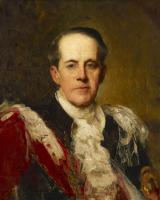
On 6th March 1915 George Cadogan 5th Earl Cadogan [aged 74] died. His son Gerald [aged 45] succeeded 6th Earl Cadogan, 6th Viscount Chelsea, 8th Baron Cadogan.
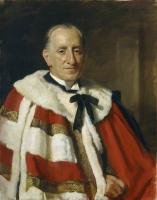
On 6th March 1923 Robert George Windsor-Clive 1st Earl Plymouth [aged 65] died at Great Cumberland Place. He was buried at Windsor Clive Family Plot, St Bartholomew's Church, Tardebigge. His son Ivor [aged 34] succeeded 2nd Earl Plymouth in Devon. Irene Corona Charteris Countess Plymouth [aged 21] by marriage Countess Plymouth in Devon.
On 6th March 1923 James Jebusa Shannon [aged 61] died.
On 6th March 1927 George Fenton Fletcher Boughey 8th Baronet [aged 78] died unmarried. His first cousin once removed George [aged 47] succeeded 9th Baronet Boughey of Newcastle under Lyme in Staffordshire.
On 6th March 1927 Marie Spartali aka Stillman [aged 82] died at Ashburn Place, Kensington. She was buried with her husband at Brookwood Cemetery, Woking.
On 6th March 1930 Herbert Gladstone 1st Viscount Gladstone [aged 76] died. Memorial at the Church of St Deiniol, Hawarden, Flintshire. Viscount Gladstone of Lanarkshire extinct.
Herbert Gladstone 1st Viscount Gladstone: On 7th January 1854 he was born to William Ewart Gladstone and Catherine Glynne. In 1901 Herbert Gladstone 1st Viscount Gladstone and Dorothy Mary Viscountess Gladstone were married. The difference in their ages was 21 years.
On 6th March 1948 Derrick Wernher 2nd Baronet [aged 58] died. His brother Harold [aged 55] succeeded 3rd Baronet Wernher of Lutton Hoo Park in Bedfordshire.
On 6th March 1964 Paul I King Greece [aged 62] died.
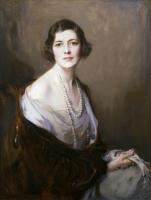
On 6th March 1984 Alexandra Bridget Coke Countess Airlie [aged 93] died.
Annals of the six Kings of England by Nicholas Trivet
Translation of the Annals of the Six Kings of England by that traces the rise and rule of the Angevin aka Plantagenet dynasty from the mid-12th to early 14th century. Written by the Dominican scholar Nicholas Trivet, the work offers a vivid account of English history from the reign of King Stephen through to the death of King Edward I, blending political narrative with moral reflection. Covering the reigns of six monarchs—from Stephen to Edward I—the chronicle explores royal authority, rebellion, war, and the shifting balance between crown, church, and nobility. Trivet provides detailed insight into defining moments such as baronial conflicts, Anglo-French rivalry, and the consolidation of royal power under Edward I, whose reign he describes with particular immediacy. The Annals combines careful year-by-year reporting with thoughtful interpretation, presenting history not merely as a sequence of events but as a moral and political lesson. Ideal for readers interested in medieval history, kingship, and the origins of the English state, this chronicle remains a valuable and accessible window into the turbulent world of the Plantagenet kings.
Available at Amazon in eBook and Paperback format.
On 6th March 2010 Fiennes Cornwallis 3rd Baron Cornwallis [aged 88] died. His son Fiennes [aged 64] succeeded 4th Baron Cornwallis of Linton in Kent.

