

13 Jun is in June.
11th May 1477 Execution of George Duke of Clarence's Servants
1483 Execution of William Hastings by Richard III
1483 Disappearance of the Princes in the Tower
1587 Execution of Mary Queen of Scots
1625 Charles I and Henrietta Maria's First Meeting
1660 June Creation of Baronets
1661 Creation of Baronets and Peerages by Charles II Post Coronation
Anglo-Saxon Chronicle. 803. This year died Hibbald, Bishop of Holy-island, on the twenty-fourth of June, and Egbert was consecrated in his stead, on the thirteenth of June following. Archbishop Ethelherd also died in Kent, and Wulfred was chosen archbishop in his stead. Abbot Forthred, in the course of the same year, departed this life.
On 13th June 823 Charles "Bald" I King West Francia was born to Louis "Pious" King Aquitaine and the Franks [aged 45] and Judith of Bavaria Queen Consort of Aquitaine and the Franks [aged 26]. He married (1) Richildis Bivinids Queen Consort West Francia and had issue (2) Ermentrude Orléans Queen Consort West Francia, daughter of Odi Orléans 1st Count Orléans, and had issue.
On 13th June 839 Charles "Fat" King East Francia Holy Roman Emperor III King West Francia King Aquitaine was born to Louis "German" II King East Francia [aged 35] and Hemma Welf Queen Consort East Francia [aged 36]. He married Richgard Unknown Holy Roman Empress.
On 13th June 1142 Godfrey Reginar VII Duke Lower Lorraine [aged 35] died. His son Godfrey succeeded III Count Louvain, VIII Duke Lower Lorraine.
Chronicle of Roger de Hoveden. 13th June 1194. When the King of England arrived at the castle of Loches, he found the Navarrese and Brabançon mercenaries already there, exhausted from their long vigils, fasts, and laborious efforts in their attempt to capture the castle, all in vain. Immediately, with his own forces and the others present, he launched a continuous assault day and night. At last, he took the castle by force and arms, capturing five knights and twenty-four sergeants, on the Monday after the Feast of Saint Barnabas the Apostle (June 13, 1194).
Cumque rex Angliæ ad castrum de Luches veniret, invenit ibi praedictos Navarrenses et Braibancenos, jam in vigiliis, et jejuniis, et laboribus multis, in captione illius castelli in vanum laborantes; et statim cum suis, et ceteris, qui aderant, die noctuque in eo insultum faciens, tandem cepit illud vi et armis, et cepit in eo quinque milites, et quatuor et viginti servientes, feria secunda post festum Sancti Barnabæ apostoli.
On 13th June 1222 Eleanor Fair Maid of Brittany [aged 38] was imprisoned at Gloucester Castle, Gloucestershire [Map] where she remained until 20th July 1223.
 Chronicle of Jean le Bel Volume 1. When they had come to Nantes, they found Sir Charles of Blois there, and they took counsel that they would lay siege to the city of Rennes; and so they went there. The valiant Countess of Montfort had so well furnished it with all provisions and men-at-arms that nothing was lacking, and she had placed there as chief and captain a noble knight called Sir William of Quadudal1, a gentleman greatly esteemed in the land of Brittany. The valiant lady had also set strong and numerous garrisons throughout the other cities, and had established there worthy gentlemen of the country who held to her cause. She had won them all by fair speech, by gifts, and by promises. Among them were the Bishop of Léon, Sir Amaury de Clisson2, Sir Yvain of Tiguery3, the lord of Landremaz, the castellan of Guingamp, Sir Olivier of Spinefort4, brother to Sir Geoffrey of Malatrait, Sir William of Quadudal, the two brothers of Quarick, and many other knights and squires whom I cannot name. There were also many who supported Sir Charles of Blois, who held to him together with Sir Henry of Léon, who had formerly been of the party of the Count of Montfort and master of his council until the city of Nantes was surrendered, as you have heard, whereof he was greatly blamed, for it was said that through his contrivance the Count of Montfort had been captured. Indeed, he was the one who laboured most to trouble the valiant countess and to uphold Sir Charles of Blois.
Quant ilz furent venus à Nantes, là ilz trouverrent messire Charles de Bloys et eurent conseil qu'ilz assiegeroient la cité de Rennes; si y alerent. La vaillant contesse de Montfort l'avoit si bien garny de tous biens et de gens d'armes que riens n'y faloit, et y avoit mis ung gentil chevalier pour chief et cappitaine que on appelloit messire Guillaume de Quadudal, gentil homme grandement du pays de Bretaigne. Aussy avoit la vaillant dame mis garnisons grandes et fortes par toutes les aultres citez, et y avoit estably bons gentilz hommes du pays, qui à luy se tenoient, et les avoit trestous acquis par beau parler, par dons et par promesses; desquelz l'ung estoit l'evesque de Lyon, messire Amaulry de Clichon, messire Yvain de Tiguery, le sire de Landremaz, le chastelain de Guingant, messire Olivier de Pennefort!, frere à messire Jeffroy de Malatrait, messire Guillaume de Quadudal, les II freres de Quarick et pluseurs aultres chevaliers et escuiers que nommer ne sçavroye. Aussy en y avoit grand foison de l'acord messire Charles de Bloys, qui à luy se tenoient avecques messire Henry de Lyon, qui fut premierement de l'acord du conte de Montfort et maistre de son conseil, jusques à tant que la cité de Nantes fut rendue, ainsy que vous avez ouy, de quoy il fut grandement blasmé, car on vouloit dire que, par son pourchas, le conte de Montfort avoit esté pris. Sy estoit il celluy qui plus se donnoit de paine à grever la contesse vaillant et soustenir messire Charles de Bloys.
Note 1. According to Kervyn de Lettenhove, in his edition of Froissart, his first name was not William but Olivier. In 1340 he was a counsellor of John III, Duke of Brittany.
1. Selon Kervyn de Lettenhove, dans son édition de Froissart, t. XX, p. 491, son prénom serait non Guillaume, mais Olivier. En 1340, il était conseiller de Jean III, duc de Bretagne.
Note 2. Amaury de Clisson [aged 38] was the younger son of Olivier III de Clisson and Isabeau de Craon. Reconciled in 1344 with Charles of Blois, he was killed at the battle of La Roche-Derrien.
2. Amaury de Clisson était fils puîné d'Olivier de Clisson et d'Isabeau de Craon; réconcilié en 1344 avec Charles de Blois, il fut tué au combat de la Roche-Derrien. (Froissart, éd, Kervyn de Lettenhove, t. XXI, p. 16-17.)
Note 3. Charles of Blois, by letters issued 'in our tents before the town of Hennebont in Brittany' on 13th June 1342, granted to Ayton Doria, 'squire', in reward for the services he had rendered during the war, the castle and castellany of Châteaulin-sur-Trieux and the castle of Brélidy, which had been confiscated from Yves de Trésiguidi. On 23rd December 1343, a letter addressed to him by Edward III shows that he was still a fervent supporter of Joan of Montfort.
3. Charles de Blois, par lettres données «en noz tentes devant la ville de Hainbont en Bretaigne» le 13 juin 1342, donna à Ayton Doria, «damoiïsel,» pour les services qu'il lui rendit pendant la guerre, le château et la châtellenie de Ch4teaulin-sur-Trieu et le château de Brelidy, qui avaient été confisqués sur Yves de Trésiguidi. (Arch. nat., JJ 74, fol. 409, no 685.) Le 23 décembre 1343, une lettre, que lui adresse Edouard III, nous montre quil était encore un chaud partisan de Jeanne de Montfort. (Rymer op. cit., t. II, No partie, p1242.)
Note 4. We see, from a letter of Edward III dated 23rd December 1343, that at that time Olivier de Spinefort was captain of Hennebont, Rymer 2.1242: 'The king to the venerable father in Christ, the bishop of Quimper, greeting and sincere affection. Since the good governance of the duchy of Brittany, and its defense against our enemies and those of the illustrious John of Montfort, our most dear kinsman, are greatly desired by us and we trust that you and others who favour our cause and that of the said duke hold this likewise at heart. We earnestly request your loyalty and affection, that, since for the necessary defense of those regions certain impositions (taxes) are to be levied upon merchandise and goods for sale, as is expedient, you will kindly permit this, and furthermore, as need may require, enjoin your men and subjects and encourage others to bear the burden of these impositions for the common good; so that, by their example, others may not withdraw from making such payments, but may rather be more strongly encouraged to do so. And, by the grace of God, we shall take care to lend a helping hand to the safety and honor of the said regions, in such a way that all those there who support us and the said duke will rejoice that they have undertaken such burdens for us. Given at Westminster, on the 23rd day of December. In the same manner, orders were sent to the following, under the same date: the lord of Pont and the son of the lord of Pont; Henry de Nyvet; William de Vieux-Chastel; the abbot and convent of Quimperlé; William of Cornouaille; Oliver of Spynesfort, captain of Hennebont; the worthy men and community of Quimper; the worthy men and community of Quimperlé; and the worthy men and community of Hennebont.'
4. Nous voyons, par une lettre d'Édouard III du 23 décembre 1343, qu'à cette date Olivier de Spinefort était capitaine de Hennebont. (Rymer Ibid p. 1242.)
On 13th June 1349 John Willoughby 2nd Baron Willoughby [aged 46] died. His son John [aged 26] succeeded 3rd Baron Willoughby de Eresby. Cecily Ufford Baroness Willoughby of Eresby [aged 22] by marriage Baroness Willoughby de Eresby.
He was buried at St James' Church, Spilsby [Map]. His wife Joan Roscelyn Baroness Willoughby and Latimer [aged 41] subsequently buried with him. She wears a skirt and mantle.


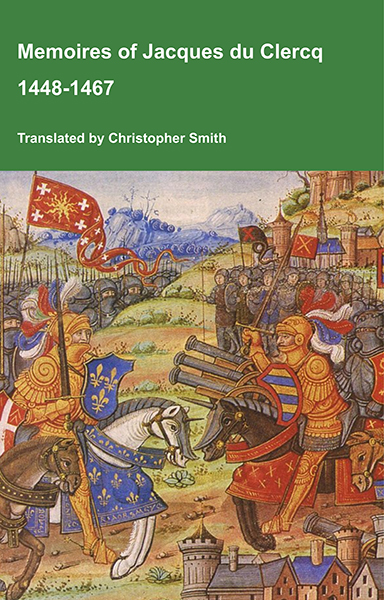
This is a translation of the 'Memoires of Jacques du Clercq', published in 1823 in two volumes, edited by Frederic, Baron de Reissenberg. In his introduction Reissenberg writes: 'Jacques du Clercq tells us that he was born in 1424, and that he was a licentiate in law and a counsellor to Philip the Good, Duke of Burgundy, in the castellany of Douai, Lille, and Orchies. It appears that he established his residence at Arras. In 1446, he married the daughter of Baldwin de la Lacherie, a gentleman who lived in Lille. We read in the fifth book of his Memoirs that his father, also named Jacques du Clercq, had married a lady of the Le Camelin family, from Compiègne. His ancestors, always attached to the counts of Flanders, had constantly served them, whether in their councils or in their armies.' The Memoires cover a period of nineteen years beginning in in 1448, ending in in 1467. It appears that the author had intended to extend the Memoirs beyond that date; no doubt illness or death prevented him from carrying out this plan. As Reissenberg writes the 'merit of this work lies in the simplicity of its narrative, in its tone of good faith, and in a certain air of frankness which naturally wins the reader’s confidence.' Du Clercq ranges from events of national and international importance, including events of the Wars of the Roses in England, to simple, everyday local events such as marriages, robberies, murders, trials and deaths, including that of his own father in Book 5; one of his last entries.
Available at Amazon in eBook and Paperback format.
On 13th June 1363 Adolph de la Marck [aged 29] was appointed Archbishop Cologne.
On 13th June 1385 Thomas Mowbray 1st Duke of Norfolk [aged 17] as appointed Earl Marshal.
On 13th June 1394 Wartislaw Griffins VI Duke Pomerania [aged 49] died. His son Barnim [aged 29] succeeded 6th Duke Pomerania. Veronica Hohenzollern Duchess Pomerania by marriage Duchess Pomerania.
On 13th June 1475 Joan Aviz Queen Consort Castile [aged 36] died.
Patent Rolls. 13th June 1477. Grant to Mary late the wife of John Stacy late of Oxford, alias John Westminster. Stace late of London, "gentilman," alias Marion Stacy of London, widow, of all the goods and debts late of the said John, lately attainted of high treason and hung. By p.s.
The History of King Richard the Third by Thomas More. And therefore he, fearing lest their motions might with the Lord Hastings [aged 52] diminish his credibility, whereunto only all the matter leaned, procured the Protector [aged 30] hastily to get rid of him. And much the rather, for that he trusted by his death to obtain much of the rule that the Lord Hastings bore in his country, the only desire whereof was the enticement that induced him to be partner and one special contriver of all this horrible treason.
Whereupon soon after, that is to wit, on the Friday, the thirteenth day of June [1483], many lords assembled in the Tower, and there sat in Council, devising the honorable solemnity of the King's coronation, of which the time appointed so near approached that the pageants and subtleties were in making day and night at Westminster, and much victual killed therefore that afterwards was cast away. These lords so sitting together speaking of this matter, the Protector came in among them, first about nine of the clock, saluting them courteously, and excusing himself that he had been from them so long, saying merrily that he had been asleep that day. And after a little talking with them, he said unto the Bishop of Ely: "My Lord, you have very good strawberries at your garden in Holborn, I require you, let us have a mess of them."
"Gladly, my Lord," said he. "Would God I had some better thing as ready to your pleasure as that." And therewith in all the haste he sent his servant for a mess of strawberries.
The Protector set the lords fast in talking, and thereupon praying them to spare him for a little while, departed thence. And soon after one hour, between ten and eleven, he returned into the chamber among them, all changed with a wonderful sour, angry countenance, knitting the brows, frowning and frothing and gnawing on his lips, and so sat him down in his place, all the lords much dismayed and sore marveling of this manner of sudden change, and what thing should him ail. Then when he had sat still awhile, thus he began: "What were they worthy to have that plan and imagine the destruction of me, being so near of blood unto the King, and Protector of his royal person and his realm?"
This question, all the lords sat astonished, musing much by whom this question should be meant, of which every man knew himself clear. Then the Lord Chamberlain, as he that for the love between them thought he might be boldest with him, answered and said that they were worthy to be punished as heinous traitors, whosoever they were. And all the others affirmed the same.
"That is," said he, "yonder sorceress, my brother's wife, and others with her," meaning the Queen [aged 46].
These words many of the other lords were greatly abashed that favored her. But the Lord Hastings was in his mind better content that it was caused by her than by any other whom he loved better; although his heart somewhat grudged that he was not before made of counsel in this matter, as he was of the taking of her kindred and of their putting to death, which were by his assent before devised to be beheaded at Pomfret this selfsame day, in which he was not aware that it was by others devised that he himself should the same day be beheaded at London.
Then said the Protector: "You shall all see in what way that sorceress and that other witch of her counsel, Shore's wife [aged 38], with their affinity, have by their sorcery and witchcraft wasted my body." And therewith, he plucked up his doublet sleeve to his elbow upon his left arm, where he showed a shriveled, withered and small arm-as if it were ever otherwise. And thereupon every man's mind sore misgave them, well perceiving that this matter was but a quarrel, for well they knew that the Queen was too wise to go about any such folly. And also if she would, yet would she of all folk least make Shore's wife of council, whom of all women she most hated, as that concubine whom the King her husband had most loved. And also no man was there present but well knew that the Protector's arm was ever such since his birth.
Nevertheless the Lord Chamberlain (which from the death of King Edward kept Shore's wife, on whom he somewhat doted in the King's life, he saving his affection, as it is said, during that time and resisting her out of reverence toward his King, or else of a certain kind of fidelity to his friend) answered and said: "Certainly, my Lord, if they have so heinously done, they be worthy heinous punishment."
"What?!" said the Protector. "Thou serve me, I know, with 'ifs' and with 'ands.' I tell thee they have so done, and that I will make good on thy body, traitor." And therewith as in a great anger, he clapped his fist upon the table a great rap. At which token given, one cried treason outside the chamber. Therewith a door slammed, and in come there rushing men in armour, as many as the chamber might hold. And at once the Protector said to the Lord Hastings"I arrest thee, traitor."
"What me, my Lord?" said he.
"Yea, thee, traitor," said the Protector.
And another let fly at the Lord Stanley, who shrunk at the stroke and fell under the table, or else his head had been cleft to the teeth; for as shortly as he shrank, yet ran the blood about his ears. Then were they all quickly bestowed in diverse chambers, except the Lord Chamberlain, whom the Protector bade speed and shrive him at once, "for by Saint Paul," said he, "I will not to dinner till I see thy head off." It remedied him not to ask why, but heavily he took a priest at random and made a short confession, for a longer one would not be suffered, the Protector made so much haste to dinner, which he might not go to till this were done for the saving of his oath. So was he brought forth into the green beside the chapel within the Tower, and his head laid down upon a long log of timber, and there stricken off, and afterward his body with the head interred at Windsor beside the body of King Edward, both of whose souls our Lord pardon. A marvelous case is it to hear either the warnings of what he should have avoided or the tokens of that he could not avoid. For the same night next before his death, the Lord Stanley sent a trusty secret messenger unto him at midnight in all the haste, requiring him to rise and ride away with him, for he was disposed utterly no longer to remain at home, he had so fearful a dream, in which he thought that a boar with his tusks so slashed them both by the heads that the blood ran about both their shoulders. And forasmuch as the Protector gave the boar for his coat of arms, this dream made so fearful an impression in his heart that he was thoroughly determined no longer to tarry, but had his horse ready, if the Lord Hastings would go with him to ride so far yet the same night, that they should be out of danger before day.
"Ay, good Lord," said the Lord Hastings to this messenger, "leans my Lord thy master so much to such trifles and has such faith in dreams, which either his own fear fancies or do rise in the night's rest by reason of his day thoughts? Tell him it is plain witchcraft to believe in such dreams, which, if they were tokens of things to come, why thinks he not that we might be as likely to make them true by our going if we were caught and brought back (as friends fail those who flee), for then had the boar a cause likely to slash us with his tusks, as folk that fled for some falsehood; wherefore, either is there no peril, nor none there is indeed; or if any be, it is rather in going than abiding. And if we must fall in peril one way or other, yet had I rather that men should see it were by other men's falsehood than think it were either our own fault or faint heart. And therefore go to thy master, man, and commend me to him, and pray him be merry and have no fear, for I assure him I am as sure of the man that he knows of, as I am of my own hand."
"God send grace, sir," said the messenger, and went his way.
Certain is it also, that in the riding toward the Tower, the same morning in which he was beheaded, his horse twice or thrice stumbled with him almost to the falling, which thing, although each man knows well daily happens to them to whom no such mischance is aimed, yet has it been of an old rite and custom observed as a token oftentimes notably foregoing some great misfortune.
Now this that follows was no warning, but an enemy's scorn. The same morning before he were up, came a knight unto him, as it were of courtesy to accompany him to the Council, but of truth sent by the Protector to haste him thitherward, with whom he was of secret confederacy in that purpose, a mean man at that time, and now of great authority. This knight, when it happened that the Lord Chamberlain by the way to stay his horse and talk awhile with a priest whom he met in the Tower Street, revealed his tale and said merrily to him: "What, my Lord, I pray you, come on; whereto talk you so long with that priest? You have no need of a priest yet." And therewith he laughed upon him, as though he would say, "You shall have soon." But so little knew the other what he meant, and so little mistrusted, that he was never merrier nor never so full of good hope in his life, which is the very thing often seen a sign of change. But I shall rather let anything pass me than the vain security of a man's mind so near his death.
On 13th June 1483 Richard, Duke of Gloucester [aged 30], [future King Richard III] held a Council meeting at the Tower of London [Map] attended by William Hastings 1st Baron Hastings [aged 52], Cardinal John Morton [aged 63], Archbishop Thomas Rotherham [aged 59] and Henry Stafford 2nd Duke of Buckingham [aged 28]. During the course of the meeting Richard accused William Hastings 1st Baron Hastings, Cardinal John Morton and Archbishop Thomas Rotherham of treasonable conspiracy with the Queen [aged 46].
William Hastings 1st Baron Hastings was summarily beheaded at Tower Green, Tower of London [Map]. He was buried in North Aisle St George's Chapel, Windsor Castle [Map] next to King Edward IV of England. His son Edward [aged 16] succeeded 2nd Baron Hastings.
Cardinal John Morton and Archbishop Thomas Rotherham were arrested.
Croyland Chronicle 1483. 13th June 1483. The lord Hastings [aged 52], on the thirteenth day of the month of June, being the sixth day of the week, on coming to the Tower to join the council, was, by order of the Protector, beheaded. Two distinguished prelates, also, Thomas, archbishop of York, and John, bishop of Ely, being, out of respect for their order, held exempt from capital punishment, were carried prisoners to different castles in Wales. The three strongest supporters of the new king being thus removed without judgment or justice, and all the rest of his faithful subjects fearing the like treatment, the two dukes did thenceforth just as they pleased.
The History of King Richard the Third by Thomas More. 13th June 1483. Yet for the further appeasing of the people's mind, he sent immediately after dinner in all the haste, one herald of arms, with a proclamation to be made through the city in the King's name, containing that the Lord Hastings [aged 52] with diverse others of his traitorous purpose had before conspired the same day to have slain the Lord Protector [aged 30] and the Duke of Buckingham [aged 28] while sitting in the Council, and after to have taken upon them to rule the King and the realm at their pleasure, and thereby to pillage and spoil whom they pleased, uncontrolled. And much matter was there in the proclamation devised to the slander of the Lord Chamberlain, as that he was an evil counselor to the King's father, enticing him to many things highly redounding to the diminishing of his honor and to the universal hurt of his realm, by his evil company, sinister procuring, and ungracious example, as well in many other things, as in the vicious living and inordinate misuse of his body, both with many others, and also especially with Shore's wife [aged 38] - who was one also of his most secret counsel in this heinous treason, with whom he lay nightly, and, namely, the night last past before his death-so that it was the less marvel if ungracious living brought him to an unhappy ending, which he was now put unto, by the most dread commandment of the King's Highness and of his honorable and faithful Council, both for his demerits, being so openly taken in his falsely conceived treason, and also lest the delaying of his execution might have encouraged other mischievous persons and partners of his conspiracy to gather and assemble themselves together in making some great commotion for his deliverance; whose hope now being by his well deserved death prudently repressed, all the realm should by God's grace rest in good quiet and peace.
Now was this proclamation made within two hours after he was beheaded, and it was so curiously composed and so fair written in parchment in so well a set hand, and therewith of itself so long a process, that every child might well perceive that it was prepared before. For all the time between his death and the proclaiming could scant have sufficed unto the bare writing alone, had it all been but in paper and scribbled forth in haste at random. So that upon the proclaiming thereof, one that was schoolmaster of Paul's, who was by chance standing by and comparing the shortness of the time with the length of the matter, said unto them that stood about him, "Here is a gay goodly cast, foul cast away for haste." And a merchant answered him that it was written by prophecy.
Chronicles of London Vitellius A XVI. 13th June 1483. And the xiijth day of Jun the Duke of Glowecetir, sodeynly wt oute Jugement, cawsid the lord Hastynges, Chamberlayne of England, to be beheded wtin the Tower. And forthwith sent the Bisshoppis of Ely and York in to Walys, there to haue been prysoned.
The Usurpation of Richard III by Mancini. 13th June 1483. One day these three and several others came to the Tower about ten o'clock to salute the protector [King Richard III of England [aged 30]], as was their custom. When they had been admitted to the innermost quarters, the protector, as prearranged, cried out that an ambush had been prepared for him, and they had come with hidden arms, that they might be first to open the attack. Thereupon the soldiers, who had been stationed there by their lord, rushed in with the duke of Buckingham [aged 28], and cut down Hastings [aged 52] on the false pretext of treason; they arrested the others, whose life, it was presumed, was spared out of respect for religion and holy orders. Thus fell Hastings, killed not by those enemies he had always feared, but by a friend whom he had never doubted. But whom will insane lust for power spare, if it dares violate the ties of kin and friendship? After this execution had been done in the citadel, the townsmen, who had heard the uproar but were uncertain of the cause, became panic-stricken, and each one seized his weapons.
Historia Regis Henrici Septimi by Bernado Andrea. The tyrant, in the Tower of London, after he had slain the lords1 whom he knew to be loyal to his brother, ordered that his nephews too, unsuspecting, be secretly struck down by the sword; and thus death was repaid by death, destruction by destruction. Then you might have seen the whole realm convulsed with sobs and griefs; then the nobles of the kingdom, fearing for their lives, each pondering in the danger of the other what they should do, outwardly faithful but in heart far from the tyrant, restrained their groans. Why say more?
Tyrannus in arce Londinia, post interemptos quos noverat fratri suo fideles dominos, nepotes quoque clam ferro incautos feriri jussit; sicque mors morte, exitium exitio pensatum est. Tunc regionem totam singultibus doloribusque misceri cerneres; tunc regni proceres vitæ suæ timentes, alter in alterius periculum cogitabat quid facerent : ore fideles, corde vero procul a tyranno, gemitus compescebant. Quid plura?
Note 1. William Hastings, 1st Baron Hastings, King Edward IV's closest friend was summarily executed at a Council meeting on 13th June 1483. He was buried next to King Edward IV at St George's Chapel, Windsor. On 25th June 1483 three people were executed at Pontefract Castle: Anthony Woodville, brother of Queen Elizabeth Woodville, his nephew Richard Grey, son of Elizabeth Woodville and her first husband John Grey, and Thomas Vaughan, Chamberlain to King Edward V.
Around April 1497 Cornish rose in rebellion against taxes being raised by King Henry VII of England and Ireland [aged 40] to support his wars against Scotland and against changes to the operation and privileges of the Cornish tin mining industry. The rebel army of 15,000 sought to replace Henry's ministers who they saw as responsible for the taxation: Cardinal John Morton [aged 77] and Reginald Bray [aged 57], the Chancellor of the Duchy of Lancaster. The army travelled from Cornwall through Devon and Somerset attempting, unsuccessfully, to recruit more men. At Wells, Somerset [Map] they were joined by James Tuchet 7th Baron Audley, 4th Baron Tuchet [aged 34] who took on command. The rebel army then travelled through Salisbury and Winchester, Hampshire [Map].
When Henry became aware of the rebel army he diverted his main army led by Giles Daubeney 1st Baron Daubeney [aged 46] to meet the rebels. Daubeny's army camped at Hounslow Heath [Map] on 13th June 1497.


On 13th June 1500 Ernest Wittelsbach was born to Albert Wittelsbach IV Duke Bavaria [aged 52] and Kunigunde Habsburg Duchess Bavaria [aged 35]. He a great x 4 grandson of King Edward III of England.
Annals of the six Kings of England by Nicholas Trivet
Translation of the Annals of the Six Kings of England by that traces the rise and rule of the Angevin aka Plantagenet dynasty from the mid-12th to early 14th century. Written by the Dominican scholar Nicholas Trivet, the work offers a vivid account of English history from the reign of King Stephen through to the death of King Edward I, blending political narrative with moral reflection. Covering the reigns of six monarchs—from Stephen to Edward I—the chronicle explores royal authority, rebellion, war, and the shifting balance between crown, church, and nobility. Trivet provides detailed insight into defining moments such as baronial conflicts, Anglo-French rivalry, and the consolidation of royal power under Edward I, whose reign he describes with particular immediacy. The Annals combines careful year-by-year reporting with thoughtful interpretation, presenting history not merely as a sequence of events but as a moral and political lesson. Ideal for readers interested in medieval history, kingship, and the origins of the English state, this chronicle remains a valuable and accessible window into the turbulent world of the Plantagenet kings.
Available at Amazon in eBook and Paperback format.

Diary of Edward VI. 13th June 1550. Commissions were signed to sir Wiliam Herbert [aged 49] and 30 other, to intreat of certain matters in Wales2, and also instructions to the same how to behave himself in the presidentship.
Henry Machyn's Diary. 13th June 1552. The xiij day of Juin rod thrugh London unto the Towre warffe [Map] my lade Mare [aged 36] grase, the kynges syster, and toke her barge to Grenwyche [Map] the kynges courte, and so cam agayn at vj a-cloke at nyght, and so landyd at the Towre, and so unto Saynt Johns beyond Smyth-feld.


Henry Machyn's Diary. 13th June 1561. The sam nyght the Quen('s) [aged 27] grace whent from the Charterhowse by Clarkyne-welle over the feldes unto the Sayvoy unto master secretore Sysselle [aged 40] to soper, and ther was the consell and mony lordes and knyghtes and lades and gentyll-women, and ther was grett chere tyll mydnyght, and after here grace ryd to my lord North('s) [aged 65] to bed at the Charter-howse.
The Letter Books of Amias Paulet Keeper of Mary Queen of Scots Published 1874 Marys Execution. The inventory of the property of the Queen of Scots [aged 44], alluded to in the foregoing letter, is printed in Prince Labanoff's collection, in which it occupies more than twenty pages. Poulet [aged 54] compiled it by summoning Mary's servants before him, and requesting each of them to give him a written note of all that the Queen had given them. A comparison of this inventory, made after Mary's death, with a former one, dated June 13, 1586, which Prince Labanoff found amongst M. de Chateauneuf's papers enables us to see that Mr. Froude has been led into a curious error respecting Mary Stuart's dress at the scaffold by the anonymous writer whose account he follows in preference to the narratives drawn up by responsible witnesses. It may seem to be of little importance, but as Mr. Froude has chosen to represent the last moments of Mary's life as "brilliant acting throughout," he should at least have been accurate in his details. He even goes so far as to say that she was deprived of the assistance of her chaplain for "fear of some religious melodrame." As to her dress, he says, "She stood on the black scaffold with the black figures all around her, blood-red from head to foot. Her reasons for adopting so extraordinary a costume must be left to conjecture. It is only certain that it must have been carefully studied, and that the pictorial effect must have been appalling." And he quotes from the Vray Rapport the words, "Ainsy fut executee toute en rouge. [Translation: So was executed all in red]".
The rouge was not "blood-red," but a dark red brown. Blackwood says that she wore, with a pourpoint or bodice of black satin, "une Juppe de vellours cramoisi brun," and the narrative called La Mort de la Royne d'Escosse says the same. There it is in the June inventory, "Une juppe de velloux cramoisy brun, bandee de passement noir, doublee de taffetas de couleur brune." In the inventory taken after her death it is wanting. As it happens, if she had wished to be "blood-red," she might have been so, for in the wardrobe there was "satin figure incarnat," "escarlate," and "satin incarnate." These figure both in the June and February inventories. When she was dressed "the most neatly that she could and better than usual1," she said to her maids of honour, "My friends, I would have left you sooner this attire than that of yesterday, but it is necessary that I go to death a little honourably, and that I have something more than the ordinary2." "The tragedy ended," continues Blackwood, "The poor maidens, careful of the honor of their mistress, addressed themselves to Paulet her guardian, and begged him that the executioner no longer touch the body of Her Majesty, and that it be allowed for them to undress her, after the crowd would have withdrawn, so that no indignity might be done to the body, promising to return the spoil, and all that he might ask. But this cursed and frightful Cerberus harshly sent them away, commanding them to leave the hall. Meanwhile, the executioner removed her shoes, and handled her at his discretion. After he had done all that he wished, the body was carried into a chamber adjoining that of her servants, securely locked for fear that they might enter to render their respects. This greatly increased their distress, they saw her through the keyhole half-covered with a piece of coarse cloth that had been torn from the billiards table, which we have spoken of above, and prayed to God at the door, which Paulet noticing, had the hole plugged3.".
The executioner snatched from her hand the little gold cross that she took from her neck. "Her Majesty took from her neck a gold cross, which she wanted to give to one of her ladies, saying to the master of works, 'My friend, this is not for your use, leave it to this lady she will give you in Silver more than it is worth;' he snatched it from her hands very rudely, saying, 'It is my right.' It would have been a wonder if she had found courtesy in an English executioner, who had never been able to find it among the most honorable of the country, except as much as they could derive profit from it4." It was worthy of Poulet to insist that, even though everything Mary wore was to be burnt and the headsman was to lose his perquisites lest he should sell them for relics, it was to be by his hands that they should be taken from the person of his victim.
Note 1. "le plus proprement qu'elle put et mieux que de coutume"
Note 2. "Mes amies, je vous eusse laisse plustost cet accoustrement que celui d'hier, sinon qu'il faut que j'aille a la mort un peu honnorablement, et que j'aye quelque chose plus que le commun"
Note 3. "La tragédie finie" continues Blackwood "les pauvres damoiselles, soigneuses de rhonneur de leur maistresse s'adresserent a Paulet son gardien, et le prierent que le bourreau ne touchast plus au corps de sa Majeste, et qu'il leur fust permis de la despouiller, apres que le monde seroit retire, afin qu'aucune indignite ne fust faitte au corps, promettant de luy rendre la despouille, et tout ce qu'il pourroit demander. Mais ce maudict et espouventable Cerbere les renvoya fort lourdement, leur commandant de sortir de la salle. Cependant le bourreau la dechausse, et la manie a sa discretion. Apres qu'il eust fait tout ce qu'il voulust, le corps fut porte en une chambre joignante celle de ces serviteurs, bien fermee de peur qu'ils n'y entrassent pour luy rendre leurs debvoirs. Ce qui augmenta grandement leur ennuy, ils la voyoient par le trou de la serrure demy couverte d'un morceau de drop de bure qu'on avoit arrache de la table du billard, dont nous avous parle cy dessus, et prioyent Dieu a la porte, dont Paulet s'appercevant fist boucher le trou".
Note 4. "Sa Majeste osta hors de son col line croix d'or, qu'elle vouloit bailler a mie de ses filles, disant au maistre d'oeuvres, Mon amy, cecy n'est pas k vostre usage, laissez la a cette damoiselle elle vous baillera en Argent plus qu'elle ne vaut; il luy arracha d'entre les mains fort rudement, disant, C'est mon droit. C'eust este merveille qu'elle eust trouve courtoisie en un bourreau Anglois, qui ne I'avoit jamais sceu trouver entre les plus honestes du pais, sinon tant qu'ils en pouvoient tirer de profit."


On 13th June 1596 Robert Devereux 2nd Earl Essex [aged 30] departed from Plymouth, Devon [Map] with a fleet of 150 English and Dutch ships divided into four squads with 6,360 private soldiers, 1,000 English volunteers, and 6,772 sailors.
Charles Howard 1st Earl Nottingham [aged 60] was admiral in command. Robert Devereux 2nd Earl Essex commanded the land forces. Edward Conway 1st Viscount Conway [aged 32] commanded a foot Regiment.
Thomas Howard 1st Earl Suffolk [aged 34], Walter Raleigh [aged 42], Francis de Vere [aged 35] each commanded a squadron.
Anthony Ashley 1st Baronet [aged 35] represented Queen Elizabeth [aged 62].
Toby Caulfeild 1st Baron Caulfeild [aged 30] was present.
On 13th June 1625 King Charles I of England, Scotland and Ireland [aged 24] and Henrietta Maria Bourbon Queen Consort England [aged 15] met for the first time at St Augustine's Abbey [Map].


In June 1660 King Charles II of England Scotland and Ireland [aged 30] rewarded those who supported his Restoration...
6th William Wray 1st Baronet [aged 35] and John Talbot of Lacock [aged 29] were knighted.
7th Geoffrey Palmer 1st Baronet [aged 62] was created 1st Baronet Palmer of Carlton in Northampton
7th Orlando Bridgeman 1st Baronet [aged 54] was created 1st Baronet Bridgeman of Great Lever in Lancashire.
7th John Langham 1st Baronet [aged 76] was created 1st Baronet Langham of Cottesbrooke in Northamptonshire.
11th Henry Wright 1st Baronet [aged 23] was created 1st Baronet Wright of Dagenham. Ann Crew Lady Wright by marriage Lady Wright of Dagenham.
13th Nicholas Gould 1st Baronet was created 1st Baronet Gould of the City of London.
14th Thomas Allen 1st Baronet [aged 27] was created 1st Baronet Allen of Totteridge in Middlesex.
18th Thomas Cullum 1st Baronet [aged 73] was created 1st Baronet Cullum of Hastede in Suffolk.
19th Thomas Darcy 1st Baronet [aged 28] was created 1st Baronet Darcy of St Osith's.
22nd Robert Cordell 1st Baronet was created 1st Baronet Cordell of Long Melford.
22nd John Robinson 1st Baronet [aged 45] was created 1st Baronet Robinson of London. Anne Whitmore Lady Robinson [aged 48] by marriage Lady Robinson of London.
25th William Bowyer 1st Baronet [aged 47] was created 1st Baronet Bowyer of Denham Court. Margaret Weld Lady Bowyer [aged 43] by marriage Lady Bowyer of Denham Court.
25th Thomas Stanley 1st Baronet [aged 63] was created 1st Baronet Stanley of Alderley in Cheshire.
26th Jacob Astley 1st Baronet [aged 21] was created 1st Baronet Astley of Hill Morton.
27th William Wray 1st Baronet was created 1st Baronet Wray of Ashby in Lincolnshire. Olympia Tufton Lady Ashby [aged 36] by marriage Lady Wray of Ashby in Lincolnshire.
28th Oliver St John 1st Baronet [aged 36] was created 1st Baronet St John of Woodford in Northamptonshire.
29th Ralph Delaval 1st Baronet [aged 37] was created 1st Baronet Delaval of Seaton in Northumberland. Anne Leslie Lady Delaval by marriage Lady Delaval of Seaton in Northumberland.
30th Andrew Henley 1st Baronet [aged 38] was created 1st Baronet Henley of Henley in Somerset.


In June 1661 King Charles II of England Scotland and Ireland [aged 31] created new Baronetcies and Peerages...
5th June 1661 James Clavering 1st Baronet [aged 41] was created 1st Baronet Clavering of Axwell in County Durham.
13th June 1661 Thomas Adams 1st Baronet [aged 75] was created 1st Baronet Adams of London.
14th June 1661 Henry Moore 1st Earl Drogheda [aged 39] was created 1st Earl Drogheda.
On 17th June 1661...
Godfrey Copley 1st Baronet [aged 38] was created 1st Baronet Copley Sprotborough.
Abraham Cullen 1st Baronet [aged 37] was created 1st Baronet Cullen of East Sheen in Surrey.
James Rushout 1st Baronet [aged 17] was created 1st Baronet Rushout of Northwick Park in Worcestershire aged only seveneteen.
William Stanley 1st Baronet [aged 33] was created 1st Baronet Stanley of Hooton in Cheshire. Charlotte Molyneux Lady Stanley by marriage Lady Stanley of Hooton in Cheshire.
Griffith Williams 1st Baronet was created 1st Baronet Williams of Penrhyn in Caernarfonshire.
18th June 1661 Thomas Vyner 1st Baronet [aged 72] was created 1st Baronet Vyner of London.
18th June 1661 Henry Winchcombe 1st Baronet [aged 18] was created 1st Baronet Winchcombe of Bucklebury in Berkshire.
26th June 1661 Theobald Taaffe 1st Earl Carlingford [aged 58] was created 1st Earl Carlingford.
Samuel Pepys' Diary. 13th June 1663. Thence to see Mrs. Hunt, which we did and were much made of; and in our way saw my Baroness Castlemaine's [aged 22], who, I fear, is not so handsome as I have taken her for, and now she begins to decay something. This is my wife's opinion also, for which I am sorry.


Samuel Pepys' Diary. 13th June 1664. Thence walked with Mr. Coventry [aged 36] to St. James's, and there spent by his desire the whole morning reading of some old Navy books given him of old Sir John Cooke's by the Archbishop of Canterbury [aged 65] that now is; wherein the order that was observed in the Navy then, above what it is now, is very observable, and fine things we did observe in our reading.


On 3rd June 1665 at the Battle of Lowestoft an English fleet commanded by King James II of England Scotland and Ireland [aged 31], Prince Rupert Palatinate Simmern 1st Duke Cumberland [aged 45] and Edward Montagu 1st Earl Sandwich [aged 39] defeated a Dutch Fleet.
Richard Boyle was killed.
Charles Maccarthy Viscount Muskerry was killed.
Charles Berkeley 1st Earl Falmouth [aged 35] was killed by a cannonball aboard the Royal Charles. Earl Falmouth extinct, Baron Botetourt Langport in Somerset extinct. His father Charles [aged 65] succeeded 2nd Viscount Fitzhardinge of Berehaven in Kerry. Penelope Godolphin Viscountess Fitzhardinge by marriage Viscountess Fitzhardinge of Berehaven in Kerry. Possibly the only occasion when a father has succeeded his son.
Charles Weston 3rd Earl of Portland [deceased] was killed by a cannon shot. On 13th June 1665 His uncle Thomas [aged 55] succeeded 4th Earl of Portland, 4th Baron Weston of Nayland in Suffolk.
Thomas Allin 1st Baronet [aged 53] was present.
Admiral Jeremy Smith commanded the Mary.
Captain George Batts fought. He was assigned to Sir George Ayscue's [aged 49] division in the Blue Squadron.
James Ley 3rd Earl Marlborough [aged 47] was killed at the Battle of Lowestoft commanding Old James attempting to recover a captured ship. His half brother William [aged 53] succeeded 4th Earl Marlborough.
John Evelyn's Diary. 8th June 1665. Came news of his highness's [aged 35] victory, which indeed might have been a complete one, and at once ended the war, had it been pursued, but the cowardice of some, or treachery, or both, frustrated that. We had, however, bonfires, bells, and rejoicing in the city. Next day, the 9th, I had instant orders to repair to the Downs, so as I got to Rochester, Kent [Map] this evening. Next day I lay at Deal, Kent [Map], where I found all in readiness: but, the fleet being hindered by contrary winds, I came away on the 12th, and went to Dover, Kent [Map], and returned to Deal, Kent [Map]; and on the 13th, hearing the fleet was at Solbay, I went homeward, and lay at Chatham, Kent [Map], and on the 14th, I got home. On the 15th, came the eldest son of the present Secretary of State to the French King, with much other company, to dine with me. After dinner, I went with him to London, to speak to my Lord General for more guards, and gave his Majesty an account of my journey to the coasts under my inspection. I also waited on his Royal Highness [aged 31], now come triumphant from the fleet, gotten into repair. See the whole history of this conflict in my "History of the Dutch War"..
Calendar of State Papers Charles II 1665 13 Jun 1665. 13th June 1665. Royal Charles. Southwold Bay [Map]. 7. Sir William Coventry [aged 37] to Lord Arlington [aged 47]. The sea there causing delay in refitting the ships, some are to be sent to Ousley Bay, the Rolling Grounds, Harwich, Essex [Map], and the buoy of the Nore, to be in smoother water. The Duke [aged 31] is sailing for London. Capt. Holmes asked to be rear-admiral of the white squadron, in place of Sansum who was killed, but the Duke gave the place to Capt. Harman [aged 40], on which Holmes delivered up his commission, which the Duke received, and put Capt. Langhorne in his stead. [2 pages.]


Samuel Pepys' Diary. 13th June 1665. At noon with Sir G. Carteret [aged 55] to my Lord Mayor's to dinner, where much company in a little room, and though a good, yet no extraordinary table. His name, Sir John Lawrence, whose father, a very ordinary old man, sat there at table, but it seems a very rich man. Here were at table three Sir Richard Brownes [aged 60], viz.: he of the Councill, a clerk, and the Alderman, and his son; and there was a little grandson also Richard, who will hereafter be Sir Richard Browne. The Alderman did here openly tell in boasting how he had, only upon suspicion of disturbances, if there had been any bad newes from sea, clapped up several persons that he was afeard of; and that he had several times done the like and would do, and take no bail where he saw it unsafe for the King [aged 35]. But by and by he said that he was now sued in the Exchequer by a man for false imprisonment, that he had, upon the same score, imprisoned while he was Mayor four years ago, and asked advice upon it. I told him I believed there was none, and told my story of Field, at which he was troubled, and said that it was then unsafe for any man to serve the King, and, I believed, knows not what to do therein; but that Sir Richard Browne, of the Councill, advised him to speak with my Chancellor [aged 56] about it. My Lord Mayor very respectfull to me; and so I after dinner away and found Sir J. Minnes [aged 66] ready with his coach and four horses at our office gate, for him and me to go out of towne to meet the Duke of Yorke [aged 31] coming from Harwich, Essex [Map] to-night, and so as far as Ilford, and there 'light.


Samuel Pepys' Diary. 13th June 1666. After dinner to the Excise Office by appointment, and there find my Lord Bellasses [aged 51] and the Commissioners, and by and by the whole company come to dispute the business of our running so far behindhand there, and did come to a good issue in it, that is to say, to resolve upon having the debt due to us, and the Household and the Guards from the Excise stated, and so we shall come to know the worst of our condition and endeavour for some helpe from my Lord Treasurer [aged 59].


Samuel Pepys' Diary. 13th June 1666. Thence with mighty content homeward, and in my way at the Stockes did buy a couple of lobsters, and so home to dinner, where I find my wife and father had dined, and were going out to Hales's [aged 66] to sit there, so Balty [aged 26] and I alone to dinner, and in the middle of my grace, praying for a blessing upon (these his good creatures), my mind fell upon my lobsters: upon which I cried, Odd zooks! and Balty looked upon me like a man at a losse what I meant, thinking at first that I meant only that I had said the grace after meat instead of that before meat. But then I cried, what is become of my lobsters? Whereupon he run out of doors to overtake the coach, but could not, so came back again, and mighty merry at dinner to thinke of my surprize.
Samuel Pepys' Diary. 13th June 1666. Up, and by coach to St. James's, and there did our business before the Duke [aged 32] as usual, having, before the Duke come out of his bed, walked in an ante-chamber with Sir H. Cholmly [aged 33], who tells me there are great jarrs between the Duke of Yorke and the Duke of Albemarle [aged 57], about the later's turning out one or two of the commanders put in by the Duke of Yorke. Among others, Captain Du Tell, a Frenchman, put in by the Duke of Yorke, and mightily defended by him; and is therein led by Monsieur Blancford, that it seems hath the same command over the Duke of Yorke as Sir W. Coventry [aged 38] hath; which raises ill blood between them. And I do in several little things observe that Sir W. Coventry hath of late, by the by, reflected on the Duke of Albemarle and his captains, particularly in that of old Teddiman, who did deserve to be turned out this fight, and was so; but I heard Sir W. Coventry say that the Duke of Albemarle put in one as bad as he is in his room, and one that did as little.


Samuel Pepys' Diary. 13th June 1666. After we had done with the Duke of Yorke [aged 32], I with others to White Hall, there to attend again a Committee of Tangier, but there was none, which vexed me to the heart, and makes me mighty doubtfull that when we have one, it will be prejudiced against poor Yeabsly and to my great disadvantage thereby, my Lord Peterborough [aged 44] making it his business, I perceive (whether in spite to me, whom he cannot but smell to be a friend to it, or to my Lord Ashly [aged 44], I know not), to obstruct it, and seems to take delight in disappointing of us; but I shall be revenged of him. Here I staid a very great while, almost till noon, and then meeting Balty [aged 26] I took him with me, and to Westminster to the Exchequer about breaking of two tallys of £2000 each into smaller tallys, which I have been endeavouring a good while, but to my trouble it will not, I fear, be done, though there be no reason against it, but only a little trouble to the clerks; but it is nothing to me of real profit at all.


Samuel Pepys' Diary. 13th June 1666. Thence with Balty [aged 26] to Hales's [aged 66] by coach, it being the seventh day from my making my late oathes, and by them I am at liberty to dispense with any of my oathes every seventh day after I had for the six days before going performed all my vowes. Here I find my father's picture begun, and so much to my content, that it joys my very heart to thinke that I should have his picture so well done; who, besides that he is my father, and a man that loves me, and hath ever done so, is also, at this day, one of the most carefull and innocent men, in the world.
Samuel Pepys' Diary. 13th June 1667. Upon which newes the King [aged 37] and Duke of York [aged 33] have been below [Below London Bridge [Map].] since four o'clock in the morning, to command the sinking of ships at Barking-Creeke, and other places, to stop their coming up higher: which put me into such a fear, that I presently resolved of my father's and wife's going into the country; and, at two hours' warning, they did go by the coach this day, with about £1300 in gold in their night-bag. Pray God give them good passage, and good care to hide it when they come home! but my heart is full of fear.

Samuel Pepys' Diary. 13th June 1667. Late at night comes Mr. Hudson, the cooper, my neighbour, and tells me that he come from Chatham, Kent [Map] this evening at five o'clock, and saw this afternoon "The Royal James", "Oake", and "London", burnt by the enemy with their fire-ships: that two or three men-of-war come up with them, and made no more of Upnor's [Map] shooting, than of a fly; that those ships lay below Upnor Castle, Kent [Map], but therein, I conceive, he is in an error; that the Dutch are fitting out "The Royall Charles"; that we shot so far as from the Yard thither, so that the shot did no good, for the bullets grazed on the water; that Upnor [Map] played hard with their guns at first, but slowly afterwards, either from the men being beat off, or their powder spent. But we hear that the fleete in the Hope is not come up any higher the last flood; and Sir W. Batten [aged 66] tells me that ships are provided to sink in the River, about Woolwich, Kent [Map], that will prevent their coming up higher if they should attempt it. I made my will also this day, and did give all I had equally between my father and wife, and left copies of it in each of Mr. Hater and W. Hewer's [aged 25] hands, who both witnessed the will, and so to supper and then to bed, and slept pretty well, but yet often waking.
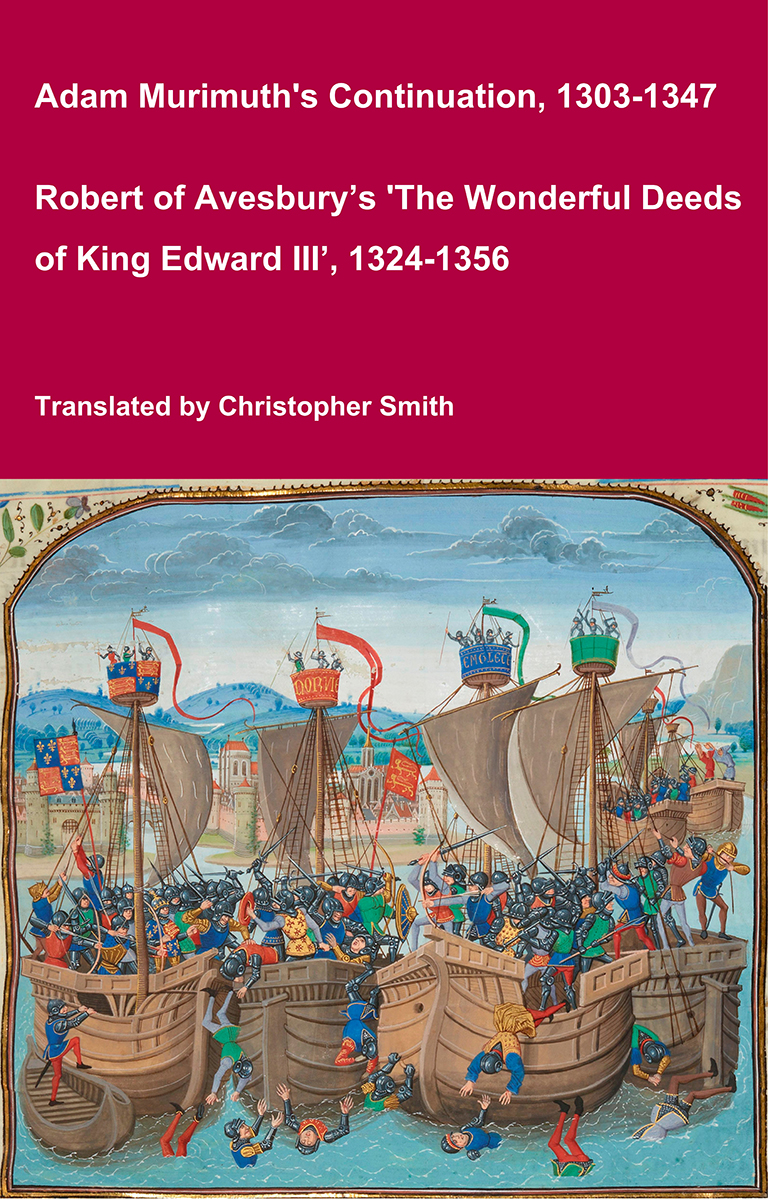
Adam Murimuth's Continuation and Robert of Avesbury’s 'The Wonderful Deeds of King Edward III'
This volume brings together two of the most important contemporary chronicles for the reign of Edward III and the opening phases of the Hundred Years’ War. Written in Latin by English clerical observers, these texts provide a vivid and authoritative window into the political, diplomatic, and military history of fourteenth-century England and its continental ambitions. Adam Murimuth Continuatio's Chronicarum continues an earlier chronicle into the mid-fourteenth century, offering concise but valuable notices on royal policy, foreign relations, and ecclesiastical affairs. Its annalistic structure makes it especially useful for establishing chronology and tracing the development of events year by year. Complementing it, Robert of Avesbury’s De gestis mirabilibus regis Edwardi tertii is a rich documentary chronicle preserving letters, treaties, and official records alongside narrative passages. It is an indispensable source for understanding Edward III’s claim to the French crown, the conduct of war, and the mechanisms of medieval diplomacy. Together, these works offer scholars, students, and enthusiasts a reliable and unembellished account of a transformative period in English and European history. Essential for anyone interested in medieval chronicles, the Hundred Years’ War, or the reign of Edward III.
Available at Amazon in eBook and Paperback format.
Samuel Pepys' Diary. 13th June 1667. In the evening comes Mr. Pelling, and several others, to the office, and tell me that never were people so dejected as they are in the City all over at this day; and do talk most loudly, even treason; as, that we are bought and sold-that we are betrayed by the Papists, and others, about the King [aged 37]; cry out that the office of the Ordnance hath been so backward as no powder to have been at Chatham, Kent [Map] nor Upnor Castle, Kent [Map] till such a time, and the carriages all broken; that Legg is a Papist; that Upnor [Map], the old good castle built by Queen Elizabeth, should be lately slighted; that the ships at Chatham, Kent [Map] should not be carried up higher. They look upon us as lost, and remove their families and rich goods in the City; and do think verily that the French, being come down with his army to Dunkirke, it is to invade us, and that we shall be invaded. Mr. Clerke, the solicitor, comes to me about business, and tells me that he hears that the King hath chosen Mr. Pierpont [aged 59] and Vaughan [aged 63] of the West, Privy-councillors; that my Chancellor [aged 58] was affronted in the Hall this day, by people telling him of his Dunkirke house; and that there are regiments ordered to be got together, whereof to be commanders my Lord Fairfax [aged 55], Ingoldsby [aged 49], Bethell, Norton, and Birch [aged 51], and other Presbyterians; and that Dr. Bates will have liberty to preach. Now, whether this be true or not, I know not; but do think that nothing but this will unite us together.


On 13th June 1668 Frederick William "Great Elector" Hohenzollern Elector Brandenburg [aged 48] and Sophia Dorothea Oldenburg [aged 31] were married. They were fifth cousins.
John Evelyn's Diary. 13th June 1673. Came to visit us, with other ladies of rank, Mrs. Sedley [aged 15], daughter to Sir Charles [aged 34], who was none of the most virtuous, but a wit. [Note. Her age somewhat curious as does her title Mrs but Ms was not in common usage then. There are no other Sir Charles Sedley other than Charles Sedley 5th Baronet.].


John Evelyn's Diary. 13th June 1688. I went to the Tower [Map] to see the Bishops, visited the Archbishop [aged 71] and the Bishops of Ely [aged 50], St. Asaph [aged 60], and Bath and Wells [aged 50].
On 13th June 1692 Joseph Highmore was born.
On 13th June 1695 William Russell 1st Duke Bedford [aged 78] was created 1st Baron Howland of Streatham.


On 13th June 1715 Jean Ranc [aged 41] and Marguerite Elisabeth Rigaud were married. She his god-daughter, daughter of painter Gaspard Rigaud.

On 13th June 1752 Frances Burney was born to Charles Burney [aged 26] at King's Lynn, Norfolk [Map].
On 13th June 1767 Henry Murray was born to John Murray 3rd Duke Atholl [aged 38] and Charlotte Murray Duchess Atholl [aged 35]. Coefficient of inbreeding 6.29%.
On 13th June 1777 Francis Saxe Coburg Gotha I Duke Saxe Coburg Gotha [aged 26] and Augusta Reuss Duchess Saxe Coburg Gotha [aged 20] were married. She by marriage Duchess Saxe Coburg Gotha. He the son of Ernest Frederick Saxe Coburg Saalfeld Duke Saxe Coburg Saalfeld [aged 53] and Sophia Antonia Brunswick-Wolfenbüttel Duchess Saxe Coburg Saalfeld [aged 53]. They were fifth cousins.


Between 13th June 1793 and 28th July 1793 the French garrison at Valciennes under Jean Henri Becays Ferrand was blockaded by part of the army of Prince Frederick Josias Saxe Coburg Saalfeld [aged 55], commanded by the Prince Frederick Hanover Duke of York [aged 29].


On 13th June 1814 Henry Burrell [aged 37] died. He was buried at the Chapel of St John the Evangelist, Bolton [Map].
in the vault beneath are deposited the remains of Henry Burrell esquire M.A. Fellow of University College in Oxford, Barrister at law and one of the principal secretaries of the Lord Chancellor Eldon. He was second son of Brian Burrell Esquire of Broome Park, and died at Lincoln's Inn on the xiii of june a.d. mdcccxiv in the xxxviii year of his age.
Henry Burrell: On or before 25th June 1776, the date he was baptised at St John the Baptist Church, Edlingham [Map], he was born to Bryan Burrell and Mary Partridge.
Chronicle of Walter of Guisborough
A canon regular of the Augustinian Guisborough Priory, Yorkshire, formerly known as The Chronicle of Walter of Hemingburgh, describes the period from 1066 to 1346. Before 1274 the Chronicle is based on other works. Thereafter, the Chronicle is original, and a remarkable source for the events of the time. This book provides a translation of the Chronicle from that date. The Latin source for our translation is the 1849 work edited by Hans Claude Hamilton. Hamilton, in his preface, says: 'In the present work we behold perhaps one of the finest samples of our early chronicles, both as regards the value of the events recorded, and the correctness with which they are detailed; Nor will the pleasing style of composition be lightly passed over by those capable of seeing reflected from it the tokens of a vigorous and cultivated mind, and a favourable specimen of the learning and taste of the age in which it was framed.'
Available at Amazon in eBook and Paperback format.
On 13th June 1827 Bishop John Jenkinson [aged 45] was appointed Dean of Durham, with a salary of £9,000 a year, which position he held with his Bishopric.
Archaeologia Volume 28 Section XV. On The Antiquity Of Abury And Stonehenge, By John Rickman, Esq., F.R.S. Read 13th June, 1839.

Ten Years' Digging. On the 13th of June, we opened the second barrow [Smerrill Barrow 1 [Map]] on the contrary side of the ravine, a mound about 9 yards across and 2 feet high, surrounded by an irregular circle of large limestones, and showing the grey surfaces of many others that jutted through its grassy covering. We began our cutting on the west side, and continued it to the centre, where, after much labour, we uncovered a large grave of irregular shape, sunk in the rock to the depth of 5 feet; its average dimensions were 8 feet by 6; it was filled with stones, and had upon its stony floor, a coating of stiff clay in which was embedded the skeleton of a tall young man, who lay on his left side with his knees drawn up, and the head in an easterly direction; owing to the wetness of the clay, the bones were in an advanced state of decomposition, having become of the consistency of cheese; the skull was narrowed and otherwise posthumously distorted by the pressure of the overlying mass; and the femur measured 19½ inches, the tibia 16. Behind the pelvis lay a very beautiful drinking cup, 8¾ inches high, the exterior entirely covered with ornament: it lay on its side upon an assemblage of implements, consisting of a bone netting rule or modelling tool, 12 inches long, made from the rib of a large animal (horse or cow), neatly rounded off at each end, and reduced to a regular breadth and thickness throughout; a dagger 4¾ inches long, a spear head 3 inches long, and four other instruments of flint, all whitened by the action of fire. The usual rats' bones were present in this undisturbed and interesting tumulus.
On 13th June 1877 Louis Hesse Darmstadt III Grand Duke [aged 71] died.
On 13th June 1877 Prince Louis Hesse Darmstadt IV Grand Duke [aged 39] was appointed IV Grand Duke of Hesse and by Rhine.
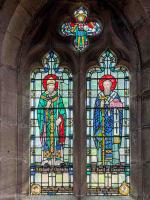
St Cuthbert's Church, Doveridge [Map]. Window by Joseph Edward Nuttgens [aged 59] in memory of Royal Navy Volunteer Reserve Test Pilot Richard Henry Basil Peach, died in the first accident involving a Canberra on 13th June 1951 at Hucknall. Son of Harry Bridford and Dora May nee Hawthorn, husband of Margaret Jean Walton nee Rudd. He lived at Crael House, Newstead Abbey near Lindy, Nottinghamshire.
On 13 June 1951, English Electric Canberra B.1, VN850, bailed to Rolls-Royce in October 1950 for Avon engine tests, crashed on approach to Hucknall with engine fire, coming down just outside field perimeter, killing 29-year-old Rolls-Royce test pilot Richard B. Peach. Part of 100 hour intensive flying trials on Avon RA7 engines, the starboard engine fitted with high energy ignition. One hour and 22 minutes after take off the pilot advised that the port engine was out and be was unable to re light. He was cleared for a direct approach to the runway. At about 250ft on finals the aircraft was seen to drop the port wing, the nose then went down, the aircraft turned 45 degrees to port and the undercarriage was retracted but the flaps stayed down. Climbing slightly and turning slowly to port the aircraft crossed the airfield before dropping the port wing again and the aircraft dived into the St.Alban's railway sidings at Bulwell Common railway station, Nottingham. The speed had been allowed to become too low on the approach by a pilot inexperienced on type (3.15hrs) and he was unable to use the full thrust of the starboard engine to recover the situation. It is likely that retraction of the flaps caused the final wing drop and dive.
On 13th June 1960 Michael Temple Canfield [aged 33] and Frances Laura Charteris Duchess of Marlborough [aged 44] were married. He the illegitmate son of Prince George Windsor 1st Duke Kent and Alice "Kiki" Preston aka Gwynne.
On 13th June 1965 Helen Gordon-Lennox Duchess Northumberland [aged 78] died.


On 13th June 1987 Henry John Fitzroy 12th Duke of Beaufort [aged 35] and Tracey Ward [aged 28] were married. He the son of David Fitzroy 11th Duke Beaufort [aged 59] and Caroline Jane Thynne 11th Duchess Beaufort [aged 59]. They were fourth cousins.
On 13th June 1988 Carlos Fitz-James Stuart 19th Duke of Alba 12th Duke of Berwick [aged 39] and Matilde de Solís-Beaumont y Martínez de Campos were married at Seville Cathedral. He the son of Luis Martínez de Irujo y Artázcoz and María del Rosario Cayetana Fitz-James Stuart 18th Duchess of Alba 11th Duke of Berwick [aged 62].
On 13th June 2003 Henry Robin Ian Russell 14th Duke Bedford [aged 63] died. His son Andrew [aged 41] succeeded 15th Duke Bedford, 15th Marquess Tavistock, 19th Earl Bedford, 19th Baron Russell of Cheneys, 17th Baron Russell of Thornhaugh, 15th Baron Howland of Streatham.
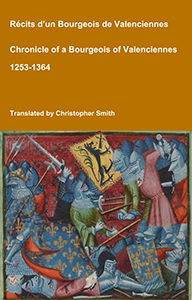
Chronicle of a Bourgeois of Valenciennes
Récits d’un bourgeois de Valenciennes aka The Chronicle of a Bourgeois of Valenciennes is a vivid 14th-century vernacular chronicle written by an anonymous urban chronicler from Valenciennes in the County of Hainaut. It survives in a manuscript that describes local and regional history from about 1253 to 1366, blending chronology, narrative episodes, and eyewitness-style accounts of political, military, and social events in medieval France, Flanders, and the Low Countries. The work begins with a chronological framework of events affecting Valenciennes and its region under rulers such as King Philip VI of France and the shifting allegiances of local nobility. It includes accounts of conflicts, sieges, diplomatic manoeuvres, and the impact of broader struggles like the Hundred Years’ War on urban life in Hainaut. Written from the perspective of a burgher (bourgeois) rather than a monastery or royal court, the chronicle offers a rare lay viewpoint on high politics and warfare, reflecting how merchants, townspeople, and civic institutions experienced the turbulence of the 13th and 14th centuries. Its narrative style combines straightforward reporting of events with moral and civic observations, making it a valuable source for readers interested in medieval urban society, regional politics, and the lived experience of war and governance in pre-modern Europe.
Available at Amazon in eBook and Paperback format.
On 13th June 823 Charles "Bald" I King West Francia was born to Louis "Pious" King Aquitaine and the Franks [aged 45] and Judith of Bavaria Queen Consort of Aquitaine and the Franks [aged 26]. He married (1) Richildis Bivinids Queen Consort West Francia and had issue (2) Ermentrude Orléans Queen Consort West Francia, daughter of Odi Orléans 1st Count Orléans, and had issue.
On 13th June 839 Charles "Fat" King East Francia Holy Roman Emperor III King West Francia King Aquitaine was born to Louis "German" II King East Francia [aged 35] and Hemma Welf Queen Consort East Francia [aged 36]. He married Richgard Unknown Holy Roman Empress.
On 13th June 1388 Thomas Montagu 1st Count Perche 4th Earl Salisbury was born to John Montagu 3rd Earl Salisbury [aged 38] and Maud Francis Countess of Salisbury [aged 24]. He a great x 3 grandson of King Edward I of England. He married (1) before 1407 his half third cousin once removed Eleanor Holland, daughter of Thomas Holland 2nd Earl Kent and Alice Fitzalan Countess Kent, and had issue (2) after 1421 Alice Chaucer Duchess Suffolk.
On 13th June 1500 Ernest Wittelsbach was born to Albert Wittelsbach IV Duke Bavaria [aged 52] and Kunigunde Habsburg Duchess Bavaria [aged 35]. He a great x 4 grandson of King Edward III of England.
On 13th June 1578 Thomas Finch 2nd Earl Winchilsea was born to Moyle Finch 1st Baronet [aged 28] and Elizabeth Heneage 1st Countess Winchelsea [aged 21]. He married 1609 his fifth cousin Cecily Wentworth Countess Winchelsea and had issue.
On 13th June 1595 John Holles 2nd Earl de Clare was born to John Holles 1st Earl de Clare [aged 31] and Anne Stanhope Countess de Clare [aged 19] at Haughton, Nottinghamshire. He married 4th September 1626 his second cousin once removed Elizabeth Vere Countess Clare, daughter of Horace de Vere 1st Baron Vere and Mary Tracy Baroness Spencer Tilbury, and had issue.
On 13th June 1631 Gilbert Hay 11th Earl Erroll was born to William Hay 10th Earl Erroll [aged 34] and Anne Lyon Countess Erroll. He married 7th January 1658 Catherine Carnegie Countess Erroll, daughter of James Carnegie 2nd Earl Southesk.
On 13th June 1692 Joseph Highmore was born.
On 13th June 1711 Richard Glyn 1st Baronet was born.

On 13th June 1728 George Rich 6th Baronet was born to Robert Rich 4th Baronet [aged 42].
Abbot John Whethamstede’s Chronicle of the Abbey of St Albans
Abbot John Whethamstede's Register aka Chronicle of his second term at the Abbey of St Albans, 1451-1461, is a remarkable text that describes his first-hand experience of the beginning of the Wars of the Roses including the First and Second Battles of St Albans, 1455 and 1461, respectively, their cause, and their consequences, not least on the Abbey itself. His text also includes Loveday, Blore Heath, Northampton, the Act of Accord, Wakefield, and Towton, and ends with the Coronation of King Edward IV. In addition to the events of the Wars of the Roses, Abbot John, or his scribes who wrote the Chronicle, include details in the life of the Abbey such as charters, letters, land exchanges, visits by legates, and disputes, which provide a rich insight into the day-to-day life of the Abbey, and the challenges faced by its Abbot.
Available at Amazon in eBook and Paperback format.

On 13th June 1739 Arthur Chichester 1st Marquess Donegal was born to John Chichester [aged 33] and Elizabeth Newdigate [aged 29]. He married (1) 11th September 1761 Anne Hamilton Countess Donegal, daughter of James Hamilton 5th Duke Hamilton 2nd Duke Brandon and Anne Spencer Duchess Hamilton Duchess Brandon, and had issue (2) 24th October 1788 Charlotte Spencer (3) October 1790 Barbara Godfey Marchioness Donegal.
On 13th June 1752 Frances Burney was born to Charles Burney [aged 26] at King's Lynn, Norfolk [Map].
On 13th June 1767 Henry Murray was born to John Murray 3rd Duke Atholl [aged 38] and Charlotte Murray Duchess Atholl [aged 35]. Coefficient of inbreeding 6.29%.
On 13th June 1770 Lucy Courtenay Countess Lisburne was born to William Courtenay 8th Earl Devon [aged 27] and Frances Clack Countess Devon. She married 2nd August 1798 her half fourth cousin once removed John Vaughan 3rd Earl Lisburne, son of Wilmot Vaughan 1st Earl Lisburne and Dorothy Shafto Countess Lisburne.

On 13th June 1775 Rowland Winn 6th Baronet was born to Rowland Winn 5th Baronet [aged 36] and Sabine Louise d'Hervart [aged 37].
On 13th June 1783 Henrietta Hunloke was born to Henry Hunloke 4th Baronet [aged 59] and Margaret Coke Lady Hunloke [aged 32]. She married before 11th March 1800 John Shelley-Sidney 1st Baronet, son of Bysshe Shelley 1st Baronet and Elizabeth Jane Perry, and had issue.
On 13th June 1786 Philip Sydney Pierrepont was born to Charles Medows aka Pierrepont 1st Earl Manvers [aged 48] and Anne Mills Countess Manvers [aged 39]. He married 19th August 1810 Georgiana Browne.
On 13th June 1787 Richard Plumptre Glyn 2nd Baronet was born to Richard Carr Glyn 1st Baronet [aged 32].
On 13th June 1793 Henrietta FitzHardinge Berkeley was born illegitimately to Frederick Augustus Berkeley 5th Earl Berkeley [aged 48] at Mount Street Grosvenor Square and Mary Cole. She a great x 3 granddaughter of King Charles II of England Scotland and Ireland.
On 13th June 1799 George Thomas Keppel 6th Earl Albermarle was born to William Charles Keppel 4th Earl Albermarle [aged 27] and Elizabeth Southwell Countess Albermarle [aged 23]. He a great x 3 grandson of King Charles II of England Scotland and Ireland.
On 13th June 1809 Caroline Jane Stuart-Wortley was born to James Archibald Stuart-Wortley-Mackenzie 1st Baron Wharncliffe [aged 32] and Elizabeth Caroline Mary Crichton Baroness Wharncliffe [aged 31]. She married 30th August 1830 John Chetwynd-Talbot, son of Charles Chetwynd-Talbot 2nd Earl Talbot and Frances Thomasina Lambart Countess Talbot, and had issue.
Annals of the six Kings of England by Nicholas Trivet
Translation of the Annals of the Six Kings of England by that traces the rise and rule of the Angevin aka Plantagenet dynasty from the mid-12th to early 14th century. Written by the Dominican scholar Nicholas Trivet, the work offers a vivid account of English history from the reign of King Stephen through to the death of King Edward I, blending political narrative with moral reflection. Covering the reigns of six monarchs—from Stephen to Edward I—the chronicle explores royal authority, rebellion, war, and the shifting balance between crown, church, and nobility. Trivet provides detailed insight into defining moments such as baronial conflicts, Anglo-French rivalry, and the consolidation of royal power under Edward I, whose reign he describes with particular immediacy. The Annals combines careful year-by-year reporting with thoughtful interpretation, presenting history not merely as a sequence of events but as a moral and political lesson. Ideal for readers interested in medieval history, kingship, and the origins of the English state, this chronicle remains a valuable and accessible window into the turbulent world of the Plantagenet kings.
Available at Amazon in eBook and Paperback format.
On 13th June 1815 Colonel Henry Skipwith was born to Grey Skipwith 8th Baronet [aged 43] and Harriet Townsend Lady Skipwith [aged 36]. He married 30th May 1862 Horatia Charlotte Pechell.

On 13th June 1836 Elizabeth Charlotte Louisa Craven Countess Wilton was born to William Craven 2nd Earl Craven [aged 26] and Emily Mary Grimston Countess Craven [aged 20]. She married (1) 11th August 1858 Arthur Egerton 3rd Earl Wilton, son of Thomas Grosvenor 2nd Earl Wilton and Mary Smith-Stanley Countess Wilton (2) 14th September 1886 Arthur Vickris Pryor.
On 13th June 1861 Harry Bennedetto Renwick 1st Baronet was born.

On 13th June 1863 Lucy "Madame Lucille" Christiana Sutherland Lady Duff-Gordon was born.
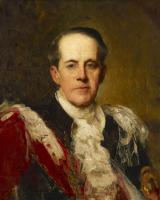
On 13th June 1868 Henry Arthur Cadogan was born to George Cadogan 5th Earl Cadogan [aged 28] and Beatrix Jane Craven Countess Cadogan [aged 23]. He married 30th April 1892 Mildred Cecilia Sturt Lady Montagu, daughter of Henry Gerard Sturt 1st Baron Alington and Augusta Bingham Baroness Alington, and had issue.
On 13th June 1880 Nan Ino Cooper 10th Baroness Lucas was born to Auberon Edward William Molyneux Howard Herbert [aged 41] and Florence Amabel Cowper [aged 43]. She married 30th April 1917 Lieutenant-Colonel Howard Lister Cooper Baron Lucas and had issue.
On 13th June 1893 Denzil George Fortescue 6th Earl Fortescue was born to Hugh Fortescue 4th Earl Fortescue [aged 39] and Emily Ormsby-Gore Countess Fortescue [aged 33]. Coefficient of inbreeding 1.61%. He married (1) 10th June 1920 Marjorie Ellinor Trotter Countess Fortescue and had issue (2) 8th August 1941 Sybil Mary Hardinge Countess Fortescue, daughter of Henry Charles Hardinge 3rd Viscount Hardinge and Mary Frances Neville Marchioness Abergavenny.
On 13th June 1894 John Compton Cavendish 4th Baron Chesham was born to Charles Compton Cavendish 3rd Baron Chesham [aged 43] and Beatrice Constance Grosvenor [aged 35]. Coefficient of inbreeding 2.22%.
On 13th June 1920 Edward Woodford Wheler 14th Baronet was born to Trevor Wood Wheler 13th Baronet [aged 30].
On 13th June 1932 Raymond Jolliffe 5th Baron Hylton was born to William Jolliffe 4th Baron Hylton [aged 33] and Perdita [aged 22].
On 13th June 1945 William Michael Addison 4th Viscount Addison was born to Michael Addison 3rd Viscount Addison [aged 31] and Kathleen Wand.
On 13th June 1490 Matthew Stewart 2nd Earl Lennox and Margaret Lyle Countess Lennox [aged 22] were married. She by marriage Countess Lennox. He the son of John Stewart 1st Earl Lennox [aged 60] and Margaret Montgomerie Countess Lennox.
On 13th June 1573 Archibald Douglas 8th Earl Angus 5th Earl Morton and Mary Erskine Countess Angus and Morton were married. She by marriage Countess Angus, Countess Morton. She the daughter of John Erskine 18th Earl of Mar. He the son of David Douglas 7th Earl Angus and Margaret Hamilton Countess Angus [aged 48]. They were fifth cousins.
On 13th June 1605 Edward Blayney 1st Baron Blayney [aged 35] and Anne Loftus [aged 38] were married.
Chronicle of Walter of Guisborough
A canon regular of the Augustinian Guisborough Priory, Yorkshire, formerly known as The Chronicle of Walter of Hemingburgh, describes the period from 1066 to 1346. Before 1274 the Chronicle is based on other works. Thereafter, the Chronicle is original, and a remarkable source for the events of the time. This book provides a translation of the Chronicle from that date. The Latin source for our translation is the 1849 work edited by Hans Claude Hamilton. Hamilton, in his preface, says: 'In the present work we behold perhaps one of the finest samples of our early chronicles, both as regards the value of the events recorded, and the correctness with which they are detailed; Nor will the pleasing style of composition be lightly passed over by those capable of seeing reflected from it the tokens of a vigorous and cultivated mind, and a favourable specimen of the learning and taste of the age in which it was framed.'
Available at Amazon in eBook and Paperback format.
On 13th June 1637 Alexander Leslie [aged 26] and Margaret Leslie Countess Buccleuch and Wemyss [aged 17] were married. She the daughter of John Leslie 6th Earl Rothes [aged 37] and Anne Erskine Countess of Rothes [aged 40]. He the son of Alexander Leslie 1st Earl Leven [aged 57].

On 13th June 1661 Lionel Cranfield 3rd Earl Middlesex [aged 36] and Rachael Fane Countess Bath and Middlesex [aged 48] were divorced by decree of the Court of Arches having previously obtained a royal warrant dated 19 Mar 1661 to retain her precedency as Countess of Bath.
On 13th June 1668 Frederick William "Great Elector" Hohenzollern Elector Brandenburg [aged 48] and Sophia Dorothea Oldenburg [aged 31] were married. They were fifth cousins.
On 13th June 1715 Jean Ranc [aged 41] and Marguerite Elisabeth Rigaud were married. She his god-daughter, daughter of painter Gaspard Rigaud.
On 13th June 1741 Walter Vavasour 5th Baronet and Dorothy Langdale Lady Vavasour were married. She by marriage Lady Vavasour of Hazlewood in Yorkshire.

On 13th June 1751 Francis North 1st Earl Guildford [aged 47] and Catherine Furnese Countess Guilford and Rockingham were married. She by marriage Baroness North, Baroness Guildford.
On 13th June 1764 John Stewart 7th Earl Galloway [aged 28] and Anne Dashwood Countess Galloway [aged 21] were married. He the son of Alexander Stewart 6th Earl Galloway [aged 70] and Catherine Cochrane Countess Galloway [aged 55].


On 13th June 1777 Francis Saxe Coburg Gotha I Duke Saxe Coburg Gotha [aged 26] and Augusta Reuss Duchess Saxe Coburg Gotha [aged 20] were married. She by marriage Duchess Saxe Coburg Gotha. He the son of Ernest Frederick Saxe Coburg Saalfeld Duke Saxe Coburg Saalfeld [aged 53] and Sophia Antonia Brunswick-Wolfenbüttel Duchess Saxe Coburg Saalfeld [aged 53]. They were fifth cousins.
On 13th June 1797 George Brodrick 4th Viscount Midleton [aged 42] and Maria Benyon were married. She by marriage Viscountess Midleton of Midleton in Cork. They had six children.
On 13th June 1850 Alfred Tennyson 1st Baron Tennyson [aged 40] and Emily Sellwood Baroness Tennyson [aged 36] were married. She the elder sister of his brother Charle's [aged 41] wife Louisa Sellwood [aged 34]. An example of the marriage of two sets of siblings.


On 13th June 1960 Michael Temple Canfield [aged 33] and Frances Laura Charteris Duchess of Marlborough [aged 44] were married. He the illegitmate son of Prince George Windsor 1st Duke Kent and Alice "Kiki" Preston aka Gwynne.
On 13th June 1987 Henry John Fitzroy 12th Duke of Beaufort [aged 35] and Tracey Ward [aged 28] were married. He the son of David Fitzroy 11th Duke Beaufort [aged 59] and Caroline Jane Thynne 11th Duchess Beaufort [aged 59]. They were fourth cousins.
On 13th June 1988 Carlos Fitz-James Stuart 19th Duke of Alba 12th Duke of Berwick [aged 39] and Matilde de Solís-Beaumont y Martínez de Campos were married at Seville Cathedral. He the son of Luis Martínez de Irujo y Artázcoz and María del Rosario Cayetana Fitz-James Stuart 18th Duchess of Alba 11th Duke of Berwick [aged 62].
Jean de Waurin's Chronicle of England Volume 6 Books 3-6: The Wars of the Roses
Jean de Waurin was a French Chronicler, from the Artois region, who was born around 1400, and died around 1474. Waurin’s Chronicle of England, Volume 6, covering the period 1450 to 1471, from which we have selected and translated Chapters relating to the Wars of the Roses, provides a vivid, original, contemporary description of key events some of which he witnessed first-hand, some of which he was told by the key people involved with whom Waurin had a personal relationship.
Available at Amazon in eBook and Paperback format.
On 13th June 1142 Godfrey Reginar VII Duke Lower Lorraine [aged 35] died. His son Godfrey succeeded III Count Louvain, VIII Duke Lower Lorraine.
On 13th June 1296 William de Valence 1st Earl Pembroke died or was killed at Bayonne [Map]. He was buried at the west side of the door to Chapel of St Edmund, Westminster Abbey [Map] where there is an altar-tomb of stone, surmounted by a broken sarcophagus, on which is a recumbent effigy of the earl. The figure is of wood, and was originally covered with copper-gilt, as was the chest on which it lies. An indulgence of one hundred days was granted to all devout people who should offer up prayers for his soul.
On 13th June 1349 John Willoughby 2nd Baron Willoughby [aged 46] died. His son John [aged 26] succeeded 3rd Baron Willoughby de Eresby. Cecily Ufford Baroness Willoughby of Eresby [aged 22] by marriage Baroness Willoughby de Eresby.
He was buried at St James' Church, Spilsby [Map]. His wife Joan Roscelyn Baroness Willoughby and Latimer [aged 41] subsequently buried with him. She wears a skirt and mantle.
On 13th June 1394 Wartislaw Griffins VI Duke Pomerania [aged 49] died. His son Barnim [aged 29] succeeded 6th Duke Pomerania. Veronica Hohenzollern Duchess Pomerania by marriage Duchess Pomerania.
On 13th June 1401 Bishop Robert Tideman of Winchcombe died.
On 13th June 1455 William Lovell 7th Baron Lovel 4th Baron Holand [aged 58] died at Minster Lovell, Oxfordshire [Map]. He was buried at Greyfriars Oxford, Oxfordshire. His son John [aged 22] succeeded 8th Baron Lovel of Titchmarsh, 5th Baron Holand.
On 13th June 1475 Joan Aviz Queen Consort Castile [aged 36] died.
On 13th June 1483 Richard, Duke of Gloucester [aged 30], [future King Richard III] held a Council meeting at the Tower of London [Map] attended by William Hastings 1st Baron Hastings [aged 52], Cardinal John Morton [aged 63], Archbishop Thomas Rotherham [aged 59] and Henry Stafford 2nd Duke of Buckingham [aged 28]. During the course of the meeting Richard accused William Hastings 1st Baron Hastings, Cardinal John Morton and Archbishop Thomas Rotherham of treasonable conspiracy with the Queen [aged 46].
William Hastings 1st Baron Hastings was summarily beheaded at Tower Green, Tower of London [Map]. He was buried in North Aisle St George's Chapel, Windsor Castle [Map] next to King Edward IV of England. His son Edward [aged 16] succeeded 2nd Baron Hastings.
Cardinal John Morton and Archbishop Thomas Rotherham were arrested.
On 13th June 1557 John Conyers 3rd Baron Conyers [aged 33] died. Baron Conyers abeyant between his daughters Elizabeth Conyers [aged 12], Katherine Conyers [aged 17], Anne Conyers [aged 17] and Margaret Conyers [aged 17] and their heirs.
On 13th June 1592 Henry Scrope 9th Baron Scrope of Bolton [aged 58] died at Carlisle, Cumberland [Map]. His son Thomas [aged 25] succeeded 10th Baron Scrope of Bolton. Philadelphia Carey Baroness Scrope Bolton by marriage Baroness Scrope of Bolton.

On 13th June 1636 George Gordon 1st Marquess Huntly [aged 74] died. His son George [aged 44] succeeded 2nd Marquess Huntly, 7th Earl Huntley. Anna Campbell Marchioness Huntly by marriage Marchioness Huntly.

On 3rd June 1665 at the Battle of Lowestoft an English fleet commanded by King James II of England Scotland and Ireland [aged 31], Prince Rupert Palatinate Simmern 1st Duke Cumberland [aged 45] and Edward Montagu 1st Earl Sandwich [aged 39] defeated a Dutch Fleet.
Richard Boyle was killed.
Charles Maccarthy Viscount Muskerry was killed.
Charles Berkeley 1st Earl Falmouth [aged 35] was killed by a cannonball aboard the Royal Charles. Earl Falmouth extinct, Baron Botetourt Langport in Somerset extinct. His father Charles [aged 65] succeeded 2nd Viscount Fitzhardinge of Berehaven in Kerry. Penelope Godolphin Viscountess Fitzhardinge by marriage Viscountess Fitzhardinge of Berehaven in Kerry. Possibly the only occasion when a father has succeeded his son.
Charles Weston 3rd Earl of Portland [deceased] was killed by a cannon shot. On 13th June 1665 His uncle Thomas [aged 55] succeeded 4th Earl of Portland, 4th Baron Weston of Nayland in Suffolk.
Thomas Allin 1st Baronet [aged 53] was present.
Admiral Jeremy Smith commanded the Mary.
Captain George Batts fought. He was assigned to Sir George Ayscue's [aged 49] division in the Blue Squadron.
James Ley 3rd Earl Marlborough [aged 47] was killed at the Battle of Lowestoft commanding Old James attempting to recover a captured ship. His half brother William [aged 53] succeeded 4th Earl Marlborough.
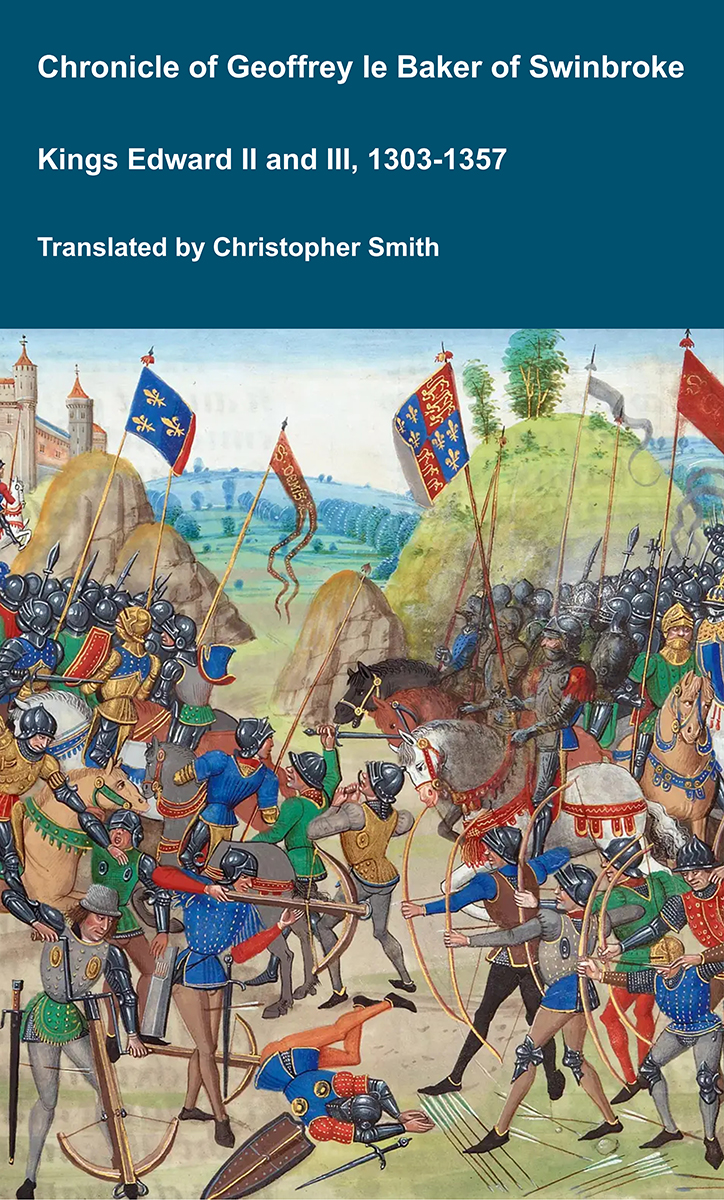
Chronicle of Geoffrey le Baker of Swinbroke
Baker was a secular clerk from Swinbroke, now Swinbrook, an Oxfordshire village two miles east of Burford. His Chronicle describes the events of the period 1303-1356: Gaveston, Bannockburn, Boroughbridge, the murder of King Edward II, the Scottish Wars, Sluys, Crécy, the Black Death, Winchelsea and Poitiers. To quote Herbert Bruce 'it possesses a vigorous and characteristic style, and its value for particular events between 1303 and 1356 has been recognised by its editor and by subsequent writers'. The book provides remarkable detail about the events it describes. Baker's text has been augmented with hundreds of notes, including extracts from other contemporary chronicles, such as the Annales Londonienses, Annales Paulini, Murimuth, Lanercost, Avesbury, Guisborough and Froissart to enrich the reader's understanding. The translation takes as its source the 'Chronicon Galfridi le Baker de Swynebroke' published in 1889, edited by Edward Maunde Thompson.
Available at Amazon in eBook and Paperback format.
On 13th June 1685 Willoughby D'Ewes 2nd Baronet [aged 35] died. His son Simonds [aged 15] succeeded 3rd Baronet D'Ewes of Stowlangtoft Hall.

On 13th June 1690 Maurice Berkeley 3rd Viscount Fitzhardinge [aged 61] died. His brother John [aged 40] succeeded 4th Viscount Fitzhardinge of Berehaven in Kerry, 2nd Baronet Berkeley of Bruton in Somerset. Barbara Villiers Viscountess Fitzhardinge [aged 36] by marriage Viscountess Fitzhardinge of Berehaven in Kerry.
On 13th June 1723 Richard Newport 2nd Earl Bradford [aged 78] died at Soho Square [Map]. He was buried at St Andrew's Church, Wroxeter [Map]. His son Henry [aged 40] succeeded 3rd Earl Bradford, 3rd Viscount Newport of Bradford in Shropshire, 4th Baron Newport of High Ercall in Shropshire.
On 13th June 1727 Philip Roper 9th Baron Teynham [aged 20] died. His brother Henry [aged 19] succeeded 10th Baron Teynham of Teynham in Kent.
On 13th June 1741 Charles Stewart 4th Earl Traquair [aged 82] died. His son Charles [aged 44] succeeded 5th Earl Traquair, 11th Lord Traquair.
On 13th June 1743 Isabella Macdonald Lady Bannerman died.
On 13th June 1753 Bridget Bertie Viscountess Bulkeley [aged 71] died.
On 13th June 1770 Alexander Bannerman 4th Baronet died. His brother Edward succeeded 5th Baronet Bannerman of Elsick in Kincardineshire.
On 13th June 1782 Sophia Von Keilmansegg Viscountess Howe [aged 78] died.
On 13th June 1823 James Cecil 1st Marquess Salisbury [aged 74] died. His son James [aged 32] succeeded 2nd Marquess Salisbury in Wiltshire, 8th Earl Salisbury. Frances Mary Gascoyne Marchioness Salisbury [aged 17] by marriage Marchioness Salisbury in Wiltshire.
On 13th June 1847 Brinsley Butler 4th Earl of Lanesborough [aged 63] died. His first cousin George [aged 52] succeeded 5th Earl Lanesborough.
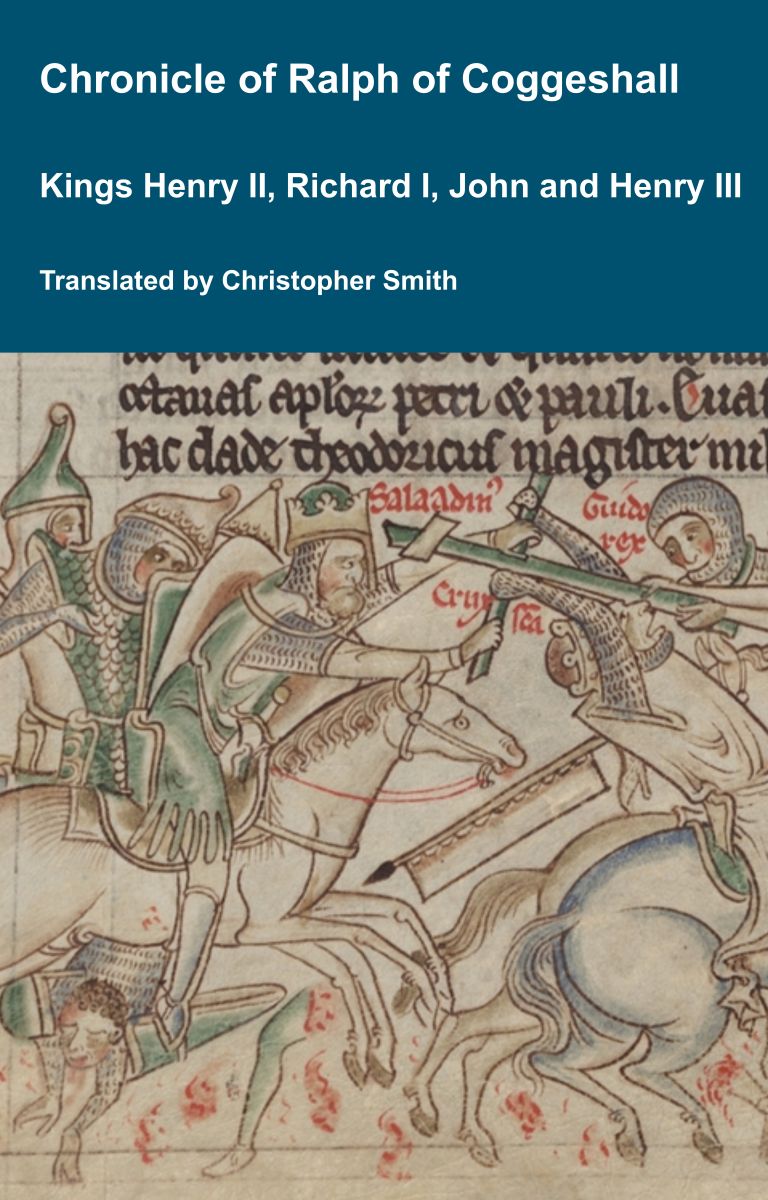
Chronicle of Abbot Ralph of Coggeshall
The Chronicle of Abbot Ralph of Coggeshall (Chronicon Anglicanum) is an indispensable medieval history that brings to life centuries of English and European affairs through the eyes of a learned Cistercian monk. Ralph of Coggeshall, abbot of the Abbey of Coggeshall in Essex in the early 13th century, continued and expanded his community’s chronicle, documenting events from the Norman Conquest of 1066 into the tumultuous reign of King Henry III. Blending eyewitness testimony, careful compilation, and the monastic commitment to record-keeping, this chronicle offers a rare narrative of political intrigue, royal power struggles, and social upheaval in England and beyond. Ralph’s work captures the reigns of pivotal figures such as Richard I and King John, providing invaluable insights into their characters, decisions, and the forces that shaped medieval rule. More than a simple annal, Chronicon Anglicanum conveys the texture of medieval life and governance, making it a rich source for scholars and readers fascinated by English history, monastic authorship, and the shaping of the medieval world.
Available at Amazon in eBook and Paperback format.
On 13th June 1862 Lancelot Brenton 2nd Baronet [aged 55] died. Baronet Brenton of London extinct.
On 13th June 1877 Louis Hesse Darmstadt III Grand Duke [aged 71] died.
On 13th June 1888 Admiral Alexander Montgomery 3rd Baronet [aged 81] died. His son Hugh [aged 40] succeeded 4th Baronet Montgomery of The Hall in County Donegal.
On 13th June 1909 Daniel Cooper 2nd Baronet [aged 60] died. His brother William [aged 57] succeeded 3rd Baronet Cooper of Woollahra in New South Wales.
On 13th June 1914 Charlotte Bridgeman Lady Cust died.
On 13th June 1928 Charles Robert Wynn-Carington 1st Marquess of Lincolnshire [aged 85] died. Marquess of Lincolnshire, Earl Carrington, Viscount Wendover of Chepping Wycombe in Buckinghamshire extinct. His brother Rupert [aged 75] succeeded 4th Baron Carrington of Bulcote Lodge, 4th Baron Carrington of Upton in Nottinghamshire.

On 13th June 1933 Grace Adelaide Fane Countess Londesborough [aged 72] died.
On 13th June 1944 Elizabeth Wharton Drexel Baroness Decies [aged 76] died at the Shelton Hotel, Manhattan. She was buried with her first husband and son in Washington, D.C. at Georgetown University's Dahlgren Chapel.

On 13th June 1958 Walter Aston Blount 10th Baronet [aged 81] died. His brother Edward [aged 73] succeeded 11th Baronet Blount of Sodington.
On 13th June 1965 Helen Gordon-Lennox Duchess Northumberland [aged 78] died.
Jean de Waurin's Chronicle of England Volume 6 Books 3-6: The Wars of the Roses
Jean de Waurin was a French Chronicler, from the Artois region, who was born around 1400, and died around 1474. Waurin’s Chronicle of England, Volume 6, covering the period 1450 to 1471, from which we have selected and translated Chapters relating to the Wars of the Roses, provides a vivid, original, contemporary description of key events some of which he witnessed first-hand, some of which he was told by the key people involved with whom Waurin had a personal relationship.
Available at Amazon in eBook and Paperback format.
On 13th June 1974 Edward Crofton 5th Baron Crofton [aged 48] died. His son Charles [aged 25] succeeded 6th Baron Crofton, 7th Baronet Crofton of The Mote in Roscommon.
On 13th June 1978 Randolph Stewart 12th Earl Galloway [aged 85] died. His son Randolph [aged 49] succeeded 13th Earl Galloway, 12th Baronet Stewart of Corsewall, 11th Baronet Stewart of Burray in Orkney.
On 13th June 1990 Edward Jessel 2nd Baronet Jessel [aged 86] died. Baron Jessel of Westminster in London, Baronet Jessel of Westminster extinct.
On 13th June 2003 Henry Robin Ian Russell 14th Duke Bedford [aged 63] died. His son Andrew [aged 41] succeeded 15th Duke Bedford, 15th Marquess Tavistock, 19th Earl Bedford, 19th Baron Russell of Cheneys, 17th Baron Russell of Thornhaugh, 15th Baron Howland of Streatham.
On 13th June 2017 Patricia Mountbatten 2nd Countess Mountbatten of Burma [aged 93] died. Her son Norton [aged 69] succeeded 3rd Earl Mountbatten of Burma.