

25 Jul is in July.
1137 Marriage of Prince Louis and Eleanor of Aquitaine
1346 Commencement of the Crécy Campaign
1503 Margaret Tudor's Journey to Scotland
1535 Execution of Bishop Fisher and Thomas More
1553 Trial and Execution of Lady Jane Grey's Supporters
1554 Marriage of Queen Mary with Philip II of Spain
1575 July 1575 Rathlin Island Massacre
1661 Creation of Baronets and Peerages by Charles II Post Coronation
Anglo-Saxon Chronicle. 757. This year Eadbert, king of the Northumbrians, received the tonsure, and his son Osulf the kingdom; which he held one year. Him his own domestics slew on the ninth day before the kalends of August [25th July 759].
On 25th July 759 Oswulf King of Northumbria was murdered by his servants.
After 25th July 1101 King Henry I "Beauclerc" England [aged 33] and Robert Curthose III Duke Normandy [aged 50], brothers, both sons of King William "Conqueror" I of England, signed the Treaty of Alton at Alton, Hampshire by which Robert Curthose III Duke Normandy agreed to renounce his claim to the English throne in exchange for a yearly stipend and other concessions.
On 25th July 1109 Afonso "Conqueror Founder Great" I King Portugal was born to Henry Burgundy Count Portugal [aged 43] and Teresa Alfónsez Jiménez [aged 29]. He married 1146 Malfada Savoy Queen Consort Portugal, daughter of Amadeus Savoy III Count Savoy and Mahaut Albon Countess Savoy, and had issue.
On 25th July 1137 Louis VII King of the Franks [aged 17] and Eleanor of Aquitaine Queen Consort Franks and England [aged 15] were married at the Cathedral of Saint-André, Bordeaux [Map] by Archbishop Geoffrey of Loroux. Her father William "Saint" Poitiers X Duke Aquitaine had died some three months previously leaving Eleanor of Aquitaine Queen Consort Franks and England as a ward of Louis's father Louis VI King of the Franks [aged 55] who quickly married her to his son Louis with a view to the Duchy of Aquitaine becoming joined with the Kingdom of France. A week later Louis VI King of the Franks died and his son Louis and Eleanor became King and Queen of France. She the daughter of William "Saint" Poitiers X Duke Aquitaine and Aenor Chatellerault Duchess Aquitaine. He the son of Louis VI King of the Franks and Adelaide Savoy Queen Consort France. They were third cousin once removed.
Eleanor gave Louis a rock-crystal vase as a wedding gift which he subsequently gave to Abbot Suger of Saint-Denis. The vase is now in the Louvre.
Crystal vase, 'of Eleanor'. Crystal: Iran (?), 6th-7th century (?). Mounting: Saint-Denis, before 1147; 13th and 14th centuries. Rock crystal, nielloed and gilded silver, precious stones, pearls, champlevé enamels on silver. Originating from the treasury of the Abbey of Saint-Denis. Inscription: "+ HOC VAS SPONSA DEDIT A(ie)NOR-REGI LUDOVICO MITADOL(us) AVO MIHI REX S(an)C(tis)Q(ue) SUGER(ius)" (This vase, Eleanor, his spouse, gave it to King Louis, Mitadolus to his ancestor, the king to me, Suger, who have offered it to the saints).
Vase de cristal, "d'Aliénor". Cristal: Iran (?), VI-VII siécle (?). Monture: Saint-Denis, avant 1147; XIII et XIV siécles. Cristal de roche, argent niellé et doré, pierres pécieuses, perles, émaux champlevés sur argent Provient du trésor de I'abbaye de Saint-Denis. Inscription: "+ HOC VAS SPONSA DEDIT A(ie)NOR-REGI LUDOVICO MITADOL(us) AVO MIHI REX S(an)C(tis)Q(ue) SUGER(ius)". (ce vase, Aliénor, son épouse, l'a donné au roi Lous, Mitadolus a son aïeul, le roi à moi, Suger, qui l'ai offert aux saints).
Archbishop Geoffrey of Loroux: In 1137 he was appointed Archbishop of Bordeaux. On 18th July 1155 he died.
William "Saint" Poitiers X Duke Aquitaine: William "Saint" Poitiers X Duke Aquitaine and Aenor Chatellerault Duchess Aquitaine were married. She by marriage Duchess Aquitaine. He the son of William "Troubadour" Poitiers IX Duke Aquitaine and Philippa Rouerge Duchess Aquitaine. In 1099 he was born to William "Troubadour" Poitiers IX Duke Aquitaine and Philippa Rouerge Duchess Aquitaine at Toulouse. On 10th February 1127 William "Troubadour" Poitiers IX Duke Aquitaine died. His son William succeeded X Duke Aquitaine. On 9th April 1137 William "Saint" Poitiers X Duke Aquitaine died. His daughter Eleanor succeeded XI Duchess Aquitaine.


 Annals of Six Kings of England by Nicholas Trivet. From there the king went to Bethenopolis. Since the army was breaking up, discouraged because the siege of Jerusalem had been dissuaded, and since he could not obtain a truce from Saladin unless Ascalon were destroyed, the king ordered the castle of Darum to be razed to the ground. From among the Hospitallers, Templars, and others he sent three hundred knights to guard and strongly fortify Ascalon. With the rest of the army the king made his way to Acre. On the very day the king arrived at Acre with his army, the following day, namely the feast of St James [25th July 1192], Saladin came with a very large force and besieged the city of Jaffa. On the feast of St Germanus [of Auxerre, 31st May 1192] the Turks broke through the wall and entered the city, plundering and destroying everything and cruelly killing all the Christians they found. They would also have quickly taken the main tower, into which many had fled, had not a truce been obtained through the patriarch until the ninth hour of the following day. If help did not come by then, the tower was to be surrendered to the Turks, and each man within was to pay Saladin ten bezants for his life, each woman five, and each child three. From the beginning of the siege messengers had been sent to Acre seeking aid. They found the king preparing to return home and already having sent ahead seven galleys with armed men to capture the castle of Beirut, through which he intended to pass. But when he heard of the condition of the city of Jaffa, he boarded ships with some knights and sailed there by sea, while the rest of the army marched by land. Contrary winds delayed him for three days, but at last he reached the harbour of Jaffa on the night before Saturday, the ninth hour of which day had been fixed as the time for surrendering the tower and paying the ransom. When the Turks learned of the king's arrival, they rushed in crowds to the shore carrying shields and bucklers. To prevent any landing, the resisting Turks poured down showers of javelins, arrows, and spears. The shore boiled with the multitude of enemies, whose horsemen even rode out into the sea to throw their missiles so that those arriving could not gain the land. Some advised the king that nothing further should be attempted, because so many thousands of enemies made landing impossible and it seemed unlikely that any of those in the tower were still alive, especially since the Turks had already anticipated the appointed hour and were demanding the bezants from the morning, and even after payment they were killing people regardless of their pledges. At that moment a certain priest swam to the king and, admitted into the royal galley, said with laboured breath and a still-pounding heart: "O magnificent king, the remnant of the people who await your coming stand with the executioners' swords raised over their necks like sheep ready for slaughter, and will perish unless divine help comes through you." The king asked, "Does anyone still survive? And where are they?" The priest replied, "Yes, lord, they are crowded before that tower, about to be struck down." Hearing this, the king said, "Let him perish who does not advance now." The king's galleys were therefore driven toward the shore by his command, and he himself was the first to leap into the sea up to his thighs, unarmoured. Next after the king were Geoffrey of Bois and Peter of Pratelles; all the others followed them, leaping into the water and advancing on foot toward the shore. The king, carrying in his hand an excellent crossbow, struck down Turks along the shore. His chosen companions also pursued the Turks along the wide stretch of the coast. Seeing the king, the Turks lost heart and dared not approach him further. When the shore had been cleared of Turks, the king alone first entered by a small stairway he had noticed in the houses of the Templars, and ordered his men to display their banners prominently. When these were seen, the multitude of Turks within the city, estimated at about three thousand, was thrown into great confusion. The king, advancing with his men and drawn sword, pursued the Turks as they fled; those who had been in the tower, recovering their strength and joining the royal troops, inflicted a dreadful slaughter on the Turks. When Saladin heard of the king's arrival and his engagement with those who had taken the city, he quickly struck his tents and fled. After Saladin's departure, King Richard pitched his own tents in that place. On the following Sunday and for the two days after, he carefully arranged for the broken walls to be repaired, though without lime or mortar, so that those in the city might at least have some form of defence.
Profectus inde rex venit Bethonopolim; ubi cum dilaberetur, exercitus, desolatus eo quod dissuaderetur obsidio Jerusalem, nec a Saladino potuit impetrare inducias nisi diruta Ascalone, jussit rex castrum Darum solo tenus dirui; et de Hospitalariis, Templariis, et aliis trecentos milites misit, qui custodirent et munirent firmissime Ascalonem. Rex cum reliquo exercitu Achonem contendit. Eadem vero die qua rex Saladin beAchonem venit cum exercitu, in crastino scilicetS. Jacobi, Saladinus cum maximo exercitu veniens Joppen civitatem obsedit. In die vero S. Germani effracto muro ingressi sunt Turci, diripientes omnia et destruentes, Christianosque quosque crudeliter perimentes; turrim etiam principalem, in quam multi confugerant, statim expugnassent, si non fuissent per patriarcham induciæ acceptæ usque ad horam nonam diei sequentis, ita ut nisi tunc veniret subsidium, redderetur Turcis, solveretque vir quisque qui in turri erat Saladino pro capite suo decem bizantia, mulier quinque, puerque tria. A principio vero obsidionis nuntii missi in Achon, pro subsidio quærendo, invenerunt regem se ad repatriandum parantem; jamque septem galeas cum gente armata, ad capiendum castrum Baruth, per quod erat transiturus, præmiserat. Qui, audito statu civitatis Joppe, ascendens naves cum aliquibus militibus illuc per mare contendit, reliquo exercitu terreno itinere gradiente. Venti autem contrarietate triduo retardatus, tandem in portum Joppe pervenit nocte præcedente diem Sabbati, cujus hora nona terminus erat reddendæ turris, et præfatæ redemptionis solvendæ. Cognito autem regis adventu, ruunt Turci catervatim in littus parmas habentes et ancilia; et ne qua parte liber pateret applicantibus ascensus, Turcorum resistentium pluunt densissime jacula, sagittæ, et pila: fervet littus obsitum hostium multitudine, quorum equites profundius in mare se agebant certatim spicula missuri, ne quando possent littus occupare appulsi. Cum autem nonnulli suaderent regi nihil ulterius tentandum, quia tot millia hostium littoris aditum asserebant impossibilem, nec credibile esse aliquos qui liberarentur superstites, præsertim cum jam Turci terminum prævenientes præfixum a mane bizantia exigerent, et nihilominus post solutionem postposita fidelitate quosque interficerent; ecce ad regem sacerdos quidam natando pervenit, qui in galeam regis admissus, spiritu fatigato et palpitante adhuc corde, ait ad regem: 'O rex magnifice, gens residua quæ tuum adspirat adventum, enses lanistarum vibratos cervicibus opperitur exertis, sicut oves occisionis jamjam perituri, nisi te cooperante Divinum adsit adjutorium.' Cui rex, 'Num superest quisquam? aut ubinam loci?' Cui sacerdos: 'Etiam, domine, coram illa turri coartantur jam feriendi.' Quo audito, 'Pereat,' inquit rex, 'modo qui non processerit.' Galeis igitur regis ad ejus imperium ad littus propulsis, ipse primus tibias inermis se misit in mare pube tenus; post regem primi erant et proximi Galfridus de Bosco et Petrus de Pratellis: hos omnes alii sequebantur, prosilientes in mare, et versus littus pedites procedebant. Rex autem singularis præstantiæ balista, quam manu gestabat, Turcos in littore passim prosternit; cujus etiam comites electi per littoris ampla Turcos cedentes persequebantur. Neque enim ulterius, viso rege, erat eis spiritus, nec eidem [appropiare] audebant. Littore a Turcis evacuato, rex per cocleam quandam, quam forte perspexerat in domibus Templariorum, solus primus intravit, suisque sequentibus jussit suas banerias eminentius explicari. Quibus cognitis, Turcorum multitudo, quæ ad tria millia infra civitatem æstimabatur, plurimum conturbatur. Rex cum suis extracto gladio progrediens, Turcos jam fugientes insequitur; et qui in turri erant resumptis viribus egressi, regiæque militiæ conjuncti, horrendam ingerunt Turcis cædem. Saladinus autem, audito regis adventu, et ejus congressu cum suis qui civitatem occupaverant, avulsis papilionibus velociter fugiendo abscessit. Rex autem Ricardus, post discessum Saladini, in eodem loco papiliones et tentoria fixit; in crastino vero die Dominica duobusque diebus sequentibus sollicite procuravit murorum diruta reparari, sed sine calce et cæmento, ut qualemcumque qui in urbe erant munitionem haberent.
On 25th July 1201 Gruffydd ap Rhys Dinefwr Prince Deheubarth died. He was buried at Strata Florida Abbey [Map].
 Adam Murimuth Continuation. At the feast of Saint James [25th July 1322] the king gathered a great army and entered Scotland. The Scots, however, destroyed everything that could serve for the sustenance of the English and withdrew beyond the Scottish Sea1, so that the king returned having accomplished nothing worthy of record and dismissed his army to their homes. When this became known, the Scots came and found the king in a place in the forest of Blackmore. They attacked the king and his men and inflicted a severe assault, so that the king barely escaped with his closest companions. The earl of Richmond and Lord de Sully, envoy of the king of France, were captured by the Scots, along with many others. The Scots then plundered and burned throughout the countryside as far as York. They committed many outrages in the town of Ripon, killing many clerics of the collegiate church and also laypeople. In the town of Beverley, however, they killed no one because the burgesses and canons redeemed themselves for four hundred pounds. Because of the approaching winter the Scots then returned home.
Et ad festum sancti Jacobi congregavit dominus rex magnum exercitum et intravit Scociam; sed Scoti, destruentes omnia quæ possent prodesse ad victum Anglicorum, retraxerunt se ultra mare Scoticum, ita quod rex rediit, nihil acto quod meruit scribi, et remisit exercitum suum ad partes suas. Quo intellecto, venerunt Scoti et invenerunt regem in quodam loco forestæ de Blakemore; et irruentes in regem et suos gravem insultum dederunt, ita quod rex cum suis secretioribus vix evasit. Et capti fuerunt per Scotos comes Richemundiæ et dominus de Sulliaco nuncius regis Franciæ, et multi alii. Unde Scoti, per totam patriam deprædantes et comburentes usque ad Eboracum, multa mala fecerunt in villa de Ripouns, et multos alios clericos collegiatæ ecclesiæ et etiam laicos occidentes. Sed in villa de Beverleye neminem occiderunt, quia CCCC libris se burgenses et canonici redemerunt. Et sic Scoti propter instantem hiemem redierunt.
Note 1. The Scottish Sea, a term used in numerous Chronicles including Geoffrey le Baker of Swinbroke, Walter of Guisborough and Ralph Coggeshall, refers to the Firth of Forth. 'Beyond the Scottish Sea' refers to the Scottish Highlands.
 Chronicle of Geoffrey le Baker of Swinbroke. In the year 1322, at a parliament held after Easter in York, Hugh le Despenser the Elder, now Earl of Winchester, was appointed to office. With a great army assembled, the king entered Scotland at the feast of Saint James [25th July]. But the Scots, foreseeing the coming of the hostile invasion, removed or transported across the sea into Scottish territory everything that could easily be carried off, and left the land empty of food for the English. With no resistance, the king ravaged the country, but, as the army suffered from hunger, he was forced to send it back into England. When the Scots learned this, they crossed the sea, and lying in hiding during the day and moving by night, they pursued the king and attacked his lodging1 at night in the forest of Blakemore. The king, with only a few companions, managed to escape their ambush and fled to the southern parts. But the Earl of Richmond, and the Lord of Sully, the envoy of the King of France, along with many others from the royal retinue, were captured. The Scots then laid waste to the entire March as far as York with fire and plundering. They devastated the town of Ripon and finally approached Beverley. That town they spared only after a payment of 400 pounds sterling was made and immediately handed over. Then the Scots returned to their own lands. In the following year, in the month of June, a truce2 was made with them, to last for thirteen years.
Anno MCCCXXIJ apud Eboracum parliamento post Pasca celebrato, Hugone le Spenser patre comite Wintone constituto, magno exercitu coadunato, ad festum sancti Jacobi rex Scociam intravit. Scoti vero, destitutis aut secum deportatis ultra mare Scoticum omnibus que possent faciliterauferre, solum victualibusevacuatum, prescii futuri adventus ostilis, Anglicis reliquerunt. Patriam nullo resistente rex transequitavit et exercitum fame laborantem in Angliam remisit. Quo cognito, Scoti, mari transmenso, die latitantes,de nocte laborantes, regem insecutiapud forestam de Blakemore, in regis ospicium de nocte obsessum insultum dedere; siquidem rege cum paucis ab ipsorum insidiis in australes partes elapso, captis ex eius comitiva comite Rechemundie, domino de Siliaco nuncio regis Francie, cum multis aliis, Scoti, totam marchiam usque Eboracum rapinis et igne depascentes, villam de Rypouns sunt depopulati, et tandem Beverlacum pro quadringentis libris sterlingorum oblatis et; statim solutis intactum declinaverunt, ad propria reversi. Anni sequentis mense Iunii inite fuerunt treuge cum ipsis per annos XIIJ durature.
Note 1. At Byland abbey, 14th October 1322.
Note 2. The truce for thirteen years was signed by Edward at Thorpe near York, 30th May; and confirmed by Bruce at Berwick, 7th June 1322. Rymer's Fœdera 2.521, 524.
On 25th July 1336 Albert Wittelsbach I Duke Lower Bavaria was born to Louis Wittelsbach IV Holy Roman Emperor [aged 54] and Margaret Hainaut Holy Roman Empress [aged 24] at Munich. He a great x 4 grandson of King Henry "Curtmantle" II of England. He married (1) after 19th July 1353 Margaret of Silesia Duchesa Lowwer Bavaria and had issue (2) 1394 his half fourth cousin once removed Margaret de la Marck Duchess Bavaria, daughter of Adolph de la Marck and Margaret Jülich Countess Cleves and Mark.
Annals of the six Kings of England by Nicholas Trivet
Translation of the Annals of the Six Kings of England by that traces the rise and rule of the Angevin aka Plantagenet dynasty from the mid-12th to early 14th century. Written by the Dominican scholar Nicholas Trivet, the work offers a vivid account of English history from the reign of King Stephen through to the death of King Edward I, blending political narrative with moral reflection. Covering the reigns of six monarchs—from Stephen to Edward I—the chronicle explores royal authority, rebellion, war, and the shifting balance between crown, church, and nobility. Trivet provides detailed insight into defining moments such as baronial conflicts, Anglo-French rivalry, and the consolidation of royal power under Edward I, whose reign he describes with particular immediacy. The Annals combines careful year-by-year reporting with thoughtful interpretation, presenting history not merely as a sequence of events but as a moral and political lesson. Ideal for readers interested in medieval history, kingship, and the origins of the English state, this chronicle remains a valuable and accessible window into the turbulent world of the Plantagenet kings.
Available at Amazon in eBook and Paperback format.
Adam Murimuth Continuation. And because the pope had provided for two cardinals, his nephews, namely, to one of them benefices falling vacant in the province of Canterbury up to the value of one thousand marks, and to the other in the province of York benefices of a like sum, and the procurators sent by those same cardinals had, by virtue of this grant, accepted certain benefices, those procurators were summoned before the king's chancellor and other justices and the king's council, and were called to answer how, and with what audacity, and under what letters of safe-conduct they had entered England and so rashly accepted such benefices to the prejudice of the king and the realm. They replied that, by the authority of the lord pope and his letters, they had entered the realm to carry out the business of the said cardinals, and had accepted the benefices as aforesaid. And because this answer was judged insufficient, they were arrested and committed to the custody of the sheriff of London. But in the end they were forbidden to attempt such things in the future, and were ordered to leave the realm under safe-conduct within a fixed time. And this was done around the feast of Saint James the Apostle [25th July 1343]. And it was publicly proclaimed in London that no one, in the name of any foreigner, under whatever authority, should attempt to obtain any benefice within the kingdom of England.
Et quia papa providit duobus cardinalibus, nepotibus guis, uni videlicet de beneficiis vacaturis in Cantuariensi provincia usque ad mille marcas, et in provincia Eboracensi alteri de vacaturis beneficiis tante summe, ac procuratores destinati per cardinales eosdem nonnulla beneficia, virtute hujus gratie, acceptarunt, fuerunt dieti procuratores coram cancellario regis et alis justiciariis regisque concilio convocati, et ad responsionem positi quomodo et qua audacia et quibus literis de conductu Angliam intrarunt et tam prejudicialiter regi et regno temere acceptarunt. Qui respondebant quod auctoritate domini papæ et literarum ipsius; pro negociis dictorum cardinalium prosequendis, regnum intrarunt et beneficia, de quibus ut premittur, aeceptarunt. Et, quia prefata responsio non fuit sufficiens reputata, fuerunt ipsi attachiati et custodie vicecomitis Londoniarum deputati. Sed finaliter fuit eis inhibitum ne talia de cetero attemptarent, et mandatum eisdem quod infra certum diem sub salvo conductu regnum exirent. Quod et factum fuit circa festum sancti Jacobi apostoli Fuitque Londoniis publice proclamatum ne quis, nomine alicujus alienigene, quacumque auctoritate beneficium aliquod in regno Angliæ attemptaret.
 Bourgeois de Valenciennes. In the month of July, about the feast of Saint James and Saint Christopher [25th July]1 in the year 1346, when the battle before the city of Liège had taken place, as we have said, and when the duke of Normandy, son of King Philip of France, was holding siege before the town and castle of Aiguillon in Gascony, near La Réole and Bordeaux, where the Earl of Derby and my lord Walter of Mauny and their men were stationed on behalf of King Edward of England to guard the land of Gascony and defend it against the said duke of Normandy and his forces. King Edward of England set out from England with a great host. With him were the Prince of Wales his son, the Bishop of Durham, the Earl of Warwick, the Earl of Montfort, my lord Godfrey who had been driven out of France, and many other knights and men-at-arms, as well as squires, pikemen, and archers. When they were all assembled, they numbered about eight thousand men-at-arms in harness of steel and twenty-five thousand archers, both Welsh and others. They had thirteen hundred ships, including those carrying provisions, and thirty-five thousand horses, and they put to sea. The wind drove them toward the coast of Cornwall, where they rested. While they were there, sixteen ships from Bayonne passed by, carrying five thousand tuns of wine into Normandy. They made it known that they were bringing the wine to Sluys in Flanders, but this was proven false by the letters they carried, which were found upon them, showing that they were taking it to Normandy. The King of England and his men seized all the wine and distributed it throughout the host, but returned the ships and vessels to the mariners. On the following day they had favourable wind to sail for Normandy.
Ou mois de jullet et en celle saison, environ la SaintJaques et Saint-Cristoffle, l'an mil IIIc et XLVI que la bataille devant la cité de Liège avoit esté, ainsy comme nous avons dit, et que le duc de Normendie, fils du roy Philippe de France, estoit et tenoit siège devant la ville et le chastel de Mont-Aguillon en Gascongne assez près de la Riolle et de Bordeaux en Gascogne où le conte d'Erby et monseigneur Gaultier de Mauny et leurs gens estoient de par le roy Édouart d'Engleterre pour garder le pays et la terre de Gascongne et deffendre à leur pooir contre le dit duc de Normendie et ses gens .... Et avoit le dit roy d'Engleterre avoec luy le prinche de Galles, son fils, l'évesque de Durâmes, le conte de Werwic, le conte de Monfort, monseigneur Godeffroy qui estoit encachiet de France et maints aultres chevaliers et gens d'armes, coustilliers, picquiers et archiers. Et quant ils furent tous assamblés, ils furent environ VIII mille hommes armés de harnas d'achier et XXV mille archiers, que Gallois, que aultres. Sy eult XIIIc nefs parmy celles des pourvéances et XXXV mille chevaulx, et entrèrent en mer; mais le vent les mena en la marche de Cornuaille, et se reposèrent là. Et en tandis qu'ils estoient là, passoient XVI nefs de Bayonne qui menoient V mille tonneaux de vin en Norraendie, et ils faisoient et donnoient à entendre qu'ils les menoient à l'Escluse en Flandres, et ce fut bien prouvé par les lettres qu'ils portoient et qu'on trouva sur eulx, qu'ils mentoient et qu'ils les menoient en Normendie. Sy eurent le roy d'Engleterreetsesgens tous les vins, et les départirent en l'ost, et rendirent aux mariniers leurs nefs et navires; et lendemain eurent bon vent pour aller en Normendie.
Note 1. The date clearly incorrect since in the next History he describes King Edward arriving in Normandy on 12th July. Chronicle of Geoffrey le Baker of Swinbroke: "Afterwards, the lord king hastened his passage into Normandy, where his fleet was awaiting him at Portsmouth and Porchester. Thus, accompanied by the earls of Northampton, Arundel, Warwick, and the lord of Harcourt, as well as the earls of Huntingdon, Oxford, and Suffolk, the bishop of Durham, and Sir William de Kyllesby, a cleric, each of whom brought with him a large force of armed men and archers, the king remained at the aforementioned ports from the calends of June [1st June] until the fifth day of July, awaiting a wind, slow but favourable. At last, with a fleet of a thousand ships, pinnaces, and transports, they began to sail in remarkable fashion. The royal council was kept secret: indeed, even the shipmasters, having left port, did not know where the fleet was to be directed, but were ordered to follow the admiral. However, on that same day, the king sent messengers from his own ship to the other vessels, already far from shore, instructing their captains to follow the admiral and steer toward the port of Hogue in Normandy. Finally, on the thirteenth day of the same month of July [1346], they arrived at the desired port."
On 25th July 1404 Philip Valois I Duke Brabant was born to Anthony Valois Duke Brabant [aged 19] and Jeanne Luxemburg Duchess Brabant. He a great x 3 grandson of King Edward I of England. He married before 4th August 1430 his second cousin Yolande Valois Anjou Duchess Brabant Duchess Brittany, daughter of King Louis of Naples and Yolande Barcelona Queen Consort Naples.
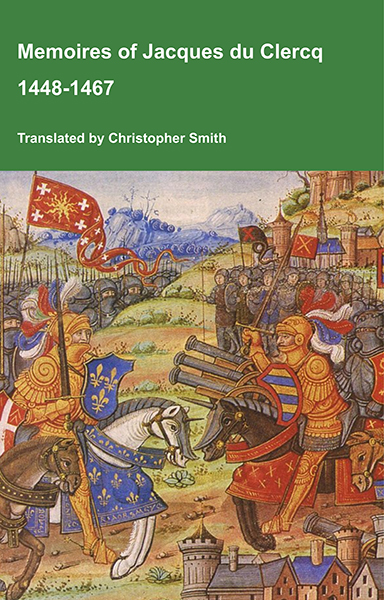 Memoires Jacques du Clercq. And on the 25th day of July [1453], the people of Ghent sent an embassy to the duke at Gavere, in which were the abbot of Saint Bavo of Ghent, the prior of the Carthusians, and several others whose names I do not know. When they came before the duke, they fell to their knees, asking him for mercy for the people of Ghent, who were ready, provided their lives were spared, to do his will. Then the duke, putting out of mind all the wrongs that the Ghenters had done to him, and not growing proud from the victory that God had granted him, but acting as a gracious and merciful lord, forgave them all their misdeeds, on condition that they would keep the treaty that had been made at Seclin, and which they had promised and agreed to carry out at the city of Lille, through the three members of Flanders together with the nations of Bruges. When these words were heard by the ambassadors of Ghent, speaking for and in the name of the people of Ghent, they promised to do and fulfil it without any contradiction, thanking the duke most humbly for his graciousness and mercy. And this treaty was as follows below.
Et le xxve jour de juillet envoyerent ceulx de Gand une ambassade vers le duc a Gavres, en laquelle estoit l'abbé de St Bavon de Gand, le prieur des Chartreux, et plusieurs que je ne sçaurois nommer, lesquels, venus devant le duc, se jetterent a genoux en priant merchy a lui pour ceulx de Gand, lesquels estoient prests, moiennant leur vie saulve, de faire sa vollonté. Lors le duc, mectant en oubli touts les maulx que les Gantois lui avoient faits, et non se orgoeuillant de la victoire que Dieu lui avoit donnée, comme begnin et piteulx leur pardonna touts leurs meffaits, par telles conditions qu'ils tiendroient le traictié qu'ils avoient fait a Seclin, et promis et conclud de faire en la ville de Lille, par les trois membres de Flandres avecq les nations de Bruges. Ces parolles ouyes par les ambassadeurs de Gand pour et au nom de ceulx de Gand, ils le promirent faire et accomplir sans nuls contredits, en remerchyant le duc bien humblement de sa benignité et pitié: lequel traictié fust tel que s'ensuit chy après.
On 25th July 1460 Archbishop George Neville [aged 28] was appointed Lord Chancellor.
Memoires Jacques du Clercq. In the same year, 1462, on a Sunday, the feast day of Saint James and Saint Christopher [25th July], Jehan Coustain was arrested in the town of Brussels by the lord of Daussy and Sir de Crèvecœur, knights, by command of the Duke of Burgundy and at the request of his son, the Count of Charolais, and was quickly taken to Rupelmonde. The reason why the said Jehan Coustain was arrested was that he had been in the duchy of Burgundy, from which he came, and there had negotiated with a poor gentleman of his acquaintance, named Jehan Diny, who had served the Marshal of Burgundy, for a certain sum of money and a promise to fetch poison from Lombardy in order to poison the Count of Charolais. The said Jehan Diny went and brought back the poison to the said Jehan Coustain, who did not keep his agreement with him, nor give him as much money as he had promised. Because of this, the said Jehan Diny was displeased, and in fact complained of Coustain to a gentleman named Arrembaux, also a native of Burgundy, who was of the household of the said Count of Charolais, saying that the said Coustain was a wicked man, and that if he would keep secret what he was about to tell him, he would reveal something remarkable. Arrembaux promised this, and then Jehan Diny told him how Coustain had bargained with him to bring the poison and would not pay him. When Arrembaux heard this, he said that if Diny would not report it to the Count of Charolais, he himself would do so. Then Jehan Diny, fearing that his actions might be discovered, went at once to the said Count of Charolais, begged his mercy, and revealed the whole matter, saying that he would give evidence against Coustain. And to make the matter more certain, he gave him several letters written in Coustain's own hand concerning the said poison. The count told him to go and surrender himself as a prisoner at Rupelmonde, which he did. The count, knowing these things, went to his father, and upon arriving, fell to his knees and begged him to do him justice, as he would for the poorest man in his lands, against one of his own household, he himself being his legitimate son and having no other. The duke asked against whom, and the count replied that it was against Jehan Coustain, who had sent to procure poison to kill him, and showed him the letters written in his hand. The duke, recognising the handwriting of the said Coustain, said that he would see justice done. This same Jehan Coustain was the first valet of the chamber, and the most trusted of all those in the duke's service, so much so that there was no office in the lands of the duke that he granted which did not pass through Coustain's hands, nor from which he did not take some profit.
En l'an ensuivant, l'an mil iiije lxij par ung dimanche, jour de St Jacques et de St Chrystophe, fust prins en la ville de Bruxelles par le Sr Daussy et messire de Crevecoeur, chevalliers, Jehan Coustain, par le commandement du duc de Bourgogne, a la requete de son fils le comte de Charollois, et fust prestement mené a Rippelmonde; et la cause pourquoy Jehan Coustain fust prins, fust qu'icelluy Jehan Coustain avoit esté au pays de Bourgogne, dont il estoit, et illecq avoit traictié a ung pauvre, gentilhomme, de ceulx de sa chevance, nommé Jehan Diny, et avoit servi le mareschal de Bourgogne, pour une certaine somme d'argent et promesse d'aller querir poison au pays de Lombardie, pour empoisonner le comte de Charollois; lequel Jehan Diny y alla et rapporta ledit poison audit Jehan Coustain, lequel Jehan Coustain ne lui tint pas convenance, et sy ne lui baillia point tant de deniers qu'il lui avoit promis, dont ledit Jehan Diny fust mal content, et de fait se plaindit dudit Coustain a ung gentilhomme nommé Arrembaux, natif de Bourgogne, lequel estoit de l'hostel dudit comte de Charollois, en disant que ledit Coustain estoit ung mauvais homme, et que s'il voulloit tenir secret ce qu'il lui diroit, il lui racompteroit merveille; ce que ledit Arrembaux lui promit: et lors lui dit comment ledit Coustain avoit marchandé a lui d'apporter ledit poison et sy ne le voulloit payer; ledit Arrembaux ce oyt lui dit, que se ne voulloit dire ce audit comte de Charollois, que lui mesme lui diroit. Ledit Jehan Diny, doubtant que son fait ne fust descouvert, s'en alla prestement audit comte de Charollois et lui pria merci, et dit toute l'oeuvre, et dit qu'il se faisoit partie fourmée contre ledit Coustain; et, adfin qu'il fust plus certain de l'oeuvre, lui baillia plusieurs lettres escriptes de la main dudit Coustain touchant ledit poison; lequel comte lui dit qu'il s'allat rendre prisonnier a Rippelmonde, comme il feit. Ledit comte, sçachant ces choses, s'en alla devers son pere ou, venu, se jetta a genoulx et lui pria qu'il lui volsit faire justice, comme il feroit au plus pauvre homme de ses pays, d'ung de son hostel, lui qui estoit son fils legitime et plus n'en avoit; le duc lui demanda duquel? le comte repondit que c'estoit de Jehan Coustain, lequel avoit envoyé querir poison pour l'empoisonner, et monstra les lettres escriptes de sa main. Le duc, qui bien cognut la lettre dudit Coustain, lui dit qu'il lui en feroit raison. Icelluy Jehan Coustain estoit le premier varlet de chambre et le plus privé de ceulx qu'il euist, et sy privé qu'il n'y avoit office es pays dudit duc que ledit duc donnat, que ne passassent par les mains dudit Coustain et qu'il n'en euist quelque chose.
On 24th July 1465 James Harrington [aged 35] assisted with the capture of the fugitive King Henry VI of England and II of France [aged 43] by being the instrument of persuasion that induced Sir Thomas Talbot of Bashall, and Sir Richard Tempest of Bracewell, who were sheltering the King, to betray him, and received £66 and £100 for expenses and reward.
On 25th July 1465 King Henry VI of England and II of France was captured.
Close Rolls Edward IV Edward V Richard III 1476-1485. 25th July 1483. John Howard 1st Duke of Norfolk [aged 58] was appointed Lord Admiral of all England Ireland and Aquitaine. King Richard III of England [aged 30]. Westminster Palace [Map]. Grant for life to the king's kinsman Henry, duke of Norfolk, of the office of admiral of England, Ireland and Aquitaine, with certain specified powers and the accustomed fees. By p.s.
Collectanea by John Leland [1502-1552]. The next Day after, being the XXVth Day of the iaid Monneth [25th July 1503], Saunt Jamys Day, she abode all the Day in the said Town, and was at the Church Masse, varey nobly acompayned.
That sam Day, at Even, th' Erle of Northumbrelaund made, to many Lords, Knights, and others, a goodely Baunket, which lasted to Mydnyght, for Cause of the Games, Dannces, Sports, and Songs, with Force of Ypocras, Succree, and other Metts of many delicyouses Maners.
To the said New Cafltll cam the Lord Dacre of the North, acompayned of many Gentylmen, honestly apoynted, and hys Folks arayd in his Liveray.
On 25th July 1522 Anna of Lorraine was born to Antoine Lorraine II Duke Lorraine [aged 33].
Letters and Papers Foreign and Domestic Henry VIII 1535. 25th July 1535. Vienna Archives. 1105. Chapuys to Charles V.
Since the return of the Duke of Norfolk [aged 62] and the others from Calais I have several times written to your Majesty, and, among other things, that immediately after the said return Cromwell came to notify to me that nothing had been concluded on the part of his master, of which he wished me to inform you at once; and that I agreed to despatch a messenger, provided there was other matter to convey, such as that the King would accept the overtures made by your Majesty, or make better ones. I have also written how, besides other three Carthusians who have been executed with the same cruelty as the former ones, they had beheaded the Cardinal of Rochester [deceased] and Master Morus [deceased], to the great grief of the whole people.


Letters and Papers Foreign and Domestic Henry VIII 1535. 25th July 1535. 1105. I have also written how the affairs of Kildare prospered, and that the English were sending two persons to Lubeck and Denmark. At the request of the Princess I lately sent a message to Cromwell to know if she could be placed with the Queen; but he told me that the King his master would never consent to it, and there was no occasion for it, except that the said Queen was too papistical. He said the true means to get the Princess removed from where she was, and cured of her illness, would be to find a suitable match for her, provided it was not the Dauphin, to whom they had no intention of giving her, however much your Majesty might desire it; and that they were importuned by several petty princes of Germany, but this would degrade her too much. I think the King is not over anxious to marry, her; and, if we may trust the concubine [aged 34], the dower will not cost much, because she is incessantly crying after the King that he does not act with prudence in suffering the Queen and Princess to live, who deserved death more than those who have been executed, and that they were the cause of all. Since Shrovetide I have sent a servant once or twice every week to the said Princess, but lately her gouvernante told my man that she was charged not to let him come in again. On this I have asked Cromwell to know the will of the King his master.


On 25th July 1538 Diane Valois was born illegitimately to King Henry II of France [aged 19] and Filippa Duci.


On 25th July 1547 King Henry II of France [aged 28] was crowned II King France: Capet Valois Angoulême.
Adam Murimuth's Continuation and Robert of Avesbury’s 'The Wonderful Deeds of King Edward III'
This volume brings together two of the most important contemporary chronicles for the reign of Edward III and the opening phases of the Hundred Years’ War. Written in Latin by English clerical observers, these texts provide a vivid and authoritative window into the political, diplomatic, and military history of fourteenth-century England and its continental ambitions. Adam Murimuth Continuatio's Chronicarum continues an earlier chronicle into the mid-fourteenth century, offering concise but valuable notices on royal policy, foreign relations, and ecclesiastical affairs. Its annalistic structure makes it especially useful for establishing chronology and tracing the development of events year by year. Complementing it, Robert of Avesbury’s De gestis mirabilibus regis Edwardi tertii is a rich documentary chronicle preserving letters, treaties, and official records alongside narrative passages. It is an indispensable source for understanding Edward III’s claim to the French crown, the conduct of war, and the mechanisms of medieval diplomacy. Together, these works offer scholars, students, and enthusiasts a reliable and unembellished account of a transformative period in English and European history. Essential for anyone interested in medieval chronicles, the Hundred Years’ War, or the reign of Edward III.
Available at Amazon in eBook and Paperback format.

Henry Machyn's Diary. 25th July 1553. The xxv day of July, the wyche was Saynt James, [there] cam in-to London, and so to the Towre, serten traturs; the first was doctur Sandes, a prest; and next hym ser Thomas Palmer, ser Hare Gattes, ser John Gattes, ser Andrew Dudley [aged 46], lord H[are Dudley] [aged 22], lord Ambrose Dudlay [aged 23], lord Hastynges, the erle of Huntingdon [aged 39], the erle of Warwyke [aged 26], the duke of Northumber land [aged 49] [attended by] iiij M1. men be-syd the garde with gettenes and trompeters, [and] with speres and gunnes to the Towre.
On 25th July 1553 John Dudley 1st Duke Northumberland [aged 49], John Dudley 2nd Earl Warwick [aged 26], Robert Dudley 1st Earl of Leicester [aged 21], Guildford Dudley [aged 18], Andrew Dudley [aged 46], Henry Dudley [aged 22] and Henry Manners 2nd Earl of Rutland [aged 26] and Francis Hastings 2nd Earl Huntingdon [aged 39] were imprisoned at the Tower of London [Map] for supporting Jane Grey I Queen England and Ireland [aged 17].


On 25th July 1554 Prince Philip of Spain [aged 27] and Queen Mary [aged 38] were married by Bishop Stephen Gardiner [aged 71] at Winchester Cathedral [Map]. She the daughter of King Henry VIII of England and Ireland and Catherine of Aragon Queen Consort England. He the son of Charles V Holy Roman Emperor [aged 54] and Isabel Aviz Queen Consort Spain. They were first cousin once removed. He a great x 5 grandson of King Edward III of England.
John Gage [aged 74] bore the queen's train.
Magdalen Dacre Viscountess Montague [aged 16] took part in the Bridal Procession.


Chronicle of Greyfriars. 25th July 1554. And the xxv. day of the same monyth was honourably marryd with gret solemnite with many honorabull lordys and ladys, and men of worchypp as it dothe apere, both spiritualle and temporally Item the furst day of August was a proclamacion made in London for the hole stylle1 bothe for the kynge and the qwene and alle ther domynyons of both.
Note 1. Their whole royal style. See Machyn's Diary, pp. 34, 67, and the Chronicle of Queen Jane and Queen Mary, p. 142.
Wriothesley's Chronicle [1508-1562]. The 25 of Julie [1554], beinge Weddensdaye and St. James dayea, about xi of the clocke the Kinge [aged 27] and Queene [aged 38] came from their lodgings towardes the churche all the way on foote, verie richelye apparelled in gownes of cloth of golde sett with riche stones, he with his gentle-men and garde and she with hers, eche of them havinge a sworde borne before them, the Earle of Darbye [aged 45] bearinge the sworde before her Maiestie, and the Earle of Pembroke [aged 53] before the Kinge; and when they were come into the churche he went into one traveys and the Queen to another richlye hunge, where they were shriven. This done they came forth of their traveys to the place appoynted for the marriage, where the Lord Chauncellor [aged 71], beinge before with 5 other bishops assistinge him, used all thinges, both in the banes-byddinge and otherwise, as hath bene in all marriages of olde tyme, and spake it both in Latin and in Englishe, her Grace on the right syde standinge and the King on the left syde. Her marriage ringe was a rownd hoope of gould without anye stone, which was her desire, for she sayde she would be married as maydens were in the olde tyme, and so she was.
After the marriage knott thus knitt the King and Queen came hand in hand under a riche canopie, beinge borne over them with 6 knightes and 2 swordes before them, all the lordes both Englishe and strangers richelye apparelled goeinge afore them, the trumpetts then blowinge tyll they came into the quier, where all the priestes and singinge men all in riche copes began to singe a psalme used in marriages, the King and Queen kneelinge awhile before the aulter, eche of them havinge a taper afore them; then after her Majestic went into her traveys on the right syde, and the King into another on the left syde; after the gospell they came owt and kneeled before the alter openlye all the masse tyme, and the care-cloth was holden ouer them; and he kissed the bishopp at the Agnus and then her Majestie. The masse done the Kinge of Herroldes openlye in the churche, and in presence of the King, the Queen, the lordes and ladies, and all the people, solemnlye proclay'med their Maiesties Kinge and Queene, with their title and style, in manner as followeth:
Philippe and Marie, by the grace of God Kinge and Queene of The Kinge and Englande, France, Naples, Jerusalem, and Irelande, Defenders of the Faythe, Princes of Spayne and Sicilie, Archdukes of Austriche, Dukes of Mylane, Burgundye, and Brabant, Countes of Aspurge,b Flaunders, and Tyrrole. Which proclamation ended, the trumpetts blue and other noyses playde. And then the Kinge and Queene came furthe hand in hand, with their lordes, ladies, and gentlemen way tinge on them, and 2 swordes borne afore them in manner aforesayde; and so went on foote to the courte, and there dined openlye in the hall, both together at one table.
Note a. The feast of St. James, the titular saint of Spain.
Note b. Haspurgi, Hapsburg.


Henry Machyn's Diary. 25th July 1559. The sam nyght was the Mersers' super, and ther supyd my lord mare [aged 50] and my lord treysorer [aged 76] and dyvers of the consell and dyvers althermen, and ther was chossen the shreyff for the quen master Logee, altherman and groser, for the yere to cume and nowe.
On 25th July 1564 Maria of Spain Holy Roman Empress [aged 36] was appointed Holy Roman Emperor.
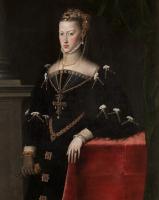

On 25th July 1564 Ferdinand I Holy Roman Emperor [aged 61] died at Vienna [Map]. His son Maximilian [aged 36] succeeded II Holy Roman Emperor. Maria of Spain Holy Roman Empress [aged 36] by marriage Holy Roman Empress. His son Ferdinand [aged 35] succeeded II Archduke Austria. Philippine Welser Archduchess Austria [aged 37] by marriage Archduke Austria.


Before 25th July 1575 Walter Devereux 1st Earl Essex [aged 33] ordered Francis Drake [aged 35] and John Norreys [aged 28] to confront Scottish refugees on Rathlin Island. On 25th July 1575 the garrison surrendered.


Around March 1577 a virulent outbreak of gaol fever occurred in Oxford killing around 300 people.
After 25th July 1577 Robert Bell [deceased] died of gaol fever.
In July 1577 Thomas D'Oyly died.

On 25th July 1588 Thomas Howard 1st Earl Suffolk [aged 26] was captain of the Golden Lion in the attack on the Spanish Armada.
On 25th July 1603 Santi di Tito [aged 66] died.
On 25th July 1603 King James I of England and Ireland and VI of Scotland [aged 37] was crowned I King England Scotland and Ireland at Westminster Abbey [Map].
Charles Howard 1st Earl Nottingham [aged 67] was appointed Lord High Steward.
On 26th July 1603 Thomas Bennett [aged 60] and Thomas Cambell [aged 67] were knighted.
On 27th July 1603 William Wrey 1st Baronet was knighted at Whitehall Palace [Map].
On 30th July 1603 Richard Preston 1st Earl Desmond was knighted at Whitehall Palace [Map].
Bishop Thomas Bilson [aged 56] gave the sermon. While the wording conceded something to the divine right of kings, it also included a caveat about lawful resistance to a monarch.


Diary of Anne Clifford. 25th July 1603. Upon the 25th of July the King and Queen [aged 28] were crowned at Westminster, my Father [aged 44] and Mother [aged 43] both attended in their robes, my Aunt of Bath and my Uncle Russell [aged 45], which solemn sight my Mother would not let me see because the plague was hot in London, therefore I continued at Norbury, where my cousin did so feed me with breakfasts and pear pies and such things, as shortly after I fell into sickness.


On 25th July 1615 Elizabeth Preston Duchess Ormonde was born to Richard Preston 1st Earl Desmond and Elizabeth Butler. She married December 1629 her second cousin once removed James Butler 1st Duke Ormonde and had issue.
On 16th July 1643 Francis Willoughby 5th Baron Willoughby of Parham launched a night attack on Gainsborough [Map] and captured it and Robert Pierrepont 1st Earl Kingston [aged 58].
On 25th July 1643 Robert Pierrepont 1st Earl Kingston Was accidentally shot and killed while a prisoner on board a vessel bound for Hull. His son Henry [aged 37] succeeded 2nd Earl Kingston upon Hull, 2nd Viscount Newark, 2nd Baron Pierrepont of Holme Pierrepoint. Catherine Stanley Marchioness Dorchester by marriage Countess Kingston upon Hull.
On 25th July 1658 Archibald Campbell 1st Duke Argyll was born to Archibald Campbell 9th Earl Argyll [aged 29] and Mary Stewart Countess Argyll [aged 30]. He married 12th March 1678 his sixth cousin Elizabeth Tollemache Duchess Argyll, daughter of Lionel Tollemache 3rd Baronet and Elizabeth Murray Duchess Lauderdale, and had issue.
In July 1661 King Charles II of England Scotland and Ireland [aged 31] created new Baronetcies and Peerages...
10th July 1661 Christopher Guise 1st Baronet [aged 44] was created 1st Baronet Guise of Elmore in Gloucestershire.
16th July 1661 Philip Parker 1st Baronet [aged 43] was created 1st Baronet Parker of Arwarton in Suffolk. Rebecca Long Lady Parker by marriage Lady Parker of Arwarton in Suffolk.
21st July 1661 Charles Hussey 1st Baronet [aged 35] was created 1st Baronet Hussey of Caythorpe in Lincolnshire.
21st July 1661 Edward Barkham 1st Baronet [aged 31] was created 1st Baronet Barkham Waynflete.
25th July 1661 John Banks 1st Baronet [aged 34] was created 1st Baronet Banks of London by King Charles I of England, Scotland and Ireland.


Samuel Pepys' Diary. 25th July 1663. Up and to my office setting papers in order for these two or three days, in which I have been hindered a little, and then having intended this day to go to Banstead Downs, Surrey to see a famous race, I sent Will to get himself ready to go with me, and I also by and by home and put on my riding suit, and being ready came to the office to Sir J. Minnes [aged 64] and Sir W. Batten [aged 62], and did a little of course at the office this morning, and so by boat to White Hall, where I hear that the race is put off, because the Lords do sit in Parliament to-day. However, having appointed Mr. Creed to come to me to Fox Hall, I went over thither, and after some debate, Creed and I resolved to go to Clapham, Surrey, to Mr. Gauden's, who had sent his coach to their place for me because I was to have my horse of him to go to the race. So I went thither by coach and my Will by horse with me; Mr. Creed he went over back again to Westminster to fetch his horse. When I came to Mr. Gauden's one first thing was to show me his house, which is almost built, wherein he and his family live. I find it very regular and finely contrived, and the gardens and offices about it as convenient and as full of good variety as ever I saw in my life. It is true he hath been censured for laying out so much money; but he tells me that he built it for his brother, who is since dead (the Bishop), who when he should come to be Bishop of Winchester, which he was promised (to which bishoprick at present there is no house), he did intend to dwell here. Besides, with the good husbandry in making his bricks and other things I do not think it costs him so much money as people think and discourse.
Samuel Pepys' Diary. 25th July 1664. Up, and with Sir J. Minnes [aged 65] and Sir W. Batten [aged 63] by coach to St. James's, but there the Duke [aged 30] being gone out we to my Lord Berkeley's [aged 62] chamber, Mr. Coventry [aged 36] being there, and among other things there met with a printed copy of the King's commission for the repair of Paul's, which is very large, and large power for collecting money, and recovering of all people that had bought or sold formerly any thing belonging to the Church. And here I find my Lord Mayor of the City [aged 48] set in order before the Archbishopp [aged 66] or any nobleman, though all the greatest officers of state are there. But yet I do not hear by my Lord Berkeley, who is one of them, that any thing is like to come of it.

Samuel Pepys' Diary. 25th July 1664. Thence back again homewards, and Sir W. Batten [aged 63] and I to the Coffee-house, but no newes, only the plague is very hot still, and encreases among the Dutch.
Samuel Pepys' Diary. 25th July 1665. At noon to the 'Change [Map], which was very thin, and thence homeward, and was called in by Mr. Rawlinson [aged 51], with whom I dined and some good company very harmlessly merry. But sad the story of the plague in the City, it growing mightily. This day my Lord Bruncker [aged 45] did give me Mr. Grant's' [aged 45] book upon the Bills of Mortality, new printed and enlarged.
The History of William Marshal was commissioned by his son shortly after William’s death in 1219 to celebrate the Marshal’s remarkable life; it is an authentic, contemporary voice. The manuscript was discovered in 1861 by French historian Paul Meyer. Meyer published the manuscript in its original Anglo-French in 1891 in two books. This book is a line by line translation of the first of Meyer’s books; lines 1-10152. Book 1 of the History begins in 1139 and ends in 1194. It describes the events of the Anarchy, the role of William’s father John, John’s marriages, William’s childhood, his role as a hostage at the siege of Newbury, his injury and imprisonment in Poitou where he met Eleanor of Aquitaine and his life as a knight errant. It continues with the accusation against him of an improper relationship with Margaret, wife of Henry the Young King, his exile, and return, the death of Henry the Young King, the rebellion of Richard, the future King Richard I, war with France, the death of King Henry II, and the capture of King Richard, and the rebellion of John, the future King John. It ends with the release of King Richard and the death of John Marshal.
Available at Amazon in eBook and Paperback format.
Samuel Pepys' Diary. 25th July 1665. Thence to my office awhile, full of business, and thence by coach to the Duke of Albemarle's [aged 56], not meeting one coach going nor coming from my house thither and back again, which is very strange. One of my chief errands was to speak to Sir W. Clerke [aged 42] about my wife's brother, who importunes me, and I doubt he do want mightily, but I can do little for him there as to employment in the army, and out of my purse I dare not for fear of a precedent, and letting him come often to me is troublesome and dangerous too, he living in the dangerous part of the town, but I will do what I can possibly for him and as soon as I can.


Samuel Pepys' Diary. 25th July 1665. At night home and to bed, my head full of business, and among others, this day come a letter to me from Paris from my Lord Hinchingbrooke [aged 17], about his coming over; and I have sent this night an order from the Duke of Albemarle [aged 56] for a ship of 36 guns to [go] to Calais to fetch him.
On 25th July 1666 the English fleet, commanded jointly between Prince Rupert Palatinate Simmern 1st Duke Cumberland [aged 46] and George Monck 1st Duke Albemarle [aged 57], inflicted a severe defeat on the Dutch fleet commanded by Admiral Michiel de Ruyter [aged 59]. Dutch casualties amounted to 1200 men, English 300. The Dutch only lost two ships: De Ruyter had been successful at saving almost the complete van, only Sneek and Tholen struck their flag. Tholen was the flagship of admiral Banckert who had moved his flag to another vessel. Both ships were burnt by the English.
Captain George Batts fought in Richard Utber's division in the White Squadron.
The Gloucester fought.


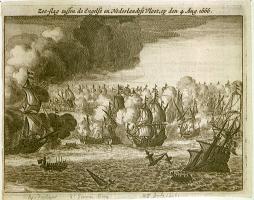
25th July 1666. Dutch text etching: "Zee-Slag tussen de Engelse en Nederlandtse Vloot, op den 4 Aug. 1666." Engraving showing the St. James' Day Battle
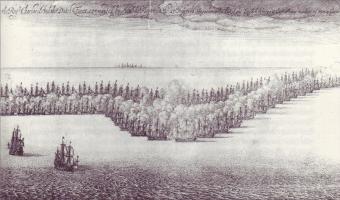
25th July 1666. St. James Day Fight by Wenceslaus Hollar
John Evelyn's Diary. 25th July 1666. The fleets engaged. I dined at Lord Berkeley's [aged 38], at St. James's, where dined my Lady Harrietta Hyde [aged 20], Lord Arlington [aged 48], and Sir John Duncomb [aged 44].


Samuel Pepys' Diary. 25th July 1666. By and by the King [aged 36] to dinner, and I waited there his dining; but, Lord! how little I should be pleased, I think, to have so many people crowding about me; and among other things it astonished me to see my Lord Barkeshire [aged 78] waiting at table, and serving the King drink, in that dirty pickle as I never saw man in my life. Here I met Mr. Williams, who in serious discourse told me he did hope well of this fight because of the equality of force or rather our having the advantage in number, and also because we did not go about it with the presumption that we did heretofore, when, he told me, he did before the last fight look upon us by our pride fated to be overcome. He would have me to dine where he was invited to dine, at the Backe-stayres.

After 25th July 1666. Church of St Michael and All Angels, Edenham [Map]. Monument to Montagu Bertie 2nd Earl Lindsey [deceased]. Two adjacent memorial tablets have moulded base and cornice and are surmounted by the Cartouche of arms and the Ancaster cannon. To the sides are military trophies in high relief and at the base, arms, anchors and helms.[Source: BLB].
Samuel Pepys' Diary. 25th July 1668. Up, and at the Office all the morning; and at noon, after dinner, to Cooper's [aged 59], it being a very rainy day, and there saw my wife's picture go on, which will be very fine indeed. And so home again to my letters, and then to supper and to bed.

John Evelyn's Diary. 25th July 1673. In my way, I saw my Lord of Dorset's [aged 50] house at Knowle, near Sevenoaks, a great old-fashioned house.
John Evelyn's Diary. 25th July 1673. I went to Tunbridge Wells, Kent [Map], to visit my Lord Clifford [aged 42], late Lord Treasurer, who was there to divert his mind more than his body; it was believed that he had so engaged himself to the Duke [aged 39], that rather than take the Test, without which he was not capable of holding any office, he would resign that great and honorable station. This, I am confident, grieved him to the heart, and at last broke it; for, though he carried with him music, and people to divert him, and, when I came to see him, lodged me in his own apartment, and would not let me go from him, I found he was struggling in his mind; and being of a rough and ambitious nature, he could not long brook the necessity he had brought on himself, of submission to this conjuncture. Besides, he saw the Dutch war, which was made much by his advice, as well as the shutting up of the Exchequer, very unprosperous. These things his high spirit could not support. Having stayed here two or three days, I obtained leave of my Lord to return.


John Evelyn's Diary. 25th July 1683. I again saw Prince George of Denmark [aged 30]: he had the Danish countenance, blonde, of few words, spoke French but ill, seemed somewhat heavy, but reported to be valiant, and indeed he had bravely rescued and brought off his brother, the King of Denmark [aged 37], in a battle against the Swedes, when both these Kings were engaged very smartly.


John Evelyn's Diary. 25th July 1692. To Mr. Hewer's [aged 50] at Clapham, where he has an excellent, useful, and capacious house on the Common, built by Sir Den. Gauden, and by him sold to Mr. Hewer, who got a very considerable estate in the Navy, in which, from being Mr. Pepys's [aged 59] clerk, he came to be one of the principal officers, but was put out of all employment on the Revolution, as were all the best officers, on suspicion of being no friends to the change; such were put in their places, as were most shamefully ignorant and unfit. Mr. Hewer lives very handsomely and friendly to everybody. Our fleet was now sailing on their long pretense of a descent on the French coast; but, after having sailed one hundred leagues, returned, the admiral and officers disagreeing as to the place where they were to land, and the time of year being so far spent,-to the great dishonor of those at the helm, who concerted their matters so indiscreetly, or, as some thought, designedly.


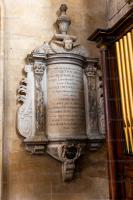
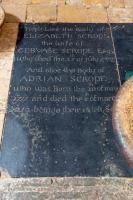
On 25th July 1719 Elizabeth Cresswell [aged 27] died. Monument at Lincoln Cathedral [Map].
Elizabeth Cresswell: Around 1692 she was born. Before 15th June 1713 Gervase Scrope of Cockeringham and she were married.
The Deeds of the Dukes of Normandy
The Gesta Normannorum Ducum [The Deeds of the Dukes of Normandy] is a landmark medieval chronicle tracing the rise and fall of the Norman dynasty from its early roots through the pivotal events surrounding the Norman Conquest of England. Originally penned in Latin by the monk William of Jumièges shortly before 1060 and later expanded at the behest of William the Conqueror, the work chronicles the deeds, politics, battles, and leadership of the Norman dukes, especially William’s own claim to the English throne. The narrative combines earlier historical sources with firsthand information and oral testimony to present an authoritative account of Normandy’s transformation from a Viking settlement into one of medieval Europe’s most powerful realms. William’s history emphasizes the legitimacy, military prowess, and governance of the Norman line, framing their expansion, including the conquest of England, as both divinely sanctioned and noble in purpose. Later chroniclers such as Orderic Vitalis and Robert of Torigni continued the history, extending the coverage into the 12th century, providing broader context on ducal rule and its impact. Today this classic work remains a foundational source for understanding Norman identity, medieval statesmanship, and the historical forces that reshaped England and Western Europe between 800AD and 1100AD.
Available at Amazon in eBook and Paperback format.
On 25th July 1727 Infante Louis of Spain was born to Philippe V King Spain [aged 43] and Elisabeth Farnese Queen Consort Spain [aged 34].


On 25th July 1745 Silvester Harding of Pall Mall was born in Newcastle under Lyme.
On 25th July 1750 George Vane of Long Newton [aged 65] died. Memorial at St Mary's Church, Long Newton [Map].
George Vane of Long Newton: In 1685 he was born to Lionel Vane and Catherine Fletcher. In or before 1728 George Vane of Long Newton and Ann Machon were married. The had fours sons and four daughters.


In 25th July 1763 Mary Greene [aged 63] died. Church of St Mary, Hillington [Map]. Large mural marble tablet with fluted Ionic pilasters and segmental head. Inscribed Sir W B Archit.
Mary Greene: On 29th September 1699 she was born to Charles Greene. On 24th August 1717 William Browne and she were married.


On 25th July 1770 Henrietta Somerset Lady Williams-Wynn [aged 22] died. Monument [Map] to Henrietta Somerset Lady Williams-Wynn sculpted by Joseph Nollekens [aged 32].


On 25th July 1787 Arthur Devis [aged 75] died at Brighton.
On 25th July 1797 Princess Augusta Hesse-Kassel Duchess Cambridge was born to Frederick Hesse-Kassel [aged 49]. She a great granddaughter of King George II of Great Britain and Ireland. She married 1st June 1818 her second cousin Adolphus Hanover 1st Duke Cambridge, son of King George III of Great Britain and Ireland and Charlotte Mecklenburg Strelitz Queen Consort England, and had issue.


On 25th July 1814 Henry Somerset 7th Duke Beaufort [aged 22] and Georgiana Frederica Fitzroy [aged 21] were married at Upper Brook Street. Following her death in 1821 he would marry her younger half-sister Emily Frances Smith Duchess Beaufort [aged 14]. An example of a man marrying two sisters, albeit in this case half-sisters. He the son of Henry Charles Somerset 6th Duke Beaufort [aged 47] and Charlotte Sophia Leveson-Gower Duchess Beaufort [aged 43]. They were fourth cousins. She a great x 4 granddaughter of King Charles II of England Scotland and Ireland.
On 25th July 1825 Alan Spencer-Churchill was born to George Spencer-Churchill 6th Duke of Marlborough [aged 31] and Jane Stewart Duchess of Marlborough [aged 27]. Coefficient of inbreeding 6.26%. He married Rosalind Dowker.

On 25th July 1829 Elizabeth Siddal was born to Charles Crooke Siddall [aged 28] and Elizabeth Eleanor Evans at 7 Charles Street, Hatton Garden. She was baptised 23rd August 1830 at St Andrew's Church, Holborn [Map]. She married 23rd May 1860 Dante Gabriel Rossetti and had issue.
Charles Crooke Siddall: Around 1801 he was born.
Adam Murimuth's Continuation and Robert of Avesbury’s 'The Wonderful Deeds of King Edward III'
This volume brings together two of the most important contemporary chronicles for the reign of Edward III and the opening phases of the Hundred Years’ War. Written in Latin by English clerical observers, these texts provide a vivid and authoritative window into the political, diplomatic, and military history of fourteenth-century England and its continental ambitions. Adam Murimuth Continuatio's Chronicarum continues an earlier chronicle into the mid-fourteenth century, offering concise but valuable notices on royal policy, foreign relations, and ecclesiastical affairs. Its annalistic structure makes it especially useful for establishing chronology and tracing the development of events year by year. Complementing it, Robert of Avesbury’s De gestis mirabilibus regis Edwardi tertii is a rich documentary chronicle preserving letters, treaties, and official records alongside narrative passages. It is an indispensable source for understanding Edward III’s claim to the French crown, the conduct of war, and the mechanisms of medieval diplomacy. Together, these works offer scholars, students, and enthusiasts a reliable and unembellished account of a transformative period in English and European history. Essential for anyone interested in medieval chronicles, the Hundred Years’ War, or the reign of Edward III.
Available at Amazon in eBook and Paperback format.

On 25th July 1832 Augustus Clifford 1st Baronet [aged 44] was appointed Gentleman Usher of the Black Rod by his half-brother William Cavendish 6th Duke Devonshire [aged 42] which office he held for life.
On 25th July 1834 Samuel Taylor Coleridge [aged 61] died.
Cansick's Monumental Inscriptions Volume 2 Highgate Cemetery. Highgate Cemetery. Sacred to the Memory of Samuel Taylor Coleridge [deceased]. Poet, Philospher. Theologian. This truly great and good man resider for the last nineteen years of his life In this Hamlet. He quitted "the body of this death" July 25th 1834 In the sixty-second year of his age. Of his profound learning and discursive genius His literary works are an imperishable record. To his or private worth. His social and Christian virtues. James and Ann Gillman. The friends with whom he lived During the above period, dedicate this tablet. Under the pressure of a long And most painful disease. His disposition was unalterably sweet and angelic. He was an ever-enduring. ever-loving friend: The gentlest and kindest teacher: The most engaging home-companion. "O! framed for calmer times, and nobler hearts, O studious poet, eloquent for truth! Philosopher! condemning wealth and death. Yet docile, childlike, full of life and love." Here on thy monumental stone thy friends inscribe thy worth; Reader, for the world, mourn; A light has passed away from the earth; But, for this pious and exalted Christian, "Rejoice! and again, I say unto you rejoice!"
Ten Years' Digging. On the 25th of July we opened another barrow, at no great distance from the last, situated on a more elevated point of the "Edge". Its mutilated appearance gave rise to no very sanguine expectations of success, and we were, therefore, neither surprised nor disappointed by finding, on examination, that the mound had been thoroughly rifled. There were some very large limestones placed on edge for a considerable length in the centre of the barrow, but whether they had been portions of cists that had been removed by former excavators, or not, is uncertain. In all parts of our diggings we observed scattered pieces of bone pertaining to skeletons, both human and animal; amongst the latter were those of the horse, ox, hog, dog, water rat, and a few specimens of the beaks of birds. The only manufactured remains were two small pieces of a drinking cup, and a circular flint which has been calcined.
On 25th July 1857 Francis Coates Jones was born.
On 25th July 1860 Luise Margarete Hohenzollern Duchess Connaught was born to Frederick Charles Hohenzollern [aged 32] and Princess Maria Anna of Anhalt-Dessau [aged 22]. She married 13th March 1879 her third cousin once removed Prince Arthur Windsor 1st Duke Connaught and Strathearn, son of Prince Albert Saxe Coburg Gotha and Queen Victoria of the United Kingdom, and had issue.
On 25th July 1863 William Richard Arthur Pole Tylney Long Wellesley 5th Earl Mornington [aged 49] died in Paris [Map]. He was buried at Draycott Cerne Chippenham, Wiltshire. His first cousin once removed Arthur [aged 56] succeeded 6th Earl Mornington, 6th Viscount Wellesley of Dangan Castle. Elizabeth Hay Duchess Wellington [aged 42] by marriage Countess Mornington.
Finds Near Stow on the Wold. "Finds" On, Or Near To, The Excursion Of The Society At Stow-On-The-Wold. On July 25th, 1882. By the Rev. David Royce, M.A.
On 25th July 1892 Bishop Thomas Legh Claughton [aged 83] died. Monument at St Albans Cathedral [Map] sculpted by James Forsyth [aged 64].
Bishop Thomas Legh Claughton: On 6th November 1808 he was born. In 1877 he was appointed Bishop of St Albans. Life's Ebb And Flow Chapter IV. [30th April 1881]. Our dear friend, the Bishop of St. Albans (Claughton), helped by our neighbour the rector of Little Easton [Map], the Rev. G. Tufnell, along with two London clergy, officiated at our wedding. It pleased me very much to have the benediction pronounced by Dean Stanley, who had kept in the background during the ceremony. The register was signed by the Prince of Wales, Prince Leopold, and Lords Warwick and Rosslyn. Our honeymoon was spent at beautiful Ditton Park, which was lent us by the Duke and Duchess of Buccleuch, and there, in lovely May weather, we had a fortnight on the river, boating and canoeing. But, alas for romance, there was one worldly honour given us that demanded all our self-control. We were commanded to dine at Windsor Castle on the day after our wedding, and I was asked to wear my bridal dress, orange blossoms and all! I must confess that Her Majesty's kindness on that occasion went far to soothe the shyness of a bride in her teens. The Queen took from my corsage a spray of orange blossom to keep as a souvenir and said many charming things about the beauty of my frock. Her Majesty so much admired what she was pleased to call the "lovely" dress, that I had a note next day from Lady Churchill, then in waiting, to say that the Queen wished so very much to possess a photograph of me if I would have myself taken in the gown, and hoping I was not too tired from the long standing.


25th July 1894. Godfrey Bingley [aged 52]. Micklegate Bar, York [Map].

On 25th July 1905 Marguerite de Rothschild Duchess Gramont [aged 49] died.
Henrici Quinti, Angliæ Regis, Gesta, is a first-hand account of the Agincourt Campaign, and subsequent events to his death in 1422. The author of the first part was a Chaplain in King Henry's retinue who was present from King Henry's departure at Southampton in 1415, at the siege of Harfleur, the battle of Agincourt, and the celebrations on King Henry's return to London. The second part, by another writer, relates the events that took place including the negotiations at Troye, Henry's marriage and his death in 1422.
Available at Amazon in eBook and Paperback format.
On 25th July 1915 Joseph Patrick Kennedy was born to Joseph Patrick Kennedy [aged 26] and Rose Elizabeth Fitzgerald [aged 25].

St Etheldreda's Church, Hatfield [Map]. Memorial to Sophy, died 25th July 1926, wife of Charles Balance, Surgeon to the British Army during the Great War.
On 25th July 1993 Margaret Whigham Duchess of Argyll [aged 80] died at St George's Nursing Home, Pimlico. She was buried with her first husband Charles Francis Sweeny, who had died four months before, at Brookwood Cemetery, Woking.


On 25th July 2002 Angus Montagu 12th Duke of Manchester [aged 63] died. His son Alexander [aged 39] succeeded 13th Duke Manchester, 16th Earl Manchester, 16th Viscount Mandeville, 16th Baron Montagu of Kimbolton.
On 25th July 2006 Lydia Yarde-Buller Duchess Bedford [aged 88] died.
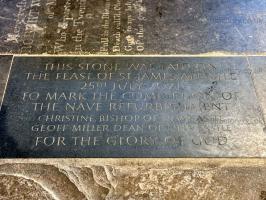
On 25th July 2021 the refurbishment of the nave at the Cathedral Church St Nicholas, Newcastle upon Tyne [Map] was completed./
On 25th July 1109 Afonso "Conqueror Founder Great" I King Portugal was born to Henry Burgundy Count Portugal [aged 43] and Teresa Alfónsez Jiménez [aged 29]. He married 1146 Malfada Savoy Queen Consort Portugal, daughter of Amadeus Savoy III Count Savoy and Mahaut Albon Countess Savoy, and had issue.
On 25th July 1216 Sybil Ferrers was born to William Ferrers 4th Earl of Derby [aged 48] and Agnes Gernon Countess Derby. She a great x 3 granddaughter of King Henry I "Beauclerc" England. She married before 1220 John Vipont and had issue.
On 25th July 1261 Arthur II Duke Brittany was born to John II Duke Brittany [aged 22] and Beatrice Plantagenet [aged 19]. He a grandson of King Henry III of England. He married (1) 1275 his third cousin Marie Limoges Duchess Brittany and had issue (2) in or before 1295 his third cousin Yolande of Dreux Queen of Scotland, daughter of Robert Capet IV Count Dreux and Beatrice Montfort Countess Dreux, and had issue.
On 25th July 1274 John Beauchamp 1st Baron Beauchamp Somerset was born to John Beauchamp 1st Baron Beauchamp [aged 26] and Cicely Vivonne Forz Baroness Beauchamp. He married before 1301 Joan Cheduit Baroness Beauchamp Somerset and had issue.
On 25th July 1290 Hawise "Lady of Powys" Mathrafal Baroness Cherleton was born to Owen de la Pole Mathrafal 1st Lord Powis [aged 33] at Radnorshire, Powys. She married 1336 John Charleton 1st Baron Cherleton and had issue.
Abbot John Whethamstede’s Chronicle of the Abbey of St Albans
Abbot John Whethamstede's Register aka Chronicle of his second term at the Abbey of St Albans, 1451-1461, is a remarkable text that describes his first-hand experience of the beginning of the Wars of the Roses including the First and Second Battles of St Albans, 1455 and 1461, respectively, their cause, and their consequences, not least on the Abbey itself. His text also includes Loveday, Blore Heath, Northampton, the Act of Accord, Wakefield, and Towton, and ends with the Coronation of King Edward IV. In addition to the events of the Wars of the Roses, Abbot John, or his scribes who wrote the Chronicle, include details in the life of the Abbey such as charters, letters, land exchanges, visits by legates, and disputes, which provide a rich insight into the day-to-day life of the Abbey, and the challenges faced by its Abbot.
Available at Amazon in eBook and Paperback format.
On 25th July 1336 Albert Wittelsbach I Duke Lower Bavaria was born to Louis Wittelsbach IV Holy Roman Emperor [aged 54] and Margaret Hainaut Holy Roman Empress [aged 24] at Munich. He a great x 4 grandson of King Henry "Curtmantle" II of England. He married (1) after 19th July 1353 Margaret of Silesia Duchesa Lowwer Bavaria and had issue (2) 1394 his half fourth cousin once removed Margaret de la Marck Duchess Bavaria, daughter of Adolph de la Marck and Margaret Jülich Countess Cleves and Mark.
On 25th July 1404 Philip Valois I Duke Brabant was born to Anthony Valois Duke Brabant [aged 19] and Jeanne Luxemburg Duchess Brabant. He a great x 3 grandson of King Edward I of England. He married before 4th August 1430 his second cousin Yolande Valois Anjou Duchess Brabant Duchess Brittany, daughter of King Louis of Naples and Yolande Barcelona Queen Consort Naples.
On 25th July 1421 Henry Percy 3rd Earl of Northumberland was born to Henry Percy 2nd Earl of Northumberland [aged 28] and Eleanor Neville Countess Northumberland [aged 24]. He a great x 2 grandson of King Edward III of England. Coefficient of inbreeding 3.49%. He married before 1449 his fifth cousin Eleanor Poynings Countess Northumberland, daughter of Richard Poynings and Eleanor Berkeley Countess Arundel, and had issue.
On 25th July 1522 Anna of Lorraine was born to Antoine Lorraine II Duke Lorraine [aged 33].
On 25th July 1538 Diane Valois was born illegitimately to King Henry II of France [aged 19] and Filippa Duci.
On 25th July 1615 Elizabeth Preston Duchess Ormonde was born to Richard Preston 1st Earl Desmond and Elizabeth Butler. She married December 1629 her second cousin once removed James Butler 1st Duke Ormonde and had issue.
On 25th July 1634 Barbara Fletcher was born to Henry Fletcher 1st Baronet [aged 34] and Catherine Dalston. She married 27th August 1655 Daniel Fleming of Rydal Hall and had issue.
On 25th July 1658 Archibald Campbell 1st Duke Argyll was born to Archibald Campbell 9th Earl Argyll [aged 29] and Mary Stewart Countess Argyll [aged 30]. He married 12th March 1678 his sixth cousin Elizabeth Tollemache Duchess Argyll, daughter of Lionel Tollemache 3rd Baronet and Elizabeth Murray Duchess Lauderdale, and had issue.
On 29th March 1674 William Hesse-Kassel was born to Charles I Landgrave Hesse-Kassel [aged 19] and Maria Amalia of Courland Landgravine Hesse-Kassel [aged 20]. On 25th July 1676 William Hesse-Kassel died. Coefficient of inbreeding 7.10%.
On 25th July 1688 Thomas Clarges 2nd Baronet was born to Walter Clarges 1st Baronet [aged 35] and Jane Herbert. He married before 1721 his fifth cousin once removed Frances Berkeley, daughter of John Berkeley 4th Viscount Fitzhardinge and Barbara Villiers Viscountess Fitzhardinge, and had issue.
On 25th July 1727 Infante Louis of Spain was born to Philippe V King Spain [aged 43] and Elisabeth Farnese Queen Consort Spain [aged 34].
On 25th July 1730 Stephen Moore 1st Earl Mount Cashell was born to Stephen Moore 1st Viscount Mount Cashell [aged 34] and Alicia Colville. He married 1769 Helena Rawdon Countess Mount Cashell, daughter of John Rawdon 1st Earl Moira and Helena Perceval, and had issue.

On 25th July 1734 Arthur Saunders Gore 2nd Earl Arran was born to Arthur Saunders Gore 1st Earl Arran [aged 31] and Jane Saunders. He married (1) 14th July 1760 Catherine Annesley, daughter of William Annesley 1st Viscount Glerawly and Anne Beresford, and had issue (2) 1771 Anne Knight Countess of Arran and had issue (3) February 1781 Elizabeth Underwood Countess of Arran and had issue.
Jean de Waurin's Chronicle of England Volume 6 Books 3-6: The Wars of the Roses
Jean de Waurin was a French Chronicler, from the Artois region, who was born around 1400, and died around 1474. Waurin’s Chronicle of England, Volume 6, covering the period 1450 to 1471, from which we have selected and translated Chapters relating to the Wars of the Roses, provides a vivid, original, contemporary description of key events some of which he witnessed first-hand, some of which he was told by the key people involved with whom Waurin had a personal relationship.
Available at Amazon in eBook and Paperback format.
On 25th July 1745 Silvester Harding of Pall Mall was born in Newcastle under Lyme.
On 25th July 1747 William Lygon 1st Earl Beauchamp was born to Reginald Pyndar aka Lygon of Madresfield in Worcestershire [aged 35] and Susannah Hamner [aged 36]. He married 1780 Catherine Denn Countess Beauchamp and had issue.
On 25th July 1756 John Gregory Shaw 5th Baronet was born to John Shaw 4th Baronet [aged 27]. He married 9th March 1782 Theodosia Margaret Monson Lady Shaw, daughter of John Monson 2nd Baron Monson, and had issue.
On 25th July 1797 Princess Augusta Hesse-Kassel Duchess Cambridge was born to Frederick Hesse-Kassel [aged 49]. She a great granddaughter of King George II of Great Britain and Ireland. She married 1st June 1818 her second cousin Adolphus Hanover 1st Duke Cambridge, son of King George III of Great Britain and Ireland and Charlotte Mecklenburg Strelitz Queen Consort England, and had issue.
On 25th July 1804 Thomas Gladstone 2nd Baronet was born to John Gladstone 1st Baronet [aged 39] and Anne MacKenzie Robertson [aged 32].
On 25th July 1809 Jane Elizabeth Howard was born to Thomas Howard 16th Earl Suffolk 9th Earl Berkshire [aged 32] and Elizabeth Jane Dutton Countess Suffolk and Berkshire [aged 34]. She married 5th April 1836 John Ogilvy of Inverquharity 9th Baronet.
On 25th July 1818 Albert aka Abdullah Sassoon 1st Baronet was born to David Sassoon [aged 25] and Hannah Joseph at Baghdad.
On 25th July 1819 Georgina Douglas was born to John Douglas 7th Marquess Queensberry [aged 40].
On 4th November 1821 Frances Julia Murray was born to James Murray 1st Baron Glenlyon [aged 39] and Emily Frances Percy Baroness Goldolphin Helston [aged 33]. She was baptised at St George's Church, Hanover Square on 25th July 1829. She married (1) 16th January 1840 Charles Henry Maynard, son of Charles Henry Maynard 3rd Viscount Maynard.
On 25th July 1825 Alan Spencer-Churchill was born to George Spencer-Churchill 6th Duke of Marlborough [aged 31] and Jane Stewart Duchess of Marlborough [aged 27]. Coefficient of inbreeding 6.26%. He married Rosalind Dowker.
The History of William Marshal was commissioned by his son shortly after William’s death in 1219 to celebrate the Marshal’s remarkable life; it is an authentic, contemporary voice. The manuscript was discovered in 1861 by French historian Paul Meyer. Meyer published the manuscript in its original Anglo-French in 1891 in two books. This book is a line by line translation of the first of Meyer’s books; lines 1-10152. Book 1 of the History begins in 1139 and ends in 1194. It describes the events of the Anarchy, the role of William’s father John, John’s marriages, William’s childhood, his role as a hostage at the siege of Newbury, his injury and imprisonment in Poitou where he met Eleanor of Aquitaine and his life as a knight errant. It continues with the accusation against him of an improper relationship with Margaret, wife of Henry the Young King, his exile, and return, the death of Henry the Young King, the rebellion of Richard, the future King Richard I, war with France, the death of King Henry II, and the capture of King Richard, and the rebellion of John, the future King John. It ends with the release of King Richard and the death of John Marshal.
Available at Amazon in eBook and Paperback format.
On 25th July 1837 Clement Wolseley 7th Baronet was born to Clement Wolseley 5th Baronet [aged 42].
On 25th July 1838 Herbert George Denman Croft 9th Baronet was born to Archer Denman Croft 8th Baronet [aged 36]. He married 10th January 1865 Georgiana Marsh Lady Croft and had issue.
On 25th July 1842 Matthew White Ridley 1st Viscount Ridley was born to Matthew White Ridley 4th Baronet [aged 34] and Cecilia Anne Parke Lady Ridley. He married 10th December 1873 Mary Georgiana Marjoribanks Viscountess Ridley, daughter of Dudley Marjoribanks 1st Baron Tweedmouth and Isabella Hogg.

On 25th July 1842 John Marsham was born to Charles Marsham 3rd Earl Romney [aged 33] and Margaret Harriet Montagu Scott Countess Romney [aged 31].
On 25th July 1842 Mary Charlotte Ashley-Cooper was born to Anthony Ashley-Cooper 7th Earl Shaftesbury [aged 41] and Emily Caroline Catherine Frances Cowper Countess Shaftesbury.


On 25th July 1848 Arthur James Balfour 1st Earl Balfour was born to James Maitland Balfour [aged 28] and Blanche Mary Harriet Gascoyne-Cecil [aged 23].


On 25th July 1857 Francis Coates Jones was born.
On 25th July 1860 Luise Margarete Hohenzollern Duchess Connaught was born to Frederick Charles Hohenzollern [aged 32] and Princess Maria Anna of Anhalt-Dessau [aged 22]. She married 13th March 1879 her third cousin once removed Prince Arthur Windsor 1st Duke Connaught and Strathearn, son of Prince Albert Saxe Coburg Gotha and Queen Victoria of the United Kingdom, and had issue.
On 25th July 1868 William Edwardes 5th and 2nd Baron Kensington was born to William Edwardes 4th and 1st Baron Kensington [aged 33].
On 25th July 1872 William Charles de Meuron "Billy" Wentworth-Fitzwilliam 7th and 5th Earl Fitzwilliam was born to William Wentworth-Fitzwilliam [aged 32] and Laura Maria Theresa Beauclerk [aged 23] in Pointe de Meuron, Ontario. The remote location of his birth gave rise to the accusation he was a changeling to remove epilepsy from the bloodline. He married 24th June 1896 his third cousin Maud Frederica Elizabeth Dundas Countess Fitzwilliam, daughter of Lawrence Dundas 1st Marquess Zetland and Lilian Selina Elizabeth Lumley Marchioness Zetland, and had issue.
On 25th July 1881 Mary Grey was born to Harry Grey 8th Earl Stamford 4th Earl Warrington [aged 69].
On 25th July 1888 Evelyn Robert Pierrepont 5th Earl Manvers was born to Charles William Sydney Pierrepont 4th Earl Manvers [aged 33].
Annals of the six Kings of England by Nicholas Trivet
Translation of the Annals of the Six Kings of England by that traces the rise and rule of the Angevin aka Plantagenet dynasty from the mid-12th to early 14th century. Written by the Dominican scholar Nicholas Trivet, the work offers a vivid account of English history from the reign of King Stephen through to the death of King Edward I, blending political narrative with moral reflection. Covering the reigns of six monarchs—from Stephen to Edward I—the chronicle explores royal authority, rebellion, war, and the shifting balance between crown, church, and nobility. Trivet provides detailed insight into defining moments such as baronial conflicts, Anglo-French rivalry, and the consolidation of royal power under Edward I, whose reign he describes with particular immediacy. The Annals combines careful year-by-year reporting with thoughtful interpretation, presenting history not merely as a sequence of events but as a moral and political lesson. Ideal for readers interested in medieval history, kingship, and the origins of the English state, this chronicle remains a valuable and accessible window into the turbulent world of the Plantagenet kings.
Available at Amazon in eBook and Paperback format.
On 25th July 1897 Avice Ela Murial Sackville was born to Gilbert Sackville 8th Earl De La Warr [aged 28] and Muriel Agnes Brassey Countess De La Warr. She married (1) 28th November 1918 Stewart Graham Menzies.
On 25th July 1903 William Smith 3rd Viscount Hambleden was born to Frederick Smith 2nd Viscount Hambleden [aged 34] and Esther Georgiana Caroline Gore Viscountess Hambleden [aged 33]. He married 26th September 1928 Patricia Herbert Viscountess Hambleden, daughter of Reginald Herbert 15th Earl Pembroke 12th Earl Montgomery and Beatrice Eleanor Paget Countess Pembroke and Montgomery, and had issue.
On 25th July 1915 Joseph Patrick Kennedy was born to Joseph Patrick Kennedy [aged 26] and Rose Elizabeth Fitzgerald [aged 25].
On 25th July 1924 Arthur Waller Liddell 8th Baron Ravensworth was born to Cyril Arthur Liddell [aged 52].
On 25th July 1935 Christoper Gerald Prévost 6th Baronet was born to George James Augustine Prévost 5th Baronet [aged 25].
On 25th July 1954 Quentin Wallop 10th Earl of Portsmouth was born to Oliver Kintzing Wallop [aged 31].
On 25th July 1961 Guy Wogan Philipps 4th Baron Milford was born to Hugo Philipps 3rd Baron Milford and Mary Makins [aged 26]. He married 1998 Rebecca Nicolson.
On 25th July 1962 Robert Ian Eden 10th Baron Auckland was born to Ian George Eden 9th Baron Auckland [aged 36].
On 25th July 1137 Louis VII King of the Franks [aged 17] and Eleanor of Aquitaine Queen Consort Franks and England [aged 15] were married at the Cathedral of Saint-André, Bordeaux [Map] by Archbishop Geoffrey of Loroux. Her father William "Saint" Poitiers X Duke Aquitaine had died some three months previously leaving Eleanor of Aquitaine Queen Consort Franks and England as a ward of Louis's father Louis VI King of the Franks [aged 55] who quickly married her to his son Louis with a view to the Duchy of Aquitaine becoming joined with the Kingdom of France. A week later Louis VI King of the Franks died and his son Louis and Eleanor became King and Queen of France. She the daughter of William "Saint" Poitiers X Duke Aquitaine and Aenor Chatellerault Duchess Aquitaine. He the son of Louis VI King of the Franks and Adelaide Savoy Queen Consort France. They were third cousin once removed.
Eleanor gave Louis a rock-crystal vase as a wedding gift which he subsequently gave to Abbot Suger of Saint-Denis. The vase is now in the Louvre.
Crystal vase, 'of Eleanor'. Crystal: Iran (?), 6th-7th century (?). Mounting: Saint-Denis, before 1147; 13th and 14th centuries. Rock crystal, nielloed and gilded silver, precious stones, pearls, champlevé enamels on silver. Originating from the treasury of the Abbey of Saint-Denis. Inscription: "+ HOC VAS SPONSA DEDIT A(ie)NOR-REGI LUDOVICO MITADOL(us) AVO MIHI REX S(an)C(tis)Q(ue) SUGER(ius)" (This vase, Eleanor, his spouse, gave it to King Louis, Mitadolus to his ancestor, the king to me, Suger, who have offered it to the saints).
Vase de cristal, "d'Aliénor". Cristal: Iran (?), VI-VII siécle (?). Monture: Saint-Denis, avant 1147; XIII et XIV siécles. Cristal de roche, argent niellé et doré, pierres pécieuses, perles, émaux champlevés sur argent Provient du trésor de I'abbaye de Saint-Denis. Inscription: "+ HOC VAS SPONSA DEDIT A(ie)NOR-REGI LUDOVICO MITADOL(us) AVO MIHI REX S(an)C(tis)Q(ue) SUGER(ius)". (ce vase, Aliénor, son épouse, l'a donné au roi Lous, Mitadolus a son aïeul, le roi à moi, Suger, qui l'ai offert aux saints).
Archbishop Geoffrey of Loroux: In 1137 he was appointed Archbishop of Bordeaux. On 18th July 1155 he died.
William "Saint" Poitiers X Duke Aquitaine: William "Saint" Poitiers X Duke Aquitaine and Aenor Chatellerault Duchess Aquitaine were married. She by marriage Duchess Aquitaine. He the son of William "Troubadour" Poitiers IX Duke Aquitaine and Philippa Rouerge Duchess Aquitaine. In 1099 he was born to William "Troubadour" Poitiers IX Duke Aquitaine and Philippa Rouerge Duchess Aquitaine at Toulouse. On 10th February 1127 William "Troubadour" Poitiers IX Duke Aquitaine died. His son William succeeded X Duke Aquitaine. On 9th April 1137 William "Saint" Poitiers X Duke Aquitaine died. His daughter Eleanor succeeded XI Duchess Aquitaine.
On 25th July 1316 Robert Fitzpayn 3rd Baron Fitzpayn [aged 16] and Maud Badlesmere Countess of Oxford [aged 8] were married.
On 25th July 1554 Prince Philip of Spain [aged 27] and Queen Mary [aged 38] were married by Bishop Stephen Gardiner [aged 71] at Winchester Cathedral [Map]. She the daughter of King Henry VIII of England and Ireland and Catherine of Aragon Queen Consort England. He the son of Charles V Holy Roman Emperor [aged 54] and Isabel Aviz Queen Consort Spain. They were first cousin once removed. He a great x 5 grandson of King Edward III of England.
John Gage [aged 74] bore the queen's train.
Magdalen Dacre Viscountess Montague [aged 16] took part in the Bridal Procession.
On 25th July 1603 Richard Boyle 1st Earl Cork [aged 36] and Catherine Fenton Countess Cork [aged 18] were married.

On 25th July 1610 Henry Clifford 5th Earl of Cumberland [aged 19] and Frances Cecil Countess Cumberland [aged 17] were married. She the daughter of Robert Cecil 1st Earl Salisbury [aged 47] and Elizabeth Brooke. He the son of Francis Clifford 4th Earl of Cumberland [aged 51] and Grisold Hughes Countess Cumberland. They were half sixth cousins.
On 25th July 1646 Francis Scott 2nd Earl Buccleuch [aged 19] and Margaret Leslie Countess Buccleuch and Wemyss [aged 26] were married. She by marriage Countess Buccleuch. She the daughter of John Leslie 6th Earl Rothes and Anne Erskine Countess of Rothes. He the son of Walter Scott 1st Earl Buccleuch and Mary Hay Countess Buccleuch. They were half third cousins.
Chronicle of Geoffrey le Baker of Swinbroke
Baker was a secular clerk from Swinbroke, now Swinbrook, an Oxfordshire village two miles east of Burford. His Chronicle describes the events of the period 1303-1356: Gaveston, Bannockburn, Boroughbridge, the murder of King Edward II, the Scottish Wars, Sluys, Crécy, the Black Death, Winchelsea and Poitiers. To quote Herbert Bruce 'it possesses a vigorous and characteristic style, and its value for particular events between 1303 and 1356 has been recognised by its editor and by subsequent writers'. The book provides remarkable detail about the events it describes. Baker's text has been augmented with hundreds of notes, including extracts from other contemporary chronicles, such as the Annales Londonienses, Annales Paulini, Murimuth, Lanercost, Avesbury, Guisborough and Froissart to enrich the reader's understanding. The translation takes as its source the 'Chronicon Galfridi le Baker de Swynebroke' published in 1889, edited by Edward Maunde Thompson.
Available at Amazon in eBook and Paperback format.
On 25th July 1695 John Hervey 1st Earl Bristol [aged 29] and Elizabeth Felton Countess Bristol [aged 18] were married. They were third cousin twice removed.


On 25th July 1745 Philip Stanhope 2nd Earl Stanhope [aged 30] and Grizel Hamilton Countess Stanhope were married. She by marriage Countess Stanhope. He the son of James Stanhope 1st Earl Stanhope and Lucy Pitt Countess Stanhope.
On 25th July 1792 Murrough O'Brien 1st Marquess Thomond [aged 66] and Mary Palmer Marchioness Thomond [aged 42] were married. The difference in their ages was 24 years.


On 25th July 1795 George Ashburnham 3rd Earl Ashburnham [aged 34] and Charlotte Percy Countess Ashburham [aged 19] were married. She the daughter of Algernon Percy 1st Earl Beverley [aged 45] and Isabella Susan Burrell Countess Beverley [aged 44]. He the son of John Ashburnham 2nd Earl Ashburnham [aged 70] and Elizabeth Crowley Countess Ashburham.
On 25th July 1811 Arthur Hasselrigge aka Grey 11th Baronet [aged 20] and Henrietta Anne Bourne Lady Haselrigge [aged 27] were married.
On 25th July 1814 Henry Somerset 7th Duke Beaufort [aged 22] and Georgiana Frederica Fitzroy [aged 21] were married at Upper Brook Street. Following her death in 1821 he would marry her younger half-sister Emily Frances Smith Duchess Beaufort [aged 14]. An example of a man marrying two sisters, albeit in this case half-sisters. He the son of Henry Charles Somerset 6th Duke Beaufort [aged 47] and Charlotte Sophia Leveson-Gower Duchess Beaufort [aged 43]. They were fourth cousins. She a great x 4 granddaughter of King Charles II of England Scotland and Ireland.
On 25th July 1821 Thomas Stonor 3rd Baron Camoys [aged 23] and Frances Towneley Baroness Camoys [aged 20] were married.
On 25th July 1833 Charles Noel 1st Earl Gainsborough [aged 51] and Frances Jocelyn Countess Gainsborough [aged 18] were married. The difference in their ages was 33 years. She the daughter of Robert Jocelyn 3rd Earl Roden [aged 44] and Maria Frances Catherine Stapleton Countess Roden.
On 25th July 1839 George William Lyttelton 4th Baron Lyttelton [aged 22] and Mary Glynne Lady Lyttelton [aged 26] were married. She by marriage Baroness Lyttelton of Frankley in Worcestershire. They were sixth cousins.
On 25th July 1854 George Byng 3rd Earl Strafford [aged 24] and Alice Leveson-Gower aka Egerton Countess Strafford [aged 23] were married. She the daughter of Francis Leveson Gower aka Egerton 1st Earl Ellesmere [aged 54] and Harriet Greville Countess Ellesmere [aged 51]. He the son of George Byng 2nd Earl Strafford [aged 48] and Agnes Paget. They were half third cousin once removed.
On 25th July 1870 Arthur Hill 5th Marquess Downshire [aged 25] and Georgiana Elizabeth Balfour were married. He the son of Arthur Hill 4th Marquess Downshire and Caroline Stapleton-Cotton Marchioness Downshire [aged 55].
The History of William Marshal was commissioned by his son shortly after William’s death in 1219 to celebrate the Marshal’s remarkable life; it is an authentic, contemporary voice. The manuscript was discovered in 1861 by French historian Paul Meyer. Meyer published the manuscript in its original Anglo-French in 1891 in two books. This book is a line by line translation of the first of Meyer’s books; lines 1-10152. Book 1 of the History begins in 1139 and ends in 1194. It describes the events of the Anarchy, the role of William’s father John, John’s marriages, William’s childhood, his role as a hostage at the siege of Newbury, his injury and imprisonment in Poitou where he met Eleanor of Aquitaine and his life as a knight errant. It continues with the accusation against him of an improper relationship with Margaret, wife of Henry the Young King, his exile, and return, the death of Henry the Young King, the rebellion of Richard, the future King Richard I, war with France, the death of King Henry II, and the capture of King Richard, and the rebellion of John, the future King John. It ends with the release of King Richard and the death of John Marshal.
Available at Amazon in eBook and Paperback format.
On 25th July 1877 Sholto Douglas 19th Earl of Morton [aged 32] and Helen Geraldine Ponsonby Countess of Morton [aged 25] were married. He the son of Sholto Douglas 18th Earl Morton [aged 59] and Helen Watson.
On 25th July 1881 Ralph Ormsby-Gore 3rd Baron Harlech [aged 26] and Margaret Ethel Gordon Baroness Harlech [aged 23] were married. She the daughter of Charles Gordon 10th Marquess Huntly and Maria Antoinetta Pegus Marchioness Huntly [aged 60].
On 25th July 1889 Francis Denzil Edward Baring 5th Baron Ashburton [aged 23] and Mabel Edith Hood Baroness Ashburton [aged 23] were married at St George's Church, Hanover Square. She by marriage Baroness Ashburton of Ashburton in Devon.
On 25th July 1906 Henry Anthony Farrington 6th Baronet [aged 34] and Dorothy Maria Farrington [aged 21] were married. They were second cousins.
On 25th July 1957 Alan Montagu Stuart-Wortley-Mackenzie 4th Earl of Wharncliffe [aged 22] and Aline Margaret Bruce Countesss Wharncliffe [aged 20] were married. She by marriage Countess Wharncliffe. He the son of Archibald Montagu Stuart-Wortley-Mackenzie 3rd Earl of Wharncliffe and Maud Lillian Elfreda Mary Wentworth-Fitzwilliam [aged 58].
On 25th July 759 Oswulf King of Northumbria was murdered by his servants.
On 25th July 1170 Renauld of Bar II Count of Bar died. His son Henry [aged 12] succeeded I Count Bar.
On 25th July 1182 Marie Blois I Countess Boulogne [aged 46] died.
On 25th July 1201 Gruffydd ap Rhys Dinefwr Prince Deheubarth died. He was buried at Strata Florida Abbey [Map].
On 25th July 1297 Donald Mar 6th Earl of Mar died.
On 25th July 1297 Donald Mar 7th Earl of Mar died at Kildrummy Castle, Kildrummy.
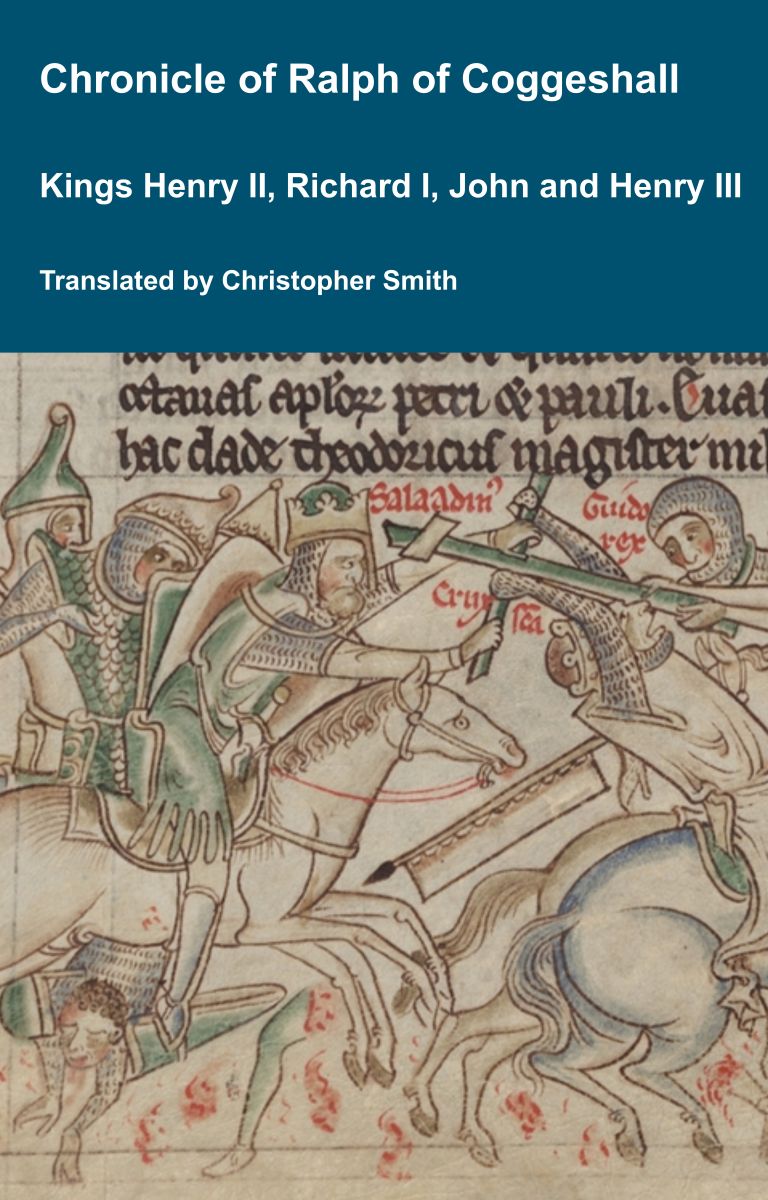
Chronicle of Abbot Ralph of Coggeshall
The Chronicle of Abbot Ralph of Coggeshall (Chronicon Anglicanum) is an indispensable medieval history that brings to life centuries of English and European affairs through the eyes of a learned Cistercian monk. Ralph of Coggeshall, abbot of the Abbey of Coggeshall in Essex in the early 13th century, continued and expanded his community’s chronicle, documenting events from the Norman Conquest of 1066 into the tumultuous reign of King Henry III. Blending eyewitness testimony, careful compilation, and the monastic commitment to record-keeping, this chronicle offers a rare narrative of political intrigue, royal power struggles, and social upheaval in England and beyond. Ralph’s work captures the reigns of pivotal figures such as Richard I and King John, providing invaluable insights into their characters, decisions, and the forces that shaped medieval rule. More than a simple annal, Chronicon Anglicanum conveys the texture of medieval life and governance, making it a rich source for scholars and readers fascinated by English history, monastic authorship, and the shaping of the medieval world.
Available at Amazon in eBook and Paperback format.
On 25th July 1349 Isabel Verdun Baroness Ferrers Groby [aged 33] died at Groby, Leicestershire.
On 25th July 1358 John Neville 2nd Baron Neville Essex [aged 59] died. Baron Neville Essex extinct. Possibly abeyant given that it was created by writ.
On 25th July 1362 Isabel Berkeley Baroness Clifford Baroness Musgrave [aged 55] died at Hartley Castle [Map].
On 25th July 1452 Robert Willoughby 6th Baron Willoughby [aged 67] died. He was buried at All Saints Church, Mettingham Bungay [Map]. His daughter Joan [aged 27] succeeded 7th Baroness Willoughby de Eresby. Richard Welles 7th Baron Welles, Baron Willoughby [aged 24] by marriage Baron Willoughby de Eresby.
On 25th July 1472 Helen Melun Countess Eu died.
On 25th July 1564 Ferdinand I Holy Roman Emperor [aged 61] died at Vienna [Map]. His son Maximilian [aged 36] succeeded II Holy Roman Emperor. Maria of Spain Holy Roman Empress [aged 36] by marriage Holy Roman Empress. His son Ferdinand [aged 35] succeeded II Archduke Austria. Philippine Welser Archduchess Austria [aged 37] by marriage Archduke Austria.
On 25th July 1603 Santi di Tito [aged 66] died.
On 16th July 1643 Francis Willoughby 5th Baron Willoughby of Parham launched a night attack on Gainsborough [Map] and captured it and Robert Pierrepont 1st Earl Kingston [aged 58].
On 25th July 1643 Robert Pierrepont 1st Earl Kingston Was accidentally shot and killed while a prisoner on board a vessel bound for Hull. His son Henry [aged 37] succeeded 2nd Earl Kingston upon Hull, 2nd Viscount Newark, 2nd Baron Pierrepont of Holme Pierrepoint. Catherine Stanley Marchioness Dorchester by marriage Countess Kingston upon Hull.
On 25th July 1666 Montagu Bertie 2nd Earl Lindsey [aged 58] died at Campden House, Middlesex. His son Robert [aged 35] succeeded 3rd Earl Lindsey, 16th Baron Willoughby de Eresby. Elizabeth Wharton Countess Lindsey [aged 33] by marriage Countess Lindsey.
On 25th July 1703 Robert Marsham 4th Baronet [aged 52] died. His son Robert [aged 17] succeeded 5th Baronet Marsham of Cuckston in Kent.

On 25th July 1734 Richard Cust 2nd Baronet [aged 53] died. He was buried at St George's Church, Stamford. His son John [aged 15] succeeded 3rd Baronet Cust of Stamford in Lincolnshire.
On 25th July 1749 Benedicta Maria Theresa Hall Viscountess Gage died.
This is a translation of the 'Memoires of Jacques du Clercq', published in 1823 in two volumes, edited by Frederic, Baron de Reissenberg. In his introduction Reissenberg writes: 'Jacques du Clercq tells us that he was born in 1424, and that he was a licentiate in law and a counsellor to Philip the Good, Duke of Burgundy, in the castellany of Douai, Lille, and Orchies. It appears that he established his residence at Arras. In 1446, he married the daughter of Baldwin de la Lacherie, a gentleman who lived in Lille. We read in the fifth book of his Memoirs that his father, also named Jacques du Clercq, had married a lady of the Le Camelin family, from Compiègne. His ancestors, always attached to the counts of Flanders, had constantly served them, whether in their councils or in their armies.' The Memoires cover a period of nineteen years beginning in in 1448, ending in in 1467. It appears that the author had intended to extend the Memoirs beyond that date; no doubt illness or death prevented him from carrying out this plan. As Reissenberg writes the 'merit of this work lies in the simplicity of its narrative, in its tone of good faith, and in a certain air of frankness which naturally wins the reader’s confidence.' Du Clercq ranges from events of national and international importance, including events of the Wars of the Roses in England, to simple, everyday local events such as marriages, robberies, murders, trials and deaths, including that of his own father in Book 5; one of his last entries.
Available at Amazon in eBook and Paperback format.
On 25th July 1756 Alexander Lindsay 4th Earl Balcarres died. His brother James [aged 64] succeeded 5th Earl Balcarres. Anne Dalrymple Countess Balcarres [aged 29] by marriage Countess Balcarres.
On 25th July 1764 Orlando Bridgeman 4th Baronet [aged 69] died. His son Henry [aged 38] succeeded 5th Baronet Bridgeman of Great Lever in Lancashire.


On 25th July 1770 Henrietta Somerset Lady Williams-Wynn [aged 22] died. Monument [Map] to Henrietta Somerset Lady Williams-Wynn sculpted by Joseph Nollekens [aged 32].
On 25th July 1787 Arthur Devis [aged 75] died at Brighton.
On 25th July 1818 Patrick Blake 2nd Baronet [aged 50] died. His brother James [aged 48] succeeded 3rd Baronet Blake of Langham in Suffolk.
On 25th July 1822 Christiana Anton Viscountess Falkland died.
On 25th July 1834 Samuel Taylor Coleridge [aged 61] died.
On 25th July 1837 Louisa Frances Mary Dickenson Lady Anson died.
On 25th July 1842 William Woods Howard [aged 56] died.
On 25th July 1863 William Richard Arthur Pole Tylney Long Wellesley 5th Earl Mornington [aged 49] died in Paris [Map]. He was buried at Draycott Cerne Chippenham, Wiltshire. His first cousin once removed Arthur [aged 56] succeeded 6th Earl Mornington, 6th Viscount Wellesley of Dangan Castle. Elizabeth Hay Duchess Wellington [aged 42] by marriage Countess Mornington.
On 25th July 1875 Francis Bond Head 1st Baronet [aged 82] died. His son Francis [aged 58] succeeded 2nd Baronet Head of Rochester in Kent.
On 25th July 1892 Bishop Thomas Legh Claughton [aged 83] died. Monument at St Albans Cathedral [Map] sculpted by James Forsyth [aged 64].
Bishop Thomas Legh Claughton: On 6th November 1808 he was born. In 1877 he was appointed Bishop of St Albans. Life's Ebb And Flow Chapter IV. [30th April 1881]. Our dear friend, the Bishop of St. Albans (Claughton), helped by our neighbour the rector of Little Easton [Map], the Rev. G. Tufnell, along with two London clergy, officiated at our wedding. It pleased me very much to have the benediction pronounced by Dean Stanley, who had kept in the background during the ceremony. The register was signed by the Prince of Wales, Prince Leopold, and Lords Warwick and Rosslyn. Our honeymoon was spent at beautiful Ditton Park, which was lent us by the Duke and Duchess of Buccleuch, and there, in lovely May weather, we had a fortnight on the river, boating and canoeing. But, alas for romance, there was one worldly honour given us that demanded all our self-control. We were commanded to dine at Windsor Castle on the day after our wedding, and I was asked to wear my bridal dress, orange blossoms and all! I must confess that Her Majesty's kindness on that occasion went far to soothe the shyness of a bride in her teens. The Queen took from my corsage a spray of orange blossom to keep as a souvenir and said many charming things about the beauty of my frock. Her Majesty so much admired what she was pleased to call the "lovely" dress, that I had a note next day from Lady Churchill, then in waiting, to say that the Queen wished so very much to possess a photograph of me if I would have myself taken in the gown, and hoping I was not too tired from the long standing.

Anne Boleyn. Her Life as told by Lancelot de Carle's 1536 Letter.
In 1536, two weeks after the execution of Anne Boleyn, her brother George and four others, Lancelot du Carle, wrote an extraordinary letter that described Anne's life, and her trial and execution, to which he was a witness. This book presents a new translation of that letter, with additional material from other contemporary sources such as Letters, Hall's and Wriothesley's Chronicles, the pamphlets of Wynkyn the Worde, the Memorial of George Constantyne, the Portuguese Letter and the Baga de Secrets, all of which are provided in Appendices.
Available at Amazon in eBook and Paperback format.
On 25th July 1905 Marguerite de Rothschild Duchess Gramont [aged 49] died.
On 25th July 1964 Marjorie Blanche Eva Greville Countess Feversham [aged 79] died.
On 25th July 1965 Sidney Patrick Shelley 8th Baronet [aged 85] died. His third cousin once removed William [aged 56] succeeded 9th Baronet Shelley of Castle Goring in Sussex.
On 25th July 1993 Margaret Whigham Duchess of Argyll [aged 80] died at St George's Nursing Home, Pimlico. She was buried with her first husband Charles Francis Sweeny, who had died four months before, at Brookwood Cemetery, Woking.
On 25th July 2002 Angus Montagu 12th Duke of Manchester [aged 63] died. His son Alexander [aged 39] succeeded 13th Duke Manchester, 16th Earl Manchester, 16th Viscount Mandeville, 16th Baron Montagu of Kimbolton.
On 25th July 2006 Lydia Yarde-Buller Duchess Bedford [aged 88] died.