

28 Sep is in September.
1528 Sweating Sickness Outbreak
1599 Robert Devereux Returns from Ireland
On 28th September 1106 King Henry I "Beauclerc" England [aged 38] defeated his older brother Robert Curthose III Duke Normandy [aged 55] at the Battle of Tinchebray at Tinchebray, Orne.
William Warenne 2nd Earl of Surrey and Robert Beaumont 1st Earl of Leicester Count Meulan [aged 66]. Elias I Count Maine commanded the reserve. The following fought for Henry:
Alan Canhiart IV Duke Brittany [aged 43].
Roger "The Spaniard" Tosny 990-1040 [aged 26].
William "Pincerna aka Butler" D'Aubigny [aged 42].
Robert Grandesmil -1040 [aged 28], and.
Robert Curthose III Duke Normandy was captured and spent the next twenty-eight years in prison; never released.
William Mortain Count Mortain 2nd Earl Cornwall [aged 22] was also captured. He spent the next thirty or more years in prison before becoming a monk. Earl Cornwall forfeit.
King Edgar Ætheling II of England [aged 55] was captured and subsequently released; Henry had married to Edgar's niece Edith aka Matilda Dunkeld Queen Consort England [aged 26] in 1100.
Robert II Belleme 2nd Count Ponthieu 3rd Earl of Shrewsbury [aged 50] escaped.
Robert Stuteville was captured.
 Chronicum Anglicanum by Ralph Coggeshall. Robert, Duke of Normandy, was captured by his brother, King Henry, at Tinchebray1 on the Vigil of Saint Michael [28th September 1106], along with William, Count of Mortain, Robert de Stuteville, and many others. From that day, all of Normandy was subjected to King Henry. Duke Robert was imprisoned in a tower and remained there until the day of his death.
Robertus, dux Normanniæ, apud Tenerchebrai, vigilia Sancti Michaelis, a fratre suo Henrico capitur, et cum eo comes Guillelmus de Moretonio, et Robertus de Stutevile, et plures alii, et sic ab illo die tota Normannia regi Henrico subjecta est. Dux vero Robertus in quadam turri relegatus est usque diem obitus sui.
Note 1. See letter in Eadmer from King Henry to Anselm: "Henry, king of the English, to Anselm, archbishop of Canterbury, greeting and friendship. To your paternity and sanctity we signify that Robert, count of Normandy, with all the forces of knights and foot soldiers which he could assemble by entreaty and by payment, on the appointed and determined day, fought fiercely with me before Tinchebray. And at last, by the mercy of God, we conquered, and without great slaughter of our men. What more? By divine mercy the duke of Normandy and the count of Mortain, and William Crispin, and William de Ferrers, and Robert de Stuteville the elder, and others, up to four hundred knights and ten thousand foot soldiers, together with Normandy, were delivered into our hands. Of those whom the sword destroyed, there is no number. But this I attribute not to pride or arrogance, nor to my own strength, but to the gift of divine ordering. Therefore, venerable father, humbly and devoutly prostrate at the knees of your sanctity, I beseech you to implore the Supreme Judge, by whose judgment and will this triumph, so glorious and so useful to me, has been granted, that it may not turn to my loss or detriment, but to the beginning of good works and of the service of God, and to the condition of God's holy Church, to be maintained and strengthened in tranquil peace, so that henceforth she may live free and be shaken by no storm of wars."
And anonymous letter Jesus College, Oxford, MS. li. fo. 104: "To his lord the priest of Sagy, the priest of Fécamp, greetings and prayers. I bring good news, my lord, since I know how eager you are for such tidings. Our lord the king fought with his brother at Tinchebray on the third day before the Kalends of October (29 September), at the third hour; and the battle was drawn up in this order. In the first line were the men of Bayeux, Avranches, and Coutances, all on foot. To these were added seven hundred knights arrayed for each battle-line; besides this, the Count of Maine and the Count of the Bretons, Alan Fergant, encircled the army with up to a thousand knights, all gildones (mercenaries) and servants having been removed. For the king's whole army was reckoned at nearly forty thousand men of this sort. The count, however, had six thousand, with seven hundred knights; and the battle scarcely lasted one hour, when Robert of Bellême at once turned his back, by whose flight all the rest were scattered. The count himself was taken prisoner, and also the Count of Mortain with his barons, and Robert of Stuteville, my friend; all the others were broken and put to flight. Moreover the land was brought under the king's sway; and so that I pass nothing by, this marvel: the king in the battle lost scarcely two men. One alone was wounded, Robert of Bonesbot. When I came to the king he received me kindly at Caen, and freely remitted all that he was demanding of our land. And now peace is restored in the land, thanks be to God. Pray too that it may remain everlasting, and that God may grant us health of mind and body. Farewell."
English Historical Review Volume 24 1909. A Contemporary Account of the Battle of Tinchebrai.
[28th September 1106] Few battles of English medieval history can vie in importance with that of Tinchebrai. Yet the accounts of the chroniclers are unsatisfactory to the last degree. We depend entirely upon Henry of Huntingdon and Orderic for our knowledge of the tactics adopted on the one side and the other. Neither of these writers had military experience; neither was an eye-witness; and they wrote at least fifteen years after the event. Even if they were in agreement we should still be free to doubt whether their descriptions of the battle were correct. But they appear to disagree, and it is difficult to see how they can be reconciled. Professor Oman, who has examined the evidence more thoroughly than any other modern writer, believes that the discrepancies of Orderic and Huntingdon only exist in the imaginations of critics.1 He holds that Huntingdon supplies the clue to the truth of the matter, and interprets Orderic in such a sense as to make him harmonise with Huntingdon. On the other hand Sir James Ramsay2 adopts the more drastic course of treating Huntingdon's account as worthless, and develops his own theory on the lines suggested by the words of Orderic. The result is that two radically different accounts of the battle are in circulation. To Sir James Ramsay the battle is essentially an affair of cavalry; while Mr. Oman is convinced that the main armies fought on foot, and that the only mounted men in the field were the king's auxiliaries from Brittany and Maine, who are admitted on all hands to have settled the fortune of the day. A new source, which I print below, suggests a third interpretation of the evidence, midway between the two existing theories. This document is a letter describing the battle, which was written within a few days of the event. It shows that neither Huntingdon nor Orderic is completely right, but that each has some ground for his statements. For the fact is that the king at all events used cavalry and infantry in close combination.
Note 1. Art of War in the Middle Ages (1898), p. 379.
Note 2. The'Foundations of England, ii. 254.
 History of the Dukes of Normandy by William of Jumieges. After a little time, while he was besieging a certain castle of the Count of Mortain, called Tinchebray, and labouring to take it, his brother Count Robert and the Count of Mortain, with a great multitude of soldiers, thinking they could avenge themselves on King Henry and drive him completely from the land, attacked him with great force1. But by the judgment of God coming upon them, they were both captured, and many others with them, by the men of King Henry, and were brought before him. Thus, God granted victory without bloodshed to the king who feared Him, just as once He did to His servant the emperor Theodosius. For in this battle none of Henry's men fell, and on the opposing side scarcely sixty were slain. So, when the conflict had ended and peace had been restored to the wretched province, which had nearly been ruined through the imprudence of the aforesaid count, King Henry took into his own possession all of Normandy and all the castles of the Count of Mortain. Having pacified the whole land, he returned to England, bringing with him Count Robert his brother, the Count of Mortain, and certain others whom he chose, and he kept them in honourable custody for the remainder of their lives. This battle at Tinchebray between King Henry of the English and his brother Robert, Duke of the Normans, was fought in the year of the Lord's Incarnation 1106, on the fifth day before the Kalends of October. In the same year, in the month of February, a comet had appeared, ominous to kings and dukes of changes of kingdoms. Count Robert ruled the duchy of Normandy for 19 years, excluding the time he spent on the journey to Jerusalem. He was a most valiant knight, and performed many noble deeds, especially when Antioch and Jerusalem were taken from the Saracens by the Christians; yet he was less fit for governing the duchy, because of his simplicity and because he lent his ear too easily to frivolous counsel.
Post aliquantulum vero temporis, cum obsideret quoddam castrum comitis Moritolii, quod vocatur Tenerchebrai, atque in obsidendo laboraret ut illud caperet, frater ejus comes Robertus et comes Moritolii, cum magna multitudine militum, putantes se de rege Henrico vindicare, eumque omnino de terra delere, cum magno impetu irrue runt in eum. Sed judicio Dei super eos veniente, capti sunt ambo et multi alii cum eis ab hominibus Henrici regis atque ante eum adducti. Concessit hoc modo Deus regi se timenti victoriam incruentam, sicut quondam Theodosio imperatori servo suo fecerat. In hoc enim conflictu ex suis nullus, ex adversa parte vix sexaginta corruerunt. Finito itaque hoc conflictu et pace reddita miseræ provinciæ, quæ pene per imprudentiam comitis prædicti destructa erat rex Henricus totam Northmanniam et omnia castella comitis Moritolii in suum dominium suscepit. Atque ita omni terra sedata, rediens in Angliam, Robertum comitem fratrem suum et comitem Moritolii et quosdam alios quos ei placuit, secum adduxit, eosque in libera custodia usque ad terminum vitæ eorum tenuit. Factum est autem hoc bellum apud Tenerchebrai inter Henricum regem Anglorum et Robertum fratrem suum ducem Northmannorum, anno ab Incarnatione Domini 1106, v Kal. Octobris. Eodem autem anno, mense Februario, cometes apparuerat, regibus et ducibus mutatione regnorum terribilis. Rexit autem Robertus comes ducatum Northmannie 19 annis, excepto spatio, quo in itinere Hierusalem demoratus est. Fuit hic Robertus miles fortissimus et multa nobiliter gessit; maxime quando a christianis Antiochia et Hierusalem super Sarracenos captæ sunt. Ad regimen tamen ducatus minus utilius propter simplicitatem suam et propter consilia levia, quibus nimium aurem accommodabat.
Note 1. The Battle of Tinchebray was fought on 28th September 1106. Historia Novorum by Eadmer, Page 184, Letter from King Henry to Archbishop Anselm: "To your paternity and sanctity we signify that Robert, count of Normandy, with all the forces of knights and foot soldiers which he could assemble by entreaty and by payment, on the appointed and determined day, fought fiercely with me before Tinchebray. And at last, by the mercy of God, we conquered, and without great slaughter of our men. What more? By divine mercy the duke of Normandy and the count of Mortain, and William Crispin, and William de Ferrers, and Robert de Stuteville the elder, and others, up to four hundred knights and ten thousand foot soldiers, together with Normandy, were delivered into our hands. Of those whom the sword destroyed, there is no number. But this I attribute not to pride or arrogance, nor to my own strength, but to the gift of divine ordering. Therefore, venerable father, humbly and devoutly prostrate at the knees of your sanctity, I beseech you to implore the Supreme Judge, by whose judgment and will this triumph, so glorious and so useful to me, has been granted, that it may not turn to my loss or detriment, but to the beginning of good works and of the service of God, and to the condition of God's holy Church, to be maintained and strengthened in tranquil peace, so that henceforth she may live free and be shaken by no storm of wars."
Jesus College, Oxford, MS. li. fo. 104. Letter from a priest of Fécamp to a priest of Séez: "To his lord the priest of Sagy, the priest of Fécamp, greetings and prayers. I bring good news, my lord, since I know how eager you are for such tidings. Our lord the king fought with his brother at Tinchebray on the third day before the Kalends of October [29th September], at the third hour; and the battle was drawn up in this order. In the first line were the men of Bayeux, Avranches, and Coutances, all on foot. To these were added seven hundred knights arrayed for each battle-line; besides this, the Count of Maine and the Count of the Bretons, Alan Fergant, encircled the army with up to a thousand knights, all gildones [mercenaries] and servants having been removed. For the king's whole army was reckoned at nearly forty thousand men of this sort. The count, however, had six thousand, with seven hundred knights; and the battle scarcely lasted one hour, when Robert of Bellême at once turned his back, by whose flight all the rest were scattered. The count himself was taken prisoner, and also the Count of Mortain with his barons, and Robert of Stuteville, my friend; all the others were broken and put to flight. Moreover the land was brought under the king's sway; and so that I pass nothing by, this marvel: the king in the battle lost scarcely two men. One alone was wounded, Robert of Bonesbot. When I came to the king he received me kindly at Caen, and freely remitted all that he was demanding of our land. And now peace is restored in the land, thanks be to God. Pray too that it may remain everlasting, and that God may grant us health of mind and body. Farewell."
On 28th September 1197 Henry Hohenstaufen VI Holy Roman Emperor [aged 31] died.
Flowers of History by Roger of Wendover 1233. Of the escape of Hubert de Burgh [aged 63].
About this time Peter bishop of Winchester, who above all things desired the death of Hubert de Burgh, who was a prisoner in Devizes castle [Map], without mentioning Hubert's name, earnestly begged of the king to give him charge of the said castle, being, as was said, in hopes of thus obtaining a chance of putting him to death. Hubert however was forewarned of all these plans by his friends at the king's court, and disclosed them to two retainers of the garrison of the castle who attended on him, and they, pitying his sufferings, devised a plan by which he might escape from death. They therefore watched their opportunity, and on the night of Michaelmas eve, when the garrison were asleep, one of them, whilst the other kept watch, took Hubert, fettered as he was, on his shoulders, and descended from the tower carrying his pious theft with which he passed entirely through the castle, unheard by the garrison, till he reached the great gate, where he went out, and, crossing a deep trench, though with much difficulty, made his way to the parochial church, and did not set down his burden till he arrived before the great altar. The two men who had set Hubert at liberty then refused to leave him, considering that it would be to their glory if they should suffer a temporal death for preserving the life of such a great man.
On 28th September 1330 Queen Elizabeth of Bohemia [aged 38] died.
 Deeds of King Edward III by Robert of Avesbury. "In testimony of all these things we have caused the present letters to be drawn up and confirmed by the attachment of our seals. These matters were done, agreed, confirmed, and sworn by the nobles named above in the fields near Calais, in the diocese of Thérouanne, on Friday, the twenty-eighth day of the month of September [1347], after vespers, before sunset, in the year of the Nativity of the Lord 1347, in the fifteenth indiction, in the sixth year of the pontificate of our aforesaid lord the pope, in the presence of the venerable fathers in Christ, by the grace of God Angelo of Grosseto and brother Francis of Tiberias, bishops, and the venerable men lord Reginald of Malbernard, canon of Laon, and Bertrand of Resandun, dean of Saint-Seine in the diocese of Langres, and many other trustworthy persons specially called and requested to witness the aforesaid."
"In quorum omnium testimoniam præsentes literas fieri fecimus et sigilloram nostrorum appensione muniri. Acta, concordata, firmata et jurata fuerant hæc per nobiles superius nominatos in campis prope Calesium, Morinensis dioceseos, die Veneris, XXVIIJ die mensis Septembris, post vesperas, ante solis occasum, anno a Nativitate Domini millesimo CCCXLVII, indictione XV, pontificatus præfati domini nostri papæ anno sexto, præsentibus venerabilibus in Christo patribus et dominis, Dei gratia, Angelo Grossetanensi et fratre Francisco Tiberiadensi, episcopis, ac venerabilibus viris domino Regiualdo de Malbernard, canonico Laudunensi, ac Bertrando Resandunensi, decano Sancti Segani, Lingonensis dioceseos, et pluribus aliis fidedignis, ad præmissa vocatis specialiter et rogatis."
On 28th September 1361 Robert Stewart 1st Duke Albany [aged 21] and Margaret Graham 3rd Countess Menteith [aged 27] were married. He by marriage Earl Menteith. See Dispensation. She the daughter of John Graham Earl Menteith and Walter Fitzalan 1st High Steward 1106-1177. He the son of King Robert II of Scotland [aged 45] and Elizabeth Mure Queen Consort Scotland. They were fourth cousin once removed. He a great x 4 grandson of King John of England.
Jean de Waurin's Chronicle of England Volume 6 Books 3-6: The Wars of the Roses
Jean de Waurin was a French Chronicler, from the Artois region, who was born around 1400, and died around 1474. Waurin’s Chronicle of England, Volume 6, covering the period 1450 to 1471, from which we have selected and translated Chapters relating to the Wars of the Roses, provides a vivid, original, contemporary description of key events some of which he witnessed first-hand, some of which he was told by the key people involved with whom Waurin had a personal relationship.
Available at Amazon in eBook and Paperback format.
On 28th September 1381 Pope Gregory X 1230-1276 [aged 30] died.
On 28th September 1396 Pierre Grandison [aged 49] was killed at the Battle of Nicopolis.
Bale's Chronicle [1450-1460]. Item the same parliament was removed to Westminster and þe king being at Clarendon indispost sodenly was take and smyten wt a ffransy and his wit and reson wt drawen and þan the parliament was proroged and began a gein at Reding atte Eve of seint michell [28th September 1453].
Paston Letters Volume 5 782. 781. Sir JOHN PASTON [aged 29] To John Paston3
To hys well belovyd John Paston, Esquier, at Norwyche, or to Mestresse Margret, his Modre.
28th September 1471
I COMANDE me to yow, letyng yow weet that, &c.4
I wolde ffayne have the mesur wher my ffadre lythe at Bromholm; bothe the thyknesse and compase off the peler at hys hed, and ffrom that the space to the alter, and the thyknesse off that alter, and imagery off tymbre werk; and what hyght the arche is to the grounde off the ilde, and how hye the grounde off the qwyr is hyer than the grownde off the ilde.
Item, I praye yowe late the me sur by pekthred be taken or elt mesured by yerde, how moche is ffrom the northe gate, ther the brygge was, at Gressham to the sowthewall, and in lyke fforme ffrom the este syde to the west, also the hyght off the estewall, and the hyght of the sowthest towr ffrom the grownde, iff ye maye easely. Also what bred de every towr is within the wall, and whych towr is moor then other within.
Alsso how manye ffote, or what brede eche towr takythe within iche corner off the quadrate1 ovyrthwert the dorys, and how many taylors yards is from the moote syde, wher the brygg was, to the hyghe weye, or to the heddge all a longe the entre, and what brede the entre is be twyen the dykys. I praye yow, iff ye have a leyser in any wyse, se thys doone yowrselffe iff ye maye; or ellys iff Pampyng do it, or who that ye thynke can doo it, I wolle spende xxd. or as ye seme to have the sertayn off every thyng her in. And as for my Hiders tombe, I charge yow se it yowr selffe, and when I speke with yow I woll tell yow the cawses why that I desyr thys to be doon.
As ffor tydyngs, the Kyng, and the yen, and moche other pepell, ar ryden and goon to Canterbery, nevyr so moche peple seyn in Pylgrymage hertofor at ones, as men seye.
Alsso it is seyde that the Erle of Penbroke [aged 39]2 is taken on to Brettayn; and men saye that the Kynge schall have delyvere off hym hastely, and som seye that the Kynge off France woll hym saffe, and schall sett hym at lyberte ageyn.
Item, Thomas Fauconbrydge [deceased] hys hed was yesterdaye sett uppon London Brydge, lokyng into Kent warde; and men seye that hys brother was sor hurte, and scope to seyntwarye [sanctuary] to Beverle [Map].
Sir Thomas FulfForthe escaped owt of Westminster with an C. sperys, as men seye, and is in to Devenshyr; and ther he hathe strekyn off Sir John Crokkers hed, and kylt an other knyght off the Corteneys, as men seye. I wolde ye hadd yowr verry pardon at onys; wherfor I praye yow ffayle not to be at London within iiij. daye afftr Seynt Feythe;1 ye schall do goode in many thynges, and I praye yow sende me worde heroff by the next mas senger; and if it come to Mestresse Elysabeth H yggens, at the Blak Swan, sche schall conveye it to me, fFor I woll not fFayle to be ther at London ageyn within thys vj. dayes.
Mestresse Elysabeth hathe a son, and was delyveryd within ij. dayes afFtr Seynt Bertelmew;2 and hyr dowtr A. H. was the next daye afftr delyveryd off an other sone, as sche seythe, xj. weks er hyr tyme; it was crystened John, and is ded. God save all! No mor tyll I speke with yow.
Wretyn at London on Mychellmesse Evyn.
J. P., K.
Item, I praye yow late some wytty felaw, or ellys yowrselff, goo to the townes ther as thes ij. women dwelle, and inquire whether they be maryed syns and ageyn or not, ffor I holde the hoorys weddyd; and iff they be, than the appelys wer abbatyd ther by. I remembr not ther names; ye knowe them better then I. Alsso in the Schreffvys bookys ther maye ye ffynde off them
Note 3. [From Fenn, ii. 80.] The evidences of date in this letter are the same as in the last.
Note 4. Here follows an account that the Duchess of Suffolk and Duke of Norfolk intend again commencing appeals against Sir John Paston and his brother, etc., concerning Caister, etc.-F.
Note 2. Jasper Tudor.
Note 1. A drawing is here given in the original letter, apparently designed as a plan of the quadrangle of Gresham, of which the subjoined is a facsimile.
Note 1. 5 th of October.
Note 2. 24 th of August.
Letters and Papers Foreign and Domestic Henry VIII 1528. 28th September 1528. Cal. B. I. 84. B. M. 4790. Henry Earl Of Cumberland [aged 35] to Wolsey.
Reminds him that he was appointed by the King last term to settle the differences that arose between himself and lord Dacres [aged 35] touching his office of warden of the West Marches. The term being adjourned in consequence of the sweating sickness, he received a summons for this next term; but, fearing that Dacres would ill treat the King's tenants in these parts, he procured a letter from the King to Dacres, commanding him not to interfere1; nevertheless, Dacres sends bailiffs, with from 10 to 400 persons, to cut down their corn, has imprisoned some of the tenants in the castle of Naward, and would show no authority for so doing. Would have been glad to defend the tenants, but it seemed to touch the honesty of himself and his brother Sir Thos. Clifford. Obtained letters from the duke of Richmond [aged 9] to Dacres, commanding him in the King's name to desist, but to no purpose. A sessions of peace was appointed by warrant addressed to Sir Edw. Musgrave, the sheriff, in the names of Sir Thos. Clifford, Sir Christ. Dacre, Sir John Lowther, and Geoffrey Lancaster, justices; but Dacres wrote to the sheriff, commanding him to repair to Naward castle for the King's affairs, so that he should be absent on the day appointed, and also kept the said Geoffrey, justice of the quorum and custos rotulorum of the county, at the said castle, as appears by Lancaster's letters to Sir Thos. Clifford, the bearer of this. Begs Wolsey not to give credit to evil reports against him. Will be with him at the beginning of next term. Carleton, 28 Sept. Signed.
Pp. 5. Add.: "To my lord Legat." Endd.
Note 1. See 26 Jun 1528.

Diary of Edward VI. 28th September 1550. The lord treasaurour [aged 67] sent to London to geve order for the preservacion of the cite with th'elp of the mayor.
On 28 or 29th September 1551 Robert Crowley [aged 34] was ordained by Bishop Nicholas Ridley [aged 51].
Henry Machyn's Diary. 28th September 1553. The xxviij day of September the Qwen('s) [aged 37] grace removed from Sant James, and so to Whyt Hall, and ther her grace took her barge unto the Towre, and ther all the craftes and the mare and the aldermen in bargurs with stremars and mynstrells, as trum pets, wettes, shames, and regalls, and with a gret [shooting] of gunes tyll her grace cam in-to the Towr, and ...


Henry Machyn's Diary. 28th September 1554. The xxviij day of September the Kyng [aged 27] and the Quen [aged 38] removyd from Hamtun court [Map] unto Westmynster tho her grace('s) plasse.


Henry Machyn's Diary. 28th September 1559. The xxviij day of September, was Myghellmas-evyn, was the old bysshope of Durram doctur Dunstall [aged 85] was deposyd of hys bysshope-pryke of Durram, be-cause he shuld not reseyff the rentes for that quarter.
On 28th September 1599 Robert Devereux 2nd Earl Essex [aged 33] presented himself to Elizabeth [aged 66] in her bedchamber at Nonsuch Palace [Map] where he found the queen newly up, the hair about her face. Elizabeth had just a simple robe over her nightdress, her wrinkled skin was free of cosmetics and, without her wig. Essex saw her bald head with just wisps of thinning grey hair 'hanging about her ears'. The Queen confined the Earl to his rooms with the comment that "an unruly beast must be stopped of his provender.".
Autobiography Simon D'Ewes. 17th February 1623. There happened on Monday, the 17th day of the month, so strange an accident as after ages will scarce believe it. For Charles Prince of Wales [aged 22] began his journey from London into Spain on Monday, the 17th day of February, with the beloved Marquis of Buckingham [aged 30], Sir Francis Cottington [aged 44], and Mr. Endimion Porter [aged 36], only in his campaign; who only, besides the King himself, were the alone men aquainted with the Prince's resolution. Their going was so secretly carried as none, I believe, knew of it in England till they were landed in France, through which kingdom they passed by posthorse into Spain.1 The journey was thought so dangerous, being above 1100 English miles by land, besides the crossing of the seas between Dover and Calais, as all men were generally ensaddened at the ad- venture, often wishing it had been better advised upon; although they knew the Spaniards durst do the Prince no harm, so long as his royal sister and her illustrious oflspring survived. Soon after followed the Lord Hays [aged 43], Earl of Carlisle, and passed into France to excuse to that King the Prince's sudden and secret passing through his kingdom without giving him a visit. All men now took it for granted, that the Prince's marriage with the Infanta Maria, the King of Spain's sister, was concluded on, and that he went over only to consummate it; no man imagining that he would take up such a resolution upon uncertainties, especially occasioning so vast and unnecessary expense at a time when the King's wants pressed him much. But God, whose decree binds princes as well as peasants, had otherwise disposed, so as our royal suitor, arriving at Madrid in Spain on Friday the 7th (or 17th) of March, about three weeks later his departure from London, and taking ship for his return to England on the 18th (or 28th) of September, then next ensuing, stayed in Spain about seven months; in all which time he seldom saw or spoke with the Spanish Princess, nor could ever receive a fair or sincere denial from her brother, although her marriage had been absolutely disposed of by her father's last will and testament; he bequeathing her to Ferdinand, son and heir of Ferdinand the Second, Emperor of Germany, who afterwards did accordingly espouse her.
Note 1. "And now behold a, strange adventure and enterprise! The Prince and the Marquis of Buckingham, accompanied with Cottington and Endimion Porter, post in disgiuse to Spain to accelerate the marriage. The 17th of February they went privately from Court, and the next day came to Dover, where they embarked for Boulogne, and from thence rode post to Paris, where they made some atop. The Prince, shadowed under a bushy peruque, beheld the splendour of that court, and had a full view of the Princess Henrietta Maria [aged 13], who was afterwards his royal consort. For, besides the great privacy of the journey, they had so laid the English ports, that none should follow or give the least advertisement, until they had got the start of intelligencers, and passed the bounds of France. Howbeit they escaped narrowly, and a swift intelligence sent to the King of Spain from Don Carlos Coloma was even at their heels before they arrived at Madrid. The Prince and Buckingham being in the territories of Spain, to make but little noise, rode post before their company.
On 28th September 1626 Elizabeth Murray Duchess Lauderdale was born to William Murray 1st Earl Dysart [aged 26]. She married (1) 1648 Lionel Tollemache 1545-1575, son of Lionel Tollemache 2nd Baronet and Richard Stanhope 1360-1436, and had issue (2) 1672 John Maitland 1st Duke Lauderdale, son of Richard Maitland of Lethington 1496-1586.


St Mary the Virgin Church, Edelsborough [Map]. Grave of Elizabeth, daughter of Henry Brugis, wife of Ralph Hutchinson, died 28th September 1636.
On 15th August 1642 Henry Bourchier 5th Earl Bath [aged 55] rejected a summons from the House of Lords which required his attendance at Parliament. On 23rd August 1642 his arrest was ordered. On 28th September 1642 he was arrested at Tawstock Court, Devon and imprisoned at the Tower of London [Map].
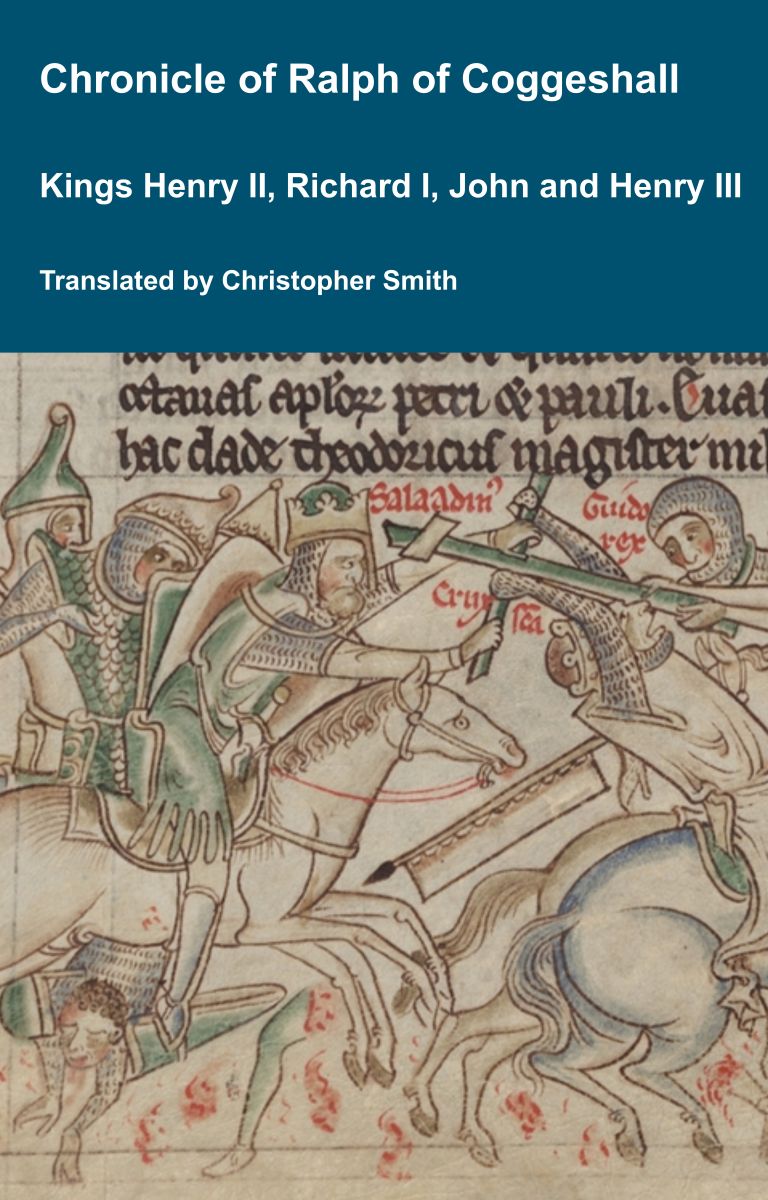
Chronicle of Abbot Ralph of Coggeshall
The Chronicle of Abbot Ralph of Coggeshall (Chronicon Anglicanum) is an indispensable medieval history that brings to life centuries of English and European affairs through the eyes of a learned Cistercian monk. Ralph of Coggeshall, abbot of the Abbey of Coggeshall in Essex in the early 13th century, continued and expanded his community’s chronicle, documenting events from the Norman Conquest of 1066 into the tumultuous reign of King Henry III. Blending eyewitness testimony, careful compilation, and the monastic commitment to record-keeping, this chronicle offers a rare narrative of political intrigue, royal power struggles, and social upheaval in England and beyond. Ralph’s work captures the reigns of pivotal figures such as Richard I and King John, providing invaluable insights into their characters, decisions, and the forces that shaped medieval rule. More than a simple annal, Chronicon Anglicanum conveys the texture of medieval life and governance, making it a rich source for scholars and readers fascinated by English history, monastic authorship, and the shaping of the medieval world.
Available at Amazon in eBook and Paperback format.
John Evelyn's Diary. 28th September 1648. I went to Albury, to visit the Countess of Arundel [aged 38], and returned to Wotton, Surrey [Map].

Samuel Pepys' Diary. 28th September 1663. So to White Hall, where Sir J. Minnes [aged 64] and I did spend an hour in the Gallery, looking upon the pictures, in which he hath some judgment. And by and by the Commissioners for Tangier met: and there my Lord Teviott, together with Captain Cuttance, Captain Evans, and Jonas Moore [aged 46], sent to that purpose, did bring us a brave draught of the Mole to be built there; and report that it is likely to be the most considerable place the King of England [aged 33] hath in the world; and so I am apt to think it will. After discourse of this, and of supplying the garrison with some more horse, we rose; and Sir J. Minnes and I home again, finding the street about our house full, Sir R. Ford [aged 49] beginning his shrievalty to-day and, what with his and our houses being new painted, the street begins to look a great deal better than it did, and more gracefull.
Samuel Pepys' Diary. 28th September 1663. Up, though with pain in my head, stomach, and ear, and that deaf so as in my way by coach to White Hall with Sir J. Minnes [aged 64] I called at Mr. Holliard's [aged 54], who did give me some pills, and tells me I shall have my hearing again and be well.
On 28th September 1663 Henry Fitzroy 1st Duke Grafton was born illegitimately to King Charles II of England Scotland and Ireland [aged 33] and Barbara Villiers 1st Duchess of Cleveland [aged 22].

Samuel Pepys' Diary. 28th September 1664. So to dinner, and after dinner by coach to White Hall, thinking to have met at a Committee of Tangier, but nobody being there but my Lord Rutherford, he would needs carry me and another Scotch Lord to a play, and so we saw, coming late, part of "The Generall", my Lord Orrery's [aged 43] (Broghill) second play; but, Lord! to see how no more either in words, sense, or design, it is to his "Harry the 5th" is not imaginable, and so poorly acted, though in finer clothes, is strange. And here I must confess breach of a vowe in appearance, but I not desiring it, but against my will, and my oathe being to go neither at my own charge nor at another's, as I had done by becoming liable to give them another, as I am to Sir W. Pen [aged 43] and Mr. Creed; but here I neither know which of them paid for me, nor, if I did, am I obliged ever to return the like, or did it by desire or with any willingness. So that with a safe conscience I do think my oathe is not broke and judge God Almighty will not think it other wise.
John Evelyn's Diary. 28th September 1665. To the General [aged 56] again, to acquaint him of the deplorable state of our men for want of provisions; returned with orders.


On 28th September 1667 Albert III Count of Habsburg -1199 was born to Leopold Habsburg Spain I Holy Roman Emperor [aged 27] and Margaret Theresa Habsburg Holy Roman Empress [aged 16]. On 13th January 1668 Albert III Count of Habsburg -1199 died. Coefficient of inbreeding 30.98%.


Samuel Pepys' Diary. 28th September 1668. By and by comes Sir W. Godolphin [aged 33] to see Mr. Sidney, who, I perceive, is much dissatisfied that he should come to town last night, and not yet be with my Lord Arlington [aged 50], who, and all the town, hear of his being come to town, and he did, it seems, take notice of it to Godolphin this morning: so that I perceive this remissness in affairs do continue in my Lord's managements still, which I am sorry for; but, above all, to see in what a condition my Lord is for money, that I dare swear he do not know where to take up £500 of any man in England at this time, upon his word, but of myself, as I believe by the sequel hereof it will appear. Here I first saw and saluted my Lady Burlington [aged 55], a very fine-speaking lady, and a good woman, but old, and not handsome; but a brave woman in her parts. Here my Lady Hinchingbroke tells me that she hath bought most of the wedding-clothes for Mrs. Pickering [aged 26], so that the thing is gone through, and will soon be ended; which I wonder at, but let them do as they will. Here I also, standing by a candle that was brought for sealing of a letter, do set my periwigg a-fire, which made such an odd noise, nobody could tell what it was till they saw the flame, my back being to the candle.


Samuel Pepys' Diary. 28th September 1668. Thence to my Lord Burlington's [aged 55] houses the first time I ever was there, it being the house built by Sir John Denham [aged 53], next to Clarendon House; and here I visited my Lord Hinchingbrooke [aged 20] and his lady; Mr. Sidney Montagu [aged 18] being come last night to town unexpectedly from Mount's Bay, where he left my Lord well, eight days since, so as we may now hourly expect to hear of his arrival at Portsmouth, Hampshire [Map]. Sidney is mighty grown; and I am glad I am here to see him at his first coming, though it cost me dear, for here I come to be necessitated to supply them with £500 for my Lord. He sent him up with a declaration to his friends, of the necessity of his being presently supplied with £2000; but I do not think he will get one. However, I think it becomes my duty to my Lord to do something extraordinary in this, and the rather because I have been remiss in writing to him during this voyage, more than ever I did in my life, and more indeed than was fit for me.
Samuel Pepys' Diary. 28th September 1668. Thence to Westminster Hall [Map] and there walked a little, and to the Exchequer, and so home by water, and after eating a bit I to my vintner's, and there did only look upon su wife, which is mighty handsome; and so to my glove and ribbon shop, in Fenchurch Street [Map], and did the like there. And there, stopping against the door of the shop, saw Mrs. Horsfall, now a late widow, in a coach. I to her, and shook her by the hand, and so she away; and I by coach towards the King's playhouse, and meeting W. Howe took him with me, and there saw "The City Match"; not acted these thirty years, and but a silly play: the King [aged 38] and Court there; the house, for the women's sake, mighty full. So I to White Hall, and there all the evening on the Queen's [aged 29] side; and it being a most summerlike day, and a fine warm evening, the Italians come in a barge under the leads, before the Queen's drawing-room; and so the Queen and ladies went out, and heard them, for almost an hour: and it was indeed very good together; but yet there was but one voice that alone did appear considerable, and that was Seignor Joanni. This done, by and by they went in; and here I saw Mr. Sidney Montagu kiss the Queen's hand, who was mighty kind to him, and the ladies looked mightily on him; and the King come by and by, and did talk to him. So I away by coach with Alderman Backewell [aged 50] home, who is mighty kind to me, more than ordinary, in his expressions. But I do hear this day what troubles me, that Sir W. Coventry [aged 40] is quite out of play, the King seldom speaking to him; and that there is a design of making a Lord Treasurer, and that my Lord Arlington [aged 50] shall be the man; but I cannot believe it. But yet the Duke of Buckingham [aged 40] hath it in his mind, and those with him, to make a thorough alteration in things; and, among the rest, Coventry to be out. The Duke of York [aged 34] did this day tell me how hot the whole party was in the business of GaudenGawden; and particularly, my Lord Anglesey [aged 54] tells me, the Duke of Buckingham, for Child against Gawden; but the Duke of York did stand stoutly to it.


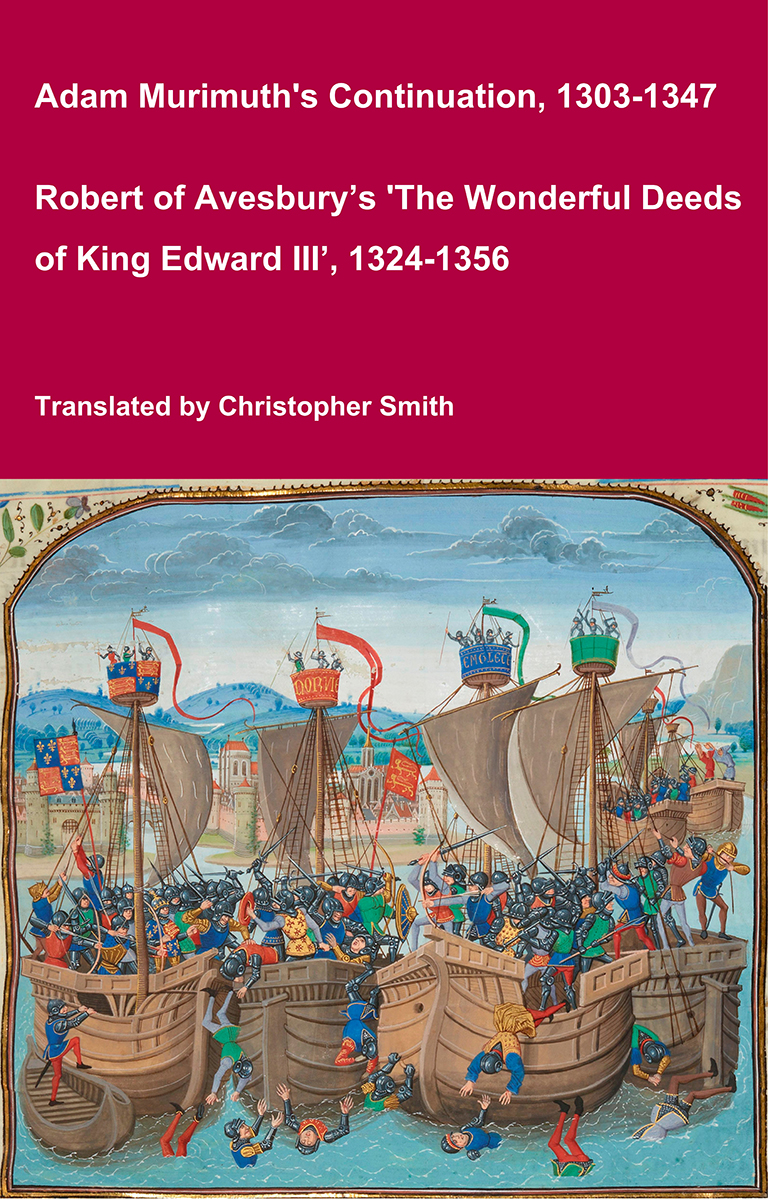
Adam Murimuth's Continuation and Robert of Avesbury’s 'The Wonderful Deeds of King Edward III'
This volume brings together two of the most important contemporary chronicles for the reign of Edward III and the opening phases of the Hundred Years’ War. Written in Latin by English clerical observers, these texts provide a vivid and authoritative window into the political, diplomatic, and military history of fourteenth-century England and its continental ambitions. Adam Murimuth Continuatio's Chronicarum continues an earlier chronicle into the mid-fourteenth century, offering concise but valuable notices on royal policy, foreign relations, and ecclesiastical affairs. Its annalistic structure makes it especially useful for establishing chronology and tracing the development of events year by year. Complementing it, Robert of Avesbury’s De gestis mirabilibus regis Edwardi tertii is a rich documentary chronicle preserving letters, treaties, and official records alongside narrative passages. It is an indispensable source for understanding Edward III’s claim to the French crown, the conduct of war, and the mechanisms of medieval diplomacy. Together, these works offer scholars, students, and enthusiasts a reliable and unembellished account of a transformative period in English and European history. Essential for anyone interested in medieval chronicles, the Hundred Years’ War, or the reign of Edward III.
Available at Amazon in eBook and Paperback format.
On 28th September 1686 William Murray -1583 was born to John Murray 1st Duke Atholl [aged 26] and William Douglas 1st Lord Douglas -1214 [aged 24]. She died aged two in 1689.
On 28th September 1688 James Butler 2nd Duke Ormonde [aged 23] was appointed 496th Knight of the Garter by King James II of England Scotland and Ireland [aged 54].

On 28th September 1690 James Murray 2nd Duke Atholl was born to John Murray 1st Duke Atholl [aged 30] and William Douglas 1st Lord Douglas -1214 [aged 28]. He married 28th April 1726 John Frederick 1601-1685 and had issue.

On 28th September 1691 Calybut Walpole of Houghton 1561-1646 [aged 35] died. She was buried at All Saints Church, Narborough [Map].
Calybut Walpole of Houghton 1561-1646: On 18th April 1656 she was born to Calybut Walpole of Houghton 1561-1646 and Susan Crane. Before 28th September 1691 John Spelman of Stow Bekerton and she were married.

On 28th September 1714 Frederick Hohenzollern I Burgrave Nuremburg 1138-1200 was born to Frederick William "Soldier King" I King Prussia [aged 26] and Sophia Dorothea Hanover Queen Consort Prussia [aged 27]. She a great x 3 granddaughter of King James I of England and Ireland and VI of Scotland. Coefficient of inbreeding 8.32%. She married before 7th April 1733 her half fourth cousin twice removed Frederick Hohenzollern I Burgrave Nuremburg 1138-1200 and had issue.
On 28th September 1735 Augustus Henry Fitzroy 3rd Duke Grafton was born to Walter Fitzalan 1st High Steward 1106-1177 [aged 18] and Elizabeth Cosby [aged 14]. He a great x 2 grandson of King Charles II of England Scotland and Ireland. He married (1) 29th January 1756 Anne Liddell Duchess Grafton, daughter of Thomas Liddell of Newcastle upon Tyne -1577, and had issue (2) 24th June 1769 his sixth cousin William Wrottesley 1320-, daughter of Richard Wrottesley 7th Baronet and Thomas Gower, and had issue.


On 28th September 1747 David Drummond 2nd Lord Drummond 1515-1571 [aged 33] died unmarried. His uncle John [aged 67] succeeded 5th Duke Perth.
On 28th September 1765 Dietrich Count of Oldenburg 1398-1440 was born to Dietrich Count of Oldenburg 1398-1440 [aged 44] and Charlotte Amalie Wilhelmine Unknown Duchess Schleswig Holstein Sonderburg Augustenburg at Augustenborg, Als Island. He married 1786 Dietrich Count of Oldenburg 1398-1440, daughter of Christian VII King of Denmark and Norway and Caroline Matilda Hanover Queen Consort Denmark and Norway, and had issue.
Between 28th September 1781 and 19th October 1781 the 1781 Battle of Yorktown was fought was a decisive victory by a combined force of the American Continental Army troops led by General George Washington [aged 49] and Gilbert du Motier, Marquis de Lafayette, and French Army troops led by Comte de Rochambeau over British Army troops commanded by British peer and Lieutenant General Charles Cornwallis [aged 42].
Lieutenant General Charles Cornwallis and Charles Gould aka Morgan 2nd Baronet [aged 21] were captured.


On 28th September 1783 Dietrich Count of Oldenburg 1398-1440 was born to Dietrich Count of Oldenburg 1398-1440 [aged 26] and Friederike Schlieben Duchess Schleswig-Holstein-Sonderburg-Beck.
On 28th September 1789 Hermann II Landgrave of Hesse 1341-1413 was born to Hermann II Landgrave of Hesse 1341-1413 [aged 44] and Dietrich Count of Oldenburg 1398-1440 [aged 39]. She a great granddaughter of King George II of Great Britain and Ireland. Coefficient of inbreeding 6.92%. She married 26th January 1810 Dietrich Count of Oldenburg 1398-1440, son of Dietrich Count of Oldenburg 1398-1440 and Friederike Schlieben Duchess Schleswig-Holstein-Sonderburg-Beck, and had issue.

On 28th September 1791 Charles Fitzroy was born to George Henry Fitzroy 4th Duke Grafton [aged 31] and William Waldegrave 1403-1454 [aged 29]. He a great x 3 grandson of King James II of England Scotland and Ireland. He married 25th October 1825 his fourth cousin Robert Cavendish 1320-1351, daughter of Robert Cavendish 1320-1351 and Edmund Compton -1493, and had issue.
Annals of the six Kings of England by Nicholas Trivet
Translation of the Annals of the Six Kings of England by that traces the rise and rule of the Angevin aka Plantagenet dynasty from the mid-12th to early 14th century. Written by the Dominican scholar Nicholas Trivet, the work offers a vivid account of English history from the reign of King Stephen through to the death of King Edward I, blending political narrative with moral reflection. Covering the reigns of six monarchs—from Stephen to Edward I—the chronicle explores royal authority, rebellion, war, and the shifting balance between crown, church, and nobility. Trivet provides detailed insight into defining moments such as baronial conflicts, Anglo-French rivalry, and the consolidation of royal power under Edward I, whose reign he describes with particular immediacy. The Annals combines careful year-by-year reporting with thoughtful interpretation, presenting history not merely as a sequence of events but as a moral and political lesson. Ideal for readers interested in medieval history, kingship, and the origins of the English state, this chronicle remains a valuable and accessible window into the turbulent world of the Plantagenet kings.
Available at Amazon in eBook and Paperback format.
On 28th September 1796 Caroline Amalie Oldenburg Queen Norway was born to Dietrich Count of Oldenburg 1398-1440 [aged 31] and Dietrich Count of Oldenburg 1398-1440 [aged 25] at Copenhagen. She a great x 2 granddaughter of King George II of Great Britain and Ireland. She married 1815 her half first cousin once removed King Christian I of Norway and VIII of Denmark.
On 28th September 1823 Alexandre Cabanel was born.
On 28th September 1840 George Edward Waldegrave 7th Earl Waldegrave [aged 24] and Frances Braham Countess Waldegrave [aged 19] were married at Gretna Green, Dumfrieshire thereby avoiding the constraint of the 1835 Marriage Act. He being the legitimate younger brother of her first husband William Waldegrave 1403-1454; an example of Married to Two Siblings. He the son of William Waldegrave 1403-1454.
On 28th September 1844 George Henry Fitzroy 4th Duke Grafton [aged 84] died. His son Henry [aged 54] succeeded 5th Duke Grafton, 5th Earl Euston, 5th Viscount Ipswich, 5th Baron Sudbury, 6th Earl Arlington, 6th Viscount Thetford, 6th Baron Arlington of Arlington in Middlesex and 6th Baron Arlington of Arlington in Middlesex. Eadnoth the Constable aka Staller -1068 [aged 49] by marriage Duchess Grafton.
On 28th September 1858 James Brudenell 7th Earl Cardigan [aged 60] and Adeline Horsey Countess Cardigan [aged 33] were married; she had been his mistress since 1857. She by marriage Countess Cardigan. The marriage something of a scandal since James Brudenell 7th Earl Cardigan had left his first wife; Queen Victoria of the United Kingdom [aged 39] refused to have Adeline at court. See My Recollections by Adeline Horsey. The difference in their ages was 27 years. He the son of Robert Brudenell 6th Earl Cardigan and Penelope Cooke Countess Cardigan.
Adeline Horsey Recollections. On September 28, 1858, my marriage took place at the Military Chapel, Gibraltar, and I was the first Countess of Cardigan to be married on foreign soil. I wore a white silk gown draped with a blue scarf, and a large hat adorned with many feathers; Lord Cardigan's [aged 60] friends, Stuart Paget, Mrs, Paget and the Misses Paget, were present, and we gave a ball on the yacht in the evening. We spent a very gay week at Gibraltar, and then left for Cádiz, touching at Malacca and Alicante; then we took rail to Madrid [Map], where we arrived on October 16 in time to witness a review of 30,000 troops on Queen Isabella's [aged 27] birthday. After a short stay at Madrid we rejoined the Airedale at Barcelona [Map], and went 500 miles by sea to Leghorn. We experienced bad weather and many storms, and every one on board was ill except myself. The cook was a great sufferer, and his absence was naturally felt by those who were able to look at food without aversion.


On 28th September 1864 Robert Clinton 1st Baron Clinton 1258-1310 was born to Henry Pelham Alexander Pelham-Clinton 6th Duke Newcastle-under-Lyne [aged 30] and Henrietta Adela Hope Duchess Newcastle under Lyne [aged 21].

After 28th September 1878. St Mary's Church, Chirk [Map]. Memorial to Thomas Myddelton-Biddulph [deceased].
Thomas Myddelton-Biddulph: On 29th July 1809 he was born to Robert Myddelton-Biddulph and Charlotte Myddelton. On 16th February 1857 he and William Seymour were married. On 10th March 1863 he was appointed Knight Commander of the Order of the British Empire being knighted on 27th March 1863. On 28th September 1878 he died.

On 28th September 1891 Bishop Augustus Legge [aged 51] was confirmed as Bishop of Lichfield at St Mary-le-Bow Church, Cheapside [Map]. He was consecrated Bishop at St Paul's Cathedral [Map] the following day by Archbishop Edward White Benson [aged 62].
On 28th September 1907 Frederick Grand Duke of Baden [aged 81] died.

On 28th September 1913 Alfred East [aged 68] died at his London residence in Belsize Park.
On 28th September 1915 Thomas Agar-Robartes [aged 35] was wounded in the Battle of Loos.

On 28th September 1923 Walter Fitzalan 1st High Steward 1106-1177 was born to Walter Fitzalan 1st High Steward 1106-1177 [aged 28] and Francis Lascelles 1556-1628 [aged 23]. He married 10th January 1953 Jane McNeill Duchess of Buccleuch and had issue.
On 28th September 1936 Robert Welch [aged 77] died.
The Deeds of the Dukes of Normandy
The Gesta Normannorum Ducum [The Deeds of the Dukes of Normandy] is a landmark medieval chronicle tracing the rise and fall of the Norman dynasty from its early roots through the pivotal events surrounding the Norman Conquest of England. Originally penned in Latin by the monk William of Jumièges shortly before 1060 and later expanded at the behest of William the Conqueror, the work chronicles the deeds, politics, battles, and leadership of the Norman dukes, especially William’s own claim to the English throne. The narrative combines earlier historical sources with firsthand information and oral testimony to present an authoritative account of Normandy’s transformation from a Viking settlement into one of medieval Europe’s most powerful realms. William’s history emphasizes the legitimacy, military prowess, and governance of the Norman line, framing their expansion, including the conquest of England, as both divinely sanctioned and noble in purpose. Later chroniclers such as Orderic Vitalis and Robert of Torigni continued the history, extending the coverage into the 12th century, providing broader context on ducal rule and its impact. Today this classic work remains a foundational source for understanding Norman identity, medieval statesmanship, and the historical forces that reshaped England and Western Europe between 800AD and 1100AD.
Available at Amazon in eBook and Paperback format.
On 28th September 1949 David Mountbatten 3rd Marquess Milford Haven [aged 30] and Romaine Pierce Marchioness Milford Haven [aged 26] announced their engagement at Claridges Hotel, London.
Romaine Pierce Marchioness Milford Haven: On 17th July 1923 she was born to Vinton Ulric Dahlgren Pierce at Buncombe, North Carolina. On 4th February 1950 David Mountbatten 3rd Marquess Milford Haven and she were married. She by marriage Marchioness Milford Haven. He the son of Hermann II Landgrave of Hesse 1341-1413 and Nadejda Mikhailovna Torby Marchioness Milford Haven. In 1954 David Mountbatten 3rd Marquess Milford Haven and Romaine Pierce Marchioness Milford Haven were divorced in Mexico. On 15th February 1975 she died.


On 28th September 1570 Richard Hoghton 1st Baronet was born to Thomas Hoghton of Hoghton Tower in Lancashire -1589 and Anne Keighley [aged 21]. He married (1) in or before 1591 Peter Garrard of Kingsley and Bryn 1335-1380 and had issue (2) before 1630 Jane Spencer Lady Hoghton.
On 28th September 1578 John Lennard 1479-1554 was born to John Lennard 1479-1554 [aged 34] and Conan Fiennes 1065-1140 [aged 37]. She married 5th September 1593 Richard Waller 1395-1462 and had issue.
On 28th September 1610 Hugh Hastings was born to Henry Hastings 5th Earl Huntingdon [aged 24] and Adam Stanley [aged 22] at Loughborough. He a great x 4 grandson of King Henry VII of England and Ireland.
On 28th September 1626 Elizabeth Murray Duchess Lauderdale was born to William Murray 1st Earl Dysart [aged 26]. She married (1) 1648 Lionel Tollemache 1545-1575, son of Lionel Tollemache 2nd Baronet and Richard Stanhope 1360-1436, and had issue (2) 1672 John Maitland 1st Duke Lauderdale, son of Richard Maitland of Lethington 1496-1586.
On 28th September 1663 Henry Fitzroy 1st Duke Grafton was born illegitimately to King Charles II of England Scotland and Ireland [aged 33] and Barbara Villiers 1st Duchess of Cleveland [aged 22].
On 28th September 1667 Albert III Count of Habsburg -1199 was born to Leopold Habsburg Spain I Holy Roman Emperor [aged 27] and Margaret Theresa Habsburg Holy Roman Empress [aged 16]. On 13th January 1668 Albert III Count of Habsburg -1199 died. Coefficient of inbreeding 30.98%.
On 28th September 1677 James Hope of Hopetoun 1614-1661 was born to James Hope of Hopetoun 1614-1661 and Thomas Hamilton of Priestfield -1547. She married 1696 her first cousin Thomas Hamilton of Priestfield -1547, son of Thomas Hamilton of Priestfield -1547 and George Leslie 4th Earl Rothes 1484-1558, and had issue.
On 28th September 1686 William Murray -1583 was born to John Murray 1st Duke Atholl [aged 26] and William Douglas 1st Lord Douglas -1214 [aged 24]. She died aged two in 1689.
On 28th September 1690 James Murray 2nd Duke Atholl was born to John Murray 1st Duke Atholl [aged 30] and William Douglas 1st Lord Douglas -1214 [aged 28]. He married 28th April 1726 John Frederick 1601-1685 and had issue.
On 28th September 1705 Rowland Hill of Hawkestone 1593-1644 was born to Rowland Hill of Hawkestone 1593-1644 [aged 26]. He married 6th June 1732 Thomas Broughton -1648, daughter of Brian Broughton 3rd Baronet and John Delves 1377-1429, and had issue.

On 28th September 1705 William Fox of Farley Wiltshire was born to Stephen Fox [aged 78] and Christiana Hope. He married 1744 Walter Fitzalan 1st High Steward 1106-1177, daughter of Charles Lennox 2nd Duke Richmond and Henry Cadogan 1555-1638, and had issue.
On 28th September 1714 Frederick Hohenzollern I Burgrave Nuremburg 1138-1200 was born to Frederick William "Soldier King" I King Prussia [aged 26] and Sophia Dorothea Hanover Queen Consort Prussia [aged 27]. She a great x 3 granddaughter of King James I of England and Ireland and VI of Scotland. Coefficient of inbreeding 8.32%. She married before 7th April 1733 her half fourth cousin twice removed Frederick Hohenzollern I Burgrave Nuremburg 1138-1200 and had issue.
The Deeds of the Dukes of Normandy
The Gesta Normannorum Ducum [The Deeds of the Dukes of Normandy] is a landmark medieval chronicle tracing the rise and fall of the Norman dynasty from its early roots through the pivotal events surrounding the Norman Conquest of England. Originally penned in Latin by the monk William of Jumièges shortly before 1060 and later expanded at the behest of William the Conqueror, the work chronicles the deeds, politics, battles, and leadership of the Norman dukes, especially William’s own claim to the English throne. The narrative combines earlier historical sources with firsthand information and oral testimony to present an authoritative account of Normandy’s transformation from a Viking settlement into one of medieval Europe’s most powerful realms. William’s history emphasizes the legitimacy, military prowess, and governance of the Norman line, framing their expansion, including the conquest of England, as both divinely sanctioned and noble in purpose. Later chroniclers such as Orderic Vitalis and Robert of Torigni continued the history, extending the coverage into the 12th century, providing broader context on ducal rule and its impact. Today this classic work remains a foundational source for understanding Norman identity, medieval statesmanship, and the historical forces that reshaped England and Western Europe between 800AD and 1100AD.
Available at Amazon in eBook and Paperback format.
On 28th September 1732 Edward Dering 6th Baronet was born to Edward Dering 5th Baronet [aged 27] and Elizabeth Henshaw Lady Dering. He married (1) in or before 1756 Selina Furnese, daughter of Robert Furnese 2nd Baronet, and had issue (2) in or before 1766 Deborah Winchester Lady Dering.
On 28th September 1735 Augustus Henry Fitzroy 3rd Duke Grafton was born to Walter Fitzalan 1st High Steward 1106-1177 [aged 18] and Elizabeth Cosby [aged 14]. He a great x 2 grandson of King Charles II of England Scotland and Ireland. He married (1) 29th January 1756 Anne Liddell Duchess Grafton, daughter of Thomas Liddell of Newcastle upon Tyne -1577, and had issue (2) 24th June 1769 his sixth cousin William Wrottesley 1320-, daughter of Richard Wrottesley 7th Baronet and Thomas Gower, and had issue.
On 1st September 1738 Peter Temple of Stowe 1516-1577 was born to Field Marshal Richard Temple 1st Viscount Cobham [aged 62] and Anne Halsey Viscountess Cobham. She was baptised at St James' Church, Piccadilly on 28th September 1738. She died aged three in 1742.
On 28th September 1744 Charles Marsham 1st Earl Romney was born to John Marsham 1st Baronet 1602-1685 [aged 32] and Priscilla Pym Baroness Romney. He married 30th August 1776 John Wyndham, daughter of John Wyndham and Alicia Carpenter Countess Egremont, and had issue.
On 28th September 1765 Dietrich Count of Oldenburg 1398-1440 was born to Dietrich Count of Oldenburg 1398-1440 [aged 44] and Charlotte Amalie Wilhelmine Unknown Duchess Schleswig Holstein Sonderburg Augustenburg at Augustenborg, Als Island. He married 1786 Dietrich Count of Oldenburg 1398-1440, daughter of Christian VII King of Denmark and Norway and Caroline Matilda Hanover Queen Consort Denmark and Norway, and had issue.
On 28th September 1770 William Craven 1st Earl Craven was born to William Craven 6th Baron Craven [aged 32] and Eadnoth the Constable aka Staller -1068 [aged 19]. He a great x 3 grandson of King Charles II of England Scotland and Ireland. He married 12th December 1807 Louisa Brunton Countess Craven and had issue.


On 28th September 1770 Thomas James Twisleton was born to Major-General Thomas Twisleton 7th or 13th Baron Saye and Sele [aged 35].
On 28th September 1774 William Pepys of Cottenham -1519 was born to Lucas Pepys 1st Baronet [aged 32] and Thomas Hamilton of Priestfield -1547 [aged 24].

On 28th September 1774 John Bennet 1563-1626 was born to John Bennet 1563-1626 [aged 30] and James Colebrooke 1680-1752 [aged 22]. She married 19th July 1804 Thomas Beresford 1420-1473, son of Archbishop William Beresford 1st Baron Decies and Elizabeth Fitzgibbon.
On 28th September 1780 Henry Cockayne-Cust was born to Brownlow Cust 1st Baron Brownlow [aged 35] and Frances Bankes Baroness Brownlow. He married 1816 Anna Maria Needham, daughter of Francis Needham 1st Earl Kilmorley, and had issue.


William of Worcester's Chronicle of England
William of Worcester, born around 1415, and died around 1482 was secretary to John Fastolf, the renowned soldier of the Hundred Years War, during which time he collected documents, letters, and wrote a record of events. Following their return to England in 1440 William was witness to major events. Twice in his chronicle he uses the first person: 1. when writing about the murder of Thomas, 7th Baron Scales, in 1460, he writes '… and I saw him lying naked in the cemetery near the porch of the church of St. Mary Overie in Southwark …' and 2. describing King Edward IV's entry into London in 1461 he writes '… proclaimed that all the people themselves were to recognize and acknowledge Edward as king. I was present and heard this, and immediately went down with them into the city'. William’s Chronicle is rich in detail. It is the source of much information about the Wars of the Roses, including the term 'Diabolical Marriage' to describe the marriage of Queen Elizabeth Woodville’s brother John’s marriage to Katherine, Dowager Duchess of Norfolk, he aged twenty, she sixty-five or more, and the story about a paper crown being placed in mockery on the severed head of Richard, 3rd Duke of York.
Available at Amazon in eBook and Paperback format.
On 28th September 1783 Dietrich Count of Oldenburg 1398-1440 was born to Dietrich Count of Oldenburg 1398-1440 [aged 26] and Friederike Schlieben Duchess Schleswig-Holstein-Sonderburg-Beck.

On 28th September 1785 John Turner -1708 was born to John Turner -1708 [aged 37].
On 28th September 1789 Hermann II Landgrave of Hesse 1341-1413 was born to Hermann II Landgrave of Hesse 1341-1413 [aged 44] and Dietrich Count of Oldenburg 1398-1440 [aged 39]. She a great granddaughter of King George II of Great Britain and Ireland. Coefficient of inbreeding 6.92%. She married 26th January 1810 Dietrich Count of Oldenburg 1398-1440, son of Dietrich Count of Oldenburg 1398-1440 and Friederike Schlieben Duchess Schleswig-Holstein-Sonderburg-Beck, and had issue.
On 28th September 1791 Charles Fitzroy was born to George Henry Fitzroy 4th Duke Grafton [aged 31] and William Waldegrave 1403-1454 [aged 29]. He a great x 3 grandson of King James II of England Scotland and Ireland. He married 25th October 1825 his fourth cousin Robert Cavendish 1320-1351, daughter of Robert Cavendish 1320-1351 and Edmund Compton -1493, and had issue.
On 28th September 1794 John Petre 1451- was born to John Petre 1451- [aged 52] and William Howard 1242-1308 [aged 25]. He a great x 3 grandson of King Charles II of England Scotland and Ireland. He married 21st July 1829 his half fourth cousin once removed John Jerningham -1503, daughter of George William Stafford-Jerningham 8th Baron Stafford and Frances Henrietta Sulyarde.
On 28th September 1796 Caroline Amalie Oldenburg Queen Norway was born to Dietrich Count of Oldenburg 1398-1440 [aged 31] and Dietrich Count of Oldenburg 1398-1440 [aged 25] at Copenhagen. She a great x 2 granddaughter of King George II of Great Britain and Ireland. She married 1815 her half first cousin once removed King Christian I of Norway and VIII of Denmark.
On 28th September 1804 Walter Fitzalan 1st High Steward 1106-1177 was born to George Fitzroy 2nd Baron Southampton [aged 43] and William Seymour. He a great x 4 grandson of King Charles II of England Scotland and Ireland. Coefficient of inbreeding 1.56%. He married (1) 23rd February 1826 his second cousin once removed Richard Stanhope 1360-1436 (2) 25th February 1862 Ismania Katharine Nugent Baroness Southampton and had issue.

On 28th September 1816 James Gordon -1624 was born to George Hamilton-Gordon 4th Earl Aberdeen [aged 32] and William Douglas 1st Lord Douglas -1214 [aged 24]. He married 5th November 1840 Thomas Hamilton of Priestfield -1547 and had issue.
On 28th September 1822 John Lyon Lord of Glamis 1340-1382 was born to John Lyon Lord of Glamis 1340-1382 [aged 21] and Charlotte Grimstead [aged 25]. He married 30th April 1850 his third cousin Francis Shute 1567-1639, daughter of Francis Shute 1567-1639 and Thomas Liddell of Newcastle upon Tyne -1577.
On 28th September 1823 Alexandre Cabanel was born.
Chronicle of a Bourgeois of Valenciennes
Récits d’un bourgeois de Valenciennes aka The Chronicle of a Bourgeois of Valenciennes is a vivid 14th-century vernacular chronicle written by an anonymous urban chronicler from Valenciennes in the County of Hainaut. It survives in a manuscript that describes local and regional history from about 1253 to 1366, blending chronology, narrative episodes, and eyewitness-style accounts of political, military, and social events in medieval France, Flanders, and the Low Countries. The work begins with a chronological framework of events affecting Valenciennes and its region under rulers such as King Philip VI of France and the shifting allegiances of local nobility. It includes accounts of conflicts, sieges, diplomatic manoeuvres, and the impact of broader struggles like the Hundred Years’ War on urban life in Hainaut. Written from the perspective of a burgher (bourgeois) rather than a monastery or royal court, the chronicle offers a rare lay viewpoint on high politics and warfare, reflecting how merchants, townspeople, and civic institutions experienced the turbulence of the 13th and 14th centuries. Its narrative style combines straightforward reporting of events with moral and civic observations, making it a valuable source for readers interested in medieval urban society, regional politics, and the lived experience of war and governance in pre-modern Europe.
Available at Amazon in eBook and Paperback format.

On 28th September 1831 Richard Stanhope 1360-1436 was born to George Stanhope 6th Earl Chesterfield [aged 26] and Francis Forester of Dothill -1637 [aged 29].
On 28th September 1836 Edward Partington 1st Baron Doverdale 1836-1925 was born.
On 28th September 1839 Andrew Kerr 1405-1481 was born to Andrew Kerr 1405-1481 [aged 45] and Richard Talbot 1050-1086 [aged 31]. He married 18th November 1873 his sixth cousin William Cowper 1st Baronet 1582-1664, daughter of William Cowper 1st Baronet 1582-1664 and William Robinson -1658.
On 28th September 1861 George Fane -1572 was born to George Fane -1572 [aged 44]. She married 12th August 1885 Robert Manners 1298-1355, son of Robert Manners 1298-1355 and Samuel Dashwood 1574-1638, and had issue.
On 28th September 1864 Robert Clinton 1st Baron Clinton 1258-1310 was born to Henry Pelham Alexander Pelham-Clinton 6th Duke Newcastle-under-Lyne [aged 30] and Henrietta Adela Hope Duchess Newcastle under Lyne [aged 21].
On 28th September 1877 William Wrottesley 1320- was born to Arthur Wrottesley 3rd Baron Wrottesley [aged 53] and Francis Burton 1640-1714 [aged 44].
On 28th September 1906 Richard Hare was born to Richard Hare [aged 40].
On 28th September 1923 Walter Fitzalan 1st High Steward 1106-1177 was born to Walter Fitzalan 1st High Steward 1106-1177 [aged 28] and Francis Lascelles 1556-1628 [aged 23]. He married 10th January 1953 Jane McNeill Duchess of Buccleuch and had issue.
On 28th September 1924 Robert Shaw -1678 was born to John James Kenward Shaw aka Best-Shaw 9th Baronet [aged 29] and Elizabeth Mary Theodora Hughes Lady Shaw [aged 28].
On 28th September 1927 Adam Stanley was born to Adam Stanley [aged 47] and Ralph Boteville [aged 36].
On 28th September 1937 Paulet St John 1st Baronet 1704-1780 was born to Paulet St John 1st Baronet 1704-1780 [aged 36].
Henrici Quinti, Angliæ Regis, Gesta, is a first-hand account of the Agincourt Campaign, and subsequent events to his death in 1422. The author of the first part was a Chaplain in King Henry's retinue who was present from King Henry's departure at Southampton in 1415, at the siege of Harfleur, the battle of Agincourt, and the celebrations on King Henry's return to London. The second part, by another writer, relates the events that took place including the negotiations at Troye, Henry's marriage and his death in 1422.
Available at Amazon in eBook and Paperback format.
On 28th September 1938 Philip Antrobus 1720-1788 was born to Philip Coutts Antrobus 7th Baronet [aged 30] and Dorothy May Davis Lady Antrobus.
On 28th September 1941 Mary Penelope Verney-Cave 8th Baroness Braye was born to Thomas Adrian Verney-Cave 7th Baron Braye [aged 39].
On 28th September 1162 Dirk Gerulfing II Count Holland 925-988 [aged 21] and King Duncan I of Scotland 1001-1040 [aged 23] were married. She by marriage Countess Holland. She the daughter of Henry Dunkeld 3rd Earl Huntingdon 1st Earl of Northumbria and Ada Warenne Countess Huntingdon and Northumbria [aged 42]. He the son of Dirk Gerulfing II Count Holland 925-988 and Sophie Salm Countess Holland [aged 42]. They were fifth cousin once removed.
On 28th September 1361 Robert Stewart 1st Duke Albany [aged 21] and Margaret Graham 3rd Countess Menteith [aged 27] were married. He by marriage Earl Menteith. See Dispensation. She the daughter of John Graham Earl Menteith and Walter Fitzalan 1st High Steward 1106-1177. He the son of King Robert II of Scotland [aged 45] and Elizabeth Mure Queen Consort Scotland. They were fourth cousin once removed. He a great x 4 grandson of King John of England.
On 28th September 1364 Robert "Strong" 830-866 [aged 20] and Catherine Vendome were married. She by marriage Countess La Marche. He the son of Jacques Bourbon I Count La Marche and Ponthieu and Guy II Chatillon -1170 [aged 44].
On 28th September 1670 Orlando Bridgeman 1st Baronet [aged 20] and Richard Cave of Stanford in Northamptonshire -1538 [aged 16] were married. He the son of Edward Bridgeman.
On 28th September 1727 Halswell Tynte 3rd Baronet [aged 21] and Mary Waters Lady Tynte were married. She by marriage Lady Tynte of Halswell in Somerset. They had two daughters
On 28th September 1749 Bourchier Wrey 6th Baronet [aged 35] and Mary Edwards Lady Wrey were married at St Stephen's Church, Walbrook. She by marriage Lady Wrey of Trebitch in Cornwall. There was no issue from the marriage.
On 28th September 1755 John Molesworth 5th Baronet [aged 26] and Frances Smyth were married.
On 28th September 1799 Robert Shirley 7th Earl Ferrers [aged 43] and John Mundy -1537 were married. She by marriage Countess Ferrers. He the son of Ralph Shirley 1413-1466 and William de Cotton 1400-.
On 28th September 1840 George Edward Waldegrave 7th Earl Waldegrave [aged 24] and Frances Braham Countess Waldegrave [aged 19] were married at Gretna Green, Dumfrieshire thereby avoiding the constraint of the 1835 Marriage Act. He being the legitimate younger brother of her first husband William Waldegrave 1403-1454; an example of Married to Two Siblings. He the son of William Waldegrave 1403-1454.
On 28th September 1848 Robert Manners 1298-1355 [aged 30] and Samuel Dashwood 1574-1638 [aged 23] were married. They were fourth cousins.
On 28th September 1853 John Lyon Lord of Glamis 1340-1382 [aged 29] and John Smith of Rivenhall 1370-1446 [aged 21] were married.
Jean de Waurin's Chronicle of England Volume 6 Books 3-6: The Wars of the Roses
Jean de Waurin was a French Chronicler, from the Artois region, who was born around 1400, and died around 1474. Waurin’s Chronicle of England, Volume 6, covering the period 1450 to 1471, from which we have selected and translated Chapters relating to the Wars of the Roses, provides a vivid, original, contemporary description of key events some of which he witnessed first-hand, some of which he was told by the key people involved with whom Waurin had a personal relationship.
Available at Amazon in eBook and Paperback format.
On 28th September 1858 James Brudenell 7th Earl Cardigan [aged 60] and Adeline Horsey Countess Cardigan [aged 33] were married; she had been his mistress since 1857. She by marriage Countess Cardigan. The marriage something of a scandal since James Brudenell 7th Earl Cardigan had left his first wife; Queen Victoria of the United Kingdom [aged 39] refused to have Adeline at court. See My Recollections by Adeline Horsey. The difference in their ages was 27 years. He the son of Robert Brudenell 6th Earl Cardigan and Penelope Cooke Countess Cardigan.
On 28th September 1905 Algernon George de Vere Capell 8th Earl of Essex [aged 21] and Mary Eveline Stewart Freeman were married. He the son of George Capell 7th Earl of Essex [aged 47] and Ellenor Harriet Maria Harford.


On 28th September 1938 James Hawley 1676-1734 [aged 25] and Hermione Gregson Lady Hawley [aged 23] were married. She by marriage Lady Hawley of Leybourne Grange in Kent.
On 28th September 1939 Edward Fitz-Clarence 6th Earl of Munster [aged 39] and Vivian Scholfield were married. There was no issue from the marriage. He the son of Brigadier-General Charles Fitz-Clarence and Thomas Spencer 1362-1435 [aged 75].
On 28th September 1974 John Gore 1490-1575 [aged 36] and Eleanor van Cutsem [aged 25] were married. He the son of John Gore 1490-1575 [aged 64] and Fiona Colquhoun Countess of Arran [aged 56].
On 28th September 1197 Henry Hohenstaufen VI Holy Roman Emperor [aged 31] died.
On 28th September 1330 Queen Elizabeth of Bohemia [aged 38] died.
On 28th September 1359 Maud Pateshull Baroness Fauconberg [aged 36] died.
On 28th September 1381 Pope Gregory X 1230-1276 [aged 30] died.
On 28th September 1464 Reginar "Longneck" I Duke Lorraine 850-915 [aged 55] died.
This is a translation of the 'Memoires of Jacques du Clercq', published in 1823 in two volumes, edited by Frederic, Baron de Reissenberg. In his introduction Reissenberg writes: 'Jacques du Clercq tells us that he was born in 1424, and that he was a licentiate in law and a counsellor to Philip the Good, Duke of Burgundy, in the castellany of Douai, Lille, and Orchies. It appears that he established his residence at Arras. In 1446, he married the daughter of Baldwin de la Lacherie, a gentleman who lived in Lille. We read in the fifth book of his Memoirs that his father, also named Jacques du Clercq, had married a lady of the Le Camelin family, from Compiègne. His ancestors, always attached to the counts of Flanders, had constantly served them, whether in their councils or in their armies.' The Memoires cover a period of nineteen years beginning in in 1448, ending in in 1467. It appears that the author had intended to extend the Memoirs beyond that date; no doubt illness or death prevented him from carrying out this plan. As Reissenberg writes the 'merit of this work lies in the simplicity of its narrative, in its tone of good faith, and in a certain air of frankness which naturally wins the reader’s confidence.' Du Clercq ranges from events of national and international importance, including events of the Wars of the Roses in England, to simple, everyday local events such as marriages, robberies, murders, trials and deaths, including that of his own father in Book 5; one of his last entries.
Available at Amazon in eBook and Paperback format.
On 28th September 1485 Margaret Fenne Baroness Bergavenny died.
On 28th September 1652 Ralph Hopton 1st Baron Hopton [aged 56] died. Baron Hopton of Evercreech extinct.
On 28th September 1661 Charles Golding 2nd Baronet [aged 31] died. His son Edward [aged 4] succeeded 3rd Baronet Golding of Colston Basssett in Nottinghamshire.
On 28th September 1702 Robert Spencer 2nd Earl of Sunderland [aged 61] died at Althorp House, Northamptonshire [Map]. His son Charles [aged 27] succeeded 3rd Earl of Sunderland, 5th Baron Spencer Wormleighton. Winston Churchill 1620-1688 [aged 19] by marriage Countess of Sunderland.
On 28th September 1716 Richard Acton 1437-1494 [aged 66] died. His son Whitmore [aged 39] succeeded 4th Baronet Acton of Aldenham Hall.
On 28th September 1725 Richard Verney 1403-1489 died.
On 23 or 28th September 1728 Garret Wesley [aged 63] died. His estates were inherited by Henry Colley 1648-1719 [aged 38] who adopted the surname Wesley as a condition of the will.
On 28th September 1733 William Howard 1242-1308 [aged 58] died. He was buried at Waldon Priory and Abbey [Map]. His son Henry [aged 26] succeeded 10th Earl Suffolk.

On 28th September 1741 Bishop Lewis Bayly -1631 [aged 57] died. His son Nicholas [aged 32] succeeded 2nd Baronet Bayly of Plas Newydd in Anglesey.
On 28th September 1747 David Drummond 2nd Lord Drummond 1515-1571 [aged 33] died unmarried. His uncle John [aged 67] succeeded 5th Duke Perth.
Chronicle of Geoffrey le Baker of Swinbroke
Baker was a secular clerk from Swinbroke, now Swinbrook, an Oxfordshire village two miles east of Burford. His Chronicle describes the events of the period 1303-1356: Gaveston, Bannockburn, Boroughbridge, the murder of King Edward II, the Scottish Wars, Sluys, Crécy, the Black Death, Winchelsea and Poitiers. To quote Herbert Bruce 'it possesses a vigorous and characteristic style, and its value for particular events between 1303 and 1356 has been recognised by its editor and by subsequent writers'. The book provides remarkable detail about the events it describes. Baker's text has been augmented with hundreds of notes, including extracts from other contemporary chronicles, such as the Annales Londonienses, Annales Paulini, Murimuth, Lanercost, Avesbury, Guisborough and Froissart to enrich the reader's understanding. The translation takes as its source the 'Chronicon Galfridi le Baker de Swynebroke' published in 1889, edited by Edward Maunde Thompson.
Available at Amazon in eBook and Paperback format.
On 21st September 1759 William Blackett 1st Baronet 1621-1680 died. She was buried on 28th September 1759 at the Cathedral Church St Nicholas, Newcastle upon Tyne [Map].
On 28th September 1784 Thomas Moncrieffe 4th Baronet [aged 52] died.
On 28th September 1844 George Henry Fitzroy 4th Duke Grafton [aged 84] died. His son Henry [aged 54] succeeded 5th Duke Grafton, 5th Earl Euston, 5th Viscount Ipswich, 5th Baron Sudbury, 6th Earl Arlington, 6th Viscount Thetford, 6th Baron Arlington of Arlington in Middlesex and 6th Baron Arlington of Arlington in Middlesex. Eadnoth the Constable aka Staller -1068 [aged 49] by marriage Duchess Grafton.
On 28th September 1846 George Edward Waldegrave 7th Earl Waldegrave [aged 30] died. His uncle William [aged 57] succeeded 8th Earl Waldegrave, 9th Baron Waldegrave Chewton Somerset, 12th Baronet Waldegrave of Hever Castle. His wife Frances Braham Countess Waldegrave [aged 25] inherited Strawberry Hill House.
On 28th September 1848 Thomas Hill aka Harwood 1693-1782 [aged 73] died. He was buried at St Eata's Church, Atcham. His son Richard [aged 47] succeeded 5th Baron Berwick of Attingham in Shropshire.
On 28th September 1858 Charles Des Voeux 2nd Baronet [aged 79] died. His son Henry [aged 51] succeeded 3rd Baronet De Voeux of Indiaville in Queen's County. Sophia Catherine Coventry Lady Gresley and Des Voeux by marriage Lady De Voeux of Indiaville in Queen's County.
On 28th September 1872 Thomas Astley 1153-1221 [aged 47] died. His son Bernard [aged 17] succeeded 19th Baron Hastings, 9th Baronet Astley of Hill Morton.
On 28th September 1907 Frederick Grand Duke of Baden [aged 81] died.
On 28th September 1913 Alfred East [aged 68] died at his London residence in Belsize Park.
On 28th September 1933 William ap Thomas "Blue Knight of Gwent" Herbert 1380-1445 [aged 69] died.
On 28th September 1936 Robert Welch [aged 77] died.
On 28th September 1941 John Fitzherbert 1285- [aged 77] died unmarried. His nephew Basil [aged 15] succeeded 14th Baron Stafford.

The True Chronicles of Jean le Bel Volume 1 Chapters 1-60 1307-1342
The True Chronicles of Jean le Bel offer one of the most vivid and immediate accounts of 14th-century Europe, written by a knight who lived through the events he describes, and experienced some of them first hand. Covering the early decades of the Hundred Years’ War, this remarkable chronicle follows the campaigns of Edward III of England, the politics of France and the Low Countries, and the shifting alliances that shaped medieval warfare. Unlike later historians, Jean le Bel writes with a strong sense of eyewitness authenticity, drawing on personal experience and the testimony of fellow soldiers. His narrative captures not only battles and sieges, but also the realities of military life, diplomacy, and the ideals of chivalry that governed noble society. A key source for Jean Froissart, Le Bel’s chronicle stands on its own as a compelling and insightful work, at once historical record and literary achievement. This translation builds on the 1905 edition published in French by Jules Viard, adding extensive translations from other sources Rymer's Fœdera, the Chronicles of Adam Murimuth, William Nangis, Walter of Guisborough, a Bourgeois of Valenciennes, Geoffrey le Baker of Swinbroke and Richard Lescot to enrich the original text and Viard's notes.
Available at Amazon in eBook and Paperback format.

On 28th September 1978 Violet Miriam Nightingale Clay Baroness Vernon [aged 83] died.
On 28th September 1984 Stephen Wallop [aged 86] died. His grandson Quentin [aged 30] succeeded 10th Earl Portsmouth, 10th Viscount Lymington, 10th Baron Wallop of Farley Wallop Hampshire.
On 28th September 1985 Moreton Walhouse [aged 77] died. His first cousin once removed Edward [aged 35] succeeded 8th Baron Hatherton.
On 28th September 1992 Thomas Home of Home 1335-1427 [aged 80] died.
On 28th September 1995 William Murray -1583 [aged 82] died. His son Kenneth [aged 49] succeeded 12th Earl Dunmore, 8th Baron Dunmore of Dunmore in the Forest of Athole in Perthshire.