

14 Jul is in July.
1503 Margaret Tudor's Journey to Scotland
1517 Sweating Sickness Outbreak
1528 Sweating Sickness Outbreak
1551 Sweating Sickness Outbreak
1641 Jul 1641 Creation of Baronets
1660 July Creation of Peerages
Bede. 664. Deusdedit, Archbishop Of Canterbury, Dying, Wighard was sent to Rome to succeed him in that dignity; But he dying there, Theodore was ordained Archbishop, and sent into Britain with the Abbot Hadrian.
In the above-mentioned year of the aforesaid eclipse, which was presently followed by the pestilence, in which also Bishop Colman, being overcome by the unanimous consent of the Catholics, returned home, Deusdedit, the sixth bishop of the church of Canterbury, died on the 14th of July. Erconbert, also, king of Kent, departed this life the same month and day; leaving his kingdom to his son Egbert, which he held nine years. The see then became vacant for some considerable time, until the priest Wighard, a man skilled in ecclesiastical discipline, of the English race, was sent to Rome by the said King Egbert, and Oswy, king of the Northumbrians, as was briefly mentioned in the foregoing book, with a request that he might be ordained bishop of the church of England; sending at the same time presents to the apostolic pope, and many vessels of gold and silver. Arriving at Rome, where Vitalian presided at that time over the Apostolic See, and having made known to the aforesaid pope the occasion of his journey, he was not long after snatched away, with almost all his companions that went with him, by a pestilence which happened at that time.
On 14th July 664 King Eorcenberht of Kent died. His son Ecgberht succeeded I King of Kent.
On 14th July 664 Archbishop Deusdedit died of plague.
On 14th July 937 Arnulf "Bad" Luitpoldings I Duke Bavaria died.
On 14th July 1223 King Philip II of France [aged 57] died. His son Louis [aged 35] succeeded VIII King France: Capet. Blanche Ivrea Queen Consort France [aged 35] by marriage Queen Consort of France.
 Chronicle of Walter of Guisborough. The King of England, Edward, replied to the aforesaid Louis in these words: "To the most serene prince, Lord Louis, by the grace of God Emperor of the Romans, ever August, Edward, by the same grace King of France and England and Lord of Ireland, greeting, and our continual congratulations on your ever-desired successes. We have respectfully received your letters, which among other things contain that the illustrious Philip of Valois, at your request, has by his letters granted you power to negotiate a concord between us and himself. And that, if it should please us to grant you such authority, you would willingly and gladly devote yourself to re-establishing the said concord; and that the friendship entered into between you and the aforesaid Philip should in no way trouble us, for since we, without your knowledge and assent, accepted truces and terms for treating of peace between us and the said Philip, you, by the counsel of your princes, to whom it seemed that this could be done without injury to your honour, contracted that friendship with him, revoking for that cause the vicariate which you had granted us. And indeed, we greatly commend the zeal which you have for making the said concord, wishing it to be known to your Excellency that we have always desired, and do desire, to have a reasonable peace with the said Philip, which, so far as was fitting, we have pursued with earnestness. And it would indeed be highly desired and acceptable to us if the longed-for peace could be brought about through the effort of so great a mediator; but because we know our right to the kingdom of France to be sufficiently clear, we are not willing to submit it to any doubtful arbitration, nor to commit it to anyone by our letters. Yet, when we carefully reflect how your circumspect judgment, seeing our manifest justice and the obstinate hardness and injury of the said Philip, entered into a league with us against that same Philip, out of your grace, admitting us, as it were, from the abundance of your affection, into the special rank of an adopted son, we cannot sufficiently express our astonishment that your great majesty, which has been divinely appointed for the praise of the good and the punishment of the wicked, has bound itself to the said Philip, our notorious injurer, against us. And as for what is said, that we, without your knowledge and assent, entered into truces and a peace negotiation with the aforesaid Philip, that ought not, when the circumstances are considered, reasonably to have moved you; because, when we were besieging the city of Tournai, it was necessary for us to follow the advice of those who were then giving us company and aid; and the sudden necessity then pressing, together with the distance of the places, did not allow us to consult your highness on the matter. Indeed, you had otherwise, if you recall, granted to us that when an opportunity offered we might negotiate about peace without consulting you, provided, however, that without your consent we would in no way make a final peace with the said Philip, a thing which we had never intended to do before having your prudent counsel and assent in the matter. But we have always had it in our wishes to do for you in all things what we ought, according to our ability, hoping that the fullness of your fatherly goodwill would have supported us with greater kindness for a time. It also seems to some that the revocation of the said vicariate was made prematurely, since, according to the pledge made to us in this matter by imperial letters, it ought not to have been done until we had peacefully obtained the kingdom of France or the greater part of the same. We ask that your inborn nobility will deign to weigh these things duly, and hereafter to do what shall be right; for, by the grace of God, we will always, according to the measure of your favour shown to us, make to you and yours a grateful return to the utmost of our power. May the Most High grant to your highness an increase of the happiness you desire. Given at Westminster, the 14th day of July [1342]."
Rex autem Angliæ Edwardus Ludovico prædicto rescripsit in hæc verba. "Serenissimo principi domino Lodovico, Dei gratia, Romanorum imperatori semper Augusto, Edwardus, eadem gratia, rex Franciæ et Angliæ et dominus Hiberniæ, salutem, et votivis semper successibus gratulari. Serenitatis vestræ literas reverenter recepimus, inter alia continentes quod præclarus Philippus de Valesio ad tractandam inter nos et ipsum concordiam, dedit vobis, ad requisitionem vestram, suis literis potestatem. Et, si placeret nobis potestatem hujusmodi vobis dare, libenti vacaretis animo ad dictam concordiam reformandam; et quod amicitia intervos et præfatum Philippum inita, minime nos moveret, nam ex quo, sine scitu et assensu vestro, treugas ac terminos ad tractandum de pace inter nos et dictum Philippum accepimus; dictam amicitiam cum eo de consilio principum vestrorum, quibus visum fuerit quod hoc, salvo honore vestro, possetis facere, contraxistis; vicariatum per vos nobis concessum propter hoc revocantes. Et quidem zelum quem habetis ad faciendam dictam concordiam plurimum commendamus; volentes vestræ patere notitiæ quod nos pacem rationabilem habere cum dicto Philippo semper optavimus, et optamus; quam in quantum decuit, sumus cum instantia prosecuti. Et, votivum nobis foret admodum et acceptum, si posset fieri per tanti mediatoris instantiam pax optata; sed quia scimus jus nostrum in regno Franciæ satis clarum, illud arbitrio dubio non proponimus ducere alicui per literas nostras committendum. Verum, dum attenta meditatione pensamus qualiter vestra consideratio circumspecta, videns patentem nostram justitiam et dicti Philippi duritiam obstinatam et injuriam, nobiscum contra dictum Philippum, vestri gratia, ligam fecit," velut in specialem adoptionis filium de dilectionis exuberantia nos admittens, ut cum pace vestra loquamur, mirari non sufficimus quod præpotens vestra sublimitas, quæ ad laudem bonorum, et vindictam malorum, est divinitus instituta, contra nos dicto Philippo injuriatori nostro notorio se ligavit. Et id quod dicitur, nos sine scitu et assensu vestro cum præfato Philippo treugas et tractatum pacis iniisse, non debuit, consideratis facti circumstantiis, rationabiliter vos movisse; quia dum obsidebamus civitatem Tornacensem oportuit nos eorum sequi consilia qui nobis comitivam et auxilium tunc fecerunt; et imminens subita necessitas" ac locorum distantia vestram super hoc consulere celsitudinem minime permiserunt. Immo nobis alias, si recolitis, concessistis quod cum opportunitas arrideret, tractare possemus de pace vobis inconsultis, ita tamen quod sine consensu vestro pacem finalem cum dicto Philippo nullatenus faceremus; quam nunquam facere proposueramus, priusquam vestrum super hoc habuissemus providum consilium et assensum. Sed semper in votis gessimus vobis in omnibus facere quod debuimus juxta vires; sperantes quod paternæ vestræ plenitudo benivolentiæ nos ad tempus benignius supportasset. Videtur etiam aliquibus quod revocatio dicti vicariatus facta fuerat præmature, cum juxta sponsionem super hoc per imperiales apices nobis factam, non debuisset fieri, quousque regnum Franciæ vel majorem partem ejusdem pacifice fuissemus adepti. Præmissa, quæsumus, velit innata vobis nobilitas debite ponderare, et ulterius facere quod debebit; quia, per Dei gratiam, vobis et vestris semper, juxta mensuram impensæ vestræ gratam faciemus pro viribus repensivam. Celsitudini vestræ donet Altissimus votivæ felicitatis augmenta. Datum apud Westmonasterium XIV die Julii."
 Adam Murimuth Continuation. "Our lord the king, by the expedition undertaken against his enemies, granted to him, as it were, by heavenly promise, as will appear below, rightly exhorts that the following words be spoken: 'Blessed be the Lord, my God, who teaches my hands to war and my fingers to fight.' For in the twentieth year of his reign, on Wednesday, namely the twelfth day of the month of July [1346], as he was about to cross into France to prosecute manfully his right to the kingdom of France, he landed with his army in the regions of Normandy at La Hogue of Saint-Vaast. There he remained until the following Tuesday, for various reasons: both to refresh himself and his men from the labour of the sea, and also so that his horses and those of his men might be brought ashore from the ships. Nine ships found there, of which eight had fighting platforms at bow and stern, our lord ordered to be burned by fire; which was immediately carried out. On Friday [14th July 1346], while our lord was still staying in that place with his army, some of his men, with common consent, crossed over to the town of Barfleur, believing that they would find there a great multitude of people. However, they found none at all; but they found nine ships equipped with castles at bow and stern, two good crayers [small cargo vessels], and other smaller ships, some of which were burned. The said town of Barfleur might be compared in size and quality to Sandwich. After these men had returned to the king's army, the sailors and those who had remained behind burned the said town of Barfleur entirely, together with very many villages and manors round about. On Tuesday he set out toward Valognes, where he passed the night with his army, provisions being found there in abundance. On Wednesday he advanced toward the bridge of Douve; and when that bridge had been broken by the people of Carentan, our lord the king repaired it that same night. Thus, when morning came, he passed safely with his whole army beyond the said bridge to the town of Carentan, about one English mile distant from the bridge, a town considered as large as Leicester. Wine, goods, and other supplies were found there in abundance; nevertheless, contrary to the king of England's command, the town was partly burned. On Friday our lord the king moved himself and his army to open country near the bank of a certain river, dangerous and deep. The bridge over that river having been broken by the people of Saint-Lô, the king repaired it that same night, and the whole army crossed unharmed. The men of the said town of Saint-Lô, armed and in very great number, had intended to resist our lord the king, gathering their forces on every side; but when they heard of his approach and that of his army, they were seized with fear and, abandoning everything, withdrew altogether. Thus, the town was taken without resistance. Our men found there a thousand tuns of wine and other goods in great abundance, thanks be to God. The town of Saint-Lô is reckoned larger than the city of Lincoln. On the following day our lord the king set out toward a certain abbey, his army encamped in the surrounding towns and countryside. While he remained there for some time, the knights of our army rode out for five or six miles around, burning and plundering all villages, and killing those who wished to resist. On Monday our lord the king departed from that abbey, and on Monday and Tuesday the army likewise remained in towns and open country. On Wednesday, about the ninth hour, approaching the town of Caen, he heard that the said town was full of men in helmets and other armed troops. Whereupon he immediately ordered his battle lines to be drawn up, thinking to meet resistance from those within the town. He also sent some of his men to reconnoitre the town. On returning, they reported that there was a very strong castle there, in which were the bishop of Bayeux, knights, esquires, and many other armed men for its defence. On that side of the river the town appeared large and beautiful. At one end stood a noble abbey, than which none more splendid is found anywhere, where William the Conqueror of England is said to be buried; it was very strongly fortified with walls and towers. In this abbey, strangely enough, those who searched found no one. At the other end of the town there was another abbey of noble ladies. In neither this abbey nor in the aforesaid town of Caen, on that side of the river, did anyone remain, except those who were guarding the castle. The inhabitants of the town had withdrawn to the other side of the river, with arms and all their goods, where the constable of France and the chamberlain of Tancarville were staying with five or six hundred men-at-arms and many others, men of very great rank, as they were held. Some of our army, without command or counsel, made a fierce assault upon the bridge of that town, which was strongly defended. Before it could be taken, they encountered very strong resistance from the enemy. At length the bridge was forced, and they immediately captured the constable of France, namely the count of Eu, and the chamberlain of Tancarville, and about one hundred knights and esquires, and more besides. In that same conflict there were slain very many knights, esquires, and others, lying in gardens, houses, and streets, so many that no one could ascertain or know their number; and as soon as they were dead, they were stripped of everything, their bodies left naked. Of our own men, however, no nobleman was killed, except one esquire, who, mortally wounded, died within two days. In the said town were found provisions and goods beyond number; and it is reckoned larger than any English city or town, except London alone. But when our lord the king departed from La Hogue of Saint-Vaast, as has been said, two hundred ships remained behind. After the king had gone on, the sailors of those ships proceeded together to the town of Barfleur and also to Cherbourg, where there were a good town, a strong castle, and a fine abbey. Finding no resistance, they burned the said towns together with the abbey, and likewise the coastal region from Barfleur as far as a place near the port of Caen, so that they burned the countryside for one hundred and twenty English miles, carrying off abundant goods to their ships. Moreover, they burned completely sixty-one ships fitted with castles at bow and stern, twenty-three good crayers, and twenty-one other smaller vessels."
"Dominus noster rex per expeditionem contra hostes suos, sibi cœlesti promissione concessam, prout inferius apparebit, verba dicere quæ sequuntur rationabiliter exhortatur, videlicet: Benedictus Dominus, Deus meus, qui docet 'manus mess ad prœlium et digitos meos ad bellum.' Nam, anno regni sui XX, die Mercurii, videlicet XIJ, die mensis Julii, versus Franciam transiturus, pro jure suo ad regnum Franciæ viriliter prosequendo, in partibus Normanniæ apud Hoghes de Seint Vaal cum suo exercitu ad terram applicuit. Ibique ad diem Martis proxime sequentem moram traxit, causis diversimodis ad hoc ductus, ut se et suos per requiem de labore maritimo recrearet similiter et ut equi sui et suorum de navibus et ducerentur. Novem naves ibidem inventas, de quibus octo castra anterius et posterius habuerunt, dominus noster igni jussit comburi; quod incontinenti fuerat expeditum. Die autem Vencris, domino nostro in eodem loco adhuc com et morante cum suo exercitu, quidam de suis ad villam de Barflet consensu unanimi trausierunt, credentes ibidem mag et nam hominum multitudinem et invenisse; non tamen invene et runt aliquos respective, sed novem naves, in parte anteriori et posteriori castra habentes, duas et bonas crayers, et alias naves minores, de quibus aliquæ sunt combustæ. Dicta autem villa de Barflet ad villam de Sandwyco quantitate et qualitate poterat comparari. Quibus ad exercitum domini regis reversis, nautæ et retro manentes dictam villam de Bar et flet totaliter combusserunt, cum villis et maneriis in circuita valde multis Die vero Martis ad Valeingnes iter suum arripuit, ibique cum suo exercitu pernoctavit, victualibus ad plenum ibidem inventis. Die Mercurii versus pontem Dovatum transivit, quo quidem ponte per gentes villæ Carantanæ dofracto, dominus nostor rex eadem nocte pontem prædictum refecit; unde, mane facto, ultra dictum pontem sanus et salvus cum toto suo exercitu pertransivit usque ad villam Carantanæ prædictam, a dicto ponte per unum milliare Anglicum situatam, quæ quidem villa ita grossa sicut Ley et cestria reputatur. Vino, bonis, et aliis ad plenum receptis, ptæcepto regis Angliæ contrario non obstante, villa pro parte est combusta. Die autem Veneris dominus noster rex se et suum exercitum transtulit ad villas campestres juxta ripam cujusdam aquæ periculosæ etiam et profandæ. Ponte ejus et dem aquæ per gentes de Seint Loo defracto et per dominam regem eadem nocte refecto, totus noster exercitus aquam prædictam transivit illæsus. Homines vero dictæ villæ de Seint Loo armati et alii in numero valde magno domino nostro regi fuerant in proposito resistendi, sibi viribus un et dique congregatis; sed de adventu suo et sui exercitus exaudito, metu ducti, relictis omnibus, unanimiter reces et serunt; unde illa capta est, nemine resistente. Nostri ctiam ibidem vini mille dolea habuerunt et alia bona, benedicto Deo, in multitudine copiosn. Villa vero prædicta do Seint Loo major civitate Lincolniæ reputatur. Die autem crastina dominus noster rex ad quandam abathiam arripuit iter suum, exercitu suo sibi in villis et campestribus in circuitu adjacente. Unde, domino nostro rege ibidem aliquotiens commorante, equites nostri exercitus per v. vel vj. milliaria in circuitu equitantes, villas omnes comburendo et spoliando, volentes resistere occiderunt. Die vero Lunæ dominus noster rex cum suo exercitu de dicta abathia recessit, et in villis et cam et pestribus die Lunæ et die Martis similiter morabantur. Die autem Mercurii, circa horam nonam, ad villam Cadomi ac et cedens, audivit quod villa Cadomi supradicta galeatis et armatis aliis erat plena. et Unde jussit et continuo suas acies ordinari, credens per exsistentes in villa obviam habuisse. Præterea misit aliquos de suis ad videndam villam Cadomi supradictam; unde venientes castrum ibidem invenerant valde forte, in quo erant episcopus Bayocensis, milites, ar et migeri, et alii armati, pro dicti castri custodia, valde multi. Ex illa parte aquæ villa grossa dinoscitur et formosa. In uno fine villæ prædictæ nobilis abathia consitur, qua nobilior nullucubi reperitur, ubi bonæ memoriæ Willelmus conquæstor Angliæ dicitur tumulatus; etenim muris et turribus valde fortiter est munita. In qua, quod mirum fuit, quærentes neminem invenerunt. In alio fine cjusdem villa est alia dominarum nobiliam abathis. In qua quidem abathia nec in villa Cadomi sæpedicta, ex illa parte aquæ, aliquis mora et batur, his exceptis qui dicti castri custodiam habuerunt. Gentes autem dictæ villæ se in villam ad aliam partem aquæ, cum armis et cum omnibus aliis, transtulerunt; ubi constabu et larius Franciæ et et camerarius Tankerville, cum quingentis vel sexcentis armatis et multis aliis, morabantur, qui valde magni et domini quasi al omnibus reputantur. Quidam vero nostri exercitus, sine consensu seu consilio, ponti dictæ villæ, defensioni et et bus multis munito, insultum fortem dederunt; et, antequam et capi posset, per adversarios habuerunt resistentiam valde fortem. Ponte tandem quæsito, prædictos constabularium Franciæ, videlicet comitem de Ewe, et camcrarium de Tan et kerville incontinenti ceperunt et circiter c. milites et armi et geros c. et plures. Eodem otiam conflictu sunt occisi et milites et armigeri et alii, in hortis, domibus, et plateis jacentes, in numero valde magno, ad quorum numerum vel et notitiam quis devenire non poterat, quin statim, cum mortui faerant, corpore nudo relicto, de omnibus fuerant spoliati. De nostris tamen nullus nobilis periit præter unum armi et geram, qui letaliter vulneratus infra duos dies sequentes decessit. In villa prædicta victualia et alia bona sine numero sunt inventa; quæ vero major tenctur civitate seu villa qualibet Anglicana, civitate Londoniarum dumtaxat excepta. Sed, quando dominus noster rex de villa de Hoghes de Scint Vaal, ut præfertur, recessit, ducentæ naves a retro remanserunt. Undo, rege præterito, nautæ navium prædictaram ad villam de Rothomasse ac ctiam ad villam de Cheyrburgh unanimiter transierunt; ubi villa bona, castram forte, et pulchra abathia etiam habebantur. Resistentia non inventa, villas prædictas cum abathia præ et dicta arserunt; et similiter patriam maris lateri adjacentem a villa de Rothomasse usquo ad villum de Hostreyne, quæ juxta portum Cadomi situatur; ita quod per C et XX milliaria Anglicana patriam concremaverunt, unde bona ad naves suas tulerant in multitudine copiosa. Præterea sexaginta et et et unam naves, castra in parte anteriori et posteriori habentes, XX tres bonas crayers, et alias naves minores XX et unam, totaliter concremaverunt."
On 14th July 1410 Arnold Egmont Duke Guelders was born to John Egmont [aged 25]. He married 23rd July 1423 Catherine de la Marck, daughter of Adolph de la Marck I Duke Cleves and Marie Valois Duchess Cleves, and had issue.
On 14th July 1425 John Mowbray 2nd Duke of Norfolk [aged 33] paid homage to King Henry VI of England and II of France [aged 3] for his Dukedom.
William of Worcester's Chronicle of England
William of Worcester, born around 1415, and died around 1482 was secretary to John Fastolf, the renowned soldier of the Hundred Years War, during which time he collected documents, letters, and wrote a record of events. Following their return to England in 1440 William was witness to major events. Twice in his chronicle he uses the first person: 1. when writing about the murder of Thomas, 7th Baron Scales, in 1460, he writes '… and I saw him lying naked in the cemetery near the porch of the church of St. Mary Overie in Southwark …' and 2. describing King Edward IV's entry into London in 1461 he writes '… proclaimed that all the people themselves were to recognize and acknowledge Edward as king. I was present and heard this, and immediately went down with them into the city'. William’s Chronicle is rich in detail. It is the source of much information about the Wars of the Roses, including the term 'Diabolical Marriage' to describe the marriage of Queen Elizabeth Woodville’s brother John’s marriage to Katherine, Dowager Duchess of Norfolk, he aged twenty, she sixty-five or more, and the story about a paper crown being placed in mockery on the severed head of Richard, 3rd Duke of York.
Available at Amazon in eBook and Paperback format.
Chronicle of Gregory. 14th July 1447. And on Fryday the xiiij day of Juylle nexte folowynge by jugement at Westemyster, there by fore v [5] personys were dampnyd to be drawe, hanggyd and her bowellys i-brente by fore hem, and thenne her heddys to ben smetyn of, ande thenne to be quarteryde, and every parte to be sende unto dyvers placys by assygnement of the jugys. Whyche personys werethes: Arteys the bastarde of the said Duke of Glouceter, Syr Rogger Chambyrlayne knyght, Mylton squyer, Thomas Harberde squyer, Nedam yeman, whyche were the said xiiij day of Juylle i-drawe fro Syn Gorgys thoroughe out Sowthewerke and on Londyn Brygge [Map], ande so forthe thorowe the cytte of London to the Tyborne [Map], and there alle they were hanggyde, and the ropys smetyn a-sondyr, they beynge alle lyvynge, and thenne, ar any more of any markys of excecusyon were done, the Duke of Sowthefolke [aged 50] brought them alle yn generalle pardon and grace from our lord and sovereign King Harry the vj [aged 25]te.
 Memoires Jacques du Clercq. Although above I have treated at length the war that the Duke of Burgundy had against the people of Ghent, without interruption, as if no other events had taken place, so as not to mix one matter with another, nevertheless, in that same year 1453, after Charles VII, king of France, had spent all the winter making preparations to reconquer the lands of Guyenne and the Bordelais, on the 2nd day of June of that year, the king departed from the castle of Lusignan and went to Saint-Jean-d'Angély. On the 12th day of that same month, the siege was laid before Cadillac in the Bordelais by Sir Jacques de Chabannes, grand master of the king's household, and by the count of Penthièvre, lord of Saint-Sever-de-Boncat. On the 17th day following, the said Cadillac was taken by assault by the aforesaid lords and others of their company, numbering four to five hundred lances, along with archers and guisarmiers and a certain number of francs-archers. There were in the town a garrison of one hundred and sixty fighting men, of whom eighty were killed when the town was taken, and the others withdrew into a tower, where they held out for some time awaiting relief, which did not come; and so they were compelled to surrender at the king's will. They numbered eighty men, all of whom were beheaded, because they had previously sworn allegiance to the king and had then turned English. The lord of Lesparre had departed from Bordeaux, intending to come to their aid; but on the way he learned of the capture of the town, and therefore hastily turned back. In that same year 1453, on the 14th day of July, the French laid siege to the town of Castillon in Périgord, situated on the river Dordogne and held by the English. The siege was conducted by the lord of Lohéac and the lord of Jallanges, marshal of France, and several other knights and men-at-arms, to the number of sixteen to eighteen hundred men-at-arms, along with archers. Among them were the troops of the count of Maine and those of the count of Nevers, led by Sir Ferry de Francy; also the troops of the count of Castres, son of the lord of La Marche; Jean de Messignac and Guillaume de Luzarc; and the troops of the duke of Brittany, commanded by the count of Étampes, his nephew, though led in his stead by the lord of La Hunaudière and the lord of Montauban, since the count had remained with the king. There also was the king's great and small artillery, under the command of Master Jean Bureau and his brother Gaspard Bureau, master of the artillery, and they had in their company seven hundred labourers, who, by the direction of the said Jean Bureau and his brother, quickly enclosed a camp with ditches in which all the artillery was placed. Thus the siege was laid before Castillon. When this came to the knowledge of Lord Talbot, he departed immediately and in haste from the city of Bordeaux, accompanied by eight hundred to a thousand English cavalry, among whom were his son, the lord of Lisle, the lord of Molins, and several others from the kingdom of England, both knights and squires, as well as men from the Bordelais. Following them came four to five thousand English infantry, and the said Talbot arrived before the siege on Wednesday, the 17th of July, around daybreak.
COMBIEN que cy devant j'ay traictié tout au long la guerre que olt le duc de Bourgogne contre ceulx de Gand sans y entrelacher, comme n'y eust d'aultres choses advenues, adfin que je n'entrelache les unes matieres avec les aultres, toutesfois audit an mil iiija liij, après ce que Charles vije de ce nom, roy de Franche, olt tout l'hyver passé fait toutes ses preparations, pour reconquester le pays de Guyenne et de Bourdelois; le second jour de juing audit an, icelluy roy se partist du chasteau de Lusignem et alla à St Jehan d'Angely; et le douziesme jour dudit mois, fust mis le siege devant Calaix en Bourdelois, par messire Jacques de Chabanne, grand maitre d'hostel du roy, et par le comte de Penthievres, sieur de St Severe de Boncat; et le dix septiesme jour ensuivant, fust icelluy Calaix prins d'assault par les Srs dessusdits et aultres de leur compagnie, en nombre de quatre a cinq cens lanches, et les archiers et guisarmiers avecq certain nombre de francs archiers, et y avoit dedans la ville en garnison huit vingt combattants, desquels a la prinse de la ville feurent tués quatre vingt, et les aultres se retirerent en une tour ou ils feurent certain espace de temps en attendant secours, lequel ne leur vint pas, sy le convint rendre a la vollonté du roy, lesquels estoient au nombre de quatre vingt hommes, qui touts feurent descappités pour ce que auparavant avoient fait serment au roy et puis s'estoient retournés Anglois. Le Sr d'Engladres s'estoit party de Bourdaulx, les cuidant venir secourir; mais, en venant il sceut la prinse de la ville, pourquoy il s'en retourna hastivement. Audit an liij, le xiiije jour du mois de juillet fust mis le siege par les Franchois devant la ville de Chastillon en Perrigort, assis sur la riviere de Dordonne, occupée par les Anglois, et y fust mectre le siege le Sr de Loheur, et le Sr de Jalloinges, mareschal de Franche, et plusieurs aultres chevalliers et gens de guerre jusques au nombre de seize a dix huit cens hommes d'armes, et les archers, entre lesquels estoient les gens du comte du Maine et les gens du comte de Nevers, que conduisoit messire Ferry de Francy; aussy y estoient les gens du comte de Castres, fils du St de la Marche; Jehan de Messignac et Guillaume de Luzarc, et les gens du comte de Bretaigne, dont estoit chief le comte d'Estampes son nepveu; et pour lui le conduisoit le Sr de la Hinnaudiere et le Sr de Montauban, pour ce que ledit comte estoit demouré vers le roy. Et la estoit la grosse et menue artillerie du roy, dont avoit la charge maitre Jehan Bureau et Jaspart Bureau son frere, maitre de ladite artillerie, et avoient en leur compagnie sept cens mannouvriers, lesquels, par l'ordonnanche d'icelluy maitre Jehan Bureau et son frere, clorent hastivement un camp de fossés ou estoit toute l'artillerie: et adonc fust mis le siege devant Chastillon. Ce venu a la cognoissance du Sr Tallebot, il se partist incontinent et en haste de la ville de Bourdaulx, accompagnié de huict cens a mille Anglois de cheval, entre lesquels, estoit son fils, Sr de Lisle, le S de Molins et plusieurs aultres du royaume d'Angleterre, tant chevalliers que escuyers et aussy du pays de Bourdelois, et après venoient quatre a cinq mille Anglois de pied, et arriva icelluy Tallebot devant ledit siege, le merquerdy, xvije de juillet, environ le poinct du jour.
Memoires Jacques du Clercq. On the 14th day of the said month of July, the Count of Clermont and those of his company went to lay siege to the château neuf of Made, and remained before it for the space of fifteen days. The place was held for the king of England by the lord of Lisle, a Gascon knight, who, seeing that it was impossible to hold it any longer, surrendered it to the French. This done, the said count and those of his company went to lay siege to Blanquefort. There the Count of Foix and the lord of Lautrec, his brother, departed from them and went to lay siege to the castle of Cadillac; and the lord of Xaintrailles went before Saint-Macaire and brought it into the obedience of the king; and the lord of Albret left before Blanquefort and went before Langon and Villandraut, which he likewise brought into the obedience of the king of France. Meanwhile, the other French were still before Blanquefort, and at one time the French were maintaining two or three sieges at once, numbering a thousand lances, including the men of the Count of Armagnac, led by a squire named Lasse de Lange, seneschal of Rouergue. While the siege was before Cadillac, the Count of Clermont continued to maintain the siege before Blanquefort and held it until it surrendered to him.
Le xiiije dudit mois de juillet, le comte de Clermont et ceulx de sa compagnie, allerent mectre le siege devant le chastel noeuf de Made, et feurent devant par l'espace de quinze jours, et tenoit la place pour le roy d'Angleterre le St de Lisle, chevallier gascon, lequel voyant lui estre impossible de la plus tenir, la rendit aulx Franchois. Ce fait, icelluy comte et ceulx de sa compagnie allerent mectre le siege devant Blanfort, et la se partist d'eulx le comte de Foix et le S de Lautrec son frere, et allerent mectre le siege devant le chastel de Cadillacq, et le S de Santralles alla devant St Malcaire, et le meit en l'obeissance du roy, et le S d'Albrecq se partist de devant Blancfort, et alla devant Langon et Villendras, lesquels il meit pareillement en l'obeissance du roy de Franche; estant les aultres Franchois encoires devant Blancfort, et tenoient a la fois les Franchois deux ou trois sieges, lesquels on nombroit mille lanches, en ce comprins les gens du comte d'Ermignac, que conduisoit ung escuyer nommé Lasue de Lange, seneschal de Rouargue. Cependant que le siege estoit devant Cadillacq,: le comte de Cleremont tenoit toujours le siege devant Blancfort et le tint tant qu'il se rendit a lui.
On 14th July 1486 Margaret Oldenburg Queen Consort Scotland [aged 30] died.

Collectanea by John Leland [1502-1552]. The XIIIIth Day of the Monneth [14th July 1503] the Quene [aged 13] departed from the sayd Place, right noble accompaned, and the sayd Mayor, Aldermen, and Bourgesses were att the End of the Towne, without gowyng any fourther.
After that she drew to her Lodgyng at Pontfret, and seyve Mylle from thence cam to hyr Sir John Melton, well arayd, and with him eight Men well horsyd makyng Gambads. Also XIII Horse well appoynted of his Liveray.
Fore Mylle nyer to the sayd Place cam Sir William Gaskyn, having in hys Company many Gentylmen of his Hous, and others, to the Nomber of 100 Horsys well apoynted of his Liveray.
Att two Mylle nyer to the sayd Place Sir John Savyll mett hyr, to the Nomber of XIII Horsys well appoynted.
Item, many other noble Sqyers, and Gentilmen of Yorkshire, well mounted and appoynted, and their Servants also cam to hyr.
Att the Intryng of the sayd Pontfret was the Mayor alone on Horsback, with the Baylys, Bourges, and Habitants all a Foot, who resayved the sayd Queene as the other Precedents.
And ther was the College of the said Place, togeder with the Freres Jacobyns in Processyon, honnestly revested. This don, after the Custome before, she entred within the sayd Towne in fayre Ordre. The wich Thing was very fayre for to se with muche People of the sayd Towne, and of the Contre thereabout.
In the Midds of the fayd Towne wer the Religyous of the Trinite revested, and the Offring hyr the Crosse for to kiss was done by the sayd Bischop in such Manner as before.
And so shee past thorough the sayd Town, and thorough the Castell, to the Abbay [Map]. Wher th' Abbot in Pontificalis, and all the Convent att the Porte of the Church, revested, resayved her. The wiche kissed the Crolfe, and entred within the sayd Church, where she maid her Prayers, and after went to her Lodginge within the sam Place for that Night.
On 14th July 1505 Buenaventura Albret was born to Jean III King Navarre [aged 36] and Catherine Grailly I Queen Navarre [aged 37]. She died aged five in 1511.
On 14th July 1510 Arthur Stewart 1st Duke Rothesay died at Edinburgh Castle [Map].
Letters and Papers Foreign and Domestic Henry VIII 1518. 14th July 1518. R. O. 4320. Pace [aged 36] to WOLSEY.
Could not send by the bearer the commission signed by the King, as he is gone "in hunting." Tomorrow the King leaves for Bisham, "as it is time; for they do die in these parts in every place, not only of the small pokkes and mezils, but also of the great sickness." Wallingford, 14 July.
Hol., p. 1. Add.: To my Lord Cardinal's grace.

Letters and Papers Foreign and Domestic Henry VIII 1528. 14th July 1528. Titus, B. XI. 356. B. M. 4510. Brian Tuke to Peter Vannes.
much consoled by Vannes' last letters, showing my Lord's great goodness to him.
His wife has "passed the sweat," but is very weak, and is broken out about the mouth and other places. Tuke "puts away the sweat" from himself nightly, though other people think they would kill themselves thereby. Has done this during the last sweat and this, feeling sure that as long as he is not first sick, the sweat is rather provoked by disposition of the time and by keeping men close than by any infection. Thousands have it from fear, who need not else sweat, especially if they observe good diet. When a man is not sick, there is no fear of putting away the sweat, in the beginning, "and before a man's grease be with hot keeping molten." Surely after the grease is heated, it must be more dangerous for a man to take cold than for a horse, which dies in such a case. His belief that the sweat in men who are not sick "proceeds much of men's opinion," is confirmed by the fact that it is prevalent nowhere but in the King's dominion. In France and Flanders it is called the king of England's sickness, and is not thought much of there. It does not go to Gravelines when it is at Calais, though people go from one to the other. It has only been brought from London to other parts by report; for when a whole man comes from London, and talks of the sweat, the same night all the town is full of it, and thus it spreads as the fame runs. It came in this way from Sussex to London, and 1,000 fell ill in a night after the news was spread. "Children also, lacking this opinion, have it not," unless their mothers kill them by keeping them too hot if they see them sweat a little.
Does not deny that there is an infection, which he takes to be "rather a kind of a pestilence than otherwise, and that the moisture of years past hath so altered the nature both of our meats and bodies to moist humours, as disposeth us to sweat." Does not think that every man who sweats is infected, and believes that the disposition to sweat may be, by good governance, relieved. Wishes him to show this to my lord's Grace, to satisfy his mind. Dr. Bartlot, his physician, cannot deny this.
The infection is greatly to be feared and avoided, which cannot be, if men meet together in great companies in infect airs and places.
Wishes him to exhort Wolsey not to run any danger. Was sorry to see by Vannes' letters that he was doing so much with so small assistance. Can do nothing to assist him, now that his house is thus visited, and he himself is in extreme perplexity, and soon cast down by the least transgression of his diet. If he were with Wolsey, would be more likely to bring danger and trouble than do any good. Has not strength to write much or study. Writes this at his waking after midnight, fearing to be still for the sweat, with an aching and troubled head.
Remembering that, as Vannes wrote, Wolsey said that Ireland was in great danger if speedy order were not taken, sends the following news. The prior of Kilmainham, who lies within three miles of Tuke, has been with him twice or thrice. He thinks that the best thing to be done until the King and Wolsey take other order is that some fit man, as James Butler, son of my lord of Ossory, "be subrogate in the lieu of the deputy prisoner," and that raids be made to destroy the corn of the wild Irish, which is the chief punishment of the rebels. The neglect of doing this encourages and enables them to offend the English. He thinks nothing would be necessary but the King's letters to whomever it pleases him to entrust the affair to, and to the Council, to assist and to do anything else beneficial. Will draw up any minutes needed, if Vannes will send instructions, but he does not wish to come to Wolsey, considering the precarious state of his health.
Encloses letters from the deputy of Calais. Portgore, 14 July 1528.
Hol., pp.5. Add. Endd.
Diary of Edward VI. 14th July 1550. The bishop of Winchestir [aged 67] did deny the articles that the bishop of London [aged 50] and the other had made.3
Note 3. See the report of the master of the horses and master secretary Petre [aged 45] in Foxe (edit. Cattley), iv. 84; in p. 75, Gardiner's own account of the interview in his answer to the 14th article subsequently objected against him; and also, in p. 116, his farther account in paragraph Ixxiv. of his justificatory narrative.
On 14th July 1551 Henry Brandon 2nd Duke of Suffolk [aged 15] died of sweating sickness at the Bishop of Lincoln's Palace, Buckden [Map]. His brother Charles [aged 14] succeeded 3rd Duke Suffolk, 3rd Viscount Lisle.
Charles Brandon 3rd Duke of Suffolk died of sweating sickness an hour or so after his brother also at the Bishop of Lincoln's Palace, Buckden [Map]. Duke Suffolk, Viscount Lisle extinct.
They were buried at St Mary's Church, Buckden [Map]
Charles Brandon 3rd Duke of Suffolk: In 1537 he was born to Charles Brandon 1st Duke of Suffolk and Catherine Willoughby Duchess Suffolk. Henry Machyn's Diary. 22nd September 1551. The xxij day of September was the monyth['s mind of the] ij dukkes of Suffoke [Henry Brandon 2nd Duke of Suffolk and Charles Brandon 3rd Duke of Suffolk] in Chambryge-shyre, with [ij] standards, ij baners grett of armes and large, and banars rolles of dyver armes, with ij elmets, ij [swords, ij] targetts crownyd, ij cotes of armes, ij crests, and [ten dozen] of schochyons crounyd; and yt was grett pete of [their] dethe, and yt had plesyd God, of so nobull a stok they wher, for ther ys no more left of them.


Henry Machyn's Diary. 14th July 1560. The xiiij day of July was bered the nob[le] erle of Hunting(don) [deceased] knyght of the garter, with a st[andard] and mony morners, and then cam ys grett baner of [arms], and then cam mo morners, and then cam iij har[olds of arms] in ther cott armurs, on bare the helme and the [crest] and the mantylles, and a-nodur cared the targett with the g[arter] and the sword, and a-nodur ys cott armur, and then [came] the cors with viij goodly grett banar-rolles a-b [out] hym; and then mony mornars; and the chyrche [Map] and the [place] and the strett hangyd with blake and armes; and ther was a goodly hers, and garnyshed with grett skochyons of armes, and a grett mageste of taffata and the valans gyldyd, and a-pone hym a nuw pall of blake velvett, and iij haroldes, master Garter [aged 50], master Clarenshux [aged 50], and (blank)
Note. P. 239. Funeral of the earl of Huntingdon. Francis second earl of Huntingdon, K.G. succeeded his father in 1554. He died at Ashby de la Zouche, June 22, 1560 (MS. Harl. 897, f. 80); and a full memoir of him will be found in Nichols's History of Leicestershire, vol. iii. pp. 580–583, and at p. 619 a description of his monument in the church of Ashby de la Zouche [Map], of which a folio engraving is given, pl. lxxxiii. It bears recumbent effigies of the earl and of his countess [aged 49], who was a niece of cardinal Pole, and acted in 1569 as administratrix of the cardinal's will.
Henry Machyn's Diary. 14th July 1561. The xiiij day of July was nuw graveled with sand from the Charterhowse through Smyth feld [Map], and under Nuwgate, and through sant Nycolas shambull [Map], Chepe-syd, and Cornhyll, unto Algatt and to Whyt-chapell, and all thes plases where hangyd with cloth of arres and carpetes and with sylke, and Chepe-syd hangyd with cloth of gold and cloth of sylver and velvett of all colurs and taffatas in all plases, and all the craftes of Londun standyng in ther leverey from sant Myghell unto Algatt, and then cam mony servyng-men rydyng, and then the pensyonars and gentyll men, and then knyghtes, and after lordes, and then the althermen in skarlett, and the serjant(s) of armes, and then the haroldes of armes in ther cottes armurs, and then my lord mare [aged 52] bayryng here septer; [then the lord Hunsdon [aged 35] bearing the sword; and then came the Queen's [aged 27] grace, and her footmen richly habited; and ladies and gentlemen; then] all lordes' men and knyghtes' [men in their masters' liveries; and at] Whytt-chapell my lord mare and the althermen [took their leave of] here grace, and so she toke her way to-ward [her pro]gresse.


On 14th July 1596 the English burned Cádiz and the next day they left the bay, taking the hostages with them since the Spanish authorities had not been able to pay the ransom. The sacking of Cádiz in 1596 was one of the worst Spanish defeats in the course of the war, together with the attack on Cádiz of 1587 and the loss of the Armada in 1588. The economic losses produced by the Earl of Essex's expedition against the city and the anchored fleet in the port, estimated at 5 million ducats,contributed to the bankruptcy of the royal treasury that same year. The city of Cádiz remained devastated; in addition to the churches and hospitals, 290 out of a total of 1,303 houses burned.
Robert Radclyffe 5th Earl of Sussex [aged 23] was knighted by Robert Devereux 2nd Earl Essex [aged 30] for the taking of Cadiz.
Governor Thomas Gates was knighted by Robert Devereux 2nd Earl Essex for his bravery.
On 14th July 1609 Robert "The Elder" Peake [aged 58] was paid £3 "for a picture of His Highness [aged 15] which was given in exchange for the King's picture".


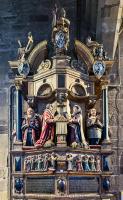
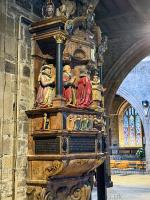
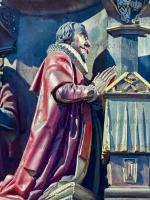
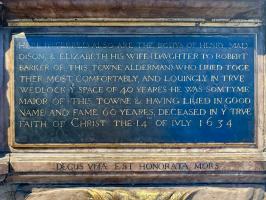
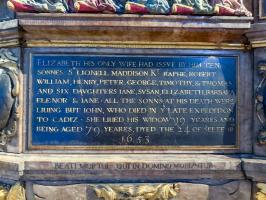
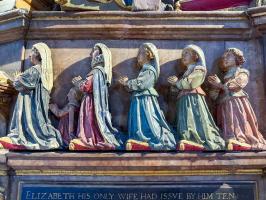
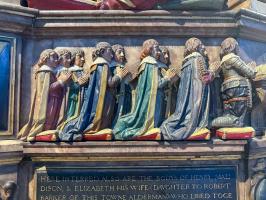
On 14th July 1634 Henry Maddison [aged 60] died. Monument at the Cathedral Church St Nicholas, Newcastle upon Tyne [Map].
Henry Maddison: In 1574 he was born to Lionel Maddison and Jane Seymour. In 1613 he and Elizabeth Barker were married. They had ten sons.
On 14th July 1641 King Charles I of England, Scotland and Ireland [aged 40] created new Baronets:
John Cotton 1st Baronet [aged 25] was created 1st Baronet Cotton of Landwade in Cambridgeshire.
Thomas Abdy 1st Baronet [aged 29] was created 1st Baronet Abdy of Felix Hall in Kelveden in Essex.
John Bampfylde 1st Baronet [aged 31] was created 1st Baronet Bampfylde of Poltimore in Devon.
On 29 or 30th July 1641 William Strickland 1st Baronet [aged 45] was created 1st Baronet Strickland of Boynton in Yorkshire. Frances Finch Lady Strickland by marriage Lady Strickland of Boynton in Yorkshire.


Chronicle of Walter of Guisborough
A canon regular of the Augustinian Guisborough Priory, Yorkshire, formerly known as The Chronicle of Walter of Hemingburgh, describes the period from 1066 to 1346. Before 1274 the Chronicle is based on other works. Thereafter, the Chronicle is original, and a remarkable source for the events of the time. This book provides a translation of the Chronicle from that date. The Latin source for our translation is the 1849 work edited by Hans Claude Hamilton. Hamilton, in his preface, says: 'In the present work we behold perhaps one of the finest samples of our early chronicles, both as regards the value of the events recorded, and the correctness with which they are detailed; Nor will the pleasing style of composition be lightly passed over by those capable of seeing reflected from it the tokens of a vigorous and cultivated mind, and a favourable specimen of the learning and taste of the age in which it was framed.'
Available at Amazon in eBook and Paperback format.
John Evelyn's Diary. 14th July 1655. Came Mr. Pratt [aged 35], my old acquaintance at Rome, also Sir Edward Hales [aged 29], Sir Joseph Tufton, with Mr. Seymour.
In July 1660 King Charles II of England Scotland and Ireland [aged 30] rewarded those who supported his Restoration...
2nd. Maurice Berkeley 3rd Viscount Fitzhardinge [aged 32] was created 1st Baronet Berkeley of Bruton in Somerset. Anne Lee Viscountess Fitzhardinge [aged 37] by marriage Lady Berkeley of Bruton in Somerset.
4th. Thomas Myddelton 1st Baronet [aged 35] was created 1st Baronet Myddelton of Chirk Castle.
6th. Varney Noel 1st Baronet was created 1st Baronet Noel.
7th. George Monck 1st Duke Albemarle [aged 51] was created 1st Duke Albemarle, 1st Earl Torrington in Devon. Anne Clarges Duchess Albermarle [aged 41] by marriage Duchess Albemarle.
12th. Robert Hales 1st Baronet [aged 50] was created 1st Baronet Hales of Beakesbourne in Kent.
12th. Edward Montagu 1st Earl Sandwich [aged 34] was created 1st Earl Sandwich. Jemima Crew Countess Sandwich [aged 35] by marriage Countess Sandwich.
14th. Elizabeth Feilding Countess Guildford was created 1st Countess Guildford by King Charles II of England Scotland and Ireland. The peerage for life.
18th. Samuel Morland 1st Baronet [aged 35] was created 1st Baronet Morland of Sulhamstead Banister. Susanne de Milleville Lady Morland by marriage Lady Morland of Sulhamstead Banister.
23rd. Henry Vernon 1st Baronet [aged 55] was created 1st Baronet Vernon of Hodnet in Shropshire.
23rd. John Aubrey 1st Baronet [aged 54] was created 1st Baronet Aubrey of Llantrithyd in Glamorganshire.
Samuel Pepys' Diary. 14th July 1663. So after dinner, they being gone, I to my office, and so home to bed. This day I hear the judges, according to order yesterday, did bring into the Lords' House their reasons of their judgment in the business between my Lord Bristoll [aged 50] and the Chancellor [aged 54]; and the Lords do concur with the Judges that the articles are not treason, nor regularly brought into the House, and so voted that a Committee should be chosen to examine them; but nothing to be done therein till the next sitting of this Parliament (which is like to be adjourned in a day or two), and in the mean time the two Lords to, remain without prejudice done to either of them.


Samuel Pepys' Diary. 14th July 1664. Thence to my Lord's again, and my Lord being up, was sent for up, and he and I alone. He did begin with a most solemn profession of the same confidence in and love for me that he ever had, and then told me what a misfortune was fallen upon me and him: in me, by a displeasure which my Chancellor [aged 55] did show to him last night against me, in the highest and most passionate manner that ever any man did speak, even to the not hearing of any thing to be said to him: but he told me, that he did say all that could be said for a man as to my faithfullnesse and duty to his Lordship, and did me the greatest right imaginable. And what should the business be, but that I should be forward to have the trees in Clarendon Park [Map] marked and cut down, which he, it seems, hath bought of my Lord Albemarle [aged 55]; when, God knows! I am the most innocent man in the world in it, and did nothing of myself, nor knew of his concernment therein, but barely obeyed my Lord Treasurer's [aged 57] warrant for the doing thereof. And said that I did most ungentlemanlike with him, and had justified the rogues in cutting down a tree of his; and that I had sent the veriest Fanatique [Deane [aged 30]] that is in England to mark them, on purpose to nose [provoke] him. All which, I did assure my Lord, was most properly false, and nothing like it true; and told my Lord the whole passage. My Lord do seem most nearly affected; he is partly, I believe, for me, and partly for himself. So he advised me to wait presently upon my Lord, and clear myself in the most perfect manner I could, with all submission and assurance that I am his creature both in this and all other things; and that I do owne that all I have, is derived through my Lord Sandwich [aged 38] from his Lordship. So, full of horror, I went, and found him busy in tryals of law in his great room; and it being Sitting-day, durst not stay, but went to my Lord and told him so: whereupon he directed me to take him after dinner; and so away I home, leaving my Lord mightily concerned for me. I to the office, and there sat busy all the morning.

Samuel Pepys' Diary. 14th July 1664. So I left them, and I to my Chancellor's [aged 55]; and there coming out after dinner I accosted him, telling him that I was the unhappy Pepys that had fallen into his high displeasure, and come to desire him to give me leave to make myself better understood to his Lordship, assuring him of my duty and service. He answered me very pleasingly, that he was confident upon the score of my Lord Sandwich's [aged 38] character of me, but that he had reason to think what he did, and desired me to call upon him some evening: I named to-night, and he accepted of it. So with my heart light I to White Hall, and there after understanding by a stratagem, and yet appearing wholly desirous not to understand Mr. Gauden's price when he desired to show it me, I went down and ordered matters in our tender so well that at the meeting by and by I was ready with Mr. Gauden's and his, both directed him a letter to me to give the board their two tenders, but there being none but the Generall Monk [aged 55] and Mr. Coventry [aged 36] and Povy [aged 50] and I, I did not think fit to expose them to view now, but put it off till Saturday, and so with good content rose.


Calendar of State Papers Charles II 14 Jul 1664. 14th July 1664. 65. Duke of Albemarle [aged 55] to Capt. Basset, officer-in-chief of the King's troop. He is to send a corporal to receive from Sir Henry Bennet [aged 46] orders to the Lieutenant of the Tower to deliver to him Robert Atkinson, and to the Keeper of the Gatehouse to deliver Rich. Oldroyd, and appoint six troopers to convey them to Northampton, and there deliver them to the chief officer of Col. Frescheville's [aged 56] troop, to convey them to York. Sec. Bennet will deliver him moneys for the whole journey, and post warrants for horses, which he is to transfer to Col. Frescheville. [Copy.]


Samuel Pepys' Diary. 14th July 1664. Thence I to the Half Moone [Map], against the 'Change [Map], to acquaint Lanyon and his friends of our proceedings, and thence to my Chancellor's [aged 55], and there heard several tryals, wherein I perceive my Lord is a most able and ready man. After all done, he himself called, "Come, Mr. Pepys, you and I will take a turn in the garden". So he was led down stairs, having the goute, and there walked with me, I think, above an houre, talking most friendly, yet cunningly. I told him clearly how things were; how ignorant I was of his Lordship's concernment in it; how I did not do nor say one word singly, but what was done was the act of the whole Board. He told me by name that he was more angry with Sir G. Carteret [aged 54] than with me, and also with the whole body of the Board. But thinking who it was of the Board that knew him least, he did place his fear upon me; but he finds that he is indebted to none of his friends there. I think I did thoroughly appease him, till he thanked me for my desire and pains to satisfy him; and upon my desiring to be directed who I should of his servants advise with about this business, he told me nobody, but would be glad to hear from me himself. He told me he would not direct me in any thing, that it might not be said that the Chancellor did labour to abuse the King [aged 34]; or (as I offered) direct the suspending the Report of the Purveyors but I see what he means, and I will make it my worke to do him service in it. But, Lord! to see how he is incensed against poor Deane [aged 30], as a fanatique rogue, and I know not what: and what he did was done in spite to his Lordship, among all his friends and tenants. He did plainly say that he would not direct me in any thing, for he would not put himself into the power of any man to say that he did so and so; but plainly told me as if he would be glad I did something. Lord! to see how we poor wretches dare not do the King good service for fear of the greatness of these men. He named Sir G. Carteret, and Sir J. Minnes [aged 65], and the rest; and that he was as angry with them all as me. But it was pleasant to think that, while he was talking to me, comes into the garden Sir G. Carteret; and my Lord avoided speaking with him, and made him and many others stay expecting him, while I walked up and down above an houre, I think; and would have me walk with my hat on. And yet, after all this, there has been so little ground for this his jealousy of me, that I am sometimes afeard that he do this only in policy to bring me to his side by scaring me; or else, which is worse, to try how faithfull I would be to the King; but I rather think the former of the two. I parted with great assurance how I acknowledged all I had to come from his Lordship; which he did not seem to refuse, but with great kindness and respect parted. So I by coach home, calling at my Lord's, but he not within.

Samuel Pepys' Diary. 14th July 1665. So he in the evening gone, I by water to Sir G. Carteret's [aged 55], and there find my Lady Sandwich [aged 40] and her buying things for my Lady Jem.'s wedding; and my Lady Jem. is beyond expectation come to Dagenhams, where Mr. Carteret is to go to visit her to-morrow; and my proposal of waiting on him, he being to go alone to all persons strangers to him, was well accepted, and so I go with him.

Samuel Pepys' Diary. 14th July 1665. Upon the 'Change [Map] all the news is that guns have been heard and that news is come by a Dane that my Lord was in view of De Ruyter [aged 58], and that since his parting from my Lord of Sandwich [aged 39] he hath heard guns, but little of it do I think true.
John Evelyn's Diary. 14th July 1666. Sat at the Tower [Map] with J. Duncomb [aged 44] and Lord Berkeley [aged 38], to sign deputations for undertakers to furnish their proportions of saltpetre.
Samuel Pepys' Diary. 14th July 1667. A very fine day, and so towards Epsum, talking all the way pleasantly, and particularly of the pride and ignorance of Mrs. Lowther, in having of her train carried up? The country very fine, only the way very dusty. We got to Epsum by eight o'clock, to the well; where much company, and there we 'light, and I drank the water: they did not, but do go about and walk a little among the women, but I did drink four pints, and had some very good stools by it. Here I met with divers of our town, among others with several of the tradesmen of our office, but did talk but little with them, it growing hot in the sun, and so we took coach again and to the towne, to the King's Head, where our coachman carried us, and there had an ill room for us to go into, but the best in the house that was not taken up. Here we called for drink, and bespoke dinner; and hear that my Lord Buckhurst [aged 24] and Nelly [aged 17] are lodged at the next house, and Sir Charles Sidly [aged 28] with them and keep a merry house. Poor girl! I pity her; but more the loss of her at the King's house. Here I saw Gilsthrop, Sir W. Batten's [aged 66] clerk that hath been long sick, he looks like a dying man, with a consumption got, as is believed, by the pox, but God knows that the man is in a sad condition, though he finds himself much better since his coming thither, he says. W. Hewer [aged 25] rode with us, and I left him and the women, and myself walked to church, where few people, contrary to what I expected, and none I knew, but all the Houblons, brothers, and them after sermon I did salute, and walk with towards my inne, which was in their way to their lodgings. They come last night to see their elder brother, who stays here at the waters, and away to-morrow. James [aged 37] did tell me that I was the only happy man of the Navy, of whom, he says, during all this freedom the people have taken of speaking treason, he hath not heard one bad word of me, which is a great joy to me; for I hear the same of others, but do know that I have deserved as well as most. We parted to meet anon, and I to my women into a better room, which the people of the house borrowed for us, and there to dinner, a good dinner, and were merry, and Pendleton come to us, who happened to be in the house, and there talked and were merry.


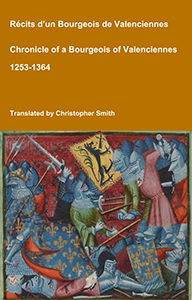
Chronicle of a Bourgeois of Valenciennes
Récits d’un bourgeois de Valenciennes aka The Chronicle of a Bourgeois of Valenciennes is a vivid 14th-century vernacular chronicle written by an anonymous urban chronicler from Valenciennes in the County of Hainaut. It survives in a manuscript that describes local and regional history from about 1253 to 1366, blending chronology, narrative episodes, and eyewitness-style accounts of political, military, and social events in medieval France, Flanders, and the Low Countries. The work begins with a chronological framework of events affecting Valenciennes and its region under rulers such as King Philip VI of France and the shifting allegiances of local nobility. It includes accounts of conflicts, sieges, diplomatic manoeuvres, and the impact of broader struggles like the Hundred Years’ War on urban life in Hainaut. Written from the perspective of a burgher (bourgeois) rather than a monastery or royal court, the chronicle offers a rare lay viewpoint on high politics and warfare, reflecting how merchants, townspeople, and civic institutions experienced the turbulence of the 13th and 14th centuries. Its narrative style combines straightforward reporting of events with moral and civic observations, making it a valuable source for readers interested in medieval urban society, regional politics, and the lived experience of war and governance in pre-modern Europe.
Available at Amazon in eBook and Paperback format.
Samuel Pepys' Diary. 14th July 1667. After dinner, he gone, we all lay down after dinner (the day being wonderful hot) to sleep, and each of us took a good nap, and then rose; and Tom Wilson come to see me, and sat and talked an hour; and I perceive he hath been much acquainted with Dr. Fuller [aged 59] (Tom) and Dr. Pierson [aged 54], and several of the great cavalier parsons during the late troubles; and I was glad to hear him talk of them, which he did very ingeniously, and very much of Dr. Fuller's art of memory, which he did tell me several instances of.
Samuel Pepys' Diary. 14th July 1667. By and by he parted, and we took coach and to take the ayre, there being a fine breeze abroad; and I went and carried them to the well, and there filled some bottles of water to carry home with me; and there talked with the two women that farm the well, at £12 per annum, of the lord of the manor, Mr. Evelyn [aged 50] (who with his lady, and also my Lord George Barkeley's [aged 39] lady, and their fine daughter [aged 17], that the King of France [aged 28] liked so well, and did dance so rich in jewells before the King [aged 37] at the Ball I was at, at our Court, last winter, and also their son [aged 18], a Knight of the Bath, were at church this morning).
John Evelyn's Diary. 14th July 1675. I went to see my Lord Sunderland's [aged 33] Seat at Althorpe [Map], four miles from the ragged town of Northampton [Map] (since burned, and well rebuilt). It is placed in a pretty open bottom, very finely watered and flanked with stately woods and groves in a park, with a canal, but the water is not running, which is a defect. The house, a kind of modern building, of freestone, within most nobly furnished; the apartments very commodious, a gallery and noble hall; but the kitchen being in the body of the house, and chapel too small, were defects. There is an old yet honorable gatehouse standing awry, and out-housing mean, but designed to be taken away. It was moated round, after the old manner, but it is now dry, and turfed with a beautiful carpet. Above all, are admirable and magnificent the several ample gardens furnished with the choicest fruit, and exquisitely kept. Great plenty of oranges, and other curiosities. The park full of fowl, especially herons, and from it a prospect to Holmby House, which being demolished in the late civil wars, shows like a Roman ruin shaded by the trees about it, a stately, solemn, and pleasing view.
John Evelyn's Diary. 14th July 1683. I visited Mr. Fraser, a learned Scotch gentleman, whom I had formerly recommended to Lord Berkeley [aged 55] for the instruction and government of his son, since dead at sea. He had now been in Holland at the sale of the learned Heinsius's library, and showed me some very rare and curious books, and some MSS., which he had purchased to good icon. There were three or four Herbals in miniature, accurately done, divers Roman antiquities of Verona, and very many books of Aldus's impression.
John Evelyn's Diary. 15th July 1685. Thus ended this quondam Duke [aged 36], darling of his father and ye ladies, being extreamly handsome and adroit; an excellent souldier and dancer, a favourite of the people, of an easy nature, debauch'd by lust, seduc'd by crafty knaves who would have set him up only to make a property, and took the opportunity of the King being of another religion, to gather a party of discontented men. He fail'd, and perish'd. He was a lovely person, had a virtuous and excellent lady that brought him greate riches, and a second dukedom in Scotland. He was Master of the Horse, General of the King his father's Army, Gentleman of the Bedchamber, Knight of the Garter, Chancellor of Cambridge, in a word had accumulations without end. See what ambition and want of principles brought him to! He was beheaded on Tuesday 14th July [Note. Most sources quote 15th July 1685]. His mother, whose name was Barlow [Note. Lucy Walter is often spoken of incorrectly as Mrs. Walters or Waters, and during her career she seems to have adopted the alias of Mrs. Barlo or Barlow (the name of a family with which the Walters of Pembrokeshire had intermarried). From Dictionary of National Biography.], daughter of some very meane creatures, was a beautiful strumpet, whom I had often seene at Paris; she died miserably without any thing to bury her; yet this Perkin had ben made to believe that the King had married her; a monstrous and ridiculous forgerie; and to satisfy the world of the iniquity of the report, the King his father (If his father he really was, for he most resembl'd one Sidney, who was familiar with his mother) publickly and most solemnly renounc'd it, to be so enter'd in the Council Booke some yeares since, with all ye Privy Councellors at testation.


John Evelyn's Diary. 14th July 1686. Was sealed at our office the constitution of certain commissioners to take upon them full power of all Ecclesiastical affairs, in as unlimited a manner, or rather greater, than the late High Commission-Court, abrogated by Parliament; for it had not only faculty to inspect and visit all Bishops' dioceses, but to change what laws and statutes they should think fit to alter among the colleges, though founded by private men; to punish, suspend, fine, etc., give oaths and call witnesses. The main drift was to suppress zealous preachers. In sum, it was the whole power of a Vicar-General-note the consequence! Of the clergy the commissioners were the Archbishop of Canterbury [Sancroft] [aged 69], Bishop of Durham [Crewe] [aged 53], and Rochester [Sprat] [aged 51]; of the Temporals, the Lord Treasurer, the Lord Chancellor [Jefferies] [aged 41] (who alone was ever to be of the quorum), the Chief justice [Herbert] [aged 38], and Lord President [Earl of Sunderland] [aged 44].


On 14th July 1690 Catalina Ventura Colón Duchess Berwick 9th Duchess Veragua was born to Pedro Manuel Colón 7th Duke Veragua [aged 38]. She married 31st December 1716 James Fitz James 2nd Duke Berwick, son of James Fitzjames 1st Duke Berwick and Honora Burke Duchess Berwick, and had issue.
On 14th July 1699 Vere Beauclerk 1st Baron de Vere was born to Charles Beauclerk 1st Duke St Albans [aged 29] and Diana Vere Duchess St Albans [aged 20]. He a grandson of King Charles II of England Scotland and Ireland. He married 13th April 1736 Mary Chambers Baroness Spencer and had issue.


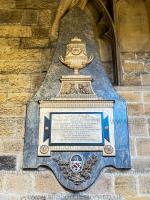
On 14th July 1750 Sarah Roddam died. Memorial at the Cathedral Church St Nicholas, Newcastle upon Tyne [Map] commissioned by her husband John Eramus Blackett [aged 21].
Sarah Roddam: Around 1750 she was born. In 1761 John Eramus Blackett and she were married. The difference in their ages was 20 years.
John Eramus Blackett: On 1st January 1729 he was born to John Blackett of Newby Park. On 11th June 1814 John Eramus Blackett died.
On 14th July 1764 Charles Fitzroy was born to Augustus Henry Fitzroy 3rd Duke Grafton [aged 28] and Anne Liddell Duchess Grafton [aged 27]. He a great x 3 grandson of King Charles II of England Scotland and Ireland. He married (1) 20th June 1795 Frances Mundy and had issue (2) before 9th February 1810 Frances Stewart, daughter of Robert Stewart 1st Marquess Londonderry and Frances Pratt Marchioness Londonderry, and had issue.


On 14th July 1765 Frederick William II King Prussia [aged 20] and Crown Princess Elisabeth Christine of Prussia [aged 18] were married. They had one child before the marriage was dissolved in 1769.

The True Chronicles of Jean le Bel Volume 1 Chapters 1-60 1307-1342
The True Chronicles of Jean le Bel offer one of the most vivid and immediate accounts of 14th-century Europe, written by a knight who lived through the events he describes, and experienced some of them first hand. Covering the early decades of the Hundred Years’ War, this remarkable chronicle follows the campaigns of Edward III of England, the politics of France and the Low Countries, and the shifting alliances that shaped medieval warfare. Unlike later historians, Jean le Bel writes with a strong sense of eyewitness authenticity, drawing on personal experience and the testimony of fellow soldiers. His narrative captures not only battles and sieges, but also the realities of military life, diplomacy, and the ideals of chivalry that governed noble society. A key source for Jean Froissart, Le Bel’s chronicle stands on its own as a compelling and insightful work, at once historical record and literary achievement. This translation builds on the 1905 edition published in French by Jules Viard, adding extensive translations from other sources Rymer's Fœdera, the Chronicles of Adam Murimuth, William Nangis, Walter of Guisborough, a Bourgeois of Valenciennes, Geoffrey le Baker of Swinbroke and Richard Lescot to enrich the original text and Viard's notes.
Available at Amazon in eBook and Paperback format.
On 14th July 1769 Frederick William II King Prussia [aged 24] and Queen Frederica Louisa of Prussia [aged 17] were married. The date exactly four years after his first marriage. They were fifth cousins. He a great x 4 grandson of King James I of England and Ireland and VI of Scotland.
On 14th July 1793 John Tollemache [aged 18] was killed at the Siege of Valciennes.

On 14th July 1808 Henrietta Laura Johnstone aka Pulteney 1st Countess Bath [aged 41] died. Earl Bath extinct. She left her personal estate to her cousin Elizabeth Evelyn Sutton and her husband John Fawcett aka Pulteney [aged 41] who adopted the surname Pulteney in 1813. The landed estates were claimed by William Henry Vane 1st Duke Cleveland [aged 41] who was a descendant of Anne Pulteney Duchess Southampton Duchess of Cleveland.

On 14th July 1829 Archbishop Edward White Benson was born at Lombard Street Highgate.

Vestiges of the Antiquities of Derbyshire. July 14th, 1843, one of the most interesting barrows ever examined in this vicinity was opened. It is situated upon a ridge of high land, near the village of Biggin, which goes by the name of the "Liffs [Map]," the barrow itself having no specific name: the mound had been sadly mutilated, at least one third of it having been removed; notwithstanding this the truth of Sir Richard Hoare's maxim, "fronta nulla fides," was agreeably exemplified. That hemisphere of the circle which still remained the most perfect was selected as the place where to commence operations: on reaching the thickest part of the circle, which, owing to the depression usual in the middle of most barrows, would be about two yards from the centre, a few human bones, horses' teeth, various animal bones, and two small pieces of a very thick and coarse urn, were found; but not until penetrating to the heart of the barrow was the principal interment discovered. In that situation an octagonal cist was erected of the usual material, namely, thin flat lime-stones, which are admirably adapted for the purpose; this vault was about half filled with stiff clay, imbedded in which lay a fine human skeleton, whose knees were drawn up, according to a general custom, prevalent in the most remote ages. The extreme antiquity of this interment is demonstrated by the simple form and material of the weapons and tools which were, with one exception, deposited in a cluster behind the shoulders of this early denizen of the Derbyshire moors. The skull, which is fine and intellectual, lay on the left side so as to look towards the west, and in the angle formed by the contraction of the knees, was placed a hammer-head ingeniously constructed out of the lower part of the horn of a noble red deer; one end of this instrument is rounded and polished, the other is cut into a diamond pattern, somewhat similar to the wafer stamps used by attorneys. The articles before alluded to as being placed near the shoulders were of a very miscellaneous character, and highly interesting; as showing, after a lapse of several thousand years, that the savage Briton reposing in this cairn had cultivated the art of making war amongst the inhabitants of the forest, in preference to molesting his fellow-savages; as almost the first observed articles were a pair of enormous tusks of the wild boar, the trophies of some, perhaps his last, sylvan triumph; next came two arrow-heads of flint, delicately chipped, and of unusual form; two flint celts or chisels, beautifully chipped and polished at the cutting edges; two spear-heads of the same material; two flint knives polished on the edge, one of them serrated on the back, in order to serve as a saw; and numerous other pieces of flints of indescribable form and use, which, together with all the flint instruments enumerated above, seem to have undergone a partial calcination being gray tinted with various shades of blue and pink; with these utensils were found three pieces of red ochre, the rouge of these unsophisticated huntsmen which, even now, on being wetted imparts a bright red colour to the skin, which is by no means easy to discharge. Upon the summit of the little heap, formed by this accumulation of relics, lay a small drinking or incense cup of novel and unprecedented shape, which was unfortunately broken and crushed, but has been since restored. The absence of instruments of metal in this and other barrows should be borne in mind; it is commented on in another part of this work.
On 14th July 1859 John "The Younger" Bacon [aged 82] died at Bath, Somerset [Map].

On 14th July 1874 Gerald Richard Grosvenor was born to Hugh Lupus Grosvenor 1st Duke Westminster [aged 48] and Constance Leveson-Gower Duchess Westminster [aged 40]. Coefficient of inbreeding 7.06%.

On 14th July 1884 Prince Adalbert of Prussia was born to Wilhelm Hohenzollern [aged 25] and Empress Auguste Viktoria Oldenburg [aged 25]. He a great grandson of Queen Victoria of the United Kingdom. He married his fourth cousin twice removed Adelaide Saxe Meiningen and had issue.
On 14th July 1890 Muriel Evelyn Nora Percy was born to Henry George Percy 7th Duke Northumberland [aged 44] and Edith Campbell Duchess Northumberland [aged 40].

On 14th July 1895 William Alleyne Cecil 3rd Marquess Exeter [aged 70] died. His son Brownlow [aged 45] succeeded 4th Marquess Exeter, 13th Earl Exeter, 14th Baron Burghley. Monument in the Church of St John the Baptist, Barnack [Map].
Brownlow Henry George Cecil 4th Marquess Exeter: On 20th December 1849 he was born to William Alleyne Cecil 3rd Marquess Exeter and and Georgina Sophia Pakenham Marchioness Exeter. On 7th September 1875 Brownlow Henry George Cecil 4th Marquess Exeter and Isabella Whichcote Marchioness of Exeter were married at St Denys' Church, Aswarby. He the son of William Alleyne Cecil 3rd Marquess Exeter.
On 14th July 1899 Sybil Anne Montagu-Douglas-Scott was born to John Scott 7th Duke Buccleuch 9th Duke Queensberry [aged 35] and Margaret Alice "Molly" Bridgeman Duchess Buccleuch Duchess Queensbury [aged 27].

On 14th July 1910 Edward Hugh Mosley [aged 25] died. He was buried at Elko, Nevada [Map]. Memorial at St Mary's Church, Rolleston on Dove [Map].
Edward Hugh Mosley: On 16th July 1884 he was born to Tonman Mosley 1st Baron Anslow and Hilda Rose Montgomerie Baroness Anslow.
This is a translation of the 'Memoires of Jacques du Clercq', published in 1823 in two volumes, edited by Frederic, Baron de Reissenberg. In his introduction Reissenberg writes: 'Jacques du Clercq tells us that he was born in 1424, and that he was a licentiate in law and a counsellor to Philip the Good, Duke of Burgundy, in the castellany of Douai, Lille, and Orchies. It appears that he established his residence at Arras. In 1446, he married the daughter of Baldwin de la Lacherie, a gentleman who lived in Lille. We read in the fifth book of his Memoirs that his father, also named Jacques du Clercq, had married a lady of the Le Camelin family, from Compiègne. His ancestors, always attached to the counts of Flanders, had constantly served them, whether in their councils or in their armies.' The Memoires cover a period of nineteen years beginning in in 1448, ending in in 1467. It appears that the author had intended to extend the Memoirs beyond that date; no doubt illness or death prevented him from carrying out this plan. As Reissenberg writes the 'merit of this work lies in the simplicity of its narrative, in its tone of good faith, and in a certain air of frankness which naturally wins the reader’s confidence.' Du Clercq ranges from events of national and international importance, including events of the Wars of the Roses in England, to simple, everyday local events such as marriages, robberies, murders, trials and deaths, including that of his own father in Book 5; one of his last entries.
Available at Amazon in eBook and Paperback format.
On 14th July 1912 Henry Wellesley 6th Duke Wellington was born to Arthur Charles Wellesley 5th Duke Wellington [aged 36] and Lillian Maud Glen Coats Duchess Wellington [aged 27].


After 14th July 1915. St Wilfrid's Church, Kirkharle [Map]. Memorial to John Frederick Anderson. Buried at Le Touret Military Cemetery, Richebourg-L'avoue, France. Killed whilst serving with the 2nd Battalion attached (Adjutant) 10th Battalion Highland Light Infantry. He was the son of George and Alice Anderson of Little Harle Tower, Kirkwhelpington [Map].

After 14th July 1917. Hasting's Chapel, St Helen's Church, Ashby-de-la-Zouch [Map]. Monument to Isabel Jacqueline Rawdon-Hastings [deceased].
Isabel Jacqueline Rawdon-Hastings: On 8th August 1887 she was born to Major Paulyn Abney-Hastings and Maud Grimston. On 20th September 1916 Major Hubert James Cecil Rostron and she were married. On 14th July 1917 Isabel Jacqueline Rawdon-Hastings died.
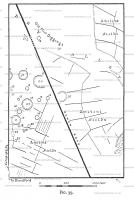
Wessex from the Air Plate 31. Reference No. 241. County, Dorset. 9 SE. and 10 SW. (131: B. 3,C. 3 ). Parish, Wimborne St. Giles. Latitude. 50° 57' 10" N. Longitude. 1° 58' 25" W. Height above Sea-level. 320 ft. (97 metres). Geological Formation. Upper Chalk. Time and Date of Photograph, 6.42 p.m., 14th July [1928]. Height of Aeroplane. 4,500 ft. (1,371 metres). Speed of Shutter. 1/90th of a second.
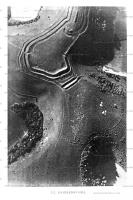
Wessex from the Air Plates 2 and 3. Reference Nos. 244 and 245. County. Dorset. 14 NW. (130: D. 11). Parish. Child Okeford. Geological Formation. Upper Chalk. Time and Date of Photographs. About 7.0 p.m., 14th July.
Latitude. 500 54' 45" N. Longitude. 20 13' 13" W. Height of Aeroplane. 5,200 ft. (1,585 metres). Height above Sea-level. About 600 ft. (182 metro). Speed of Shutter. 1190th of a second.
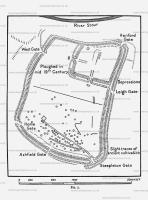
Wessex from the Air Plate 1. Reference No. 246. County. Dorset. 14 S.W. (130: D. 11, E. 11). Parish. Stourpaine. Latitude. 50° 53' 40" N. Longitude. 2° 20' 12" W. Height above Sea-level. 400 ft. (121 metres); summit, 471 ft. (143 metres). Geological Formation. Upper Chalk. Time and Date of Photograph. 7.2 p.m., 14th July [1928]. Height of Aeroplane. 5,200 ft. (1,585 metres). Speed of Shutter. 1/90th of a second.
Bolton War Memorial [Map]. Unveiled 14th July 1928 by Edward George Villiers Stanley 17th Earl of Derby [aged 63]. Sculpted by Walter Marsden [aged 45].
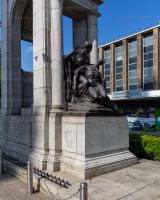
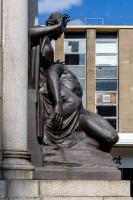
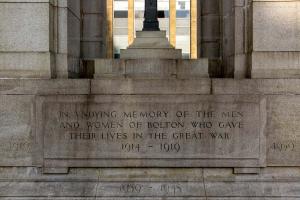
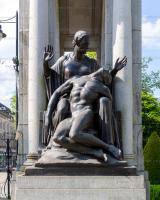

The London Gazette 42411. Whitehall, London S.W.1. 14th July 1961.
The Queen has been pleased by Letters Patent under the. Great Seal of the Realm, bearing date the 12th July, to confer the dignities of a Viscounty and an Earldom of the United Kingdom upon The Right Honourable Sir Robert Anthony Eden [aged 64], KG, MC, and the heirs male of his body lawfully begotten, by the names, styles and titles of Viscount Eden, of Royal Leamington Spa in the County of Warwick, and Earl of Avon.
On 14th July 1410 Arnold Egmont Duke Guelders was born to John Egmont [aged 25]. He married 23rd July 1423 Catherine de la Marck, daughter of Adolph de la Marck I Duke Cleves and Marie Valois Duchess Cleves, and had issue.
On 14th July 1505 Buenaventura Albret was born to Jean III King Navarre [aged 36] and Catherine Grailly I Queen Navarre [aged 37]. She died aged five in 1511.
William of Worcester's Chronicle of England
William of Worcester, born around 1415, and died around 1482 was secretary to John Fastolf, the renowned soldier of the Hundred Years War, during which time he collected documents, letters, and wrote a record of events. Following their return to England in 1440 William was witness to major events. Twice in his chronicle he uses the first person: 1. when writing about the murder of Thomas, 7th Baron Scales, in 1460, he writes '… and I saw him lying naked in the cemetery near the porch of the church of St. Mary Overie in Southwark …' and 2. describing King Edward IV's entry into London in 1461 he writes '… proclaimed that all the people themselves were to recognize and acknowledge Edward as king. I was present and heard this, and immediately went down with them into the city'. William’s Chronicle is rich in detail. It is the source of much information about the Wars of the Roses, including the term 'Diabolical Marriage' to describe the marriage of Queen Elizabeth Woodville’s brother John’s marriage to Katherine, Dowager Duchess of Norfolk, he aged twenty, she sixty-five or more, and the story about a paper crown being placed in mockery on the severed head of Richard, 3rd Duke of York.
Available at Amazon in eBook and Paperback format.
On 14th July 1530 Agnes Keith Countess Moray and Mar was born to William Keith 4th Earl Marischal [aged 24] and Margaret Keith Countess Marischal [aged 19]. She married (1) 8th February 1562 her fourth cousin James Stewart 1st Earl of Moray Regent and had issue (2) 13th January 1571 her half fourth cousin Colin Campbell 6th Earl Argyll, son of Archibald Campbell 4th Earl Argyll and Margaret Graham Countess Argyll, and had issue.
On 14th July 1544 Henry Compton 1st Baron Compton was born to Peter Compton and Anne Talbot Countess Pembroke [aged 21]. He married (1) before 1574 his third cousin once removed Frances Hastings Baroness Compton, daughter of Francis Hastings 2nd Earl Huntingdon and Catherine Pole Countess Huntingdon, and had issue (2) after 10th November 1581 Anne Spencer Countess Dorset and had issue.
On 14th July 1587 Lewis Watson 1st Baron Rockingham was born to Edward Watson of Rockingham Castle [aged 38] and Anne Digby [aged 41]. Some sources say 1584. He married (1) 1609 Catherine Bertie, daughter of Peregrine Bertie 13th Baron Willoughby and Mary Vere Baroness Willoughby of Eresby (2) 3rd October 1620 Eleanor Manners Baroness Rockingham and had issue.
On 14th July 1608 Colonel George Goring was born to George Goring 1st Earl Norwich [aged 23]. He married before 1657 Lettice Boyle, daughter of Richard Boyle 1st Earl Cork and Catherine Fenton Countess Cork.
On 14th July 1622 William Armine 2nd Baronet was born to William Armine 1st Baronet [aged 28] and Elizabeth Hicks Lady Armine [aged 24]. He married 26th August 1649 Anne Crane, daughter of Robert Crane 1st Baronet and Susan Alinton, and had issue.
On 14th July 1623 Hedwig Sophia Hohenzollern was born to George William Hohenzollern [aged 27] and Elisabeth Charlotte Palatinate Simmern [aged 25]. She married her fifth cousin Wilhelm "The Just" VI Hesse-Kassel, son of Landgrave William V of Hesse-Kassel, and had issue.
On 14th July 1657 William Cheyne 2nd Viscount Newhaven was born to Charles Cheyne 1st Viscount Newhaven [aged 31] and Jane Cavendish [aged 35].
On 14th July 1690 Catalina Ventura Colón Duchess Berwick 9th Duchess Veragua was born to Pedro Manuel Colón 7th Duke Veragua [aged 38]. She married 31st December 1716 James Fitz James 2nd Duke Berwick, son of James Fitzjames 1st Duke Berwick and Honora Burke Duchess Berwick, and had issue.
On 14th July 1699 Vere Beauclerk 1st Baron de Vere was born to Charles Beauclerk 1st Duke St Albans [aged 29] and Diana Vere Duchess St Albans [aged 20]. He a grandson of King Charles II of England Scotland and Ireland. He married 13th April 1736 Mary Chambers Baroness Spencer and had issue.
On 24th June 1727 George Neville 1st Earl Abergavenny was born to William Neville 1st Baron Abergavenny [aged 32] and Katherine Tatton Baroness Abergavenny. On 14th July 1727 he was christened at St Margaret's Church, Westminster [Map]. He married 5th February 1753 Henrietta Pelham Baroness Bergavenny and had issue.
The True Chronicles of Jean le Bel Volume 1 Chapters 1-60 1307-1342
The True Chronicles of Jean le Bel offer one of the most vivid and immediate accounts of 14th-century Europe, written by a knight who lived through the events he describes, and experienced some of them first hand. Covering the early decades of the Hundred Years’ War, this remarkable chronicle follows the campaigns of Edward III of England, the politics of France and the Low Countries, and the shifting alliances that shaped medieval warfare. Unlike later historians, Jean le Bel writes with a strong sense of eyewitness authenticity, drawing on personal experience and the testimony of fellow soldiers. His narrative captures not only battles and sieges, but also the realities of military life, diplomacy, and the ideals of chivalry that governed noble society. A key source for Jean Froissart, Le Bel’s chronicle stands on its own as a compelling and insightful work, at once historical record and literary achievement. This translation builds on the 1905 edition published in French by Jules Viard, adding extensive translations from other sources Rymer's Fœdera, the Chronicles of Adam Murimuth, William Nangis, Walter of Guisborough, a Bourgeois of Valenciennes, Geoffrey le Baker of Swinbroke and Richard Lescot to enrich the original text and Viard's notes.
Available at Amazon in eBook and Paperback format.
On 14th July 1732 John Cramer aka Coghill 1st Baronet was born to Balthazar John Cramer and Judith Butler. At some point he adopted the surname of his paternal grandmother Hester Coghill probably as a condition of inheritance.
On 14th July 1746 Charlotte Fitzwilliam Baroness Dundas was born to William Fitzwilliam 1st and 3rd Earl Fitzwilliam [aged 26] and Anne Watson Wentworth Countess Fitzwilliam. She married 24th May 1764 Thomas Dundas 1st Baron Dundas, son of Thomas Laurence Dundas 1st Baronet, and had issue.
On 14th July 1757 Morris Robinson Montagu 3rd Baron Rokeby was born to Morris Robinson Montagu [aged 43].
On 14th July 1759 Frances Capell was born to William Anne Capell 4th Earl Essex [aged 26] and Frances Hanbury Williams Countess Essex. She died aged less than one years old.
On 14th July 1764 Charles Fitzroy was born to Augustus Henry Fitzroy 3rd Duke Grafton [aged 28] and Anne Liddell Duchess Grafton [aged 27]. He a great x 3 grandson of King Charles II of England Scotland and Ireland. He married (1) 20th June 1795 Frances Mundy and had issue (2) before 9th February 1810 Frances Stewart, daughter of Robert Stewart 1st Marquess Londonderry and Frances Pratt Marchioness Londonderry, and had issue.

On 14th July 1773 Charlotte Herbert was born to Henry Herbert 10th Earl Pembroke 7th Earl Montgomery [aged 39] and Elizabeth Spencer Countess Pembroke and Montgomery [aged 36]. She died aged ten in 1784.
On 14th July 1774 Edward Jerningham was born to William Jerningham of Cossey Park 6th Baronet [aged 38] and Frances Dillon [aged 27]. He a great x 3 grandson of King Charles II of England Scotland and Ireland.

On 14th July 1775 John Morris 2nd Baronet was born to John Morris 1st Baronet [aged 29] and Henrietta Musgrave Lady Morris. He married 5th October 1809 Lucy Juliana Byng Lady Morris, daughter of John Byng 5th Viscount Torrington and Bridget Forrest Viscountess Byng, and had issue.
On 14th July 1789 Emily Anne Bennet Elizabeth Cecil Marchioness Westmeath was born to James Cecil 1st Marquess Salisbury [aged 40] and Mary Amelia Hill Marchioness Salisbury [aged 38]. She married 29th May 1812 George Nugent 1st Marquess Westmeath and had issue.
On 14th July 1797 Charles James Yorke was born to Philip Yorke 3rd Earl of Hardwicke [aged 40] and Elizabeth Lindsay Countess Hardwicke [aged 33].


Jean de Waurin's Chronicle of England Volume 6 Books 3-6: The Wars of the Roses
Jean de Waurin was a French Chronicler, from the Artois region, who was born around 1400, and died around 1474. Waurin’s Chronicle of England, Volume 6, covering the period 1450 to 1471, from which we have selected and translated Chapters relating to the Wars of the Roses, provides a vivid, original, contemporary description of key events some of which he witnessed first-hand, some of which he was told by the key people involved with whom Waurin had a personal relationship.
Available at Amazon in eBook and Paperback format.
On 14th July 1798 Fletcher Norton 3rd Baron Grantley was born to Fletcher Norton [aged 53] and Caroline Elizabeth Balmain. He married 26th July 1825 Charlotte Earle Beechey Baroness Grantley.
On 14th July 1819 Charles Somers-Cocks 3rd Earl Somers was born to John Somers-Cocks 2nd Earl Somers [aged 31] and Caroline Yorke Countess Somers [aged 24]. He married 1850 Virginia Somers-Cocks Countess Somers.
On 14th July 1819 John Fortescue was born to Hugh Fortescue 2nd Earl Fortescue [aged 36] and Susan Ryder [aged 23].
On 14th July 1829 Archbishop Edward White Benson was born at Lombard Street Highgate.
On 14th July 1840 Claude Scott 4th Baronet was born to Claude Edward Scott 3rd Baronet [aged 36] . He married (1) 20th July 1861 Maria Burney Lady Scott.
On 14th July 1841 William Frederick Hicks-Beach was born to Michael Hicks-Beach 8th Baronet [aged 31].
On 14th July 1851 Dudley Francis North 7th Earl Guildford was born to Dudley North [aged 21].
On 14th July 1856 Commander Hugh Tyrwhitt was born to Henry Thomas Tyrwhitt-Jones 3rd Baronet [aged 32] and Emma Harriet Wilson 12th Baroness Berners [aged 20].
On 14th July 1868 Gertrude Bell was born to Thomas Hugh Bell 2nd Baronet [aged 24] and Maria Shield.
On 14th July 1874 Gerald Richard Grosvenor was born to Hugh Lupus Grosvenor 1st Duke Westminster [aged 48] and Constance Leveson-Gower Duchess Westminster [aged 40]. Coefficient of inbreeding 7.06%.
On 14th July 1884 Prince Adalbert of Prussia was born to Wilhelm Hohenzollern [aged 25] and Empress Auguste Viktoria Oldenburg [aged 25]. He a great grandson of Queen Victoria of the United Kingdom. He married his fourth cousin twice removed Adelaide Saxe Meiningen and had issue.
On 14th July 1890 Muriel Evelyn Nora Percy was born to Henry George Percy 7th Duke Northumberland [aged 44] and Edith Campbell Duchess Northumberland [aged 40].
Jean de Waurin's Chronicle of England Volume 6 Books 3-6: The Wars of the Roses
Jean de Waurin was a French Chronicler, from the Artois region, who was born around 1400, and died around 1474. Waurin’s Chronicle of England, Volume 6, covering the period 1450 to 1471, from which we have selected and translated Chapters relating to the Wars of the Roses, provides a vivid, original, contemporary description of key events some of which he witnessed first-hand, some of which he was told by the key people involved with whom Waurin had a personal relationship.
Available at Amazon in eBook and Paperback format.
On 14th July 1897 Cecil Eustace Irby 8th Baron Boston was born to Cecil Suamarez Irby [aged 35].
On 14th July 1899 Winifred Agnes Lloyd Viscountess Leverhulme was born.
On 14th July 1899 Sybil Anne Montagu-Douglas-Scott was born to John Scott 7th Duke Buccleuch 9th Duke Queensberry [aged 35] and Margaret Alice "Molly" Bridgeman Duchess Buccleuch Duchess Queensbury [aged 27].
On 14th July 1908 Ralph Wolfe Graham 13th Baronet was born to Percival Harris Graham [aged 30].
On 14th July 1912 Henry Wellesley 6th Duke Wellington was born to Arthur Charles Wellesley 5th Duke Wellington [aged 36] and Lillian Maud Glen Coats Duchess Wellington [aged 27].
On 14th July 1932 Stafford Henry Northcote 4th Earl of Iddesleigh was born to Henry Stafford Northcote 3rd Earl Iddesleigh [aged 31].
On 14th July 1933 John Beresford 8th Marquess of Waterford was born to John Beresford 7th Marquess of Waterford [aged 32]. He married 1957 his fifth cousin once removed Caroline Wyndham-Quin Marchioness of Waterford, daughter of Richard Wyndham-Quin 6th Earl of Dunraven and Mount-Earl and Nancy Yuille Countess of Dunraven and Mount-Earl, and had issue.
On 14th July 1938 Arthur Gore 9th Earl of Arran was born to Arthur Gore 8th Earl of Arran [aged 28] and Fiona Colquhoun Countess of Arran [aged 19]. He married 28th September 1974 Eleanor van Cutsem.
On 14th July 1948 Eliza Manningham-Buller 1st Baroness Manningham-Buller was born to Reginald Manningham-Buller 1st Viscount Dilhorne [aged 42] and Mary Lillian Lindsay [aged 38].
On 14th July 1948 Michael Charles James Willoughby 13th Baron Middleton was born to Digby Michael Godfrey John Willoughby 12th Baron Middleton [aged 27]. He married 26th January 1974 Lucy Corinna Agneta Sidney Baroness Middleton, daughter of William Philip Sidney 1st Viscount de l'Isle and Jacqueline Vereker Countess de l'Isle.
On 14th July 1617 Richard Lennard 13th Baron Dacre Gilsland [aged 21] and Elizabeth Throckmorton Baroness Dacre of Gilsland were married. She by marriage Baroness Dacre Gilsland. They were fourth cousin once removed.
On 14th July 1623, two days after the death of his father, and his succeeding as Earl of Bath, Edward Bourchier 4th Earl Bath [aged 33] and Dorothy St John Countess Bath were married. She by marriage Countess Bath. He the son of William Bourchier 3rd Earl Bath [deceased] and Elizabeth Russell Countess Bath. They were second cousins.
Adam Murimuth's Continuation and Robert of Avesbury’s 'The Wonderful Deeds of King Edward III'
This volume brings together two of the most important contemporary chronicles for the reign of Edward III and the opening phases of the Hundred Years’ War. Written in Latin by English clerical observers, these texts provide a vivid and authoritative window into the political, diplomatic, and military history of fourteenth-century England and its continental ambitions. Adam Murimuth Continuatio's Chronicarum continues an earlier chronicle into the mid-fourteenth century, offering concise but valuable notices on royal policy, foreign relations, and ecclesiastical affairs. Its annalistic structure makes it especially useful for establishing chronology and tracing the development of events year by year. Complementing it, Robert of Avesbury’s De gestis mirabilibus regis Edwardi tertii is a rich documentary chronicle preserving letters, treaties, and official records alongside narrative passages. It is an indispensable source for understanding Edward III’s claim to the French crown, the conduct of war, and the mechanisms of medieval diplomacy. Together, these works offer scholars, students, and enthusiasts a reliable and unembellished account of a transformative period in English and European history. Essential for anyone interested in medieval chronicles, the Hundred Years’ War, or the reign of Edward III.
Available at Amazon in eBook and Paperback format.
On 14th July 1668 John Thompson 1st Baron Haversham [aged 20] and Frances Annesley Baroness Haversham were married. She the daughter of Arthur Annesley 1st Earl Annesley [aged 54] and Elizabeth Altham Countess Anglesey [aged 48].
On 14th July 1720 Thomas Fermor 1st Earl Pomfret [aged 22] and Henriette Louise Jeffreys Countess Pomfret [aged 21] were married. They were fifth cousins.
On 14th July 1730 Robert Nugent 1st Earl Nugent [aged 21] and Emilia Plunkett were married. She the daughter of Peter Plunkett 4th Earl of Fingall and Frances Hales Countess Fingall.

On 14th July 1760 Arthur Saunders Gore 2nd Earl Arran [aged 25] and Catherine Annesley were married. He the son of Arthur Saunders Gore 1st Earl Arran [aged 57] and Jane Saunders.
On 14th July 1765 Frederick William II King Prussia [aged 20] and Crown Princess Elisabeth Christine of Prussia [aged 18] were married. They had one child before the marriage was dissolved in 1769.
On 14th July 1768 Charles Cornwallis 1st Marquess Cornwallis [aged 29] and Jemima Tullekin Jones Countess Cornwallis were married. She by marriage Countess Cornwallis. He the son of Charles Cornwallis 1st Earl Cornwallis and Elizabeth Townshend Countess Cornwallis.


On 14th July 1769 Frederick William II King Prussia [aged 24] and Queen Frederica Louisa of Prussia [aged 17] were married. The date exactly four years after his first marriage. They were fifth cousins. He a great x 4 grandson of King James I of England and Ireland and VI of Scotland.
On 14th July 1776 George Greville 2nd Earl Warwick and Brooke [aged 29] and Henrietta Vernon Countess Warwick and Brooke [aged 15] were married at Whitehall Palace [Map]. She by marriage Countess Warwick, Countess Brooke Warwick Castle. She the daughter of Richard Vernon [aged 50] and Evelyn Leveson-Gower Countess Upper Ossory. He the son of Francis Greville 1st Earl Brooke Warwick Castle 1st Earl Warwick and Elizabeth Hamilton Countess Brooke Warwick Castle and Warwick [aged 56]. They were fourth cousin once removed.
On 14th July 1825 Arthur Algernon Capell 6th Earl Essex [aged 22] and Caroline Janetta Beauclerk Countess Essex [aged 21] were married. She by marriage Countess Essex. She the daughter of William Beauclerk 8th Duke St Albans [aged 58] and Maria Janetta Nelthorpe Duchess St Albans. They were fourth cousin once removed. She a great x 3 granddaughter of King Charles II of England Scotland and Ireland.


On 14th July 1835 Arthur Grey Haselrigge 12th Baronet [aged 22] and Henrietta Phillipps Lady Haselrigge [aged 22] were married. She by marriage Lady Haselrigge of Noseley Hall in Leicestershire.
On 14th July 1846 Henry Wentworth Acland 1st Baronet [aged 30] and Sarah Cotton [aged 30] were married.
The History of William Marshal was commissioned by his son shortly after William’s death in 1219 to celebrate the Marshal’s remarkable life; it is an authentic, contemporary voice. The manuscript was discovered in 1861 by French historian Paul Meyer. Meyer published the manuscript in its original Anglo-French in 1891 in two books. This book is a line by line translation of the first of Meyer’s books; lines 1-10152. Book 1 of the History begins in 1139 and ends in 1194. It describes the events of the Anarchy, the role of William’s father John, John’s marriages, William’s childhood, his role as a hostage at the siege of Newbury, his injury and imprisonment in Poitou where he met Eleanor of Aquitaine and his life as a knight errant. It continues with the accusation against him of an improper relationship with Margaret, wife of Henry the Young King, his exile, and return, the death of Henry the Young King, the rebellion of Richard, the future King Richard I, war with France, the death of King Henry II, and the capture of King Richard, and the rebellion of John, the future King John. It ends with the release of King Richard and the death of John Marshal.
Available at Amazon in eBook and Paperback format.
On 14th July 1853 Henry Vivian 1st Baron Swansea [aged 32] and Flora Caroline Elizabeth Cholmeley were married.
On 14th July 1863 Gilbert Henry Heathcote Drummond Willoughby 1st Earl Ancaster [aged 32] and Evelyn Elizabeth Gordon Countess Ancaster [aged 17] were married. She the daughter of Charles Gordon 10th Marquess Huntly [aged 71] and Maria Antoinetta Pegus Marchioness Huntly [aged 42].
On 14th July 1868 William Lewis Salusbury-Trelawny 10th Baronet [aged 23] and Jessy Rose Murray [aged 22] were married.
On 14th July 1869 Charles Gordon 11th Marquess Huntly [aged 22] and Amy Brooks Marchioness Huntly were married. She by marriage Marchioness Huntly. He the son of Charles Gordon 10th Marquess Huntly and Maria Antoinetta Pegus Marchioness Huntly [aged 48].
On 14th July 1885 George William Henry Venables-Vernon 7th Baron Vernon [aged 31] and Frances Margaret Lawrance Baroness Vernon were married. She by marriage Baroness Vernon of Kinderton in Cheshire.


On 14th July 1902 Charles Cospatrick Douglas-Home 13th Earl of Home [aged 28] and Lilian Lambton Countess of Home [aged 20] were married. She the daughter of Frederick Lambton 4th Earl Durham [aged 47] and Beatrix Bulteel Countess Durham [aged 43]. He the son of Charles Douglas-Home 12th Earl of Home [aged 68] and Maria Gray Countess of Home [aged 53]. They were third cousin once removed.
On 14th July 1903 Arthur Ramsay 14th Earl Dalhousie [aged 24] and Mary Heathcote-Willoughby-Drummond Countess Dalhousie [aged 25] were married. She by marriage Countess Dalhousie. She the daughter of Gilbert Henry Heathcote Drummond Willoughby 1st Earl Ancaster [aged 72] and Evelyn Elizabeth Gordon Countess Ancaster [aged 57]. He the son of John William Maule Ramsay 13th Earl Dalhousie and Ida Louise Bennet Countess Dalhousie.
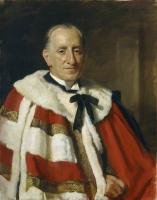
On 14th July 1921 Ivor Windsor-Clive 2nd Earl Plymouth [aged 32] and Irene Corona Charteris Countess Plymouth [aged 19] were married. She the daughter of Hugo Charteris 11th Earl of Wemyss [aged 63] and Mary Constance Wyndham Countess Wemyss [aged 58]. He the son of Robert George Windsor-Clive 1st Earl Plymouth [aged 63] and Alberta Victoria Sarah Caroline Paget Countess Plymouth [aged 58].
On 14th July 664 Archbishop Deusdedit died of plague.
On 14th July 937 Arnulf "Bad" Luitpoldings I Duke Bavaria died.
On 14th July 1223 King Philip II of France [aged 57] died. His son Louis [aged 35] succeeded VIII King France: Capet. Blanche Ivrea Queen Consort France [aged 35] by marriage Queen Consort of France.
On 14th July 1262 Richard de Clare 6th Earl Gloucester 5th Earl Hertford [aged 39] died. His son Gilbert [aged 18] succeeded 7th Earl Gloucester, 6th Earl Hertford, 9th Lord Clare, 3rd Lord Glamorgan. Alice or Alix Lusignan Countess Gloucester and Hertford [aged 26] by marriage Countess Gloucester, Countess Hertford.
On 14th July 1323 Ralph Greystoke 1st Baron Greystoke [aged 23] died at Gateshead, County Durham. Possibly poisoned by a rebel knight. He was buried at Newminster Abbey, Northumberland [Map]. His son William [aged 2] succeeded 2nd Baron Greystoke.
On 14th July 1361 Edward Montagu 1st Baron Montagu died. Baron Montagu abeyant between his daughters Joan Montagu Countess Suffolk [aged 12] and Audrey Montagu 2nd Baroness Montagu.
On 14th July 1484 Frederico Gonzaga Marquess Mantua [aged 43] died. His son Francesco [aged 17] succeeded II Marquess Mantua.
On 14th July 1486 Margaret Oldenburg Queen Consort Scotland [aged 30] died.
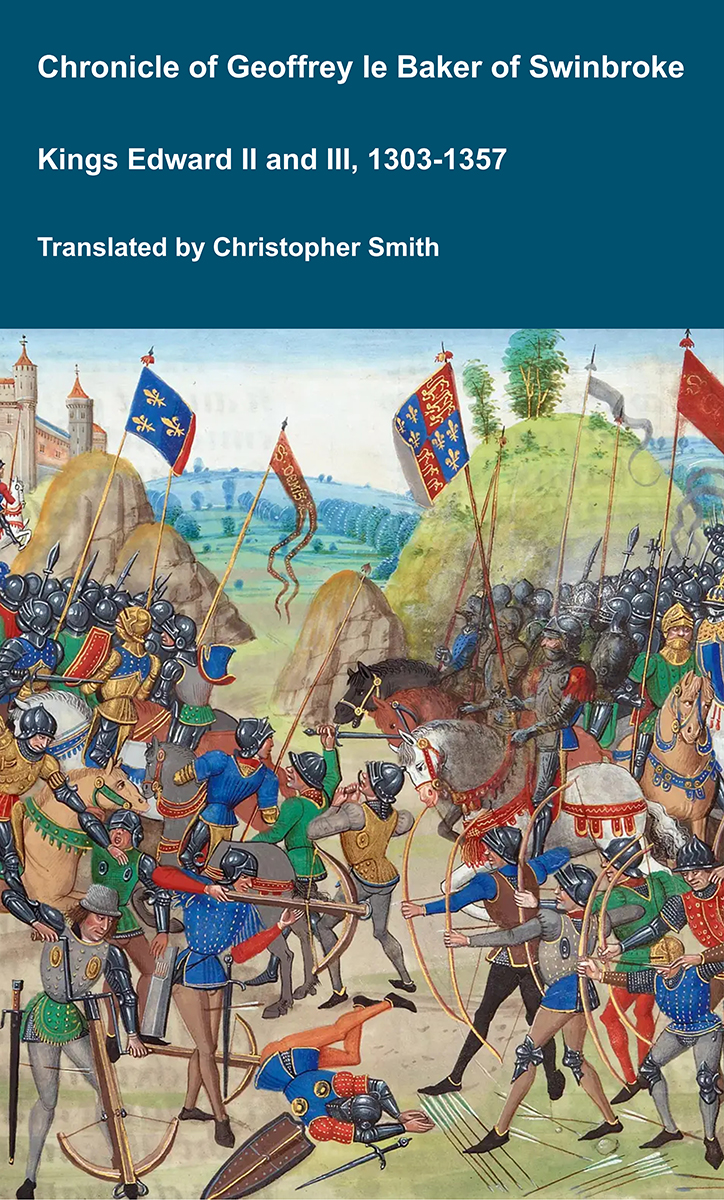
Chronicle of Geoffrey le Baker of Swinbroke
Baker was a secular clerk from Swinbroke, now Swinbrook, an Oxfordshire village two miles east of Burford. His Chronicle describes the events of the period 1303-1356: Gaveston, Bannockburn, Boroughbridge, the murder of King Edward II, the Scottish Wars, Sluys, Crécy, the Black Death, Winchelsea and Poitiers. To quote Herbert Bruce 'it possesses a vigorous and characteristic style, and its value for particular events between 1303 and 1356 has been recognised by its editor and by subsequent writers'. The book provides remarkable detail about the events it describes. Baker's text has been augmented with hundreds of notes, including extracts from other contemporary chronicles, such as the Annales Londonienses, Annales Paulini, Murimuth, Lanercost, Avesbury, Guisborough and Froissart to enrich the reader's understanding. The translation takes as its source the 'Chronicon Galfridi le Baker de Swynebroke' published in 1889, edited by Edward Maunde Thompson.
Available at Amazon in eBook and Paperback format.
On 14th July 1510 Arthur Stewart 1st Duke Rothesay died at Edinburgh Castle [Map].
On 14th July 1526 John de Vere 14th Earl of Oxford [aged 26] died. He was buried at Colne Priory, Essex [Map]. His second cousin John [aged 55] succeeded 15th Earl of Oxford.
On 14th July 1551 Henry Brandon 2nd Duke of Suffolk [aged 15] died of sweating sickness at the Bishop of Lincoln's Palace, Buckden [Map]. His brother Charles [aged 14] succeeded 3rd Duke Suffolk, 3rd Viscount Lisle.
Charles Brandon 3rd Duke of Suffolk died of sweating sickness an hour or so after his brother also at the Bishop of Lincoln's Palace, Buckden [Map]. Duke Suffolk, Viscount Lisle extinct.
They were buried at St Mary's Church, Buckden [Map]
Charles Brandon 3rd Duke of Suffolk: In 1537 he was born to Charles Brandon 1st Duke of Suffolk and Catherine Willoughby Duchess Suffolk. Henry Machyn's Diary. 22nd September 1551. The xxij day of September was the monyth['s mind of the] ij dukkes of Suffoke [Henry Brandon 2nd Duke of Suffolk and Charles Brandon 3rd Duke of Suffolk] in Chambryge-shyre, with [ij] standards, ij baners grett of armes and large, and banars rolles of dyver armes, with ij elmets, ij [swords, ij] targetts crownyd, ij cotes of armes, ij crests, and [ten dozen] of schochyons crounyd; and yt was grett pete of [their] dethe, and yt had plesyd God, of so nobull a stok they wher, for ther ys no more left of them.
On 14th July 1615 John Savage 1st Baronet [aged 65] died. His son Thomas [aged 29] succeeded 2nd Baronet Savage of Rocksavage in Cheshire. Elizabeth Darcy 1st Countess Rivers [aged 34] by marriage Lady Savage of Rocksavage in Cheshire.

On 14th July 1716 Edward Lee 1st Earl Lichfield [aged 53] died. His son George [aged 26] succeeded 2nd Earl Lichfield, 6th Baronet Lee of Quarrendon in Buckinghamshire. Frances Hales Countess Lichfield [aged 19] by marriage Countess Lichfield.

On 14th July 1734 Robert Dashwood 1st Baronet [aged 71] died at Northbrook, Oxfordshire. His grandson James [aged 21] succeeded 2nd Baronet Dashwood of Kirtlington Park in Oxfordshire.
On 14th July 1774 Matthew Blakiston 1st Baronet [aged 72] died at Jermyn Street. His son Matthew [aged 13] succeeded 2nd Baronet Blakiston of the City of London.
On 14th July 1800 George Mason aka Villiers 2nd Earl Grandison [aged 49] died. Earl Grandison of County Leitrim, Viscount Grandison of Dromana Country Waterford extinct.
On 14th July 1800 Basil Feilding 5th Earl Desmond 6th Earl Denbigh [aged 81] died. His grandson William [aged 4] succeeded 6th Earl Desmond, 7th Earl Denbigh, 7th Viscount Feilding, 7th Baron Feilding of Newnham Paddocks in Warwickshire, 6th Viscount Callan of Callan in Kilkenny, 6th Baron Feilding of Lecagh in Tipperary, 6th Baron St Liz.
On 14th July 1802 Anne Elizabeth Henniker Countess Aldborough died.
On 14th July 1805 Harriet Hobart Viscountess Belmore [aged 43] died.
Chronicle of Geoffrey le Baker of Swinbroke
Baker was a secular clerk from Swinbroke, now Swinbrook, an Oxfordshire village two miles east of Burford. His Chronicle describes the events of the period 1303-1356: Gaveston, Bannockburn, Boroughbridge, the murder of King Edward II, the Scottish Wars, Sluys, Crécy, the Black Death, Winchelsea and Poitiers. To quote Herbert Bruce 'it possesses a vigorous and characteristic style, and its value for particular events between 1303 and 1356 has been recognised by its editor and by subsequent writers'. The book provides remarkable detail about the events it describes. Baker's text has been augmented with hundreds of notes, including extracts from other contemporary chronicles, such as the Annales Londonienses, Annales Paulini, Murimuth, Lanercost, Avesbury, Guisborough and Froissart to enrich the reader's understanding. The translation takes as its source the 'Chronicon Galfridi le Baker de Swynebroke' published in 1889, edited by Edward Maunde Thompson.
Available at Amazon in eBook and Paperback format.
On 14th July 1808 Frances Pulteney [aged 93] died.
On 14th July 1808 Henrietta Laura Johnstone aka Pulteney 1st Countess Bath [aged 41] died. Earl Bath extinct. She left her personal estate to her cousin Elizabeth Evelyn Sutton and her husband John Fawcett aka Pulteney [aged 41] who adopted the surname Pulteney in 1813. The landed estates were claimed by William Henry Vane 1st Duke Cleveland [aged 41] who was a descendant of Anne Pulteney Duchess Southampton Duchess of Cleveland.

On 14th July 1809 Charles Agar 1st Earl Normanton [aged 72] died. He was buried at North Transept Westminster Abbey [Map]. His son Welbore [aged 31] succeeded 2nd Earl Normanton.

On 14th July 1811 Sitwell Sitwell 1st Baronet [aged 41] died. His son George [aged 14] succeeded 2nd Baronet Sitwell of Renishaw Hall in Derbyshire.
On 14th July 1813 Elizabeth Hudson Lady Heathcote [aged 58] died.
On 14th July 1817 James Everard Arundell 9th Baron Arundel [aged 54] died. His son James [aged 31] succeeded 10th Baron Arundel of Wardour in Wiltshire.
On 14th July 1836 Matthew White Ridley 3rd Baronet [aged 58] died. His son Matthew [aged 28] succeeded 4th Baronet Ridley of Blagdon in Northumberland.
On 14th July 1851 Edward Hardinge John Stracey 2nd Baronet [aged 82] died. His brother George [aged 80] succeeded 3rd Baronet Stracey of Rackheath in Norfolk.
On 14th July 1853 John Wallop 3rd Earl Portsmouth [aged 85] died. He was buried at St John's Church, Farleigh Wallop. His brother Newton [aged 81] succeeded 4th Earl Portsmouth, 4th Viscount Lymington, 4th Baron Wallop of Farley Wallop Hampshire. He died six months later. Catherine Fortescue Countess Portsmouth [aged 66] by marriage Countess Portsmouth.
On 14th July 1859 John "The Younger" Bacon [aged 82] died at Bath, Somerset [Map].
On 14th July 1888 Emma Elizabeth Alicia Dawkins-Pennant Baroness Sudeley died.
On 14th July 1895 William Alleyne Cecil 3rd Marquess Exeter [aged 70] died. His son Brownlow [aged 45] succeeded 4th Marquess Exeter, 13th Earl Exeter, 14th Baron Burghley. Monument in the Church of St John the Baptist, Barnack [Map].
Brownlow Henry George Cecil 4th Marquess Exeter: On 20th December 1849 he was born to William Alleyne Cecil 3rd Marquess Exeter and and Georgina Sophia Pakenham Marchioness Exeter. On 7th September 1875 Brownlow Henry George Cecil 4th Marquess Exeter and Isabella Whichcote Marchioness of Exeter were married at St Denys' Church, Aswarby. He the son of William Alleyne Cecil 3rd Marquess Exeter.
Jean de Waurin's Chronicle of England Volume 6 Books 3-6: The Wars of the Roses
Jean de Waurin was a French Chronicler, from the Artois region, who was born around 1400, and died around 1474. Waurin’s Chronicle of England, Volume 6, covering the period 1450 to 1471, from which we have selected and translated Chapters relating to the Wars of the Roses, provides a vivid, original, contemporary description of key events some of which he witnessed first-hand, some of which he was told by the key people involved with whom Waurin had a personal relationship.
Available at Amazon in eBook and Paperback format.
On 14th July 1897 Francis Stonor 4th Baron Camoys [aged 40] died. His son Francis [aged 13] succeeded 5th Baron Camoys.

On 14th July 1928 Andrew Agnew 9th Baronet [aged 77] died.
On 14th July 1944 Arthur Cocks 6th Baron Somers [aged 57] died at Eastnor Castle, Herefordshire. His uncle Arthur [aged 79] succeeded 7th Baron Somers.
On 14th July 1963 Richard Wilmot Onslow 7th Baronet [aged 56] died. His son John [aged 30] succeeded 8th Baronet Onslow of Althain.

On 14th July 1979 Walter Keppel 9th Earl Albermarle [aged 97] died. His grandson Rufus [aged 13] succeeded 10th Earl Albermarle, 10th Viscount Bury in Lancashire, 10th Baron Ashford of Ashford in Kent.
On 14th July 1983 John Rous 4th Earl of Stradbroke [aged 80] died. His brother William [aged 76] succeeded 5th Earl Stradbroke, 5th Viscount Dunwich, 10th Baronet Stradbrooke of Henham in Suffolk.
On 14th July 1997 George Hardinge 3rd Baron Hardinge [aged 75] died. His son Julian [aged 51] succeeded 4th Baron Hardinge of Penshurt in Kent.
