

29 Sep is in September.
1283 Execution of David Prince of Wales
1308 de Clare and de Burgh Double Marriage
1328 Roger Mortimer created Earl of March
1397 Richard II Rewards his Supporters
1469 Execution of the Neville Brothers
1470 September 1470 King Edward flees to Burgundy
29 Sep is known as Michaelmas being the Feast of St Michael, and also Saints Gabriel and Raphel, aka the Feast of the Archangels, or the Feast of All Saints.
On 29th September 792 Æthelred I of Northumbria [aged 30] and Queen Ælfflæd of Northumbria were married. She by marriage Queen Northumbria. She the daughter of King Offa of Mercia and Cynethryth Queen Mercia. He the son of Æthelwald Moll King of Northumbria.
On 29th September 855 Lothair Holy Roman Emperor [aged 60] died.
 Annals of Six Kings of England by Nicholas Trivet. 1140. The Empress Matilda, daughter of King Henry I, together with her brother Robert, count of Gloucester, came to England around the feast of Saint Michael [29th September 1140], stirring the hearts of many against the king by recalling the oath that had once been sworn to her. The kingdom was divided against itself and, according to the word of truth, was laid waste by hostile incursions, with plundering and burnings carried out everywhere. Meanwhile Geoffrey, count of Anjou, ranged through Normandy with an army and in a short time brought the whole of it under his power in the name of his wife and son, no one being able to resist his attack.
1140. MATILDIS imperatrix, filia regis Henrici primi, cum germano suo Roberto Glocestriæ comite, circa festum Sancti Michaelis, venit in Angliam contemplatione juramenti olim sibi præstiti corda multorum¹ commovens contra regem. Regnum in se dividitur, et juxta verbum veritatis, per hostiles incursus, passim rapinas exercentes et incendia, desolatur. Interim Galfridus, Andegavensis comes, Normanniam pervagatur cum exercitu, totamque in brevi uxoris et filii nomine redegit in suam potestatem, nemine, qui ejus valeret sustinere impetum, resistente.
Annals of Six Kings of England by Nicholas Trivet. King Henry, therefore, around the feast of Saint Michael [29th September 1155], after holding a parliament at Winchester, discussed with his nobles the conquest of Ireland. But because this did not please his mother [Matilda], the empress, that expedition was postponed to another time. Henry, bishop of Winchester and formerly brother of King Stephen, secretly sent his treasure ahead through the abbot of Cluny and departed secretly from England without royal permission; for this reason King Henry seized all his castles.
Rex igitur Henricus circa festum sancti Michaelis, [habito] Wintoniæ parliamento, de conrespecting quirenda Hibernia cum suis optimatibus tractathe conquest of Ireland. vit. Quod quia matri ejus imperatrici non placuit, ad tempus aliud dilata est illa expeditio. Henricus, Wyntoniensis episcopus, germanus quondam regis Stephani, præmisso latenter thesauro suo per abbatem Cluniacensem, absque regia licentia ab Anglia clam discessit; propter quod rex Henricus pessundedit omnia castra ejus.
Annals of Six Kings of England by Nicholas Trivet. At this time there flourished in the region of Beauvais Helinand of Froidmont, a monk who diligently wrote a chronicle from the beginning of the world down to his own time. He also composed two books, one on the Government of Princes and another which he entitled The Lament of the Monk. Henry of Flanders, emperor of the Greeks, having gathered an army, marched through the land, subdued those who resisted, and compelled those already subject to live in peace, extending and enlarging the bounds of his dominion on every side. King John of England, having returned prosperously from Ireland on the fourth day before the Kalends of September [29th September 1210], imposed a very heavy tax upon abbeys and other religious houses, especially those of the Cistercian order.
His temporibus claruit in territorio Belvacensi Elinandus monachus, qui chronicam ab initio mundi usque ad tempus suum diligenter conscripsit: edidit et duos libros, unum de Regimine Principum, et alium quem de Planctu Monachi voluit appellari. Henricus Græcorum imperator, coadunato exercitu, terram pervagans, resistentes subjecit, et subjectos pacifice vivere coegit; dominationis suæ terminos undique amplians et dilatans. Joannes rex Angliæ, de Hibernia quarto calendas Septembris prospere reversus, de abbatiis aliisque religiosorum domibus, et præcipue Cisterciensium, exegit tallagium nimis grave.
On 29th September 1240 Margaret Queen of Scotland was born to King Henry III of England [aged 32] and Eleanor of Provence Queen Consort England [aged 17] at Windsor Castle [Map]. She married 25th December 1251 her half fourth cousin King Alexander III of Scotland, son of King Alexander II of Scotland and Marie Coucy, and had issue.
On 29th September 1253 Otto "Illustrious" Wittelsbach II Duke Bavaria [aged 47] died. His son Louis [aged 24] succeeded II Duke Upper Bavaria, Count Palatine of the Rhine.
Annals of Six Kings of England by Nicholas Trivet. While these things were taking place, the Earl of Gloucester, disloyal to the king, having raised an army in Wales in support of the disinherited, went to London; and John de Eyville, meeting him with a great force of his accomplices, they took possession of the city with the favour of the citizens. The earl immediately sent messengers to the legate, who was lodging in the Tower, ordering him to surrender it to him without delay; and, to hasten this, he forbade anyone to sell provisions to those remaining in the Tower. The legate, concealing the matter, left the Tower and went to the church of Saint Paul to preach the crusade. This disturbance ceased after a few days, and the earl was reconciled to the king through the mediation of Richard, King of the Romans, and of the illustrious knight Philip Basset, a penalty of ten thousand marks being imposed if the earl should in future raise any disturbance. Around the feast of Saint Michael [29th September 1267], the king came with a great army to Shrewsbury, intending to proceed into Wales to subdue its prince, Llywelyn, who had supported the cause of Earl Simon in his defiance of the king. But he, sending envoys to the king, granted him thirty thousand pounds sterling for peace; and thus, through the intervention of the legate, the land of the four cantrefs, which the king had taken from him by right of war, was restored to the prince. The Sultan of Babylon, having ravaged Armenia, took Antioch, one of the most famous cities of the world, from the Christians, and, many men and women having been slain or captured, reduced it to desolation. John Gervase, Bishop of Winchester, died and was buried at Viterbo.
Dum hæc aguntur, comes Gloverniæ regi infidus, parato exercitu in Wallia in favorem exheredatorum, Londonias adiit, et occurrente sibi Joanne de Eyvile cum magna manu complicium suorum, civitatem faventibus civibus occupavit: moxque legato, qui turrim pro hospitio habuit, mandavit comes per nuntios, ut eam sibi redderet indilate; et ut hoc maturaret facere, ne quis in tarri eidem manenti victualia venderet interdixit. Legatus dissimalato negotio, a turri discedens, prædicaturus crucem procedit ad ecclesiam sancti Pauli. Cessavit iste tumultus post dies paucos; comesque regi reconciliatur per mediationem Ricardi regis Romanorum, ac illustris militis. Philippi Basseth, posita pœna decem millium marcarum si comes in posterum tumultum aliquem commoveret. Circa festum S. Michaelis rex cum magno exercitu venit Salopiam, in Walliam progressurus, ut principem ejus Lewelinum, qui partem comitis Symonis in sua præsumptione contra regem foverat, debellaret. At ille, missis ad regem nuntiis, triginta millia librarum sterlingorum pro pace habenda regi concessit: sicque interveniente legato restituta est principi terra quatuor cantredorum, quam rex abstulerat ei jure belli. Soldanus Babyloniæ, vastata Armenia, Antiochiam unam de famosioribus civitatibus orbis abstulit Christianis, et tam viris quam mulieribus occisis et captis, in solitudinem ipsam redegit. Obiit Joannes Gervasii, Wintoniensis episcopus, et Viterbii sepelitur.
On 29th September 1273 Rudolph I King Romans [aged 55] was elected I King Romans.
Annals of Six Kings of England by Nicholas Trivet. A parliament was held at Shrewsbury after the feast of St Michael [29th September 1283], in which David, having been judicially condemned by justices appointed for this purpose, was drawn, hanged, and his entrails burned [on 3rd October 1283]; his body was beheaded and divided into four parts, which were hung in the chief cities of England, while his head was set up on a stake in London as a warning to similar traitors. Rhys ap Maredudd, one of the most noble of the Welsh, on hearing of David’s capture, surrendered himself to the earl of Hereford; and, being delivered to the king, was sent to the Tower of London and committed to prison. In the same year, the king transferred the abbey of Aberconwy to another site, and there constructed a strong castle [Conwy1] to check the incursions of the Welsh. He also founded in the county of Chester another abbey of Cistercian monks, which, having endowed it with many lands, he wished to be called Vale Royal. In this year there was granted to the king, for the support of his war, a thirtieth from the people and a twentieth from the clergy.
Parliamentum post festum S. Michaelis est habitam Salopiæ: in quo per deputatos ad hoc justitiarios David judicialiter condemnatus, tractus, et suspensus est; visceribusque combustis, corpus capite truncatum, et in quatuor partes est divisum, quibus in civitatibus Angliæ majoribus suspensis, caput Londoniis super palum fixum est ad terrorem consimilium proditorum. Resus autem Vauhan, nobilissimus Wallensium, audita captione David, comiti Herfordiæ se dedidit, regique redditus, ad turrim Londoniarum missus carceri mancipatur. Eodem anno translata est per regem abbatia de Abercon ad locum alium, constructumque est ibidem [ad compescendum] irruptiones Wallensium castrum forte: fundavit et rex in comitata Cestriæ aliam abbatiam monachorum Cisterciensium, quam multis ditatam prædiis Vallem Regalem voluit appellari. Concessa est hoc anno regi in guerræ suæ subsidium a populo tricesima, et a clero vicesima pars bonorum.
Note 1. Conwy was one of a number of castles along the north coast of Wales by which King Edward intended to subdue Wales: Flint, Rhuddlan, Conwy, Caernarfon, Beaumaris, Harlech and Aberystwyth. Arguably, although not coastal, Chirk should also be included.
Annals of Six Kings of England by Nicholas Trivet. After the feast of Saint Michael [29th September 1291], the king, again setting out for Scotland, when he had come to York and had stayed there for some time, Rhys, son of Maredudd, having been captured and brought there, was judicially condemned. The king then proceeding into Scotland, imposed upon all those claiming right to the kingdom of Scotland that they should appear before him at the next feast of Saint John the Baptist [24th June 1292], and should more fully declare by what right they claimed that kingdom.
Rex vero post festum S. Michaelis iterum tendens in Scotiam, cum Eboracum venisset, moramque aliqualem ibi fecisset, Resus filius Mereduci captus, illucque deductus, judicialiter est condemnatus. Profectus deinde rex in Scotiam, omnibus in regnum Scotiæ jus vindicantibus imposuit, ut in festo S. Joannis Baptistæ proximo futuro coram se comparerent, et quo jure regnum illud vindicabant plenius declararent.
 Chronicle of Walter of Guisborough. In the same year, around the Feast of Saint Michael [29th September 1294], the Welsh began to rebel. For they had gathered and agreed among themselves that on that very day of Saint Michael they would all rise up together against the king and take his castles. And so they did: on that same day, almost without warning, they seized many castles, including the castle of Caernarfon [Map], which our king had previously constructed at great expense. They demolished its walls and slaughtered the king's officials; the English who were able fled, and many were cut down by the sword, for these events occurred suddenly. The leaders of this rebellion claimed to be descended, by name, from the blood of Prince Llywelyn, and therefore said they were bound to revive the name of prince.
Eodem anno circa festum sancti Michaelis Wallenses rebellare cœperunt. Convenerant enim et statuerant inter se quod in ipso die sancti Michaelis omnes unanimiter insurgerent contra regem, et castra ejus dirimerent, feceruntque sic, et eodem die quasi ex improviso ceperunt castella multa, ceperuntque castrum de Carnarvan quod rex noster dudum sumptuosissime construxerat, demolientes muros et ministros regis trucidantes, fugeruntque Anglici qui poterant, et multi absorpti sunt in ore gladii eo quod subito facta sunt hæc. Istius autem sediduo, nominatim de sanguine principis Leulini se descendisse dicebant, et ideo nomen principis suscitare debere.
Annals of Six Kings of England by Nicholas Trivet. The army of the King of England, setting out from Portsmouth about the feast of Saint Michael [29th September 1294], being driven back by force of winds, put in at Dartmouth. On the day [10th October 1294] after Saint Denis, however, having caught a favourable wind, they sailed swiftly and reached Saint-Mathieu in Brittany on the second day. Departing from Brittany, on the day after the feast of Saints Crispin and Crispinian [25 October], they entered the mouth of the Gironde, the river that flows down from Bordeaux, and ascending by it, having taken two good and walled towns, Bourg-sur-Mer and Blaye, passing with favourable course before Bordeaux, they came to Rions, where the town having been surrendered to them, they disembarked their horses from the ships.
Exercitus regis Angliæ, de Portamuta circa festum sancti Michaelis progrediens, vi ventorum repulsus applicuit Dertemutam. In crastino vero sancti Dionysii captata aura cursu velivolo ad S. Matthæum in Britannia die secundo pervenit. Discedentes a Britannia, in crastino sanctorum Crispini et Crispiniani intraverunt ostia Girundiæ, fluvii a Burdegala descendentis; per quem adscendentes, captis duabus villis bonis ac muratis, Burgo super mare ac Blavio, cursu prospero transeuntes coram Burdegala, Risuncium pervenerunt; ubi reddita eis villa, equos suos de navibus eduxerunt.
Jean de Waurin's Chronicle of England Volume 6 Books 3-6: The Wars of the Roses
Jean de Waurin was a French Chronicler, from the Artois region, who was born around 1400, and died around 1474. Waurin’s Chronicle of England, Volume 6, covering the period 1450 to 1471, from which we have selected and translated Chapters relating to the Wars of the Roses, provides a vivid, original, contemporary description of key events some of which he witnessed first-hand, some of which he was told by the key people involved with whom Waurin had a personal relationship.
Available at Amazon in eBook and Paperback format.
On 29th September 1296 James Barcelona was born to James "The Just" II King Aragon [aged 29] and Blanche Capet Queen Consort Aragon. He a great x 4 grandson of King Henry "Curtmantle" II of England.
The Treaty of Montgomery was signed on 29th September 1297 by King Henry III of England and Llywelyn ap Gruffudd, acknowledging Llywelyn as the Prince of Wales, and a vassal of King Henry. It ended the Second Barons' War.
Chronicle of Walter of Guisborough. Meanwhile, our men who had been in the rearguard passed through, and upon encountering the fourth division of the Count's army, they routed it swiftly and completely, as though it were nothing. Then darkness fell, so thick that no one could recognize another unless they spoke the same native tongue. Both our forces and the French were scattered, uncertain where to turn until the moon finally shone upon them. When it did, the French made their way to the nearby towns. Some of our men had become mixed in with the French, and when they were discovered, either by the moonlight or by their own language, they were captured and violently taken away. Among them was Lord John de St. John and several others. However, only a few were actually killed by the sword, since these events happened at nightfall, under a kind of sudden gloom, and there were no foot soldiers on either side to strip or slay the fallen knights. Our foot soldiers had remained in the forest and accomplished little to no good. Three hundred of our armed men proceeded as far as Bellegarde, but the townspeople, who had already heard of the outcome, would not admit them. Shutting their gates, they reproached them for so foolishly abandoning their comrades and their brave commander. So the men pressed on that same night to Saint-Cyner, four leagues away, and were received there. Later, more of our men arrived during the dead of night and were also received. Encouraged by their advice, they set out at dawn for the battlefield, gathered much plunder, and carried away the grain they had brought with them. Meanwhile, our commander, having wandered through the night with many others, not knowing where to go, returned by the same road by which he had come. Around the third hour of the morning, he arrived at Perforarde, where he had spent the previous night, and found there many of his men, sorrowful over his absence, but now rejoicing at his safe return. He then returned to Bayonne with Lord John of Brittany and his entire retinue. In the following Lent, all his scattered and fugitive men rejoined him. That summer, they moved again toward the region of Toulouse, burning as many towns and cities as they could, and devastating with fire and sword until the Feast of Saint Michael [29th September 1297]. They lifted the siege of Saint Catherine, which the Toulousains had laid, and returned with great plunder to Bayonne, where they spent the winter until after Christmas. Shortly afterward, having received orders from our king concerning a newly agreed truce, they returned to England around Easter.
Interim transierunt nostri qui in ultima custodia erant, et obviantes quartæ aciei ipsius comitis ipsam in velocem fugam quasi pro nihilo converterunt, et facta est obscura nox, ita quod nullus cognosceretur ab altero nisi lingua materna loqueretur. Dispersique sunt nostri, et etiam Franci, nescientes bene qua parte diverterent quousque luna luceret super eos; lucente tandem luna declinaverunt Franci ad urbes finitimas, et quidam ex nostris inserti cum Francis, qui cum ex ipsa luce vel lingua manifestarentur propria, capti sunt et violenter abducti. Inter quos dominus Johannes de Sancto Johanne captus est, et quidam alii; pauci tamen corruerunt gladio, quia advesperante die facta sunt hæc, et cooperuerat eos quasi subita caligo, nec erant pedestres hinc vel inde qui projectos armatos spoliarent vel interimerent. Nostri enim pedestres remanserunt in nemore, nec boni quicquam exorsi sunt. Ex armatis autem nostris trecenti viri processerunt usque Belegarde, sed tamen a civibus, qui jam hoc factum audierant, admissi non sunt, sed, clausis januis, improperabant eis quod suos consocios et comitem strenuum tam vecorditer reliquerunt, processeruntque eadem nocte ad Sanctum Cynerum per quatuor leucas, et ibi recepti sunt. Susceperunt tamen alios in profundo noctis venientes, et, eorum consilio freti, egressi sunt in aurora diei ad locum pugnæ, colligentes spolia multa, et frumentum quod portaverant asportantes. Comes autem noster cum multis aliis magno noctis spatio vagans, cum jam nesciret quo diverteret, per eandem viam reversus est qua et venerat, et mane, hora quasi tertia, venit ad Perforarde ubi prius pernoctaverat, et invenit ibidem multos ex suis moestos quidem de ejus absentia, sed de præsentia jam gaudentes eo quod salvum eum receperant. Reversusque est usque Bayonum cum domino Johanne de Britannia et toto comitatu, congregatique sunt ad eum in sequenti Quadragesima omnes dispersi sui et profugi, et in sequenti æstate moverunt se versus partes Tholosanas, incendentes urbes et villas quas poterant, et sævientes igne et gladio usque ad Festum Sancti Michaelis. Removeruntque obsidionem Sancti Katerini quam Tholonenses fecerant, et reversi sunt cum præda magna usque Bayonum, hyemaveruntque ibidem usque post Dominica natalitia. Et cito post, accepto mandato a rege nostro de treugis initis, reversi sunt in Angliam circa Pascha.
Chronicle of Walter of Guisborough. That same year, after the king had heard that his men had fallen in Scotland, as said above, he gathered a large army, and by royal summons all came to him at the Feast of Pentecost [26th May 1303] at Roxburgh. Advancing in short marches, he carried off much plunder, burning and almost laying waste everything, traversing the land and all the mountains as far as Caithness; nor was there anyone to resist him, for they had fled into the marshes and certain nearby islands. Seeing that they could by no means resist, the Scots sent to the king, submitting and humbly asking for the things that make for peace; and that if he would allow them to hold and possess under him, in peace, the lands which he had given and promised to his magnates before, they would willingly redeem them for a price. The proposal pleased the king, and in his royal clemency he received them into peace on the aforesaid terms, at the Feast of Saint Michael [29th September 1303] following.
Eodem anno, postquam audiverat rex suos corruisse in Scotia, ut prædictum est, congregavit exercitum copiosum, et convenerunt ad eum omnes ex edicto in festo Pentecostes apud Rokesburch; profectusque est per dietas modicas, prædas agens multas, incendens et quasi devastans omnia, perlustravitque terram et omnes montes usque Cathenesse, nec erat qui resisteret ei, fugerant enim ad paludes et insulas quasdam finitimas. Videntes autem Scoti se nullo modo posse resistere, miserunt ad regem, submit, rogantes humiliter ea quæ pacis sunt; et si permittere vellet quod terras suas, quas suis magnatibus dederat et promiserat ante, possent sub eo pacifice possidere et tenere, libenter eas redimerent dato pretio. Placuitque regi sermo, et ex clementia regia suscepit eos ad pacem modo prædicto in festo Sancti Michaelis subsequentis.
On 29th September 1305 Henry Wittelsbach XIV Duke Bavaria was born to Stephen Wittelsbach I Duke Bavaria [aged 34] and Jutta Jawor Duchess Bavaria. He a great x 4 grandson of King Henry "Curtmantle" II of England. He married 12th August 1328 his fourth cousin once removed Margaret Luxemburg, daughter of King John I of Bohemia and Queen Elizabeth of Bohemia, and had issue.
Chronicle of Walter of Guisborough. Around the Feast of Saint Michael [29th September 1306], the new king [Robert the Bruce] returned from the islands of Scotland to which he had fled, bringing with him many Irish and Scots, and remained in Kintyre. He sent some of his men into Carrick, and there they collected his rents for the term of Saint Martin. Hearing of this, Lord Henry de Percy went there, but the new king, arriving there unexpectedly at night, attacked the said Lord Henry, killed a few of his household, seized his warhorses and silver vessels, and besieged him in the castle of that place until the lord king of England, sending a strong force, freed him. From then on, the new king ranged through the land of Scotland, and all the strong and able-bodied men who refused to follow him he put to death by the sword, and he inflicted many evils upon the people. In the following Lent, he sent away from himself, with part of his army, his two brothers, namely Lord Thomas de Brus [aged 22], who had always hated the English, and Lord Alexander [aged 21], a cleric1, who were taken unexpectedly at night by our forces, and, after judgment, drawn and hanged. From that time onward the new king kept himself in the farthest ends of the land.
Circa festum Sancti Michaelis reversus est novus rex ab insulis Scotiæ ad quas fugerat, cum multis Hibernicis et Scotis, mansitque in Kentyr, misitque aliquos ex suis in Karryk, et levaverunt ibi firmas suas de termino Sancti Martini. Quod audiens dominus Henricus de Percy, declinavit ibidem, et ex improviso superveniens novus rex irruit nocte in prædictum dominum Henricum, et occidit paucos de familia ejus, cepitque equos suos dextrarios et vasa argentea, et obsedit eum in castro ejusdem loci, quousque dominus rex Angliæ misso robore exercitus liberavit eum. Extunc circuivit terram Scotiæ ille novus rex, et omnes potentes atque robustos qui contempserunt sequi eum peremit gladio, fecitque multa mala in populo illo. In Quadragesima vero sequente misit a se cum parte and exercitus sui duos fratres suos, dominum scilicet Thomam de Brus, qui Anglicos semper odio habuerat, et dominum Alexandrum clericum, qui ex improviso a nostris de nocte capti sunt, et judicialiter tracti et suspensi. Tenuitque se extunc novus rex in extremis finibus terræ.
Note 1. The Chronicle of Lanercost.
On 29th September 1308 (possibly 30th) in a Siblings Marriage de Clare siblings married de Burgh siblings at Waltham Abbey, Essex [Map] in the presence of King Edward II of England [aged 24].
John Burgh [aged 22] and Elizabeth Clare Lady Verdun [aged 13] were married. She the daughter of Gilbert "Red Earl" Clare 7th Earl Gloucester 6th Earl Hertford and Joan of Acre Countess Gloucester and Hertford. He the son of Richard "Red Earl" Burgh 2nd Earl of Ulster [aged 49] and Margaret Burgh Countess Ulster. They were third cousin once removed. She a granddaughter of King Edward I of England.
Gilbert de Clare 8th Earl Gloucester 7th Earl Hertford [aged 17] and Matilda Burgh Countess Gloucester and Hertford [aged 20] were married. She by marriage Countess Gloucester, Countess Hertford. She the daughter of Richard "Red Earl" Burgh 2nd Earl of Ulster and Margaret Burgh Countess Ulster. He the son of Gilbert "Red Earl" Clare 7th Earl Gloucester 6th Earl Hertford and Joan of Acre Countess Gloucester and Hertford. They were third cousin once removed. He a grandson of King Edward I of England.
 Chronicle of Geoffrey le Baker of Swinbroke. Once the matters for which the queen had been sent to France were completed, shortly after the feast of Saint Michael [29th September 1325], her husband wrote to her,1 ordering her to return her son to England without delay. The queen, however, replied that her brother, the King of France, was treating them with such excessive affection that he was holding them back against their will. As a result, she dismissed a large part of both households and spent the remainder of that year attending to certain affairs for which, it appeared, she had originally intended to set out. Bishop Walter of Exeter, although not ordered to return to England, saw himself completely excluded from the queen's inner circle of counsel. Recognizing that Roger de Mortimer and other fugitives, enemies of his lord the king, had taken over his place in the queen's favour, he quietly returned to England.2 England grew increasingly disturbed by the queen's extended stay abroad, and by her retention, against the king's will, of their son outside the realm. Some claimed they were being detained unwillingly; others suspected that the queen, seduced by the illicit embraces of Roger de Mortimer, refused to return, preferring the company of him and other English exiles she had found in France. Yet with various and conflicting explanations, some clearly false, others only partially true, the Bishops of Lincoln and Hereford, who were aware of the true affair and awaited its conclusion with the wrathful virago, concealed the secret of their conscience.
Completis negociis pro quibus in Franciam missa fuerat regina, statim post festum sancti Michaelis scripsit sibi eius maritus, precipiens quod filium suum in Angliam reduceret cum festinacione. Rescripsit ipsa mulier quod dominus rex Francie frater suus nimia caritate foveret illos et secum invitos detineret, unde, remissa magna parte utriusque familie, residium illius anni certa negocia pro quibus ex intencione proficiscebatur ipsa transegit. Walterus episcopus Exoniensis non in Angliam iussus redire, a questione tamen secreti concilii regine videns se totaliter sequestratum, set Rogerum de Mortimer et alios profugatos regis domini sui inimicos locum suum quoad regine familiaritatem usurpasse, clam repatriavit. Commovebatur Anglia de regine mora ad regis displicenciam extra regnum filium suum detinentis, quibusdam asserentibus quod inviti detinebantur, aliis conicientibus quod illicitis complexibus Rogeri de Mortuo mari delinita, cum ipso et aliis profugis Anglorum quos in Francia reperivit, noluit redire; set has et alias causas diversas quibusdam falsas, quibusdam vero semiplenas pretendentibus, episcopi Lincolniensis et Herefordensis, conscii negocii cuius finem expectavit irata virago, consciencie secretum dissimularunt.
Note 1. Edward wrote to the king of France complaining of the queen's delay, 1st December 1325. On the same day he wrote to her ordering her return. On the following day he wrote to his son to return, with or without his mother. Rymer's Fœdera 2.615, 2.616.
Note 2. In his letter to the queen, 1st December 1325, Edward states that Walter Stapleton returned at his command: "And as it happened, at the time when our honourable father in God, Walter, Bishop of Exeter, was with you, it was certainly made known to us that certain of our enemies and exiles over there were lying in wait to do him harm to his person, had they found the opportunity. And so, to avoid such dangers, and because we had urgent business with him, we summoned him, firmly commanding him, upon his faith and allegiance owed to us, that he hasten to come to us, leaving all other matters aside, in the safest manner he could, to preserve himself. We wish, and hereby command you, that you hold this as his justification for why the said bishop came suddenly to us from those parts, and understand that he did so for no other reason than the ones stated above." Rymer's Fœdera 2.615.
This account of his flight is given in the Vita Edward II, 285.
Chronicle of Geoffrey le Baker of Swinbroke. In the year of our Lord 1328, the second year of King Edward III from the Conquest, the king held a parliament at Salisbury1 shortly after the feast of Saint Michael [29th September]. At this parliament, he created three earls: namely, Lord John of Eltham, his brother, as Earl of Cornwall; Roger de Mortimer as Earl of the March of Wales; and the Butler of Ireland as Earl of Ormond. From this parliament, the Earl of Lancaster, Lord Wake, and certain other nobles withdrew themselves, and among their company were Lord Henry de Beaumont and the Earl Marshal; they came near, however, armed. This provoked the king's displeasure. But afterward, in summer, through the mediation of the Archbishop of Canterbury, they submitted themselves to the king's grace at Bedford. Not long after, the Earl of Lancaster became blind, and devoted himself wholly and patiently to the service of God.
Anno Domini MCCCXXVIIJ, ipsius regis Edwardi tercii a conquestu anno secundo, post quindenam sancti Michaelis tenuit rex parliamentum Sarisburie; in quo fecit tres comites, scilicet dominum Ioannem Deltham, fratrem suum, comitem Cornubie, et Rogerum de Mortuo mari comitem Marchie Wallie, et pincernam Hibernye comitem de Ormonde. Ab hoc parliamento comes Lancastrie et dominus de Wake, et alii quidam nobiles se subtraxerunt, et in eorum comitiva dominus Henricus de Bellemonte et comes Marescallus; prope tamen venerant armati. Unde in offensionem regem commoverunt, set postmodum in estate, procurante archiepiscopo Cantuariensi, apud Bedeford gracie regis se submiserunt; non multumque postea comes Lancastrie cecus effectus ad pacienter Deo serviendum se totum ordinavit.
Note 1. This parliament sat from the 16th to the 31st October. Lancaster's abortive attempt to throw off Mortimer's yoke is thus described by Knighton 2553-2555.
The Brute chronicle (Harley MS. 2279).
Lancaster's submission took place about the 12th or 13th January 1329. Bishop Stubbs's Introduction to Chronicle Edward I, II, i, cxxi. and Annales Paulini 343-4.
On 29th September 1328 Joan "Fair Maid of Kent" Princess Wales was born to Edmund of Woodstock 1st Earl Kent [aged 27] and Margaret Wake Countess Kent [aged 31] at Woodstock Palace, Oxfordshire [Map]. She a granddaughter of King Edward I of England. She married (1) March 1340 her fourth cousin once removed Thomas Holland 1st Earl Kent, son of Robert Holland 1st Baron Holand and Maud Zouche Baroness Holand, and had issue (2) November 1340 William Montagu 2nd Earl Salisbury, son of William Montagu 1st Earl Salisbury and Catherine Grandison Countess of Salisbury (3) 10th October 1361 her half first cousin once removed Edward "Black Prince", son of King Edward III of England and Philippa of Hainaut Queen Consort England, and had issue.
Chronicle of Geoffrey le Baker of Swinbroke. In the year of our Lord 1333, and the seventh year of the king's reign, Lord Edward Balliol, King of Scotland, held a parliament in Galloway shortly after the feast of Saint Michael [29th September], to which came the nobles of the kingdom of England who were claiming lands and possessions in Scotland; and from there they peacefully returned to their native soil.
Anno Domini MCCCXXXIIJ, regis vero septimo, dominus Edwardus de Baylol, rex Scocie, tenuit parliamentum in Galewey, cito post festum sancti Michaelis, ad quod venerunt nobiles regni Anglie, terras et possessiones in Scocia vendicantes, et ab inde pacifice in suum natale solum revertebantur.
 Adam Murimuth Continuation. In the year of our Lord 1338, in the fourth year of Pope Benedict XII, the twelfth year of the reign of King Edward III since the conquest, and the sixty-fourth year of the writer's age, beginning from the feast of Saint Michael the Archangel [29th September 1338]. The galleys of the King of France captured five large ships of the King of England which were lying in the port of Sluys, though they were almost empty, as the sailors had gone into town. The French then took them to parts of Normandy.
Anno Domim MMCCCXXXVIII, Benedicti pape XII, quarto, regni regis Edwardi tertii a conquæstu XIJ, ætatis scribentis LXIIIJ, incipiendo a festo sancti ships Michaelis, galeæ regis Franciæ ceperunt v. majores naves regis Angliæ stantes in portu de Scluse, fere tamen vacuas, dum nautæ fuerunt in villa, et eas ad partes Normanniæ perduxerunt.
Chronicle of William Nangis, -1300. [29th September 1339] In this year, two notable ships of the King of England, one called Christopher, and the other Edward, along with several other common ships heavily laden, were captured at sea by the people of the King of France, though not without great bloodshed; for more than a thousand Englishmen were killed there, and the battle lasted for almost an entire day.
Hoc anno duæ naves iiotabiles regis Angliæ, quarum una vocabatur Christophora, altera vero Eduarda, cum aliquibus aiiis navibus communibus multis oneratis, per gentes regis Franciæ in mari capiuntur, non tamen sine magna sanguinis effusione; nam ibi de Anglicis plusquam mille mortui sunt, et duravit bellum fere per unum diem integrum.
Adam Murimuth Continuation. In the year of the Lord 1340, in the sixth year of Pope Benedict XII and the fourteenth of Edward III of England, and in the sixty-seventh year of the writer, on the feast of Saint Michael [29th September 1340], the king was at Ghent with his followers, awaiting confirmation of the truce and also money from England, which did not arrive. Afterwards, while all the English who were with the king at Ghent believed that he would celebrate Christmas there, the king, with only eight companions, pretending to go out for exercise, secretly departed without informing almost any of his household. He rode to Zeeland, put to sea, and after three days and nights sailing, entered the Tower of London by water in the night of Saint Andrew [30th November], around cockcrow. With him were the earl of Northampton, Sir Walter Manny, John Darcy the younger, John Beauchamp, Sir Giles Beauchamp, Sir William Killesby, Sir Philip Weston, and a very few others. Immediately he summoned the chancellor, the treasurer, and the justices then present in London. He removed the bishop of Chichester from the office of chancellor and the bishop of Coventry from that of treasurer, intending either to send them to Flanders and hold them there as security, or, if they refused, to detain them unwillingly in the Tower. But the bishop of Chichester warned him of the canonical danger incurred by imprisoning bishops, and so the king allowed them to depart. He then ordered the imprisonment of leading justices, Sir John Stonor, Sir Richard Willoughby, Sir William Shareshull, and especially Sir Nicholas de la Beche, as well as prominent merchants such as John Pulteney and William de la Pole, and senior clerks of the chancery and exchequer. Yet, because this had been done hastily and in anger, they were later released.
Anno Domini millesimo CCCXL, Benedicti papæ XII anno VJ, regni regis Edwardi tertii a conquæstu XIIIJ, ætatis vero scribentis LXVIJ in festo sancti Michaelis fuit idem dominus rex in Gandavo cum suis, exspectans confirmationem dictæ treugæ et etiam pecuniam de Anglia quæ non venit. Postea vero, cum omnes Anglici qui cum rege in Gandavo fuerunt crederent ipsum regem Angliæ festa Natalis Domini celebraturum ibidem, idem dominus rex cum paucis, scilicet VIIJ de suis, fingens se velle spatiari, equitavit secrete, nullis quasi fumiliaribus præmunitis, venit ad Selondiamubi posuit se in mari, in quo IIJ diebus et noctibus navigavit, et in nocte sancti Andreæ, circa gallicantum, turrim Londoniarum per aquam intravit; et cum eo comes Northamptoniæ, dominus Wfalterus de Mauny, dominus Johannes Darsy filius, Johannes de Beuchamp, dominus Egidius de Beuchamp, milites, dominus Willelmus de Killesby, dominus Philippus de Weston, clerici, et alii valde pauci. Et statim in gallicantu misit pro cancellario, thesaurario, et aliis justiciariis tune præsentibus Londoniis. Et statim episcopum Cicestrensem ab officio cancellariæ amovit, et episcopum Coventriensem ab officio thesaurariæ; quos voluit misisse in Flandriam et eos impignorasse ibidem, vel, si hoc nollent, in turri Londoniarum retinuisse invitos. Sed episcopus Cicestrensis exposuit sibi periculum canonis quod imminet incarcerantibus episcopos, et sic ipsos tarrim exire permisit. Justiciarios vero majores, videlicet dominum Johannem de Stonore, dominum Ricardum de Wylugby dominum Willelmum de Schareshull, et præcipue dominum Nicholaum de la Beche, qui prius fuit custos filii sui et turris Londoniarum; item, mercatores, dominum Johannem de Pulteneye, Willelimum de la Pole; et clericos tancellariæ majores, scilicet dominos Johannem de Sancto Paulo, Michaelem de Wathe, Henricum de Streteforde, Robertum de Chikewelle; et de scaccario dominum Johannem de Thorpe et quamplures alios, fecit diversis carceribus mancipari. Sed, quia illud voluntarie et ex capite quodam colore iracundiæ factum fuerat, postmodum liberati fuerunt.
Chronicle of Geoffrey le Baker of Swinbroke. The king then, having returned to Flanders, came to Ghent for the feast of Saint Michael [29th September 1340], where he waited a long time for the confirmation of the truce and the arrival of money, which never came. Later, when all the English who were waiting in Ghent with the king thought that he would remain there until the feast of the Nativity of Christ, the king one day, pretending he wanted to go for a ride, secretly rode off with eight of his men, without informing any of his household. He came to Zeeland, where he found a ship.1 After sailing for three days and nights, on the night of Saint Andrew's day, around cockcrow, he entered the Tower of London by water. He was accompanied by the Earl of Northampton, Sir Nicholas de Cantilupe, Sir Reginald de Cobham [aged 45], Sir Giles de Beauchamp [aged 57], Sir John de Beauchamp [aged 24], and the clerks William de Kyllesby and Philip de Weston.
Rex igitur ad Flandriam reversus venit Gandavum ad festum sancti Michaelis, ubi diu expectavit treuge confirmacionem et pecuniam adfuturam, que non venit. Postea, putantibus omnibus Anglicis expectantibus in Gandavo cum rege ipsum ibidem ad festum Nativitatis Christi expectaturum, una dierum rex cum octo de suis, fingens se velle spaciari, equitans secreto, nullisque familiaribus premunitis, venit Selandiam, ubi nacto navigio, post trium dierum et totidem noctium havigacionem, in nocte sancti Andree circa gallicantum turrim Londoniarum per aquam intravit, ipsum comitantibus comite Norhamptonie et domino Nicholao de Cantilupo, Reginaldo de Cobham, Egidio de Bello campo, Iohanne de Bello campo, militibus, et Willelmo de Kyllesby et Philippo de Westone, clericis.
Note 1. The Brute Chronicle [Egerton MS. 650].
Abbot John Whethamstede’s Chronicle of the Abbey of St Albans
Abbot John Whethamstede's Register aka Chronicle of his second term at the Abbey of St Albans, 1451-1461, is a remarkable text that describes his first-hand experience of the beginning of the Wars of the Roses including the First and Second Battles of St Albans, 1455 and 1461, respectively, their cause, and their consequences, not least on the Abbey itself. His text also includes Loveday, Blore Heath, Northampton, the Act of Accord, Wakefield, and Towton, and ends with the Coronation of King Edward IV. In addition to the events of the Wars of the Roses, Abbot John, or his scribes who wrote the Chronicle, include details in the life of the Abbey such as charters, letters, land exchanges, visits by legates, and disputes, which provide a rich insight into the day-to-day life of the Abbey, and the challenges faced by its Abbot.
Available at Amazon in eBook and Paperback format.
Adam Murimuth Continuation. In the year of the Lord 1341, in the seventh year of the pontificate of Pope Benedict XII, and the fifteenth year of the reign of Edward III of England, the king of England was at London on the feast of Saint Michael [29th September]. Shortly afterward, on the day after the feast of Saint Luke the Evangelist [18th October], the archbishop of Canterbury held a provincial council at St Paul's Cathedral, together with his suffragan bishops, namely those of London, Chichester, Salisbury, Ely, Bath, Coventry, St Davids, and Bangor, while the others excused themselves. At this council, abbots, priors, clergy, and cathedral chapters were not summoned strictly (i.e. by obligation), but only conditionally, that is, if they believed their interests were involved. In the council many matters were discussed concerning the preservation of ecclesiastical liberty and the reform of morals. However, these could not then be concluded, and everything was postponed until another council to be similarly convened. While this council was still pending, through the efforts of certain prelates and some earls, a reconciliation was made between the king and the archbishop, if only that it might be to the honour of the English Church.
Anno Domini millesimo CCCXLI, pontificatus Benedicti papæ XII anno VIJ, regniregis Edwardi tertii a conquæstu XV, ætatis vero scribentis LXVIIJ, in festo sancti Michaelis fuit dominus rex Angliæ Londoniis. Et cito postea, in crastino sancti Lucæ evangelistæ, habuit archiepiscopus Cantuariensis provinciale concilium in ecclesia Sancti Pauli Londoniis cum suffraganeis suis, videlicet Londoniensi, Cicestriensi, Sarisburiensi, Elyensi, Bathoniensi, Coventriensi, Menevensi, et Bangorensi, ceteris se excusantibus. Ad quod concillum abbates, priores, clerus, et capitula vocati non fuerant præcise sed causative, videlicet si sua crederent interesse. In quo concilio multa tractata fuerant pro libertatis ecclesiasticæ conservatione et morum reformatione, quæ tunc non poterant terminari; sed usque ad aliud concilium, similiter convocandum, fuerant omnia prorogata. Quo concilio pendente, ad procurationem prælatorum et quorundam comitum, fuit quædam pax inter regem et archiepiscopum reformata, utinam ad honorem ecclesiæ Anglicanæ.
On 29th September 1349 Margaret Wake Countess Kent [aged 52] died of plague. Her son John [aged 19] succeeded 4th Baron Wake of Liddell and inherited her dower lands and the estates she had inherited from her brother Thomas Wake 2nd Baron Wake of Liddell.
Deeds of King Edward III by Robert of Avesbury. In the same year, about the feast of Saint Michael [29th September 1353], the said lord Charles, having obtained a dispensation that his son and the daughter of the king of England might be joined in marriage, returned from Brittany to England with many magnates who adhered to him, in order to complete the said marriage. But while he was returning, a certain island in Brittany with a castle upon it, which was then in the hands of the king of England and guarded by Englishmen, was secretly captured by Bretons adhering to the said lord Charles, and all the English found on that island and in the castle were killed. When this was reported to the king of England, the said lord Charles lost the king's favour, and the magnates who had come with him, being wholly frustrated in their purpose, returned to their own lands, leaving the said lord Charles with his aforesaid children in England.
Anno prædicto, circiter festum sancti Michaelis, dictus dominus Carolus, optenta dispensatione quod filus suus et filia regis Angliæ possent matrimonialiter copulari, cum multis magnatibus sibi adhærentibus, de Britannia rediit in Angliam, pro dicto matrimonio perficiendo; et, dum sic rediit, quædam insula in Britannia cum castro in eadem, tunc exsistens in manibus domini regis Angliæ per Anglicos custodita, capta est furtive per Britones, adhærentes dicto domino Carolo, et omnes Anglici in eisdem insula et castro inventi interfecti sunt. Quibus ad notitiam domini regis Augliæ perlatis, dictus dominus Carolus gratiam ipsius regis perdidit, et dicti magnates secum venientes, Suo proposito omnino frustrati, ad propria redierunt, dicto domino Carolo cum suis liberis predictis in Anglia dimisso.
 Bourgeois de Valenciennes. It is true that at Michaelmas [29th September 1357], after the peace between the two kingdoms of France and England had been concluded in the manner described above, King Edward of England and his five sons came into Calais. These were: Edward, Prince of Wales, the eldest; the second called Lionel; the third John; the fourth Edmund; and the fifth Thomas. With them also came Duke Henry of Lancaster and a great number of other barons and lords. A parliament was assembled outside the town of Calais. There were present King John of France and his four sons: Charles, duke of Normandy; the second, Louis; the third, John; and the fourth, Philip. There were also present the Duke of Orléans, brother to King John, and many great lords of the realm of France.
Vray est qu'à la Saint-Michiel, après ce que la paix fut faite des II royalmes de France et d'Engleterre en la manière comme dessus est dit, que le roy Édouart d'Engleterre et ses V fils vindrent dedens Calais, c'est-assavoir Édouart prince de Galles aisné des enfans dudit roy, le second estoit appelles Lyon, le tierch Jehan, le quart Aymon, et le V, Thomas. Et avoec eulx vindrent le duc Henry de Lencastre et grande quantité d'aultres barons et seigneurs. Et fut assarablé ung parlement au dehors de la ville de Calais. Sy y fut le roy Jehan de France et ses IIII enfans, c'est-assavoir Charles duc de Normendie, le second Loys, le tierch Jehan, et le quart Philippe. Et sy y fut le duc d'Orliens, frère au roy Jehan, et pluseurs grans sei gneurs du royalme de France.
On 29th September 1360 Joan Auvergne Queen Consort France [aged 34] died. Her son Philip [aged 14] succeeded Count Auvergne and Count Boulogne.
On 29th September 1364 Battle of Auray decided the Breton Succession in favour of John Montfort V Duke Brittany [aged 25]. The Breton and English army was commanded by John Chandos [aged 44] and included William Latimer 4th Baron Latimer of Corby [aged 34], Miles Stapleton [aged 44] and Hugh Calverley [aged 40]. Charles of Blois Duke Brittany [aged 45] was killed. Bertrand Geusclin [aged 44] surrendered.
Bourgeois de Valenciennes. When John Chandos learned for certain that Charles de Blois and his forces were approaching [on 29th September 1364], he brought his men out into the open field and arranged four divisions. He himself took command of the first battle. With him was Sir Matthew de Gournay and a great number of archers, whom he placed on the right. The second division, on the left, he entrusted to Sir Robert Knolles, who likewise had many archers with him. The third division he assigned to Sir John of Montfort, count of Montfort. The fourth division, which formed the rearguard, he gave to Sir Olivier de Clisson and Sir Hugh Calveley, telling them that he could not assign them a better position than that. "You shall remain on the flank without entering the battle, in such a manner that if you see any of our divisions wavering, you shall at once go to their aid." At this Hugh was so angered with Chandos, because he was not placed in the vanguard and would not have the first battle, that he wished to withdraw.
Quant monseigneur Jehan Chando sceult pour vray que Charles de Blois et ses gens avoient ainsy approchiet, il fist traire ses gens tous à plains champs, et ordonna IIII batailles, et se prendoit la première bataille. Sy avoit avoecques lui monseigneur Mathieu de Gournay et grant plenté d'archiers, lesquels il metoit à destre; et la seconde bataille à senestre il le charga à monseigneur Robert Canolle, et avoit avoec luy grant plenté d'archiers; la tierche bataille ordonna-il à monseigneur Jehan de Clermont, conte de Monfort; et l'arrière-garde qu'il faisoit et la IlIIe délivra-il à monseigneur de Clichon et à monseigneur Hue de Cavrelée, et luy dist qu'à railleur de luy ne le pooit-il ordonner. "Et sur esle vous tenrez sans entrer en la bataille, par tele manière que, se vous véez voiler aucunnes batailles, que tantost vous les confortez." Adont fut Hue sy courouchiet sur Chando qu'il se volut partir, pour ce qu'il n'estoit point devant et qu'il n'aroit point la première bataille.
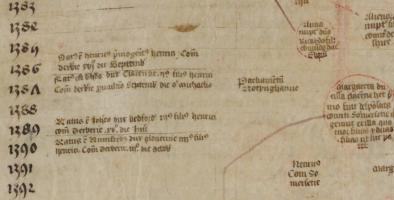
On 29th September 1387 Thomas Lancaster 1st Duke of Clarence was born to King Henry IV of England [aged 20] and Mary Bohun [aged 19]. Coefficient of inbreeding 2.60%.
French MS 54 at the John Rylands Library in Manchester: "1387 Nat[us] est Tho[mal]s dux Clarencie, ij[us] filius henrici Com[iti] derb[er]ie p[e]nultimo" i.e. "1387 Thomas, duke of Clarence, the second son of Henry, earl of Derby, was born the penultimate day of September, St Michael's day [29 September]". He married November 1411 his first cousin once removed Margaret Holland Duchess Clarence, daughter of Thomas Holland 2nd Earl Kent and Alice Fitzalan Countess Kent.
Mary Bohun: Around 1368 she was born to Humphrey Bohun 7th Earl Hereford 6th Earl Essex 2nd Earl of Northampton and Joan Fitzalan Countess Essex, Hereford and Northampton. She a great x 2 granddaughter of King Edward I of England. On 16th January 1373 Humphrey Bohun 7th Earl Hereford 6th Earl Essex 2nd Earl of Northampton died. He was buried at Waldon Priory and Abbey [Map]. Earl Hereford, Earl Essex, Earl of Northampton extinct. His estates were divided between his two daughters Eleanor Bohun Duchess Gloucester, wife of Thomas of Woodstock 1st Duke of Gloucester and Mary Bohun, wife of Henry of Bolingbroke, the future Henry IV, although the title and estates should have been inherited Gilbert Bohun who was a grandson of Humphrey Bohun 2nd Earl Hereford 1st Earl Essex. On 5th February 1381 Henry Bolingbroke and she were married at Arundel Castle [Map]. She the daughter of Humphrey Bohun 7th Earl Hereford 6th Earl Essex 2nd Earl of Northampton and Joan Fitzalan Countess Essex, Hereford and Northampton. He the son of John of Gaunt 1st Duke Lancaster and Blanche Duchess of Lancaster. They were second cousins. He a grandson of King Edward III of England. She a great x 2 granddaughter of King Edward I of England. Froissart Book 4 Chapter 94. Before 19th October 1398. You must know that the earl of Derby and the late duke of Gloucester had married two sisters [Note. Mary Bohun and Eleanor Bohun Duchess Gloucester], daughters to the earl of Hereford and Northampton, constable of England: the children, therefore, of the earl of Derby and duke of Gloucester were cousins-german by their mother's side, and one degree removed by their father's. To say the truth, the death of the duke of Gloucester had displeased many of the great barons of England, who frequently murmured at it when together; but the king had now so greatly extended his power, none dared to speak of it openly, nor act upon the current rumours of the mode of his death. The king had caused it to be proclaimed, that whoever should say anything respecting the duke of Gloucester or the earl of Arundel, should be reckoned a false and wicked traitor and incur his indignation. This threat had caused many to be silent, afraid of what might befal them, who were, nevertheless, much dissatisfied.

On 29th September 1397 King Richard II [aged 30] rewarded his relations with Dukedoms, possibly for their part in downfall of Thomas of Woodstock 1st Duke of Gloucester [deceased], Thomas Beauchamp 12th Earl Warwick [aged 59] and Richard Fitzalan 9th Earl of Surrey 4th or 11th Earl of Arundel [deceased]...
His older half-brother John Holland 1st Duke Exeter [aged 45] was created 1st Duke Exeter. Elizabeth Lancaster Duchess Exeter [aged 34] by marriage Duchess Exeter.
His nephew Thomas Holland 1st Duke Surrey [aged 23] was created 1st Duke Surrey.
His first cousin once-removed Margaret was created 1st Duchess Norfolk - for life only. On the same day her grandson Thomas [aged 29] was also created Duke of Norfolk - see below.
His second cousin once removed Thomas Mowbray 1st Duke of Norfolk was created 1st Duke Norfolk. Elizabeth Fitzalan Duchess Norfolk [aged 31] by marriage Duchess Norfolk.
His first cousin Edward 2nd Duke of York 1st Duke Albemarle [aged 24] was created 1st Duke Albemarle. Beatrice Burgundy Countess Rutland and Cork [aged 24] by marriage Duchess Albemarle.
His illegitimate first cousin John Beaufort 1st Marquess Somerset and Dorset [aged 24] was created 1st Marquess Somerset, 1st Marquess Dorset. Margaret Holland Duchess Clarence [aged 12] by marriage Marchioness Somerset, Marchioness Dorset.
Ralph Neville 1st Earl of Westmoreland [aged 33] was created 1st Earl of Westmoreland. Joan Beaufort Countess of Westmoreland [aged 18] by marriage Countess of Westmoreland.


On 29th September 1397 Henry Bolingbroke [aged 30] was created 1st Duke of Hereford.
On 29th September 1399 King Richard II of England [aged 32] abdicated King of England at the Tower of London [Map]. William Ros 6th Baron Ros Helmsley [aged 29], Thomas Grey [aged 40], William Willoughby 5th Baron Willoughby [aged 29], Hugh Burnell 2nd Baron Burnell [aged 52] and Thomas Rempston were present.
Around 1401. Jean Creton Chronicler. The Capture and Death of King Richard. King Richard II of England delivered to the citizens of London.
On 29th September 1402 Ferdinand Aviz was born to King John I of Portugal [aged 50] and Philippa of Lancaster Queen Consort Portugal [aged 42]. He a great grandson of King Edward III of England.
 Chronicle of England by William of Worcester. In the year 1462, at the Feast of St. Michael [September 29th], in the year of our Lord 1462, and in the second year of the reign of King Edward IV after the conquest, Bartholomew James, clothier, and William Hampton, fishmonger, were sheriffs of London. And at the Feast of Simon and Jude, Thomas Cooke, clothier, was made mayor of the city of London.
Ad festum Sancti Michaelis anno Domini m.cccc.lxij. et anno regis Edwardi Quarti post conquæstum ij. Bartholomæus Jamys, pannarins, Wyllelmus Hamptone, piscensis, vicecomites Londoniæ. Et ad festum Simonis et Judæ Thomas Cooke, pannarius, factus est major civitatis Londoniæ.
On 29th September 1469 brothers Humphrey Neville of Brancepeth [aged 30] and Charles Neville of Brancepeth were beheaded at York [Map] in the presence of King Edward IV of England [aged 27] and Richard "Kingmaker" Neville Earl Warwick, 6th Earl Salisbury [aged 40] bringing to an end the Neville-Neville feud that arose as a consequence of the senior line being dis-inherited.
Warkworth's Chronicle [1461-1474]. 29th September 1469. And the same yere, the xxix, day of Septembre, Humfrey Nevylle, knyght, and Charles his brothere, were takene by the Earl of Warwick [aged 40], and behedede at Yorke, the Kynge beynge present.
Collectanea by John Leland [1502-1552]. [29th September 1469] The fame Yere the 29. of Septembre Humfrey Neville Knight, and Charles his Brother were taken by the Erle of Warwike, and behedid at York, the King beyng present.
On 29th September 1470 King Edward IV of England [aged 28] fled from King's Lynn, Norfolk [Map] to the court of Charles the Bold [aged 36] who had married his sister Margaret [aged 24] two years earlier. His brother Richard [aged 17].
Gilbert Debenham [aged 38] travelled with King Edward IV of England.
Memoirs of Philip de Commines [1447-1511]. 29th September 1470. And thus King Edward made his escape in the year 1470, by the assistance of a small vessel of his own and two Dutch merchantmen, attended only by 700 or 800 men, without any clothes but what they were to have fought in, no money in their pockets, and not one of them knew whither they were going. It was very surprising to see this poor king (for so he might justly be called) run away in this manner, and be pursued by his own servants. He had indulged himself in ease and pleasures for twelve or thirteen years together, and enjoyed a larger share of them than any prince in his time. His thoughts were wholly employed upon the ladies (and far more than was reasonable), hunting, and adorning his person. In his summer-hunting, his custom was to have several tents set up for the ladies, where he treated them after a magnificent manner; and indeed his person was as well turned for love-intrigues as any man I ever saw in my life: for he was young, and the most handsome man of his time; I mean when he was in this adversity, for afterwards he grew very corpulent. But see now how, on a sudden, he is fallen into the calamities of the world! He sailed directly for Holland. At that time the Easterlinjzs1 were at war both with the English and French; they had many ships at sea, and were dreaded by the English, and upon good grounds; for they were good soldiers, had done them much prejudice that year already, and had taken several of their ships. The Easterlings at a great distance descried the ships which were with the king, and about seven or eight of them began to give them chase; but being far before them, he gained the coast of Holland, or rather some thing lower, for he put into Friesland, not far from a little town called Alquemare2, where he came to an anchor, and, it being low water, the king could not get into the harbour, but ran himself as near the town as he could. The Easterlings came as near him as they could possibly make, and dropt their anchors, intending to board him the next tide.
Note 1. Easterlings, in French Ostrelins, was the name given to the merchants of the Hanseatic League,
Note 2. Alkmaar, the capital of North Holland, distant about twenty miles from Amsterdam.

The True Chronicles of Jean le Bel Volume 1 Chapters 1-60 1307-1342
The True Chronicles of Jean le Bel offer one of the most vivid and immediate accounts of 14th-century Europe, written by a knight who lived through the events he describes, and experienced some of them first hand. Covering the early decades of the Hundred Years’ War, this remarkable chronicle follows the campaigns of Edward III of England, the politics of France and the Low Countries, and the shifting alliances that shaped medieval warfare. Unlike later historians, Jean le Bel writes with a strong sense of eyewitness authenticity, drawing on personal experience and the testimony of fellow soldiers. His narrative captures not only battles and sieges, but also the realities of military life, diplomacy, and the ideals of chivalry that governed noble society. A key source for Jean Froissart, Le Bel’s chronicle stands on its own as a compelling and insightful work, at once historical record and literary achievement. This translation builds on the 1905 edition published in French by Jules Viard, adding extensive translations from other sources Rymer's Fœdera, the Chronicles of Adam Murimuth, William Nangis, Walter of Guisborough, a Bourgeois of Valenciennes, Geoffrey le Baker of Swinbroke and Richard Lescot to enrich the original text and Viard's notes.
Available at Amazon in eBook and Paperback format.
 Chronicle of England by Jean de Waurin. For this reason, the King, in order to escape this danger, realizing that Warwick was so close to him with about fifty thousand men and considering how the said lords, brothers of Warwick, treacherously betrayed him by taking the opposite side, hastily withdrew to the town of Hepshuye1 where he luckily found a ship. He sailed to Holland [29th September 1470]2 accompanied by his brother of Gloucester, the Earl of Rivers, Lord Scales, his squire, Lord Hastings, Lord Duras, and others. He arrived at The Hague, where the Lord of Gruuthuse, Prince of Steinhouse and then governor of the province of Holland, sent by the Duke of Burgundy, received him honourably, as was fitting, and feasted him generously throughout the province of Holland. He conducted himself there so agreeably to the King's wishes that he greatly praised him afterward, as was evident, for he granted him, as a deserving recipient of greater honour and preeminence, the Earldom of Winchester in England.
Pour laquele cause le roy, adfin deschiever ce dangier, adverti que Warewic estoit si prez de lui atout bien chinquante mille hommes, considerant comment lesdis seigneurs, freres de Warewic le trahissoient villainement en prendant party contraire, se tyra hastivement en la ville de Hepshuye ou il trouva daventure navire; si passa en Hollandes, luy adcompaignie de son frere de Clocestre, du comte de Riviere, seigneur de Scalles, son serouge, le seigneur de Hastinghes, le seigneur de Duras et autres, si vint arriver a La Haye, ouquel lieu fut envoie par le duc de Bourguoigne le seigneur de Grathuse, prince de Steinhouse, pour lors gouverneur dudit pays de Hollande, qui honnourablement le recheut, comme bien faire le scavoit, et la le festoia bonne espace parmy ledit pays de Hollande, ei si au gre dudit roy se conduisi que grandement depuis sen loa, comme bien y parut, car il luy eslargy, ainsi que bien digne de plus grant honnour et preeminence, la comte de Wincestre en Angleterre.
Note 1. Hepshuye". Unclear as to the location of Hepshuye. Warkworth's Chronicle has 'Lynn' and the Croyland Continuation has 'Bishop's Lynn', both we now call King's Lynn.
Note 2. See next paragraph: 'He [King Henry] was acknowledged as king from the feast day of Saint Michael [29th of September 1470]' which suggest King Edward left on that date.
Warkworth's Chronicle [1461-1474]. [29th September 1470]. But anone one of the oste went oute frome the fellawschippe, and tolde Kynge Edwarde alle manere of thynge, and bade hym avoyde, for he was not strong enoghe to gyff batayle to Markes Montagu [aged 39]; and then anone Kynge Edwarde haysted hym in alle that he might to the towne of Lynne, and ther he toke schyppynge one Michaelmesse day, in the x. yere of his regne, with Lorde Hastynges, that was the Kynges Chambearlyne, Lorde Say, withe dyverse other knyghtes and squires, passed and saylede overe the see into Flaunders, to his brother-in-lawe1 the Duke of Burgeyne2, for socoure and helpe, &c.
Note 1. The Harl. MS. 7353, is a most curious roll on vellum, containing pictures on one side representing parts of scripture history, and on the other assumed similar transactions in the life of Edward IV. We have, 1. The King on his throne. 2. The King encouraging his soldiers. 3. The King with a triple sun shining upon him through three golden crowns, and saying "Domine! quid vis me facere? [Lord! What do you want me to do?]" 4. Pardoning Henry after the battle of Northampton. 5. Setting sail for Calais. At the bottom is a genealogical tree, with portraits of all the members of the houses of York and Lancaster, very fantastically arranged.
Note 2. Duke of Burgeyne. Charles the Bold [aged 36], Duke of Burgundy, married Edward's sister on the 18th of June, 1467 [1468?]. It was to this marriage that Edward owed his preservation abroad, and the final recovery of his kingdom. An account of the marriage, with the reception of the Princess in Flanders, may be seen in MS. Cotton. Nero, C. IX. Cf. Cart. Antiq. Mus. Brit. XI. 54.
Croyland Chronicle 1470. As soon as this reached the king's ears by the secret agency of a spy, he found himself compelled to consult his own safety and that of his followers by a precipitate flight to the port of Bishop's Lynn1, in Norfolk. Here finding some ships, he caused himself and his followers, nearly two thousand in number, to be conveyed across the sea to Holland, a territory of the duke of Burgundy. These events took place about the festival of Michaelmas [29th September 1470], in the year of our Lord, 1470, it being the ninth year of the reign of the said king Edward.
Note 1. Now known as King's Lynn. The name was changed from Bishop's Lynn to King's Lynn in 1537 during the Dissolution of the Monasteries.
Chronicle of Robert Fabyan [-1512]. [29th September 1470] Then the foresayd lordes holdynge on theyr iournaye drewe towarde the kyng, beyng in ye North, as aboue is sayd. Wherof he beynge warnyd, and hauynge with hym as then but small strength, wherof some to hym were nat very trusty, he with a secrete company toke the next waye towarde the Wash in Lyncolneshyre, and there passed ouer with great daunger, nat without losse of dyuerse of his company, and so passyd the countres into Flaundres, and styntyd nat tyll he came to Charlys his broder, than duke of Burgoyne, with whom he restyd a season. Whanne the quene, whiche thenne was in the Tower, harde of the kynges auoydynge, anone she departyd frome thens, and yode vnto Westmynster, and there regystred herself for a seyntwary [sanctuary] woman, and in lyke wyse dyd many of kynge Edwardes frendes.
Collectanea by John Leland [1502-1552]. [29th September 1470] This tyme Marquis Montacute had gatherid a vi. M. Men yn King Edwardes Name, and cumming nere King Edward, told them how Edwarde had fervid hym, first making hym Erle of Northumbreland, and after gyving it to Percy, and after making hym Marquis Montacute, gyving hym a Pyes Nest to maintein it with al.Wherfor he signified, that he wold take the Erle of Warwik his Brothers Part. King Edwarde hering of this, went to Lynne with the Lorde Hastinges his Chamberlayne, the Lord Say, and other Knighttes, and went to the Duke of Burgoyne his Brother yn Law.
A Brief Latin Chronicle. [29th September 1470]. Edward, seeing their boldness, fled with a few followers to Flanders, where he was honourably received by the Duke of Burgundy.
Edwardus autem, videns eorum audciam, fugit cum paucis in Flandriam, ubi a duce Burgundie honorifice est susceptus.
Letters and Papers Foreign and Domestic Henry VIII 1520. 29th September 1520. 996. For Sir Thos. Boleyn [aged 43] and Elizabeth [aged 40] his wife, Margaret Boleyn [aged 66], widow, a daughter and heir of Thos. late Earl of Ormond, and John Trevethen, Thos. Barrett, Wm. Tusser and Nich. Fynche.
Pardon for the alienation of the manor of Fritwell, Oxon [Map]. Westm., 29 Sept.
Pat. 12 Hen. VIII. p. 1, m. 6.
On 29th September 1548 William Wittelsbach V Duke Bavaria was born to Albert V Wittelsbach V Duke Bavaria [aged 20] and Anna Habsburg Spain Duchess Bavaria [aged 20]. Coefficient of inbreeding 1.58%. He married 22nd February 1568 his second cousin Renata Lorraine Duchess Bavaria, daughter of Francis Lorraine I Duke Lorraine and Christina Oldenburg Duchess Lorraine, and had issue.
On 28 or 29th September 1551 Robert Crowley [aged 34] was ordained by Bishop Nicholas Ridley [aged 51].
Henry Machyn's Diary. 29th September 1553. The xxix day of September the Qwuen('s) [aged 37] grace mad knyghts of the Bathe xv; the furst was the yerle of Devonshyre [aged 26], the yonge yerle of Surray [aged 17], the iijde lord of Borgane, and lord Barkley, the lord Monjoye [aged 20], lord Sowche [aged 27], ser Wylliam Pallet, my lord Cardyff [aged 52], the lord Wyndsore('s) [aged 54] sune [aged 21], sir Ryche('s) sune, sir Clynton, ser Pagett, ser Robart Rochaster, ser Hare Jernyngham [aged 41], ser Edward Dormer.
Note. P. 45. The knights of the Bath made at the coronation of queen Mary were, Edward earl of Devonshire, Thomas earl of Surrey, William lord Herbert of Cardiff, Henry lord Bergavenny [aged 23], Henry lord Berkeley [aged 18], John lord Lumley, James lord Mountjoy, sir Robert Rochester [aged 59], controller of the queen's house, sir Henry Jerningham, sir William Powlett [aged 21], sir Henry Clinton, sir Hugh Rich, sir Henry Paget, sir Henry Parker, and sir William Dormer. The arms of these knights are beautifully tricked in the Cottonian MS. Claudius C. III.
Note. P. 45. Coronation of queen Mary. A document respecting the claims at this coronation has been printed in the Society's volume of Rutland Papers, p. 118: and, as there mentioned, a formulary of the ceremonial is in the library of the Society of Antiquaries.


Henry Machyn's Diary. 29th September 1555. The xxix day of September was the grettest rayn and fludes that ever was sene in England, that all low contreys was drounyd, and in dyver plasses boyth men and catell drounyd, and all the marssys, and sellers boyth of wyne and bere and alle and odur marchandysse, in London and odur plassys, drounyd; and the rayne begane after Bathellmuw-tyd telle sant Edwardes tyde, after not x days fayre....ij goodly whytt branchys and xij longe torchys .... stayffes torchys grett, and a c. mornars in blake, [xij poor] men and xij women, and all xxiiij in rosett gownes [and the] vomen raylles apon ther heds, and iiij gylt candyllstykes, with iiij grett tapurs and xx prestes and xx clarkes.
On 29th September 1560 King Gustav I of Sweden [aged 64] died. His son Erix [aged 26] succeeded XIV King Sweden.

On 29th September 1574 Ludovic Stewart 2nd Duke Lennox 1st Duke Richmond was born to Esme Stewart 1st Duke Lennox [aged 32] and Catherine Balsac Duchess Lennox. He married (1) before June 1590 his third cousin Sophia Ruthven Duchess Lennox, daughter of William Ruthven 1st Earl Gowrie and Dorothea Stewart Countess Gowrie (2) August 1598 his second cousin once removed Jean Campbell Duchess Lennox (3) 16th June 1621 his fifth cousin once removed Frances Howard Duchess Lennox and Richmond, daughter of Thomas Howard 1st Viscount Howard Bindon and Mabel Burton Viscountess Howard Bindon.
On 29th September 1599 Robert Devereux 2nd Earl Essex [aged 33] was compelled to stand before the Council during a five-hour interrogation. The Council, which included his uncle William Knollys 1st Earl Banbury [aged 55], took a quarter of an hour to compile a report, which declared that his truce with O'Neill was indefensible and his flight from Ireland tantamount to a desertion of duty. He was committed to the custody of Sir Richard Berkeley [aged 68] in his own York House [Map] on 1 October.


Diary of Anne Clifford. 29th September 1617. The 29th my Lord [aged 28] came here to Knole from his long journey. All this Michaelmas did my Lord receive four thousand pounds of my Uncle the Earl of Cumberland, which was the first penny that I received of my portion.
Annals of the six Kings of England by Nicholas Trivet
Translation of the Annals of the Six Kings of England by that traces the rise and rule of the Angevin aka Plantagenet dynasty from the mid-12th to early 14th century. Written by the Dominican scholar Nicholas Trivet, the work offers a vivid account of English history from the reign of King Stephen through to the death of King Edward I, blending political narrative with moral reflection. Covering the reigns of six monarchs—from Stephen to Edward I—the chronicle explores royal authority, rebellion, war, and the shifting balance between crown, church, and nobility. Trivet provides detailed insight into defining moments such as baronial conflicts, Anglo-French rivalry, and the consolidation of royal power under Edward I, whose reign he describes with particular immediacy. The Annals combines careful year-by-year reporting with thoughtful interpretation, presenting history not merely as a sequence of events but as a moral and political lesson. Ideal for readers interested in medieval history, kingship, and the origins of the English state, this chronicle remains a valuable and accessible window into the turbulent world of the Plantagenet kings.
Available at Amazon in eBook and Paperback format.
On 29th September 1617 John Villiers 1st Viscount Purbeck [aged 26] and Frances Coke Viscountess Purbeck [aged 15] were married at Hampton Court Palace, Richmond [Map]. King James I of England and Ireland and VI of Scotland [aged 51] gave away the bride. He the son of George Villiers of Brokesby and Mary Beaumont 1st Countess Buckingham [aged 47].


On 29th September 1636 Archbishop Thomas Tenison was born in Cottenham.
On 29th September 1639 William Russell was born to William Russell 1st Duke Bedford [aged 23] and Anne Carr Countess of Bedford [aged 23]. He married 1669 his fifth cousin once removed Rachel Wriothesley, daughter of Thomas Wriothesley 4th Earl of Southampton 2nd Earl Chichester and Rachel Massue Countess Southampton, and had issue.


On 29th September 1642 David Barry 1st Earl Barrymore [aged 37] died from wounds in Castlelyons, County Cork. He was buried in Youghal, Cork. His son Richard [aged 11] succeeded 2nd Earl Barrymore.
On 29th September 1665 Martin Noell [aged 65] died of plague.

On 29th September 1671 Arthur Somerset was born to Henry Somerset 1st Duke Beaufort [aged 42] and Mary Capell Duchess Beaufort [aged 41]. He married 1695 Mary Russell, daughter of William Russell 1st Baronet and Hester Rouse Lady Russell, and had issue.

On 29th September 1679 John Manners 8th Earl of Rutland [aged 75] died at Nether Haddon, Derbyshire [Map]. He was buried at St Mary the Virgin Church, Bottesford, Leicestershire [Map]. His son John [aged 41] succeeded 9th Earl of Rutland. Catherine Noel Duchess Rutland [aged 22] by marriage Countess of Rutland.
After 29th September 1679. St Mary the Virgin Church, Bottesford, Leicestershire [Map]. Monument to John Manners 8th Earl of Rutland [deceased] and Frances Montagu Countess Rutland. Monument sculpted by Grinling Gibbons [aged 31].


On 29th September 1680 Louise Dorothea Hohenzollern was born to Frederick I King Prussia [aged 23] and Elisabeth Henriëtte Hesse-Kassel [aged 18]. Coefficient of inbreeding 6.66%. She married 1700 her first cousin Frederick I King Sweden, son of Charles I Landgrave Hesse-Kassel and Maria Amalia of Courland Landgravine Hesse-Kassel.
John Evelyn's Diary. 29th September 1695. Very cold weather. Sir Purbeck Temple, uncle to my son Draper, died suddenly. A great funeral at Addiscombe. His lady being own aunt to my son Draper, he hopes for a good fortune, there being no heir. There had been a new meeting of the commissioners about Greenwich Hospital [Map], on the new commission, where the Lord Mayor, etc. appeared, but I was prevented by indisposition from attending. The weather very sharp, winter approaching apace. The King [aged 44] went a progress into the north, to show himself to the people against the elections, and was everywhere complimented, except at Oxford, Oxfordshire [Map], where it was not as he expected, so that he hardly stopped an hour there, and having seen the theater, did not receive the banquet proposed. I dined with Dr. Gale [aged 60] at St. Paul's school, who showed me many curious passages out of some ancient Platonists' MSS. concerning the Trinity, which this great and learned person would publish, with many other rare things, if he was encouraged, and eased of the burden of teaching.


Anne Boleyn. Her Life as told by Lancelot de Carle's 1536 Letter.
In 1536, two weeks after the execution of Anne Boleyn, her brother George and four others, Lancelot du Carle, wrote an extraordinary letter that described Anne's life, and her trial and execution, to which he was a witness. This book presents a new translation of that letter, with additional material from other contemporary sources such as Letters, Hall's and Wriothesley's Chronicles, the pamphlets of Wynkyn the Worde, the Memorial of George Constantyne, the Portuguese Letter and the Baga de Secrets, all of which are provided in Appendices.
Available at Amazon in eBook and Paperback format.
On 29th September 1719 Henry Johnson Baron Wentworth [aged 58] died of gout at Bath, Somerset [Map].

On 2nd September 1746 Henry Scott 3rd Duke Buccleuch was born to Francis Scott [aged 25] and Caroline Campbell 1st Baroness Greenwich [aged 28]. He baptised at St George's Church, Hanover Square on 29th September 1746. He a great x 3 grandson of King Charles II of England Scotland and Ireland. He married 2nd May 1767 his fourth cousin Elizabeth Montagu Duchess Buccleuch, daughter of George Brudenell aka Montagu 1st Duke Montagu and Mary Montagu Duchess of Montagu, and had issue.
On 29th September 1766 Princess Charlotte Hanover was born to King George III of Great Britain and Ireland [aged 28] and Charlotte Mecklenburg Strelitz Queen Consort England [aged 22] at Buckingham House [Map]. She married 18th May 1797 her third cousin King Frederick Wilhelm Karl Württemberg and had issue.

The London Gazette 12124. The Article in last Saturday's Gazette, notifying the Creation of Lord Portchester, having been incorrectly sent, we are desired to substitute the following in the Room thereof. St. James's, September 29 [1780].
The King has been pleased to grant to Henry Herbert [aged 39], Esq; and to his Heirs Male, the Dignity of a Baron of the Kingdom of Great Britain, by the Name, Stile and Title of Baron Portchester, of Highclere, in the County of Southampton. [Elizabeth Alicia Maria Wyndham Countess Carnarvon [aged 27] by marriage Baroness Porchester of Highclere in Hampshire]

On 29th September 1789 James Brydges 3rd Duke Chandos [aged 57] died without male issue. Duke Chandos, Marquess Carnarvon, Earl Carnarvon, Viscount Wilton, Baron Chandos of Sudeley and Baronet Brydges of Wilton in Herefordshire extinct. His wife Anne Eliza Gamon Duchess Chandos [aged 52] had pulled away a chair, whether inadvertently or deliberately is unknown, he was about to sit in causing him injuries from which he ultimately died. She was, thereafter, declared a lunatic and confined to their London home, 2 Queen Anne Street aka Chandos House Marylebone.

On 29th September 1830 John Murray 4th Duke Atholl [aged 74] died. His son John [aged 52] succeeded 5th Duke Atholl, 6th Marquess Atholl, 7th Earl Atholl, 8th Earl Tullibardine, 10th Baron Strange Knockin.
On 29th September 1833 Ferdinand VII King Spain [aged 48] died. His daughter Isabella [aged 2] succeeded Queen Spain. Her succession was disputed by her uncle Infante Carlos María Isidro of Spain [aged 45] since her father Ferdinand VII King Spain had modified the laws of the Salic Spanish Succession, known as the Pragmatic Sanction, shortly before her birth. Traditionally the Spanish succession has allowed females to inherit. When Philippe V King Spain inherited the throne he introduced the French Salic Law barring females.


Adeline Horsey Recollections. It is said that few people achieve greatness, but that some have it thrust upon them. I can class myself with the latter, for I could have married a Prince of the Royal Family of Spain, the Count de Montemolin [aged 26]1, who was at one time regarded as the rightful King of Spain.
Note 1. Carlos Luis Fernando de Bourbon, Count de Montemolin, born 1818, was the eldest son of the first Don Carlos [aged 29], the legitimist claimant to the Spanish throne on the death of his brother, Fernando VII [aged 33], in 1833. After the ending of the first Carlist war in the defeat of the legitimists and the establishment of Isabella on the throne, the old Don Carlos retired into private life and abdicated his claims in 1845 to his eldest son Montemolin, who thus became the second Don Carlos. He was a young man of some ability but weak and unstable. There was a strong party in Spain desirous to bring about a reconciliation of the two branches of the Royal Family by a marriage between the young Queen Isabella and her first cousin, Montemolin, but political passion and personal animosity stood in the way, and all Europe took part in the intrigue known as the Spanish Marriages. This ended of course in the disastrous marriage of Isabella with her cousin Francisco, and that of her sister Fernanda with the Due de Montpensier, the son of Louis Philippe [aged 44], a defeat for English diplomacy which nearly caused a war with France. The Carlists had never been favourable to the idea of a marriage of Montemolin and Isabella, whom they regarded as a usurper, and they looked out a legitimist Royal Princess for him. His younger brother, Don Juan, married Princess Beatrix of Modena, and their son was the late Don Carlos. Queen Isabella married in 1846, and dissensions very soon broke out between her and her wretched husband, who really, like most of the Royal Family, was a Carlist at heart. Montemolin had issued a manifesto at Bourges in France in 1845, when he saw that he could not marry Isabella on his own terms, and his father had abdicated in the same year, and he soon after came to London, mustered his party, and began to organise a fresh Carlist rising in Spain. English diplomacy had suffered a great defeat and he found plenty of people here to help him; he was made much of in Society and became a lion for a time, being treated with full royal honours.
On 29th September 1853 Thyra Glücksburg Duchess Cumberland and Teviotdale was born to King Christian IX of Denmark [aged 35] and Queen Louise Hesse-Kassel of Denmark [aged 36]. She a great x 3 granddaughter of King George II of Great Britain and Ireland. Coefficient of inbreeding 2.85%. She married 22nd December 1878 her fourth cousin Ernest Augustus Hanover 3rd Duke Cumberland and Teviotdale, son of George V King Hanover and Marie Saxe Altenburg Queen Consort Hanover, and had issue.
Ten Years' Digging. On the 29th of September, we examined the remains of a large tumulus at Bole Hill, on Bakewell Moor, near that [Bole Hill Barrow [Map]] investigated on the 24th of August, 1843. (Vestiges, page 47.) By measurement with a tape, the diameter was ascertained to be exactly 23 yards; about eighteen inches only in height remained, the upper part having been removed at the time of the enclosure of the common for the sake of the stone. The remainder consisted entirely of small gravelly stone, the upper moiety having been much disturbed, together with all the later interments that had been deposited above the natural surface; of these we observed the remnants of at least two, some in their natural state, others calcined. We also found a few articles of different dates, the most modem being a small piece of kiln-baked pottery, of coarse texture, and red colour, and a circular stud of green glass, which may possibly have graced the centre of a fibula, as a fictitious gem; a more ancient object was the point of a very slender bronze dagger, much attenuated by frequent sharpening; it was in two pieces, which lay some distance apart: there were many bones and teeth of animals amongst the gravel, and when we arrived at a depth that left only six or eight inches of artificial ground above the natural level, we observed innumerable rat' bones, and in the gravel just below, near the centre of the barrow, we discovered the primary interment in a state of advanced decay; it was the skeleton of a man lying on his left side, with the knees drawn up and the head to the north-east; beneath the head was a very rude instrument of grey flint, nearly round, which was the only article of man's device found near him. From the unmanageable nature of the clayey soil on which the skeleton lay, and the friable condition of the bones, no measurement of the long bones could be taken, but fortunately so many pieces of the skull were recovered as to allow of its restoration. To us it appears a remarkable example, and may be described as having the calvarium long, narrow, and conveying the idea of lateral pressure; the forehead retreating, with the frontal sinuses prominent, the facial bones large, and the upper maxiilaries, together with the lower jaw, strong and wide.
On 29th September 1857 Mary Ellen Peacock [aged 36] wrote to Henry Wallis [aged 27]:
"If we have to stay in England let us be at Clifton. I have no answer from George [aged 29]. I imagine he wants to see Darvall [Henry Darvall] before writing. If he gives no reply in a week I shall take his silence for freedom and go abroad without another word, if you will like it, and where you will… I am always dreading to lose you because I feel I have no right to you, and I love you so really, so far beyond anything I have known of love, that there are ways in which I believe I could bear to lose you. God knows how hard it would be; but I believe I could bear it. Not by Death or weariness or anger. By Death I could not lose you
The love where Death has set his seal
Nor age can chill, nor rival steal
Nor falsehood disavow, (Lord Byron, Elegy on Thyrza)
But I do not fear your Death, because I feel how much you owe to Life, how much Life has for you, and surely I shall in no shape lead you Delilah-like to Death, since it is my one aim to add to your strength, my one prayer 'God grant that I may do this man no harm'. And for weariness or anger, if we begin to thread either of those paths we will part before they possess us."


Jean de Waurin's Chronicle of England Volume 6 Books 3-6: The Wars of the Roses
Jean de Waurin was a French Chronicler, from the Artois region, who was born around 1400, and died around 1474. Waurin’s Chronicle of England, Volume 6, covering the period 1450 to 1471, from which we have selected and translated Chapters relating to the Wars of the Roses, provides a vivid, original, contemporary description of key events some of which he witnessed first-hand, some of which he was told by the key people involved with whom Waurin had a personal relationship.
Available at Amazon in eBook and Paperback format.
Wiltshire Archaeological Magazine 1866 V10 Pages 209-216. On September 29th of last year, Mr. Cunnington and I, on behalf of our Society, began some considerable researches within the area of the temple at Avebury, sinking holes in many places, running trenches across certain spots, and tunnelling the large external mound, and tapping it at several points, with the view of thoroughly examining its structure and materials; and in every case digging down to the chalk or clay which forms the natural substratum of the district.
In these explorations we were materially assisted by the respected Vicar of the parish, the Rev. Bryan King [aged 53], who very kindly directed and superintended the workmen, whenever neither of us was able to be on the spot, and otherwise furthered our operations. We were also most kindly and zealously aided by those true friends of archaeology, Mr. George Brown and Mr. Kemm, who not only sanctioned our somewhat unceremonious disturbance of their land, but abetted us to the utmost of their power, by providing the labourers and all the materiel required for carrying out the work.
To these gentlemen as well as to Mr. Robert Smith, who suffered us to dig an extensive trench across one of his fields, we beg at the outset to tender our hearty thanks, as without their permission and assistance, we could of course have done nothing.
Wiltshire Archaeological Magazine 1866 V10 Pages 209-216. Excavations at Avebury. Under the Direction of the Secretaries of the Wiltshire Archaeological and Natural History Society, September 29th,— October 5th, 1865.
Note. In preparing the following account, I have had the advantage of comparing the notes which Mr. King and Mr. Cunnington also took of our daily work as it proceeded, and from the three several accounts I have compiled this paper. Alfred Charles Smith.
On 29th September 1879 Armand de Gramont 12th Duc de Gramont was born to Antoine Alfred Agénor de Gramont 11th Duc de Gramont [aged 28] and Marguerite de Rothschild Duchess Gramont [aged 24]. He married 1904 Élaine Greffulhe Duchess Gramont.


On 29th September 1882 Alexandra Hanover was born to Ernest Augustus Hanover 3rd Duke Cumberland and Teviotdale [aged 37] and Thyra Glücksburg Duchess Cumberland and Teviotdale [aged 29]. She a great x 2 granddaughter of King George III of Great Britain and Ireland.
St Mary's Church, Sutton Scarsdale [Map]. Grave of Jane Abercrombie Liardet, widow of the late Colonel C. F. Liardet (Madras Army). Died 29th September 1882 aged 69 years.


On 28th September 1891 Bishop Augustus Legge [aged 51] was confirmed as Bishop of Lichfield at St Mary-le-Bow Church, Cheapside [Map]. He was consecrated Bishop at St Paul's Cathedral [Map] the following day by Archbishop Edward White Benson [aged 62].
On 29th September 1891 Bishop John Gott [aged 60] was consecrated Bishop of Truro at St Paul's Cathedral [Map] by Archbishop Edward White Benson [aged 62].
On 29th September 1898 Queen Louise Hesse-Kassel of Denmark [aged 81] died.
On 29th September 1915 Lieutenant-Colonel Arthur George Edward Egerton [aged 36] was killed in action at the Battle of Loos.
On 29th September 1931 William Orpen [aged 52] died.

On 29th September 1949 George Henry Hubert Lascelles 7th Earl Harewood [aged 26] and Marion Stein Countess Harewood [aged 22] were married at St Mark's Church North Audley Street. King George VI of the United Kingdom [aged 53], his uncle, Elizabeth Bowes-Lyon Queen Consort England [aged 49], Victoria Mary Teck Queen Consort England [aged 82] Princess Mary Windsor Countess Harewood [aged 52], his mother, and other members of the Royal family attended the wedding. He the son of Henry Lascelles 6th Earl Harewood and Princess Mary Windsor Countess Harewood.
Marion Stein Countess Harewood: On 18th October 1926 she was born at Vienna [Map]. On 6th March 2014 she died.
Chronicle of a Bourgeois of Valenciennes
Récits d’un bourgeois de Valenciennes aka The Chronicle of a Bourgeois of Valenciennes is a vivid 14th-century vernacular chronicle written by an anonymous urban chronicler from Valenciennes in the County of Hainaut. It survives in a manuscript that describes local and regional history from about 1253 to 1366, blending chronology, narrative episodes, and eyewitness-style accounts of political, military, and social events in medieval France, Flanders, and the Low Countries. The work begins with a chronological framework of events affecting Valenciennes and its region under rulers such as King Philip VI of France and the shifting allegiances of local nobility. It includes accounts of conflicts, sieges, diplomatic manoeuvres, and the impact of broader struggles like the Hundred Years’ War on urban life in Hainaut. Written from the perspective of a burgher (bourgeois) rather than a monastery or royal court, the chronicle offers a rare lay viewpoint on high politics and warfare, reflecting how merchants, townspeople, and civic institutions experienced the turbulence of the 13th and 14th centuries. Its narrative style combines straightforward reporting of events with moral and civic observations, making it a valuable source for readers interested in medieval urban society, regional politics, and the lived experience of war and governance in pre-modern Europe.
Available at Amazon in eBook and Paperback format.
Ten Years' Digging. 29th of September, we examined a tumulus at Pike Low [Map], between the villages of Waterhouses and Waterfall, which had likewise been destroyed by lime burning.
Ten Years' Digging. On the same day we opened another barrow on Throwley Moor, which, like the last in the same locality, is formed on an uneven protuberance of rock; it is thirteen yards diameter. About two feet from the surface, near the centre, we found a shallow rounded grave, about three feet in average diameter, the bottom covered with black ashes, amongst which were a few dislocated bones, above which were some large pieces of a plain globular urn of considerable size, which had been perforated at the side with two small holes, like a similar vessel found at Steep Low [Map], near Alstonefield, in 1845. At no great distance was ano ther depression in the rock, seven feet long and just wide enough to receive a human body, the broken remains of which were accompanied by a few calcined bones and one chipping of flint. A piece of the urn was found in the earth above.
On 29th September 1955 Emmeline "Nina" Welby-Gregory [aged 88] died.
After 29th September 1984. Memorial to Predendary John Hugh Barker Andrews at the Church of the Holy Trinity, Weare Giffard [Map].
On 29th September 1240 Margaret Queen of Scotland was born to King Henry III of England [aged 32] and Eleanor of Provence Queen Consort England [aged 17] at Windsor Castle [Map]. She married 25th December 1251 her half fourth cousin King Alexander III of Scotland, son of King Alexander II of Scotland and Marie Coucy, and had issue.
On 29th September 1259 Hugh Bardolf 1st Baron Bardolf was born to William Bardolf [aged 28] and Juliane Gournay [aged 29].
On 29th September 1286 John Hastings 2nd Baron Hastings 14th Baron Abergavenny was born to John Hastings 13th Baron Abergavenny 1st Baron Hastings [aged 24] and Isabel Valence Baroness Bergavenny Baroness Hastings at Abergavenny, Monmouthshire [Map]. He married before 20th March 1319 Juliana Leybourne Countess Huntingdon and had issue.
On 29th September 1296 James Barcelona was born to James "The Just" II King Aragon [aged 29] and Blanche Capet Queen Consort Aragon. He a great x 4 grandson of King Henry "Curtmantle" II of England.
On 29th September 1305 Henry Wittelsbach XIV Duke Bavaria was born to Stephen Wittelsbach I Duke Bavaria [aged 34] and Jutta Jawor Duchess Bavaria. He a great x 4 grandson of King Henry "Curtmantle" II of England. He married 12th August 1328 his fourth cousin once removed Margaret Luxemburg, daughter of King John I of Bohemia and Queen Elizabeth of Bohemia, and had issue.
On 29th September 1312 Henry Scrope 1st Baron Scrope of Masham was born to Geoffrey Scrope [aged 27] and Ivette Ros [aged 27] at Masham. He married before 1342 Joan Unknown and had issue.
Chronicle of Geoffrey le Baker of Swinbroke
Baker was a secular clerk from Swinbroke, now Swinbrook, an Oxfordshire village two miles east of Burford. His Chronicle describes the events of the period 1303-1356: Gaveston, Bannockburn, Boroughbridge, the murder of King Edward II, the Scottish Wars, Sluys, Crécy, the Black Death, Winchelsea and Poitiers. To quote Herbert Bruce 'it possesses a vigorous and characteristic style, and its value for particular events between 1303 and 1356 has been recognised by its editor and by subsequent writers'. The book provides remarkable detail about the events it describes. Baker's text has been augmented with hundreds of notes, including extracts from other contemporary chronicles, such as the Annales Londonienses, Annales Paulini, Murimuth, Lanercost, Avesbury, Guisborough and Froissart to enrich the reader's understanding. The translation takes as its source the 'Chronicon Galfridi le Baker de Swynebroke' published in 1889, edited by Edward Maunde Thompson.
Available at Amazon in eBook and Paperback format.
On 29th September 1328 Joan "Fair Maid of Kent" Princess Wales was born to Edmund of Woodstock 1st Earl Kent [aged 27] and Margaret Wake Countess Kent [aged 31] at Woodstock Palace, Oxfordshire [Map]. She a granddaughter of King Edward I of England. She married (1) March 1340 her fourth cousin once removed Thomas Holland 1st Earl Kent, son of Robert Holland 1st Baron Holand and Maud Zouche Baroness Holand, and had issue (2) November 1340 William Montagu 2nd Earl Salisbury, son of William Montagu 1st Earl Salisbury and Catherine Grandison Countess of Salisbury (3) 10th October 1361 her half first cousin once removed Edward "Black Prince", son of King Edward III of England and Philippa of Hainaut Queen Consort England, and had issue.
On 29th September 1387 Thomas Lancaster 1st Duke of Clarence was born to King Henry IV of England [aged 20] and Mary Bohun [aged 19]. Coefficient of inbreeding 2.60%.
French MS 54 at the John Rylands Library in Manchester: "1387 Nat[us] est Tho[mal]s dux Clarencie, ij[us] filius henrici Com[iti] derb[er]ie p[e]nultimo" i.e. "1387 Thomas, duke of Clarence, the second son of Henry, earl of Derby, was born the penultimate day of September, St Michael's day [29 September]". He married November 1411 his first cousin once removed Margaret Holland Duchess Clarence, daughter of Thomas Holland 2nd Earl Kent and Alice Fitzalan Countess Kent.
Mary Bohun: Around 1368 she was born to Humphrey Bohun 7th Earl Hereford 6th Earl Essex 2nd Earl of Northampton and Joan Fitzalan Countess Essex, Hereford and Northampton. She a great x 2 granddaughter of King Edward I of England. On 16th January 1373 Humphrey Bohun 7th Earl Hereford 6th Earl Essex 2nd Earl of Northampton died. He was buried at Waldon Priory and Abbey [Map]. Earl Hereford, Earl Essex, Earl of Northampton extinct. His estates were divided between his two daughters Eleanor Bohun Duchess Gloucester, wife of Thomas of Woodstock 1st Duke of Gloucester and Mary Bohun, wife of Henry of Bolingbroke, the future Henry IV, although the title and estates should have been inherited Gilbert Bohun who was a grandson of Humphrey Bohun 2nd Earl Hereford 1st Earl Essex. On 5th February 1381 Henry Bolingbroke and she were married at Arundel Castle [Map]. She the daughter of Humphrey Bohun 7th Earl Hereford 6th Earl Essex 2nd Earl of Northampton and Joan Fitzalan Countess Essex, Hereford and Northampton. He the son of John of Gaunt 1st Duke Lancaster and Blanche Duchess of Lancaster. They were second cousins. He a grandson of King Edward III of England. She a great x 2 granddaughter of King Edward I of England. Froissart Book 4 Chapter 94. Before 19th October 1398. You must know that the earl of Derby and the late duke of Gloucester had married two sisters [Note. Mary Bohun and Eleanor Bohun Duchess Gloucester], daughters to the earl of Hereford and Northampton, constable of England: the children, therefore, of the earl of Derby and duke of Gloucester were cousins-german by their mother's side, and one degree removed by their father's. To say the truth, the death of the duke of Gloucester had displeased many of the great barons of England, who frequently murmured at it when together; but the king had now so greatly extended his power, none dared to speak of it openly, nor act upon the current rumours of the mode of his death. The king had caused it to be proclaimed, that whoever should say anything respecting the duke of Gloucester or the earl of Arundel, should be reckoned a false and wicked traitor and incur his indignation. This threat had caused many to be silent, afraid of what might befal them, who were, nevertheless, much dissatisfied.
On 29th September 1402 Ferdinand Aviz was born to King John I of Portugal [aged 50] and Philippa of Lancaster Queen Consort Portugal [aged 42]. He a great grandson of King Edward III of England.

On 29th September 1408 Thomas Lumley 1st Baron Lumley was born to John Lumley [aged 25] and Felicia Wodecok. He married before 1445 Margaret Harrington Baroness Knightley and had issue.
On 29th September 1494 Gilbert Kennedy 2nd Earl Cassilis was born to David Kennedy 1st Earl Cassilis [aged 24]. He married his second cousin Isabel Campbell Countess Cassilis, daughter of Archibald Campbell 2nd Earl Argyll and Elizabeth Stewart Countess Argyll.
On 29th September 1548 William Wittelsbach V Duke Bavaria was born to Albert V Wittelsbach V Duke Bavaria [aged 20] and Anna Habsburg Spain Duchess Bavaria [aged 20]. Coefficient of inbreeding 1.58%. He married 22nd February 1568 his second cousin Renata Lorraine Duchess Bavaria, daughter of Francis Lorraine I Duke Lorraine and Christina Oldenburg Duchess Lorraine, and had issue.
On 29th September 1557 William Bourchier 3rd Earl Bath was born to John Bourchier and Frances Kitson. He married (1) 15th December 1578 Mary Cornwallis Countess Bath (2) 7th August 1583 his half sixth cousin Elizabeth Russell Countess Bath, daughter of Francis Russell 2nd Earl Bedford and Margaret St John Countess Bedford, and had issue.
On 29th September 1574 Ludovic Stewart 2nd Duke Lennox 1st Duke Richmond was born to Esme Stewart 1st Duke Lennox [aged 32] and Catherine Balsac Duchess Lennox. He married (1) before June 1590 his third cousin Sophia Ruthven Duchess Lennox, daughter of William Ruthven 1st Earl Gowrie and Dorothea Stewart Countess Gowrie (2) August 1598 his second cousin once removed Jean Campbell Duchess Lennox (3) 16th June 1621 his fifth cousin once removed Frances Howard Duchess Lennox and Richmond, daughter of Thomas Howard 1st Viscount Howard Bindon and Mabel Burton Viscountess Howard Bindon.
On 29th September 1580 Gertrude Talbot Baroness Pierrepont Holme Pierrepoint was born to Henry Talbot [aged 17] and Elizabeth Rayner [aged 24]. She married 8th January 1601 Robert Pierrepont 1st Earl Kingston and had issue.
On 29th September 1591 Thomas Windsor 6th Baron Windsor was born to Henry Windsor 5th Baron Windsor [aged 29]. He married before 14th January 1608 his third cousin twice removed Catherine Somerset Baroness Windsor, daughter of Edward Somerset 4th Earl of Worcester and Elizabeth Hastings Countess of Worcester.
Chronicle of Walter of Guisborough
A canon regular of the Augustinian Guisborough Priory, Yorkshire, formerly known as The Chronicle of Walter of Hemingburgh, describes the period from 1066 to 1346. Before 1274 the Chronicle is based on other works. Thereafter, the Chronicle is original, and a remarkable source for the events of the time. This book provides a translation of the Chronicle from that date. The Latin source for our translation is the 1849 work edited by Hans Claude Hamilton. Hamilton, in his preface, says: 'In the present work we behold perhaps one of the finest samples of our early chronicles, both as regards the value of the events recorded, and the correctness with which they are detailed; Nor will the pleasing style of composition be lightly passed over by those capable of seeing reflected from it the tokens of a vigorous and cultivated mind, and a favourable specimen of the learning and taste of the age in which it was framed.'
Available at Amazon in eBook and Paperback format.
On 29th September 1600 Thomas Aston 1st Baronet was born to John Aston [aged 23]. He married (1) 1627 Magdalene Pulteney (2) 1639 Anne Willoughby Lady Aston, daughter of Henry Willoughby 1st Baronet and Elizabeth Knollys, and had issue.
On 29th September 1602 Algernon Percy 10th Earl of Northumberland was born to Henry "Wizard Earl" Percy 9th Earl of Northumberland [aged 38] and Dorothy Devereux Countess Northumberland [aged 38]. He married (1) 1629 his fourth cousin once removed Anne Cecil, daughter of William Cecil 2nd Earl Salisbury and Catherine Howard Countess Salisbury, and had issue (2) 1st October 1642 his fourth cousin once removed Elizabeth Howard Countess Northumberland, daughter of Theophilus Howard 2nd Earl Suffolk and Elizabeth Home Countess Suffolk, and had issue.


On 29th September 1636 Archbishop Thomas Tenison was born in Cottenham.
On 29th September 1639 William Russell was born to William Russell 1st Duke Bedford [aged 23] and Anne Carr Countess of Bedford [aged 23]. He married 1669 his fifth cousin once removed Rachel Wriothesley, daughter of Thomas Wriothesley 4th Earl of Southampton 2nd Earl Chichester and Rachel Massue Countess Southampton, and had issue.
On 29th September 1644 Mary Anne Boyle was born to Richard Boyle 2nd Earl Cork 1st Earl Burlington [aged 31] and Elizabeth Clifford Countess Burlington [aged 31]. She married before 17th March 1668 her half fifth cousin once removed Edward Montagu 2nd Earl Sandwich, son of Edward Montagu 1st Earl Sandwich and Jemima Crew Countess Sandwich, and had issue.


On 29th September 1671 Arthur Somerset was born to Henry Somerset 1st Duke Beaufort [aged 42] and Mary Capell Duchess Beaufort [aged 41]. He married 1695 Mary Russell, daughter of William Russell 1st Baronet and Hester Rouse Lady Russell, and had issue.
On 29th September 1680 Louise Dorothea Hohenzollern was born to Frederick I King Prussia [aged 23] and Elisabeth Henriëtte Hesse-Kassel [aged 18]. Coefficient of inbreeding 6.66%. She married 1700 her first cousin Frederick I King Sweden, son of Charles I Landgrave Hesse-Kassel and Maria Amalia of Courland Landgravine Hesse-Kassel.
On 29th September 1684 Frances Digby Viscountess Scudamore was born to Simon Digby 4th Baron Digby [aged 27] and Frances Noel Baroness Digby [aged 23]. She married 7th March 1706 her fourth cousin once removed James Scudamore 3rd Viscount Scudamore, son of John Scudamore 2nd Viscount Scudamore and Frances Cecil Viscountess Scudamore, and had issue.

On 29th September 1685 George Brudenell 3rd Earl Cardigan was born to Francis Brudenell [aged 31] and Frances Savile [aged 27]. He married 15th May 1707 his half fourth cousin once removed Elizabeth Bruce 3rd Countess Cardigan, daughter of Thomas Bruce 3rd Earl Elgin 2nd Earl Ailesbury and Elizabeth Seymour Countess Elgin and Ailesbury, and had issue.
On 29th September 1699 Charles Calvert 5th Baron Baltimore was born to Benedict Calvert 4th Baron Baltimore [aged 20] and Charlotte Lee Baroness Baltimore [aged 20]. He a great grandson of King Charles II of England Scotland and Ireland. He married 20th July 1730 Mary Janssen Baroness Baltimore and had issue.
Adam Murimuth's Continuation and Robert of Avesbury’s 'The Wonderful Deeds of King Edward III'
This volume brings together two of the most important contemporary chronicles for the reign of Edward III and the opening phases of the Hundred Years’ War. Written in Latin by English clerical observers, these texts provide a vivid and authoritative window into the political, diplomatic, and military history of fourteenth-century England and its continental ambitions. Adam Murimuth Continuatio's Chronicarum continues an earlier chronicle into the mid-fourteenth century, offering concise but valuable notices on royal policy, foreign relations, and ecclesiastical affairs. Its annalistic structure makes it especially useful for establishing chronology and tracing the development of events year by year. Complementing it, Robert of Avesbury’s De gestis mirabilibus regis Edwardi tertii is a rich documentary chronicle preserving letters, treaties, and official records alongside narrative passages. It is an indispensable source for understanding Edward III’s claim to the French crown, the conduct of war, and the mechanisms of medieval diplomacy. Together, these works offer scholars, students, and enthusiasts a reliable and unembellished account of a transformative period in English and European history. Essential for anyone interested in medieval chronicles, the Hundred Years’ War, or the reign of Edward III.
Available at Amazon in eBook and Paperback format.
On 29th September 1703 Thomas Needham 9th Viscount Kilmorey was born to Robert Needham 7th Viscount Kilmorey [aged 20]. He married 20th June 1730 Mary Shirley Viscountess Kilmorey, daughter of Washington Shirley 2nd Earl Ferrers and Mary Levinge Countess Ferrers.
On 29th September 1726 Hugh Clifford 4th Baron Clifford Chudleigh was born to Hugh Clifford 3rd Baron Clifford Chudleigh [aged 26] and Elizabeth Blount Baroness Clifford Chudleigh. He married 17th December 1749 Anne Lee Baroness Clifford Chudleigh, daughter of George Henry Lee 2nd Earl Lichfield and Frances Hales Countess Lichfield, and had issue.
On 29th September 1728 Charles Sloane Cadogan 1st Earl Cadogan was born to Charles Cadogan 2nd Baron Cadogan [aged 43] and Elizabeth Sloane Baroness Cadogan [aged 33]. He married (1) 30th May 1747 Frances Bromley, daughter of Henry Bromley 1st Baron Montfort and Frances Wyndham, and had issue (2) 10th May 1777 Mary Churchill Countess Cadogan and had issue.
On 29th September 1728 Bishop John Harley was born to Edward Harley 3rd Earl of Oxford and Earl Mortimer [aged 29] and Martha Morgan Countess of Oxford and Mortimer [aged 29].

On 29th September 1729 James Duff 2nd Earl Fife was born to William Duff 1st Earl Fife [aged 32] and Jean Grant Countess Fife [aged 24]. He married 5th June 1759 Dorothea Sinclair.
On 29th September 1732 Henry Cavendish 2nd Baronet was born to Henry Cavendish 1st Baronet [aged 25] and Anne Pyne [aged 25]. He married 1757 Sarah Bradshaw 1st Baroness Waterpark and had issue.
On 29th September 1738 Michael D'Anvers 5th Baronet was born to John Danvers 3rd Baronet [aged 65].
On 2nd September 1746 Henry Scott 3rd Duke Buccleuch was born to Francis Scott [aged 25] and Caroline Campbell 1st Baroness Greenwich [aged 28]. He baptised at St George's Church, Hanover Square on 29th September 1746. He a great x 3 grandson of King Charles II of England Scotland and Ireland. He married 2nd May 1767 his fourth cousin Elizabeth Montagu Duchess Buccleuch, daughter of George Brudenell aka Montagu 1st Duke Montagu and Mary Montagu Duchess of Montagu, and had issue.
On 29th September 1757 Richard Chetwynd 5th Viscount Chetwynd was born to William Chetwynd 4th Viscount Chetwynd [aged 35] and Susannah Cope.
On 29th September 1758 Horatio Nelson 1st Viscount Nelson was born to Reverend Edmund Nelson [aged 36].


Chronicle of Walter of Guisborough
A canon regular of the Augustinian Guisborough Priory, Yorkshire, formerly known as The Chronicle of Walter of Hemingburgh, describes the period from 1066 to 1346. Before 1274 the Chronicle is based on other works. Thereafter, the Chronicle is original, and a remarkable source for the events of the time. This book provides a translation of the Chronicle from that date. The Latin source for our translation is the 1849 work edited by Hans Claude Hamilton. Hamilton, in his preface, says: 'In the present work we behold perhaps one of the finest samples of our early chronicles, both as regards the value of the events recorded, and the correctness with which they are detailed; Nor will the pleasing style of composition be lightly passed over by those capable of seeing reflected from it the tokens of a vigorous and cultivated mind, and a favourable specimen of the learning and taste of the age in which it was framed.'
Available at Amazon in eBook and Paperback format.
On 29th September 1766 Princess Charlotte Hanover was born to King George III of Great Britain and Ireland [aged 28] and Charlotte Mecklenburg Strelitz Queen Consort England [aged 22] at Buckingham House [Map]. She married 18th May 1797 her third cousin King Frederick Wilhelm Karl Württemberg and had issue.

On 29th September 1782 Windham Quin 2nd Earl Dunraven and Mount-Earl was born to Valentine Richard Wyndham-Quin 1st Earl Dunraven and Mount-Earl [aged 30] and Frances Muriel Fox-Strangways Baroness Adare. He married 27th December 1810 Caroline Wyndham Countess Dunraven and Mount Earl and had issue.
On 29th September 1788 Francis Charles Stanhope was born to Charles Stanhope 3rd Earl of Harrington [aged 35] and Jane Fleming Countess Harrington [aged 33]. He a great x 3 grandson of King Charles II of England Scotland and Ireland.


On 29th September 1794 John Hadley D'Oyly 8th Baronet was born to John Hadley D'Oyly 6th Baronet [aged 40] and Diana Rochfort Lady D'Oyly [aged 39] at Calcutta, India. He married (1) 1st December 1819 Charlotte Thompson and had issue (2) 1830 Mary Fendall Lady D'Oyly and had issue.
On 29th September 1799 Robert Vanbrugh Law was born to Bishop George Henry Law [aged 38].
On 29th September 1804 Jane Elizabeth Liddell Viscountess Barrington was born to Thomas Liddell 1st Baron Ravensworth [aged 29] and Maria Susannah Simpson Baroness Calthorpe [aged 31]. She married 1823 William Keppel Barrington 6th Viscount Barrington, son of George Barrington 5th Viscount Barrington and Elizabeth Adair Viscountess Barrington, and had issue.
On 29th September 1806 Isabella Catherine Mary Howard-Molyneux-Howard Countess Suffolk and Berkshire was born to Henry Howard-Molyneux-Howard [aged 39] and Elizabeth Long. She married 1829 Charles Howard 17th Earl Suffolk 10th Earl Berkshire, son of Thomas Howard 16th Earl Suffolk 9th Earl Berkshire and Elizabeth Jane Dutton Countess Suffolk and Berkshire, and had issue.
On 29th September 1811 Maria Louisa Vanneck was born to Joshua Vanneck 2nd Baron Huntingfield [aged 33]. She married 14th September 1830 Charles Robert Rowley 4th Baronet, son of William Rowley 2nd Baronet and Susanna Edith Harland, and had issue.
On 29th September 1812 Archibald William Montgomerie 13th Earl Eglinton was born to Major-General Archibald Montgomerie [aged 39] and Mary Montgomerie Lady Lamb [aged 25] at Palermo [Map]. He married 17th February 1841 Theresa Howe Newcomen, daughter of Thomas Gleadowe-Newcomen 2nd Viscount Newcomen and Harriet Holland, and had issue.
On 29th September 1819 Frances Harriet Douglas Countess Fitzwilliam was born to George Sholto Douglas 17th Earl Morton [aged 29] and Frances Theodora Rose Countess of Morton [aged 20]. She married 10th September 1838 William Thomas Wentworth-Fitzwilliam 6th and 4th Earl Fitzwilliam, son of Charles Wentworth-Fitzwilliam 5th and 3rd Earl Fitzwilliam and Mary Dundas, and had issue.
On 29th September 1822 Charles Barclay-Maitland 12th Earl of Lauderdale was born to Reverend Charles Barclay-Maitland [aged 32].
On 29th September 1829 Catherine Hamilton Noel was born to Charles Noel 1st Earl Gainsborough [aged 47] and Arabella Hamlyn-Williams. She married 19th June 1849 James Carnegie 9th Earl Southesk, son of James Carnegie 5th Baronet, and had issue.
On 29th September 1846 Edmund Charles Cradock-Hartopp was born to William Edmund Cradock-Hartopp 3rd Baronet [aged 49].
On 29th September 1853 Thyra Glücksburg Duchess Cumberland and Teviotdale was born to King Christian IX of Denmark [aged 35] and Queen Louise Hesse-Kassel of Denmark [aged 36]. She a great x 3 granddaughter of King George II of Great Britain and Ireland. Coefficient of inbreeding 2.85%. She married 22nd December 1878 her fourth cousin Ernest Augustus Hanover 3rd Duke Cumberland and Teviotdale, son of George V King Hanover and Marie Saxe Altenburg Queen Consort Hanover, and had issue.
The True Chronicles of Jean le Bel Volume 1 Chapters 1-60 1307-1342
The True Chronicles of Jean le Bel offer one of the most vivid and immediate accounts of 14th-century Europe, written by a knight who lived through the events he describes, and experienced some of them first hand. Covering the early decades of the Hundred Years’ War, this remarkable chronicle follows the campaigns of Edward III of England, the politics of France and the Low Countries, and the shifting alliances that shaped medieval warfare. Unlike later historians, Jean le Bel writes with a strong sense of eyewitness authenticity, drawing on personal experience and the testimony of fellow soldiers. His narrative captures not only battles and sieges, but also the realities of military life, diplomacy, and the ideals of chivalry that governed noble society. A key source for Jean Froissart, Le Bel’s chronicle stands on its own as a compelling and insightful work, at once historical record and literary achievement. This translation builds on the 1905 edition published in French by Jules Viard, adding extensive translations from other sources Rymer's Fœdera, the Chronicles of Adam Murimuth, William Nangis, Walter of Guisborough, a Bourgeois of Valenciennes, Geoffrey le Baker of Swinbroke and Richard Lescot to enrich the original text and Viard's notes.
Available at Amazon in eBook and Paperback format.
On 29th September 1855 Alice Emily White Countess Leicester was born to Luke White 2nd Baron Annaly [aged 26]. She married Thomas William Coke 3rd Earl of Leicester, son of Thomas Coke 2nd Earl of Leicester and Juliana Whitbread Countess Leicester, and had issue.
On 29th September 1857 Matthew Wood 4th Baronet was born to Francis Wood 3rd Baronet [aged 23].
On 29th September 1879 Armand de Gramont 12th Duc de Gramont was born to Antoine Alfred Agénor de Gramont 11th Duc de Gramont [aged 28] and Marguerite de Rothschild Duchess Gramont [aged 24]. He married 1904 Élaine Greffulhe Duchess Gramont.

On 29th September 1880 Windham Baring was born to Evelyn Baring 1st Earl Cromer [aged 39] and Ethel Errington [aged 35]. He married 11th July 1913 Gweneth Frida Ponsonby, daughter of Edward Ponsonby 8th Earl Bessborough and Blanche Vere Guest Countess Bessborough.
On 29th September 1882 Alexandra Hanover was born to Ernest Augustus Hanover 3rd Duke Cumberland and Teviotdale [aged 37] and Thyra Glücksburg Duchess Cumberland and Teviotdale [aged 29]. She a great x 2 granddaughter of King George III of Great Britain and Ireland.
On 29th September 1886 Arthur Michael Cosmo Bertie was born to Montagu Arthur Bertie 7th Earl of Abingdon [aged 50] and Gwendoline Mary Dormer [aged 21].
On 29th September 1886 Paul Ayshford Methuen 4th Baron Methuen was born to Paul Methuen 3rd Baron Methuen [aged 41] and Mary Ethel Sanford Baroness Methuen.
On 29th September 1903 Evelyn Baring 1st Baron Howick was born to Evelyn Baring 1st Earl Cromer [aged 62] and Katherine Georgina Louisa Thynne Countess Cromer [aged 38]. He married 24th April 1935 Mary Cecil Grey Baroness Howick Glendale, daughter of Charles Robert Grey 5th Earl Grey and Mabel Laura Georgiana Palmer Countess Grey, and had issue.
On 29th September 1911 Gerald Bridgeman 6th Earl of Bradford was born to Orlando Bridgeman 5th Earl Bradford [aged 37] and Margaret Cecilia Bruce Countess Bradford [aged 28]. He married 30th October 1946 Mary Willoughby Montgomery Countess Bradford and had issue.
On 29th September 1928 Eric Lubbock 4th Baron Avebury was born to Maurice Fox Pitt Lubbock [aged 27] and Mary Katherine Adelaide Stanley [aged 22]. He married (1) 2nd September 1953 Kina-Maria O'Kelly de Gallagh Baroness Avebury and had issue (2) 1985 Lindsay Jean Stewart Baroness Avebury.
On 29th September 1947 Mark Ian Philip Chandos Henniker-Major 9th Baron Henniker was born to John Patrick Edward Chandos Henniker-Major 8th Baron Henniker [aged 31].
On 29th September 792 Æthelred I of Northumbria [aged 30] and Queen Ælfflæd of Northumbria were married. She by marriage Queen Northumbria. She the daughter of King Offa of Mercia and Cynethryth Queen Mercia. He the son of Æthelwald Moll King of Northumbria.
On 29th September 1308 (possibly 30th) in a Siblings Marriage de Clare siblings married de Burgh siblings at Waltham Abbey, Essex [Map] in the presence of King Edward II of England [aged 24].
John Burgh [aged 22] and Elizabeth Clare Lady Verdun [aged 13] were married. She the daughter of Gilbert "Red Earl" Clare 7th Earl Gloucester 6th Earl Hertford and Joan of Acre Countess Gloucester and Hertford. He the son of Richard "Red Earl" Burgh 2nd Earl of Ulster [aged 49] and Margaret Burgh Countess Ulster. They were third cousin once removed. She a granddaughter of King Edward I of England.
Gilbert de Clare 8th Earl Gloucester 7th Earl Hertford [aged 17] and Matilda Burgh Countess Gloucester and Hertford [aged 20] were married. She by marriage Countess Gloucester, Countess Hertford. She the daughter of Richard "Red Earl" Burgh 2nd Earl of Ulster and Margaret Burgh Countess Ulster. He the son of Gilbert "Red Earl" Clare 7th Earl Gloucester 6th Earl Hertford and Joan of Acre Countess Gloucester and Hertford. They were third cousin once removed. He a grandson of King Edward I of England.
Anne Boleyn. Her Life as told by Lancelot de Carle's 1536 Letter.
In 1536, two weeks after the execution of Anne Boleyn, her brother George and four others, Lancelot du Carle, wrote an extraordinary letter that described Anne's life, and her trial and execution, to which he was a witness. This book presents a new translation of that letter, with additional material from other contemporary sources such as Letters, Hall's and Wriothesley's Chronicles, the pamphlets of Wynkyn the Worde, the Memorial of George Constantyne, the Portuguese Letter and the Baga de Secrets, all of which are provided in Appendices.
Available at Amazon in eBook and Paperback format.
On 29th September 1617 John Villiers 1st Viscount Purbeck [aged 26] and Frances Coke Viscountess Purbeck [aged 15] were married at Hampton Court Palace, Richmond [Map]. King James I of England and Ireland and VI of Scotland [aged 51] gave away the bride. He the son of George Villiers of Brokesby and Mary Beaumont 1st Countess Buckingham [aged 47].
On 29th September 1679 William Wycherley [aged 38] and Letitia Robartes Countess Drogheda [aged 29] were married in secret fearing to lose the King's patronage. She the daughter of John Robartes 1st Earl Radnor [aged 73] and Letitia Isabella Smythe Countess Radnor [aged 49].
On 29th September 1720 Francis Drake 4th Baronet [aged 26] and Anne Heathcote Lady Drake [aged 18] were married. She by marriage Lady Drake of Buckland in Devon.
On 29th September 1729 Walter Calverley aka Blackett 2nd Baronet [aged 21] and Elizabeth Orde Lady Blackett were married. They were first cousins.
On 24th or 29th September 1782 George Legge 3rd Earl Dartmouth [aged 26] and Frances Finch Countess Dartmouth [aged 21] were married. She the daughter of Heneage Finch 3rd Earl Aylesford and Charlotte Seymour Countess Aylesford [aged 52]. He the son of William Legge 2nd Earl Dartmouth [aged 51] and Frances Catherine Gounter Nicoll Countess Dartmouth [aged 49]. They were second cousin once removed.

On 29th September 1848 William Wells Addington 3rd Viscount Sidmouth [aged 24] and Georgiana Susan Pellew Viscountess Sidmouth [aged 18] were married. They were first cousins.
On 29th September 1887 Henry Coster Lea Edwards 2nd Baronet [aged 47] and Laura Selina Clark Lady Edwards were married. She by marriage Lady Edwards of Pyenest in West Yorkshire.

On 29th September 1942 Richard Sykes 7th Baronet [aged 37] and Virginia Gilliat Lady Sykes were married. She by marriage Lady Sykes of Sledmere in Yorkshire. She the daughter of John Francis Grey Gilliat [aged 60] and Lilian Florence Chetwynd Marchioness of Anglesey [aged 66]. They were half fifth cousin once removed.
On 29th September 1949 George Henry Hubert Lascelles 7th Earl Harewood [aged 26] and Marion Stein Countess Harewood [aged 22] were married at St Mark's Church North Audley Street. King George VI of the United Kingdom [aged 53], his uncle, Elizabeth Bowes-Lyon Queen Consort England [aged 49], Victoria Mary Teck Queen Consort England [aged 82] Princess Mary Windsor Countess Harewood [aged 52], his mother, and other members of the Royal family attended the wedding. He the son of Henry Lascelles 6th Earl Harewood and Princess Mary Windsor Countess Harewood.
Marion Stein Countess Harewood: On 18th October 1926 she was born at Vienna [Map]. On 6th March 2014 she died.
On 29th September 855 Lothair Holy Roman Emperor [aged 60] died.
On 29th September 1052 Sweyn Godwinson 1st Earl Hereford [aged 31] died at Constantinople aka Istanbul, Turkey on his return from the Holy Land. Earl Hereford extinct.
On 29th September 1157 Mabel Fitzhamon Countess Gloucester died.
The History of William Marshal was commissioned by his son shortly after William’s death in 1219 to celebrate the Marshal’s remarkable life; it is an authentic, contemporary voice. The manuscript was discovered in 1861 by French historian Paul Meyer. Meyer published the manuscript in its original Anglo-French in 1891 in two books. This book is a line by line translation of the first of Meyer’s books; lines 1-10152. Book 1 of the History begins in 1139 and ends in 1194. It describes the events of the Anarchy, the role of William’s father John, John’s marriages, William’s childhood, his role as a hostage at the siege of Newbury, his injury and imprisonment in Poitou where he met Eleanor of Aquitaine and his life as a knight errant. It continues with the accusation against him of an improper relationship with Margaret, wife of Henry the Young King, his exile, and return, the death of Henry the Young King, the rebellion of Richard, the future King Richard I, war with France, the death of King Henry II, and the capture of King Richard, and the rebellion of John, the future King John. It ends with the release of King Richard and the death of John Marshal.
Available at Amazon in eBook and Paperback format.
On 29th September 1210 Mabel Marmion Baroness Burford [aged 50] died at Worcestershire.
On 29th September 1241 Bishop Roger Niger died.
On 29th September 1253 Otto "Illustrious" Wittelsbach II Duke Bavaria [aged 47] died. His son Louis [aged 24] succeeded II Duke Upper Bavaria, Count Palatine of the Rhine.
On 29th September 1268 John Burgundy Count Charolais [aged 37] died.
On 29th September 1288 Matilda Reginar Countess Saint Pol [aged 64] died.
On 29th September 1304 John Warenne 6th Earl of Surrey [aged 73] died at Kennington, Kent. He was buried at Lewes Priory [Map]. His grandson John [aged 18] succeeded 7th Earl Surrey and inherited his estates including Conisbrough Castle [Map].
On 29th September 1349 Margaret Wake Countess Kent [aged 52] died of plague. Her son John [aged 19] succeeded 4th Baron Wake of Liddell and inherited her dower lands and the estates she had inherited from her brother Thomas Wake 2nd Baron Wake of Liddell.
On 29th September 1355 Katherine Saye Baroness St John Lagenham [aged 40] died.
On 29th September 1360 Joan Auvergne Queen Consort France [aged 34] died. Her son Philip [aged 14] succeeded Count Auvergne and Count Boulogne.
On 29th September 1362 Walter Fauconberg 4th Baron Fauconberg [aged 43] died at Guisborough Priory [Map]. His son Thomas [aged 17] succeeded 5th Baron Fauconberg.
On 29th September 1364 Battle of Auray decided the Breton Succession in favour of John Montfort V Duke Brittany [aged 25]. The Breton and English army was commanded by John Chandos [aged 44] and included William Latimer 4th Baron Latimer of Corby [aged 34], Miles Stapleton [aged 44] and Hugh Calverley [aged 40]. Charles of Blois Duke Brittany [aged 45] was killed. Bertrand Geusclin [aged 44] surrendered.
On 29th September 1416 Isabella Beauchamp Countess Suffolk died.
On 29th September 1439 Agnes Darcy Countess Kildare [aged 61] died at Knayth.
On 29th September 1469 brothers Humphrey Neville of Brancepeth [aged 30] and Charles Neville of Brancepeth were beheaded at York [Map] in the presence of King Edward IV of England [aged 27] and Richard "Kingmaker" Neville Earl Warwick, 6th Earl Salisbury [aged 40] bringing to an end the Neville-Neville feud that arose as a consequence of the senior line being dis-inherited.
On 29th September 1530 Anne Bourchier Baroness Dacre of Gilsland [aged 60] died.
Anne Boleyn. Her Life as told by Lancelot de Carle's 1536 Letter.
In 1536, two weeks after the execution of Anne Boleyn, her brother George and four others, Lancelot du Carle, wrote an extraordinary letter that described Anne's life, and her trial and execution, to which he was a witness. This book presents a new translation of that letter, with additional material from other contemporary sources such as Letters, Hall's and Wriothesley's Chronicles, the pamphlets of Wynkyn the Worde, the Memorial of George Constantyne, the Portuguese Letter and the Baga de Secrets, all of which are provided in Appendices.
Available at Amazon in eBook and Paperback format.
On 29th September 1557 William Courtenay 2nd Earl Devon [aged 28] died. His son William [aged 4] de jure 3rd Earl Devon.

On 29th September 1558 George Brooke 9th Baron Cobham [aged 61] died. His son William [aged 30] succeeded 10th Baron Cobham. Dorothy Neville Baroness Cobham [aged 33] by marriage Baroness Cobham.
On 29th September 1560 King Gustav I of Sweden [aged 64] died. His son Erix [aged 26] succeeded XIV King Sweden.

On 29th September 1596 Margaret Clifford Countess Derby [aged 56] died.
On 29th September 1616 Henry Clinton 2nd Earl Lincoln [aged 75] died at Sempringham. His son Thomas [aged 45] succeeded 3rd Earl Lincoln, 11th Baron Clinton. Elizabeth Knyvet Countess Lincoln [aged 38] by marriage Countess Lincoln.
On 29th September 1623 William Sandys 3rd Baron Sandys of the Vyne [aged 80] died. His son William succeeded 4th Baron Sandys of The Vyne in Hampshire.
On 29th September 1642 William Stanley 6th Earl of Derby [aged 81] died. His son James [aged 35] succeeded 7th Earl Derby. Charlotte Thouars Countess Derby [aged 42] by marriage Countess Derby.


On 29th September 1642 David Barry 1st Earl Barrymore [aged 37] died from wounds in Castlelyons, County Cork. He was buried in Youghal, Cork. His son Richard [aged 11] succeeded 2nd Earl Barrymore.
On 29th September 1679 John Manners 8th Earl of Rutland [aged 75] died at Nether Haddon, Derbyshire [Map]. He was buried at St Mary the Virgin Church, Bottesford, Leicestershire [Map]. His son John [aged 41] succeeded 9th Earl of Rutland. Catherine Noel Duchess Rutland [aged 22] by marriage Countess of Rutland.
On 29th September 1679 Compton Reade 1st Baronet [aged 54] died. He was buried at St Mary the Virgin Church, Shipton-under-Wychwood. His son Edward [aged 20] succeeded 2nd Baronet Reade of Barton in Berkshire.
On 29th September 1689 John Hotham 2nd Baronet [aged 57] died. He was buried in St Mary's Church, South Dalton. His son John [aged 34] succeeded 3rd Baronet Hotham of Scorborough in Yorkshire.
On 29th September 1700 Henry Every 2nd Baronet [aged 70] died. His son Henry [aged 51] succeeded 3rd Baronet Every of Egginton in Derbyshire.
Chronicle of Walter of Guisborough
A canon regular of the Augustinian Guisborough Priory, Yorkshire, formerly known as The Chronicle of Walter of Hemingburgh, describes the period from 1066 to 1346. Before 1274 the Chronicle is based on other works. Thereafter, the Chronicle is original, and a remarkable source for the events of the time. This book provides a translation of the Chronicle from that date. The Latin source for our translation is the 1849 work edited by Hans Claude Hamilton. Hamilton, in his preface, says: 'In the present work we behold perhaps one of the finest samples of our early chronicles, both as regards the value of the events recorded, and the correctness with which they are detailed; Nor will the pleasing style of composition be lightly passed over by those capable of seeing reflected from it the tokens of a vigorous and cultivated mind, and a favourable specimen of the learning and taste of the age in which it was framed.'
Available at Amazon in eBook and Paperback format.
On 29th September 1708 James Oxenden 2nd Baronet [aged 67] died without issue. His brother Henry [aged 63] succeeded 3rd Baronet Oxenden of Dene in Kent.
On 29th September 1763 Grace Fitzroy Countess Darlington [aged 66] died.
On 29th September 1789 James Brydges 3rd Duke Chandos [aged 57] died without male issue. Duke Chandos, Marquess Carnarvon, Earl Carnarvon, Viscount Wilton, Baron Chandos of Sudeley and Baronet Brydges of Wilton in Herefordshire extinct. His wife Anne Eliza Gamon Duchess Chandos [aged 52] had pulled away a chair, whether inadvertently or deliberately is unknown, he was about to sit in causing him injuries from which he ultimately died. She was, thereafter, declared a lunatic and confined to their London home, 2 Queen Anne Street aka Chandos House Marylebone.
On 29th September 1798 John Parker Mosley 1st Baronet [aged 66] died. His grandson Oswald [aged 13] succeeded 2nd Baronet Mosley of Ancoats.
On 29th September 1801 Thomas St Lawrence 1st Earl Howth [aged 71] died. His son William [aged 48] succeeded 2nd Earl Howth, 2nd Viscount St Lawrence, 16th Baron Howth.
On 29th September 1818 John Edward Dryden 2nd Baronet [aged 36] died unmarried. His brother Henry [aged 31] succeeded 3rd Baronet Dryden of Canons Ashby in Northamptonshire.
On 29th September 1830 John Murray 4th Duke Atholl [aged 74] died. His son John [aged 52] succeeded 5th Duke Atholl, 6th Marquess Atholl, 7th Earl Atholl, 8th Earl Tullibardine, 10th Baron Strange Knockin.

On 29th September 1830 Charlotte Granville Lady Williams-Wynn [aged 76] died.
On 29th September 1833 Ferdinand VII King Spain [aged 48] died. His daughter Isabella [aged 2] succeeded Queen Spain. Her succession was disputed by her uncle Infante Carlos María Isidro of Spain [aged 45] since her father Ferdinand VII King Spain had modified the laws of the Salic Spanish Succession, known as the Pragmatic Sanction, shortly before her birth. Traditionally the Spanish succession has allowed females to inherit. When Philippe V King Spain inherited the throne he introduced the French Salic Law barring females.
On 29th September 1898 Queen Louise Hesse-Kassel of Denmark [aged 81] died.

On 29th September 1910 Virginia Somers-Cocks Countess Somers [aged 83] died.
The Deeds of the Dukes of Normandy
The Gesta Normannorum Ducum [The Deeds of the Dukes of Normandy] is a landmark medieval chronicle tracing the rise and fall of the Norman dynasty from its early roots through the pivotal events surrounding the Norman Conquest of England. Originally penned in Latin by the monk William of Jumièges shortly before 1060 and later expanded at the behest of William the Conqueror, the work chronicles the deeds, politics, battles, and leadership of the Norman dukes, especially William’s own claim to the English throne. The narrative combines earlier historical sources with firsthand information and oral testimony to present an authoritative account of Normandy’s transformation from a Viking settlement into one of medieval Europe’s most powerful realms. William’s history emphasizes the legitimacy, military prowess, and governance of the Norman line, framing their expansion, including the conquest of England, as both divinely sanctioned and noble in purpose. Later chroniclers such as Orderic Vitalis and Robert of Torigni continued the history, extending the coverage into the 12th century, providing broader context on ducal rule and its impact. Today this classic work remains a foundational source for understanding Norman identity, medieval statesmanship, and the historical forces that reshaped England and Western Europe between 800AD and 1100AD.
Available at Amazon in eBook and Paperback format.
On 29th September 1911 Henry Northcote 1st Baron Northcote [aged 64] died. Baron Northcote of Exeter, Baronet Northcote of Seamore Place in the Parish of St George, Hanover Square, in Middlesex extinct.
On 29th September 1931 William Orpen [aged 52] died.
On 29th September 1938 Tankerville Morris 5th Baronet [aged 46] died. His uncle George [aged 86] succeeded 6th Baronet Morris of Clasemont in Glamorganshire.
On 29th September 1955 Emmeline "Nina" Welby-Gregory [aged 88] died.
On 29th September 1956 Charles Chute 1st Baronet [aged 77] died. Baronet Chute of The Vyne in Hampshire extinct. He bequeathed The Vyne, Sherbourne St John [Map], to the National Trust.
On 29th September 1957 Fitzroy Anstruther-Gough-Calthorpe 1st Baronet [aged 85] died. His son Richard [aged 49] succeeded 2nd Baronet Anstruther-Gough-Calthorpe of Elvetham Hall in Hampshire.
On 29th September 1969 John Lionel Reginald Blunt 10th Baronet [aged 61] died. His brother Richard [aged 56] succeeded 11th Baronet Blunt of the City of London.
On 29th September 1990 Rosemary Ann Portal 2nd Baroness Portal [aged 67] died. She was cremated and her ashes spread at St Mary's Church, Funtingdon [Map]. Baron Portal of Hungerford in Berkshire extinct.
On 29th September 2011 Robert Cave-Browne-Cave 16th Baronet [aged 82] died. His son John [aged 54] succeeded 17th Baronet Cave of Stanford in Northamptonshire.
On 29th September 2014 Elizabeth Mairi Keppel Baroness Sudeley [aged 72] died.