

06 Sep is in September.
1465 George Neville's Enthronement as Archbishop of York
1535 Execution of Bishop Fisher and Thomas More
On 6th September 957 Liudolf Duke Swabia [aged 27] died.
On 6th September 1032 Rudolph "Idle" III King Burgundy [aged 61] died.
Images of Histories by Ralph Diceto. The Count of Flanders came before the town of Saint-Omer with his army on the 8th of the Ides of September [6th September 1198], and besieged the town for three weeks.
Comes Flandriæ venit ante villam Sancti Audomari cum exercitu suo VIII idus Septembris, et villam the count obsedit per tres septimanas.
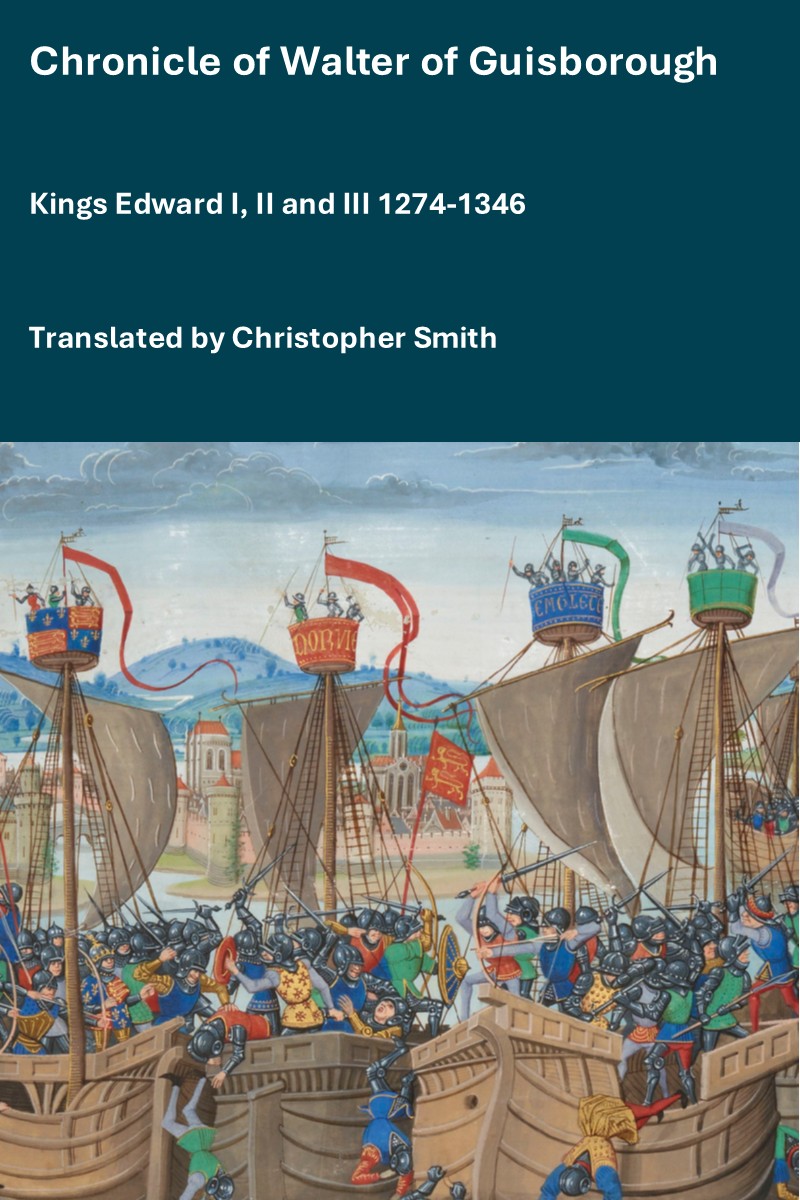 Chronicle of Walter of Guisborough. [6th September 1296] The king therefore, in his Parliament held at Berwick, appointed a new treasurer1 for the kingdom of Scotland, a new great seal, and a new chancellor. He also established justiciars and commanded that all who held any lands from the king's domain should be summoned and do homage, and that all other landholders, holding from other sources, should swear fealty, acknowledging themselves from then on to be subjects of his dominion. This was to be recorded in writing by each person for the perpetual memory of the conquered kingdom. The king also ordered that John, formerly King of Scotland, and both Johns Comyn, along with the other magnates of that land, should either accompany him on his journey or go ahead of him to the southern parts (of England), and remain in those parts beyond the river Trent, under penalty of death, until the war between him and the King of France was entirely concluded. Having thus gained the victory over the kingdom of Scotland and established its governance, the king dismissed the Welsh, Irish, and English armies, allowing them to return to their own lands, thanking them and adding that the English crown was henceforth greatly indebted and perpetually obliged to them for their role in this matter. The king himself also returned to the south, and by edict set a time for his magnates to gather to him on the day after All Souls' Day at St Edmund's2. The Scottish magnates preceded the king and, in accordance with the decree, remained beyond the Trent.
Ordinavit igitur rex in eodem parliamento suo de Berewyk novum thesaurarium regni Scotia, novum sigillum, et novum cancellarium. Justitiarios quoque constituit, et præcepit ut omnes qui terras aliquantas de dominio regis tenerent, vocarentur, homagiumque facerent, et cæteri omnes tenentes aliunde fidelitatem jurarent, recognoscentes se suo dominio extunc esse subjectos, et hoc per scripta singulorum in perpetuam regni conquesti memoriam. Statuitque rex et præcepit ut Johannes quondam rex Scotiæ, et uterque Johannes Comyn, cæterique magnates terræ illius vel in suo itinere vel faciem ejus præcederent ad partes australes, morarenturque in partibus eisdem ultra aquam quæ Trenta dicitur, non revertentes sub poena capitis quousque inter ipsum et regem Franciæ omnino guerra finiretur. Obtenta itaque victoria regni Scotiæ et ordinato regno, dimisit rex Wallenses, et Hibernicos, et Anglicanum exercitum, ut reverterentur ad propria, gratias eis agens, et adjiciens coronam Anglicanam eis in hoc facto multum teneri et perpetuo obligari. Ipse quoque rex ad partes australes reversus est, ex edicto tempus statuens optimatibus suis ut convenirent ad eum in crastino Animarum apud Sanctum Saturday, Edmundum; præcesseruntque regem magnates Scotiæ, et juxta statutum ultra Trentam morati sunt.
Note 1. Hugh de Cressingham was appointed treasurer on the 6th September 1296. Rot. Scot. 24 Edward I m. 7.
Note 2. Bury St Edmunds. The king's summons to the Archbishop of Canterbury to attend this parliament is dated on the 26th of August at Berwick-upon-Tweed. Rot. Claus. 24 Edward I m. 7, d.
Between 31st August 1304 or 1st September 1304 to 6th September 1304 King Edward I [aged 65] stayed at Horton Castle, Northumberland [Map].
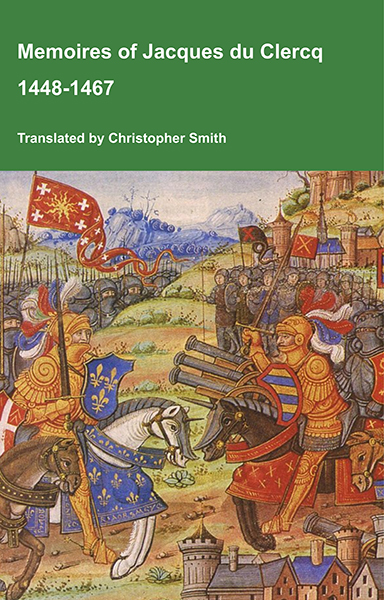 Memoires Jacques du Clercq. In that year sixty-three, on the sixth day of September, by decree of Parliament, sentence was given against Antoine de Chabannes, Count of Dammartin, who, after the death of King Charles, father of King Louis, had fled for fear of the said King Louis; which count, about a year after the death of the said King Charles, came to beg mercy of the said King Louis, and placed himself entirely at his will; whereupon the king sent him to the Conciergerie at Paris, and ordered those of Parliament that his trial should be conducted; which being done, it was declared that he had committed the crime of lèse-majesté against King Louis; for which reason all his goods and inheritances were declared confiscated to the said king, and his body adjudged worthy of death. But King Louis spared his life, on condition that he should promise to go to the island of Rhodes, and there remain for the rest of his life, and for this he should provide good surety, which surety he could not find; for which cause it happened that he was kept prisoner in Paris, in the Bastille of Saint Anthony, until such time as he should have found the said surety.
Audit an lxiij, le vje jour de septembre, par arrest de parlement, fust rendue sentence contre Anthoine de Chabannes, comte de Damp Martin, lequel après la mort du roy Charles, pere du roy Loys, s'estoit rendu fugitif pour le creineur dudit roy Loys; lequel comte, ung an après la mort dudit roy Charles, ou environ, vint prier merchy audit roy Loys, et se mit du tout en sa volonté; lequel l'envoya en la conciergerie a Paris, et manda a ceulx du parlement, que son procés fust fait; lequel fait, il fust dit qu'il avoit commis crime de leze majesté devers le roy Loys; pourquoy touts ses biens et heritages feurent dits confisqués audit roy et son corps digne de mort; mais le roy Loys lui remit sa vie, moiennant qu'il promectoit d'aller en l'isle de Rhodes, et illecq se tenir toute sa vie; et de ce baillieroit bonne caution, laquelle caution il ne peut my trouver; pour laquelle cause il faillit qu'il tint prison a Paris, en la bastille Saint Anthoine, jusques ad ce qu'il aura trouvé ladite caution.
On 6th September 1465 Archbishop George Neville [aged 33] was enthroned as Archbishop of York at Cawood Castle, North Yorkshire [Map]. Isabel Neville Duchess Clarence [aged 14], Anne Neville Queen Consort England [aged 9] and King Richard III of England [aged 12] were present.
On 6th September 1478 John King of Denmark Norway and Sweden [aged 23] and Christina Queen Consort Denmark Norway and Sweden [aged 16] were married. He the son of Christian I King of Denmark [aged 52] and Dorothea of Brandenburg [aged 47].
Letters and Papers Foreign and Domestic Henry VIII 1519. 6 Sept. [1519] Calig. D. VII. 148. B. M. 446. Boleyn [aged 42] To Wolsey.
Wrote his last on the 14th Aug. The King tells him that he has heard from his ambassador that the king of Castile will go next summer into Flanders, thence to Frankfort. He thinks Charles will go to Rome to be crowned, and must pass through France or the Venetian territory; but neither the Pope nor the Venetians wish him to go to Rome. He thinks also the Emperor will not be able to pay for his coronation. Had a long talk with the King's mother respecting Don Ferdinand and his prospects. She thinks it will be a long time before his brother Charles can have children; and Madame Charlotte, the King's daughter, is only three years old. She said she heard he had few folks of honor about him, "and said how Bouton was put to him." Her son will be this winter at Lyons, near the king of Castile, the Swiss and the Pope, the Venetians and Milan. The King has been curious to know what sort of a man the English ambassador in Spain is. The Queen will, in the course of a fortnight, send a gentleman to England with a token to Queen Catharine, and another from the Dauphin to the Princess. The Venetian ambassador is on his return here from England, of which he gives a good report. The Pope's legate and the ambassador of Venice have more communication than usual with the King, and the Spaniard less. William Pa[wne] has been despatched with a letter to Loogis, governor of Tournay, commissioning the latter to buy such material of him as may be needful for the repair of the castle. Seigneur Marcantoyn de Coloigne (Colonna) is here, in great favour with the King, "and is of the order of France." He is sick, but not dangerously. The Admiral is still sick. The Legate will have the Bishopric of Coutance. The cardinal of Roussy died lately at Rome. Great sickness reigns here. Blois, 6 Sept. Signature burnt off.
Mutilated, pp. 3. Add.
Letters and Papers Foreign and Domestic Henry VIII 1535. 6th September 1535. Add. MS. 28,588, f. 20. B. M. 295. Viscount J. Hannart to the Empress.
The queens of France and Hungary met at Cambray on 16 Aug. There were present the daughters and daughter-in-law of the King, Madame de Vendome, the cardinals of Borvon (Bourbon) and Tornon, the Admiral, the duke of Albany, and the marchioness of Zenete. The Empress probably knows that the king of England has separated from the Church of Rome, and put to death many persons who will not obey him as head of the Church after God. Since the death of the Cardinal of Rochester and More, twentyeight persons have been executed, among them nine Carthusians. The King has given the Carthusian Monastery in London to his new wife [aged 34] for a palace, and others to his daughter and father-in-law [aged 58].
The king of Scotland has sent ambassadors to conclude his marriage with the daughter of Mons. de Vandôme, and to conduct her to Scotland.
* * * 6 Sept. 1535. Sp., pp. 3. Modern copy.


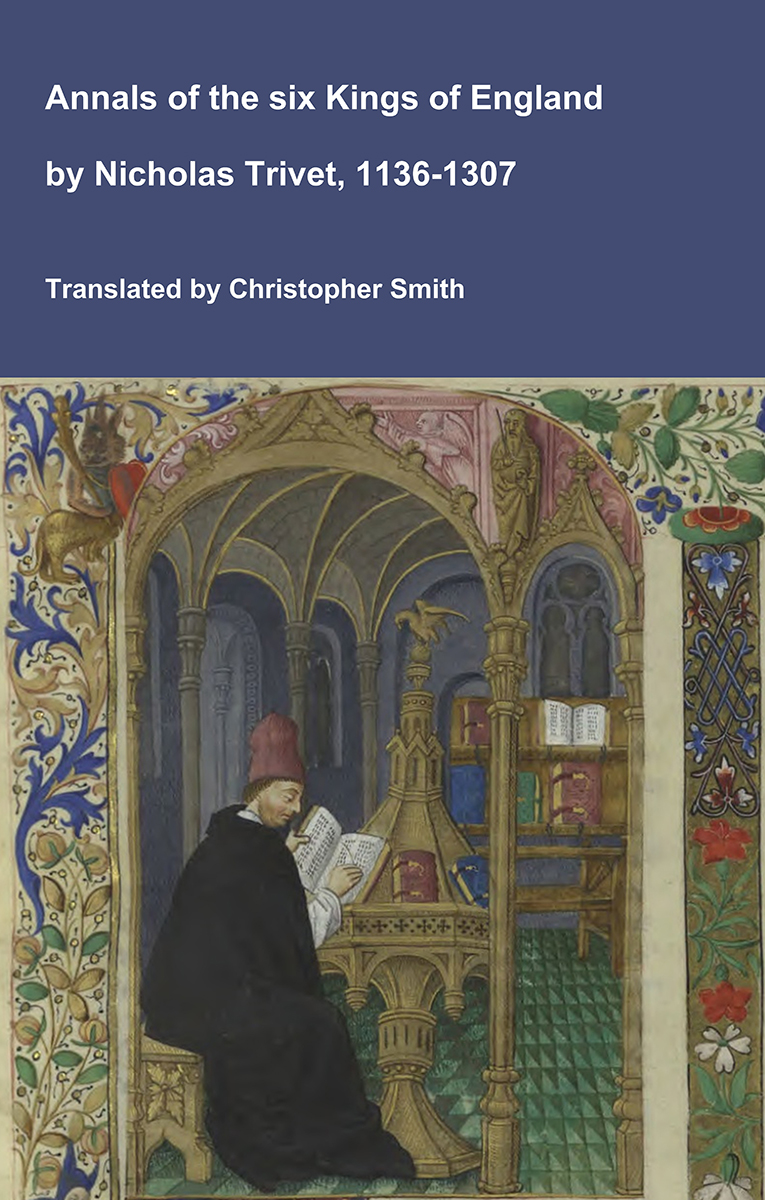
Annals of the six Kings of England by Nicholas Trivet
Translation of the Annals of the Six Kings of England by that traces the rise and rule of the Angevin aka Plantagenet dynasty from the mid-12th to early 14th century. Written by the Dominican scholar Nicholas Trivet, the work offers a vivid account of English history from the reign of King Stephen through to the death of King Edward I, blending political narrative with moral reflection. Covering the reigns of six monarchs—from Stephen to Edward I—the chronicle explores royal authority, rebellion, war, and the shifting balance between crown, church, and nobility. Trivet provides detailed insight into defining moments such as baronial conflicts, Anglo-French rivalry, and the consolidation of royal power under Edward I, whose reign he describes with particular immediacy. The Annals combines careful year-by-year reporting with thoughtful interpretation, presenting history not merely as a sequence of events but as a moral and political lesson. Ideal for readers interested in medieval history, kingship, and the origins of the English state, this chronicle remains a valuable and accessible window into the turbulent world of the Plantagenet kings.
Available at Amazon in eBook and Paperback format.
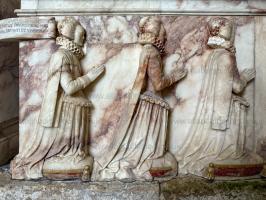
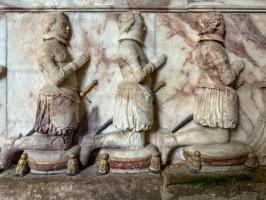
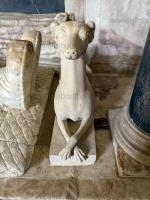
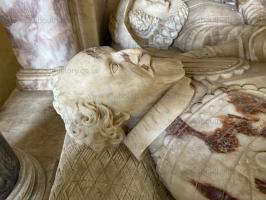
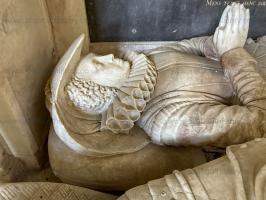
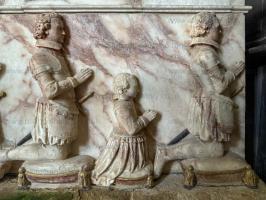
On 6th September 1613 Thomas Cave [aged 51] died. Monument at St Nicholas' Church, Stanford-on-Avon [Map] with his wife Eleanor St John [aged 46] depicted.
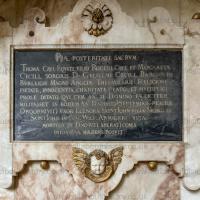
The inscription above: "Sacred to the pious memory of future generations. To Thomas Cave, knight, son of Roger Cave and Margaret Cecil, sister of Lord William Cecil, Baron of Burleigh, Lord High Treasurer of England. A man distinguished for his faith, piety, innocence, and charity, and blessed with many children. Having served the Lord faithfully for 51 years, he peacefully fell asleep in the Lord on September 6, in the year of our Lord 1613. His wife Eleanor Saint John, daughter of Nicholas Saint John, esquire, of the County of Wiltshire, his inseparable companion in life and (as she hopes) in the Lord in death, placed this monument, mourning."
Piæ posteritati sacrum. Thomæ Cave equity, filio Rogeri Cave, et Margaretæ Cecill sororis D. Gulieimi Cecill, Barosnis de Burleigh magni Angliæ Thesaurarii. Religione pietate, innocentia charitate claro, et multiplici prole ditato: (qui, cum. anos 51 domino fæliciter militasset in eodem ano DNI (1613) September 6o placide Obdommivit) uxor Elenora Saint John filia Nicholai Saint John in Com: Wilt: Armigeri vitæ mortisq in Dño (vti sperat) comes: individva mærens posvit.
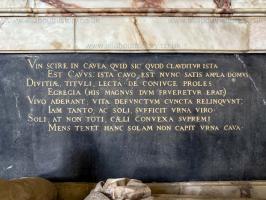
The inscription below: "'I came to see what lies in the tomb — what is this that is enclosed?'" This is a hollow place; yet now, this hollow is a house spacious enough. Wealth, honours, noble offspring by a worthy wife. While he enjoyed these, he was a great man. While he lived, they were with him; In death, all things are left behind. Now a single urn suffices for such a man, so great. Suffices but only for the body, not the whole: The vaulted heavens of the highest sky belong to him still. The mind holds this truth. But the hollow tomb cannot contain the soul."
Vin scire in cavea qvid sic qvod clauditur ista est cavus ista cavo est nunc satis amla domus. Divitiæ, tituli, lecta de coniuge proles egregia (his magnus dum frueretur erat;) Vivo aderant; vita defunctum cuncta relinquunt: Iam tanto, ac soli, sufficit urna viro. Soli, at non toti, cæli convexa supremi. Mens tenet hanc solam non capit urna cava.
Thomas Cave: Around 1562 he was born to Roger Cave of Stanford and Margaret Cecil. In 1586 Thomas Cave and Eleanor St John were married at St Nicholas' Church, Stanford-on-Avon [Map].
Eleanor St John: Around 1567 she was born to Nicholas St John and Elizabeth Blount. In 1654 Eleanor St John died.
Between 6th September 1618 and 25th September 1618 a comet was visible to the naked eye.
On 6th September 1640 Lionel Tollemache 2nd Baronet [aged 49] died at Tilbury, Essex [Map]. He was buried at Church of St Mary, Helmingham [Map]. His son Lionel [aged 16] succeeded 3rd Baronet Talmash of Helmingham in Suffolk. Elizabeth Murray Duchess Lauderdale [aged 13] by marriage Lady Talmash of Helmingham in Suffolk.


John Evelyn's Diary. 6th September 1651. I went with my wife [aged 16] to St. Germains, to condole with Mr. Waller's [aged 45] loss. I carried with me and treated at dinner that excellent and pious person the Dean of St. Paul's, Dr. Stewart, and Sir Lewis Dives [aged 52] (half-brother to the Earl of Bristol [aged 38]) [Note. Beatrice Walcott was mother to Lewis Dyve and George Digby 2nd Earl Bristol by her first and second husbands respectively. At the time of writing, 1651, the Earl of Bristol was John Digby 1st Earl Bristol [aged 71]; a case of Evelyn writing hi sdiary retrospectively], who entertained us with his wonderful escape out of prison in Whitehall [Map], the very evening before he was to have been put to death, leaping down out of a jakes two stories high into the Thames at high water, in the coldest of winter, and at night; so as by swimming he got to a boat that attended for him, though he was guarded by six musketeers. After this, he went about in women's habit, and then in a small-coal-man's, traveling 200 miles on foot, embarked for Scotland with some men he had raised, who coming on shore were all surprised and imprisoned on the Marquis of Montrose's score; he not knowing anything of their barbarous murder of that hero. This he told us was his fifth escape, and none less miraculous; with this note, that the charging through 1,000 men armed, or whatever danger could befall a man, he believed could not more confound and distract a man's thoughts than the execution of a premeditated escape, the passions of hope and fear being so strong. This knight was indeed a valiant gentleman; but not a little given to romance, when he spoke of himself. I returned to Paris the same evening.


In September 1660 King Charles II of England Scotland and Ireland [aged 30] rewarded a further tranche of those who supported his Restoration...
On 4th September 1660 John King 1st Baron Kingston was created 1st Baron Kingston of Kingston in Dublin.
On 5th September 1660 Roger Boyle 1st Earl Orrery [aged 39] was created 1st Earl Orrery. Margaret Howard Countess Orrery [aged 38] by marriage Countess Orrery.
On 5th September 1660 Oliver St George 1st Baronet was created 1st Baronet St George of Carrickdrumrusk in Leitrim in the Peerage of England.
On 6th September 1660 Francis Boyle 1st Viscount Shannon [aged 37] was created 1st Viscount Shannon. Elizabeth Killigrew Viscountess Shannon [aged 38] by marriage Viscountess Shannon.
On 6th September 1660 Richard Coote 1st Baron Coote [aged 40] was created 1st Baron Coote.
On 10th September 1660 Charles Gordon 1st Earl Aboyne [aged 22] was created 1st Earl Aboyne.
John Evelyn's Diary. 6th September 1662. Dined with me Sir Edward Walker [aged 51], Garter King of Arms, Mr. Slingsby [aged 41], master of the Mint, and several others.
Samuel Pepys' Diary. 6th September 1664. So home, and to bed. This day Mr. Coventry [aged 36] did tell us how the Duke [aged 30] did receive the Dutch Embassador the other day; by telling him that, whereas they think us in jest, he believes that the Prince [aged 44] (Rupert) which goes in this fleete to Guinny will soon tell them that we are in earnest, and that he himself will do the like here, in the head of the fleete here at home, and that for the meschants, which he told the Duke there were in England, which did hope to do themselves good by the King's being at warr, says he, the English have ever united all this private difference to attend foraigne, and that Cromwell, notwithstanding the meschants in his time, which were the Cavaliers, did never find them interrupt him in his foraigne businesses, and that he did not doubt but to live to see the Dutch as fearfull of provoking the English, under the government of a King, as he remembers them to have been under that of a Coquin. I writ all this story to my Lord Sandwich [aged 39] tonight into the Downes, it being very good and true, word for word from Mr. Coventry to-day.


Samuel Pepys' Diary. 6th September 1665. Thence by water to the Duke of Albemarle's [aged 56]: all the way fires on each side of the Thames, and strange to see in broad daylight two or three burials upon the Bankeside, one at the very heels of another: doubtless all of the plague; and yet at least forty or fifty people going along with every one of them.


From 2nd September 1666 to 6th September 1666 the Great Fire of London destroyed around 13000 properties in the medieval City of London as well as 87 parish churches and St Paul's Cathedral [Map]. The fire is estimated to have left 80% of the city's residents homeless.
Samuel Pepys' Diary. 6th September 1666. Up about five o'clock, and where met Mr. Gawden at the gate of the office (I intending to go out, as I used, every now and then to-day, to see how the fire is) to call our men to Bishop's-gate [Map], where no fire had yet been near, and there is now one broke out which did give great grounds to people, and to me too, to think that there is some kind of plot1 in this (on which many by this time have been taken, and, it hath been dangerous for any stranger to walk in the streets), but I went with the men, and we did put it out in a little time; so that that was well again. It was pretty to see how hard the women did work in the cannells, sweeping of water; but then they would scold for drink, and be as drunk as devils. I saw good butts of sugar broke open in the street, and people go and take handsfull out, and put into beer, and drink it. And now all being pretty well, I took boat, and over to Southwarke [Map], and took boat on the other side the bridge, and so to Westminster, thinking to shift myself, being all in dirt from top to bottom; but could not there find any place to buy a shirt or pair of gloves, Westminster Hall [Map] being full of people's goods, those in Westminster having removed all their goods, and the Exchequer money put into vessels to carry to Nonsuch [Map]; but to the Swan [Map], and there was trimmed; and then to White Hall, but saw nobody; and so home. A sad sight to see how the River looks: no houses nor church near it, to the Temple [Map], where it stopped.
Note 1. The terrible disaster which overtook London was borne by the inhabitants of the city with great fortitude, but foreigners and Roman Catholics had a bad dime. As no cause for the outbreak of the fire could be traced, a general cry was raised that it owed its origin to a plot. In a letter from Thomas Waade to Williamson (dated "Whitby, Sept. 14th") we read, "The destruction of London by fire is reported to be a hellish contrivance of the French, Hollanders, and fanatic party" (Calendar of State Papers, 1666-67, p. 124).
Samuel Pepys' Diary. 6th September 1666. At home, did go with Sir W. Batten [aged 65], and our neighbour, Knightly (who, with one more, was the only man of any fashion left in all the neighbourhood thereabouts, they all removing their goods and leaving their houses to the mercy of the fire), to Sir R. Ford's [aged 52], and there dined in an earthen platter-a fried breast of mutton; a great many of us, but very merry, and indeed as good a meal, though as ugly a one, as ever I had in my life.
Samuel Pepys' Diary. 6th September 1666. Thence down to Deptford, Kent [Map], and there with great satisfaction landed all my goods at Sir G. Carteret's [aged 56] safe, and nothing missed I could see, or hurt. This being done to my great content, I home, and to Sir W. Batten's [aged 65], and there with Sir R. Ford [aged 52], Mr. Knightly, and one Withers, a professed lying rogue, supped well, and mighty merry, and our fears over. From them to the office, and there slept with the office full of labourers, who talked, and slept, and walked all night long there. But strange it was to see Cloathworkers' Hall on fire these three days and nights in one body of flame, it being the cellar full of oyle.
John Evelyn's Diary. 6th September 1676. Supped at the Lord Chamberlain's [aged 58], where also supped the famous beauty and errant lady, the Duchess of Mazarine [aged 30] (all the world knows her story), the Duke of Monmouth [aged 27], Countess of Sussex [aged 15] (both natural children of the King [aged 46] by the Duchess of Cleveland [aged 35]) [Note. A mistake by Evelyn. Jame's Scott's mother was Lucy Walter, Anne Fitzroy's mother was Barbara Villiers 1st Duchess of Cleveland], and the Countess of Derby [aged 16], a virtuous lady, daughter to my best friend, the Earl of Ossory [aged 42].
John Evelyn's Diary. 6th September 1680. He is generous, and lives very honourably, of a sweet nature, well-spoken, well-bred, and is so highly in his Majesty's [aged 50] esteem, and so useful, that being long since made a knight, he is also advanced to be one of the Lords Commissioners of the Treasury, and has the reversion of the Cofferer's place after Harry Brouncker [aged 53]. He has married his eldest daughter [aged 11] to my Lord Cornwallis [aged 15], and gave her £12,000, and restored that entangled family besides. He matched his son to Mrs. Trollop [aged 19], who brings with her (besides a great sum) near, if not altogether, £2,000 per annum. Sir Stephen's lady (an excellent woman) is sister to Mr. Whittle [aged 49], one of the King's chirurgeons. In a word, never was man more fortunate than Sir Stephen; he is a handsome person, virtuous, and very religious.


The True Chronicles of Jean le Bel Volume 1 Chapters 1-60 1307-1342
The True Chronicles of Jean le Bel offer one of the most vivid and immediate accounts of 14th-century Europe, written by a knight who lived through the events he describes, and experienced some of them first hand. Covering the early decades of the Hundred Years’ War, this remarkable chronicle follows the campaigns of Edward III of England, the politics of France and the Low Countries, and the shifting alliances that shaped medieval warfare. Unlike later historians, Jean le Bel writes with a strong sense of eyewitness authenticity, drawing on personal experience and the testimony of fellow soldiers. His narrative captures not only battles and sieges, but also the realities of military life, diplomacy, and the ideals of chivalry that governed noble society. A key source for Jean Froissart, Le Bel’s chronicle stands on its own as a compelling and insightful work, at once historical record and literary achievement. This translation builds on the 1905 edition published in French by Jules Viard, adding extensive translations from other sources Rymer's Fœdera, the Chronicles of Adam Murimuth, William Nangis, Walter of Guisborough, a Bourgeois of Valenciennes, Geoffrey le Baker of Swinbroke and Richard Lescot to enrich the original text and Viard's notes.
Available at Amazon in eBook and Paperback format.
John Evelyn's Diary. 6th September 1680. I dined with Sir Stephen Fox [aged 53], now one of the Lords Commissioners of the Treasury. This gentleman came first a poor boy from the choir of Salisbury, then he was taken notice of by Bishop Duppa, and afterward waited on my Lord Percy (brother to Algernon, Earl of Northumberland), who procured for him an inferior place among the clerks of the kitchen and Greencloth side, where he was found so humble, diligent, industrious, and prudent in his behavior, that his Majesty being in exile, and Mr. Fox waiting, both the King [aged 50] and Lords about him frequently employed him about their affairs, and trusted him both with receiving and paying the little money they had. Returning with his Majesty to England, after great want and great sufferings, his Majesty found him so honest and industrious, and withal so capable and ready, that, being advanced from clerk of the kitchen to that of the Greencloth, he procured to be paymaster of the whole army, and by his dexterity and punctual dealing he obtained such credit among the bankers, that he was in a short time able to borrow vast sums of them upon any exigence. The continual turning thus of money, and the soldiers' moderate allowance to him for keeping touch with them, did so enrich him, that he is believed to be worth at least £200,000, honestly got and unenvied; which is next to a miracle. With all this he continues as humble and ready to do a courtesy as ever he was.


John Evelyn's Diary. 6th September 1685. About 6 o'clock came Sl Dudley [aged 44] and his brother Roger North [aged 32], and brought the greate seale from my Lord Keeper [deceased], who died ye day before at his house [Map] in Oxfordshire. the King went immediately to Council; every body guessing who was most likely to succeed this greate officer; most believing it could be no other than my Lord Chief Justice Jefferies [aged 40], who had so vigorously prosecuted the late rebells, and was now gone the Western circuit, to punish the rest that were secur'd in the several counties, and was now neere upon his returne. I tooke my leave of his Ma* [aged 51], who spake very graciously to me, and supping that night at Sr Stephen Fox's [aged 58], I promis'd to dine there the next day.


John Evelyn's Diary. 6th September 1685. Sunday. I went to prayer in the Chapell, and heard Dr. Standish. The second sermon was preach'd by Dr. Creighton [aged 46], on 1 Thess. 4, 11, persuading to unity and peace, and to be mindfull of our owne businesse, according to the advise of the Apostle. Then I went to heare a Frenchman who preached before the King [aged 51] and Queene [aged 26] in that splendid Chapell [Map] next St. George's Hall. Their Maties going to masse, I withdrew to consider the stupendous painting of ye Hall, which, both for the art and invention, deserve the inscription in honour of the painter, Signior Verrio [aged 49]. The history is Edward the 3rd receiving the Black Prince, coming towards him in a Roman triumph. The whole roofe is the history of St. George. The throne, the carvings, &e. are incomparable, and I think equal to any, and in many circumstances exceeding any, I have seene abroad.


John Evelyn's Diary. 6th September 1685. I din'd at Lord Sunderland's [aged 44], with (amongst others) Sr Wm Soames [aged 40], design'd Ambass. to Constantinople.
John Evelyn's Diary. 6th September 1696. I went to congratulate the marriage of a daughter of Mr. Boscawen to the son [aged 24] of Sir Philip Meadows; she is niece to my Lord Godolphin [aged 51], married at Lambeth [Map] by the Archbishop [aged 59], 30th of August. After above six months' stay in London about Greenwich Hospital, I returned to Wotton, Surrey [Map].

On 6th September 1759 John Heathcote 2nd Baronet [aged 70] died. His son Gilbert [aged 39] succeeded 3rd Baronet Heathcote of London. Margaret Yorke Lady Heathcote [aged 26] by marriage Lady Heathcote of London. Monument in St Mary's Church, Edith Weston, Rutlandshire [Map].
John Heathcote 2nd Baronet: In 1689 he was born to Gilbert Heathcote 1st Baronet. In 1720 John Heathcote 2nd Baronet and Bridget White Lady Heathcote were married. She by marriage Lady Heathcote of London. On 9th February 1733 he was appointed MP Bodmin.
Gilbert Heathcote 3rd Baronet: After 1720 he was born to John Heathcote 2nd Baronet. On 22nd June 1749 Gilbert Heathcote 3rd Baronet and Margaret Yorke Lady Heathcote were married. She the daughter of Philip Yorke 1st Earl of Hardwicke and Margaret Cocks Countess Hardwicke. In 1770 Gilbert Heathcote 3rd Baronet and Elizabeth Hudson Lady Heathcote were married. She by marriage Lady Heathcote of London. The difference in their ages was 34 years.
Margaret Yorke Lady Heathcote: On 23rd March 1733 she was born to Philip Yorke 1st Earl of Hardwicke and Margaret Cocks Countess Hardwicke.
On 6th September 1776 James Lenox Dutton [aged 63] died. He was buried at Saint Mary Magdalene's Church, Sherborne [Map]. Monument to James Lenox Dutton and his second wife Jane Bond sculpted by Richard "The Elder" Westmacott [aged 29] in 1791. Remarkable for the quality of the carving and the stone (probably Carrara Marble) and the skeleton. Believed to be called Immortality Trampling Death. Life-sized angel leans on a medallion with profiles of the deceased, underfoot a prostrate skeleton (representing death).
Jane Bond: James Lenox Dutton and she were married. she was born to Christopher Bond. On 29th May 1776 she died.


On 6th September 1784 the grave of Mary Tudor Queen Consort France was opened and locks of her hair were taken by a number of people. In, or before, 1786 one lock was given to Horace Walpole [aged 66] by Jane Georgiana Fauquier.


On 6th September 1797 Henry Adam Lennox was born to Charles Lennox 4th Duke Richmond [aged 32] and Charlotte Gordon Duchess Richmond [aged 28]. He a great x 3 grandson of King Charles II of England Scotland and Ireland.
On 6th September 1801 William Tyler [aged 73] died.
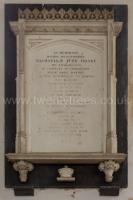
After 6th September 1830. Memorial to Rachel Ives Drake Baroness Boston [deceased] at St Nicholas Church, Whiston [Map].
Rachel Ives Drake Baroness Boston: On 29th January 1783 she was born. On 17th October 1801 George Irby 3rd Baron Boston and she were married. On 23rd March 1825 Frederick Irby 2nd Baron Boston died at Lower Grosvenor Street, Belgravia. His son George succeeded 3rd Baron Boston, 4th Baronet Irby of Whaplode and Boston. She by marriage Baroness Boston. On 6th September 1830 she died.

Anne Boleyn. Her Life as told by Lancelot de Carle's 1536 Letter.
In 1536, two weeks after the execution of Anne Boleyn, her brother George and four others, Lancelot du Carle, wrote an extraordinary letter that described Anne's life, and her trial and execution, to which he was a witness. This book presents a new translation of that letter, with additional material from other contemporary sources such as Letters, Hall's and Wriothesley's Chronicles, the pamphlets of Wynkyn the Worde, the Memorial of George Constantyne, the Portuguese Letter and the Baga de Secrets, all of which are provided in Appendices.
Available at Amazon in eBook and Paperback format.
On 6th September 1836 John Atkinson Grimshaw was born.
Ten Years' Digging. September 6th [1848], opened a barrow at Dale, in the same township as the preceding, about a mile from Calton Moor House [Map]. It is irregular in form, being 13 yards diameter from North to South, and 16 from East to West; the height about three feet, and the components flat stones and earth. On the natural surface lay two skeletons in a line, one at the feet of the other, which presented a mode of sepulture different to any yet found in our researches, from having been intentionally subjected to the action of fire upon the spot, in such a manner as to preserve the bones in their natural order, entire and unwarped by the heat. They were surrounded by charcoal and earth, to which a red colour had been imparted by the operation, themselves exhibiting a curious variety of tints from the same cause. All deposits of burnt bones previously found by us have been strictly calcined, and reduced to fragments by the process, and have generally been gathered into a heap, or placed within an urn, so that here we find an exception to the rule perfectly inexplicable - we may observe that the bones are evidently those of different sexes. Portions of human skull and some teeth found near the burnt skeletons, indicate that a former interment was displaced to make way for the new comers. No implements were found with them, but chips of flint, and one piece of primitive earthenware occurred near the top of the barrow.
On 6th September 1862 Archbishop John Bird Sumner [aged 81] died.
On 6th September 1864 William Vane 3rd Duke Cleveland [aged 72] died. His brother Harry [aged 61] succeeded 4th Duke of Cleveland, 4th Marquess of Cleveland, 6th Earl Darlington, 6th Viscount Barnard, 8th Baron Barnard, 4th Baron Raby of Raby Castle in County Durham. Catherine Lucy Wilhelmina Stanhope Duchess of Cleveland [aged 45] by marriage Duchess of Cleveland.


On 6th September 1864 Thomas Woolner [aged 38] and Alice Gertrude Waugh were married. He had previously proposed to her sister Fanny Waugh [aged 31]. They had two sons and four daughters.


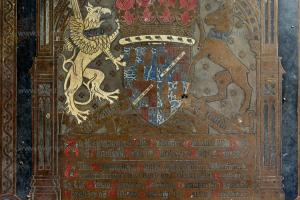
After 6th September 1864. St Mary's Church, Staindrop [Map]. Memorial to William Vane 3rd Duke Cleveland [deceased].
William Vane 3rd Duke Cleveland: On 3rd April 1792 he was born to William Henry Vane 1st Duke Cleveland and Catharine Margaret Powlett Countess Darlington. He a great x 3 grandson of King Charles II of England Scotland and Ireland. Coefficient of inbreeding 6.45%. On 3rd July 1815 William Vane 3rd Duke Cleveland and Grace Caroline Lowther Duchess of Cleveland were married at St James' Church, Piccadilly. She the daughter of William Lowther 1st Earl Lonsdale and Augusta Fane Countess Lonsdale. He the son of William Henry Vane 1st Duke Cleveland and Catharine Margaret Powlett Countess Darlington. They were half fifth cousins. He a great x 3 grandson of King Charles II of England Scotland and Ireland. On 18th January 1864 Henry Vane 2nd Duke Cleveland died at the parish of St George's Church, Hanover Square. His brother William succeeded 3rd Duke of Cleveland, 3rd Marquess of Cleveland, 5th Earl Darlington, 5th Viscount Barnard, 7th Baron Barnard, 3rd Baron Raby of Raby Castle in County Durham. Grace Caroline Lowther Duchess of Cleveland by marriage Duchess of Cleveland. On 6th September 1864 William Vane 3rd Duke Cleveland died. His brother Harry succeeded 4th Duke of Cleveland, 4th Marquess of Cleveland, 6th Earl Darlington, 6th Viscount Barnard, 8th Baron Barnard, 4th Baron Raby of Raby Castle in County Durham. Catherine Lucy Wilhelmina Stanhope Duchess of Cleveland by marriage Duchess of Cleveland.

On 6th September 1869 Bishop Robert Eden 3rd Baron Auckland [aged 70] resigned his position as Bishop of Bath and Wells.
On 6th September 1871 Walter Crane [aged 26] and Mary Frances Andrews [aged 25] were married at All Souls, Marylebone [Map]. See An Artist's Reminiscences.
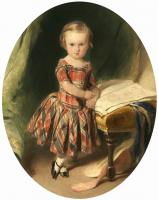


On 6th September 1875 Susan Charlotte Catherine Pelham-Clinton [aged 36] died. Memorial at St Mary's Church, Long Newton [Map].
Susan Charlotte Catherine Pelham-Clinton: On 7th April 1839 she was born to Henry Pelham-Clinton 5th Duke Newcastle-under-Lyne and Susan Harriet Catherine Hamilton Duchess Newcastle under Lyne. On 23rd April 1860 Adolphus Frederick Charles William Vane-Tempest and she were married. She the daughter of Henry Pelham-Clinton 5th Duke Newcastle-under-Lyne and Susan Harriet Catherine Hamilton Duchess Newcastle under Lyne. He the son of Charles William Vane 3rd Marquess Londonderry and Frances Vane Tempest Marchioness Londonderry. After 11th June 1864 Susan Charlotte Catherine Pelham-Clinton became the mistress of King Edward VII of the United Kingdom. She is believed by some to have had a child with the Prince although evidence is scant.
On 6th September 1888 Joseph Patrick Kennedy was born.
On 6th September 1890 Robert St Clair-Erskine 4th Earl of Rosslyn [aged 57] died. Memorial at the Rosslyn Chapel [Map]
Robert St Clair-Erskine 4th Earl of Rosslyn: On 2nd March 1833 he was born. On 8th November 1866 he and Blanche Adeliza Fitzroy were married.


The True Chronicles of Jean le Bel Volume 1 Chapters 1-60 1307-1342
The True Chronicles of Jean le Bel offer one of the most vivid and immediate accounts of 14th-century Europe, written by a knight who lived through the events he describes, and experienced some of them first hand. Covering the early decades of the Hundred Years’ War, this remarkable chronicle follows the campaigns of Edward III of England, the politics of France and the Low Countries, and the shifting alliances that shaped medieval warfare. Unlike later historians, Jean le Bel writes with a strong sense of eyewitness authenticity, drawing on personal experience and the testimony of fellow soldiers. His narrative captures not only battles and sieges, but also the realities of military life, diplomacy, and the ideals of chivalry that governed noble society. A key source for Jean Froissart, Le Bel’s chronicle stands on its own as a compelling and insightful work, at once historical record and literary achievement. This translation builds on the 1905 edition published in French by Jules Viard, adding extensive translations from other sources Rymer's Fœdera, the Chronicles of Adam Murimuth, William Nangis, Walter of Guisborough, a Bourgeois of Valenciennes, Geoffrey le Baker of Swinbroke and Richard Lescot to enrich the original text and Viard's notes.
Available at Amazon in eBook and Paperback format.

On 6th September 1896 Doris Hilda Gordon-Lennox was born to Charles Gordon-Lennox 8th Duke Richmond [aged 25] and Hilda Madeline Brassey Duchess Richmond [aged 24]. She married 10th April 1923 Commander Clare George Vyner.
The Times. 26th December 1910. We regret to state that Lord Ancaster [deceased] died on Saturday night at his Grimsthorpe, Bourne, Lincolnshire seat, in his 81st year.
Gilbert Henry Heathcote-Drummond-Willoughby, created first Earl of Ancaster in 1892, was Joint Hereditary Lord Great Chamberlain of England. This dignity is held jointly by Lord Cholmondeley [aged 27], Lord Ancastor, and Lord Carrington [aged 67]. The late peer filled it during the reign of Queen Victoria, Lord Cholmondeley during that of King Edward, and Lord Carrington fills it during the present reign.
He was born on October 1, 1830, and succeeded his father [aged 12] as second Lord Aveland on September 6, 1807, and his mother as 24th Lord Willoughby de Eresby on November 13, 1888.
Few noblemen possessed a longer lineage, for the lordship of Erresby in Lincolnshire was acquired by the family of Bee or Belec bv the marriage of Walter dc Bec with Agnes, daughter and heiress of Hugh Fitz Pincheon, a 12th century magnate of Lincolnshire. A John Beeke received permission from Edward I to make a castle of his manor house at Eresby and was summoned to Parliament as one of the barons of the realm. By his wife, Sarah, daughter of Thomas, Lord Furnival, be had, among other children, Alice, who was married to Sir William de Willoughby, one of those who went with Prince Edward to the Holy Land. His son, Robert, became first Lord Willoughby de Eresby. Subsequent holders of that title played a prominent part in the country's history at home and abroad. The 13th baron was created Earl of Lindsey. The fourth Earl of Lindsey was created Duke of Ancaster and Kesteven in 1713. That dukedom became extinct with the death of the fifth Duke in 1809. The barony of Willoughby de Eresby fell into abeyance between the sisters of the fourth duke until it was terminated by the Crown in 1780 in favour of the elder co-heir, Priscilla Barbara Elizabeth, whom the first Lord Gwydir married in 1779. Their eldest son Peter Robert, 21st Baron Willoughby de Eresby, married the daughter of the first Lord Perth, and one of their daughters became in 1840 the wife of the second Lord Carrington. Almeric, the 22nd Lord Willoughby do Eresby and third Baron Gwydyr of Gwydyr, County Carnarvon, Joint Hereditary Great Chamberlain of England, died in August, 1870. The barony of Willoughby do Eresby again fell into abeyance between his lordship's surviving sisters, and it was terminated in favour of the elder, the Dowager Baroness Aveland, who married in 1827 Sir Gilbert John Heathcote, created Baron Aveland in 1856. Their eldest son was the late Lord Ancaster, whose sister, Clementina Charlotte [aged 78], married in 1869 Vice-Admiral Sir George Tryon, who died in her Majesty's ship Victoria in June 1893.
The late Lord Ancaster married in 1863 Lady Evelyn Elizabeth Gordon [aged 64], second daughter of the tenth Marquis of Huntly, by whom be had four sons and six daughters. He was educated at Harrow and Trinity College, Cambridge, and sat as Member of Parliament for Rutland from 1856 to 1867. He was a magistrate for Kesteven and chairman of Quarter Sessions, lord of the manor of Thurlbv Baston and Langtoft, as well as chairman of the Stamford Division Conservative and Unionist Association; and was Lord Chamberlain during Queen Victoria's reign and contested the right to continue on King Edward's succession.
He is succeeded in the title by Lord Willoughby de Eresby [aged 43],??? for the Hornecastle Division of Lincolnshire, who is a major and hon. lieutenant-colonel of the Lincolnshire Yeomanry and was formerly an officer of the Leicestershire Yeomanry Cavalry. He married in 1905 Eloise Laurence [aged 28], eldest daughter of the late Mr. W. L. Breese, of New York, and has a son, Gilbert James [aged 3], born in 1907, and two daughters.
The late earl's other children include Major Charles S. Heathcote-Drunmond-Willoughby [aged 40], who married Lady Muriel Erskine, daughter of Lord Buchan [aged 60]; Major Claud Heathcote-Drummond-Willoughby [aged 38], who married Lady Florence Astley [aged 43], youngest daughter of the third Marquis Ponyngham; Lady Evelyn Clementina [aged 46], wife of Major-General Sir Henry Peter Ewart; the Hon. Margaret Mary [aged 44], who was married to the late Mr. Gideon Macpherson Rutherford; the Hon. Cecilie [aged 36], wife of Mr. T. C. E. Goff; and Lady Dalhousie [aged 32]. The late peer assumed by Royal licence in 1872 the additional surnames of Willoughby and Drummond. He was a large landowner, owning Drummond Castle Crieff, and extensive deer forests in Perthshire and land in Lincolnshire and Rutland. Recently, however, he sold considerable portion of his estates, in many instances to the tenants who had the option of purchase. He was a very generous landlord, and was highly respected. He used Normanton Castle as his chief country house till Lord Willoughby de Eresby was married; then Normanton became the latter's home, and Lord Ancester lived at Grimsthorpe. He was president of the National Society for the Prevention of Cruelty to Children.


On 6th September 1912 George Backhouse Witts [aged 66] died.
On 6th September 1916 Alexandra Margaret Anne Cavendish-Bentinck was born to William Arthur Henry Cavendish-Bentinck 7th Duke Portland [aged 23] and Ivy Gordon-Lennox Duchess Portland [aged 29].

On 6th September 1942 Bristol Beaufighter Mk IIF, 96 Sqn RAF, Registration T3046, crashed at takeoff in RAF Wrexham and hit a Blenheim. Flying Officer John Birkbeck [aged 22] and Sergeant D L Nicholas were killed on active service.
Memorial in All Saints Church, West Acre [Map].
Flying Officer John Birkbeck: Around 1920 he was born to Major Henry Anthony Birkbeck.
On 6th September 2012 Nicole Schnedier Duchess Bedford [aged 92] died.
On 6th September 1602 Edward Bishopp 2nd Baronet was born to Thomas Bishopp 1st Baronet [aged 49] and Jane Weston [aged 49]. He married in or before 1625 his half fifth cousin once removed Mary Tufton, daughter of Nicholas Tufton 1st Earl of Thanet and Frances Cecil Countess Isle Thanet, and had issue.
On 6th September 1610 Alexander Leslie was born to Alexander Leslie 1st Earl Leven [aged 30]. He married 13th June 1637 Margaret Leslie Countess Buccleuch and Wemyss, daughter of John Leslie 6th Earl Rothes and Anne Erskine Countess of Rothes, and had issue.
On 6th September 1610 David Wemyss 2nd Earl of Wemyss was born to John Wemyss 1st Earl of Wemyss [aged 24] and Jane Gray Countess Wemyss. He a great x 4 grandson of King Henry VII of England and Ireland. He married (1) July 1625 Anna Balfour and had issue (2) April 1650 his half fourth cousin Helenor Fleming, daughter of John Fleming 2nd Earl Wigtown and Margaret Livingston Countess Wigtown (3) 13th January 1653 his fourth cousin once removed Margaret Leslie Countess Buccleuch and Wemyss, daughter of John Leslie 6th Earl Rothes and Anne Erskine Countess of Rothes, and had issue.
On 6th September 1633 Elizabeth Kerr was born to William Kerr 1st Earl Lothian [aged 28] and Anne Kerr 3rd Countess of Lothian. She married Francis Scott and had issue.
On 6th September 1675 Meliora Coningsby was born to Thomas Coningsby 1st Earl Coningsby [aged 18] and Barbara Gorges [aged 18]. She married 8th August 1695 Thomas Southwell 1st Baron Southwell and had issue.
On 6th September 1684 Anne Lumley Lady Anderson was born to Martin Lumley 3rd Baronet [aged 22] and Elizabeth Dawes. She married before 1707 Stephen Anderson 2nd Baronet, son of Stephen Anderson 1st Baronet and Judith Laurence Lady Anderson.
Adam Murimuth's Continuation and Robert of Avesbury’s 'The Wonderful Deeds of King Edward III'
This volume brings together two of the most important contemporary chronicles for the reign of Edward III and the opening phases of the Hundred Years’ War. Written in Latin by English clerical observers, these texts provide a vivid and authoritative window into the political, diplomatic, and military history of fourteenth-century England and its continental ambitions. Adam Murimuth Continuatio's Chronicarum continues an earlier chronicle into the mid-fourteenth century, offering concise but valuable notices on royal policy, foreign relations, and ecclesiastical affairs. Its annalistic structure makes it especially useful for establishing chronology and tracing the development of events year by year. Complementing it, Robert of Avesbury’s De gestis mirabilibus regis Edwardi tertii is a rich documentary chronicle preserving letters, treaties, and official records alongside narrative passages. It is an indispensable source for understanding Edward III’s claim to the French crown, the conduct of war, and the mechanisms of medieval diplomacy. Together, these works offer scholars, students, and enthusiasts a reliable and unembellished account of a transformative period in English and European history. Essential for anyone interested in medieval chronicles, the Hundred Years’ War, or the reign of Edward III.
Available at Amazon in eBook and Paperback format.
On 16th June 1704 Edward Ward 9th Baron Dudley 4th Baron Ward was born to Edward Ward 8th Baron Dudley 3rd Baron Ward and Diana Howard. His father had died three months before. On 6th September 1731 Edward Ward 9th Baron Dudley 4th Baron Ward died unmarried. His uncle William [aged 18] succeeded 10th Baron Dudley, 5th Baron Ward of Birmingham.

On 6th September 1724 George Lane Parker was born to George Parker 2nd Earl Macclesfield [aged 28].
On 6th September 1756 Henry Tichborne 7th Baronet was born to Henry Tichborne 6th Baronet [aged 46].
On 6th September 1760 George Henry Neville was born to George Neville 1st Earl Abergavenny [aged 33] and Henrietta Pelham Baroness Bergavenny [aged 30]. He married before September 1807 Caroline Walpole and had issue.
On 6th September 1797 Henry Adam Lennox was born to Charles Lennox 4th Duke Richmond [aged 32] and Charlotte Gordon Duchess Richmond [aged 28]. He a great x 3 grandson of King Charles II of England Scotland and Ireland.
On 6th September 1809 George Chetwynd 3rd Baronet was born to George Chetwynd 2nd Baronet [aged 26] and Hannah Maria Sparrow [aged 20]. He married 2nd August 1843 Charlotte Augusta Hill Lady Chetwynd, daughter of Arthur Blundell Sandys Trumbull Hill 3rd Marquess Downshire and Maria Windsor Marchioness Downshire, and had issue.


On 6th September 1834 Everard Aloysius Gonzaga Arundell 13th Baron Arundel was born to Henry Benedict Arundell 11th Baron Arundel [aged 29] and Frances Catherine Tichborne Baroness Arundel.
On 6th September 1836 John Atkinson Grimshaw was born.
On 6th September 1837 Captain Edward Hughes Brodrick Hartnell was born to Broderick Hartwell 2nd Baronet [aged 24]. He married 4th December 1873 Augusta Henrietta Paget and had issue.
On 6th September 1839 Walter Striling 3rd Baronet was born to Walter Stirling 2nd Baronet [aged 37] and Caroline Frances Byng.
Anne Boleyn. Her Life as told by Lancelot de Carle's 1536 Letter.
In 1536, two weeks after the execution of Anne Boleyn, her brother George and four others, Lancelot du Carle, wrote an extraordinary letter that described Anne's life, and her trial and execution, to which he was a witness. This book presents a new translation of that letter, with additional material from other contemporary sources such as Letters, Hall's and Wriothesley's Chronicles, the pamphlets of Wynkyn the Worde, the Memorial of George Constantyne, the Portuguese Letter and the Baga de Secrets, all of which are provided in Appendices.
Available at Amazon in eBook and Paperback format.
On 6th September 1846 Lawrence Hesketh Palk 2nd Baron Haldon was born to Lawrence Palk 1st Baron Haldon [aged 28] and Maria Harriett Hesketh Baroness Haldon. He married 7th October 1868 Constance Mary Barrington Baroness Haldon, daughter of George Barrington 7th Viscount Barrington, and had issue.
On 6th September 1852 Colonel Everard Charles Digby was born to Edward St Vincent Digby 9th and 3rd Baron Digby [aged 46] and Theresa Anna Maria Fox-Strangways Baroness Digby [aged 38]. He married before 16th January 1916 his second cousin Emily Petty Fitzmaurice, daughter of Henry Thomas Petty-Fitzmaurice 4th Marquess Lansdowne and Emily Jane de Flahaut Marchioness Lansdowne, and had issue.
On 6th September 1860 George Florance Irby 6th Baron Boston was born to Florance George Henry Irby 5th Baron Boston [aged 23]. He married 1890 his first cousin once removed Cecilia Constance Irby.

On 6th September 1882 James Walter Mackay Simpson 3rd Baronet was born to Walter Grindlay Simpson 2nd Baronet [aged 39] and Ann Fitzgerald Mackay Lady Simpson [aged 25].
On 6th September 1888 Joseph Patrick Kennedy was born.
On 6th September 1890 Henry Parnell 5th Baron Congleton was born to Henry Parnell 4th Baron Congleton [aged 51] and Elizabeth Peter Dove.
On 6th September 1892 Francis Osbert Sacheverell Sitwell 5th Baronet was born to George Reresby Sitwell 4th Baronet [aged 32] and Ida Emily Augusta Denison Lady Sitwell [aged 24].



On 6th September 1896 Doris Hilda Gordon-Lennox was born to Charles Gordon-Lennox 8th Duke Richmond [aged 25] and Hilda Madeline Brassey Duchess Richmond [aged 24]. She married 10th April 1923 Commander Clare George Vyner.
On 6th September 1909 Pamela Margaret Stanley was born to Arthur Stanley 5th Baron Stanley, 5th Baron Sheffield, 4th Baron Eddisbury [aged 33].
On 6th September 1911 Angela Christina Sykes Countess of Antrim was born to Mark Sykes 6th Baronet [aged 32] and Edith Violet Gorst [aged 39]. She married 11th May 1934 her sixth cousin Randal McDonnell 8th Earl of Antrim, son of Randall McDonnell 7th Earl of Antrim and Margaret Isabel Talbot Countess of Antrim, and had issue.
Adam Murimuth's Continuation and Robert of Avesbury’s 'The Wonderful Deeds of King Edward III'
This volume brings together two of the most important contemporary chronicles for the reign of Edward III and the opening phases of the Hundred Years’ War. Written in Latin by English clerical observers, these texts provide a vivid and authoritative window into the political, diplomatic, and military history of fourteenth-century England and its continental ambitions. Adam Murimuth Continuatio's Chronicarum continues an earlier chronicle into the mid-fourteenth century, offering concise but valuable notices on royal policy, foreign relations, and ecclesiastical affairs. Its annalistic structure makes it especially useful for establishing chronology and tracing the development of events year by year. Complementing it, Robert of Avesbury’s De gestis mirabilibus regis Edwardi tertii is a rich documentary chronicle preserving letters, treaties, and official records alongside narrative passages. It is an indispensable source for understanding Edward III’s claim to the French crown, the conduct of war, and the mechanisms of medieval diplomacy. Together, these works offer scholars, students, and enthusiasts a reliable and unembellished account of a transformative period in English and European history. Essential for anyone interested in medieval chronicles, the Hundred Years’ War, or the reign of Edward III.
Available at Amazon in eBook and Paperback format.
On 6th September 1916 Alexandra Margaret Anne Cavendish-Bentinck was born to William Arthur Henry Cavendish-Bentinck 7th Duke Portland [aged 23] and Ivy Gordon-Lennox Duchess Portland [aged 29].
On 6th September 1920 John Lambton was born to John Frederick Lambton 5th Earl Durham [aged 35].
On 6th September 1932 Hugh Campbell 6th Earl Cawdor was born to John Campbell 5th Earl Cawdor [aged 32].
On 6th September 1425 John "Old Talbot" Talbot 1st Earl of Shrewsbury [aged 42] and Margaret Beauchamp Countess Shrewsbury and Waterford [aged 21] were married. She by marriage Baroness Strange Blackmere, Baroness Talbot. The difference in their ages was 21 years. She the daughter of Richard Beauchamp 13th Earl Warwick [aged 43] and Elizabeth Berkeley Countess Warwick. They were second cousin twice removed. He a great x 3 grandson of King Edward I of England. She a great x 4 granddaughter of King Edward I of England.
On 6th September 1478 John King of Denmark Norway and Sweden [aged 23] and Christina Queen Consort Denmark Norway and Sweden [aged 16] were married. He the son of Christian I King of Denmark [aged 52] and Dorothea of Brandenburg [aged 47].
On 6th September 1660 Mark Milbanke 1st Baronet [aged 22] and Elizabeth Acklom Lady Milbanke were married at Moreby Hall.
On 6th September 1671 Basil Firebrace 1st Baronet [aged 19] and Elizabeth Hough Lady Firebrace were married at St Margaret's Church, Westminster [Map].
On 6th September 1682 Thomas Littleton 3rd Baronet [aged 35] and Anne Baun Lady Littleton were married. She by marriage Lady Littleton of Stoke Milburgh in Suffolk.
On 6th September 1691 Henry Howard 6th Earl Suffolk [aged 21] and Auberie Anne Penelope O'Brien were married. She the daughter of Henry O'Brien 7th Earl Thomond and Sarah Russell Countess Thomond [aged 53]. He the son of Henry Howard 5th Earl Suffolk [aged 64] and Mary Stewart. They were fifth cousin once removed.
On 6th September 1697 Edmund Harington 4th Baronet [aged 62] and Abigail Vennour Lady Harington were married. She by marriage Lady Harington of Ridlington in Rutlandshire. There was no issue from the marriage.
On 6th September 1711 Thomas Wentworth 1st Earl Strafford [aged 38] and Anne Johnson Countess Strafford were married. She by marriage Countess Strafford. The marriage was described as both advantageous and happy: while Anne brought him a dowry rumoured to be £60000, her letters show their deep mutual affection.
Annals of the six Kings of England by Nicholas Trivet
Translation of the Annals of the Six Kings of England by that traces the rise and rule of the Angevin aka Plantagenet dynasty from the mid-12th to early 14th century. Written by the Dominican scholar Nicholas Trivet, the work offers a vivid account of English history from the reign of King Stephen through to the death of King Edward I, blending political narrative with moral reflection. Covering the reigns of six monarchs—from Stephen to Edward I—the chronicle explores royal authority, rebellion, war, and the shifting balance between crown, church, and nobility. Trivet provides detailed insight into defining moments such as baronial conflicts, Anglo-French rivalry, and the consolidation of royal power under Edward I, whose reign he describes with particular immediacy. The Annals combines careful year-by-year reporting with thoughtful interpretation, presenting history not merely as a sequence of events but as a moral and political lesson. Ideal for readers interested in medieval history, kingship, and the origins of the English state, this chronicle remains a valuable and accessible window into the turbulent world of the Plantagenet kings.
Available at Amazon in eBook and Paperback format.
On 6th September 1802 Henry Maturin Farrington 3rd Baronet [aged 24] and Clarissa Claringbould were married.
On 6th September 1813 George Nugent-Grenville 2nd Baron Nugent [aged 24] and Anne Lucy Poulet were married. He the son of George Nugent Temple Grenville 1st Marquess Buckingham and Mary Elizabeth Nugent Marchioness Buckingham.
On 6th September 1838 John William Montagu 7th Earl Sandwich [aged 26] and Mary Paget Countess Sandwich [aged 26] were married. She by marriage Countess Sandwich. She the daughter of Henry William Paget 1st Marquess Anglesey [aged 70] and Charlotte Cadogan Marchioness Anglesey [aged 57]. He the son of George Montagu 6th Earl Sandwich and Louisa Lowry-Corry Countess of Sandwich [aged 57].


On 6th September 1854 Henry Bourchier Toke Wrey 10th Baronet [aged 25] and Marianne Sarah Sherard Lady Wrey [aged 19] were married at Sidmouth, Devon.
On 6th September 1855 John Aird 1st Baronet [aged 21] and Sarah Smith of Lewisham Lady Aird were married. They had eight children.
On 6th September 1864 Thomas Woolner [aged 38] and Alice Gertrude Waugh were married. He had previously proposed to her sister Fanny Waugh [aged 31]. They had two sons and four daughters.
On 6th September 1871 Walter Crane [aged 26] and Mary Frances Andrews [aged 25] were married at All Souls, Marylebone [Map]. See An Artist's Reminiscences.
On 6th September 1876 Edward Villiers 5th Earl Clarendon [aged 30] and Caroline Elizabeth Agar Countess Clarendon [aged 19] were married at Harbridge, Someroy. She by marriage Countess Clarendon. She the daughter of James Charles Agar 3rd Earl Normanton [aged 57] and Caroline Susan Augusta Barrington Countess Normanton [aged 41]. He the son of George William Villiers 4th Earl Clarendon and Katherine Grimston Countess Clarendon. They were sixth cousins. She a great x 5 granddaughter of King Charles II of England Scotland and Ireland.
On 6th September 957 Liudolf Duke Swabia [aged 27] died.
On 6th September 1032 Rudolph "Idle" III King Burgundy [aged 61] died.
Adam Murimuth's Continuation and Robert of Avesbury’s 'The Wonderful Deeds of King Edward III'
This volume brings together two of the most important contemporary chronicles for the reign of Edward III and the opening phases of the Hundred Years’ War. Written in Latin by English clerical observers, these texts provide a vivid and authoritative window into the political, diplomatic, and military history of fourteenth-century England and its continental ambitions. Adam Murimuth Continuatio's Chronicarum continues an earlier chronicle into the mid-fourteenth century, offering concise but valuable notices on royal policy, foreign relations, and ecclesiastical affairs. Its annalistic structure makes it especially useful for establishing chronology and tracing the development of events year by year. Complementing it, Robert of Avesbury’s De gestis mirabilibus regis Edwardi tertii is a rich documentary chronicle preserving letters, treaties, and official records alongside narrative passages. It is an indispensable source for understanding Edward III’s claim to the French crown, the conduct of war, and the mechanisms of medieval diplomacy. Together, these works offer scholars, students, and enthusiasts a reliable and unembellished account of a transformative period in English and European history. Essential for anyone interested in medieval chronicles, the Hundred Years’ War, or the reign of Edward III.
Available at Amazon in eBook and Paperback format.
On 6th September 1308 Margaret Mauley Baroness Multon [aged 28] died.
On 6th September 1415 Piers Mauley 5th Baron de Mauley [aged 38] died at Mulgrave Castle. Baron Mauley abeyant between his sisters Constance Mauley Lady Morley [aged 32] and Elizabeth Mauley [aged 32].
On 6th September 1572 John Fleming 5th Lord Fleming [aged 43] died at Boghall Castle, Biggar having been accidentally shot in the knee two months previously by a French soldier at Edinburgh Castle. His son John [aged 5] succeeded 6th Lord Fleming.
On 6th September 1606 Grizel Leslie Countess Dunfermline died.
On 6th September 1629 Benjamin Tichborne 1st Baronet [aged 89] died. His son Richard [aged 51] succeeded 2nd Baronet Tichborne of Tichborne in Hampshire.
On 6th September 1640 Lionel Tollemache 2nd Baronet [aged 49] died at Tilbury, Essex [Map]. He was buried at Church of St Mary, Helmingham [Map]. His son Lionel [aged 16] succeeded 3rd Baronet Talmash of Helmingham in Suffolk. Elizabeth Murray Duchess Lauderdale [aged 13] by marriage Lady Talmash of Helmingham in Suffolk.
On 6th September 1647 Adam Littleton 1st Baronet [aged 57] died. His son Thomas [aged 26] succeeded 2nd Baronet Littleton of Stoke Milburgh in Suffolk. Anne Littleton Lady Littleton by marriage Lady Littleton of Stoke Milburgh in Suffolk.
On 6th September 1707 Edward Smith 1st Baronet [aged 77] died. His son Edward [aged 52] succeeded 2nd Baronet Smith of Edmundthorpe in Leicestershire. Olivia Pepys Lady Smith [aged 42] by marriage Lady Smith of Edmundthorpe in Leicestershire.
On 6th September 1721 Bishop Philip Bisse [aged 54] died.
On 6th September 1721 John Mordaunt 5th Baronet died. His son Charles succeeded 6th Baronet Mordaunt of Massingham Parva.
On 6th September 1743 Mary Holbech Baroness Leigh died. She was buried at the Church of the Virgin Mary, Stoneleigh [Map].
On 6th September 1748 Bishop Edmund Gibson [aged 79] died. He was buried in All Saints Church, Fulham.
On 6th September 1756 Anne Hamilton 2nd Countess Orkney and Inchiquin died. Her daughter Mary [aged 35] succeeded 3rd Countess Orkney.
On 6th September 1759 John Heathcote 2nd Baronet [aged 70] died. His son Gilbert [aged 39] succeeded 3rd Baronet Heathcote of London. Margaret Yorke Lady Heathcote [aged 26] by marriage Lady Heathcote of London. Monument in St Mary's Church, Edith Weston, Rutlandshire [Map].
John Heathcote 2nd Baronet: In 1689 he was born to Gilbert Heathcote 1st Baronet. In 1720 John Heathcote 2nd Baronet and Bridget White Lady Heathcote were married. She by marriage Lady Heathcote of London. On 9th February 1733 he was appointed MP Bodmin.
Gilbert Heathcote 3rd Baronet: After 1720 he was born to John Heathcote 2nd Baronet. On 22nd June 1749 Gilbert Heathcote 3rd Baronet and Margaret Yorke Lady Heathcote were married. She the daughter of Philip Yorke 1st Earl of Hardwicke and Margaret Cocks Countess Hardwicke. In 1770 Gilbert Heathcote 3rd Baronet and Elizabeth Hudson Lady Heathcote were married. She by marriage Lady Heathcote of London. The difference in their ages was 34 years.
Margaret Yorke Lady Heathcote: On 23rd March 1733 she was born to Philip Yorke 1st Earl of Hardwicke and Margaret Cocks Countess Hardwicke.
On 6th September 1776 James Lenox Dutton [aged 63] died. He was buried at Saint Mary Magdalene's Church, Sherborne [Map]. Monument to James Lenox Dutton and his second wife Jane Bond sculpted by Richard "The Elder" Westmacott [aged 29] in 1791. Remarkable for the quality of the carving and the stone (probably Carrara Marble) and the skeleton. Believed to be called Immortality Trampling Death. Life-sized angel leans on a medallion with profiles of the deceased, underfoot a prostrate skeleton (representing death).
Jane Bond: James Lenox Dutton and she were married. she was born to Christopher Bond. On 29th May 1776 she died.
This is a translation of the 'Memoires of Jacques du Clercq', published in 1823 in two volumes, edited by Frederic, Baron de Reissenberg. In his introduction Reissenberg writes: 'Jacques du Clercq tells us that he was born in 1424, and that he was a licentiate in law and a counsellor to Philip the Good, Duke of Burgundy, in the castellany of Douai, Lille, and Orchies. It appears that he established his residence at Arras. In 1446, he married the daughter of Baldwin de la Lacherie, a gentleman who lived in Lille. We read in the fifth book of his Memoirs that his father, also named Jacques du Clercq, had married a lady of the Le Camelin family, from Compiègne. His ancestors, always attached to the counts of Flanders, had constantly served them, whether in their councils or in their armies.' The Memoires cover a period of nineteen years beginning in in 1448, ending in in 1467. It appears that the author had intended to extend the Memoirs beyond that date; no doubt illness or death prevented him from carrying out this plan. As Reissenberg writes the 'merit of this work lies in the simplicity of its narrative, in its tone of good faith, and in a certain air of frankness which naturally wins the reader’s confidence.' Du Clercq ranges from events of national and international importance, including events of the Wars of the Roses in England, to simple, everyday local events such as marriages, robberies, murders, trials and deaths, including that of his own father in Book 5; one of his last entries.
Available at Amazon in eBook and Paperback format.
On 6th September 1801 William Tyler [aged 73] died.
On 6th September 1803 Diana Rochfort Lady D'Oyly [aged 48] died.
On 6th September 1810 John Dixon Dyke 3rd Baronet [aged 77] died. His son Thomas [aged 47] succeeded 4th Baronet Dyke of Horeham in Sussex.
On 6th September 1819 Archbishop William Beresford 1st Baron Decies [aged 76] died. His son John [aged 45] succeeded 2nd Baron Decies of Decies in Waterford.
On 6th September 1824 John Roper 13th Baronet Teynham [aged 57] died unmarried. His first cousin Henry [aged 57] succeeded 14th Baron Teynham of Teynham in Kent.
On 6th September 1830 Rachel Ives Drake Baroness Boston [aged 47] died.
On 6th September 1844 Julia Maria Petre Lady Brooke-Pechell [aged 54] died at Hill Street, Berkeley Square.
On 6th September 1849 Bishop Edward Stanley [aged 70] died.
On 6th September 1851 Henry Fletcher 3rd Baronet [aged 43] died. His son Henry [aged 15] succeeded 4th Baronet Fletcher of Clea Hall in Cumberland.
On 6th September 1857 Anna Maria Dashwood Marchioness Ely [aged 67] died.
On 6th September 1862 Archbishop John Bird Sumner [aged 81] died.
On 6th September 1864 William Vane 3rd Duke Cleveland [aged 72] died. His brother Harry [aged 61] succeeded 4th Duke of Cleveland, 4th Marquess of Cleveland, 6th Earl Darlington, 6th Viscount Barnard, 8th Baron Barnard, 4th Baron Raby of Raby Castle in County Durham. Catherine Lucy Wilhelmina Stanhope Duchess of Cleveland [aged 45] by marriage Duchess of Cleveland.
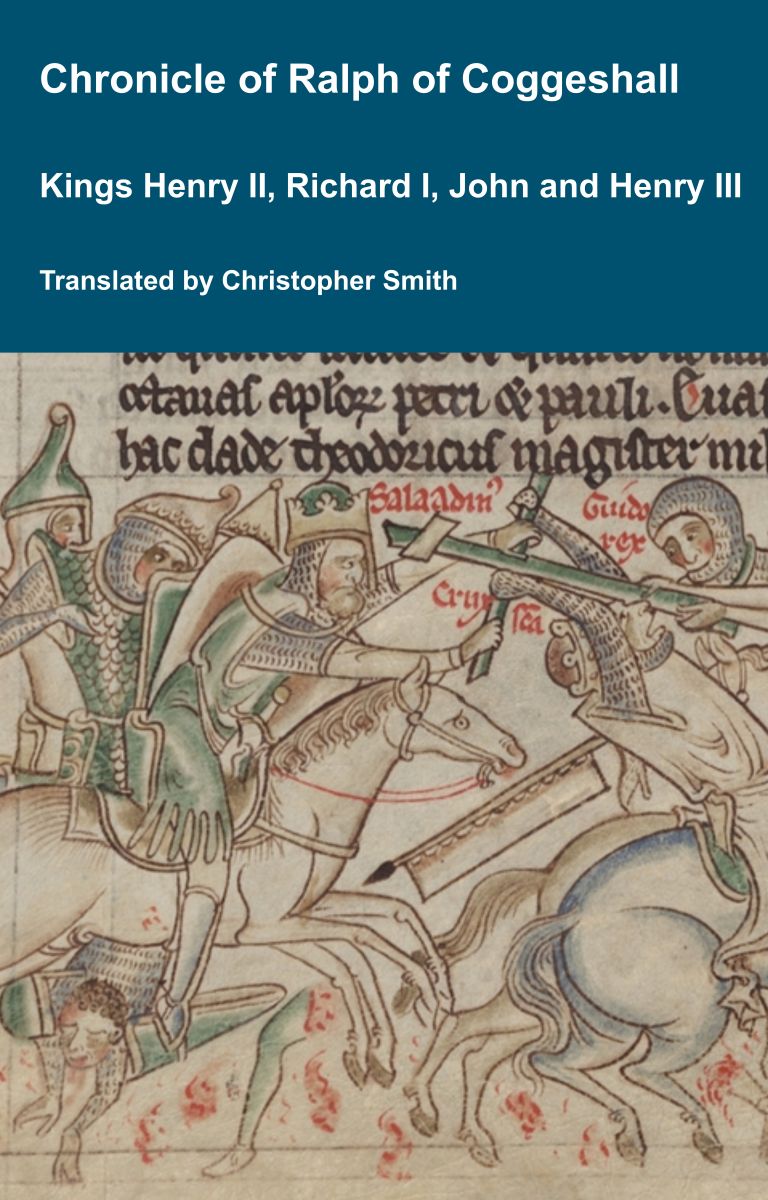
Chronicle of Abbot Ralph of Coggeshall
The Chronicle of Abbot Ralph of Coggeshall (Chronicon Anglicanum) is an indispensable medieval history that brings to life centuries of English and European affairs through the eyes of a learned Cistercian monk. Ralph of Coggeshall, abbot of the Abbey of Coggeshall in Essex in the early 13th century, continued and expanded his community’s chronicle, documenting events from the Norman Conquest of 1066 into the tumultuous reign of King Henry III. Blending eyewitness testimony, careful compilation, and the monastic commitment to record-keeping, this chronicle offers a rare narrative of political intrigue, royal power struggles, and social upheaval in England and beyond. Ralph’s work captures the reigns of pivotal figures such as Richard I and King John, providing invaluable insights into their characters, decisions, and the forces that shaped medieval rule. More than a simple annal, Chronicon Anglicanum conveys the texture of medieval life and governance, making it a rich source for scholars and readers fascinated by English history, monastic authorship, and the shaping of the medieval world.
Available at Amazon in eBook and Paperback format.
On 6th September 1866 Francis Baring 1st Baron Northbrook [aged 70] died. His son Thomas [aged 40] succeeded 2nd Baron Northbrook, 4th Baronet Baring of Larkbeer in Devon. Elizabeth Sturt Baroness Northbrook by marriage Baroness Northbrook.


On 6th September 1867 Gilbert John Heathcote 1st Baron Aveland [aged 72] died. His son Gilbert [aged 36] succeeded 2nd Baron Aveland, 6th Baronet Heathcote of London. Evelyn Elizabeth Gordon Countess Ancaster [aged 21] by marriage Baroness Aveland.
On 6th September 1868 Mary Robinson Montagu Marchioness Winchester died.
On 6th September 1868 Francis Baring 3rd Baron Ashburton [aged 68] died. His son Alexander [aged 33] succeeded 4th Baron Ashburton of Ashburton in Devon. Leonara Caroline Digby Baroness Ashburton [aged 23] by marriage Baroness Ashburton of Ashburton in Devon.
On 6th September 1869 Trevor Wheler 9th Baronet [aged 76] died at Limerick House, Lemington Priors. He was buried at Old Milverton, Leamington Spa. His brother Francis [aged 67] succeeded 10th Baronet Wheler of the City of Westminster. Elizabeth Bishop Lady Wheler by marriage Lady Wheler of the City of Westminster.
On 6th September 1877 Harriet Wingfield Lady Verner died.
On 6th September 1884 Selina Griselda Beresford Countess Erne [aged 80] died.

On 6th September 1898 Emily Vaughan Lady Isham died.
On 6th September 1899 Charles Raymond Burrell 6th Baronet [aged 51] died. His son Merrik [aged 22] succeeded 7th Baronet Burrell of Valentine House in Essex.
On 6th September 1912 George Backhouse Witts [aged 66] died.
Henrici Quinti, Angliæ Regis, Gesta, is a first-hand account of the Agincourt Campaign, and subsequent events to his death in 1422. The author of the first part was a Chaplain in King Henry's retinue who was present from King Henry's departure at Southampton in 1415, at the siege of Harfleur, the battle of Agincourt, and the celebrations on King Henry's return to London. The second part, by another writer, relates the events that took place including the negotiations at Troye, Henry's marriage and his death in 1422.
Available at Amazon in eBook and Paperback format.

On 6th September 1919 Charles de la Poer Beresford 1st Baron Beresford [aged 73] died. Baron Beresford of Metemmeh and Curraghmore in Waterford County extinct.
On 6th September 1944 Henry Anthony Farrington 6th Baronet [aged 72] died. His son Henry [aged 30] succeeded 7th Baronet Farrington of Blackheath in Kent.

On 6th September 1995 Bapsybanoo Pavry Marchioness of Winchester [aged 93] died.
On 6th September 2012 Nicole Schnedier Duchess Bedford [aged 92] died.
On 6th September 2018 Davina Mary Cecil Baroness Barnard [aged 87] died.