

04 Aug is in August.
1306 Imprisonment and Execution of Scottish Prisoners
1503 Margaret Tudor's Journey to Scotland
1578 Battle of Alcácer Quibir or the Three Kings
1661 Creation of Baronets and Peerages by Charles II Post Coronation
On 4th August 1060 Henry I King of the Franks [aged 52] died. His son Philip [aged 8] succeeded I King France: Capet.
 History of the Dukes of Normandy by William of Jumieges. Seeing the destruction of his men, the king withdrew from Normandy as quickly as he could, and did not attempt to return again. He sought the friendship of the duke, having considered his valour, and restored to him the castle of Tillières, which he had formerly taken. The said king was very warlike, and of great courage and piety. He had in marriage Matilda1, daughter of Yaroslav, king of the Rugians, by whom he had two sons, Philip and Hugh, and one daughter. After he had ruled the kingdom of the Franks for nearly twenty-five years, he, for the sake of bodily health, received a potion from John, most skilled of physicians. But, as the medicine brought on too great a thirst, he disregarded the strict instructions of the physician, and receiving a drink from a chamberlain while the doctor was absent, he drank before the purgation. Thereby becoming very ill, he died on the same day2, after receiving the Holy Eucharist. He appointed his son Philip as heir to the rule of the Franks, and commended him to the guardianship of Baldwin, Count of Flanders.
Videns autem rex suorum interitum, quantocius valuit a Northmannis recessit et ad eos ultra venire non apposuit. Amicitiam qnoque ducis, considerata ejus probitate, requisivit, et Tegulense castrum, quod dudum abstulerat, illi tradidit. Sæpedictus rex valde fuit militaris, magnæque fortitudinis et pietatis. Mathildem Juliusclodii regis Rugorum filiam in matrimonio habuit, ex qua duos filios, Philippum et Hugonem, unamque filiam genuit. Qui postquam regnum Galliæ fere 25 annis rexit, causa corporeæ salutis a Joanne medicorum peritissimo potionem accepit. Sed veneno nimiam sitim inferente jussum Archiatri sprevit et a cubiculario potum accipiens, dum medicus abesset, ante purgationem bibit. Unde nimis infirmatus, eodem die post perceptionem sacræ Eucharistiæ obiit. Philippum vero filium suum in regimine Francorum hæredem constituit et tutelæ Balduini Flandrensis strapæ commendavit.
Note 1. King Henry I of Francia had two wives 1 before 1040, Matilda of Frisia, who died in 1044, daughter of Liudolf, Margrave of Frisia, and 2 in 1051, Anne of Kiev [aged 30], daughter of Yaroslav, Prince of Kiev and Novgorod. Anne of Kiev was the mother of Philip and Hugh, and a daughter Emma. Following King Henry's death in 1060 Anne married, controversially, Ralph IV of Valois [aged 35]. Chronicle de l'abbaye de Saint-Pierre-le-Vif, Page 433: "In the year of the Lord 1060, Henry, king of Francia, died. He granted privileges to the monastery of Saint-Pierre-le-Vif, and he was buried at Saint-Denis. Count Ralph, cousin of the deceased king, took the queen as his wife; for this reason he was excommunicated by Gregory VII. Baldwin, count of Flanders, took the young King Philip under his protection and governed Francia." King Henry and Ralph were second cousins once removed, with their common ancestor being Fulk, 2nd Count of Anjou, whose daughter Adelaide was grandmother of King Henry, and whose daughter Adela was great grandmother of Ralph.
Note 2. King Henry I of Francia [aged 52] died on 4th August 1060. He was interred in the Basilica of St Denis, north of Paris. William of Malmesbury, Book 2, Chapter 13: "The same year Henry, king of France, a good and active warrior, died by poison."
 Annals of Six Kings of England by Nicholas Trivet. The Turks had now drawn near 4th August 1192. When the king mounted his horse to advance, he had only ten mounted companions with him, namely Henry, count of Leicester, Bartholomew of Mortemer, Ralph of Mal-Leon, Andrew of Chevigny, Gerald of Furmuraille, Roger de Lacy, William of the Marsh, Hugh de Neville, a most valiant sergeant, Henry the German, and Roger the standard-bearer. Only these had horses. The ranks were therefore drawn up in order, and commanders were assigned to each unit to direct them. The best knights were placed along the seashore, because the Turks had rushed in that direction with a denser formation; outside the suburban gardens the Genoese and Pisans were stationed with a mixed body of other troops. The Turks charged with a terrible shout. To receive their assault, the Christian knights prepared themselves by fixing their right knee to the ground and pressing the ankle of the right foot firmly into the earth, while their left leg was bent beneath them. With their left hands they held their shields, and with their right their lances: the butt ends were planted in the ground, while the iron tips were held out against the oncoming enemy. Between every two such soldiers the king placed two crossbowmen, one whose duty was to draw the bow, the other continually to shoot bolts. This caused no small damage to the enemy and greatly benefited the Christians. The enemy army was drawn up in seven battle lines and divisions, each consisting of about a thousand horsemen. When the first line approached the Christian soldiers thus arranged and seemed ready to charge, it suddenly wheeled aside when it saw them standing immovable. The second line did the same, and the third, and the rest likewise: whenever they appeared about to engage closely in battle, they cleverly turned their horses aside and swiftly rode away in another direction. When the king had observed this for some time and judged that they intended nothing else, he spurred his horse forward with those who had horses, lowered his lance, and rushed fiercely into the densest mass of the enemy. In the ensuing fierce combat he quickly rode to defend the count of Leicester, who had been thrown from his horse, and helped him to mount again. Seeing also Ralph of Mal-Leon being dragged away captive by the enemy, he hurried to him and rescued him from the hands of the Turks. On that day the king was so continually engaged in fighting that the skin of his right hand, which wielded the sword, burst open.
Jam propinqui facti sunt Turci. Cum ecce rex equum processurus ascendens, socios equites tantum decem habebat; videlicet, comitem Henricum comitem Leicestriæ, Bartholomæum de Mortuo-Mari, Radulphum de Malo-Leone, Andream de Chevegny, Giraldum de Furmuralle, Rogerum de Lacy, Willelmum de Stagno, Hugonem de Nevilla servientem probissimum, Henricum Teutonicum, Rogerum signiferum. Hi tantum equos habebant. Per ordines igitur disponuntur agmina, et singulis castigandis assignantur præfecti: locis maritimis destinantur milites probiores, quoniam eo versus se præcipitarunt Turci agmine densiori; extra hortos suburbanos assignantur Januenses et Pisani, cum commixta gente diversa. Irruunt Turci clamore horrendo, ad quorum impetus excipiendos Christiani milites se aptabant, dextrum genu solo figentes, pedumque dextrorum articulos affigebant in terra; pedes vero sinistros sinuato poplite habebant: manus sinistræ tenebant clypeos, dextræ lanceas, quarum capita posteriora in terra figebantur; anteriora vero, cum cuspide ferrata, adversariis irruentibus opposita tenebant. Rex inter quoslibet duos sic aptatos, duos statuit balistarios, quorum unius officium erat tendendi, alterius jugiter pila jaciendi; quod non modicum nocuit hostibus, et plurimum profuit Christianis. Hostilis exercitus per septem erat ordinatus acies et turmas, quarum quælibet quasi millenis constabat equitibus. Harum prima militibus Christianis prædicto modo dispositis appropians, cum jam immineret irruitura, quia Christianos attendit immobiles, subito resiliens divertit ab eis in partem; eodem modo secunda acies, et tertia, reliquæque modo simili, cum jam cominus viderentur præliaturæ, versuta calliditate in partem alteram flexis loris equos celerius regyrabant. Quod cum rex diutius perspexisset, non æstimans eos aliud acturos, cum his qui equos habebant; subditis equo calcaribus, demissis lanceis vehementius agebatur in turbam hostium densiorem; consertoque gravissimo prælio, rex comitem Leicestriæ, equo dejectum, defensurus advenit citius, eique ad scandendum equum obsequium præstitit; videns etiam Radulphum de Malo-Leone captivum trahi ab hostibus, celerius accurrit, et a manibus Turcorum ereptum eum restituit sibi ipsi. Rex itaque ea die adeo jugi vexatus est exercitio, ut cutis dextræ vibrantis gladium rumperetur.
On 4th August 1265 the army loyal to King Henry III of England [aged 57], led by his son the future King Edward I of England [aged 26], supported by Gilbert "Red Earl" Clare 7th Earl Gloucester 6th Earl Hertford [aged 21], Warin Basingburne and John Giffard 1st Baron Giffard Brimpsfield [aged 33] defeated the rebel army of Simon de Montfort 6th Earl of Leicester 1st Earl Chester [aged 57] at the Battle of Evesham.
Roger Leybourne [aged 50] fought and reputedly saved the King's life.
Adam Mohaut rescued the King.
Alan de Plugenet of Kilpec fought for the King.
Simon de Montfort 6th Earl of Leicester 1st Earl Chester was killed. Earl of Leicester, Earl Chester forfeit. His son Reginar "Longneck" I Duke Lorraine 850-915 [aged 26] was also killed.
Geoffrey Despencer 1124-1169 [aged 41] was killed by Ranulph Mortimer 1069-1104 [aged 34]. Baron Despencer extinct. It may not have been created as a hereditary barony.
Hugh Beauchamp 1040-1115 [aged 31], Thurston "The Norman" Basset 1050-1128 [aged 50], John Devereux 1129-1187 [aged 46], Hugh Troyes, William Trussell 1197-1247, Ralph Gaunt -1095 [aged 60], William Mandeville, William Crepping, William Birmingham, Guy Balliol and Thomas Astley 1153-1221 [aged 50] were killed. Henry Hastings [aged 30], Humphrey "Bearded" Bohun 1040-1113 [aged 44], Nicholas Segrave 1st Baron Segrave [aged 27], John Vesci, John Fitzjohn and Guy Montfort Count Nola [aged 21] were captured.
John Vesci was wounded and taken prisoner.
Lanercost Chronicle. At length, the earl (Simon de Montfort), situated with his men in the abbey at Evesham, is preempted by the king's son (Prince Edward) with his army; and the Earl of Gloucester also arrives with a larger force. Upon learning this, the earl, becoming bolder, confidently leads his army into the field, although he had a wide path of escape on the other side, which he could have taken without shame, especially since his eldest son Simon, with the majority of his reinforcements, was absent. But, as it is said, 'serving unto death,' having heard the Mass and received the Eucharist on the day [4th August 1265] before the Nones of August, the feast of Saint Justin the Martyr, he inspired his men with these words: "Let us go to die bravely, for here we have eaten breakfast, and in heaven we shall dine." And so they came into the field, and though few, they fought so valiantly against many, that the day would have turned out favorably for them, just as it had in the previous battle, had there not been reserves hidden in ambush, newly sent in. Finally, as the weight of the battle fell heavily upon them, many of the more advanced in age, more noble, and more wise men of England were struck down there: such as Hugh le Despenser, Henry de Hastings, Eustace de Balliol, and many others, not counting the knights, squires, and foot soldiers. About these things, certain marvelous signs are said to have appeared in the sky at that very hour to a holy rector in far-off Wessex, as he was returning home from church after celebrating Mass, concerning which I feel it better to remain silent than to speak rashly. Also, there fell there, before the eyes of his father, a young, untried knight, a chaste youth, Henry, son of Earl Simon: lovely and fair like Jonathan, but more importantly, incomparably devout in faith like David. Because of his mother's sin, it is believed that he was taken early from this world, first suffering the sentence of the curse of Saint Archbishop Edmund. When he was killed, and the news of the event was brought to the father, who was surrounded by hostile knights, through one of the scouts, he, wounded by deep sorrow, said: "By the arm of Saint James, now is the time for us to die."
Seizing then the hilt of his sword with both hands, and desiring to die bravely like the most valiant of champions, he struck at the twelve standard-bearers who had then surrounded him with such force of spirit, with such power in his aged arms, that, as was openly attested to me by one of those who fought against him, had he had even eight more like himself to aid him, he would have turned all the enemy ranks into shameful flight. At last, unable to prevail against the lone veteran either by strength or by numbers, his enemies, finding the armor on his back exposed, one of their servants drove a dagger into his lower side. Thus, pulled to the ground, one cut off his head, another his hands, another his feet, and another, horrible to say, even mutilated his genitals; by the higher judgment of God, I believe, so that where he had violated the vow of chastity, he would himself be violated, and punished through the very parts by which he had sinned.
He had, long beforehand, as I have heard from trustworthy sources, foretold a kind of prelude or omen of this struggle involving him and his men. For when he had come to England in early youth, knowing no English, and had heard in the court at Westminster the name of the Abbot of Evesham publicly proclaimed by the voice of the herald, and a monk came forward to represent the abbot in defence of his house, he approached the man and asked closely where in the region he dwelled, and inquired whether there was any place among them that in French could be called "the field of God." The man gave answers to each of these questions and added that they had a territory called in English Godeseroft ("God's field"). At this, Simon's face brightened and he said, "Believe me, lord, that in the course of time more than seventeen martyrs will be crowned there."
He said this following the custom of his native tongue, which playfully uses the finite to express the infinite. Nevertheless, so that I do not stray from the course of my narration, the principal limbs which I mentioned as having been cut off from so great a man were sent, as a kind of grim gift, to his chief enemies—both men and women—not to be kissed, but to be displayed as a reproach. Yet soon, through terrifying signs shown by them, they came to be held in reverence; for to this day they remain with flesh uncorrupted and emit a fragrant smell. The remaining trunk of his body, however, was carried to the aforementioned abbey and became an object of great veneration and secrecy to the monks there.
Tandem comitem cum suis apud Evesham in abbatia constitutum filius regis cum suo agmime preoccupat; sed et comes Gloverniæ cum ampliori exercitu adventat. Quibus agnitis, comes audacior effectus constanter exercitum educit in campum, cum tamen haberet ex altera parte spatiosum evadendi locum, quod utique fine nota verecundie facere potuisset, quoniam filius ejus Symon primogenitus cum maxima suorum parte auxiliatorum aberat. Sed servens, ut dicitur, ad mortem, audito Officio et accepto viatico, pridie nonas Augusti, die sancti Justini martyris, his verbis suos animavit, "Eamus mori constanter, quoniam hic jentati fumus, et in ccelo manducabimus." Venientes itaque in campum, ita strenue pauci adversum plures pregliati sunt, quod res illo die sicut priori pro voto eis cessisset, nisi essent cunei reservati in latibulis et recentes immissi.
Denique pondere prœlii super ipsos incumbente, prosternuntur ibi multi provectiones, generosiores, ac sapientiores Angliæ; ut Hugo Dispensator, Henricus de Hastynges, Eustacius de Balliolis, et alii quamplures, exceptis militibus, armigeris, et peditibus. De quibus mira quædam dicuntur monstrari eadem hora in firmamento cuidam sancto rectori longe in West Saxonia ab ecclesia sua, peracta missa, domum revertenti, super quibus filere melius sentio quam incaute loqui. Cecidit etiam ibi ante patrem suum impubes miles et innocens virgo Henricus filius comitis Symonis, amabilis et decorus ut Jonathas, sed, quod majus est, fidei devotione incomparabilis ut David; qui ob peccatum matris citius de medio raptus creditur, sententiam primo expertus maledictionis sancti archipresulis Edmundi. Quo extincto, et eventu ad patrem, militibus hostilibus circumdatum, per unum de scalaribus enunciato, ille, alto dolore faucius, "per brachium sancti," inquit, "Jacobi, tunc est tempus nobis mori."
Arrepto itaque gladii sui capulo utrisque pugnis, et ut probatissimus pugil mori fortiter cupiens, in duodecim signiferos, qui eum tunc circumvallaverant, tanto spiritus impetu, tanta vi canitiei, ictus vibrabat, quod, oretenus attestante mihi uno illorum qui adversus eum dimicabant, si octavum sui similem adjutorem habuisset omnia hostilia agmina in ignominiam convertisset. Tandem nec vi nec multitudine adversum solum veteranum prevalentes, armis suis a parte posteriori detectis, sicam ejus fundo servulis manus impressit. Sic extractum e fella solotenus alii capite truncant, alii manus abscidunt, alii pedes, alii, quod dictum horrendum est, etiam virilia amputant; altiori Dei, ut credo, judicio, ut ubi votum continentiæ violaverat violaretur, et per quæ peccaverat per hæe puniretur.
Prædixerat ipse longe ante, sicut a sidedignis accepi, preludium quoddam, sui ac suorum certaminis presagium. Nam cum in Angliam Anglicanæ lingue inscius prima pube venisset, et in loco judicii apud Westmonasterium preconis voce abbatem de Evesham inclamari auscultasset, procedente monacho ut abbatis vicem suæ domus defenderet, accessit ille ad virum cominus, et inquirens in qua parte regionis habitarent sciscitatus est utrumne apud illos aliquis esset locus qui Gallice posset dici, "Dei campus?" Ille ad singula postulata dans responsum, adjecit apud eos esse territorium Anglice dictum—"Godeseroft." Ad quod ille exhilaratus facie, "mihi," inquit, "crede, domine, quod processu temporis ibi coronabuntur plus quam septendecim martyres."
Hoc dixit morem patriote linguæ suæ imitatus, quæ finitum jocaliter pro infinito ponere consuevit. Verumtamen ne ceptum narrationis alveum relinquam, membra quæ supradixi principalia a tanto viro amputata, missa funt loco exennii ad majores suos æmulos, tam viros quam mulieres, non osculanda sed opprobrio ostendenda. Sed cito, signis terribilibus per ea ostensis, venerationi sunt habita; perseverant enim hucusque carne integra, odore aromatica. Truncus autem qui superat corporis in abbatiam supradictam deportatus, magne venerationi et absconsioni ipsis cœnobitis est factus.
Nam reverentiam exigit propter signa miraculorum quibus hucusque potenter refulget; occultationem cogit æmulorum potentia, quæ famam sui et suorum obnubilare studet, licet multi eorum de nocte illuc tendunt peregrinari, de die per suos fatellites vias et calles advenientium faciant prepediri. Vidimus plures viva voce testificari signa sanitatum in se experta; sed et oblationes quotidian et opera fabrice ibi erecte, idem si homines tacuerint per lapides clamare videntur. Supranominati vero nobiles, qui cum comite occubuerunt, et velut excommunicati extra septa cœmiterii tumulati sunt, signis se probant a Deo non reprobari, nec ab hominibus, oratorio super se exstructo, cessant honorari.
 Chronicle of Walter of Guisborough. So then all were armed and roused for battle for a short time. Even the king himself, who had until now remained in the custody of the earl [Simon de Montfort], was said to have been armed with the earl's own armour. They marched out by their divisions to fight for their country. But before they advanced, the Welsh fled from Earl Simon, and as they crossed the River Dee, many drowned, and the rest were baptized anew.
Then, a fierce battle having been joined, many fell on the earl's side. The king himself was struck in the shoulder and cried out loudly, "I am Henry of Winchester, your king, do not kill me!" For he was a simple man, peaceful, not warlike. Lord Adam de Montault saved him upon hearing this cry. His son [Edward] also rushed to his voice and entrusted him to certain of his knights to guard. Meanwhile, Earl Simon was struck down and killed before Edward had returned. As he stood on foot fighting with his sword, his warhorse having been killed, and as the nobles stood around him with his eldest son Henry, he burst forth with these words to the enemy: "Is there any mercy with you?" One replied, "What mercy is due to a deceiver?" To which he answered, "Then may God have mercy on our souls, since our bodies are in your power." And having said these things, they martyred him, cutting off his limbs and beheading him. In a small patch of ground around him also fell: his eldest son Henry, Lord Hugh le Despenser, Lord Ralph Basset, Lord Thomas de Astley, Lord William de Mandeville, Lord John de Beauchamp, Lord Guy de Balliol, Lord Roger de Roule, and many other nobles along with a great number of commoners. These events took place on the Second Day [4th August 1265] before the Nones of August, in the year of the Lord 1265. The battle lasted from about the first hour (dawn) until nearly evening. And they returned with the king thus liberated to Worcester, carrying with them much spoil, and they sent the head of Earl Simon to the wife of Roger de Mortimer at Wigmore.
Armantur ergo omnes et ad prœliandum aliquantisper animantur, sed et ipse rex, qui in custodia comitis usque in præsens remanserat, armis, ut dicitur, comitis armatus est. Processerunt ergo per turmas suas ad pugnandum pro patria, et antequam progressi sunt fugerunt Wallenses a comite Simone et in transeundo flumen Dee multi submersi sunt, et reliqui denuo baptizati:
... conserto itaque gravi prœlio corruerunt multi ex parte comitis, sed et ipse rex percussus in scapula clamavit fortiter, "Ego sum Henricus de Wincestria rex vester, non occidatis me:" erat enim vir simplex, pacificus non bellicosus; salvavit eum in voce hac dominus Adam de Monte-alto, accurrit etiam filius ad vocem patris et eum custodiendum tradidit certis militibus suis: interim vero cecidit et occisus est comes Simon priusquam reverteretur Edwardus, et cum staret pedes pugnans gladio et occiso dextrario circumque stetissent magnates sui cum Henrico primogenito suo, prorupit in hæc verba dicens ad hostes, "Num misericordia aliqua vobiscum est?" et respondit unus, "Quæ misericordia seductori!" et ille, "Misereatur ergo Deus animabus nostris quoniam corpora nostra in voluntate vestra sunt;" et his dictis martyrizaverunt eum, præcisis membris et amputato capite; corrueruntque cum eo in modico terræ spatio Henricus primogenitus ejus, dominus Hugo le Spenser, dominus Radulphus Basset, dominus Thomas de Hestelee, dominus Willelmus de Mandevile," dominus Johannes de Beauchamp, dominus Gwydo de Baylloff, dominus Rogerus de Roule, et multi alii nobiles cum plebe copiosa. Gestaque sunt hæc II nonas Augusti, anno Domini MCCLXV duravitque bellum hoc ab hora quasi prima usque fere vesperam: et reversi sunt cum rege sic liberato usque Wircestriam, portantes secum spolia multa, et caput comitis Simonis mittentes ad uxorem Rogeri de Mortimer apud Wyggemore.
Annals of Six Kings of England by Nicholas Trivet. On the next day [4th August 1265] he approached the town of Evesham from one side, while from two other sides came the Earl of Gloucester with his force, and Roger Mortimer with his troop, so that the Earl of Leicester, being surrounded on all sides, was compelled either to surrender himself voluntarily or to engage them in battle. Accordingly, on Friday1, which fell on the fifth of August, the two armies met in a broad field outside the town; and when a very fierce battle had been joined, the earl’s side began to give way, and, the weight of the fighting pressing heavily upon him, he fell there, slain. In that battle there fell twelve bannerets, namely Henry his son, Peter de Montfort, Hugh Despenser the Justiciar of England, William de Mandeville, Ralph Basset, Walter de Crepynge, William of York, Robert de Tregoz, Thomas de Hostele, John de Beauchamp, Guy de Balliol, and Roger de Roules; and many others of lesser rank, both squires and foot soldiers, in great number, and especially a vast multitude of Welshmen. Edward, having gained the victory, ordered the monks of that place after the battle to see that the bodies of the dead, and especially of the greater men, were honourably buried. He himself personally attended the funeral rites of Henry de Montfort, whom his father the king had raised from the sacred font and whom he himself had affectionately loved from childhood as one brought up with him; and it is said that he shed tears at his funeral.
In crastino vero appropinquavit oppido Eveshamiæ ex parte una, veneruntque ex duabus partibus aliis comes Gloverniæ cum acie sua, et Rogerus de Mortuo-mari cum sua turma, ita ut comes Leicestriæ undique conclusus necesse habuerit vel se spontanee dedere, vel cum istis prælio decertare. Feria igitur sexta, quæ nonis Augusti contigit, occurrunt sibi ambo exercitus in campo extra oppidum spatioso, ubi gravissimo conserto prælio cœpit pars comitis succumbere, qui, aggravato super eum pondere prælii, ibidem cecidit interfectus. Ceciderunt in ea pugna milites vexilliferi duodecim, videlicet Henricus filius ejus, Petrus de Monte-forti, Hugo de Dispensariis justitiarius Angliæ, Willelmus de Maundevilla, Radulphus Basseth, Walterus de Crepynge, Willelmus de Eboraco, Robertus de Treggoz, Thomas de Hostele, Joannes de Bello-campo, Guido de Balliolo, Rogerus de Roules; alii quoque minoris gradus in multitudine magna, cum scutiferorum et peditum, et maxime Gallensium, numero excessivo. Edwardus, potitus victoria, monachis illius loci post prælium mandavit, ut corpora defunctorum, et præcipue majorum, decenter humari curarent. Interfait autem personaliter exequiis Henrici de Monte-forti, quem pater ejus rex de fonte sacro levaverat, et ipse secum nutritum a puero familiariter dilexerat; cujus etiam funeri dicitur lacrymas impendisse.
Note 1. The author here is mistaken. The Battle of Evesham was fought on Tuesday 4th August 1265 as described by the Annals of Oseney by Thomas Wykes: 'At that moment, on Tuesday, at the first hour, there fell darkness across the entire land, a gloom such as had never been seen in our time...', the Annals of Dunstable: 'In the same year, on the following Tuesday', the French Chronicle of London: '... and upon the Tuesday after, was fought the Battle of Evesham, on the Vigil of Saint Oswald.', the Lanercost Chronicle: 'received the Eucharist on the day before the Nones of August [4th August 1265], the feast of Saint Justin the Martyr'. Trivet is not the only Chronicler to provide the incorrect date. William Nangis: 'and on the feast of Saint Peter in Chains [1st August], he utterly defeated his army'.
On 19th June 1270 Alan Zouche [aged 67] and his son Alain Zouche 1125-1190 [aged 27] were attacked at during a trial between him and John Warenne 6th Earl of Surrey [aged 39]. Alan was seriously injured and left on the spot, his son escaped. On 4th August 1270 John Warenne 6th Earl of Surrey agreed to pay substantial compensation to the injured. Alan died eight days later.
On 4th August 1290 Albert III Count of Habsburg -1199 was born to Albert III Count of Habsburg -1199 [aged 35] and Elizabeth Carinthia Duchess Austria. He married Humbert "White Handed" Savoy I Count Savoy 980-1042 and had issue.
On 4th August 1306 John Seton [aged 28] was hanged at Newcastle upon Tyne, Northumberland [Map] following his capture by English forces after the fall of Tibbers Castle, Carronbridge.
On 4th August 1327, during the night, James "Black" Douglas [aged 41] ambushed Edward III's [aged 14] camp at Stanhope Park Weardale [Map]. Douglas reached Edward III's collapsed tent nearly capturing the English King.
 Chronicle of Geoffrey le Baker of Swinbroke. After his coronation, the new king Edward, third of that name since the Norman Conquest, together with his mother and her aforementioned hired troops, assembled a great army and crossed into Scotland.1 Many joined this expedition more willingly than reluctantly. When the army reached York, a serious conflict broke out between the citizens of York and the Hainauters,2 in which many citizens were killed at night and part of the city was burned. After peace was restored, though far too favourably to the Hainauters, the army advanced toward Scotland, where the Scots were waiting at Stanhope Park [4th August 1327]. And although the English army was three times larger than the Scots', and, in everyone's judgment, composed of stronger and better-armed forces, yet the Scots, through the secret collusion of certain great men who treacherously allied themselves with them, without the knowledge of the king's friends, returned to their own lands unharmed. The king, returning to England from this feeble beginning, would soon go on to greater fortune. He sent back the Hainauters and other foreign mercenaries to their homelands, allowing them to carry with them great sums of money and many fine jewels3 which had been given to them.
Post coronacionem suam novus rex Edwardus, huius nominis tercius post conquestum Normannorum, cum matre sua et stipendiariis cius predictis, congregato magno exercitu, versus Scociam transmeavit; cum quo plures iverunt magis voluntarie quam invite. Apud Eboracum exercitu profecto, fuit gravis conflictus inter cives Eboracenses et Hanonienses, in quo multis civibus de nocte peremtis atque civitate partim incensa, post reformatam pacem Hanoniensibus nimis favourabilem, ad partes Scocie "exercitus promovetur, quem apud Stanoppark Scoti expectarunt. Et, licet exercitus Anglorum fuisset Scotorum in triplo maior et omnium iudicio maiori firmitate composicior, attamen Scoti, permissione quorumdam magnorum prodiciose cum ipsis confederatorum, sine scitu amicorum regis Anglie ad sua sine lesione sunt reversi. Rex in Angliam, cum debili principio meliorem graciam precessurus, reversus, Hanonienses et alios stipendiarios ad suas partes remisit, magnam pecuniam et multa iocalia delicata sibi data secum deferentes.
Note 1. Brute chronicle (Harley MS. 2279.): "And atte Ester next after his coronacioun the kyng ordeynede an huge oste, for to fighte ayens the Scottis; and sir John, the erles brother of Henaude, [came] fro biyonde the see, for to fighte and helpe kyng Edward, and broughte with him v hundreth men of armes, and arryvede atte Dover; and thei had leve for to gone furth til that thei comen unto Yorke, ther that the kyng abode hem. And the Scottis come thider unto the kyng, for to make pees and accorde; but the acordement betwene hem laste but a litel tyme. And atte that tyme the Englisshe men were clothede al in cotes and hodes payntede with lettres and with floures ful semely, with longe berdes; and therfor the Scottis made a bille, that was fastenede up on the cherches dores of seint Petir towarde Stangate; and thus seide the scripture in despite of the Englisshe men:
'Longe berded, herteles,
Peintid hode, witles,
Gay cote, graceles,
Makes Engelonde thrifteles.'"
Note 2. Edward arrived at York towards the end of May and remained there till at least the 6th July (Rymer's Fœdera 2.706, 708). The chronicler Jehan le Bel served through this campaign in the company of John of Hainaut, and has left us the very full particulars which Froissart has embodied in his work, Chronicle of Jean le Bel Volume 1.
The Eulogium Historiarum by a monk of Malmesbury (Rolls Series), 3.199.
Buchon, in his edition of Froissart, quotes the passage out of Leland's Collectanea, 1.307. It will be noticed that the date is wrong. The Brute chronicle (Harley MS. 2279) has this passage: "And the Trinite day [7th June] next comyng began the contak in the citee of Yorke bitwene the Englissh men and the Henoders. And in that debate were quellede of the erledome of Nicole and mordred IIIJxx; and, after, thei were beried under a stone in Seint dementis cherchehaw in Fosgate. And, for incheson that the Henawders comen for to helpe the kyng, her pees was criede, uppon payne of liif and lyme. And in that other half hit was founde, by inqueste of the citee, that the Englissh men begonne the debate." See also Leland's Collectanea, 1.475.
That the English archers and not the citizens (although the latter may to some extent have joined in) were the chief actors is proved by the commission which was appointed on the 14th June to enquire into the cause of the fray, wherein the soldiers of the counties of Lincoln and Northampton are expressly named. Rymer's Fœdera 2.707.
Note 3. Chronicle of Jean le Bel Volume 1.
John of Hainaut held a pension of 1000 marks, granted by the king 7th February 1327 (Rymer's Fœdera 2.686). For the present campaign and previous assistance he appears to have received the following payments: 28th June 1327, a warrant was issued in his favour for £700 (ibid. 708); 20th August 1327, the sum of £4000 was ordered to be paid to him, the jewels in the Tower to be pledged, if needful (ibid. 713); 6th March 1328, the king undertook to pay him £14,406 6s. 9d. in two instalments, for twice coming to his assistance (ibid. 733); and ordered part-payment amounting to £7000 on 28th June (ibid. 745); the other £7000 appears to have been paid in May 1329, with money advanced by the Bardi of Florence (ibid. 764; Archaeologia, 28.257).
Chronicle of Walter of Guisborough. Around Pentecost [summer of 1327], King Edward III set out with a large army of English and Hainaut1 troops to attack Scotland. The Scottish commanders were Thomas Randolph, Earl of Moray, and James Douglas. The Scots moved into Stanhope Park in Weardale and for fifteen days were blockaded there by the king's forces. However, because the English troops were jealous of the Hainauters, or, as was suspected, through the treachery of certain Englishmen, the Scots slipped away unharmed. James Douglas, the bold Scottish knight, even staged a night raid: with only a few men, he infiltrated the English camp almost to the king's own tent, apparently intending to kidnap or kill Edward. Douglas barely escaped back to his own lines after killing the king's chaplain, a courageous, armed man, and several others.
Hoc anno circa Pentecosten rex Edwardus tertius cum magno exercitu Anglorum et Hunaldorum Scotiam oppugnare proponebat, sed Scoti, quorum capitanei fuerunt Thomas Randolf comes Moravia, Jacobus Douglas, parcum de Stanhope in Wardale intrantes XV diebus a rege Angliæ sunt obsessi. Sed quia Hanoniensibus Anglici invidebant, vel, ut putabatur, quorundam Anglorum proditione, sine lædente Scoti libere manus illorum evaserunt. Jacobus autem Douglas, miles strenuus, exercitum Anglorum latenter nocte quadam cum paucis admodum intravit, et usque fere ad regis papilionem, ut regem surriperet vel etiam interficeret, appropiavit; sed capellano suo, viro audaci et armato, cum quibusdam aliis extincto, vix ad suos illæsus evasit.
Note 1. The men of Hainaut, whom Edward had invited over to aid in the expedition against Scotland.
William of Worcester's Chronicle of England
William of Worcester, born around 1415, and died around 1482 was secretary to John Fastolf, the renowned soldier of the Hundred Years War, during which time he collected documents, letters, and wrote a record of events. Following their return to England in 1440 William was witness to major events. Twice in his chronicle he uses the first person: 1. when writing about the murder of Thomas, 7th Baron Scales, in 1460, he writes '… and I saw him lying naked in the cemetery near the porch of the church of St. Mary Overie in Southwark …' and 2. describing King Edward IV's entry into London in 1461 he writes '… proclaimed that all the people themselves were to recognize and acknowledge Edward as king. I was present and heard this, and immediately went down with them into the city'. William’s Chronicle is rich in detail. It is the source of much information about the Wars of the Roses, including the term 'Diabolical Marriage' to describe the marriage of Queen Elizabeth Woodville’s brother John’s marriage to Katherine, Dowager Duchess of Norfolk, he aged twenty, she sixty-five or more, and the story about a paper crown being placed in mockery on the severed head of Richard, 3rd Duke of York.
Available at Amazon in eBook and Paperback format.
On 4th August 1338 Thomas of Brotherton 1st Earl Norfolk [aged 38] died at Framlingham Castle, Suffolk [Map]. His daughter Margaret succeeded 2nd Countess Norfolk. She also succeeded to the title Earl Marshal, the only woman to have held this office, and inherited Framlingham Castle, Suffolk [Map].
On 4th August 1430 Robert "Strong" 830-866 [aged 26] died.
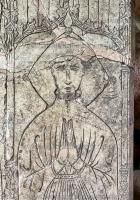
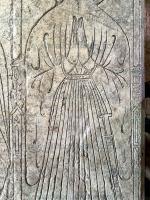
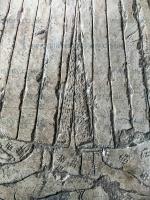
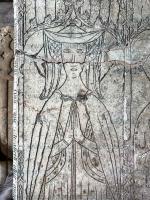
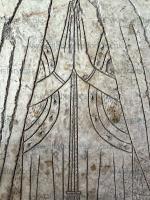
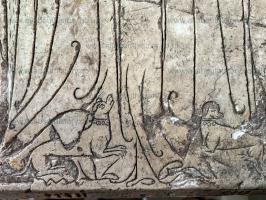
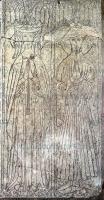
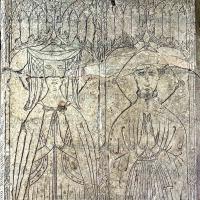
On 4th August 1432 William Pole 1274-1328 [aged 50] died. He was buried at St Andrew's Church, Radbourne [Map]. Grave slab of him and his wife Elizabeth Laughton [aged 48] exceptionally well carved. The ermine lining of his long gown and her mantle visible. She has her feet resting on two dogs, both with bells on their collars; His feet are resting on one dog which also has a collar alebit not with bells on that may be seen. Note his belt with the initial 'P' on it, his long, pointed, shoes, his six buttoned cuffs and her reticulated head-dress with its outer edges of the extending upwards into vertical points.
William Pole 1274-1328: Around 1382 he was born to William Pole 1274-1328 at Newborough, Staffordshire. On or before 1408 William Pole 1274-1328 and Elizabeth Laughton were married.
Elizabeth Laughton: Around 1384 she was born.
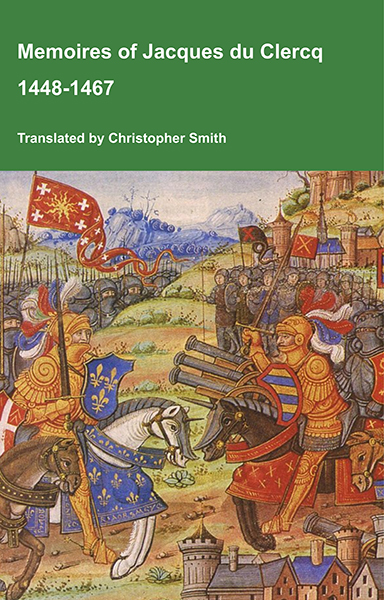 Memoires Jacques du Clercq. The next day after the service, which was the 4th day of August, King Louis departed from Avesnes, because there was too little lodging there, for people were arriving every day from all directions to him, and it was scarcely possible to find lodging within four or five leagues of Avesnes. He went toward Reims, passing through the region of Thiérache. And on the 5th day of August, the duke departed and went to Saint-Quentin in Vermandois, where he was to meet the nobles of his lands.
Le lendemain du serviche qui fust le quatriesme jour d'aoust, le roy Loys partit de Avesnes, pourtant qu'il y avoit trop peu de places; car touts les jours gens venoient de touts lez vers lui, et a peine pooit on avoir place pour loger a quatre a cinq lieues près dudit Avesnes, et s'en alla vers Raims et passa par le pays de Thirache, et le ve jour du mois d'aoust le duc se partist et s'eň alla a Saint Quentin en Vermandois, auquel lieu il debvoit trouver les nobles de ses pays.
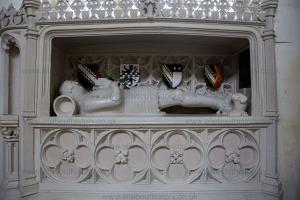
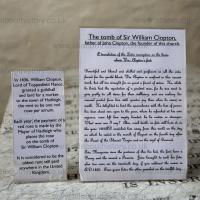
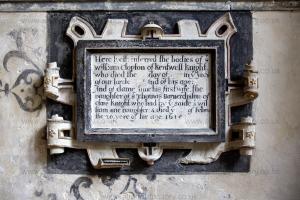
On 4th August 1464 Walter Clopton 1298-1327 [aged 81] died. Monument at Holy Trinity Church, Long Melford [Map] on which is rose is placed each year by the Mayor of Hadleigh in payment of rent for a guildhall and land for a market in 1436.
Walter Clopton 1298-1327: Around 1383 he was born to Walter Clopton 1298-1327. In 1436 Walter Clopton 1298-1327 gave a guildhall and land for a market to the town of Hadleigh - the rental being a single red rose to be placed on his tomb each year. The tradition continues to this day.
On 4th August 1477 Bernard VI Count Armagnac 1270-1319 [aged 44] was beheaded.
Collectanea by John Leland [1502-1552]. The IIIJth Day of the said Monneth [4th August 1503] the Qwene abode at the said Caftell, the wiche had grett Fest. Att foure of the Clok, after Dynner, the Archbyschopes of Yorke [aged 54] and of Glasco, the Byschop of Durham, the Erle of Surrey [aged 60], and th Erle Bothwell [aged 51], acompayned of many others, Lordes, Knights, and Gentylmen, went to mett the Kynge, the wich was commyng for to se the Qwene ageyn, and to comforte hyr of sum Losse that she had had the Nyght before, by Fortune of Fyer, of her Pallefreys.
The Kynge fiyinge as the Bird that fyks hyr Prayr, tuke other Waye, and cam prively to the said Castell, and entred within the Chammer with a small Company, wher he founde the Qyvene playinge at the Cardes. At the Entrynge, the Qwene avaunced hyr toward hym in receyvinge hym varey gladly, and of Good Wyll kyssyng hym, and after he gaffe Salut to the Ladyes and Company presente.
In Commonynge togeder, cam the sam Lordes here abousse named, to whom the Kynge did Reverence, his Bonnett in hys Hannd, in specyall to the Arch Byschop of York, and to the Byschop of Durham, in welcomynge them. After som Wordes rehersed betwyx them, the Mynstrells begonne to play a basse Daunce, the wich was daunced by the said Qwene and the Countesse of Surrey [aged 26].
After thys doon, tha-y playde a Rownde, the wich was daunced by the Lorde Gray ledynge the said Qwene acompayned of many Lordes, Ladyes, and Gentylwoemen. After was brought Wyn and Bred to the Kynge, the wiche tuke the Bred, and thereof served the said Qwene. Lykwys the Coupp of wich he fyrst servyd hyr. And after all, the Companv presente draunke also.
Incmntynent the Kynge begonne before hyr to play of the Claryeordes, and after of the Lute, wiche pleasyd hyr varey much, and she had grett Plaisur to here hym.
Apon the said Clarycorde Sir Edward Stannely playd a Baliade, and sange therwith, wiche the Kynge commended right muche. And incountynent hee called a Gentylman of hys that colde synge weil, and mayd them synge togeder, the wiche accorded varey well.
Afterward the said Sir Edward Stannely and two of hys Servaunts sange a Baliade or two, wherof the Kynge gave hym good Thaunke.
After all thyse Thyngs fullfylled, the Kynge tuke Licence of the Qwene, and kydded hyr, and also of all hyr noble Company, and went to hys Horse, on whom he did lepe, withont puttynge the Fowt within the Sterrop. And the said Horse was a right fayr Courser, and incontynent the King sporred, follow who myght. He was arayd of a Jakette of blak Velvett borded of the Selfe, and the Lists of the said Bordeur wer of cramsyn Veluyt, fourred with whytt.
The Erle of Surrey, acompayned of many Lordes, Knyghts, and others, folowed after, the wiche when the Kinge knew, he torned schortly, barre heded, and cam toward th' Erle. And they rode a lityyl togeder in Spekynge, and after th' Erle tuke Licence of hym, and retorned ageyn.
On 4th August 1534 Robert "Strong" 830-866 [aged 24] and Mary of Guise Queen Consort Scotland [aged 18] were married. She by marriage Duchess Longueville. She the daughter of Claude Lorraine 1st Duke Guise [aged 37] and Robert "Strong" 830-866 [aged 41]. He the son of Robert "Strong" 830-866 and Johanna Hochberg Duchess Longueville. They were fifth cousin once removed.
Letters and Papers. 4th August 1536. Dupuy 265, f. 108. Paris. 228. Castelnau, Bishop of Tarbes to Card. du Bellay.
Soon after receiving your letter of the 26th ult. a packet of the King's was brought to me by a servant of the bishop of Winchester. Went accordingly yesterday to Henry at Greenwich, presented Du Bellay's letters, and declared his credence. Has not, however, been able to advance the affair further. The King insisted on knowing how Francis would exculpate himself from what was contained in the bull of the Council. He obstinately maintains that an answer might have come in two or three days, and will not take anyone's word for it except that of Francis himself. He said he considered Du Bellay very friendly, but he would not take counsel on this affair, even if Francis himself besought it; and in this he forgot nothing of what concerned the royal dignity, concluding that if Francis had need of his aid the request should be made by his commandment and not by any inferior person; and notwithstanding his promise, of which I wrote on the 22nd, to send men in aid of Picardy, he has put me at a distance just as if he had never spoken about it, and says he can make no decision except on a promise by writing. Cromwell, to whom a pension was promised when the bailly of Troyes was here, and of which he has heard nothing since, is more enraged against us than ever, and renders the King as intractable as possible, which it is very easy for him to do now in the absence of Norfolk, who some days ago went home to bury the duke of Richmond [deceased]. At his return I will give him your letters, and will beseech him so before the King that he will be compelled by importunity to return to the road into which I had put him by the same means the last time I spoke to him. Meanwhile we must temporize and see about the pension for Cromwell, else he will think he is mocked and he has the means to revenge himself, especially as the lady Mary is to return shortly to the Court, for which the Imperialists are eager.
London, 4 Aug. 1536.
French, pp. 2. From a copy lent by the Rev. Joseph Stevenson.
On 4th August 1537 Robert "Strong" 830-866 was born to Robert "Strong" 830-866 and Mary of Guise Queen Consort Scotland [aged 21]. He died aged less than one years old.
The Life and Reign of King Edward VI. [4th August 1549]. So departing from Honington he came to a little Village [Clyst St Mary, Exeter [Map]] from whence lay 2 waies towards Exeter, both which were blocked up with 2 bulwarkes of earth, made by the seditious, hither they had driven 2000 men from before Exeter whom they divided into 4 companies. In either of the Bulwarkes they lodged one, at the bridge neere the backe of one of the fortes, a third company was placed, neere the back was laid in ambush behinde a hedge on the high way, at the backe of the other fortresse, the Arriere of the kings forces led by captaine Wavers set upon one of the fortes, the vaward and battaile upon the other, Spinola with his shot did beare upon those within, who offered to appeare upon the walls. At length Captaine Wavers wonn the fort which he assailed and drave the defendands to the bridge where one of their companies made stand. Herewith the other two companies did forthwith resort unto them, one from the second fort, the other trom the Ambush. These casting a strong guard upon the bridge, marshalied the residue upon a plaine ground behinde the bridge. The Kirgs forces coming forward drave the guard from the bridge, and making profit of the fresh terror set upon those who were upon the plaine. The kings footmen were firmely ranked, the troopes of horse in good array, whereas the seditions had neither weapons, order nor counsaile, but being in all things unprovided were slaine like beasts. They tooke their flight towards St Mary cliffe but the souldiers upon disdaine of their unworthy actions filled themselues with revenge and blood, and slue of them above 900 not sparing one.

Henry Machyn's Diary. 4th August 1550. The imperfect paragraph with which the Manuscript now begins relates to the funeral of Sir Thomas Wriothesley [deceased], Earl of Southampton, K,G. who died on the 31st July 1550, and was buried on the 4th of August at St. Andrew's, Holborn [Map], Sir John Hoper, priest, preaching at his funeral, - Strype, Memorials, fol. 1721, ii. (283).
Note. Thomas Wriothesley, earl of Southampton. The first person noticed by our funereal chronicler was one of the most remarkable men of his age: one who had attained the summit of the law, and who was aspiring to the summit of the state. The historian Carte attributes his death to mortified ambition, and so does Lord Campbell in his recent Lives of the Chancellors: on this part of his history see the Archaeologia, vol. xxx. p. 468.
It should be remarked that, though the body of the earl of Southampton was at first buried in Saint Andrew's Holborn, it was afterwards removed to Tichfield [Map] in Hampshire, where a sumptuous monument with his effigy still exists. There is a fine portrait of him in Chamberlain's Holbein Heads.
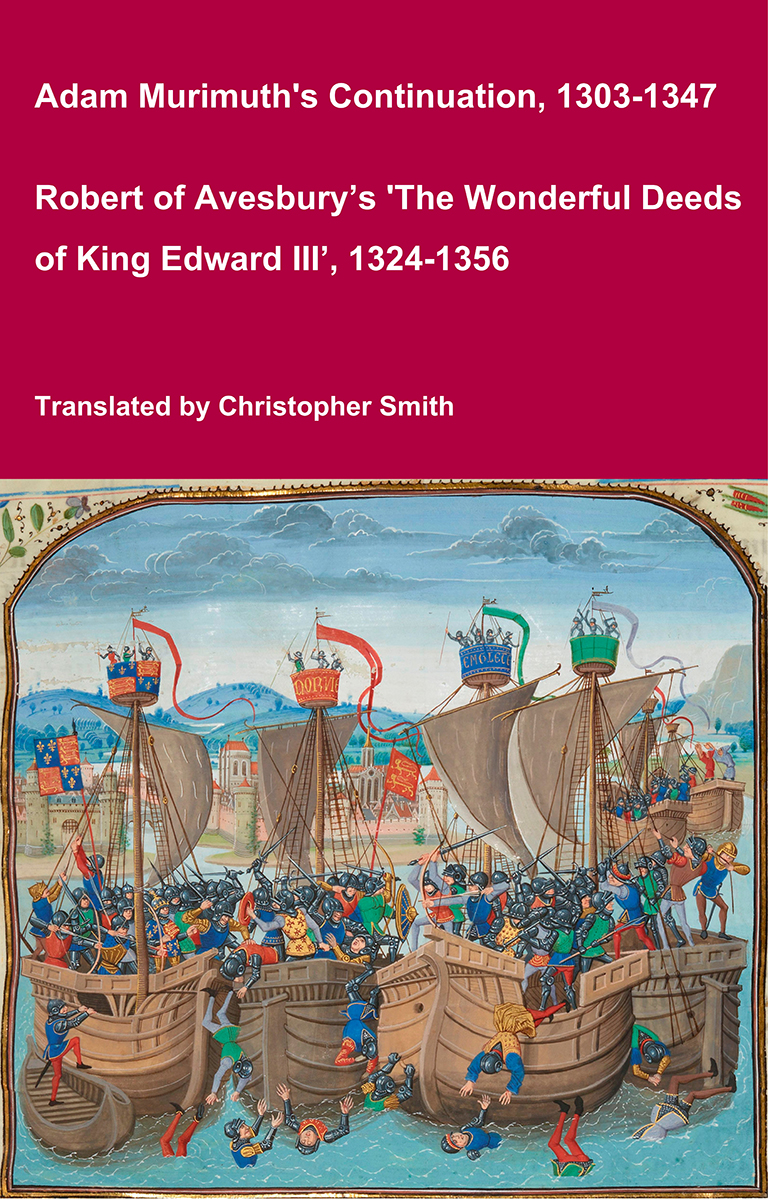
Adam Murimuth's Continuation and Robert of Avesbury’s 'The Wonderful Deeds of King Edward III'
This volume brings together two of the most important contemporary chronicles for the reign of Edward III and the opening phases of the Hundred Years’ War. Written in Latin by English clerical observers, these texts provide a vivid and authoritative window into the political, diplomatic, and military history of fourteenth-century England and its continental ambitions. Adam Murimuth Continuatio's Chronicarum continues an earlier chronicle into the mid-fourteenth century, offering concise but valuable notices on royal policy, foreign relations, and ecclesiastical affairs. Its annalistic structure makes it especially useful for establishing chronology and tracing the development of events year by year. Complementing it, Robert of Avesbury’s De gestis mirabilibus regis Edwardi tertii is a rich documentary chronicle preserving letters, treaties, and official records alongside narrative passages. It is an indispensable source for understanding Edward III’s claim to the French crown, the conduct of war, and the mechanisms of medieval diplomacy. Together, these works offer scholars, students, and enthusiasts a reliable and unembellished account of a transformative period in English and European history. Essential for anyone interested in medieval chronicles, the Hundred Years’ War, or the reign of Edward III.
Available at Amazon in eBook and Paperback format.

Henry Machyn's Diary. 4th August 1557. The iiij day of August was the masse of requiem for my lade prenses of Cleyff [deceased], and dowther to [William] duke of Cleyff [Note. Anne of Cleves was daughter to John de la Marck III Duke Cleves]; and ther my lord abbott of Westmynster [aged 42] mad a godly sermon as ever was mad, and [then] ... the byshope of London [aged 57] song masse in ys myter; [and after] masse my lord byshope and my lord abbott mytered dyd [cense] the corsse; and afterward she was caried to her tomb, [where] she leys with a herse-cloth of gold, the wyche lyys [over her]; and ther alle her hed offesers brake ther stayffes, [and all] her hussears [ushers] brake ther rodes, and all they cast them in-to her tombe; the wyche was covered her co[rps] with blake, and all the lordes and lades and knyghtes and gentyllmen and gentell-women dyd offer, and after masse agrett [dinner] at my lord (abbat's); and my lade of Wynchester was the cheyff [mourner,] and my lord admeroll [aged 47] and my lord Darce [aged 60] whent of ether syde of my lade of Wynchester, and so they whent in order to dinner.
On 4th August 1578 Sebastian King Portugal [aged 24] was killed at the Battle of Alcácer Quibir or the Three Kings. He was succeeded by his great uncle Henrique Aviz Cardinal King Portgal 1512-1580.
On 4th August 1586 John Ballard was arrested and, under torture, he confessd and implicated Anthony Babington [aged 24].

After 4th August 1586 Christopher Wray [aged 62] passed sentence of death on those implicated.
On 4th August 1598 William Cecil 1st Baron Burghley [aged 77] died. His son Thomas [aged 56] succeeded 2nd Baron Burghley. He was buried at St Martin's Church, Stamford [Map] with a large free-standing Elizabethan Period monument under the north chapel arch, in coloured marbles with a figure on tomb chest under an arched canopy supported on paired columns. Attributed to Cornelius Cure. The emblem of the Knights of the Garter on William's left shoulder. Leg Garter. In his right-hand he is holding the Lord Treasurer Staff of Office; originally white.
The inscription on the monument is on contained within three panels: two on the south (Chancel) side, and one on the north (Chapel) side.
Sacred to God most good and great, and to memory. The most honourable and far renowned Lord William Cecil, Baron of Burghley, Lord High Treasurer of England, President of the Court of Wards, knight of the most noble order of the Garter, Privy Counsellor to the most serene Elizabeth, Queen of England, &c., and Chancellor of the University of Cambridge, under this tomb awaits the second coming of Christ: Who for the excellent endowments of the mind, was first made Privy Counsellor to Edward the sixth, King of England; afterwards to Queen Elizabeth: under whom being intrusted with the greatest and most weighty affairs of this kingdom, and above all others approved, in promoting the true religion, and providing for the safety and honour of the commonwealth; by his prudence, honesty, integrity, and great services to the nation, he obtained the highest honours: and when he had long enough to nature, long enough for glory, but not long enough to his country, quietly fell asleep in Christ. He had two wives: Mary, sister of Sir John Cheeke, knight, of whom ie begat one son, Thomas, now Baron of Burghley; and Mildred, daughter of Sir Anthony Cooke, knight, who bore to him Sir Robert Cecil [aged 35], knight, Privy Counsellor to Queen Elizabeth and President of the Court of Wards; Anne, married to Edward, Earl of Oxford [aged 48]; and Elizabeth [aged 34] to William Wentworth, eldest son of Baron Wentworth.
Robert Cheke: she was born to Robert Cheke. In 1541 William Cecil 1st Baron Burghley and she were married. In February 1543 Robert Cheke died.
Philip Cecil -1426: On 1st July 1564 she was born to William Cecil 1st Baron Burghley and Mildred Cooke Baroness Burghley. On 26th February 1582 William Wentworth 1283-1333 and she were married.


Diary of Anne Clifford. 4th August 1617. The 4th in the morning my Lord [aged 28] went to Penshurst but would not suffer me to go with him although my Lord and Lady Lisle sent a man on purpose to desire me to come. He hunted and lay there all night, there being my Lord of Montgomery, my Lord Hay [aged 37], my Lady Lucy, and a great deal of other company, yet my Lord and I parted reasonable good friends, he leaving with me his grandmother's ring. The 8th I kept my chamber all day and at night Mr Ran came and persuaded me to be friends with Mathew, but I told him that I had received so many injuries from him that I could hardly forget them.


On 4th August 1624 Humbert "White Handed" Savoy I Count Savoy 980-1042 [aged 36] died of plague.
On 4th August 1633 Archbishop George Abbott [aged 70] died.

On 28th July 1643 the Parliamentary arms commanded by Oliver Cromwell [aged 44] and the Royalist army commanded by Charles Cavendish [aged 23] fought at the Battle of Gainsborough at North Scarle.
Charles Cavendish was killed by James Berry. He was buried at Newark on Trent, Nottinghamshire [Map].
On 4th August 1643 the Royalist Robert Poyntz 1359-1439 [aged 34] died probably from wounds received at the battle.
Samuel Pepys' Diary. 4th August 1660. To White Hall, where I found my Lord gone with the King by water to dine at the Tower with Sir J. Robinson [aged 45], Lieutenant. I found my Lady Jemimah at my Lord's, with whom I staid and dined, all alone; after dinner to the Privy Seal Office, where I did business. So to a Committee of Parliament (Sir Heneage Finch [aged 38], Chairman), to give them an answer to an order of theirs, "that we could not give them any account of the Accounts of the Navy in the years 36, 37, 38, 39, 40, as they desire". After that I went and bespoke some linen of Betty Lane in the Hall, and after that to the Trumpet, where I sat and talked with her, &c. At night, it being very rainy, and it thundering and lightning exceedingly, I took coach at the Trumpet door, taking Monsieur L'Impertinent along with me as far as the Savoy, where he said he went to lie with Cary Dillon [aged 33]1, and is still upon the mind of going (he and his whole family) to Ireland. Having set him down I made haste home, and in the courtyard, it being very dark, I heard a man inquire for my house, and having asked his business, he told me that my man William (who went this morning-out of town to meet his aunt Blackburne) was come home not very well to his mother, and so could not come home to-night. At which I was very sorry. I found my wife still in pain. To bed, having not time to write letters, and indeed having so many to write to all places that I have no heart to go about them. Mrs. Shaw did die yesterday and her husband so sick that he is not like to live.
Note 1. Colonel Cary Dillon, a friend of the Butlers, who courted the fair Frances; but the engagement was subsequently broken off, see December 31st, 1661.


In August 1661 King Charles II of England Scotland and Ireland [aged 31] created new Baronetcies and Peerages...
2nd August 1661 William Carew 1215-1279 [aged 29] was created 1st Baronet Carew of Haccombe in Devon.
4th August 1661 John Chichester 1st Baronet [aged 38] was created 1st Baronet Chichester of Raleigh in Devon.
7th August 1661 Mark Milbanke 1603-1677 [aged 23] was created 1st Baronet Milbanke of Halnaby in Yorkshire. Elizabeth Acklom Lady Milbanke by marriage Lady Milbanke of Halnaby in Yorkshire.
17th August 1661 Thomas Boyd 5th of Kilmarnock 1405-1439 [aged 15] was created 1st Earl Kilmarnock.


John Evelyn's Diary. 4th August 1662. Came to see me the old Countess of Devonshire, with that excellent and worthy person, my Lord her son [aged 44], from Roehampton, Surrey.


Samuel Pepys' Diary. 4th August 1664. Thence visited my Lady Sandwich [aged 39], who tells me my Lord FitzHarding [aged 34] is to be made a Marquis, Thence home to my office late, and so to supper and to bed.
Samuel Pepys' Diary. 4th August 1665. So home, and found all things well, and letters from Dover that my Lord Hinchingbrooke [aged 17] is arrived at Dover, and would be at Scott's hall this night, where the whole company will meet. I wish myself with them.
John Evelyn's Diary. 4th August 1665. I went to Wotton, Surrey [Map] with my Son and his tutor, Mr. Bohun, Fellow of New College (recommended to me by Dr. Wilkins [aged 51], and the President of New College, Oxford), for fear of the pestilence, still increasing in London and its environs. On my return, I called at Durdans, where I found Dr. Wilkins, Sir William Petty [aged 42], and Mr. Hooke [aged 30], contriving chariots, new rigging for ships, a wheel for one to run races in, and other mechanical inventions; perhaps three such persons together were not to be found elsewhere in Europe, for parts and ingenuity.
The Deeds of the Dukes of Normandy
The Gesta Normannorum Ducum [The Deeds of the Dukes of Normandy] is a landmark medieval chronicle tracing the rise and fall of the Norman dynasty from its early roots through the pivotal events surrounding the Norman Conquest of England. Originally penned in Latin by the monk William of Jumièges shortly before 1060 and later expanded at the behest of William the Conqueror, the work chronicles the deeds, politics, battles, and leadership of the Norman dukes, especially William’s own claim to the English throne. The narrative combines earlier historical sources with firsthand information and oral testimony to present an authoritative account of Normandy’s transformation from a Viking settlement into one of medieval Europe’s most powerful realms. William’s history emphasizes the legitimacy, military prowess, and governance of the Norman line, framing their expansion, including the conquest of England, as both divinely sanctioned and noble in purpose. Later chroniclers such as Orderic Vitalis and Robert of Torigni continued the history, extending the coverage into the 12th century, providing broader context on ducal rule and its impact. Today this classic work remains a foundational source for understanding Norman identity, medieval statesmanship, and the historical forces that reshaped England and Western Europe between 800AD and 1100AD.
Available at Amazon in eBook and Paperback format.

Samuel Pepys' Diary. 4th August 1666. Up, and to the office, where all the morning, and, at noon to dinner, and Mr. Cooke dined with us, who is lately come from Hinchingbroke [Map], [Lord Hinchingbrooke [aged 18]] who is also come to town: The family all well. Then I to the office, where very busy to state to Mr. Coventry [aged 38] the account of the victuals of the fleete, and late at it, and then home to supper and to bed.
Samuel Pepys' Diary. 4th August 1668. Up, and to my office a little, and then to White Hall about a Committee for Tangier at my Lord Arlington's [aged 50], where, by Creed's being out of town, I have the trouble given me of drawing up answers to the complaints of the Turks of Algiers, and so I have all the papers put into my hand. Here till noon, and then back to the Office, where sat a little, and then to dinner, and presently to the office, where come to me my Lord Bellassis [aged 54], Lieutenant-Colonell Fitzgerald, newly come from Tangier, and Sir Arthur Basset, and there I received their informations, and so, they being gone, I with my clerks and another of Lord Brouncker's, Seddon, sat up till two in the morning, drawing up my answers and writing them fair, which did trouble me mightily to sit up so long, because of my eyes.


John Evelyn's Diary. 4th August 1669. I was invited by Sir Henry Peckham [aged 54] to his reading feast in the Middle Temple, a pompous entertainment, where were the Archbishop of Canterbury [aged 71], all the great Earls and Lords, etc. I had much discourse with my Lord Winchelsea [aged 41], a prodigious talker; and the Venetian Ambassador [Signor Muccinigo].
John Evelyn's Diary. 4th August 1686. I dined at Signor Verrio's [aged 50], the famous Italian painter, now settled in his Majesty's garden at St. James's [Map], which he had made a very delicious paradise.
On 4th August 1696 Dietrich Count of Oldenburg 1398-1440 was born to Dietrich Count of Oldenburg 1398-1440 [aged 27]. He married before 6th April 1721 Frederikke Louise Unknown Duchess Schleswig Holstein Sonderburg Augustenburg, daughter of Frederick Unknown Count Langeland, and had issue.

On 4th August 1713 James Brydges 1st Duke Chandos [aged 40] and Cassandra Willoughby Duchess Chandos [aged 43] were married. They were half first cousins.
The 1715 Battle of Preston was the final action of the 1715 Jacobite Rebellion. It commenced on 9th November 1715 when Jacobite cavalry entered Preston, Lancashire [Map]. Royalist troops arrived in number over the next few days surrounding Preston forcing the Jacocobite surrender. 1463 were taken prisoner of which 463 were English. The Scottish prisoners included:
Alan Wyntoun 1291-1347 [aged 38]. The only prisoner to plead not guilty, sentenced to death, escaped from the Tower of London [Map] on 4th August 1716 around nine in the evening. Travelled to France then to Rome.
On 24th February 1716 William Gordon 6th Viscount Kenmure [aged 44] was beheaded on Tower Hill [Map].
On 9th February 1716 John Maxwell 3rd Lord Maxwell -1484 was sentenced to be executed on 24th February 1716. The night before his wife [aged 36] effected his escape from the Tower of London [Map] by exchanging his clothes with those of her maid. They travelled to Paris then to Rome where the court of James "Old Pretender" Stewart [aged 27] was.
Richard de Radclyffe 1245-1291 [aged 26] was imprisoned in the Tower of London [Map]. He was examined by the Privy Council on 10th January 1716 and impeached on 19th January 1716. He pleaded guilty in the expectation of clemency. He was attainted and condemned to death. Attempts were made to procure his pardon. His wife John Webb 1st Baronet -1680 [aged 24], her sister John Webb 1st Baronet -1680 [aged 21] [Note. Assumed to be her sister Mary], their aunt Anne Brudenell Duchess Richmond [aged 45], Barbara Villiers 1st Duchess of Cleveland appealed to King George I [aged 55] in person without success.
On 24th February 1716 Richard de Radclyffe 1245-1291 was beheaded on Tower Hill [Map]. Earl Derwentwater, Baronet Radclyffe of Derwentwater in Cumberland forfeit.
William Murray 2nd Lord Nairne was tried on 9th February 1716 for treason, found guilty, attainted, and condemned to death. He survived long enough to benefit from the Indemnity Act of 1717.
Thomas Forster III 1471-1526 [aged 31] was attainted. He was imprisoned at Newgate Prison, London [Map] but escaped to France.
The trials and sentences were overseen by the Lord High Steward William Cowper 1st Earl Cowper [aged 50] for which he subsequently received his Earldom.
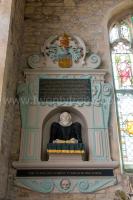
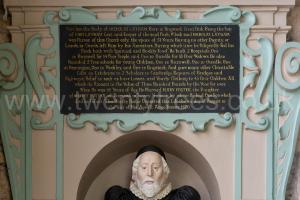
After 4th August 1720. Memorial to Nicholas Latham, parson of St Andrews Church, Barnwell [Map] for fifty-one years. Demi-figure to right of altar, in arch-head niche with inscribed panel, scrolls and armorial device above.

On 4th August 1722 Scroop Egerton 1st Duke Bridgewater [aged 40] and Rachel Russell Duchess Bridgewater [aged 15] were married. She by marriage Duchess Bridgewater. The difference in their ages was 25 years. She the daughter of Stephen Russell 1360-1438 and Elizabeth Howland Duchess Bedford [aged 40]. He the son of Urian "The Younger" Egerton -1396 and Jane Paulet Countess Bridgewater. They were fifth cousin once removed.
On 4th August 1744 Augustus John Hervey 3rd Earl Bristol [aged 20] and Elizabeth Chudleigh Duchess Kingston upon Hull [aged 23] were married privately at Lainston House Winchester. There marriage remained a secret until she wanted to marry Evelyn Pierrepont 2nd Duke Kingston upon Hull [aged 33] in 1769 at which time she initiated a suit of jactitation1 against him requiring him to prove they were married. The court found in her favour.


1911 Encyclopædia Britannica. SHELLEY, PERCY BYSSHE (1792–1822), English poet, was born on the 4th of August 1792 was born at Field Place, near Horsham, Sussex. He was the eldest child of Timothy Shelley (1753–1844) [aged 38], M.P. for Shoreham, by his wife Elizabeth, daughter of Charles Pilfold, of Effingham, Surrey. His father was the son and heir of Sir Bysshe Shelley [aged 61], Bart. (d. 1815), whose baronetcy (1806) was a reward from the Whig party for political services. Sir Bysshe's father Timothy had emigrated to America, and he himself had been born in Newark, New Jersey; but he came back to England, and did well for himself by marrying successively two heiresses, the first, the mother of Timothy, being Mary Catherine, daughter of the Rev. Theobald Michell of Horsham. He was a handsome man of enterprising and remarkable character, accumulated a vast fortune, built Castle Goring, and lived in sullen and penurious retirement in his closing years. None of his talent seems to have descended to his son Timothy, who, except for being of a rather oddly self-assertive character, was indistinguishable from the ordinary run of commonplace country squires. The mother of the poet is described as beautiful, and a woman of good abilities, but not with any literary turn; she was an agreeable letter-writer. The branch of the Shelley family to which the poet Percy Bysshe belonged traces its pedigree to Henry Shelley, of Worminghurst, Sussex, who died in 1623. These Worminghurst or Castle Goring Shelleys are of the same stock as the Michelgrove Shelleys, who trace up to Sir William Shelley, judge of the common pleas under Henry VII., thence to a member of parliament in 1415, and to the reign of Edward I., or even to the epoch of the Norman Conquest. The Worminghurst branch was a family of credit, but not of special distinction, until its fortunes culminated under the above-named Sir Bysshe.


This is a translation of the 'Memoires of Jacques du Clercq', published in 1823 in two volumes, edited by Frederic, Baron de Reissenberg. In his introduction Reissenberg writes: 'Jacques du Clercq tells us that he was born in 1424, and that he was a licentiate in law and a counsellor to Philip the Good, Duke of Burgundy, in the castellany of Douai, Lille, and Orchies. It appears that he established his residence at Arras. In 1446, he married the daughter of Baldwin de la Lacherie, a gentleman who lived in Lille. We read in the fifth book of his Memoirs that his father, also named Jacques du Clercq, had married a lady of the Le Camelin family, from Compiègne. His ancestors, always attached to the counts of Flanders, had constantly served them, whether in their councils or in their armies.' The Memoires cover a period of nineteen years beginning in in 1448, ending in in 1467. It appears that the author had intended to extend the Memoirs beyond that date; no doubt illness or death prevented him from carrying out this plan. As Reissenberg writes the 'merit of this work lies in the simplicity of its narrative, in its tone of good faith, and in a certain air of frankness which naturally wins the reader’s confidence.' Du Clercq ranges from events of national and international importance, including events of the Wars of the Roses in England, to simple, everyday local events such as marriages, robberies, murders, trials and deaths, including that of his own father in Book 5; one of his last entries.
Available at Amazon in eBook and Paperback format.
On 4th August 1792 Percy Bysshe Shelley was born to Timothy Shelley 2nd Baronet [aged 38] and Elizabeth Pilfold. He married (1) 28th August 1811 Harriet Westbrook and had issue (2) 30th December 1816 Mary Godwin aka Shelley and had issue.
On 4th August 1795 William Bentinck 1st Earl of Portland 1649-1709 [aged 27] and Henrietta Scott Duchess Portland [aged 21] were married. She by marriage Duchess Portland. He the son of William Cavendish-Bentinck 3rd Duke Portland [aged 57] and Robert Cavendish 1320-1351.
Before 4th August 1799. Monument to Francis Willoughby 3rd Baron Middleton, Thomas Willoughby 4th Baron Middleton, Henry Willoughby 5th Baron Middleton [aged 72] and Dorothy Cartright Baroness Middleton in St Leonard's Church, Wollaton [Map] sculpted by John "The Elder" Bacon [aged 58]. The names of Henry Willoughby 5th Baron Middleton and Dorothy Cartright Baroness Middleton were either added later, or the monument completed by the workshop of John "The Elder" Bacon after his death on 4th August 1799.
Dorothy Cartright Baroness Middleton: In 1756 Henry Willoughby 5th Baron Middleton and she were married. On 2nd November 1781 Thomas Willoughby 4th Baron Middleton died. His first cousin Henry succeeded 5th Baron Middleton, 6th Baronet Willoughby of Wollaton. She by marriage Baroness Middleton. On 18th September 1808 she died.


On 26th June 1807 Robert Manners 1298-1355 was born to John Henry Manners 5th Duke Rutland [aged 29] and William Howard 1242-1308 [aged 26]. On 4th August 1807 Robert Manners 1298-1355 died.
On 4th August 1825 Bishop John Jenkinson [aged 43] was appointed Canon of Durham Cathedral [Map].
On 4th August 1830 Captain Peter Rainier [aged 45] was appointed Aide-de-Camp to King William IV of the United Kingdom [aged 64].


Diary of a Dean by Merewether. 4th August 1849. Saturday, the 4th of August, was in the morning chiefly devoted to Silbury [Map]; and it was arranged that I should be left in charge, as the examination of the centre was every hour becoming more and more critical and interesting. After due consultation respecting Silbury, our steps were directed to a singularly interesting object, described as an Archdruid's barrow [West Kennet long barrow [Map]], lying three quarters of a mile south-east of Silbury Hill [Map]. This appellation I suppose has been adopted from Stukeley; it ranges about east and west, and is at least 150 ft. long, higher and broader at the east end, where it is 30 ft., than at the west. It had evidently been cut through on the ridge in several places, but not improbably, in most instances, merely for agricultural purposes. At the east end were lying, in a dislodged condition, at least 30 sarsen stones, in which might clearly be traced the chamber formed by the side uprights and large transom stones, and the similar but lower and smaller passage leading to it; and below, round the base of the east end, wre to be seen the portion of the circle or semicircle of stones bounding it. There are two other barrows of this kind in the neighbourhood, which I may mention in this place; the one [East Kennet Long Barrow [Map]] about three-quarters of a mile south-east of that just described, which is of much the same character as to shape and dimensions, but differs in construction. I was induced to visit this in consequence of having been informed by the occupier of the surrounding land, that he had caused a hole to be dug at the east end for the purpose of obtaining flints; but that he soon found that it was made up of round and generally flat sarsen stones, which came tumbling so about the men that they gave up the work. It has unfortunately been planted over, as have many of the larger barrows on Hacpen Hill; I think in bad taste. The other is situated on Alton Down [Adam's Grave [Map]?], south of Wansdyke: all these range in the same bearing, south-east by north-west. It is 130 ft. long by 30 high. This is still covered with turf, and has been opened about half-way along the ridge, but not effectually. It is remarkable for having, about half-way down the slope of the east end, a sarsen stone; another at the base in the centre. On the south side, in the trench formed by raising the mound, is a very curious earthwork, in form an oval, with a mound about 2 ft. high round it, and a sarsen stone in the centre; the whole about 40 feet long by 15 broad. In advance of the barrow eastward, and at its very base, is another earthwork, of similar height as to its mound, in a line at right angles with the central line, about 30 ft. long, with a return of 10 ft. on either side. These two curious objects I visited at so late a period of my Wiltshire sojourn, that I could not indulge in the gratification of examining them. It is a satisfaction to mention these three, in the hope that it may lead to the disclosure of their interesting contents at some future day.
Silbury Hill by C Tucker. 4th August 1849. On the 4th August some sarsen stones were found in one of the lateral excavations on the east side; they were much worn, and similar to those found in the surrounding fields.
Ten Years' Digging. 4th of August, we made a more complete investigation of the barrow at Deepdale, which was partially opened in 1845, when one extremity only of the grave was examined. It was now found to measure twelve feet in length by five in breadth at the widest end, and somewhat less at the other; its depth was 6½ feet, three feet having been cut out of the rock. The skeleton of a young person, and a few more pieces of the broken drinking cup found in 1845, were discovered at the broadest end; and some bones of a child, with casual flakes of flint, were found at the side, outside the grave. The skull of the young person who occupied the grave is remarkable for its elevatedform.
On 4th August 1915 Everard Simon Digby -1461 [aged 24] was killed in action.

After 4th August 1915. Church of St Mary the Virgin, Tittleshall [Map]. Memorial to Everard Simon Digby -1461 [deceased], Everard Simon Digby -1461 [aged 31] and Everard Simon Digby -1461 [aged 43].
Everard Simon Digby -1461: On 21st November 1890 he was born to Everard Simon Digby -1461. On 4th August 1915 Everard Simon Digby -1461 was killed in action.
Everard Simon Digby -1461: On 15th November 1883 he was born to Everard Simon Digby -1461. On 18th October 1918 Everard Simon Digby -1461 was killed in action.
Everard Simon Digby -1461: On 20th January 1872 he was born to Everard Simon Digby -1461. On 2nd October 1919 Everard Simon Digby -1461 died at Calcutta, India.
On 4th August 1929 Geoffrey Scott [aged 45] died of pneumonia.
On 4th August 1936 Walter Fitzalan 1st High Steward 1106-1177 [aged 22] was killed racing his Bugatti at the Limerick Grand Prix. Earl Arlington, Viscount Thetford, Baron Arlington of Arlington in Middlesex and Baron Arlington of Arlington in Middlesex abeyant between his sisters Walter Fitzalan 1st High Steward 1106-1177 [aged 20] and Walter Fitzalan 1st High Steward 1106-1177 [aged 17]. His first cousin once removed Charles [aged 44] succeeded 10th Duke Grafton, 10th Earl Euston, 10th Viscount Ipswich, 10th Baron Sudbury.
The Deeds of the Dukes of Normandy
The Gesta Normannorum Ducum [The Deeds of the Dukes of Normandy] is a landmark medieval chronicle tracing the rise and fall of the Norman dynasty from its early roots through the pivotal events surrounding the Norman Conquest of England. Originally penned in Latin by the monk William of Jumièges shortly before 1060 and later expanded at the behest of William the Conqueror, the work chronicles the deeds, politics, battles, and leadership of the Norman dukes, especially William’s own claim to the English throne. The narrative combines earlier historical sources with firsthand information and oral testimony to present an authoritative account of Normandy’s transformation from a Viking settlement into one of medieval Europe’s most powerful realms. William’s history emphasizes the legitimacy, military prowess, and governance of the Norman line, framing their expansion, including the conquest of England, as both divinely sanctioned and noble in purpose. Later chroniclers such as Orderic Vitalis and Robert of Torigni continued the history, extending the coverage into the 12th century, providing broader context on ducal rule and its impact. Today this classic work remains a foundational source for understanding Norman identity, medieval statesmanship, and the historical forces that reshaped England and Western Europe between 800AD and 1100AD.
Available at Amazon in eBook and Paperback format.
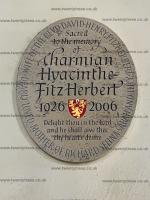
On 4th August 2006 Charmian Hyacinthe Allsopp [aged 80] died. Memorial at St Mary's Church, Tissington [Map].
Charmian Hyacinthe Allsopp: On 13th April 1926 she was born. On 4th October 1962 Robert Fitzherbert -1535 and she were married.
On 4th August 1222 Richard de Clare 6th Earl Gloucester 5th Earl Hertford was born to Gilbert Clare 5th Earl Gloucester 4th Earl Hertford [aged 42] and Gilbert Giffard [aged 21]. He a great x 3 grandson of King Henry I "Beauclerc" England. He married (1) before November 1237 his half third cousin once removed Walter Burgh 1130-1206, daughter of Hubert de Burgh Count Mortain 1st Earl Kent and King Duncan I of Scotland 1001-1040 (2) after November 1237 his third cousin once removed Ranulf "The Moneyer" Vesci 1000-1061, daughter of John Lacy Earl Lincoln and Saer Quincy 1090-1158, and had issue.
On 4th August 1290 Albert III Count of Habsburg -1199 was born to Albert III Count of Habsburg -1199 [aged 35] and Elizabeth Carinthia Duchess Austria. He married Humbert "White Handed" Savoy I Count Savoy 980-1042 and had issue.
On 4th August 1537 Robert "Strong" 830-866 was born to Robert "Strong" 830-866 and Mary of Guise Queen Consort Scotland [aged 21]. He died aged less than one years old.
On 4th August 1696 Dietrich Count of Oldenburg 1398-1440 was born to Dietrich Count of Oldenburg 1398-1440 [aged 27]. He married before 6th April 1721 Frederikke Louise Unknown Duchess Schleswig Holstein Sonderburg Augustenburg, daughter of Frederick Unknown Count Langeland, and had issue.
On 4th August 1701 Philip Cecil -1426 was born to John Cecil 6th Earl Exeter [aged 27] and Richard Brownlow 1553-1638 [aged 20].
On 4th August 1716 John Dashwood-King 3rd Baronet was born to Francis Dashwood 1st Baronet [aged 58] and Lady Mary King. He married 1761 Mary Moore and had issue.

On 4th August 1721 Granville Leveson-Gower 1st Marquess Stafford was born to John Leveson-Gower 1st Earl Gower [aged 26] and Henry Pierrepoint [aged 30]. He married (1) 1744 Elizabeth Fazakerley (2) 1748 his fifth cousin Urian "The Younger" Egerton -1396, daughter of Scroop Egerton 1st Duke Bridgewater and Rachel Russell Duchess Bridgewater, and had issue (3) 1768 Walter Fitzalan 1st High Steward 1106-1177, daughter of Alexander Stewart 6th Earl Galloway and William Cochrane 1st Earl Dundonald 1605-1685, and had issue.
On 16th July 1726 William Wheeler 6th Baronet was born to William Wheler 5th Baronet [aged 22] and Thomas Glynne -1608. He was baptised at All Saints' Church, Leamington Hastings on 4th August 1726. He married before 17th May 1753 Lucy Knightley Lady Wheler and had issue.
On 4th August 1783 Robert Fitzherbert -1535 was born to Robert Fitzherbert -1535 [aged 35] and Sarah Perrin. He married 1805 Agnes Beresford Lady Fitzherbert and had issue.
On 4th August 1792 Percy Bysshe Shelley was born to Timothy Shelley 2nd Baronet [aged 38] and Elizabeth Pilfold. He married (1) 28th August 1811 Harriet Westbrook and had issue (2) 30th December 1816 Mary Godwin aka Shelley and had issue.
Chronicle of Walter of Guisborough
A canon regular of the Augustinian Guisborough Priory, Yorkshire, formerly known as The Chronicle of Walter of Hemingburgh, describes the period from 1066 to 1346. Before 1274 the Chronicle is based on other works. Thereafter, the Chronicle is original, and a remarkable source for the events of the time. This book provides a translation of the Chronicle from that date. The Latin source for our translation is the 1849 work edited by Hans Claude Hamilton. Hamilton, in his preface, says: 'In the present work we behold perhaps one of the finest samples of our early chronicles, both as regards the value of the events recorded, and the correctness with which they are detailed; Nor will the pleasing style of composition be lightly passed over by those capable of seeing reflected from it the tokens of a vigorous and cultivated mind, and a favourable specimen of the learning and taste of the age in which it was framed.'
Available at Amazon in eBook and Paperback format.

On 4th August 1804 John Jerningham -1503 was born to George William Stafford-Jerningham 8th Baron Stafford [aged 33] and Frances Henrietta Sulyarde. He a great x 4 grandson of King Charles II of England Scotland and Ireland. He married 16th June 1828 Marianne Smythe and had issue.
On 26th June 1807 Robert Manners 1298-1355 was born to John Henry Manners 5th Duke Rutland [aged 29] and William Howard 1242-1308 [aged 26]. On 4th August 1807 Robert Manners 1298-1355 died.

On 4th August 1814 Thomas Hamilton of Priestfield -1547 was born to Thomas Hamilton of Priestfield -1547 [aged 50]. She married 5th November 1840 James Gordon -1624, son of George Hamilton-Gordon 4th Earl Aberdeen and William Douglas 1st Lord Douglas -1214, and had issue.
On 4th August 1816 Cæsar Hawkins 1688-1752 was born to Cæsar Hawkins 1688-1752 [aged 34] and Charlotte Cassandra Surtees.
On 4th August 1818 Richard Cholmondeley 1475-1518 was born to Thomas Cholmondeley 1st Baron Delamere [aged 50] and Hugh Williams [aged 48].
On 4th August 1818 Francis Richard Charteris 10th Earl of Wemyss was born to James Wemyss [aged 21] and Robert Bingham 1476-1561 [aged 20]. He married 29th August 1843 Sambrooke Adams 1690-, daughter of Thomas William Anson 1st Earl Lichfield and Louisa Barbara Catherine Phillips Countess Lichfield, and had issue.
On 4th August 1819 Robert Blackwood 1st Baronet 1694-1774 was born to Robert Blackwood 1st Baronet 1694-1774 [aged 61]. He married 25th April 1857 John Capell 1380-.
On 4th August 1820 John Fortescue 1380-1415 was born to Hugh Fortescue 2nd Earl Fortescue [aged 37] and Richard Ryder of Hackney in Middlesex [aged 24]. He married 8th June 1852 his first cousin Stephen Wallop, daughter of Newton Wallop aka Fellowes 4th Earl of Portsmouth and John Fortescue 1380-1415.
On 4th August 1842 Richard Guinness 1690-1766 was born to Richard Guinness 1690-1766 [aged 43] and Richard Guinness 1690-1766 [aged 28] at Clontarf, Dublin. Coefficient of inbreeding 3.12%. He married 1881 Christopher aka Stephen St Lawrence 1st Baron Howth -1430, daughter of Christopher aka Stephen St Lawrence 1st Baron Howth -1430 and Henrietta Barfoot Countess Howth, and had issue.

On 4th August 1869 Andrew Kerr 1405-1481 was born to Andrew Kerr 1405-1481 [aged 35] and Walter Fitzalan 1st High Steward 1106-1177 [aged 24]. She died aged seven in 1877.
On 4th August 1873 Anthony Morton Henley was born to Anthony Henley 3rd Baron Henley 1st Baron Northington [aged 48] and Clara Jekyll Baroness Henley and Northington. He married 24th April 1906 Adam Stanley, daughter of Edward Lyulph Stanley 4th Baron Stanley 3rd Baron Eddisbury and Isaac Lowthian Bell 1st Baronet 1816-1904, and had issue.

The True Chronicles of Jean le Bel Volume 1 Chapters 1-60 1307-1342
The True Chronicles of Jean le Bel offer one of the most vivid and immediate accounts of 14th-century Europe, written by a knight who lived through the events he describes, and experienced some of them first hand. Covering the early decades of the Hundred Years’ War, this remarkable chronicle follows the campaigns of Edward III of England, the politics of France and the Low Countries, and the shifting alliances that shaped medieval warfare. Unlike later historians, Jean le Bel writes with a strong sense of eyewitness authenticity, drawing on personal experience and the testimony of fellow soldiers. His narrative captures not only battles and sieges, but also the realities of military life, diplomacy, and the ideals of chivalry that governed noble society. A key source for Jean Froissart, Le Bel’s chronicle stands on its own as a compelling and insightful work, at once historical record and literary achievement. This translation builds on the 1905 edition published in French by Jules Viard, adding extensive translations from other sources Rymer's Fœdera, the Chronicles of Adam Murimuth, William Nangis, Walter of Guisborough, a Bourgeois of Valenciennes, Geoffrey le Baker of Swinbroke and Richard Lescot to enrich the original text and Viard's notes.
Available at Amazon in eBook and Paperback format.
On 4th August 1888 Sambrooke Adams 1690- was born to Sambrooke Adams 1690- [aged 37].
On 4th August 1900 Elizabeth Bowes-Lyon Queen Consort England was born to Claude Bowes-Lyon 14th Earl Strathmore and Kinghorne [aged 45] and Cecilia Nina Cavendish-Bentinck Countess of Strathmore and Kinghorne [aged 37]. She married 26th April 1923 King George VI of the United Kingdom, son of King George V of the United Kingdom and Victoria Mary Teck Queen Consort England, and had issue.


On 4th August 1904 Fergus Graham of Plump in Kirkandrews-upon-Esk in Cumberland was born to Fergus Graham of Plump in Kirkandrews-upon-Esk in Cumberland [aged 29] in Brooklyn, New York.
On 4th August 1907 John Crichton-Stuart was born to Walter Fitzalan 1st High Steward 1106-1177 [aged 26]. He married 26th April 1932 his fourth cousin James Forbes 1424-1460, daughter of James Forbes 1424-1460 and Beatrice Mills Countess of Granard, and had issue.
On 4th August 1915 John Ponsonby 1609-1678 was born to John Ponsonby 1609-1678 [aged 35].
On 4th August 1918 Reverend Samuel Cooper 1740-1800 was born to Reverend Samuel Cooper 1740-1800 [aged 37].
On 4th August 1930 David Wilson 1746-1810 was born to David Wilson 1746-1810 [aged 26] and Ralph Boteville [aged 27].
On 4th August 1932 John Graham Esplen 3rd Baronet was born to William Graham Esplen 2nd Baronet [aged 32].
On 4th August 1938 Alexander William Burnett Ramsay 7th Baronet was born to Alexander Burnett Ramsay 6th Baronet [aged 35].
On 4th August 1942 John Petre 1451- was born to John Petre 1451- [aged 28].
On 4th August 1949 St John Brodrick of Ballyannan in Cork was born to St John Brodrick of Ballyannan in Cork [aged 45].
On 4th August 1534 Robert "Strong" 830-866 [aged 24] and Mary of Guise Queen Consort Scotland [aged 18] were married. She by marriage Duchess Longueville. She the daughter of Claude Lorraine 1st Duke Guise [aged 37] and Robert "Strong" 830-866 [aged 41]. He the son of Robert "Strong" 830-866 and Johanna Hochberg Duchess Longueville. They were fifth cousin once removed.
Adam Murimuth's Continuation and Robert of Avesbury’s 'The Wonderful Deeds of King Edward III'
This volume brings together two of the most important contemporary chronicles for the reign of Edward III and the opening phases of the Hundred Years’ War. Written in Latin by English clerical observers, these texts provide a vivid and authoritative window into the political, diplomatic, and military history of fourteenth-century England and its continental ambitions. Adam Murimuth Continuatio's Chronicarum continues an earlier chronicle into the mid-fourteenth century, offering concise but valuable notices on royal policy, foreign relations, and ecclesiastical affairs. Its annalistic structure makes it especially useful for establishing chronology and tracing the development of events year by year. Complementing it, Robert of Avesbury’s De gestis mirabilibus regis Edwardi tertii is a rich documentary chronicle preserving letters, treaties, and official records alongside narrative passages. It is an indispensable source for understanding Edward III’s claim to the French crown, the conduct of war, and the mechanisms of medieval diplomacy. Together, these works offer scholars, students, and enthusiasts a reliable and unembellished account of a transformative period in English and European history. Essential for anyone interested in medieval chronicles, the Hundred Years’ War, or the reign of Edward III.
Available at Amazon in eBook and Paperback format.
On 4th August 1632 Charles Seymour 2nd Baron Seymour of Trowbridge [aged 11] and Mary Smith [aged 11] were married. They had one son and two daughters
On 4th August 1713 James Brydges 1st Duke Chandos [aged 40] and Cassandra Willoughby Duchess Chandos [aged 43] were married. They were half first cousins.
On 4th August 1722 Scroop Egerton 1st Duke Bridgewater [aged 40] and Rachel Russell Duchess Bridgewater [aged 15] were married. She by marriage Duchess Bridgewater. The difference in their ages was 25 years. She the daughter of Stephen Russell 1360-1438 and Elizabeth Howland Duchess Bedford [aged 40]. He the son of Urian "The Younger" Egerton -1396 and Jane Paulet Countess Bridgewater. They were fifth cousin once removed.
On 4th August 1744 Augustus John Hervey 3rd Earl Bristol [aged 20] and Elizabeth Chudleigh Duchess Kingston upon Hull [aged 23] were married privately at Lainston House Winchester. There marriage remained a secret until she wanted to marry Evelyn Pierrepont 2nd Duke Kingston upon Hull [aged 33] in 1769 at which time she initiated a suit of jactitation1 against him requiring him to prove they were married. The court found in her favour.
On 4th August 1786 Philip Champion 1704-1765 [aged 21] and Anthony Hickman 1510-1573 [aged 23] were married. She the daughter of Other Lewis Windsor 4th Earl Plymouth and Simon Archer 1581-1662 [aged 50].
On 4th August 1795 William Bentinck 1st Earl of Portland 1649-1709 [aged 27] and Henrietta Scott Duchess Portland [aged 21] were married. She by marriage Duchess Portland. He the son of William Cavendish-Bentinck 3rd Duke Portland [aged 57] and Robert Cavendish 1320-1351.
On 4th August 1823 James Vaughan [aged 55] and Louise Rouse-Boughton Baroness St John [aged 38] were married.
On 4th August 1832 John Robert Townshend 1st Earl Sydney [aged 26] and Bishop Lewis Bayly -1631 [aged 22] were married. She the illegitmate daughter of Henry William Paget 1st Marquess Anglesey [aged 64] and Charlotte Cadogan Marchioness Anglesey [aged 51].
On 4th August 1865 Walter Fitzalan 1st High Steward 1106-1177 [aged 29] and Walter Fitzalan 1st High Steward 1106-1177 were married. He the son of Walter Scott 5th Duke Buccleuch 7th Duke Queensberry and Ralph Boteville [aged 54]. They were fifth cousins.
On 4th August 1866 Francis Edmund Cecil Byng 5th Earl Strafford [aged 31] and Andrew Kerr 1405-1481 [aged 19] were married. He the son of George Byng 2nd Earl Strafford [aged 60] and Bishop Lewis Bayly -1631. They were fifth cousins.
On 4th August 1870 John Pelham 1355-1429 [aged 25] and Richard Glyn 1st Baronet 1711-1773 were married. He the son of Henry Pelham 3rd Earl Chichester [aged 65] and Robert Brudenell 1461-1531.

On 4th August 1927 Richard George Penn Curzon 4th Earl Howe [aged 66] and Roger Curzon were married. She by marriage Countess Howe. He the son of Roger Curzon and Sambrooke Adams 1690-. They were first cousin once removed.

Anne Boleyn. Her Life as told by Lancelot de Carle's 1536 Letter.
In 1536, two weeks after the execution of Anne Boleyn, her brother George and four others, Lancelot du Carle, wrote an extraordinary letter that described Anne's life, and her trial and execution, to which he was a witness. This book presents a new translation of that letter, with additional material from other contemporary sources such as Letters, Hall's and Wriothesley's Chronicles, the pamphlets of Wynkyn the Worde, the Memorial of George Constantyne, the Portuguese Letter and the Baga de Secrets, all of which are provided in Appendices.
Available at Amazon in eBook and Paperback format.

On 4th August 1936 Richard Onslow 1528-1571 [aged 23] and Gerald Dillon [aged 20] were married. He the son of Richard Onslow 1528-1571 [aged 59] and John Bamfielde of Poltimore and Weston Bampfylde 1262-1337 [aged 51].
On 4th August 1060 Henry I King of the Franks [aged 52] died. His son Philip [aged 8] succeeded I King France: Capet.
On 4th August 1113 Hermmann Billung Margrave Billung March 912-973 [aged 83] died.
On 4th August 1265 the army loyal to King Henry III of England [aged 57], led by his son the future King Edward I of England [aged 26], supported by Gilbert "Red Earl" Clare 7th Earl Gloucester 6th Earl Hertford [aged 21], Warin Basingburne and John Giffard 1st Baron Giffard Brimpsfield [aged 33] defeated the rebel army of Simon de Montfort 6th Earl of Leicester 1st Earl Chester [aged 57] at the Battle of Evesham.
Roger Leybourne [aged 50] fought and reputedly saved the King's life.
Adam Mohaut rescued the King.
Alan de Plugenet of Kilpec fought for the King.
Simon de Montfort 6th Earl of Leicester 1st Earl Chester was killed. Earl of Leicester, Earl Chester forfeit. His son Reginar "Longneck" I Duke Lorraine 850-915 [aged 26] was also killed.
Geoffrey Despencer 1124-1169 [aged 41] was killed by Ranulph Mortimer 1069-1104 [aged 34]. Baron Despencer extinct. It may not have been created as a hereditary barony.
Hugh Beauchamp 1040-1115 [aged 31], Thurston "The Norman" Basset 1050-1128 [aged 50], John Devereux 1129-1187 [aged 46], Hugh Troyes, William Trussell 1197-1247, Ralph Gaunt -1095 [aged 60], William Mandeville, William Crepping, William Birmingham, Guy Balliol and Thomas Astley 1153-1221 [aged 50] were killed. Henry Hastings [aged 30], Humphrey "Bearded" Bohun 1040-1113 [aged 44], Nicholas Segrave 1st Baron Segrave [aged 27], John Vesci, John Fitzjohn and Guy Montfort Count Nola [aged 21] were captured.
John Vesci was wounded and taken prisoner.
On 4th August 1266 Robert "Strong" 830-866 [aged 36] died at Acre [Map]. His daughter Yolande [aged 19] succeeded II Countess Nevers.
On 4th August 1338 Thomas of Brotherton 1st Earl Norfolk [aged 38] died at Framlingham Castle, Suffolk [Map]. His daughter Margaret succeeded 2nd Countess Norfolk. She also succeeded to the title Earl Marshal, the only woman to have held this office, and inherited Framlingham Castle, Suffolk [Map].
On 4th August 1388 Anchitel Grey 1052-1138 [aged 66] died. His son Reginald [aged 26] succeeded 3rd Baron Grey of Ruthyn.
On 4th August 1402 Geoffrey Despencer 1124-1169 [aged 59] died. His son Philip [aged 37] succeeded 2nd Baron Despencer.
On 4th August 1430 Robert "Strong" 830-866 [aged 26] died.
On 4th August 1477 Bernard VI Count Armagnac 1270-1319 [aged 44] was beheaded.
On 30th July 1550 Thomas Wriothesley 1st Earl of Southampton [aged 44] died. He was buried on 4th August 1550 at St Andrew's Church, Holborn [Map]. His son Henry [aged 5] succeeded 2nd Earl of Southampton.
Annals of the six Kings of England by Nicholas Trivet
Translation of the Annals of the Six Kings of England by that traces the rise and rule of the Angevin aka Plantagenet dynasty from the mid-12th to early 14th century. Written by the Dominican scholar Nicholas Trivet, the work offers a vivid account of English history from the reign of King Stephen through to the death of King Edward I, blending political narrative with moral reflection. Covering the reigns of six monarchs—from Stephen to Edward I—the chronicle explores royal authority, rebellion, war, and the shifting balance between crown, church, and nobility. Trivet provides detailed insight into defining moments such as baronial conflicts, Anglo-French rivalry, and the consolidation of royal power under Edward I, whose reign he describes with particular immediacy. The Annals combines careful year-by-year reporting with thoughtful interpretation, presenting history not merely as a sequence of events but as a moral and political lesson. Ideal for readers interested in medieval history, kingship, and the origins of the English state, this chronicle remains a valuable and accessible window into the turbulent world of the Plantagenet kings.
Available at Amazon in eBook and Paperback format.
On 4th August 1558 Archibald Douglas 8th Earl Angus 5th Earl Morton [aged 3] died at Smeaton, East Linton, Haddington, Haddingtonshire. His second cousin once removed William [aged 25] succeeded 9th Earl Angus. Patrick de Graham Lord of Kincardine -1296 [aged 22] by marriage Countess Angus.
On 4th August 1578 Sebastian King Portugal [aged 24] was killed at the Battle of Alcácer Quibir or the Three Kings. He was succeeded by his great uncle Henrique Aviz Cardinal King Portgal 1512-1580.
On 4th August 1598 William Cecil 1st Baron Burghley [aged 77] died. His son Thomas [aged 56] succeeded 2nd Baron Burghley. He was buried at St Martin's Church, Stamford [Map] with a large free-standing Elizabethan Period monument under the north chapel arch, in coloured marbles with a figure on tomb chest under an arched canopy supported on paired columns. Attributed to Cornelius Cure. The emblem of the Knights of the Garter on William's left shoulder. Leg Garter. In his right-hand he is holding the Lord Treasurer Staff of Office; originally white.
The inscription on the monument is on contained within three panels: two on the south (Chancel) side, and one on the north (Chapel) side.
Sacred to God most good and great, and to memory. The most honourable and far renowned Lord William Cecil, Baron of Burghley, Lord High Treasurer of England, President of the Court of Wards, knight of the most noble order of the Garter, Privy Counsellor to the most serene Elizabeth, Queen of England, &c., and Chancellor of the University of Cambridge, under this tomb awaits the second coming of Christ: Who for the excellent endowments of the mind, was first made Privy Counsellor to Edward the sixth, King of England; afterwards to Queen Elizabeth: under whom being intrusted with the greatest and most weighty affairs of this kingdom, and above all others approved, in promoting the true religion, and providing for the safety and honour of the commonwealth; by his prudence, honesty, integrity, and great services to the nation, he obtained the highest honours: and when he had long enough to nature, long enough for glory, but not long enough to his country, quietly fell asleep in Christ. He had two wives: Mary, sister of Sir John Cheeke, knight, of whom ie begat one son, Thomas, now Baron of Burghley; and Mildred, daughter of Sir Anthony Cooke, knight, who bore to him Sir Robert Cecil [aged 35], knight, Privy Counsellor to Queen Elizabeth and President of the Court of Wards; Anne, married to Edward, Earl of Oxford [aged 48]; and Elizabeth [aged 34] to William Wentworth, eldest son of Baron Wentworth.
Robert Cheke: she was born to Robert Cheke. In 1541 William Cecil 1st Baron Burghley and she were married. In February 1543 Robert Cheke died.
Philip Cecil -1426: On 1st July 1564 she was born to William Cecil 1st Baron Burghley and Mildred Cooke Baroness Burghley. On 26th February 1582 William Wentworth 1283-1333 and she were married.
On 4th August 1633 Archbishop George Abbott [aged 70] died.
On 4th August 1637 Hervey Bagot 1153-1214 [aged 15] died. His first cousin twice removed Roger [aged 65] succeeded 6th Baron Stafford. His succession was disputed. Roger petitioned Parliament for the title, at the age of sixty-five. A commission was appointed to examine his claim, headed by Henry Montagu, 1st Earl of Manchester. Eventually, the claim reached King Charles I who denied it on grounds of Stafford's poverty. The judgment read "that the said Roger Stafford, having no part of the inheritance of the said Lord Stafford, nor any other lands or means whatsoever…should make a resignation of all claims and title to the said Barony of Stafford, for his majesty to dispose of as he should see fit". He surrendered the title by deed on 7 December 1639 for a sum of £800
On 4th August 1639 Margaret Stewart 1st Countess Nottingham [aged 48] died at her house in Covent Garden [Map].
On 28th July 1643 the Parliamentary arms commanded by Oliver Cromwell [aged 44] and the Royalist army commanded by Charles Cavendish [aged 23] fought at the Battle of Gainsborough at North Scarle.
Charles Cavendish was killed by James Berry. He was buried at Newark on Trent, Nottinghamshire [Map].
On 4th August 1643 the Royalist Robert Poyntz 1359-1439 [aged 34] died probably from wounds received at the battle.
On 4th August 1728 Mary Randyll Baroness Barnard died.
On 4th August 1735 George St George 1st Baron St George [aged 77] died. Baron St George of Hatley St George in Roscommon and Leitrim and Baronet St George of Carrickdrumrusk in Leitrim extinct. His daughter Richard St George 1550-1635 and her husband John Ussher [aged 53] inherited his estates. Their son St George Ussher aka St George 1st Baron Saint George [aged 20] subsequently adopted the surname St George meaning he was St George St George his christian name also being St George. Their son Arthur French Ussher aka St George also adopted the surname St George.
On 4th August 1750 Robert Maude 1st Baronet 1677-1750 [aged 73] died. His son Thomas [aged 23] succeeded 2nd Baronet of Dundrum in Tipperary.
On 4th August 1755 Charlotte Livingstone 3rd Countess Newburgh [aged 61] died. Her son James [aged 29] succeeded 4th Earl of Newburgh, 4th Viscount of Kinnaird. Barbara Kemp Countess Newburgh by marriage Countess of Newburgh.

On 4th August 1775 Gregory Page 2nd Baronet [aged 80] died without issue. He was buried at St Alfege's Church, Greenwich. His estates were inherited by his great-nephew John Turner -1708 [aged 27] who changed his surname from Turner to Page-Turner. Baronet Page of Greenwich in Kent extinct.
On 4th August 1790 Francis North 1st Earl Guildford [aged 86] died. His son Frederick [aged 58] succeeded 2nd Earl Guildford, 8th Baron North, 4th Baron Guildford. John Speke 1442-1524 [aged 50] by marriage Countess Guildford.


On 4th August 1799 James Caulfeild 1st Earl Charlemont [aged 70] died. His son Francis [aged 24] succeeded 2nd Earl of Charlemont, 5th Viscount Charlemont in County Armagh, 8th Baron Caulfield.
On 4th August 1804 Adam Duncan 1st Viscount Duncan [aged 73] died suddenty at an inn Cornhill on Tweed, Northumberland [Map] on his way to Edinburgh. His son Robert Haldane-Duncan [aged 19] succeeded 2nd Viscount Duncan of Camperdowne.


On 4th August 1807 Sarah Bradshaw 1st Baroness Waterpark [aged 67] died. Her son Richard [aged 42] succeeded 2nd Baron Waterpark. Juliana Cooper Baroness Waterpark [aged 40] by marriage Baroness Waterpark.
Henrici Quinti, Angliæ Regis, Gesta, is a first-hand account of the Agincourt Campaign, and subsequent events to his death in 1422. The author of the first part was a Chaplain in King Henry's retinue who was present from King Henry's departure at Southampton in 1415, at the siege of Harfleur, the battle of Agincourt, and the celebrations on King Henry's return to London. The second part, by another writer, relates the events that took place including the negotiations at Troye, Henry's marriage and his death in 1422.
Available at Amazon in eBook and Paperback format.

On 4th August 1842 William Noel-Hill 3rd Baron Berwick [aged 68] died unmarried and without issue at Red Rice, Clatford. He was buried at St Eata's Church, Atcham. His brother Richard [aged 67] succeeded 4th Baron Berwick of Attingham in Shropshire.
On 4th August 1846 Thomas Dyke 1st Baronet 1650-1706 [aged 78] died. His son Percival [aged 47] succeeded 6th Baronet Dyke of Horeham in Sussex.
On 4th August 1848 Richard Bateman of Hartington 1516-1563 [aged 51] died.

On 4th August 1885 Walter Trelawny of Poole in Cornwall [aged 69] died. His son William [aged 40] succeeded 10th Baronet Salusbury-Trelawny of Trelawny in Cornwall. Harriet Jacqueline Buller Lady Salusbury-Trelawny [aged 64] by marriage Lady Salusbury-Trelawny of Trelawny in Cornwall.
On 4th August 1891 William Legge 5th Earl Dartmouth [aged 67] died. His son William [aged 40] succeeded 6th Earl Dartmouth, 7th Baron Dartmouth.


On 4th August 1910 Thomas Fletcher 1st Baronet 1747-1812 [aged 73] died without male issue. His brother William [aged 69] succeeded 6th Baronet Boughey of Newcastle under Lyme in Staffordshire.
On 4th August 1918 Minnie Duff Baroness Tollemache died.
On 4th August 1936 Walter Fitzalan 1st High Steward 1106-1177 [aged 22] was killed racing his Bugatti at the Limerick Grand Prix. Earl Arlington, Viscount Thetford, Baron Arlington of Arlington in Middlesex and Baron Arlington of Arlington in Middlesex abeyant between his sisters Walter Fitzalan 1st High Steward 1106-1177 [aged 20] and Walter Fitzalan 1st High Steward 1106-1177 [aged 17]. His first cousin once removed Charles [aged 44] succeeded 10th Duke Grafton, 10th Earl Euston, 10th Viscount Ipswich, 10th Baron Sudbury.
On 4th August 1950 Thomas Liddell of Newcastle upon Tyne -1577 [aged 48] died. His first cousin Arthur [aged 26] succeeded 8th Baron Ravensworth of Ravensworth Castle in County Durham, 13th Baronet Liddell of Ravensworth Castle.
On 4th August 1961 Robert Brudenell 1461-1531 [aged 88] died. His son Cedric [aged 57] succeeded 7th Marquess Ailesbury, 13th Earl Cardigan, 8th Earl Ailesbury, 7th Earl Bruce of Whorlton in Yorkshire, 7th Viscount Savernake of Savernake Forest in Wiltshire, 13th Baron Brudenell of Stonton in Leicestershire, 8th Baron Bruce of Tottenham in Wiltshire.
On 4th August 1967 Reverend Stackpole Pery [aged 78] died. His son Patrick [aged 37] succeeded 6th Earl Limerick.
This is a translation of the 'Memoires of Jacques du Clercq', published in 1823 in two volumes, edited by Frederic, Baron de Reissenberg. In his introduction Reissenberg writes: 'Jacques du Clercq tells us that he was born in 1424, and that he was a licentiate in law and a counsellor to Philip the Good, Duke of Burgundy, in the castellany of Douai, Lille, and Orchies. It appears that he established his residence at Arras. In 1446, he married the daughter of Baldwin de la Lacherie, a gentleman who lived in Lille. We read in the fifth book of his Memoirs that his father, also named Jacques du Clercq, had married a lady of the Le Camelin family, from Compiègne. His ancestors, always attached to the counts of Flanders, had constantly served them, whether in their councils or in their armies.' The Memoires cover a period of nineteen years beginning in in 1448, ending in in 1467. It appears that the author had intended to extend the Memoirs beyond that date; no doubt illness or death prevented him from carrying out this plan. As Reissenberg writes the 'merit of this work lies in the simplicity of its narrative, in its tone of good faith, and in a certain air of frankness which naturally wins the reader’s confidence.' Du Clercq ranges from events of national and international importance, including events of the Wars of the Roses in England, to simple, everyday local events such as marriages, robberies, murders, trials and deaths, including that of his own father in Book 5; one of his last entries.
Available at Amazon in eBook and Paperback format.
On 4th August 1979 William Mordaunt 1432-1481 [aged 72] died. His son Richard [aged 39] succeeded 14th Baronet Mordaunt of Massingham Parva.