

31 May is in May.
1328 Mortimer Double Marriage and Tournament
1532 Coronation of Anne Boleyn
On 31st May 1076 Waltheof Northumbria 1st Earl of Northampton 1st Earl Huntingdon was beheaded at St Gile's Hill, Winchester. His daughter Maud [aged 2] succeeded 2nd Countess Huntingdon, 2nd Countess of Northampton.
Anglo-Saxon Chronicle. 1076. This year also was Earl Waltheof beheaded at Winchester, Hampshire [Map], on the mass-day of St. Petronilla;99 and his body was carried to Croyland [Map], where he lies buried. King William [aged 48] now went over sea, and led his army to Brittany, and beset the castle of Dol; but the Bretons defended it, until the king [aged 23] came from France; whereupon William departed thence, having lost there both men and horses, and many of his treasures.
Note 99. This notice of St. Petronilla, whose name and existence seem scarcely to have been known to the Latin historians, we owe exclusively to the valuable MS. "Cotton Tiberius" B lv. Yet if ever female saint deserved to be commemorated as a conspicuous example of early piety and christian zeal, it must be Petronilla.
Chronicon ex Chronicis by Florence and John of Worcester. Earl Waltheof having been brought outside the city of Winchester, by king William's order, was cruelly and undeservedly beheaded [31st May 1076], and thrown into a hole on the the spot; but in the course of time, by the providence of God, his body was exhumed, and conveyed with great honour to Croyland, where it was entombed in the church with due ceremony. The earl, during the close of his life, when in close confinement, ceaselessly and most bitterly lamented whatever he had done amiss, and strove to propitiate God by vigils, prayers, fastings, and alms. Men, indeed, sought to blot out the remembrance of him on earth, but we firmly believe that he is rejoicing with the saints in heaven. For this we have the faithful testimony of archbishop Lanfranc, of pious memory, who having received his confession, and administered absolution and penance, declared that he was guiltless of the crime laid to his charge, the conspiracy already mentioned; and as to his other offences, he had lamented them with tears of penitence, so that he himself should have reason to be thankful if, after his own departure, he should be partaker of the same blessed rest. After this, the king crossed the sea, and invading the lesser Britain, sat down before the castle of Dol, until Philip, king of France, forced him to retreat.
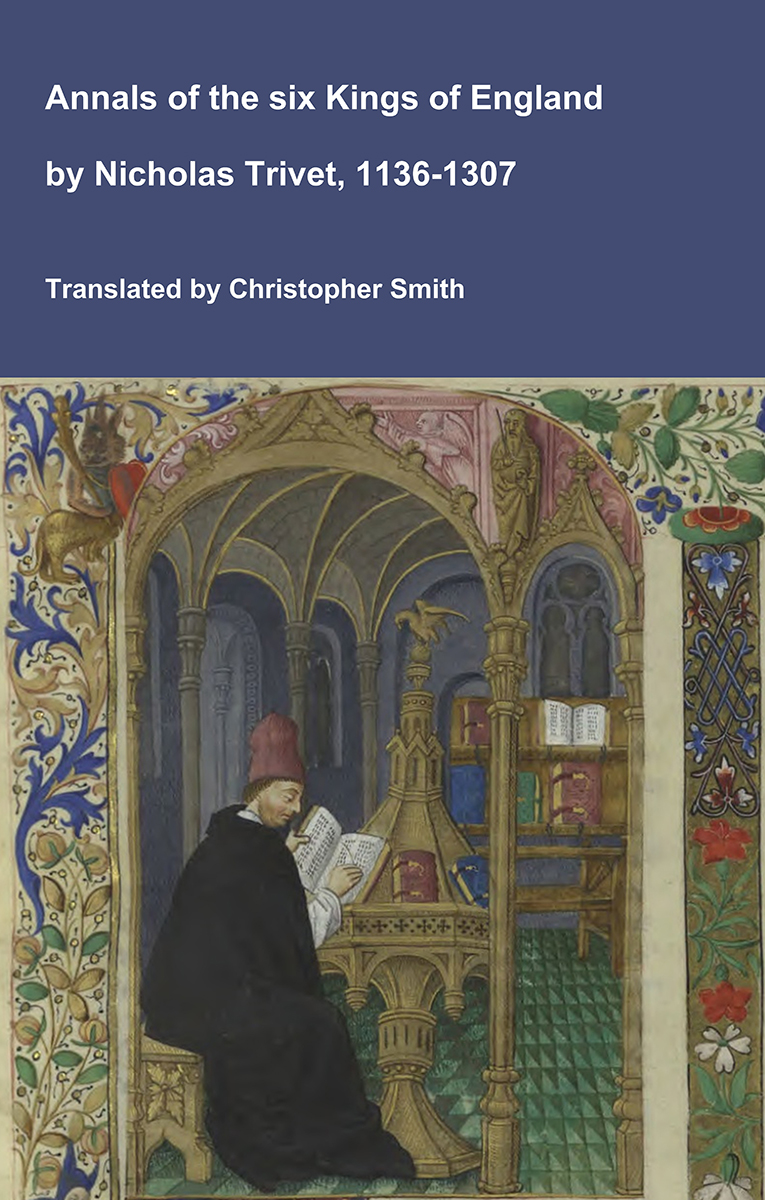 Annals of Six Kings of England by Nicholas Trivet. From there the king went to Bethenopolis. Since the army was breaking up, discouraged because the siege of Jerusalem had been dissuaded, and since he could not obtain a truce from Saladin unless Ascalon were destroyed, the king ordered the castle of Darum to be razed to the ground. From among the Hospitallers, Templars, and others he sent three hundred knights to guard and strongly fortify Ascalon. With the rest of the army the king made his way to Acre. On the very day the king arrived at Acre with his army, the following day, namely the feast of St James [25th July 1192], Saladin came with a very large force and besieged the city of Jaffa. On the feast of St Germanus [of Auxerre, 31st May 1192] the Turks broke through the wall and entered the city, plundering and destroying everything and cruelly killing all the Christians they found. They would also have quickly taken the main tower, into which many had fled, had not a truce been obtained through the patriarch until the ninth hour of the following day. If help did not come by then, the tower was to be surrendered to the Turks, and each man within was to pay Saladin ten bezants for his life, each woman five, and each child three. From the beginning of the siege messengers had been sent to Acre seeking aid. They found the king preparing to return home and already having sent ahead seven galleys with armed men to capture the castle of Beirut, through which he intended to pass. But when he heard of the condition of the city of Jaffa, he boarded ships with some knights and sailed there by sea, while the rest of the army marched by land. Contrary winds delayed him for three days, but at last he reached the harbour of Jaffa on the night before Saturday, the ninth hour of which day had been fixed as the time for surrendering the tower and paying the ransom. When the Turks learned of the king's arrival, they rushed in crowds to the shore carrying shields and bucklers. To prevent any landing, the resisting Turks poured down showers of javelins, arrows, and spears. The shore boiled with the multitude of enemies, whose horsemen even rode out into the sea to throw their missiles so that those arriving could not gain the land. Some advised the king that nothing further should be attempted, because so many thousands of enemies made landing impossible and it seemed unlikely that any of those in the tower were still alive, especially since the Turks had already anticipated the appointed hour and were demanding the bezants from the morning, and even after payment they were killing people regardless of their pledges. At that moment a certain priest swam to the king and, admitted into the royal galley, said with laboured breath and a still-pounding heart: "O magnificent king, the remnant of the people who await your coming stand with the executioners' swords raised over their necks like sheep ready for slaughter, and will perish unless divine help comes through you." The king asked, "Does anyone still survive? And where are they?" The priest replied, "Yes, lord, they are crowded before that tower, about to be struck down." Hearing this, the king said, "Let him perish who does not advance now." The king's galleys were therefore driven toward the shore by his command, and he himself was the first to leap into the sea up to his thighs, unarmoured. Next after the king were Geoffrey of Bois and Peter of Pratelles; all the others followed them, leaping into the water and advancing on foot toward the shore. The king, carrying in his hand an excellent crossbow, struck down Turks along the shore. His chosen companions also pursued the Turks along the wide stretch of the coast. Seeing the king, the Turks lost heart and dared not approach him further. When the shore had been cleared of Turks, the king alone first entered by a small stairway he had noticed in the houses of the Templars, and ordered his men to display their banners prominently. When these were seen, the multitude of Turks within the city, estimated at about three thousand, was thrown into great confusion. The king, advancing with his men and drawn sword, pursued the Turks as they fled; those who had been in the tower, recovering their strength and joining the royal troops, inflicted a dreadful slaughter on the Turks. When Saladin heard of the king's arrival and his engagement with those who had taken the city, he quickly struck his tents and fled. After Saladin's departure, King Richard pitched his own tents in that place. On the following Sunday and for the two days after, he carefully arranged for the broken walls to be repaired, though without lime or mortar, so that those in the city might at least have some form of defence.
Profectus inde rex venit Bethonopolim; ubi cum dilaberetur, exercitus, desolatus eo quod dissuaderetur obsidio Jerusalem, nec a Saladino potuit impetrare inducias nisi diruta Ascalone, jussit rex castrum Darum solo tenus dirui; et de Hospitalariis, Templariis, et aliis trecentos milites misit, qui custodirent et munirent firmissime Ascalonem. Rex cum reliquo exercitu Achonem contendit. Eadem vero die qua rex Saladin beAchonem venit cum exercitu, in crastino scilicetS. Jacobi, Saladinus cum maximo exercitu veniens Joppen civitatem obsedit. In die vero S. Germani effracto muro ingressi sunt Turci, diripientes omnia et destruentes, Christianosque quosque crudeliter perimentes; turrim etiam principalem, in quam multi confugerant, statim expugnassent, si non fuissent per patriarcham induciæ acceptæ usque ad horam nonam diei sequentis, ita ut nisi tunc veniret subsidium, redderetur Turcis, solveretque vir quisque qui in turri erat Saladino pro capite suo decem bizantia, mulier quinque, puerque tria. A principio vero obsidionis nuntii missi in Achon, pro subsidio quærendo, invenerunt regem se ad repatriandum parantem; jamque septem galeas cum gente armata, ad capiendum castrum Baruth, per quod erat transiturus, præmiserat. Qui, audito statu civitatis Joppe, ascendens naves cum aliquibus militibus illuc per mare contendit, reliquo exercitu terreno itinere gradiente. Venti autem contrarietate triduo retardatus, tandem in portum Joppe pervenit nocte præcedente diem Sabbati, cujus hora nona terminus erat reddendæ turris, et præfatæ redemptionis solvendæ. Cognito autem regis adventu, ruunt Turci catervatim in littus parmas habentes et ancilia; et ne qua parte liber pateret applicantibus ascensus, Turcorum resistentium pluunt densissime jacula, sagittæ, et pila: fervet littus obsitum hostium multitudine, quorum equites profundius in mare se agebant certatim spicula missuri, ne quando possent littus occupare appulsi. Cum autem nonnulli suaderent regi nihil ulterius tentandum, quia tot millia hostium littoris aditum asserebant impossibilem, nec credibile esse aliquos qui liberarentur superstites, præsertim cum jam Turci terminum prævenientes præfixum a mane bizantia exigerent, et nihilominus post solutionem postposita fidelitate quosque interficerent; ecce ad regem sacerdos quidam natando pervenit, qui in galeam regis admissus, spiritu fatigato et palpitante adhuc corde, ait ad regem: 'O rex magnifice, gens residua quæ tuum adspirat adventum, enses lanistarum vibratos cervicibus opperitur exertis, sicut oves occisionis jamjam perituri, nisi te cooperante Divinum adsit adjutorium.' Cui rex, 'Num superest quisquam? aut ubinam loci?' Cui sacerdos: 'Etiam, domine, coram illa turri coartantur jam feriendi.' Quo audito, 'Pereat,' inquit rex, 'modo qui non processerit.' Galeis igitur regis ad ejus imperium ad littus propulsis, ipse primus tibias inermis se misit in mare pube tenus; post regem primi erant et proximi Galfridus de Bosco et Petrus de Pratellis: hos omnes alii sequebantur, prosilientes in mare, et versus littus pedites procedebant. Rex autem singularis præstantiæ balista, quam manu gestabat, Turcos in littore passim prosternit; cujus etiam comites electi per littoris ampla Turcos cedentes persequebantur. Neque enim ulterius, viso rege, erat eis spiritus, nec eidem [appropiare] audebant. Littore a Turcis evacuato, rex per cocleam quandam, quam forte perspexerat in domibus Templariorum, solus primus intravit, suisque sequentibus jussit suas banerias eminentius explicari. Quibus cognitis, Turcorum multitudo, quæ ad tria millia infra civitatem æstimabatur, plurimum conturbatur. Rex cum suis extracto gladio progrediens, Turcos jam fugientes insequitur; et qui in turri erant resumptis viribus egressi, regiæque militiæ conjuncti, horrendam ingerunt Turcis cædem. Saladinus autem, audito regis adventu, et ejus congressu cum suis qui civitatem occupaverant, avulsis papilionibus velociter fugiendo abscessit. Rex autem Ricardus, post discessum Saladini, in eodem loco papiliones et tentoria fixit; in crastino vero die Dominica duobusque diebus sequentibus sollicite procuravit murorum diruta reparari, sed sine calce et cæmento, ut qualemcumque qui in urbe erant munitionem haberent.
Annals of Six Kings of England by Nicholas Trivet. In the same year William Marshal [aged 73], 1st Earl of Pembroke the elder died [on 14th May 1219], and was buried on the day after Ascension [31st May] at the Temple Church. He was fortunate in his children, having five sons, of whom William Marshal, 2nd Earl of Pembroke succeeded to his father's inheritance, and five daughters, whom he married in his lifetime: the eldest, Matilda, to Hugh Bigod, 3rd Earl of Norfolk; the second, Joan, to Warin de Montchensy; the third, Isabella, to Gilbert de Clare; the fourth, Sibyl, to William de Ferrers, 4th Earl of Derby; and the fifth, Eva, to William de Braose. Upon their heirs, when the male line failed, the whole and very great inheritance of the Marshal family devolved.
Hoc anno Willelmus Marescalli senior defungitur, et in crastino Ascensionis apud Novum Templum Londoniæ sepelitur. Hic prole felix, quinque habuit filios, quorum Willelmus fuit paternæ hereditatis successor: et quinque filias, quarum seniorem Matildem Hugoni Bigoth, secundam Joannam Garino de Monte-Camisii, tertiam Isabellam Gilberto de Clare, quartam Sibillam Willelmo de Ferrariis comiti Derebeyæ, quintam Evam Willelmo de Brehuse, dum adhuc viveret, maritavit. Ad quarum heredes, deficiente fratribus successione, totius Marescalliæ bereditas amplissima est devoluta.
 Bourgeois de Valenciennes. After Trinity Day [31st May 1327], while the knights were sleeping and their men were amusing themselves with one another in the fine warm weather, a knight from the land of Lincoln came with a great company of soldiers and fell upon the men of Hainaut in a deliberate attack. They shut the field gates in order to enclose the men of Hainaut so that none might escape. But the men of Hainaut defended themselves vigorously and cried out, "Hainaut!" Then the knights began to awaken, and my lord John leapt upon his horse, which had been made ready for him. And my lord Perceval de Lalain rode before him with his banner, and he had the trumpet sounded.
Quant ce vint après le jour de la Trinité, en tandis que les chevaliers se dormoient et s’esbanioient leurs gens l’un à l’autre et qu'il faisoit bel et chault, ung chevalier vint de la terre de Nicole à tout grant plenté de saudoyers et coururent sus aux gens de Haynault de fait avisé, et fermèrent les portes des champs pour enclore les Haynuiers que nul n’en yssist. Et les Haynuyers se deffendirent vigoreusement et crièrent: "Haynault!" Adont se commenchèrent les chevaliers à esveillier, et monseigneur Jehan sallit sur son cheval qu’on luy avoit appresté. Et monseigneur Percheval de Lalain devant luy à tout sa banière. Et fist sonner la trompette.
On 31st May 1328 the Mortimer family leveraged their new status at a lavish ceremony that celebrated the marriages of two of Roger Mortimer's [aged 41] daughters at Hereford [Map].
Edward Plantagenet [aged 8] and Beatrice Mortimer [aged 6] were married. She the daughter of Roger Mortimer 1st Earl March and Joan Geneville Baroness Mortimer 2nd Baroness Geneville [aged 42]. He the son of Thomas of Brotherton 1st Earl Norfolk [aged 27] and Alice Hales Countess Norfolk. They were half third cousin once removed. He a grandson of King Edward I of England. She a great x 4 granddaughter of King John of England.
Laurence Hastings 1st Earl Pembroke [aged 9] and Agnes Mortimer Countess of Pembroke [aged 11] were married. She the daughter of Roger Mortimer 1st Earl March and Joan Geneville Baroness Mortimer 2nd Baroness Geneville. He the son of John Hastings 2nd Baron Hastings 14th Baron Abergavenny and Juliana Leybourne Countess Huntingdon [aged 25]. They were third cousin once removed. She a great x 4 granddaughter of King John of England.
King Edward III of England [aged 15] and his mother Isabella of France Queen Consort England [aged 33] attended as well as Roger Mortimer 1st Earl March.
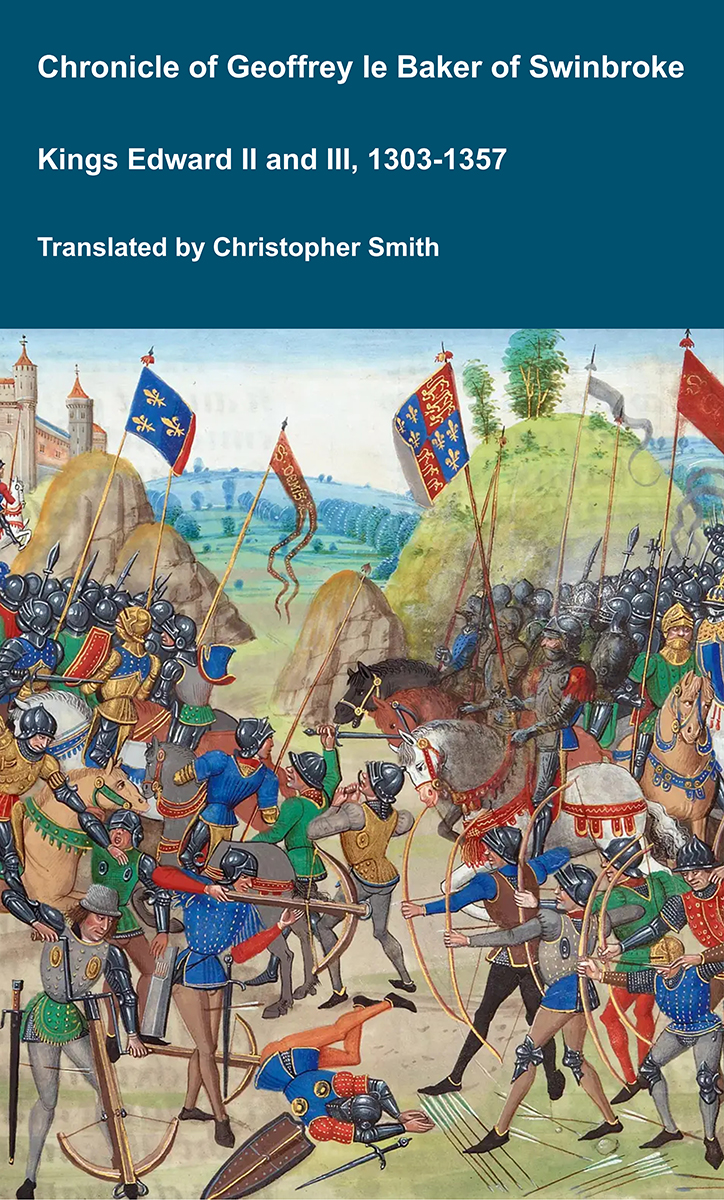 Chronicle of Geoffrey le Baker of Swinbroke. The King of England, after the aforementioned betrothal of his sister, shortly after the Feast of the Holy Trinity [31st May 1328], proceeded to Hereford, where solemn weddings were held for the daughters of Roger de Mortimer and certain noblemen,1 namely, the son of the Earl Marshal [aged 27] and the heir of Lord John of Hastings. There were also grand tournaments held there, in which the king's mother took part.
Rex Anglie, post predictam sue sororis desponsacionem, cito post festum sancte Trinitatis, se transtulit versus Herefordiam, ubi fuerunt solemnes nupcie inter filias Rogeri de Mortuo mari et quosdam nobiles, videlicet filium comitis Marescalli et heredem domini Iohannis de Hastinghes. Fuerunt eciam ibidem hastiludia solemnia, quibus interfuit mater regis.
Note 1. His daughter Beatrix [aged 6] was married to Edward [aged 8], son of Thomas of Brotherton; and Agnes [aged 11] to Laurence [aged 9], son of John, Lord Hastings, and afterwards earl of Pembroke. He had in all seven daughters, each of whom was married into some powerful family.

On 31st May 1359 Elizabeth Montagu Baroness Badlesmere and Despencer [aged 35] died. Monument in Tewkesbury Abbey [Map].
On 31st May 1410 King Martin I of Aragon [aged 53] died. His nephew Ferdinand [aged 29] succeeded I King Aragon.
On or after 31st May 1431, the date of the contract, Louis Valois Anjou III Duke Anjou [aged 27] and Margaret of Savoy [aged 10] were married. She the daughter of Amadeus Savoy VIII Count Savoy [aged 47] and Mary Valois Countess Savoy. He the son of King Louis of Naples and Yolande Barcelona Queen Consort Naples [aged 49]. They were second cousins. He a great x 5 grandson of King Henry III of England. She a great x 4 granddaughter of King Edward I of England.
On 31st May 1433 Holy Roman Emperor Sigismund [aged 65] was crowned Holy Roman Emperor Luxemburg at Rome, Italy [Map].

The True Chronicles of Jean le Bel Volume 1 Chapters 1-60 1307-1342
The True Chronicles of Jean le Bel offer one of the most vivid and immediate accounts of 14th-century Europe, written by a knight who lived through the events he describes, and experienced some of them first hand. Covering the early decades of the Hundred Years’ War, this remarkable chronicle follows the campaigns of Edward III of England, the politics of France and the Low Countries, and the shifting alliances that shaped medieval warfare. Unlike later historians, Jean le Bel writes with a strong sense of eyewitness authenticity, drawing on personal experience and the testimony of fellow soldiers. His narrative captures not only battles and sieges, but also the realities of military life, diplomacy, and the ideals of chivalry that governed noble society. A key source for Jean Froissart, Le Bel’s chronicle stands on its own as a compelling and insightful work, at once historical record and literary achievement. This translation builds on the 1905 edition published in French by Jules Viard, adding extensive translations from other sources Rymer's Fœdera, the Chronicles of Adam Murimuth, William Nangis, Walter of Guisborough, a Bourgeois of Valenciennes, Geoffrey le Baker of Swinbroke and Richard Lescot to enrich the original text and Viard's notes.
Available at Amazon in eBook and Paperback format.
On 31st May 1443 Margaret Beaufort Countess Richmond was born to John Beaufort 1st Duke of Somerset [aged 40] and Margaret Beauchamp Duchess Somerset [aged 33] at Bletsoe Castle [Map]. Some sources suggest her birth may have been two years earlier in 1441 by saying she was three years old when her father died on 30 May 1444 - see Excerpta Historica. She a great x 2 granddaughter of King Edward III of England. She married (1) January 1450 her half third cousin John de la Pole 2nd Duke of Suffolk, son of William "Jackanapes" de la Pole 1st Duke of Suffolk and Alice Chaucer Duchess Suffolk (2) 1st November 1455 her half fourth cousin once removed Edmund Tudor 1st Earl Richmond, son of Owen Tudor and Catherine of Valois Queen Consort England, and had issue (3) 3rd January 1458 her second cousin Henry Stafford, son of Humphrey Stafford 1st Duke of Buckingham and Anne Neville Duchess Buckingham (4) 12th June 1472 her third cousin Thomas Stanley 1st Earl of Derby, son of Thomas Stanley 1st Baron Stanley and Jane Goushill Baroness Stanley.


Excerpta Historica Page 3. [31st May 1444.] Grant Of The Wardship Of Margaret [aged 1], Daughter And Heiress Of John Beaufort [deceased], Duke Of Somerset, To William De La Pole [aged 47], Earl Of Suffolk, In The 22nd Hen. Vi. 1443.
Until the reign of Charles the Second, the custody of the lands of minors formed a profitable branch of the royal prerogative, their wardship being either sold by the Crown, or conferred on some faithful servant or needy favourite. The death of John de Beaufort, Duke of Somerset, grandson of John of Gaunt, in 1443, leaving by Margaret [aged 34], daughter of Sir John Beauchamp of Bletsho, a daughter Margaret, only three years of age, his heir, afforded the King an opportunity of rewarding, in a substantial manner, Michael de la Pole, Earl of Suffolk, who was the next year created Marquess, and soon afterwards Duke, of Suffolk; but who, after attaining the highest honours, having been Lord Chancellor, and Lord High Admiral, was beheaded in a cock-boat near Dover in 1450.
The young heiress became one of the most distinguished women of her age: the foundress of a college, the patroness of literature, the mother of a sovereign, and progenitrix of every subsequent monarch of England. When very young, she married Edmond Tudor [aged 13], Earl of Richmond, by whom, at the age of fifteen, she was mother of King Henry VII. The Earl died in 1456, and she married, secondly, Sir Henry Stafford [aged 19], a younger son of Humphrey, Duke of Buckingham [aged 41]; and thirdly, Thomas, Lord Stanley [aged 9], first Earl of Derby. This illustrious lady lived just long enough to see her grandson on the Throne, and dying on the 29th of June, 1 Hen. VIII. 1509, aged about sixty-nine, was interred in the south aisle of Henry the Seventh's Chapel at Westminster.
Right Reverend fader in God Right trusty and Right welbeloved we grete you wel. And for as moche as oure Cousin the Duc of Somerset is nowe late passed to God mercy the whiche hath a doughter and heir to succede after hym of ful tender age called Margarete. We considering the notable services that oure Cousin the earl of Suffolk hath doon unto us and tendering hym therfore the more spially as reson wol have of oure grace and espialle propre mocion and mere deliberacion graunted unto hym to have the warde and mariage of the said Margarete withouten eny thing therfore unto us or oure heires yelding. Wherfore we wol and charge you that unto oure said Cousin of Suffolk ye do make upon this oure graunte oure tres patent souffisant in lawe and in deue forme. And that ye faille not hereof. As we spially truste you and as ye desire to do unto us singuleir plesir. And that ye sende unto us oure said tres patent seeled by the berer of these. Lating you wite that ye shal hereafter at suche tyme as ye come unto oure presence have suche warrant for youre discharge in this behalve. As shal be souffisant unto you and as the cas requireth. Yeven under oure signet at oure Castel of Berkhampstede [Map] the laste day of May.
To the Right Reverend fader in God oure Right trusty and Right wel beloved the archebisshop of Caunterbury oure Chancellor of Englande.
On 31st May 1469 Manuel "Fortunate" I King Portugal was born to Ferdinand Aviz 2nd Duke Viseu [aged 35] and Beatrice Aviz Duchess Viseu [aged 38]. He a great x 3 grandson of King Edward III of England. Coefficient of inbreeding 9.54%. He married (1) 1497 his first cousin once removed Isabella Trastámara Queen Consort Portugal, daughter of Ferdinand II King Aragon and Isabella Queen Castile, and had issue (2) 1500 his first cousin once removed Maria Trastámara Queen Consort Portugal, daughter of Ferdinand II King Aragon and Isabella Queen Castile, and had issue (3) 16th July 1518 his first cousin twice removed Eleanor of Austria Queen Consort France Queen Consort Portugal, daughter of Philip "Handsome Fair" King Castile and Joanna "The Mad" Trastámara Queen Castile, and had issue.
On 31st May 1475 Unamed Trastámara was born to Ferdinand II King Aragon [aged 23] and Isabella Queen Castile [aged 24]. He a great x 3 grandson of King Edward III of England. Coefficient of inbreeding 3.23%. He died aged less than one years old.


On 31st May 1495 Cecily "Rose of Raby" Neville Duchess York [aged 80] died. She was buried at St Mary and All Saints Church, Fotheringhay [Map].
Chronicle of Edward Hall [1496-1548]. 31st May 1522. The same day at afternoon, the two noble princes marched forward to Canterbury, where the Mayor and Aldermen received them without the town, with a solemn oration, to whom the Emperor's Secretary answered ornately. Then the Princes with their swords borne naked before them, and the Emperour [aged 22] on the right hand, entered the city of Canterbury, and so with procession were brought to Christes Church [Map] where the Archbishop [aged 72] and twelve prelates mitred, received them under a canopy, and so they offered to the Sacrament, and the Emperor was brought to the Bishop's palace, where he lay for that night, and the King lodged at St Augustine's [Map].


The Noble Triumphant Coronacyon of Quene Anne. 31st May 1532. Also the Saturday the last daye of May the Kynge made Knyghtes of the swerde in the towre of London whose names folowe.
Syr Wyllyam Drury.
Syr John Gernyngham.
Syr Thomas Rusche.
Syr Randolfe Buerton.
Syr George Caluerly.
Syr Edwarde Fytton.
Syr George Conyers.
Syr Robert Nedham.
Syr Johan Chaworth.
Syr George Gresley.
Syr Johan Constable.
Syr Thomas Umpton.
Syr John Horsley.
Syr Richarde Lygon.
Syr Johan Saintclere.
Syr Edwarde Maidison.
Syr Henry Feryngton.
Syr Marmaduc Tustall.
Syr Thomas Halsall.
Syr Robert Thyrkham.
Sir [sic] Anthony Wyndsour.
Syr Water Hubbert.
Syr Johan Wyllongby.
Syr Thomas Thytson.
Sir Thomas Mysseden.
Sir Thomas Fouleshurst.
Sir Henry Delues.
Sir Peter Warburton.
Sir Rycharde Bulkelley.
Sir Thomas Lakyng.
Sir Henry Lakyng.
Sir Water Smythe.
Sir Henry Eueringham.
Sir Willyam Unedall.
Sir Tho. Massyngberd.
Sir Willyam Sandon.
Sir James Baskeruille.
Sir Edmonde Trafforde.
Sir Arthur Eyre.
Sir Henry Sutton.
Sir Johan Nories.
Sir Willyam Malorie.
Sir Johan Harcourt.
Sir Johan Tyrell.
Sir Willyam Browne.
Sir Nycolas Sturley.
Sir Randolfe Manering.
Letters and Papers Foreign and Domestic Henry VIII 1533. 31st May 1533. R. MS. 18, A. LXIV. B. M. 564. Queen Anne Boleyn.
Verses composed by Nic. Udall, and spoken at the pageants in Cornhill, Leadenhall, and Cheapside, at queen Anne's procession through the city.
"Hereafter ensueth a copy of divers and sundry verses, as well in Latin as in English1, devised and made partly by John Leland, and partly by Nicholas Vuedale, whereof some were set up and some other were spoken and pronounced unto the most high and excellent Queen the lady Anne, wife unto our sovereign lord king Henry the Eight, in many goodly and costely pageants exhibited and showed by the mayor and citizens of the famous city of London at such time as her Grace rode from the Tower of London through the said city to her most glorious coronation at the monastery of Westminster, on Whitson eve in the xxvth year of the reign of our said sovereign lord." Latin and English, pp. 29. Endorsement pasted on: Versis and dities made at the coronation of Quene Anne.
Note 1. Several of the English verses are printed by Arber in his "English Garner," ii. 52.
An English Garner Volume 2 Page 52. Nicholas Udall. English Verses and Ditties at the Coronation Procession of Queen Anne Boleyn. [Royal MS. 18. A. Lxiv.]
At the Pageant representing the Progeny of Saint ANNE, exhibited at Cornhill, besides Leadenhall.
Were pronounced unto the Queen's Grace, these words following.
Most excellent Queen, and bounteous Lady!
Here now to see your gracious Goodness,
With such honour entering this City;
What joy we take, what hearty gladness, No pen may write, nor any tongue express! For of you, depend the sure felicity And hope, both of us and our posterity.
For like as from this devout Saint ANNE
Issued this holy generation,
First CHRIST, to redeem the soul of man;
Then JAMES th'apostle, and th'evangelist JOHN;
With these others, which in such fashion
By teaching and good life, our faith confirmed,
That from that time yet to, it hath not failed:
Right so, dear Lady! our Queen most excellent!
Highly endued with all gifts of grace,
As by your living is well apparent;
We, the Citizens, by you, in short space,
Hope such issue and descent to purchase;
Whereby the same faith shall be defended,
And this City from all dangers preserved.
Which time that we may right shortly see,
To our great comfort, joy and solace;
Grant the most high and blessed Trinity!
Most humbly beseeching your noble Grace,
Our rude simpleness showed in this place To pardon;
and, the brief time considering,
To esteem our good minds, and not the thing.
Wriothesley's Chronicle [1508-1562]. 31st May 1533. And on Saturdaie, the last daie of Maie, shee [aged 32] rode from the Towre of London [Map] throwe the Cittie,a with a goodlie companye of Lordes, Knightes, and Gentlemen, with all the Peares of the Realme, rytchlie apparailed, and also eightene Knightes of the Bath newlie made, ridinge in blewe gownes with hoodes on their sholders purfeled with white, and white laces of silke knitt on the left sholders of their gownes. And she herself riding in a rytch chariott covered with cloath of silver, and a rich canapie of cloath of silver borne over her heade by the fower Lordes of the Portes,b in gownes of Scarlett, and fower chariotts, with ladies followinge after her rytchlie behanged; and also divers other ladies and gentlewomen riding on horscbacke all in gownes made of crymson velvett; and their was divers pageants made on skaffoldes in the Cittie; and all the craftes standing in their liveries everie one in order, the Major and Aldermen standinge in Cheepeside; and when she came before them the Recorder of London made a goodlie preposition to her, and then the Majorc gave her a purse of cloath of golde, with a thousand markes of angell nobles in it, for a presente for the whole bodie of the Cittie; and so the Lordes brought her to the Palace at Westminster, and their left her that night.
Note a. The City on this occasion appears to hare been decorated in a more somptaoos manner than at any time heretofore. — Maitland's "History of London," p. 188.
Note b. Cinque Ports.
Note c. According to Stow, it was Master Baker, the Recorder of London, who presented to Anne Boleyn the City purse, containing one thousand marks of gold.


Letters and Papers. [31 May 1536]. R. O. 1008. Anne Boleyn's Debtors.
Abstract of the "arrearages" of divers persons, due to the late Queen Anne at Michaelmas 27 Henry VIII.
Northt.—Berkhampstede, from lord Vaux.
Berks.—Newbury, from John Erley.
Wilts.—Dychamton, fr. Sir Humph. Stafford; Marleborough, fr. John Wylks.
Linc.—Grantham, fr. Francis Halle; Kelby, fr. the heir of George Taylbos, of the fee farm of Shillinghope.
Herts.—Huchyn, John Smyth.
Norf.—From the Earl of Rutland [aged 44], Richard Southwell, William Conyngesby, and Sir John Heydon.
Hants.—Southampton.
Salop.—Fordeshome.
Total, £197 13s. 1d. ¼ 1/8.
Lat., pp. 4.
Letters and Papers. 31st May 1536. Vesp. F. XIII. f. 109 b. B. M. Arch, XVII., 277. Ellis, 1 S. II., 67. 1010. Jane [aged 31], widow of Lord Rochford [deceased], to [Cromwell].
Beseeching him to obtain from the King for her the stuff and plate of her husband. The King and her father paid 2,000 marks for her jointure to the Earl of Wyltchere [aged 59], and she is only assured of 100 marks during the Earl's life, "which is very hard for me to shift the world withal." Prays him to inform the King of this. Signed.
P. 1. Begins: Master Secretary.
Letters and Papers. 31 May. R. O. 1000. John Husee to Lord Lisle [aged 72].
The bearer, Mrs. Alice Warton, is the gentlewoman I wrote of, and I trust will do you good service. She has taken out a great part of the cushion, but has not had leisure to take out the whole. There remains the tree or flower and the beast, which is an unicorn. If you will have it taken out, I will get some woman or painter to do it. You will receive by this ship two dozen bowls, which cost 4s., and the coals which Annes Woodrove bought for you. It is said the coronation will not be till Michaelmas. "The King was married yesterday [to Jane Seymour [aged 27]] in the Queen's closet at York Place or Manor, whose Grace is determined to see the watch on Midsummer night." London, 31 May.
Hol., p. 1. Add.
P.S. on the back:—Mine host Cross sends in this ship a kilderkin of ale, and desires his barrel again and some venison. Mine hostess will have half the thanks.


Henry Machyn's Diary. 31st May 1551. The xxxj day of May my lord the yerle of Darbe [aged 42] [came] to Clessay [Possibly Cheslea?] owt of the North, with a goodly compeny of men and horssys.
On 31st May 1594 Tintoretto [aged 75] died.
Chronicle of Abbot Ralph of Coggeshall
The Chronicle of Abbot Ralph of Coggeshall (Chronicon Anglicanum) is an indispensable medieval history that brings to life centuries of English and European affairs through the eyes of a learned Cistercian monk. Ralph of Coggeshall, abbot of the Abbey of Coggeshall in Essex in the early 13th century, continued and expanded his community’s chronicle, documenting events from the Norman Conquest of 1066 into the tumultuous reign of King Henry III. Blending eyewitness testimony, careful compilation, and the monastic commitment to record-keeping, this chronicle offers a rare narrative of political intrigue, royal power struggles, and social upheaval in England and beyond. Ralph’s work captures the reigns of pivotal figures such as Richard I and King John, providing invaluable insights into their characters, decisions, and the forces that shaped medieval rule. More than a simple annal, Chronicon Anglicanum conveys the texture of medieval life and governance, making it a rich source for scholars and readers fascinated by English history, monastic authorship, and the shaping of the medieval world.
Available at Amazon in eBook and Paperback format.
On 31st May 1613 John George Wettin Elector Saxony was born to John George Elector Saxony [aged 28] and Magdalene Sibylle of Prussia [aged 26].

Diary of Anne Clifford. 31st May 1616. Upon the 31st came Mr Amherst from my Lord [aged 27] and brought me word that my Lord would be here on Saturday. The same day Mr James brought me a letter from Mr Woolrich wherein it seemed it was my Mother's pleasure her body should be conveyed to what place I appointed which was some contentment to my aggrieved soul.
Diary of Anne Clifford. 31st May 1619. The 31st I stayed at home and was sad and melancholy.
Note. After I came out of town my Lord Chancellor had the tenants before him and willed them to yield to my Uncle Cumberland, at which time he gave Mr Davis bad words.
The 27th my Lord [aged 30] and my Brother Sackville and I, Moll Neville and Mr Longworth rid abroad on horseback in Whitby Wood and did not sup till 8 or 9 o'clock. After supper my Lord and I walked before the gate where I told him how good he was teverybody else and how unkind to me. In conclusion he promised me in a manner that he would make me a jointure of four thousand pounds a year, whereof part should be of the land he has assured to my Uncle Cumberland.
This term there was great expectation that my Lord and Lord Suffolk and that faction would be proceeded against in the Star Chamber but at their suit it was put off till Michaelmas Term. This term Lord William Howard put a Bill into the Star Chamber against Sir William Hatton and others of my Coz. Clifford's faction. This term my Lord kept an exceeding great table, at dinner had much company. He had often cocking and sometimes with the King at Greenwich and won a great deal of money.
The 19th Lady Rosse's submission was read in the Star Chamber but Sir Thomas and Lady Lake refused to submit, for which their contempt they were committed close prisoners to the Tower. The 21st Sir Thomas Glenham [aged 25] married Sir Peter Vavasour's daughter with whom he had a great portion. This marriage was at her Father's house and very private.
About this time my Coz. Mary made an end of reading Parson's resolutions to me.

After 31st May 1638. Monument to Walter Chetwynd [deceased] at St Mary the Virgin Church, Ingestre [Map]. Left side. The inscription refers to his first wife Mary Mullins [aged 78] and their sons Walter Chetwynd [aged 40] and Thomas Chetwynd [aged 39], and their daughter Mary Chetwynd who married George Digby, and to his second wife Katherine Hastings [deceased], daughter of George Hastings 4th Earl Huntingdon, who married first Edward Unton
Right side. Walter Chetwynd.
Left side below. Katherine Hastings, wife of Edward Unton and Walter Chetwynd.
Walter Chetwynd: In 1598 he was born to Walter Chetwynd and Mary Mullins. On 2nd July 1632 Walter Chetwynd and Frances Hesilrige were married at St Dunstan's in the West, Fleet Street [Map]. On 31st May 1638 Walter Chetwynd died. His son Walter Chetwynd inherited Ingestre Hall, Staffordshire. On 19th April 1669 Walter Chetwynd died. His son Walter Chetwynd inherited Ingestre Hall, Staffordshire.
Katherine Hastings: Around 1557 she was born to George Hastings 4th Earl Huntingdon and Dorothy Port Countess Huntingdon. In 1579 Edward Unton and she were married. There were no children from the marriage. She the daughter of George Hastings 4th Earl Huntingdon and Dorothy Port Countess Huntingdon. He the son of Edward Unton and Anne Seymour Countess of Warwick. They were half fifth cousin once removed. On or after 13th April 1605, the date of the licence, Walter Chetwynd and she were married. She the daughter of George Hastings 4th Earl Huntingdon and Dorothy Port Countess Huntingdon. They were fifth cousin once removed. On 25th May 1638 Katherine Hastings died.
John Evelyn's Diary. 31st May 1641. To Nimeguen [Map]: and on the 2nd of August we arrived at the League, where was then the whole army encamped about Genep, a very strong castle situated on the river Waal; but, being taken four or five days before, we had only a sight of the demolitions. The next Sunday was the thanksgiving sermons performed in Colonel Goring's [aged 32] regiment (eldest son of the since Earl of Norwich) by Mr. Goffe [aged 36], his chaplain (now turned Roman, and father-confessor to the Queen-Mother [aged 31]). The evening was spent in firing cannon and other expressions of military triumphs.


On 31st May 1653 Ferdinand IV King of the Romans [aged 19] succeeded IV King Romans.
John Evelyn's Diary. 31st May 1658. I went to visit my Lady Peterborough [aged 55], whose son, Mr. Mordaunt [aged 31], prisoner in the Tower [Map], was now on his trial, and acquitted but by one voice; but that holy martyr, Dr. Hewer, was condemned to die without law, jury, or justice, but by a mock Council of State, as they called it. A dangerous, treacherous time!
Samuel Pepys' Diary. 31st May 1660. All the morning making orders. After dinner a great while below in the great cabin trying with W. Howe some of Mr. Laws' songs,' particularly that of "What is a kiss", with which we had a great deal of pleasure. After that to making of orders again. Captain Sparling of the Assistance brought me a pair of silk stockings of a light blue, which I was much pleased with. The Captain and I to supper, and after that a most pleasant walk till to at night with him upon the deck, it being a fine evening. My pain was gone again that I had yesterday, blessed be God. This day the month ends, I in very good health, and all the world in a merry mood because of the King's [aged 30] coming. This day I began to teach Mr. Edward; who I find to have a very good foundation laid for his Latin by Mr. Fuller [aged 52]. I expect every minute to hear how my poor wife do. I find myself in all things well as to body and mind, but troubled for the absence of my wife.
Samuel Pepys' Diary. 31st May 1662. The Queen [aged 23] is brought a few days since to Hampton Court [Map]; and all people say of her to be a very fine and handsome lady, and very discreet; and that the King [aged 32] is pleased enough with her which, I fear, will put Madam Castlemaine's [aged 21] nose out of joynt. The Court is wholly now at Hampton.


Samuel Pepys' Diary. 31st May 1662. My Lord Sandwich [aged 36] is lately come with the Queen [aged 23] from sea, very well and in good repute.


John Evelyn's Diary. 31st May 1662. I saw the Queen [aged 23] at dinner; the Judges came to compliment her arrival, and, after them, the Duke of Ormond [aged 51] brought me to kiss her hand.


Samuel Pepys' Diary. 31st May 1663. Being come from church, I to make up my month's accounts, and find myself clear worth £726, for which God be praised, but yet I might have been better by £20 almost had I forborne some layings out in dancing and other things upon my wife, and going to plays and other things merely to ease my mind as to the business of the dancing-master, which I bless God is now over and I falling to my quiet of mind and business again, which I have for a fortnight neglected too much. This month the greatest news is, the height and heat that the Parliament is in, in enquiring into the revenue, which displeases the Court, and their backwardness to give the King [aged 33] any money. Their enquiring into the selling of places do trouble a great many among the chief, my Chancellor [aged 54] (against whom particularly it is carried), and Mr. Coventry [aged 35]; for which I am sorry.


The Deeds of the Dukes of Normandy
The Gesta Normannorum Ducum [The Deeds of the Dukes of Normandy] is a landmark medieval chronicle tracing the rise and fall of the Norman dynasty from its early roots through the pivotal events surrounding the Norman Conquest of England. Originally penned in Latin by the monk William of Jumièges shortly before 1060 and later expanded at the behest of William the Conqueror, the work chronicles the deeds, politics, battles, and leadership of the Norman dukes, especially William’s own claim to the English throne. The narrative combines earlier historical sources with firsthand information and oral testimony to present an authoritative account of Normandy’s transformation from a Viking settlement into one of medieval Europe’s most powerful realms. William’s history emphasizes the legitimacy, military prowess, and governance of the Norman line, framing their expansion, including the conquest of England, as both divinely sanctioned and noble in purpose. Later chroniclers such as Orderic Vitalis and Robert of Torigni continued the history, extending the coverage into the 12th century, providing broader context on ducal rule and its impact. Today this classic work remains a foundational source for understanding Norman identity, medieval statesmanship, and the historical forces that reshaped England and Western Europe between 800AD and 1100AD.
Available at Amazon in eBook and Paperback format.
Samuel Pepys' Diary. 31st May 1664. I was told to-day, that upon Sunday night last, being the King's birth-day, the King [aged 34] was at my Baroness Castlemayne's [aged 23] lodgings (over the hither-gates at Lambert's lodgings) dancing with fiddlers all night almost; and all the world coming by taking notice of it, which I am sorry to hear.
Samuel Pepys' Diary. 31st May 1664. Thence to my Lord Sandwich's [aged 38], and while he was dressing I below discoursed with Captain Cooke [aged 48], and I think if I do find it fit to keep a boy at all I had as good be supplied from him with one as any body.
Samuel Pepys' Diary. 31st May 1664. So abroad with my wife by coach to St. James's, to one Lady Poultny's, where I found my Lord, I doubt, at some vain pleasure or other. I did give him a short account of what I had done with Mr. Coventry [aged 36], and so left him, and to my wife again in the coach, and with her to the Parke, but the Queene [aged 54] being gone by the Parke to Kensington, we staid not but straight home and to supper (the first time I have done so this summer), and so to my office doing business, and then to my monthly accounts, where to my great comfort I find myself better than I was still the last month, and now come to £930.
Samuel Pepys' Diary. 31st May 1664. Up, and called upon Mr. Hollyard [aged 55], with whom I advised and shall fall upon some course of doing something for my disease of the wind, which grows upon me every day more and more.
Samuel Pepys' Diary. 31st May 1665. So weary and sleepy to bed. I endeavoured but missed of seeing Sir Thomas Ingram [aged 50] at Westminster, so went to Houseman's the Painter [aged 32], who I intend shall draw my wife, but he was not within, but I saw several very good pictures.
Samuel Pepys' Diary. 31st May 1666. Homewood, and I took him home in the evening to my chamber, and discoursed with him about my business of the Victualling, which I have a mind to employ him in, and he is desirous of also, but do very ingenuously declare he understands it not so well as other things, and desires to be informed in the nature of it before he attempts it, which I like well, and so I carried him to Mr. Gibson to discourse with him about it, and so home again to my accounts. Thus ends this month, with my mind oppressed by my defect in my duty of the Victualling, which lies upon me as a burden, till I get myself into a better posture therein, and hinders me and casts down my courage in every thing else that belongs to me, and the jealousy I have of Sir W. Coventry's [aged 38] being displeased with me about it; but I hope in a little time to remedy all. As to publique business; by late tidings of the French fleete being come to Rochelle (how true, though, I know not) our fleete is divided; Prince Rupert [aged 46] being gone with about thirty ships to the Westward as is conceived to meet the French, to hinder their coming to join with the Dutch. My Lord Duke of Albemarle [aged 57] lies in the Downes with the rest, and intends presently to sail to the Gunfleete.


Samuel Pepys' Diary. 31st May 1667. Thence to Sir G. Carteret [aged 57] at his lodgings; who, I perceive, is mightily displeased with this new Treasury; and he hath reason, for it will eclipse him; and he tells me that my Lord Ashly [aged 45] says they understand nothing; and he says he believes the King [aged 37] do not intend they shall sit long. But I believe no such thing, but that the King will find such benefit by them as he will desire to have them continue, as we see he hath done, in the late new Act that was so much decried about the King; but yet the King hath since permitted it, and found good by it. He says, and I believe, that a great many persons at Court are angry at the rise of this Duncomb [aged 44], whose father, he tells me, was a long-Parliamentman, and a great Committee-man; and this fellow used to carry his papers to Committees after him: he was a kind of an atturny: but for all this, I believe this man will be a great man, in spite of all.


Samuel Pepys' Diary. 31st May 1668. At noon I sent for Mr. Mills and his wife and daughter to dine, and they dined with me, and W. Hewer [aged 26], and very good company, I being in good humour. They gone to church, comes Mr. Tempest, and he and I sang a psalm or two, and so parted, and I by water to the New Exchange, and there to Mrs. Pierce's, where Knepp, and she, and W. Howe, and Mr. Pierce, and little Betty, over to Fox Hall, and there walked and supped with great pleasure. Here was Mrs. Manuel also, and mighty good company, and good mirth in making W. Howe spend his six or seven shillings, and so they called him altogether "Cully". So back, and at Somerset-stairs do understand that a boy is newly drowned, washing himself there, and they cannot find his body. So seeing them home, I home by water, W. Howe going with me, and after some talk he lay at my house, and all to bed. Here I hear that Mrs. Davis [aged 20] is quite gone from the Duke of York's [aged 34] house, and Gosnell comes in her room, which I am glad of. At the play at Court the other night, Mrs. Davis was there; and when she was to come to dance her jigg, the Queene [aged 58] would not stay to see it, which people do think it was out of displeasure at her being the King's whore, that she could not bear it. My Baroness Castlemayne [aged 27] is, it seems, now mightily out of request, the King [aged 38] coming little to her, and thus she mighty melancholy and discontented.
On 31st May 1670 Josceline Percy 11th Earl of Northumberland [aged 25] died in Turin without male issue. Earl of Northumberland, Baron Percy of Alnwick and Baron Percy of Topcliffe, Baron Percy of Alnwick and Baron Poynings extinct. His daughter Elizabeth [aged 3] was his sole heiress.


On 25th May 1671 Henry Wood 1st Baronet [aged 73] died without male issue. Baronet Wood extinct. On 31st May 1671 he was buried at Ufford, Suffolk. His daughter Mary Wood Duchess Southampton [aged 8] was his heir. In view of the great wealth she was to inherit she was betrothed to Charles Fitzroy 1st Duke Southampton 2nd Duke Cleveland [aged 8], an illegitmate son of King Charles II of England Scotland and Ireland [aged 40] and Barbara Villiers 1st Duchess of Cleveland [aged 30]. On her father's death she went to live with Barbara Villiers 1st Duchess of Cleveland. They, Mary Wood Duchess Southampton and Charles Fitzroy 1st Duke Southampton 2nd Duke Cleveland married 1679 but she died a year later from smallpox.
The History of William Marshal was commissioned by his son shortly after William’s death in 1219 to celebrate the Marshal’s remarkable life; it is an authentic, contemporary voice. The manuscript was discovered in 1861 by French historian Paul Meyer. Meyer published the manuscript in its original Anglo-French in 1891 in two books. This book is a line by line translation of the first of Meyer’s books; lines 1-10152. Book 1 of the History begins in 1139 and ends in 1194. It describes the events of the Anarchy, the role of William’s father John, John’s marriages, William’s childhood, his role as a hostage at the siege of Newbury, his injury and imprisonment in Poitou where he met Eleanor of Aquitaine and his life as a knight errant. It continues with the accusation against him of an improper relationship with Margaret, wife of Henry the Young King, his exile, and return, the death of Henry the Young King, the rebellion of Richard, the future King Richard I, war with France, the death of King Henry II, and the capture of King Richard, and the rebellion of John, the future King John. It ends with the release of King Richard and the death of John Marshal.
Available at Amazon in eBook and Paperback format.
John Evelyn's Diary. 31st May 1672. Here, I cannot but make some reflections on things past. It was not above a day or two that going to Whitehall [Map] to take leave of his Lordship [deceased], who had his lodgings in the Privy-Garden, shaking me by the hand he bid me good-by, and said he thought he would see me no more, and I saw, to my thinking, something boding in his countenance: "No", says he, "they will not have me live. Had I lost a fleet (meaning on his return from Bergen when he took the East India prize) I should have fared better; but, be as it pleases God-I must do something, I know not what, to save my reputation". Something to this effect, he had hinted to me; thus I took my leave. I well remember that the Duke of Albemarle, and my now Lord Clifford [aged 41], had, I know not why, no great opinion of his courage, because, in former conflicts, being an able and experienced seaman (which neither of them were), he always brought off his Majesty's [aged 42] ships without loss, though not without as many marks of true courage as the stoutest of them; and I am a witness that, in the late war, his own ship was pierced like a colander. But the business was, he was utterly against this war from the beginning, and abhorred the attacking of the Smyrna fleet; he did not favour the heady expedition of Clifford at Bergen, nor was he so furious and confident as was the Duke of Albemarle, who believed he could vanquish the Hollanders with one squadron. My Lord Sandwich was prudent as well as valiant, and always governed his affairs with success and little loss; he was for deliberation and reason, they for action and slaughter without either; and for this, whispered as if my Lord Sandwich was not so gallant, because he was not so rash, and knew how fatal it was to lose a fleet, such as was that under his conduct, and for which these very persons would have censured him on the other side. This it was, I am confident, grieved him, and made him enter like a lion, and fight like one too, in the midst of the hottest service, where the stoutest of the rest seeing him engaged, and so many ships upon him, dared not, or would not, come to his succor, as some of them, whom I know, might have done. Thus, this gallant person perished, to gratify the pride and envy of some I named.

John Evelyn's Diary. 31st May 1672. I received another command to repair to the seaside; so I went to Rochester, Kent [Map], where I found many wounded, sick, and prisoners, newly put on shore after the engagement on the 28th, in which the Earl of Sandwich [deceased], that incomparable person and my particular friend, and divers more whom I loved, were lost. My Lord (who was Admiral of the Blue) was in the "Prince", which was burnt, one of the best men-of-war that ever spread canvas on the sea. There were lost with this brave man, a son of Sir Charles Cotterell [aged 57] (Master of the Ceremonies), and a son [aged 32] of Sir Charles Harbord (his Majesty's [aged 42] Surveyor-General), two valiant and most accomplished youths, full of virtue and courage, who might have saved themselves; but chose to perish with my Lord, whom they honoured and loved above their own lives.

John Evelyn's Diary. 31st May 1675. I went with Lord Ossory [aged 40] to Deptford, Kent [Map], where we chose him Master of the Trinity Company.

On 31st May 1731 Philip Wharton 1st Duke Wharton died. Duke Wharton, Marquess Wharton and Earl Wharton extinct. Baron Wharton abeyant between Jane Wharton [aged 25] and Lucy Wharton Lady Morice.
On 31st May 1734 Edward Stanton [aged 53] died. He was buried at St Andrew's Church, Holborn [Map].
On 31st May 1740 Frederick William "Soldier King" I King Prussia [aged 51] died. His son Frederick [aged 28] succeeded I King Prussia.
On 31st May 1750 Victor Amadeus III King Sardinia [aged 24] and Infanta Maria Antonia Spain [aged 20] were married. She the daughter of Philippe V King Spain and Elisabeth Farnese Queen Consort Spain [aged 57]. He the son of Charles Emmanuel III King Sardinia [aged 49] and Polyxena Hesse Rotenburg Queen Consort Sardinia. They were third cousins. He a great x 2 grandson of King Charles I of England, Scotland and Ireland.
On 31st May 1762 William Courtenay 7th Earl Devon [deceased] was buried at Powderham, Devon.
On 31st May 1778 John Jackson was born.
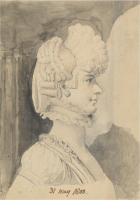
31st May 1800. Henry Fuseli [aged 59]. Sophia Rawlins, the artist's wife, in profile.
Archaeologia Volume 15 Section XI Page 122. Sir, Heytesbury, May 31, 1802
The numerous tumuli or barrows, that meet the eye of the traveller in every direction, as he passes over the Wiltshire. and Dorsetshire Downs; naturally excite the curious mind to know the history of these ancient and simple monuments.
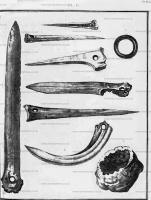
Stukeley, Borlase, and other able antiquaries, [a] have. written much on these subjects, and we have many accounts of casual discoveries in barrows; but it rarely happens that the latter details are marked with that accuracy which, is necessary to elucidate a history, of which (with all our lights) we know, but little; for I am of opinion, that on viewing a barrow, our best antiquaries are not able to ascertain the particular contents, with any degree of certainty; much less to fay in what æra, or by what people it was raised. These reflections have led me to employ many of my leisure hours, in opening a considerable number of the barrows on the Wiltshire Downs, in hopes of meeting with something that might supersede conjecture; such as inscriptions or ornaments on the urns, instruments of war, or perhaps coins, or some discriminate marks to aid the judgment. With the result of some of these researches, you are already acquainted, and I now hasten to give you the particulars of a very interesting barrow which I opened a few days since, on Upten-Lovel Downs near this place. This barrow is situated on an elevated part of the Downs, about a quarter of a mile south of the second milestone, on the road leading from this place to Amesbury: it is of a circular form, forty feet in diameter, very fat, with a little depression near the centre, and in elevation not more than 15 or 28 inches above the adjoining soil. I opened it by a trench of considerable length and breadth; near the centre, at the depth of nearly three feet, we found a skeleton, lying on its back with the head to the north; on clearing away the earth, we discovered another in a fitting posture; the head and bands of which were within ten or twelve inches of the surface. The first appeared, from the largeness of the bones, to have been the skeleton of a stout man; the latter being much smaller, I conjectured might have been a female, perhaps his wife: the bones of both were much decayed, though the teeth were found, and from their appearance indicated no great age. The cist in which they were interred was nearly of an oval form, excepting a small variation to the left of the larger skeleton to make room for the other body; I therefore consldered the latter as a subsequent interment. On removing the earth from the feet of the largest, we found more than three dozen of bone instruments, and as I conceive, arrow and lance heads, [b] some of which you will find delineated in plate II; adjoining to these lay nearly together, three stone or flint celts, fig. 1, 2, 3, plate IV, also the stones, fig. 1, 2, 3, in plate III, and fig. 2 and 3, in plate V; on clearing the earth from the legs were found several boar's teeth, these were perforated, see fig 2, plate II, also several eagle-stones of white flint, which have been cut or broke in two, see fig. 3, plate II. Near the breast of this fkeleton we found a stone celt or battle ax, see fig. 1, plate V, also a circular sone, fig. 4, plate III, with about two dozen more of the bone arrow and lance heads: after discovering the latter, a considerable quantity of the bones of the small skeleton fell upon the large one, so that it was difficult to say to which the ring, fig. 1, plate II, belonged; as also the beads fig. 4, plate IV, which lay together. In delineating the articles, my friend Mr. Crocker has given the sizes and original colours as nearly as possible. The celts are of white flint, fig. 1 and 3; are neatly polished, and have a fine circular edge; fig. 2 is only chipped to the intended form and size: the only one that I recollect having seen noticed like these, is described by Borlase, [c] which is of white flint, and very much like fig. 3, but of this you will perceive there is only a side view, (plate V, fig. 1.) The stone celt or battle ax was formed from a very hard stone [d] or pebble, and is most neatly polished, as are the fragments of another, fig. 2, 2, in the same plate; the stone, fig 3, on this plate was, perhaps, intended for a similar weapon. The long stone, fig. 1, plate III, appears to be of granite or moor-stone, but for what purpose I am at a loss to say, unless to polish the celts or similar instruments. I conceive the small stone, fig. 3 on the same plate, (which is a hard green sand-stone) to have been used for the purpose of whetting to a point the arrow heads. But I am quite at a loss to conceive for what purpose the circular stone, fig. 4, plate III, was used [e]; it weighs thirteen ounces avoirdupoise; and appears to be made from a light coloured pebble, it is also very neatly polished; I consider the ring to have been worn as an amulet, perhaps the anguinum; it is made of a black substance like canal-coal, it is very light, and has a good polish: from the notches cut on the outside, it appears like a serpent curled up; the inside has a sharp edge, therefore could not have been worn on the finger, (plate IV.) The black beads are of a similar subftance, the light-coloured one is of ivory or bone. I am also at a loss to find the use of the rough cups formed from the eagle-stones of flint, fig. 3, plate II.; there were five of them with a handful of small pebbles of different colours lying together. Besides the articles already noticed, there were several pebbles and other stones not to be found in this neighbourhood; and also a small brass pin, see fig. 5, plate IV, which is the exact fize of it. On a view of the relicks contained in this barrow, every thing we see indicates a remote period; probably before either brass or iron arms were in use in this island, or if arms of the former metal were at all in use, they were only to be found in the possession of the great chieftains; we may therefore not err much, if we pronounce this barrow to be an early Celtic sepulchre.
I am, Sir,
Your most faithful Servant,
William Cunnington.
Note a. Mr. Douglas, in his Nenia, has given a very interesting account of the contents of a great many barrows, which he has illustrated, with many elegant drawings. But these tumuli are, with a few exceptions, on the Downs in Kent; and appear to have been the burial places of a distinct people, and posterior to those found in Wiltshire, Hampshire, and Dorsetshire.
Note b. I confess I am almost at a loss to appropriate these stone instruments to any other use; yet the thickness of the ends, which are perforated, at first sight operates against their having been used for that purpose, as also against their use as needles. I think it probable the holes were made for the convenience of stringing them, and a rough stone acting as a file would soon reduce the large end, to a proper size for the head of an arrow or lance. There were three of a more delicate form, that appeared to have been used as needles, but these were broken in pieces.
Antiq. Cornw. 2d ed. page 316, he gives a drawing of a flint celt found in Cornwall, which is very similar to fig. 3, but this was not found in a barrow. Montfaucon Vol, V. gives figures of two flint celts like the above; these latter I believe were found in a tumulus, but I have no recollection of any having been found in the barrows in this country.
Note d. It is veined a little like Purbeck marble.
Note e. I have since seen a similar stone in a sling, which was brought from one of the Sandwich islands. W.C.
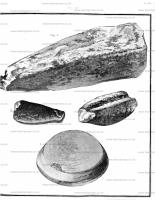
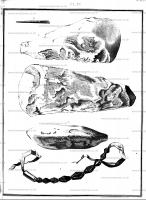
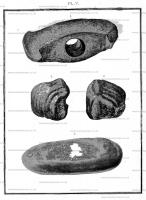
Derbyshire Archaeological Journal Volume 30 1908 Page 155. [Fol. 42.] May 31st 1824. Opening of One Ash [Map] barrow.1
"I re-opened a low [Cales Dale Barrow [Map]] on Mr. Beaumont's farm at One Ash, in the County of Derby, in which we found some further remains of an urn, and the bones and teeth of a skeleton lying with its head towards the S.E. On a previous examination of this barrow in 1818 we found some remains of the urn, and calcined bones, together with a great quantity of the bones of rats, and a few human bones. Having been disturbed by labourers procuring stone, the urn was, no doubt, broken to pieces by them. The barrow was about 6 yds. in diameter, and elevated not more than 3 ft. irom the surface. From the appearance of the urn, which is ornamented in a style rather superior to what are usually found, Mr. Lemon supposes it (the barrow) to have been the burial place of a Briton of distinction."
Note 1. This barrow was opened by Mr.Thomas Bateman on July 31st, 1844, when he found the remains of several interments. At the time, he was not aware that it had been previousiy opened by Mr. Mitchell, but refers to this in his text. Vestiges, p. 54.
Thomas Bateman 1824. On the 31st of May, 1824, a large tumulus [Map], sixty feet in diameter, and four feet in height, situated in Haddon field, near the river Lathkiln, almost opposite to Conksbury [Map] was opened; it had been before disturbed by labourers in search of stone, who discovered near the centre a loosely walled vault or cist, containing two human skeletons, and a rude urn of baked clay; they also met with a considerable number of Roman coins in small brass, which were deposited in Haddon Hall. This second opening was made by cutting a trench from the north-west extremity towards the centre, during the progress of which the whole barrow was observed to consist of loose stones thrown together.
About three yards from the centre of the mound were found scattered about a quantity of third brass Roman coins to the number of eighty-two (quere 71 ), and with them some small pieces of lead ore, which would furnish an additional proof, were any wanting, of the remote era in which the Derbyshire lead mines were worked; near the coins was part of a glass vessel, when perfect, about three inches in diameter. In the vault (apparently the only one in the barrow), and doubtless containing the original interments, were discovered human bones, some of which had undergone cremation, fragments of four urns, and traces of decayed wood. The bodies were laid with their heads towards the north-east, and had the usual accompaniment of rats' bones; also the teeth of a canine animal.
The coins, which would pertain to a later interment of the Romano-British period, were of the following reigns: Constantine nine, Constans seventeen, Constantius II nine, family of Constantine three; namely, Urbs Roma one, and Constantinopolis two, Valentinian five, Valens twelve, Gratian three, and the remainder illegible.
The History of William Marshal was commissioned by his son shortly after William’s death in 1219 to celebrate the Marshal’s remarkable life; it is an authentic, contemporary voice. The manuscript was discovered in 1861 by French historian Paul Meyer. Meyer published the manuscript in its original Anglo-French in 1891 in two books. This book is a line by line translation of the first of Meyer’s books; lines 1-10152. Book 1 of the History begins in 1139 and ends in 1194. It describes the events of the Anarchy, the role of William’s father John, John’s marriages, William’s childhood, his role as a hostage at the siege of Newbury, his injury and imprisonment in Poitou where he met Eleanor of Aquitaine and his life as a knight errant. It continues with the accusation against him of an improper relationship with Margaret, wife of Henry the Young King, his exile, and return, the death of Henry the Young King, the rebellion of Richard, the future King Richard I, war with France, the death of King Henry II, and the capture of King Richard, and the rebellion of John, the future King John. It ends with the release of King Richard and the death of John Marshal.
Available at Amazon in eBook and Paperback format.
On 31st May 1835 Alphonse de Neuville was born.

On 31st May 1860 Arthur Hugh Grosvenor was born to Hugh Lupus Grosvenor 1st Duke Westminster [aged 34] and Constance Leveson-Gower Duchess Westminster [aged 25]. Coefficient of inbreeding 7.06%. He married 1893 Helen Sheffield, daughter of Robert Sheffield 5th Baronet and Priscilla Isabella Laura Dumaresq.
Letters of James McNeill Whistler 1863. 31st May 1863. 7 Lindsey Row Old Chelsea. Sunday
Dear Sandys [aged 34] -
You have done the proper thing thoroughly and I only wish I could accept your jolly invitation and do the yachting and eat the dinner which I have no doubt will be stunning -
but it's of no use - I must stick to a couple of pictures, commissions! for I am just about cleaned out - and tin will be forked over on their completion -
Your "Vivien" is splendid in tone and colour especially the head - of course it is badly hung -
One of my pictures [is] refused and one put on the floor - You will perhaps be pleased to hear that the "White Girl" is a real success in Paris - and already I have had a letter to know if it may be possessed for gold! -
Adieu mon cher - Remember me to Tom Geckyl [aged 35] -
Jo [aged 20] says many things aimables - and if ever I lent her to anyone to paint, it should certainly be to you mon ami -
Adieu again - and success to the trip -
Ever yours,
J. Whistler [aged 28]


After 31st May 1866. Memorials to George Venables-Vernon aka Warren 5th Baron Vernon [deceased] and Frances Maria Emma Boothby at All Saints Church, Sudbury [Map].
Frances Maria Emma Boothby: she was born to Reverend Brooke Boothby and Louisa Henrietta-Venables-Vernon. On 14th December 1859 George Venables-Vernon aka Warren 5th Baron Vernon and she were married. They were first cousins. On 29th May 1907 Frances Maria Emma Boothby died.


After 31st May 1866. Memorial to George Venables-Vernon aka Warren 5th Baron Vernon [deceased] and his first wife Isabella Caroline Ellison at All Saints Church, Sudbury [Map].
Isabella Caroline Ellison: On 15th May 1805 she was born to Cuthbert Ellison. On 30th October 1824 George Venables-Vernon aka Warren 5th Baron Vernon and she were married. On 14th October 1853 she died. She was buried at Kingsbury, Middlesex.

On 31st May 1868 Victor Christian William Cavendish 9th Duke Devonshire was born to Edward Cavendish [aged 30] and Emma Elizabeth Lascelles. Coefficient of inbreeding 6.69%. He married 30th July 1892 his fifth cousin Evelyn Emily Mary Petty-Fitzmaurice Duchess Devonshire, daughter of Henry Petty-Fitzmaurice 5th Marquess Lansdowne, and had issue.
On 31st May 1915 George Colborne Nugent [aged 51] was killed in action.
On 31st May 1915 the first bombs were dropped on London by Zeppelin LZ38; they killed seven people. The first bomb, an incendiary, was dropped on 16 Alkham Road. Moving south it dropped eight more bombs. Its ninth landed on 33 Cowper Road setting the house on fire killed 3-year-old Elsie Leggatt and her 11-year-old sister, Elizabeth May. The next incendiary set fire to 187 Balls Pond Road causing the death of the married couple, Henry and Caroline Good. Steering away from the Tower of London, and, over Whitechapel LZ 38 dropped another explosive on Christian Street: 8-year-old Samuel Reuben and 16-year-old Leah Lehrman were killed. The seventh and last victim was Eleanor Willis, 67, who died of shock two days later. In total Zeppelin LZ 38 dropped 91 incendiaries, 28 explosive bombs and 2 grenades.

On 31st May 1915 John White Alexander [aged 58] died.
On 31st May 1916 HMS Black Prince was lost with her entire crew including Lieutenant-Commander David Shafto Douglas [aged 32].
From 31st May 1916 to 1st June 1916 the Battle of Jutland was fought between the British and German fleets.
On 31st May 1916 Rear-Admiral Horace Hood [aged 45] was killed during the engagement of HMS Invincible with SMS Lützow and SMS Derfflinger at the Battle of Jutland. A catastrophic explosion from "Q" turret's magazine, which blew the ship in half, which then sank quickly. Of Invincible's crew of 1,021, there were just six survivors, pulled from the water by attendant destroyers.

Oscar Parkes [aged 30]. HMS 'Southampton on the morning of the Battle of Jutland, 31st May 1916.
On 31st May 1916 Victor Alexander Ewart was killed at the Battle of Jutland serving on HMS Queen Mary.
After 31st May 1916 in the Battle of Jutland HMS Southampton torpedoed the German light cruiser SMS Frauenlob, which subsequently sank.
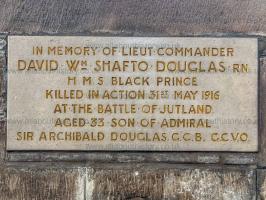
After 31st May 1916. North Aisle, Edinburgh Cathedral [Map]. Memorial to Lieutenant-Commander David Shafto Douglas [deceased].
Lieutenant-Commander David Shafto Douglas: On 1st July 1883 he was born to Admiral Archibald Douglas. On 31st May 1916 HMS Black Prince was lost with her entire crew including Lieutenant-Commander David Shafto Douglas.
Chronicle of Geoffrey le Baker of Swinbroke
Baker was a secular clerk from Swinbroke, now Swinbrook, an Oxfordshire village two miles east of Burford. His Chronicle describes the events of the period 1303-1356: Gaveston, Bannockburn, Boroughbridge, the murder of King Edward II, the Scottish Wars, Sluys, Crécy, the Black Death, Winchelsea and Poitiers. To quote Herbert Bruce 'it possesses a vigorous and characteristic style, and its value for particular events between 1303 and 1356 has been recognised by its editor and by subsequent writers'. The book provides remarkable detail about the events it describes. Baker's text has been augmented with hundreds of notes, including extracts from other contemporary chronicles, such as the Annales Londonienses, Annales Paulini, Murimuth, Lanercost, Avesbury, Guisborough and Froissart to enrich the reader's understanding. The translation takes as its source the 'Chronicon Galfridi le Baker de Swynebroke' published in 1889, edited by Edward Maunde Thompson.
Available at Amazon in eBook and Paperback format.
On 31st May 1443 Margaret Beaufort Countess Richmond was born to John Beaufort 1st Duke of Somerset [aged 40] and Margaret Beauchamp Duchess Somerset [aged 33] at Bletsoe Castle [Map]. Some sources suggest her birth may have been two years earlier in 1441 by saying she was three years old when her father died on 30 May 1444 - see Excerpta Historica. She a great x 2 granddaughter of King Edward III of England. She married (1) January 1450 her half third cousin John de la Pole 2nd Duke of Suffolk, son of William "Jackanapes" de la Pole 1st Duke of Suffolk and Alice Chaucer Duchess Suffolk (2) 1st November 1455 her half fourth cousin once removed Edmund Tudor 1st Earl Richmond, son of Owen Tudor and Catherine of Valois Queen Consort England, and had issue (3) 3rd January 1458 her second cousin Henry Stafford, son of Humphrey Stafford 1st Duke of Buckingham and Anne Neville Duchess Buckingham (4) 12th June 1472 her third cousin Thomas Stanley 1st Earl of Derby, son of Thomas Stanley 1st Baron Stanley and Jane Goushill Baroness Stanley.
On 31st May 1469 Manuel "Fortunate" I King Portugal was born to Ferdinand Aviz 2nd Duke Viseu [aged 35] and Beatrice Aviz Duchess Viseu [aged 38]. He a great x 3 grandson of King Edward III of England. Coefficient of inbreeding 9.54%. He married (1) 1497 his first cousin once removed Isabella Trastámara Queen Consort Portugal, daughter of Ferdinand II King Aragon and Isabella Queen Castile, and had issue (2) 1500 his first cousin once removed Maria Trastámara Queen Consort Portugal, daughter of Ferdinand II King Aragon and Isabella Queen Castile, and had issue (3) 16th July 1518 his first cousin twice removed Eleanor of Austria Queen Consort France Queen Consort Portugal, daughter of Philip "Handsome Fair" King Castile and Joanna "The Mad" Trastámara Queen Castile, and had issue.
On 31st May 1475 Unamed Trastámara was born to Ferdinand II King Aragon [aged 23] and Isabella Queen Castile [aged 24]. He a great x 3 grandson of King Edward III of England. Coefficient of inbreeding 3.23%. He died aged less than one years old.
On 31st May 1527 Agnes of Hesse was born to Landgrave Philip I of Hesse [aged 22] and Christine of Saxony [aged 21]. She married 9th January 1541 her half first cousin once removed Maurice Elector of Saxony and had issue.
On 31st May 1540 Henry Cheney 1st Baron Cheyne was born to Thomas Cheney [aged 55] and Anne Broughton [aged 27]. He married in or before 1572 Jane Wentworth Baroness Cheyne, daughter of Thomas Wentworth 1st Baron Wentworth and Margaret Fortescue Baroness Wentworth.
On 31st May 1590 Frances Howard Countess Essex and Somerset was born to Thomas Howard 1st Earl Suffolk [aged 28] and Catherine Knyvet Countess Suffolk [aged 26]. She married (1) 1603 her fourth cousin Robert Devereux 3rd Earl Essex, son of Robert Devereux 2nd Earl Essex and Frances Walsingham Countess Essex (2) 26th December 1613 Robert Carr 1st Earl Somerset and had issue.


On 31st May 1613 John George Wettin Elector Saxony was born to John George Elector Saxony [aged 28] and Magdalene Sibylle of Prussia [aged 26].
On 31st May 1676 Katherine Shirley was born to Robert Shirley 1st Earl Ferrers [aged 25] and Elizabeth Washington Baroness Ferrers Chartley. He died aged three in 1679.


On 31st May 1702 Sophia Hope Countess Findlater was born to Charles Hope 1st Earl Hopetoun [aged 21] and Henrietta Johnstone [aged 19]. She married 14th December 1723 James Ogilvy 5th Earl Findlater 2nd Earl Seafield, son of James Ogilvy 1st Earl Seafield 4th Earl Findlater.
On 31st May 1727 Diana Leveson-Gower was born to John Leveson-Gower 1st Earl Gower [aged 32] and Evelyn Pierrepont Baroness Gower. She died aged nine in 1737.
On 31st May 1755 Mary Frances Rich was born to Robert Rich 5th Baronet [aged 38]. She married in or before 1784 Charles Bostock aka Rich 1st Baronet and had issue.
Henrici Quinti, Angliæ Regis, Gesta, is a first-hand account of the Agincourt Campaign, and subsequent events to his death in 1422. The author of the first part was a Chaplain in King Henry's retinue who was present from King Henry's departure at Southampton in 1415, at the siege of Harfleur, the battle of Agincourt, and the celebrations on King Henry's return to London. The second part, by another writer, relates the events that took place including the negotiations at Troye, Henry's marriage and his death in 1422.
Available at Amazon in eBook and Paperback format.
On 31st May 1757 Philip Yorke 3rd Earl of Hardwicke was born to Charles Yorke [aged 34] and Catherine Blount Freeman [aged 20]. He married 24th July 1782 Elizabeth Lindsay Countess Hardwicke, daughter of James Lindsay 5th Earl Balcarres and Anne Dalrymple Countess Balcarres, and had issue.


On 31st May 1778 John Jackson was born.
On 31st May 1782 Thomas Peregrine Courtenay was born to Bishop Reginald Courtenay [aged 40] and Elizabeth Howard. He married 1805 Anne Wynell Mayow and had issue.
On 31st May 1796 Mary Bligh was born to John Bligh 4th Earl Darnley [aged 28].
On 31st May 1800 Charles Joshua Smith 2nd Baronet was born to Charles Smith [aged 43] and Augusta Smith.
On 31st May 1806 John Chetwynd-Talbot was born to Charles Chetwynd-Talbot 2nd Earl Talbot [aged 29] and Frances Thomasina Lambart Countess Talbot [aged 34]. He married 30th August 1830 Caroline Jane Stuart-Wortley, daughter of James Archibald Stuart-Wortley-Mackenzie 1st Baron Wharncliffe and Elizabeth Caroline Mary Crichton Baroness Wharncliffe, and had issue.


On 31st May 1815 George Finch-Hatton 6th Earl Nottingham 11th Earl Winchilsea was born to George Finch-Hatton 5th Earl Nottingham 10th Earl Winchilsea [aged 24] and Georgiana Charlotte Graham Countess Nottingham Winchelsea [aged 21]. He married (1) 6th August 1846 Constance Henrietta Paget Countess Nottingham Winchilsea, daughter of Henry Paget 2nd Marquess Anglesey and Eleanora Campbell, and had issue (2) 1882 Elizabeth Georgiana Conyngham Countess Winchelsea, daughter of Francis Nathaniel Conyngham 2nd Marquess Conyngham and Jane Paget Marchioness Conyngham.
On 31st May 1817 Charlotte Stuart Countess Canning was born to Charles Stuart 1st Baron Stuart de Rothesay [aged 38] and Elizabeth Yorke Lady Stuart [aged 28]. She married 5th September 1835 Charles Canning 1st Earl Canning, son of George Canning Prime Mininster and Joan Scott Viscountess Canning.


On 31st May 1817 George Whichcote 8th Baronet was born to Thomas Whichcote 6th Baronet [aged 29] and Sophia Sherard Lady Whichcote [aged 21]. He married 10th April 1866 Louisa Clagett and had issue.
On 31st May 1825 Morton Manningham-Buller 2nd Baronet was born to Edward Manningham-Buller 1st Baronet [aged 24].
On 31st May 1832 Augusta Maria Hare was born to William Hare 2nd Earl Listowel [aged 30] and Maria Augusta Windham Countess Listowel [aged 27]. She married 19th July 1853 Granville Leveson Proby 4th Earl of Carysfort.
On 31st May 1835 Alphonse de Neuville was born.
Annals of the six Kings of England by Nicholas Trivet
Translation of the Annals of the Six Kings of England by that traces the rise and rule of the Angevin aka Plantagenet dynasty from the mid-12th to early 14th century. Written by the Dominican scholar Nicholas Trivet, the work offers a vivid account of English history from the reign of King Stephen through to the death of King Edward I, blending political narrative with moral reflection. Covering the reigns of six monarchs—from Stephen to Edward I—the chronicle explores royal authority, rebellion, war, and the shifting balance between crown, church, and nobility. Trivet provides detailed insight into defining moments such as baronial conflicts, Anglo-French rivalry, and the consolidation of royal power under Edward I, whose reign he describes with particular immediacy. The Annals combines careful year-by-year reporting with thoughtful interpretation, presenting history not merely as a sequence of events but as a moral and political lesson. Ideal for readers interested in medieval history, kingship, and the origins of the English state, this chronicle remains a valuable and accessible window into the turbulent world of the Plantagenet kings.
Available at Amazon in eBook and Paperback format.
On 31st May 1849 George Chetwynd 4th Baronet was born to George Chetwynd 3rd Baronet [aged 39] and Charlotte Augusta Hill Lady Chetwynd. He married 1870 his fifth cousin Florence Cecilia Paget Marchioness Hastings, daughter of Henry Paget 2nd Marquess Anglesey and Henrietta Bagot Marchioness Anglesey, and had issue.
On 31st May 1858 Bernard Petre 14th Baron Petre was born to William Bernard Petre 12th Baron Petre [aged 40] and Mary Theresa Clifford [aged 34]

On 31st May 1859 Edward Tennant 1st Baron Glenconner was born to Charles Tennant 1st Baronet [aged 35] and Emma Winsloe Lady Tennant [aged 38]. He married 1895 Pamela Wyndham Viscountess Grey and had issue.
On 31st May 1860 Arthur Hugh Grosvenor was born to Hugh Lupus Grosvenor 1st Duke Westminster [aged 34] and Constance Leveson-Gower Duchess Westminster [aged 25]. Coefficient of inbreeding 7.06%. He married 1893 Helen Sheffield, daughter of Robert Sheffield 5th Baronet and Priscilla Isabella Laura Dumaresq.
On 31st May 1868 Victor Christian William Cavendish 9th Duke Devonshire was born to Edward Cavendish [aged 30] and Emma Elizabeth Lascelles. Coefficient of inbreeding 6.69%. He married 30th July 1892 his fifth cousin Evelyn Emily Mary Petty-Fitzmaurice Duchess Devonshire, daughter of Henry Petty-Fitzmaurice 5th Marquess Lansdowne, and had issue.
On 31st May 1874 Giles Fox-Strangways 6th Earl of Ilchester was born to Henry Edward Fox-Strangways 5th Earl of Ilchester [aged 26]. He married 25th January 1902 Helen Vane-Tempest-Stewart Countess Ilchester, daughter of Charles Stewart Vane-Tempest-Stewart 6th Marquess Londonderry and Theresa Susey Helen Chetwynd-Talbot Marchioness Londonderry, and had issue.
On 31st May 1878 Walter Farquhar 5th Baronet was born to Walter Farquhar [aged 36] and Kathleen Mary Bateson.
On 31st May 1912 William Amherst Cecil 3rd Baron Amherst was born to William Amherst Cecil [aged 26] and Gladys Evelyn Baggallay [aged 28].
On 31st May 1914 Richard Souter 25th Baron Audley was born to Charles Alexander Souter and Charlotte Dorothy Jesson.
On 31st May 1926 Edward Crofton 5th Baron Crofton was born to Edward Crofton [aged 30].
On 31st May 1943 Richard Parker 9th Earl Macclesfield was born to George Parker 8th Earl Macclesfield [aged 29] and Valerie Mansfield Countess Macclesfield [aged 24].
On 31st May 1328 the Mortimer family leveraged their new status at a lavish ceremony that celebrated the marriages of two of Roger Mortimer's [aged 41] daughters at Hereford [Map].
Edward Plantagenet [aged 8] and Beatrice Mortimer [aged 6] were married. She the daughter of Roger Mortimer 1st Earl March and Joan Geneville Baroness Mortimer 2nd Baroness Geneville [aged 42]. He the son of Thomas of Brotherton 1st Earl Norfolk [aged 27] and Alice Hales Countess Norfolk. They were half third cousin once removed. He a grandson of King Edward I of England. She a great x 4 granddaughter of King John of England.
Laurence Hastings 1st Earl Pembroke [aged 9] and Agnes Mortimer Countess of Pembroke [aged 11] were married. She the daughter of Roger Mortimer 1st Earl March and Joan Geneville Baroness Mortimer 2nd Baroness Geneville. He the son of John Hastings 2nd Baron Hastings 14th Baron Abergavenny and Juliana Leybourne Countess Huntingdon [aged 25]. They were third cousin once removed. She a great x 4 granddaughter of King John of England.
King Edward III of England [aged 15] and his mother Isabella of France Queen Consort England [aged 33] attended as well as Roger Mortimer 1st Earl March.
On 31st May 1660 Christopher Musgrave 4th Baronet [aged 28] and Mary Cogan were married.
On 31st May 1698 Edward Hussey 3rd Baronet [aged 36] and Elizabeth de Vic were married.
Annals of the six Kings of England by Nicholas Trivet
Translation of the Annals of the Six Kings of England by that traces the rise and rule of the Angevin aka Plantagenet dynasty from the mid-12th to early 14th century. Written by the Dominican scholar Nicholas Trivet, the work offers a vivid account of English history from the reign of King Stephen through to the death of King Edward I, blending political narrative with moral reflection. Covering the reigns of six monarchs—from Stephen to Edward I—the chronicle explores royal authority, rebellion, war, and the shifting balance between crown, church, and nobility. Trivet provides detailed insight into defining moments such as baronial conflicts, Anglo-French rivalry, and the consolidation of royal power under Edward I, whose reign he describes with particular immediacy. The Annals combines careful year-by-year reporting with thoughtful interpretation, presenting history not merely as a sequence of events but as a moral and political lesson. Ideal for readers interested in medieval history, kingship, and the origins of the English state, this chronicle remains a valuable and accessible window into the turbulent world of the Plantagenet kings.
Available at Amazon in eBook and Paperback format.
On 31st May 1715 Christopher Wandesford 2nd Viscount Castlecomer [aged 31] and Frances Pelham Viscountess Castlecomer were married. They were fifth cousins.
On 31st May 1750 Victor Amadeus III King Sardinia [aged 24] and Infanta Maria Antonia Spain [aged 20] were married. She the daughter of Philippe V King Spain and Elisabeth Farnese Queen Consort Spain [aged 57]. He the son of Charles Emmanuel III King Sardinia [aged 49] and Polyxena Hesse Rotenburg Queen Consort Sardinia. They were third cousins. He a great x 2 grandson of King Charles I of England, Scotland and Ireland.
On 31st May 1763 Henry Arundell 8th Baron Arundel [aged 23] and Mary Conquest Baroness Arundel Wardour [aged 20] were married. She by marriage Baroness Arundel of Wardour in Wiltshire.


On 31st May 1794 Francis Charteris 8th Earl of Wemyss Douglas 4th Earl March [aged 22] and Margaret Campbell of Shawfield [aged 14] were married. They were fifth cousin once removed.

On 31st May 1825 Edward Smith-Stanley 14th Earl of Derby [aged 26] and Emma Caroline Bootle-Wilbraham Countess Derby [aged 20] were married. She by marriage Countess Derby. He the son of Edward Smith-Stanley 13th Earl of Derby [aged 50] and Charlotte Margaret Hornby Countess Derby.
On 31st May 1831 Norton Joseph Knatchbull 10th Baronet [aged 22] and Mary Watts-Russell were married.
On 31st May 1834 Cornwallis Ricketts 2nd Baronet [aged 31] and Henrietta Plumbe Tempest were married.
On 31st May 1864 Charles Bunbury 8th Baronet [aged 55] and Anna Susannah Lloyd Lady Bunbury were married. She by marriage Lady Bunbury of Bunbury in Oxfordshire and Stanney Hall in Cheshire.
On 31st May 1864 Frederick Arthur Stanley 16th Earl of Derby [aged 23] and Constance Villiers Countess Derby [aged 24] were married. She the daughter of George William Villiers 4th Earl Clarendon [aged 64] and Katherine Grimston Countess Clarendon [aged 54]. He the son of Edward Smith-Stanley 14th Earl of Derby [aged 65] and Emma Caroline Bootle-Wilbraham Countess Derby [aged 59].

On 31st May 1897 Richard Arthur Surtees Paget 2nd Baronet [aged 28] and Muriel Finch-Hatton Lady Paget [aged 20] were married at St George's Church, Hanover Square. She the daughter of Murray Finch-Hatton 7th Earl Nottingham 12th Earl Winchilsea [aged 46] and Edith Harcourt Countess Winchelsea and Nottingham [aged 41].
On 31st May 1076 Waltheof Northumbria 1st Earl of Northampton 1st Earl Huntingdon was beheaded at St Gile's Hill, Winchester. His daughter Maud [aged 2] succeeded 2nd Countess Huntingdon, 2nd Countess of Northampton.
William of Worcester's Chronicle of England
William of Worcester, born around 1415, and died around 1482 was secretary to John Fastolf, the renowned soldier of the Hundred Years War, during which time he collected documents, letters, and wrote a record of events. Following their return to England in 1440 William was witness to major events. Twice in his chronicle he uses the first person: 1. when writing about the murder of Thomas, 7th Baron Scales, in 1460, he writes '… and I saw him lying naked in the cemetery near the porch of the church of St. Mary Overie in Southwark …' and 2. describing King Edward IV's entry into London in 1461 he writes '… proclaimed that all the people themselves were to recognize and acknowledge Edward as king. I was present and heard this, and immediately went down with them into the city'. William’s Chronicle is rich in detail. It is the source of much information about the Wars of the Roses, including the term 'Diabolical Marriage' to describe the marriage of Queen Elizabeth Woodville’s brother John’s marriage to Katherine, Dowager Duchess of Norfolk, he aged twenty, she sixty-five or more, and the story about a paper crown being placed in mockery on the severed head of Richard, 3rd Duke of York.
Available at Amazon in eBook and Paperback format.
On 31st May 1326 Maurice Berkeley 7th and 2nd Baron Berkeley [aged 55] died at Wallingford Castle [Map]. He was buried at St Augustine's Abbey, Bristol [Map]. His son Thomas [aged 30] succeeded 8th Baron Berkeley Feudal, 3rd Baron Berkeley. Margaret Mortimer Baroness Berkeley [aged 22] by marriage Baroness Berkeley Feudal.
On 31st May 1349 Thomas Wake 2nd Baron Wake of Liddell [aged 52] died. He was buried at Haltemprice Priory [Map]. His sister Margaret [aged 52] succeeded 3rd Baroness Wake of Liddell.
On 31st May 1359 Elizabeth Montagu Baroness Badlesmere and Despencer [aged 35] died. Monument in Tewkesbury Abbey [Map].
On 31st May 1410 King Martin I of Aragon [aged 53] died. His nephew Ferdinand [aged 29] succeeded I King Aragon.
On 31st May 1423 Maud Neville 6th Baroness Furnivall [aged 30] died.
On 31st May 1495 Cecily "Rose of Raby" Neville Duchess York [aged 80] died. She was buried at St Mary and All Saints Church, Fotheringhay [Map].
On 31st May 1594 Tintoretto [aged 75] died.
On 31st May 1637 Susan Booth Lady Brereton [aged 37] died.
On 31st May 1670 Josceline Percy 11th Earl of Northumberland [aged 25] died in Turin without male issue. Earl of Northumberland, Baron Percy of Alnwick and Baron Percy of Topcliffe, Baron Percy of Alnwick and Baron Poynings extinct. His daughter Elizabeth [aged 3] was his sole heiress.
On 25th May 1671 Henry Wood 1st Baronet [aged 73] died without male issue. Baronet Wood extinct. On 31st May 1671 he was buried at Ufford, Suffolk. His daughter Mary Wood Duchess Southampton [aged 8] was his heir. In view of the great wealth she was to inherit she was betrothed to Charles Fitzroy 1st Duke Southampton 2nd Duke Cleveland [aged 8], an illegitmate son of King Charles II of England Scotland and Ireland [aged 40] and Barbara Villiers 1st Duchess of Cleveland [aged 30]. On her father's death she went to live with Barbara Villiers 1st Duchess of Cleveland. They, Mary Wood Duchess Southampton and Charles Fitzroy 1st Duke Southampton 2nd Duke Cleveland married 1679 but she died a year later from smallpox.
On 31st May 1691 Eleanor Lee Countess Abingdon died. She was buried at West Lavington 6th June 1691, where she is commemorated by a monument.
On 31st May 1707 Bishop Simon Patrick [aged 80] died. He was buried in Ely Cathedral [Map].
On 31st May 1710 Mary Grey Baroness Ossulston [aged 32] died.
Chronicle of Geoffrey le Baker of Swinbroke
Baker was a secular clerk from Swinbroke, now Swinbrook, an Oxfordshire village two miles east of Burford. His Chronicle describes the events of the period 1303-1356: Gaveston, Bannockburn, Boroughbridge, the murder of King Edward II, the Scottish Wars, Sluys, Crécy, the Black Death, Winchelsea and Poitiers. To quote Herbert Bruce 'it possesses a vigorous and characteristic style, and its value for particular events between 1303 and 1356 has been recognised by its editor and by subsequent writers'. The book provides remarkable detail about the events it describes. Baker's text has been augmented with hundreds of notes, including extracts from other contemporary chronicles, such as the Annales Londonienses, Annales Paulini, Murimuth, Lanercost, Avesbury, Guisborough and Froissart to enrich the reader's understanding. The translation takes as its source the 'Chronicon Galfridi le Baker de Swynebroke' published in 1889, edited by Edward Maunde Thompson.
Available at Amazon in eBook and Paperback format.
On 31st May 1731 Philip Wharton 1st Duke Wharton died. Duke Wharton, Marquess Wharton and Earl Wharton extinct. Baron Wharton abeyant between Jane Wharton [aged 25] and Lucy Wharton Lady Morice.
On 31st May 1734 Edward Stanton [aged 53] died. He was buried at St Andrew's Church, Holborn [Map].
On 31st May 1740 Frederick William "Soldier King" I King Prussia [aged 51] died. His son Frederick [aged 28] succeeded I King Prussia.
On 31st May 1742 Nicolas Tempest 6th Baronet [aged 78] died without issue. Baronet Tempest of Stella Hall in County Durham extinct.
On 31st May 1751 Robert Walpole 2nd Earl Orford [aged 50] died. His son George [aged 21] succeeded 3rd Earl Orford.
On 31st May 1755 Henry Every 6th Baronet [aged 46] died without issue. His brother John [aged 45] succeeded 7th Baronet Every of Egginton in Derbyshire.
On 31st May 1776 Henry Cavendish 1st Baronet [aged 69] died. His son Henry [aged 43] succeeded 2nd Baronet Cavendish of Doveridge Hall.
On 31st May 1816 Rebecca Fielding Baroness Ribblesdale [aged 44] died.

On 31st May 1823 Jane Georgiana Fauquier Baroness Vernon [aged 75] died.
On 31st May 1840 Alexander Bannerman 7th Baronet [aged 70] died. His brother Charles [aged 57] succeeded 8th Baronet Bannerman of Elsick in Kincardineshire.
Chronicle of a Bourgeois of Valenciennes
Récits d’un bourgeois de Valenciennes aka The Chronicle of a Bourgeois of Valenciennes is a vivid 14th-century vernacular chronicle written by an anonymous urban chronicler from Valenciennes in the County of Hainaut. It survives in a manuscript that describes local and regional history from about 1253 to 1366, blending chronology, narrative episodes, and eyewitness-style accounts of political, military, and social events in medieval France, Flanders, and the Low Countries. The work begins with a chronological framework of events affecting Valenciennes and its region under rulers such as King Philip VI of France and the shifting allegiances of local nobility. It includes accounts of conflicts, sieges, diplomatic manoeuvres, and the impact of broader struggles like the Hundred Years’ War on urban life in Hainaut. Written from the perspective of a burgher (bourgeois) rather than a monastery or royal court, the chronicle offers a rare lay viewpoint on high politics and warfare, reflecting how merchants, townspeople, and civic institutions experienced the turbulence of the 13th and 14th centuries. Its narrative style combines straightforward reporting of events with moral and civic observations, making it a valuable source for readers interested in medieval urban society, regional politics, and the lived experience of war and governance in pre-modern Europe.
Available at Amazon in eBook and Paperback format.
On 31st May 1841 Robert John Wilmot 3rd Baronet [aged 56] died. His son Robert [aged 32] succeeded 4th Baronet Wilmot of Osmaston in Derbyshire.
On 31st May 1842 Thomas Manners-Sutton 1st Baron Manners [aged 86] died. His son John [aged 24] succeeded 2nd Baron Manners of Foston in Lincolnshire.
On 31st May 1843 Henry Devereux 14th Viscount Hereford [aged 66] died. His son Robert [aged 34] succeeded 15th Viscount Hereford, 12th Baronet Devereux of Castle Bromwich.

On 31st May 1846 John Wodehouse 2nd Baron Wodehouse [aged 75] died. His grandson John [aged 20] succeeded 3rd Baron Wodehouse of Kimberley in Norfolk, 8th Baronet Woodhouse of Wilberhall.
On 31st May 1847 John Beckett 2nd Baronet [aged 72] died at Brighton. He was buried at All Saints Church, Fulham. His brother Thomas [aged 68] succeeded 3rd Baronet Beckett of Leeds.
On 31st May 1860 William à Court 1st Baron Heytesbury [aged 80] died. His son William [aged 50] succeeded 2nd Baron Heytesbury of Heytesbury in Wiltshire, 3rd Baronet à Court.

On 31st May 1866 George Venables-Vernon aka Warren 5th Baron Vernon [aged 62] died in Gibralta. His son Augustus [aged 37] succeeded 6th Baron Vernon of Kinderton in Cheshire. Harriet Frances Maria Anson Baroness Vernon [aged 38] by marriage Baroness Vernon of Kinderton in Cheshire.
On 31st May 1882 Elizabeth Jane Somerville Countess Charlemont [aged 47] died.
On 31st May 1892 Francis Burdett 7th Baronet [aged 79] died. His son Francis [aged 22] succeeded 8th Baronet Burdett of Bramcote in Warwickshire.
On 31st May 1895 George Gough 2nd Viscount Gough [aged 80] died. His son Hugh [aged 45] succeeded 3rd Viscount Gough of Goojerat in the Punjab and of the City of Limerick, 3rd Baron Gough of Chin-Kang-Foo in China and of Maharajpore and the Sutlej in the East Indies, 3rd Baronet Gough of Synone and Drangan in County Tipperary. Georgiana Pakenham Viscountess Gough [aged 31] by marriage Viscountess Gough of Goojerat in the Punjab and of the City of Limerick.
On 31st May 1915 Victor Albert George Child-Villiers 7th Earl Jersey [aged 70] died at Osterley Park. His son George [aged 41] succeeded 8th Earl Jersey, 11th Viscount Grandison, 8th Viscount Villiers, 8th Baron Villiers. Cynthia Almina Needham Countess Jersey by marriage Countess Jersey.
The Deeds of the Dukes of Normandy
The Gesta Normannorum Ducum [The Deeds of the Dukes of Normandy] is a landmark medieval chronicle tracing the rise and fall of the Norman dynasty from its early roots through the pivotal events surrounding the Norman Conquest of England. Originally penned in Latin by the monk William of Jumièges shortly before 1060 and later expanded at the behest of William the Conqueror, the work chronicles the deeds, politics, battles, and leadership of the Norman dukes, especially William’s own claim to the English throne. The narrative combines earlier historical sources with firsthand information and oral testimony to present an authoritative account of Normandy’s transformation from a Viking settlement into one of medieval Europe’s most powerful realms. William’s history emphasizes the legitimacy, military prowess, and governance of the Norman line, framing their expansion, including the conquest of England, as both divinely sanctioned and noble in purpose. Later chroniclers such as Orderic Vitalis and Robert of Torigni continued the history, extending the coverage into the 12th century, providing broader context on ducal rule and its impact. Today this classic work remains a foundational source for understanding Norman identity, medieval statesmanship, and the historical forces that reshaped England and Western Europe between 800AD and 1100AD.
Available at Amazon in eBook and Paperback format.
On 31st May 1915 John White Alexander [aged 58] died.
On 31st May 1919 Thomas Fowell Buxton 4th Baronet [aged 54] died. His son Thomas [aged 29] succeeded 5th Baronet Buxton of Belfield in Dorset.
On 31st May 1923 Ambrose Macdonald Poynter 2nd Baronet [aged 55] died. His brother Hugh [aged 41] succeeded 3rd Baronet Poynter of Albert Gate in Westminster in London
On 31st May 1927 Gilbert Clifton-Hasting-Campbell 3rd Baron Donington [aged 68] died. Baron Donington of Dongington Park in Leicestershire extinct. Baron Donington of Dongington Park in Leicestershire.
On 31st May 1974 Albert Archibald Primrose 6th Earl Rosebery 2nd Earl Midlothian [aged 92] died. His son Neil [aged 45] succeeded 7th Earl Rosebery, 3rd Earl Midlothian, 3rd Viscount Mentmore of Mentmore in Buckinghamshire, 3rd Baron Epsom of Hyde in Surrey.
On 31st May 1981 Mary Smith Baroness Rennell [aged 79] died.
On 31st May 1997 Marion Hester Cameron Lady Orr-Ewing [aged 82] died.