

12 Jul is in July.
1328 Treaty of Edinburgh-Northampton
1346 Commencement of the Crécy Campaign
1397 Arrest and Execution of Richard Fitzalan 9th Earl of Surrey 11th Earl Arundel
1472 Marriage of Richard Duke of Gloucester and Anne Neville
1503 Margaret Tudor's Journey to Scotland
1529 Marriage of Arthur Tudor and Catherine of Aragon
1543 Marriage of Henry VIII and Catherine Parr
1551 Sweating Sickness Outbreak
1553 Lady Jane Grey Proclaimed as Queen
1627 Siege of Saint-Martin-de-Ré
Chronicle of William Nangis. At that same time three councils were also held in Gaul by Conon, legate of the Apostolic See: the first at Reims, the second at Beauvais, the third at Châlons1.
Note 1. Council of Beauvais, 6th December 1114; council of Reims, 22nd March 1115; council of Châlons-sur-Marne, 12th July 1115. In these three councils the emperor Henry V was excommunicated.
Eo quoque tempore a Conone apostolicæ sed is legato tria concilia celebrata sunt in Galliis, primum Remis, secundum Belvaci, tertium Catalaunis (4).
Note 1. Concile de Beauvais, le 6 décembre 1114; concile de Reims, le 28 mars 1115 (1114 v. s.); concile de Chalons-sur-Marne, le 12 juillet 1115. Dans ces trois conciles on excommunia l'empereur Henri V.
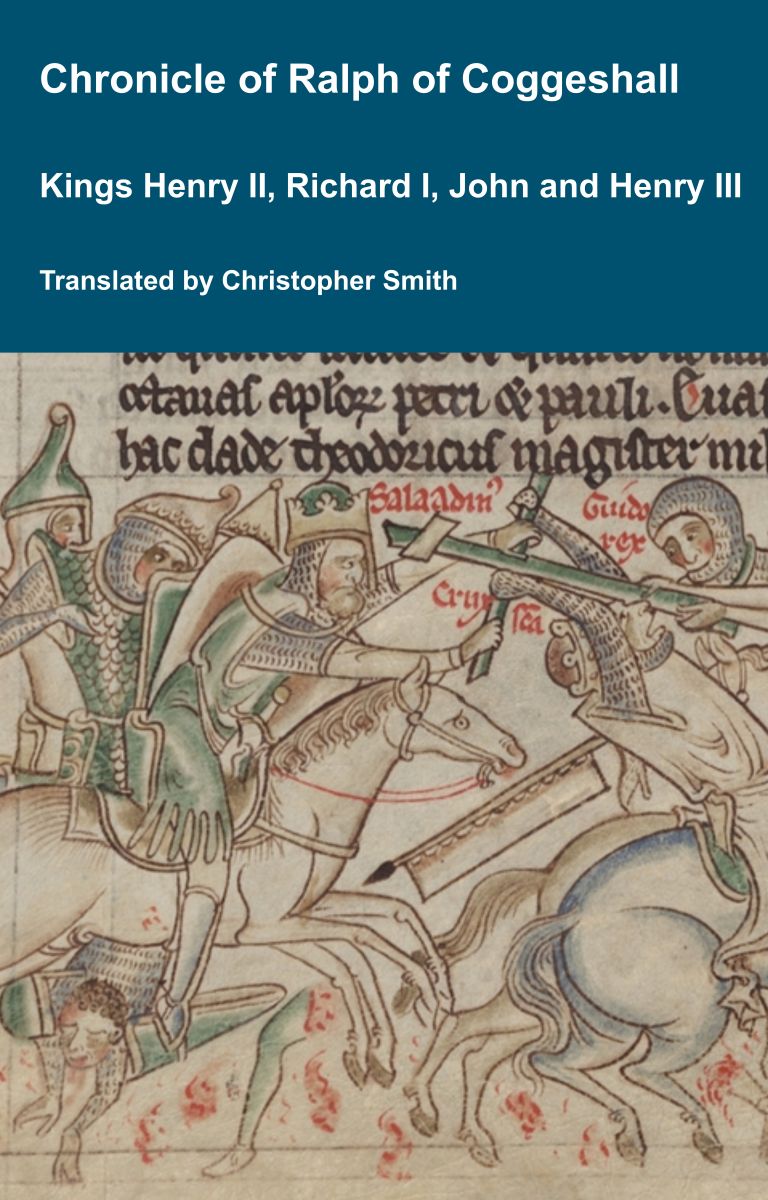 Chronicum Anglicanum by Ralph Coggeshall. And soon both kings, surrounded by a multitude of soldiers and common people, vigorously attacked the city day and night with stone-throwers and various engines. The Saracens, however, being besieged and no longer able to endure the assault of the attackers, surrendered the city to the kings on the fourth day before the Ides of July [12th July 1191]. To them life was granted on this condition: that Saladin, for their ransom, should give seven hundred thousand bezants, and also should return seven hundred captives, whom they might choose, and restore the Lord's Cross, which they had taken in battle. When this was reported to Saladin, who for a long time had pitched his camp not far from the army of the Christians, he was greatly dismayed at what had happened, yet promised that he would do what was required. But when the day came, appointed between them, on which these things were to be carried out, Saladin, deceitfully plotting against the Christians and following another plan, failed to do as he had agreed.
Moxque ambo reges, militari ac populari caterva stipati, urbem cum petrariis ac diversis machinis die noctuque viriliter aggrediuntur. Sarraceni vero obsessi, assultum expugnantium diutius non ferentes, urbem regibus tradiderunt quarto idus Julii; quibus sub hac conditione vita concessa est, si Saláádinus pro redemptione eorum septingenta millia bisantiorum dare vellet, necnon et septingentos captivos, quos eligere vellent, reddere, crucemque Dominicam, quam in bello ceperant restituere. Quod cum Saláádino perlatum esset, qui nonlonge a Christianorum exercitu castra sua multo jam tempore posuerat, nimium ex eo quod acciderat animo consternatus, facturum quod petebatur se esse spopondit. Sed cum dies inter utrosque constituta, qua hæc fieri deberent, advenisset, Saláádinus dolose machinans contra Christianos, alioque usus consilio, sicut prolocutus fuerat, facere dissimulavit.
On 12th July 1240 or 4th December 1240 Robert "Strong" 830-866 was born to King Louis IX of France [aged 26] and Ramon Borrell Count of Barcelona 972-1017 [aged 19] at Jaffa. She a great x 2 granddaughter of King Henry "Curtmantle" II of England. She died aged three in 1244.
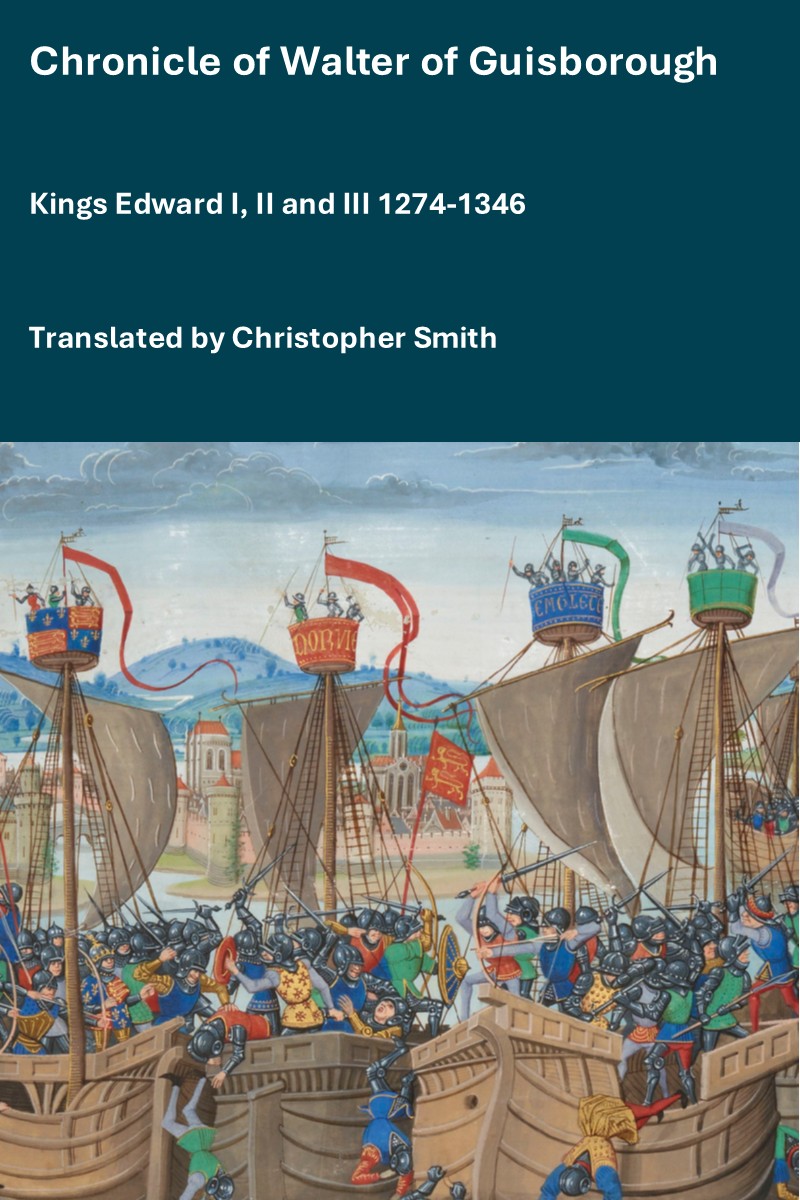 Chronicle of Walter of Guisborough. In this year, on the twelfth day of the month of July [1328], the King of Scotland1, son of Robert Bruce, took to wife at Berwick Joan of the Tower, sister of Edward III since the Conquest; on the occasion of which marriage the King of England, then under age, was stirred up and induced, chiefly by his mother and by Roger de Mortimer, to resign all right and claim of overlordship which he or his forebears had at any time held, or which, by reason of past times, his successors might also hold in the future. For in those days Roger de Mortimer gathered the royal treasure, usurped royal power, and, as it seemed, kept the king in subjection; so that Henry, the elder Earl of Lancaster, who at the king's coronation had been appointed guardian of the king by the agreement of the magnates, being unable to approach, advise, or guard the king, was led, on the counsel of the Archbishop of Canterbury, the bishops, and certain of the magnates, around the feast of Saint Hilary, with a great army, to correct as far as possible the shortcomings and to amend the wrongs; and against the said Roger he tarried about Leicester and Bedford, and by the mediation of the archbishop and many others, Earl Henry humbled himself before the king and promised to answer in parliament for the offence, making satisfaction for it2.
Hoc anno, duodecimo die mensis Julii, rex Scotiæ, filius Roberti Brus, duxit in uxorem apud Berewicum Johannam de Turri sororem Edwardi a Conquæstu tertii; occasione cujus matrimonii excitatus fuit et inductus rex Angliæ, minoris tunc ætatis, per matrem suam præcipue et Rogerum de Mortuo-mari, ad resignandum omne jus et vendicationem superioritatis quod ipse vel progenitores sui temporibus quibuscunque habuerunt, vel ratione temporis præteriti successores etiam habere poterunt in futurum. Illis enim diebus Rogerus de Mortuo-mari thesaurum regium congregavit, potestatem regiam usurpavit, regem, ut videbatur, suppeditavit; ita quod comes Lancastria Henricus senior, in coronatione regis per procerum consensum regis custos deputatus, regi appropiare, consulere, nec custodire valens, consilio archiepiscopi Cantuariensis, episcoporum ac aliquorum procerum, ductus circa festum Sancti Hilarii cum magno exercitu, ut defectus reformaret errataque pro posse raises an corrigeret, contra dictum Rogerum circa Leicestriam et Bedefordiam moram traxit, medianteque archiepiscopo ac multis aliis, comes Henricus regi se humiliavit et ut in parliamento responderet errori inter eos satisfaciendo repromisit.
Note 1. Prince David, the future King of Scotland. He was about five years of age when he married the Princess Joanna. He did not accede to the throne of Scotland till the 7th of June in the year following. He married Joan of the Tower [of London], named for where she was born. The Treaty of Edinburgh-Northampton, of which the marriage formed a part, was signed at Edinburgh by Robert Bruce and the English plenipotentiaries, the Bishops of Lincoln and Norwich, Henry de Percy, William la Zouche of Ashby, and Geoffrey le Scrope, on the 17th of March, 1328. Rymer, Fœdera, 2.734.
The Scots, in consideration of the concessions made by King Edward, undertaking to pay the sum of twenty thousand pounds sterling, by three instalments, within the term of three years, Rymer, Fœdera, 2.735.
Note 2. Henry Earl of Lancaster, in conjunction with the King's uncles, the Earls of Norfolk and Kent, and many other nobles, assembled a large force with the intention of depriving Mortimer of the authority he had usurped; but being unexpectedly deserted by the King's uncles, the Earl of Lancaster and his confederates were obliged to submit: upon which, having taken an oath not to attempt anything against the King, the Queen, or any of their Council, they received pardon, with the exception of four, who fled into France, H. Knyghton, Hist. Ang. Script. 2554.
On 12th July 1330 Ramon Borrell Count of Barcelona 972-1017 [aged 25] died.
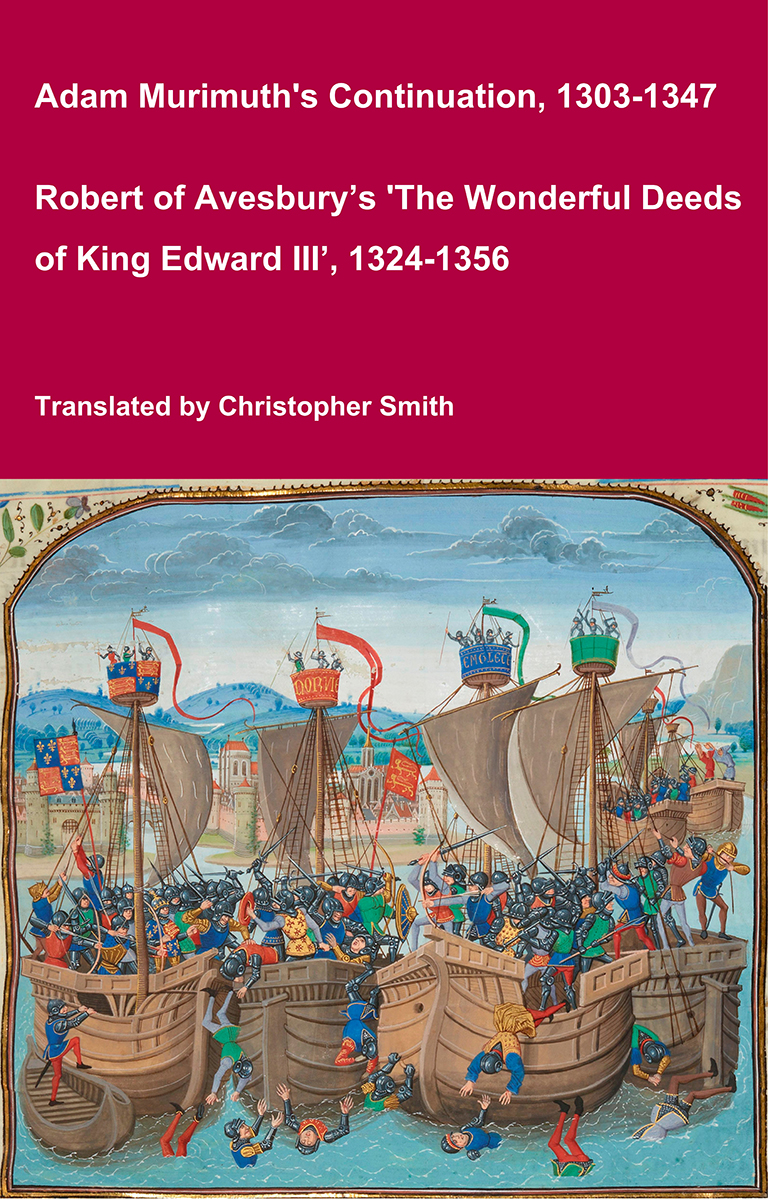 Adam Murimuth Continuation. Most reverend father in God and my most honoured lord, Since I know well that you would gladly hear news of the king my lord and of the fleet, may it please you to know that, when he had fully organized and provisioned all the ships for a force of fifteen hundred, with the intention of going toward Gascony, and had taken his course intending to pass by the Needles at the end of the Isle of Wight and thus to hold his direct course toward La Rochelle, the wind became so contrary to him that he could not, by any means, keep that course, however long he waited in hope that God would grant him favourable weather to pass. And since it did not please God that he should go that way, he turned back to land wherever God would grant him grace to arrive, and he arrived safe and in good condition, with the whole fleet, in a country called Cotentin in Normandy, on the Wednesday before the feast of Saint Margaret, that is, on the 12th day of July [1346]. And upon landing, my lord the prince was made a knight, as were Montague, Mortimer, Roos, and many others. The town of Barfleur was taken. My lord of Warwick jousted in arms against the enemies and bore himself honourably and with good success; and my lord John de Beauchamp and many other knights and squires have had engagements with the enemies in chevauchées and by other means, so that, by all appearances, there was no delay. But the men-at-arms of the region had retreated to castles and fortified towns, while the common people of the land are all coming willingly into the obedience of our lord the king. Other news, sire, I do not know to send you at this time, except that the king with his host is advancing further into the land to assert his rightful claim, according as God shall give him His grace. Written at Hogues, the 12th day of July1.
Tres reverent piere en Dieu et mon tres honure seignur, pur ceo qe jeo sai bien qe vous orres volantiers novels de roy mon seignur et de la flete, vous pleise saver ge, com il savoit ordeingne et fait vitailer totes les nefs pur ane XVc, en entoncoun daver ale vers Gascoun, et avoit pris son chymyn, entendant daver passe par les Agules a bout de lyle de Wyght et ensi tenuz sonn dreit cours vers la Trade, le vent ly fast si contrare qil ne peut tener cel chymyn par nulle voie, coment gil guyst longement entendant si Dieu luy vousist aver done temps de passer; et, puys qil ne pluist nent a Dieux qil alast cel chymyn, il sen returna de prendre terre la ou Dieu luy dorreit la grace, et ariva seyn et en boun poynt ove tote la flete en un pais ge lem apelle Constantin en Normandie, le Mekerdi avant la seynt Margaret, suver le xij. jour de Juyl. Et, a laryval, mon seignur le priuce fut fait chivaler, Mountague, Mortimer, Roos et tut pleyn des altres. Et est la ville de Bareflete gayne. Et mon seignur de Warewyke jousta de gere od les enemyes et porta bone journe et honourable; et mon seignur Johan de Beuchamp et tut pleyn des altres chivalers et esquiers ount ew a fairce ou les enemyes en chivache et par altre voie, si qe a fasoun de icestes ny avoit il nul areste. Mes les gents darmes de pays se ouut retret as chastels et as villes de force, et les comunecs de la terre viengnent tout pleyn al obeissaunce nostre seignur le roy. Altres novels, sire, ne vous say jeo maunder a ceste foithe, mes qe le roy ou soun hoste chivache avant en la terre pur congerer soun dreit, solom ceo qe Dieu luy dorra sa grace. Escrit a Hoghes, le XI jour de Juyle.
Note 1. The date given in the letter, 12th July, is evidently incorrect since that is the day they landed, and they took Barfleur on 14th July. The letter should probably read XVIJ rather than XIJ i.e. 17th July 1346 rather than 12th.
Deeds of King Edward III by Robert of Avesbury. Be it remembered that our lord the king and his host took land at St. Vaast de la Hougue the 12th day of July [1346], and in order to unship his horses and to rest him and his people and to bake bread he tarried there until the Tuesday next following. And he found at La Hongue eleven ships, whereof eight had castles fore and aft: the which wero burnt. And on the Friday, while the king tarried, certain men went to Barfleur, and thought to have found much people, and found none to speak of; and they found there nine ships with castles fore and aft, two good crayers, and other smaller vessels, which were also burnt. And the town was as good and aa large as the town of Sandwich. And after that the said people were gone, the seamen burned the town. And there are burnt many of the good towns and manors in the country roundabout. And on the Tuesday [18th July] when the king marched, he went to Valognes, and lay there all night and found food in plenty. And on the next day he marched a long march up to the bridge over the Douve, which they of Carentan had broken down. And the king made repair it the same night, and passed on the morrow even to the said town of Carentan, which is distant but about an English league from the said bridge. The which town is as large as Leicester; and in it they found wine and food in great plenty, and much of the town was burnt, for all that the king could do. And on the Friday the king went and lay in country towns, on a river which was hard to pass. And they of the city of St. Lo brake down the bridge; and the king made mend it, and passed on the morrow, he and his host, and encamped close by the city. And all they of the city had begun to strengthen the same, and had drawn to them many men of arms, to have held the same city; but they fled before the coming of the king. And they found in the said city full a thousand tuns of wine and of other goods great plenty. And the city is greater than Lincoln. And on the morrow the king marched on and lay at an abbey, and his host in the country towns round about him. And they of the host rode pillaging and laying waste five or six leagues round about each day, and they fired many places. And on the Monday the king marched and quartered in the country towns, and on the Tuesday also. And on the Wednesday betimes he came before the city of Caen at the hour of nones, and had news that great plenty of men of arms were within the city. And the king made array his battles, fair and great, and sent certain men to the city to spy it out. And they found the castle fair and strong; and within was the bishop of Bayeux, knights, and men of arms, who held it. And on that side the water in the city very fair and large; and at one end of the city is an abbey, as noble as can be, where William the Conqueror lies; and it is closed in with walls and embattled towers, great and strong. In the which abbey there was no man found. And at the other end of the city is another noble abbey 'des Dames.' And no man was found abiding in the said abbeys nor in the town on that side of the water, save only in the castle. And the men of the city were drawn into the city on the other side of the water, where was the constable of France, and the chamberlain of Tancarville, who is a very great lord, and much people, to the number of five or six hundred, and the commons of the city.
Fait a remembrer qe nostre seignur le roy et son host pristrent terre a Hogges de Seint Vaal le XIJ jour de Juyl, et pur deskiper ses chivaux et reposer luy et ses gentz et fourner pain demurra illeosqes tantqe al Mardy proschein suant. Et treova a les Hogges xj. niefs, des queux viIJ avoient chastiel devaunt et derere: lez quenx homme fist ardre. Et le Vendredy, taunt come le roi demurra, ascuns gentz alerent a Barflet et quidoient avoir trove plusors gents, et troverent nulles a regard; et treoverent illesges ix. niefs on chastels devaunt et derere, IJ bones oraiers, et aultres meindres vesseaux, les queux fusrent auxint arz. Et feust la ville anxi bone et auxi graunde come la ville de Sandwich. Et apres qe lez ditz gentz fusrent ales, lez marineres arderent la ville. Et sount ars plusors des bones villes et manoirs en le pais enviroun. Et le Mardy qe le roi remua il ala a Valoignes, et geust illesqes tut la nuyt et trova des vitailles assetz. Et lendemain remua une graunt journey tantqe a pount Doue, quel ceux de la ville de Carantane debruserent. Et le roi le fist refaire mesme la nuyt, et passa lendemain tange al dite ville de Carantane, qe neet forsqe entour une lieu Engleis del dit pount. La quele ville est auxi grosse come Leicestre; od ils troverount vines et vitailles graunt foisoun, et feust molt de la ville ars, pur riens ge le roy purroit faire. Et le Vendredy le roy ala et geust en villes campestres, sur une river qe feust mal a passer. Et ceaux de la ville de Seint Lee dobraserent le pount; ot le roi le fist refaire, et passalendemain, luy et son host, et se herberga joynaunt a la ville. Et avoient toutz de la ville comence dafforcer la dit ville et attret a eux multz de gentz darmes, davoir tenu mesme la ville; et sen alerent, avaunt la venue le roy. Et troverount en la dite ville bien mil tonels de vin et des sultres biens grant foisoun. Et est la ville plus grosse qe nest Nichole. Et lendemain le roi prist son chemyn et geust a un abbe et son host as villes champestres entour luy. Et chivacherent lez gents del host robbantz et destruasuntsz V od VJ lieus environ touts les jours, et arderent en plusors lieus. Et le Lundi le roy remus et se herberga as villes champestres, et le Mardy auxint. Et le Mescredy par temps vint devaunt la ville de Caame a heure de none, et avoit novels ge graunt foisoun dez gentz darmes fusrent deinz la ville. Et le roi fist arraier ses batailles, bieles et grosses, et maunda ascuns gentz a la ville de lez veer. Et troveront le chastiel biele et fort; et leinz fust levesqe de Baious, chivalers, et gentz darmes, qe le tiegnent. Et cele partie de la eawe est la ville molt biele et molt grosse; et al une bout de la ville est une abbe, si noble come il peot estre, od William le conquerour gist; et est ferme de mures et toures bataillez, grauntz et fortes. En quele abbe nul homme nestoit. Et al antre bout de la ville une autre noble abbe des dames. Et nul homme ne feust demurre as dites abbeies ne en la ville de cele part del eawe, forsqge en chastel. Et lez gentz de la ville fusrent trahez en la ville del autre part del eawe, ou le conestable de Fraunce estoit, et le chamberlain de Tankerville, gest une mult graunt seignur, et plusors gentz, a la mountance de D od DC, et la comune de la ville.
On 12th July 1346 King Edward III of England [aged 33] landed at La Hogue [Map] with army of around 10,000 men including John Lisle 2nd Baron Lisle [aged 28].
Adam Murimuth Continuation. "Our lord the king, by the expedition undertaken against his enemies, granted to him, as it were, by heavenly promise, as will appear below, rightly exhorts that the following words be spoken: 'Blessed be the Lord, my God, who teaches my hands to war and my fingers to fight.' For in the twentieth year of his reign, on Wednesday, namely the twelfth day of the month of July [1346], as he was about to cross into France to prosecute manfully his right to the kingdom of France, he landed with his army in the regions of Normandy at La Hogue of Saint-Vaast. There he remained until the following Tuesday, for various reasons: both to refresh himself and his men from the labour of the sea, and also so that his horses and those of his men might be brought ashore from the ships. Nine ships found there, of which eight had fighting platforms at bow and stern, our lord ordered to be burned by fire; which was immediately carried out. On Friday [14th July 1346], while our lord was still staying in that place with his army, some of his men, with common consent, crossed over to the town of Barfleur, believing that they would find there a great multitude of people. However, they found none at all; but they found nine ships equipped with castles at bow and stern, two good crayers [small cargo vessels], and other smaller ships, some of which were burned. The said town of Barfleur might be compared in size and quality to Sandwich. After these men had returned to the king's army, the sailors and those who had remained behind burned the said town of Barfleur entirely, together with very many villages and manors round about. On Tuesday he set out toward Valognes, where he passed the night with his army, provisions being found there in abundance. On Wednesday he advanced toward the bridge of Douve; and when that bridge had been broken by the people of Carentan, our lord the king repaired it that same night. Thus, when morning came, he passed safely with his whole army beyond the said bridge to the town of Carentan, about one English mile distant from the bridge, a town considered as large as Leicester. Wine, goods, and other supplies were found there in abundance; nevertheless, contrary to the king of England's command, the town was partly burned. On Friday our lord the king moved himself and his army to open country near the bank of a certain river, dangerous and deep. The bridge over that river having been broken by the people of Saint-Lô, the king repaired it that same night, and the whole army crossed unharmed. The men of the said town of Saint-Lô, armed and in very great number, had intended to resist our lord the king, gathering their forces on every side; but when they heard of his approach and that of his army, they were seized with fear and, abandoning everything, withdrew altogether. Thus, the town was taken without resistance. Our men found there a thousand tuns of wine and other goods in great abundance, thanks be to God. The town of Saint-Lô is reckoned larger than the city of Lincoln. On the following day our lord the king set out toward a certain abbey, his army encamped in the surrounding towns and countryside. While he remained there for some time, the knights of our army rode out for five or six miles around, burning and plundering all villages, and killing those who wished to resist. On Monday our lord the king departed from that abbey, and on Monday and Tuesday the army likewise remained in towns and open country. On Wednesday, about the ninth hour, approaching the town of Caen, he heard that the said town was full of men in helmets and other armed troops. Whereupon he immediately ordered his battle lines to be drawn up, thinking to meet resistance from those within the town. He also sent some of his men to reconnoitre the town. On returning, they reported that there was a very strong castle there, in which were the bishop of Bayeux, knights, esquires, and many other armed men for its defence. On that side of the river the town appeared large and beautiful. At one end stood a noble abbey, than which none more splendid is found anywhere, where William the Conqueror of England is said to be buried; it was very strongly fortified with walls and towers. In this abbey, strangely enough, those who searched found no one. At the other end of the town there was another abbey of noble ladies. In neither this abbey nor in the aforesaid town of Caen, on that side of the river, did anyone remain, except those who were guarding the castle. The inhabitants of the town had withdrawn to the other side of the river, with arms and all their goods, where the constable of France and the chamberlain of Tancarville were staying with five or six hundred men-at-arms and many others, men of very great rank, as they were held. Some of our army, without command or counsel, made a fierce assault upon the bridge of that town, which was strongly defended. Before it could be taken, they encountered very strong resistance from the enemy. At length the bridge was forced, and they immediately captured the constable of France, namely the count of Eu, and the chamberlain of Tancarville, and about one hundred knights and esquires, and more besides. In that same conflict there were slain very many knights, esquires, and others, lying in gardens, houses, and streets, so many that no one could ascertain or know their number; and as soon as they were dead, they were stripped of everything, their bodies left naked. Of our own men, however, no nobleman was killed, except one esquire, who, mortally wounded, died within two days. In the said town were found provisions and goods beyond number; and it is reckoned larger than any English city or town, except London alone. But when our lord the king departed from La Hogue of Saint-Vaast, as has been said, two hundred ships remained behind. After the king had gone on, the sailors of those ships proceeded together to the town of Barfleur and also to Cherbourg, where there were a good town, a strong castle, and a fine abbey. Finding no resistance, they burned the said towns together with the abbey, and likewise the coastal region from Barfleur as far as a place near the port of Caen, so that they burned the countryside for one hundred and twenty English miles, carrying off abundant goods to their ships. Moreover, they burned completely sixty-one ships fitted with castles at bow and stern, twenty-three good crayers, and twenty-one other smaller vessels."
"Dominus noster rex per expeditionem contra hostes suos, sibi cœlesti promissione concessam, prout inferius apparebit, verba dicere quæ sequuntur rationabiliter exhortatur, videlicet: Benedictus Dominus, Deus meus, qui docet 'manus mess ad prœlium et digitos meos ad bellum.' Nam, anno regni sui XX, die Mercurii, videlicet XIJ, die mensis Julii, versus Franciam transiturus, pro jure suo ad regnum Franciæ viriliter prosequendo, in partibus Normanniæ apud Hoghes de Seint Vaal cum suo exercitu ad terram applicuit. Ibique ad diem Martis proxime sequentem moram traxit, causis diversimodis ad hoc ductus, ut se et suos per requiem de labore maritimo recrearet similiter et ut equi sui et suorum de navibus et ducerentur. Novem naves ibidem inventas, de quibus octo castra anterius et posterius habuerunt, dominus noster igni jussit comburi; quod incontinenti fuerat expeditum. Die autem Vencris, domino nostro in eodem loco adhuc com et morante cum suo exercitu, quidam de suis ad villam de Barflet consensu unanimi trausierunt, credentes ibidem mag et nam hominum multitudinem et invenisse; non tamen invene et runt aliquos respective, sed novem naves, in parte anteriori et posteriori castra habentes, duas et bonas crayers, et alias naves minores, de quibus aliquæ sunt combustæ. Dicta autem villa de Barflet ad villam de Sandwyco quantitate et qualitate poterat comparari. Quibus ad exercitum domini regis reversis, nautæ et retro manentes dictam villam de Bar et flet totaliter combusserunt, cum villis et maneriis in circuita valde multis Die vero Martis ad Valeingnes iter suum arripuit, ibique cum suo exercitu pernoctavit, victualibus ad plenum ibidem inventis. Die Mercurii versus pontem Dovatum transivit, quo quidem ponte per gentes villæ Carantanæ dofracto, dominus nostor rex eadem nocte pontem prædictum refecit; unde, mane facto, ultra dictum pontem sanus et salvus cum toto suo exercitu pertransivit usque ad villam Carantanæ prædictam, a dicto ponte per unum milliare Anglicum situatam, quæ quidem villa ita grossa sicut Ley et cestria reputatur. Vino, bonis, et aliis ad plenum receptis, ptæcepto regis Angliæ contrario non obstante, villa pro parte est combusta. Die autem Veneris dominus noster rex se et suum exercitum transtulit ad villas campestres juxta ripam cujusdam aquæ periculosæ etiam et profandæ. Ponte ejus et dem aquæ per gentes de Seint Loo defracto et per dominam regem eadem nocte refecto, totus noster exercitus aquam prædictam transivit illæsus. Homines vero dictæ villæ de Seint Loo armati et alii in numero valde magno domino nostro regi fuerant in proposito resistendi, sibi viribus un et dique congregatis; sed de adventu suo et sui exercitus exaudito, metu ducti, relictis omnibus, unanimiter reces et serunt; unde illa capta est, nemine resistente. Nostri ctiam ibidem vini mille dolea habuerunt et alia bona, benedicto Deo, in multitudine copiosn. Villa vero prædicta do Seint Loo major civitate Lincolniæ reputatur. Die autem crastina dominus noster rex ad quandam abathiam arripuit iter suum, exercitu suo sibi in villis et campestribus in circuitu adjacente. Unde, domino nostro rege ibidem aliquotiens commorante, equites nostri exercitus per v. vel vj. milliaria in circuitu equitantes, villas omnes comburendo et spoliando, volentes resistere occiderunt. Die vero Lunæ dominus noster rex cum suo exercitu de dicta abathia recessit, et in villis et cam et pestribus die Lunæ et die Martis similiter morabantur. Die autem Mercurii, circa horam nonam, ad villam Cadomi ac et cedens, audivit quod villa Cadomi supradicta galeatis et armatis aliis erat plena. et Unde jussit et continuo suas acies ordinari, credens per exsistentes in villa obviam habuisse. Præterea misit aliquos de suis ad videndam villam Cadomi supradictam; unde venientes castrum ibidem invenerant valde forte, in quo erant episcopus Bayocensis, milites, ar et migeri, et alii armati, pro dicti castri custodia, valde multi. Ex illa parte aquæ villa grossa dinoscitur et formosa. In uno fine villæ prædictæ nobilis abathia consitur, qua nobilior nullucubi reperitur, ubi bonæ memoriæ Willelmus conquæstor Angliæ dicitur tumulatus; etenim muris et turribus valde fortiter est munita. In qua, quod mirum fuit, quærentes neminem invenerunt. In alio fine cjusdem villa est alia dominarum nobiliam abathis. In qua quidem abathia nec in villa Cadomi sæpedicta, ex illa parte aquæ, aliquis mora et batur, his exceptis qui dicti castri custodiam habuerunt. Gentes autem dictæ villæ se in villam ad aliam partem aquæ, cum armis et cum omnibus aliis, transtulerunt; ubi constabu et larius Franciæ et et camerarius Tankerville, cum quingentis vel sexcentis armatis et multis aliis, morabantur, qui valde magni et domini quasi al omnibus reputantur. Quidam vero nostri exercitus, sine consensu seu consilio, ponti dictæ villæ, defensioni et et bus multis munito, insultum fortem dederunt; et, antequam et capi posset, per adversarios habuerunt resistentiam valde fortem. Ponte tandem quæsito, prædictos constabularium Franciæ, videlicet comitem de Ewe, et camcrarium de Tan et kerville incontinenti ceperunt et circiter c. milites et armi et geros c. et plures. Eodem otiam conflictu sunt occisi et milites et armigeri et alii, in hortis, domibus, et plateis jacentes, in numero valde magno, ad quorum numerum vel et notitiam quis devenire non poterat, quin statim, cum mortui faerant, corpore nudo relicto, de omnibus fuerant spoliati. De nostris tamen nullus nobilis periit præter unum armi et geram, qui letaliter vulneratus infra duos dies sequentes decessit. In villa prædicta victualia et alia bona sine numero sunt inventa; quæ vero major tenctur civitate seu villa qualibet Anglicana, civitate Londoniarum dumtaxat excepta. Sed, quando dominus noster rex de villa de Hoghes de Scint Vaal, ut præfertur, recessit, ducentæ naves a retro remanserunt. Undo, rege præterito, nautæ navium prædictaram ad villam de Rothomasse ac ctiam ad villam de Cheyrburgh unanimiter transierunt; ubi villa bona, castram forte, et pulchra abathia etiam habebantur. Resistentia non inventa, villas prædictas cum abathia præ et dicta arserunt; et similiter patriam maris lateri adjacentem a villa de Rothomasse usquo ad villum de Hostreyne, quæ juxta portum Cadomi situatur; ita quod per C et XX milliaria Anglicana patriam concremaverunt, unde bona ad naves suas tulerant in multitudine copiosa. Præterea sexaginta et et et unam naves, castra in parte anteriori et posteriori habentes, XX tres bonas crayers, et alias naves minores XX et unam, totaliter concremaverunt."
Deeds of King Edward III by Robert of Avesbury. Therefore the said Edward, the most excellent prince mentioned above, in the aforesaid year of the Lord and in the twentieth year of his reign in England and the seventh of his reign in France, intending to cross the sea in order to relieve the siege of Aiguillon, set out with a very great fleet, about a thousand ships, both large and small, loaded with fighting men, archers, and their equipment. However, while he was sailing, a contrary wind did not allow him to pass across the sea to that place. Instead, a favourable wind carried him to the land of his inheritance, to Normandy, at Hogues. There, on the twelfth day of July in the year of the Lord 1346, he landed with his army and rested for six days, sending most of the ships back to England. Afterward he advanced toward Caen. Master Michael de Northburgh, a capable cleric and one of the councillors of the said king of England who was accompanying him, wrote about the king's arrival there and his march toward Caen in the following words.
Dominus igitur Edwardus, princeps excellentissimus supradictus, anno Domini supradicto, et regni sui Angliæ XX, regni sui Franciæ VIJ, ad removendum dictam obsidionem de Agulonia, transfretare proponens, versus eam cum classe maxima, videlicet circiter mille navibus magnis et parvis, onustis de viris bellicosis sagittariisque et eorum sarcinolis, iter suum direxit. Ipsum tamen navigio venientem in mari illuc transire ventus cContrarius non permisit, sed spiritus bonus deduxit eum in terram hereditatis suæ, in Normanniam, apud Hogges; et ibidem XIJ die Julii, anno Domini millesimo CCCXLVI, cum exercitu suo terram ascendens, per sex dies quievit, dictasque naves pro majori parte in Angliam remittendo. Deindo progrediens versus Cadamum, magister Michael de Northburgh, valens clericus, de consiliariis dicti domini regis Anglorum exsistene, et progrediens cum eodem, ipsius regis adventum ibidem et progressum versus Cadamum scripsit in hæc verba:
Henrici Quinti, Angliæ Regis, Gesta, is a first-hand account of the Agincourt Campaign, and subsequent events to his death in 1422. The author of the first part was a Chaplain in King Henry's retinue who was present from King Henry's departure at Southampton in 1415, at the siege of Harfleur, the battle of Agincourt, and the celebrations on King Henry's return to London. The second part, by another writer, relates the events that took place including the negotiations at Troye, Henry's marriage and his death in 1422.
Available at Amazon in eBook and Paperback format.
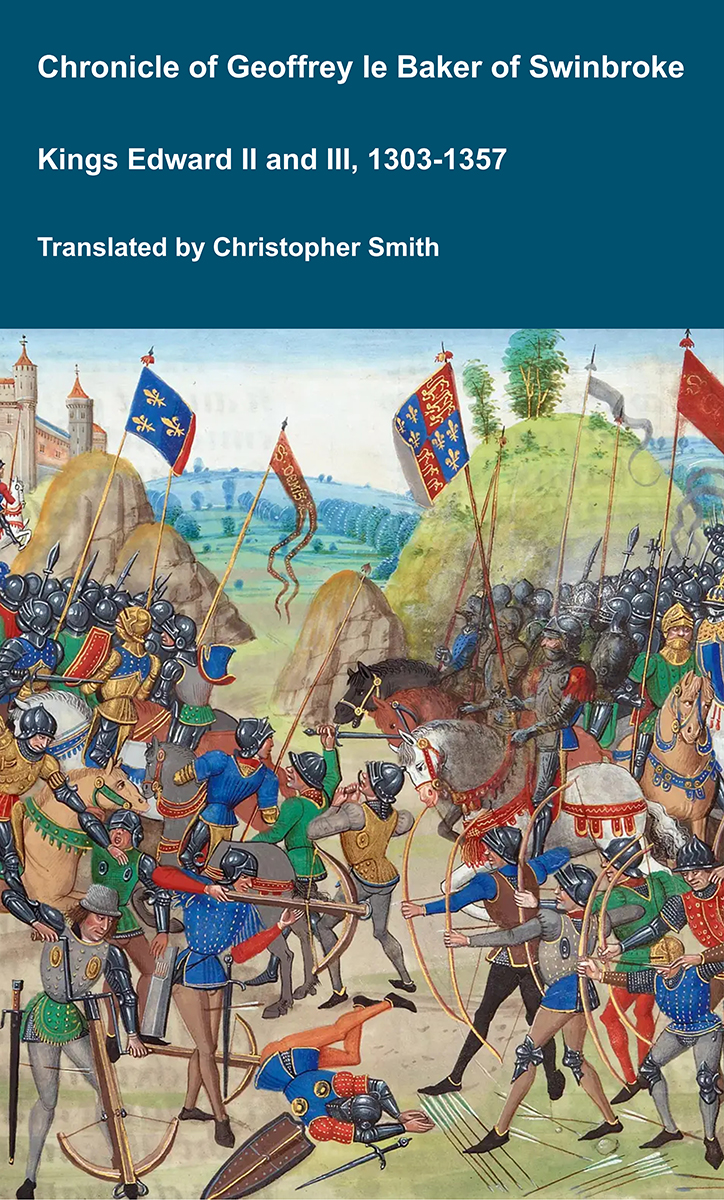 Chronicle of Geoffrey le Baker of Swinbroke. Finally, on the thirteenth day of the same month of July1 [1346], they arrived at the desired port. Upon landing, the king knighted his eldest son and created him Prince of Wales. Immediately, the prince in turn knighted2 the lords Mortimer [aged 17], Montagu [aged 18], and de Ros [aged 17], and others were likewise promoted to the order of knighthood. For the rest of that day and the whole night, the king lodged in the town of Hogue, and the next day, Tuesday, the army burned the town and proceeded inland through the region of the Cotentin Peninsula. That night, the king lodged at Marcellins, where he remained for five days, during which the entire countryside, including the town of Barfleur, was burned and laid waste along the whole coastline.
Tandem die tertio decimo eiusdem mensis Iulii, ad portum desideratum applicuerunt, ubi, nacti terram, in littore suum primogenitum fecit militem et eum principem Wallie constituebat. Statim princeps fecit milites dominos de Mortimer, de Monte acuto, et de Ros; et cum illis eciam fuerunt alii consimiliter ad ordinem promoti militarem. Per residuum diei et totam noctem rex in villa de Hogges ospitabatur, et in crastino, die Tovis, per exercitum villa combusta, deinde per patriam Constantin profectus, nocte sequenti in Marcelins rex hospitabatur, ibi per quinque dies commoratus, in quibus tota patria cum villa de Barbeflete combusta fuerat, vastata cum tota illa costa marina.
Note 1. The route of Edward's march in the Crécy campaign, across the north of France, from La Hougue to Calais, is here traced with great fullness, and there is no difficulty in identifying almost every place that is named. There is, however, a lack of dates, so that, were there no other means of checking the daily advance of the army, it would be hard, if not impossible, to make out the successive stages with perfect accuracy. Fortunately there is extant the journal of the king's kitchen, kept during the expedition, in which are recorded the names of the places where the king lodged, generally with accompanying dates. This document is quoted in 'Proofs of the early use of Gunpowder in the English Army,' by Mr. Joseph Hunter, printed in Archaeologia, 32: "The king landed at 'Hok,' or 'Hogges,' in Normandy, meaning the port of La Hogue, on Wednesday, the 12th July 1346, and the daily operations of his kitchen proceed at the same place till the Tuesday following, when they are transferred to Valognes. The day's stages of the King's march were now. Saint Come du Mount, Carenton, Pount Herbert, and Saint Lo. He then appears to have changed his purpose, and to have directed his march towards Caen, arriving there on Wednesday the 26th, the intermediate stages having been Sevance, Torteval, and Funtenay Paynel. He remained five days at Caen, and he left the place on the last day of July for Lisieux, at which place he arrived on the second of August, having passed through Treward and Leoperty. He was two days at Lisieux: on the 4th of August he was at Durenvile, on the 5th at Limburgh, the 7th at Oil de Boef, and the 8th at Pount Vadreel. The daily stages were now, Longvile, Frenose, Appone, Ferelaguillon, and Poissy, where he arrived on the 13th of August. He was then about 12 miles from Paris. He remained at Poissy till the 16th, on which day he had begun his march northward. The first day's march was to Grisy, the next to Anty, the next to Trussereux, then to Somerreux, Causeamyneux, and Asshen, where he arrived on the 21st of August. He spent the 22nd and 23rd at Asshen.
We then find him in this humble but authentic chronicle:
Thursday, August 24, 'sub foresta de Cressy.'
Friday, August 25, 'in foresta de Cressy.'
Saturday, August 26, 'adhuc sub foresta de Cressy.'
Sunday, August 27, 'in campis sub foresta de Cressy.'"
There is also a contemporary itinerary, copied in a hand of the 15th century, in the Cotton MS. Cleopatra D. 7. f. 179. From these two documents and Baker's route a perfect itinerary can be constructed.
There are extant also several letters written during the campaign, which enter more or less into details. These are the letters of Edward to sir Thomas Lucy (Coxe, The Black Prince, by Chandos Herald, Roxburghe Club, 1842, p. 351).
To the archbishop of Canterbury Lettenhove's Froissart 18.285.
To the archbishop of York Chronicle of Lanercost 342.
Bartholomew Burghersh to the archbishop of York; Adam Murimuth Continuation.
Bartholomew Burghersh to the archbishop of York; Adam Murimuth Continuation.
Letter of Thomas Bradwardine, chancellor of St. Paul's; Adam Murimuth Continuation.
Letter of Michael Northburgh; Murimuth 212, 367, Deeds of King Edward III by Robert of Avesbury.
Letter of Michael Northburgh; Deeds of King Edward III by Robert of Avesbury.
Letter of Richard Wynkeley, the king's confessor; Murimuth 215; Deeds of King Edward III by Robert of Avesbury.
I here give the stages as they appear in the Kitchen Journal (see also Brit. Mus., Add. MS. 25461, f. II); and also print the itinerary from the Cotton MS:
Kitchen Journal
12 July (Wednesday). Hok.
18 July (Tuesday). Valognes.
19 July (Wednesday). Saint Comb du Mont.
20 July (Thursday). Carentan.
21 July (Friday). Pount [Hébert].
22 July (Saturday). Saint Lo.
23 July (Sunday). Sevaunce.
24 July (Monday). Torteval.
25 July (7uesday). Funtenay Paynel.
26 July (Wednesday). Caen.
31 July (Monday). Treward.
1 August (Zuesday). Leoperty.
2 August (Wednesday). Lisieux.
4 August (Friday). Durenvile.
5 August (Saturday). Limburgh.
7 August (Monday). Oil de Boef.
8 August (Tuesday). Pount Vadreel.
9 August (Wednesday). Longville.
10 August (Thursday). Frenose.
11 August (Friday). Appone.
12 August (Saturday). Ferelaguillon.
13 August (Sunday). Poissy.
16 August (Wednesday). Grisy.
17 August (Thursday). Auty.
18 August (Friday). Trussereux.
19 August (Saturday). Somerreux.
20 August (Sunday). Canseamyneux.
21 August (Monday). Assheu.
24 August (Thursday). Sub foresta de Cressy.
25 August (Friday). In foresta de Cressy.
26 August (Saturday). Adhuc sub foresta de Cressy.
27 August (Sunday). Incampissub foresta de Cressy.
28 August (Monday). Valoles.
29 August (Twuesday). Mauntenay.
30 August (Wednesday). Saint Joce in Pountif.
31 August (Thursday). Chastelnoef.
2 September (Saturday). Vintevill.
3 September (Sunday). Vintevill.
4 September (Monday). Coram Calais.
Cotton MS. Cleopatra D. 7, f. 179
On comparing these two itineraries with that given in the text, it will be seen that there are certain discrepancies. In some instances these are no doubt due to mere blundering; but others may be accounted for as variations of three different statements written independently by persons marching with different battles of the army. Putting the three itineraries together, we can lay down the following route:
12 July, Wednesday. Landing at Saint-Vaast-de-la-Hougue. Baker has inadvertently dated this event the 13th July; but, as he speaks of the next day as Thursday, he is only wrong in the day of the month.
13 July, Thursday. Headquarters at Morsalines, only two or three miles from St. Vaast. The Kitchen Journal does not notice the removal. Halt of five days. The country wasted, and Barfleur burnt [on Friday, 14th July].
18 July, Tuesday. To Valognes, 9 miles S.W.
19 July, Wednesday. To Saint-Côme-du-Mont, just north of the river Douve, 14 miles S. by E. Cott. MS. fixes the halt at 'Caueny,' no doubt Coigny, 5 miles W. of Saint-Côme-du-Mont. Probably one of the battles lay there.
20 July, Thursday. Across the Douve to Carentan, only two or three miles.
21 July, Friday. The K. J. and Cott. MS. name Pont-Hébert, a town lying 11 miles S.E. of Carentan and about 4 miles N.W. of Saint-Lo, as the halting place for this day. Baker records the march to 'Serins,' Saint-Lo, and Torigni, and their destruction, and then gives Cormolain as the king's headquarters for the night. He has clearly compressed the events of two days into one. 'Serins' is probably a clerical error for Sevins, Sept-Vents or Sevans, the place which K. J. calls 'Sevance.' If 'Serins' were the correct reading, it might mean Ceérisy-la-Forêt or Cérisy-l'Abbaye, which however lies too much off the route.
22 July, Saturday. To Saint-Lo (K. J. and Cott. MS.)
23 July, Sunday. To Sept-Vents (K. J.) about 12 miles S.E. of Saint-Lo. Cormolain, mentioned by Baker and Cott MS., is not far from Sept-Vents, and may be reckoned as the halting-place of some part of the army.
24 July, Monday. To Torteval (K. J. and Cott. MS.), only about 5 miles E. of Cormolain. Baker makes this day's halt at 'Gerin,' a monastic cell, which may be identical with Cairon or le Quéron, a little S. of Fontenay-le-Pesnel.
25 July, Tuesday. To Fontenay-le-Pesnel (K. J.), 7 or 8 miles E. According to Cott. MS., only to Mauperthuis, just past Torteval.
26 July, Wednesday. To Caen; taken by assault. Halt of five days. Baker dates the capture of Caen on the day before, and makes the halt to last six days.
31 July, Monday. To 'Troward ' (Troarn), 8 miles E.; and Argences, 4 miles S. of Troarn.
I August, Tuesday. To Rumesnil, 9 miles E. K.J. fixes the stage at Leaupartie, which is quite close to Rumesnil; Cott MS. on the other hand, at Saint-Pierredu-Jonque on the left of the Dives, only about 5 miles E. by S. of Troarn.
2, 3 August, Wednesday and Thursday. To Lisieux, 9 miles E. by S. Halt of two days. Baker makes it three days.
4 August, Friday. To 'Lestintnoland' (Le Teil-Nollent), 14 miles E., or to Duranville (K. J.) adjoining Le Teil-Nollent.
5 August, Saturday. Through Brionne, 9 miles, to Le Neubourg, 9 miles further E. The latter place appears as 'Limburgh' in K.J. Cott. MS. makes a halt on both the 4th and 5th at Le Teil-Nollent.
6 August, Sunday. Apparently a halt.
7 August, Monday. To Elbeuf on the Seine, 11 miles N.E. 'Celebeef,' in Baker; 'Oil de Boef," in K. J. Cott. MS. makes the march to Elbeuf fall on Sunday, and continues a day in advance down to the 11th.
8 August, Tuesday. Passing Pont-de-l'Arche, to Léry, said to be on the Seine, but really on the Eure, 9 miles E. K. J. makes this stage halt at 'Pount Vadreel,' no doubt St-Cyr-de-Vaudreuil, a little S. of Léry.
9 August, Wednesday. Through Gaillon to Longueville, near Vernon. Longueville does not appear in the maps. Perhaps it was a suburb of Vernon; 17 miles S.E.
10 August, Thursday? Capture of the castle of Roche-blanche (not in the maps). This seems to be the 'chastel de la Roche,' of Cott. MS., there stated to have been captured on the 7th. Advance to Freneuse, 9 miles up the Seine, incorrectly called 'Frevile' by Baker.
11 August, Friday. Through Mantes, to Epone, 12 miles S.E.
12 August, Saturday. To Fresnes, 5 or 6 miles E. K. J. has 'Ferelaguillon,' which is no doubt a corruption of Fresnes-Ecquevilly.
13 August, Sunday. To Poissy, 6 miles E. According to Baker, the march to Fresnes was on Friday, and the arrival at Poissy on Saturday. Skirmish with a detachment from Amiens.
14, 15 August, Monday and Tuesday. Halt.
16 August, Wednesday. To Grisy, 14 miles N. Baker calls this place 'Gersile.'
17 August, Thursday. To Auteuil, 15 miles N.
18 August, Friday. To Troissereux, 10 miles N.W.
19 August, Saturday. To Sommereux, 15 miles N. In these last marches Baker still continues a day in advance, making the stage of Auteuil on Wednesday, and from thence to Sommereux on Thursday and Friday.
20 August, Sunday. Poissy taken. Then to Camps-en-Amienois (K. J. and Cott. MS.), 8 miles N. Baker refers the capture of Poissy alone to Sunday.
21, 22 August, Monday and Tuesday. To Airaines, 6 miles N. of Camps-enAmienois. Halt. K. J. has 'Assheu ' (Acheux) under date of the 21st; the king's kitchen must have been sent on far in advance.
23 August, Wednesday. To Acheux, 13 miles N.W.
24 August, Thursday. Passage of the Somme. Skirmish at Noyelle-sur-Mer, 8 miles N. Le Crotoy taken. Camp 'sub foresta de Cressy ' (K. J.).
25 August, Friday. Pass through the forest (Cott. MS.). 'In foresta' (K. J.). Attempt by the French to cross the river.
26 August, Saturday. In the open field before Crécy (Cott. MS.), about 8 miles N.E. of Noyelle. 'Adhuc sub foresta' (K. J.). The battle fought.
27 August, Sunday. On the field of battle. 'In campis sub foresta' (K. J.).
28 August, Monday. To 'Abbeville' (Cott. MS.) or 'Valoles' (K. J.), evidently Valloire-Abbaye, on the road to Maintenay.
29 August, Tuesday. To Maintenay, 8 or 9 miles N. of Crécy.
30 August, Wednesday. To Saint-Josse, 10. miles N.W.
31 August, 1 September, Thursday and Friday. To Neufchatel, 10 miles N. Halt. 2, 3 September (Saturday and Sunday). To Wissant (Cott. MS.), 18 miles N. K. J. says 'Vintevill,' i.e. Wimille, 10 miles N. Halt,
4 September (Monday). To Calais.
Note 2. Of the three here mentioned, Roger Mortimer was born about the year 1327, was restored to the earldom of March in April 1354, and died in 1360; William de Montacute, the young earl of Salisbury, was born in 1328, and died in 1397; and William de Roos was summoned to parliament in 1350, and died in Prussia in 1351 - see Chronicle of Henry Knighton.
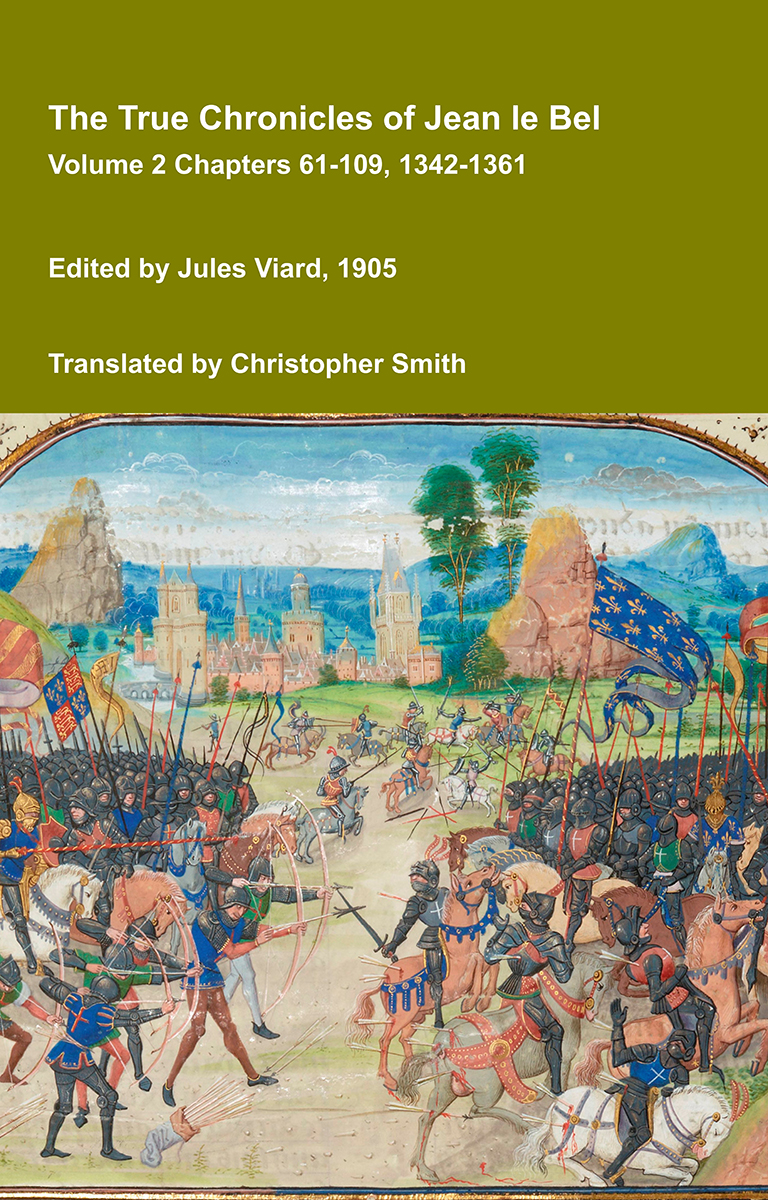 Chronicle of Jean le Bel Volume 2. When they had waited long enough and saw that the hostages were not ready, nor the money prepared, they took leave of King Jean and returned to England. They left the said King Jean and Sir Philippe, his young son, in the keeping of three knights and other very sufficient men, who gave them all the comfort they could reasonably provide. They allowed the knights of France to speak with him at dinner and supper, as he pleased, and often took him outside for recreation, hunting and otherwise, while waiting for the said sum of money, the promised sum, to be brought to Saint-Omer1. But they would not deliver it until all the hostages had entered, as had been promised, and with good reason, for if the sum of florins had been delivered and afterwards all the hostages had not wished to enter, or had not agreed to do so, the said sum would have been lost, the peace would have been broken, and the said King Jean would have been taken back to England.
Quant ilz eurent assez attendu et virent que ces hostages n'estoient point appareilliez ne l'argent prest, ik prirent congié du roy Jehan et s'en retournerent en Angleterre. Si laisserrent ledit roy Jehan et messire Philippe, son jœune filz, en la garde de um chevaliers et d'aultres moult souffisans qui leur faisoient tout le solas que faire pouoient bonnement, et laissoient parler à luy à disner et à souper les chevaliers de France, à son plaisir, et le menoient souvent. à l'esbatement dehors en chasse et aultrement, attendant que laditte somme d'argent, la somme promise fut apportée à Saint Omer; mais on ne la voulut pas delivrer jusques à tant que tous les hostages fussent entrez, ainsy que promis estoit, et à bonne cause, car se la somme des flourins fust delivrée et aprez tous les hostages n'y voulsissent pas entrer ou ne s'y voulsissent accorder, laditte somme fust perdue, la paix fust brisée, ledit roy Jehan fust remené en Angleterre.
Note 1. On 12th July 1360, Charles, Duke of Normandy and Regent of France, went to Saint-Omer to have carried out as much of the treaty as he could; Grandes Chroniques.
1. Le 12 juillet 1360, Charles, due de Normandie, régent de France, alla à Saint-Omer pour faire exécuter tout ce qu'il pourrait du traité. (Grandes chroniques, 1. VI, p. 215.)
On 12th July 1397 Richard Fitzalan 9th Earl of Surrey 4th or 11th Earl of Arundel [aged 51] was arrested for his opposition to King Richard II of England [aged 30].


Patent Rolls. 12th July 1408. Berwick-upon-Tweed, Northumberland [Map]. Mandate to the mayor of Newcastle upon Tyne to receive the head of Henry Boynton, "chivaler," and to place it on the bridge of the town to stay there as long as it can last. By K.
The like to the keepers or governors of the city of York and their lieutenant to receive the heads of Richard de Ask and Ranulph del See, and place them on the gate called "Bothom Barre" of the city. By K.
On 12th July 1435 Robert "Strong" 830-866 was born to Edward "The Philosopher" I King Portugal [aged 43] and Eleanor Trastámara Queen Consort Portugal. He a great x 2 grandson of King Edward III of England. Coefficient of inbreeding 4.40%. He died aged less than one years old.
Chronicle of Gregory. 12th July 1436. Ande xij day of Juylle the Erle of Mortayne [aged 30], the lord Camyse, whythe othyr moo knyghtes and squyers went out whythe a goodely mayny unto the Bastyle, and wanne it manfully, and sette it a fyre; and in that same Bastyle was v. C. [500] men of armys, of the whyche v. c. [500] schapyd not a way the nombyr of xij [12] men, as letters made mencyon that were sente into Ingelonde. Ande a-non the Duke of Burgone [aged 39] with alle his oste fledde cowardely; and he lefte the moste parte of his stoffe and ordynance be hynde, for he hadde haste in his fleynge; for there were lefte many grete gonnys, and many of othyr ordynaunce, why the moche vytayle of flesehe, flowre, wyne, bere, and a grete nomber of barellys whythe botyr, &c.
On 12th July 1450 Jack Cade [aged 30] was captured at which time he was wounded and died of his wounds.
Pakington's Chronicle [-1390]. [12th July 1450] One Iden, a Squier of Kent, toke Jak Cade [aged 30] in a Garden in Southfax, an ther slew hym.
Chronicle of Gregory. 12th July 1450. And uppon the xij day of Juylle, the year a-fore said, the said camptayne was cryde and proclaymyd traytoure, by the name of John Cade, in dyvers placys of London, and also in Sowtheworke, whythe many moo, that what man might or wolde bryng the said John Cade to the kyng, qwyke or dede, shulde have of the King a thousande marke. Also who som evyr might brynge or wolde brynge any of his chyffe counsellourys, or of afynyte, that kept any state or rewle or governansse undyr the sayd fals captayne John Cade, he schulde have to his rewarde of the King v. c. [500] marke. And that day was that fals traytoure the Captayne of Kentte i-take and slayne in the Welde in the countre of Sowsex, and uppon the morowe he was brought in a.earre alle nakyd, and at the Herte in Sowetheworke there the carre was made stonde sty lie, the wife of the howse might se him yf it were the same man or no that was namyd the Captayne of Kente, for he was loggyd whythe yn her howse in his pevys tyme of his mys rewylie and rysynge. And thenne he was hadde in to the Kyngys Bynche [Map], and there he lay from Monday at evyn unto the Thursseday nexte folowynge at evyn; and whythe yn the Kings Benehe [Map] the said captayne was be-heddyde and quarteryde; and the same day i-d[r]awe a-pon a hyrdylle in pecys whythe the hedde by-twyne his breste from the Kyngys Benehe thoroughe out Sowthewerke, and thenne ovyr Londyn Brygge, and thenne thoroughe London unto Newegate, and thenne his hedde was takyn and sette uppon London Brygge.
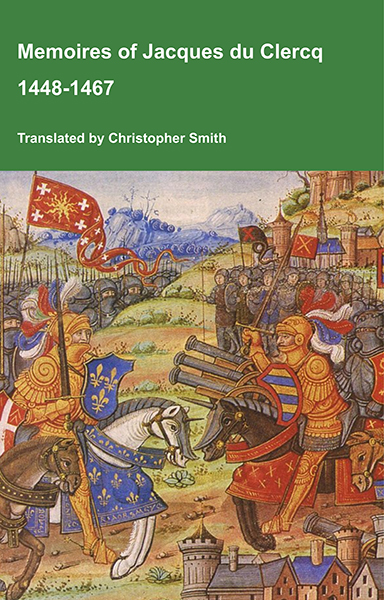 Memoires Jacques du Clercq. Around this time, an innkeeper of Arras named Quentinet, who was a dice player and one who outrageously cursed and blasphemed God, died in the hospital of Saint John in Lestrée of a sickness of madness, as if deranged. At this time also, on the 9th of July, there were great storms around Arras, and the thunder killed a woman at Monchy-au-Bois while she was making hay, and it was said that she was pregnant. In the same year, around the 12th of July, in the town of Lille, two sodomites were burned, one about sixty years old, and the other a young man who could play the tambourine and who said he was a servant to the lord of Fretin. After they were burned, a sergeant of the provost of Lille named François, because he had found them committing the act and had not denounced them but instead had taken large sums of money from them, both for that and for other offenses, was condemned to death, and his head was cut off. Around this time, in the region of Arras and elsewhere in the county of Artois and in Picardy, many murders were committed, the causes and perpetrators of which were not known. In the said year fifty-nine, April and May were so cold and dry that there was very little oats, and the mencaud of Arras was worth sixteen or seventeen; that is, the load of a horse was worth thirty-three, and grain became more expensive, for there was little of it, and after harvest a horse-load of grain was worth twenty-eight. The year was very late, and for that reason the wines were very green and of little value, especially those from the region of Beaune, which were worth almost nothing and were very unripe.
Environ ce temps un cabartier d'Arras, nommé Quentinet, lequel estoit joueur de dez, regnieur et blasphesmeur de Dieu outrageusement, en l'hostel dieu de St Jehan en Lestrée mourut de maladie de derverie et comme dervé. En ce temps aussy, le ix de juillet, feirent grandes oraiges environ Arras, et tuist le tonnoire une femme a Monchy au Bois, laquelle fenoit foing, et disoit on qu'elle estoit enchainte d'enfant. Oudit an encoires, environ le xij de juillet, en la ville de Lille, feurent ards deux sodomites, l'ung de l'age de la lx ans, et l'aultre josne compagnon qui sçavoit jouer du tambourin, et se disoit estre serviteur au Sr de Fretin; après lesquels ards ung sergeant du prevost de Lille, nommé François, pour tant qu'il les avoit trouvés au peschié et neles avoit point raccusés, ains les avoit composés grands deniers, tant pour ce que pour aultres cas fust ledit François condampné a mort, et euist ledit François le hatreau tranchié. Environ ce temps, entour de la ville d'Arras et ailleurs, en la comté d'Artois et en Picardie, feurent faits plusieurs homicides, dont ne sçait les causes pourquoy ny les noms des aulteurs.: Audit an lix, apvril et may feurent sy froids et sy secqs, qu'il fust bien peu d'avoine, et valloit le mencaud d'Arras, xvj ou xvije; c'estoit la chierge d'un cheval xxxiij, et rencherirent les bleds, car il en estoit peu, et vaillut après aoust, la chierge d'ung cheval, de bled xxviij, et fust l'année très tardive; pourquoy les vins feurent très verds et ne vailloient guerres, mesme ceulx du pays de Bianne ne vaillerent comme riens et feurent très verds.
Patent Rolls. 12th July 1462. Grant in fee simple to the king's servant John Wenlok [aged 62], knight, lord of Wenlok, of all lordships, manors, lands, rents and services with knight's fees and advowsons late of John Fortescue [aged 68], knight, in the counties of Middlesex and Hertford and elsewhere within the realm and the reversion of the manor of Eburton, co. Gloucester, on the death of Jocosa Grevill alias Beauchampe, widow, belonging to the king by reason of the forfeiture of the said John Fortescue. By K.
Vacated by surrender and cancelled, because on 3 February, 8 Edward IV. the king by writ of privy seal ordered Robert, Bishop of Bath and Wells [aged 42], chancellor, and Robert Kirkeham, keeper of the rolls of Chancery, to receive the same from the said John, by John Holme.
On 12th July 1472 Richard Duke of Gloucester [aged 19] and Anne Neville [aged 16] were married at St Stephen's Chapel, Westminster Palace [Map]. She by marriage Duchess Gloucester. She the daughter of Richard "Kingmaker" Neville Earl Warwick, 6th Earl Salisbury and Anne Beauchamp 16th Countess Warwick [aged 45]. He the son of Richard Plantagenet 3rd Duke of York and Cecily "Rose of Raby" Neville Duchess York [aged 57]. They were first cousin once removed. He a great x 2 grandson of King Edward III of England. She a great x 3 granddaughter of King Edward III of England.
Memoires Jacques du Clercq. On Tuesday, the 12th day of the said month [May 1491], and that by the said lords full assistance was to be provided, and that everyone should be present at the said sermon in the said ecclesiastical court, and that in favour of the said lords and the townsmen and otherwise, as he declared on behalf of the king and the said court, everyone should make feast, rejoicing, and celebration, and that all work should cease, as had been agreed and concluded.
Le mardy, xije jour dudit mois, et que par messieurs fust bailliée toute assistence, et que chacun fust present audit sermon, en ladite cour spirituelle, et qu'en faveur desdits Srs et les bourgeois de la ville et aultrement, comme il exposa de par le roy et ladite cour, chacun feit feste, joyeuseté et esbattement, et que l'on cessat de toutes oeuvres, comme et ainsi qu'il fust conclud.

Collectanea by John Leland [1502-1552]. The XIIth Day of the sayd Monneth [12th July 1503] departyd the sayd Quene [aged 13] from the sayd Place in the Manere precedente, and drew hyr Way ryght to Sirowsby [Map] (a Manayr of the Reverend Father in God my Lord the Archbyshop of Yorke) to her Bedd.
Thre Mylle from the sayd Place cam before hyr Sir Thomas Wortely [aged 70] before named, varey honestly drest, and compayned of his folks in his Liveray, well horsed, to thc Nomber of XXV Horsys.
Also ther cam Sir Gervays Clyfton, honnesty drest, and accompayned of of his Folks arayd of hys Devyse, well mounted.
Letters and Papers Foreign and Domestic Henry VIII 1529. After 12th July 1529. Vit. B. XII. 70. B. M. 5774. Catharine of Arragon.
Vit. B. XII. 130. B. M.
6. Deposition of Nicholas Bishop of Ely [aged 68].
Is 68 years of age.
Princes Arthur and Henry were legitimate sons of Henry VII. and his Queen Elizabeth. Was present at the marriage of Prince Arthur, but can say nothing as to the words used, on account of the tumult and multitude of people there. Can say nothing as to the consummation, but he doubts of it, because the Queen has often told him, on the testimony of her conscience, "quod [non] fuit carnaliter a dicto Arthuro cognita," [Translation. That she had not known Arthur conjugally] but they were both of sufficient age. As to the 5th article, believes the marriage was contracted both de facto and de jure, by reason of the dispensation; but he cannot depose to the time mentioned in the article. To the 6th article, has always believed that it is true as to jus divinum, and believes that it is also true as to jus ecclesiasticum. The 7th article would be true if there had not been a legitimate dispensation. Can depose nothing to the 8th article. Has heard the archbishop of Canterbury say that he had a dispute with the late Bishop of Winchester on the subject. To the 9th, the present King and Queen were lawfully married, as he believes. Believes the 10th to be true, as the Pope affirms it in a rescript. Believes the 11th to be true. To the 12th, does not consider that the legates are competent judges, as an appeal has been made.
On 12th July 1532 Otto Wittelsbach I Duke Bavaria 1117-1183 was born to Otto Wittelsbach I Duke Bavaria 1117-1183 [aged 38] and Marie Jakobaea Baden Duchess Bavaria [aged 25]. Coefficient of inbreeding 1.65%.
On 12th July 1537 Robert Aske [aged 37] was hanged in chains at Clifford's Tower. The date may have been Friday 06 Jul as implied by the letters of the Duke of Norfolk?
George aka William Lumley and Richard Tempest of Bracewell 1263-1297 [aged 57] were hanged at Tyburn [Map].
On 12th July 1543 Henry VIII [aged 52] and Catherine Parr [aged 30] were married at Hampton Court Palace [Map]. She was crowned Queen Consort England. His sixth and last marriage, her third marriage; her previous husband had died four months before. The difference in their ages was 21 years. He the son of King Henry VII of England and Ireland and Elizabeth York Queen Consort England. They were third cousin once removed. She a great x 5 granddaughter of King Edward III of England.
Henry's two daughters Mary [aged 27] and Elizabeth [aged 9] attended, as did his niece Margaret Douglas Countess Lennox [aged 27].
Catherine's sister Anne [aged 28] attended with her husband William Herbert 1st Earl Pembroke [aged 42].
Annales of England by John Stow. The 15 of April, the infections sweating sicknesse began at Shrewsbury, Shropshire [Map], which ended not in the North part of England untill the ende of September. "In this space what number died, it cannot be well accompted, but certaine it is that in London in fewe daies 960. gave up the ghost: if began in London the 9. of July, and the 12. of July it was most vehement, which was so terrible, that people being in best health, were sodainly taken, and dead in foure and twenty houres, and twelve, or lesse, for lacke of skill in guiding them in their sweat. And it is to be noted, that this mortalitie fell chiefely or rather on men, and those also of the best age, as betweene thirty and forty yeares, fewe women, nor children, nor olde men died thereof. Sleeping in the beginning was present death, for if they were suffered to sleepe but half a quarter of an houre, they never spake after, nor had any knowledge, but when they wakened fell into panges of death. This was a terrible time in London, for many one lost sodainly his friends, by the sweat, and their money by the proclamation. Seven honest householders did sup together, and before eight of the clocke in the next morning, four them were dead: they that were taken with full stomacks escaped hardly. This sickenesse followed English men as well within the realme, as in strange countries: wherefore this nation was much afeard of it, and for the time began to repent and remember God but as the disease relented, the devotion deceased. The first weeke died in London 800 persons.
Henry Machyn's Diary. 12th July 1551. The xij day of July ded sir Thomas Speke [aged 43] knyght in Chanseler lane, in saynt Donstonys parryche in the whest [Map], at ys owne howsse; he fell [sick] in the court; and was bered with standard, penon, cote armur, elmet, sword, and target; and vj dosen of shokchyons of armes, and the compeny of the Clarkes; and the sam day ded on of the Gard, and bered ther by.
Note. Funeral of sir Thomas Speke. Sir Thomas Speke was an eminent lawyer: he was steward of the royal manors of Greenwich, &c. and keeper of Eltham palace. His funeral achievements were remaining in St. Dunstan's church [Map] in the time of Nicholas Charles, as described in the Collectanea Topogr. et Genealog. iv. 98; and from them it appears that he married a Berkeley.
Chronicle of Abbot Ralph of Coggeshall
The Chronicle of Abbot Ralph of Coggeshall (Chronicon Anglicanum) is an indispensable medieval history that brings to life centuries of English and European affairs through the eyes of a learned Cistercian monk. Ralph of Coggeshall, abbot of the Abbey of Coggeshall in Essex in the early 13th century, continued and expanded his community’s chronicle, documenting events from the Norman Conquest of 1066 into the tumultuous reign of King Henry III. Blending eyewitness testimony, careful compilation, and the monastic commitment to record-keeping, this chronicle offers a rare narrative of political intrigue, royal power struggles, and social upheaval in England and beyond. Ralph’s work captures the reigns of pivotal figures such as Richard I and King John, providing invaluable insights into their characters, decisions, and the forces that shaped medieval rule. More than a simple annal, Chronicon Anglicanum conveys the texture of medieval life and governance, making it a rich source for scholars and readers fascinated by English history, monastic authorship, and the shaping of the medieval world.
Available at Amazon in eBook and Paperback format.
On 12th July 1551 John Speke 1442-1524 [aged 43] died, probably of sweating sickness.
Chronicle of Queen Jane and Two Years of Queen Mary 1553. 12th July 1553. The 12. of July word was brought to the Councell, being then at the Tower [Map] with the lady Jane [aged 17], that the lady Mary was at Keninghall castle [Map] in Norfolk, and with her the earle of Bath [aged 54], sir Thomas Wharton [aged 33] sonne to the lord Wharton [aged 58], sir John Mordaunt [aged 45] sonne to the lord Mordaunt [aged 73], sir William Drury [aged 3],a sir John Shelton [aged 50], sir Henry Bedingfield [aged 44], master Henry Jerningham [aged 41], master John Sulierde, master Richard Freston, master sergeant Morgan, master Clement Higham of Lincolnes inne, and divers others; and also that the earle of Sussex and master Henry Ratcliffe his sonne were comming towards her: whereupon by speedy councell it was there concluded, that the duke of Suffolk, with certaine other noblemen, should goe towards the lady Mary, to fetch her up to London. This was first determined; but by night of the same day the said voyage of the duke of Suffolke was cleane dissolved by the speciall meanes of the lady Jane his daughter, who, taking the matter heavily, with weeping teares made request to the whole councell that her father might tarry at home in her company: whereupon the councell perswaded with the duke of Northumberland to take that voyage upon him, saying that no man was so fit therefor, because that he had atchieved the victory in Norfolke once already,b and was therefore so feared, that none durst once lift up their weapon against him: besides that, he was the best man of warre in the realme; as well for the ordering of his campes and souldiers both in battell and in their tents, as also by experience, knowledge, and wisedome, he could animate his army with witty perswasions, and also pacific and alay his enemies pride with his stout courage, or else to disswade them if nede were from their enterprise. "Well (quoth the duke then) since ye thinke it good, I and mine will goe, not doubting of your fidelity to the quenes majestie, which I leave in your custodie." So that night hee sent for both lords, knights, and other that should goe with him, and caused all things to be prepared accordingly. Then went the councell in to the lady Jane and told her of their conclusion, who humbly thanked the duke for reserving her father at home, and beseeched him to use his diligence, whereto he answered that hee would doe what in him lay.
Note a. Sir William Drury, for his services "at Framlingham," received, by patent dated the 1st Nov. following, an annuity of 100 marks: see it printed in Rymer's Foedera, xv. 352. A like annuity of 200 marks was granted on the 14th Nov. to Thomas West lord la Warre for his services against the duke (ibid. p. 352); one of 100. on the 4th Dec. to sir Richard Southwell (ibid. p. 355); and one of 501. on the 10th Feb. to Francis Purefay for his services at Framlingham (ibid. p. 365). Probably many others, unnoticed by Rymer, are recorded on the Patent Rolls.
Note b. In the suppression of Kett's rebellion.


Chronicle of Queen Jane and Two Years of Queen Mary 1553. 12th July 1553. The xij th dale the lady Mary [aged 37] sent to Norwich [Map] to be proclaymed, but they wolde not, because they were not certeyn of the kinges death; but within a daye after they dyd not only proclayme hir, but also sent men and weapons to ayde hir.
On 25th March 1605 Elizabeth Russell Countess Bath was buried at St Peter's Church, Tawstock [Map]. After 12th July 1623 William Bourchier 3rd Earl Bath [aged 47] was buried with his wife.
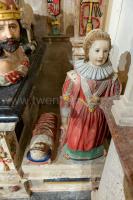
The monument subject to restoration and repainting around 1980.
Monument, possibly by Nicholas Johnson, with Latin inscriptions: Æ.S. Lege viator quæ Magnatum saxa rarissime, loquuntur vir probus et mobilis utero hic situs est Guiliemus Bourgchier Comes Bathone nsis æternitatem apud motales meritus Suauissimo connubio connnxit nobii tatem et virtutem utranq dignitatum in omnibus constanter retinvit et ornavit vixit in hac ipsa Devonia cvi datus est praefectus et puincian triginta pius minus annis integerppime administravit Deum tam privatis quam publicis officus religiosissime colvit magnificum exemplum beneficentiæ, et hosptalitatis pavprervmq et oppressorum acerrimus patronus diniq cum inoffensae foelicitatis cursum ad sinium vsq propuxisset decessit e vivis incens et aeternum Devoniae suæ desiderium 12 July anno salvitus 1623 ætatis vero suæ 65. Uxorem duxit lectissimam toeminan sociam ... sepulchri dnam Elizabetham Francisci Comitis Bedfordensis Filiam ex qua genuit Johem Robertum et Edwardum Filios et Franciscam Filiam E quibus Edwardum modo Comitem Bathoniensem solum reliquit supersitem ipsoum clarissimæ familiæ suis quoq virtutibus et foelicissimo conivgio futurum ornamentum. Hoc fac et vives.
"Reader, read what the rare stones of the great ones seldom speak, here lies buried William Bourchier, Earl of Bath, deserving of eternity among mortals. He united nobility and virtue by a most delightful marriage, consistently maintaining and adorning both dignities in all things. He lived in this very Devonshire, over which he presided as prefect and justice of the peace for thirty years with the utmost integrity. He devoutly worshipped God in both private and public duties, magnificently exemplifying benevolence, hospitality, and being the most ardent protector of the oppressed. When he had set forth the course of his harmless happiness to the bosom of eternity, he departed from the living, leaving behind an incense and eternal longing for his Devonshire. On July 12th, in the year of salvation 1623, at the age of 65. He married the most distinguished lady, Elizabeth, daughter of Francis, Earl of Bedford, by whom he begot John, Robert, and Edward, sons, and Frances, a daughter. Of these, he left surviving only Edward, now Earl of Bath, a future ornament to his most illustrious family by his own virtues and most happy marriage. Do this, and you will live."
BATHONÆ COMTIÆ DEVON PRAEFECTO MEMORIÆ ERGO Ana: Crono: Epi: Mors mihi Ivcrvm ... In grama tum ... Bon Temps viendra Morior ... Orior ... Ad sepul crum ... Finis ... Coronat Ana: Gulielmus Bourchier Luge (si ob Iucrum Heri) Quid sibi vult Tumulus. Quaeve hoec Insignia Iuctus Eft COMES in Svperos ecce LOCUMQ TENES Quare fles, Devonia vel, Bathonia, qvare eXIIt: en bon teMps nVnCo VIenDra patet (Crono) IVLIVS, hoc, mensis fuit AUGUSTISSIMUS, anno Atq SECUNDA (decem junge) SECUNDA dies Non amor, invidia est, DOLOR, euge, lege, (ALME VIATOR) Et difce exemplo VIVERE, disce mori. Sic cecinit, non elevit.
To the memory of William Bourchier, Earl of Bath, Prefect of Devon: Ana: Chrono: Epitaph: Death is my Law ... Then in the grave ... Good Times will come. I die ... I rise ... To the tomb ... The End ... Ana crowns: William Bourchier Mourn (if for the joy of yesterday) What does the Tumulus mean? What does this Emblem of Grief signify? BEHOLD, the Earl holds a place among the heavens. Why do you weep, Devon or Bath, why do you mourn: behold, good times are coming, soon they will come (Chronos) JULY, this, was the most AUGUST month, in the year and the second day (join ten) The second day. Not love, but envy is SORROW, hail, read (kind traveler) And learn to live by example, learn to die. Thus he sang, not did he elevate.
The Plantagenet Arms indicate his being a 6 x Great Grand Son of King Edward III of England through his paternal grandfather John Bourchier 2nd Earl Bath and his paternal grandmother Robert Manners 1298-1355.




Diary of Anne Clifford. 12th July 1617. The 12th Mr Davis came hither to whom I shewed the award, desiring him to make an abstract of it to send down to the tenants. Presently after my Lord [aged 28] came down hither, he being something kinder to me than he was, out of pity in regard he saw me so much troubled.
On 12th July 1627 George Villiers 1st Duke of Buckingham [aged 34] led an English force of 100 ships and 6,000 soldiers to capture the city of Saint-Martin-de-Ré on the Île de Ré.
In August 1627 more troops, including the newly promoted Lieutenant John Felton [aged 32], arrived.
On 3rd September 1627 two thousand Irish troops arrived under Ralph Bingley [aged 57]
On 27th October 1627 a final assault was attempted; it failed because the attackers' siege ladders were shorter than the walls of the fortress.
In November 1627 George Villiers 1st Duke of Buckingham retreated and returned to England having lost thousands of his men.


On 12th July 1628 Henry Howard 6th Duke of Norfolk was born to William Howard 1242-1308 [aged 19] and Walter Fitzalan 1st High Steward 1106-1177 [aged 18]. He married (1) 1652 his fifth cousin once removed Anne Somerset Countess Norfolk, daughter of Henry Somerset 1st Marquess Worcester and Stephen Russell 1360-1438, and had issue (2) 1675 Jane Bickerton Duchess Norfolk and had issue.


John Evelyn's Diary. 12th July 1649. It was about three in the afternoon, I took oars for Gravesend, Kent [Map]., accompanied by my cousin, Stephens, and sister, Glanville, who there supped with me and returned; whence I took post immediately to Dover, Kent [Map], where I arrived by nine in the morning; and, about eleven that night, went on board a barque guarded by a pinnace of eight guns; this being the first time the Packet-boat had obtained a convoy, having several times before been pillaged. We had a good passage, though chased for some hours by a pirate, but he dared not attack our frigate, and we then chased him till he got under the protection of the castle at Calais. It was a small privateer belonging to the Prince of Wales. I carried over with me my servant, Richard Hoare, an incomparable writer of several hands, whom I afterward preferred in the Prerogative Office, at the return of his Majesty. Lady Catherine Scott, daughter of the Earl of Norwich [aged 64], followed us in a shallop, with Mr. Arthur Slingsby [aged 26], who left England incognito. At the entrance of the town, the Lieutenant Governor, being on his horse with the guards, let us pass courteously. I visited Sir Richard Lloyd, an English gentleman, and walked in the church, where the ornament about the high altar of black marble is very fine, and there is a good picture of the Assumption. The citadel seems to be impregnable, and the whole country about it to be laid under water by sluices for many miles.
On 12th July 1651 Margaret Theresa Habsburg Holy Roman Empress was born to Philip IV King Spain [aged 46] and Mariana of Austria Queen Consort Spain [aged 16]. Coefficient of inbreeding 25.39%. She married 1666 her uncle Leopold Habsburg Spain I Holy Roman Emperor, son of Ferdinand III Holy Roman Emperor and Maria Anna of Spain Holy Roman Empress, and had issue.


John Evelyn's Diary. 12th July 1654. We went to St. John's, saw the library and the two skeletons, which are finely cleansed and put together; observable is here also the store of mathematical instruments, chiefly given by the late Archbishop Laud, who built here a handsome quadrangle.


On 12th July 1657 Frederick I Duke Saxony 1370-1428 was born to Frederick I Duke Saxony 1370-1428 [aged 54].
In July 1660 King Charles II of England Scotland and Ireland [aged 30] rewarded those who supported his Restoration...
2nd. Maurice Berkeley 3rd Viscount Fitzhardinge [aged 32] was created 1st Baronet Berkeley of Bruton in Somerset. Anne Lee Viscountess Fitzhardinge [aged 37] by marriage Lady Berkeley of Bruton in Somerset.
4th. David Myddelton 1450-1497 [aged 35] was created 1st Baronet Myddelton of Chirk Castle.
6th. Thomas Noel 1440- was created 1st Baronet Noel.
7th. George Monck 1st Duke Albemarle [aged 51] was created 1st Duke Albemarle, 1st Earl Torrington in Devon. Anne Clarges Duchess Albermarle [aged 41] by marriage Duchess Albemarle.
12th. Roger Hales 1274-1313 [aged 50] was created 1st Baronet Hales of Beakesbourne in Kent.
12th. Edward Montagu 1st Earl Sandwich [aged 34] was created 1st Earl Sandwich. Jemima Crew Countess Sandwich [aged 35] by marriage Countess Sandwich.
14th. Elizabeth Feilding Countess Guildford was created 1st Countess Guildford by King Charles II of England Scotland and Ireland. The peerage for life.
18th. Samuel Morland 1st Baronet [aged 35] was created 1st Baronet Morland of Sulhamstead Banister. Susanne de Milleville Lady Morland by marriage Lady Morland of Sulhamstead Banister.
23rd. Richard de Vernon 1st Baron Shipbrook 1050-1107 [aged 55] was created 1st Baronet Vernon of Hodnet in Shropshire.
23rd. William Aubrey 1529-1595 [aged 54] was created 1st Baronet Aubrey of Llantrithyd in Glamorganshire.
On 12th July 1663 James Stewart 1st Duke Cambridge was born to James, Duke of York [aged 29] and Anne Hyde Duchess of York [aged 26] at St James's Palace [Map]. He died aged three in 1667.


Samuel Pepys' Diary. 12th July 1664. And so rose, called up by my Lord Peterborough's [aged 42] gentleman about getting his Lord's money to-day of Mr. Povy [aged 50], wherein I took such order, that it was paid, and I had my £50 brought me, which comforts my heart. We sat at the office all the morning, then at home. Dined alone; sad for want of company and not being very well, and know not how to eat alone.
Samuel Pepys' Diary. 12th July 1665. After doing what business I could in the morning, it being a solemn fast-day1 for the plague growing upon us, I took boat and down to Deptford, Kent [Map], where I stood with great pleasure an houre or two by my Lady Sandwich's [aged 40] bedside, talking to her (she lying prettily in bed) of my Lady Jemimah's being from my Lady Pickering's [aged 39] when our letters come to that place; she being at my Lord Montagu's, at Boughton, Northamptonshire. The truth is, I had received letters of it two days ago, but had dropped them, and was in a very extraordinary straite what to do for them, or what account to give my Lady, but sent to every place; I sent to Moreclacke, where I had been the night before, and there they were found, which with mighty joy come safe to me; but all ending with satisfaction to my Lady and me, though I find my Baroness Carteret [aged 63] not much pleased with this delay, and principally because of the plague, which renders it unsafe to stay long at Deptford, Kent [Map].
Note 1. "A form of Common Prayer; together with an order for fasting for the averting of God's heavy visitation upon many places of this realm. The fast to be observed within the cities of London and Westminster and places adjacent, on Wednesday the twelfth of this instant July, and both there and in all parts of this realm on the first Wednesday in every month during the visitation" ("Calendar of State Papers", Domestic, 1664-65, p. 466).
Chronicle of Abbot Ralph of Coggeshall
The Chronicle of Abbot Ralph of Coggeshall (Chronicon Anglicanum) is an indispensable medieval history that brings to life centuries of English and European affairs through the eyes of a learned Cistercian monk. Ralph of Coggeshall, abbot of the Abbey of Coggeshall in Essex in the early 13th century, continued and expanded his community’s chronicle, documenting events from the Norman Conquest of 1066 into the tumultuous reign of King Henry III. Blending eyewitness testimony, careful compilation, and the monastic commitment to record-keeping, this chronicle offers a rare narrative of political intrigue, royal power struggles, and social upheaval in England and beyond. Ralph’s work captures the reigns of pivotal figures such as Richard I and King John, providing invaluable insights into their characters, decisions, and the forces that shaped medieval rule. More than a simple annal, Chronicon Anglicanum conveys the texture of medieval life and governance, making it a rich source for scholars and readers fascinated by English history, monastic authorship, and the shaping of the medieval world.
Available at Amazon in eBook and Paperback format.
Samuel Pepys' Diary. 12th July 1666. But was up again by five o'clock, and was forced to rise, having much business, and so up and dressed myself (enquiring, was told that Mrs. Tooker was gone hence to live at London) and away with Poundy to the Tower [Map], and thence, having shifted myself, but being mighty drowsy for want of sleep, I by coach to St. James's, to Goring House [Map], there to wait on my Lord Arlington [aged 48] to give him an account of my night's worke, but he was not up, being not long since married: so, after walking up and down the house below,-being the house I was once at Hartlib's sister's wedding, and is a very fine house and finely furnished,-and then thinking it too much for me to lose time to wait my Lord's rising, I away to St. James's, and there to Sir W. Coventry [aged 38], and wrote a letter to my Lord Arlington giving him an account of what I have done, and so with Sir W. Coventry into London, to the office. And all the way I observed him mightily to make mirth of the Duke of Albemarle [aged 57] and his people about him, saying, that he was the happiest man in the world for doing of great things by sorry instruments. And so particularized in Sir W. Clerke [deceased], and Riggs, and Halsey, and others. And then again said that the only quality eminent in him was, that he did persevere; and indeed he is a very drudge, and stands by the King's business. And this he said, that one thing he was good at, that he never would receive an excuse if the thing was not done; listening to no reasoning for it, be it good or bad. But then I told him, what he confessed, that he would however give the man, that he employs, orders for removing of any obstruction that he thinks he shall meet with in the world, and instanced in several warrants that he issued for breaking open of houses and other outrages about the business of prizes, which people bore with either for affection or fear, which he believes would not have been borne with from the King [aged 36], nor Duke [aged 32], nor any man else in England, and I thinke he is in the right, but it is not from their love of him, but from something else I cannot presently say. Sir W. Coventry did further say concerning Warcupp, his kinsman, that had the simplicity to tell Sir W. Coventry, that the Duke did intend to go to sea and to leave him his agent on shore for all things that related to the sea. But, says Sir W. Coventry, I did believe but the Duke of Yorke would expect to be his agent on shore for all sea matters. And then he begun to say what a great man Warcupp was, and something else, and what was that but a great lyer; and told me a story, how at table he did, they speaking about antipathys, say, that a rose touching his skin any where, would make it rise and pimple; and, by and by, the dessert coming, with roses upon it, the Duchesse [aged 29] bid him try, and they did; but they rubbed and rubbed, but nothing would do in the world, by which his lie was found at then.


Samuel Pepys' Diary. 12th July 1666. She being gone, I to White Hall and there to Lord Arlington's [aged 48], and met Mr. Williamson [aged 32], and find there is no more need of my trouble about the Galliott, so with content departed, and went straight home, where at the office did the most at the office in that wearied and sleepy state I could, and so home to supper, and after supper falling to singing with Mercer did however sit up with her, she pleasing me with her singing of "Helpe, helpe", 'till past midnight and I not a whit drowsy, and so to bed.
Samuel Pepys' Diary. 12th July 1667. To dinner, and very good discourse with my Lord. And after dinner Sir Thomas Crew [aged 43] and I alone, and he tells me how I am mightily in esteem with the Parliament; there being harangues made in the House to the Speaker [aged 50], of Mr. Pepys's readiness and civility to show them every thing, which I am at this time very glad of. He tells me the news of the King [aged 37] and my Baroness Castlemayne [aged 26] which I have wrote already this day, and the design of the Parliament to look into things very well before they give any more money, and I pray God they may.


Samuel Pepys' Diary. 12th July 1667. And so Sir H. Cholmly [aged 34] tells me they did all argue for peace, and so he do believe that the King [aged 37] hath agreed to the three points Mr. Coventry [aged 39] brought over, which I have mentioned before, and is gone with them back. He tells me further that the Duke of Buckingham [aged 39] was before the Council the other day, and there did carry it very submissively and pleasingly to the King; but to my Lord Arlington [aged 49], who do prosecute the business, he was most bitter and sharp, and very slighting. As to the letter about his employing a man to cast the King's nativity, says he to the King, "Sir", says he, "this is none of my hand, and I refer it to your Majesty whether you do not know this hand". the King answered, that it was indeed none of his, and that he knew whose it was, but could not recall it presently. "Why", says he, "it is my sister of Richmond's [aged 45], some frolick or other of hers of some certain person; and there is nothing of the King's name in it, but it is only said to be his by supposition, as is said". the King, it seems, seemed not very much displeased with what the Duke had said; but, however, he is still in the Tower, and no discourse of his being out in haste, though my Baroness Castlemayne [aged 26] hath so far solicited for him that the King and she are quite fallen out: he comes not to her, nor hath for some three or four days; and parted with very foul words, the King calling her a whore, and a jade that meddled with things she had nothing to do with at all: and she calling him fool; and told him if he was not a fool, he would not suffer his businesses to be carried on by fellows that did not understand them, and cause his best subjects, and those best able to serve him, to be imprisoned; meaning the Duke of Buckingham.
Samuel Pepys' Diary. 12th July 1667. Thence he set me down at my Lord Crew's [aged 69] and away, and I up to my Lord, where Sir Thomas Crew [aged 43] was, and by and by comes Mr. Caesar, who teaches my Lady's page upon the lute, and here Mr. Caesar did play some very fine things indeed, to my great liking. Here was my Lord Hinchingbrooke [aged 19] also, newly come from Hinchingbroke [Map], where all well, but methinks I knowing in what case he stands for money by his demands to me and the report Mr. Moore gives of the management of the family, makes me, God forgive me! to condemn him, though I do really honour and pity them, though they deserve it not, that have so good an estate and will live beyond it.
Samuel Pepys' Diary. 12th July 1667. Up betimes and to my chamber, there doing business, and by and by comes Greeting and begun a new month with him, and now to learn to set anything from the notes upon the flageolet, but, Lord! to see how like a fool he goes about to give me direction would make a man mad. I then out and by coach to White Hall and to the Treasury chamber, where did a little business, and thence to the Exchequer to Burges, about Tangier business, and so back again, stepping into the Hall a little, and then homeward by coach, and met at White Hall with Sir H. Cholmly [aged 34], and so into his coach, and he with me to the Excise Office, there to do a little business also, in the way he telling me that undoubtedly the peace is concluded; for he did stand yesterday where he did hear part of the discourse at the Council table, and there did hear the King [aged 37] argue for it. Among other things, that the spirits of the seamen were down, and the forces of our enemies are grown too great and many for us, and he would not have his subjects overpressed; for he knew an Englishman would do as much as any man upon hopeful terms; but where he sees he is overpressed, he despairs soon as any other; and, besides that, they have already such a load of dejection upon them, that they will not be in temper a good while again. He heard my Chancellor [aged 58] say to the King, "Sir", says he, "the whole world do complain publickly of treachery, that things have been managed falsely by some of his great ministers".-"Sir", says he, "I am for your Majesty's falling into a speedy enquiry into the truth of it, and, where you meet with it, punish it. But, at the same time, consider what you have to do, and make use of your time for having a peace; for more money will not be given without much trouble, nor is it, I fear, to be had of the people, nor will a little do it to put us into condition of doing our business". But Sir H. Cholmly tells me he [the] Chancellors did say the other day at his table, "Treachery!" says he; "I could wish we could prove there was anything of that in it; for that would imply some wit and thoughtfulness; but we are ruined merely by folly and neglect".


On 12th July 1690 General Charles Chalmot de Saint Ruhe [aged 40] was killed at the Battle of the Boyne.
On 12th July 1691 James Hamilton 1396-1440 was killed in action fighting for the Jacobites at Aughrim, County Galway during the Battle of Aughrim.
Gerald Dillon was killed at Aughrim, County Galway during the Battle of Aughrim.
John Bellew of Dullek fought and where he was severely wounded and taken prisoner.
William ap Thomas "Blue Knight of Gwent" Herbert 1380-1445 was killed in action.

On 12th July 1712 Richard Cromwell Lord Protector [aged 85] died.
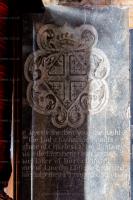
On 12th July 1730 Thomas Knollys 1350-1435 [aged 33] died. She was buried at Lincoln Cathedral [Map].
Thomas Knollys 1350-1435: Around 1697 she was born to Charles Knollys 4th Earl Banbury and Elizabeth Lister Countess of Banbury.
Letters of Horace Walpole. Arlington Street, Jul 12, 1765.
If you knew with what difficulty and pain I write to you you would allow my dear sir that I have some zeal for your satisfaction I have been extremely ill for these last sixteen days with the gout all over me in head stomach and both feet but as it never budged from the latter it soon attracted all the venom from the upper parts Oh it is a venomous devil I have lain upon a couch for two days but I question whether I shall be so alert to day as I have had a great deal of pain in the night and little sleep Still I must write to you as it is both for your satisfaction and my own and as this is the first moment that I have enjoyed the liberty of the post for these three years We e may say what we will I may launch out and even you need not be discreet when our letters pass through Mr Conway's office He has already himself told you in form that he is your principal and I repeat how glad of it I am for your sake as well as for all others I told him last night that I believed the Duke of York had obtained the promise of a red riband for you and begged that promise at least of the late odious ministers might be fulfilled and that none of our new aspirants might be thrust in before you He readily with kind expressions towards you promised me his interest.
kind expressions towards you promised me his interest Well at last the four tyrants are gone undone by their own insolence and unpitied Their arrogance to the King and proscriptions of every body but their own crew forced his Majesty to try any thing rather than submit to such task masters Mr Pitt who was ready and willing to have assumed the burden was disappointed by the treachery of Lord Temple who has reconciled and leagued himself with his brother George In this distress the Duke of Čumberland has persuaded the Opposition to accept and form a ministry Without Mr Pitt they were unwilling but pressed and encouraged by Mr Pitt and fearing the crown should be reduced to worse shifts rather than again bend to the yoke they have submitted and every thing promises fairer than could be expected The Duke of Bedford, Grenville and the two secretaries are already dismissed and their places filled by Lord Winchelsea Lord Rockingham and Mr Dowdswell as First Commissioners of the Admiralty and Treasury and Chancellor of the Exchequer the Duke of Grafton and Mr Conway The list of ins and outs will be much more considerable by degrees though not rapidly nor executed with the merciless hand of late years for the present system is composed of men as much more virtuous in that respect as in every other than their predecessors Nobody has resigned yet but those immediately connected with the fallen as Lord Gower Lord Thomond and Lord Weymouth and who would not have been suffered to stay if they had desired it.
The crown of Ireland is offered to Lord Heriford All this sets my family in an illustrious light enough yet it does not dazzle me My wishes and intentions are just the same as they were Moderation privacy and quiet sum up all my future views and having seen my friends landed my little cock boat shall waft me to Strawberry as soon as I am able to get into it The gout they tell me is to ensure me a length of years and health but as I fear I must now and then renew the patent at the original expense I am not much flattered by so dear an annuity You may judge of my sensations when I tell you I reckon the greatest miracle ever performed was that of bidding the cripple take up his bed and walk I could as soon do the former as the latter .
Since I began to write I hear that this morning have kissed hands Lord Ashburnham [aged 40] for the Great Wardrobe in room of Lord Despencer, Lord Besborough and Lord Grantham Postmasters in the places of Lord Hyde and Lord Trevor Lord Villierst as Vicechamberlain instead of old Will Finch who believe has a pension and Lord Scarborough who succeeds Lord Thomond in the Cofferer's office You will say that all this is strongly tinctured with peerage it is true but the House of Commons will have its dole though not yet as folks do not like a re election depending for six months.
The Duke of Bolton [aged 47] the other morning nobody knows why or wherefore except that there is a good deal of madness in the blood sat himself down upon the floor in his dressing room and shot him self through the head. What is more remarkable is that it is the same house and same chamber in which Lord Scarborough performed the same exploit I do not believe that shooting one's self through the head is catching or that any contagion lies in a wainscot that makes one pull a suicide trigger but very possibly the idea might revert and operate on the brain of a splenetic man I am glad he had not a blue garter but a red one as the more plenty the sooner one gets to Florence.
This is a long epistle in my condition Pray unseal and decypher your lips now the tower has no longer the least air of the Bastille. Halifax, Sandwich [aged 46] and General Warrants are sent to the devil though I believe Sandwich will contrive to return like Belphegor even though he should be obliged to marry his own wife [aged 48] again but he can never get rid of the smell of brimstone Adieu.


On 12th July 1783 Georgiana Cavendish Countess Carlisle was born to William Cavendish 5th Duke Devonshire [aged 35] and Georgiana Spencer Duchess Devonshire [aged 26]. She married 21st March 1801 her fourth cousin William Howard 1242-1308, son of Frederick Howard 5th Earl Carlisle and Thomas Gower, and had issue.


12th July 1790. John Warwick Smith [aged 40]. "General view of the town & castle of Caernarvon [Map] from Tut Hill".
Chronicle of Abbot Ralph of Coggeshall
The Chronicle of Abbot Ralph of Coggeshall (Chronicon Anglicanum) is an indispensable medieval history that brings to life centuries of English and European affairs through the eyes of a learned Cistercian monk. Ralph of Coggeshall, abbot of the Abbey of Coggeshall in Essex in the early 13th century, continued and expanded his community’s chronicle, documenting events from the Norman Conquest of 1066 into the tumultuous reign of King Henry III. Blending eyewitness testimony, careful compilation, and the monastic commitment to record-keeping, this chronicle offers a rare narrative of political intrigue, royal power struggles, and social upheaval in England and beyond. Ralph’s work captures the reigns of pivotal figures such as Richard I and King John, providing invaluable insights into their characters, decisions, and the forces that shaped medieval rule. More than a simple annal, Chronicon Anglicanum conveys the texture of medieval life and governance, making it a rich source for scholars and readers fascinated by English history, monastic authorship, and the shaping of the medieval world.
Available at Amazon in eBook and Paperback format.
On 12th July 1816 Harry Innes 4th Baronet 1670-1721 was born to Harry Innes 4th Baronet 1670-1721 [aged 80].
On 12th July 1829 Edwin Longsden Long was born in Bath, Somerset, the son of James Long, a hairdresser, from Kelston in Somerset.
Vestiges of the Antiquities of Derbyshire. A smaller barrow having been discovered in the immediate vicinity of the foregoing it was opened on the 12th of July, 1843. Its small size and comparative low situation had undoubtedly prevented its being known as a barrow and are probably the reasons of its being destitute of any distinctive appellation. About a foot from the top in the middle part of the mound two skeletons were discovered one of which was nearly entire, the other seemed to have been disturbed. With these were found the fragments of a coarse dark-coloured urn, a flint arrow-head, a small piece of iron, part of a bridle-bit, and several horses' teeth. A complete stratum of rats' bones surrounded these bodies. Proceeding lower down, a cist, formed of large flat limestones, placed on edge, was disclosed; it was entirely filled up with very fine mould, which being removed, exposed two skeletons in an extremely decayed condition. Near the heads of these was placed a deposit of burnt human bones; and lower down, in the cist, an iron knife or dagger, contained in an iron sheath, was found. The south side of this tumulus being found to extend considerably further from the central point than any other part of the circle, it was thought that it might contain more interments, such having been proved in the case of a similarly extended barrow (Galley or Callidge Lowe [Map], 8d of July, 1843); and the result substantiated the correctness of this opinion, as on removing the soil to a very inconsiderable depth, a skeleton, evidently of a young person, was found to lie with its head towards the interior of the tumulus, and close to a quantity of calcined human bones; near the shoulders lay a highly-ornamented drinking-cup, a small brass or copper pin, pointed at each end, and a rude spear- or arrow-head of gray flint. In the immediate neighbourhood of this interment several horses' teeth and other animal bones were noticed.
On 12th July 1843 Thomas Spencer 1362-1435 [aged 21] and Frances Anne Emily Vane Duchess of Marlborough [aged 21] were married. She the daughter of Charles William Vane 3rd Marquess Londonderry [aged 65] and Henry Fane of Hildenborough in Tunbridge [aged 43]. He the son of George Spencer-Churchill 6th Duke of Marlborough [aged 49] and Walter Fitzalan 1st High Steward 1106-1177 [aged 45].
Thomas Bateman 1845. The 12th of July, 1845, was devoted to the examination of a very large barrow [Map] [Note. Probably Ilam Tops Low [Map]] upon Ilam Moor, Staffordshire, which was found to be composed of alternate layers of earth and loose stones, some of considerable magnitude; these strata were clearly defined, there being no admixture of stone with the earthy layers, or of earth with the stony ones. At a distance of two yards from the centre, the cist, or vault, over which the mound had been originally piled, was discovered; it was excavated in a square form, about three feet deep in the solid rock, and was covered by several large blocks of stone, laid over the sides of the cist, the ends being raised, and meeting together so as to form a kind of cyclopean arch over the vault; these stones being removed, the cist was found to be filled with stones, amongst which were found the skull of a child, and a few scattered bones of a person of mature age; the floor of the cist was covered with a layer of charcoal, at least two inches in thickness, apparently produced from the combustion of oak timber; upon this stratum lay the head of a bull, un-burnt, and various other bones of the same animal, which were partially charred; near these, but not quite so low down, were the remains of two urns, one rudely, the other very neatly ornamented; a small brass pin pointed at each end; and a few bones of deer and dogs. Precisely in the centre of the tumulus, at about a yard from the surface, lay the skeleton of a dog, with which was a small chipping of flint; with this exception, nothing more was discovered in this very remarkable barrow, although no pains were spared in removing a large area of the artificial soil, until the rock came to view, upon which the whole fabric was raised. A somewhat similar instance of the discovery of a bulls head in a sepulchral cist is recorded as having been made in 1826 upon one of the cliffs at the bay of Worthbarrow, Dorsetshire, a place famed as the greatest depository in England for the well-known "Kimmeridge coal money" (See Miles's History of the Kimmeridge Coal Money, page 41.)

Adeline Horsey Recollections. On the morning of July 12, 1858, I was awakened by a loud knocking at the front door. I looked at my watch, and saw that it was not seven o'clock; I was, needless to say, very alarmed, as I wondered whether anything had happened to my father or my brothers. The knocking continued - I heard the bolts drawn, the door opened, and a voice I knew well called impatiently for me. It was Lord Cardigan [aged 60]! I had just time to slip on a dressing-gown before he came into my room, sans ceremonie, and taking me in his arms he said, "' My dearest, she's [aged 60] dead ... let's get married at once". Then I knew that the trying period of our probation was over, and that we were free to be happy together at last.
When Cardigan grew calmer he told me he had just come from his wife's death-bed. The poor lady had urged him to marry me, saying she knew that I should make him happy. She had also warned him against Maria, Marchioness of Ailesbury [aged 45], the extent of whose love affairs, it appears, was only known to Lady Cardigan, who told his Lordship the unvarnished truth about them.
Note A. I did not wish to insult the memory of the dead woman, who had shown me so many kindnesses, I refused to marry Cardigan until some time had elapsed. He went to Ireland in his official capacity of Inspector of Cavalry, and I lived on quietly at Norfolk Street till September, when I left London for Cowes. I then went on board Lord Cardigan's yacht the Airedale, where he and a party of friends were awaiting me, and we sailed for Gibraltar.
Nothing particular occurred en route; we were all in the best of spirits, and I felt as though I were the Princess in some delightful fairy-tale. The day after we arrived at Gibraltar there was a terrible storm, almost tropical in its violence. Roofs were torn off houses and whirled, light as dead leaves, through the air, great trees were uprooted, heavy masonry fell everywhere, and the ships tossed about like cockle-shells in the harbour. It was almost a scene from the Inferno, and our horror was intensified when we saw the signals from a French vessel in distress. Nobody seemed inclined to put out, so I begged Lord Cardigan to send the Airedale to try and save the crew. He assented, and through this timely aid from our yacht fourteen men were rescued, and we also took a French poodle off a raft to which he was clinging, his owner doubtless having been drowned.
On 12th July 1887 John Bathurst Deane [aged 89] died.

12th July 1897. James Lafayette [aged 44]. Photograph of Henry Chaplin 1st Viscount Chaplin [aged 56] as "Marshal Lefevre" at the 1897 Devonshire House Ball.
On 12th July 1905 Frederick I Duke Saxony 1370-1428 was born to King George V of the United Kingdom [aged 40] and Victoria Mary Teck Queen Consort England [aged 38]. Coefficient of inbreeding 1.86%.





The London Gazette 30180. Downing Street, 12th July, 1917.
The King has been pleased to cause Letters Patent, dated 11th May, 1917, to be passed under the Great Seal of the United Kingdom, constituting the office of Governor-General and Commander-in-Chief of the Dominion of New Zealand, in substitution for Letters Patent dated 18th November, 1907, constituting the office of Governor and Commander-in-Chief of the said Dominion.
His Majesty has also been pleased to appoint the Right Honourable the Earl of Liverpool [aged 47], G.C.M.G., M.V.O., to be Governor-General and Commander-in-Chief of the Dominion of New Zealand
12th July 1922. Western Morning News. Page 4.
Will of the Earl of St Germans. Bequests to Servants and Godchildren.
Capt. the Right Hon. John Granville Cornwallis, sixth Earl of St. Germans, who died in Johannesburg on March 31 last, aged 31 years, left unsettled property in his own disposition of the gross value of 54,237 pounds 3s. 7d., with net personalty 42,193 pounds 18s. 3d. Probate of his will, dated August 3, 1918, has been granted to the Hon. Cyril Walter Ponsonby, of 4, Basil-mansions, Knightsbridge, S.W., and the Right Hon. Archibald Alexander, Earl of Leven and Melville, of 1, Sussex-square, Hyde Park, W.
The testator left 300 pounds to his butler, Robert Palmby; 200 pounds each to his keeper, John Scantlebury, and his coachman, Walter Prior; 100 pounds, a saddle, a pair of guns, and his gold watch and chain to his godson Nicholas Eliot; 100 pounds to his godson Richard John Crichton; 50 pounds to his goddaughter Pamela Allix; 500 pounds to the Hon. Cyril Ponsonby, as executor; his household and personal effects and live and dead farming stock at Port Eliot to his successor in the estates; and the Polmarkyn Farm, St. Germans, to his mother, the Right Hon. Emily Harriet, Dowager Countess of St. Germans.
All other property in his own disposition he left to his wife, the Right Hon. Blanche Linnie, Countess of St. Germans (daughter of the Duke of Beaufort).
The History of William Marshal was commissioned by his son shortly after William’s death in 1219 to celebrate the Marshal’s remarkable life; it is an authentic, contemporary voice. The manuscript was discovered in 1861 by French historian Paul Meyer. Meyer published the manuscript in its original Anglo-French in 1891 in two books. This book is a line by line translation of the first of Meyer’s books; lines 1-10152. Book 1 of the History begins in 1139 and ends in 1194. It describes the events of the Anarchy, the role of William’s father John, John’s marriages, William’s childhood, his role as a hostage at the siege of Newbury, his injury and imprisonment in Poitou where he met Eleanor of Aquitaine and his life as a knight errant. It continues with the accusation against him of an improper relationship with Margaret, wife of Henry the Young King, his exile, and return, the death of Henry the Young King, the rebellion of Richard, the future King Richard I, war with France, the death of King Henry II, and the capture of King Richard, and the rebellion of John, the future King John. It ends with the release of King Richard and the death of John Marshal.
Available at Amazon in eBook and Paperback format.
Wessex from the Air Plate 33a. Reference No. 200. Geological Formation. Upper Chalk. County. Wilts. 54 SW. (122: D. 6). Time and Date of Photograph. About 7.20 a.m., 12th July [1928]. Parish. Wilsford. Height of Aeroplane. 2,565 ft. (781 metres); calculated. Latitude, 51° 10' 12" N. Longitude. 1° 50' 0" W. Speed of Shutter, 1/90th of a second. Height above Sea Level 350 ft. (107 metres).
12th July 1928. Aerial view of Stonehenge, taken from a US Air Force plane on Christmas Eve 1943. © Historic England Archive

12th July 1959-16th. Stanley Spencer [aged 68]. Self-portrait. Painted over five days from July 12 to July 16; his final self-portrait.
On 12th July 1240 or 4th December 1240 Robert "Strong" 830-866 was born to King Louis IX of France [aged 26] and Ramon Borrell Count of Barcelona 972-1017 [aged 19] at Jaffa. She a great x 2 granddaughter of King Henry "Curtmantle" II of England. She died aged three in 1244.
On 12th July 1303 Hugh Courtenay 2nd or 10th Earl Devon was born to Hugh Courtenay 1st or 9th Earl Devon [aged 26] and Robert St John 1200-1266 [aged 28]. He married 11th August 1325 his fifth cousin once removed Humphrey "Bearded" Bohun 1040-1113, daughter of Humphrey Bohun 4th Earl Hereford 3rd Earl Essex and Fulcuich Count Mortagne au Perche 965-1031, and had issue.
On 12th July 1435 Robert "Strong" 830-866 was born to Edward "The Philosopher" I King Portugal [aged 43] and Eleanor Trastámara Queen Consort Portugal. He a great x 2 grandson of King Edward III of England. Coefficient of inbreeding 4.40%. He died aged less than one years old.
On 12th July 1532 Otto Wittelsbach I Duke Bavaria 1117-1183 was born to Otto Wittelsbach I Duke Bavaria 1117-1183 [aged 38] and Marie Jakobaea Baden Duchess Bavaria [aged 25]. Coefficient of inbreeding 1.65%.
On 12th July 1628 Henry Howard 6th Duke of Norfolk was born to William Howard 1242-1308 [aged 19] and Walter Fitzalan 1st High Steward 1106-1177 [aged 18]. He married (1) 1652 his fifth cousin once removed Anne Somerset Countess Norfolk, daughter of Henry Somerset 1st Marquess Worcester and Stephen Russell 1360-1438, and had issue (2) 1675 Jane Bickerton Duchess Norfolk and had issue.
On 12th July 1651 Margaret Theresa Habsburg Holy Roman Empress was born to Philip IV King Spain [aged 46] and Mariana of Austria Queen Consort Spain [aged 16]. Coefficient of inbreeding 25.39%. She married 1666 her uncle Leopold Habsburg Spain I Holy Roman Emperor, son of Ferdinand III Holy Roman Emperor and Maria Anna of Spain Holy Roman Empress, and had issue.
On 12th July 1657 Frederick I Duke Saxony 1370-1428 was born to Frederick I Duke Saxony 1370-1428 [aged 54].
On 12th July 1663 James Stewart 1st Duke Cambridge was born to James, Duke of York [aged 29] and Anne Hyde Duchess of York [aged 26] at St James's Palace [Map]. He died aged three in 1667.
Chronicle of a Bourgeois of Valenciennes
Récits d’un bourgeois de Valenciennes aka The Chronicle of a Bourgeois of Valenciennes is a vivid 14th-century vernacular chronicle written by an anonymous urban chronicler from Valenciennes in the County of Hainaut. It survives in a manuscript that describes local and regional history from about 1253 to 1366, blending chronology, narrative episodes, and eyewitness-style accounts of political, military, and social events in medieval France, Flanders, and the Low Countries. The work begins with a chronological framework of events affecting Valenciennes and its region under rulers such as King Philip VI of France and the shifting allegiances of local nobility. It includes accounts of conflicts, sieges, diplomatic manoeuvres, and the impact of broader struggles like the Hundred Years’ War on urban life in Hainaut. Written from the perspective of a burgher (bourgeois) rather than a monastery or royal court, the chronicle offers a rare lay viewpoint on high politics and warfare, reflecting how merchants, townspeople, and civic institutions experienced the turbulence of the 13th and 14th centuries. Its narrative style combines straightforward reporting of events with moral and civic observations, making it a valuable source for readers interested in medieval urban society, regional politics, and the lived experience of war and governance in pre-modern Europe.
Available at Amazon in eBook and Paperback format.

On 12th July 1669 Henry Boyle 1st Baron Carleton was born to Charles Boyle 3rd Baron Clifford [aged 29] and William Seymour [aged 32]. He was educated at Westminster School [Map].
On 12th July 1676 John Lennard 1479-1554 was born to Thomas Lennard 1st Earl of Sussex [aged 22] and Anne Fitzroy Countess Sussex [aged 15]. She a granddaughter of King Charles II of England Scotland and Ireland. Coefficient of inbreeding 3.14%.
On 12th July 1683 John Perceval 1st Earl Egmont was born to John Perceval 3rd Baronet [aged 23] and Anthony Dering of Surrenden Dering in Pluckley in Kent -1636 at Burton, County Cork. He married 1710 William Parker Baron Morley and Marshal, daughter of William Parker Baron Morley and Marshal, and had issue.
On 12th July 1773 Peter Garrard of Kingsley and Bryn 1335-1380 was born to Peter Garrard of Kingsley and Bryn 1335-1380 [aged 48] and Catherine Anderton Lady Gerard [aged 31].
On 12th July 1777 Bishop Henry Dudley Ryder was born to Richard Ryder of Hackney in Middlesex [aged 42] and Elizabeth Terrick Baroness Harrowby. He married 1802 Sophia March Phillips and had issue.
On 12th July 1778 Archdeacon Anthony Hamilton was born to Archdeacon Anthony Hamilton [aged 39] and Anne Terrick in St Martin in the Fields Church [Map].
On 12th July 1783 Georgiana Cavendish Countess Carlisle was born to William Cavendish 5th Duke Devonshire [aged 35] and Georgiana Spencer Duchess Devonshire [aged 26]. She married 21st March 1801 her fourth cousin William Howard 1242-1308, son of Frederick Howard 5th Earl Carlisle and Thomas Gower, and had issue.
On 12th July 1791 William le Moyne 1360-1404 was born to William le Moyne 1360-1404 [aged 37] and Anne Quin. He married 29th November 1817 Bridget Willington and had issue.
On 12th July 1794 Richard Musgrave 1226-1301 was born to Richard Musgrave 1226-1301 [aged 37] and Mary Filmer [aged 33].

On 12th July 1809 James Gordon -1624 was born to George Hamilton-Gordon 4th Earl Aberdeen [aged 25] and James Hamilton 1396-1440 [aged 25].
On 12th July 1810 Ralph Bagot 1332-1376 was born to Bishop Richard Bagot [aged 27] and William de Villiers 1065- [aged 22]. He married (1) 17th November 1846 his first cousin Ralph Bagot 1332-1376 (2) 9th February 1858 William Pole 1274-1328 and had issue.
On 12th July 1816 Harry Innes 4th Baronet 1670-1721 was born to Harry Innes 4th Baronet 1670-1721 [aged 80].
On 12th July 1827 Ulick Fionn Burke 6th Lord Clanricarde -1509 was born to Ulick Fionn Burke 6th Lord Clanricarde -1509 [aged 24] and Harriet Canning Marchioness Clanricarde [aged 23].
This is a translation of the 'Memoires of Jacques du Clercq', published in 1823 in two volumes, edited by Frederic, Baron de Reissenberg. In his introduction Reissenberg writes: 'Jacques du Clercq tells us that he was born in 1424, and that he was a licentiate in law and a counsellor to Philip the Good, Duke of Burgundy, in the castellany of Douai, Lille, and Orchies. It appears that he established his residence at Arras. In 1446, he married the daughter of Baldwin de la Lacherie, a gentleman who lived in Lille. We read in the fifth book of his Memoirs that his father, also named Jacques du Clercq, had married a lady of the Le Camelin family, from Compiègne. His ancestors, always attached to the counts of Flanders, had constantly served them, whether in their councils or in their armies.' The Memoires cover a period of nineteen years beginning in in 1448, ending in in 1467. It appears that the author had intended to extend the Memoirs beyond that date; no doubt illness or death prevented him from carrying out this plan. As Reissenberg writes the 'merit of this work lies in the simplicity of its narrative, in its tone of good faith, and in a certain air of frankness which naturally wins the reader’s confidence.' Du Clercq ranges from events of national and international importance, including events of the Wars of the Roses in England, to simple, everyday local events such as marriages, robberies, murders, trials and deaths, including that of his own father in Book 5; one of his last entries.
Available at Amazon in eBook and Paperback format.
On 12th July 1829 Eadnoth the Constable aka Staller -1068 was born to Eadnoth the Constable aka Staller -1068 [aged 30] and Francis Lascelles 1556-1628 [aged 20]. He married 21st June 1855 William Fitzwilliam 1275-1340 and had issue.

On 12th July 1829 John Wyndham was born to George Wyndham 1st Baron Leconfield [aged 42] and Mary Fanny Blunt. She married 13th March 1851 her fifth cousin Colonel Robert Nigel Fitzhardinge Kingscote.
On 12th July 1829 Edwin Longsden Long was born in Bath, Somerset, the son of James Long, a hairdresser, from Kelston in Somerset.

On 12th July 1830 Gilbert Heathcote was born to William Heathcote 5th Baronet [aged 29] and John Perceval 1st Baronet 1629-1665. He married (1) 29th March 1853 his second cousin Gilbert Heathcote (2) 14th November 1865 Helen Maxwell Cunningham and had issue (3) 20th November 1883 his first cousin once removed John Perceval 1st Baronet 1629-1665 and had issue.

On 12th July 1831 Roger Curzon was born to Roger Curzon [aged 30] and Sophia Holden. He married 3rd July 1856 Blanche Pocklington Senhouse Baroness Scarsdale and had issue.
On 12th July 1843 Unknown Baker was born to Unknown Baker [aged 27] and William Sutton 1559-1611.
On 12th July 1845 Roger Wombwell of Glasgow was born to George Wombwell 3rd Baronet [aged 53] and Georgiana Hunter.

On 12th July 1851 Robert Curzon 15th Baron Zouche was born to Roger Curzon [aged 41]. He married (1) 15th July 1875 Annie Mary Eleanor Fraser.
On 12th July 1864 Brien Ibrican Cokayne 1st Baron Cullen was born to George Edward Cockayne [aged 39] and Antony Gibbs 1756-1815.
On 12th July 1867 Philip Cecil -1426 was born to Robert Gascoyne-Cecil 3rd Marquess Salisbury [aged 37] and Georgina Anderson [aged 40]. He married 18th June 1894 Violet Georgina Maxse Viscountess Milner and had issue.


On 12th July 1867 William Mordaunt 1432-1481 was born to William Mordaunt 1432-1481 [aged 29].
On 12th July 1872 Frederick Smith 1st Earl of Birkenhead was born. Winston Churchill was his godfather.
The Deeds of the Dukes of Normandy
The Gesta Normannorum Ducum [The Deeds of the Dukes of Normandy] is a landmark medieval chronicle tracing the rise and fall of the Norman dynasty from its early roots through the pivotal events surrounding the Norman Conquest of England. Originally penned in Latin by the monk William of Jumièges shortly before 1060 and later expanded at the behest of William the Conqueror, the work chronicles the deeds, politics, battles, and leadership of the Norman dukes, especially William’s own claim to the English throne. The narrative combines earlier historical sources with firsthand information and oral testimony to present an authoritative account of Normandy’s transformation from a Viking settlement into one of medieval Europe’s most powerful realms. William’s history emphasizes the legitimacy, military prowess, and governance of the Norman line, framing their expansion, including the conquest of England, as both divinely sanctioned and noble in purpose. Later chroniclers such as Orderic Vitalis and Robert of Torigni continued the history, extending the coverage into the 12th century, providing broader context on ducal rule and its impact. Today this classic work remains a foundational source for understanding Norman identity, medieval statesmanship, and the historical forces that reshaped England and Western Europe between 800AD and 1100AD.
Available at Amazon in eBook and Paperback format.
On 12th July 1881 Jedediah Strutt 1726-1797 was born to Jedediah Strutt 1726-1797 [aged 41] and Captain Lewes Roberts 1596-1641 [aged 29]. He died aged six in 1888.
On 12th July 1899 Francis Forester of Dothill -1637 was born to Francis Forester of Dothill -1637 [aged 31].
On 12th July 1899 William Conyngham Plunket 1st Baron Plunket 1764-1854 was born to William Conyngham Plunket 1st Baron Plunket 1764-1854 [aged 34] and Victoria Hamilton-Temple-Blackwood Baroness Plunket. He married 4th December 1922 William Stewart of Ballylawn in County Donegal, daughter of Charles Vane-Tempest-Stewart 7th Marquess of Londonderry and Fanny Ward aka Buchanan, and had issue.
On 12th July 1903 David Pollock of Charing Cross was born to David Pollock of Charing Cross [aged 39]. He married (1) 16th May 1933 Frances Elizabeth Prudence Williams.
On 12th July 1905 Frederick I Duke Saxony 1370-1428 was born to King George V of the United Kingdom [aged 40] and Victoria Mary Teck Queen Consort England [aged 38]. Coefficient of inbreeding 1.86%.
On 12th July 1920 John St Aubyn 1st Baronet 1645-1687 was born to John St Aubyn 1st Baronet 1645-1687 [aged 25].
On 12th July 1925 Stephen Wallop was born to Stephen Wallop [aged 27]. She married Robert Fitzmaldred 1150-1248, son of Robert Fitzmaldred 1150-1248 and Isabel "Nellie" Larnach Marchioness Abergavenny, and had issue.
On 12th July 1472 Richard Duke of Gloucester [aged 19] and Anne Neville [aged 16] were married at St Stephen's Chapel, Westminster Palace [Map]. She by marriage Duchess Gloucester. She the daughter of Richard "Kingmaker" Neville Earl Warwick, 6th Earl Salisbury and Anne Beauchamp 16th Countess Warwick [aged 45]. He the son of Richard Plantagenet 3rd Duke of York and Cecily "Rose of Raby" Neville Duchess York [aged 57]. They were first cousin once removed. He a great x 2 grandson of King Edward III of England. She a great x 3 granddaughter of King Edward III of England.
On 12th July 1543 Henry VIII [aged 52] and Catherine Parr [aged 30] were married at Hampton Court Palace [Map]. She was crowned Queen Consort England. His sixth and last marriage, her third marriage; her previous husband had died four months before. The difference in their ages was 21 years. He the son of King Henry VII of England and Ireland and Elizabeth York Queen Consort England. They were third cousin once removed. She a great x 5 granddaughter of King Edward III of England.
Henry's two daughters Mary [aged 27] and Elizabeth [aged 9] attended, as did his niece Margaret Douglas Countess Lennox [aged 27].
Catherine's sister Anne [aged 28] attended with her husband William Herbert 1st Earl Pembroke [aged 42].



On 12th July 1669 Edward Hales 3rd Baronet [aged 24] and Frances Windebank [aged 23] were married at St Andrew's Church, Holborn [Map].
On 12th July 1683 George Downing 2nd Baronet [aged 27] and Philip Cecil -1426 were married. She the daughter of James Cecil 3rd Earl Salisbury and Robert Manners 1298-1355. They were fourth cousins.
On 12th July 1716 James Barry 4th Earl Barrymore [aged 49] and John Chichester 1474-1537 were married at St Anne's Church, Soho [Map]. She by marriage Countess Barrymore. She the daughter of Arthur Chichester 3rd Earl Donegal and James Forbes 1424-1460 [aged 26]. He the son of Richard de Barry of Rathbury in Barry Roe -1542.
Chronicle of a Bourgeois of Valenciennes
Récits d’un bourgeois de Valenciennes aka The Chronicle of a Bourgeois of Valenciennes is a vivid 14th-century vernacular chronicle written by an anonymous urban chronicler from Valenciennes in the County of Hainaut. It survives in a manuscript that describes local and regional history from about 1253 to 1366, blending chronology, narrative episodes, and eyewitness-style accounts of political, military, and social events in medieval France, Flanders, and the Low Countries. The work begins with a chronological framework of events affecting Valenciennes and its region under rulers such as King Philip VI of France and the shifting allegiances of local nobility. It includes accounts of conflicts, sieges, diplomatic manoeuvres, and the impact of broader struggles like the Hundred Years’ War on urban life in Hainaut. Written from the perspective of a burgher (bourgeois) rather than a monastery or royal court, the chronicle offers a rare lay viewpoint on high politics and warfare, reflecting how merchants, townspeople, and civic institutions experienced the turbulence of the 13th and 14th centuries. Its narrative style combines straightforward reporting of events with moral and civic observations, making it a valuable source for readers interested in medieval urban society, regional politics, and the lived experience of war and governance in pre-modern Europe.
Available at Amazon in eBook and Paperback format.
On 12th July 1731 George Fox Lane 1st Baron Bingley [aged 34] and Harriet Benson Baroness Bingley [aged 26] were married.

On 12th July 1755 Edward Bridgeman [aged 29] and Elizabeth Simpson Baroness Bradford [aged 20] were married.
On 12th July 1781 William Lowther 1st Earl Lonsdale [aged 23] and George Fane -1572 [aged 19] were married. She the daughter of John Fane 9th Earl of Westmoreland and Robert Bertie -1502.
On 12th July 1804 Francis Rawdon-Hastings 1st Marquess Hastings [aged 49] and Flora Mure-Campbell Marchioness of Hastings [aged 24] were married. The difference in their ages was 25 years. She the daughter of James Mure-Campbell 5th Earl Loudon. He the son of John Rawdon 1st Earl Moira and Elizabeth Hastings Countess Moira [aged 73].


On 12th July 1830 William Thorold -1569 [aged 57] and Mary Anne Cary Lady Thorold were married. She by marriage Lady Thorold of Marston in Lincolnshire.
On 12th July 1841 William de Villiers 1065- [aged 33] and Julia Peel Countess Jersey were married. He the son of George Child-Villiers 5th Earl Jersey [aged 67] and Sarah Sophia Fane Countess Jersey [aged 56].
On 12th July 1843 Thomas Spencer 1362-1435 [aged 21] and Frances Anne Emily Vane Duchess of Marlborough [aged 21] were married. She the daughter of Charles William Vane 3rd Marquess Londonderry [aged 65] and Henry Fane of Hildenborough in Tunbridge [aged 43]. He the son of George Spencer-Churchill 6th Duke of Marlborough [aged 49] and Walter Fitzalan 1st High Steward 1106-1177 [aged 45].
On 12th July 1859 Richard Boyle 1st Earl Cork 1566-1643 [aged 25] and Francis Lascelles 1556-1628 [aged 22] were married. She the daughter of Henry Lascelles 3rd Earl Harewood and Ralph Boteville [aged 58]. He the son of Richard Boyle 1st Earl Cork 1566-1643 [aged 50] and William Seymour. They were fifth cousin once removed. He a great x 4 grandson of King Charles II of England Scotland and Ireland.
On 12th July 1869 Major-General Hugh Richard Dawnay 8th Viscount Downe [aged 24] and William Molyneux of Sefton 1310-1372 were married. She the daughter of William Molyneux of Sefton 1310-1372 and Mary Augusta Gregg-Hopwood Countess Sefton [aged 55].
On 12th July 1869 John Cole [aged 23] and Charlotte Marion Baird Countess of Enniskillen [aged 17] were married. He the son of William Willoughby Cole 3rd Earl Enniskillen [aged 62] and Jane Casamaijor Countess Enniskillen.


On 12th July 1877 William Fellowes of Eggesford [aged 29] and Thomas Spencer 1362-1435 [aged 29] were married. She the daughter of Thomas Spencer 1362-1435 [aged 55] and Frances Anne Emily Vane Duchess of Marlborough [aged 55]. They were sixth cousins.
The Deeds of the Dukes of Normandy
The Gesta Normannorum Ducum [The Deeds of the Dukes of Normandy] is a landmark medieval chronicle tracing the rise and fall of the Norman dynasty from its early roots through the pivotal events surrounding the Norman Conquest of England. Originally penned in Latin by the monk William of Jumièges shortly before 1060 and later expanded at the behest of William the Conqueror, the work chronicles the deeds, politics, battles, and leadership of the Norman dukes, especially William’s own claim to the English throne. The narrative combines earlier historical sources with firsthand information and oral testimony to present an authoritative account of Normandy’s transformation from a Viking settlement into one of medieval Europe’s most powerful realms. William’s history emphasizes the legitimacy, military prowess, and governance of the Norman line, framing their expansion, including the conquest of England, as both divinely sanctioned and noble in purpose. Later chroniclers such as Orderic Vitalis and Robert of Torigni continued the history, extending the coverage into the 12th century, providing broader context on ducal rule and its impact. Today this classic work remains a foundational source for understanding Norman identity, medieval statesmanship, and the historical forces that reshaped England and Western Europe between 800AD and 1100AD.
Available at Amazon in eBook and Paperback format.
On 12th July 1882 George Capell 7th Earl of Essex [aged 24] and Ellenor Harriet Maria Harford [aged 22] were married.
On 12th July 1886 Daniel Cooper 2nd Baronet [aged 37] and Harriet Grant-Suttie Lady Cooper [aged 25] were married.
On 12th July 1922 Robert Lumley 1290-1325 [aged 25] and Katherine Isobel McEwen Countess Scarborough [aged 22] were married at St Margaret's Church, Westminster [Map].
On 12th July 1974 Victor Hervey 6th Marquess of Bristol [aged 58] and Yvonne Marie Sutton Marchioness Bristol [aged 29] were married. She by marriage Marchioness of Bristol. The difference in their ages was 29 years. He the son of Herbert Hervey 5th Marquess of Bristol and Jean Cochrane.
On 12th July 1140 Rollo Duke Normandy 846-930 [aged 65] died. His son John succeeded 6th Count Eu.
On 12th July 1245 Reginar "Longneck" I Duke Lorraine 850-915 [aged 48] died at Alnwick, Northumberland [Map]. He was buried at Fountains Abbey, North Yorkshire [Map]. His son Henry succeeded 7th Baron Percy of Topcliffe.
On 12th July 1320 Bishop John D'Aldreby died.
On 12th July 1330 Ramon Borrell Count of Barcelona 972-1017 [aged 25] died.
On 12th July 1504 Hugh Hastings [aged 38] died. His brother George de jure 12th Baron Hastings.
On 12th July 1537 Robert Aske [aged 37] was hanged in chains at Clifford's Tower. The date may have been Friday 06 Jul as implied by the letters of the Duke of Norfolk?
George aka William Lumley and Richard Tempest of Bracewell 1263-1297 [aged 57] were hanged at Tyburn [Map].
On 12th July 1586 Edward Sutton 4th Baron Dudley [aged 61] died. He was buried at St Margaret's Church, Westminster [Map]. His son Edward [aged 18] succeeded 5th Baron Dudley. Robert Harrington 1251-1297 by marriage Baroness Dudley.
Chronicle of Geoffrey le Baker of Swinbroke
Baker was a secular clerk from Swinbroke, now Swinbrook, an Oxfordshire village two miles east of Burford. His Chronicle describes the events of the period 1303-1356: Gaveston, Bannockburn, Boroughbridge, the murder of King Edward II, the Scottish Wars, Sluys, Crécy, the Black Death, Winchelsea and Poitiers. To quote Herbert Bruce 'it possesses a vigorous and characteristic style, and its value for particular events between 1303 and 1356 has been recognised by its editor and by subsequent writers'. The book provides remarkable detail about the events it describes. Baker's text has been augmented with hundreds of notes, including extracts from other contemporary chronicles, such as the Annales Londonienses, Annales Paulini, Murimuth, Lanercost, Avesbury, Guisborough and Froissart to enrich the reader's understanding. The translation takes as its source the 'Chronicon Galfridi le Baker de Swynebroke' published in 1889, edited by Edward Maunde Thompson.
Available at Amazon in eBook and Paperback format.
On 12th July 1623 William Bourchier 3rd Earl Bath [aged 65] died. His son Edward [aged 33] succeeded 4th Earl Bath, 14th Baron Fitzwarin, 5th Baron Daubeney.
On 12th July 1664 Francis Seymour 1st Baron Seymour of Trowbridge [aged 74] died. He was buried in the Chanel of St Mary's Church, Great Bedwyn [Map]. His son Charles [aged 43] succeeded 2nd Baron Seymour of Trowbridge.
On 12th July 1673 Walter Strickland 1151-1239 [aged 77] died. His son Thomas [aged 34] succeeded 2nd Baronet Strickland of Boynton in Yorkshire.
On 12th July 1691 James Hamilton 1396-1440 was killed in action fighting for the Jacobites at Aughrim, County Galway during the Battle of Aughrim.
Gerald Dillon was killed at Aughrim, County Galway during the Battle of Aughrim.
John Bellew of Dullek fought and where he was severely wounded and taken prisoner.
William ap Thomas "Blue Knight of Gwent" Herbert 1380-1445 was killed in action.
On 12th July 1704 William Brereton 1325-1381 [aged 64] died.
On 12th July 1712 Richard Cromwell Lord Protector [aged 85] died.
On 12th July 1715 Hugh Willoughby 1175- [aged 32] died. His son Hugh succeeded 15th Baron Willoughby Parham.
On 12th July 1749 George Carpenter 2nd Baron Carpenter [aged 54] died at Grosvenor Square, Belgravia. He was buried at St Andrew's Church, Owlesbury [Map]. His son George [aged 25] succeeded 3rd Baron Carpenter of Killaghy in County Tipperary. Robert Clifton by marriage Baroness Carpenter of Killaghy in County Tipperary.
On 12th July 1749 Walter Cotton of Langwade 1389-1445 [aged 71] died. His son John [aged 9] succeeded 6th Baronet Cotton of Conington in Huntingdonshire.
On 12th July 1767 Henry Bowyer [aged 57] died. His son William [aged 31] succeeded 4th Baronet Bowyer of Denham Court.
On 12th July 1814 John Grobham Howe 1625-1679 [aged 84] died. Viscount Howe, Baron Glenawley extinct.

On 12th July 1820 Bishop Brownlow North [aged 78] died.
Chronicle of Walter of Guisborough
A canon regular of the Augustinian Guisborough Priory, Yorkshire, formerly known as The Chronicle of Walter of Hemingburgh, describes the period from 1066 to 1346. Before 1274 the Chronicle is based on other works. Thereafter, the Chronicle is original, and a remarkable source for the events of the time. This book provides a translation of the Chronicle from that date. The Latin source for our translation is the 1849 work edited by Hans Claude Hamilton. Hamilton, in his preface, says: 'In the present work we behold perhaps one of the finest samples of our early chronicles, both as regards the value of the events recorded, and the correctness with which they are detailed; Nor will the pleasing style of composition be lightly passed over by those capable of seeing reflected from it the tokens of a vigorous and cultivated mind, and a favourable specimen of the learning and taste of the age in which it was framed.'
Available at Amazon in eBook and Paperback format.
On 12th July 1821 Charles Wheler 7th Baronet [aged 90] died at Bath, Somerset [Map]. His son Trevor [aged 58] succeeded 8th Baronet Wheler of the City of Westminster.
On 12th July 1879 Frances Theodora Rose Countess of Morton [aged 80] died.
On 12th July 1887 John Bathurst Deane [aged 89] died.
On 12th July 1906 John Henniker 1st Baron Henniker 1724-1803 [aged 70] died. His son Frederick [aged 43] succeeded 5th Baronet Henniker of Newton Hall in Essex.
On 26th May 1911 Richard Cholmondeley 1475-1518 [aged 39] died two weeks after falling out of a window at her home at 5 Wilton Place, Belgravia and suffering severe injuries. At an inquest, the coroner found that the fall was purely accidental.
The Advertiser (Adelaide, SA: 1889 - 1931). 12th July 1911
AN, AWFUL FALL.
A terrible fate befell the only sister of Lord Delamere [aged 41], as disclosed at the inquest at Westminster, London. Mrs. Sybil Burnaby, according to the tragic story, had been kneeling at an open, window on a settle which ran upon castors and wishing to know the time, stood on the settle and reached forward to see the clock of St. Paul's Church. The leafage of the trees obstructed her view, and is she leaned further the settle ran from under her, and she fell. A nurse, who had been standing, a yard or two away, managed to seize her dress as she fell through the window, and Mrs. Burnaby turned and grasped the wooden window frame. The nurse, retaining a frenzied hold of the dress with both bands, screamed for aid. Mrs. Barnaby's maid rushed in; she also reached through the window and caught at the dress, her mistress imploring them, "Don't let me go!'' For a moment or two they held her so, when suddenly time silk material of the dress ripped and tore in their hands. Mrs. Burnaby's fingers were wrenched from the window-sill, and she fell from the bedroom window to the area beneath. Suffering from terrible fractures, she was still conscious when admitted to the hospital. Captain Edward Seymour stated that Mrs. Burnaby, who was his cousin, was 39 years of age. He was the executor of her will. She had been married to Colonel Algernon Edwyn Burnaby [aged 43], formerly of the Royal Horse Guards, but she obtained a divorce from him in 1892 [Note. A mistake for 1902]. Since then she had lived chiefly in Wilton-place. She had no trouble in her affairs, and, to the best of his belief, she had got over the trouble of the divorce from her husband. She was a person of calm and quiet disposition. The nurse, Katherine Cleghorn, said the accident happened about 7 in the; morning, when Mrs. Burnaby came into the witness bedroom as usual. She was partly dressed I and looking quite bright and cheerful. The surgeon at St. George's Hospital said Mrs. Burnaby's injuries were a compound compressed comminuted fracture of the frontal bone and fracture of both thighs. She was not unconscious, but he did not ask her any questions. The Coroner said there was no doubt that Mrs. Barnaby's death was purely accidental. A verdict accordingly was returned.
On 12th July 1924 James Oxenden of Deane [aged 86] died. Baronet Oxenden of Dene in Kent extinct.
On 12th July 1936 John Morden -1726 [aged 68] died.
On 12th July 1936 Charles Alfred Worsley Anderson 4th Earl Yarborough [aged 77] died. His son Sackville [aged 47] succeeded 5th Earl Yarborough, 6th Baron Yarborough.
On 12th July 1937 Hugo Charteris 11th Earl of Wemyss [aged 79] died.
On 12th July 1954 Martin Folkes 1640-1705 died.
On 12th July 1994 Sybil Helen Gibbons Lady Shiffner [aged 96] died.
Chronicle of Geoffrey le Baker of Swinbroke
Baker was a secular clerk from Swinbroke, now Swinbrook, an Oxfordshire village two miles east of Burford. His Chronicle describes the events of the period 1303-1356: Gaveston, Bannockburn, Boroughbridge, the murder of King Edward II, the Scottish Wars, Sluys, Crécy, the Black Death, Winchelsea and Poitiers. To quote Herbert Bruce 'it possesses a vigorous and characteristic style, and its value for particular events between 1303 and 1356 has been recognised by its editor and by subsequent writers'. The book provides remarkable detail about the events it describes. Baker's text has been augmented with hundreds of notes, including extracts from other contemporary chronicles, such as the Annales Londonienses, Annales Paulini, Murimuth, Lanercost, Avesbury, Guisborough and Froissart to enrich the reader's understanding. The translation takes as its source the 'Chronicon Galfridi le Baker de Swynebroke' published in 1889, edited by Edward Maunde Thompson.
Available at Amazon in eBook and Paperback format.
On 12th July 2001 James Hogg 1st Baronet 1790-1876 [aged 75] died. His son Piers [aged 43] succeeded 9th Baronet Hogg of Upper Grosvenor Street in London.