

05 Aug is in August.
910 Battle of Tettenhall aka Wednesfield
1063 Death of King Gruffydd ap Llywelyn
1305 Capture and Execution of William Wallace
1447 Death of Humphrey of Lancaster
1503 Margaret Tudor's Journey to Scotland
On 5th August 641 (or 642 or 644 depending on the source) King Penda of Mercia Mercian and Welsh army defeated the Northumbrian army at the Battle of Maserfield. The battle is believed to have taken place at Oswestry, Shropshire. Northumbria was once again separated into two kingdoms.
King Oswald of Northumberland [aged 37] was killed. His body was subsequently dismembered with his head and arms mounted on poles. His brother Oswiu [aged 29] succeeded King Bernicia. Rhiainfellt Rheged Queen Consort Bernicia by marriage Queen Consort Bernicia.
Osric King Deira was killed. His son Oswine succeeded King Deira.
Eowa King Mercia was killed (probably).
On 5th August 759 Æthelwald Moll King of Northumbria was crowned King Northumbria.
On 5th August 882 Louis III King West Francia [aged 19] died.
On 5th August 890 Ranulf I Duke Aquitaine 820-866 [aged 40] died.
Anglo-Saxon Chronicle. 910. This year the army in Northumberland broke the truce, and despised every right that Edward and his son demanded of them; and plundered the land of the Mercians. The king [aged 36] had gathered together about a hundred ships, and was then in Kent while the ships were sailing along sea by the south-east to meet him. The army therefore supposed that the greatest part of his force was in the ships, and that they might go, without being attacked, where that ever they would. When the king learned on enquiry that they were gone out on plunder, he sent his army both from Wessex and Mercia; and they came up with the rear of the enemy as he was on his way homeward, and there fought with him and put him to flight [5th August 910], and slew many thousands of his men. There fell King Eowils, and King Healfden; Earls Ohter and Scurf; Governors Agmund, Othulf, and Benesing; Anlaf the Swarthy, and Governor Thunferth; Osferth the collector, and Governor Guthferth.
Anglo-Saxon Chronicle. But in the harvest of the same year was King Griffin slain, on the nones of August [5th August 1063], by his own men, through the war that he waged with Earl Harold [aged 41]. He was king over all the Welsh nation. And his head was brought to Earl Harold; who sent it to the king [aged 60], with his ship's head, and the rigging therewith. King Edward committed the land to his two brothers, Blethgent [aged 50] and Rigwatle; who swore oaths, and gave hostages to the king and to the earl, that they would be faithful to him in all things, ready to aid him everywhere by water and land, and would pay him such tribute from the land as was paid long before to other kings.
Chronicon ex Chronicis by Florence and John of Worcester. Griffyth, king of Wales, was slain by his own people, on the nones of August [5th August 1063], and his head and the beak of his ship, with its ornaments, were sent to earl Harold [aged 41], who, shortly afterwards, presented them to king Edward [aged 60]. The king then gave the territories of the Welsh king to his brothers Blethgent [aged 50] and Rithwalon77, and they swore to be faithful to him and Harold, and promised to be ready to obey their orders by sea and land, and that they would faithfully pay whatever was paid before from that country to former kings.
Note 77. Blethyn and Rhywallon, princes of North Wales and Powis, 1060—1066.
On 5th August 1063 Gruffydd ap Llywelyn King Wales was killed. The Ulster Chronicle states that he was killed by Cynan ab Iago King Gwynedd in 1064, whose father Iago had been put to death by Gruffydd in 1039.
Annals of Ulster. [5th August 1063] The son [Gruffydd ap Llywelyn King Wales] of Llewellyn, king of the Britons, was killed by the son of Iago.
 Chronicum Anglicanum by Ralph Coggeshall. In the year 1100, King William II, while engaged in hunting in the New Forest, was struck by an arrow shot1 by a certain Frenchman, Walter, surnamed Tyrrel, and met his death on the fourth day before the Nones of August [2nd August], on a Thursday, having reigned for thirteen years and thirty-eight days. His brother Henry succeeded him to the throne and was immediately crowned king on the Nones of August [5th August], a Sunday, at Westminster by Maurice, Bishop of London. On the feast of Saint Martin [11th November], Matilda, daughter of King Malcolm of Scotland, was consecrated as Queen of England by Archbishop Anselm.
MC. Guillelmus rex junior in Nova Foresta, cum fuisset venatu occupatus, a quodam Franco, Gualtero, cognomine Tirel, sagitta percussus vitam finivit quarto nonas Augusti, feria quinta, cum regnasset tredecim annis, octo et triginta diebus miniis. Cui successit frater ejus Henricus in regnum; et mox nonis Augusti, die Dominica, in Westmonasterio a Mauritio Londoniensi episcopo in regem est consecratus. Die vero Sancti Martini consecrata est Matildis, filia regis Scottorum Malcolmi, in reginam Anglorum ab Anselmo archiepiscopo.
Note 1. Eadmer: "For he did not believe that the Apostolic See could have any jurisdiction in his kingdom unless it was permitted by him. How he behaved thereafter, it is not fitting to write here while hastening on to other matters. Nevertheless, he was not allowed to enjoy for long the liberty he so proudly claimed to have attained. For before a year had passed, he was struck down by an unexpected and sudden death and lost it. October heard him boast; the second day of the following August saw him breathe his last. Indeed, on that morning he had eaten and gone into the forest to hunt, and there, pierced in the heart by an arrow, he died instantly, unrepentant and unconfessed, and was immediately abandoned by all. Whether the arrow, thrown, as some say, struck him, or whether, as more affirm, he stumbled and fell upon it, we think it idle to investigate; it is enough to know that he was struck down and killed by the just judgment of God."
Suger: "So he [King William II] crossed back into England and gave himself over lustfully to the desires of his heart. And one day while he was hotly pursuing game in the New Forest, he was struck suddenly by an untimely arrow and died. Some people, believing their opinion to be true, judged that divine vengeance had struck the man down, for he had burdened the poor beyond endurance and had cruelly extorted from churches. Whenever bishops or prelates died, he kept their possessions for himself and squandered them, showing no respect. Several people claimed that the very noble Walter Tirel shot him with the arrow; but we have quite often heard Walter Tirel, when he had nothing to fear or gain, affirm on oath as if he were swearing on a holy relic, that he had not come into that part of the forest where the king was hunting on that day, and that he had never even seen the king in the forest!"
Orderic Vitalis: "The king and Walter de Poix posted themselves with a few others in one part of the forest, and stood with their weapons in their hands eagerly watching for the coming of the game, when a stag suddenly running between them, the king quitted his station, and Walter [Tirel] shot an arrow. It grazed the beast's grizzly back, but glancing from it, mortally wounded the king who stood within its range. He immediately fell to the ground, and alas! suddenly expired."
On 5th August 1100 King Henry I "Beauclerc" England [aged 32] was crowned I King of England by Bishop Maurice at Westminster Abbey [Map].
The Ecclesiastical History of England and Normandy by Orderic Vitalis. In the year of our Lord 1100, on Thursday, the fourth of the nones [ 20th ] of August, William Rufus was mortally wounded by an arrow in the New Forest, after having possessed the kingdom of England twelve years and nearly ten months. Thereupon Henry hastened to London with Robert earl of Mellent, and the following Sunday [5th August 1100] was placed on the throne in the church of St. Peter the apostle, at Westminster, being anointed by the venerable Maurice, bishop of London. Anselm, archbishop of Canterbury, was then an exile, as it has been already observed, and Thomas, archbishop of York, being lately dead1, that metropolitan see was still vacant. Henry was thirty years old when he ascended the throne, and his reign lasted thirty-five years and four months2. He ruled the dominions, divinely committed to him, with prudence and success in prosperity and adversity, and was distinguished among the princes of Christendom for his love of peace and justice. In his time the church of God was brilliantly endowed with wealth and honours, and all orders of the religious increased to the glory of the Creator. This is shown by the monks and clergy, who, during his reign, augmented their numbers and their dignity; this is proved in the case of anchorites, who, felling dense woods, and rearing among them the lofty spires of churches and abbeys, exult in their labours, and sing the praises of God with heart-felt peace, where once robbers and outlaws, abandoned to all wickedness, found their retreats.
Note 1. This is incorrect; the archbishop of York survived till the end of the following November. It is not even quite certain that he did not assist at the coronation of Henry I, placing the crown on his head, after the royal unction had been given by the bishop of London. At any rate the archbishop did not die till Sunday, November 28.
Note 2. In the MS. of St. Evroult the figures have been erased, and the six last words, "reigned five years and six months," interlined.
On 5th August 1103 William Adelin Duke Normandy was born to King Henry I "Beauclerc" England [aged 35] and Edith aka Matilda Dunkeld Queen Consort England [aged 23]. The name Adelin an Anglo-Saxon term meaning Noble, or Prince, reflecting his mother's descent from the House of Wessex (her mother was Margaret Wessex Queen Consort Scotland ). He married 1119 his fourth cousin once removed Matilda of Anjou, daughter of Fulk "Young" King Jerusalem and Ermengarde of Maine Countess of Anjou.

The True Chronicles of Jean le Bel Volume 1 Chapters 1-60 1307-1342
The True Chronicles of Jean le Bel offer one of the most vivid and immediate accounts of 14th-century Europe, written by a knight who lived through the events he describes, and experienced some of them first hand. Covering the early decades of the Hundred Years’ War, this remarkable chronicle follows the campaigns of Edward III of England, the politics of France and the Low Countries, and the shifting alliances that shaped medieval warfare. Unlike later historians, Jean le Bel writes with a strong sense of eyewitness authenticity, drawing on personal experience and the testimony of fellow soldiers. His narrative captures not only battles and sieges, but also the realities of military life, diplomacy, and the ideals of chivalry that governed noble society. A key source for Jean Froissart, Le Bel’s chronicle stands on its own as a compelling and insightful work, at once historical record and literary achievement. This translation builds on the 1905 edition published in French by Jules Viard, adding extensive translations from other sources Rymer's Fœdera, the Chronicles of Adam Murimuth, William Nangis, Walter of Guisborough, a Bourgeois of Valenciennes, Geoffrey le Baker of Swinbroke and Richard Lescot to enrich the original text and Viard's notes.
Available at Amazon in eBook and Paperback format.
On 5th August 1301 Edmund of Woodstock 1st Earl Kent was born to King Edward I of England [aged 62] and Margaret of France Queen Consort England [aged 22] at Woodstock Palace, Oxfordshire [Map]. Coefficient of inbreeding 3.81%. He married 1325 his half second cousin twice removed Margaret Wake Countess Kent, daughter of Hugh Wake 1202-1241 and Conan Fiennes 1065-1140, and had issue.
On 5th August 1305 William Wallace was handed over to the English forces by Walter Fitzalan 1st High Steward 1106-1177 [aged 30] at Robroyston, Glasgow.
Illustrations of Scottish History. The following account of the capture and execution of Wallace is transcribed from the Arundel MS. 220, fol. 287, b. From internal evidence the volume appears to have been written about the year 1320, or shortly after.
In the year 1305 [5th August 1305], William Wallace was captured. He had first been a scoundrel and a thief, and later, during the Scottish war, was made a knight by the Scots and became their leader. He invaded Northumbria, which he largely burned, including even the noble church of Hexham. However, he was captured in the house of a certain Rowe Ra by Lord John of Menteith and brought to London by Lord John de Segrave. There, having received judgment, he was first drawn as a traitor, then hanged as a thief, then, while still alive, cut down and beheaded as a banished man. Afterward, he was disembowelled and his entrails were burned, just as he had burned churches full of men and women. Then his body was divided into four parts, just as he had wished to divide the people of Scotland from their king, Edward. His head was placed on display in London on the bridge; his right hand on the bridge at Newcastle upon Tyne above the public latrines; his right foot at Berwick; his left hand at Stirling; and his left foot at Perth, that is, the town of St. John.
Anno MCCC quinto, captus est Willelmus Waleys, qui primo fuit ribaldus et latro, et postea in guerra Scociae factus miles a Scotis, et ductor eorum factus, intravit Northumbriam, quam pro magna parte conbussit, sed etiam illam nobilem ecclesiam de Exilsham. Captus autem erat in domo cujusdam Rowe Ra per dominum Johannem de Menethet, et ductus Londonias per dominum Johannem de Segrave, ibique accepto judicio, ibique primo tractus tanquam traytour, postea suspensus tanquam latro, et vivus post deorsum dimissus decapitatus est tanquam forbannitus, deinde exentratus et viscera sua combusta sunt, sicut et ipse ecclesiam hominum et mulierum conbusserat. Post hoc in quatuor partes divisus, sicut et ipse gentem Scottorum voluit a rege suo Edwardo divisisse, caputque ejus suspensum est Londoniis super pontem, manus dextra super pontem apud Novum Castrum super Tynam ultra cloacas communes, pes dexter apud Berewyk, manus sinistra apud Strivelyn, et pes sinister apud Perth, id est villam Sancti Johannis.
The Ancient Kalendars and Inventories Volume 1. After 5th August 1305. In the hanaper, among the rods, at such a sign.
Certain letters from Philip, King of France, John, King of Scotland, and Haakon, King of Norway, granting safe-conduct to William Wallace in their respective kingdoms, for travel to and from. Also included were some letters of ordinance and confederation made for the said William by certain magnates of Scotland. These letters were found with William Wallace when he was captured, and they were brought to the King (of England) at Kingston [by Sir John de Segrave].
In hanapio de virgis ad tale signu.
46. Quedam lre Phi Regis Franc, Johis Reg Scoc t Haqini Reg Norwag de conductu p eosdem Reges Willo le Waleys concesso in regnis eodem Regū eundo t redeundo cu quibʒd lřis de ordinacoibʒ t confederacoibʒ p quosdam Magnates Scoc psato Willo sce que lre invente suunt cu eodm Willo qando capt fuit t Dno R apud Kyngeston apportate [p Dnm J. de Segave.]
Documents Illustrative of the Life of William Wallace Chapter 20. Memoranda respecting measures on the apprehension of Sir William Wallace.1
After 5th August 1305.
1. The Bishop of Chester, of Worcester... the Bishop of St... the Bishop of Worcester... the Earl of... Sir Adam Gurdon.
2. The letter to Sir Miles de Stapelton, William of [Berwick?], Renaud, etc., that they remit the sums.
3. Item: the letter from Mary, daughter of B[ernard or someone else—uncertain].
4. To remember the 40 marks that ought to be given to a valet who spied on William Wallace.
5. Item: the 60 marks that ought to be given to others, and the King wills that these 60, which were from the taking of the said William, be divided among them.
6. Concerning the letter: that is to say, the one by J. de Meneteth.
7. Concerning the appointment of those who will be in the Scottish business, etc.
8. Item: concerning the credit/validation of the letters, etc.
9. Item: concerning the writings from Scotland, etc., and the memoranda.
1. L Euesq de Cestř de Wyrecestř .... l Euesq de Seint .... l Euesq de Wyrecestr .... le Conte de .... Mons Ad Gurdon.
2. La lre a Mofs Mil de Stapelton Will de .... rgh .... Renaud &c. t q il remandet les somes.
3. It de la lre Marie fil B.
4. Fait a remembrer des XL mars q deyvent estre dones a un Vallet q espia Will le Waleys.
5. It de les LX mars q deyvent estre donez as autres , t le Roi voet q ces .... LX .... qui feurent a la pise du dit Willa p ptir entre eus
6. D la tre. cest assav c li p J. de Meneteth .
7. D smet de ceaux q sront au fail d Escoce &c.
8. It de la creance des lres &c.
9. It des escritz d Escoce &c . t des rembances.
Note 1. On a small pannel, written in a very loose manner. The first paragraph is written transversely, the others horizontally. The document appears to be a series of memoranda of business to be brought before the notice of the Parliament or Privy Council . It is here printed from the work last quoted, p. 295.
On 5th August 1309 Piers Gaveston 1st Earl Cornwall [aged 25] was restored 1st Earl Cornwall.
Rymer's Fœdera Volume 3. For John Mautravers the elder [aged 55]."
The King, to his sheriffs and to all his bailiffs and faithful subjects, both within liberties and without, to whom, etc., greeting.
John Mautravers the elder, knight, having come to us at the port of Swyn in Flanders, together with certain magnates and others then lately there present, and having surrendered himself to us, humbly petitioned that, although according to the law and custom of our realm of England, and by an ordinance made in one of our parliaments, no man of the said realm ought to be adjudged or condemned without an answer being heard: nevertheless, he, not being summoned nor heard, but wholly undefended, in another of our parliaments held at Westminster in the fourth year of our reign, in his absence, at the prosecution of certain persons seeking to oppress him, contrary to the said law, custom, and ordinance, on account of a certain crime imputed to him, although he had never been indicted, appealed, entangled, nor found guilty in anything, was adjudged to a shameful death. He prayed that, by reason of justice, we might grant that the record and process of the said judgment be rehearsed and examined in our next parliament, or elsewhere if it please us, and that the said judgment, if errors should be found in them such that it by right cannot stand, might be annulled; so that if the said judgment be thus annulled, he might answer anyone upon the charges laid to him and upon other matters, according to the said law and custom; and that in the meantime he might safely come to and remain within our realm, notwithstanding the said judgment.
We, considering that we are bound by oath to do justice to all our subjects, and also considering the faith and gratitude of the said John, and the great place which he held for us in the parts of Flanders and elsewhere, and the loss of his goods in those parts which he has sustained on our behalf, and his state thereby brought low, by the assent of the earls and magnates then with us in the said port, and of the venerable fathers John, archbishop of Canterbury, and Richard, bishop of Chichester, as well as of our chancellor and treasurer, and others of our council, after our return into England we granted to the aforesaid John that he may safely and securely come into our said realm of England and remain therein, and freely travel within the same realm wheresoever he will, until the said judgment, in the said next parliament or sooner if expedient, be annulled for the said errors, or, if such errors be not found, confirmed, notwithstanding the judgment aforesaid.
We take him, and his men and servants and all his goods whatsoever, into our special protection, defence, and safe-guard for the aforesaid time. And we will further that, the said judgment being annulled as aforesaid, the same John shall answer to any man upon the premises and upon any other matters, if any be brought against him, according to the said law and custom, and shall stand to right. Concerning which we will proclamation to be made in every county of the said realm, and that no execution be made in the meantime, under colour of the said judgment.
And therefore we command you that you do not inflict, nor, so far as lies in you, permit to be inflicted, upon the said John or his men or servants, in their persons, goods, or property, any injury, molestation, arrest, damage, hindrance, or grievance, in his coming into our said realm and there remaining for the said time, as aforesaid; and if anything be done to him unlawfully, you are to cause it to be restored without delay.
In witness whereof, etc.
Witness the King at Westminster, the 5th day of August [1345].
By writ of the privy seal.
Pro Johanne de Mautravers seniore.
Rex, vicecomitibus & omnibus ballivis & fidelibus suis, tam infra libertates quam extra, ad quos, &c. salutem.
Veniens ad nos, in portu de Swyn in Flandria, cum quibusdam magnatibus & aliis, jam ultimò existentes, Johannes Mautravers senior miles, & se nobis reddens, humiliter supplicavit quod, licet secundum legem & consuetudinem regni nostri Angliæ, & per quandam ordinationem in quodam parliamento nostro factam, nullus de eodem regno sine responso adjudicari debeat vel dampnari:
Ipse tamen non vocatus nec auditus, set penitùs indefensus, in quodam alio parliamento nostro, apud Westm', anno regni nostri quarto tento, in ejus absenciâ, ad prosecutionem quorumdam ipsum gravare volentium contra legem, consuetudinem, & ordinationem prædictas, propter quoddam maleficium sibi impositum, quamvis indictatus, appellatus, irretitus seu culpabilis in aliquo non fuisset, adjudicatus extitit turpi morti, velimus optentu justiciæ concedere quod recordum & processus considerationis sive judicii prædicti, in proximo parliamento nostro, seu alibi, si nobis placuerit, recitari & examinari, & judicium prædictum, si errores in eisdem reperti fuerint, propter quos illud subsistere nequaquam potest, de jure adnullari valeant, ut ipse si dictum judicium sic adnullatum fuerit, cuilibet super sibi impositis & aliis, respondeat secunduin legem & consuetudinem supradictas, quodque interim securè ad dictum regnum nostrum accedere & morari possit, dicto judicio non obstante. Nos, attendentes quod ad faciendum singulis subditis justiciam sumus astricti vinculo juramenti, considerantes etiam fidelitatem & gratitudinem dicti Johannis, ac locum magnum quem nobis in partibus Flandriæ & alibi tenuit, ac amissionem bonorum suorum in eisdem partibus, quam propter nos sustinuit, & statûs depressionem ejusdem, de assensu comitum & magnatum in dicto portu nobiscum assistentium, ac venerabilium patrum Johannis Cantuar' archiepiscopi & R. episcopi Cicestr', necnon cancellarii & thesaurarii nostrorum, & aliorum de concilio nostro, post regressum nostrum in Angliam, concessimus præfato Johanni, quod ipse infra dictum regnum nostrum Angliæ salvò & securè venire & morari, & infra idem regnum quo voluerit liberè se transferre, quousque dictum judicium in dicto proximo parliamento, vel citra si expediens fuerit, propter errores hujusmodi adnullatum, seu, eis non repertis, approbatum fuerit, valeat, non obstante judicio supradicto: suscipientes ipsum & homines & servientes suos ac bona sua quæcumque, in protectionem & defensionem, ac salvam gardiam nostras speciales pro tempore antedicto;
Volentes insuper quod dicto judicio, propter errores hujusmodi, ut præmittitur, adnullato, idem Johannes cuilibet super præmissis & aliis, si quæ sibi obicienda fuerint, secundum dictas legem & consuetudinem respondeat, & stet juri: super quo proclamationem fieri volumus in singulis comitatibus dicti regni, & quod nulla fiat interim executio quovis colore considerationis & judicii prædictorum;
Et ideò vobis mandamus quod eidem Johanni aut hominibus vel servientibus suis, in personis, bonis, aut rebus suis, veniendo infra dictum regnum nostrum & ibidem per tempus prædictum morando, ut præmittitur, non inferatis, seu quantuin in vobis est, ab aliis publicè vel occultè inferri permittatis injuriam, molestiam, arestum, dampnum, impedimentum aliquod vel gravamen; & si quid ei foris factum fuerit, id ei sine dilatione faciatis emendari.
In cujus, &c.
T.R. apud Westin', v. die Aug'.
Per breve de privato sigillo.
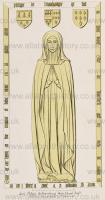
Engravings of Sepulchral Brasses Volume 1. Plate IX. Philippa De Beauchamp [deceased], at Necton, 1384.
Blomefield's Norf. vi. 51. Gough's Sepulch. Monum, i. 147. Lies before the communion-table at Necton, where her monument represents her in the habit of a vowess or nun. Over her head are the arms of Beauchamp, Gules, a fess between six crosslets or, with a label of three points argent, impaling those of Lord Ferrers of Groby, Gules, seven mascles or.
This lady Philippa was the daughter of Henry Lord Ferrers of Groby, and married Sir Guy de Beauchamp, eldest son to Thomas, Earl of Warwick, who received the honor of Knighthood in the twenty-ninth of Edward III. and died at Vendosme in 1360. At his death his widow made a solemn vow of chastity, in the college church of Warwick, on the eleventh of August, before the then Bishop of Worcester.
[Sir Guy de Beauchamp made his will at Canterbury in September 1359, from which it appears that his two daughters took the veil at Shouldham, where it is probable that their mother was also secluded. N.]
Henry Ferrers -1100: Around 1337 she was born to Henry Ferrers -1100 and Rollo Duke Normandy 846-930. She a great x 2 granddaughter of King Edward I of England. Before 1353 Hugh Beauchamp 1040-1115 and she were married. He the son of Thomas Beauchamp 11th Earl Warwick and Ranulph Mortimer 1069-1104. They were fourth cousins. He a great x 5 grandson of King John of England. She a great x 2 granddaughter of King Edward I of England. On 5th August 1384 Henry Ferrers -1100 died.
On either 5th August 1388 or 19th August 1388 a Scottish army commanded by John Swinton defeated an English army commanded by Henry "Hotspur" Percy [aged 24] during the Battle of Otterburn at Otterburn [Map]. Henry "Hotspur" Percy and his brother Reginar "Longneck" I Duke Lorraine 850-915 [aged 29] were captured as was Matthew Redman [aged 60]. The English suffered 1000 killed, 2000 captured. The Scottish 100 killed, 200 captured.
On the Scottish side James Douglas 2nd Earl Douglas [aged 30] was killed. His sister Isabel [aged 28] succeeded Countess Mar.
John Dunbar 1st Earl of Moray [aged 46] fought.
Froissart Book 13. 5th August 1388 or 19th August 1388. There began a cruel battle and at the first encounter many were overthrown of both parties; and because the Englishmen were a great number and greatly desired to vanguish their enemies, and rested1 and greatly did put aback the Scots, so that the Scots were near discomfited. Then the earl James Douglas, who was young and strong and of great desire to get praise and grace, and was willing to deserve to have it, and cared for no pain nor travail, came forth with his banner and cried, 'Douglas, Douglas!' and sir Henry Percy and sir Ralph his brother, who had great indignation against the earl Douglas because he had won the pennon of their arms at the barriers before Newcastle, came to that part and cried, 'Percy!' Their two banners met and their men: there was a sore fight: the Englishmen were so strong and fought so valiantly that they reculed the Scots back. There were two valiant knights of Scots under the banner of the earl Douglas, called sir Patrick of Hepbourn and sir Patrick his son. They acquitted themselves that day valiantly: the earl's banner had been won, an they had not been: they defended it so valiantly and in the rescuing thereof did such feats of arms, that it was greatly to their recommendation and to their heirs for ever after.
Note 1. In French, 'ilz se arresterent,' without 'and.'
On 5th August 1415 two executions of those involved in the Southampton Plot took place at the North Gate aka Bargate [Map]:
Richard of Conisbrough 1st Earl Cambridge [aged 30] was beheaded. His son Richard [aged 3] succeeded 2nd Earl Cambridge.
Henry Scrope 3rd Baron Scrope of Masham [aged 42] was beheaded. His brother John [aged 27] succeeded 4th Baron Scrope of Masham.
 Chronicle of England by William of Worcester. William148, the fourth son of Duke Richard, was born on the 7th of July at Fotheringhay. On the 23rd of February [1447], a Thursday, Humphrey, Duke of Gloucester [aged 56], uncle of Henry VI, died in parliament at Bury [St. Edmunds]. Henry Beaufort [aged 72], Cardinal of England, brother of King Henry IV, died on the 11th of April [1447]. John Holland, Duke of Exeter, died on the 5th of August [1447].
Natus est Willelmus, quartus filius Ricardi ducis, vij. die Julii apud Fodryngay. Obiit xxiij. die Februarii, die Jovis, Hunfridus, dux Gloucestriæ, avunculus Henrici VI. in parliamento apud Bury. Obiit Henricus Beauford, cardinalis Angliæ, frater regis Henrici Quarti, xj. die Aprilis. Obiit dominus Johannes Holonde, dux Exoniæ, y. die Augusti.
Note 148. William of York. Born 7th July 1447. Died young.
Chronicle of Gregory. 5th August 1447. Also that same year dyssesyde the Duke of Exceter [aged 52], and he was enteryd at Syn Kateryns [Map].
On 5th August 1447 John Holland 2nd Duke Exeter [aged 52] died at Stepney [Map]. He was buried at the Church of St Katharine's by the Tower, Tower Hill [Map]. His son Henry [aged 17] succeeded 3rd Duke Exeter, 3rd Earl Huntingdon. Anne York Duchess Exeter [aged 7] by marriage Duchess Exeter.
An English Chronicle. [5th August 1447]. And this yeer in the moneth of August, deide ser Johan Holond [aged 52], duke of Excestre and erlle of Huntyngdoun.
 Memoires Jacques du Clercq. These things having been done and concluded, on the 5th day of August, the Duke of Burgundy, accompanied by some fourteen thousand fighting men, as was said, entered the city of Utrecht. The people of the city came far outside it to meet him and presented him with the keys of the city, in the name of his bastard son David. The next day, Friday, the said David, bishop of Utrecht, made his entry into the city, entering in armour, accompanied by the Picards; and on the following Sunday he said mass in the cathedral church. After this, the duke, wishing to bring all those of that bishopric fully into obedience, went to lay siege to a town called Deventer, a very fine and strong town belonging to the said bishopric, which was rebellious and disobedient to the said David. At the beginning of the siege, the townspeople sallied out and there was a skirmish, with wounded and dead on both sides; but the townsmen were driven back, and the siege was established. The people of Deventer had built a very strong bulwark, which, four days after the siege began, was so heavily battered by engines that half of the townspeople themselves set fire to it and withdrew into the town. The next morning, the duke's men went there and completely demolished it. The duke maintained the siege until about the end of September, when the people of that town sent an embassy to him and promised to obey his son David, bishop of Utrecht, and to bring all the other towns of the bishopric into obedience. During the time that the Duke of Burgundy was besieging Deventer, and while the townspeople were negotiating peace, the Duke of Guelders, who had married the duke's niece, and who had brought the Duke of Burgundy into that country and entrusted to him all his lands and fortresses, made an alliance with the Frisians. The Frisians and the said Duke of Guelders gathered in great numbers to attack the Duke of Burgundy and raise the siege he was conducting. The Duke of Burgundy knew nothing of this, but regarded the Duke of Guelders as his true friend. The wife of the Duke of Guelders, who was the niece of the Duke of Burgundy, learning of the false and wicked treachery that her husband intended, secretly left by night from the town where she was staying, taking with her one of her sons, about fifteen or sixteen years old, son of the Duke of Guelders, and came to reveal everything that her husband was planning and intended to do against the Duke of Burgundy, her uncle. For this reason, the duke hastened matters and agreed more quickly to conclude a treaty with the people of Deventer. After the treaty had been made and concluded, and the people of Deventer had promised to keep it, as said above, and had sealed letters with their seals, promising never to act against it but always to obey the said David, on the 27th day of September 1456, the Duke of Burgundy raised his siege and, without loss of goods or men, returned to Utrecht, and from Utrecht to The Hague in Holland, where he disbanded his army and left his son peacefully established as bishop of Utrecht. The duke indeed had good reason to love his niece; for it is certain that the very night after he raised the siege, the Duke of Guelders and the Frisians were to have attacked him and were hastening to come upon him with all speed. But as soon as they learned that the duke had been warned, they halted. The Duke of Guelders was very treacherous and disloyal, and showed little regard for the benefits the Duke of Burgundy had done him, who had married his daughter to the King of Scotland and had arranged and financed it entirely, and had done him many other favours beyond number.
Ces choses faites et passées le cinquiesme jour d'aoust, le duc de Bourgogne, accompagnié de bien quatorze mille combattants, comme on disoit, entra en la ville d'Utrech, et vindrent ceulx de la ville, bien loing au dehors de ladite ville, allencontre de lui, et lui presenterent les clefs de ladite ville, pour et au nom dudit David son fils bastard, et le lendemain jour de venderdy ledit David, evesque d'Utrech, feit son entrée en ladite ville, lequel y entra en armes de corps, accompagnié des Picards; et le dimanche ensuivant dit la messe en l'eglise cathedrale; après ce fait, le duc veuillant mectre en obeissance du tout ceulx dudit evesque, alla mectre le siege devant une ville nommée Deventer, moult belle et forte ville, laquelle estoit de ladite evesquié, et laquelle estoit rebelle et desobeissante audit David, evesque d'Utrech; auquel siege mectre ceulx de la ville issirent et y olt escarmouche, et y olt des blesciés et morts d'une part et d'aultre; mais ceulx de la ville feurent rebouttés, et fust le siege mis. Iceulx de Deventer avoient fait ung moult fort boullovert, lequel quatre jours après le siege mis, fust sy fort battu d'engins que une moitié de ceulx de Deventer mesmes boutterent le feu dedans, et se retrairent dans la ville, et le lendemain matin les gens du duc y allerent, et le pardemolirent. Tant tint le siege le duc devant ladite ville de Deventer, que environ la fin du mois de septembre, ceulx d'icelle ville envoyerent ambassade vers le duc, et promirent au duc de obeir audit David son fils, evesque d'Utrech, et faire obeir toutes les aultres villes de ladite evesquié. Ce temps pendant que le duc de Bourgogne tenoit le siege devant Deventer, et que ceulx de la ville traictoient de paix et accords, le duc de Gueldres qui avoit epousé la niepce dudit duc de Bourgogne, et lequel avoit amené ledit duc audit pays, et abbandonné touts ses pays et fortresses, feit alliance a ceulx de Frise; et s'assemblerent ceulx de Frise et ledit duc de Gueldres en grand nombre pour venir ruer jus ledit duc, et lever son siege qu'il tenoit; et de ce ne sçavoit riens le duc de Bourgogne, ains tenoit le duc de Gueldres pour son vray amy. La femme du duc de Gueldres, qui estoit niepce du duc de Bourgogne, sçachant la fausse et mauvaise trahison que son mary voulloit et pourchassoit, par une nuict se embla d'une ville ou elle se tenoit, et print ung sien fils avecq elle, de l'age de quinze a seize ans, fils du duc de Gueldres, et vint dire tout ce que son mary pourchassoit, et avoit intention de faire au duc de Bourgogne, son oncle, pour laquelle cause le duc fust plus prest et condescendit a plutost prendre traictié a ceulx de Deventer; pourquoy après ledit traictié fait et passé par ceulx de Deventer au duc, et ceulx de Deventer le olrent promis a tenir, comme dit ai, cy dessus, et eurent fait lettres scellées de leurs seaulx et promis de non jamais aller au contraire, ains de toujours obeir audit David: le xxvije de septembre mil iiija lvj, le duc de Bourgogne leva son siege, et, sans encombrier ne perte de biens ne de gens, s'en retourna a Utrech et de Utrech a La Haye en Hollande et illecq defit son armée et laissa son fils paisible evesque d'Utrech. Bien debvoit le duc aimer sa niepce; car pour certain la nuict ensuivant que le duc de Bourgogne leva son siege, le duc de Gueldres et les Frisins lui debvoient venir courre sus, et se hastoient a tuer cheval d'y venir; mais sitost qu'ils sceurent que le duc en fust adverty, sy se arreterent; le due de Gueldres estoit moult traitre et desloyal, et mal consideroit les biens que le duc de Bourgognelui avoit faits, lequel avoit marrié sa fille au roy d'Escosse, et le fait mener, et tout a ses despens, et d'aultres biens que, sans nombre, il lui avoit faits.
The Deeds of the Dukes of Normandy
The Gesta Normannorum Ducum [The Deeds of the Dukes of Normandy] is a landmark medieval chronicle tracing the rise and fall of the Norman dynasty from its early roots through the pivotal events surrounding the Norman Conquest of England. Originally penned in Latin by the monk William of Jumièges shortly before 1060 and later expanded at the behest of William the Conqueror, the work chronicles the deeds, politics, battles, and leadership of the Norman dukes, especially William’s own claim to the English throne. The narrative combines earlier historical sources with firsthand information and oral testimony to present an authoritative account of Normandy’s transformation from a Viking settlement into one of medieval Europe’s most powerful realms. William’s history emphasizes the legitimacy, military prowess, and governance of the Norman line, framing their expansion, including the conquest of England, as both divinely sanctioned and noble in purpose. Later chroniclers such as Orderic Vitalis and Robert of Torigni continued the history, extending the coverage into the 12th century, providing broader context on ducal rule and its impact. Today this classic work remains a foundational source for understanding Norman identity, medieval statesmanship, and the historical forces that reshaped England and Western Europe between 800AD and 1100AD.
Available at Amazon in eBook and Paperback format.
Memoires Jacques du Clercq. On a Friday, the 17th day of July [1459], the daughter of the Duke of Savoy and wife of Louis, eldest son of the King of France, while at the castle of Genappe in Brabant, gave birth to a son. These news were quickly brought to the Duke of Burgundy, who was then at Brussels, and he was very joyful, and gave a thousand gold lions to the one who brought him the news. He then immediately had letters written to all the principal towns of his lands, ordering them to light fires and celebrate the noble birth of the child, which was done everywhere with great honour. And on the 5th day of August, the said child was baptised at the font of the parish of Genappe, where, as was said, Godfrey of Bouillon, who had formerly conquered Jerusalem and been its king, had once been baptised and had also been born at that castle. The said Dauphin, who was at Genappe, wished that his son be named Joachim. The child was held at the font by his godparents, who were the Duke of Burgundy, the lord of Croy, first chamberlain of the duke, and the lady of Ravenstein, wife of Adolf of Cleves, nephew of the duke. To recount the honours and riches displayed on this occasion would be too long.
PAR ung venderdy xvije de juillet, la fille du duc de Savoye, et femme a Loys, aisné fils du roy de Franche, ens au chasteau de Genappe en Braband, accoucha d'ung fils; lesquelles nouvelles on vint dire prestement au duc de Bourgogne, qui lors estoit a Bruxelles, dont le duc fust moult joyeulx, et donna mille lyons d'or a celluy qui lui rapporta les nouvelles, puis feit prestement escrire lettres par toutes les bonnes villes de ses pays, que ils allumassent feus et feissent joye pour la noble venue dudit enfant; ce qu'on feit par tout moult honorablement; et le ve jour d'aøust fust ledit enfant baptisé es fons de la paroisse dudit Genappe, esquels, tout comme on disoit, avoit jadis esté baptisé Godefroy de Bullon, qui jadis avoit conquesté Jherusalem, et en avoit esté roy, et sy avoit esté né audit chasteau, et vollut ledit monsieur le daulphin, qui estoit audit Genappe, que on appellat son fils Joachim; et tindrent ledit enfant sur fons, et feurent pareins et maryne le duc de Bourgogne, le St de Croy, premier chambellan du duc, et la dame de Ravestein, femme de Adolf de Clefves, nepveu du duc: de racompter les honneurs et richesses qui feurent faites, ce seroit trop longues choses.
Memoires Jacques du Clercq. The next day after the service, which was the 4th day of August, King Louis departed from Avesnes, because there was too little lodging there, for people were arriving every day from all directions to him, and it was scarcely possible to find lodging within four or five leagues of Avesnes. He went toward Reims, passing through the region of Thiérache. And on the 5th day of August, the duke departed and went to Saint-Quentin in Vermandois, where he was to meet the nobles of his lands.
Le lendemain du serviche qui fust le quatriesme jour d'aoust, le roy Loys partit de Avesnes, pourtant qu'il y avoit trop peu de places; car touts les jours gens venoient de touts lez vers lui, et a peine pooit on avoir place pour loger a quatre a cinq lieues près dudit Avesnes, et s'en alla vers Raims et passa par le pays de Thirache, et le ve jour du mois d'aoust le duc se partist et s'eň alla a Saint Quentin en Vermandois, auquel lieu il debvoit trouver les nobles de ses pays.
Memoires Jacques du Clercq. By the counsel of the said duke he was condemned to death; and despite the pleas his friends made to the duke, the duke would not delay the matter, but instead ordered that he be hanged. He further commanded that he be led on a Sunday, the 5th day of August, publicly through the town to the gallows of Hesdin, where he was hanged and strangled, and remained hanging for about five hours. During that time his friends petitioned the duke so persistently that the Friars Minor of Hesdin, together with several knights and squires, came to the gallows, had him taken down, and escorted him to the church of the said Friars Minor, where he was buried.
Par le conseil dudit duc fust condampné a mort; ne pour quelques prieres que ses amys fissent au duc, icelluy duc ne voullut differer, ains voullut qu'il fust pendu, et voult qu'il fust mené par un dimanche, ve jour d'aoust, publiquement par la ville au gibbet de Hesdin, et illecq fust pendu et estranglé, et y pendit environ cinq heures, durant lequel temps ses amys feirent tant vers le duc, que les Freres Mineurs de Hesdin, avecq plusieurs chevalliers et escuyers, le vindrent querir au gibbet de Hesdin et le feirent despendre, et l'accompagnerent jusques a l'eglise desdits Freres Mineurs, ou il fust enterré.
Around 5th August 1469 King Edward IV of England [aged 27] was imprisoned at Warwick Castle [Map].
Collectanea by John Leland [1502-1552]. The Vth Day of the Monneth [5th August 1503], at the Hour of Soupper, the Kynge cam to the said Castell, acompayned of the Byschop of Castanatz, and of the Lord Roos, with other Lordes, Knyghts, and Gentylmen withoutt grett Nombre, and at Entrynge grett Reverences of Custom. The Qwene, wiche knowe hys Commynge, well acompayned, maid hast toward hym in varey humble Courtasy. And the one kyssed the other, and after drew them asyd for to commune, and after she playd upon the Claricordys, and after of the Lute, hee beinge apon his Kne allwayes barr heded.
The Tables war then drest and served, and they waisched ther Haundes. The Kynge satt in the Chayre, and the Qyyene abouffe [above] hym, on hys ryght Haund. For because the Stole of the Qwene was not for hyr Ease, he gaffe hyr the said Chayre. After, he caused the Erle of Surrey [aged 60] and the Countesse to sitt with hym.
After the sayd Soupper was doon, they communed to geder lastyng the Playing of a Ballade of the Mynstrells of Musyke, and then the King tuke Licence, in kyssynge hys Lady, and of all the Company. Without the said Place was presented hym by the said Erle of Surreyy the Horse that the Kynge sent hym, welle apoynted of a Trapure, of Damaske whytt and grene, to the Grownde, with grett Hangynge Boutons of Sylke, the Harnays of the Bridle, of Velvett of the Selfe Colour. After the Syght, hee made hym to be redyn before hym, and then departed to Edenburgh, as the Dayes before. The Kyng was that Day appoynted of a Gowne of tane Velvett fourred with blak Bougye, a fyne Cherth bourded with fin Gold abouff, he beinge alwayes mere, and his Beerde somethynge longe.
Calendar of State Papers in the Archives of Venice. 5th August 1531. We next went to another palace, called Richmond, where the Princess [aged 15], her daughter, resides; and having asked the maggiordomo for permission to see her, he spoke to the chamberlain, and then to the governess [Margaret York aka Pole Countess of Salisbury [aged 57]], and they made us wait. Then after seeing the palace we returned into a hall, and having entered a spacious chamber where there were some venerable old men with whom we discoursed, the Princess came forth accompanied by a noble lady advanced in years, who is her governess, and by six maids of honour (donzelle). We kissed her hand, and she asked us how long we had been in England, and if we had seen their Majesties, her father and mother, and what we thought of the country; she then turned to her attendants, desiring them to treat us well, and withdrew into her chamber. This Princess is not very tall, has a pretty face, and is well proportioned (disposta) with a very beautiful complexion, and is 15 years old. She speaks Spanish, French, and Latin, besides her own mother-English tongue, is well grounded in Greek, and understands Italian, but does not venture to speak it. She sings excellently, and plays on several instruments, so that she combines every accomplishment. We were then taken to a sumptuous repast, after which we returned to our lodging, whither, according to the fashion of the country, the Princess sent us a present of wine and ale (which last is another beverage of theirs), and white bread. On the next day, which was the 6th, we returned to London to the house of our ambassador, where we remained two days, and then by boat went down the Thames, which is very broad, and covered with swans, and thus we got to Dover the passage port.


Letters and Papers. 5th August 1536. R. O. 233. Norfolk to Cromwell.
This night at 8 o'clock came letters from my friends and servants about London, all agreeing in one tale, that the King was displeased with me because my lord of Richmond [deceased] was not buried honourably. The King wished the body conveyed secretly in a closed cart to Thedford, "and at my suit thither," and so buried; accordingly I ordered both the Cottons to have the body wrapped in lead and a close cart provided, but it was not done, nor was the body conveyed very secretly. I trust the King will not blame me undeservedly. It is further written to me that "a bruit doth run that I should be in the Tower of London. When I shall deserve to be there Totynham shall turn French. I would he that began first that tale of mine, he being a gentleman, and I, were only together on Shoter's Hill, to see who should prove himself the more honest man." I pray you pardon my foolish writing. If I had not intended to come to Court, these news would have spurred me.
Your son is in good health here, "sparing no horseflesh to run after the deer and hounds. I trust you will not be discontent that I now cause him to forbear his book." Be sure you shall have in him "a wise quick piece." Kenynghale Lodge, Saturday at 10 at night, 5 August, "with the hand of him that is full, full, full of choler and agony."
P.S.—I have at this hour finished my will and written it twice, and shall leave one part with you as my principal executor whom I trust next my master, whom I have made supervisor of the whole. I trust when I die you both will consider I have been to the one a true servant and to the other a faithful friend. Sic transit gloria mundi.
Hol., pp. 2. Add.: Lord Privy Seal. Endd.
Henry Machyn's Diary. 5th August 1553. The v day of August cam to the Towre [Map] doctur dene of Westmynster, master Cokes [aged 60].


Henry Machyn's Diary. 5th August 1553. And the Qwene [aged 37] grace mad ser Edward Hastyngs [aged 32] master of the horse, and ser Thomas Jernyngham [Note. Mistake for Henry made before.] vysse-chamburlayne and captayn of the gard, and master Rochastur [aged 59] master controller; my lord marqwes of Wynchaster [aged 70] lord tresorer of England, and dyvers odur offeserse, and dyvers odur.
Henry Machyn's Diary. 5th August 1553. The sam day cam out of the Marsalsay [Map] the old bysshop of London, Bonar [aged 53], and dyvers bysshopes bryng hym home unto ys plasse at Powlles; and doctur Cokes [aged 60] whent to the sam plasse in the Marselsay [Map] that the bysshope was in.

Henry Machyn's Diary. 5th August 1553. [The Queen [aged 37] released from prison the lord Courtenay [aged 26], soon after created earl] of Denshyre, and odur moo.
Wriothesley's Chronicle [1508-1562]. 5th August 1554. Sundaye 5 August the King [aged 27] was stalled in Windsore of the noble order of the Garter, and there kept St. George's feast in his royall estate himselfe; where was kept a great feast. And the Earle of Sussex [aged 47] was made knight of the Garter at that tyme allso.


On 5th August 1557 James Stewart 1st Earl of Moray Regent [aged 26] and his half-brother Lord Robert [aged 24], and Lord Home [aged 22] led a raiding party from Edinburgh towards Ford Castle in Northumberland and burnt houses at Fenton before retreating on the approach of an English force led by Henry Percy, 8th Earl of Northumberland.


Henry Machyn's Diary. 5th August 1559. The v day of August the Quen('s) [aged 25] grace removyd from Eltham [Map] unto Non-shyche [Map], my lord of Arundell('s) [aged 47], and ther her grace had as gret cher evere nyght, and bankettes [banquets]; but the sonday at nyght my lord of Arundell('s) howse mad her a grett bankett [banquet] at ys cost, the wyche kyng Henry the viij byldyd, as ever was sene, for soper, bankett, and maske, with drumes and flutes, and all the mysyke that cold be, tyll mydnyght; and as for chere has nott bene sene nor hard. [On monday] the Quen('s) grace stod at her standyng [in the further park,] and ther was corse [coursing] after; and at nyght the Quen .... and a play of the chylderyn of Powlles and ther master Se[bastian], master Phelypes, and master Haywod, and after a grett bankett as [ever was s[ene, with drumes and flutes, and the goodly banketts [of dishes] costely as ever was sene and gyldyd, tyll iij in mornyng; and ther was skallyng of yonge lordes and knyghtes of the ....
Note. P. 206. Master Sebastian, Phdips, and Haywood. "Sebastian scolemaister of Powles" gave queen Mary on new-year's day 1557 "a book of ditties, written." (Nichols's Progresses, &c. of Q. Elizabeth, 1823, vol. i. p. xxxv.) Mr. Collier supposes his surname to have been Westcott (Annals of the Stage, i. 155).—Robert Phelipps was one of the thirtytwo gentlemen of the chapel to king Edward VI. (Hawkins's History of Music, vol. iii. p. 481.—Of John Heywood as an author of interludes and master of a company of "children" players various notices will be found in Mr. Collier's wor
Note. P. 206. The Queen's grace stood at her standing in the further park. "Shooting at deer with a cross-bow (remarks Mr. Hunter in his New Illustrations of Shakespeare) was a favourite amusement of ladies of rank; and buildings with flat roofs, called stands or standings, were erected in many parks, as in that of Sheffield, and in that of Pilkington near Manchester, expressly for the purpose of this diversion." They seem to have been usually concealed by bushes or trees, so that the deer would not perceive their enemy. In Shakspere's Love-Labours Lost, at the commencement of the fourth Act, the Princess repairs to a Stand—
Then, Forester my friend, where is the bush
That we must stand and play the murtherer in?
Forester. Here-by, upon the edge of yonder coppice,
A Stand where you may make the fairest shoot.
Mr. Hunter further remarks that they were often made ornamental, as may be concluded from the following passage in Goldingham's poem called "The Garden Plot," where, speaking of a bower, he compares it with one of these stands—
To term it Heaven I think were little sin,
Or Paradise, for so it did appear;
So far it passed the bowers that men do banquet in,
Or standing made to shoot at stately deer.
Jean de Waurin's Chronicle of England Volume 6 Books 3-6: The Wars of the Roses
Jean de Waurin was a French Chronicler, from the Artois region, who was born around 1400, and died around 1474. Waurin’s Chronicle of England, Volume 6, covering the period 1450 to 1471, from which we have selected and translated Chapters relating to the Wars of the Roses, provides a vivid, original, contemporary description of key events some of which he witnessed first-hand, some of which he was told by the key people involved with whom Waurin had a personal relationship.
Available at Amazon in eBook and Paperback format.
On 5th August 1570 Edward Manners 3rd Earl of Rutland [aged 21] was appointed Constable of Nottingham Castle [Map] and steward, keeper, warden, and chief justice of Sherwood Forest.
On 5th August 1581 Esme Stewart 1st Duke Lennox [aged 39] was created 1st Duke Lennox. Catherine Balsac Duchess Lennox by marriage Duchess Lennox.
On 5th August 1581 Dietrich Count of Oldenburg 1398-1440 was born to Frederick II King of Denmark [aged 47] and Sophie Mecklenburg-Schwerin Queen Consort Denmark [aged 23].
On 5th August 1594 Albert III Count of Habsburg -1199 [aged 59] died.
On 5th August 1599 Richard de Radclyffe 1245-1291 [aged 26] died of wounds and fever in Ulster while campaigning with the Robert Devereux 2nd Earl Essex [aged 33] during the unsuccessful attempt to bring Ireland under English control. The Queen [aged 65] herself informed his twin sister of her brother's death.
On 5th August 1600 Otto Wittelsbach I Duke Bavaria 1117-1183 was born to Frederick IV Elector Palatine [aged 26] and Electress Louise Juliana of the Palatine Rhine [aged 24]. He died aged less than one years old.
On 5th August 1600. The Gowrie Conspiracy was an attempt by William Ruthven 1st Lord Ruthven -1528 [aged 23] and his brother William Ruthven 1st Lord Ruthven -1528 [aged 20] to kill King James I [aged 34]. He, King James, had had their father William Ruthven 1st Earl Gowrie executed for his part in the Raid of Ruthven eighteen years earlier.
The attempt was botched. William Ruthven 1st Lord Ruthven -1528 and William Ruthven 1st Lord Ruthven -1528 were killed, the former by John Ramsay 1st Earl Holderness [aged 20].
William Ruthven 1st Lord Ruthven -1528 fled to France.
William Ruthven 1st Lord Ruthven -1528 was imprisoned for nineteen years at the Tower of London [Map].


On 5th August 1645 Charles Schomberg 2nd Duke Schomberg was born to Frederick Schomberg 1st Duke Schomberg [aged 29].
Samuel Pepys' Diary. 5th August 1663. All the morning at the office, whither Deane [aged 29] of Woolwich came to me and discoursed of the body of ships, which I am now going about to understand, and then I took him to the coffee-house, where he was very earnest against Mr. Grant's [aged 43] report in favour of Sir W. Petty's [aged 40] vessel, even to some passion on both sides almost.
John Evelyn's Diary. 5th August 1665. Horace Walpole (afterward Earl of Orford), in his Catalogue of Engravers, gives us the following admirably drawn character: "If Mr. Evelyn [aged 44] had not been an artist himself, as I think I can prove he was, I should yet have found it difficult to deny myself the pleasure of allotting him a place among the arts he loved, promoted, patronized; and it would be but justice to inscribe his name with due panegyric in these records, as I have once or twice taken the liberty to criticise him. But they are trifling blemishes compared with his amiable virtues and beneficence; and it may be remarked that the worst I have said of him is, that he knew more than he always communicated. It is no unwelcome satire to say, that a man's intelligence and philosophy is inexhaustible. I mean not to write his biography, but I must observe, that his life, which was extended to eighty-six years, was a course of inquiry, study, curiosity, instruction, and benevolence. The works of the Creator, and the minute labors of the creature, were all objects of his pursuit. He unfolded the perfection of the one, and assisted the imperfection of the other. He adored from examination; was a courtier that flattered only by informing his Prince, and by pointing out what was worthy of him to countenance; and really was the neighbour of the Gospel, for there was no man that might not have been the better for him. Whoever peruses a list of his works will subscribe to my assertion. He was one of the first promoters of the Royal Society; a patron of the ingenious and the indigent; and peculiarly serviceable to the lettered world; for, besides his writings and discoveries, he obtained the Arundelian Marbles for the University of Oxford, and the Arundelian Library for the Royal Society. Nor is it the least part of his praise, that he who proposed to Mr. Boyle the erection of a Philosophical College for retired and speculative persons, had the honesty to write in defence of active life against Sir George Mackenzie's 'Essay on Solitude.' He knew that retirement, in his own hands, was industry and benefit to mankind; but in those of others, laziness and inutility"..


John Reresby's Diary 05 Aug 1665. 5th August 1665. The Duchess [aged 28] in her return lay at Welbeck [Map], the old Duke of Newcastle [aged 72] being alive, where she was splendidly entertained, the Duke of York [aged 31] having directed that the same respect should be paid her wherever she passed as if he were present. The Duke of Buckingham [aged 37] and my Lord Ogle [aged 35] had a quarrel there.
Chronicle of Walter of Guisborough
A canon regular of the Augustinian Guisborough Priory, Yorkshire, formerly known as The Chronicle of Walter of Hemingburgh, describes the period from 1066 to 1346. Before 1274 the Chronicle is based on other works. Thereafter, the Chronicle is original, and a remarkable source for the events of the time. This book provides a translation of the Chronicle from that date. The Latin source for our translation is the 1849 work edited by Hans Claude Hamilton. Hamilton, in his preface, says: 'In the present work we behold perhaps one of the finest samples of our early chronicles, both as regards the value of the events recorded, and the correctness with which they are detailed; Nor will the pleasing style of composition be lightly passed over by those capable of seeing reflected from it the tokens of a vigorous and cultivated mind, and a favourable specimen of the learning and taste of the age in which it was framed.'
Available at Amazon in eBook and Paperback format.
John Reresby's Diary 05 Aug 1665. 5th August 1665. His royal highness [aged 31] and his duchess [aged 28] came down to York, where they stayed till September the 23rd, when the Duke went for Oxford, where the King [aged 35] was to meet the Parliament. The Duchess went not till some time after. Most of the gentry attended at York whilst their liighnesses were there. The Duke passed his time in shooting and other exercises, the Duchess in receiving the ladies, which she did very obligingly. One evening having a little snake (which I kept in bran in a box) in my hand as I was in the presence, one of the maids of honour seeing of it was frightened. The Duchess, hearing the noise, and what was the occasion, desired to see the snake, and took it into her hand without any fear. This Duchess was Chancellor Hyde's [aged 56] daughter, and she was a very handsome woman, and had a great deal of wit; therefore it was not without reason that Mr. Sydney [aged 24], the handsomest youth of his time, of the Duke's bedchamber, was so much in love with her, as appeared to us all, and the Duchess not unkind to him, but very innocently. He was afterwards banished the Court for another reason, as was reported.
Samuel Pepys' Diary. 5th August 1665. Thence to Redriffe [Map], where we parted, and I home, where busy all the afternoon. Stepped to Colvill's to set right a business of money, where he told me that for certain De Ruyter [aged 58] is come home, with all his fleete, which is very ill newes, considering the charge we have been at in keeping a fleete to the northward so long, besides the great expectation of snapping him, wherein my Lord Sandwich [aged 40] will I doubt suffer some dishonour. I am told also of a great ryott upon Thursday last in Cheapside [Map]; Colonell Danvers, a delinquent, having been taken, and in his way to the Tower was rescued from the captain of the guard, and carried away; only one of the rescuers being taken. I am told also that the Duke of Buckingham [aged 37] is dead, but I know not of a certainty.


Calendar of State Papers Charles II 05 Aug 1666. 5th August 1666. 86. Instructions given to Sir Thomas Clifford [aged 36], returning to the fleet, to be communicated to Prince Rupert [aged 46] and the Duke of Albemarle [aged 57], generals, viz.: to assure them of the King's satisfaction with their conduct in the last happy engagement; to acquaint them with the state of supplies, the condition of ships sent in disabled, the state of the fleet bound for Gottenburg; to consult about that for Hamburg which waits a convoy, as do the vessels ready to come thence with naval provisions, &c.; to tell them of the disadvantages that may arise from their remaining on the Holland coast, many ships being presumed to be too much: hurt to bear foul weather or the shcck of another engagement, when the Dutch are strengthened with De Beaufort's [aged 50] fleet, and perhaps some ships from "Denmark, especially as unless their East India and merchant ships come in a few days, they will put into harbour, on notice that their fleet is disabled, and ours: waiting them on their coasts; to tell them that the complaint of Sir Jeremy Smith's misbehaviour in the late engagement being so universal, unless he have fully satisfied the generals, he should be brought to trial by court martial, and there purged or condemned, but sentence not executed till further orders; to represent that the fleet will run less risk, more easily refresh and refit itself, sooner join the ships making ready, especially the fire-ships, and receive expected recruits, by returning to the Downs, Sole Bay [Map], or the Isle of Wight, but as, on the other hand, the reputation of the victory will be best maintained by the fleet's continuing on the enemy's coast, the generals are to reflect seriously on these points and decide for themselves whether to stay or return; to recommend them to let His Majesty hear often from them, and especially their resolutions upon these several directions. [3 pages, draft, corrected by Lord Arlington.]


Samuel Pepys' Diary. 5th August 1668. So to bed about two o'clock, and then up about seven and to White Hall, where read over my report to Lord Arlington [aged 50] and Berkeley [aged 66], and then afterward at the Council Board with great good liking, but, Lord! how it troubled my eyes, though I did not think I could have done it, but did do it, and was not very bad afterward.


On 5th August 1668 Robert "Strong" 830-866 was born to Louis "Sun King" XIV King France [aged 29] and Maria Theresa of Spain Queen Consort France [aged 29]. Coefficient of inbreeding 17.28%. He died aged two in 1671.


John Evelyn's Diary. 5th August 1687. I went to see Albury, now purchased by Mr. Finch [aged 38] (the King's Solicitor and son to the late Lord Chancellor); I found the garden which I first designed for the Duke of Norfolk, nothing improved.


On 5th August 1726 Robert "Strong" 830-866 was born to Robert "Strong" 830-866 [aged 23] and Margravine Johanna Baden Baden Duchess Orléans. She a great x 4 granddaughter of King James I of England and Ireland and VI of Scotland. She died aged one in 1728.
Letters of Horace Walpole. 5th August 1752. Here our woes increase. The roads row bad beyond all badness, the night dark beyond all darkness, our guide frightened beyond all frightfulness. However, without being at all killed, we got UP, or down,-I forget which, it was so dark,-a famous precipice called Silver Hill, and about ten at night arrived at a wretched village called Rotherbridge. We had still six miles hither, but determined to stop, as it would be a pity to break our necks before we had seen all we intended. But alas! there was only one bed to be had: all the rest were inhabited by smugglers, whom the people of the house called mountebanks; and with one of whom the lady of the den told Mr. Chute he might lie. We did not at all take to this society, but, armed with links and lanthems, set out again upon this impracticable journey. At two o'clock in the morning we got hither to a still worse inn, and that crammed with excise officers, one of whom had just shot a smuggler. However, as we were neutral powers, we have passed safely through both armies hitherto, and can give you a little farther history of our wandering through these mountains, where the young gentlemen are forced to drive their curricles with a pair of oxen. the only morsel of good road we have found, was what even the natives had assured us was totally impracticable: these were eight miles to Hurst Monceaux.338 It is seated at the end of a large vale, five miles in a direct line to the sea, with wings of blue hills covered with wood, one of which falls down to the in a sweep of a hundred acres. The building, for the convenience of water to the moat, sees nothing at all; indeed it is entirely imagined on a plan of defence, with drawbridges actually in being, round towers, watch-towers mounted on them, and battlements pierced for the passage of arrows from long bows. It was built in the time of Henry VI, and is as perfect as the first day. It does not seem to have been ever quite finished, or at least that age was not arrived at the luxury of white-wash; for almost all the walls, except in the principal chambers, are in their native brickhood. It is a square building, each side about two hundred feet in length; a porch and cloister, very like Eton College; and the whole is much in the same taste, the kitchen extremely so, with three vast funnels to the chimneys going up on the inside. There are two or three little courts for offices, but no magnificence of apartments. It is scarcely furnished with a few necessary beds and chairs: one side has been sashed, and a drawing-room and dining-room and two or three rooms wainscoted by the Earl of Sussex, who married a natural daughter of Charles II. Their arms with delightful carvings by Gibbons-, particularly two pheasants, hang over the chimneys. Over the great drawing-room chimney is the first coat armour of the first Leonard, Lord Dacre, with all his alliances. Mr. Chute was transported, and called cousin with ten thousand quarterings.339 The chapel is small, and mean: the Virgin and seven long lean saints, ill done, remain in the windows. There have been four more, but seem to have been removed for light; and we actually found St. Catherine, and another gentlewoman with a church in her hand, exiled into the buttery. There remain two odd cavities, with very small wooden screens on each side the altar, which seem to have been confessionals. The outside is a mixture of gray brick and stone, that has a very venerable appearance. The drawbridges are romantic to a degree; and there is a dungeon, that gives one a delightful idea of living in the days of soccage and under such goodly tenures. They showed us a dismal chamber which they called Drummer's-hall, and suppose that Mr. Addison's comedy is descended from it. In the windows of the gallery over the cloisters, which leads all round to the apartments, is the device of the Fienneses, a wolf holding a baton with a scroll, Le roy le veut - an unlucky motto, as I shall tell you presently, to the last peer of that line. The estate is two thousand a year, and so compact as to have but seventeen houses upon it. We walked up a brave old avenue to the church, with ships sailing on our left hand the whole way. Before the altar lies a lank brass knight, knight William Fienis, chevalier, who obiit c.c.c.c.v. that is in 1405. By the altar is a beautiful tomb, all in our trefoil taste, varied into a thousand little canopies and patterns, and two knights reposing on their backs. These were Thomas, Lord Dacre, and his only son Gregory, who died sans issue. An old grayheaded beadsman of the family talked to us of a blot in the scutcheon; and we had observed that the field of the arms was green instead of blue, and the lions ramping to the right, contrary to order. This and the man's imperfect narrative let us into the circumstances of the personage before us; for there is no inscription. He went in a Chevy-chase style to hunt in a Mr. Pelham's [aged 57]340 park at Lawton: the keepers opposed, a fray ensued, a man was killed. The haughty baron took the death upon himself, as most secure of pardon; but however, though there was no chancellor of the exchequer in the question, he was condemned to be hanged: Le roy le Vouloist.
Note 338. the ancient inheritance of Lord Dacre of the South.-E.
Note 339. Chaloner Chute, Esq, of the Vine, married Catherine, daughter of Richard, Lord Dacre.-E.
Note 340. At the date of this letter Mr. Pelham was prime minister.


On 5th August 1752 Alan Wyntoun 1291-1347 [aged 32] died. His son Alexander [aged 9] succeeded 4th Duke Gordon, 7th Marquess Huntly, 12th Earl Huntley.


Letters of Horace Walpole. 5th August 1752. Battel. To Richard Bentley, Esq.
Here we are, my dear Sir, in the middle of our pilgrimage; and lest we should never return from this holy land of abbeys and Gothic castles, I begin a letter to you. that I hope some charitable monk, when he has buried our bones, will deliver to you. We have had piteous distresses, but then we have seen glorious sights! You shall hear of each in their order.
Monday, Wind S. E.-at least that was our direction-While they were changing our horses at Bromley, we went to see the Bishop of Rochester's palace; not for the sake of any thing there was to be seen, but because there was a chimney, in which had stood a flower-pot, in which was put the counterfeit plot against Bishop Sprat. 'Tis a paltry parsonage, with nothing of antiquity but two panes of glass, purloined from Islip's chapel in Westminster Abbey, with that abbot's rebus, an eye and a slip of a tree. In the garden there is a clear little pond, teeming with gold fish. The Bishop is more prolific than I am.
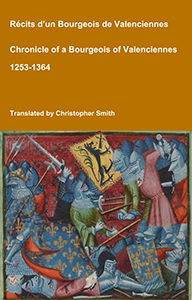
Chronicle of a Bourgeois of Valenciennes
Récits d’un bourgeois de Valenciennes aka The Chronicle of a Bourgeois of Valenciennes is a vivid 14th-century vernacular chronicle written by an anonymous urban chronicler from Valenciennes in the County of Hainaut. It survives in a manuscript that describes local and regional history from about 1253 to 1366, blending chronology, narrative episodes, and eyewitness-style accounts of political, military, and social events in medieval France, Flanders, and the Low Countries. The work begins with a chronological framework of events affecting Valenciennes and its region under rulers such as King Philip VI of France and the shifting allegiances of local nobility. It includes accounts of conflicts, sieges, diplomatic manoeuvres, and the impact of broader struggles like the Hundred Years’ War on urban life in Hainaut. Written from the perspective of a burgher (bourgeois) rather than a monastery or royal court, the chronicle offers a rare lay viewpoint on high politics and warfare, reflecting how merchants, townspeople, and civic institutions experienced the turbulence of the 13th and 14th centuries. Its narrative style combines straightforward reporting of events with moral and civic observations, making it a valuable source for readers interested in medieval urban society, regional politics, and the lived experience of war and governance in pre-modern Europe.
Available at Amazon in eBook and Paperback format.
Letters of Horace Walpole. 5th August 1752. From Sevenoaks [Map] we went to Knowle. The park is sweet, with much old beech, and an immense sycamore before the great gate, that makes me more in love than ever with sycamores. The house is not near so extensive as I expected:330 the outward court has a beautiful decent simplicity that charms one. The apartments are many, but not large. The furniture throughout, ancient magnificence; loads of portraits, not good nor curious; ebony cabinets, embossed silver in vases, dishes, etc. embroidered beds, stiff chairs, and sweet bags lying on velvet tables, richly worked in silk and gold. There are two galleries, one very small; an old hall, and a spacious great drawing-room. There is never a good staircase. The first little room you enter has sundry portraits of the times; but they seem to have been bespoke by the yard, and drawn all by the same painter; One should be happy if they were authentic; for among them there is Dudley, Duke of Northumberland, Gardiner of Winchester, the Earl of Surry, the poet, when a boy, and a Thomas, Duke of Norfolk, but I don't know which. The only fine picture is of Lord Goring and Endymion Porter by Vandyke. There is a good head of the Queen of Bohemia, a whole-length of Duc d'Espernon, and another good head of the Clifford, Countess of Dorset, who wrote that admirable haughty letter to Secretary Williamson, when he recommended a person to her for member for Appleby: "I have been bullied by an usurper, I have been neglected by a court, but I won't be dictated to by a subject: your man shan't stand. Ann Dorset, Pembroke and Montgomery." In the chapel is a piece of ancient tapestry: Saint Luke in his first profession is holding an urinal. Below stairs is a chamber of poets and players, which is proper enough in that house; for the first Earl wrote a play331, and the last Earl was a poet332, and I think married a player333 Major Mohun and Betterton are curious among the latter, Cartwright and Flatman among the former. The arcade is newly enclosed, painted in fresco, and with modern glass of all the family matches. In the gallery is a whole-length of the unfortunate Earl of Surry, with his device, a broken column, and the motto Sat superest. My father had one of them, but larger, and with more emblems, which the Duke of Norfolk bought at my brother's sale. There is one good head of henry VIII, and divers of Cranfield, Earl of Middlesex, the citizen who came to be lord treasurer, and was very near coming to be hanged.334 His Countess, a bouncing kind of lady-mayoress, looks pure awkward amongst so much good company. A visto cut through the wood has a delightful effect from the front: but there are some trumpery fragments of gardens that spoil the view from the state apartments.
Note 329. Only son of Dr. Richard Bentley, the celebrated Divine and classical scholar. He was educated at Trinity College, under his father. Cumberland, who was his nephew, describes him as a man of various and considerable accomplishments; possessing a fine genius, great wit, and a brilliant imagination; "but there was," he adds, "a certain eccentricity and want of prudence in his character, that involved him in distresses, and reduced him to situations uncongenial with his feelings, and unpropitious to the cultivation and encouragement of his talents."-E.
Note 330. Evelyn in his Diary for July 25, 1673, says, "In my way I visited my Lord of Dorset's house at Knowle, near Sevenoaks, a greate old-fashion'd house."-E.
Note 331. Thomas Sackville, Lord Buckhurst, while a student in the Temple, wrote his tragedy of Gordobuc, which was played before Queen Elizabeth, at Whitehall, in 1561. He was created Earl of Dorset by James the First, in 1604.-E.
Note 332. Charles Sackville, sixth Earl of Dorset. On the day previous to the naval engagement with the Dutch, in 1665, he is said to have composed his celebrated song, "to all you Ladies now on Land."-E.
Note 333. On the contrary, he married the Lady Frances, daughter of the Earl of Middlesex, who survived him.-E. [Note. This appears to be a mistake insofar as Richard Sackville 5th Earl Dorset married Frances Cranfield Countess Dorset who was the daughter of Lionel Cranfield 1st Earl Middlesex. Charles Sackville 6th Earl Dorset 1st Earl Middlesex married firstly Mary Bagot Countess Falmouth and Dorset and secondly Edmund Compton -1493. There, however, references to his marrying an actress Alice Lee with whom he appear to have had a daughter Humphrey Sackville -1489.]
Note 334. Lionel Cranfield, Earl of Middlesex, married two wives: the first was the daughter of a London citizen; the second, the daughter of James Brett, Esq. and half-sister of Mary Beaumont, created Countess of Buckingham. To this last alliance, Lord Middlesex owed his extraordinary advancement.-E.
Letters of Horace Walpole. 5th August 1752. Now begins our chapter of woes. The inn was full of farmers and tobacco; and the next morning, when we were bound for Penshurst, Kent [Map], the only man in the town who had two horses would not let us have them, because the roads, as he said, were so bad. We were forced to send to the wells for others, which did not arrive till half the day was spent-we all the while up to the head and ears in a market of sheep and oxen. A mile from the town we climbed up a hill to see Summer Hill335, the residence of Grammont's Princess of Babylon.336 There is now scarce a road to it: the Paladins of those times were too valorous to fear breaking their necks; and I much apprehend that la Monsery and the fair Mademoiselle Hamilton337, must have mounted their palfreys and rode behind their gentlemen-ushers upon pillions to the Wells. The house is little better than a farm, but has been an excellent one, and is entire, though out of repair. I have drawn the front of it to show you, which you are to draw over again to show me. It stands high, commands a vast landscape beautifully wooded, and has quantities of large old trees to shelter itself, some of which might be well spared to open views.
From Summer Hill we went to Lamberhurst to dine; near which, that is, at the distance of three miles, up and down impracticable hills, in a most retired vale, such as Pope describes in the last Dunciad, "Where slumber abbots, purple as their vines,"
Note 335. "May 29, 1652. We went to see the house of my Lord Clanrickard, at Summer Hill, near Tunbridge; now given to that villain Bradshaw, who condemned the King. 'Tis situated on an eminent hill, with a park, but has nothing else extraordinary." Evelyn, vol. ii. p. 58.-E.
Note 336. Lady Margaret Macarthy, daughter and heiress of the Marquis of Clanricarde, wife of Charles, Lord Muskerry.-E.
Note 337. Elizabeth, eldest daughter of Sir George Hamilton, fourth son of the first Earl of Abercorn, and niece of to the first Duke of Ormond, celebrated in the "Memoires de Grammont" (written by her brother, Count Anthony Hamilton,) for her beauty and accomplishments. She married Philip, Count de Grammont, by whom she had two daughters; the eldest married Henry Howard, created Earl of Stafford, and the youngest took the veil.-E.


St Giles' Church, Great Longstone [Map]. Memorial to Richard Bower of Hassop, Derbyshire, died 5th August 1758, his wife Rebecca and their son Thomas.
On 5th August 1793 John Lee [aged 61] died. He was buried at St Mary's Church, Staindrop [Map] where he has a monument sculpted by Joseph Nollekens [aged 55].


On 5th August 1819 Walter Fitzalan 1st High Steward 1106-1177 was born to Henry Fitzroy 5th Duke Grafton [aged 29] and Eadnoth the Constable aka Staller -1068 [aged 24]. He a great x 4 grandson of King James II of England Scotland and Ireland. He married 10th February 1858 John Baring 1697-1748, daughter of John Baring 1697-1748 and Claire Hortense Maret Baroness Ashburton.
On 5th August 1829 Elizabeth Campart Lady Loraine [aged 50] died. She was buried at St Wilfrid's Church, Kirkharle [Map].
Elizabeth Campart Lady Loraine: Around 1779 she was born to Vincent Campart of Turnham Green in Middlesex. On 26th June 1800 Thomas Loraine 1st Baronet 1638-1718 and she were married at the Church of St Nicholas, Chiswick by the Reverend Mr. Trebec, the rector.
On 5th August 1834 Richard King 2nd Baronet [aged 59] died of cholera at Sheerness Isle of Sheppey [Map]. His son Richard [aged 29] succeeded 3rd Baronet King of Bellevue in Kent.
On 5th August 1835 Gilbert Stuart Newton [aged 39] died.
Vestiges of the Antiquities of Derbyshire. August the 5th 1843 was opened a barrow called Elk Lowe [Map] (quere Ell? that being the ancient British word signifying conspicuous) situate on a considerable eminence near Newhaven. It is of the form which Dr. Stukeley assigns to Druids' barrows without any substantial grounds. The only point in which this kind of tumulus differs from the general form being in the central depression which in this case is so much extended as to spread out into a level and circular area surrounded by a more elevated ring or rampire of earth or stones. In the barrow in question this circle was constructed of very large stones inclining towards the central plain, and covered with small stones and earth, thus forming an extremely durable erection to the height of about three feet, whilst the interior area is not more than one foot above the level of the surrounding soil. In the centre of this space, upon a stratum of stiff clay, was laid a skeleton, whose head rested upon a large limestone. This clay, appearing to replace soil (which had been removed for about a foot in depth below the natural surface), was dug out and carefully examined, and from amongst it were taken a large flint arrow- or lance-head, three other instruments of the same material, and a small piece of sandstone, rubbed smooth. These articles were immediately beneath the skeleton, on whose right hand lay a deposit of burnt human bones, containing an arrow-head of flint, also calcined, and a considerable quantity of charcoal, amongst which were several hazel-nuts, still retaining their perfect form. In other parts of the area, the remains of two more skeletons and some fragments of a large urn, composed of imperfectly baked clay, profusely ornamented, were found. A few dogs' teeth were also observed. The most remarkable circumstance attending the opening of this barrow was the discovery of rats' bones in an unprecedented quantity the whole of the interior circle of the area being covered with a stratum of them not less than three inches in thickness.
On 5th August 1864 Robert Manners 1298-1355 was born to John Manners [aged 45] and Janetta Hughan Duchess Rutland [aged 27].


'The Week', Brisbane, 5th August 1876: In London, on May 23 [1876], the four men—chiefly if not all Greeks—convicted at the last sessions of the Central Criminal Court, and sentenced to death, for the part they took in the mutiny and murders on board the Lennie, were executed within the prison of Newgate. Their names, as may be remembered, were Matteo Corgalis, aged thirty-six, better known as "French Peter," Pascale Caladis, thirty-three, otherwise "Big Harry," George Kaida, twenty-two, otherwise "Lips", and Giovanni Cacaris, twenty-one, otherwise "Joe the Cook." After their trial ad conviction the dommed men were reportedly visited in prison by the Greek Archimandrite in the City of London, Hieronymus Myriantheus, and by the Greek Vice-Consul, M. Lascaridi. Eventually, as the brief interval after conviction began to wear away, the convicts are said to have in effect acknowledged their guilt and the justice of their sentence, adding that they must have been tempted by the devil; that they deeply repented the crimes they committed and were grateful for the time them do repentenee. After the visit of the Greek Archimandrite they gave themselves up to fasting and prayer, and before retiring to rest the previous evening they expressed their grateful acknowledgements for the considerate attention they had received after their conviction from the Greek Archimandrite and the Vice-Consul; French Peter adding, it is understood, in their own country, for such a crime, they would have been executed at once, without any interval for repentence. The sentence was executed as usual in a yard at the back of the the same in which the convict Wainwright vas executed, and in like circumatances as to the manner of execution. The prisoners had previously written letters to their friends, which they entrusted to the Greek Consul to be forwarded to their respective destinations. The first to approach the gallows was "French Peter," as he was called; next Caladis, otherwise "Big Harry;" then Kaida, otherwise "Lips;" and last Carcaris, alias "Joe the Cook," each wearing a white calico cap. "Big Harry," on being placed on the scaffold, said, with a smile, addressing those within hearing, "Good bye, good bye." "Joe the Cook," who had but recently attained his twenty-first year appeared to realise the doom that awaited him far more acuely than any of the rest, and as the noose was being adjusted seemed to be on the point of fainting. At last, all things being in readiness, the drop fell with a dreadful crash, and the men, all of whom were still in their prime, had expiated their crime with their lives. According to the custom of late years, immediately after the sentence of the law had been carried into effect, a black flag was hoisted over the roof of the prison, and the bodies of the convicts, after hanging an hour, were taken down and subsequently submitted to a coroner’s inquest, at the conclusion of which the prison surgeon, having officially certified that life in each case was extinct, a verdict was given in accordance with the circumstances. Later in the day the dead bodies, placed in a shell with quick-lime, were buried withim the precincts of the prison—the place of sepulture being part of tbe sentence—and in immediate contiguity, as it happened, to the remains of the famious Cato-street conspirators. Mr. Alderman and Sheriff Knight made a communication to the representatives of the Press present, to the effect that they would be pleased to hear that three of the prisoners—"Big Harry" being the exception—had confessed that they were participators in the crimes of which they had been convicted, and acknowledged the justness of the sentence. "Joe the Cook," however, he said, persisted in asserting that he took part in the affray under compulsion.
Chronicle of Walter of Guisborough
A canon regular of the Augustinian Guisborough Priory, Yorkshire, formerly known as The Chronicle of Walter of Hemingburgh, describes the period from 1066 to 1346. Before 1274 the Chronicle is based on other works. Thereafter, the Chronicle is original, and a remarkable source for the events of the time. This book provides a translation of the Chronicle from that date. The Latin source for our translation is the 1849 work edited by Hans Claude Hamilton. Hamilton, in his preface, says: 'In the present work we behold perhaps one of the finest samples of our early chronicles, both as regards the value of the events recorded, and the correctness with which they are detailed; Nor will the pleasing style of composition be lightly passed over by those capable of seeing reflected from it the tokens of a vigorous and cultivated mind, and a favourable specimen of the learning and taste of the age in which it was framed.'
Available at Amazon in eBook and Paperback format.

The London Gazette 25615. St. James's Palace, August 5, 1886. To be Lords in Waiting in Ordinary to Her Majesty:—
William Hillier [aged 33], Earl of Onslow, in the room of William, Lord Kensington, resigned.
William Hale John Charles [aged 46], Earl of Limerick, in the room of Henry James, Lord Hothfield, resigned.
John-Major [aged 43], Lord Henniker, in the room of Thomas, Lord Ribblesdale, resigned.
John Adrian Louis, Earl of Hopetoun, in the room of Frederick Henry Paul, Lord Methuen, resigned.
William Buller Fullerton, Lord Elphinstone, in the room of Thomas John, Lord Thurlow, resigned.
On 5th August 1892 St Mary's Church, Rolleston on Dove [Map] was re-opened for Divine Service by Bishop Augustus Legge [aged 52]. The north aisle was built, and the Nave and Chancel re-roofed, wkith money bequeathed by Edward Mosley 1500-1568, eldest daughter of Edward Mosley 1500-1568.
Edward Mosley 1500-1568: On 15th October 1806 she was born to Edward Mosley 1500-1568 and John Every of Wycroft Castle. On 29th April 1880 Edward Mosley 1500-1568 died unmarried.
Chester Chronicle, and Cheshire and North Wales General Advertiser. 5th August 1893. Church Consecration By Bishop Jayne.
The consecration of Wynbunbury Church [Map] was performed by the Lord Bishop of Chester (Dr Jayne) [aged 48] on Thursday. This interesting event proved a red-latter day in the church life of the district, this being evidenced by the general display of bunting, flags etc.
The vicar (the Rev. C.H. Stolterforth), and the churchwardens Messrs E.R. Bellyse and Charles Edwads, together with the building committee, have worked hard to bring about the present state of affairs, and assisted by the liberal response of all those connected with the church, and the assistance of the neighbouring parishes, the work will ere long be completed, and Wybunbury Chruch will then form one of the most beautiful in this part of Cheshire.
The consecration took place in the morning when there was a large congregation present.
In the course of his sermon the bishop said that their service was not unmixed with sorrow, and feelingly referred to the death of Sir Henry Fox Bristowe, and Mr Samuel Acton, who had taken a very active part in the erection of the church, and who had very liberally contributed towards it. He also touched upon the death of Miss Turner (daughter of the late vicar), who had lived in the parish a good many years, and had taken much interest in the building of the church.
At the close of the consecration service a public luncheon was provided in the Delves Schoolroom, at which there was a large attendance. In the afternoon there was an organ recital by the Rev. C.H.H. Stewart, Vicar of New Brighton, and the late precentor of Chester Cathedral.
At 5.30 a public tea was given in the Delves School. In the evening, the Very Rev. S.R. Hole DD [aged 73], Dean of Rochester, preached to a crowded congregation.
The offertories in the morning amounted to £38 13s 9 1/2 d'.
On 5th August 1901 Victoria Empress Germany Queen Consort Prussia [aged 60] died.


On 5th August 1905 Charles Arthur Francis Cavendish was born to Victor Christian William Cavendish 9th Duke Devonshire [aged 37] and William Fitzmaurice 20th Baron Kerry 1633-1697 [aged 34]. He married 1932 Adele Astaire.


On 5th August 1906 John Manners 7th Duke Rutland [aged 87] died at Belvoir Castle [Map]. His son Henry [aged 54] succeeded 8th Duke Rutland, 8th Marquess Grandby, 16th Earl of Rutland, 2nd Baron Roos of Belvoir in Leicestershire. Violet Lindsay Duchess Rutland [aged 50] by marriage Duchess Rutland.



On 5th August 1953 William Fitzmaurice 20th Baron Kerry 1633-1697 [aged 76] died.
On 5th August 1103 William Adelin Duke Normandy was born to King Henry I "Beauclerc" England [aged 35] and Edith aka Matilda Dunkeld Queen Consort England [aged 23]. The name Adelin an Anglo-Saxon term meaning Noble, or Prince, reflecting his mother's descent from the House of Wessex (her mother was Margaret Wessex Queen Consort Scotland ). He married 1119 his fourth cousin once removed Matilda of Anjou, daughter of Fulk "Young" King Jerusalem and Ermengarde of Maine Countess of Anjou.
On 5th August 1223 Geoffrey Despencer 1124-1169 was born to Geoffrey Despencer 1124-1169 [aged 26] at Loughborough. He married 1260 Thurston "The Norman" Basset 1050-1128 and had issue.
On 5th August 1301 Edmund of Woodstock 1st Earl Kent was born to King Edward I of England [aged 62] and Margaret of France Queen Consort England [aged 22] at Woodstock Palace, Oxfordshire [Map]. Coefficient of inbreeding 3.81%. He married 1325 his half second cousin twice removed Margaret Wake Countess Kent, daughter of Hugh Wake 1202-1241 and Conan Fiennes 1065-1140, and had issue.
On 5th August 1581 Dietrich Count of Oldenburg 1398-1440 was born to Frederick II King of Denmark [aged 47] and Sophie Mecklenburg-Schwerin Queen Consort Denmark [aged 23].
On 5th August 1600 Otto Wittelsbach I Duke Bavaria 1117-1183 was born to Frederick IV Elector Palatine [aged 26] and Electress Louise Juliana of the Palatine Rhine [aged 24]. He died aged less than one years old.
Chronicle of a Bourgeois of Valenciennes
Récits d’un bourgeois de Valenciennes aka The Chronicle of a Bourgeois of Valenciennes is a vivid 14th-century vernacular chronicle written by an anonymous urban chronicler from Valenciennes in the County of Hainaut. It survives in a manuscript that describes local and regional history from about 1253 to 1366, blending chronology, narrative episodes, and eyewitness-style accounts of political, military, and social events in medieval France, Flanders, and the Low Countries. The work begins with a chronological framework of events affecting Valenciennes and its region under rulers such as King Philip VI of France and the shifting allegiances of local nobility. It includes accounts of conflicts, sieges, diplomatic manoeuvres, and the impact of broader struggles like the Hundred Years’ War on urban life in Hainaut. Written from the perspective of a burgher (bourgeois) rather than a monastery or royal court, the chronicle offers a rare lay viewpoint on high politics and warfare, reflecting how merchants, townspeople, and civic institutions experienced the turbulence of the 13th and 14th centuries. Its narrative style combines straightforward reporting of events with moral and civic observations, making it a valuable source for readers interested in medieval urban society, regional politics, and the lived experience of war and governance in pre-modern Europe.
Available at Amazon in eBook and Paperback format.
On 5th August 1645 Charles Schomberg 2nd Duke Schomberg was born to Frederick Schomberg 1st Duke Schomberg [aged 29].
On 5th August 1668 Robert "Strong" 830-866 was born to Louis "Sun King" XIV King France [aged 29] and Maria Theresa of Spain Queen Consort France [aged 29]. Coefficient of inbreeding 17.28%. He died aged two in 1671.
On 5th August 1711 John Marsham 1st Baronet 1602-1685 was born to Robert Marsham 1st Baron Romney [aged 25] and Elizabeth Shovell Baroness Romney. She married 21st April 1741 Jacob Bouverie 1st Viscount Folkestone, son of Edward des Bouverie 1622-1694 and Anne Urry Lady Bouverie, and had issue.
On 5th August 1726 Robert "Strong" 830-866 was born to Robert "Strong" 830-866 [aged 23] and Margravine Johanna Baden Baden Duchess Orléans. She a great x 4 granddaughter of King James I of England and Ireland and VI of Scotland. She died aged one in 1728.
On 5th August 1732 Henry Fox 1670-1719 was born to George Fox Lane 1st Baron Bingley [aged 35] and Harriet Benson Baroness Bingley [aged 27].

On 5th August 1736 James Lowther 1st Earl Lonsdale was born to Christopher Lowther 1557-1617 [aged 54] and Katherine Pennington. He married 7th September 1761 Mary Stuart Countess Lonsdale, daughter of John Stuart 3rd Earl Bute and Mary Wortley-Montagu Countess Bute.
On 5th August 1737 John Hotham of Scorborough 1540-1609 was born to John Hotham of Scorborough 1540-1609 [aged 31].
On 5th August 1738 Richard Verney 1403-1489 was born to Richard Verney 1403-1489 [aged 38] and John Harley of Brampton Bryan 1491-1542 [aged 39]. He married 8th October 1761 Edward North 1st Baron North 1496-1564, daughter of Francis North 1st Earl Guildford and John Kaye 1st Baronet -1662, and had issue.

On 5th August 1795 George Rice Trevor 4th Baron Dynevor was born to George Talbot Rice 3rd Baron Dynevor [aged 29] and John Townshend -1463. He married 27th November 1824 his half fifth cousin Walter Fitzalan 1st High Steward 1106-1177 and had issue.
On 5th August 1798 William Wrottesley 1320- was born to John Wrottesley 1st Baron Wrottesley [aged 26] and John Bennet 1563-1626 [aged 25].
On 5th August 1802 Montague Cholmeley 2nd Baronet was born to Montague Cholmeley 1st Baronet [aged 30] and Elizabeth Harrison Lady Cholmeley. He married 10th February 1829 Walter Fitzalan 1st High Steward 1106-1177, daughter of Walter Fitzalan 1st High Steward 1106-1177 and Maria Janetta Nelthorpe Duchess St Albans, and had issue.
On 5th August 1819 Walter Fitzalan 1st High Steward 1106-1177 was born to Henry Fitzroy 5th Duke Grafton [aged 29] and Eadnoth the Constable aka Staller -1068 [aged 24]. He a great x 4 grandson of King James II of England Scotland and Ireland. He married 10th February 1858 John Baring 1697-1748, daughter of John Baring 1697-1748 and Claire Hortense Maret Baroness Ashburton.
On 5th August 1821 James Naper -1676 was born to James Naper -1676 [aged 42] at Sherborne, Gloucestershire. He married 3rd August 1838 Isabella Mansfield and had issue.
On 5th August 1841 Frederick Johnstone 8th Baronet was born to Frederick Johnstone 7th Baronet and William Craven -1597.
The Deeds of the Dukes of Normandy
The Gesta Normannorum Ducum [The Deeds of the Dukes of Normandy] is a landmark medieval chronicle tracing the rise and fall of the Norman dynasty from its early roots through the pivotal events surrounding the Norman Conquest of England. Originally penned in Latin by the monk William of Jumièges shortly before 1060 and later expanded at the behest of William the Conqueror, the work chronicles the deeds, politics, battles, and leadership of the Norman dukes, especially William’s own claim to the English throne. The narrative combines earlier historical sources with firsthand information and oral testimony to present an authoritative account of Normandy’s transformation from a Viking settlement into one of medieval Europe’s most powerful realms. William’s history emphasizes the legitimacy, military prowess, and governance of the Norman line, framing their expansion, including the conquest of England, as both divinely sanctioned and noble in purpose. Later chroniclers such as Orderic Vitalis and Robert of Torigni continued the history, extending the coverage into the 12th century, providing broader context on ducal rule and its impact. Today this classic work remains a foundational source for understanding Norman identity, medieval statesmanship, and the historical forces that reshaped England and Western Europe between 800AD and 1100AD.
Available at Amazon in eBook and Paperback format.
On 5th August 1849 John Cole was born to William Willoughby Cole 3rd Earl Enniskillen [aged 42] and Jane Casamaijor Countess Enniskillen. She married 1870 John Crichton 4th Earl Erne, son of John Crichton 3rd Earl Erne and Thomas Beresford 1420-1473.


On 5th August 1853 Margaret Francis Graham Countess Verulam was born to Fergus Graham of Plump in Kirkandrews-upon-Esk in Cumberland [aged 33] and William Seymour [aged 21]. Coefficient of inbreeding 3.57%. She married 1878 James Walter Grimston 3rd Earl Verulam, son of William Luckyn 1st Baronet 1594-1660 and Elizabeth Joanna Weyland Countess Verulam, and had issue.
On 5th August 1864 Robert Manners 1298-1355 was born to John Manners [aged 45] and Janetta Hughan Duchess Rutland [aged 27].
On 5th August 1865 Robert Bateson 1st Baronet was born to Robert Bateson 1st Baronet [aged 42].
On 5th August 1865 John Smith 1st Baronet 1744-1807 was born to John Smith 1st Baronet 1744-1807 [aged 27].
On 5th August 1870 Richard Glyn 1st Baronet 1711-1773 was born to Richard Glyn 1st Baronet 1711-1773 [aged 65] and Richard Glyn 1st Baronet 1711-1773.
On 5th August 1871 William Shelley 1480-1549 was born to William Shelley 1480-1549 [aged 33].
On 5th August 1880 Hugh Hastings was born to Hugh Hastings [aged 38] and Mary Anne Westenra Countess Huntingdon [aged 33].
On 5th August 1887 Hugh Boscawen 1578-1641 was born to Hugh Boscawen 1578-1641 [aged 40] and William Douglas 1st Lord Douglas -1214 [aged 26]. He was educated at Eton College [Map] and Trinity College, Cambridge University [Map]. He married 17th March 1915 Mary Margaret Desiree Meynell Viscountess Falmouth and had issue.
On 5th August 1899 John Bridger Shiffner 6th Baronet was born to Henry Shiffner of Pontrilas in Herefordshire [aged 41] and Elsie Burrows. He married 16th July 1918 Sybil Helen Gibbons Lady Shiffner.
On 5th August 1905 Charles Arthur Francis Cavendish was born to Victor Christian William Cavendish 9th Duke Devonshire [aged 37] and William Fitzmaurice 20th Baron Kerry 1633-1697 [aged 34]. He married 1932 Adele Astaire.
The History of William Marshal was commissioned by his son shortly after William’s death in 1219 to celebrate the Marshal’s remarkable life; it is an authentic, contemporary voice. The manuscript was discovered in 1861 by French historian Paul Meyer. Meyer published the manuscript in its original Anglo-French in 1891 in two books. This book is a line by line translation of the first of Meyer’s books; lines 1-10152. Book 1 of the History begins in 1139 and ends in 1194. It describes the events of the Anarchy, the role of William’s father John, John’s marriages, William’s childhood, his role as a hostage at the siege of Newbury, his injury and imprisonment in Poitou where he met Eleanor of Aquitaine and his life as a knight errant. It continues with the accusation against him of an improper relationship with Margaret, wife of Henry the Young King, his exile, and return, the death of Henry the Young King, the rebellion of Richard, the future King Richard I, war with France, the death of King Henry II, and the capture of King Richard, and the rebellion of John, the future King John. It ends with the release of King Richard and the death of John Marshal.
Available at Amazon in eBook and Paperback format.
On 5th August 1948 Thomas Beresford 1420-1473 was born to Thomas Beresford 1420-1473 [aged 33].
On 5th August 1954 David Wilson 1746-1810 was born to David Wilson 1746-1810 [aged 50] and Alex Hockley Baroness Nunburnholme.
On 5th August 1641 Benjamin Weston and Elizabeth Sheldon Countess Anglesey [aged 33] were married.
On 5th August 1680 Edward Holte of the Manor House in Duddeston in Warwickshire [aged 31] and Anne Clobery Lady Holte [aged 18] were married. She by marriage Lady Holte of Aston in Warwickshire.
On 5th August 1728 Thomas Belasyse 1st Earl Fauconberg [aged 29] and Catherine Betham Countess Fauconberg were married.
On 5th August 1749 Richard Bulkeley -1349 and Emma Bridget Rowlands Viscountess Bulkeley were married. She by marriage Viscountess Bulkeley of Cashel in Tipperary.

On 5th August 1811 Anthony Hickman 1510-1573 [aged 22] and Humphrey Sackville -1489 [aged 19] were married. She by marriage Countess Plymouth. She the daughter of John Frederick Sackville 3rd Duke Dorset and William Cope 1450-1513 [aged 42]. He the son of Anthony Hickman 1510-1573 and Sarah Archer Countess Plymouth and Amherst [aged 49].
On 5th August 1819 Henry Paget 2nd Marquess Anglesey [aged 22] and Eleanora Campbell were married. He the son of Henry William Paget 1st Marquess Anglesey [aged 51] and Caroline Elizabeth Villiers Duchess Argyll [aged 44].
On 5th August 1825 John Jacob Buxton 2nd Baronet [aged 36] and Montague Cholmeley of Easton were married at St George's Church, Hanover Square.
On 5th August 1834 John Cockerell 1714-1767 [aged 25] and Richard Foley 1551-1600 were married.
Chronicle of Abbot Ralph of Coggeshall
The Chronicle of Abbot Ralph of Coggeshall (Chronicon Anglicanum) is an indispensable medieval history that brings to life centuries of English and European affairs through the eyes of a learned Cistercian monk. Ralph of Coggeshall, abbot of the Abbey of Coggeshall in Essex in the early 13th century, continued and expanded his community’s chronicle, documenting events from the Norman Conquest of 1066 into the tumultuous reign of King Henry III. Blending eyewitness testimony, careful compilation, and the monastic commitment to record-keeping, this chronicle offers a rare narrative of political intrigue, royal power struggles, and social upheaval in England and beyond. Ralph’s work captures the reigns of pivotal figures such as Richard I and King John, providing invaluable insights into their characters, decisions, and the forces that shaped medieval rule. More than a simple annal, Chronicon Anglicanum conveys the texture of medieval life and governance, making it a rich source for scholars and readers fascinated by English history, monastic authorship, and the shaping of the medieval world.
Available at Amazon in eBook and Paperback format.
On 5th August 1869 Henry Willoughby 8th Baron Middleton [aged 51] and Eliza Maria Gordon Cumming Baroness Middleton were married. She by marriage Baroness Middleton.
On 5th August 1874 William Waldegrave 1403-1454 [aged 23] and William Jocelyn Palmer 1778-1853 [aged 24] were married. She by marriage Countess Waldegrave. She the daughter of Roundell Palmer 1st Earl Selborne [aged 61] and William Waldegrave 1403-1454 [aged 53]. They were half first cousins. He a great x 5 grandson of King James II of England Scotland and Ireland. She a great x 5 granddaughter of King James II of England Scotland and Ireland.
On 5th August 1879 William Howard 1242-1308 [aged 24] and Robert Bertie -1502 [aged 19] were married. She the daughter of Robert Bertie -1502 [aged 43] and Richard Towneley 1689-1735. He the son of William Howard 1242-1308 and Augusta Mary Minna Catherine Lyons Duchess Norfolk [aged 58]. They were half second cousin once removed.
On 5th August 1886 Charles Alfred Worsley Anderson 4th Earl Yarborough [aged 27] and Marcia Amelia Mary Lane-Fox Countess Yarborough [aged 22] were married. She by marriage Countess Yarborough. He the son of Henry Anderson 1465-1520 and Richard Hare.
On 5th August 1896 Reverend Albany Bourchier Sherard Wrey 13th Baronet [aged 35] and Isabel Fleet were married.
On 5th August 1896 George Kemp 1st Baron Rochdale [aged 30] and Thomas Gower [aged 24] were married. She the daughter of Thomas Gower [aged 49] and Francis Phipps [aged 46].
On 5th August 1903 Colonel Frank Wigram Foley and Eva Mary FitzHardinge Milman 16th Baroness Berkeley [aged 28] were married.

On 5th August 1908 Edward Villiers 5th Earl Clarendon [aged 62] and Emma Hatch [aged 53] were married at the Chapel Royal, St James's Palace. She by marriage Countess Clarendon. He the son of George William Villiers 4th Earl Clarendon and Katherine Grimston Countess Clarendon.
On 5th August 641 (or 642 or 644 depending on the source) King Penda of Mercia Mercian and Welsh army defeated the Northumbrian army at the Battle of Maserfield. The battle is believed to have taken place at Oswestry, Shropshire. Northumbria was once again separated into two kingdoms.
King Oswald of Northumberland [aged 37] was killed. His body was subsequently dismembered with his head and arms mounted on poles. His brother Oswiu [aged 29] succeeded King Bernicia. Rhiainfellt Rheged Queen Consort Bernicia by marriage Queen Consort Bernicia.
Osric King Deira was killed. His son Oswine succeeded King Deira.
Eowa King Mercia was killed (probably).
On 5th August 882 Louis III King West Francia [aged 19] died.
On 5th August 890 Ranulf I Duke Aquitaine 820-866 [aged 40] died.
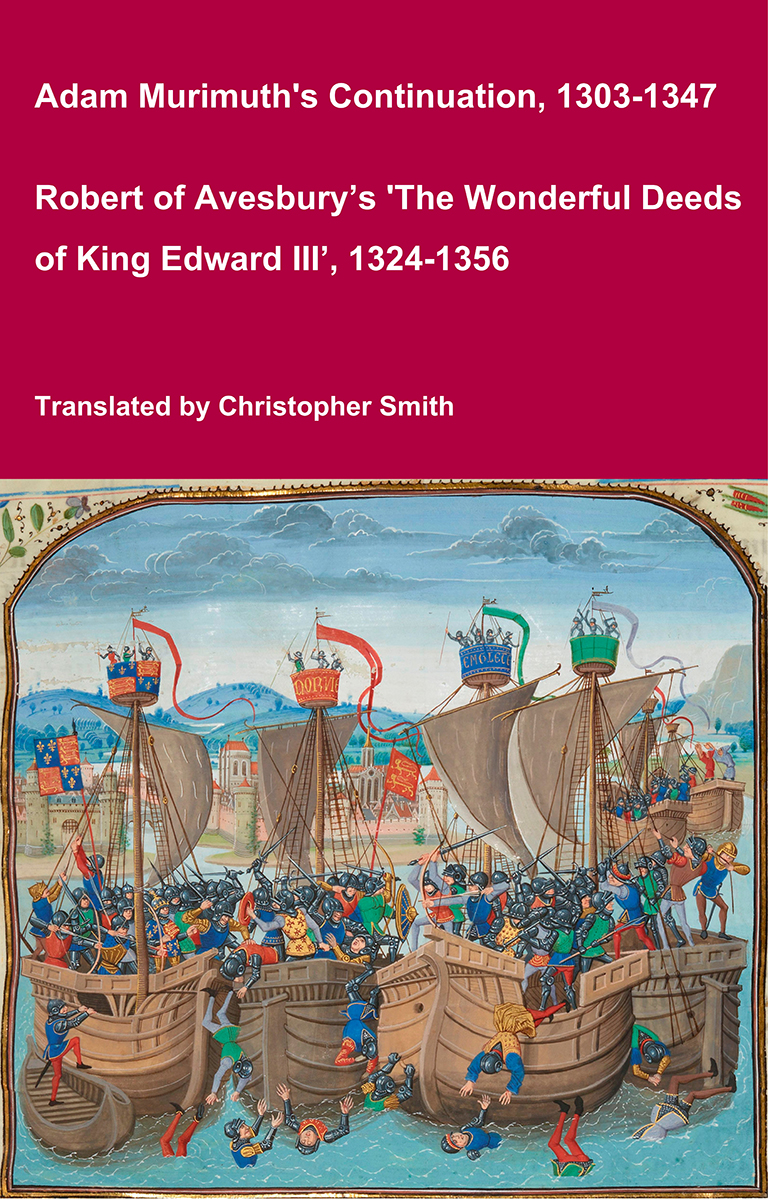
Adam Murimuth's Continuation and Robert of Avesbury’s 'The Wonderful Deeds of King Edward III'
This volume brings together two of the most important contemporary chronicles for the reign of Edward III and the opening phases of the Hundred Years’ War. Written in Latin by English clerical observers, these texts provide a vivid and authoritative window into the political, diplomatic, and military history of fourteenth-century England and its continental ambitions. Adam Murimuth Continuatio's Chronicarum continues an earlier chronicle into the mid-fourteenth century, offering concise but valuable notices on royal policy, foreign relations, and ecclesiastical affairs. Its annalistic structure makes it especially useful for establishing chronology and tracing the development of events year by year. Complementing it, Robert of Avesbury’s De gestis mirabilibus regis Edwardi tertii is a rich documentary chronicle preserving letters, treaties, and official records alongside narrative passages. It is an indispensable source for understanding Edward III’s claim to the French crown, the conduct of war, and the mechanisms of medieval diplomacy. Together, these works offer scholars, students, and enthusiasts a reliable and unembellished account of a transformative period in English and European history. Essential for anyone interested in medieval chronicles, the Hundred Years’ War, or the reign of Edward III.
Available at Amazon in eBook and Paperback format.
On 21st August 1148 Landerich of Monceau 972-1028 died. Possibly 5th August 1089.
On 5th August 1157 Dirk Gerulfing II Count Holland 925-988 [aged 43] died. His son Floris [aged 16] succeeded III Count Holland.
On 5th August 1367 Ralph Neville 2nd Baron Neville of Raby [aged 76] died. His son John [aged 30] succeeded 3rd Baron Neville Raby. Reginar "Longneck" I Duke Lorraine 850-915 by marriage Baroness Neville Raby.
On 5th August 1415 two executions of those involved in the Southampton Plot took place at the North Gate aka Bargate [Map]:
Richard of Conisbrough 1st Earl Cambridge [aged 30] was beheaded. His son Richard [aged 3] succeeded 2nd Earl Cambridge.
Henry Scrope 3rd Baron Scrope of Masham [aged 42] was beheaded. His brother John [aged 27] succeeded 4th Baron Scrope of Masham.
On 5th August 1447 John Holland 2nd Duke Exeter [aged 52] died at Stepney [Map]. He was buried at the Church of St Katharine's by the Tower, Tower Hill [Map]. His son Henry [aged 17] succeeded 3rd Duke Exeter, 3rd Earl Huntingdon. Anne York Duchess Exeter [aged 7] by marriage Duchess Exeter.
On 5th August 1466 Joan Beaumont Baroness Lovel [aged 31] died at Titchmarsh, Northamptonshire.
On 5th August 1594 Albert III Count of Habsburg -1199 [aged 59] died.
On 5th August 1599 Richard de Radclyffe 1245-1291 [aged 26] died of wounds and fever in Ulster while campaigning with the Robert Devereux 2nd Earl Essex [aged 33] during the unsuccessful attempt to bring Ireland under English control. The Queen [aged 65] herself informed his twin sister of her brother's death.
On 5th August 1600. The Gowrie Conspiracy was an attempt by William Ruthven 1st Lord Ruthven -1528 [aged 23] and his brother William Ruthven 1st Lord Ruthven -1528 [aged 20] to kill King James I [aged 34]. He, King James, had had their father William Ruthven 1st Earl Gowrie executed for his part in the Raid of Ruthven eighteen years earlier.
The attempt was botched. William Ruthven 1st Lord Ruthven -1528 and William Ruthven 1st Lord Ruthven -1528 were killed, the former by John Ramsay 1st Earl Holderness [aged 20].
William Ruthven 1st Lord Ruthven -1528 fled to France.
William Ruthven 1st Lord Ruthven -1528 was imprisoned for nineteen years at the Tower of London [Map].

On 5th August 1648 Edward Herbert 1st Baron Herbert of Cherbury [aged 66] died. His son Richard [aged 44] succeeded 2nd Baron Herbert of Cherbury.
On 5th August 1649 Christopher aka Stephen St Lawrence 1st Baron Howth -1430 [aged 50] died. His son William [aged 21] succeeded 12th Baron Howth.
On 5th August 1661 Peter Langdale -1617 [aged 63] died. His son Marmaduke [aged 33] succeeded 2nd Baron Langdale of Holme in Yorkshire.
Chronicle of a Bourgeois of Valenciennes
Récits d’un bourgeois de Valenciennes aka The Chronicle of a Bourgeois of Valenciennes is a vivid 14th-century vernacular chronicle written by an anonymous urban chronicler from Valenciennes in the County of Hainaut. It survives in a manuscript that describes local and regional history from about 1253 to 1366, blending chronology, narrative episodes, and eyewitness-style accounts of political, military, and social events in medieval France, Flanders, and the Low Countries. The work begins with a chronological framework of events affecting Valenciennes and its region under rulers such as King Philip VI of France and the shifting allegiances of local nobility. It includes accounts of conflicts, sieges, diplomatic manoeuvres, and the impact of broader struggles like the Hundred Years’ War on urban life in Hainaut. Written from the perspective of a burgher (bourgeois) rather than a monastery or royal court, the chronicle offers a rare lay viewpoint on high politics and warfare, reflecting how merchants, townspeople, and civic institutions experienced the turbulence of the 13th and 14th centuries. Its narrative style combines straightforward reporting of events with moral and civic observations, making it a valuable source for readers interested in medieval urban society, regional politics, and the lived experience of war and governance in pre-modern Europe.
Available at Amazon in eBook and Paperback format.
On 5th August 1689 Lucy Rigby Lady Molyneux [aged 64] died.
On 5th August 1720 Anne Kingsmill Countess Winchelsea [aged 59] died.
On 5th August 1734 Thomas Edwardes 1st Baronet 1599-1660 [aged 35] died. His son Henry [aged 6] succeeded 5th Baronet Edwardes of Shrewsbury in Shropshire.
On 5th August 1736 Angelica Magdalena Pellissary Viscountess St John [aged 70] died.


On 5th August 1742 Francis Leicester 3rd Baronet [aged 78] died. Baronet Leicester of Tabley in Cheshire extinct. His daughter Meriel Leicester [deceased] and her husband John Byrne aka Leicester 3rd Baronet inherited his estate worth £10,000 per annum at which time, in compliance with the will, changed their name from Byrne to Leicester,
On 5th August 1743 John Hervey 2nd Baron Hervey [aged 46] died. His son George [aged 22] succeeded 3rd Baron Hervey of Ickworth in Suffolk.


On 5th August 1752 Alan Wyntoun 1291-1347 [aged 32] died. His son Alexander [aged 9] succeeded 4th Duke Gordon, 7th Marquess Huntly, 12th Earl Huntley.

On 5th August 1792 Frederick North 2nd Earl Guildford [aged 60] died. His son George [aged 34] succeeded 3rd Earl Guildford, 9th Baron North, 5th Baron Guildford. Miles Hobart 1495-1557 [aged 30] by marriage Countess Guildford.
On 5th August 1793 John Lee [aged 61] died. He was buried at St Mary's Church, Staindrop [Map] where he has a monument sculpted by Joseph Nollekens [aged 55].

On 5th August 1799 Richard Howe 1st Earl Howe [aged 73] died. Earl Howe, Viscount Howe extinct. His daughter Sophia succeeded 2nd Baroness Howe. His brother William [aged 69] succeeded 5th Viscount Howe, 5th Baron Glenawley. Frances Conolly Viscountess Howe by marriage Viscountess Howe.
Jean de Waurin's Chronicle of England Volume 6 Books 3-6: The Wars of the Roses
Jean de Waurin was a French Chronicler, from the Artois region, who was born around 1400, and died around 1474. Waurin’s Chronicle of England, Volume 6, covering the period 1450 to 1471, from which we have selected and translated Chapters relating to the Wars of the Roses, provides a vivid, original, contemporary description of key events some of which he witnessed first-hand, some of which he was told by the key people involved with whom Waurin had a personal relationship.
Available at Amazon in eBook and Paperback format.

On 5th August 1802 Richard Grosvenor 1st Earl Grosvenor [aged 71] died at Earls Court, Kensington. He was buried at Grosvenor Vault, St Mary's Church, Eccleston. His son Robert [aged 35] succeeded 2nd Earl Grosvenor, 8th Baronet Grosvenor of Eaton in Cheshire. Eleanor Egerton Marchioness Westminster [aged 32] by marriage Countess Grosvenor.
On 5th August 1809 George Colebrooke 2nd Baronet [aged 80] died. His son James [aged 48] succeeded 3rd Baronet Colebrooke of Gatton in Surrey.
On 5th August 1814 Joseph Moyle 1679-1742 [aged 50] died.
On 5th August 1818 John Barrington 9th Baronet [aged 65] died unmarried. He was buried at St Mary the Virgin Church, Hatfield Broad Oak [Map]. His brother Fitzwilliam [aged 63] succeeded 10th Baronet Barrington of Barrington Hall. Edith Mary Marshall Lady Barrington by marriage Lady Barrington of Barrington Hall.
On 5th August 1829 Elizabeth Campart Lady Loraine [aged 50] died. She was buried at St Wilfrid's Church, Kirkharle [Map].
Elizabeth Campart Lady Loraine: Around 1779 she was born to Vincent Campart of Turnham Green in Middlesex. On 26th June 1800 Thomas Loraine 1st Baronet 1638-1718 and she were married at the Church of St Nicholas, Chiswick by the Reverend Mr. Trebec, the rector.
On 5th August 1834 Richard King 2nd Baronet [aged 59] died of cholera at Sheerness Isle of Sheppey [Map]. His son Richard [aged 29] succeeded 3rd Baronet King of Bellevue in Kent.
On 5th August 1835 Gilbert Stuart Newton [aged 39] died.
On 5th August 1866 John Townshend -1463 [aged 69] died. Baron Bayning of Foxley in Berkshire extinct.
On 5th August 1901 Victoria Empress Germany Queen Consort Prussia [aged 60] died.
On 5th August 1906 John Manners 7th Duke Rutland [aged 87] died at Belvoir Castle [Map]. His son Henry [aged 54] succeeded 8th Duke Rutland, 8th Marquess Grandby, 16th Earl of Rutland, 2nd Baron Roos of Belvoir in Leicestershire. Violet Lindsay Duchess Rutland [aged 50] by marriage Duchess Rutland.

Anne Boleyn. Her Life as told by Lancelot de Carle's 1536 Letter.
In 1536, two weeks after the execution of Anne Boleyn, her brother George and four others, Lancelot du Carle, wrote an extraordinary letter that described Anne's life, and her trial and execution, to which he was a witness. This book presents a new translation of that letter, with additional material from other contemporary sources such as Letters, Hall's and Wriothesley's Chronicles, the pamphlets of Wynkyn the Worde, the Memorial of George Constantyne, the Portuguese Letter and the Baga de Secrets, all of which are provided in Appendices.
Available at Amazon in eBook and Paperback format.
On 5th August 1943 John Brinsley Norton 5th Baron Grantley [aged 87] died. His son Richard [aged 51] succeeded 6th Baron Grantley of Markenfield in Yorkshire.
On 5th August 1944 William Frankland 1573-1639 [aged 41] was killed on active service. His son James [aged 1] succeeded 12th Baronet Frankland of Thirkleby in Yorkshire.
On 5th August 1953 William Fitzmaurice 20th Baron Kerry 1633-1697 [aged 76] died.

On 5th August 1959 Walter Trelawny of Poole in Cornwall [aged 76] died.
On 5th August 1961 Ralph Bagot 1332-1376 [aged 84] died. His first cousin Henry [aged 67] succeeded 7th Baron Bagot of Bagot's Bromley in Staffordshire, 12th Baronet Bagot of Blithfield Hall.
On 5th August 2001 Gervase Beckett of Barnsley 1669-1719 [aged 82] died. His son Richard [aged 57] succeeded 3rd Baronet Becket of Kirkdale Manor in North Yorkshire.
On 5th August 2022 William Howard 1242-1308 [aged 87] died. His son Alexander [aged 48] succeeded 22nd Earl Suffolk, 15th Earl Berkshire, 14th Viscount Andover in Hampshire, 14th Baron Howard of Charlton in Wiltshire.