

24 Jun is in June.
1295 Edward I Creates New Barons 36th Parliament
1312 Capture, Trial and Execution of Piers Gaveston
1468 Marriage of Charles the Bold and Margaret of York
1509 Marriage and Coronation of Henry VIII and Catherine of Aragon
 Memoires Jacques du Clercq. At that time also, around the feast of Saint John the Baptist [24th June], in the city of Paris, Jean, bishop of Meaux, a monk who had been abbot of Saint-Omer and was a native of the region around Aire in Artois, died.
En ce temps aussy, environ la St Jehan Baptiste, en la ville de Paris, mourut Jehan, evesque de Meaux, moine, et avoit esté abbé de St Omer, et estoit natif d'entour Aire en Artois.
Anglo-Saxon Chronicle. 803. This year died Hibbald, Bishop of Holy-island, on the twenty-fourth of June, and Egbert was consecrated in his stead, on the thirteenth of June following. Archbishop Ethelherd also died in Kent, and Wulfred was chosen archbishop in his stead. Abbot Forthred, in the course of the same year, departed this life.
Chronicon ex Chronicis by Florence and John of Worcester. 24th June 1069. Two of Harold's sons came again from Ireland, with sixty-four ships, and landing about the Nativity of St. John the Baptist [24th June] at the mouth of the river Tivy, fought a severe battle with Brian [aged 29], count of Brittany; after which they returned to the place whence they came.
Chronicon ex Chronicis by Florence and John of Worcester. 24th June 1070. The feast of St. John the Baptist being near, earl Asbiorn sailed to Denmark with the fleet which had wintered in the Humber; but his brother Sweyn [aged 51] outlawed him, because he had accepted money from king William [aged 42], to the great regret of the Danes. Edric, surnamed the Forester, a man of the most resolute courage, of whom we have spoken before, was reconciled with king William. After this, the king summoned from Normandy Lanfranc [aged 65], abbot of Caen, a Lombard by birth, a man of unbounded learning, master of the liberal arts, and of both sacred and secular literature, and of the greatest prudence in counsel and the administration of worldly affairs; and on the day of the Assumption of St. Mary, appointed him archbishop of Canterbury, causing him to be consecrated at Canterbury on the feast of St. John the Baptist, being Sunday. He was consecrated by Giso, bishop of Wells, and Walter, bishop of Hereford, who were both ordained at Rome by pope Nicholas, when Aldred, archbishop of York, received the pallium,—for he evaded being ordained by Stigand, who then held the archbishopric of Canterbury, knowing him not to have received the pallium canonically. Bishop Heriman, who had already transferred the seat of his bishopric from Sherbourne to Salisbury, also assisted at his consecration, with some others. Afterwards, Lanfranc consecrated Thomas, archbishop of York. The suit of the reverend Wulfstan [aged 62], bishop of Worcester, was again prosecuted, there being now a bishop who could advocate the cause of the church of York; and the affair was, by the aid of God's grace, decided at a council held at a place called Pedred, before the king, archbishop Lanfranc, and the bishops, abbots, earls, and lords of all England. All the groundless assertions by which Thomas and his abettors strove to humble the church of Worcester, and reduce her to subjection and servitude to the church of York, were, by God's just judgement, entirely refuted and negatived by written documents, so that Wulfstan not only recovered the possessions he claimed, but, by God's goodness, and the king's assent, regained for his see all the immunities and privileges freely granted to it by its first founders, the holy king Ethered, Oshere, sub-king of the Hwiccas, and the other kings of Mercia, Cenred, Ethelbald, Offa, Kenulf, Edward the Elder, Athelstan, Edmund, Edred, and Edgar.
Chronicon ex Chronicis by Florence and John of Worcester. 24th June 1138. The Bishops arrested. Then the king, when the Nativity of St. John [24th June] was near, proceeded to Oxford, and hearing that the castle of Devizes [Map] was fortified against him, sent messengers to Roger, bishop of Salisbury, the founder of the castle, who was then at Malmesbury, commanding him to come and confer with him. It is said that the bishop undertook this journey with great reluctance, believing that he should never return; taking with him his two nephews, the bishops of Lincoln and Ely, and a large retinue of mounted and well-armed soldiers. Seeing this, the king, suspecting treason, ordered his followers to arm themselves and be ready to defend him, if need should arise. While the king was engaged with the bishops in treating of various affairs, a furious quarrel arose between the two parties of soldiers respecting their quarters; and the king's troops flying to arms, the bishops' men took to flight, leaving all their baggage behind. Roger, bishop of Salisbury, with the bishop of Lincoln and his son Roger, surnamed The Poor, were taken; the bishop of Ely made his escape, and having reached the castle of Devizes, fortified it and held it against the king. The king, much incensed, went in pursuit of him, placing the bishops he had arrested in custody; Roger in the crib of an ox-house, and the other in a mean hut, while he threatened to hang the third, unless the castle was speedily surrendered to him. Roger finding this, and alarmed for his son, bound himself by an oath that he would neither eat nor drink until the king had possession of the castle; which oath he kept, and neither ate nor drank for three days.1
Note 1. Cf. the account of the circumstances attending the seizure of the bishops and their castles, in Henry of Huntingdon s History, p. 271, Antiq. Lib.; Gesta Stephani, ibid, 370, &c.; and William of Malmesbury, ibid, 507.
 Annals of Six Kings of England by Nicholas Trivet. The citizens of London, broken by the misfortune of the king's fall, received the empress favourably on the eleventh day before the Kalends of May [21st April 1141], after she had committed the king to custody at Bristol; and she was proclaimed lady by almost the whole people of the English, except the men of Kent. But fortune, angered by feminine pride, turned the wavering minds of the nobles and the hearts of the citizens, still only weakly attached to her, so that from friends they suddenly became enemies. Therefore on the day of the Nativity of the Lord's Forerunner1 [24th June 1141] the empress was driven from London when the Tower was besieged. Geoffrey de Mandeville, however, defended the Tower vigorously and, making a sortie, captured Robert, bishop of the city, a supporter of the opposing side, at his manor of Fulham.
Cives Londonii, regii casus infelicitate fracti, imperatricem, quæ regem apud Bristoliam custodiæ mancipaverat, favorabiliter susciperunt undecimo kal. Maii, quæ et ab omni pæne gente Anglorum, Cantianis exceptis, est domina proclamata. Sed irritata fortuna fastu femineo, pendulos optimatum animos, et corda civium tenero adhuc affectu hærentia, pervertit, ut de amicis subito converterentur in hostes. Igitur in die nativitatis Præcursoris Domini, obsessa turri, fugatur imperatrix de Londonio. Turrim tamen Galfridus de Magnavilla potenter defendit, et egressu facto Robertum civitatis episcopum, partis adversæ fautorem, cepit apud manerium suum de Fulham.
Note 1. The Lord's Forerunner being John the Baptist. The Feast of the Nativity of John the Baptist is 24th June.
On 24th June 1144 García "Restorer" IV King Navarre [aged 32] and Urraca La Asturiana Queen Consort Navarre were married. She by marriage Queen Consort Navarre.
Annals of Six Kings of England by Nicholas Trivet. Thierry, count of Flanders, setting out on a journey to Jerusalem with his wife, left his son Philip, together with the whole land, in the care of Henry, king of England. Around the feast of Saint John the Baptist [24th June 1157], the king, having prepared an expedition, suppressed the uprising of the rebellious Welsh; and he strengthened two castles on the borders of Wales, Rhuddlan and Basingwerk, and between them built a house for the Knights of the Temple. In the month of September a son was born to the king, whom he named Richard. In this same year Thomas became the king's chancellor in London. The Saracens, entering Spain, captured the city of Almería after putting to flight King Alfonso V, who soon afterward died from the shame and grief of his flight. In the same year, when the truce between Baldwin, king of Jerusalem, and the king of Aleppo had been broken because of plunder which King Baldwin had rashly taken from the Saracens, the city of Abilene, formerly called Caesarea Philippi, was besieged and was captured and completely destroyed by the Saracens, except for its principal fortress. King Baldwin, surrounded by ambush, scarcely escaped, and a very great slaughter was inflicted upon the Christians.
Terricus, comes Flandriæ, cum uxore sua, iter Ierosolymitanum arripiens, Philippum filium suum, cum tota terra, in manu regis Anglorum Henrici dimisit. Circa festum sancti Joannis Baptistæ, rex præparata expeditione Wallensium insurgentium tumultum compressit; firmavitque in finibus Walliæ duo castra, Rovelenc et Basyngwerc, et inter illa construxit Templi militibus domum unam. Mense Septembri natus est regi filius, quem Ricardum vocavit. Hoc anno Thomas, Londonii, cancellarius regis efficitur. Saraceni, Hispaniam ingressi, ceperunt Almariam civitatem, fugato rege Alphonso quinto, qui cito post obiit ex fugæ suæ verecundia et dolore. Eodem anno ruptis induciis, quæ erant inter Baldewinum regem Jerusalem et regem Halapiæ, propter prædam quam rex Baldewinus a Saracenis ceperat inconsulte, obsessa est civitas Abilina, quæ olim dicta fuit Cæsarea Philippi, et a Saracenis capta et destructa totaliter, præter ejus munitionem principalem. Rex Baldewinus, insidiis circumventus, vix evasit; illataque est strages maxima Christianis.
 Chronicum Anglicanum by Ralph Coggeshall. On the Nativity of Blessed John [24th June 1194] there appeared in the sky two great circles, differing from one another in position, colour, and size. For the smaller circle, reddish and somewhat dim, surrounded the very sun at equal distances on every side; beneath this circle and around the sun there were seen clouds, darkish and smoky in appearance, yet they did not at all cover the brightness of the sun. But another very great circle, white and shining, without any dimness or redness, encompassed half of the aforesaid circle and half of the sun, stretching in a wide arc toward England. In this white circle, near the point where it joined the smaller circle, there appeared a certain form like a rainbow, of the length and breadth of a human body; and this fateful portent lasted from the third hour until the sixth, drawing the gaze of many eyes to itself, not without wonder. Many thought these circles portended famine and storms, which afterwards followed from the unsteadiness of the air.
In Nativitate beati Johannis apparuerunt in aere duo magni circuli, loco, colore, et magnitudine a se invicem distantes. Nam minor circulus subrubeus et subobscurus ipsum solem æquis spatiis undique ambiebat; nubes vero subobscuræ et quasi fumosæ infra circulum et circa solem visebantur, sed solis fulgorem minime operiebant. Alius autem circulus permaximus erat, candidus et præfulgidus, nulla obscuritate vel rubedine suffusus, qui medietatem prædicti circuli atque solis medietatem complectens, versus Angliam se latissimo circuitu extendebat. In circulo autem candido juxta minoris circuli conjunctionem apparuit quædam species iridis ad longitudinem et latitudinem humani corporis; quod fatale prodigium ab hora tertia usque ad horam sextam perdurans, plurimorum oculos non sine admiratione ad se intuendum alliciebat. Hos autem circulos famem, tempestates, quæ ex aeris inæqualitate subsecutæ sunt, plurimi portendere arbitrabantur.
The Deeds of the Dukes of Normandy
The Gesta Normannorum Ducum [The Deeds of the Dukes of Normandy] is a landmark medieval chronicle tracing the rise and fall of the Norman dynasty from its early roots through the pivotal events surrounding the Norman Conquest of England. Originally penned in Latin by the monk William of Jumièges shortly before 1060 and later expanded at the behest of William the Conqueror, the work chronicles the deeds, politics, battles, and leadership of the Norman dukes, especially William’s own claim to the English throne. The narrative combines earlier historical sources with firsthand information and oral testimony to present an authoritative account of Normandy’s transformation from a Viking settlement into one of medieval Europe’s most powerful realms. William’s history emphasizes the legitimacy, military prowess, and governance of the Norman line, framing their expansion, including the conquest of England, as both divinely sanctioned and noble in purpose. Later chroniclers such as Orderic Vitalis and Robert of Torigni continued the history, extending the coverage into the 12th century, providing broader context on ducal rule and its impact. Today this classic work remains a foundational source for understanding Norman identity, medieval statesmanship, and the historical forces that reshaped England and Western Europe between 800AD and 1100AD.
Available at Amazon in eBook and Paperback format.
Chronicum Anglicanum by Ralph Coggeshall. On the night of St John the Baptist [24th June 1205], dreadful thunders were heard through the whole night, and terrifying flashes of lightning, issuing incessantly from the clouds, were seen throughout all England. A certain monster, struck by lightning, was found in Kent near Maidstone, where the most fearful crash had sounded. This monster appeared to have the head of an ass, the belly of a man, and other portentous limbs very unlike those of any single creature. To its blackened body, scorched by the lightning, scarcely anyone could draw near because of the intolerable stench.
In nocte Sancti Johannis-Baptistæ, audita sunt per totam noctem horrenda tonitrua, et fulgura terrifica, ex nubibus indesinenter prodeuntia, per totam Angliam visa sunt. Quoddam monstrum fulmine percussum in Cantia, juxta Meidenestan, ubi maxime horrendus fragor insonuerat, repertum est, quod caput asininum, ventrem humanum, et cætera portentuosa membra ab uno animalis genere valde dissimilia habere videbatur; ad quod nigerrimum cadaver, fulmine exustulatum, vix aliquis propter intolerabilem foetorem propius acceder valebat.
On 24th June 1242 Beatrice Plantagenet was born to King Henry III of England [aged 34] and Eleanor of Provence Queen Consort England [aged 19] at Bordeaux [Map]. She married 22nd January 1260 her half second cousin twice removed John II Duke Brittany, son of John "The Red" Capet I Duke Brittany and Blanche "Navarre" Blois Duchess Brittany, and had issue.
On 24th June 1268 King Edward I of England [aged 29] took the cross at Northampton [Map], along with his brother Edmund "Crouchback" Plantagenet 1st Earl of Leicester 1st Earl Lancaster [aged 23] and cousin Henry "Almain" Cornwall [aged 32], from Papal Legate Ottobuono Fieschi [aged 58].
On 24th June 1291 Eleanor of Provence Queen Consort England [aged 68] died at Amesbury Abbey, Wiltshire [Map] where she was subsequently buried. Her heart was buried at Christ Church, Greyfriars [Map].
Annals of Six Kings of England by Nicholas Trivet. In the same year, about the feast of Saint John the Baptist [24th June 1291], Eleanor [aged 68], the king’s mother, died at Amesbury, on account of which the king returned from Scotland to England, in order to commit his mother’s funeral to burial with due honour. Her body, therefore, was buried in the monastery of Amesbury, but her heart in London, in the church of the Friars Minor.
Eodem anno, circa festum beati Joannis Baptistæ, Alienora mater regis Ambresburiæ est defuncta; propter quod rex de Scotia in Angliam rediit, ut funus maternum sepulturæ traderet debito cum honore. Sepultum itaque est corpus ejus in monasterio Ambresburiæ, cor vero Londoniis in ecclesia fratrum Minorum.
 Chronicle of Walter of Guisborough. Nicholas, bishop, servant of the servants of God, to his venerable brothers, the Bishops of Winchester and Lincoln, greeting and apostolic blessing. Not without much matter of joy, not without great cause of exultation in the Lord, do we turn over within the secret places of our mind and publish to others, that He, the King in whose hand are the hearts of kings, has graciously touched the heart of our most dear son in Christ, the illustrious Edward, King of England, and has so enkindled in him the desire personally to aid the innumerable needs of the Holy Land, that he has taken upon himself, as a most Catholic prince and a most valiant prince, to prosecute in his own person and with royal power the business of that land, being about to cross the sea, with God's favour, on the feast of the Nativity of Saint John the Baptist [24th June] in the year of our Lord 1293, which date, for him and for other crusaders already signed with the cross and for those yet to be signed for the general passage, we, with the counsel of our brethren, have determined to set. And because for such a hard and weighty undertaking of so burdensome a business, there is no doubt that many things are required and that great subsidy is needed, therefore we, with the counsel of our brethren, have granted to the aforesaid king a tithe of all ecclesiastical revenues, incomes, and emoluments of the said kingdom of England, according to their true valuation, for six years, beginning from the feast of the Nativity of Saint John the Baptist next to come, etc." Accordingly, a new taxation was made that same year by the aforesaid bishops of Winchester and Lincoln. And although to those same bishops it had been enjoined by the pope that the said tithe should remain stored in the monasteries until the said king should have entered upon the sea in his journey toward the East, and only then should be paid to him, nevertheless the same king, by his own act, exacted from the collectors the tithe of three years, already gathered in the monasteries, and this violently and by force. Yet he did not set out, nor did he keep the promises he had made.
Nicolaus episcopus, servus servorum Dei, venerabilibus fratribus Wyntoniensi et Lincolniensi episcopis, salutem et apostolicam benedictionem. Non absque lætitiæ multæ materia, non absque causa grandis exultationis in Domino, intra mentis secreta revolvimus et aliis publicamus quod ille Rex in cujus manu regum corda consistunt, carissimi in Christo filii nostri, Edwardi regis Angliæ illustris, benigne cor tetigit, et sic ad subveniendum personaliter innumeris necessitatibus Terræ Sanctæ ipsius accendit affectum, quod ejusdem terræ negotium in propria persona et regali potentia prosequendum, tanquam princeps catholicus tanquam princeps strenuissimus assumpsit, transfretaturus, Deo auspice, in festo Nativitatis Sancti Johannis Baptistæ anno Domini MCCXCIII quod tam sibi quam aliis crucesignatis et crucesignandis ad generale passagium, de fratrum nostrorum consilio terminum duximus præfigendum. Et quia ad profectionem tam arduam onerosi negotii non est dubium quin oportet multa requiri et magnæ subventionis indigere, ideo decimam omnium ecclesiasticorum reddituum, proventuum, et obventionum dicti regni Angliæ juxta veram eorum æstimationem præfato regi, de ipsorum fratrum consilio, concessimus per sex annos a festo Nativitatis Sancti Johannis Baptistæ venturos proxime subsequenti, etc. Facta fuit igitur taxatio nova per supradictos episcopos Wyntoniæ et Lincolniæ eodem anno, et licet eisdem episcopis per papam esset injunctum quod eadem decima in monasteriis recondita maneret quousque idem rex in suo itinere versus Orientem mare magnum esset ingressus, et tunc primo solveretur ei, idem applies the tamen rex ex proprio facto decimam trium annorum in monasteriis collectam ab ipsis collectoribus exegit et violenter quidem et potenter; nec tamen profectus est, nec promissa tenuit.
On 24th June 1293 Joan "Lame" Burgundy Queen Consort France was born to Robert II Duke Burgundy [aged 45] and Agnes Capet Duchess Burgundy [aged 33]. She a great x 3 granddaughter of King Henry "Curtmantle" II of England. She married her first cousin once removed King Philip "Fortunate" VI of France, son of Charles Valois I Count Valois and Margaret Capet Countess Valois, and had issue.
On 24th June 1295 King Edward I of England [aged 56] created new baronies through writs for summons to his 36th Parliament
John Montfort 1st Baron Montfort [aged 31] was created 1st Baron Montfort. Alice Plaunche Baroness Montfort by marriage Baroness Montfort.
Walter Fauconberg 1st Baron Fauconberg [aged 75] was created 1st Baron Fauconberg.
Thomas Furnival 1st Baron Furnivall [aged 35] was created 1st Baron Furnivall. Joan Despencer Baroness Furnivall [aged 37] by marriage Baroness Furnivall.
Robert Fitzwalter 1st Baron Fitzwalter [aged 48] was created 1st Baron Fitzwalter. Eleanor Ferrers Baroness Fitzwalter by marriage Baroness Fitzwalter.
Ralph Basset 1st Baron Basset Drayton [aged 31] was created 1st Baron Basset Drayton. Hawise Grey Baroness Basset Drayton [aged 40] by marriage Baroness Basset Drayton.
The following Baronies may have been created at the 36th Parliament or the 37th Parliament summoned on 30th September 1295.
John Wake 1st Baron Wake of Liddell [aged 27] was created 1st Baron Wake of Liddell.
Andrew Astley 1st Baron Astley [aged 49] was created 1st Baron Astley.
Thomas Berkeley 6th and 1st Baron Berkeley [aged 49] was created 1st Baron Berkeley. Joan Ferrers Baroness Berkeley by marriage Baroness Berkeley.
Reginald Grey 1st Baron Grey of Wilton [aged 55] was created 1st Baron Grey of Wilton. Maud Fitzhugh Baroness Grey Wilton [aged 73] by marriage Baroness Grey of Wilton.
John Hastings 13th Baron Abergavenny 1st Baron Hastings [aged 33] was created 1st Baron Hastings by a summons to Parliament. Isabel Valence Baroness Bergavenny Baroness Hastings by marriage Baroness Hastings.
Ralph Neville 1st Baron Neville of Raby [aged 32] was created 1st Baron Neville Raby. Euphemia Clavering Baroness Neville Raby [aged 28] by marriage Baroness Neville Raby.
John Beke 1st Baron Beke [aged 72] was created 1st Baron Beke (although there is some doubt whether he was created Baron).
Fulk Fitzwarin 1st Baron Fitzwarin [aged 43] was created 1st Baron Fitzwarin.
Chronicle of Walter of Guisborough. A few days later, the king proceeded to Roxburgh Castle, which had long been held by the Seneshal of Scotland. Upon the king's arrival, it was immediately surrendered, with the lives, limbs, lands, and possessions of the garrison spared. There, 15,000 Welshmen came to the king, and he immediately sent back to England an equal number of fatigued English troops. After securing the castle, he moved with his entire army to the Castle of the Maidens, which is called Edinburgh in English. He besieged it for eight days and attacked it vigorously using large wooden siege engines, which he had brought in abundance. The defenders surrendered, and their lives were spared. The king then marched to Stirling, and found the castle empty, with no one offering resistance, for the garrison had fled in fear at his approach. At Stirling, the Earl of Ulster came to the king with 400 horsemen and 30,000 Irish foot soldiers. The king then moved on to the town called St. John's Town [Perth], where on the Feast of the Nativity of St. John the Baptist [24th June 1296], he created new knights and celebrated with great solemnity, remaining there for several days. Then messengers came to him on behalf of the King of Scots, requesting peace in his name, though he had recently spurned it. They pleaded that the king should not act according to what was deserved, but according to his merciful clemency, and grant peace. Our king, not weighing their offenses, but acting mercifully, graciously replied that within fifteen days, the King of Scotland himself, along with his nobles, should come to the Castle of Brechin, to discuss the terms of peace with his envoys. When the King of Scots arrived there, along with both John Comyns (of Badenoch and Buchan) and the other nobles of the realm, our king sent the Bishop of Durham, Antony Bek, with full counsel and full powers to negotiate the matter and bring it to a proper conclusion. After many negotiations and long discussions, no other form of peace could be agreed upon except that the King of Scotland resign his kingdom, and the Great Seal of Scotland be broken, and that he and all his nobles surrender unconditionally to the will of the King of England, with no conditions attached. And so they did. The King of Scots gave himself over to the will of the English king, and delivered his son Edward as a hostage, and renounced the Kingdom of Scotland by a written document in the following terms.
Post dies aliquot processit rex ad castrum de Rokesburgh, quod diu tenuerat senescallus Scotiæ, et statim illud reddidit in adventu regis, salvis vita et membris, terris et catallis; ibique venerunt ad regem XV millia Wallensium, et confestim in Angliam remisit quasi eundem numerum ex Anglicis fatigatis, stabilitoque castro, profectus est cum exercitu toto ad castrum Puellarum, quod Anglice dicitur Edensburgh, obseditque illud per VIII dies, et fortiter expugnavit ligneis machinis quas copiosas et maximas ibidem attulerat, dederuntque se castrenses et eisdem vita data est. Divertitque rex usque Strivelyn, et invenit castrum vacuum et neminem ei resistentem, fugerant enim custodes a facie ejus timore perterriti, ibique venit ad regem comes de Huluester cum quadringentis equestribus et triginta peditum millibus Hibernicorum; et profectus est rex usque villam sic dictam villa Sancti Johannis, ubi in nativitate beati Johannis Baptistæ fecit novos milites et solemnitatem magnam, mansitque ibidem diebus aliquot, et venerunt ad eum nuncii ex parte regis Scotorum postulantes pacem ex nomine ejus quam nuper exhorruerat, adjicientes ut non faceret ei secundum merita, sed secundum suam misericordiam benignam sibi pacem concederet. Rex vero noster, delicta non ponderans sed misericorditer agens, clementer respondit, quod infra XV dies veniret ipse rex Scotia cum optimatibus suis ad castrum de Brighyn, de ipsa pacis forma tractaturi cum suis nunciis quos missurus erat. Cumque venissent ibi rex, scilicet Scotia, et uterque Johannes Comyn, de Badenach scilicet et de Bughan, cæterique magnates ejusdem regni, misitque ibidem rex noster Antonium Dunolmensem episcopum cum consilio pleno et plena potestate tractandi negotium et debito fine claudendi, et per varios tractatus et multa colloquia non fuit alia pacis forma nisi ab ipso rege resignato regno, et fracto communi sigillo, ipseque rex et cæteri sui optimates voluntati regis Angliæ se darent et redderent, condiand resigns tione nulla apposita. Feceruntque sic, et dederunt se voluntati regis Angliæ, et tradidit ipse rex filium suum Edwardum in obsidem, et regno Scotia renunciavit per scriptum in hæc verba conceptum.
Note 1. Seneshal ska Steward. In Scotland the Stewards became the Stewart dynasty when King Robert II acceded to the throne, being the son of Walter Stewart and Majorie, daughter of King Robert the Bruce.
 Bourgeois de Valenciennes. When the fair King Philip of France learned that Robert of Béthune and his men had entered Lille as a garrison, he immediately had his host strike camp and move down toward Lille. He laid siege to the city of Lille with the great multitude of people he had brought with him. And the siege was begun on the night of Saint John the Baptist [24th June], in the year of grace 1297, and the king sat before it for the space of eleven weeks. He greatly devastated the surrounding countryside and the abbeys, to great damage; and the king’s engines and the engines of the Count of Hainaut were often and repeatedly hurled into the city, and those of the city returned fire against them.
Quant le beau roy Philippe de France sceult que Robert de Béthune et ses gens estoient venus en garnison dedens Lille, il fit tantost son ost deslogier et avaller vers Lille. Sy assiéga la ville de Lille à tout grant peuple qu'il avoit amené. Et fut mis le siége la nuit Saint-Jehan-Baptiste l'an de grâce mil IIc IIIIxx et XVII, lequel roy y sist l’espasse de XI sepmaines. Sy exilla moult le pays environ et les abayes, dont ce fut grant domage, et jettoient les engiens du roy et les engiens du conte de Haynau souvent et menu dedens la ville.
Chronicle of Walter of Guisborough. In the year of our Lord 1301, when the truce made between the king and the Scots at the feast of Pentecost had expired, the king gathered an army and, about the feast of Saint John the Baptist [24th June 1301], set out for Scotland. He wintered there and held his Christmas at Linlithgow, but his men lost many horses because of a lack of fodder and the cold of winter. The king of France then sent envoys and letters on behalf of the Scots, requesting that, at his urging, a truce be arranged, at least until the feast of All Saints. And because the king had only recently married his sister to him, he did not wish to refuse, but granted the request. Custodians were appointed on the border, and he returned to London, where he held parliament in mid-Lent.
Anno Domini MCCCI finitis treugis in festo Pentecostes inter regem et Scotos initis, congregavit rex exercitum, et circa festum beati Johannis Baptistæ in Scotiam profectus est, hiemavitque ibidem, et Natale suum tenuit apud Linlyscoth, perdideruntque sui equos multos propter defectum foragii et frigoris hiemalis. Misitque rex Franciæ nuncios et literas pro Scotis, ut ad rogatum ipsius inirentur treugæ, saltem usque ad festum Omnium Sanctorum. Et quia rex sororem suam de novo duxerat, noluit ei contradicere, sed rogata concessit, appositisque custodibus in confinio, reversus est Londoniis, et at London. parliamentum ibidem tenuit in medio Quadragesimæ.

The True Chronicles of Jean le Bel Volume 1 Chapters 1-60 1307-1342
The True Chronicles of Jean le Bel offer one of the most vivid and immediate accounts of 14th-century Europe, written by a knight who lived through the events he describes, and experienced some of them first hand. Covering the early decades of the Hundred Years’ War, this remarkable chronicle follows the campaigns of Edward III of England, the politics of France and the Low Countries, and the shifting alliances that shaped medieval warfare. Unlike later historians, Jean le Bel writes with a strong sense of eyewitness authenticity, drawing on personal experience and the testimony of fellow soldiers. His narrative captures not only battles and sieges, but also the realities of military life, diplomacy, and the ideals of chivalry that governed noble society. A key source for Jean Froissart, Le Bel’s chronicle stands on its own as a compelling and insightful work, at once historical record and literary achievement. This translation builds on the 1905 edition published in French by Jules Viard, adding extensive translations from other sources Rymer's Fœdera, the Chronicles of Adam Murimuth, William Nangis, Walter of Guisborough, a Bourgeois of Valenciennes, Geoffrey le Baker of Swinbroke and Richard Lescot to enrich the original text and Viard's notes.
Available at Amazon in eBook and Paperback format.
Chronicle of Walter of Guisborough. In the year of Our Lord 1304, the king levied from his cities and boroughs a sixth penny, according to the valuation of their goods. That same year, the king of France sent word to our king, saying that at his (our king's) request and urging, he had driven the Scots out of his land; and he earnestly asked that our king should likewise deal with his own enemies, the Flemings. And the king did as he had requested, proclaiming them outlaws on the [24th June 1304], but, it is believed, only in appearance, for they soon returned.
Anno Domini MCCCIV exegit rex a civitatibus suis et burgis sextum denarium, secundum taxationem bonorum suorum. Eodem anno misit rex Franciæ ad regem nostrum, dicens se ad ipsius instantiam et rogatum Scotos ejecisse de terra sua, et rogans cum instantia ut consimiliter faceret cum hostibus suis Flandrensibus. Fecitque rex quod rogaverat, et forbannivit eos in festo Sancti Johannis Baptistæ, sed sub colore, ut creditur, quia cito reversi sunt.
Chronicle of Walter of Guisborough. In the year of our Lord 1308, on the fifteenth day after Easter [28th April 1308], the king held his parliament in London, and there was great contention between the king and his earls on account of Lord Piers, so that the earls won the better part, saying that Piers was excommunicated and perjured; and a day was set for him to cross over into the land of his birth, on the morrow of the Feast of Saint John the Baptist [24th June 1308].
Anno Domini MCCCVIII in quindena Pascha tenuit rex parliamentum suum Londoniis, et magna fuit altercatio inter regem et comites suos pro domino Petro, ita quod obtinuerunt comites meliorem partem, dicentes ipsum Petrum esse excommunicatum et perjurum: et assignatus est dies transfretandi in terram nativitatis suæ, in crastino Sancti Johannis Baptistæ.
On 24th June 13101 Philippa of Hainaut Queen Consort England was born to William of Avesnes I Count Hainaut III Count Avesnes III Count Holland II Count Zeeland [aged 24] and Joan Valois Countess Zeeland Holland Avesnes and Hainaut [aged 16].
Note 1. The date from the Register of Walter Stapledon who in 1319 writes: "And the young lady will be of the age of nine years at the Feast of the Nativity of Saint John [24th June] next to come". She married 24th January 1328 her second cousin King Edward III of England, son of King Edward II of England and Isabella of France Queen Consort England, and had issue.
 Adam Murimuth Continuation. In this year, around the feast of Saint John the Baptist [24th June 1312], the king wished that Piers de Gaveston should be brought to him by Lord Aymer de Valence, earl of Pembroke, for his safety. When they were at Deddington near Banbury, the earl left him there during the night and went nearby to another place for some business. At dawn the next day Guy, earl of Warwick, arrived with a moderate retinue and with a hue and cry. He roused the said Piers and carried him off to his castle of Warwick. Afterwards, having taken counsel with the leading men of the realm, and especially with Thomas, earl of Lancaster, he at last released him from prison to go wherever he wished. And when he left the town of Warwick and reached a place called, as if prophetically, Gaveston, he found many people raising a hue and cry against him with shouts and horns, as against an enemy of the king and of the realm who had been lawfully outlawed or exiled. At length, on the nineteenth day of the month of June [1312], they beheaded him as such. His head was carried by a certain friar of the Order of Preachers in his hood; and afterwards friars of the same order sought out his body and kept it at Oxford with solemn vigils for a year and more. Finally he was buried at Langley, where the king established a solemn convent of the Friars Preachers for the good of his soul, placing there a large number of student friars and providing them with suitable maintenance from his treasury in London.
Hoc anno, circa festum sancti Johannis baptiste, voluit rex Petrum de Gaverstone sibi adduci per dominum Adomarum de Valence, comitem Penbrokim, securitatis causa; et, cum essent apud Danyntone juxta Bannebury, idem comes dimisit eum in nocte, et ivit prope ad unum locum ex causa Et in crastino in aurora venit Guido, comes Warewykiæ, cum comitiva mediocri et hutesio, et ipsum Petrum evigilavit et ad castrum suum de Warewyk secum duxit; et, habita postmodum deliberatione cum majoribus regni, et t.. precipue cum Thoma comite Lancastriæ, finaliter dimisit eum de carcere, ire quo vellet. Et, quando exivit villam de Warewyk usque ad locum qui dicitur, quasi prophetice, Gaveressich invenit ibi multos homines facientes hutesium super eum vocibus et cornibus, sicut super inimicum regis et regni legitime utlagatum sive exulatum; et finaliter ipsum, sicut talem, XIX die mensis Junii decapitaverunt. Cujus caput quidam frater Predicatorum portavit in capucio suo, et post corpus fratres ejusdem ordinis quæsiverunt et apud Oxoniam cum solempnibus vigiliis per annum et amplius tenuerunt Sed finaliter sepultus fuit apud Langeley, ubi idem rex solempnem conventum Predicatorum pro anima ipsius statuit; ibi magnum numerum fratrum studentium constituens, eis de rario suo Londoniis congruam exhibuit sustentationem.
On 24th June 1314 the Scottish army of King Robert the Bruce I of Scotland [aged 39] including, James "Black" Douglas [aged 28], heavily defeated the English army led by King Edward II of England [aged 30] at the Battle of Bannockburn.
Gilbert de Clare 8th Earl Gloucester 7th Earl Hertford [aged 23] was killed. Earl Gloucester, Earl Hertford extinct.
John Comyn 4th Lord Baddenoch [aged 20], Robert Felton 1st Baron Felton [aged 44] and William Vesci were killed.
William Marshal 1st Baron Marshal [aged 36] was killed. His son John [aged 22] succeeded 2nd Baron Marshal.
Robert Clifford 1st Baron Clifford [aged 40] was killed. His son Roger [aged 14] succeeded 2nd Baron de Clifford.
John Lovell 2nd Baron Lovel [aged 25] was killed. His son John succeeded 3rd Baron Lovel of Titchmarsh.
Henry Bohun was killed by King Robert the Bruce I of Scotland. He was buried in Llanthony Secunda Priory, Gloucestershire [Map].
Walter Fauconberg 2nd Baron Fauconberg [aged 50] possilby died although his death is also reported as being on 31 Dec 1318.
Bartholomew Badlesmere 1st Baron Badlesmere [aged 38], Humphrey Bohun 4th Earl Hereford 3rd Earl Essex [aged 38], Goronwy ap Tudur Hen Tudor, Henry Beaumont Earl Buchan [aged 35], Aymer de Valence 2nd Earl Pembroke [aged 39] and Robert Umfraville 8th Earl Angus [aged 37] fought.
Pain Tiptoft 1st Baron Tibetot [aged 34] was killed. His son John succeeded 2nd Baron Tibetot.
John Montfort 2nd Baron Montfort [aged 23] was killed. Peter Montfort 3rd Baron Montfort [aged 23] succeeded 3rd Baron Montfort.
Thomas Grey [aged 34] undertook a suicidal charge that contributed to the English defeat and subsequently blemished his career.
William Latimer 2nd Baron Latimer of Corby [aged 38] was captured.
Michael Poynings [aged 44] was killed.
 Chronicle of Geoffrey le Baker of Swinbroke. On the following day [24th June 1314], the Scots, having secured a battlefield location most advantageous to the victors, dug trenches three feet deep and of the same width,1 extending lengthwise from the right to the left wing of the army. They covered them with fragile interwoven branches and wicker hurdles, what they called herdeles, layered with turf and grass on top. These pits were passable for infantry who were aware of the ruse, but they were incapable of bearing the weight of charging cavalry.
In crastino Scoti, campi locum nacti victoribus maxime oportunum, subfodiebant ad mensuram trium pedum in profundum et ad eiusdem mensure latitudinem fossas protensas in longum a dextro in sinistrum cornu exercitus, operientes illas cum plexis fragilibus ex virgulis et viminibus sive cratibus, id est 'herdeles,' cespite et herbis superstratis, peditibus quidem perviis saltim consciis cautele, set equitum pondera non valentibus sufferre.
Note 1. In crastino Scoti, etc. Harbour's Brits (Spalding Club), 262, describes the stratagem of the pitfalls in the following lines:
And in ane plane feld by the way,
Quhar he thocht ned behufit a way
The Inglishmen, gif that tha wald
Throu the Park to the castell hald,
He gert men mony pottis ma
Of ane fut bred round, and all tha
War dep up till ane manis kne,
Sa thik that tha micht liknit be
Till ane wax-cayme that beis mais.
Thus all that nicht travaland he was
Sa that or day was he had mad
Tha pottis, and tham helit had
With stikis and with gyrs [foliage] all grene
Sa that tha micht nocht wele be sene.
....
The king, quhen that the mes was done,
Went furth to see the pottis sone,
And at his liking saw tham mad:
On athir sid the way wele brad
It was pottit as I haf tald.
Gif that thar fais on hors will hald
Furth in that way, I trow tha sail
Nocht wele eschap [escape] forouten [without] fall.
The account of the battle as given in the Chronicle of Lanercost 225.
The chronicler seems to know nothing of the artificial pits. According to his account, the English fell into the channel of the burn, Chronicle of Lanercost 226.
So also the writer of the Vita Edward II, 205.
The Brute chronicle (Harl. MS. 2279) has an interesting note of a popular song commemorating the victory: "And when kyng Edward herde this tithing, he lete assemble his hoste, and mette the Scottis atte Est Revelyn, in the day of the Nativite of seint John the Baptist, in the yeer of his regne the VII, and in the yeer of oure Lorde Jesu Criste MCCCXIIIJ. Alias the sorowe and lost that ther was done! For ther was slayn the noble erle Gilbert of Clare, sir Robert of Clifford, baron, and many other; and of other peple that no man couth nombre. And the kyng Edward was scomfitede. and sire Edmunde of Maule, the kyng stiward, for drede wente and drenchid him selfe in a fressh ryver that is callede Bannokesburne. Wherfore the Scottis seide in reprofe and dispite of kyng Edward, for as moche that he lovede for to gone by water and also for he was descomfitede atte Bannokesbourne, therfore maydenes maden a songe therof, in that cuntre, of kyng Edward of Engelonde, and in this maner songe:
"Maydenes of Engelonde, sare may ye mourne,
For tynte ye have youre lemmans atte Bannokisbourne.
With hevalowe.
What! wende the kyng of Engelonde
[To] have gete Scotlande?
With rumbelowe."'
Adam Murimuth Continuation. In this year of our Lord 1314, though the reckoning had changed, on the feast of the Nativity of Saint John the Baptist [24th June], a great battle was fought near Stirling between the king of England with his army and the Scots. In it the earl of Gloucester, Gilbert [aged 23], was killed, and many others on the king's side; the earl of Hereford [aged 38] was captured, along with many other nobles; and the king of England and others scarcely escaped.
Hoc anno Domini MCCCXIIII, mutato tamen, in festo Nativitatis sancti Johannis baptistæ, fuit magnum prœlium prope Strivelyn inter regem Anglie et exercitum suum et Scotos; in quo fuit occisus comes Gloucestriæ, Gilbertus, et multi alii de parte regis, et comes Herefordiæ captus, et multi alii nobiles, et rex Angliæ et ali vix evaserunt.
Lanercost Chronicle. [24th June 1314] Now they had arranged their army in such a way that two divisions marched ahead of the third, one to the side of the other, so that neither preceded the other; and the third followed behind, in which was Robert. When at last both armies engaged each other, and the great English warhorses charged into the Scottish spears—as into a thick forest—a great and terrible noise arose from the breaking of lances and the mortal wounding of chargers. Thus they stood, at peace for a moment. But the English reinforcements could not reach the Scots because the first division (of English troops) stood in the way, nor could they assist in any way, and so there remained no option but to plan for retreat. I heard this account from a trustworthy man, who was present and saw it. In that first English division were slain: the Earl of Gloucester, Sir Robert de Clifford, Sir John Comyn, Sir Payn Tiptoft, Sir Edmund de Mauley, and many other nobles—apart from the foot soldiers, who fell in great numbers.
Ordinaverant autem sic exercitum suum, quod duæ acies ejus præirent tertiam, una ex latere alterius, ita quod neutra aliam præcederet; et tertia sequeretur, in qua erat Robertus. Quando vero ambo exercitus se mutuo conjunxerunt, et magni equi Anglorum irruerunt in lanceas Scottorum, sicut in unam densam silvam, factus est sonus maximus et horribilis ex lanceis fractis et ex dextrariis vulneratis ad mortem, et sic steterunt in pace ad tempus. Anglici, autem, sequentes non potuerunt assingere ad Scottos, propter primam aciem interpositam, nec in aliquo se juvare, et ideo nihil restabat nisi ordinare de fuga. Istum processum audivi a quodam fidedigno, qui fuit præfens et vidit. In illa autem prima acie interfecti sunt comes Glovernie, dominus Robertus de Clifforde, dominus Johannes de Comyn, dominus Paganus de Typetot, dominus Edmundus de Mauley, et multi alii nobiles, exceptis peditibus, qui in magno numero corruerunt.
The Bruce 1306. [24th June 1314] Lines 4.39-58:
| The Queyn, and als dame Marjory, | The Queen [aged 30]1, and also Lady Marjory [aged 18], |
| Hyr dochtyr that syne worthily | Her daughter who later worthily |
| Wes coupillyt in-to Goddis band | Was joined into God's bond |
| With Walter, Stewart off Scotland; | With Walter [aged 18], Stewart of Scotland; |
| That wald on na wys langar ly | Who would not in any way longer stay |
| In the castell off Kyldromy, | In the castle of Kildrummy, |
| To byd a sege, ar ridin raith | To await a siege, but riding quickly |
| With knychtis and with squyeris bath, | With knights and with squires both, |
| Throw Ros, rycht to the gyrth off Tayne. | Through Ross, right to the girth of Tayne2. |
| Bot that travaill thai maid in vayne; | But their efforts were in vain; |
| For thai off Ros, that wald nocht ber | For the men of Ross3, who would not bear |
| For thaim na blayme, na yheit danger, | Any blame or even danger for them, |
| Owt off the gyrth thame all has tayne; | Out of the girth, they all have been taken; |
| And syne has send thaim evirilkane | And then they have sent them all |
| Rycht in-till Ingland, to the King, | Right into England, to the King, |
| That gert draw all the men, and hing; | Who ordered all the men to be drawn and hanged; |
| And put the ladyis in presoune, | And put the ladies in prison4, |
| Sum in-till castell, sum in dongeoun. | Some in a castle, some in a dungeon. |
| It wes gret pite for till heir | It was a great pity to hear |
| Folk till be troublyt on this maneir. | People being troubled in this manner. |
Note 1. dame Marjory. Bruce's daughter by his first wife, Isabel, daughter of Donald Earl of Mar. She afterwards married Walter, the High Steward (see Bk. XIII. 689).
Note 2. the gyrth of Tayne. The enclosure or "sanctuary" attached to the chapel of St. Duthac, at Tain, Ross-shire, a favourite place of pilgrimage with the Scottish kings, especially James IV. There was, however, no privilege of sanctuary for treason. William Earl of Ross was in the English interest, and on May 20, 1308, is the recipient of thanks from Edward II. "for faithful service to his father and himself" (Bain, iii., No. 43). Hemingburgh says "the new Queen" was taken in Kildrummy (ii. 249); Gray that Cristina Bruce was captured there, and the Queen and Nigel Bruce in Dunaverty (Scala., p. 131); Trivet agrees with the second statement, but obviously confuses (p. 410); according to Fordun the Queen was taken at Tain, and many ladies at "Kyndrumy" (Gesta Ann., cxx.).
Note 3. thai of Ros. Fordun says the Queen was seized at St. Duthac's by the Earl of Ross (Gesta Ann., cxx.).
Note 4. put the ladyis in presoune. On November 7, 1306, there are "further orders for the custody of the Countesses of Carrick (the Queen) and Buchan, Marie, and Christine, the sisters, and Margerie the daughter, of Robert de Bruce ... three of the ladies to be in 'kages.'" (Bain, ii., No. 1851). The Countess of Buchan, who had crowned Bruce, was to be placed in a cage of wooden bars and lattice in one of the turrets of Berwick Castle (Palgrave, p. 358; Scala., p. 131); Marie Bruce in a "kage" in Roxburgh (Palgrave, 359); Marjory in a "kage" in the Tower of London (359); Cristina [aged 41] in ward in England (Palgrave, 359). The Queen was to be in custody at "Brustewik" (Palgrave p. 357); was removed thence by an order of June 22, 1308 (Bain, iii., No. 48). Marjory was in ward at Wattone in March, 1307 (Bain, ii., 1910). By 1311-1312 Maria de Brus is a prisoner in Newcastle (Bain, iii., 227, 340).
On 24th June 1316 Philip Capet was born to Philip V King France I King Navarre [aged 23] and Joan of Burgundy Queen Consort France [aged 24]. Coefficient of inbreeding 2.35%. He died aged less than one years old.
Adam Murimuth Continuation. In this year, on the feast of Saint John the Baptist [24th June 1327], James [Berkeley], bishop of Exeter, died at Petershegs in his diocese. Although John of Godeleye, dean of Wells, was afterwards unanimously elected, the pope provided the church of Exeter with Lord John of Grandison [aged 35], who was consecrated at the papal court on the feast of Saint Luke [18th October] in the year of our Lord 1327.
Isto anno, in festo sancti Johannis baptistæ, est Jacobus episcopus Exoniensis mortuus apud Petreshegkes in sua diœcesi. Et licet Johannes de Godeleye, decanus Wellensis, concorditer postmodum fuisset electus, tamen providit ecclesiæ Exoniensi papa de domino Johanne de Grandissono, qui in festo sancti Lucæ, anno Domini MCCCXVII, fuit in curia consecratus.
Chronicle of Geoffrey le Baker of Swinbroke. In the year of our Lord 1333, in the sixth year of the king's reign, the Scottish war,1 begun the previous year, continued. Many English nobles and seasoned warriors, invited to take up service under Lord Edward Balliol and his allies, set out for Scotland around the feast of the Nativity of Saint John the Baptist [24th June]. In addition to these, many others eager for glory joined them at their own expense, and together they laid siege to the town and castle of Berwick. But the King of England, considering the many insults inflicted on him and his ancestors by the Scots, and recognizing the just cause of Lord Edward Balliol, King of Scots by conquest, as well as the fact that the agreement made between him and the Scots had been initiated through treachery while he was still a minor under the guardianship of his mother, who was wholly governed by the counsel of Roger de Mortimer, his traitor, decided to act. Now grown to manhood and, as the Apostle says, having 'put away childish things,' he gathered a host of armed men. Not in defence of his own claim, nor seeking exaction of tribute, but rather to promote and support the rightful claim of his friend Edward, King of Scots by conquest, he boldly attacked Berwick shortly before the feast of Saint Margaret [20th July]. The besieged, meanwhile, engaged in numerous deceitful negotiations2 with the King of England and the King of Scots by conquest, in order to delay assaults upon them and to wait for promised external aid, which did arrive, but to no avail.
Anno Domini MCCCXXXIJ, regis anno VJ, continuata guerra Scotica, anno proximo incoata, multi nobiles Anglici et viri bellicosi ad stipendia domini Edwardi Baylol et suorum complicium invitati, circa festum Nativitatis sancti Iohannis Baptiste Scociam profecti, et preter eos multi laudis avidi sumptibus propriis et eiis associat, villam et castrum de Berewyk obsiderunt. Rex autem Anglie, considerans multa vituperia sibi et suis antecessoribus per Scotos illata, justam quoque causam domini Edwardi de Baylol regis Scotorum per conquestum, et quod concordia fuit inter ipsum et Scotos inita per prodicionem, ipso in minori etate notorie constituto et in custodia matris sue existente, que concilio Rogeri de Mortuo mari proditoris sui per omnia regebatur, factus autem vir, evacuans cum apostolo que parvuli erant, contra voluntatem matris sue collecta multitudine armatorum, non defensionem aut exaccionem sui iuris, set promocionem et sustentacionem iuste calumpnie sui amici Edwardi regis Scotorum pretendens, Berewicum viriliter est aggressus modicum ante festum sancte Margarete. Ubi obsessi multos cum rege Anglie et Scocie conquestore dolosos tractatus habuerunt, ut ipsos compescerent ab insultu, et auxilium ab extra promissum expectarent; quod venit, set incassum.
Note 1. Balliol was driven out by a sudden rising on the 13th December 1332. With the assistance of the English he laid siege to Berwick on the 12th March 1333. Deeds of King Edward III by Robert of Avesbury.
Note 2. The Brute chronicle (Harley MS. 2279).
William of Worcester's Chronicle of England
William of Worcester, born around 1415, and died around 1482 was secretary to John Fastolf, the renowned soldier of the Hundred Years War, during which time he collected documents, letters, and wrote a record of events. Following their return to England in 1440 William was witness to major events. Twice in his chronicle he uses the first person: 1. when writing about the murder of Thomas, 7th Baron Scales, in 1460, he writes '… and I saw him lying naked in the cemetery near the porch of the church of St. Mary Overie in Southwark …' and 2. describing King Edward IV's entry into London in 1461 he writes '… proclaimed that all the people themselves were to recognize and acknowledge Edward as king. I was present and heard this, and immediately went down with them into the city'. William’s Chronicle is rich in detail. It is the source of much information about the Wars of the Roses, including the term 'Diabolical Marriage' to describe the marriage of Queen Elizabeth Woodville’s brother John’s marriage to Katherine, Dowager Duchess of Norfolk, he aged twenty, she sixty-five or more, and the story about a paper crown being placed in mockery on the severed head of Richard, 3rd Duke of York.
Available at Amazon in eBook and Paperback format.
Adam Murimuth Continuation. Also, in this year, shortly before Easter, on the 8th of April, in the year of our Lord 1338, Stephen, Bishop of London, passed away from this life. And in the same year, around the Feast of the Invention of the Holy Cross [3rd May 1338], Richard de Bynteworth was unanimously elected as his successor. He was confirmed by the Archbishop [of Canterbury] at Otford around the Feast of the Ascension [21st May], and consecrated at Lambeth by the Bishop of Chichester around the Feast of St. John the Baptist [24th June].
Item, hoc anno, parum ante Pascha, videlicet vj. idus Aprilis, anno Domini MCCCXXXVIII, Stephanus episcopus Londoniensis ab hac luce migravit et eodem anno, circa festum Inventionis sancte Crucis, electus fuit concorditer Ricardus de Bynteworth, qui circa festum Ascensionis apud Ottefordiam fuit per archiepiscopum confirmatus, et cirea festum sancti Johannis apud Lambhuth per Cicestriensem episcopum consecratus.
Chronicle of Jean le Bel Volume 1. Thus the winter passed and the feast of Saint John [24th June] drew near. The German lords began to make their preparations to carry out their enterprise. The King of France made ready in response1, for he knew something of their intentions. The noble King Edward had all his provisions prepared in England and his men-at-arms transported overseas as soon as St. John’s Day [24th June 1339] had come. He himself went to Vilvoorde and lodged his men there; and when the town was full, he had them quartered outside in the fields, along the meadows, in tents and pavilions. There they remained from the feast of St. Mary Magdalene [22nd July] until after Our Lady’s Day [15th] in September, waiting from week to week for the arrival of the other lords and for the long delays of the Duke of Brabant.
Or passa cel yver et la feste Saint Jehan aprocha. Ces seigneurs d'Alemaigne se commencerrent à appareillier pour achever leur emprise. Le roy de France se pourvey à l'encontre, car ils sçavoit partye de leur entention. Le noble roy Edowart fist toutes ses pourveances aprester en Angleterre et ses gens d'armes passer par deça la mer, si tost que le Saint Jehan fut venue, et s'en ala luy mesmes à Vilvorde et loga luy propre ses gens; et quant la ville fut plaine, il les fit logier dehors aux champs, contreval les prez, en tentes et paveillons, et là demourerent dès la feste de la Magdalaine jusques aprez la Nostre Dame en septembre, en attendant de septmainne en septmainne la venue des aultres seigneurs et les long dangiers du duc de Brabant.
Note 1. It was at Saint-Quentin that Philip VI of France assembled his army in order to block Edward III of England. Nangis: 'In the same year [1399], around the same feast [St Michael, 29th September], the king of England gathered a great army of Englishmen, Brabanters, Germans, mercenaries, and raiders, in order to invade the kingdom of France. The king of France, wishing to oppose him, assembled a very great, strong, and powerful army at Saint-Quentin in Vermandois. But since he wished to enter the frontiers of the empire more easily, he delayed battle for some time and waited for his army, which was not yet fully assembled.' The numerous receipts preserved at the Bibliothèque Nationale relating to service performed in that army show that men were summoned from mid-July until 27th October.
1. C'est à Saint-Quentin que Philippe VI réunit son armée pour arréter Édouard III (Chronographia Regum Francorum, t. Il, p. 66; Guillaume de Nangis, éd. H. Géraud, t. II, p. 163.) Les nombreuses quittances concernant le service fait à cette armée conservées à la Bibliothèque Nationale montrent que les hommes étaient convoqués pour jusqu'au 27 octobre, depuis le milieu du mois de juillet. Voy. en particulier, Bibl. nat., Scellés de Clairambautk, vol. 8, no 139; vol. II, no 57; vol. 12, nos 28 et 29; vol. 13, nos 12 et 13 et fol. 823; vol. 16, no 55, etc.
Bourgeois de Valenciennes. About the Feast of Saint John the Baptist [24th June] in the year of grace 1339, King Edward of England departed from the town of Antwerp with all his men, all his hosts, all his allies, and all the men-at-arms he had assembled to go with him, and they rode toward Hainaut. The host was led in the vanguard by my lord John of Hainaut, the lord of Clères, the lord of Fauquemont, Henry of Flanders, and my lord Walter of Mauny, who served as scout. Walter took and captured the castle of Thuin and placed there as its keeper his brother, my lord Grignart. But the men of Cambrai later maliciously surrounded him and killed him, and took Walter of Mauny prisoner and wounded him on Saint Martin’s night. There remained in command my lord Richard of Limousin of England, castellan of Thuin, who defended it well against the French.
Environ la Saint-Jehan-Décolace l'an de grâce mil IIIc et XXXIX se party le roy Édouart d'Engleterre hors de la ville d'Anvers à tout ses gens et tous ses osts et tous ses allyés et tous les gens d'armes qu'il avoit assamblés pour aller avoec luy, et chevauchèrent par devers Haynault Et conduisoit l'ost devant monseigneur Jehan de Haynault, le sire de Clers le sire de Faucquemont, Henry de Flandres et monseigneur Gaultier de Mausny qui estoit descouvreur, lequel print et gaigna le chastel de Thuin, et y mist en garde monseigneur Gringnart sou frère que ceulx de Cambray encloyrent puis malicieusement et le tuèrent, et menèrent Gaultier de Mausny son frère en prison et le navrèrent la nuit Saint-Martin; et demoura à garde monseigneur Richart de Lymosin, d'Engleterre, chastelain de Thun, qui bien le garda contre les Franchois.
On 24th June 1340 King Edward III of England [aged 27] attacked the French fleet at anchor during the Battle of Sluys capturing more than 200 ships, killing around 18000 French. The English force included John Beauchamp 1st Baron Beauchamp Warwick [aged 24], William Bohun 1st Earl of Northampton [aged 30], Henry Scrope 1st Baron Scrope of Masham [aged 27], William Latimer 4th Baron Latimer of Corby [aged 10], John Lisle 2nd Baron Lisle [aged 22], Ralph Stafford 1st Earl Stafford [aged 38], Henry of Grosmont 1st Duke Lancaster [aged 30], Walter Manny 1st Baron Manny [aged 30], Hugh Despencer 1st Baron Despencer [aged 32] and Richard Pembridge [aged 20].
Thomas Monthermer 2nd Baron Monthermer [aged 38] died from wounds. His daughter Margaret succeeded 3rd Baroness Monthermer.
Adam Murimuth Continuation. And on the Thursday before the feast of the Nativity of Saint John the Baptist, the king had a favourable wind and began to sail successfully. On the following Friday, that is, on the vigil of Saint John [23rd June 1340], he saw the fleet of France drawn up in the port of Sluys, arranged like ranks of fortified positions. Throughout that day he deliberated what would be best to do. On the feast of Saint John the Baptist 24th June 1340, in the morning, the French fleet, dividing itself into three squadrons, advanced about a mile toward the fleet of the king of England. Perceiving this, the king of England declared that there was no longer time to wait, and he prepared himself and his men for battle. Thus, shortly after the ninth hour, having the wind and the sun at his back and the force of the tide with him, he likewise divided his fleet into three squadrons and attacked the French.
A great naval battle was then fought, because of the strength and size of the ships of Spain and France prepared for combat. Nevertheless, the English overcame the French and broke into the ships of the first division, among them a very large vessel called the Saint Denis, another called the Saint George, and others named the Christopher and the Black Cogges, which the French had earlier deceitfully seized in the port of Sluys. In this first clash were present the earls of Gloucester, Northampton, and Huntingdon, who was commander and admiral of the ships of the Cinque Ports, and Sir Robert de Morley, admiral and leader of the northern fleet from Yarmouth, Lynn, and other northern ports, along with many other nobles. When the first French division had been defeated, though with great difficulty, the English attacked the second, which they overcame more easily, for many of the enemy cast themselves into the sea; and they captured their ships, as evening approached. With nightfall, because of the darkness and extreme exhaustion, they wished to rest until morning. But the ships of the third French division attempted to flee secretly, and about thirty ships escaped. One large ship among them, called the James of Dieppe, tried in its flight to seize a ship of Sandwich belonging to the priory of Christ Church, Canterbury; but its crew defended themselves, with the aid of the earl of Huntingdon. The fighting continued until morning, that is, on the day after the feast of Saint John the Baptist; but in the end the English defeated the Normans and captured their ship, in which they found more than four hundred men slain and dead.
Et die Jovis ante festum Nativitatis sancti Johannis baptistæ habuit ventum bonum, et incepit feliciter navigare. Et die Veneris sequenti, scilicet in vigilia sancti Johannis, vidit classem navium Franciæ in portu de la Swyne paratam cet quasi castrorum acies ordinatam; et per totam illam diem deliberavit quid essect consultius faciendum. Et in festo sancti Johannis Daptistie, mane, classis Franciæ, se dividens in tres turmas, movit se per spatium unius milliaris versus classem regis Angliæ. Quod percipiens rex Angliæ dixit non esse ulterius exspectandum, sed se et suos ad arma paravit; it quod cito post horam nonam, quando habuit ventum et solem ad tergum et vim fluminis secum, divisit navigium suum similiter in tres turmas et Francis dedit insultum.
Ubi fuit magnum prœlium navale commissum, propter fortitudinem et magnitudinem navium Hispanite et Franciæ ad prœlium paratarum. Tamen Anglici Gallicos devicerunt et naves primæ cohortis intrarunt, videlicet unam maximaun navem vocatam Sanctus Dionisius et aliam vocatam Sanetus Georgius et alias naves, videlicet Christofre, et Blakekoges, quas Gallici primitus, ut supra seriptum est, in portu de Swyne dolose ceperunt. Et in isto primo conflictu fuerunt comites Gloucestriæ, Northamptoniæ, e Huntyngdoniæ, qui fuit dux et admirallus navium de Quinque Portubus, et dominus Robertus de Morley, qui fuit admirallus et dux navium borealium, scilicet de Yarnemouth, Lynne, et ceterarum navium borealium, et multi alii nobiles. Victa igitur prima cohorte Gallicorum, licet cum magna difficultate, dederunt insultum secundæ, quam facilius devicerunt, quia multi se gratis submerserunt; et naves eorum ceperunt, quasi in crepusculo noctis Adveniente nocte, tam propter obscuritatem quam propter nimiam fatigationem, quiescere voluerunt usque mane. Sed naves tertiæ cohortis Gallicorum latenter fugere voluerunt; et fugerunt circa XXX naves. Sed una magna navis illarum,quæ vocabatur James de Depe, voluit fugiendo cepisse quandam navem de Sandewyco, quæ fuit prioris ecclesiæ Christi Cantuariæ; sed ipsi se defenderunt, cum adjutorio comitis Huntyngdoniæ. Et duravit conflictus usque mane, scilicet in crastino sancti Johannis baptistæ, sed finaliter Anglici vicerunt Normannos et navem illorum ceperunt, in qua quadringentos homines et ultra interfectos et mortuos invenerunt.
Chronicle of Geoffrey le Baker of Swinbroke. On the feast of Saint John the Baptist1 [24th June 1340], very early in the morning, the French fleet divided itself into three squadrons, moved about a mile toward the king's fleet. Upon seeing this, King Edward declared that it was no longer the time to wait, and he and his men hastened to arm themselves and were quickly ready. After the ninth hour, when he had the wind, the sun, and the river's current at his back, he launched an attack on the enemy, dividing his own forces into three squadrons. A terrible cry rose to the heavens over the wooden horses, as Merlin's prophecy foretold. A rain of iron bolts from crossbows and arrows from longbows slaughtered thousands of men; they fought hand-to-hand with lances, axes, and swords, those who dared or were able. Stones hurled from the masts of ships cracked open many skulls. In sum, a great and terrible naval battle was fought without pretence, the kind that a madman2 would not have dared to witness even from afar.
In festo vero sancti Iohannis valde mane classis Francorum se dividens in tres turmas movit se per spacium unius miliaris versus classem regis; quod percipiens rex Anglie dixit non esse ulterius expectandum, se et suis ad arma currentibus et cito paratis. Post horam nonam, quando habuit ventum et solem a tergo et impetum fluminis secum, divise in tres turmas, hostibus dedit optatum insultum. Horridus clamor ad ethera conscendit super equos ligneos, iuxta Merlini propheciam; ferreus imber quarellorum de balistis atque sagittarum de arcubus in necem milia populi detraxit; hastis, securibus et gladiis pugnabant cominus, qui voluerunt aut fuerunt ausi; lapides a turribus malorum proiecti multos excerebrarunt; in summa committitur sine ficticio ingens et terribile et navale bellum, quale vecors vidisse a longe non fuisset ausus.
Note 1. Details, more or less full, of the battle of Sluys are to be found in Edward's own letters, in Guisborough, Nangis, Murimuth, Avesbury, Knighton, Minot, Le Bel, and Froissart and, later, in Walsingham:
Chronicle of Walter of Guisborough.
Among modern writers, sir N. Harris Nicolas, A History of the Royal Navy, 2.51, has given the most exact account. He has embodied all the information to be gathered from contemporary writers known to him, but, having found that which is given here in Baker's text and in Murimuth (whose chronicle was not then fully in print) only as quoted by Stow and other later historians, he excluded it from his narrative and placed it in a foot-note (p. 56) as being of an 'apocryphal character.' Murimuth and Baker are the authorities for the statement that the French fleet sailed out the space of a mile to meet the English; and the movement is also, though more obscurely, described by Knighton ('divertit se de portu de Swyne' i.e. 'he turned away from the port of Zwin'). The English fleet had lain the previous night off Blanckenberghe, some ten miles westward of the haven of Sluys. Edward would have therefore approached the enemy from nearly due west. But, before engaging, he executed a manoeuvre which is thus described by Froissart 114.
That is to say, the wind blowing probably from the north or north-east, the English fleet went about and stood away to the north-west, thus getting the advantage of the wind for the attack. (The manoeuvre, as appears both from Froissart and Avesbury, was mistaken by the enemy for a retreat.) But the object of the movement was, further, to get the advantage of the sun and also of the tide. Baker's words (following Murimuth) are "After the ninth hour, when he had the wind, the sun, and the river's current at his back." Edward himself also, in his letter to his son describing the battle (Nicolas, 2.501 Edward's letter Attacking in the afternoon from a position north-west of the enemy, Edward would bear down upon them with the tide running down channel, thus literally having the 'impetum fluminis,' the ebbing ocean stream, in his favour, and with the sun, not indeed actually 'a tergo' i.e. 'from behind' but, rapidly drawing away behind him.
Note 2. Froissart 115.
Chronicle of Walter of Guisborough. On that same day [24th June 1340], shortly before the hour of vespers, the ship of Lord Robert de Morley was the first of all to attack the French fleet; after that came the ship of the Earl of Huntingdon, then the Earl of Northampton, then Walter de Manny. In this way, each ship, hastening toward the enemy, had both the sun and the wind in their favour, just as they wished. And almost at the beginning of the struggle, they captured three of the largest "cogs," called Edward, Katherine, and Rose, which had once been taken from the English at sea. Once this first French naval line was subdued, those within being slain by the sword and the French king's banner trampled down, while the English king's banner was raised high on the three captured ships, the remaining ships each tried to flee. But, surrounded by the English, those inside threw down their arms and tried to escape into small boats. Before they could reach shore, however, the little vessels, overloaded, sank, sending about two thousand men into the depths. Thus, with the first three French battle-lines subdued, the fourth line, about sixty ships strong, still contained some armed men who had escaped from the captured vessels, and who were difficult to overpower. And after the middle of the night had passed, with many thousands slain, they could scarcely be subdued. In this final fight the English lost one ship and a galley from Hull, all those inside being crushed by stones. In the ship where the wardrobe of the King of England was kept, all but two men and one woman were killed; yet the ship was afterwards taken by the English. From the French side there fell, some by the sword, some who leapt into the sea, and others who, descending from their great ships into small boats, were sunk by the excessive weight, about thirty thousand men. On the English side, no nobleman was killed that day, except for Sir Thomas de Monthermer, knight. Thus, with victory granted by the Lord over the French, the King of England, coming ashore with certain others, humbly gave the highest thanks to Almighty God.
Et eodem die, parum ante horam vesperam, navis domini Roberti de Morlee navigio Gallicorum primo omnium insultum dedit, post illam navis comitis de Huntingdon, deinde comitis de Northampton, deinde Walteri de Mannay, sicque singulæ naves versus inimicos festinantes, solem et ventum secum habuerunt juxta votum. Et quasi in agonis principio tres maximos cogones quos vocabant Edwardum, Katerinam, et Rosam, olim de manibus Anglorum in mari sublatos, adepti sunt. Subjugata, que prima navali acie, qui intus erant gladio deletis et conculcato regis Franciæ vexillo, regisque Angliæ in sublimi in tribus dictis navibus elevato, reliquæ naves singulæ fugam inire temptabant; circumclusæ tamen ab Anglis, depositis armis suis, qui intus erant scaphas intrabant, sed antequam terram tangere possent naviculæ, nimis oneratæ, submersis circa duo millibus hominum profundum maris petierunt, sicque tribus gagement at aciebus subditis, in IV acie, circa LX naves habente, erant nonnulli armati a prædictis fugati navibus difficiles ad subjiciendum. Transactaque media nocte occisis multis millibus vix subjugari potuerunt. In hoc enim ultimo bello perdiderunt Anglici unam navem et galeam de Hull, cunctis qui intus erant lapidibus oppressis. Illi vero qui erant in navi, ubi garderoba regis Angliæ posita est, præter duos homines et mulierem quandam omnes occisi sunt: navis tamen postea ab Anglicis adepta est. Ceciderunt autem ex parte Gallicorum tum ferro tum ex illis qui in mari saltaverunt tum ex illis qui de magnis navibus in naviculas parvas descendentes nimio navali pondere submersi sunt circa triginta millia virorum. Ex parte vero Anglicorum nullus nobilis, præter solum dominum Thomam de Monte-Hermeri militem, interfectus fuit die illo. Collata itaque super Francigenas a Domino victoria, rex Angliæ cum quibusdam ad terram veniens, summas Altissimo gratias humiliter referebat.
Bourgeois de Valenciennes. On that same day of which mention has been made above, the king of England was at sea with all his fleet. And as he intended to come and land in Flanders, between Sluys and Blankenberge, there came against him Barbevaire, who claimed allegiance to the king of France, a robber, pirate, and sea-raider, with a great force, guarding the passage on behalf of the king of France so that the king of England might not pass. And they fell upon one another most fiercely, and there were many dead on both sides1. In the end Barbevaire was defeated and fled, and a great number of his men; and there were slain of Barbevaire’s company well twenty-five thousand and more, besides those of the English party. And this was on the night of Saint John the Baptist [24th June] in the year 1340.
En ce jour mesmes, dont dessus est dit, le roy d'Engleterre estoit en mer à toute sa navie. Et ainsy qu'il euidoit venir et ariver en Flandres, entre l'Escluse et le BlancheBerge, il leur vint au-devant Barbevaire, qui se disoit au roy de France, ung robeur, piratte et escumeur de raer, à tout grans gens, et gardoit le passage de par le roy de France que le roy d'Engleterre ne passast; et coururent sus l'un à l'autre moult mervilleusement, et y eult moult de mors d'un costé et d'aultre, et enfin fut Barbevaire desconfit, et s'enfuy et grant plenté de ses gens, et y eult Barbevaire mors de ses gens bien XXV mille et plus, sans ceulx de la partye des Englecqs, et fut la nuit Saint- Jehan-Baptiste l'an mil CCC et XL.
Note 1. Chronicle of Geoffrey le Baker of Swinbroke: "On the feast of Saint John the Baptist, very early in the morning, the French fleet divided itself into three squadrons, moved about a mile toward the king's fleet. Upon seeing this, King Edward declared that it was no longer the time to wait, and he and his men hastened to arm themselves and were quickly ready. After the ninth hour, when he had the wind, the sun, and the river's current at his back, he launched an attack on the enemy, dividing his own forces into three squadrons. A terrible cry rose to the heavens over the wooden horses, as Merlin's prophecy foretold. A rain of iron bolts from crossbows and arrows from longbows slaughtered thousands of men; they fought hand-to-hand with lances, axes, and swords, those who dared or were able. Stones hurled from the masts of ships cracked open many skulls. In sum, a great and terrible naval battle was fought without pretence, the kind that a madman would not have dared to witness even from afar.
Chronicle of Walter of Guisborough: "On that same day [24th June 1340], shortly before the hour of vespers, the ship of Lord Robert de Morley was the first of all to attack the French fleet; after that came the ship of the Earl of Huntingdon, then the Earl of Northampton, then Walter de Manny. In this way, each ship, hastening toward the enemy, had both the sun and the wind in their favour, just as they wished. And almost at the beginning of the struggle, they captured three of the largest cogs, called Edward, Katherine, and Rose, which had once been taken from the English at sea. Once this first French naval line was subdued, those within being slain by the sword and the French king's banner trampled down, while the English king's banner was raised high on the three captured ships, the remaining ships each tried to flee. But, surrounded by the English, those inside threw down their arms and tried to escape into small boats. Before they could reach shore, however, the little vessels, overloaded, sank, sending about two thousand men into the depths. Thus, with the first three French battle-lines subdued, the fourth line, about sixty ships strong, still contained some armed men who had escaped from the captured vessels, and who were difficult to overpower. And after the middle of the night had passed, with many thousands slain, they could scarcely be subdued. In this final fight the English lost one ship and a galley from Hull, all those inside being crushed by stones. In the ship where the wardrobe of the King of England was kept, all but two men and one woman were killed; yet the ship was afterwards taken by the English. From the French side there fell, some by the sword, some who leapt into the sea, and others who, descending from their great ships into small boats, were sunk by the excessive weight, about thirty thousand men. On the English side, no nobleman was killed that day, except for Sir Thomas de Monthermer, knight. Thus, with victory granted by the Lord over the French, the King of England, coming ashore with certain others, humbly gave the highest thanks to Almighty God."
Deeds of King Edward III by Robert of Avesbury. "Edward, by the grace of God king of England and France and lord of Ireland, etc. We think it fitting to make known to you, for your consideration and joy, the outpouring of divine mercy which has lately been shown toward us. You know indeed, and you and our other faithful people have in some measure felt it, by how many storms of war we have been assailed and how, as upon a great sea, we have been tossed by violent waves. Yet although the surges of the sea are mighty, more mighty is the Lord on high, who, turning the storm into a calm, has now most graciously looked upon us amid so many adversities. For when we had lately arranged our necessary passage toward the parts of Flanders, Philip of Valois, our most hostile persecutor, foreseeing this, sent to the port of Sluys a very great fleet of armed ships, which he had prepared to destroy us and our faithful followers, lying in wait to capture us or at least to hinder our passage. Had that passage been hindered, which God forbid, the important undertakings which we pursue would have fallen entirely into ruin; indeed we and our people would likely have been exposed to great danger and confusion. But God, the Father of mercies, seeing us placed in such dangers, more graciously and more swiftly than human reason could judge, sent us a great naval aid and an unexpected number of armed men, and always a favourable wind according to our desire. Thus, trusting in heavenly help and in the justice of our cause, when we came by ship to the said port we found the said fleet and our enemies there, very ready for battle in great numbers. Against them, on the feast of the Nativity of Saint John the Baptist [24th June 1340] last past, Christ our God, our hope, granted us victory in a strong and fierce conflict. A great slaughter was made among those enemies, and the whole fleet was in a manner captured, with comparatively little loss among our own people. Thus, the passage over the sea will henceforth lie more safely open to our faithful subjects, and many other advantages will likely come from this to us and to our faithful people, from which a most fair hope now arises. Contemplating so great a heavenly grace with devotion, we humbly render praise and thanks to our Saviour, praying that He who has already and always graciously assisted us in times of need may continue His help, and grant that we may so rule in this world that we may rejoice eternally in Him above. We earnestly ask your affection and beseech you by the mercy of God that, rising in the praise of devout thanksgiving to the living God who has wrought so great a sign of good with us, you will commend us, now far away and seeking not only to recover our rights but also to uphold the holy Catholic Church and to govern the people in justice, to Him through your devoted prayers. Cause masses and other works of pious devotion to be performed for us, and by wholesome exhortations encourage the clergy and people of your diocese to do the same, so that God Himself, having mercy upon us, may grant a happy progress and a gracious outcome, and give His servant an understanding heart to judge and rule rightly, and so to do what He commands that we may deserve to obtain what He promises. Witness Edward, duke of Cornwall and earl of Chester, our most dear son, guardian of England, at Waltham Holy Cross, on the twenty-eighth day of June [1340], in the fourteenth year of our reign of England and the first year of our reign of France."
"Edwardus, Dei gratia rex Angliæ et Franciæ et dominus Hiberniæ, etc. Effusam circs nos his diebus propitiationis divinæ clementiam ad vestri contemplationem et lætitiam vobis ducimus intimandam. Scitis autem immo vos et alii fideles nostri, quadam participatione sensitis, quantis fuimus et sumus guerrarum lacessiti turbinibus et velut in mari magno procellosis fluctibus agitati. Sed, licet sint mirabiles elationes maris, mirabilior tamen est in altis Dominus, qui, procellam convertens in auram, jam inter tot adversa clementissime nos respexit. Nam, cum pridem ordinassemus passagium nostrum necessarium versus partes Flandriæ, dominus Philippus de Valesio, persecutor noster infestissimus, hoc prævidens, classem maximam navium armatarum, quam in expugnationem nostram nostrorumque fidelium parari fecerat, ad insidiandum nobis, in portu de Swina transmisit, ut vel sic nos caperet vel nostrum transitam impediret. Qui transitus si, quod absit, fuisset impeditus, ardua negotia, quæ prosequimur, fuissent penitus in ruina; quin immo nos et nostri fuissemus verisimiliter periculo confusionis magnæ subjecti. Sed Deus misericordiarum, videns nos in tantis periculis constitutos, gratius et citius quam humana ratio judicare poterat, misit nobis magnum navale subsidiam et insperatum numerum armatorum, ac semper ventum prosperum juxta votum; et sic, sub spe cœlestis auxilii et justitiæ nostræ fiducia, dictum portum navigio venientes, invenimus' dictam classem et hostes mnostros ibidem paratissimos ad prœlium in multitudine copiosa. Quibus, in festo Nativitatis sancti Johannis baptistæ proximo præterito, ipse spes nostra Christus Deus per conflictum fortem et validum nos prævalere concessit, facta strage non modica dictorum hostium, capta etiam quodammodo tota dicta classe, cum læsione gentis noatræ modica respective. Sicque tutior de cetero patebit transitus nostris fidelibus supra mare, et alia bona plurima sunt ex hoc nobis et nostris fidelibus verisimiliter proventura, de quo spes palcherrima jam arridet. Nos autem, tantam cœlestem gratiam devotissime contemplantes, ipsi Salvatori nostro laudes et gratias humiliter exsolvimus, deprecantes ut, qui jam et semper in opportunitatibus copiosis gratis nos prævenit, continuatis nos auxiliis prosequatur, et nobis regere tem poraliter sic concedat in terris, ut in Eo lætemur æternaliter in excelsis. Dilectionem vestram attente rogamus et per Dei misericordiam obsecramus, quatinus soli Deo vivo, qui tantum signum nobiscum fecit in bonum, in devotæ laudis præconium assurgentes,nos, jam in remotis agentes, et nedum jura nostra recuperare sed sanctam eocle siam catholicam attollere et in justitia populum regere cupientes, Sibi devotis orationum instantiis recommendare cuaretis, facientes pro nobis missas et alia piæ placationis officia misericorditer exerceri; et ad hoc clerum et populum vestræ dioceseos salutaribus monitis inducatis, ut Deus ipse, miseratus nobis, progressum felicem et exitum annuat gratiosum, detque servo suo cor docile, ut recte judicare possimus et regere et sic facere quod præcipit, ut mereamur assequi quod promittit. Testo Edwardo, duce Cornubiæ et comite Cestriæ, filio nostro carissimo, custode Angliæ, apud Waltham Sanctæ Crucis, XXVIIJ die Junii, anno regni nostri Angliæ XIIIJ, regni vero Franciæ primo."
Chronicle of Jean le Bel Volume 1. [24th June 1340] The French had a fleet half as large again as that of the others, and they possessed the great ship called Christopher, which could destroy many smaller vessels. Indeed, it inflicted great damage upon the English, and if God had not aided them, they would have had neither the power nor the hope to withstand the French. But King Edward bore himself so valiantly and performed such feats of arms with his own body that he encouraged and gave heart to all the others. Thus, through his prowess, and that of the Earl of Derby and Sir Walter Manny, who acquitted himself most nobly, as well as many others whom I cannot name, and above all through the grace of God, the French, Normans, Gascons, Bretons, and Genoese, were in the end slain, drowned, and defeated, and few escaped. The English also suffered heavy losses, but they recaptured the fine ship called Christopher, along with a great number of other vessels. In that battle the said Sir Hugh Quieret was killed, together with many of his kin, and, as was said, fully thirty thousand men, whether slain or drowned. Of these, the sea cast a great number upon the shores of Sluys and Cadzand1, and some were found still fully armed, just as they had fought.
Les Françoys avoient de navire la moitié plus deux fois que les aultres, et sy avoient la grosse nave que on appelloit Cristofle, qui pouoit destruire moult de petites, aussy fist elle moult de dommages aux Anglois, et se Dieu ne leur eust aidié, ilz n'avoient pas pouoir n'esperance de resister aux Françoys. Maiz le roy Edowart se maintint sy vassaument, et faisoit de si grands proesses de son propre corps que il resbaudissoit el donnoil cuer à lous les aultres, siques par la proesse de luy, et du conte Derby, et de messire Walier de Manny, qui trés bien s'y porta, aussy firent pluseurs aultres que je ne sçay nommer, et par la grace de Dieu principaument, les Françoys, Normans, Gascons, Bretons, Genevoys furent au desrain mors, noyez et desconfitz, et petit en eschappa. Et les Anglois aussi perdirent grandement, maiz ilz regaignerrent la belle nave que on appelloit Cristofle avecques grand foison d'aultres vasseaulx. A celle bataille fut mort ledit messire Hue Kyrès et pluseurs de son lignage, et bien XXXM hommes, que morts que noyez, ainsy comme on disoit, desquelx la mer en jetta grand partie sur la rive de l'Escluse et de Cagant, et furent trouvez aucuns tous armez, ainsy que combastus s'estoient.
Note 1. Cadzand, an island situated between the town of Sluys and the island of Walcheren, in Zeeland.
1. Auj. Cadsand, île située entre la ville de l'Écluse et l'île de Walcheren, en Zélande.
Chronicle of Walter of Guisborough. King Edward of England, with very few ships and only a small band of armed men, prepared to cross over into Flanders. But, by God's will, being forewarned of the French fleet, which had almost covered the sea near Sluys, within about seven days, by travelling in person through various places and ports with only a very small retinue, he hastily gathered together shipping, a company of armed men, and archers as best he could. Having raised the sails1 and committed the fleet to wind and sea, he landed prosperously near Sluys, about three miles from the town which is called Ays, on Friday at noon, the vigil of St John the Baptist. The French, with 250 ships, very well supplied with armed men and crossbowmen, positioned themselves at what was almost the mouth of the river flowing from Sluys into the sea. On Saturday, the feast of St. John the Baptist [24th June 1340], at sunrise, they furled their sails, and arranged their ships in four naval lines. The ships were lashed together with great iron chains and ropes. The French also hung their small boats in the middle of the masts, loaded with stones, and erected their wooden "castles" at the tops of the masts. The King of England sent the Bishop of Lincoln to the town of Ays, instructing him to gather the Flemings and the other English who were there, so that, when the time to attack the enemy was favourable, while the king was engaging the French, they might be ready to go out to battle. His hope, however, came to nothing: for in the fighting the Flemings stood on the seashore, merely watching the outcome of the battle so that, as was said, they might join whichever side proved victorious.
Rex Angliæ Edwardus cum paucis admodum navibus, et armatorum tenui manu, ad transfretandum versus Flandriam se paravit; sed, Deo volente, de classe Gallicana quæ mare juxta Sclusam, quasi operuerat, præmonitus, infra septem fere dies per loca diversa et portus in persona propria cum paucis valde equitando, navigium, armatorum copiam, et arcitenentes, meliori modo quo potuit, festinanter congregavit. Erectis velis, navigioque vento et mari commisso, juxta Sclusam ad tria milliaria ad villam quæ Ays dicitur die Veneris in vigilia Sancti Johannis Baptistæ quasi in meridie prospere applicuit. Gallici vero cum CCL navibus, armatorum et balistariorum multitudine optime munitis, quasi in ostio fluvii de Sclusa decurrentis, ad mare se statuerunt. Die autem Sabbati in festo Sancti Johannis Baptistæ, orto vix sole, velis depositis quatuor acies navales, colligatis magnis catenis ferreis et cordis insimul navibus, Gallici statuerunt, scaphasque suas parvulas lapidibus plenas, in medio mali suspendentes, castella sua lignea in summitate mali erexerunt. Misit autem Angliæ rex ad villam de Ays episcopum Lincolniensem ut Flandrenses et cæteros Anglicos ibidem repertos, cum tempus infestandi inimicos opportunum arrideret, rege Gallicos impugnante, congregaret, ac paratos exire ad bellum faceret; spes tamen ejus evanuit. In conflictu enim stantes in ripa maris Flandrenses exitum belli, ut parti victrici favere valerent, ut dicebatur, solum expectabant.
Note 1. King Edward set sail from Orwell on the 22nd of June, 1340, 'at about the first hour of the day,' [i.e. 6am] Rot. Claus. 14 Edward III p. 1, m. 12, d.; Rymer, Fœdera, 2.1129.
The History of William Marshal was commissioned by his son shortly after William’s death in 1219 to celebrate the Marshal’s remarkable life; it is an authentic, contemporary voice. The manuscript was discovered in 1861 by French historian Paul Meyer. Meyer published the manuscript in its original Anglo-French in 1891 in two books. This book is a line by line translation of the first of Meyer’s books; lines 1-10152. Book 1 of the History begins in 1139 and ends in 1194. It describes the events of the Anarchy, the role of William’s father John, John’s marriages, William’s childhood, his role as a hostage at the siege of Newbury, his injury and imprisonment in Poitou where he met Eleanor of Aquitaine and his life as a knight errant. It continues with the accusation against him of an improper relationship with Margaret, wife of Henry the Young King, his exile, and return, the death of Henry the Young King, the rebellion of Richard, the future King Richard I, war with France, the death of King Henry II, and the capture of King Richard, and the rebellion of John, the future King John. It ends with the release of King Richard and the death of John Marshal.
Available at Amazon in eBook and Paperback format.
Deeds of King Edward III by Robert of Avesbury. When he heard this, the king at once sent for the said archbishop of Canterbury, his chancellor, and, speaking to him with gentle words, returned to him the seal of the chancellery. Immediately he caused orders to be sent to every port toward the northern and southern coasts and also to London for additional ships, so that within ten days he had obtained sufficient shipping and an unexpected number of men-at-arms and archers, even more than he wished to have, so that he sent many of them away. With this force he sailed to the said port of Sluys and arrived there on the feast of Saint John the Baptist [24th June 1340].
His auditis, dominus rex misit statim pro dicto domino Cantuariensi archiepiscopo, cancellario suo, et, blandis sermonibus sibi loquens, retradidit sibi sigillum cancellariæ. Confestimque fecit mandare ad singulos portus versus partes boreales et australes ac etiam Londonias pro majori navigio, ita quod ex tunc infra X dies sufficiens habuit navigium et insperatum numerum hominum armorum et sagittariorum, majorem etiam quam habere vellet, ita quod plures remisit; et ad dictum portum de Swyna in dicto festo sancti Johannis baptistæ navigando pervenit.
Adam Murimuth Continuation. In this year, around the feast of the Beheading of Saint John the Baptist [29th August 1340], the truce between the kings of France and England was extended until the next following feast of Saint John the Baptist [24th June 1341].
Hoc anno, circa festum Decollationis beati Johannis, fuit prorogata treuga inter reges Franciæ et Angliæ, usque ad festum sancti Johannis baptistæ proximum tunc sequens.
Deeds of King Edward III by Robert of Avesbury. "Louis, by the grace of God emperor of the Romans, ever august and illustrious, to Edward king of England, his most dear brother, greeting and the affection of sincere love. Although innumerable and great affairs rest upon our shoulders and we are continually and variously occupied with them, nevertheless when the discord between you and the illustrious Philip king of France, our most beloved kinsman, presents itself before our eyes, a discord from which, if it is not settled, very many losses of persons and goods may in the future arise to you and to your kingdom, it especially troubles and moves our mind that we should apply the effort and labour of our care to removing it. Therefore, we wish you to know that the aforesaid Philip, at our request, has granted us by his letters authority to treat concerning peace between you and him regarding the discord that has arisen between you. Believing that such an agreement would in many ways be advantageous to you and to your kingdom, after carefully weighing all the circumstances of your condition and of our alliances, we urge this upon your friendship and earnestly exhort you to give your consent to it, so that we may be able to bring you and him back to concord and establish true bonds of peace between you. To this work we are willing to devote ourselves with ready mind and diligent effort. If you are willing, as we hope, to consent to and accept our counsel, please grant us by your letters the authority mentioned above to negotiate the agreement and to arrange a truce for one or two years. Nor should the friendship that has been entered into and contracted between us and the aforesaid Philip king of France move you. For since you accepted truces and certain terms for treating of peace between you and the said Philip king of France without our knowledge, will, or consent, we, by the advice of our princes, who know our leagues, agreements, and alliances, and who judged that this could be done without harm to our honour, have concluded concord and friendship with the said king of France and entered into an alliance with him. For the same reasons we have revoked the vicariate which we had committed to you. Yet be assured that in our negotiations we will provide for you in a brotherly manner, so that if you are willing to follow our counsel your cause may, with our assistance, be brought to a favourable conclusion. In order to inform your friendship more fully of our intention in these matters, we send to your brotherhood the religious man Brother Eliarhard, lector of the Order of the Hermits of Saint Augustine and special chaplain of our court, whom we ask you to dispatch back to us promptly after hearing him on these matters. Given at Frankfurt on the twenty-fourth day of the month of June [1341], in the twenty-fourth year of our reign and the thirteenth year of our empire."
"Lodowicus, Dei gratia Romanorum imperator semper augustas præclarus, Edwardo regi Angliæ, fratri suo carissimo, salutem et sinceræ dilectionis affectam. Licet innumera grandiaque negocia nostris incumbant humeris et circa illa multipliciter et assidue distrahamur, tamen, cum discordia inter te et præclarum Philippam regem Franciæ, affinem nostram prædilectum, ex qua tibi et tuo regno quamplurima personarum et rerum dispendia, ipsa non sedata, in futuram poterunt evenire, se nostris representat optutibus, mentem nostram specialius angit et excitat, ut ad tollendum illam stadium et operam nostræ solicitudinis apponamus; propter quod scire te volumus quod præfatus Philippus, ad requisitionem nostram, dedit nobis suis literis potestatem tractandi inter te et ipsum concordiam super discordiam inter vos suscitatam, quam etiam tibi et tuo regno, pensatis diligenter omnibus conditionibus tuis et alligatoram tnoram, multipliciter expedire credentes amicitiæ tuæ persuademur, teque cam diligentia exhortamur ut ad hoc taum assensum præbeas, quod te et ipsum revocare possimus ad concordiam et inter vos vera pacis fœdera ordinare, ad quæ libenti animo vacare volumus et impendere operosa persecutione labores. In quo si consiliis nostris consentire et adquiescere volueris, ut speramus, placeat tibi nobis tuis literis dare potestatem præmissam tractandi concordiam et treugas ad annum vel biennium ordinandi. Neo te moveat amicitia inter nos et Philippum regem Francoram prædiotaum inita et contracta. Nam, ex quo tu treugas et certos terminos ad tractandum de concordia inter te et predictum Philippum regem Francorum accepisti absque nostro scitu,' voluntate, et assensu, de consilio nostrorum principum qui ligas, pacta,' et uniones nostras noverint, quibus visum fuit quod hoc, salvo honore nostro, facere possemus, concordiam et amicitiam cum dicto rege Francis contraximus et unionem inivimus, vicariatumque, tibi per nos commissum, ex causis revocavimus prænotatis, pro firmo sciturus quod in tractatibus nostris sic tibi fraterne providemus quod, si in nostris consilis adquiescere volueris, causa tua ad finem bonum, mediante nostro auxilio, perduceretur. Super quibus tuam amicitiam de nostra intentione plenius informandam, religiosum virum fratrem Eliarhardum, lectorem ordinis fratrum heremitarum sancii Augustini, specialem nostre curie capellanum, tus fraternitati transmittimus, quem petimus super premissis celeriter expeditum remitti. Dats Franchinforde, XXIIIJ die mensis Junii, regni nostri anno XXIIIJ, imperii nostri XIIIJ."
On 24th June 1343 Joan Valois Queen Consort Navarre was born to King John "The Good" II of France [aged 24] and Bonne Luxemburg Queen Consort France [aged 28]. She married 12th February 1352 her second cousin Charles "Bad" II King Navarre, son of Philip "Noble" III King Navarre and Joan Capet II Queen Navarre, and had issue.
Adam Murimuth Continuation. Around the feast of the Nativity of Saint John the Baptist [24th June 1345], Henry, earl of Derby, and the earl of Pembroke, and Ralph, lord of Stafford, Walter Manny, and John Grey of Codnor, with a great company of men-at-arms and archers, crossed the sea toward Gascony. Having arrived there successfully, by the grace of God, they drew to themselves the lord of Albret and many other lords of that land, together with an innumerable people—at least those who owed allegiance to the king of England. And, having arranged all things necessary for war, they advanced against the French with armed force. And since they spent no time there in idleness but in toil for a year and more, God granted them such success that they always prevailed in battle against their French enemies, killing many, taking very many into captivity and imprisonment, and capturing countless towns and strongholds; so that it could truly be said of them, "Their sound has gone out into all the earth," etc.
Circa festum Nativitatis beati Johannis baptistæ Henricus comes Derbyæ, et comes Penbrokiæ, eb Radulphus baro de Stafford, Walterus de Mauny, et Johannes Grey de Codenore, cum grandi comitatu armatorum et archeriorum, transfretaverunt versus Vasconiam. Quibus ibidem, mediante gratia divina, prospere applicatis, attraxerunt sibi dominum de la Brete et alios dominos illius terræ quam plures, cum cetero populo innumerabili, illos saltem qui fidem debebant regi Angliæ. Qui, dispositis universis ad guerram necessariis, procedebant contra Gallos cum vi armata. Quibus in eisdem partibus non moram sed laborem trahentibus per unum annum et amplius, talem Deus contulit expeditionem, ut contra inimicos suos Francigenas semper prævaluerunt in conflictu, multos occidendo, quam plures in captivitatem incarcerationis ducendo, oppida et villas capiendo innameras; ita quod de illis veraciter dici potuit, "In omnem terram exivit sonus eorum," etc.
On 24th June 1346 Joanne Armagnac Duchess Berry was born to John I Count Armagnac [aged 35] and Beatrice Clermont Countess Armagnac [aged 36]. She married before 1362 her third cousin John Valois 1st Duke Berry, son of King John "The Good" II of France and Bonne Luxemburg Queen Consort France, and had issue.
Deeds of King Edward III by Robert of Avesbury. During the said siege of Calais, on the day after the feast of Saint John the Baptist [24th June 1347], the earls of Northampton and Pembroke, with many men-at-arms and archers, having obtained leave to depart from the siege, sailed across the sea, which was then calm, toward Boulogne and Crotoy. From a distance they saw many ships laden with provisions intended to be carried to those besieged in the town of Calais. As soon as the French sailors perceived the English fleet, greatly alarmed, they scattered at once, turning their ships in various directions. One large vessel, however, together with its Genoese captain and master and seventeen other Genoese, was captured. And a certain letter, containing an account of the want and misery of those besieged in Calais, tied to an axe, was by chance found upon the shore after being cast up by the sea, as is set forth more fully in the letters that follow.
Item, durante dicta obsidione de Caleys, in crastino sancti Johannis baptistæ, domini de Northamptone et de Penbrok comites, cum multis hominibus armorum et sagittariis, dictam obsidionem licenciati egredientes, versus Bononiam et Crotoye per mare tunc pacifieum navigarunt, multasque naves cum victualibus transvehendis pro obsessis in dicta villa de Caleys onustas a remotis viderunt; et statim nautæ Francigeni,navigium Anglicorum perpendentes non modicum per territi se ad loca diversa divertentes, illico sunt dis persi. Quidam tamen magnus patronus et magister Genuencium, cum XVIJ aliis Genuencibus captus fuit; et quædam litera, continens defectum et miseriam obsessorum in Caleys, cuidam securi ligata, retroacto mari in litore exstitit a casu reperta, prout in literis seriose sequentibus inter alia continetur:
Deeds of King Edward III by Robert of Avesbury. "These are the stages of the chevauchée of my lord the Duke of Lancaster in Normandy, who had in his company Sir John de Montfort, who claimed to be Duke of Brittany, and who from childhood had been raised by the King of England. He had with him 200 men-at-arms and 800 archers. Sir Philip, brother of the King of Navarre, and Sir Geoffrey de Harcourt also came to him with 100 men-at-arms from the region; and Robert Knolles brought 300 men-at-arms and 500 archers from the garrison of Brittany. So in total, my lord the Duke had 900 men-at-arms and 1,400 archers. On Wednesday [22nd June 1356] before the feast of Saint John the Baptist, he departed from the abbey of Montebourg in the Isle of Cotentin and moved to Carentan, which lies five leagues inland, each of those leagues being longer than two English leagues, and he stayed there on the eve of the feast. On Friday, the feast itself 24th June, he moved again, passing before the strong town of Saint-Lô, and travelled to Torigny, which was eight leagues from there, and there he stayed on Saturday. On Sunday, he moved to Evrecy, traveling seven leagues. On Monday, he moved, passing before Caen, to the town of Argences, a distance of seven leagues. On Tuesday, he moved again, crossing the bridge of Corbon, which is an extremely strong fortress and the most fortified crossing in the realm, built across a marsh, and travelled seven leagues until he came to the city of Lisieux. On Wednesday, he moved six leagues to the town and castle of Pont-Audemer, which belonged to the King of Navarre. This castle had been under siege by a great number of men-at-arms and crossbowmen. But when they heard that my lord the Duke had crossed the bridge of Corbon, they fled by night in great haste, leaving behind all their siege engines and artillery, crossbows, pavises, and other various equipment. There, the Duke stayed on Thursday and Friday, to repair the mines that had been dug, so well and so close to the walls that only four feet remained before breaching the castle. He provisioned the castle for a year, and installed as castellan Sir John de Luc, a knight from Brabant, with 50 men-at-arms and 50 archers of his own household. On Saturday, he moved five leagues to the abbey of Bec-Hellouin. On Sunday, he moved to the town of Conches by eight leagues, where he assaulted the castle and took the outer bailey by force, and set it on fire. On Monday, he went to Breteuil, which belonged to the King of Navarre, where there was a very strong castle, also under siege by the king's enemies. But before the Duke's arrival, they had already departed. My lord provisioned that castle well, and the same day went two leagues off the road to a large walled town called Verneuil, which belonged to the Countess of Alençon. That town my lord took by assault, capturing many prisoners and much booty. That same Monday, he attacked a tower within the town, which was very strong, and endured the assault all that day, and on Tuesday and Wednesday until the hour of prime, at which time the tower was surrendered, with all the goods inside, under the condition that the occupants would be spared and not made prisoners. During the assault, many English were wounded by crossbow bolts and stones. The Duke ordered the tower destroyed, for it held many valuable goods. The town of Verneuil is only eighteen leagues from Paris, and is considered the capital of Normandy. On Thursday, my lord rested there to refresh his men. On Friday, while returning toward the Cotentin, my lord the Duke came to a town called L'Aigle, where Sir Charles of Spain had been put to death by King John of France."
"Ces sount lez journees de la chivache monseignur le duk de Lancastre en Normandie, qavoit en sa companye monsire Johan de Mounfort, qe chalange destre duyk de Bretaigne et de lenfaunce avoit este nurry od le roy Dengleterre, et avoit D hommes darmes et VIIJc archiers. Et sire Phelipe, frere au roy de Navarre, et sire Godefray de Harecourt vindrent a luy od C hommes darmes de le pays, et Robert Cnolles amesna del Garenstour de Brutayne CCC hommes darmes et D archiers; si qe mounsire le duyk avoit en toutz DCCCC hommes darmes et mil CCCC archiers. Et le Mescredy proschein devaunt la feste de seint Johan le baptistre se remus del abbeye de Mounteburghe en isle de Constantin a Carant, hors del isle, V lienes de la terre, dount chescun liene est plus long qe IJ lieues Dengleterre, et demurroit illesques la veille de la dite feste. Et le Vendredy, en la dite feste, il se remus, en passaunt devaunt la forte ville de Seintlou, tantqe a Troioye, gest dilleosqes VIIIJ lienes de la terre; et la demurroit il le Samady. Et le Demynge il se remus a Frosscye, par VIJ liemes de la terre. Et le Lundy il se remus, en passaunt par devant Caame, a la ville Dargentyn, par VIJ lieues de la terre. Et le Mardy il se remua, en passaunt le pount Corboun, gest un tres graunt forteresse et le plus forte passage qe soit de realme, en une mareys, par VIJ lienes de la terre, tantqe al cite de Lyseus. Et le Mekerdy il se remua par VJ lieues de la terre tantqe a la ville et le chastiel de Pountodomer, qe sount au roy de Navarre. Quel chastiel fust assiege ou tres graunt nombre dez geantz darmes et arblasters. Et gaunt ils oyeront ge mounseignur le duyk estoit passe le dit pount Corboun, ils se fuerent de nuyt ou trop graunt haste, issint qils lesserount toutz lours engynnes et artillers, arblastes, pavys, et aunltres herneys diverges. Ou il demurroit le Jeofdy et le Vendredy, pur refaire les mynes, qils avoient faitz tres biens et tres fortz a chastiel si pres qils ne faillerent forsqe de IIIJ pees de lez mures del chastiel; et fist vitailler le chastel pur un an, et myst leinz une chastelyn, monsire Johan de Luk, chivaler de Braban, od L hommes darmes et L archiers de ses gentz demene. Et le Samady il se remua dillesqes V lieues de la terre, al abbeye de Bekharlewyn. Et le Dymenge il se remus dillesqes tantqe al ville de Counse, par VIIJ lienes de la terre, od il fist assaut al chastiel et gayna la primere garde du chastiel par force et le fist mettre en fen. Et le Lundy il sen ala a Brycoyl, gest au roy de Navarre, la ou estoit une tres forte chastiel, assege par lez enemys le dist roy. Mes, devaunt la venue mounseignur le duyk, ils se departerount dillesqes. Le quele chastiel mounseignur fist bien vitailler; et sen ala mesme le jour IJ liecues dun ocoste au ume graunt ville murre, appelle Vernoyl, qest a la countesse de Alassoun. Quele ville monseignur gayna par assaut, ls ou estoient pris plasours prisoners et plusours® biens. Et tauntost mesme la Lundy il fist assailler une tour en la dite ville de Vernoyl, qestoit tres fort et endurra Iasxaut tout cele jour et le Marsdy et le Meskerdy tanqe al houre de prime, quele houre la tour luy feust rendus od touts les biens dedeinz la tour, en cel condicion qils deveroient aver lour vie et nient estre prisoners. En quele assant fasrent plusours Engleys naufrez de quarels et de peeres. Quele tour mounseignur fist destruire; et avoit illecsqes mults des biens. Et Ia dite ville de Vernoyl nest qe XVIIJ lieues de Parys, et est appelle le chief de Normandy. Et le Jeofdy mounseignur demurra illecsqes pur refressher ses gents. Et le Vendredy, en retournaunt devers la isle de Constantyn, mounseignur le duyk se remua a une ville gest appelle la Egle, ou mounsire Charles Despayne estoit mys a ls mort de le roy Johan de Fraunce."
On 24th June 1373 King John I of Aragon [aged 22] and Martha Armagnac Queen Consort Aragon [aged 26] were married at Barcelona [Map]. She by marriage Queen Consort Aragon. She the daughter of John I Count Armagnac [deceased] and Beatrice Clermont Countess Armagnac. He the son of Peter IV King Aragon [aged 53] and Eleanor of Sicily Queen Consort Aragon [aged 48]. They were fourth cousin once removed. She a great x 5 granddaughter of King Henry "Curtmantle" II of England.
On 24th June 1380 John Hastings 3rd Earl Pembroke [aged 7] and Elizabeth Lancaster Duchess Exeter [aged 17] were married at Kenilworth Castle [Map]. She by marriage Countess Pembroke. She the daughter of John of Gaunt 1st Duke Lancaster [aged 40] and Blanche Duchess of Lancaster. He the son of John Hastings 2nd Earl Pembroke and Anne Manny Countess Pembroke. They were half third cousins. He a great x 2 grandson of King Edward I of England. She a granddaughter of King Edward III of England.
Henrici Quinti, Angliæ Regis, Gesta, is a first-hand account of the Agincourt Campaign, and subsequent events to his death in 1422. The author of the first part was a Chaplain in King Henry's retinue who was present from King Henry's departure at Southampton in 1415, at the siege of Harfleur, the battle of Agincourt, and the celebrations on King Henry's return to London. The second part, by another writer, relates the events that took place including the negotiations at Troye, Henry's marriage and his death in 1422.
Available at Amazon in eBook and Paperback format.
On 24th June 1386 John Holland 1st Duke Exeter [aged 34] and Elizabeth Lancaster Duchess Exeter [aged 23] were married at Plymouth, Devon [Map]. She the daughter of John of Gaunt 1st Duke Lancaster [aged 46] and Blanche Duchess of Lancaster. He the son of Thomas Holland 1st Earl Kent and Joan "Fair Maid of Kent" Princess Wales. They were half second cousin once removed. He a great grandson of King Edward I of England. She a granddaughter of King Edward III of England.
On 24th June 1439 Frederick "Empty Pockets" Habsburg 4th Duke Austria [aged 57] died. His son Sigismund [aged 11] succeeded 4th Duke Austria.
Memoires Jacques du Clercq. When the King of France learned that the town of Caen was requesting to parley in order to arrange its terms, the king, placing God before his eyes and considering the pity it would be to destroy such a city, to violate and pillage the churches of God, and also to avoid the shedding of the blood of men, women, and children who might be within, consented to negotiate with them; and thus the town was received by agreement. Indeed, in truth, there was no doubt that, had it pleased the king, the town would have been taken by assault without remedy, and afterward also the castle and the keep, though not so quickly, for that castle is one of the strongest in Normandy, furnished with a strong enclosure and a great bulwark of very hard stone, set upon a rock, as large as the town of Corbeil or that of Montferrand. Within it is a very strong keep, made as a large and high square tower like that of London or of the castle of Amboise, and surrounded all around by four great masonry towers rising from the bottom of the ditches to the height of the ground, very tall; and it is enclosed all around by strong and high walls proportionate to those towers. Within this castle were the Duke of Somerset, his wife and children; and within the town were Sir Robert Vere [aged 40], brother of the Earl of Oxford, Sir Henry Redford, Sir Expansier, Henry Seandre, William Carne, Henry Lord Clogiet, Toucquet, Ethon, and many others, who were commanders under the Duke of Somerset of four thousand English for the defense of the town of Caen. During the siege these English sallied out several times against the French, and likewise the French against them, namely, for the King of France, the Count of Dunois, the seneschal of Poitou, and many others. When the English learned that the king was willing to parley with them and with those of the town, they appointed, with the king's consent, a place for negotiation. There, for the King of France, were deputed the Count of Dunois, the seneschal of Poitou, and Sir Jean Bureau, treasurer of France; and for the English, Sir Richard Kenton, bailiff of Caen, Foucquiers, Othon, and John Gages; and for those of the town, Ytasse Caninet, lieutenant of the bailiff, and the abbot of Saint-Étienne of Caen. These, assembled together, negotiated until, on the day after the feast of Saint John the Baptist [24th June], the agreement was concluded in the following manner: that the said English promised to place the town, castle, and keep into the hands and obedience of the King of France by the 1st day of July, provided that the king and his forces were not attacked by the English. In return, the Duke of Somerset, his wife, his children, and all other English who wished to depart might go, they, their wives and children, with horses, armour, and other movable goods; and they would be given ships and transport to carry them to England, and nowhere else, at their own expense. On condition also that the English would release all prisoners, would leave the townspeople unmolested, and would acquit all those of the town, churchmen, merchants, and others, of any debts owed to them, without exacting payment or taking anything from them upon their departure. They would also leave all artillery, great and small, except bows, crossbows, and hand-guns; and to ensure the observance of these terms, they would give as hostages twelve Englishmen from England, two knights of Normandy, and four burgesses of the town of Caen. On the 1st day of July, in the year 1450, they surrendered the town, castle, and keep of Caen, since no relief had come. The said bailiff brought the keys of the keep into the fields and placed them in the hands of the Constable of France, in the presence of the Count of Dunois, lieutenant general of the King of France; and the constable immediately delivered them to him as captain and governor of the said town and castle for the king. The constable remained in the field to oversee the departure of the English and to ensure they kept the road toward Cherbourg; and shortly thereafter the Count of Dunois, accompanied by the Marshal of France, the lord of Jalognes, preceded by two hundred archers on foot, and between them the heralds and trumpeters of the King of France, followed closely by three equerries bearing the king's banners, and behind them one hundred men-at-arms on foot, entered on foot through the keep into the town and castle, and had the king's banners set upon the keep and upon the gates of the town.
QUANT le roy de Franche sceut que ville de Caen requefoient parlamenteq pour trouver leui traictié, icelluy roy mectant Dieu devant ses yeulsx, regardaut la pitié que ce seroit de desu truire: une telle ville, et de violer et piller les eglises de Dieu; pour aussy eschevir l'effusion de sang de hommes; de femmes, etyde enfants qui dedans euiSseht pu estre,tués; Se consentist de parlamenter au eulx, ret: la ville fust receuptej ac composition, jasoit que: aila verité il n'y avoit. nulle; apparencc, que s'il eustopleu åwrey,quetlatville n'euist esté prinse d'assault sans nul remede et euist eu aprés le chastel et le donjon; mais non pas sitost, car icelluy chastel est l'ung des forts de Normandie, garni de haye et grand boulleovert de moult dure pierre, assis sur une roche, laqueelle contient autant que la ville de Corbeil ou celle de Montferrant, et y a dedans un donjon tres fort,fait d'une largeet haulte tour carrée de la fachon de celle de Londres ou du chastel d'Amboise, et environné tout autour de quatre grosses tours maconnées depuis le pied des fossés jusques au hault a l'esgal de la terre, lesquelles tours sont moult haultes; puis est fermé de fortes murailles et haultes tout autour, selon la quantité des tours dessusdites. Dedans icelluy chastel se tenoient le duc de Sombreset, ses femme et enfants, et dedans la ville, messire Robert Vere, frere du comte de Meffort, messire Henry Reddefort, messire Expausier, Henry Seandre, Guillaume Carne, Henry lord Clogiet, Toucquet, Ethon, et plusieurs aultres, lesquels estoient conduiseurs pour le duo de Sombreset de quatre mille Anglois pour la garde de la ville de Caen; lesquels Anglois durant le siege s'assemblerent par plusieurs fois etJ coururent sus aulx Franchois, et ce feirent pareillement les Franchois sur,les Anglois. C'est a sçavoir: pour le roy de Franche, le comte de Dunois, le seneschal de Poitou et plusieurs aultres. Quant les Anglois sceurent que le roy estoit content de tenir parlement a eulx et ceulx de la Nille, sy ordonnerent, par l'octroy du roy de Franche, certain lieu pour parlamenter; auquel lieu pour le roy de Franche feurent deputés le comte de Dunois, le seneschal de Poitou et messire Jean Bureau, thresorier de Franche; et pour les Anglois, messire Richard Kenton, bailly de Caen, Foucquiers, Othon, et Jehan Gages; et pour cculx de la ville, Ytasse Caninet lieutenant du bailly, et l'abbé de St Estienne de Caen, lesquels ensemble assemblés, parlamenterent tant que le lendemain du jour de St JehanBaptiste, fust le traictié faict par la maniere que s'ensuit; c'est a sçavoir: que les dessusdits Anglois promeirent de mectre les ville, chastel et donjon en -la main et obeissance du roy de Franché, endedans le premier jour de juillet, au cas. que le roy de Franche et sa puissance ne seroient combattus des Anglois, et moiennant ce, le duc de Sombreset, sa femme, ses enfants et touts les aultres Anglois qui s'en vouldroientaller, s'en Iroient, eulx, leurs femmes et enfants, chevaulx, harnois et aultres biens meubles; et avecq ce, pour les porter et mener, on leur bailleroit vaissaulx et charroy pour les passer en Angleterre et non ailleurs a leurs despens, a telle condition que les Anglois delibvreroient touts prisonniers; sy delibvreroient et laisseroient bourgeois, touts scellés, et sy quicteroient touts ceulx de la ville, tant gens d'eglise, marchands et aultres qui leur debvoient sans riens leur en faire payer, et sans encoires que pour ce, ils leur ostassent riens du leur, quant ils se partiroient de la ville; et avecq ce laisseroient toute artillerie, grosse et menue, rescrvés arcqs et arbalestres et coullevriues en main; et pour entretenir les choses dessusdites sans faillir, bailleroient les Anglois pour hostaiges, douze Anglois d'Angleterre, deux chevalliers de Normandie et quatre bourgeois de la ville de Caen; et le premier jour de juillet ensuivant, mil iiijc l, rendirent les ville, chastel et donjon de Caen pour ce qu'ils ne feurent point secourus; et en apporta les clefs aulx champs pour le dessusdit donjon, le dessusnommé bailly, et les meit es mains du connestable de Franche en presence du comte de Dunois, lieutenant general du roy de Franche, auquel incontinent les livra icelluy connestable comme le capitaine et gouverneur d'icelle ville et chastel pour le roy de Franche, et demoura le connestable aulx champs, pour faire wider les Anglois et leur faire tenir chemin droit a Caen, et au plutost après le comte de Dunois accompagnié du mareschal de Franche, Sr de Jalloingnes, debvant Iui deus cens archiers a pied, ct entre deux les heraulx et trompettes du roy de Franche, aprés lui joignant trois escuyers d'escurie, portants les bannieres du roy de Franche,et derriere cent hommes d'armes a pied, entra par le donjon a pied dedans la ville et chastel et feit mectre les bannieres du roy sur le donjon et sur les portes d'icelle ville.
Memoires Jacques du Clercq. Five days after the Duke Philip of Burgundy had thus been received, celebrated, and honoured in the town of Arras, the said duke assembled and summoned the three estates of the county of Artois. To these three estates he requested that, in order to resist the enemies of the faith, they would grant an aid of one hundred and twenty thousand gold crowns, each weighing seventy to the mark of Troy, which is eight ounces. At this request, the said three estates were greatly astonished; for the county of Artois in domain brought to the count no more than fourteen thousand francs. Nevertheless, both out of fear and affection, they agreed and promised to pay fifty-six thousand francs, on the condition that he would not levy the said money until he departed, with his army, to go against the said Turks; and the duke himself promised this. After this, the duke departed from the town of Arras and went into Flanders, Brabant, Hainaut, and elsewhere in his lands, where he likewise requested very large and heavy subsidies for the said expedition, which were partly granted to him, as stated above, both through fear and through goodwill. At this time, in the year 1455, around the feast of Saint John the Baptist [24th June], Raoul de Habare, brother of the lord of Habare, accompanied by fourteen or fifteen men, entered the city of Arras around six in the morning through the Master Adam gate. At this gate he left eight of his companions, and he with six others went inside to the cellar of the inn of the Crown in the city, which is between the church porch and the gate of Arras. There he seized in his bed, completely naked, a man named Estienne Braquet, sergeant of the provost of the city, dragged him out, and beat him so severely that two or three days later he died.
CINQ jours après ce que le duc Philippe de Bourgogne olt ainsy esté receu, festoyé et honoré en la ville d'Arras, ledit duc assembla et manda les trois estats de la comté d'Artois, aulxquels trois es tats il requist que, adfin de resister aulx ennemys de la foy, qu'ils volsissent faire ayde de six vingt mille couronnes d'or, les soixante dix pesant huict onces, qui est le marc de Troye, de laquelle ayde qu'il requit lesdits trois estats feurent moult esbahis; car la comté d'Artois en domaine ne vault au comte d'Artois, que quatorze mille frans; toutesfois, tant par crainte que par amour on lui accorda et promit payer cinquante six mille frans, moiennant qu'il ne leveroit point ledit argent jusques a ce qu'il se partiroit, et son armée avecq lui, pour aller sur lesdits Turcs, et aussy le duc de soy mesme le promit. Après ce fait le duc se partist de la ville d'Arras, et s'en alla en Flandres, Braband, Haynault et ailleurs ses pays, ou illecq il requit aussy moult grandes et grosses aydes pour faire ledit voyage, lesquels en partie on ly accorda, comme dessusdit est, tant par crainte que par amour. En ce temps, l'an mil iiija lv, ou environ le saint Jehan Baptiste, Raoul de Habare, frere germain du Sr de Habare, accompagnié de xiiijou xv hommes, entra en la cité d'Arras, environ six heures du matin, par la porte Maitre Adam; laquelle porte il laissa les huict de ses compagnons, et lui sixiesme alla ens au cellier de l'hostel de la Courronne, en la cité, qui est entre le portal de l'eglise et la porte d'Arras, et illecq print au lit tout nud ung nommé Estienne Braquet, sergeant du presvot de la cité, et le tira hors, et tant le bastit que deux jours ou trois après il mourut.
Memoires Jacques du Clercq. In the year 1455, the bishop of Utrecht, a great city situated between the lands of Holland and Frisia, died. After his death, the canons of that church elected as bishop the provost of the same church, who was brother to the Lord of Brederode. This lord bore the Order of the Duke Philip of Burgundy, that is to say the Order of the Golden Fleece, and was related to the duke. But before this election was made, the duke had already sent to request of the canons of the church of Utrecht, even before the bishop had died, that if the said bishop should die, they would choose as bishop David, his bastard son, bishop of Thérouanne. This they refused to grant. Therefore the duke sent to obtain the said bishopric for his son from the pope, who granted and confirmed the bishopric to the said David after the death of the bishop. And when, during that time, the bishop of Utrecht died, and after the duke had obtained this confirmation from the pope for David, he went into his land of Holland, to a town called The Hague, seeking by gentle means to persuade the people of Utrecht to accept his son as bishop. The duke arrived at The Hague around the feast of Saint Remigius [1st October] in the year 1455, and remained there until the feast of Saint John the Baptist in 1456 [24th June], without being able to reach agreement with the people of Utrecht. And when the duke saw that without force he would not place his son in that bishopric, he assembled his army near the city of Utrecht. After he had gathered his forces, the people of Utrecht came to terms with him, and a treaty was made between the duke and them on the condition that the said David would have the bishopric of Utrecht, with four thousand gold francs each year, and two thousand francs each year from the bishopric of Thérouanne, which made four thousand gold crowns.
En l'an mil iiije cinquante cinq, l'evesque d'Utrech, une grosse cité, située entre les pays de Hollande et le pays de Frise, mourut; après laquelle mort les chanoines de ladite eglise esleurent le presvot d'icelle eglise, lequel estoit frere du Sr de Brederode, lequel S de Brederode portoit l'ordre du duc Philippe de Bourgogne, qui estoit le Toison d'or, et estoit parent au duc; et ains ladite election faite, le duc envoya prier aulx chanoines de ladite eglise d'Utrech, et ains aussy que l'evesque fust mort, que se ledit evesque mouroit, qu'ils volsissent eslire a evesque David, son fils bastard, evesque de Therouanne, ce qu'ils ne voullurent accorder; pourquoy le duc envoya impetrer ledit evesquié pour son fils au pape, lequel confirma ledit evesquié audit David, après la mort de l'evesque; et comme ce temps pendant l'evesque d'Utrech mourut, après ce que le duc olt ladite confirmation du pape pour ledit David, il se transporta en son pays de Hollande, en une ville qu'on appelle La Haye en Hollande, contendant par doulce voye tant faire a ceulx d'Utrech, qu'ils receussent son fils a evesque; et arriva le duc a ladite Haye, environ le jour saint Remy, l'an mil iiije cinquante cinq, auquel lieu il sejourna jusques a la saint Jehan Baptiste, mil iiijo cinquante six ensuivant, sans qu'il sceut ne peult estre d'accord a ceulx d'Utrech; et quand le duc veit que sans forche il ne mectroit point son fils en ladite evesquié; sy assembla ses osts près de ladite ville d'Utrech; après ce qu'il ost assemblé ses osts, ceulx d'Utrech s'accorderent a lui, et fust le traictié fait entre le duc et ceulx d'Utrech, par telle condition que ledit David auroit l'evesquié d'Utrech, quatre mille frans d'or chacun an, et deux mille frans chacun an sur l'evesquié de Therouanne, qui font quatre mille courronnes d'or.
Memoires Jacques du Clercq. In that same year fifty-eight, toward the end of April, ambassadors from Charles, King of France, the seventh of that name, came to Philip, Duke of Burgundy, and informed him that King Charles had set a day to give judgment of release or otherwise concerning the Duke of Alençon, and also to treat certain matters touching the welfare of the realm, on the 15th day of June in the said year fifty-eight, at a town called Montargis, where he intended to assemble the peers of France, among whom the said duke was thrice a peer: namely, peer and dean of the peers by reason of his duchy of Burgundy, and peer by reason of his county of Flanders, and peer by reason of the county of Artois. After this notification made on behalf of King Charles, they summoned the duke to be present on that day, if it pleased him. The duke replied to the ambassadors that, although by the peace made between the king and himself in the city of Arras the king had no authority over his person, nor was his person in any way subject to him by that treaty, nevertheless, with God's will, he would be there. After this reply, the said ambassadors departed, and the duke sent Toison d'Or, his chief herald, to the king. And after that herald had departed, the duke had it proclaimed throughout all the principal towns of his lands that every man accustomed to bear arms, those holding fiefs and sub-fiefs, and the sworn archers and crossbowmen of the towns, should arm themselves and be ready in the field on the 24th day of June 1458. And the duke's proclamation stated that this was in order to go to Montargis on the appointed day to which King Charles had summoned him, and that it was his intention to go there with as great an array and force as he could muster.
OUDIT an cinquante huict, environ la fin du mois d'apvril, arriverent ambassadeurs de par le roy de Franche, Charles vije de ce nom, devers Philippe, duc de Bourgogne, lesquels signifierent audit duc que le roy Charles avoit prins jour pour baillier sentence de deslivrance ou aultrement au duc d'Allenchon, et aussy pour traicter d'aulcunes besoignes touchant le bien du royaume, au xvº de juing audit an cinquante huict, a une ville nommée Montargis, auquel lieu il avoit intention d'assembler les pairs de Franche, dont ledit duc estoit trois fois pair, c'est a sçavoir, pair et doyen des pairs, a cause de sa duchié de Bourgogne, et pair, a cause de sa comté de Flandres, et pair, a cause de la comté d'Artois; après laquelle signification faite de par le roy Charles, ils sommerent au duc qu'il fust a ladite journée, se bon lui sembloit; lequel duc respondit aulx ambassadeurs, que, jasoit que par la paix faite d'entre le roy et lui en la ville d'Arras, le roy n'avoit sur sa personne quelque commandement, et n'estoit sa personne en rien subjecte a lui par ledit traicté, toutefois, au plaisir de Dieu, il y seroit; après laquelle response, lesdits ambassadeurs partis, envoya Thoison d'Or, son premier herault, devers le roy; lequel Thoison d'Or parti, le duc feit publier par toutes les bonnes villes de ses pays, que tout homme qui avoit accoustumé de soy armer, fiefvés et arriere fiefvés, et archiers et arbaslestiers sermentés des bonnes villes se meissent en armes et feussent prests sus les champs le vingt quatriesme de juing cinquante huict, et contenoit le mandement dudit duc que c'estoit pour aller a Montargis a certain jour que le roy Charles lui avoit sommé qu'il y fust, sy estoit son intention d'y aller, a la plus grande arrivée et puissance qu'il pourroit.
Memoires Jacques du Clercq. Around the feast of Saint John the Baptist [24th June], in the year 1458, in the city of Naples, Alfonso, King of Aragon, King of Sicily, King of Naples, and lord of many other lands, and the richest king, as was said, that had been for a long time before him, ended his days and died a natural death. He left the kingdom of Naples with its dependencies, and likewise that of Sicily, to a bastard son he had, named Ferrand. And moreover he left to him, as was reported to Pope Calixtus, sixty thousand florins of gold, amounting to six million in gold, without counting his chapel, which was said to be the richest in the world, which he left to him with his jewels and treasury, valued, as was said, at more than a million. The said Alfonso, among many great vessels he had caused to be made for fighting at sea, had built a ship that was held to be the largest in the world; for it was so great that it could scarcely go to sea, and it was always kept in the port of Naples. A little before the king's death, this ship had been put out to sea; and at the very hour that King Alfonso died, it was brought back into the port of Naples, and upon arriving it struck the seabed so that it split apart, and broke the main mast, which was so large that five men could not have encircled it with their arms; and when it fell, the mast shattered the ship into more than a thousand pieces, and made such a great sound and noise that all in Naples and the surrounding region thought the land would collapse, as had happened in some places about two years before, as has been said above. Likewise, in the hall of King Alfonso, which was very beautiful and richly painted, there was a tabernacle above the seat where the king sat, gilded with fine gold and bearing painted arms and crowns; this tabernacle, eight days after the king's death, at the very hour he had died, broke together with its arms and crown, and fell down from above his seat. The said Alfonso, King of Aragon, was reputed a very bold and valiant man in war and otherwise, and very wise by natural sense, as he had well shown, for he had acquired most of the lands and kingdoms he held by force of arms and by the sword; and he also held, as was said, by force a part of the patrimony of the Church of Rome, although the pope did not make war upon him, the reason being, as was said, that he was so powerful and feared that no one dared to move against him. And although he was far from the lands of Philip of Burgundy, nevertheless the said king and duke were allied and companions in arms; the king bore the duke's order, which was the Golden Fleece, and the duke bore the king's order, which was a white band; and although they had never seen one another, they loved one another greatly, as was said. After his death, Pope Calixtus, although during Alfonso's lifetime he had agreed that his son should succeed to the kingdom of Naples, caused a revoking bull to be proclaimed, by which he expelled the bastard from the kingdom, not wishing him to succeed his father, and excommunicated him and his adherents, and all those who would give him aid or support, saying that the kingdom belonged to him, since Alfonso had no legitimate children. But after the death of Pope Calixtus, who died soon after the said king, Pope Pius received the bastard in homage for the kingdom of Naples, and it was said that the bastard had given a great sum of gold to Pope Pius.
ENVIRON le jour St Jehan Baptiste, mil iiija lviij, en la ville de Naples, Alphonse, roy d'Arragon, roy de Cecile, roy de Naples, et sieur de plusieurs aultres terres, et le plus riche roy, comme on disoit, qui avoit esté grand temps devant lui, cloist son dernier jour et mourut de mort naturelle, et laissa le royaume de Naples avecq les dependances, et illecq de Cecile, a ung fils bastard qu'il avoit nommé Ferrand; et avecq ce lui laissa, comme on certifia au St pere de Rome Calixte, six fois x mille florins d'or, qui font six millions d'or, sans sa chapelle qui estoit la plus riche du monde, laquelle il lui laissa avec ses joyaulx et sa credence qui valloient, comme on disoit, plus d'ung million; lequel Alphonse, entre aultres plusieurs grands vaisseaulx qu'il avoit fait faire pour combattre sur mer, avoit fait faire une navire, que on tenoit la plus grande du monde, car elle estoit sy grande que a grande peine pooit aller en mer, et estoit toujours au port de Naples; laquelle nef ung peu devant la mort du roy, on l'avoit mise en mer, et a ceste propre heure que icelluy roy Alphonse mourut, on ramena icelle nef au port de Naples, et a l'arrivée toucha au fond du gravier de la mer, tellement qu'elle se fendit, et rompit l'arbre du moilon, qui estoit de telle grosseur que cinq hommes ne l'eussent sceu embrasser aulx bras, et au cheoir ledit arbre rompit la nave en plus de mille pieches, et feit sy grand son et grande noise, que chacun de Naples et d'entour cuidoit que le pays deubt fondre, comme il avoit fait en aulcuns lieux environ deux ans devant, comme cy devant est dit. Et pareillement en la salle dudit roy Alphonse, qui estoit moult belle et richement peinctrée, en laquelle salle, il y avoit ung tabernacle dessus le siege ou le roy se seoit, lequel estoit doré d'or fin, et y estoient peinctes les armes et courronnées, icelluy tabernacle, huict jours après la mort dudit roy, a telle heure propre que le roy rendit l'ame, rompit avecq ses armes et sa courronne, et cheit de dessus son siege. Icelluy Alphonse, roy d'Arragon, estoit reputé très hardy et valliant homme de son corps en guerre et aultrement, et très sage de sens naturel, et bien le avoit monstré, car il avoit acquis la plus grande part des pays et royaume qu'il tenoit par forche d'armes et a l'espée; et sy tenoit, comme on disoit, par forche une partie du patrimoine de l'eglise de Rome, combien que le pape ne lui livroit la guerre, et estoit la cause, comme on disoit, qu'il 1 estoit sy fort et redoubté que nul ne se osoit mouvoir contre lui; et ja fust ce vray qu'il estoit bien loing des pays de Philippe de Bourgogne, toutesfois estoient alliés et compagnons d'armes lesdits roy et duc ensemble, et portoit le roy l'ordre du duc, qui estoit la Toison d'or, et le duc portoit l'ordre du roy, qui estoit une bande blanche; et combien qu'ils n'euissent oncques veu l'ung l'aultre, sy s'entre aimoient ils très fort, comme on disoit. Après la mort duquel, le pape Calixte, combien qu'il euist, durant la vie dudit Alphonse, accordé que son fils succedat au royaume de Naples, feit publier une bulle revocatoire par laquelle il chassoit le bastard du royaume, non voullant qu'il succedat a son père le roy, et excommunia le bastard et ses adherants, et touts ceulx qui lui presteroient ayde ne confort, et disoit le pape que le royaume lui appartenoit, puisqu'il n'avoit nuls enfants legitimes; mais après la mort du pape Calixte, qui mourut assés tost après ledit roy, le pape Pius receupt le bastard en hommaige du royaume de Naples, et disoit on que le bastard avoit donné grande somme d'or audit pape Pius.
Memoires Jacques du Clercq. The said defendants and respondents, on the contrary, alleged and maintained, and in particular the said bishop of Arras, wishing to assume warranty for his said vicars, for the bishop of Baruto, for the inquisitor of the faith, and for all the others, that according to the common disposition of the law, the cognisance, determination and punishment of the abominable crime of heresy or idolatry belonged and pertained to ecclesiastical judges, and that the principal matter now in issue, from which the appeals claimed by the said appellants were said to proceed, being a matter ventilated upon the said crime, was ecclesiastical, and that the Church had fully taken cognisance of it in its own forum and judgment, and had, due process having been followed, pronounced its sentence and caused it in part to be executed. And these matters being presupposed, the said defendants further alleged that they had done and acted nothing in this regard save for the confirmation of the Catholic faith, for the said officers of the bishop of Arras had proceeded against several persons charged and accused of the most wicked sect called Waldensianism, of whom some had been condemned and others acquitted, and in making and completing the proceedings against those persons, the said vicars and inquisitor had found that the said Collard de Beauffort was charged and accused of the said sect of Waldensianism by two men and two women detained as prisoners in separate prisons. Nevertheless, notwithstanding this, the said vicars had delayed proceeding to the arrest of the said de Beauffort until the officers of the ordinary justice of the town of Arras had represented to them that provision ought to be made concerning him, and therefore, after great deliberation, on the feast day of Saint John the Baptist [24th June] in the year 1460, the said de Beauffort had been seized as a prisoner by the lay officers of the said town, and because the matter concerned the faith, had been handed over to the said bishop of Arras and his officers, and lodged in a chamber with such guards as he had requested. And the said commissioners had interrogated him upon articles concerning the said crime, so that the truth might be known from him, but he had been unwilling to confess anything, whereupon the said commissioners, for that day, had withdrawn without proceeding further. And on the following day, when the said commissioners and others, to the number of about ten, returned to the said de Beauffort, Philip, the eldest son of the said de Beauffort, and also the lords of Rivery and Mailly, and other nobles and esquires in a great company, had come to meet the said defendants and had requested leave to speak with the said de Beauffort, which the said commissioners granted, though in the presence of some of them. And after they had spoken many words with the said de Beauffort, the said de Beauffort, being a prisoner, having first taken a solemn oath, when questioned in the presence of the said officers and of his kinsmen, without inducement, threats or any tortures, had said and confessed that within the past three years, with a certain woman called la Pigneresse, in the town of Arras, he had had dealings, and that one day they had agreed to lie together, and in making that agreement the said la Pigneresse had asked him to go with her on a little stick to a fair gathering, to which the said de Beauffort had answered that he was willing, and thereupon they had both descended the steps of the house of the said la Pigneresse. And the said la Pigneresse had anointed a certain stick with a black ointment, and afterwards both of them, as if on horseback, had mounted the said stick and found themselves swiftly in the wood of Mofflaines, where they had found many persons seated at table, the first of whom bore the form of a red ape, and had many dishes before them. Before that ape the said de Beauffort had been presented, and the said ape had spoken these words to him, namely, "You are welcome"; and after supper had been taken, the said ape had stretched out its right foot, which foot the said de Beauffort, bending his knees, while the others danced, had kissed. And afterwards, before they departed from the said wood, the said de Beauffort had carnally known the said la Pigneresse, and they had also returned to the house of the said la Pigneresse, with whom he had had dealings many times, and further he had disclosed that the devil was under the said form of an ape, and had also revealed the lots and the colours of the garments with which the others were clothed. Moreover, he had confessed and declared that he had again gone to the said Waldensianism with another woman called la Parcheminiere, where they had found one in the form of a black dog, who had promised him money, and to whom the said de Beauffort had offered the hair of his head as a gift, and that a third time he had been in the wood of Hautefontaine with one of his servants, and had there seen the evil spirit in the said form of an ape. And he had persisted many times in those confessions, which confessions having been examined by several universities, great doctors, and other notable and learned persons, the said commissioners, by their sentence pronounced in the sight of the people of the said town of Arras, after first absolving the said de Beauffort from the sentence of excommunication, had condemned him to imprisonment in the prisons of the said bishop of Arras for a term of years, and also in the sum of six thousand livres of the money of Artois, to be employed for the Catholic faith against the Turks and nowhere else, and to be placed in the town of Mechelen outside the power of the said bishop of Arras, and also in one thousand four hundred livres to be expended according to the declaration of the said sentence, from which sentence no appeal had been made. But after its execution, the said de Beauffort and his kinsmen had obtained relief in the matter of appeal, and had caused the said respondents and defendants to be notified and summoned. The said our kinsman the Duke of Burgundy had likewise maintained that the prosecution of the said matter had been undertaken in good faith by the said vicars of the bishop of Arras and the inquisitor of the faith, for the extirpation of so great an error which, he said, was spreading in those parts by the evil spirit, and that by reason thereof the said de Beauffort ought to be held inadmissible. Likewise the said de Saneuses had said and caused it to be proposed that he, being a notable knight of seventy years of age, very wealthy in movable and immovable goods, had always conducted and governed himself well and honourably without reproach, and had had great friendship with the said Collard de Beauffort, whose son Philip de Beauffort he had lifted from the sacred font at baptism and given his name to, so that the said Philip de Beauffort was his godson, and that during the pendency of the proceedings against the said Collard his father, the said Philip had drunk, eaten and conversed with the said de Saneuses, but that the said de Saneuses had only been present in making the said process at the request of the said vicars, and that it was the said vicars, and not he, who had condemned the said de Beauffort. And the said Pierre du Hamel, Gilles le Flameng, Jacques du Bois, Jacques Thiebaut, Jehan Pochon, Pierre le Brossart, Jehan le Boullengier, Mathieu Paille, Jehan Forme, Mathieu du Hamel, Jehan l'Hostellier and Guillaume de Bary likewise alleged that the said plaintiffs had been charged and accused of the crime of Waldensianism, sorcery or heresy in the manner and form aforesaid by certain of their accomplices, and that, after being questioned and proceedings having been taken against them in many and various penalties, as declared above, they had been condemned. Wherefore, by the means aforesaid and others more fully set forth in the proceedings, they concluded and required that by judgment of our said court the said appellants should be declared not admissible, or at least that their appeals should be held abandoned, and that the said appellants should be returned and restored at their own expense to the prisons of the said bishop of Arras, and that the said de Beauffort should in like manner make honourable and beneficial amends towards the said de Saneuses, as the said de Beauffort had concluded against him, and likewise that it should be declared that the said de Beauffort should perform the faith and homage owed by him, by reason of the lordship of Beauffort, which the said lord de Saneuses held in his hands; and further that the said defendants should be absolved from all petitions, requests and conclusions of the said plaintiffs, and that the said plaintiffs should be condemned in the damages, interest and costs of the said defendants and respondents. Our said Attorney General, reducing the contents of the said proceedings to their effect, likewise alleged and maintained that the said defendants, without any prior information, had caused the said plaintiffs and many others to be seized and imprisoned on the occasion of the said Waldensianism, and had caused them to be questioned and tortured on many occasions by grievous, cruel and intolerable tortures, and had drawn up their proceedings, without observance of legal order, making no mention of the said tortures, and had condemned them in various penalties and amends. Wherefore the same our Attorney General required that all the said proceedings, both in the court of the Count of Artois and in the ecclesiastical court, made in the said matter of Waldensianism, should be declared abusive, false and null, contrary to all order and form of justice, having been done by intolerable cruelties and otherwise than they ought to have been, and that as such they should be publicly broken, shattered and torn up in our court, or at the least annulled and brought to nothing, together with all sentences, judgments, confiscations of movable and immovable goods, monetary condemnations, exactions and all other things which had followed by means of those proceedings, sentences and judgments. And in so doing, that all and singular the movable and immovable goods of the said plaintiffs, seized by reason of the premises, should be restored to the heirs wherever they were of those who had been executed, and to each of the said plaintiffs in so far as it concerned them, and that other goods and sums of money should be rendered and restored to all those from whom they had been seized, extorted and exacted, and that to effect this the said defendants and each of them should be compelled, and likewise all arrests, seizures and impediments placed upon such goods should be removed and lifted at their expense. And that the said plaintiffs should be restored to the honour, fame and estate in which they had stood before the said proceedings, and that in the places where the said condemned persons had been executed, and the others preached, scaffolded and mitred, and in the principal place where they had been preached, the said defendants should cause a stone cross to be built and erected as a sign of perpetual memory, in which the substance of the reparation should be contained, and that the said lay defendants should be punished with corporal and public punishment according to the exigency of the case; or otherwise, that in our said court, and in the places where the said abuses had been perpetrated and committed, they should make honourable amends, saying and declaring that they had falsely, unjustly and otherwise than was due committed and perpetrated the aforesaid excesses and abuses, and for that cause asking pardon of God, of us, of justice, and of the said plaintiffs and the heirs of those executed. And that, by way of beneficial amends, the said defendants and each of them jointly should be condemned in the sum of ten thousand gold crowns towards us, and to be held in close prison until the full satisfaction and completion of the premises, and further, at the instance of our said Attorney General, to cause five hundred Masses to be said and celebrated in the said cathedral church of Arras, of which three should be in a loud voice and the others in a low voice on those days on which the condemned persons had suffered the last penalty, and also to found in the said church a chaplaincy furnished with chalices, copes, chasubles and all other fitting ornaments, and to endow it with one hundred livres of duly mortmain revenue, so that one Mass should be said there each day for the salvation and remedy of the souls of the said deceased, and that all sums of money taken, exacted, extorted and levied from them should be rendered and restored to the said deceased and to the other living plaintiffs, or to their heirs, and that the said vicars of the bishop of Arras, and all others and each of them, should be forbidden and prohibited henceforth from using the aforesaid tortures and examinations, under pain of one hundred marks of gold, to be applied to us.
Memorati vero deffensores et intimati ex adverso dixissent et præsupposuissent, et signanter dictus episcopus atrebatensis, garandiam pro dictis suis vicariis, episcopo de Baruto, inquisitore fidei, ac cæteris aliis in se suscipere volens, quod secundum juris communem dispositionem, cognitio, decisio et punitio de nefando hæresis seu idolatriæ crimine ad judices ecclesiasticos spectabat ac pertinebat, quodque principalis materia de qua nunc agebatur et unde appellationes per dictos appellantes prætentes procedebant, super dicto crimine ventillata materia præ ecclesiastica erat; de qua etiam ecclesia in suo foro et judicio integraliter cognoverat, taliterque processibus debitè factis suam sententiam protulerat et partim exsequi fecerat; hisque præsuppositis dicebant ulterius dicti deffensores quod quicquam in hac parte, nisi pro confirmatione fidei catholicæ fecerant seu egerant; nam jam dicti officiarii episcopi atrebatensis plures personas de nefandissima secta valderiæ nuncupata, oneratas et accusatas in processu posuerant, quarum aliæ condemnatæ, aliæ absolutæ fuerant, earumdemque personarum processus faciendo et perficiendo dicti vicarii et inquisitor, jam dictum Collardum de Belloforti de dicta secta valderiæ per duos viros et duas mulieres in diversis carceribus prisonnieros detentos, oneratum accusatumque invenerant; his tamen non obstantibus dicti vicarii ad captionem dicti de Belloforti procedere distulerant donec gentes justitiæ ordinariæ villæ atrebatensis, eisdem vicariis quod super facto ejusdem de Belloforti provideri debebat, demonstraverant, et propterea magna deliberatione præhabita, die festi beati Joannis Baptistæ, anni 1460, dictus de Belloforti per officiarios laïcos dictæ villæ prisonnierus captus, ac eo quod de fide quæstio erat, jam dicto episcopo atrebatensi ac suis officiariis redditus, ac in una camera cum talibus custodibus quos habere requisiverat, conductus fuerat; quem dicti commissarii super articulis dictum crimen concernentibus, ut ab eo sciretur veritas, inter rogaverant, sed ipse nihil confiteri voluerat; ob quod ipsi commissarii pro illa die absque aliter procedendo, recesserant; et die sequenti, dum sæpè dicti commissarii et alii usque ad decennarium numerum, erga dictum de Belloforti reverterentur, Philippus dicti de Belloforti, filius natu major, nec non domini de Rivery et de Mailly, aliique nobiles et scutiferi in magna comitiva iisdem deffensoribus obviam occurrerant, et dictum de Belloforti alloqui requisiverant, quod fieri dicti commissarii in præsentia tamen nonnullorum ex ipsis concesserant; et postquam plura verba cum eodem de Belloforti habuissent, dictus de Belloforti prisonnierus, juramento solemni prius præstito, interrogatus in præsentia dictorum officiariorum suorumque parentum, absque inductione, minis neque aliquibus torturis, dixerat et confessus fuerat, quod a tribus annis citra ipsius cognitionem cum una muliere, la Pigneresse vocata, in villa atrebatensi rem habuerat, et una dierum in simul cubare seu jacere concluserant; quam conclusionem faciendo dicta Pigneresse ipsi de Belloforti in villeto ad unam pulchram comutinam pergere petierat; ad quam idem de Belloforti istud benè velle responderat, et ex tunc ipsi ambo gradus domus dictæ Pigneresse descenderant; quæ quidem la Pigneresse quemdam baculum uno nigro unguento unxerat, et postea uterque, ut eques, dictum baculum ascenderat et raptim in nemore de Mofflaines se repererat, et ipsi in dicto nemore plures personas, prima quarum speciem simiæ rufæ gerebat, ad mensam sedentes, multas epulas habentes, invenerant et repererant. Coram qua simia ipse de Belloforti præsentatus fuerat, cui dicta simia hæc verba videlicet, vos-bene veneritis, protulerat; et post coœnam peractam dicta simia pedem dextrum tetenderat, quem pedem dictus de Belloforti, genibus per eum flexis, aliis tripudiantibus, deosculatus fuerat; et postea idem de Belloforti, antequam a dicto nemore exirent, dictam la Pigneresse carnaliter cognoverat, et adhuc in domum dictæ la Pigneresse redierant, cum qua etiam ipse rem pluries habuerat; et ultra diabolum sub dicta figura simiæ esse, sortes etiam et colores vestium quibus alii induebantur declarando, revelaverat. Præterea quod in dictam valderiam, cum quadam alia, la Parcheminiere vocata, iterum fuerat, ubi quendam in speciem unius nigri canis, qui sibi pecunias promiserat, repererant; cui dictus de Belloforti capillos sui capitis dono præsentaverat, et tertio ipsum in nemore Alti-fontium cum quodam suo servitore fuisse, et ibidem malignum spiritum in dicta simiæ specie vidisse responderat et confessus fuerat; et in illis confessionibus pluries relictis perseveraverat, quibus quidem confessionibus per plures universitates magnosque doctores et cæteras alias personas egregias et scientificas visis, dicti commissarii per eorum sententiam in conspectu populi dictæ villæ atrebatensis prolatam, ipso de Belloforti a sententia excommunicationis prius absoluto, ad prisonem in carceribus dicti episcopi atrebatensis spatio annorum tenendum, nec non in sex millium librarum summam monetæ Artesii pro fide catholica adversus Turcos et non alibi impendendam ac in loco de Malinnes extra potestatem dicti episcopi atrebatensis ponendam, nec non in mille quadringentis libris secundum declarationem dictæ sententiæ impendendis condemnaverant, a qua quidem sententia minimè appellatum exstiterat; sed post executionem ipsius, dictus de Belloforti et ejus parentes re levamentum in causa appelli obtinuerant, ac jam dictos intimatos ac deffensores intimari et adjournari fecerant. Prædictus vero consanguineus noster dux Burgundiæ prosecutionem dictæ materiæ pro bona fide et pro abjuratione tanti erroris qui maligno spiritu ad partes augere dicebat, per jam dictos vicarios episcopi atrebatensis ac inquisitorem fidei factam fuisse, et ob hoc dictum de Belloforti inadmissibilem fore similiter proposuisset pariterque dictus de Saneuses dixisset et proponi fecisset, quod ipse de Saneuses notabilis miles in ætate septuagenaria constitutus, multum dives in bonis tam mobilibus quam immobilibus erat, ac benè et honorabiliter absque opprobrio sese rexerat ac gubernaverat, ac cum dicto Collardo de Belloforti magnam amicitiam habuerat, cujus filium Philippum de Belloforti vocatum ex sacris fontibus baptismatis nomen sibi imponendo levaverat, ipse Philippus de Belloforti, ejus filiolus, processu dicti Collardi sui patris pendente et durante cum eodem de Saneuses biberat, manducaverat ac conversus fuerat, sed dictus de Saneuses ad dictum processum faciendum ad requestam dictorum vicariorum dumtaxat sese repererat, dictique vicarii, et non idem de Saneuses dictum de Belloforti condemnarant. Præfati vero Petrus du Hamel, Ægidius le Flameng, Jacobus du Bois, Jacobus Thiebaut, Joannes Pochon, Petrus le Brossart, Joannes le Boullengier, Matheus Paille, Joannes Forme, Matheus du Hamel, Joannes l'Hostellier et Guillelmus de Bary dicebant similiter quod dicti actores eo crimine valderiæ, sortilegii seu hæresis modo et forma præfatis, per quosdam suos complices onerati et accusati fuerant, ob quod ipsis interrogatis, processibus contra eos factis in multis et diversis emendis, superius declaratis, condemnati fuerant; quare mediis præfatis et aliis latiùs in processu deductis et propositis, concludendo etiam petebant et requirebant. Dicti intimati et deffensores per arrestum dictæ curiæ nostræ dici et declarari jam dictos appellantes minimè fore admittendos, saltem suas appellationes desertas esse, ipsosque appellantes ad carceres dicti episcopi atrebatensis ipsorum expensis reddi et restitui debere, præfatumque de Belloforti in similibus emendis honorabilibus et utilibus erga dictum de Saneuses, prout ipse de Belloforti adversus ipsum concluserat, ipsum de Belloforti fidem et hommagium per eum, ratione domini de Belloforti, quod dictus dominus de Saneuses in suis manibus tenebat fore, fecisse similiter declarando; nec non memoratos deffensores ab omnibus petitionibus, requestis et conclusionibus, ipsorum actorum absolvi, eosque in ipsorum deffensorum et intimatorum damnis, interesse, et expensis condemnari. Memoratus procurator noster generalis, contentum dictis processibus ad effectum reducendo, dicebat etiam et proponebat quod prædicti deffensores absque informatione præcedente jam dictos actores et cæteros alios occasione dictæ valderiæ capi ac incarcerari, ac eos enormiter diversis vicibus, crudelibus et intollerabilibus torturis quæstionari et torturari, ipsorumque processus, absque juris ordine servato, de dictis torturis nulla habita mentione, fecerant, ac eos in diversis pænis et emendis condemnaverant; ob quod idem procurator noster generalis, omnes prædictos processus, tam in curia comitis Artesii, quam in curia ecclesiastica, in dicta materia valderiæ factos, abusivos, falsos, nullos, contra totum ordinem et formam jus titiæ per crudelitates intollerabiles, et aliter quam debitæ factos fuisse, dici ac declarari, ac tamquam tales publicé in nostra curia disrumpi, frangi et lacerari, saltem per ipsam, cum omnibus sententiis, judiciis, confiscationibus bonorum mobilium et immobilium condemnationibusque pecuniarum, exactionibus et cæteris aliis quæ medio processuum, sententiarum et judiciorumunde secuta fuerunt adnullari et adnihillari, et id faciendo, omnia et singula bona mobilia et immobilia dictorum actorum ratione præmissorum capta, hæredibus ubicumque illorum qui executati fuerunt, et cuilibet ipsorum actorum in quantum eos concernebat, alia autem bona et denariorum summas omnibus illis a quibus extortæ et exactæ fuerant reddi et restitui, ad eosque faciendum jam dictos deffensores et quemlibet ipsorum compelli nec non omnia arresta, manusumsias et impedimenta super hujusmodi bonis posita, suis expensis amoveri et levari; dictosque actores, in suo honore fama et statu in quibus ante dictos processus erant, reponi ac prædictos deffensores in locis in quibus dicti condemnati, executati, et cæteri alii prædicati, scalfaudati et mittrati fuerant, et in loco principali in quo prædicati exstiterunt, unam crucem lapideam in signum perpetuæ memoriæ, in qua casus reparationis contineatur construi et erigi, præfatosque deffensores laï- cos pœna corporali et publica secundum casûs exigentiam puniri; sin autem etiam in dicta curia nostra in locis in quibus dicti abusus fuerunt perpetrati et commissi, emendam honorabilem faciendum, dicendo et proferendo quod ipsi falso, iniquè ac aliter quam debitè supradictos excessus et abusus fecerant, commiserant et perpetraverant, et ob hoc, Deo, nobis, justitiæ et dictis actoribus ac hæredibus executatorum veniam exposcendo, et pro emenda utili dictos deffensores, et quemlibet ipsorum in solidum in decem millium scutorum auri summa erga nos, et ad tenendum carcerem fermatum usque ad plenariam satisfactionem et complementum præmissorum, et ex beneficio dicti procuratoris nostri generalis ad in dicta ecclesia cathedrali atrebatensi quingentas missas, quarum tres alta voce, altera voce submissa diebus illis quibus condemnati ultimo supplicio executati fuerant, dici et celebrari faciendum, nec non in dicta ecclesia unam capellaniam, calicibus, cappis, casulis et cæteris aliis ornamentis decentibus munitam, fundandam, ac illam de centum librarum reditu debitè admortisato dotandam; pro in ea qualibet die unam missam, ob dictorum defunctorum animarum salutem et remedium dicendo, et ad eisdem defunctis et aliis actoribus viventibus, seu eorum hæredibus omnes denariorum summas super eis captas, exertas, extortas et levatas reddendum et restituendum condemnari, supradictisque vicariis dicti episcopi atrebatensis, ac omnibus aliis et cuilibet ipsorum ne ipsi a modo torturis quæstionibusque supradictis uterentur, sub pœna centum marcarum auri, nobis applicandarum, inhiberi et defendi.
Memoires Jacques du Clercq. On the following Tuesday, the feast day of Saint John the Baptist [24th June 1460], the said Robert de Marquais arrested Sir Payen de Beaufort, a knight, a noble man and one of the ancient bannerets of Artois, about seventy-two years of age, and possessing an income of five or six hundred francs, as one accused of being a Waldensian. Before he was arrested, the said Lord of Beaufort knew well that he was accused of being a Waldensian, and he had been warned to take care. But he replied to those who told him this that, even if he were a thousand leagues away and knew that he was accused, he would return to clear himself and feared nothing. For this very reason he came to the town of Arras to present himself and justify himself. Even after he had arrived in Arras, at his lodging called Quiefvrette, which was his own, his eldest son and other friends earnestly begged and urged him that, if he felt himself guilty of the said crime, he should withdraw. He replied again that he would do no such thing and that he feared no man. There he made the most solemn oath he could, giving his soul to all the devils of hell and renouncing the glory of paradise if he knew what the said Waldensianism was or if he were guilty of it, and he swore that he was innocent. Nevertheless, that very day, as has been said, he was arrested after dinner by the lieutenant of Arras, though not yet placed in prison. The said Lord of Beaufort asked the lieutenant to take him before the Count of Étampes, who was then in the town of Arras for this matter, which the lieutenant did. But when the Lord of Beaufort came before the count, intending to justify himself, the count refused to speak with him, and instead ordered Sir Hugues de Mailly, knight, Lord of Boullencourt, a close relative of the said Lord of Beaufort, together with Guillaume de Berry, lieutenant of the bailiff of Amiens, and the lieutenant of Arras, to take him publicly to the bishop's prison. This the knight did, taking the Lord of Beaufort by the arm and leading him publicly, between four and five o'clock, into the city and to the bishop's prison. Several of his sons accompanied him as far as the prison, as well as a man named Jacques Guillemant, who had married his sister, a bastard. This Jacques was the son of a canon of Arras, and he too was detained in prison with the said Lord of Beaufort, as one accused of being a Waldensian. This Jacques was known for curing people of fevers by means of words, and many people had confidence in him, though this was against the commandment of God and of the Church.
Le mardy ensuivant, jour de saint Jehan Baptiste, par ledit Robert de Marquais, fust prins messire Payen de Beauffort, chevalier, noble homme et une des anchiennes bannieres d'Artois, agié de lxxij ans ou environ, et riche de v a vje francs de rente, comme accusé d'estre vauldois; icelluy Sr de Beauffort, aincheis qu'il fust fait prisonnier, sçavoit bien qu'il estoit accusé d'estre vauldois, et lui avoit on dit qu'il se gardast, mais il repondit a ceulx quilui dirent, que s'il estoit mille lieues loing et qu'il sceut qu'il en fust accusé, sy reviendroit il pour s'en excuser et ne craignoit rien; pour ce cas mesme vint en la ville d'Arras pour se monstrer et excuser, et encoires lui venu en ladite ville d'Arras, en son hostel del Quiefvrette qui estoit sien, son fils aisné et aultres ses amis lui prierent et requirent très instamment que s'il se sentoit coupable dudit crime, il se voulsit absenter; lequel leur repondit derechief qu'il n'en feroit rien et qu'il ne craignoit homme, et illecq leur feit le plus solemnel serment qu'il poeult, en donnant son ame a touts les diables d'enfer et en renonchant a la gloire du paradis, s'il sçavoit que c'estoit ladite vaulderie et s'il en estoit coupable, et jura qu'il en estoit innocent; toutesfois celuy propre jour, comme dit est, fust prins a l'après disner par le lieutenant d'Arras sans le tenir prisonnier, lequel Sr de Beauffort pria audit lieutenant qu'il le menat devers le comte d'Estampes, lequel pour ceste heure estoit en la ville d'Arras, venu pour ceste cause; ce que feit le lieutenant. Et comme le Sr de Beauffort fust venu devers le comte pour se cuider excuser, le comte ne voullut parler a lui, ains commanda ledit comte a messire Hues de Mailly, chevalier, St de Boullencourt, prochain parent dudit Sr de Beauffort, que accompagnié de Guillaume de Berry, lieutenant du bailly d'Amiens et du lieutenant d'Arras, il le menat publiquement en la prison de l'eveque, ce que feit ledit chevalier, et prist ledit Sr de Beauffort par le bras et le mena publiquement entre iiij et v heures en ladite cité en la prison de l'eveque, et allerent jusques en ladite prison plusieurs de ses fils et ung nommé Jacques Guillemant, lequel avoit epousé sa sœur, bastarde, lequel Jacques estoit fils d'un canoine d'Arras, et lequel Jacques fust aussi detenu prisonnier avec ledit Sr de Beauffort, comme accusé d'estre vauldois; icelluy Jacques usoit de guerir gens de fievres par parolles et y avoient plusieurs gens fianche, mais c'estoit contre le commandement de Dieu et de l'eglise.
Warkworth's Chronicle [1461-1474]. 24th June 1465. Also the same yere, Kynge Herry [aged 43] was takene bysyde a howse of religione in Lancaschyre, by the mene of a blacke monke of Abyngtone1, in a wode called Cletherwode, besyde Bungerly Hyppyngstones [Map]2, by Thomas Talbott3,4, sonne and heyre to Sere Edmunde Talbot of Basshalle, and Jhon Talbott his cosyne of Colebry6, withe other moo, whiche disseyvide7, beyngne at his dynere at Wadyngtone Halle [Map]8, and caryed to Londone on horse bake, and his lege bownde to the styrope9, and so brought thrugh Londone to the Toure, where he was kepte longe tyme by two squyres and ij. yomen of the crowne, and ther menne, and every manne was suffred to come and speke withe hym, by licence of the kepers,
Note 1. A blacke monke of Abyngtone. In the curious fragment printed by Hearne, at the end of the Chronicle of Sprottus, we are informed that William Cantlow was the name of this rascal. Henry's capture, in the MS. No 5, in the College of Arms, is placed under the year 1465: "Hoc et anno, circiter festum Apostolorum Petri et Pauli, captus est Henricus Sextus, nuper Rex Anglie, du[c]tus et publice per Chepam Londonie, cum aliis secum captis; ductus usque ad Turrim Londonie, ibique honorifice commendatus custodie mansit. [During this year, around the feast of the Apostles Peter and Paul [29th June], Henry VI, the former King of England, was captured, led publicly through Cheapside in London, along with others captured with him; he was taken to the Tower of London, where he remained in custody with honorable commendation.]" Fol. 170, vo,
Note 2. Bungerly Hyppyngstones [Map]. This was a ford, obtained by stepping-stones, across the river Ribble. - J.G.N.
Note 3. Thomas Talbott, sonne and heyre to Sere Edmund Talbot of Basshalle. Sir Edmund Talbot, of Bashall, in the parish of Mitton, co. York, died in the 1st Edw. IV. His son, Sir Thomas, was then under age (pedigree in Whitaker's History of Craven, 2d edit. 1812, p. 25); but there can be little doubt that, before his traitorous achievement, he had married Alice, daughter of Sir John Tempest, of Bracewell, under whose protection the unfortunate King was then living. Beside the present reward mentioned in the ensuing note, Sir Thomas Talbot appears to have received a grant of a yearly pension of £40, which was confirmed by Richard III. (pedigree, as above). He survived to the 13th Hen. VII. His father-in-law, Sir John Tempest, was Sheriff of Yorkshire in 18 and 37 Henry VI. (see pedigree of Tempest in Whitaker's Craven, p. 80.) - J.G.N.
Note 4. Thomas Talbott. In the Issue Rolls of the Exchequer of 5 Edw. IV. are the statements of monies paid to this gentleman and others for taking Henry, late de facto et non de jure King of England. It appears that Sir James Haryngton and Sir John Tempest were also concerned in the capture; but the fact of Sir Thomas Talbot being the chief actor is confirmed by the amount of their relative rewards, he receiving £100 and they each 100 marks. Their "costs and charges," amounting to 100 marks, were also paid. John Levesey also received a reward of £20, and William Rogers of Serne and David Colinley, valets of the King's chamber, together £6 13s 4d. On the 9th of July 1465, Edward, in consideration of "magnam et laboriosam diligentiam suam circa captionem et retinentiam magni proditoris, rebellis, et inimici nostri Henrici nuper vocati Regis Henrici Sexti, per ipsum Jacobum factum [his great and laborious diligence in the capture and retention of the great traitor, rebel, and our enemy, Henry, formerly called King Henry VI, was done by James himself]," gave to Sir James Haryngton a grant of Thurland Castle and other lands, formerly belonging to Richard Tunstell5, a partizan of Henry. - Fœdera, XI. 548.
My ancestor, Sir James Haryngton, did once take prisoner, with his party, this poor prince; for which the House of York did graunt him a parcel of lands in the northern counties, and which he was fool enough to lose again, after the battle of Bosworth, when King Henry the Seventh came to the crown." - Haryngton's Nuga Antiquæ, by T. Park, vol. II. pp. 385–86. Cf. Rot. Parl. V. 584, and Devon's Issue Rolls of the Exchequer, p. 489.
Sir James Harrington [aged 35] was of Brierly near Barnsley; a younger brother of Sir John Harrington, of Hornby, who had fallen on the Yorkists ' side at the battle of Wakefield in 1460; their father, Sir Thomas, dying also of his wounds the day after the same battle. Sir James had, in 6 Edw. IV. a grant of £340 from the issues of the county of York. Both he and his younger brother, Sir Robert Harrington, were attainted after the battle of Bosworth in 1 Hen. VII. See further respecting him in Hunter's Deanery of Doncaster, vol. ii. p. 403; to which it may be added that it is probably of him that Leland speaks: "There was a younger brother of the Haryngtons that had in gifte Horneby Castelle [Map]." (Itin. viii. f. 109 a.), that is, he had it for a time to the prejudice of his nieces, the heirs of his elder brother. - J.G.N.
Note 5. The great extent of these possessions may be seen in the Great Roll of the Pipe for 1 Edw. IV. com. Westmorland.
Note 6. Jhon Talbott his cosyne of Colebry. That is, of Salesbury, in the parish of Blackburn, co. Lancaster; see Whitaker's Whalley, 3d edit. 1818, p. 432. A yearly fee of twenty marks was granted by King Edward in consideration of the good and faithful service of Johannes Talbot de Salebury, Esq. "in captura magni adversarii sui Henrici [in the capture of his great adversary, Henry.]," until he received a grant of lands or tenements to the like value; and the same annuity was confirmed to his son Sir John Talbot, of Salebury, by King Richard the Third. See the grant of the confirmation, dated at York 6th June 1484, printed in Baines's History of Lancashire, vol. i. p. 421.—J.G.N.
Note 7. whiche disseyvide. i e. which King Henry, deceived.
Note 8. Wadyngtone Hall [Map]. Waddington is a chapelry within the parish of Mitton, little more than a mile from Bashall. It had belonged to the Tempests of Bracewell from the time of Edward I. Dr. Whitaker says (Hist. of Craven, p. 25), "Waddington Hall, though constructed of strong old masonry, has nearly lost all appearance of antiquity. But one room contains the name of King Henry's chamber." In the History of Whalley, p. 473, will be seen an etching of the ruins. At Bracewell also, (which is now likewise in ruins,) in the older stone portion of the house, "is an apartment called King Henry's Parlour; undoubtedly one of the retreats of Henry VI." (Ibid. p. 82.) At Bolton, in the same neighbourhood, after describing a very ancient hall, and its canopy over the high table, Dr. Whitaker adds, "In this very hall, and probably under the same canopy, that unhappy monarch ate the bread of affliction during a retreat, as it is reported by tradition, of several months. An adjoining well retains the name of King Harry, who is said to have directed it to be dug and walled, in its present shape, for a cold bath." It is at Bolton where there are still preserved three relics of King Henry, a boot, a glove, and a spoon; figures of which are engraved in the Gentleman's Magazine for June 1785, and again in the History of Craven, p. 106. The boot and glove are remarkably small, and show, in Dr. Whitaker's words, that "in an age when the habits of the great, in peace as well as war, required perpetual exertions of bodily strength, this unhappy prince must have been equally contemptible from corporeal and from mental imbecility." - J.G.N.
Note 9. His lege bownde to the styrope. One author, and as far as I have been able to find he is the only authority for it, says, that Henry was immediately cast into chains. - Matthæi Palmesii Pisani Continuatio Chronici Eusebiani, ed. Venetiis, 1483, fol. 155, vº. According to some writers, Henry's two religious friends, Drs. Manning and Bedle, were the only companions of his misfortunes. - Cf. Monstrelet, IV. 182.
A Brief Latin Chronicle. In this year, around the feast of Saint John the Baptist [24th June 1468], Margaret [aged 22], sister of King Edward, crossed the sea and became the wife of the Duke of Burgundy [aged 34].
Hoc anno, circiter festum Sancti Johannis Baptiste, transfretavit Margareta soror Regis Edwardi et uxor ducis Burgundie effecta est.
Archaeologia Volume 21 Section III Chapter IV. 24th June 1471 All these events having come to the knowledge of Henry, lately stiled king, but then a prisoner in the Tower of London, he took them so much to heart, that through displeasure and melancholy, he departed this life on the 24th of the said month of June.
On 24th June 1485 Elizabeth Oldenburg was born to John King of Denmark Norway and Sweden [aged 30] and Christina Queen Consort Denmark Norway and Sweden [aged 23].
This is a translation of the 'Memoires of Jacques du Clercq', published in 1823 in two volumes, edited by Frederic, Baron de Reissenberg. In his introduction Reissenberg writes: 'Jacques du Clercq tells us that he was born in 1424, and that he was a licentiate in law and a counsellor to Philip the Good, Duke of Burgundy, in the castellany of Douai, Lille, and Orchies. It appears that he established his residence at Arras. In 1446, he married the daughter of Baldwin de la Lacherie, a gentleman who lived in Lille. We read in the fifth book of his Memoirs that his father, also named Jacques du Clercq, had married a lady of the Le Camelin family, from Compiègne. His ancestors, always attached to the counts of Flanders, had constantly served them, whether in their councils or in their armies.' The Memoires cover a period of nineteen years beginning in in 1448, ending in in 1467. It appears that the author had intended to extend the Memoirs beyond that date; no doubt illness or death prevented him from carrying out this plan. As Reissenberg writes the 'merit of this work lies in the simplicity of its narrative, in its tone of good faith, and in a certain air of frankness which naturally wins the reader’s confidence.' Du Clercq ranges from events of national and international importance, including events of the Wars of the Roses in England, to simple, everyday local events such as marriages, robberies, murders, trials and deaths, including that of his own father in Book 5; one of his last entries.
Available at Amazon in eBook and Paperback format.

Letters and Papers Foreign and Domestic Henry VIII 1509. 24th June 1509. The Bishop of Canterbury, Chancellor, the Bishop of Winchester, Privy Seal, the Bishop of Durham, Secretary, my Lord Treasurer, the Master of the Rolls, the Lord Herberd, King's Chamberlain, Sir David Owen, first carver, Richard Hastynges, first cup-bearer, Sir William Vampage, first sewer, Henry Wyott, Master of the Jewel House, William FitzWilliam [aged 19], second cup-bearer, Sir Thomas West, second carver, Sir Andrew Wyndesore, Master of the Great Wardrobe. The King's Bench:—Sir William Fyneux, Chief Justice, Robert Brudenell and Humphrey Conysby, justices. The "Comyn Place":—Sir Robert Redd, Chief Justice, Sir John Fyssher, John Butteler, and William Greveld, justices. Barons of the Exchequer:—Sir William Hoody, Chief Baron, Barth. Westby, William Bollyng, John Aleyn. The King's serjeants:—Ric. Elyott, Lewis Pollard, John Ernley, King's attorney, William Porter, Clerk of the Crown, Edward Lewkenour, gentleman usher.
The King's Household:—The Earl of Shrewsbury [aged 41], steward, Sir Thomas Lovell, keeper of the Great Wardrobe of the Household, Sir Edward Ponynges, controller. Counting House: John Shurley, cofferer, William Atlyff, Thomas Byrkes, John Miklowe, clerk controller, John Robyns, clerk of records, Edward Welden, clerk cofferer, Thomas Darell, yeoman usher. Bakehouse: Richard Guyll, serjeant, John Bartilmewe, clerk, John Downer, yeoman "for the mouth," Henry Freyne, yeoman furnour, John Skern, purveyor, Henry Perkyn, groom purveyor, Hugh Mathewe, yeoman garnetor. Pantry: Stephen Coope, serjeant, Edward Addeley, yeoman for the mouth, Griffith Gwyn, groom for the mouth, Richard Bendon, William Busshe and Robert Rochester, yeomen of the Hall, John Knolles, yeoman "brewer," Richard Carpenter, John Egleston and Robert Johnson, grooms of the Hall, Thomas Blythe and Thomas Brampton, pages of the Hall. Cellar: Roger Mynors, serjeant, Thomas Bell, yeoman for the mouth, John Brent, groom for the mouth, Edward Atwood, yeoman "brewer," Ralph Annesley and Thomas Parker, grooms at the bar, Henry Hakker and Noel Loveday, pages, Alen Kyng, yeoman purveyor, Maurice Apparrey, yeoman for the bottles. Buttery: William Hogeson and William Bawdy, yeomen, Edward ApJohn, John Gylmyn and John Saulkyll, grooms, Thomas Annesley and Richard Parker, pages, William Kerne, yeoman ale taker, Thomas Cooke groom ale taker, William Bowman, groom ale taker. Pitcher House: Thomas Orme and George Vanhorn, yeomen, William Depyng, John Parre and John Man, grooms, John Stanbanke and Thomas Peper, pages. Spicery: Nicholas Hill, chief clerk, Nicholas Uddelston, second clerk, John Mery, under-clerk, William Herd, yeoman powderbeter. Confectionary: Richard Babbam, serjeant, Robert Dowker, yeoman, John Wolbaston, groom, William Towres, page. Wafery; Robert Lee, groom. Chaundry: John Ketilby, serjeant, John Symond, and William Rutter, yeomen, Richard Merston and William Coterell, grooms, Robert Spurnell, page. Ewery: George Brocas, serjeant, Edm. Lovesey and William Wymbysshe, yeomen, Roger Bedyll, yeoman for the Hall, William Davy and John Edwardes, grooms, Thomas Pacheford and Thomas Wyldyng, pages. Laundry: Hugh Deane, yeoman, Robert Bryce, Thomas Morres and Thomas Judde, grooms, John Sutton and John Mylt, pages. Kitchen: Ant. Legh, chief clerk, Edward Atclyff, 2nd clerk, John Cony, 3rd clerk, Thomas Barowe, master cook, John Case, yeoman for the mouth, William Meryman, Pero and John Hunt, yeomen, William Bolton and George Nelson, grooms, Robert Elys, yeoman for the Hall, Gilbert Alençon, Nicholas Lenton, and James Dewam, yeomen, William Beryman, groom of the Hall, Lancelot Clerk and William Mayo, grooms. Larder: John Ricroft, serjeant, William Blaknall, clerk, John Forster, yeoman for the mouth, John Gogh, yeoman usher, John Dale, yeoman of the larder, Richard Appulby, groom usher, Thomas Assheley, Robert Warner and James Michell, grooms, John Grove, page. Boiling House: Roger Elys, yeoman, William Stephyns and Thomas Russell, grooms. Accatry: Brian Roche, serjeant, Gervas Buklond, clerk, Edm. Sherp, yeoman for the mouth, John Stratton, yeoman of the store, William Honnyng, yeoman fisher, John Plome, yeoman butcher, Thomas Randolff and Robert Newman, yeomen, Thomas Raven, groom butcher, Robert Steyneford, groom, Richard Cudd and Richard Gybons, herds, James Huddylston, keeper of Creslowe, William Atkynson, pig taker. Poultry: Thomas Ynglysshe, serjeant, William Bonde, clerk, William Burwell, Thomas Strode and Nicholas Warde, yeomen purveyors, John Lylle, Thomas Shalford and John Botyll, grooms. Scaldinghouse: William Thomson, yeoman, Richard Hill, Rog. Kylward, Thomas Hervy, Rob. Lewesham, and John Proctour, grooms. Squyllary: John Sterkey, serjeant, Richard Anyden, clerk, John Dey, yeoman for the King, John Spokesman, yeoman, John Lovedey, yeoman for the Hall, John Harreson, yeoman, Boyt Joys, James Skelton and William Foly John, grooms. Saucery: Richard Pyttour, serjeant, Ant. Neele, clerk, John Fulmer and John Congell, yeomen, Ralph Holyn, John Summan, Gilbert Borowe and William Seynt, grooms. The Hall: Chr. Vyncent, John Stephyns, John Lytcote, John Gyttons and Morgan Holand, marshals, William Lathebury, serjeant, Richard Lee, clerk, William Chace, Richard Benson, John Hewett and Edward Ouseley, yeomen, John Kyllyngworthe, John Parker, John Savell, John Henkyn and Robert Bowyngton, grooms, Robert Clerk and John Tirrill, pages. Porters: Thomas Fogg, serjeant, Evan ap Rice, Thomas Greves, John Lynsey, John Passey, Robert Maunger and Robert Thornhey, yeomen, Hugh Jeynyng and John Jely, grooms. Harbingers ("Harbegeours"): Thomas Mathewe, gentleman, Humphrey Wylede, William Treswell, Thomas Ward and Richard Twety, yeomen. Almonry ("Amnosnery"): Doctor Ednam, great almoner, Sir John Hawkesfeld, under-almoner, John Hether and Thomas Dey, yeomen, Ric Dyves and John Dey, grooms. Mr. Robert Yong, confessor of the Household, William Edwardes, surveyor for the King, Edward Otheney, sewer of the Hall, William Fynall, John Segysmond and John Lloyd, sewers, Thomas Rider, surveyor for the Hall, Thomas Mangall, surveyor. Cart takers: John Ewdale, yeoman, and John Sherp, groom. Servitors of the Hall: Robert Whitlok, Thomas Dederygh, Edm. Sampson, Richard Stylbarnd, John Gogh, Robert Colle, Robert Dyker, Henry Kyghley, Reynold Hylles, Maurice Kydowen, Simon Symms, Roland Roosse.
Continues ...
On 24th June 1509 Henry VIII [aged 17] was crowned VIII King of England at Westminster Abbey [Map]. Catherine of Aragon [aged 23] was crowned Queen Consort England.
Edward Stafford 3rd Duke of Buckingham [aged 31], Thomas Boleyn 1st Earl Wiltshire and Ormonde [aged 32] and Thomas Howard 2nd Duke of Norfolk [aged 66] attended. Henry Clifford 1st Earl of Cumberland [aged 16] was knighted. Robert Dymoke [aged 48] attended as the Kings's Champion. Robert Radclyffe 1st Earl of Sussex [aged 26] was created Knight of the Bath and served as Lord Sewer.


Wriothesley's Chronicle [1508-1562]. 24th June 1509... and were both [King Henry VIII of England and Ireland [aged 17] and Catherine of Aragon Queen Consort England [aged 23]] crowned on Midsommer day.i
Note i. For the account of Henry's coronation with his queen, Kadiarine, see MS. Harleian. 169, Art 7.
Letters and Papers Foreign and Domestic Henry VIII 1509. 24th June 1509. 82. The Coronation.
Coronation of the King:—Copies of warrants of various dates in May, June, July and August, 1 Henry VIII., for stuff provided by the Great Wardrobe against the Coronation of the King and Queen, and for their use and that of the Princess of Castile about that time. Folios 170–3 mainly refer to stuff for the nine henchmen and their master, and the five footmen (none named). Total for the King's coronation, £1,749 8s. 4d.
Coronation of the Queen (f. 175b.):—Ff. 182b. to 191 contain warrants for stuff for gowns, coats, &c., for particular persons, viz.:—Lady Elizabeth Stafforde, Lady Anne Piercey, Lady Lysle, Dame Elizabeth Bolen [aged 29], the Earl of Shrewsbury's daughter, "Lady Dona Agnes," Lady Scrope, Mistress Maubell Clyfforde, Lady Savayll, Lady Mary de Grauara, Lady Bryan, Lady Darell, Lady Peche, Kateryn Fortes, Mrs. Denys, Mrs. Botyller, Mrs. Weston, Mrs. Jirnyngham, Mrs. Brevs, Mrs. Stanap, Mrs. Odall; Mary de Salyns; two of the Queen's footmen; three of her chamberers; Dame Margaret Pole; Mrs. Redynge; Anne Luke, the King's nurse; my lord of Ormond and Sir Robert Poyntz; William Bulstrode and Roger Radclyffe; Alonso Desquirvell, and John de Quero; Robt. Hasilrig and Oliver Holand, yeoman ushers with the Queen; Giles Duwes and three of his fellows; Richard Big; Sir Robert Dymmok, champion; Ralph Jenet and four of his fellows of the Wardrobe; James Worsley and John Copynger of the Wardrobe of Robes; John Crochet, the King's armourer; Henry Pole; John Chaunte (or Chauntey) "le sage doctour"; Lady Eliz. Stafford, and and seven other ladies and gentlewomen; Mrs. Mary Jernyngham; the Queen's stable; Sir Davy Owen, carver, and Richard Hastynges, cup-bearer for the King; Alexander Thrognall, chief carver, Edward Jernyngham, chief cup-bearer, and John Varney, chief sewer for the Queen; Sir Thomas Lovell, Treasurer of Household, Sir Andrew Wyndesore, Keeper of the Great Wardrobe, my Lord of Oxford [aged 9], Great Chamberlain of England, the Abbot of Westminster, and the Queen's Chancellor and Confessor.
Ff. 191b. and 192 are occupied with wages of skinners and other necessary expenses. Total for the Queen's coronation, £1,536 16s. 2½d.
At f. 193 begins the list of purchases of scarlet and red cloth from John Bounde, John Saxey and many other merchants, the totals being scarlet 1,641 yds., red cloth 2,040 yds., and the whole cost £1,307 11s. 3½d. F. 196b. contains the list of white and green woollen cloth (240 yds. of each) as purchased for 100 persons of the King's Bench and 60 of the Marshalsea "bearing tipped staves at the coronation." Total cost of silks, scarlet, red cloth and necessaries, 4,£748 6s. 3d.
At f. 198 begins a list showing number of yards (of scarlet and red cloth, as appears by totals of each kind noted page by page) delivered to each of the following, viz.:—
Wriothesley's Chronicle [1508-1562]. 24th June 1509. The coronationa of Kinge Henrie the Eight [aged 17], which was the 24th of June, A.D. 1509.
Note a. In consequence of the erroneous idea that the Kings of England always ascended the throne immediately on the decease of the preceding sovereign, some authorities make the regnal years of Henry VIII. to commence on the 21st April, 1509, the day of his father's decease, but it is clearly established, as shown by Sir Harris Nicolas, that they ought to be computed from the day following, viz. April 22. The years in the text, howerer, are computed from Lord Mayor's day.
Letters and Papers Foreign and Domestic Henry VIII 1509. 24th June 1509. 89. Edward Duke of Buckingham [aged 31]. To be Great Steward of England on 24 June, the day of the Coronation from sunrise until sunset. S.B. [213.]
On 24th June 1513 Edmund Carew [aged 47] was killed at Thérouanne [Map] at the Siege of Thérouanne. Apparently by a cannon ball whilst he sat in council.
On 24th June 1532 Robert Dudley 1st Earl of Leicester was born to John Dudley 1st Duke Northumberland [aged 28] and Jane Guildford Duchess Northumberland [aged 23]. He married (1) 4th June 1550 Amy Robsart (2) 21st September 1578 his fifth cousin Lettice Knollys Countess Essex and Leicester and had issue.


Letters and Papers Foreign and Domestic Henry VIII 1535. 24th June 1535. R. O. 919. Sir William Kyngston [aged 59] to [Lord Lisle [aged 71]].
I thank you and my Lady for my "puetts," "which made the King merry in Waltham forest," and also for your letters. The hawk you sent to my lord of Carlisle has not yet come, "bot when she comys you apounted a gud keper fro hyr for Johnnies may now keper well, for my lord his master fell yowt with hym for playing at penny gleke and never will play with hym agayn." No news here worth writing. The King and Queen [aged 34] are well, "and her Grace has a fair belly as I have seen." Master Treasurer was never better, and thanks you for your continual kindness. You wrote me for Master Elmer. I have not yet spoken with him, but will do for him as for my brother. Master Radcliff recommends him to you and my lady and so does my poor wife, who has had little health since your departure. Do not forget me to my good bedfellow Master Porter (my lady is here), and to Master Marshall and my lady. Greenwich, St. John's Day.
Hol., p. 1. Endd.: 24 June.


Letters and Papers. 24th June 1536. R. O. 1193. John Husee to Lady Lisle [aged 42].
Has this day received her letter by Corbet, and with it £4, which he has delivered to Basset, "who is now, lauded be God, merry and in good health at Lincoln's Inn." This will pay all his debts and what he has borrowed for his commons. "And it is not to be doubted but he will be husband good enough, for he is both discreet, sober, and wise, and not too liberal in spending." Can keep nothing secret from her ladyship. Finds that Basset has not been half so well treated as he was at Mr. Danastre's, "but hath been grontyd and grudgid at, and laid in a worse lodging than he was wont to be." Finds he has no mind to return thither "by reason of a dunne cowe that is in the house, by whom he hath had five or six calves, so that she thought all too much that was set before him, and would have Mr. Danastre spare for to bring up her calves. God send them good weaning! But I had little thought Mr. Danastre had been a man of so vile and dissimuling a nature," else he should not have been so fat fed. Hopes to get "him" (Basset) an honest lodging within seven miles of London against the vacation, but Mr. Skerne and his wife have shown themselves at all times to be one manner of people. Will learn of my lady Sarum the Queen's [aged 27] pleasure about your coming over to the coronation. Will do all he can about Hide for my lord and my lady's profit. As to your ladyship's daughter, you will receive herewith my lord Montague's letter showing both my lady's and his meaning. My lord said the Queen had appointed all her maidens already, and that on the next vacancy he would get my lady to do her best for your daughter's preferment. This was all his answer. Mentioned the matter to Lady Rutland [aged 41], Mrs. Margery, and Mrs. Arundell, but is sure no one moved it except lady Sarum and Mr. Hennage. Did not press Lord Beauchamp [aged 36], who would scarce give him a hearing. Will show Mr. Hennage that Mrs. Catharine is of sufficient age. Will work by Mrs. Margery's counsel and Mrs. Goldyng's if he find her friendly. Is sorry Skutt has disappointed her about her gown. He promised repeatedly it should be made like the Queen's gowns. Is sure the "velot" (velvet) will be found satisfactory. God have mercy on Mr. Norres's [deceased] soul! for my lord may say he lost a friend. Hopes, however, his new friends will be good at length. Begs that William Sendy, Lady Lisle's man, may have the profits of making the passports. Has delivered the hogshead for lord Daubeney to Thomas Seller, who has cellared it till he know my lord's pleasure. Has written to lord Daubeney about it, and about the quails sent by my lady, which were given to his friends as he was so far off. Seller said he would undertake to redeem Bekonholt Wood for £40, or that if you would write to Mr. Hatche that my lord Dawbny should do his pleasure with Waram Wood, Bekonholt might be allowed to stand without money. Geofford is in town. Will speak with him in the morning. London, 24 June.
If her ladyship would send the Queen her bird and her dog, thinks they would be well received. Hol., pp. 4. Add.

On 24th June 1556 Joan Valois was born to King Henry II of France [aged 37] and Catherine Medici Queen Consort France [aged 37]. She died aged less than one years old.


On 24th June 1556 Victoria Valois was born to King Henry II of France [aged 37] and Catherine Medici Queen Consort France [aged 37]. She died aged less than one years old.
Henry Machyn's Diary. 24th June 1561. The xxiiij day of June, was Mydsomer-day, at Grenwyche was grett tryum(ph) of the rever, a-gaynst the cou[rt; there] was a goodly castylle mad a-pone Temes, and men of armes with-in ytt, with gones and spers, for to deffend [the same,] and a-bowt ytt wher serten small pynnes with ... and grett shottyng of gonnes and horlyng of ba[lls of] wyld fyre, and ther was a barke with ij tope [castles?] for the Quen('s) [aged 27] grace to be in for to se the passe-tyme, the wyche was vere latt or yt was done.


On 24th June 1584 Dorothy Vernon [aged 53] died. On 4th June 1611 John Manners [aged 57] died at Haddon Hall, Derbyshire [Map]. Both were buried at All Saint's Church, Bakewell, Derbyshire [Map]. Elizabethan Period facing each other. Complex armorial of his arms impaled with her arms.
Arms of John Manners impaled with those of Dorothy Vernon.
On the left, Top Row: 1  Manners Augmented Arms 2 His great-grandmother Eleanor Ros.
Second Row: 5  Beauchamp Arms 6
  Beaumont Arms 7
  Berkeley Arms 8
  Lisle Arms.
Third Row: 11  Tiptoft Arms.
On the right the arms of Dorothy Vernon. Top Row: 1  Vernon Arms. Her arms. Second Row: 5
  Welles Arms. Third Row: 9
  Tailboys Arms. Fourth Row: 10 Berkeley Arms.
Dorothy Vernon: In 1531 she was born to George Vernon "King of the Peak" and Margaret Tailboys. Before 22nd March 1572 John Manners and she were married. He the son of Thomas Manners 1st Earl of Rutland and Eleanor Paston Countess Rutland. They were fourth cousin once removed. He a great x 5 grandson of King Edward III of England.
John Manners: In 1527 he was born to Thomas Manners 1st Earl of Rutland and Eleanor Paston Countess Rutland.
Eleanor Ros: Around 1449 she was born to Thomas Ros 9th Baron Ros Helmsley and Philippa Tiptoft Baroness Ros of Helmsley. In or before 1460 Robert Manners and she were married. They were fifth cousins. He a great x 5 grandson of King Edward I of England. She a great x 5 granddaughter of King Edward I of England. In 1487 Eleanor Ros died. In 1492 George Manners 11th Baron Ros Helmsley became a ward of his uncle-in-law Thomas Lovell, husband of his mother's sister Isabel Ros as a consequence of his father Robert Manners being deemed unable to administer his own affairs.


Chronicle of a Bourgeois of Valenciennes
Récits d’un bourgeois de Valenciennes aka The Chronicle of a Bourgeois of Valenciennes is a vivid 14th-century vernacular chronicle written by an anonymous urban chronicler from Valenciennes in the County of Hainaut. It survives in a manuscript that describes local and regional history from about 1253 to 1366, blending chronology, narrative episodes, and eyewitness-style accounts of political, military, and social events in medieval France, Flanders, and the Low Countries. The work begins with a chronological framework of events affecting Valenciennes and its region under rulers such as King Philip VI of France and the shifting allegiances of local nobility. It includes accounts of conflicts, sieges, diplomatic manoeuvres, and the impact of broader struggles like the Hundred Years’ War on urban life in Hainaut. Written from the perspective of a burgher (bourgeois) rather than a monastery or royal court, the chronicle offers a rare lay viewpoint on high politics and warfare, reflecting how merchants, townspeople, and civic institutions experienced the turbulence of the 13th and 14th centuries. Its narrative style combines straightforward reporting of events with moral and civic observations, making it a valuable source for readers interested in medieval urban society, regional politics, and the lived experience of war and governance in pre-modern Europe.
Available at Amazon in eBook and Paperback format.
Letters of the Court of James I 1613. 24th June 1613. London. Reverend Thomas Lorkin to Thomas Puckering 1st Baronet [aged 21].
If these letters did not assure you to the contrary, you might judge me dead; at least that some strange accident hath befallen me, who have kept so deep silence so long a time; for to imagine that either I could forget or neglect your so infinite merits towards me, were a censure too hard and rigorous once to enter into the conceit of so generous a disposition. None of these therefore have been the occasion, but only a mere necessity, first of drawing forth my journey into a longer tract than ever I propounded to myself, and then of making a farther abode in France, than at the beginning I intended, thereby to accommodate certain businesses of your brother [Note. brother-in-law] Newton's [aged 33]1, which began through my absence to grow into some untowardly disorder. But now that I am safely arrived here, I shall promise to dedicate myself wholly to your affairs, and will hope to improve my industry and diligence such as you shall find no fault to complain that ever you reposed in me that trust which you have done. Touching your design in the prince's' service, I had already communicated it with Mr. Newton, who giveth small encouragement of proceeding farther in it, at least till his highpess grow near upon the point of his creation [as Prince of Wales], which is yet likely to hold us in expectance three years longer.
There hath been already some contestation had between your brother and Mr. Murray2, the prince's tutor, touching the place of secretaryship, this man making it, as your brother formerly did, the chief end of his hopes; so that at length Mr. Newton hath been content to relinquish his right thereunto, upon condition to be made his highnesses Teceiver»general, which is like to be no less beneficial than the former. The mastership of his highness's horse hath divers competitors. Sir Thomas Howard is the most importunate suitor; and Ramsey, who is first escuyer to the prince, thinks it great wrong if he do not enjoy it. In the bedchamber, you know there are already two, Sir Robert Carey and Sir James Fullerton [aged 50]: David Murray sues to be the third, hoping by that means to recover himself of what he is so much cast behind in, having made a very weak and uncertain estate unto himself, notwithstanding all his former service. But he is like to meet with difficulty enough before be obtain it, notwithstanding all the furtherance he finds from Mr. Murray, his kinsman.
Among the grooms, Sandilands began the suit first, and had procured the king's grant for his present entrance into that charge: but this giving occasion to Gibb and Ramsey to do the like, their importunity hath been a means to revoke and cross that which the other made sure reckoning to have before fully effected for himself.
The first day of this next month the prince begins to keep house at Richmond, where Sir Arthur Mainwaring [aged 33] and Sir Edward Varnam [aged 23] (so I think they call him, for I am a bad treasurer-up of names) are like to exercise their former places, though they both sue to exchange them with being gentlemen of the privy-chamber. Mr. Alexander likewise shall be pat again into the possession of his. So shall Mr. Peter Newton and his fellow Shaw also. Few others shall be admitted above stairs at this present; and for them below, the first clerks in every office shall execute their proper charge as before.
The great places of the court are not yet disposed of. The manifest faction which is between the family of the Howards on the one side, and the Earl of Southampton [aged 39] and Viscount Rochester [aged 26] on the other, is supposed to be the cause thereof. For the treasurership, the general voice confers it still upon Northampton [aged 73], as it did that of the secretaryship upon Sir Harry Neville; though, for this latter, I suppose his hopes quite dashed; for merely depending upon my Lord Rochester, he wants not opposition; and then, besides, Overbury [aged 32] being fallen into disgrace3, he is thereby deprived of his best instrument. The most likely man to carry it, in the judgment of those who are not altogether unacquainted with those businesses, is Sir Charles Cornwallis, late treasurer to the prince deceased, who is reported very sufficient for foreign affairs: and with him it is thought shall be joined Sir Thomas Luke, though in a far meaner condition than were their predecessors, by reason of the lord treasurer's present greatness.
There hath lately come forth a proclamation against one Cotton, a west-country gentleman and a great recusant, charging him with high treason against the king and State, for having published a very scandalous and railing book against his majesty; and promising a very large reward to whosoever could apprehend him and bring him in. At the very self-same time, this Cotton being to cross the Thames, and inquiring of the watermen what news, they, not knowing the man, told him what was newly happened concerning himself. Whereupon being landed, he muffled himself in his cloak, thinking thereby to pass unknown to any of his acquaintance that he might haply meet. But he had not passed thence many paces, when one Maine, a follower sometimes of the late Lord of Devonshire, and a sure friend of his meeting him in the street and discovering well what he was, [warned] him likewise of danger, with protestation nevertheless not to make any benefit of the discovery of his friend, but wishing him to provide for his own safety. Thereupon Cotton demanding his opinion what he thought fittest to be done, he advised him to submit himself to the king's mercy: whose counsel he followed, and presently went and surrendered himself into my Lord of South* ampton's hands, and so rests at his majesty's mercy.
Your brother Newton, Mr. Southcot, and one Mr. Wood, have all, jointly together, lately obtained letters-patents for the putting in practice of an invention of the said Wood's, who by steeping all kind of com and grain in a certain liquor, undertakes thereby to render it more fruitful with five shillings' cost, than would ever have been before done with forty. They are now very busy in projecting a course for the [spread]ing of it throughout the realm, and hope to reap no small profit and advantage by it. When that is settled, your brother meaneth to make a journey to Durham4, whither Sir Thomas Grantham and his lady purpose to accompany him. He despatches away before great store of provision by sea, both of wine, beer, and divers other commodities, and means to be at the charge of a very honourable entertainment. Only Mrs. Newton stays behind, being hindered by a very happy occasion, finding herself quick with child.
Sir Thomas Mildmay5 keeps Whitehall close, not daring to venture abroad, for Sir John Wentworth's debt. He intends [to sell] Moulsham away shortly, and so to procure his own liberty.
About four or five days since, the Duke of Savoy's [aged 51] ambassador took his leave, who hath been here honoured with a very royal entertainment. The occasion of his ambassage, I suppose, is well enough known unto you, namely, to treat of a second motion of marriage between our prince and one of the daughters of Savoy. His offers are very great, and such as none other cometh near to. His wars upon the Duke of Mantua do, in a manner, furnish the whole subject to the Frenchmen's discourse. To write anything of them, I hold it needless; for, being much nearer, you cannot but understand those things likewise, much better than myself. Only I shall, in a word or two, inform you in how doubtful a deliberation the state of France stands, touching those affairs. The Prince of Conde [aged 24] and the Duke of Bouillon press both very earnestly for the relief of the Mantuan against the Savoyard. The Duke d'Espemon, on the contrary, travaileth all he may to overthrow and hinder it. And not long since, this point being debated in open council. Monsieur le Prince, in the heat of his contestation with the said duke, spared not to tell him that there was now carried so much respect to the affairs of Spain, as in the mean time they quite forgot that natural affection which they owed unto France, threatening therewithal that, in case they continued to reject the wholesome counsel which he gave in a matter of that importance, he would go and make his protestations to the Court of Parliament. It is that which keeps the adverse part somewhat in bridle, though yet the queen seems rather inclined to authorize the advice of the others than his. For, as touching the little aid which the Chevalier de Guise hath lately carried over, it is rather by permission than any commission from the queen, and is wholly composed of mere voluntaries.
The Duke de Vendome having lately retired himself from court to a certain house of his, not far from Paris upon a discontentment taken in the behalf and favour of the Prince of Conde, and there threatening never to return again so long as the regency of this queen lasteth; the queen, being advertised thereof presently, sent and confined him to his house. But the said duke, not able to brook any such confinement, contrary to the queen's injunction, made a journey into Bretagne, and there put himself into a very strong castle, named Ansenis. Whereupon, the queen presently despatched Monsieur de la Yarenne towards him, to command him to return; and, in case of his refusal, threatened to deprive him of his goyemment. The duke thereto made a very humble and submissive answer, yet no way disposes himself to obey her commandment Hereupon, the queen hath renewed it a second time by letters; but these are thought will as little avail as the former. And yet, nevertheless, the Prince of Conde, employing himself very earnestly in favour of the said duke, it is not like that there will be any rigorous proceeding against him, as is threatened.
Note 1. Adam Newton, Esq. He is styled by Dr. Thomas Smith, "Vitre quorandam eruditise et illost. virorim," printed in 4to., in 1707, vir elegantissimi ingenii."
Note 2. This appears to refer to Mr. Thomas Murray, who was tutor to the Duke of York, Charles I [aged 12].
Note 3. He had ventored to remonstrate with the favourite respecting his intimacy with the Countess of Essex [aged 23].
Note 4. See the letter of Letter August 12. Mr. Newton was, as we have stated, Dean of Durham, though a layman: such an appointment being allowable at this period.
Note 5. Knighted by King James I., at his majesty's arrival at Whitehall from Scotland, July 23, 1603, and created a baronet, Jane 29, 1611.


On 24th June 1616 Ferdinand Bol was born to Balthasar Bol at Dortrecht. He married (1) 1653 Elisabeth Dell (2) 1669 Anna van Erckel.

Diary of Anne Clifford. 24th June 1616. Upon the 24th my Lord [aged 27], Lord [blank in MS.], my Coz. Cecily Neville went by barge to Greenwich and waited on the King and Queen to Chapel and dined at my Lady Bedford [aged 36]'s. Where I met my Lord [sic] Hume, my old acquaintance.
After dinner we went up to the Gallery where the Queen used me exceeding well.
On 24th June 1618 Philip Packer was born to John Packer [aged 45] in Groombridge, Kent [Map].
Diary of Anne Clifford. 24th June 1619. The 24th my Lord [aged 30] received the last payment of my portion which was £6,000, so as he hath received in all £17,000. John Taylor required of my Lord an acquittance which he refused to give in regard he had delivered in the Statutes which were a sufficient discharge.
On or before 24th June 1628 Joshua Marshall was born.
On 24th June 1628 Joshua Marshall was baptised in St Martin in the Fields Church [Map].
On 24th June 1630 Henry Cavendish 2nd Duke Newcastle upon Tyne was born to William Cavendish 1st Duke Newcastle upon Tyne [aged 37] and Elizabeth Bassett Countess Newcastle upon Tyne [aged 38] at Handsworth Manor. He married 1652 his second cousin once removed Frances Pierrepont Duchess Newcastle upon Tyne and had issue.


On 24th June 1640 William Davenport [aged 36] died. Monument at St Cuthbert's Church, Doveridge [Map] to William and his wife Mary Milward.
William Davenport: Around 1604 he was born. On 12th January 1631 he and Mary Milward were married at St Cuthbert's Church, Doveridge [Map].
Mary Milward: Around 1609 she was born to Thomas Milward and Thomasine Beresford. On 6th January 1639 she died.
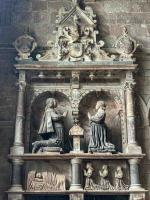
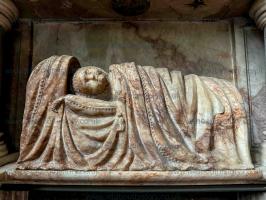
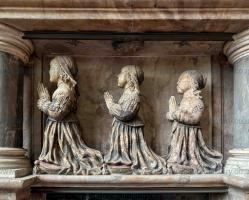
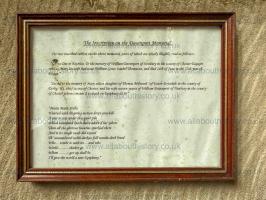
On 24th June 1649 Henry Hastings [aged 19] died of smallpox.
Adam Murimuth's Continuation and Robert of Avesbury’s 'The Wonderful Deeds of King Edward III'
This volume brings together two of the most important contemporary chronicles for the reign of Edward III and the opening phases of the Hundred Years’ War. Written in Latin by English clerical observers, these texts provide a vivid and authoritative window into the political, diplomatic, and military history of fourteenth-century England and its continental ambitions. Adam Murimuth Continuatio's Chronicarum continues an earlier chronicle into the mid-fourteenth century, offering concise but valuable notices on royal policy, foreign relations, and ecclesiastical affairs. Its annalistic structure makes it especially useful for establishing chronology and tracing the development of events year by year. Complementing it, Robert of Avesbury’s De gestis mirabilibus regis Edwardi tertii is a rich documentary chronicle preserving letters, treaties, and official records alongside narrative passages. It is an indispensable source for understanding Edward III’s claim to the French crown, the conduct of war, and the mechanisms of medieval diplomacy. Together, these works offer scholars, students, and enthusiasts a reliable and unembellished account of a transformative period in English and European history. Essential for anyone interested in medieval chronicles, the Hundred Years’ War, or the reign of Edward III.
Available at Amazon in eBook and Paperback format.
On 24th June 1649 William Lewis of Boarstall [aged 24] and Margaret Banastre Duchess of Richmond were married.
Samuel Pepys' Diary. 24th June 1663. He tells me, too, that he hath lately been observed to tack about at Court, and to endeavour to strike in with the persons that are against the Chancellor [aged 54]; but this he says of him, that he do not say nor do anything to the prejudice of the Chancellor. But he told me that the Chancellor was rising again, and that of late Sir G. Carteret's [aged 53] business and employment hath not been so full as it used to be while the Chancellor stood up. From that we discoursed of the evil of putting out men of experience in business as the Chancellor, and from that to speak of the condition of the King's party at present, who, as the Papists, though otherwise fine persons, yet being by law kept for these fourscore years out of employment, they are now wholly uncapable of business; and so the Cavaliers for twenty years, who, says he, for the most part have either given themselves over to look after country and family business, and those the best of them, and the rest to debauchery, &c.; and that was it that hath made him high against the late Bill brought into the House for the making all men incapable of employment that had served against the King [aged 33]. Why, says he, in the sea-service, it is impossible to do any thing without them, there being not more than three men of the whole King's side that are fit to command almost; and these were Captain Allen [aged 51], Smith, and Beech; and it may be Holmes, and Utber, and Batts might do something. I desired him to tell me if he thought that I did speak anything that I do against Sir W. Batten [aged 62] and Sir J. Minnes [aged 64] out of ill will or design. He told me quite the contrary, and that there was reason enough. After a good deal of good and fine discourse, I took leave, and so to my Lord Sandwich's [aged 37] house, where I met my Lord, and there did discourse of our office businesses, and how the Duke do show me kindness, though I have endeavoured to displease more or less of my fellow officers, all but Mr. Coventry [aged 35] and Pett; but it matters not. Yes, says my Lord, Sir J. Minnes, who is great with the Chancellor; I told him the Chancellor I have thought was declining, and however that the esteem he has among them is nothing but for a jester or a ballad maker; at which my Lord laughs, and asks me whether I believe he ever could do that well.


Samuel Pepys' Diary. 24th June 1663. We did talk highly of Sir W. Batten's [aged 62] corruption, which Mr. Coventry [aged 35] did very kindly say that it might be only his heaviness and unaptness for business, that he do things without advice and rashly, and to gratify people that do eat and drink and play with him, and that now and then he observes that he signs bills only in anger and fury to be rid of men. Speaking of Sir G. Carteret [aged 53], of whom I perceive he speaks but slightly, and diminishing of him in his services for the King [aged 33] in Jersey; that he was well rewarded, and had good lands and rents, and other profits from the King, all the time he was there; and that it was always his humour to have things done his way. He brought an example how he would not let the Castle there be victualled for more than a month, that so he might keep it at his beck, though the people of the town did offer to supply it more often themselves, which, when one did propose to the King, Sir George Carteret being by, says Sir George, "Let me know who they are that would do it, I would with all my heart pay them". "Ah, by God", says the Commander that spoke of it, "that is it that they are afeard of, that you would hug them", meaning that he would not endure them. Another thing he told me, how the Duke of York [aged 29] did give Sir G. Carteret and the Island his profits as Admirall, and other things, toward the building of a pier there. But it was never laid out, nor like to be. So it falling out that a lady being brought to bed, the Duke was to be desired to be one of the godfathers; and it being objected that that would not be proper, there being no peer of the land to be joyned with him, the lady replied, "Why, let him choose; and if he will not be a godfather without a peer, then let him even stay till he hath made a pier of his own1".
Note 1. In the same spirit, long after this, some question arising as to the best material to be used in building Westminster Bridge, Lord Chesterfield [aged 29] remarked, that there were too many wooden piers (peers) at Westminster already. B.
Samuel Pepys' Diary. 24th June 1664. After dinner to White Hall; and there met with Mr. Pierce, and he showed me the Queene's [aged 54] bed-chamber, and her closett, where she had nothing but some pretty pious pictures, and books of devotion; and her holy water at her head as she sleeps, with her clock by her bed-side, wherein a lamp burns that tells her the time of the night at any time.


Samuel Pepys' Diary. 24th June 1664. Thence with him to the Parke, and there met the Queene [aged 54] coming from Chappell, with her Mayds of Honour, all in silver-lace gowns again: which is new to me, and that which I did not think would have been brought up again.
Samuel Pepys' Diary. 24th June 1665. Midsummer-Day. Up very betimes, by six, and at Dr. Clerke's at Westminster by 7 of the clock, having over night by a note acquainted him with my intention of coming, and there I, in the best manner I could, broke my errand about a match between Sir G. Carteret's [aged 55] eldest son and my Lord Sandwich's [aged 39] eldest daughter, which he (as I knew he would) took with great content: and we both agreed that my Lord and he, being both men relating to the sea, under a kind aspect of His Majesty, already good friends, and both virtuous and good familys, their allyance might be of good use to us; and he did undertake to find out Sir George this morning, and put the business in execution. So being both well pleased with the proposition, I saw his niece there and made her sing me two or three songs very prettily, and so home to the office, where to my great trouble I found Mr. Coventry [aged 37] and the board met before I come. I excused my late coming by having been on the River about office business.
Samuel Pepys' Diary. 24th June 1665. At noon Captain Ferrers and Mr. Moore dined with me, the former of them the first time I saw him since his coming from sea, who do give me the best conversation in general, and as good an account of the particular service of the Prince [aged 45] and my Lord of Sandwich [aged 39] in the late sea-fight that I could desire.
Samuel Pepys' Diary. 24th June 1665. After dinner they parted. So I to White Hall, where I with Creed and Povy [aged 51] attended my Lord Treasurer [aged 58], and did prevail with him to let us have an assignment for 15 or £20,000, which, I hope, will do our business for Tangier.


Samuel Pepys' Diary. 24th June 1666. In the gallery among others met with Major Halsey, a great creature of the Duke of Albemarle's [aged 57]; who tells me that the Duke, by name, hath said that he expected to have the worke here up in the River done, having left Sir W. Batten [aged 65] and Mr. Phipps there. He says that the Duke of Albemarle do say that this is a victory we have had, having, as he was sure, killed them 8000 men, and sunk about fourteen of their ships; but nothing like this appears true. He lays much of the little success we had, however, upon the fleete's being divided by order from above, and the want of spirit in the commanders; and that he was commanded by order to go out of the Downes to the Gun-fleete, and in the way meeting the Dutch fleete, what should he do? should he not fight them? especially having beat them heretofore at as great disadvantage. He tells me further, that having been downe with the Duke of Albemarle, he finds that Holmes and Spragge do govern most business of the Navy; and by others I understand that Sir Thomas Allen [aged 33] is offended thereat; that he is not so much advised with as he ought to be. He tells me also, as he says, of his own knowledge, that several people before the Duke went out did offer to supply the King [aged 36] with £100,000 provided he would be treasurer of it, to see it laid out for the Navy; which he refused, and so it died. But I believe none of this. This day I saw my Lady Falmouth [aged 21], with whom I remember now I have dined at my Lord Barkeley's [aged 64] heretofore, a pretty woman: she was now in her second or third mourning, and pretty pleasant in her looks.


Samuel Pepys' Diary. 24th June 1666. By and by the Council rises, and Sir W. Coventry [aged 38] comes out; and he and I went aside, and discoursed of much business of the Navy; and afterwards took his coach, and to Hide-Parke, he and I alone: there we had much talke. First, he started a discourse of a talke he hears about the towne, which, says he, is a very bad one, and fit to be suppressed, if we knew how which is, the comparing of the successe of the last year with that of this; saying that that was good, and that bad. I was as sparing in speaking as I could, being jealous of him and myself also, but wished it could be stopped; but said I doubted it could not otherwise than by the fleete's being abroad again, and so finding other worke for men's minds and discourse. Then to discourse of himself, saying, that he heard that he was under the lash of people's discourse about the Prince's not having notice of the Dutch being out, and for him to comeback again, nor the Duke of Albemarle [aged 57] notice that the Prince was sent for back again: to which he told me very particularly how careful he was the very same night that it was resolved to send for the Prince back, to cause orders to be writ, and waked the Duke, who was then in bed, to sign them; and that they went by expresse that very night, being the Wednesday night before the fight, which begun on the Friday; and that for sending them by the post expresse, and not by gentlemen on purpose, he made a sport of it, and said, I knew of none to send it with, but would at least have lost more time in fitting themselves out, than any diligence of theirs beyond that of the ordinary post would have recovered. I told him that this was not so much the towne talke as the reason of dividing the fleete. To this he told me he ought not to say much; but did assure me in general that the proposition did first come from the fleete, and the resolution not being prosecuted with orders so soon as the Generall thought fit, the Generall did send Sir Edward Spragge [aged 46] up on purpose for them; and that there was nothing in the whole business which was not done with the full consent and advice of the Duke of Albemarle.
Samuel Pepys' Diary. 24th June 1666. But he did adde (as the Catholiques call 'le secret de la Masse'), that Sir Edward Spragge [aged 46]-who had even in Sir Christopher Mings's [deceased] time put in to be the great favourite of the Prince, but much more now had a mind to be the great man with him, and to that end had a mind to have the Prince at a distance from the Duke of Albemarle [aged 57], that they might be doing something alone-did, as he believed, put on this business of dividing the fleete, and that thence it came1. He tells me as to the business of intelligence, the want whereof the world did complain much of, that for that it was not his business, and as he was therefore to have no share in the blame, so he would not meddle to lay it any where else. That De Ruyter [aged 59] was ordered by the States not to make it his business to come into much danger, but to preserve himself as much as was fit out of harm's way, to be able to direct the fleete. He do, I perceive, with some violence, forbear saying any thing to the reproach of the Duke of Albemarle; but, contrarily, speaks much of his courage; but I do as plainly see that he do not like the Duke of Albemarle's proceedings, but, contrarily, is displeased therewith. And he do plainly diminish the commanders put in by the Duke, and do lessen the miscarriages of any that have been removed by him. He concurs with me, that the next bout will be a fatal one to one side or other, because, if we be beaten, we shall not be able to set out our fleete again. He do confess with me that the hearts of our seamen are much saddened; and for that reason, among others, wishes Sir Christopher Mings was alive, who might inspire courage and spirit into them. Speaking of Holmes, how great a man he is, and that he do for the present, and hath done all the voyage, kept himself in good order and within bounds; but, says he, a cat will be a cat still, and some time or other out his humour must break again. He do not disowne but that the dividing of the fleete upon the presumptions that were then had (which, I suppose, was the French fleete being come this way), was a good resolution. Having had all this discourse, he and I back to White Hall; and there I left him, being [in] a little doubt whether I had behaved myself in my discourse with the policy and circumspection which ought to be used to so great a courtier as he is, and so wise and factious a man, and by water home, and so, after supper, to bed.
Note 1. This division of the fleet was the original cause of the disaster, and at a later period the enemies of Clarendon charged him with having advised this action, but Coventry's communication to Pepys in the text completely exonerates Clarendon.


John Evelyn's Diary. 24th June 1667. The Dutch fleet still continuing to stop up the river, so as nothing could stir out or come in, I was before the Council, and commanded by his Majesty [aged 37] to go with some others and search about the environs of the city, now exceedingly distressed for want of fuel, whether there could be any peat, or turf, found fit for use. The next day, I went and discovered enough, and made my report that there might be found a great deal; but nothing further was done in it.
Samuel Pepys' Diary. 24th June 1667. He [Povy [aged 53]] tells me that the other day, upon this ill newes of the Dutch being upon us, White Hall was shut up, and the Council called and sat close; and, by the way, he do assure me, from the mouth of some Privy-councillors, that at this day the Privy-council in general do know no more what the state of the Kingdom as to peace and war is, than he or I; nor knows who manages it, nor upon whom it depends; and there my Chancellor [aged 58] did make a speech to them, saying that they knew well that he was no friend to the war from the beginning, and therefore had concerned himself little in, nor could say much to it; and a great deal of that kind, to discharge himself of the fault of the war. Upon which my Lord Anglesey [aged 52] rose up and told his Majesty that he thought their coming now together was not to enquire who was, or was not, the cause of the war, but to enquire what was, or could be, done in the business of making a peace, and in whose hands that was, and where it was stopped or forwarded; and went on very highly to have all made open to them: and, by the way, I remember that Captain Cocke [aged 50] did the other day tell me that this Lord Anglesey hath said, within few days, that he would willingly give £10,000 of his estate that he was well secured of the rest, such apprehensions he hath of the sequel of things, as giving all over for lost.

Samuel Pepys' Diary. 24th June 1667. That at a certain time Mr. Povy [aged 53] did carry him an account of the state of the Duke of York's [aged 33] estate, showing in faithfullness how he spent more than his estate would bear, by above £20,000 per annum, and asked my Lord's opinion of it; to which he answered that no man that loved the King [aged 37] or kingdom durst own the writing of that paper; at which Povy was startled, and reckoned himself undone for this good service, and found it necessary then to show it to the Duke of York's Commissioners; who read, examined, and approved of it, so as to cause it to be put into form, and signed it, and gave it the Duke. Now the end of the Chancellor [aged 58] was, for fear that his daughter's [aged 30] ill housewifery should be condemned.


Samuel Pepys' Diary. 24th June 1667. In the evening comes Mr. Povy [aged 53] about business; and he and I to walk in the garden an hour or two, and to talk of State matters. He tells me his opinion that it is out of possibility for us to escape being undone, there being nothing in our power to do that is necessary for the saving us: a lazy Prince [aged 47], no Council, no money, no reputation at home or abroad. He says that to this day the King [aged 37] do follow the women as much as ever he did; that the Duke of York [aged 33] hath not got Mrs. Middleton [aged 22], as I was told the other day: but says that he wants not her, for he hath others, and hath always had, and that he [Povy] hath known them brought through the Matted Gallery at White Hall into his [the Duke's] closet; nay, he hath come out of his wife's [aged 30] bed, and gone to others laid in bed for him: that Mr. Bruncker [aged 47] is not the only pimp, but that the whole family is of the same strain, and will do anything to please him: that, besides the death of the two Princes lately, the family is in horrible disorder by being in debt by spending above £60,000 per. annum, when he hath not £40,000: that the Duchesse is not only the proudest woman in the world, but the most expensefull; and that the Duke of York's marriage with her hath undone the Kingdom, by making the Chancellor [aged 58] so great above reach, who otherwise would have been but an ordinary man, to have been dealt with by other people; and he would have been careful of managing things well, for fear of being called to account; whereas, now he is secure, and hath let things run to rack, as they now appear.

Samuel Pepys' Diary. 24th June 1667. He tells me, speaking of the horrid effeminacy of the King [aged 37], that the King hath taken ten times more care and pains in making friends between my Baroness Castlemayne [aged 26] and Mrs. Stewart [aged 19], when they have fallen out, than ever he did to save his kingdom; nay, that upon any falling out between my Baroness Castlemayne's nurse and her woman, my Lady hath often said she would make the King to make them friends, and they would be friends and be quiet; which the King hath been fain to do: that the King is, at this day, every night in Hyde Park with the Duchesse of Monmouth [aged 16], or with my Baroness Castlemaine's: that he [Povy [aged 53]] is concerned of late by my Lord Arlington [aged 49] in the looking after some buildings that he is about in Norfolke, where my Lord is laying out a great deal of money; and that he, Mr. Povy, considering the unsafeness of laying out money at such a time as this, and, besides, the enviousness of the particular county, as well as all the Kingdom, to find him building and employing workmen, while all the ordinary people of the country are carried down to the seasides for securing the land, he thought it becoming him to go to my Lord Arlington (Sir Thomas Clifford [aged 36] by), and give it as his advice to hold his hands a little; but my Lord would not, but would have him go on, and so Sir Thomas Clifford advised also, which one would think, if he were a statesman worth a fart should be a sign of his foreseeing that all shall do well. But I do forbear concluding any such thing from them. He tells me that there is not so great confidence between any two men of power in the nation at this day, that he knows of, as between my Lord Arlington and Sir Thomas Clifford; and that it arises by accident only, there being no relation nor acquaintance between them, but only Sir Thomas Clifford's coming to him, and applying himself to him for favours, when he come first up to town to be a Parliament-man. He tells me that he do not think there is anything in the world for us possibly to be saved by but the King of France's [aged 28] generousnesse to stand by us against the Dutch, and getting us a tolerable peace, it may be, upon our giving him Tangier and the islands he hath taken, and other things he shall please to ask. He confirms me in the several grounds I have conceived of fearing that we shall shortly fall into mutinys and outrages among ourselves, and that therefore he, as a Treasurer, and therefore much more myself, I say, as being not only a Treasurer but an officer of the Navy, on whom, for all the world knows, the faults of all our evils are to be laid, do fear to be seized on by some rude hands as having money to answer for, which will make me the more desirous to get off of this Treasurership as soon as I can, as I had before in my mind resolved.
Chronicle of Geoffrey le Baker of Swinbroke
Baker was a secular clerk from Swinbroke, now Swinbrook, an Oxfordshire village two miles east of Burford. His Chronicle describes the events of the period 1303-1356: Gaveston, Bannockburn, Boroughbridge, the murder of King Edward II, the Scottish Wars, Sluys, Crécy, the Black Death, Winchelsea and Poitiers. To quote Herbert Bruce 'it possesses a vigorous and characteristic style, and its value for particular events between 1303 and 1356 has been recognised by its editor and by subsequent writers'. The book provides remarkable detail about the events it describes. Baker's text has been augmented with hundreds of notes, including extracts from other contemporary chronicles, such as the Annales Londonienses, Annales Paulini, Murimuth, Lanercost, Avesbury, Guisborough and Froissart to enrich the reader's understanding. The translation takes as its source the 'Chronicon Galfridi le Baker de Swynebroke' published in 1889, edited by Edward Maunde Thompson.
Available at Amazon in eBook and Paperback format.
John Evelyn's Diary. 24th June 1670. Came the Earl [aged 19] of Huntington and Countess [aged 16], with the Lord Sherard [aged 48], to visit us.
John Evelyn's Diary. 24th June 1671. Constantine Huygens [aged 74], Signor of Zuylichem, that excellent learned man, poet, and musician, now near eighty years of age, a vigorous, brisk man, came to take leave of me before his return into Holland with the Prince [aged 20], whose Secretary he was.


John Evelyn's Diary. 31st October 1680. I spent this whole day in exercises. A stranger preached at Whitehall [Map] on Luke xvi. 30, 31. I then went to St. Martin's [Map], where the Bishop of St. Asaph [aged 53] [Note. The next post refers to Bishop William Lloyd being made Bishop of St Asaph. The previous incumbent Isaac Barrow had died 24th June 1680] preached on 1 Peter iii. 15; the Holy Communion followed, at which I participated, humbly imploring God's assistance in the great work I was entering into. In the afternoon, I heard Dr. Sprat [aged 45], at St. Margaret's [Map], on Acts xvii. 11.
John Evelyn's Diary. 24th June 1686. My Lord Treasurer [aged 44] settled my greate buisinesse with Mr. Pretyman, to which I hope God will at last give a prosperous issue.


John Evelyn's Diary. 24th June 1690. Dined with Mr. Pepys [aged 57], who the next day was sent to the Gatehouse, and several great persons to the Tower [Map], on suspicion of being affected to King James [aged 56]; among them was the Earl of Clarendon, the Queen's [aged 28] uncle. King William [aged 39] having vanquished King James in Ireland, there was much public rejoicing. It seems the Irish in King James's army would not stand, but the English-Irish and French made great resistance. Schomberg [aged 74] was slain, and Dr. Walker, who so bravely defended Londonderry. King William received a slight wound by the grazing of a cannon bullet on his shoulder, which he endured with very little interruption of his pursuit. Hamilton [aged 55], who broke his word about Tyrconnel [aged 60], was taken. It is reported that King James is gone back to France. Drogheda [Map] and Dublin [Map] surrendered, and if King William be returning, we may say of him as Cæsar said, "Veni, vidi, vici". But to alloy much of this, the French fleet rides in our channel, ours not daring to interpose, and the enemy threatening to land.
On 24th June 1694 John Michael Rysbrack was born in Antwerp [Map].
On 24th June 1695 Martin van Meytens was born.
On 24th June 1697 William Fitzherbert [aged 72] died. He was buried at St Mary's Church, Tissington [Map].
William Fitzherbert: Around October 1624 he was born to John Fitzherbert and Elizabeth Fitzherbert of Norbury. Before 6th April 1676 William Fitzherbert and Mary Cromwell were married. She the daughter of Thomas Cromwell 1st Earl Ardglass and Elizabeth Meverell Countess Ardglass. They were fourth cousin twice removed. Before 24th June 1697 William Fitzherbert and Anne Breton were married.
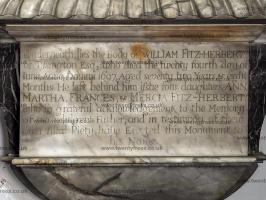
On 24th June 1700 Bishop Thomas Vesey 1st Baronet [aged 32] was ordained as a Priest after which he was appointed Archdeacon of Tuam and chaplain to James Butler 2nd Duke Ormonde [aged 35].
On 24th June 1703 Anne Lennox Countess Albermarle was born to Charles Lennox 1st Duke Richmond [aged 30] and Anne Brudenell Duchess Richmond [aged 32]. She a granddaughter of King Charles II of England Scotland and Ireland. She married 21st February 1722 William Anne Keppel 2nd Earl Albermarle, son of Arnold Keppel 1st Earl Albermarle and Geertruid Johanna Quirina Van Der Duyn Countess Albermarle, and had issue.


On 24th June 1708 Seymour Beauclerk was born to Charles Beauclerk 1st Duke St Albans [aged 38] and Diana Vere Duchess St Albans [aged 29]. He a grandson of King Charles II of England Scotland and Ireland. He died aged less than one years old.


The Deeds of the Dukes of Normandy
The Gesta Normannorum Ducum [The Deeds of the Dukes of Normandy] is a landmark medieval chronicle tracing the rise and fall of the Norman dynasty from its early roots through the pivotal events surrounding the Norman Conquest of England. Originally penned in Latin by the monk William of Jumièges shortly before 1060 and later expanded at the behest of William the Conqueror, the work chronicles the deeds, politics, battles, and leadership of the Norman dukes, especially William’s own claim to the English throne. The narrative combines earlier historical sources with firsthand information and oral testimony to present an authoritative account of Normandy’s transformation from a Viking settlement into one of medieval Europe’s most powerful realms. William’s history emphasizes the legitimacy, military prowess, and governance of the Norman line, framing their expansion, including the conquest of England, as both divinely sanctioned and noble in purpose. Later chroniclers such as Orderic Vitalis and Robert of Torigni continued the history, extending the coverage into the 12th century, providing broader context on ducal rule and its impact. Today this classic work remains a foundational source for understanding Norman identity, medieval statesmanship, and the historical forces that reshaped England and Western Europe between 800AD and 1100AD.
Available at Amazon in eBook and Paperback format.

On 24th June 1720 Louisa Ulrika of Prussia Queen Consort of Sweden was born to Frederick William "Soldier King" I King Prussia [aged 31] and Sophia Dorothea Hanover Queen Consort Prussia [aged 33]. She a great x 3 granddaughter of King James I of England and Ireland and VI of Scotland. Coefficient of inbreeding 8.32%. She married 29th August 1744 her fourth cousin once removed Adolph Frederick King Sweden and had issue.
On 24th June 1724 John Astley was born at Wem, Shropshire.
On 24th June 1735 Frederica Caroline Saxe Coburg Saalfeld Margrave Brandenburg-Ansbach was born to Francis Josias Saxe Coburg Saalfeld Duke Saxe Coburg Saalfeld [aged 37] and Duchess Anna Sophie Of Saxe-Coburg-Saalfeld [aged 34] at Coburg. Coefficient of inbreeding 3.40%. She married 22nd November 1754 her fifth cousin once removed Charles Alexander Hohenzollern Margrave Brandenburg-Ansbach, son of Charles William Frederick "The Wild Margrave" Hohenzollern and Frederica Louise Hohenzollern.
On 24th June 1769, three months after his divorce from his first wife Anne Liddell Duchess Grafton [aged 32], Augustus Henry Fitzroy 3rd Duke Grafton [aged 33] and Elizabeth Wrottesley Duchess Grafton [aged 23] were married. She by marriage Duchess Grafton. They were sixth cousins. He a great x 2 grandson of King Charles II of England Scotland and Ireland.


On 24th June 1774 Caroline Hanover was born to William Henry Hanover 1st Duke Gloucester and Edinburgh [aged 30] and Maria Walpole Duchess Gloucester and Edinburgh [aged 37] at Gloucester House. She a great granddaughter of King George II of Great Britain and Ireland. She died aged less than one years old.


In 1783 Richard Hely-Hutchinson 1st Earl of Donoughmore [aged 26] was elected MP Taghmon which seat he held until 24th June 1788 when he succeeded to his mother's Barony.
On 24th June 1800 Edward Seymour 11th Duke of Somerset [aged 25] and Charlotte Hamilton Duchess Somerset [aged 28] were married. She by marriage Duchess Somerset. She the daughter of Archibald Hamilton 9th Duke Hamilton 6th Duke Brandon [aged 59] and Harriet Stewart. He the son of Webb Seymour 10th Duke of Somerset and Anne Maria Bonnell Duchess Somerset.
On 24th June 1819 Victoria, the future Queen, was christened privately by the Archbishop of Canterbury, Charles Manners-Sutton [aged 64] in the Cupola Room, Kensington Palace.


Ten Years' Digging. On the 24th of June, a small barrow called Green Low, situated in the same field as the large barrow at Castern, opened in July, 1846; was opened by cutting three parallel trenches through it. In the middle cut were no perceptible traces of human remains, but several articles of different periods were found in it» as a small celt of green hone slate, a round ended flint, a piece of coarse pottery, and a very perfect harp shaped bronze fibula, of a type with good reason considered as Roman. These articles were to all appearance of casual occurrence, not having been deposited with any interment, or even in connection with each other. In another of the cuttings, near the edge of the moundy we found the skeleton of a child, with a flint arrow point. In the remaining trench, another juvenile skeleton, much decayed, was discovered. In the course of the day, pieces of stags' horns, animals' teeth, rats' bones, numerous pebbles, and some flints were found.
On 24th June 1860 Maria de las Mercedes Queen Consort Spain was born to Antoine Orléans Duke Montpensier [aged 35] and Infanta Luisa Fernanda Duchess of Montpensier [aged 28]. She married 23rd January 1878 her half first cousin Alfonso XII King Spain, son of Francisco de Asís King Consort Spain and Isabella II Queen Spain.


The True Chronicles of Jean le Bel Volume 1 Chapters 1-60 1307-1342
The True Chronicles of Jean le Bel offer one of the most vivid and immediate accounts of 14th-century Europe, written by a knight who lived through the events he describes, and experienced some of them first hand. Covering the early decades of the Hundred Years’ War, this remarkable chronicle follows the campaigns of Edward III of England, the politics of France and the Low Countries, and the shifting alliances that shaped medieval warfare. Unlike later historians, Jean le Bel writes with a strong sense of eyewitness authenticity, drawing on personal experience and the testimony of fellow soldiers. His narrative captures not only battles and sieges, but also the realities of military life, diplomacy, and the ideals of chivalry that governed noble society. A key source for Jean Froissart, Le Bel’s chronicle stands on its own as a compelling and insightful work, at once historical record and literary achievement. This translation builds on the 1905 edition published in French by Jules Viard, adding extensive translations from other sources Rymer's Fœdera, the Chronicles of Adam Murimuth, William Nangis, Walter of Guisborough, a Bourgeois of Valenciennes, Geoffrey le Baker of Swinbroke and Richard Lescot to enrich the original text and Viard's notes.
Available at Amazon in eBook and Paperback format.
On 24th June 1862 Arthur Bulleid was born to John George Bulleid [aged 35] and Christine Wooff [aged 38] at Glastonbury, Somerset. He married 27th September 1900 Anna Eleanor Austin.
On 24th June 1869 George Glücksburg was born to George I King Greece [aged 23] and Olga Constantinovna Holstein Gottorp Romanov Queen Consort Greece [aged 17]. He a great x 4 grandson of King George II of Great Britain and Ireland. He married 21st November 1907 Princess Marie Bonaparte.

On 24th June 1878 Archbishop William Dalrymple Maclagan [aged 52] was consecrated Bishop of Lichfield by Archbishop Archibald Campbell Tait [aged 66] at St Paul's Cathedral [Map].
On 24th June 1900 William Edwardes 5th and 2nd Baron Kensington [aged 31] died from wounds at Krantz Kraal, South Africa. His brother Hugh [aged 26] succeeded 6th Baron Kensington, 3rd Baron Kensington of Middlesex.

24th June 1902. James Lafayette [aged 49]. Photograph of Evelyn Caroline Davenport Baroness Newton.
Evelyn Caroline Davenport Baroness Newton: she was born to William Bromley-Davenport. In 1880 Thomas Wodehouse Leigh 2nd Baron Newton and she were married. On 15th December 1898 William John Legh 1st Baron Newton died. His son Thomas succeeded 2nd Baron Newton of Newton-in-Makerfield in Lancashire. She by marriage Baroness Newton of Newton-in-Makerfield in Lancashire. In September 1931 she died.
On 24th June 1905 John "Rex" Whistler was born.

On 24th June 1908 Mary Joanna Hincks [aged 72] died at Beadnell Hall, Northumberland [Map]. Memorial at the Church of the Holy Trinity Embleton [Map].
Mary Joanna Hincks: Around 1836 she was born to Thomas Cowper Hincks of Breckenbrough in Yorkshire. On 17th June 1868 Colonel William Robert Craster and she were married.
On 24th June 1916 Lieutenant Hugh Vaughan Charlton was killed in action whilst serving with the 7th Northumberland Fusiliers on the Western Front.

24th June 1927. Sasha aka Alexander Stewart. Photograph of Mimi Crawford [aged 29].
On 24th June 1927 Kathleen Emily Bulkeley Williams Duchess Wellington [aged 78] died at Apsley House, Hyde Park Corner.
Abbot John Whethamstede’s Chronicle of the Abbey of St Albans
Abbot John Whethamstede's Register aka Chronicle of his second term at the Abbey of St Albans, 1451-1461, is a remarkable text that describes his first-hand experience of the beginning of the Wars of the Roses including the First and Second Battles of St Albans, 1455 and 1461, respectively, their cause, and their consequences, not least on the Abbey itself. His text also includes Loveday, Blore Heath, Northampton, the Act of Accord, Wakefield, and Towton, and ends with the Coronation of King Edward IV. In addition to the events of the Wars of the Roses, Abbot John, or his scribes who wrote the Chronicle, include details in the life of the Abbey such as charters, letters, land exchanges, visits by legates, and disputes, which provide a rich insight into the day-to-day life of the Abbey, and the challenges faced by its Abbot.
Available at Amazon in eBook and Paperback format.

On 24th June 1945 Theresa Jane Fitzalan Marchioness Lothian was born to Bernard Fitzalan 16th Duke of Norfolk [aged 37] and Lavinia Mary Strutt Duchess Norfolk [aged 29]. She married 7th June 1975 Michael Andrew Foster Jude Kerr 13th Marquess Lothian, son of Peter Francis Walter Kerr 12th Marquess Lothian.
On 24th June 1958 Oscar Parkes [aged 72] died.

On 24th June 1979 Rupert Leigh 4th Baron Leigh [aged 71] died. His son John [aged 43] succeeded 5th Baron Leigh of Stoneleigh in Warwickshire.
Memorial at Church of the Virgin Mary, Stoneleigh [Map].
Rupert Leigh 4th Baron Leigh: On 14th March 1908 he was born to Rupert Leigh. On 27th April 1931 Rupert Leigh 4th Baron Leigh and Anne Hicks-Beach were married. In 1938 Francis Dudley Leigh 3rd Baron Leigh died. His nephew Rupert succeeded 4th Baron Leigh of Stoneleigh in Warwickshire. Anne Hicks-Beach by marriage Baroness Leigh of Stoneleigh in Warwickshire.
John Leigh 5th Baron Leigh: On 11th September 1935 he was born to Rupert Leigh 4th Baron Leigh and Anne Hicks-Beach Baroness Leigh. On 16th September 2003 John Leigh 5th Baron Leigh died. His son Christopher succeeded 6th Baron Leigh of Stoneleigh in Warwickshire.
On 24th June 2002 Miles Stapleton Fitzalan Howard 17th Duke of Norfolk [aged 86] died. His son Edward [aged 45] succeeded 18th Duke Norfolk, 36th Earl Arundel, 19th Earl Surrey, 16th Earl Norfolk, 26th Baron Maltravers, 26th Baron Arundel, 5th Baron Howard of Glossop in Derbyshire, 13th Baron Beaumont. Georgina Susan Gore Duchess of Norfolk [aged 40] by marriage Duchess Norfolk.
Antiquity 2025 Volume 99 Issue 405 Pages 672-688. The 'king' of Newgrange? A critical analysis of a Neolithic petrous fragment from the passage tomb chamber.
Published online by Cambridge University Press: 24th June 2025.
Abstract: Recent genomic analysis of a skull fragment from Newgrange, Ireland [Map], revealed a rare case of incest. Together with a wider network of distantly related passage tomb interments, this has bolstered claims of a social elite in later Neolithic Ireland. Here, the authors evaluate this social evolutionary interpretation, drawing on insecurities in context and the relative rarity of engendered status or resource restrictions in the archaeological record of prehistoric Ireland to argue that the status of individuals during this period is better understood through unstable identity negotiations. Inclusion in a passage tomb, while 'special', need not equate to a perpetual elite.
This is an Open Access article, distributed under the terms of the Creative Commons Attribution - Non Commercial - Share Alike licence, which permits non-commercial re-use, distribution, and reproduction in any medium, provided the same Creative Commons licence is included and the original work is properly cited.
On 24th June 1210 Floris Gerulfing IV Count Holland was born to William Gerulfing I Count Holland [aged 43] and Adelaide Guelders Countess Holland. He married 6th December 1214 his half third cousin once removed Mathilde Reginar Countess Holland and Palatine, daughter of Henry Reginar VIII Duke Lower Lorraine I Duke Brabant and Maud Metz, and had issue.
On 24th June 1242 Beatrice Plantagenet was born to King Henry III of England [aged 34] and Eleanor of Provence Queen Consort England [aged 19] at Bordeaux [Map]. She married 22nd January 1260 her half second cousin twice removed John II Duke Brittany, son of John "The Red" Capet I Duke Brittany and Blanche "Navarre" Blois Duchess Brittany, and had issue.
On 24th June 1254 Floris Gerulfing V Count Holland was born to William Gerulfing II Count Holland [aged 27] and Elizabeth Brunswick-Lüneburg Countess Holland [aged 24]. He a great x 3 grandson of King Stephen I England. He married 1270 his fourth cousin Beatrix Dampierre, daughter of Guy Dampierre Count Flanders and Mathilde Bethune, and had issue.
On 24th June 1255 Roger Somery 3rd Baron Dudley was born to Roger Somery 2nd Baron Dudley [aged 65] and Amabilia Chaucombe Baroness Dudley at Dinas Powys. He married before March 1279 Agnes Unknown Baroness Dudley and had issue.
On 24th June 1257 Robert de Vere 6th Earl of Oxford was born to Robert de Vere 5th Earl of Oxford [aged 17] and Alice Sanford Countess of Oxford. He married before 1282 his fifth cousin Margaret Mortimer Countess of Oxford, daughter of Roger Mortimer 1st Baron Mortimer of Wigmore and Maud de Braose, and had issue.
On 24th June 1270 John Sutton 1st Baron Sutton was born to Sayer IV Sutton [aged 26] and Anne Ros [aged 26] at Holderness. He married Constantia Sampson Baroness Lexington and had issue.
On 24th June 1287 John Giffard 2nd Baron Giffard Brimpsfield was born to John Giffard 1st Baron Giffard Brimpsfield [aged 55] and Margaret Belet [aged 32]. He married April 1322 Aveline Courtenay Baroness Giffard Brimpsfield, daughter of Hugh Courtenay 3rd Baron Okehampton and Eleanor Despencer Baroness Okehampton.
Annals of the six Kings of England by Nicholas Trivet
Translation of the Annals of the Six Kings of England by that traces the rise and rule of the Angevin aka Plantagenet dynasty from the mid-12th to early 14th century. Written by the Dominican scholar Nicholas Trivet, the work offers a vivid account of English history from the reign of King Stephen through to the death of King Edward I, blending political narrative with moral reflection. Covering the reigns of six monarchs—from Stephen to Edward I—the chronicle explores royal authority, rebellion, war, and the shifting balance between crown, church, and nobility. Trivet provides detailed insight into defining moments such as baronial conflicts, Anglo-French rivalry, and the consolidation of royal power under Edward I, whose reign he describes with particular immediacy. The Annals combines careful year-by-year reporting with thoughtful interpretation, presenting history not merely as a sequence of events but as a moral and political lesson. Ideal for readers interested in medieval history, kingship, and the origins of the English state, this chronicle remains a valuable and accessible window into the turbulent world of the Plantagenet kings.
Available at Amazon in eBook and Paperback format.
On 24th June 1290 John Fauconberg 3rd Baron Fauconberg was born to Walter Fauconberg 2nd Baron Fauconberg [aged 26] and Isabel Ros Baroness Fauconberg.
On 24th June 1293 Joan "Lame" Burgundy Queen Consort France was born to Robert II Duke Burgundy [aged 45] and Agnes Capet Duchess Burgundy [aged 33]. She a great x 3 granddaughter of King Henry "Curtmantle" II of England. She married her first cousin once removed King Philip "Fortunate" VI of France, son of Charles Valois I Count Valois and Margaret Capet Countess Valois, and had issue.
On 24th June 13101 Philippa of Hainaut Queen Consort England was born to William of Avesnes I Count Hainaut III Count Avesnes III Count Holland II Count Zeeland [aged 24] and Joan Valois Countess Zeeland Holland Avesnes and Hainaut [aged 16].
Note 1. The date from the Register of Walter Stapledon who in 1319 writes: "And the young lady will be of the age of nine years at the Feast of the Nativity of Saint John [24th June] next to come". She married 24th January 1328 her second cousin King Edward III of England, son of King Edward II of England and Isabella of France Queen Consort England, and had issue.
On 24th June 1316 Philip Capet was born to Philip V King France I King Navarre [aged 23] and Joan of Burgundy Queen Consort France [aged 24]. Coefficient of inbreeding 2.35%. He died aged less than one years old.
On 24th June 1340 John Mowbray 4th Baron Mowbray Baron Segrave was born to John Mowbray 3rd Baron Mowbray [aged 29] and Joan Plantagenet Baroness Mowbray [aged 28] at Epworth. He a great x 2 grandson of King Henry III of England. He married 25th March 1349 his third cousin Elizabeth Segrave 5th Baroness Segrave Baroness Mowbray, daughter of John Segrave 4th Baron Segrave and Margaret Plantagenet 1st Duchess of Norfolk, and had issue.
On 24th June 1343 Joan Valois Queen Consort Navarre was born to King John "The Good" II of France [aged 24] and Bonne Luxemburg Queen Consort France [aged 28]. She married 12th February 1352 her second cousin Charles "Bad" II King Navarre, son of Philip "Noble" III King Navarre and Joan Capet II Queen Navarre, and had issue.
On 24th June 1346 Joanne Armagnac Duchess Berry was born to John I Count Armagnac [aged 35] and Beatrice Clermont Countess Armagnac [aged 36]. She married before 1362 her third cousin John Valois 1st Duke Berry, son of King John "The Good" II of France and Bonne Luxemburg Queen Consort France, and had issue.
On 24th June 1380 Ralph Deincourt 4th Baron Deincourt was born to William Deincourt 3rd Baron Deincourt [aged 22] and Alice Neville Baroness Deincourt [aged 22] He died aged four in 1384.
On 24th June 1389 Anne Bardolf Baroness Cobham Sternborough was born to Thomas Bardolf 5th Baron Bardolf [aged 19] and Avice Cromwell Baroness Bardolf [aged 19]. She a great x 4 granddaughter of King Edward I of England. She married (1) 1427 her half fifth cousin Reginald Cobham 3rd Baron Cobham, son of Reginald Cobham 2nd Baron Cobham and Eleanor Maltravers 2nd Baroness Maltravers Baroness Arundel and Cobham (2) 1427 her fourth cousin once removed William Clifford, son of Roger Clifford 5th Baron Clifford and Maud Beauchamp Baroness Clifford.
On 24th June 1413 John IV Marquis of Montferrat was born to John Jacob Marquis of Montferrat [aged 18] and Joan of Savoy. He married December 1458 his first cousin once removed Margaret Savoy Countess Saint Pol, daughter of Louis Savoy I Count Savoy and Anne Cyprus Countess Savoy.
Abbot John Whethamstede’s Chronicle of the Abbey of St Albans
Abbot John Whethamstede's Register aka Chronicle of his second term at the Abbey of St Albans, 1451-1461, is a remarkable text that describes his first-hand experience of the beginning of the Wars of the Roses including the First and Second Battles of St Albans, 1455 and 1461, respectively, their cause, and their consequences, not least on the Abbey itself. His text also includes Loveday, Blore Heath, Northampton, the Act of Accord, Wakefield, and Towton, and ends with the Coronation of King Edward IV. In addition to the events of the Wars of the Roses, Abbot John, or his scribes who wrote the Chronicle, include details in the life of the Abbey such as charters, letters, land exchanges, visits by legates, and disputes, which provide a rich insight into the day-to-day life of the Abbey, and the challenges faced by its Abbot.
Available at Amazon in eBook and Paperback format.
On 24th June 1485 Elizabeth Oldenburg was born to John King of Denmark Norway and Sweden [aged 30] and Christina Queen Consort Denmark Norway and Sweden [aged 23].
On 24th June 1506 William Keith 4th Earl Marischal was born to Robert Keith Master of Marischal [aged 23] and Elizabeth Douglas. He married before 1527 his half third cousin Margaret Keith Countess Marischal and had issue.
On 24th June 1532 William IV Landgrave of Hesse-Kassel was born to Landgrave Philip I of Hesse [aged 27] and Christine of Saxony [aged 26].
On 24th June 1532 Robert Dudley 1st Earl of Leicester was born to John Dudley 1st Duke Northumberland [aged 28] and Jane Guildford Duchess Northumberland [aged 23]. He married (1) 4th June 1550 Amy Robsart (2) 21st September 1578 his fifth cousin Lettice Knollys Countess Essex and Leicester and had issue.
On 24th June 1556 Joan Valois was born to King Henry II of France [aged 37] and Catherine Medici Queen Consort France [aged 37]. She died aged less than one years old.
On 24th June 1556 Victoria Valois was born to King Henry II of France [aged 37] and Catherine Medici Queen Consort France [aged 37]. She died aged less than one years old.
On 24th June 1575 William Petre 2nd Baron Petre was born to John Petre 1st Baron Petre [aged 25]. He married 8th November 1596 his fourth cousin Katherine Somerset Baroness Petre, daughter of Edward Somerset 4th Earl of Worcester and Elizabeth Hastings Countess of Worcester, and had issue.
On 24th June 1614 John Belasyse 1st Baron Belasyse was born to Thomas Belasyse 1st Viscount Fauconberg [aged 37] and Barbara Cholmley [aged 39]. He married (1) 8th March 1637 Jane Boteler and had issue (2) 24th July 1659 Anne Crane, daughter of Robert Crane 1st Baronet and Susan Alinton (3) after 11th August 1662 Anne Paulett Baroness Belasyse, daughter of John Paulet 5th Marquess Winchester and Honora Burke Marchioness Winchester, and had issue.


On 24th June 1616 Ferdinand Bol was born to Balthasar Bol at Dortrecht. He married (1) 1653 Elisabeth Dell (2) 1669 Anna van Erckel.
On 24th June 1618 Philip Packer was born to John Packer [aged 45] in Groombridge, Kent [Map].
On 24th June 1621 Thomas Howard was born to Theophilus Howard 2nd Earl Suffolk [aged 38] and Elizabeth Home Countess Suffolk [aged 22].
On 24th June 1629 John Petre 5th Baron Petre was born to Robert Petre 3rd Baron Petre [aged 30] and Mary Browne Baroness Petre.
William of Worcester's Chronicle of England
William of Worcester, born around 1415, and died around 1482 was secretary to John Fastolf, the renowned soldier of the Hundred Years War, during which time he collected documents, letters, and wrote a record of events. Following their return to England in 1440 William was witness to major events. Twice in his chronicle he uses the first person: 1. when writing about the murder of Thomas, 7th Baron Scales, in 1460, he writes '… and I saw him lying naked in the cemetery near the porch of the church of St. Mary Overie in Southwark …' and 2. describing King Edward IV's entry into London in 1461 he writes '… proclaimed that all the people themselves were to recognize and acknowledge Edward as king. I was present and heard this, and immediately went down with them into the city'. William’s Chronicle is rich in detail. It is the source of much information about the Wars of the Roses, including the term 'Diabolical Marriage' to describe the marriage of Queen Elizabeth Woodville’s brother John’s marriage to Katherine, Dowager Duchess of Norfolk, he aged twenty, she sixty-five or more, and the story about a paper crown being placed in mockery on the severed head of Richard, 3rd Duke of York.
Available at Amazon in eBook and Paperback format.
On 24th June 1630 Henry Cavendish 2nd Duke Newcastle upon Tyne was born to William Cavendish 1st Duke Newcastle upon Tyne [aged 37] and Elizabeth Bassett Countess Newcastle upon Tyne [aged 38] at Handsworth Manor. He married 1652 his second cousin once removed Frances Pierrepont Duchess Newcastle upon Tyne and had issue.
On 24th June 1665 Edward Stourton 13th Baron Stourton was born to William Stourton 12th Baron Stourton [aged 21] and Elizabeth Preston Baroness Stourton.
On 24th June 1671 Dorothy Keyt was born to William Keyt 2nd Baronet [aged 32]. She married 30th November 1694 Gilbert Coventry 4th Earl Coventry, son of Thomas Coventry 1st Earl Coventry and Winifred Edgecumbe, and had issue.
On 24th June 1694 John Michael Rysbrack was born in Antwerp [Map].
On 24th June 1695 Martin van Meytens was born.

On 24th June 1701 William Lee was born to Edward Lee 1st Earl Lichfield [aged 38] and Charlotte Fitzroy Countess Lichfield [aged 36]. He a grandson of King Charles II of England Scotland and Ireland.
On 24th June 1703 Anne Lennox Countess Albermarle was born to Charles Lennox 1st Duke Richmond [aged 30] and Anne Brudenell Duchess Richmond [aged 32]. She a granddaughter of King Charles II of England Scotland and Ireland. She married 21st February 1722 William Anne Keppel 2nd Earl Albermarle, son of Arnold Keppel 1st Earl Albermarle and Geertruid Johanna Quirina Van Der Duyn Countess Albermarle, and had issue.
On 24th June 1706 James Porter Hervey was born to John Hervey 1st Earl Bristol [aged 40] and Elizabeth Felton Countess Bristol [aged 29]. He died aged less than one years old.


On 24th June 1708 Henry Harpur 5th Baronet was born to John Harpur 4th Baronet [aged 29] and Catherine Crew Lady Harpur [aged 25]. He married 2nd October 1734 his half fifth cousin Caroline Manners Lady Harpur and Burdett, daughter of John Manners 2nd Duke Rutland and Lucy Sherard Duchess Rutland, and had issue.


On 24th June 1708 Seymour Beauclerk was born to Charles Beauclerk 1st Duke St Albans [aged 38] and Diana Vere Duchess St Albans [aged 29]. He a grandson of King Charles II of England Scotland and Ireland. He died aged less than one years old.
Chronicle of Geoffrey le Baker of Swinbroke
Baker was a secular clerk from Swinbroke, now Swinbrook, an Oxfordshire village two miles east of Burford. His Chronicle describes the events of the period 1303-1356: Gaveston, Bannockburn, Boroughbridge, the murder of King Edward II, the Scottish Wars, Sluys, Crécy, the Black Death, Winchelsea and Poitiers. To quote Herbert Bruce 'it possesses a vigorous and characteristic style, and its value for particular events between 1303 and 1356 has been recognised by its editor and by subsequent writers'. The book provides remarkable detail about the events it describes. Baker's text has been augmented with hundreds of notes, including extracts from other contemporary chronicles, such as the Annales Londonienses, Annales Paulini, Murimuth, Lanercost, Avesbury, Guisborough and Froissart to enrich the reader's understanding. The translation takes as its source the 'Chronicon Galfridi le Baker de Swynebroke' published in 1889, edited by Edward Maunde Thompson.
Available at Amazon in eBook and Paperback format.
On 24th June 1720 Louisa Ulrika of Prussia Queen Consort of Sweden was born to Frederick William "Soldier King" I King Prussia [aged 31] and Sophia Dorothea Hanover Queen Consort Prussia [aged 33]. She a great x 3 granddaughter of King James I of England and Ireland and VI of Scotland. Coefficient of inbreeding 8.32%. She married 29th August 1744 her fourth cousin once removed Adolph Frederick King Sweden and had issue.
On 24th June 1724 John Astley was born at Wem, Shropshire.
On 24th June 1724 Joseph Yorke 1st Baron Dover was born to Philip Yorke 1st Earl of Hardwicke [aged 33] and Margaret Cocks Countess Hardwicke. He married 1783 Christiana Charlotte Margaret Henrik.


On 24th June 1727 George Neville 1st Earl Abergavenny was born to William Neville 1st Baron Abergavenny [aged 32] and Katherine Tatton Baroness Abergavenny. On 14th July 1727 he was christened at St Margaret's Church, Westminster [Map]. He married 5th February 1753 Henrietta Pelham Baroness Bergavenny and had issue.
On 24th June 1735 Barbara Herbert Countess Powis was born to Edward Herbert and Henrietta Waldegrave [aged 18]. She a great x 2 granddaughter of King James II of England Scotland and Ireland. She married 30th March 1751 Henry Herbert 1st Earl Powis and had issue.
On 24th June 1735 Frederica Caroline Saxe Coburg Saalfeld Margrave Brandenburg-Ansbach was born to Francis Josias Saxe Coburg Saalfeld Duke Saxe Coburg Saalfeld [aged 37] and Duchess Anna Sophie Of Saxe-Coburg-Saalfeld [aged 34] at Coburg. Coefficient of inbreeding 3.40%. She married 22nd November 1754 her fifth cousin once removed Charles Alexander Hohenzollern Margrave Brandenburg-Ansbach, son of Charles William Frederick "The Wild Margrave" Hohenzollern and Frederica Louise Hohenzollern.
On 24th June 1742 Thomas Foley 2nd Baron Foley was born to Thomas Foley 1st Baron Foley [aged 25] and Grace Granville. He married 20th March 1776 his fourth cousin once removed Henrietta Stanhope Baroness Foley, daughter of William Stanhope 2nd Earl of Harrington and Caroline Fitzroy Countess Harrington, and had issue.
On 24th June 1746 Philip Stanhope was born to Philip Stanhope 2nd Earl Stanhope [aged 31] and Grizel Hamilton Countess Stanhope.
On 24th June 1752 Horatio Walpole 2nd Earl Orford was born to Horatio Walpole 1st Earl Orford [aged 29] and Rachel Cavendish [aged 25]. He married (1) 1781 his half second cousin Sophia Churchill and had issue (2) 1806 Catherine Tunstall.


On 24th June 1763 Elizabeth Amcotts Lady Ingilby was born to Wharton Emerson aka Amcotts 1st Baronet [aged 23] and Anna Maria Amcotts. She married 25th October 1780 John Ingilby 1st Baronet and had issue.
On 24th June 1764 William Lee 5th Baronet was born to William Lee 4th Baronet [aged 37] and Elizabeth Harcourt Lady Lee [aged 25].
Chronicle of Walter of Guisborough
A canon regular of the Augustinian Guisborough Priory, Yorkshire, formerly known as The Chronicle of Walter of Hemingburgh, describes the period from 1066 to 1346. Before 1274 the Chronicle is based on other works. Thereafter, the Chronicle is original, and a remarkable source for the events of the time. This book provides a translation of the Chronicle from that date. The Latin source for our translation is the 1849 work edited by Hans Claude Hamilton. Hamilton, in his preface, says: 'In the present work we behold perhaps one of the finest samples of our early chronicles, both as regards the value of the events recorded, and the correctness with which they are detailed; Nor will the pleasing style of composition be lightly passed over by those capable of seeing reflected from it the tokens of a vigorous and cultivated mind, and a favourable specimen of the learning and taste of the age in which it was framed.'
Available at Amazon in eBook and Paperback format.
On 24th June 1774 Caroline Hanover was born to William Henry Hanover 1st Duke Gloucester and Edinburgh [aged 30] and Maria Walpole Duchess Gloucester and Edinburgh [aged 37] at Gloucester House. She a great granddaughter of King George II of Great Britain and Ireland. She died aged less than one years old.
On 24th June 1776 Stephen Digby was born to Henry Digby 1st Earl Digby [aged 44].
On 24th June 1777 Mary Chester Countess of Liverpool was born to Charles Bagot aka Chester [aged 46] and Catherine Legge [aged 36]. Coefficient of inbreeding 6.25%. She married 22nd September 1822 Robert Jenkinson 2nd Earl Liverpool, son of Charles Jenkinson 1st Earl Liverpool and Amelia Watts.
On 24th June 1777 Frances Stewart was born to Robert Stewart 1st Marquess Londonderry [aged 37] and Frances Pratt Marchioness Londonderry [aged 26]. She married before 9th February 1810 Charles Fitzroy, son of Augustus Henry Fitzroy 3rd Duke Grafton and Anne Liddell Duchess Grafton, and had issue.


On 24th June 1779 John Dutton 2nd Baron Sherborne was born to James Dutton 1st Baron Sherborne [aged 34] and Elizabeth Coke Baroness Sherborne [aged 26]. He married before 1804 Mary Bilson Legge Baroness Sherborne, daughter of Henry Bilson Legge 2nd Baron Stawell and Mary Curzon Baroness Stawell, and had issue.
On 24th June 1780 William Bateman-Hanbury 1st Baron Bateman was born.
On 24th June 1787 Willoughby Bertie was born to Willoughby Bertie 4th Earl of Abingdon [aged 47] and Charlotte Warren.
On 24th June 1795 Henry Chudleigh Oxenden 8th Baronet was born to Henry Oxenden 7th Baronet [aged 39] and Mary Graham Lady Oxenden [aged 22].

On 24th June 1803 Caroline Georgiana Howard was born to George Howard 6th Earl Carlisle [aged 29] and Georgiana Cavendish Countess Carlisle [aged 19]. She married 14th May 1823 William Lascelles, son of Henry Lascelles 2nd Earl Harewood and Henrietta Sebright Countess Harewood, and had issue.
On 24th June 1804 Augustus Moreton Macdonald of Largie was born to Thomas Reynolds-Moreton 1st Earl Ducie [aged 27] and Frances Herbert Baroness Ducie Tortworth [aged 22]. He married 15th September 1837 Mary Jane-Macdonald Lockhart, daughter of Charles Macdonald Lockhart 2nd Baronet and Emilia Olivia Ross, and had issue.
The Deeds of the Dukes of Normandy
The Gesta Normannorum Ducum [The Deeds of the Dukes of Normandy] is a landmark medieval chronicle tracing the rise and fall of the Norman dynasty from its early roots through the pivotal events surrounding the Norman Conquest of England. Originally penned in Latin by the monk William of Jumièges shortly before 1060 and later expanded at the behest of William the Conqueror, the work chronicles the deeds, politics, battles, and leadership of the Norman dukes, especially William’s own claim to the English throne. The narrative combines earlier historical sources with firsthand information and oral testimony to present an authoritative account of Normandy’s transformation from a Viking settlement into one of medieval Europe’s most powerful realms. William’s history emphasizes the legitimacy, military prowess, and governance of the Norman line, framing their expansion, including the conquest of England, as both divinely sanctioned and noble in purpose. Later chroniclers such as Orderic Vitalis and Robert of Torigni continued the history, extending the coverage into the 12th century, providing broader context on ducal rule and its impact. Today this classic work remains a foundational source for understanding Norman identity, medieval statesmanship, and the historical forces that reshaped England and Western Europe between 800AD and 1100AD.
Available at Amazon in eBook and Paperback format.
On 24th June 1805 Thomas Wathen Phipps Waller 2nd Baronet was born to Jonathan Wathen Phipps aka Waller 1st Baronet [aged 35] and Elizabeth Slack [aged 31]. Coefficient of inbreeding 3.12%.
On 24th June 1827 Robert Charles Herbert was born to Edward Herbert 2nd Earl Powis [aged 42] and Lucy Graham Countess Powis [aged 33] at Powis Castle [Map].


On 24th June 1831 Henry Howard Molyneux Herbert 4th Earl Carnarvon was born to Henry John George Herbert 3rd Earl Carnarvon [aged 31] and Henrietta Anna Howard-Molyneux-Howard Countess Carnarvon [aged 26]. He married (1) 1861 his half fourth cousin once removed Evelyn Stanhope Countess Carnarvon, daughter of George Stanhope 6th Earl Chesterfield and Anne Weld-Forester Countess Chesterfield, and had issue (2) 1878 his first cousin Elizabeth Catherine Howard-Molyneux-Howard Countess Carnarvon and had issue.
On 24th June 1831 Ashley George John Ponsonby was born to William Francis Spencer Ponsonby 1st Baron de Mauley [aged 43] and Barbara Ashley-Cooper Baroness Mauley [aged 42]. He married 1857 Frances Charlotte Gordon and had issue.
On 24th June 1834 John Wolseley 6th Baronet was born to Clement Wolseley 5th Baronet [aged 39].
On 24th June 1844 Emily Harriet Labouchere Countess St Germans was born to Henry Labouchere 1st Baron Taunton [aged 45] and Frances Baring [aged 31]. Coefficient of inbreeding 6.25%. She married 18th October 1881 Henry Cornwallis Eliot 5th Earl St Germans, son of Edward Granville Eliot 3rd Earl St Germans and Jemima Cornwallis Countess St Germans, and had issue.
On 24th June 1854 Constance Eilizabeth Pitt-Rivers was born to George Pitt-Rivers 4th Baron Rivers [aged 43] and Susan Georgiana Leveson-Gower Baroness Rivers [aged 44].
On 24th June 1860 Maria de las Mercedes Queen Consort Spain was born to Antoine Orléans Duke Montpensier [aged 35] and Infanta Luisa Fernanda Duchess of Montpensier [aged 28]. She married 23rd January 1878 her half first cousin Alfonso XII King Spain, son of Francisco de Asís King Consort Spain and Isabella II Queen Spain.
On 24th June 1861 Edward Pellew 4th Viscount Exmouth was born to Fleetwood John Pellew [aged 30] and Emily Sarah Ferguson [aged 20]. He married 3rd June 1884 Edith Hargreaves Viscountess Exmouth and had issue.
On 24th June 1862 Arthur Bulleid was born to John George Bulleid [aged 35] and Christine Wooff [aged 38] at Glastonbury, Somerset. He married 27th September 1900 Anna Eleanor Austin.

On 24th June 1862 George Herbert 4th Earl Powis was born to Percy Egerton Herbert [aged 40] and Mary Caroline Louisa Petty Fitzmaurice. He married December 1890 Violet Ida Evelyn Lane-Fox Countess Powis, daughter of Sackville George Lane-Fox 15th Baron Darcy of Knayth 12th Baron Conyers and Mary Curteis, and had issue.
William of Worcester's Chronicle of England
William of Worcester, born around 1415, and died around 1482 was secretary to John Fastolf, the renowned soldier of the Hundred Years War, during which time he collected documents, letters, and wrote a record of events. Following their return to England in 1440 William was witness to major events. Twice in his chronicle he uses the first person: 1. when writing about the murder of Thomas, 7th Baron Scales, in 1460, he writes '… and I saw him lying naked in the cemetery near the porch of the church of St. Mary Overie in Southwark …' and 2. describing King Edward IV's entry into London in 1461 he writes '… proclaimed that all the people themselves were to recognize and acknowledge Edward as king. I was present and heard this, and immediately went down with them into the city'. William’s Chronicle is rich in detail. It is the source of much information about the Wars of the Roses, including the term 'Diabolical Marriage' to describe the marriage of Queen Elizabeth Woodville’s brother John’s marriage to Katherine, Dowager Duchess of Norfolk, he aged twenty, she sixty-five or more, and the story about a paper crown being placed in mockery on the severed head of Richard, 3rd Duke of York.
Available at Amazon in eBook and Paperback format.
On 24th June 1869 George Glücksburg was born to George I King Greece [aged 23] and Olga Constantinovna Holstein Gottorp Romanov Queen Consort Greece [aged 17]. He a great x 4 grandson of King George II of Great Britain and Ireland. He married 21st November 1907 Princess Marie Bonaparte.
On 24th June 1872 Percy Bysshe Shelley 7th Baronet was born to Charles Shelley 5th Baronet [aged 34].
On 24th June 1874 Cecilie Heathcote-Willoughby-Drummond was born to Gilbert Henry Heathcote Drummond Willoughby 1st Earl Ancaster [aged 43] and Evelyn Elizabeth Gordon Countess Ancaster [aged 28].
On 24th June 1876 Henry St John 18th Baron St John was born to Beauchamp St John 17th Baron St John [aged 31].
On 24th June 1877 Reverend Thomas Robert Heneage 3rd Baron Heneage was born to Edward Heneage 1st Baron Heneage [aged 37] and Eleanor Cecilia Hare [aged 32].
On 24th June 1878 Captain Cyril Hawley was born to Henry Michael Hawley 5th Baronet [aged 30]. He married 10th July 1912 Ursula Mary St John and had issue.
On 24th June 1882 Leila Cecilia Clayton Lady Clayton was born to Francis Edmund Clayton [aged 37]. She married 1903 her second cousin Harold Dudley Clayton 10th Baronet and had issue.
On 24th June 1890 Frederick William Conyngham 6th Marquess Conyngham was born to Henry Conyngham 4th Marquess Conyngham [aged 32] and Frances Elizabeth Sarah Eveleigh-de-Moleyns Marchioness Conyngham.
On 24th June 1898 Patience Kemp was born to George Kemp 1st Baron Rochdale [aged 32] and Beatrice Mary Egerton Baroness Rochdale [aged 26]. She married 16th January 1931 Victor Basil John Seely 4th Baronet, son of Charles Hilton Seely 2nd Baronet.
On 24th June 1905 Philippa Fendall Wendell Countess of Galloway was born to Jacob "Jake" Wendell [aged 36] and Marian Fendall [aged 35]. She married 14th October 1924 Randolph Stewart 12th Earl Galloway, son of Randolph Stewart 11th Earl Galloway and Amy Mary Pauline Cliffe Countess Galloway, and had issue.
On 24th June 1905 John "Rex" Whistler was born.
The True Chronicles of Jean le Bel Volume 1 Chapters 1-60 1307-1342
The True Chronicles of Jean le Bel offer one of the most vivid and immediate accounts of 14th-century Europe, written by a knight who lived through the events he describes, and experienced some of them first hand. Covering the early decades of the Hundred Years’ War, this remarkable chronicle follows the campaigns of Edward III of England, the politics of France and the Low Countries, and the shifting alliances that shaped medieval warfare. Unlike later historians, Jean le Bel writes with a strong sense of eyewitness authenticity, drawing on personal experience and the testimony of fellow soldiers. His narrative captures not only battles and sieges, but also the realities of military life, diplomacy, and the ideals of chivalry that governed noble society. A key source for Jean Froissart, Le Bel’s chronicle stands on its own as a compelling and insightful work, at once historical record and literary achievement. This translation builds on the 1905 edition published in French by Jules Viard, adding extensive translations from other sources Rymer's Fœdera, the Chronicles of Adam Murimuth, William Nangis, Walter of Guisborough, a Bourgeois of Valenciennes, Geoffrey le Baker of Swinbroke and Richard Lescot to enrich the original text and Viard's notes.
Available at Amazon in eBook and Paperback format.
On 24th June 1908 Stuart Royden Biddulph 10th Baronet was born to Francis Henry Biddulph 9th Baronet [aged 26].
On 24th June 1917 Charles Kay-Shuttleworth 4th Baron Shuttleworth was born to Captain Edward James Kay-Shuttleworth [deceased] and Sibell Eleanor Maud Adeane [aged 27] twp weeks after his father had died in a motor-cycle accident.
On 24th June 1945 Theresa Jane Fitzalan Marchioness Lothian was born to Bernard Fitzalan 16th Duke of Norfolk [aged 37] and Lavinia Mary Strutt Duchess Norfolk [aged 29]. She married 7th June 1975 Michael Andrew Foster Jude Kerr 13th Marquess Lothian, son of Peter Francis Walter Kerr 12th Marquess Lothian.
On 24th June 1977 Anthony Ashley-Cooper 11th Earl of Shaftesbury was born to Anthony Ashley-Cooper 10th Earl of Shaftesbury [aged 39] and Christina Eva Montan Countess of Shaftesbury [aged 37].
On 24th June 1144 García "Restorer" IV King Navarre [aged 32] and Urraca La Asturiana Queen Consort Navarre were married. She by marriage Queen Consort Navarre.
On 24th June 1373 King John I of Aragon [aged 22] and Martha Armagnac Queen Consort Aragon [aged 26] were married at Barcelona [Map]. She by marriage Queen Consort Aragon. She the daughter of John I Count Armagnac [deceased] and Beatrice Clermont Countess Armagnac. He the son of Peter IV King Aragon [aged 53] and Eleanor of Sicily Queen Consort Aragon [aged 48]. They were fourth cousin once removed. She a great x 5 granddaughter of King Henry "Curtmantle" II of England.
On 24th June 1380 John Hastings 3rd Earl Pembroke [aged 7] and Elizabeth Lancaster Duchess Exeter [aged 17] were married at Kenilworth Castle [Map]. She by marriage Countess Pembroke. She the daughter of John of Gaunt 1st Duke Lancaster [aged 40] and Blanche Duchess of Lancaster. He the son of John Hastings 2nd Earl Pembroke and Anne Manny Countess Pembroke. They were half third cousins. He a great x 2 grandson of King Edward I of England. She a granddaughter of King Edward III of England.
On 24th June 1386 John Holland 1st Duke Exeter [aged 34] and Elizabeth Lancaster Duchess Exeter [aged 23] were married at Plymouth, Devon [Map]. She the daughter of John of Gaunt 1st Duke Lancaster [aged 46] and Blanche Duchess of Lancaster. He the son of Thomas Holland 1st Earl Kent and Joan "Fair Maid of Kent" Princess Wales. They were half second cousin once removed. He a great grandson of King Edward I of England. She a granddaughter of King Edward III of England.
On 24th June 1627 Charles Cockayne 1st Viscount Cullen [aged 24] and Mary O'Brien Viscountess Cullen [aged 18] were married at Church of St Gile's in the Fields. She the daughter of Henry O'Brien 5th Earl Thomond [aged 39] and Mary Brereton Countess Thomond [aged 47]. He the son of William Cockayne and Mary Morris Countess Dover [aged 62].
On 24th June 1649 William Lewis of Boarstall [aged 24] and Margaret Banastre Duchess of Richmond were married.
On 24th June 1663 John Shaw 1st Baronet [aged 48] and Bridget Drury were married at Eltham.
On 24th June 1686 Henry Horatio O'Brien and Henrietta Somerset Countess Suffolk [aged 17] were married. She the daughter of Henry Somerset 1st Duke Beaufort [aged 57] and Mary Capell Duchess Beaufort [aged 55]. He the son of Henry O'Brien 7th Earl Thomond [aged 66] and Sarah Russell Countess Thomond [aged 48]. They were fourth cousin once removed.
On 24th June 1704 John Spring 5th Baronet [aged 30] and Elizabeth or Mary Nightingale Lady Spring [aged 30] were married. She by marriage Lady Spring of Pakenham in Suffolk.
On 24th June 1742 Philip Musgrave 6th Baronet [aged 31] and Jane Turton were married.
The True Chronicles of Jean le Bel Volume 1 Chapters 1-60 1307-1342
The True Chronicles of Jean le Bel offer one of the most vivid and immediate accounts of 14th-century Europe, written by a knight who lived through the events he describes, and experienced some of them first hand. Covering the early decades of the Hundred Years’ War, this remarkable chronicle follows the campaigns of Edward III of England, the politics of France and the Low Countries, and the shifting alliances that shaped medieval warfare. Unlike later historians, Jean le Bel writes with a strong sense of eyewitness authenticity, drawing on personal experience and the testimony of fellow soldiers. His narrative captures not only battles and sieges, but also the realities of military life, diplomacy, and the ideals of chivalry that governed noble society. A key source for Jean Froissart, Le Bel’s chronicle stands on its own as a compelling and insightful work, at once historical record and literary achievement. This translation builds on the 1905 edition published in French by Jules Viard, adding extensive translations from other sources Rymer's Fœdera, the Chronicles of Adam Murimuth, William Nangis, Walter of Guisborough, a Bourgeois of Valenciennes, Geoffrey le Baker of Swinbroke and Richard Lescot to enrich the original text and Viard's notes.
Available at Amazon in eBook and Paperback format.
On 24th June 1758 Richard Temple 7th Baronet [aged 27] and Anne Sophia Temple were married. They were first cousins.
On 24th June 1763 Bellingham Graham 5th Baronet [aged 34] and Elizabeth Hudson Lady Graham were married. She by marriage Lady Graham of Norton Conyers in Yorkshire.
On 24th June 1769, three months after his divorce from his first wife Anne Liddell Duchess Grafton [aged 32], Augustus Henry Fitzroy 3rd Duke Grafton [aged 33] and Elizabeth Wrottesley Duchess Grafton [aged 23] were married. She by marriage Duchess Grafton. They were sixth cousins. He a great x 2 grandson of King Charles II of England Scotland and Ireland.
On 24th June 1785 Thomas Whichcote 5th Baronet [aged 22] and Diana Turnor Lady Whichcote [aged 22] were married.
On 24th June 1800 Edward Seymour 11th Duke of Somerset [aged 25] and Charlotte Hamilton Duchess Somerset [aged 28] were married. She by marriage Duchess Somerset. She the daughter of Archibald Hamilton 9th Duke Hamilton 6th Duke Brandon [aged 59] and Harriet Stewart. He the son of Webb Seymour 10th Duke of Somerset and Anne Maria Bonnell Duchess Somerset.
On 24th June 1815 Spencer Compton 2nd Marquess Northampton [aged 25] and Margaret Douglas-Maclean-Clephane Marchioness Northampton [aged 23] were married. He the son of Charles Compton 1st Marquess Northampton [aged 55].


On 24th June 1817 Charles Shaw-Lefevre 1st Viscount Eversley [aged 23] and Emma Laura Whitbread [aged 22] were married.
On 24th June 1820 Newton Wallop aka Fellowes 4th Earl of Portsmouth [aged 47] and Catherine Fortescue Countess Portsmouth [aged 33] were married. She the daughter of Hugh Fortescue 1st Earl Fortescue [aged 67] and Hester Granville Countess Fortescue [aged 54]. He the son of John Wallop 2nd Earl Portsmouth and Urania Fellowes. They were sixth cousins.
On 24th June 1879 George Thomas Shuckburgh 9th Baronet [aged 49] and Ida Florence Geraldine Robertson Lady Schuckburgh were married. She by marriage Lady Schuckburgh of Schuckburgh in Warwickshire. They were first cousin once removed.
On 24th June 1896 William Charles de Meuron "Billy" Wentworth-Fitzwilliam 7th and 5th Earl Fitzwilliam [aged 23] and Maud Frederica Elizabeth Dundas Countess Fitzwilliam [aged 18] were married at St Paul's Cathedral [Map]. She the daughter of Lawrence Dundas 1st Marquess Zetland [aged 51] and Lilian Selina Elizabeth Lumley Marchioness Zetland [aged 44]. They were third cousins. He a great x 5 grandson of King Charles II of England Scotland and Ireland.
The Deeds of the Dukes of Normandy
The Gesta Normannorum Ducum [The Deeds of the Dukes of Normandy] is a landmark medieval chronicle tracing the rise and fall of the Norman dynasty from its early roots through the pivotal events surrounding the Norman Conquest of England. Originally penned in Latin by the monk William of Jumièges shortly before 1060 and later expanded at the behest of William the Conqueror, the work chronicles the deeds, politics, battles, and leadership of the Norman dukes, especially William’s own claim to the English throne. The narrative combines earlier historical sources with firsthand information and oral testimony to present an authoritative account of Normandy’s transformation from a Viking settlement into one of medieval Europe’s most powerful realms. William’s history emphasizes the legitimacy, military prowess, and governance of the Norman line, framing their expansion, including the conquest of England, as both divinely sanctioned and noble in purpose. Later chroniclers such as Orderic Vitalis and Robert of Torigni continued the history, extending the coverage into the 12th century, providing broader context on ducal rule and its impact. Today this classic work remains a foundational source for understanding Norman identity, medieval statesmanship, and the historical forces that reshaped England and Western Europe between 800AD and 1100AD.
Available at Amazon in eBook and Paperback format.
On 24th June 1902 William Henry Dudley Boyle 12th Earl Cork [aged 28] and Florence Cecilia Keppel Countess Cork [aged 31] were married. She the daughter of William Keppel 7th Earl Albermarle and Sophia Mary MacNab of Dundurn Castle [aged 69]. They were fifth cousins. He a great x 5 grandson of King Charles II of England Scotland and Ireland. She a great x 5 granddaughter of King Charles II of England Scotland and Ireland.
On 24th June 1903 Walter Guiness 1st Baron Moyne [aged 23] and Evelyn Erskine Baroness Moyne [aged 20] were married. She the daughter of Shipley Gordon Stuart Erskine 14th Earl Buchan [aged 53]. He the son of Edward Guiness 1st Earl Iveagh [aged 55] and Adelaide "Dodo" Guinness [aged 59].
On 24th June 1972 John Lister-Kaye 8th Baronet [aged 26] and Sorrel Deidre Bentinck [aged 30] were married. She the daughter of Henry Charles Bentinck 11th Earl of Portland [aged 52].
On 24th June 1088 William Warenne 1st Earl of Surrey died at Lewes [Map]. His son William succeeded 2nd Earl Surrey and inherited his estates including Conisbrough Castle [Map].
On 24th June 1183 Ermesinde Luxemburg Countess Namur died.
On 24th June 1214 Bishop Gilbert Glanvill died.
On 24th June 1253 Amedeo Savoy IV Count Savoy [aged 56] died without male issue. His son Boniface [aged 8] succeeded Count Savoy.
On 16th June 1286 Bishop Hugh de Balsham died at Doddington, Ely [Map]. He left 200 pounds in his will to Peterhouse College, Cambridge University [Map] which he had founded. He was buried at Ely Cathedral [Map] on 24th June 1286.
On 24th June 1291 Eleanor of Provence Queen Consort England [aged 68] died at Amesbury Abbey, Wiltshire [Map] where she was subsequently buried. Her heart was buried at Christ Church, Greyfriars [Map].
On 24th June 1314 the Scottish army of King Robert the Bruce I of Scotland [aged 39] including, James "Black" Douglas [aged 28], heavily defeated the English army led by King Edward II of England [aged 30] at the Battle of Bannockburn.
Gilbert de Clare 8th Earl Gloucester 7th Earl Hertford [aged 23] was killed. Earl Gloucester, Earl Hertford extinct.
John Comyn 4th Lord Baddenoch [aged 20], Robert Felton 1st Baron Felton [aged 44] and William Vesci were killed.
William Marshal 1st Baron Marshal [aged 36] was killed. His son John [aged 22] succeeded 2nd Baron Marshal.
Robert Clifford 1st Baron Clifford [aged 40] was killed. His son Roger [aged 14] succeeded 2nd Baron de Clifford.
John Lovell 2nd Baron Lovel [aged 25] was killed. His son John succeeded 3rd Baron Lovel of Titchmarsh.
Henry Bohun was killed by King Robert the Bruce I of Scotland. He was buried in Llanthony Secunda Priory, Gloucestershire [Map].
Walter Fauconberg 2nd Baron Fauconberg [aged 50] possilby died although his death is also reported as being on 31 Dec 1318.
Bartholomew Badlesmere 1st Baron Badlesmere [aged 38], Humphrey Bohun 4th Earl Hereford 3rd Earl Essex [aged 38], Goronwy ap Tudur Hen Tudor, Henry Beaumont Earl Buchan [aged 35], Aymer de Valence 2nd Earl Pembroke [aged 39] and Robert Umfraville 8th Earl Angus [aged 37] fought.
Pain Tiptoft 1st Baron Tibetot [aged 34] was killed. His son John succeeded 2nd Baron Tibetot.
John Montfort 2nd Baron Montfort [aged 23] was killed. Peter Montfort 3rd Baron Montfort [aged 23] succeeded 3rd Baron Montfort.
Thomas Grey [aged 34] undertook a suicidal charge that contributed to the English defeat and subsequently blemished his career.
William Latimer 2nd Baron Latimer of Corby [aged 38] was captured.
Michael Poynings [aged 44] was killed.
On 24th June 1327 Bishop James Berkeley died.
On 24th June 1340 King Edward III of England [aged 27] attacked the French fleet at anchor during the Battle of Sluys capturing more than 200 ships, killing around 18000 French. The English force included John Beauchamp 1st Baron Beauchamp Warwick [aged 24], William Bohun 1st Earl of Northampton [aged 30], Henry Scrope 1st Baron Scrope of Masham [aged 27], William Latimer 4th Baron Latimer of Corby [aged 10], John Lisle 2nd Baron Lisle [aged 22], Ralph Stafford 1st Earl Stafford [aged 38], Henry of Grosmont 1st Duke Lancaster [aged 30], Walter Manny 1st Baron Manny [aged 30], Hugh Despencer 1st Baron Despencer [aged 32] and Richard Pembridge [aged 20].
Thomas Monthermer 2nd Baron Monthermer [aged 38] died from wounds. His daughter Margaret succeeded 3rd Baroness Monthermer.
Henrici Quinti, Angliæ Regis, Gesta, is a first-hand account of the Agincourt Campaign, and subsequent events to his death in 1422. The author of the first part was a Chaplain in King Henry's retinue who was present from King Henry's departure at Southampton in 1415, at the siege of Harfleur, the battle of Agincourt, and the celebrations on King Henry's return to London. The second part, by another writer, relates the events that took place including the negotiations at Troye, Henry's marriage and his death in 1422.
Available at Amazon in eBook and Paperback format.
On 24th June 1398 Bishop John Swaffham died.
On 24th June 1439 Frederick "Empty Pockets" Habsburg 4th Duke Austria [aged 57] died. His son Sigismund [aged 11] succeeded 4th Duke Austria.
On 24th June 1569 Richard Cornwall 9th Baron Burford [aged 76] died at Burford, Shropshire [Map]. His son Edmund [aged 34] succeeded 10th Baron Burford of Burford in Shropshire.
On 24th June 1604 Edward de Vere 17th Earl of Oxford [aged 54] died at his home in King Street Covent Garden. His son Henry [aged 11] succeeded 18th Earl of Oxford.


On 24th June 1630 William Compton 1st Earl of Northampton died. His son Spencer [aged 29] succeeded 2nd Earl of Northampton, 3rd Baron Compton of Compton in Warwickshire. Mary Beaumont Countess of Northampton [aged 26] by marriage Countess of Northampton.


On 24th June 1676 John Northcote 1st Baronet [aged 77] died. His son Arthur [aged 48] succeeded 2nd Baronet Northcote of Hayne in Devon.
On 24th June 1684 Edward Dering 2nd Baronet [aged 58] died. His son Edward [aged 34] succeeded 3rd Baronet Dering of Surrenden Dering in Kent. Elizabeth Cholmley Lady Dering [aged 20] by marriage Lady Dering of Surrenden Dering in Kent.
On 24th June 1693 Henry Lyttelton 2nd Baronet [aged 69] died. His brother Charles [aged 65] succeeded 3rd Baronet Lyttelton of Frankley. Anne Temple Lady Lyttelton [aged 44] by marriage Lady Lyttelton of Frankley.
On 24th June 1701 Ford Grey 1st Earl Tankerville [aged 45] died without male issue. Earl Tankerville extinct. His brother Ralph [aged 40] succeeded 4th Baron Grey Werke in Northumberland.
On 24th June 1713 Edward Smyth 2nd Baronet [aged 76] died. His son Edward [aged 27] succeeded 3rd Baronet Smith of Hill Hall in Essex.
On 24th June 1743 Elizabeth Arundell Countess Castlehaven [aged 50] died.
On 24th June 1757 John St John 11th Baron St John [aged 69] died. His son John [aged 31] succeeded 12th Baron St John of Bletso, 9th Baronet St John of Woodford in Northamptonshire.
On 24th June 1766 John Butler 15th Earl Ormonde died. His first cousin Walter [aged 63] de jure 16th Earl Ormonde, 9th Earl Ossory although he never used these titles.

On 24th June 1788 Christiana Nixon 1st Baroness Donoughmore [aged 56] died. Her son Richard [aged 32] succeeded 2nd Baron Donoughmore of Knocklofty in Tipperary.
Adam Murimuth's Continuation and Robert of Avesbury’s 'The Wonderful Deeds of King Edward III'
This volume brings together two of the most important contemporary chronicles for the reign of Edward III and the opening phases of the Hundred Years’ War. Written in Latin by English clerical observers, these texts provide a vivid and authoritative window into the political, diplomatic, and military history of fourteenth-century England and its continental ambitions. Adam Murimuth Continuatio's Chronicarum continues an earlier chronicle into the mid-fourteenth century, offering concise but valuable notices on royal policy, foreign relations, and ecclesiastical affairs. Its annalistic structure makes it especially useful for establishing chronology and tracing the development of events year by year. Complementing it, Robert of Avesbury’s De gestis mirabilibus regis Edwardi tertii is a rich documentary chronicle preserving letters, treaties, and official records alongside narrative passages. It is an indispensable source for understanding Edward III’s claim to the French crown, the conduct of war, and the mechanisms of medieval diplomacy. Together, these works offer scholars, students, and enthusiasts a reliable and unembellished account of a transformative period in English and European history. Essential for anyone interested in medieval chronicles, the Hundred Years’ War, or the reign of Edward III.
Available at Amazon in eBook and Paperback format.
On 24th June 1810 George Fitzroy 2nd Baron Southampton [aged 48] died. He was buried at St James' Church, Piccadilly. His son Charles [aged 5] succeeded 3rd Baron Southampton.
On 24th June 1813 Christopher Willoughby 2nd Baronet [aged 20] died "from the effects of a blow at cricket" - see Oxford University Alumni, 1500-1886. His brother Henry [aged 16] succeeded 3rd Baronet Willoughby of Baldon House in Oxfordshire. On coming of age, he succeeded to the family estates, which comprised 2,882 acres in Oxfordshire, Gloucestershire, Surrey and Berkshire in 1872, and the £30,390 residue of his father's will.
On 24th June 1826 Bridget Wynn Countess Egmont died.
On 24th June 1837 Henry Frederick Thynne 3rd Marquess of Bath [aged 40] died. His son John [aged 6] succeeded 4th Marquess of Bath, 6th Viscount Weymouth, 6th Baron Thynne of Warminster in Wiltshire, 7th Baronet Thynne of Kempsford in Gloucestershire.
On 24th June 1845 Charlotte Norris Baroness Woodhouse died.
On 24th June 1877 John Manners-Sutton 3rd Viscount Canterbury [aged 63] died. His son Henry [aged 37] succeeded 4th Viscount Canterbury of Canterbury, 4th Baron Bottesford of Bottesford in Leicestershire.
On 24th June 1892 Henry Thynne Lascelles 4th Earl Harewood [aged 68] died. His son Henry [aged 45] succeeded 5th Earl Harewood in Yorkshire, 5th Viscount Lascelles, 5th Baron Harewood of Harewood in Yorkshire. Florence Katharine Bridgeman Countess Harewood [aged 33] by marriage Countess Harewood in Yorkshire.
On 24th June 1900 William Edwardes 5th and 2nd Baron Kensington [aged 31] died from wounds at Krantz Kraal, South Africa. His brother Hugh [aged 26] succeeded 6th Baron Kensington, 3rd Baron Kensington of Middlesex.
On 24th June 1904 Rosamund Rushworth Lady Watson died.
On 24th June 1927 Kathleen Emily Bulkeley Williams Duchess Wellington [aged 78] died at Apsley House, Hyde Park Corner.
This is a translation of the 'Memoires of Jacques du Clercq', published in 1823 in two volumes, edited by Frederic, Baron de Reissenberg. In his introduction Reissenberg writes: 'Jacques du Clercq tells us that he was born in 1424, and that he was a licentiate in law and a counsellor to Philip the Good, Duke of Burgundy, in the castellany of Douai, Lille, and Orchies. It appears that he established his residence at Arras. In 1446, he married the daughter of Baldwin de la Lacherie, a gentleman who lived in Lille. We read in the fifth book of his Memoirs that his father, also named Jacques du Clercq, had married a lady of the Le Camelin family, from Compiègne. His ancestors, always attached to the counts of Flanders, had constantly served them, whether in their councils or in their armies.' The Memoires cover a period of nineteen years beginning in in 1448, ending in in 1467. It appears that the author had intended to extend the Memoirs beyond that date; no doubt illness or death prevented him from carrying out this plan. As Reissenberg writes the 'merit of this work lies in the simplicity of its narrative, in its tone of good faith, and in a certain air of frankness which naturally wins the reader’s confidence.' Du Clercq ranges from events of national and international importance, including events of the Wars of the Roses in England, to simple, everyday local events such as marriages, robberies, murders, trials and deaths, including that of his own father in Book 5; one of his last entries.
Available at Amazon in eBook and Paperback format.

On 24th June 1954 Muriel Emily Spencer Baroness Mount Temple [aged 73] died.
On 24th June 1957 John Walter Barrrington Simeon 6th Baronet [aged 71] died. His son John [aged 46] succeeded 7th Baronet Simeon of Grazeley in Berkshire.
On 24th June 1958 Oscar Parkes [aged 72] died.
On 24th June 1963 Leonard Vyvyan Heathcote 10th Baronet [aged 77] died. His son Michael [aged 35] succeeded 11th Baronet Heathcote of Hursley in Hampshire.
On 24th June 1966 Iris Florence Biles Baroness Chalmers died.
On 24th June 1979 Rupert Leigh 4th Baron Leigh [aged 71] died. His son John [aged 43] succeeded 5th Baron Leigh of Stoneleigh in Warwickshire.
Memorial at Church of the Virgin Mary, Stoneleigh [Map].
Rupert Leigh 4th Baron Leigh: On 14th March 1908 he was born to Rupert Leigh. On 27th April 1931 Rupert Leigh 4th Baron Leigh and Anne Hicks-Beach were married. In 1938 Francis Dudley Leigh 3rd Baron Leigh died. His nephew Rupert succeeded 4th Baron Leigh of Stoneleigh in Warwickshire. Anne Hicks-Beach by marriage Baroness Leigh of Stoneleigh in Warwickshire.
John Leigh 5th Baron Leigh: On 11th September 1935 he was born to Rupert Leigh 4th Baron Leigh and Anne Hicks-Beach Baroness Leigh. On 16th September 2003 John Leigh 5th Baron Leigh died. His son Christopher succeeded 6th Baron Leigh of Stoneleigh in Warwickshire.
On 24th June 1991 Anthony Vivian 5th Baron Vivian [aged 85] died. His son Nicholas [aged 55] succeeded 6th Baron Vivian of Glynn and Truro in Cornwall, 6th Baronet Vivian of Truro.
On 24th June 2001 Berwick Hungerford Lechmere 6th Baronet [aged 83] died. His first cousin once removed Reginald [aged 80] succeeded 7th Baronet Lechmere of Rhyd in Worcestershire.
On 24th June 2002 Miles Stapleton Fitzalan Howard 17th Duke of Norfolk [aged 86] died. His son Edward [aged 45] succeeded 18th Duke Norfolk, 36th Earl Arundel, 19th Earl Surrey, 16th Earl Norfolk, 26th Baron Maltravers, 26th Baron Arundel, 5th Baron Howard of Glossop in Derbyshire, 13th Baron Beaumont. Georgina Susan Gore Duchess of Norfolk [aged 40] by marriage Duchess Norfolk.
On 24th June 2005 John Vivian 4th Baron Swansea [aged 80] died. His son Richard [aged 48] succeeded 5th Baron Swansea of Singleton in Glamorganshire, 5th Baronet Vivian of Singleton in Swansea in Glamorganshire.